
Home » Swashbuckling Literature (Page 2)
Category Archives: Swashbuckling Literature
The Duel on the Beach, Part II: The Black Swan (Updated!)

Perhaps the only swashbuckling novel whose narrative arc rests entirely upon the near-certainty of a duel at the climax, Rafael Sabatini’s The Black Swan epitomizes the duel on the beach: a desert isle and a ship careened; a pair of expert swordsmen who hate each other; a damsel’s safety, even her life, depending upon the outcome; an audience of pirates as Howard Pyle or N. C. Wyeth painted at their finest; and, above all, at atmosphere of tropical romance amidst danger.
Famed novelist George MacDonald Fraser, in his introduction to Captain Blood: His Odyssey (Akadine, 1998), referred to The Black Swan as “an almost domestic story of the buccaneers.” The only other novel to come close to such “domesticity” is Frenchman’s Creek by Daphne Du Maurier–but it has no climactic duel. (Fraser also described The Black Swan as “almost claustrophobic,” not as in insult but to point out that it takes place largely within the confines of a tiny desert isle.)
Even The Leatherneck magazine, a publication for United States Marines, noted in October 1932 that “the thrilling duel between Tom [Leach] and Charles [de Bernis] is one of the best pieces of description we have read in many moons.” Of all the pirate duels in literature it easily ranks as the finest. (Contrast this magazine with the Ladies’ Home Journal below: Sabatini had broad appeal.)
Let me note right now that (1) this blog post is not a review–I thoroughly enjoy the novel, it’s one of my favorite “summer” reads, especially at the beach–but more of an abridged annotation. Further (2), this post is divided in two sections: background and annotations, so to speak, regarding the novel itself, followed by a detailed dissection of a singular technique employed in the duel.
This post follows part one (the duel on the beach in fiction) and precedes part three (in film), part four (Flynn versus Rathbone in Captain Blood), and part five (in reality).

The first section has some spoilers, but not so many as might ruin the first-time reading of the novel. Even so, if you haven’t read the book, you might still to choose to read it now and then return here. And then re-read the novel, it’s certainly enjoyable enough to deserve a second time around.
However, if you haven’t yet read the novel, PLEASE DON’T READ THE SECOND PART ON THE DUEL ITSELF! Read the novel, then return. I’ll place a second warning just prior, just in case. Reading Part One of this Duel on the Beach series is also helpful but not required.
Background & Annotations
The Black Swan was based on a short story, likely written simultaneously with the novel itself, by Rafael Sabatini, called “The Duel on the Beach,” published in the Ladies’ Home Journal, September 1931. Sabatini’s short stories, excerpts, and “pre-novels” were published widely in both “men’s” and “women’s” magazines. “The Brethren of the Main,” upon which Captain Blood: His Odyssey was based, was serialized in Adventure magazine, for example, for a largely male audience.


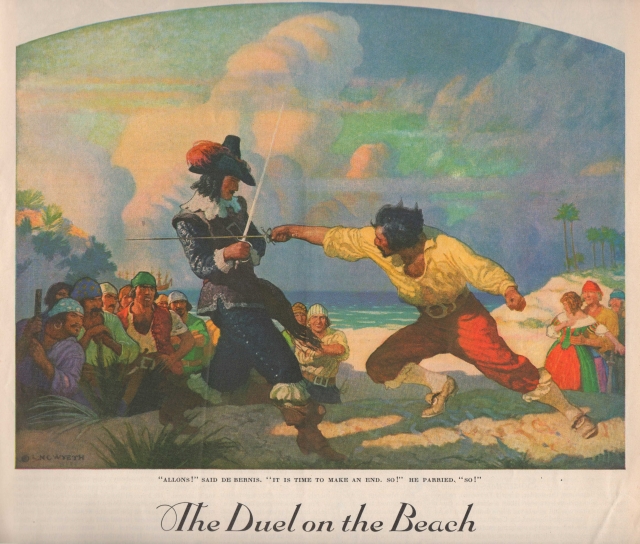
The Famous Wyeth Painting
The novel is often closely associated with N. C. Wyeth’s famous painting, shown above and below, used on its US dust jacket. Secondarily, and unfortunately, it is often also associated with the 1942 film of the same name, which takes such extraordinary liberties with the novel as to be the same story almost in name only. The film deserves little if any further discussion here.
Wyeth’s painting evokes the action of the climactic duel, if not entirely accurately. The close parrying of hero Charles de Bernis and the animal-like aggressiveness of villain Tom Leach are graphically represented, but the actual technique of both depicted fencers leaves something to be desired for expert swordsmen. It’s more representative or symbolic than accurate, although–as I will be the first to point out–one could argue that the swordsman on the left may have just made a close, shortened parry as he stepped forward into an attack. But no matter, at least not for now.
More importantly, a couple of principal characters, whom we would expect to be in the painting, Major Sands in particular, are missing. Further, it is difficult to tell the color of the clothing of de Bernis on the left–is it the “violet taffetas with its deep cuffs reversed in black and the buttonholes richly laced with silver” (and apparently with claret breeches) which Sabatini early on confuses with a suit of pale blue taffetas worn by this “tall, slim, vigorous figure of a man”? De Bernis, for what it’s worth, wore the violet at the duel.

Still, the woman in the painting might be Priscilla Harradine, the love interest, wearing “lettuce” green as she does at all times, duel included, in The Black Swan other than in the opening scene, although the bright orange doesn’t fit. Further, the woman in the painting has the correct “golden” hair, and pirate Tom Leach, on the right, wears the scarlet breeches of his faded scarlet suit, as in the novel, including at the time of the duel.
Still, it’s not as accurate a representation of the novel’s duel as we would expect from a commissioned painting, even though most dust jacket and frontispiece art is often inaccurate.
And there’s a reason for this: the painting was commissioned neither for the 1931 story nor the 1932 novel. Rather, it was commissioned in the mid-1920s by Carl Fisher, a wealthy American entrepreneur. N. C. Wyeth completed the painting in 1926. Two of Fisher’s friends are depicted as pirates watching the duel, one of whom is John Oliver La Gorce of The National Geographic Society (more details here) and into whose hands the painting passed, and from his eventually to the Society.
Some suggestions have been made that Sabatini may have written the duel scene to somewhat correspond to the painting. This is entirely possible, but I don’t think it is necessarily so except in broad strokes, as we’ll see momentarily, and also later in the discussion of the duel itself. The trope of pirate duels on the beach leads all of them to look much alike, in other words, thanks in large part to Howard Pyle. (See Part One for other examples.)

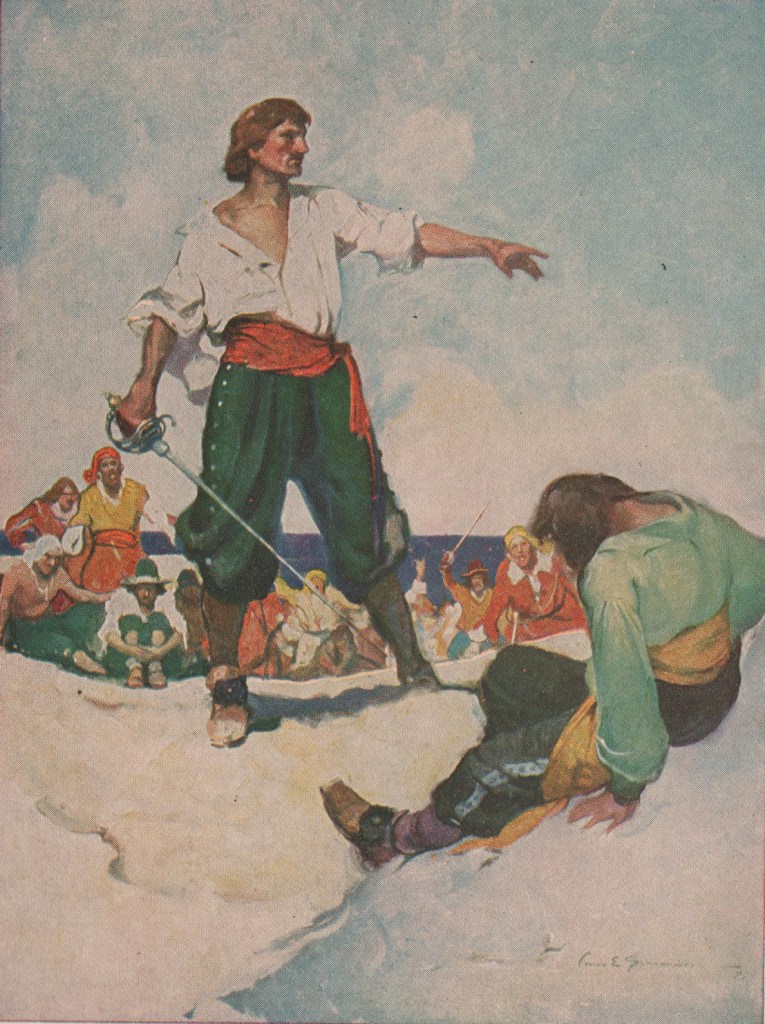
The positions of the swordsmen in the “Duel on the Beach” painting are almost identical to those in an earlier N. C. Wyeth work shown immediately above, also named, or at least captioned, “The Duel on the Beach.” Wyeth painted it for Westward Ho! by Charles Kingsley (New York: Charles Scribner’s Sons, 1924), a swashbuckling romance of Elizabethan privateering.

The parrying fencer in the 1924 Captain Blood poster above, artist unknown, is strikingly similar to that painted by N. C. Wyeth the same year for Westward Ho! and was probably influenced by Wyeth’s painting. Note the similarities to Wyeth’s 1931 painting used for the dust jacket and frontispiece of The Black Swan.
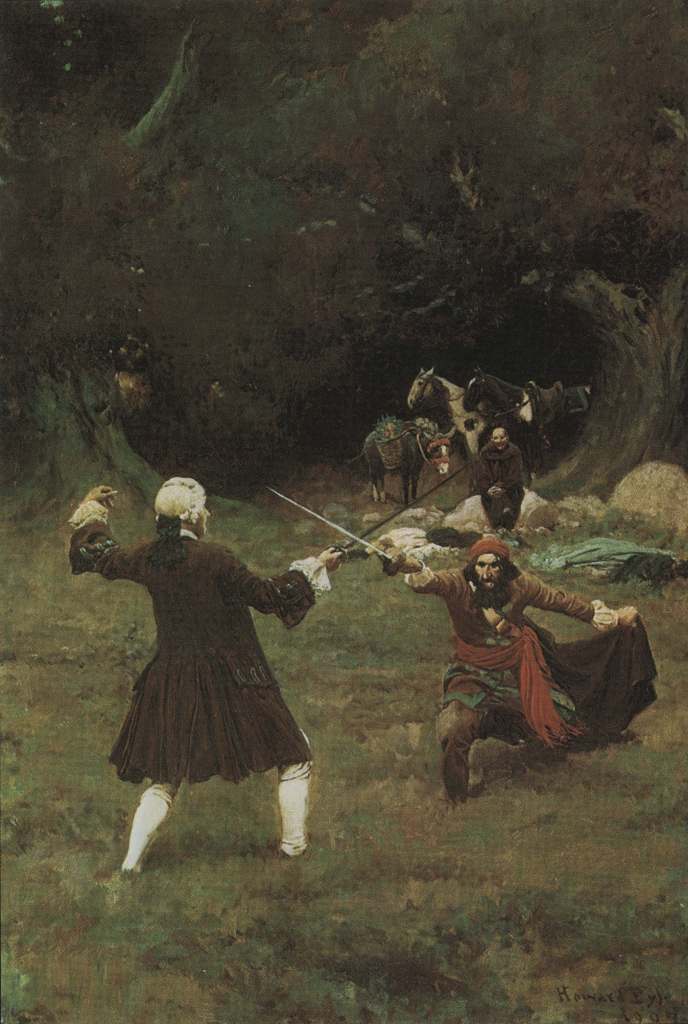
I strongly suspect Wyeth’s later “generic pirate sword-fight on the beach” painting that become the cover of The Black Swan was originally intended, at least in part, to suggest the duel in Captain Blood: His Odyssey. The clothing of the figure on the left might even be the “black with silver lace” of Captain Peter Blood.
Wyeth’s dust jacket and frontispiece for Captain Blood: His Odyssey, shown below, bolster my argument, as do the two single lines describing the duel in it [SPOILER ALERT]:
“It was soon over. The brute strength, upon which Levasseur so confidently counted, could avail nothing against the Irishman’s practised skill.”

Even so, again there are details lacking that we would expect: the buccaneers are not divided into two groups representing the two crews (Blood’s and Levasseur’s); Cahusac and the pearls-before-swine do not figure prominently among the spectators; Governor d’Ogeron’s son is missing; two ships rather than one show up in the background (the Arabella was anchored out of sight); and most importantly, Mademoiselle d’Ogeron and her lustrous black hair is missing–as already noted, the woman in the painting has blond hair.
Even more to the point (pun half-intended), perhaps Sabatini re-clothed his hero from sky blue to violet to match the painting–and then he and his editor forgot to correct all instances. It wouldn’t be the first time harried writers and editors have let errors go uncorrected.
Thus, at best, in spite of my best hopes and desires, the painting may have merely been inspired to suggest the duel in Captain Blood. The original “Duel on the Beach” painting, by the way, an oil on canvas 48 by 60 inches, was sold at auction by Christie’s in 2012 for $1,082,500.
The Duelists: Charles de Bernis & Tom Leach

The novel’s hero is Charles de Bernis, former buccaneer and close companion of Henry Morgan. Sabatini biographer Ruth Heredia, author of Romantic Prince: Seeking Sabatini and Romantic Prince: Reading Sabatini, considers the character to be ultimately an iteration of Captain Peter Blood, probably Sabatini’s favorite of all those he created.
De Bernis is more or less a French gentleman, if a bit of a fortune hunter or adventurer originally, which all flibustiers by definition were. And indeed a fair number of flibustier leaders were gentlemen, most notably Michel, sieur de Grammont, who played so commanding a role in many of the great French buccaneering actions of the 1680s. Others included Raveneau de Lussan who wrote a journal documenting one of the great South Seas buccaneering expeditions; the sieur d’Hulot, veteran of two campaigns against Algiers and the Algerine corsairs, who would later command the regular French forces on Saint-Domingue; the sieur de Chauvelin who died in battle during a failed reconnaissance of Matanzas prior to an ultimately aborted attempt on St. Augustine; and many more.
Barring the boots Sabatini and so many authors of his era dress buccaneers in–a trope or myth, there were no horses to ride aboard ship, thus no need for boots of “fine black Cordovan leather,” nor any evidence that seamen, including buccaneers, wore them–Charles de Bernis in real life would have otherwise dressed much as the author described him.

The image above is a near-perfect fit for Charles de Bernis. Please note that the cavalier is wearing “stirrup hose,” not boots. Stirrup hose was variously popular from the 1650s in the Netherlands to as late as the 1680s in parts of Spanish America. In France, it seemed largely, if not entirely, out-of-style circa 1680, and de Bernis likely no longer wore it.
Sword-belts were also common by this time, although many gentlemen did still wear baldrics as Sabatini’s hero does, of purple leather stiff with silver bullion. That said, eyewitness images of 1680s buccaneers (they do exist, I discuss them here) shows sword-belts, not baldrics. But this is a mere quibble.
So perfect is this illustration that I suggested it to Firelock Games (likely with the fictional Charles de Bernis in the back of my mind), and Miami artist Peter Diesen Hosfeld then used it as the basis for the French flibustier commander for its tabletop war game Blood & Plunder.

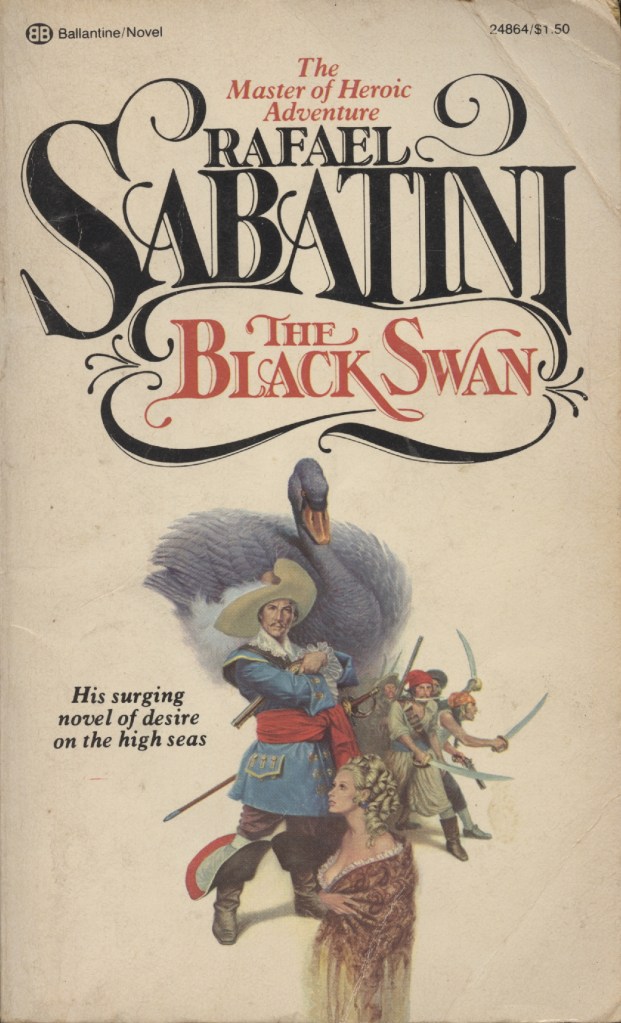
Popular illustrations and covers for the novel are rarely accurate, although this one for the 1976 Ballantine Books mass market paperback (the first I read, in fact), comes closer than most, and could have taken its inspiration from the author’s description along with images such as the one above:
As for red-suited Tom Leach, the villain, his name and something of his character may have been inspired by the fictional Captain Edward Leach of the East India Company, who out of greed betrayed his fellow passengers to pirates, and was, in poetic justice, murdered by the same pirates. Captain Leach, a fictional character, was invented by artist and author Howard Pyle in The Rose of Paradise (1887/1888), his first pirate novel.
However, there are two likely authentic 1680s candidates for his inspiration, both of whom Sabatini, an avid researcher, was probably aware of, given that their exploits are well-documented in the Calendar of State Papers Colonial, America and West Indies.
The first is Joseph Banister, an indebted English sea captain turned pirate who slipped away at night with his 36-gun Golden Fleece, a former merchantman, under the cannon of the forts at Port Royal, Jamaica, escaping with little damage due to his surprise flight. But his piratical adventure would be relatively short-lived.
In June 1686 while careening his ship at Samana Bay, Hispaniola he was discovered by the pirate hunters HMS Falcon and HMS Drake. The men-of-war expended nearly all of their powder pounding the pirate ship to pieces. Banister’s temporary shore batteries (which [SPOILER ALERT] Tom Leach should have erected at the Albuquerque Keys) returned fire but failed to stop the men-of-war.

His ship lost, Banister and a few of his crew set sail with the French flibustier crew of a nearby flibot (the French term for a small flute) of one hundred tons and six guns. Parting soon afterward aboard a captured sloop, Banister was soon run to ground by the Royal Navy and hanged from the yardarm of the HMS Drake in sight of Port Royal, Jamaica in 1687.
As a noteworthy aside, the flibustiers Banister briefly consorted with soon set sail for the South Sea (the Pacific coast of South America), plundering until 1693 and leaving behind a journal of their escapades. In 1688, while attacking Acaponeta, Mexico, these French pirates unfurled a red flag of no quarter–the pavillon rouge, the pavillon sans quartier–of special interest: the red flag bore a white skill with crossbones beneath, the only instance of the skull and bones being flown by late seventeenth century buccaneers or flibustiers. It is possible, even likely, though, that it was flown at other times as well.

However, no matter his piracies, Banister was nowhere near the villain that Tom Leach is. Leach murdered captured crews, but not so Banister. But there was a 1680s pirate villain who was a closer match to Leach in villainy: Jean Hamlin, or more correctly Jean Amelin whose real name was Pierre Egron.
In desperate need of extra time for numerous projects, I’ll cheat and quote, with some paraphrase and revision, from the original draft of The Buccaneer’s Realm (Potomac Books, 2009), along with some added details from the Dictionnaire de Flibustiers Caraïbes by Jacques Gasser:
In 1683 Hamlin, a Frenchman commanding two sloops, captured the merchantman La Trompeuse (The Deceiver) from a French Huguenot, conman, and thief named Paine, and embarked on a piratical rampage. Or so goes the version of the story in English records. In French records, Hamlin inherited the ship from French buccaneer Nicolas Amon, known as Grénéze, when he gave up command in order to command another vessel on a voyage to the South Sea.
Amon had captured La Trompeuse, 200 tons and 16 guns, at the Isle of Roatan. Originally a French merchantman contracted to ferry soldiers, poor young women destined to become wives, and sundry goods and supplies to Cayenne, it was commanded by a Pierre Pan, a French Huguenot (Protestant). Learning of the first dragonnades in France — Louis XIV ordered dragoons quartered on French Huguenots in order to harass them into turning Catholic — Pain took the ship from Cayenne to Barbados, then to Jamaica where he contracted it to English merchant traders.
Hamlin set sail on a brutal voyage or outright piracy. He soon captured an English ship, informed the crew he was a pirate–not, mind you, a buccaneer or flibustier–, tortured some of the crew, impressed some, plundered the ship, and let her go. He soon captured several other English vessels, then sailed to the Guinea Coast and captured eleven slavers and three boats, plundering them all.
At Cape St. John the pirates divided the spoil, and, quarreling, separated into two companies, part remaining with Hamlin, part choosing to serve under an Englishman named Thomas Morgan (no relation to Sir Henry and probably a false name). Hamlin’s usual tactic was to fly an English Jack and commission pendant as if he were an English man-of-war, come alongside as if seeking a salute, and fire a broadside. Indeed, Hamlin’s strategy and tactics were identical to those of the early eighteenth century Anglo-American pirates who flew the black flag: attack weaker merchantmen, preferably by ruse. Most significantly, Hamlin and his crew referred to themselves openly as pirates, not buccaneers, filibusters, or “privateers.”

Hamlin was noted for torturing prisoners and otherwise brutalizing them, and for cutting men down “left and right” when he boarded ships. The violence often seemed in retaliation for any resistance.
Throughout his piracies he was protected by the corrupt Danish governor of St. Thomas, although after one return to St. Thomas, the HMS Francis entered the harbor and burned his ship in spite of being fired upon by the Danish fort. Some of Hamlin’s ship-less crew volunteered to serve Captain Le Sage, others Captain Yanky (Jan Willems). Soon enough, the governor of St. Thomas sold Hamlin a sloop with which he reportedly captured a Dutch frigate of thirty-six guns, renamed her La Nouvelle Trompeuse (the New Deceiver), manned it with sixty of his old crew and sixty new men, and continued his depredations. Some claimed that the ship was outfitted in New England, a colony well-noted for its Protestant piety and hypocritical support of piracy.
Other sources indicate that the ship was instead Hamlin’s consort, the Resolution commanded by Thomas Morgan. The ship had been chased aground at St. Thomas by the HMS Francis, whose crew cut its masts down and abandoned it. Hamlin soon refitted the frigate and sailed south, plundering mostly small prizes along the coast of Brazil. At one point, in a fit of rage and revenge, he cut the nose and ears from a captured priest, forced him to eat them, then murdered him. Or more likely, a sadistic crewman who acted as chief torturer — René Marcart, known as Vaujour, along with his assistants “La Fontaine” and Guillaume Belhumeur — did the deed while Hamlin supervised.
Some of his crew were so appalled at this abuse of a priest that they quit the ship in Cayenne. One of them, Jean le Mont, slipped away from Cayenne to Dutch Suriname — and was hanged for piracy. Four others who made it back to St. Thomas, including forced surgeon Samuel Beloth, made a similar mistake of sailing to Dutch Suriname where they thought they might lead a better life than at St. Thomas, and escape charges of piracy as well. The three pirate seamen were hanged for piracy and Beloth was forced to serve as a surgeon without pay indefinitely.
In his final act of piracy Hamlin had captured a small Portuguese ship and carried her into St. Thomas where he forced some of her Dutch crew to serve with him, even as the governor of St. Thomas forced some of the captured crew to draw lots and hanged the losers. Hamlin, who can rightly be called the first of the true pirates of the Golden Age — only the black flag was missing — was never captured.
In fact, he settled at St. Thomas, that Danish slave colony (they were all slave colonies, but St. Thomas was settled by Denmark specifically to profit from the slave trade) and occasional pirate haven, under his real name, and until his death owned a cacao (chocolate) plantation and raised a family with his wife, Barbara Rambert, who bore him three children.
Make Hamlin an Englishman, and not quite as lucky, and we almost have Tom Leach.
The Swords: The “Rapier” aka The Smallsword

In the novel, the duel is fought with rapiers. This is mildly problematic, as by this time the true rapier was still carried only Iberians–Spaniards and Portuguese–and by some Italians in areas under Spanish rule. The smallsword, with its shorter, lighter blade and smaller hilt, was the common dueling sword among gentlemen and those so pretending.


However, word usage comes to our rescue: Sabatini’s “rapier” remained in use in the British Isles as a word for smallsword. In fact, the English tended to refer to the Spanish rapier as a “spado,” from espada.
Although the cutlass was the common sword of late 17th century mariners, there are a few accounts of those who carried smallswords. Given that Charles de Bernis is something of a gentleman, and Tom Leach prides himself on his swordplay, we can imagine the duel, historically and realistically, as Sabatini described it.

[BRIEF SPOILER ALERT!] Charles de Bernis prepares for the duel by secretly practicing with the pompous Major Sands. In the book, the men use their real swords for practice, each with a pear-shaped wooden tip added to blunt the weapons. This is historically inaccurate, and almost certainly Sabatini, with his experience of fencing, knew this, but went with a simple plot device instead to keep the narrative clean and simple.


Read sword blades were never intended for practice with blade or target contact. They are tempered differently than practice blades, the latter of which are designed to flex many times before breaking, as well as to flex in order to take up some of the energy when hitting.
Real blades were and are usually much stiffer in order to maximize penetration–a too flexible blade might not penetrate thick clothing, cartilage, or otherwise deeply enough to cause a serious wound. Further, the use of real sword blades for practice will severely nick the sharp edges (if sharpened–not all smallsword blades were, but the nicks will still eventually damage the integrity of the blade) and significantly increase the risk of breaking a blade. In other words, such practice will ruin a fighting sword blade.

Practice swords called foils were used instead of real thrusting swords, and there were several styles in use at the time. The French “crowned” style was prominent in many schools. Pierre, the servant of Charles de Bernis, could easily have hidden the foils beforehand, making the scene more historically accurate. Hopefully the island was large enough, or the pirates busy enough, not to hear the clash of steel on steel–it travels far and there is no other sound quite like it.

The Dueling Ground: Maldita Key
The duel and much of the rising conflict leading to it takes place on the northernmost of the two Cayos de Albuquerque while Tom Leach’s pirate ship the Black Swan* is being careened there. The islands do exist, although their geography doesn’t entirely match that described in the novel, which for reasons of plot must take certain liberties. It might also have been quite difficult for the author to get accurate details of these small out-of-the-way keys.
There is, however, plenty of beach for dueling on the real island.
Located off the Mosquito Coast of Nicaragua and Belize south of Santa Catalina (Providencia, Old Providence) and San Andres Islands (roughly twenty-five miles SSW of the latter), the two small principal Albuquerque keys are actually part of Colombia (with a small military presence on the north key). The keys are ringed with reefs: technically, the islands are part of an atoll with a large lagoon at its center. Some old English charts list them as the S.S.W. Keys. The keys are roughly 250 to 300 yards apart, and Cayo de Norte is perhaps 200 yards across. Passage to its anchorages is difficult. Both keys are covered in coconut palms.


Cayo del Norte, where the action takes place, is named Maldita Key in the novel, meaning cursed or damned, probably a name of Sabatini’s creation given that I’ve not found the name referenced anywhere else. This isn’t the only time he invents or changes a place name. Similarly, Sabatini has imagined the island as larger, with higher elevations in places than the roughly 7 feet maximum elevation of the real island, and with a hidden pool of fresh water large enough to swim in.
Having once lived on Old Providence Island until the Spanish sacked it and forced the interloping settlers from it, buccaneer Charles de Bernis would have been familiar with the keys to the south.

The Duel Itself
LAST WARNING! SPOILER ALERTS! If you haven’t yet read the novel, you should stop, read The Black Swan, and then return.
The duel as described by Sabatini is about as well-written as a sword duel can be: exciting, well-paced, and largely rooted in reality. As such, I’m not going to comment further except to discuss and dissect the singular unconventional technique used by Charles de Bernis to kill his adversary.
Several years ago in a long-running conversation with Sabatini biographer Ruth Heredia as she prepared her second volume, Romantic Prince: Reading Sabatini, we had numerous discussions about swordplay in his novels. One point of discussion was what the de Bernis technique might actually have been.

I was never satisfied with the answer, discussed below, I gave her. Then one recent evening, while rereading the duel as part of some research into my annotations for Captain Blood, the answer struck me. I realized I had been mistaken in every analysis I’ve done on the duel, and knew immediately what de Bernis had done—and where Sabatini almost certainly found his inspiration. It was right under my nose all along, a purloined technique lying literally in plain sight for two decades or more, but my mind had categorized it such that I had not yet made the connection. Please excuse my excitement and fencing vanity as I make my argument.
For what it’s worth, this separate blog on The Black Swan was inspired by a recent long e-letter to Ruth Heredia on the subject.

The pertinent details: at the end of the duel, Leach makes a sudden and sneaky (sudden and sneaky are expected in swordplay) long low lunge in the “Italian” style, snake-like, with one hand supporting him, to slip under the guard of de Bernis. This was in fact both a French and Italian technique in the late 17th century, although by Rafael Sabatini’s era it was largely confined to the Italian and was generally considered as such. Sabatini notes in the novel that no “direct” parry could deflect this attack once fully launched. (Strictly speaking, a direct or simple parry is one made by moving the point and hand more or less in a direct line horizontally, as opposed to a diagonal, half circle, or circle.) While this may not be entirely true (see below and also the note at the end of this blog), a very low attack like this is quite difficult to parry, making an esquive (see also the discussion below) of some sort highly useful in defending against it.
Further, an attack made with the body and hand so low can only have as its torso target the lower abdomen or the groin, making it a ruthless, dishonorable attack when this is the intended, as opposed to accidental target — an attack suitable to Tom Leach’s venomous character.
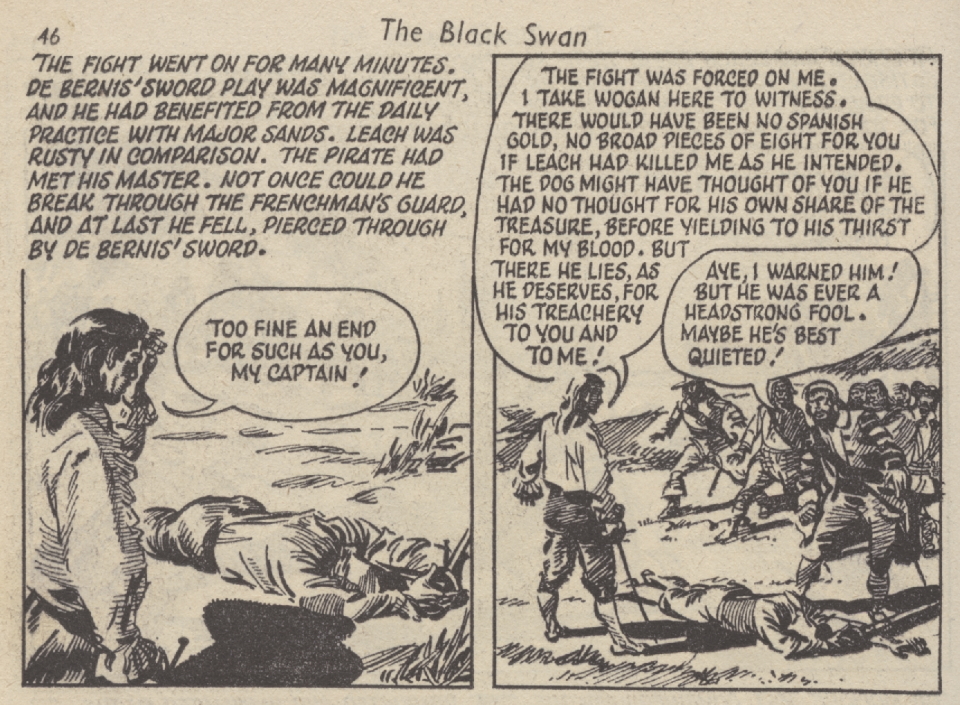
As Leach lunges, de Bernis disappears from the line of attack. “Pivoting slightly to the left, he averted his body by making in his turn a lunging movement outward upon the left knee.” It was a “queer, unacademic movement” that “had placed him low upon his opponent’s flank.” De Bernis then passed his sword through Leach.
We require six conditions for the answer:
- A pivoting movement that averts the body.
- It must outward upon the LEFT knee (we assume almost assuredly that de Bernis is a right-hander).
- It must be a “queer, unacademic movment.”
- It must place him low upon his opponent’s flank.
- It must put de Bernis in position to pass his blade “side to side” through Leach.
- It must require TWO tempos, one for the pivoting movement, and one for the thrust into Leach’s flank.
As already noted, I was never satisfied with any conclusion I’ve come to. Of course, it could be that Sabatini left his description somewhat vague on purpose, and I’ve considered this as a possibility. However, my best guess was some form of intagliata, a term used by some nineteenth century Italian masters for an “inside” lunge off the line. In other words, if you’re a right-hander, you lunge toward the left, or inside, removing your body from the direct line of attack or riposte and placing yourself upon your adversary’s flank.

by Cesare Enrichetti, 1871. the fencer on the right has lunged off the line to the left in order to avoid his adversary’s blade.

The intagliata is a member of a group of techniques known in French as esquives, or in English, dodgings or body displacements for lack of more elegant expressions. The two principal esquives are the inquartata and the passata soto, both of which are primarily used as counter-attacks in a single tempo, designed to avoid the adversary’s attack while simultaneously thrusting, preferably in opposition (closing the line to prevent the adversary from hitting) or with bind (pressure on the adversary’s blade to prevent it from hitting) and removing the body from the line of attack.
They may also be used in two tempos, parrying and displacing in the first tempo, and riposting in the second. Single tempo counter-attacks without esquive often result in double hits, even when opposition is attempted, for the fencer often fails to predict the correct line or uses inadequate opposition. Body displacement increases the protection. It’s a backup, in other words.
Other esquives include the cartoccio or forward lunge while lowering the upper body; the rassemblement or very old school “slipping” as it was called; the “pass” or crossover forward bringing the rear foot forward in front of the lead foot; the simple backward lean; a lunge forward to the inside with rear foot (arguably a form of the pass); the various leaps or voltes to the side noted by some late 17th and early 18th century masters (seldom used now due to the narrowness of the fencing strip); and the lunge to the outside (to the right for a right-hander) off the line. My personal preference for dealing with Leach’s style attack is to retreat with a crossover (lead leg passing behind read leg) — if possible — while counter-attacking to the head (and, in historical weapons, using the offhand to attempt a parry), or making a hard low-line parry (see the technical note at the end). Note that if attacked in tempo as one advances, this is a difficult attack to counter without also getting hit.

I considered and even tested all of these. None entirely met the conditions. In particular, none were considered then as un-academic, although it could be argued that the leaps to the side are considered so today and likewise in Sabatini’s era. But the leaps met few of the other conditions. Compounding the problem was Sabatini’s use of the word “outward” which I, with 46 years fencing and studying swordplay of the past and present, and 26 teaching both, took at first to mean “outside,” which in fencing terms means, for a right-hander, to the right. In fact, Sabatini appears to have meant the word conventionally–outward rather than inward. One problem solved!
Yet the major problem still remained. In the 1935 film version of Captain Blood there is one option depicted, probably drawn by famous fencing choreographer Ralph Cavens (take note!) from an interpretation of The Black Swan is my guess — a volt to the left with the leading right foot, followed by the rear — but this too is actually an academic movement, a form of intagliata, again really nothing more than “lunging off the line.”
I remained distracted by the question: what other possible, conceivable two tempo movement — a pivot and lunging movement outward upon the left knee, followed by a thrust, probably via a lunge — would fit? What esquive could it be if not an intagliata? What might work yet be unorthodox? Importantly, what might be documented — not imaginary — in this category? In other words, how did Sabatini develop this scene, what was his inspiration?
I think almost certainly right here:

On the right a swordsman has made a very long low lunge. His hand is not on the ground as it commonly was, but this is immaterial. On the left is a swordsman slightly off the line, bending inward slightly, WITH HIS LEFT (REAR) LEG BENT IN A SOMEWHAT LUNGING MANNER.
This left fencer’s position appears bothersome to fencers not well-versed in fencing history (most aren’t, in fact). What does it depict? It might well be just a lean backward onto the rear leg to avoid a sudden low attack, or a failed retreat — the 17th century French school advocated keeping most weight on the rear foot, forcing most retreats to be made by crossing over, front foot moving first to the rear, passing the rear foot en route. (In fact, a parry combined with a crossover retreat is perhaps the safest counter to a long low lunge.) Or, it might be something more conventional, which we’ll discuss in a moment.
What’s important is what Rafael Sabatini might have thought it was!
Let’s assume, for the sake of argument, that it depicts a fencer who has just pivoted off the line slightly in a lunging fashion in order to avoid a long low attack, as described by Sabatini. If so, to execute this, de Bernis need, as described, only pivot slightly to the left on the right or lead foot as he simultaneously leans back into a lunge on the left leg. This places him out of the direct line of attack and also out of range — and he has a tempo to do this as the low attack is made.

In fact, the parry shown in the detail above is a natural one against a long low attack, and would help protect de Bernis as he made his next movement, by providing some opposition — but it would almost certainly not have stopped the attack, or at least such conclusion might be drawn from the image. The exceptionally low attack might easily “force” most parries, as it has here.
In other words, parrying with the hand held at the usual height of the en garde position makes it difficult to apply forte (the strong third of the blade nearest the hilt) against the middle or, preferably, foible (weak third of the blade at the tip end), so necessary for an effective parry. In the detail above, the foible or middle of the parrying blade has been applied against the forte of the attacking blade, rendering the parry largely useless. It is likely that Sabatini’s statement to the effect that there is no direct parry that can stop such an attack once fully launched was inspired in part by this image. (See the technical note at the end of this blog for more detail, including on at least one unconventional parry that can deflect such an attack.)
But let us return to the unusual esquive. Because Leach is now subsequently off-balance — for a full second, fortunately — de Bernis has a second tempo in which to run him through, almost certainly with a conventional lunge. In fact, such long low lunges have a distinct disadvantage: they’re slow to recover from conventionally, that is, to the rear, leaving the fencer in danger. Likewise, if the fencer recovers forward, he (or she) may be at dangerously close distance. As well, poor balance is typical of this long lunge although there are some rare fencers who can manage it well, at least on hard floors.

Importantly, does the technique of Charles de Bernis work?
I’ve tested it — and it does! It is also historical, it is also unorthodox — and its imagination by Sabatini from the drawing, brilliant. It would only require that the fencer using be familiar with lunging with his left leg — having experience fencing left-handed, in other words, would help. And a fair number of fencers, although probably not a majority, did practice at times with the off-hand.
In fact, if the technique were deliberate, it would fall into the category of “secret thrusts,” which were nothing more than legitimate, if unorthodox, technique that was known to a minority of fencers and masters and was useful only in rare circumstances. And once it’s found useful, the unorthodox becomes the orthodox, in everything, not only in fencing.
The inspiring drawing is by Louis François du Bouchet, marquis de Sourches (1645 – 1716), circa 1670. The small collection of his drawings is well-known to historians of seventeenth century France. More importantly, there are some thirteen volumes of his memoirs, dating from 1681 to 1712, first published in the late 19th century: Mémoires du marquis de Sourches sur le règne de Louis XIV, publiés par le comte de Cosnac et Arthur Bertrand (Paris: Hachette, 1882-1893). Sabatini would doubtless have run across these volumes of memoirs of the French court in his researches, and from them his drawings, if not otherwise. I’ve found copies of the swordplay image in both the British Museum and Rijksmusem.
So, there we have it! Or do we? I think almost certainly this is Sabatini’s inspiration. But does the drawing actually represent what the author described?

Almost certainly not.
The two images below are from Les Vrays Principes de l’Espée Seule by the sieur de la Touche, 1670. The first shows the long lunge in use, or at least promoted (it requires great flexibility), at the time, although not as long as the extreme lunges above, along with the en garde. The second also shows the common French en garde of the 1660s and 1670s, with most of the weight on the rear leg and the lead leg almost straight.
Vestiges of this en garde remain in some of the French schools today. A few years ago, although Olympic gold medalist Dr. Eugene Hamori had been mentoring me as a fencing teacher for two decades, he had not given me a fencing lesson since 1981. As I came en garde very upright, almost leaning back, a position I’d picked up from years of giving fencing lessons, he immediately said, “That’s a beautiful French guard, Ben. Now lean forward a little bit, like a Hungarian.”
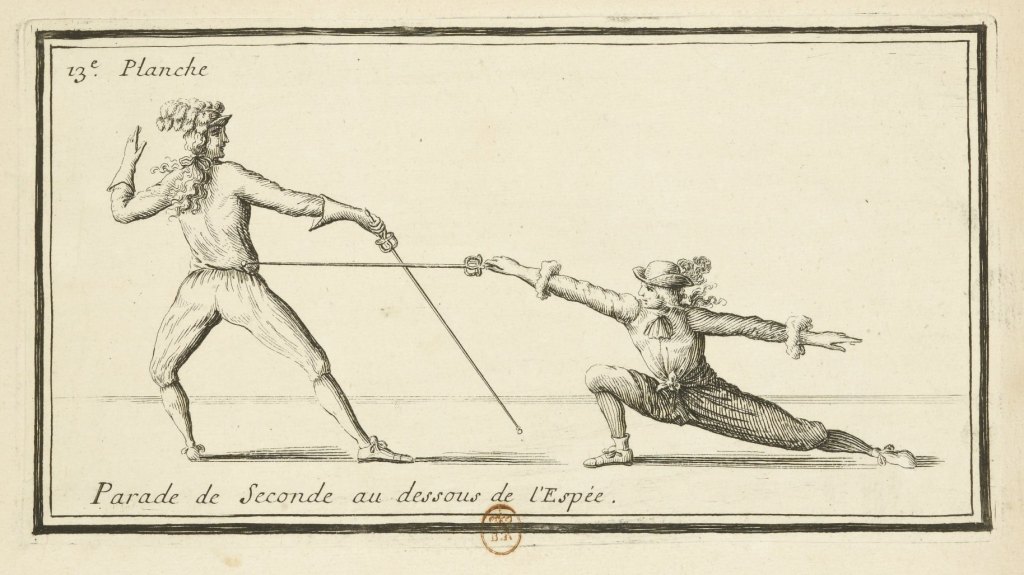
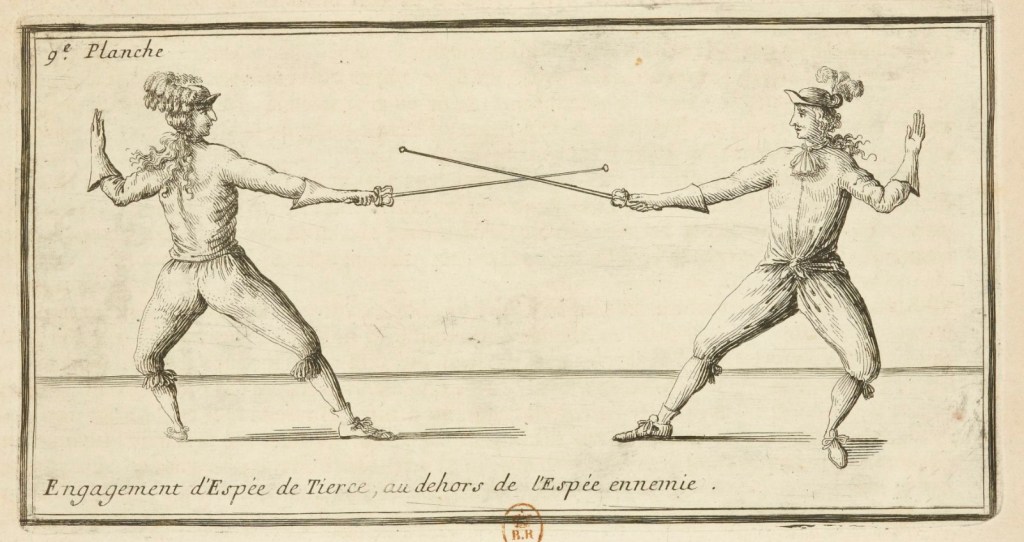
We find this unbalanced French en garde not only in de la Touche’s work, but in other images as well, as shown below. The guard does have the advantage of keeping the body well back and even permitting one to lean back even farther — the first commandment of swordplay is (or should be) to hit and, especially, to not get hit. But the guard has the disadvantage of limiting mobility, including a slower attack (but then, that’s not what the French school was most noted for anyway at the time).
Most French schools would soon place less extreme emphasis on this heavy rear foot position, although it would remain in use to a lesser degree for another century.

So there’s an end on it, yes? Sabatini’s inspiration and its reality?
Or is there more?
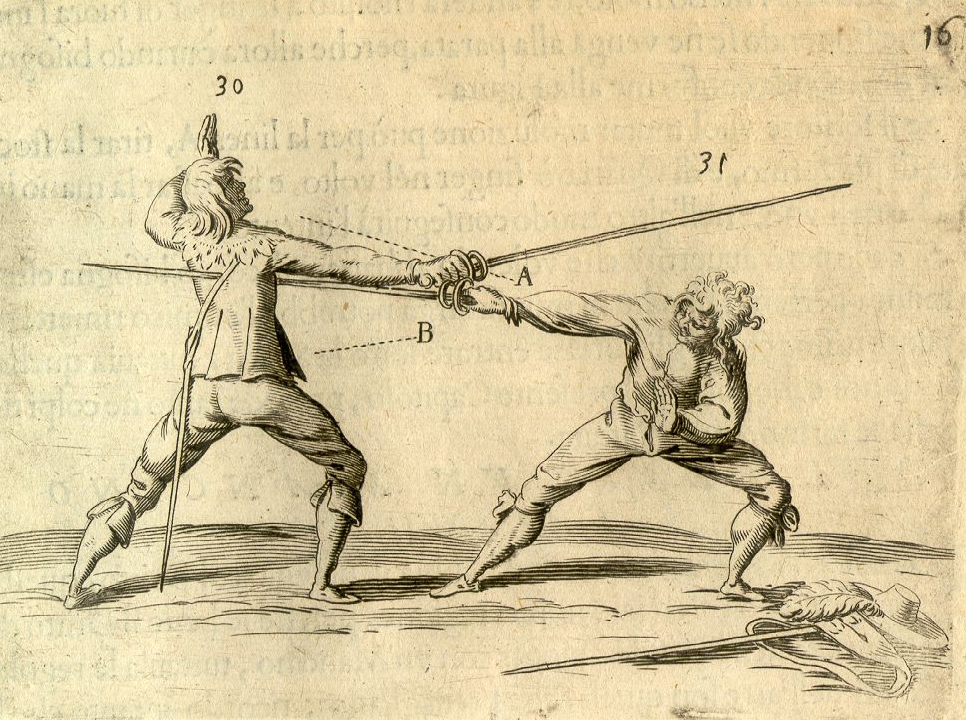
In my experience there always is. Below, from Alfieri, here’s a swordsman leaning backward, weight on his rear leg, to avoid a thrust while thrusting in turn. It doesn’t take much to imagine the addition of a small lunging movement off the line with the rear leg. In this case, though, the fencer on the right has made a single tempo movement, thrusting as he simultaneously evades an adversary who has rashly ventured too close, or has been tricked into doing so. Tom Leach provides no such opportunity. 🙂
Still, I think we have Sabatini’s original source above in the du Bouchet drawing, and therefore the “queer, un-academic” technique of Charles de Bernis as well.
However, the most useful lesson, at least fencing-wise, from the novel may be the admonition derived from the following lines:
“…and that, too confident of himself, he had neglected to preserve his speed in the only way in which a swordsman may preserve it.”
In this time of pandemic, fencers may improve their footwork, increase their flexibility and strength, study strategy and tactics, and so forth. But it takes free fencing — practice with an adversary — to maintain the most important components of fencing speed: the sense of tempo and the ability to react without hesitation. Without these, raw speed is worth next to nothing sword-in-hand.
Next up in the series: the duel on the beach in film!
Update!
I have often thought that the final technique in the duel choreographed by Fred Cavens for the Flynn-Rathbone duel in Captain Blood (1935) was his take on Sabatini’s technique as described in The Black Swan. It is mindful to remind ourselves that almost none of our ideas and inspirations, particularly in swordplay, are original, and so it is here. The 1952 photograph below, which I ran across quite by accident recently (September 2023), shows Fred Cavens lunging at actor-swordsman Cornel Wilde — who is making a lunge with the left foot exactly as described by Sabatini in The Black Swan! I would not be surprised if Cavens, as I was, was unsatisfied with his first answer. Clearly he found it — at least seven years before I was born — and as noted above, the technique does work! Below is a beautiful representation.

Technical End Note on Parrying Leach’s Low Attack: Arguably there are five parries that might possibly deflect Leach’s blade: septime, octave, seconde, quinte (low quarte), all by different names in the 1680s and some not really even in much use at all; and a largely unfamiliar vertical parry made straight down, noted by Augustin Grisier in 1847 (he names it cinquième or quarte-croisée), described in some of the old Italian schools, and also described by Alfred Hutton in his famous fencing text, Cold Steel. He describes the parry as being effective against an upward vertical cut toward the “fork” aka the groin.
Such vertical and other below the waist cuts are the reason, by the way, that the modern saber target is limited to the body from the waist up. This is due to the Italians who made the rules more than a century ago, intending by them to protect their manhood. Yet the myth of the saber target “being limited to above the waist due to the saber being a cavalry weapon, and you wouldn’t want to hurt the horse,” persists in spite of being arrant nonsense. In fact, the modern “Olympic” saber derives from the light dueling saber of the nineteenth century, and it was used in duels afoot. As for not hitting the horse or below the waist? Such blows were commonly permitted in duels among many various schools and peoples, and always in warfare.
Below the waist attacks, especially to the knee, have long been common with cutting weapons, but somewhat less so with thrusting weapons, at least when the legs are target (the area below the ribs is in fact an excellent target with real thrusting weapons), due to the fact that a thrust to the legs is rarely incapacitating, unlike a cut, and leaves the attacker’s head and torso wide open for a possibly fatal counter thrust. Thrusts to the groin, besides generally being considered dishonorable when intentional, may easily miss and slip between the legs, leaving the attacker open as just noted. In my experience, fencers hit in the groin by thrusting weapons are usually themselves at fault, having parried late or insufficiently, or used a filo/grazing or yielding parry incorrectly and thereby carrying the attacking blade to the groin.
The vertical downward hard parry of Grisier et al is used unknowingly by some epee fencers today, and if asked would probably define it as an incomplete seconde. I use it and find it highly effective against hard-driven low attacks, particularly when made Hungarian style with beat as the opposition parry is made (Sir Wm. Hope also recommended that parries be made in this manner). Grisier recommends riposting in opposition. The parry is made by lowering the hand while simultaneously bringing the point perpendicular to the fencing line — pointing inside, that is, 90 degrees away from the fencing line and definitely not in line with the adversary, contrary to most advice of keeping the point in line with the target. It is in spite of this a highly effective parry and riposte. One imagines de Bernis using it successfully and riposting with an opposition thrust to the eye, given that much of the target would be protected by Leach’s long lunge and extended arm.

In order for any of the first four of these parries to be effective against a low thrust, the parrying hand must be lowered significantly in order to bring forte to foible, making for a slow parry. If the parry is begun after the attack has developed, instead of at its initiation, often by anticipating it, it will likely prove ineffective.
Note again that Sabatini writes that no direct parry — one made in a more or less straight horizonal line — can stop the attack. Sabatini probably intends to mean that no simple parry (direct, diagonal, half-circle), rather than a circular parry would stop the attack, for a circular parry would likely be too slow and would be forced by the attack. A true direct parry against the attack would have to be made from an en garde held in a very low line, McBane’s “Portuguese guard” for example. But if de Bernis had been in this guard, Leach would not have made his low attack.
However the direct vertical parry just described, if correctly timed and made with a powerful beat with the middle of the blade on the attacker’s foible or middle, can be highly effective against such attacks, capable of being forced only with great difficulty. Even so, Sabatini is largely correct when he writes that such a low powerful attack is not easily parried, at least not conventionally.
Hutton notes that septime is also effective against low vertical upward cuts. In my experience it has some utility against low thrusts, particularly if the parry is made with a combined beat/opposition and the hand is dropped to bring forte against foible. However, it is often easily forced.
* The pirate ship Black Swan may be the ultimate inspiration for the concept of Disney’s Black Pearl (rather than the Wicked Wench). Details here…
Copyright Benerson Little, 2020 – 2026. First published 10 September 2020. Last updated 10 February 2026.

The Duel on the Beach, Part I: In Fiction & Illustration
It’s all too easy to imagine a duel on the beach between pirates or, as fiction and film often have it, between pirate captains. A sandy beach, palm trees, spectators often including both pirates and a woman in distress, a tropical sea and sky–a duel is mandatory in the genre if only because the setting demands one.
This blog post is part one of a likely five part series on the classical piratical duel on the beach, a pirate trope too evocative to pass up and one based to some degree in reality too. Only the trope of the tavern sword brawl is as prevalent, but not as romantic.
Up first is a look at the sandy duel in fiction. Part two examines the duel described by Rafael Sabatini in The Black Swan, in particular the origin of the hero’s singular technique. Part three reviews the duel on the beach in film, part four takes a close look at the most famous fictional duel on the beach, that depicted in Captain Blood (1935) starring Errol Flynn and Basil Rathbone, and part five discusses the historical reality of the duel on the beach.
In particular, we’ll look not just at some classic swashbuckling episodes, but also consider how genres and tropes are created, and how misinterpretation often not only leads us astray, but also, at times, to authentic historical discoveries.

It’s entirely likely that I’ll also throw in a blog post each on the inquartata, the flanconnade, and also the intagliata and similar techniques of “lunging off the line,” given their prevalence in swashbuckling fiction and film (not to mention their utility in historical and modern fencing). I’ve already written one for the same reason on The Night Thrust; or, More Politely, the Passata Soto, and I’ve discussed Sabatini’s hero’s off the line technique in The Black Swan, linked above. I’ll likely also write a brief post on Dutch knife fighting for reasons noted just below.
The series is also part of an effort to encourage outdoor fencing, especially at the beach or seaside. (Don’t worry, any light rust is easily removed from blades! In fact, two or three hours in a sea breeze will start to rust carbon steel.) Not too long ago the FIE (the international fencing body) in its infinite [lack of] wisdom did away with outdoor tournaments in epee, at least as sanctioned events, and national bodies followed suit. Not even the Covid-19 pandemic inspired the dour, sports-rabid international and national bodies to reconsider outdoor fencing. Tournaments held outdoors — at the beach, at historical sites, in parks — are a lot of fun for their own sake, although arguably fencing these days seems more focused on its falsely purported utility as an add-on to college applications than on fun. Some of my fondest fencing memories are of outdoor swordplay, both competitive and recreational, and their associated celebrations.

So where to begin? It seems almost too easy. At least half the blame lays with the highly enjoyable illustrator and writer of out-sized piratical myth, misconception, and trope (and even some fact!), Howard Pyle, several of whose students–N. C. Wyeth and Frank E. Schoonover in particular–followed closely in his swashbuckling-illustrator footsteps.
However, before we get to Pyle in detail, we need to note the existence of an old ballad called “Dixey Bull” or “The Slaying of Dixey Bull” which describes a duel on tiny Beaver Island (near modern Pemaquid Beach, Maine) between a pirate captain and a local fisherman. The ballad was first published in 1907 from oral tradition dating possibly as early as circa 1725 based on its mention of the “skull and cross bones,” language used, and its description of swordplay consistent with early to mid-18th century prizefighting and broadsword technique. The song was sung in Maine and environs, was apparently well-known by seamen and fishermen, and their wives and daughters, and it’s entirely possible that Howard Pyle was aware of its existence.

Dixie Bull was the first-noted pirate of New England and the northeast coast of North America. In 1632 some Frenchmen in a pinnace robbed him of his trading stock of blankets, “ruggs,” coats, &c, for which he sought reprisal at sea in his own small craft. Failing to make good against the French he plundered some local Englishmen, thereby turning pirate. In 1633 three deserters from his crew said he’d gone over to the French, although he is believed to have eventually returned to England.
In the ballad, which has no known basis in reality, as is the case with many ballads of the era, Dixey Bull is challenged by local fisherman Daniel Curtis to a duel with broadswords. If Bull wins, he and his crew keep their stolen treasure. If he loses, the pirate crew returns the plunder and sails away. Wounded, but with a trick worthy of one of Rafael Sabatini’s heroes or the best of those of swashbuckling Hollywood, Curtis kills Bull. Of course, no such duel ever took place: pirates would never offer up their plunder on a point of honor. Whether or not the ballad influenced Howard Pyle is unknown but certainly possible.


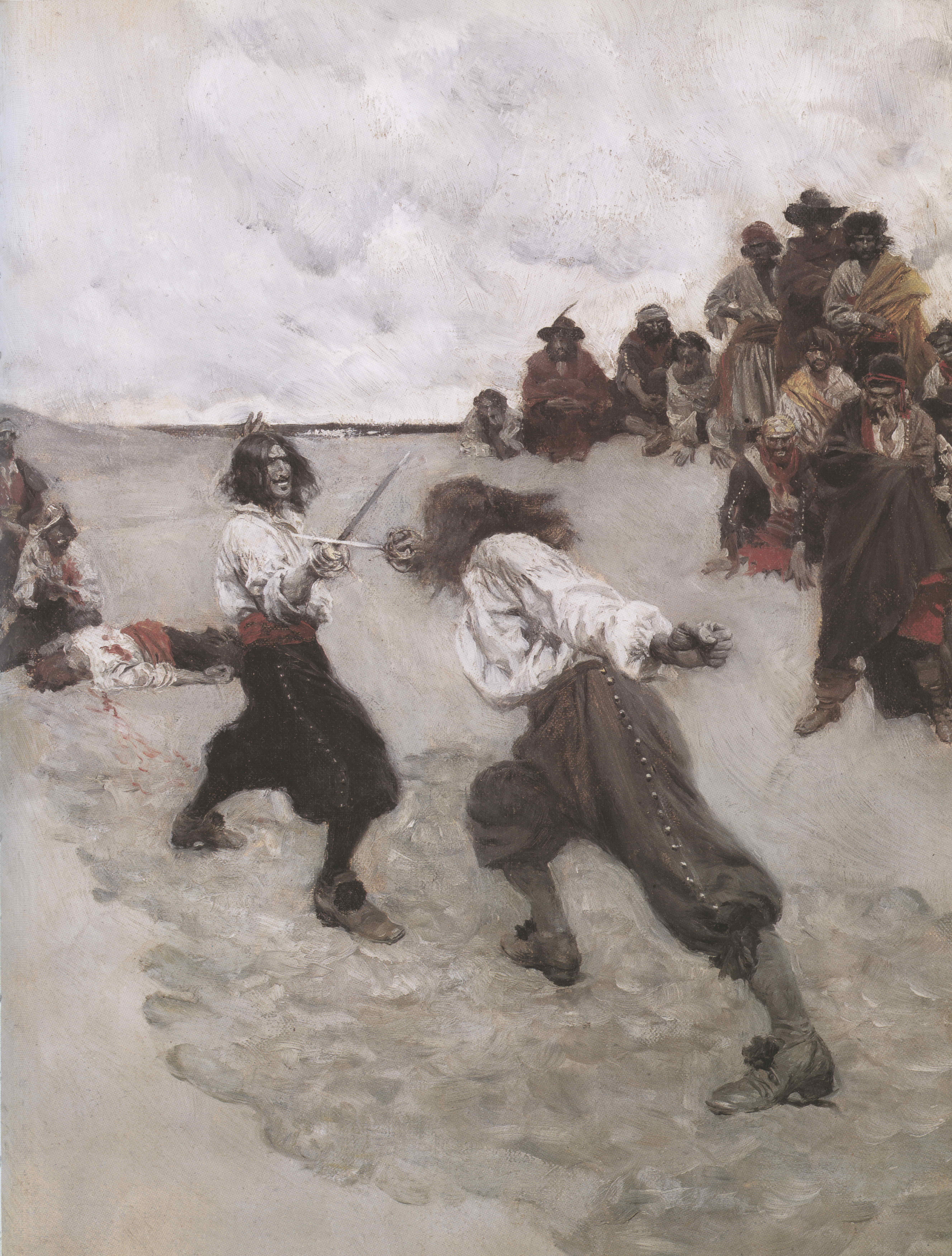
Although Howard Pyle painted several sword duels, two of them by the seaside, it’s his “Which Shall Be Captain?” (shown above the Dixie Bull images) that may be the significant culprit, and it shows no obvious connection to the duel between Bull and Curtis. In the painting, two pirate captains struggle against each other with daggers to determine who will command. The notion of dueling for command is false, however, to be discussed in more detail in part five (or if you can’t wait, you can read about it in The Golden Age of Piracy: The Truth Behind Pirate Myths). Put simply, captains and quartermasters were democratically elected. Even lesser officers required the approval of the crew. Dueling was never considered or acted upon as a means to gain command.

Likewise false, or at least uncommon as far as we know, is the use of daggers in duels on the beach. In fact, among buccaneers the musket was usual dueling weapon although some fought with cutlasses. However, there may be a possible exception among Dutch and Flemish seamen, who like many of their adventurous compatriots ashore had a habit of knife fighting, often using their hats in the unarmed hand for parrying. The style of fighting appears to have been more cut than thrust, notwithstanding the Dutch term “snickersnee,” which means to stick or stab and thrust, which Lewis Carroll turned into the snicker-snak of the vorpal sword. (See Buccaneer Cutlasses: What We Know for more information on cutlasses, including a bit on dueling.)
Even so, the only authenticated duel between buccaneer captains was between two Dutchmen–and they used cutlasses. Again, more on this in part five.
A duel on the beach between Dutch pirate captains is likely not what Pyle intended though, unless they were Dutch buccaneer captains of which there were in fact a fair number, more of them in service among French flibustiers than among English buccaneers. Their names are legend: Laurens de Graff, Nicolas Van Horn, Michiel Andrieszoon aka Michel Andresson, Jan Willems aka Yanky, Jacob Evertson, and Jan Erasmus Reyning among many others.
No matter his original intention, Pyle’s scene-setting has been imitated as homage, sometimes even copied, in numerous films as well as in illustrations for swashbuckling tales.

However, Pyle’s painting can only ultimately be said to have inspired the trope to far greater prominence, for a decade earlier, in 1899, Mary Johnston’s To Have and to Hold was published, a romantic novel of ladies, gentlemen, settlers (or invaders), Native Americans, and pirates. Notably, Howard Pyle painted the frontispiece, and, more on this later, Johnston’s works were a significant influence on Rafael Sabatini, author of Captain Blood and many other great romantic, often swashbuckling, novels.

Pyle’s painting of the duel for command, between gentleman hero and the last of three pirate villains he fights one after the other, takes place on what is known today as Fisherman’s Island off Cape Charles, Virginia. All three duels are described not in terms of fencing technique but via the hero’s thoughts and emotions as he fights–and easy way to avoid describing actual swordplay. Side note: the hero’s second adversary is a Spaniard (the best blade in Lima) and the third is the “man in black and silver”–almost as if the duel takes place in The Princess Bride. I won’t add the duel in The Princess Bride to this post, although I’m sorely tempted, as it takes place not on the shore but on the cliffs high above.
The entire composition of Pyle’s painting has been copied by many illustrators and filmmakers, including Douglas Fairbanks in The Black Pirate (1926) and Michael Curtiz in Captain Blood (1935).

As for the action itself, duels in fiction and film require high drama. It helps if the hero and his adversary are equally matched, although often the hero ends up hard-pressed but prevails in the end, often by stratagem. Occasionally we see the hero who is always in control, whose swordplay is so exceptional that the villain comes soon to realize he (villainous duelists are almost always a he, thus the pronoun) is entirely outmatched. Here the drama derives from the villain realizing he’s going to lose and be rewarded as he so richly deserves.
Depicting swordplay in fiction can be difficult, or rather, is actually quite difficult. Explain too much and you lose drama and tempo. Explain too little, and the duel is reduced to vague nonsense, even if dramatic. Using a few modern fencing terms has been the refuge of many novelists–but modern terms lack the flavor, and often the correct historical technique, to adequately depict a historical duel. And even in this case only fencers will actually understand what’s going on. In other words, to understand fencing you must be a fencer (and this is part of the reason, in spite of the FIE’s attempts at dumbing down fencing, why it will never be, and frankly should not be, a great spectator sport). But writers often cheat and describe swordfights only in vague terms or through the protagonist’s mental state.
In related fashion, writers often forget, or far more likely haven’t learned, that fencing on a shoreline causes changes in footwork and agility. Fencing in sand tends to slow the action down a bit, footwork in particular. Lunges are slower because the foot slips even in the best-compacted damp sand. Of course, if the beach is rocky, as in Captain Blood (1935), or covered in various beach and dune plants, this may help prevent the foot from slipping although it may also increase the risk of tripping and falling. Fencing in shallow water can diminish the lunge or even negate it.
Further, sand gets in the shoe, which can affect footwork. Sand is also readily available for villainously throwing in the adversary’s eyes. And, as in the case of all outdoor fencing on uneven ground, there’s always the chance at taking a special form of tempo, that of the brief surprise when the adversary accidentally steps in a hole or runs into a bush or trips over driftwood, or is maneuvered into doing this. Distraction, however brief, can be fatal.

There are partial remedy for these hazards, which I’ll discuss in part five, and, like running in the sand, you’ll at least in part naturally adapt to the best technique over time. (Thanks Bear Mac Mahon for your brief comments and reminders on fencing in the sand. 🙂 )
Sadly, seldom does any of this make it into fictional accounts of duels on the beach. But no matter! It’s the ring and spark of steel on steel while the sun glints off sand and sea we’re after. Which, by the way, is another issue with fencing on the beach: glare, which can easily be used to advantage by maneuvering the adversary into position with his face facing sun and sea, or even a sandy sea breeze…
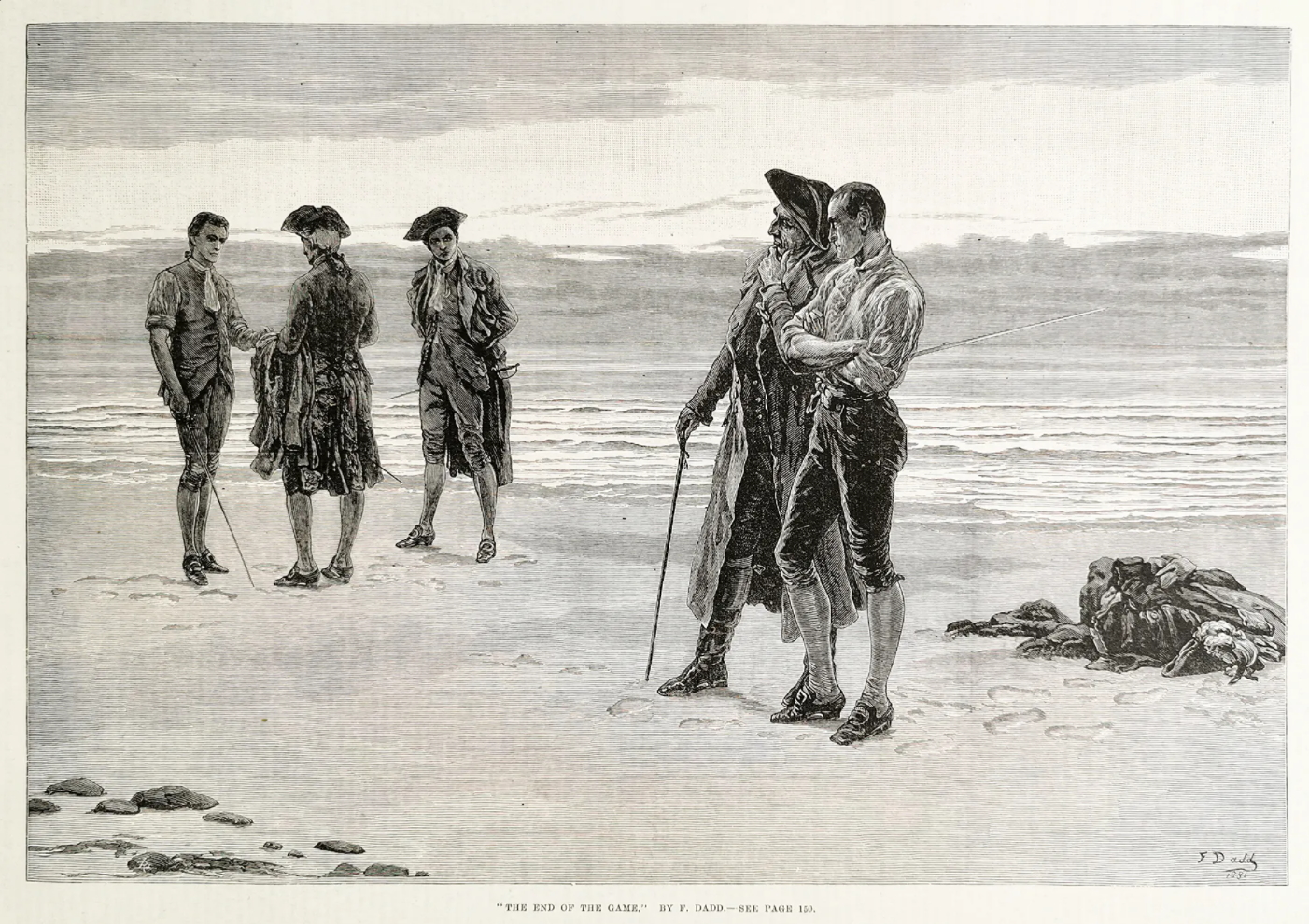
On occasion there artwork of a duel on the beach unassociated with a published story, and even when discovered there is often something of a written description associated with it, as with Frank Dadd’s “The End of the Game” published in The Illustrated London News:

The duel on the beach also makes its way into pirate pulp fiction, as in these novels by Donald Barr Chidsey (the rhythm of whose name makes me think of Simon Bar Sinister):


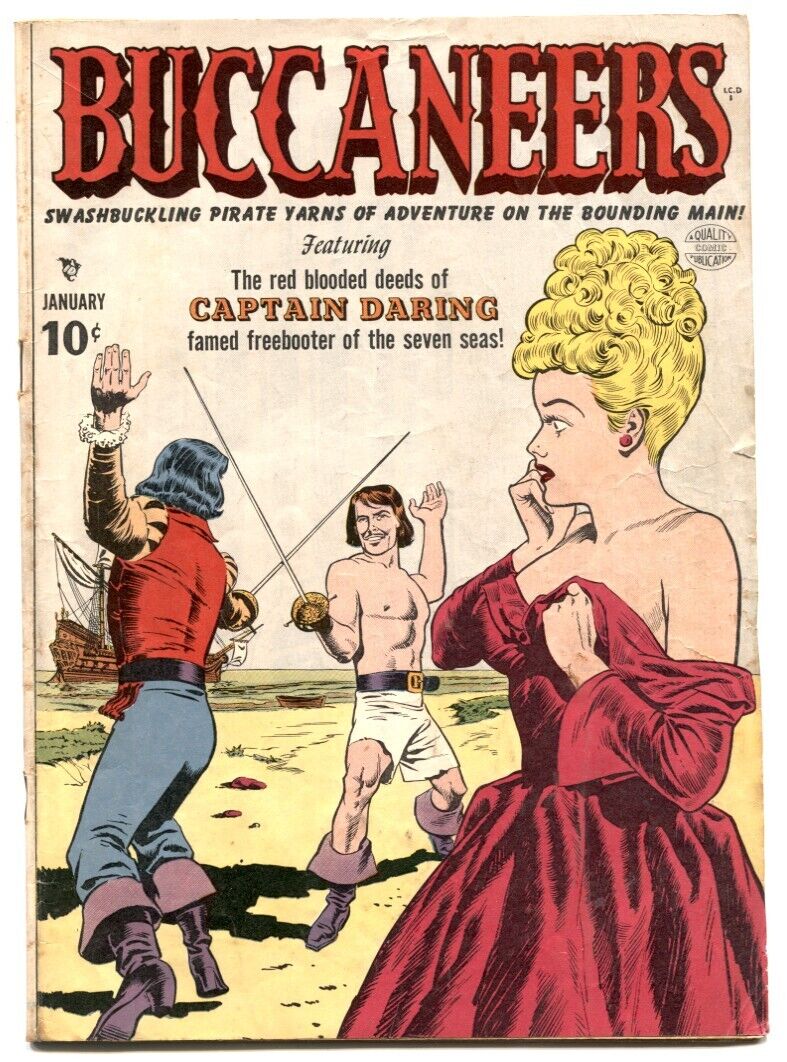
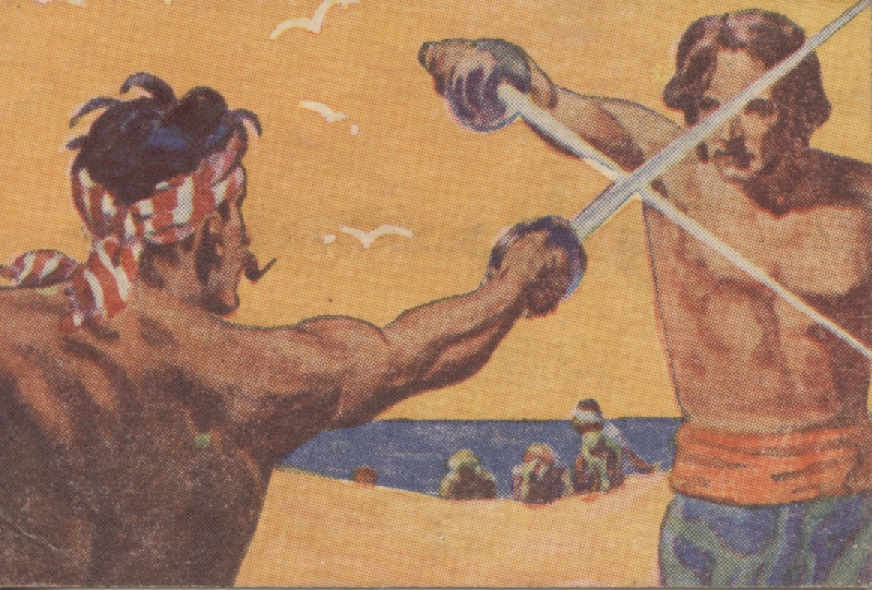
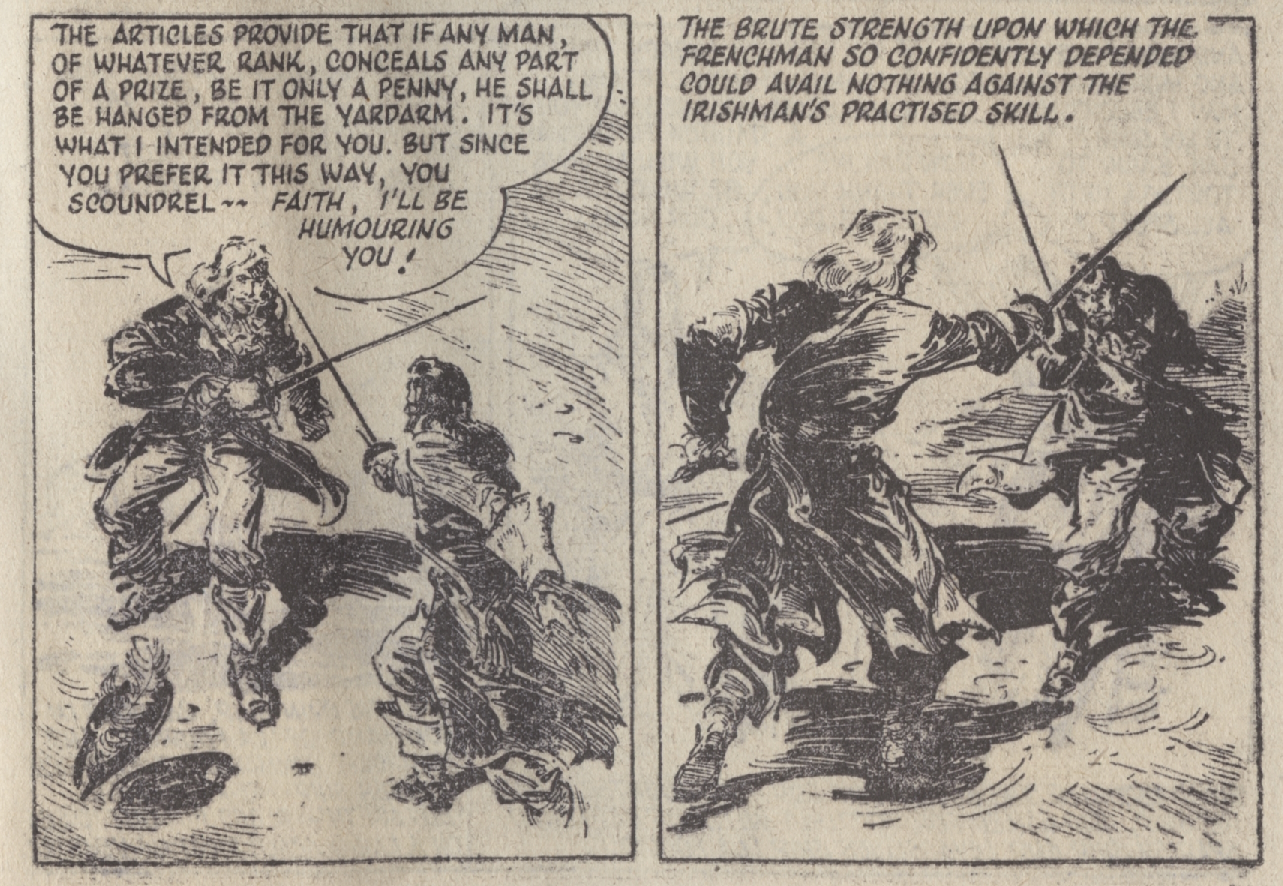
The duel on the beach has had a fair amount of depiction in other print media as well, including comic books and trading cards:
The front cover of Buccaneers (January 1950, #19) showing a duel on the beach, with costumes and en gardes inspired by a combination of several films. Notably, the duelist on the left has an en garde typical of many beginning fencers.
A trading card duel, with buccaneers watching as in Howard Pyle’s paintings and in the films The Black Pirate and Captain Blood.

A duel over buried treasure below, with daggers, clearly inspired by the famous Howard Pyle painting.
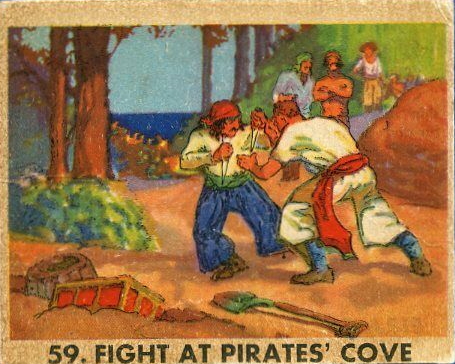

Below, a duel for command–a myth, as is the duel or affray over buried treasure.
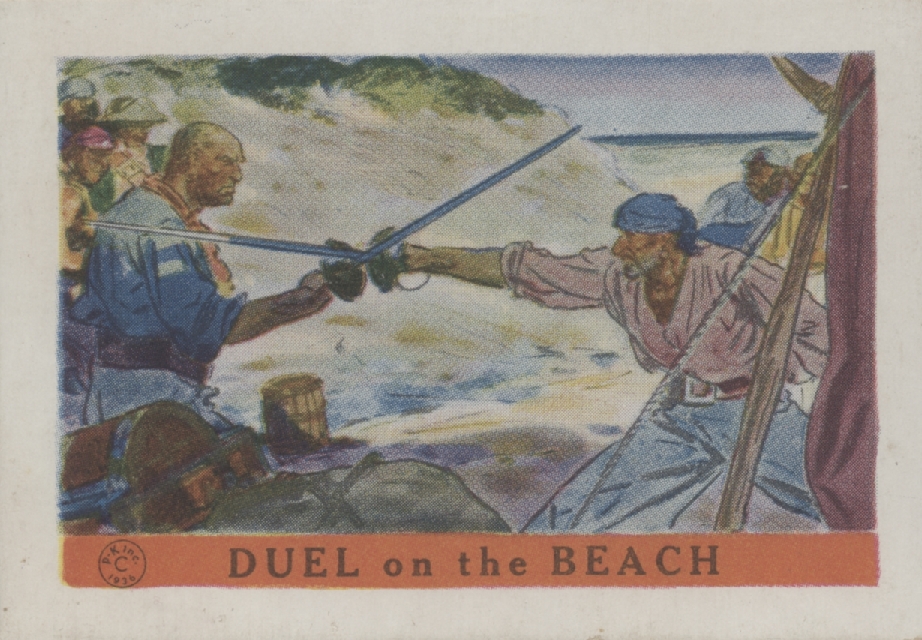

The trading card above probably owes as much to Douglas Fairbanks’s The Black Pirate (1926) as it does to Howard Pyle and various fiction, as shown below–but then, The Black Pirate owes much to Howard Pyle, purposely so according to the film program. We’ll discuss the duel in this film in more detail in part three.

There is a duel on the beach–well, not the beach but on higher ground on tiny Beaver Island, for the “ledges” (rocks) ran down to the water–in Clothes Make the Pirate by Holman Day (1925), a comic pirate novel. The duel is based on the fictional encounter between Dixie Bull and Daniel Curtis but is fought here between two tailors, Tidd and Sneck, both of them impersonating pirates (the former pretends to be Dixie Bull), and the two tailors merely pretend to fight, working out the details while briefly hidden behind some spruce trees during the engagement.

Of course, one of the great duels on the beach is depicted in Captain Blood: His Odyssey (1922) by Rafael Sabatini, in particular the dramatic build-up and famous dialogue. But alas, the duel itself is described in only two lines:
“It was soon over. The brute strength, upon which Levasseur so confidently counted, could avail nothing against the Irishman’s practised skill.”
In part four we’ll look further into this most famous of duels as it was depicted in the 1935 film starring Errol Flynn, Olivia de Havilland, and Basil Rathbone.
Numerous illustrators have tried their hand at the duel, some more successfully than others, historical accuracy (and even fictional accuracy) often to be desired.




This is a good opportunity to segue to several tobacco card illustrations of duels on the beach. Up first is Captain Blood, although based entirely on the duel in the 1935 film.

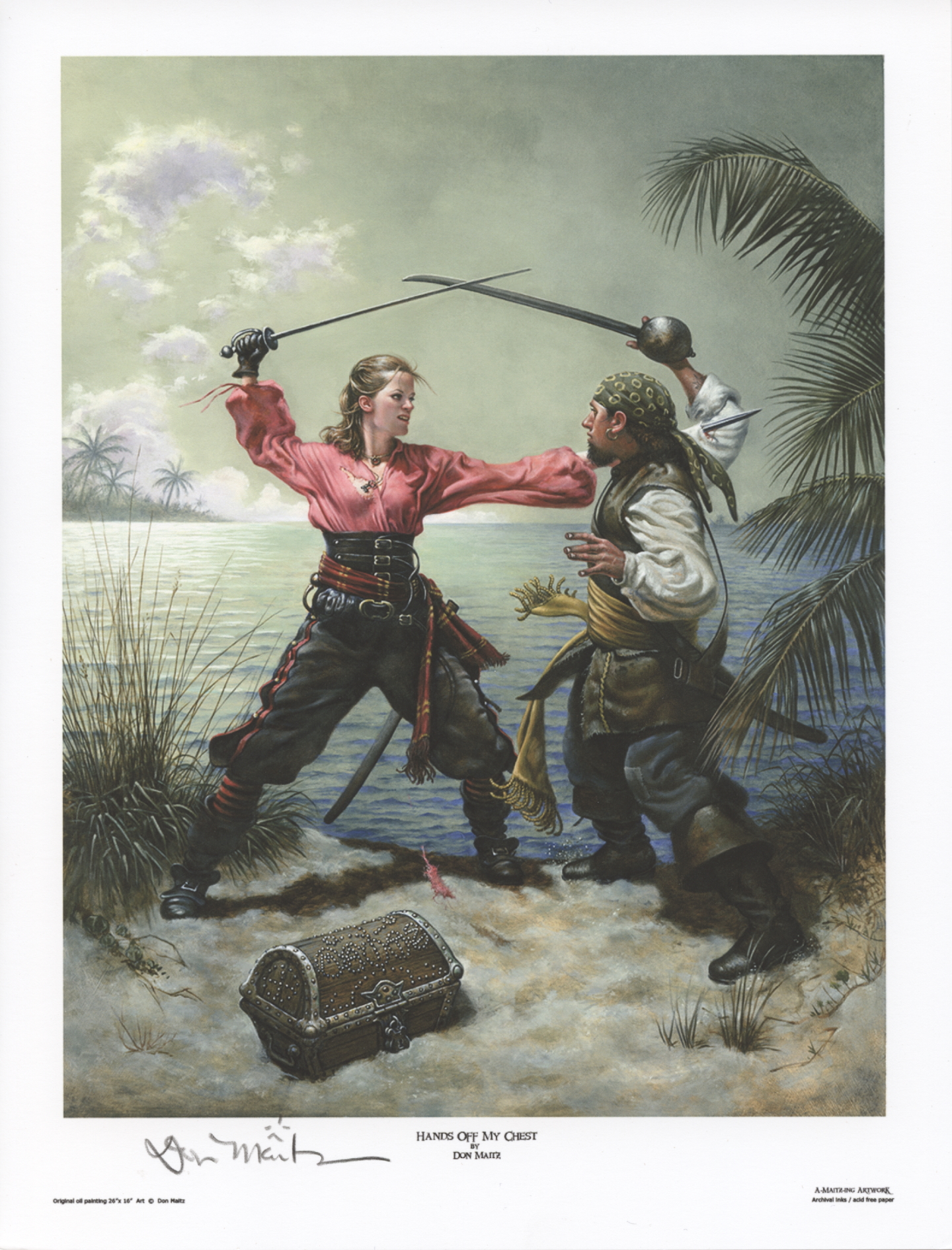
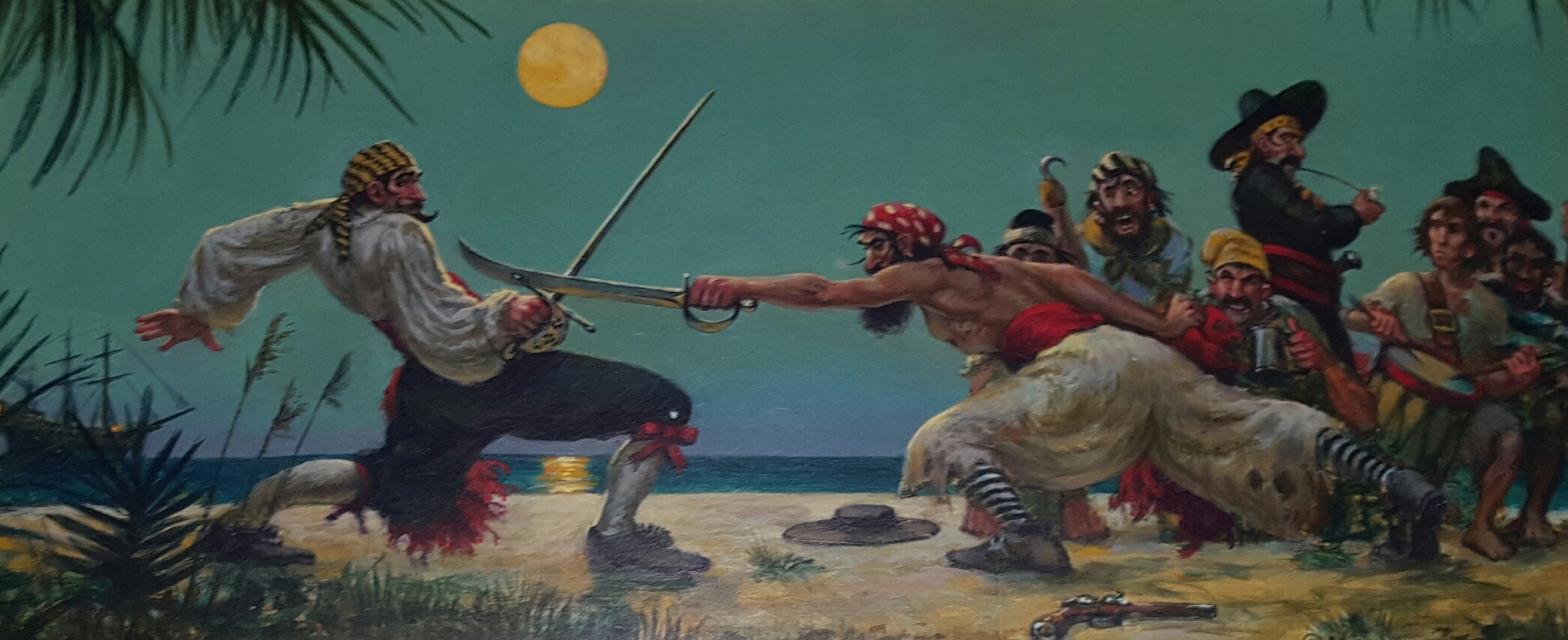
Although I can’t discover any connection to specific works of fiction per se, four of Don Maitz’s paintings of swordplay on the beach evoke classic swashbucklers and the paintings of Howard Pyle and N. C. Wyeth. Mr. Maitz is a famous illustrator, perhaps most noted for his depictions of Captain Morgan for the rum of the same name. Copies of his works can be purchased here.
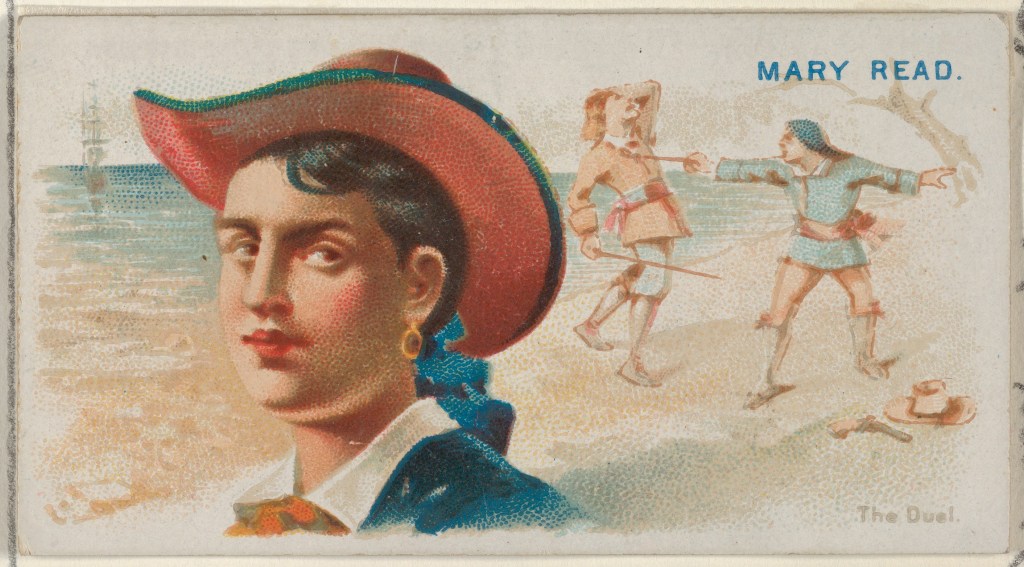
The purportedly authentic duel between Mary Read and a fellow pirate who was threatening her lover (or at least Charles Johnson so claimed, but he lied often in his 1724-1726 chronicle of pirates) shows up in an Allen & Ginter Cigarettes trading card, circa 1888. I’ve included it here as the account may well be fictional.

Norman Price illustrated this duel in The Rogue’s Moon by Robert W. Chambers (New York: D. Appleton and Company, 1929), yet another prolific (roughly one hundred novels, short story collections, and children’s books) popular genre writer already forgotten less than a century later. The story is enjoyable enough even given its light genre and Chambers’s style. It is action-filled and interspersed with scenes of mild titillation, and includes several major characters of the era (Blackbeard among them) in prime appearances, with pirates as the story’s villains. The protagonist is a cross-dressing, seeking-revenge-against-pirates, older teenager named Nancy Topsfield. The novel pretends to a background of historical accuracy, which is in fact, as with most of the genre, only superficial at best.

The duel is brief but exciting, and follows the manner described by Charles Johnson as in use by the early eighteenth century pirates of the black flag: pistols followed by cutlasses. Read’s sword is a “Barbary” or “Arab” blade, which might be a nimcha (of which were some naval captains who owned these swords, usually as trophies) but which the illustrations suggest is more likely a scimitar (or shamshir if you want to be pedantic–but scimitar was the common word in use by Europeans at the time). In either case her blade looks curved enough that she needs to hook her thrust. The duel ends with a near-decapitation.
Although Price’s drawings and paintings of men in the story are reasonably historically accurate by the low standard of popular illustration, he takes pop culture liberties with the leading female characters. He and Chambers dress Mary Read as a typical 1920s/1930s Hollywood starlet-type of pirate, sometimes termed “pirate flapper” and derived most likely from Douglas Fairbanks’s style of dress in his 1926 The Black Pirate. Female pirates were commonly depicted in this fashion during this era, ranging from magazine ads for sterling flatware to Hollywood studio portraits.

Given the rarity of known pirate duels, it’s not surprising that so few are depicted in various literature. However, at least one is. The famous duel, familiar if you’ve read the French edition of Alexandre Exquemelin’s The Buccaneers of America, or other related French texts (or even some of my books), between Laurens de Graff and Nicolas Van Horn at Isla Sacrificios near Veracruz in 1683 is also depicted on a cigarette card. However, given that this duel actually occurred and we have period accounts of it, we’ll save further description for part five. Whoever illustrated the duel below had not read the rare eyewitness account (unsurprising at it is neither easily found nor easily deciphered) although he or she may have read a secondary account, possibly Exquemelin’s.

All of this rather meandering exposition of the duel on the beach in fiction is leading us to a single novel that epitomizes it above all others: The Black Swan by Rafael Sabatini. And, given its role and singular technique, I’ll devote part two of this series to it entirely.

An honorable mention of sorts must go to George MacDonald Fraser’s comic novel The Pyrates (Collins 1983 & Knopf 1984). It’s one of my favorite pirate novels. It’s a campy, loving, satirical send up of pirate fiction and film, including Captain Blood: Fraser was a fan of Sabatini as I was and remain (and as well of Fraser). My attachment is also due in part due to the fact that when I first read it I was a somewhat cocky young naval officer, Navy SEAL, and swordsman recovering on a San Diego beach from an injury received on a Hawaiian beach during deployment.
Fraser’s duel on the beach scene is not traditional. Instead, it is a blindfolded duel between the super Sabatini-esque hero, Benjamin Avery, and the anti-hero Colonel Thomas Blood, a character based on the real quasi-gentleman who stole the English Crown jewels and whose name Sabatini appropriated for his honorable hero. Soon abandoned by the pirates who set them en garde on Dead Man’s Chest (an islet or cay in the Virgin Islands and the inspiration via author Charles Kingsley for said lyric in Treasure Island), the two adversaries fence comically in hoods, with swords tied to their hands and a small bell as well to cue them.
A line or two captures the spirit: “Even Black Sheba, concerned as she was for Avery, could not repress a smile as he came academically on guard, extended himself in a perfect lunge, and fell slap into the surf.”

I’d have to do a more detailed survey of recent fiction to adequately note any other significant renderings in fiction of duels on the beach. At the moment, only one comes to mind, that depicted by famous Spanish novelist Arturo Pérez-Reverte in El Puente de Los Asesinos (2011), part of his excellent Capitán Alatriste series. Alas, there is no English translation. The first six were translated, but not the seventh due to low sales, an indication of where the genre–especially “upmarket” swashbucklers–is today, replaced largely, and sadly, by fantasy.
Much if not most of the swashbuckling fiction that does make it print today tends to fall into the “writing by trope” category with inaccurate historical detail (a problem with much historical fiction in general today, to the point that many authors have accepted fictional tropes as historical fact and will vigorously, even hilariously, defend them) and “dialogue as might be spoken by modern suburbanites at a cocktail party” (likewise a common problem as a journalist friend pointed out), or is sadly relegated to small ebook and print-on-demand presses with little if any access to brick-and-mortar chains and independents. I remain hopeful that this will change. And if I bother to dust off Fortune’s Favorite, the sequel to Fortune’s Whelp, I’ll let you know–it has a duel on the beach in it. In the Caribbean. Naturally. 🙂
On a more positive note, I’ll close with two watercolors of pirate dueling on the beach, by one of the most famous American painters of all: Andrew Wyeth, son of illustrator N. C. Wyeth, around the age of twenty.


And last, well, just because it’s a beautiful beach painting in the pirate genre by Andrew Wyeth…

NOTES
A couple of notes on the duel at Teviot beach by Howard Pyle: Aficionados of fencing history will note that Pyle clearly took his inspiration from late 19th and early 20th century epee duels, many of which were photographed, and some even filmed. In the late 17th century it would be unusual for there to be a directeur de combat (someone who monitors the fight, in other words, and ensures that no villainy is perpetrated). Further, seconds often fought too, and spectators were absent more often than not.
Even more critically, both swordsmen are in sixte rather than tierce (although one might argue that the fencer on the left is actually correctly in carte, perhaps having just been parried to the outside line by a circular parry). Sixte, not yet called by this name, was not unknown but was disregarded by most masters and fencers in spite of its utility in closing the “light” (hole, open target) revealed in tierce. Sixte is a weaker position and requires more blade set and wrist angulation (some of the latter was later relieved by modifying the way the grip was held) than tierce, which is a stronger position physically and whose point falls naturally toward the adversary’s shoulder. The guards shown in the painting are more typical of fencers in Pyle’s day (and in ours as well).
POSTSCRIPT for members of the Huntsville Fencing Club: post-pandemic we’ll [finally] host a rum tournament on the beach. 🙂
Copyright Benerson Little 2020. First published September 1, 2020. Last updated October 8, 2024.

The Women in Red: The Evolution of a Pirate Trope

With news that Disney is planning a new standalone pirate film starring a female pirate, it’s time review what has become a pirate trope: the woman in red, specifically, or at least often, a redhead. Why this trope in regard to a new Disney film? Because speculation has it that the film will be tied to Redd the Pirate above.
UPDATE: According to Margot Robbie in the press on November 14, 2022, Disney has killed the project, although rumors periodically surface that Disney continues to look at continuing the franchise, including a film with a female protagonist. A pity indeed that the rumored Robbie film was cancelled, it might’ve been quite the film. Certainly the genre needs a new female-led pirate film hearkening back to the Golden Age of Piracy and Pirate Film. There have been only a few made. Shout-out to The Pirates (2014), a Korean comedy-drama about Korean pirates, with strong overtones of the Disney Pirates of the Caribbean franchise, starring Son Ye-jin. (And please let it not be about Anne Bonny! See below…)
LATEST UPDATE! As of February 17, 2026, Margot Robbie is reportedly still in talks regarding Pirate of the Caribbean 6. We’ll see…
In the meantime while waiting for a new pirate film with a female lead, we’ll take a quick look at some of the myths and realities of female pirates during the so-called Golden Age of Piracy in the Americas from roughly 1655 to 1730.

The obvious apparent origin of the woman in red (a “scarlet woman”?), at least in terms of pirate fiction and film, is the Redhead in line in the bride auction–“Take a Wench for a Bride”–in the original version of the Disney Pirates of the Caribbean attraction in which drunken pirates shouted, “We wants the redhead!” Forced marriage, in other words, and all of its associated crimes.

Notably, text on the back of the publicity still describes the scene as an auction: “Gold-hungry pirate captain puts the town’s fair maidens–and the ones not so fair–on the auction block for his rowdy crewmen.” Thankfully, things have somewhat changed since then, tongue-in-cheek humor or not.


The Disney auction scene was doubtless inspired by scenes in The Black Swan (1942), Anne of the Indies (1951), and, in particular, Against All Flags (1952), in which captured women are portrayed as captives to be sold or given away as plunder. Both Anne of the Indies and Against All Flags have auction scenes of female captives, and the latter has an auctioneer with whip-in-hand as in the Disney attraction.
When it first opened in 1967, the Disney attraction was intended as–and in fact was–a tongue-in-cheek, lighthearted, swashbuckling film-based version of buccaneers sacking a hapless Spanish town in the Caribbean. Marketing text associated with early publicity stills noted that the ride was a “thoroughly realistic re-creation of buccaneer days.”

To enjoy the ride–which I did and still do–requires viewing it as a fantasy rather than a depiction of reality, for the reality of buccaneer attacks in the seventeenth century was anything but romantic to the victims: torture, rape, murder, and the enslavement of free men, women, and children were common. Documentary evidence of what today would likely be defined as resulting PTSD, among both victim and perpetrator, exists.
Like most of our fictional and cinematic adventure, we tend to sanitize or ignore facts in order to help create a fantasy more amenable to entertainment. Humans have done this for millennia. And there’s often nothing wrong with this unless we confuse the fantasy with the reality, which unfortunately happens all too often.


Today, the ride has been modified somewhat to both fit with the Disney pirate films, which are only loosely inspired by the attraction, and to bring the attraction up-to-date with current social mores. The latter changes have generally been a good thing, I think, even if the changes are not historical (and a few I disagree with). The attraction is a swashbuckling fantasy, after all, not an accurate “Audio-Animatronic” documentary. I’m much less enamored of the changes in keeping with the film franchise.
The most significant of the changing mores alterations to the attraction was the conversion of the pirates-chasing-women scene into one of pirates-chasing-food, and the conversion in 2018 of the bride auction scene into one of conquered residents bearing possessions, perhaps as ransom, and of the famous red-dressed redhead showing a leg into a red-dressed redheaded female pirate standing guard (and still, after a fashion, showing a leg).

Personally, I prefer the new scene and new redhead, ancient passing pre-adolescent fantasies notwithstanding.
In general, as in the original trope-setting (and great fun to watch) pirate swashbuckler, The Black Pirate (1926), leading women in pirate films are usually depicted as the “tavern wench” or “exotic wench,” or other saucy secondary love interest; or the “swooning heroine;” or the “pirate woman.”
The “pirate woman” is usually by far the most interesting, although too often she, Hollywood-style, gives up piracy at the end of the film in exchange for true love. Or she dies in battle, her true love unrequited, her true love interest running off with the “good girl”–often the swooning heroine. At least Against All Flags with Maureen O’Hara and Cutthroat Island with Geena Davis avoided this trope.
Sometimes the tropes are combined: Elizabeth Swann in Pirates of the Caribbean: The Curse of the Black Pearl goes from a nod at the literally swooning–via an over-tightened corset (“stays” to be correct)–heroine to pirate woman.
She also wears a red dress in the first film of the series, in scenes which combine multiple tropes: woman in peril, woman tied-up, woman with (airbrushed via CGI, reportedly) cleavage. The dress is a likely homage to the Disney attraction. A red dress also shows up on Scarlett, a tavern wench aka prostitute.


The red dress shows up in other pirate films as well, and as apparent copies or homages in Halloween costumes and video games.

Geena Davis stars in Cutthroat Island (1995, Carolco), and in one scene swashbuckles her way tolerably well with an anachronistic rapier and dressed in a red dress borrowed from a prostitute. The dress is clearly a nod, perhaps more than a bit humorous, at the Disney ride. In fact, Cutthroat Island often seems like one long string of pirate tropes, homages, and stolen scenes. Great soundtrack, though, and Davis does well as a pirate captain.
Now is a good time to briefly point out the reality of women pirates during the so-called Golden Age of Piracy 1655 to 1730. Strictly speaking, we know of only two who can be truly said to be pirates of the Caribbean: Anne Bonny and Mary Read, the former of whom gets all the cinematic glory while the latter, if what Charles Johnson wrote about her is true even in part, was the real swashbuckling bad-ass of the twain.
If Johnson’s early eighteenth century account is true, Read had been thrice a soldier in disguise, then a pirate, and even a privateer, in disguise, and reportedly fought at least one duel against a male crew member. Of course, this may be entirely an invention of the author, and his account of Read’s army service may have been inspired by the real life of female soldier-in-disguise Christian Davies. Although a fictionalized account of her life was not published until 1739, her story was known at the time Johnson’s pirate book was written.
Whether a true tale or not, it’s not Read’s warrior-woman story that ends up in fiction and film, but that of redheaded Anne Bonny–or at least she’s assumed to be redheaded because she was Irish and reportedly had a hot temper. Bonny gets all the glory, even though she may have been merely the girlfriend along for a joyride with her bad boy pirate boyfriend. Or not. Likewise Mary Read. We simply don’t know enough about her or Mary Read. Johnson may have invented the past histories of both to “sex up” his book for sales potential.
Of course, it’s entirely possible that both were as bold as Charles Johnson described them, even if they only dressed as pirates when attacking at least one vessel, and remained in women’s clothing otherwise. And their piracy was pitiful, nothing more than cruising in a tiny 12-ton sloop, not the 40-ton sloop Johnson described, and robbing a few “mom and pop” local trading vessels, including a canoe paddled by an old woman — hardly the stuff of Hollywood. Of course Johnson had to exaggerate for the sake of book sales!

Bonny, though gets all the attention, thanks largely to her relationship with “Calico” Jack Rackham. Writers are often lazy, and it’s easier to combine Read’s martial prowess with Bonny’s reported temperament and relationship with Rackham. However, not all writers who fictionalize the female pirate pair are as lazy. Some, including Erica Jong, have balanced their accounts of the two women.
But it’s Read, in my opinion, who deserves a movie.


Perhaps Anne Bonny, the assumed redhead, has also given us the redheaded part of the redhead in the red dress trope.
There are no other known women pirates of the Golden Age but for two who were technically pirates under the law, each having participated in utterly inept attempts at petty piracy, one of them comically so. Notably, two of the most commonly cited women pirates of the era were not pirates at all (please please please ignore Wikipedia!): Jacquotte de la Haye is entirely fictional, a creation entirely of author Leon Treich (Les Gentilshomes de la Flibuste, 1944, a factual-fictional account of buccaneers and some pirates written for a juvenile audience), and Anne Dieu-le-Veult, a wealthy widow, married the famous Laurens de Graff after his buccaneering days. She was never a member of his crew, nor is there any evidence that she was a member of any other crews. Treich is also responsible for exaggerating myths about Dieu-le-veult to an even greater degree, and even imaging deeds that never happened (including the utter nonsense that de Graff died in battle at her side).
More detail on Rackham, Bonny, and Read can be found here.
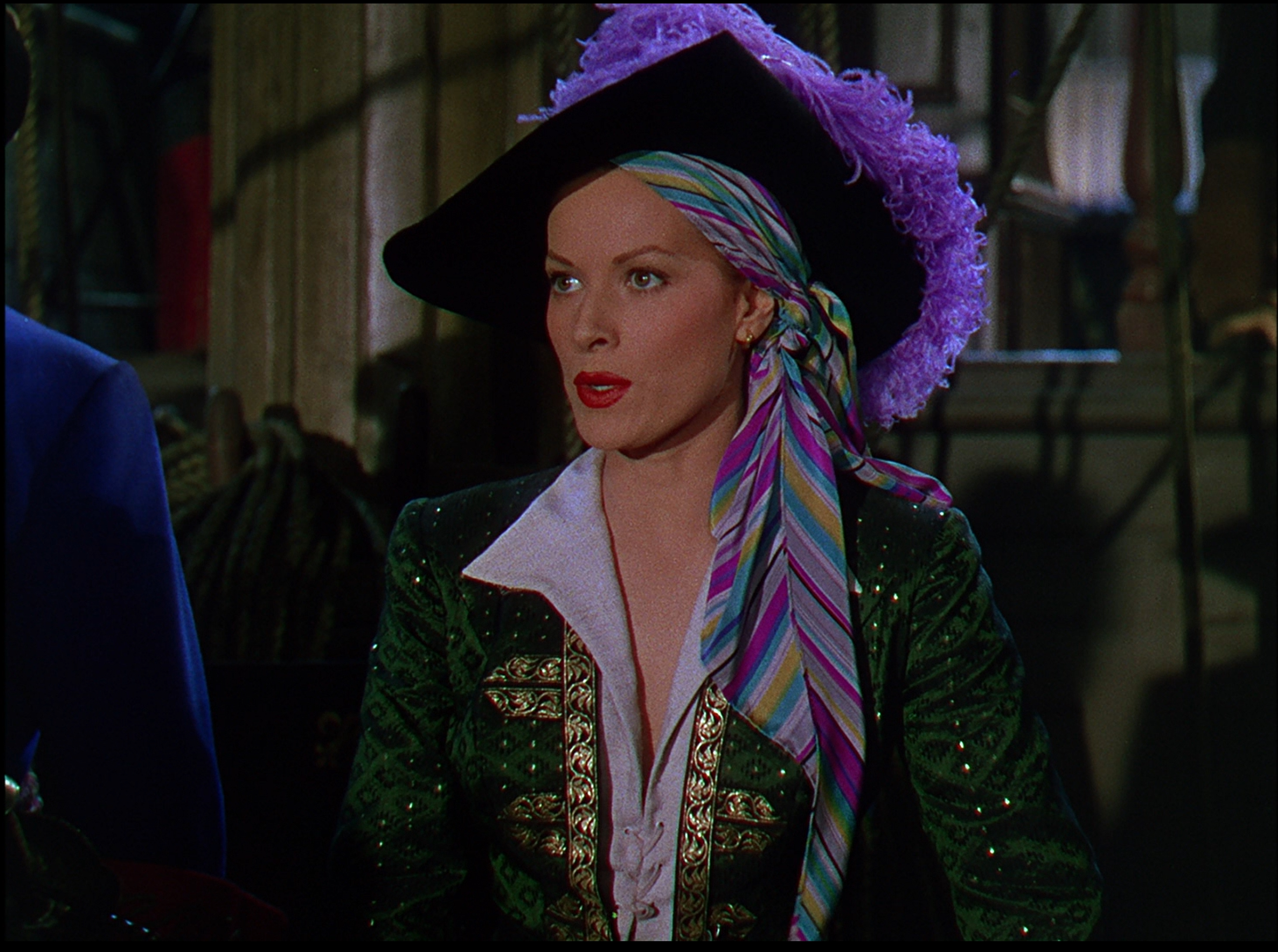
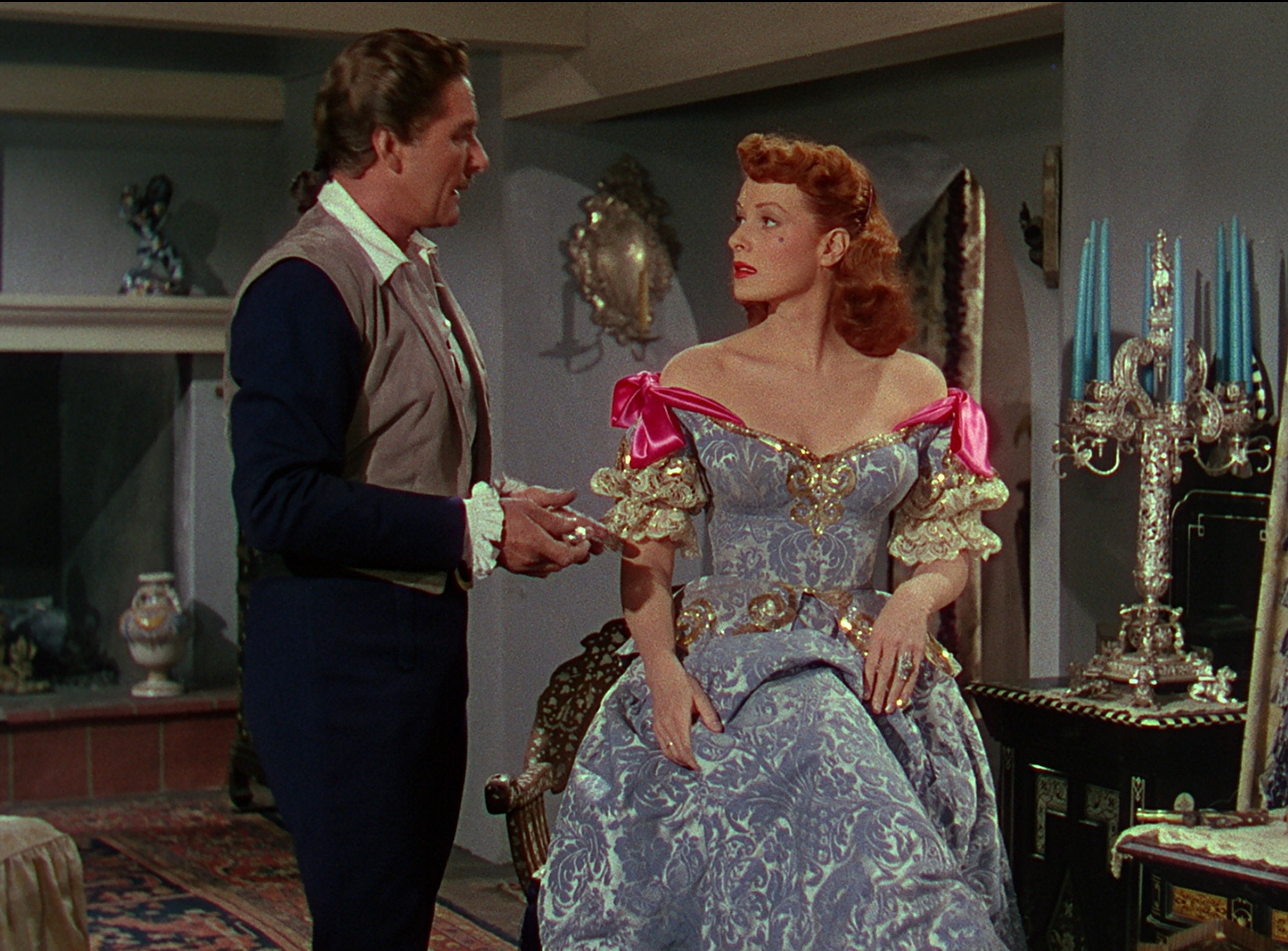

Likely though, there were real buccaneer and pirate women we’ll never know about because they remained in disguise. The common sexism of the day prevented women from becoming obvious members of a pirate crew. In fact, it’s probable that Anne Bonny and Mary Read (in Read’s case, after she revealed her sex) were part of John “Calico Jack” Rackham’s crew only because it was very small, no more than a dozen or so aboard a twelve-ton (that’s very small) sloop.
Pirates by majority vote could override their captains anytime but in action, and a larger crew would doubtless never have permitted women aboard as equals. In general, women were forbidden among early eighteenth century pirates except as prisoners, and even then pirates preferred to keep them away out of fear of indiscipline among the crew.

Red dresses pop up in other pirate or pirate-associated films as well, but it’s hard to tell if they qualify as tropes. Red is a popular dress color, after all: it stands out well and is often associated with temperament and sexual license, accurate or not.

In 1952’s Blackbeard the Pirate starring Robert Newton, heroine and damsel-in-distress Linda Darnell, in the scene most often used for advertising posters and lobby cards, is often depicted in red rather than the actual dark blue in the film. Clearly, there is marketing value in placing a woman in red clothing. In some cases she is even depicted as redheaded rather than as raven-haired as in the film and in life.


Honorable mention must go to pirate queen Black Sheba in George MacDonald Fraser’s comic novel The Pyrates (1984): “she donned her scarlet silk breeches and shirt, buckled her dimanté rapier at her hip, drew on her long Gucci boots, exclaimed at the state of her coiffure, clapped on her plumed picture hat, dapped a touch of Arpège behind her ear, and then spent ten minutes selecting one long earring and applying her lipstick.” She is by far the fiercest and sexiest of all the pirates in the book–a pirate queen as only a novelist or Hollywood could create.
A phrase in the novel, “dark and sinister woman…,” gives away part of her inspiration: she’s at least to some degree a female Captain Hook, the wordplay on the color of her skin notwithstanding. (“Proud and insolent youth,” said Hook, “prepare to meet thy doom.” “Dark and sinister man,” Peter answered, “have at thee.”) Even so, Fraser in the afterword describes the pirate queen as “a Dahomey Amazon with echoes of Lola Montez, Queen Ranavalona, and a pantomime principal boy,” all characters from his Flashman novels. She’s clearly inspired by other characters as well. Note also that the character of Bilbo–named for the slang term for sword (i.e. a blade from Bilbao, Spain) and not for the Hobbit–is according to the author, “Basil Rathbone playing a raffish Captain Hook.”
Also, at one point Fraser dresses one of the two more “traditional” heroines, Lady Vanity, in a maroon velvet dress, almost certainly, given his numerous other homages to piratical Hollywood and fictional tropes, in honor of classic pirate film heroines in red, and quite possibly of Disney’s woman in red as well. The dust jacket below shows another of the heroines, Dona Meliflua, also in red.
In video games, Elaine Marley from the several Monkey Island games was surely inspired at least in part by redheaded “Spitfire” Stevens aka Maureen O’Hara.

Cover art for two of the Monkey Island games, courtesy of The Monkey Island SCUMM Bar and Lucas Arts Posters at the International House of Mojo. Original box art by Michael Koelsch (left) and Steve Purcell (right).
We might also consider the possibility that Nami from the One Piece anime, manga, and Netflix series was possibly inspired at least in part by the various redheaded pirate queens.


Nami as depicted in the film One Piece Redd (2022), and as played by Emily Rudd in the live action Netflix series (2023).
Nonetheless, Blackbeard the Pirate and other films (and novels!) notwithstanding, there is a possible ultimate origin for the redhead in red dress trope prior to the Disney attraction — in fact, its inspiration perhaps, or at least part of it.
In 1952 Columbia Pictures released The Golden Hawk, a pirate film, albeit one technically about French and Spanish privateers in the Caribbean in the late seventeenth century. The film is based on the novel by Black author Frank Yerby.
The male lead is Sterling Hayden playing Captain Kit Gerardo. His acting appears a bit wooden by Hollywood pirate captain standards until you read his biography: a true tall ship captain in his youth, later a Silver Star recipient and US Marine Corps officer assigned to the OSS (the precursor to the CIA covert operations department) behind enemy lines in World War Two. In other words, he was playing himself as a privateer captain. Even so, Variety magazine wrote that Hayden was “out of his element as the gallant French privateer…” Hollywood goes for (melo)drama, but most real captains are far more quiet and self-assured. They have to be. But I digress.

The female lead was red-haired Rhonda Fleming, one of the “queens of technicolor,” the most famous of whom was Maureen O’Hara who starred in several swashbucklers and whom some critics suggested would have been better in the role–and better for its box office.
Fleming’s character in the film is “fiery,” to be expected of the popular genre, including the Frank Yerby novel on which the film was based. In one scene–SPOILER ALERT!–she shoots Kit Gerardo when he makes “romantic overtures” to her, then leaps out a stern window and swims ashore. No swooning heroine she, thankfully, nor one to put up with sexual harassment or worse.
In a few scenes, Fleming, whose character’s real name is Lady Jane Golfin, wears a luxurious green dress. But in most lobby cards, tinted publicity stills, and movie posters, it’s red.


More importantly, Rhonda Fleming plays a buccaneer, Captain Rouge (that is, Captain Red)–she was also a pirate!


We may have simultaneously moved forward while also coming full circle. 🙂

Postscript July 22, 2020: This bears repeating: Please, please, please do not use the Wikipedia entry on women pirates for research! Or on any piratical subject! At least not if you’re looking for facts. 🙂 Wikipedia has a number of flaws in many of its articles on piracy (and in many other areas as well), including factual errors, incomplete information, inadequate or incorrect sources, trolling (intentional factual misrepresentation to trigger a reaction or otherwise for fun), severe ideological slants leading to inaccuracy (i.e. deliberate “scholarly” misrepresentation, often in support of social or political ideologies, ranging from the far left to the far right, attributed to pirates, yet running counter to historical fact), and fairly constant regressive, incorrect changes to accurate information. Some articles on piracy are occasionally quite accurate, but many are all too soon revised inaccurately again.
Copyright Benerson Little 2020-2026. First posted July 8, 2020. Last updated February 21, 2026.

Of Sacrifices Great and Small
“Nous avions autre chose à faire durant la mortelle épreuve que de croiser le fer ‘pour rire.'”
[“We had other things to do during the deadly ordeal than to cross blades ‘for fun.'”]
—Poet and muse Emma Lambotte writing of the disbanding of “the Ladies’ Fencing Club of Anvers” at the beginning of WWI. Many of the fencers volunteered to serve as nurses during the war. The club was never reinstituted. From Lambotte’s essay L’Escrimeuse (Paris: Éditions du Nord, 1937).
Some reflections for those who have been unable to return to fencing, or to any passionate pursuit for that matter, or are disappointed that things are not the same.
Put plainly, this is not the time to bemoan any temporary loss or abatement in fencing practice, however passionate you feel about swordplay.

Worldwide, we’re living amidst an obvious historical moment that affects everyone. In the US, we’re amidst an even greater one: a pandemic combined with great social change and political consequence. It is a time of great personal, moral, and political danger.
This isn’t the first such moment in modern history, nor for many of us not the first in our lifetimes. And for many of us it probably won’t be the last.
For fencers who are missing the sport, or have had their participation reduced, it’s a time to remember that swordplay is not going away, no matter that its principles have long been under siege by a sport mentality. If you haven’t already returned to it to some degree, you will be able to one day.
Further, you should remember that no matter how much swordplay means to you, there are more important things in life–and what’s most important about fencing is its connection to these important things.

I came of fencing age in an era in which, for many of us, swordplay was still strongly associated with a sense of honor and associated duty, unlike today in which many competitors and their coaches regard it as pure sport where winning at almost any cost is expected. (Happily, though, many “average” competitors still prefer to view it traditionally.)
It was this traditional sense that drew me when I first started fencing more than forty years ago. Many of our fencing masters back then, not to mention many of the veterans we fenced with, were true swashbucklers who, although they competed in fencing, saw swordplay as something beyond mere sport.
A few had actually fought duels, while others had trained duelists. Some had served in the military in the final days of the sword on the battlefield. Many had lived through the trauma of two world wars. Some had fought in them. Others had escaped or fought against repressive regimes in the manner of adventures as might be found in a novel by Dumas or Sabatini.
At the very least, most had been trained by those who had come of age in an era where the sword was still a weapon both of the military and of the duel. Many were true adventurers with a powerful sense of duty and honor, of moral, rather than legal, right and wrong.
Many had proved themselves of great moral and physical courage, though none ever mentioned this. You had to learn it from those who had long known them.
All understood that fencing competition was ultimately a mere substitute, not an end in itself. Medals, although fun to compete for, were in many ways secondary, and their value ultimately illusory. A drawer filled with dusty old fencing medals is in its essence exactly that, nothing more. It is only the acts that earned them, and the context in which they were earned, that matter.
My first fencing master, Dr. Francis Zold, pointed this out to me more than forty years ago when he noted that most people only remember who came in first place, and then usually only in regard to the Olympics and World Championships, and then often not for long. Aladar Gerevich was one of the world’s greatest athletes, yet most sports fans have no idea who he was. Nor, sadly, do most fencers.
In other words, not only were we expected to fence honorably and regard medals as the ultimate illusions they are–mementos of transient fortunate, often happy, moments–but we were expected to carry this expectation of honor and duty far beyond the strip. Camaraderie, derived from mutual respect and shared experience, bolstered this.
Even today one can easily judge a fencer’s character off the strip by their behavior on the strip. If a fencer, coach, or referee will game the system or cheat on the strip, they’re likely do so everywhere else they think they can get away with it. Those you can trust on the strip under pressure can probably be trusted off the strip.
In practice, this associated sense of honor and duty meant that some of us, as I did, gave up promising competitive potential for military service, or the Foreign Service, Peace Corps, medical volunteerism, or even simply to provide for a family or care for loved ones.
Several fencers I know had to give up significant competitive potential due to injuries received in the line of duty. Others had their participation upended by war, revolution, natural disaster, economic failure, accident, or disease. Similarly for aspiring fencers: I’ve had many beginning students in their sixties and seventies whose delay in learning to fence was commonly due to decades of circumstances beyond their control.
Some fencers fared even worse for their open embrace of service. I still recall a poignant story Dr. Zold, a Hungarian, told me forty or more years ago, about an American epeeist he knew well. When war was declared, the American fencer volunteered for military service and was commissioned as a naval officer. He was killed in action aboard a destroyer in the Pacific. He was not the only such fencer.
Dr. Zold, who was no stranger to dueling and its associated sense of honor, himself put aside active swordplay for an even more dangerous, and far more noble, practice, which was to assist Raoul Wallenberg in helping Jews escape Hungary after the country was annexed by Nazi Germany in 1944. To have been caught doing so would have resulted in torture and death at the hands of the Gestapo. Wallenberg himself was abducted by the Soviet Secret Police at the end of the war and, two years later, reportedly murdered in custody.

Today, right now, some fencers are taking leave of their beloved sport, and even of family, to risk their well-being, possibly their lives, in support of others in peril from disease or injustice.
Again, we all need to remember that fencing will not be diminished forever. Our passion and practice will return in full measure. Many of us have often had to miss fencing for months or even years at a time for a variety of reasons. We always came back to it, and it to us.
In the meantime, if it’s not yet safe or practical for you to return to fencing, there’s still much you can do. You can read and study, stay fit, do footwork, practice if you have a partner at home.
One of the great lessons I’ve learned both from fencing and from particularly hazardous naval service was to be prepared for change. You may have expectations, you may have a plan, but in a fencing bout as in life our expectations and plans are often thwarted. We must always be prepared to adapt, and especially to carry our experience forward with us as life changes.
Fencing, if you pay attention, has many lessons useful in life’s trials.
Thus there is always more we can do. Simultaneously, as fencers past have done and some at present are already doing, we can seize upon fencing’s great virtues–honor and duty, camaraderie and respect, risk-taking, the courage to stand and fight alone–and via them try to make this world in danger a better place.
We need heroes today and everyday, and fencing, at its best, helps make them.
Copyright Benerson Little 2020. First published July 2, 2020. Last updated (Lambotte quotation) October 14, 2020.

Captain Hook’s Hook: Its Most Likely Inspiration–And His Nemesis Crocodile’s Too!
Here’s a brief look at what I consider the mostly likely origin, or more correctly, inspiration, for J. M. Barrie’s eponymous villain’s most notable feature–his hook, not to mention the reason he had one. Although the novel, for both children and adults, was published in 1911, it was based on Barrie’s 1904 play. Curiously, annotators and Peter Pan scholars seem to have missed the likely origin of hook and crocodile, although I could be mistaken–there is a lot of published work on Peter and Wendy aka Peter Pan.
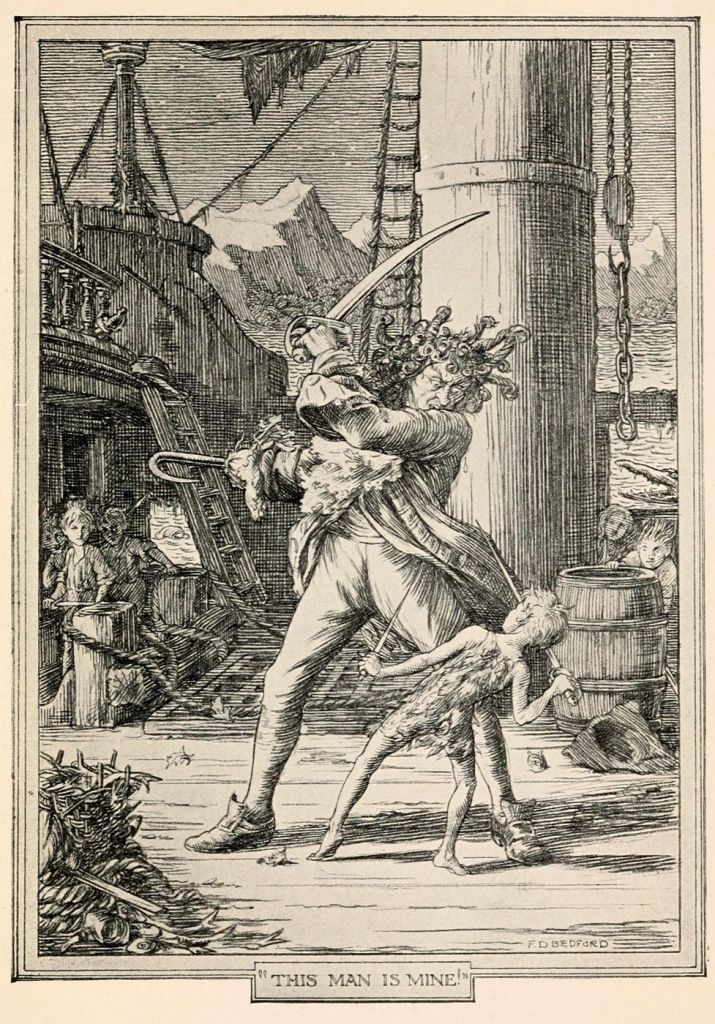
Barrie’s inspiration for Captain Hook is commonly ascribed to a combination of the painted images of King Charles II, plus various references to various historical Captain Cooks. There are several of the latter captains, in fact, including a couple who were buccaneers in the 1680s. Cook, Hook, right? And a dashing pirate captain might look like a dashing rakish king, correct?

For more detail, here’s Barrie’s perfectly written description of Captain Hook, from Chapter V, The Island Come True:
“In the midst of them, the blackest and largest jewel in that dark setting, reclined James Hook, or as he wrote himself, Jas. Hook, of whom it is said he was the only man that the Sea-Cook feared. He lay at his ease in a rough chariot drawn and propelled by his men, and instead of a right hand he had the iron hook with which ever and anon he encouraged them to increase their pace. As dogs this terrible man treated and addressed them, and as dogs they obeyed him. In person he was cadaverous and blackavized, and his hair was dressed in long curls, which at a little distance looked like black candles, and gave a singularly threatening expression to his handsome countenance. His eyes were of the blue of the forget-me-not, and of a profound melancholy, save when he was plunging his hook into you, at which time two red spots appeared in them and lit them up horribly. In manner, something of the grand seigneur still clung to him, so that he even ripped you up with an air, and I have been told that he was a raconteur of repute. He was never more sinister than when he was most polite, which is probably the truest test of breeding; and the elegance of his diction, even when he was swearing, no less than the distinction of his demeanour, showed him one of a different caste from his crew. A man of indomitable courage, it was said of him that the only thing he shied at was the sight of his own blood, which was thick and of an unusual colour. In dress he somewhat aped the attire associated with the name of Charles II, having heard it said in some earlier period of his career that he bore a strange resemblance to the ill-fated Stuarts; and in his mouth he had a holder of his own contrivance which enabled him to smoke two cigars at once. But undoubtedly the grimmest part of him was his iron claw.”
So presents the man in all his glory, a Captain Peter Blood might-have-been, or a Captain Blood had he truly turned ruthless pirate, although the character of Captain Blood wasn’t created until eighteen years later by Rafael Sabatini.

A quick digression by way of annotation: the Sea-Cook is Long John Silver from Stevenson’s Treasure Island, and yes, many men and women in the 17th and 18th century Caribbean, including English buccaneers and pirates at times, smoked cigars. For more information on the latter, see my blog post Of Buccaneer Christmas, Dog as Dinner, & Cigar Smoking Women.
Iron Hooks & Hands in the Seventeenth Century
But first, before I reveal the answer most obvious once you’ve read it, we’ll make a very brief examination of seventeenth century hooks and iron hands. Notably, there are few if any historical references to pirates with them during the so-called Golden Age of Piracy from circa 1655 to 1730. Offhand, without doing a detailed review of my notes (only half of which are digitized or well-organized), I can’t think of any.
Typically, we see only stumps, not hooks or other prostheses in most seventeenth and eighteenth century images. One sixteenth century barber-surgeon, Ambroise Paré, designed and built various sophisticated prostheses, but these were fairly rare, in part due to their obvious expense. Far more commonly, a simple hook or wooden hand was used as a prosthesis.


Famous explorer Henri de Tonti, an Italian-born French citizen, wore an iron hook. One of the lieutenants of René-Robert Cavelier, sieur de La Salle, de Tonti explored much of the Mississippi Valley, fought against the English alongside France’s Iroquois allies, wrote an account of some of his exploits with La Salle, and died in 1704 in Old Mobile, Alabama of yellow fever. He had lost his hand in action in Sicily in 1677 when a grenade exploded. An epic swashbuckling figure, his likeness could have been taken as a model for Captain Hook, although this is unlikely.
Even so, Tonti’s written account of his fascinating adventures with La Salle was published in both French and English in the late nineteenth century. In fact, Tonti even had a run-in with alligators on the Mississippi near the villages known as the Akancas (Arkansas): “The first day we began to see and to kill alligators, which are numerous, and from 15 to 20 feet long.” (From Tonti’s 1693 Memoir.)
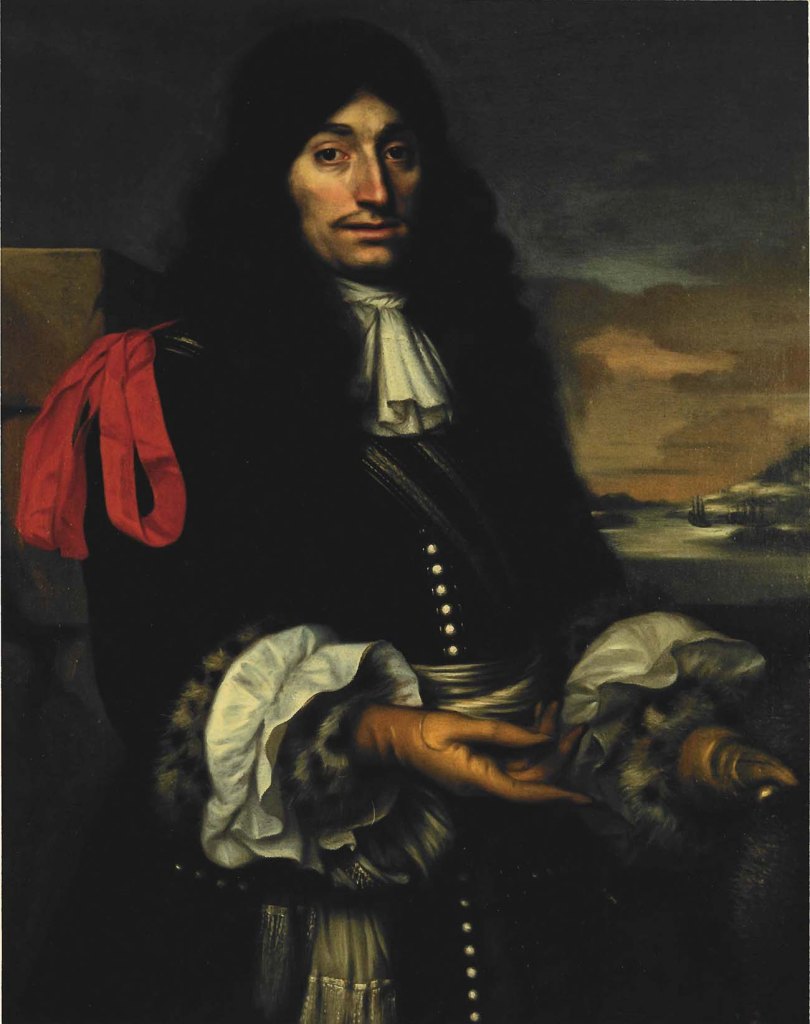
Shifting briefly to other “Captains Hook,” the most notable is Roger Tressady, also Black Tressady, of the Iron Hand in Jeffery Farnol’s novels Black Bartlemy’s Treasure and Martin Conisby’s Vengeance. Classics of pirate literature, the novels tend to be better-known in the UK than the US. The character is clearly inspired by Barrie’s Captain Hook.

So, historical other popular fiction digression aside, where might J. M. Barrie had had his inspiration? Almost certainly from the following passage in Alexandre Exquemelin’s 1684/85 edition of The Buccaneers of America. For centuries a bestseller, there is little if any doubt that Barrie read the book. If you had any interest in pirates or maritime history in general, you probably read it. It’s been decades since I first read the passage below, but it immediately struck me as the inspiration for Hook’s hook and crocodile…

“Yea, we ourselves, desirous to revenge the disaster of our companion, went in troops the next day to the woods, with design to find out crocodiles to kill. These animals would usually come every night to the sides of our ship, and make resemblance of climbing up into the vessel. One of these, on a certain night, we seized with an iron hook, but he instead of flying to the bottom, began to mount the ladder of the ship, till we killed him with other instruments.”


So there we have it: crocodiles eating pirates, a buccaneer ship with a crocodile climbing it, and an iron hook used to defend against it! It’s but a small leap from here to Captain Hook and the crocodile who took his hand…

Copyright Benerson Little 2020, first published April 10, 2020, last updated November 20, 2022.

Fortune’s Fool: Swordplay in the Time of Pestilence

Set amidst the 1665 London plague, Fortune’s Fool by Rafael Sabatini spins the tale of an English officer, Colonel Randal Holles, too often abandoned by the goddess Fortune.
It’s not Sabatini’s best work, but it’s an enjoyable read and, in particular, it clearly show’s his worldview: one romantically cynical, in that he understood well the foolishness and fecklessness, even the depravity and cowardice, of much of humankind, while simultaneously asserting that good can, and often does, triumph in the end.
Sabatini understood that to succeed honorably, even nobly in such a world, one needed not only courage, but wit as well. And it never hurt to have a sharp sword too.

In particular, the novel, whose details are almost certainly drawn from Daniel Defoe’s A Journal of the Plague Year (1722) and the Diary of Samuel Pepys, shows numerous parallels with today’s Covid-19 pestilence. After all, people don’t change. They lie, they deny, they seek supernatural counsel, they indulge in quackery, they hoard, they exploit, they scapegoat, they profit from the death of the members of some groups over others.
And yet, many rise above the baser nature of humanity, and behave nobly, with great courage and sacrifice.

And, romance though it is, Fortune’s Favorite shows this hopeful, uplifting side of humanity amidst death and the panicked fear of it. Even so, and sadly, our modern experience with the Covid-19 pandemic has proved Sabatini, not to mention historical chroniclers, too accurate in their descriptions of humanity in time of a deadly pandemic.

The protagonist is based on Gervase Holles (1605 – 1675) and his family. Plot details concerning widows and profane exchanges appear to be based on those of his father, Frescheville Holles (1575- 1630), but Randal himself is likely based on Gervase’s son, Sir Frescheville Holles (1642 – 1672). Sir Frescheville, originally an officer of militia and afterward a privateer captain, was, similarly to the narrative in the book, appointed to the navy thanks to the patronage of George Monck, Duke of Albemarle. Sir Frescheville, commanding the HMS Antelope, lost an arm at the Four Days Battle, was knighted afterward, became Member of Parliament for Grimsby, later mayor of Grimsby, and was made a Fellow of the Royal Society. He was killed in action in 1672 while commanding the HMS Cambridge at the Battle of Solebay. There was no real Randal Holles by name. Futher, no Holles appears on the death warrant of King Charles I, unlike in the book, given that the real Holles family were supporters of the royal prerogative, not Parliamentary rebels against the king.
Finally, and notably, the novel has an excellent description of swordplay in action too!

Copyright Benerson Little 2020. First published March 30, 2020. Last updated February 18, 2021.

Captain Blood: His Odyssey–A Near-Century of Dust Jackets & Trade Covers
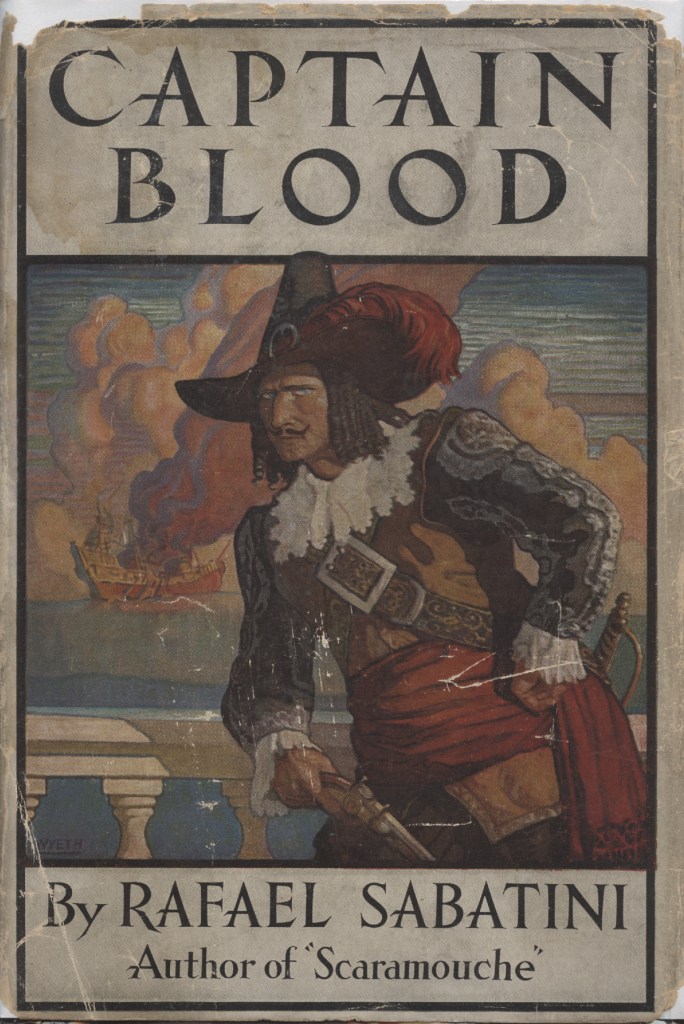
Associated with our announcement of the creation of Treasure Light Press and the forthcoming publication of its first title, Captain Blood: His Odyssey by Rafael Sabatini, The 100th Anniversary Annotated Edition, here’s a look at Captain Blood dust jackets over the years!
In a future post I’ll cover trade and mass market paperback covers.
The dust jacket of the first hardcover edition above is iconic, if not entirely historically accurate, but then, fiction book cover illustrations almost never are. Artist and illustrator N. C. Wyeth–a student of Howard Pyle–does, however, well-conveys the color and swashbuckling adventure of the novel.
Notably, as in many of the dust jackets below, Captain Peter Blood is sporting a mustache. However, only in the magazine serial, “Brethren of the Main,” published prior to the release of the novel, does he wear one. In the novel he does not. The Wyeth illustration has been used in numerous subsequent editions.
Also notably: according to authors Jesse F. Knight and Stephen Darley (see below), Captain Blood did not reach the bestseller list the year it was published. (See the end of the blog for a few notes on identifying true first editions.)

In 1924, Vitagraph motion picture studio released a silent version of Captain Blood, of which only thirty minutes unfortunately still survive. Starring J. Warren Kerrigan–a poor choice if his personal character were to be compared to that of the fictional hero of the book, for he was no Peter Blood nor even an Errol Flynn–the film did much to further promote the novel. In fact, the novel was printed in full or in part in hundreds of newspapers as part of the studio campaign.

The illustration above is not a dust jacket, but the cover of the Astor Theatre program for the 1924 version of Captain Blood, starring J. Warren Kerrigan. The program art is based on the design of the novel’s 1922 US edition.

A UK photoplay edition associated with the 1924 Vitagraph film. Again, Peter Blood sports a mustache he doesn’t have in the book. His costume, however, maintains a fair degree of historical accuracy. The cover illustration is the same one used in the original UK (Hutchinson) first edition. As with the Wyeth illustration, this one has been used in full or in part for numerous subsequent UK editions.

In 1927 a Riverside Press edition (Houghton Mifflin) was published with the dust jacket above, and remained in print for at least twenty-five years. Both the dust jacket and the four illustrations inside are by Clyde O. Deland, the most impressive being that of the cover and perhaps of Col. Bishop being forced to walk the plank, and the least being that of the famous duel on the beach–it looks rather stilted and lacks the dynamism of Howard Pyle and N. C. Wyeth duel impressions. The illustrations are above average for historical detail. I’ve seen a simple drawing in black, based on the illustration, on the front hardcover of some library editions.

In 1929 a German edition was published. Mine has small notes in pencil regarding historical personages and such–Rafael Sabatini’s books have a knack for inspiring the study of history. I’ve often wondered how this reader, assuming he or she read it prior to WWII, regarded the rise of German authoritarianism and dictatorship–and the rise of the Nazi party–in light of the very opposing values of the novel.

A quasi-photoplay edition was published in 1935, timed with the release that December of the famous film that also made Errol Flynn a star. By quasi I mean that its end papers are illustrated with scenes from the film. There are no images placed within the pages, however. The cover is copied from a hard-to-find publicity still from the film, shown below.


An identical dust jacket, lacking only the film information, was also released around 1935 or soon after. I’ve seen this dust jacket on Grosset & Dunlap editions with and without the end papers from the film. Notably, all Grosset & Dunlap editions with this jacket have a statement on the front flap or back cover that it is a reduced price edition, made possible by using the original plates and the author accepting a reduced royalty. I’ve also seen library editions (no dust jackets) with a simple drawing in color, based on the image above, on the hardcover, and I’ve seen the full image itself also used.

Newspaper ad for the 1935 film, showing a US edition dust jacket with Errol Flynn. This jacket was never actually produced.

Dustjacket depicted in the trailer for the 1935 film version. As with the previous jacket, it is an advertising creation and was never printed.

Hutchinson in the UK also published an edition timed with the release of the “new talkie film.” It has no images from the film in the book itself.

Appropriately, given that Peter Blood was half Irish and considered himself an Irishman, an Irish language edition was published in 1937. The text font is beautiful. Sabatini, as did and do many writers, put his pirate hero in boots. In fact, mariners in this era did not wear riding boots–which is what the myth has pirates wearing–aboard ship, or even ashore–unless mounted on a horse.

Below, a heavily-abridged Hachette French edition with a very French cinema-looking Peter Blood on the front.

A rather youngish-looking (definitely not in his thirties) Captain Peter Blood on the dust jacket of the 1973 edition published by Hutchinson Library Services Ltd in the UK. Purists will note the incorrect grip on the smallsword.

Given that both of my fencing masters (Dr. Francis Zold, Dr. Eugene Hamori) were Hungarian, it’s appropriate that I’d have at least one copy in Hungarian to honor these swashbucklers!

There are numerous Russian editions of the novel, many of them well-illustrated. This is not a dust jacket per se, but the printed cover of a hardcover dual edition: Captain Blood: His Odyssey and The Chronicles of Captain Blood (aka Captain Blood Returns in the US).

Above, another softcover I’ve included for interest (and because it doesn’t quite fit with the “Mass Market” editions blog either). From Albania, 1974, a severely abridged version stripped down to eighteen chapters, and all of them cut down to a few pages.

The cover of the Easton Press leather edition. The ship is of a later period and Peter Blood is wearing boots, as in the novel but not as he would have in real life–again, unless he were about to mount a horse or had just dismounted…

Last, my favorite recent hardcover edition. In Spanish, it’s well-illustrated with line drawings, and its design does justice to the story.

Dust jacket illustrations, collectible and evocative as they are, are there for a reason: to induce the potential reader to buy the book. And no matter how appealing they are, they pale when compared to the actual text. A battered old library copy sold for a buck at a yard or library sale is still a great read.
Of course, that hasn’t stopped me from collecting a variety of editions with dustjackets!
Captain Blood First Editions
A quick word of warning to those of you who collect books, especially those looking for first editions. Later editions or printings of Captain Blood are often listed, sometimes mistakenly, sometimes purposefully to deceive, as true first editions. It is easy to mistake later editions for firsts, given that many editions list the original publication year–1922–but not the year of the later edition or impression. For example, both the 1922 first and the 1924 US photoplay state 1922 as the year, but I’ve often seen the 1924 listed as a true first, as I have later editions. I’ve even seen the 1924 photoplay with dustjacket listed as a first for over $1,700–a terrible ripoff, were anyone to pay this much. I acquired both of my similar copies for under $50, and at the time the over $1,700 priced edition was listed (January 2021), so was a $40 edition with dustjacket and in similar condition. Unfortunately, even editions published in the 1930s typically list only 1922 as the year of publication.
Notably, true firsts have the first dust jacket shown above, and list both the year 1922 AND the month and the year of all impressions, except for the first impression, up to the date of the published edition. For example, the eleventh impression of the first edition lists the dates of the second through eleventh impressions, the last given as “ELEVENTH IMPRESSION, OCTOBER 1924.” The dust jacket spine lists the printing, for example, “Twelfth Printing” for the eleventh impression.

For more information on identifying firsts, see The Last of the Great Swashbucklers: A Bio-Bibliography of Rafael Sabatini by Jesse F. Knight and Stephen Darley (New Castle, DE: Oak Knoll Press, 2020), and also “Collecting Rafael Sabatini” by Jesse F. Knight in Firsts: The Book Collector’s Magazine (March 2001, Vol. 11, No. 3).
True firsts in fine or near fine book and dust jacket conditions (very rare!) command large prices, so if you’re looking to buy one, make sure that’s what you’re actually getting. Especially beware of firsts whose dust jacket is actually a modern–and usually so noted–reprint. They’re typically much over-priced. For example, I’ve seen a near-fine original first without dust jacket, which can often be found for $25 or less if you’re patient, combined with a $25 reprint dust jacket–and listed for a few hundred dollars. It’s a ripoff. It’s the original dust jacket, or author signature, or both, that command the great prices.
Copyright Benerson Little 2020-2022. First published February 12, 2020. Last updated November 15, 2022.

Swordplay Aloft: A Fictional But Entirely Enjoyable Pirate Trope

Cutthroat Island finale, Morgan Adams (Geena Davis, right) versus Dawg Brown (Frank Langella). Carolco, 1995.
Originally written in advance of my forthcoming series on “The Duel on the Beach,” here’s a fun look at the Hollywood trope of swordplay in the rigging.
We can probably blame Robert Louis Stevenson’s Treasure Island for the trope’s ultimate inspiration. In the novel [Spoiler Alert!], Jim Hawkins climbs aloft aboard the schooner Hispaniola to escape the murderous pirate Israel Hands, ultimately burning the salty thug’s brains with a brace of pistols. Why the hungover, perhaps even still-besotted, sea-thief didn’t simply use a musket to murder the lad is unknown. Perhaps he was too fogged by rum to think of it, or he didn’t have a musket at hand, or knew he wouldn’t be able to hit the bold lad. More likely, it’s simply a much better scene to have a murderous pirate armed with a knife slowly climb aloft while his victim waits at the extreme point of retreat.

“One Step More, Mr. Hands” by N. C. Wyeth for the 1911 Charles Scribner’s Sons edition of Treasure Island by Robert Louis Stevenson.
Doubtless inspired by Treasure Island, Charles Boardman Hawes includes a scene of fighting aloft in his Newberry award-winnning novel, The Dark Frigate.

But the primary origin of the trope, whether for Mr. Stevenson or Hollywood in general, is almost certainly the simple fact that the masts and rigging are too enticing not be used: a vast network or “jungle gym” overhead with boundless possibilities. It’s simply impossible to ignore the setting towering aloft above a vessel’s decks. It’s a nautical gymnasium begging to be used! And so it often has.
Before going further, we should quickly examine what sailors did, and still do, aloft. They set, take in, and furl sail. They hoist spars and masts aloft, and strike the same as necessary. They stand lookout. They man the tops in battle, enabling armed seamen to fire on the enemy below. They make repairs. They skylark.


Although fighting aloft was routine–men firing from above at men below–there’s no evidence of anything other than with firearms, grenades, and sometimes swivel guns occasionally fired at the enemy also aloft. No swordplay on yards, in other words. Note that in the painting below, no one aloft is wielding a sword, nor are there lines rigged from which to slide down or swing across (another popular but false Hollywood pirate trope). However, note the third image below in which two seamen slide down a forestay.
Actual fighting aloft would look something like this:


The painting just above, although it has many accurate details (including the grappling hook hanging by chain from the yardarm (although it should have two lines attached), appears to be rather romanticized, with seamen sliding down a forestay, another with his cutlass between his teeth, apparently having just slid down the stay, details lacking in the previous two images. Doubtless seamen did slide down stays during routine operations, but during action?
Moving on to film, the earliest scenes of swordplay aloft I’m aware of are those in the 1924 silent version of Peter Pan: a brave Michael — played by Phillipe de Lacy, six or seven years old! — climbs the shrouds after a pirate. The entire melee of lost boys, John, and Michael versus pirates is extraordinarily well-choreographed, far superior to the hack and slash knife sharpening melees of most pirate films, even those with well-choreographed duels between hero and villain. The quality here is no surprise: Henri Uyttenhove was the fencing master and choreographer. The children’s fencing and enthusiasm is a joy to watch.


Even so, when it comes to film, The Black Pirate (Vitagraph, 1926) starring Douglas Fairbanks set the standard for action aloft–but not for swordplay aloft, of which it alas had none. The film included circus-like aerial stunts and a famous scene in which Fairbanks slips a sword or dagger into a sail and slides down its face, cutting the canvas as he does. The stunt was repeated in Against All Flags (Universal-International, 1952), The Goonies (Warner Bros., 1985), Peter Pan (2003 & 2023) and Pirates of the Caribbean: Dead Man’s Chest (Disney, 2006), although in the the last film it appears heavily CGI’d, and may have been in the 2023 Peter Pan as well.


In Captain Blood (Warner Bros., 1935) starring Errol Flynn, the action aloft is more mundane, although it does include some brief swordplay, and includes a lesser trope: pirates sliding down on ropes during boarding actions, swinging from ship to ship, and occasionally from yard to yard, none of which actually occurred to ship to ship combat. Still, it’s fun.


In Double Crossbones, a 1951 Universal International Pictures pirate comedy starring Donald O’Connor (and from which Disney borrowed some scenes and character development for its pirate franchise), O’Connor as pirate Danny Crandall duels aloft with John Emery as Governor Elden of Charleston, South Carolina. At one point, Hope Emerson as Mistress Anne Bonney hoists him aloft a few times, almost Peter Pan-fashion) to avoid the governor’s cuts and thrusts. One wonders if this inspired Disney’s dueling aloft in its 1953 Peter Pan (see below), although the trope is an obvious one. Even so, I’ve yet to find an illustration of Peter Pan and Captain Hook dueling aloft prior to the 1953 film.
In the end, the governor falls off the yard into the sea; good guy Danny Crandall, who spends much time in the film fencing with broomsticks and candlesticks, is allowed to avoid running his enemy through. Several scenes in the film, and Crandall’s character as well, inspired scenes in Disney’s The Pirates of the Caribbean: The Curse of the Black Pearl.
Notably, John Emery starred as one of the villains in The Spanish Main (1945). In the finale he falls to the sword of Paul Henreid as Captain Nicolas Van Horn, even though Emery was the far superior fencer (although when he first picked up a sword in The Corsican Brothers he knew little if anything — clearly Fred Cavens taught him well). Basil Rathbone could commiserate.


In Against All Flags (Universal International, 1952) Errol Flynn as Brian Hawke climbs aloft via the lubber’s hole (for shame!) to cut down the main-yard. He’s lucky the pirates were lazy, otherwise the yard would’ve been slung with chain in time of battle and his rapier of little use in cutting through. When he sees pirates coming at him from aloft and alow, rather than fight them he escapes instead, using Douglas Fairbanks’s famous technique. The film was remade, almost scene for scene, as The King’s Pirate (Universal, 1967), but an acrobatic escape was substituted for the sword-in-sail trick. Against All Flags was one of Flynn’s last films, certainly one of his last good ones (arguably a tie among these last films with Crossed Swords, The Master of Ballantrae, and a more serious film, The Warriors). Against All Flags also starred Maureen O’Hara in her last swashbuckler. She’s as dashing as Flynn in the film, and as good if not better with a sword.


The Crimson Pirate (Warner Bros., 1952) showcased Burt Lancaster’s acrobatic skills aloft, but lacked swordplay. That said, the antics aloft in the finale are real, not CGI’d, and far more spectacular than anything done before or after, arguably superior even to the gymnastics of Douglas Fairbanks in The Black Pirate:

Disney’s Peter Pan (1953) had plenty of action aloft, including an homage to Treasure Island:

But the real action was between Pan and Hook on the main-topsail yard:

And also in Return to Neverland (Disney, 2002):

The action is included on the Disney theme park attraction:

And even in the Disney theme parks Fantasmic! show:

The trope also made it into a series of Dominica Peter Pan postage stamps in 1980, shown below as a Disney pin:

Hallmark has even introduced (July 2023) a 70th anniversary ornament with Pan and Hook swordplay aloft!

Peter Pan (2003) even included a brief homage to the slide down a sail by cutting it. Here, Hook uses his hook to do the deed. Nearly all of the swordplay aloft was literally in the air, given that Hook was permitted to fly in this version, at least in the finale.

Disney added the same classic pirate trope to its 2023 live action, and rather disappointing, at least in script, sets, and settings, version of Peter and Wendy. A cool move, but unnecessary, as above, given that Peter can fly — unless he’s briefly lost his ability to do so.

The Goonies (1995) reprised the sliding down the sail with cutlass or dagger stunt, first on a television in a scene created on set and added ostensibly to Captain Blood watched by Sloth, then near the end of the film when Sloth slides to the deck of the Inferno, Chunk on his back. In the recent Lego build of The Goonies, which includes ship and major scenes, the sliding down the sail scene is recreated.


But it was Cutthroat Island (Carolco, 1995) that did it’s best to include a sword fight in earnest on a yard aloft. The film was a box office bomb. Even so, Geena Davis did a creditable job, the soundtrack is excellent, and it has earned a deserved cult status as a guilty pleasure, so much so that a 4K release is available.


Even Shaggy and Scooby Doo got into the action aloft in Scooby Doo! Pirates Ahoy! in 2006.

Not to be beat by previous adventure aloft, and surely as an homage too, Disney’s Pirates of the Caribbean: At World’s End (2007) included swordplay between Davy Jones and Jack Sparrow on a yard aloft during a storm while dueling ships were whipped around at the edge of a giant maelstrom:

Tales of Monkey Island (2009), a five chapter sequel to the previous Monkey Island games, includes swordplay aloft during the opening puzzle of Chapter 2.

The Adventures of Tintin (Columbia Pictures et al, 2011) featured animated if improbable-but-exciting swordplay aloft:


Swordplay, or at least swords, aloft has continued in recent pirate films. Below is Son Ye-jin as Captain Yeo-wol in The Pirates (Harimao Pictures, 2014), engaging in aerial swashbuckling.

The trope made its way even into the recent Thugs of Hindostan (Latina Pictures, et al, 2018), a pirate-ish, Bollywood, stick-it-to-the-English Indian film:

Action aloft also made its way onto television in the form of the final episode in season four of Black Sails, in a scene in which I, as historical consultant, not to mention as a swordsman of nearly fifty years and a fencing teacher for nearly thirty, had some input.

But the trope has found its way into more than just film. A significant but largely unstudied contribution to pirate culture is that of various collector’s cards: tobacco, bubble gun, and arcade. Typically inspired by popular illustration, film, and general cliché, the cards often include images of swordplay and other fighting aloft, invariably via contrived circumstances often involving pirates or merchant seamen attempting to escape aloft. In the 1930s card just below, failed mutineer-pirates retreat aloft to little avail.


Below, in a 1930s Holloway Pirate Treasure trading card, merchant seamen flee aloft to make their last stand, again to no avail.


Below, a Swedish/French bubble gum card dating to the 1930s. This time it’s not a merchant seaman retreating aloft, but a duel over the plunder on a night “full of stars, the air calm, the sea tranquil.” One of the pirates, Mulrooney, has hidden a brace of pistols in the rigging. He drops his cutlass and climbs aloft, followed by his armed adversary Hawkins. Mulrooney, in most dishonorable fashion–even for a pirate–arms himself with his hidden pistols and shoots Hawkins dead.


Comic books are another significant source of modern pirate culture, and like the cards above they typically reinforce existing tropes. Below, Yellow Beak and Black Pete cross cutlasses (or rather, knife and parrot cutlass) in “Donald Duck Finds Pirate Treasure!” (1942, from an original film concept that was never green-lighted).

Below, the sword fight is on the bowsprit, one man armed with an anachronistic rapier (unless he’s an Iberian or perhaps an Italian under Spanish rule) with quillons in the wrong place, the other armed with an anachronistic “soup ladle” cutlass.

And it’s even made it to a book cover!

And even onto a 1000 piece puzzle!

But just how easy would it be to fence aloft on spars? It wouldn’t be. By way of experiment I’ve attempted footwork on a balance beam, much as in the photograph below but with much less danger. At first it’s not easy to maintain balance and any “fencing” done is best done by way of slow choreographed movements. Put simply, I fell often, more even than the time more than forty years ago a friend and I fenced with sabers at midnight in New Orleans under live oaks on a carpet of acorns (it was a mast year). Still, after a bit of practice one can move conditionally well on a flat beam–but still not sufficiently to prevent a likely fall. A rounded spar would be much more difficult to fence upon.
Aerial fencing, usually on rooftops or on beams or scaffolding attached to them, and usually as stunts or photo opportunities, is not uncommon:


Any real fencing on a beam or spar would obviously quickly result in a fall. Many years ago I saw a fencing high wire act performed at the Ringling Bros & Barnum &Bailey Circus: it was composed of simple, if impressive, choreographed movements, as expected.

In similar fashion, the modern aerial troupe Pirates of the Colombian Caribbean performs a tightrope fencing act on tour, including this past summer at the Miami Seaquarium:


But could swordplay aloft have happened in reality? Even rarely? The answer is akin to that of the myth of buried pirate treasure. Did pirates bury treasure? No, although it’s possible to find a rare instance of a couple of shipwrecked pirates burying their plundered shares to keep other pirates from stealing it. Further, it’s possible to imagine a rare similar but more significant exception, for example the shipwreck of pursued pirates who bury their plunder to prevent a pirate hunting landing party from finding it. But there’s no evidence anything like this ever happened. Similarly, there’s no evidence of swordplay aloft among pirates or anyone else at sea, as thrilling and pregnant with possibility the prospect is. Even so, it’s possible to imagine a rather contrived, but still possible, circumstance. Hollywood does it all the time.


Copyright Benerson Little, 2019-2025. First posted September 18, 2019. Last updated November 27, 2025.

The Myth of Sharp’s Buccaneers, the Wreck of the Santa Maria de la Consolación, and Isla de Muerto

The account of events is easy to find on the Internet: while on her two thousand mile voyage along the Pacific coast of South America in the spring of 1681, the Spanish merchantman–possibly a galleon, but likely only in the sense that any Spanish treasure ship might be known as a galleon–Santa Maria de la Consolación was sighted by one or more pirate ships under the command of the notorious buccaneer Bartholomew Sharp.
The Consolación only barely escaped by slipping into Guayaquil Harbor, but in her haste she wrecked on Isla Santa Clara. The buccaneers came ashore and, furious that the treasure was lost, tortured several of the crew and beheaded two of them.
So notorious were the acts of the buccaneers, or so one version of the story goes, that the island became known as Isla de Muerto.
The story has almost everything Hollywood has led us to expect in a pirate story.
But there’s a problem with this tale, as is there is with much that evokes Hollywood expectations.
Almost none of it is true.

The Buccaneers & the Santa Maria de la Consolación
Yes, there was a shipwreck.
The Santa Maria de la Consolación did run aground and sink.
And yes, the Consolación’s captain, crew, and passengers had been concerned about the pirates in the region, and yes, the pirates were commanded by the famous Bartholomew Sharp, at least most of the time.
But that’s all the truth there is.
Neither Sharp nor any other pirates chased the ship, nor did they come ashore after the wreck, nor did they torture or behead any of the crew or passengers.
In fact, the captain, crew, and passengers of the Consolación never saw any pirates at all, much led fled from any unless you consider the definition to include their haste to complete their voyage in case they might see them.
Bartholomew Sharp and his ship the Trinity were far to windward at the time. Only two or three months later did he and his buccaneers even learn that the Consolación had been at sea, and conditions made it impossible to search for her even though the sea rovers were in the area of Guayaquil.
Time, distance, and other circumstances–Fortune–ensured that the Trinity would never cross paths with the Consolación. Nor would the buccaneers even learn of the shipwreck until long after she had wrecked.

According to buccaneer and author Basil Ringrose (1684):
“August 19 [1681]. This day our pilot [captured July 29, 1681 aboard the Spanish ship El Santo Rosario] told us that, since were to windward, a certain ship that was coming from Lima bound for Guayaquil ran ashore on Santa Clara, losing there in money to the value of 100,000 pieces-of-eight; which otherwise, peradventure, we might very fortunately have met with.”
In fact, the buccaneers had no great guns (cannon) aboard their flagship, the Trinity, while the Consolación had more than twenty of brass and iron. Unless the buccaneers could have boarded the treasure ship, the battle might easily gone to the Spanish.
Sharp’s voyage is by far the most well-documented of any buccaneer or pirate voyage in history, with some seven members writing full or partial accounts. Further, Spanish records quite thoroughly corroborate the buccaneer accounts, including dates and locations. There is no possibility of mistake: Sharp and his buccaneers never sighted the Consolación, much less chased her, much less abused her crew. Having written several books on the subject of piracy, including extensive research on the subject of Bartholomew Sharp, I’m in a pretty good position to know.
Of course, there may, however, have been a small number of buccaneers who might have been briefly in the area, but they never saw the Consolación either and in any case were in no shape to have chased or attacked her. They were sneaking their way back to the Isthmus of Darien after having “mutinied” and parted from Bartholomew Sharp, finding his behavior as a commander less than acceptable.
La Isla de Muerto
One of these “mutineers” (they really weren’t mutineers, for buccaneer articles permitted crew members to leave the crew, provided that they paid for their provisions) was William Dampier, soon to become famous for his travels and books. He did write about the wreck when, as a member of a buccaneer crew three years later, they hovered around Guayaquil.

According to Dampier, writing of 28 November 1684 in his A New Voyage Round the World, “It is reported by the Spaniards, that there is a very rich Wreck lies on the North-side of that Island [Santa Clara], not far from it; and that some of the Plate hath been taken up by one who came from Old-Spain, with a Patent from the King to fish in those Seas for Wrecks; but he dying, the Project ceased, and the Wreck still remains as he left it; only the Indians by stealth do sometimes take up some of it; and they might have taken up much more, if it were not the Cat-fish which swarms hereabouts.”
If we look at several of the Basil Ringrose and William Hack (or Hacke) charts of the Bay of Guayaquil, based on a captured Spanish derrotero, we learn that Isla Santa Clara was known as Isla de la Muerto not because there was a massacre there, but because it is shaped like “the corps of a man in a shroud.” Dampier also notes that “it appears like a dead Man stretched out in a Shroud.”

From this would derive not only the island’s nickname, but also the myth. An additional suggestion toward the myth may come from a line in a copy of another of Hack’s South Sea waggoners, shown in the image below. Sharp, however, never actually gave chase as attested by numerous buccaneer accounts and Spanish records.

In other words, the coins aren’t cursed Aztec treasure (wrong region anyway), or cursed by direct association with pirates who tortured the crew, or cursed at all unless you consider the coca chewing slave labor used in extracting the Potosí silver from the mines or in refining it with poisonous quicksilver.

Salvage Coins
And if there were no massacre, any marketing done to sell coins salvaged from the wreck is misleading. I own a few coins from the wreck and as I recall there were references to the massacre in the associated descriptions and apparently still are. Why does this matter? Because people buying the coins might want to know that, although there is a buccaneer association, it’s not as close as often advertised.
Yet the purported association lures buyers. In fact, some several or more years ago I purchased one of these wreck-salvaged pieces-of-eight from a reportedly reliable coin vendor on ebay as a memento. I’m not a big coin collector, and generally don’t care for salvage coins. Perhaps as few as two or three wrecks whose coins are available on the market have an indirect relationship to actual pirates or sea rovers, and most salvage coins are in poor shape as compared to many “land hoard” coins. I prefer coins that have been handled and used, not those that have lain for centuries at the bottom of the sea soon after being minted. In other words, I prefer coins with a long active history.
However, having written several times of Bartholomew Sharp and his South Sea buccaneers, I thought a coin or two from the wreck of the Santa Maria de la Consolación off Santa Clara Island in the Bay of Guayaquil would be in order, given its association with the South Sea buccaneers. I found a third one reasonably priced, from a reliable coin vendor with high ratings and thousands of transactions. The coin was not expensive, as eight reale pieces-of-eight go, and was priced in the lower end of the range. I did not examine it too closely before buying it, although I ran it past the images of forged pieces-of-eight on the Daniel Sedwick website. But when I received the coin I was perplexed. It appeared genuine, but there was no sea damage at all, nor did the coin match any description of any New World coin.
Eventually I appealed to Mr. Sedwick to evaluate the coin for me. The coin was genuine, as I thought, but was a common piece-of-eight minted in Spain, “Seville” as it was called by the English in America, and not one from the wreck of the Santa Maria. Further, as Mr. Sedwick pointed out to me in an email, upon close examination it was apparent that the certificate of authenticity had been forged. I hesitate to accuse the vendor I purchased it from of this, although as a professional he should have spotted it.

More curious, though, is what the certificate forger, not to mention criminal jackass, whoever he or she was, expected to get away with. Perhaps he or she intended to capitalize on the inexplicable (to me at least) preference for sea salvage coins over land hoard and circulated coins which are typically in much better shape, although not always. Whatever he or she intended, the coin’s pretended shipwreck status did nothing to increase its value. Comparable Spain-minted coins often go for more money than I paid for it. I lost nothing on the transaction except the coin as memento. Now it’s part of a display of three coins as examples of the three types of pieces-of-eight described by English merchants in the Americas: Mexico, Peru, and Seville, based on their origins.
Ebay is often criticized for failing to scrutinize its coin vendors enough, and buyers need to be careful when buying from anyone other than a highly reputable dealer who deals regularly in Spanish cobs. Mr. Sedwick’s book, The Practical Book of Cobs has good sections on buying coins and spotting fakes. Although an expensive book, readers should also review Sewall Menzel’s Cobs: Pieces of Eight and Treasure Coins–The Early Spanish American Mints and Their Coinages, 1536-1773. (However, I should note that as of the date of original publication of this post, even Mr. Sedwick’s page associated with this wreck incorrectly stated that the pirates tortured some of the survivors &c.)
A bit of advice: don’t simply accept any claims made on the Internet. Double-check them. Start with books on the subject, and especially look for citations. If there are no citations in an Internet article, or even a book, be highly suspicious. For that matter, be a bit suspicious even if there are. Check the citations: you might be surprised to learn how often citations don’t actually support the claim. (This is unfortunately true even in some PhD-level scholarship more often than it should be: most often it’s a deliberate omission or even outright deception by various academic ideologues.)
In the case of these coins, you’ll find not only that there really aren’t citations given at all to support the claims, but also that the descriptions are all very similar, often identical. In other words, they all have the ultimate incorrect source. And when you go looking for books to support the claim you won’t find any. So why hasn’t the story been changed, even though I’ve challenged it on the Internet for some years now, and in books as well? Even though no scholarly work on Sharp’s voyage mentions it? Even though the written accounts of the buccaneers themselves not only don’t mention it but dispute it?
Money.
The purported pirate association makes the coins more likely to sell, or so the thinking goes, and in some cases permits a higher price.
Still, none of the foregoing should devalue the coins as “pirate treasure,” including the fact that the buccaneers never chased the ship. Sharp’s voyage was epic, and these coins are what he was after. The Santa Maria de la Consolación, sailing alone, struggled to make it safely to port, in fear all the while of Sharp’s buccaneers. These coins are the closest pieces-of-eight readily available–and affordable–to what we would describe as “buccaneer treasure.”
Copyright Benerson Little 2019. First published February 13, 2019. Last updated April 5, 2019.
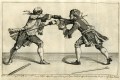
Fencing Quotations

Useful advice and commentary, by category, for swordsmen and swordswomen. I’ve collected these over almost fifty years from a variety of sources, ranging from books published over several centuries to fencing masters and even to my own observations.
Some of these quotations are repeated in my post, Fencing Salles & Fencing Commandments, along with other advice and commentary. Please note that the list below is not complete, and never can be. I will, however, update it as convenient.
Except where noted, the English translations from the original French are mine.
A long detailed list of fencing books can be found here.
On the Virtues of Fencing
“And moreover, the exercifing of weapons putteth away aches, griefes, and difeafes, it increafeth ftrength, and fharpneth the wits, giuith a perfect iudgement, it expelleth melancholy, cholericke and euill conceits, it keepeth a man in breath, perfect health, and long life. It is vnto him that hath the perfection thereof, a moft friendly and comfortable companion when he is alone, hauing but only his weapon about him, it putteth him out of all feare, & in the warres and places of moft danger it maketh him bold, hardie, and valiant.”
—George Silver, Paradoxes of Defence, 1599
“If you master the principles of sword-fencing, when you freely beat one man, you beat any man in the world. The spirit of defeating a man is the same as for ten million men.”
—Musashi Miyamoto, Go Rin No Sho (A Book of Five Rings), 1645. Musashi, Japan’s kensei or “sword saint,” fought and won more than sixty duels before retiring as a hermit to write his famous masterpiece on swordplay and strategy. Of course, what readers often miss is the implication: that you don’t have to have a brilliant understanding of the “Way” in order to fence well—Musashi himself admits that he didn’t understand the true Way until after he had fought all of his duels—but certainly it would help.
And in the West, a similar sentiment:
“J’asseureray que celui qui est instruit dans les armes, ayant du cœur, réussira contre cent mal adroits; j’entends l’un après l’autre, nullus Hercules contra duos.”
“I will assure that he who is instructed in arms, having a stout heart, will succeed against one hundred clumsy swordsmen; [yet] I hear often that there is no Hercules against two [other swordsmen].”
—André Wernesson, sieur de Liancour, Le maistre d’armes: ou, L’exercice de l’epée seule, dans sa perfection, 1686. My translation. The admonition that no one is a Hercules against two adversaries is often written as “No Hercules against the multitude.”
And yet…
“[B]ecause, when a vigorous and brisk Officer, hath perhaps Disabled or run one Enemy thorow, and is actually commanding [grappled with] of another; there steps in a Third, who endeavours to knock him on the head, or Cleave him down; for, Ne Hercules quidem contra multos.”
—Sir William Hope, A New, Short, and Easy Method of Fencing, 1714. Here Hope takes the opposite–and certainly more correct view, swashbuckling films notwithstanding–view that it is difficult, if not impossible or at least highly unlikely, to succeed against multiple adversaries attacking at once. Unlike in Hollywood where enemies are trained to attack one-at-a-time per the script, multiple adversaries tend to attack simultaneously. Hope suggests that the hanging guard might defend against two adversaries while a thick leather gauntlet in the non-dominant hand might defend against a third. But with offense comes at least one opening for the several adversaries…
“When you count all the benefits of swordsmanship, there are so many, encompassing the virtues of heaven and earth.”
—Yagyu Muneyoshi, 17th century, translated by Hiroaki Sato.
“So doeth the Art of Fencing teach us to defend our Bodies, from the Assaults and Attaques of all Adversaries, whether Artists or not, who in respect of the cruel designe they have against our Bodies, may in some sense be accounted Devils, it also teacheth us not to be deceived by the fallacious Quirks and Tricks of Artists when we are engaged with the which do represent the cunning subtile Allurements of the World.”
“[Y]et all Gentlemen should practice it, & have an esteem for it, if it were for no other reason but this, that it is a most pleasant divertissement, and an Innocent, Healthful, and Manly Recreation and Exercise for the Body, and although a Man could reap no Advantage by it for the Defence of his Body; yet that its very keeping a Mans joynts and members nimble and cleaver [clever], and in a ready trime [trim], as it were, for any other Divertisement or Exercise, as Tenice, Dancing, Riding, &e. should make it Esteemed and Practised by all who are above the rank of Clowns.”
—Sir William Hope, The Sword-Man’s Vade-Mecum, 1694
“Nothing can give a greater Lusture and Enoblement to the most Excellent and Bravest Persons, than an absolute and perfect Qualification in the true Knowledge and Skill in Weapons.”
—Zachary Wylde, The English Master of Defence, 1711
“Indeed I am perfectly of opinion, which is corroborated by numberless persons who have experienced the utility of fencing, that for the navy it should be considered as one of the most essential branches of a nautical education, and ought to be encouraged by Captains and Commanders as much as possible. The ship’s company should, every one of them, be compelled to understand the use of the sword familiarly, previously to their going abroad, and should continue practising it at all times on board; for they have, if possible, even more occasion for fencing than the army, because, in general, they are more frequently at close quarters with the enemy than the military are.”
—Joseph Roland, The Amateur of Fencing, 1809
“Glancing fearfully about, I took up the weapon, finding it play very light in my grasp for all its size; and having wielded it, I held it that the moonbeams made a glitter on the long, broad blade. Now as I stood, watching this deadly sparkle, I trembled no longer, my side fears were forgotten, a new strength nerved me and I raised my head, teeth clenched in sudden purpose so desperate bold indeed as filled me with marvelous astonishment at myself; and all this (as I do think) by mere feel of this glittering sword.”
“There remains then always your sword, friend Adam; with this you may win the fame, the fortune—or the grave so honourable. Ha, it is true, when all other fails, there remains always—the sword!”
—Jeffery Farnol, Over the Hills, 1930
“I would consider Laci Nedeczky as a role model, he is the type who has unfortunately already died out in the great scramble, where only business and money are important, and altruism is already on the wane…”
“Nedeczky Lacit példaképnek állítanám, ő az a típus, aki sajnos kipusztult már a nagy tülekedésben, ahol csak az üzlet, a pénz a fontos, és az önzetlenség már szűnőben van…”
—Dr. Francis Zold (Zold Ferenc) commenting on the 90th birthday of László Nedeczky in 2003. Fencing is often believed to instill great virtues, or at least it can. However, many observers have noticed a great diminution in the number of noble, altruistic fencers, alongside a diminution in the number of swashbuckling fencers and masters: often they were one and the same. Quoted in an article by Kö András.

Defining Fencing & Swordplay
“Fencing is neither art nor science. Fencing is fencing!”
—Dr. Francis Zold, personal communication, 1977
“Fencing—is speed!”
Eugenio Pini, quoted in László Szabó, Fencing and the Master, 1977
“The use of arms doth much differ in these times. I hear now the single rapier is altogether in use: when I was young, the rapier and dagger. And I cannot understand, seeing God hath given a man two hands, why he should not use them both for his defence.”
—William Higford, Institutions: Or, Advice to His Grandson, 1658
Mr. Higford makes an excellent point: the reality of real combat with thrusting swords is that the unarmed hand must come into play, if only in opposition in order to prevent angulations (various cavés, “carte over the arm,” &c), the appuntata (a remise made in tempo against a delayed parry), and other continuations and renewals of attacks and ripostes, not to mention to use in extremis as a parry or by grasping the blade or guard to defend oneself. Only in highly regulated formal duels—those of the 19th and early 20th century epee de combat, for example—may this practice be proscribed (and, of course, in sport fencing). See also Sir Wm. Hope immediately below.
“That if a good and dexterous Sword-man have no other design but Defence of his own Person, and not the Destruction of his Adversary’s also, that then his Sword alone, assisted by a judicious Breaking of Measure [retreating], is…sufficient to defend him: But again, if he design to Offend [attack] as well as Defend, then there is an absolute Necessity to make use of his left Hand for his Assistance; otherwise his Adversary, continually redoubling his Thrusts irregularly and with Vigour upon him, he shall never almost have the Opportunity of Thrusting, his Sword being in a manner wholly take up with the Parade, by endeavoring to make good his own Defence…”
“There is a vast difference, betwixt assaulting in a School with Blunts, for a Man’s Diversion, and engaging in the Fields with Sharps, for a Man’s Life; and whatever latitude a Man may take in the one, to show his Address and Dexterity, yet he ought to go a little more warily, and securely to Work, when he is concerned in the other: For in assaulting with Fleurets [foils], a Man may venture upon many difficult and nice Lessons, wherein if he fail, he runs no great Risque, and if they take not at one time, they many succeed at another: But with Sharps, the more plain and simple his Lessons of Pursuit [attack] are, so much the more secure is his Person; whereas, by venturing upon variety of difficult Lessons, he very much exposes himself, even to the hazarding of his Life, by his Adversary’s taking of Time, and endeavouring to Contretemps [an attack into an attack or a simultaneous attack, often resulting in a double touch], which are not so easily effectuat [sic, “effectuated,” i.e., “executed”] against a plain and secure Pursuit [attack].”
“[T]hat it clearly appears, that what goes under the Name of Graceful Fencing, is for no other use, but only for such, as, for Divertisement, counterfit a Fight with Blunts, who only Assault in the Schools with Foils.”
—Sir William Hope, A New, Short, and Easy Method, 1714
“And, though none might suspect it from his clumsy bearing, he is a noted swordsman.”
—John Dickson Carr, Most Secret, 1964. Many excellent fencers appear clumsy or ungraceful, or lack classical form.
“I enjoyed swordsmanship more than anything because is was beautiful. I thought it was a wonderful exercise, a great sport. But I would not put it under the category of sport; I would put it under the category of the arts. I think it’s tremendously skillful and very beautiful.”
—Basil Rathbone, interviewed by Russ Jones for Flashback magazine, June 1972. Modern “Olympic” fencing might be much improved if more fencers and their teachers took this attitude. Rathbone was without doubt the best of the non-competitive Hollywood fencers.
“Briefly, our method could be expressed in this sentence: ‘The best parry is the blow.'”
—Luigi Barbasetti, The Art of the Sabre and the Épée, 1936.
“The most efficacious means of fighting are offensive actions—above all attacks. In all weapons the majority of fencers score the largest amount of hits by attacks…”
—Zbigniew Czajkowski, Understanding Fencing, 2005
However, according to many of the French and derivative schools, old and new, note the following two quotations…
“…but also procures to himself the advantage of playing from the Risposte, which of all Methods of Fencing is the most commendable, and safest, but then, as I have said, it is only to such as are Masters of the Parade; which is a quality rare enough to be found, even amongst the greatest Sword-men.”
—Sir William Hope, A New, Short, and Easy Method of Fencing, 1714. In other words, the method of relying foremost on the riposte is ideal—but only if you have the rare ability of mastering it. My own preference is for a patiently aggressive balance of offense and defense, added to judicious use of second intention and feint-in-time actions which provide the opportunity to both attack and riposte. See especially the quotes on patience below.
“…on doit attendre l’attaque, CAR LA PARADE EST LE PREMIER DEVOIR…“
“…one must wait for the attack, BECAUSE THE PARRY IS THE FIRST DUTY…”
—Augustin Grisier, Les Armes et le Duel, 1847. My translation.
“It is more dangerous to attack than to parry. Instead of waiting you let yourself go. And the great difficulty is to know how to let yourself go far enough without going to far.”
—Baron de Bazancourt, Secrets of the Sword, 1900 (English translation by C. F. Clay of the original 1862 French edition.)
“Dans les salles on discute la valeur des méthodes; qu’il s’agisse de radaellistes (école réformée d’Italie) de méridionaux (obscurantists de l’antique école napolitaine) ou de pinistes, on donne á notre école cet avatage de ne pas exiger une musculature extraordinaire: un tireur italien doit être un hercule, un tireur français peut être…une femme.”
“In the salles the value of the methods is discussed; whether they are Radaellists (the reformed school of Italy [named for the famous Radaelli]), or Southerners (obscurantists of the ancient Neapolitan school), or Pinists [named for the famous Pini], we argue that our school has the advantage of not requiring extraordinary musculature: an Italian fencer must be a Hercules, a French fencer can be…a woman.”
—”Rapière,” “L’Illustration,” 28 May 1892
“La spada è acuta, pungente, affilata, forbita, fatale, formidabile, lucida, nuda, fina, forte, ben temprata, nobile, perfetta.“
“The epee is pointed, biting, sharp, forbidding, fatal, formidable, shiny, naked, fine, strong, well tempered, noble, perfect.”
—Agesilao Greco, La Spada e la sua Disciplina d’Arte, 1912
“Elle [l’épée] voltige, menace, pare, s’élance; elle se fait serpent et spirale, elle est tour à tour flèche ou cercle, couvre son chevalier et envelope l’ennemi.”
“She [the epee] flutters, menaces, parries, launches; she becomes a serpent and a spiral, she is in turn an arrow or a circle, she covers her knight and envelops the enemy.”
—Aurélien Scholl, in the preface to L’Art du Duel by Adolphe Tavernier, new ed., 1885. My translation.
“The genius of the French school is, of course, opportunist. In theory, every move of the adversary is acted on as it is made. The Italian fencer relies more on deductions from what has passed, and on premeditated schemes of attack and defence. Hence the diversity of the spirit in which the systems of opposition are conceived.”
“For the practical realist there is the duelling sword [the epee]; for the stylist there is the foil; for the imaginative and the artistic there is the saber. But some sense of reality, some sense of style, and some sense of artistry is essential to the practice of any one of the three weapons.”
—Percy E. Nobbs, Fencing Tactics, 1936. One might add the Hungarian school to his description of the Italian, given its heavy Italian influence and similar attitude toward tactics.
“La scherma, come l’aritmetica, no sopporta opinioni; essa è un fatto governato da leggi sicure, fisse, esperimentate, le quali se pure tollrano qualche leggera variante all loro forma esteriore, sogliono rimanere integre nella sostanza, perchè conducono sempre allo stesso, allo identico resultato. Insomma: la scherma nostra è come una bella signora la quale muti d’abito: la persona resta sempre la medesima.”
“Fencing, like arithmetic, does not tolerate opinions; it is a fact governed by sure, fixed, tested laws, which, even if they tolerate some slight variation to their external form, usually remain intact in substance, because they always lead to the same, identical result. In short: our fencing is like a beautiful lady who changes her dress: the person always remains the same.”
Eugenio Pini, Tratto Pratico e Teorico Sulla Scherma di Spada, 1904
“L’escrime est une science expérimentale, soumise à des lois immuables comme las physique et la chemie. Chaque movement y a son importance, sa signification, et on peut en verifier les consequences, les avantages et les inconvénients. L’escrime est une art; certaines natures, particulièrement douées, y sont parfois prepares, predestines; mais il faut s’appliquer assidûment pour atteindre à la perfection.”
“Fencing is an experimental science, which operates under immutable laws just as do physics and chemistry. Each movement has its importance, its significance, and one can verify the consequences, advantages, and disadvantages. Fencing is an art; certain natures, particularly gifted, are sometimes prepared, predestined, but it is necessary to apply oneself diligently to achieve perfection.”
—Dr. Achille Edom, L’Escrime, le Duel & l’Épée, 1908. My translation.
“L’art des armes ne consiste pas, contrairement à ce qu’a dit Molière, “à donner et à ne pas recevoir”; mais à ne pas recevoir d’abord et à donner ensuite, si l’on peut.”
“The art of arms consists not, contrary to what Molière said, ‘to give and not to receive,’ but at the outset to not receive and to give subsequently, if one can.”
“Il ne doit y avoir qu’une école d’escrime, celle qui prepare le tireur aussi bien pour l’assaut public que pour le terrain. En un mot, j’estime que l’escrime doit rester un art, mais il ne faut pas qu’elle demeure sans utilité pratique.”
“There must not be but one school of fencing, that which prepares the swordsman as well for the public assault [sport] as for the terrain [duel]. In a word, I deem that fencing must remain as an art, but it must not remain without practical use.”
— Anthime Spinnewyn, L’Escrime à l’épée, 1898. My translation.
“[I]l y a deux escrimes, l’escrime du fleuret et l’escrime de l’épée, l’escrime de la salle et l’escrime du terrain.”
[T]here are two forms of fencing, foil fencing and epee fencing, the swordplay of the club [sport fencing] and the swordplay of the [dueling] ground.
“N’est-ce pas là une indication de plus qu’il y a deux escrimes, l’escrime du fleuret, sport admirable, mais exercice de convention, et l’escrime à l’épée, méthode de combat?”
“Isn’t this more of an indication that there are two forms of fencing [with thrusting weapons], foil fencing, an admirable sport, but an exercise of convention, and epee fencing, a method of combat?”
—Arthur Ranc in the preface to Le Jeu de l’épée by Jules Jacob, 1887. My translation.
“Sur la planche, il suffit d’être plus fort aux armes que son adversaire; l’épée à la main in ne suffit pas d’être le plus habile, il faut aussi être le plus prudent et surtout le plus brave.”
“On the plank [piste, fencing strip], it suffices to have stronger technique than one’s adversary; [but] with a real sword-in-hand it does not suffice to be the most skillful, it is also necessary to be the most prudent and above all the most brave.”
—H. de Villeneuve, in the front matter to L’Art du Duel by Adolphe Tavernier, new ed., 1885. My translation.
“L’épée est une maîtrisse jalouse qui accapare ceux qu’elle a séduits. Elle prend son homme des pieds à lat tête.”
“The epee is a jealous mistress who monopolizes those she has seduced. She takes her man from head to toe.”
—Aurélien Scholl, in the preface to L’Art du Duel by Adolphe Tavernier, new ed., 1885. My translation.
“Jusqu’à ce jour l’Italie a représenté l’école romantique; la France, l’école classique.”
“Up to this day Italy has represented the romantic shool; France, the classical school.”
—Aurélien Scholl, in the preface to Deux Écoles d’armes: L’escrime et le duel en Italie et en France by Daniel Cloutier, 1896. My translation.
“Gallant bearing, disdainful valour, all that is very well in its way, ‘but the thing, Sir, is to hit your man without being hit yourself.’ That is the wisdom of ages.”
—Egerton Castle, “Swordsmanship Considered Historically and as a Sport,” 1903.
“But delightful as good foil-play is, both to performers and lookers-on, it is neither the real sword-fight nor even a reasonably complete preparation for it.”
—Charles Newton-Robinson in “The Revival of the Small-Sword,” 1905, in The Living Age.
“‘Henry Durie,’ said the Master, ‘Two words before I begin. You are a fencer, you can hold a foil; you little know what a change it makes to hold a sword!'”
—Robert Louis Stevenson, The Master of Ballantrae, 1889
De Meuse. — “L’assaut à l’épée de combat doit être l’image la plus complete possible du duel. Or, dans un duel, on ne donne jamais qu’un seul coup d’épée.”
Berger. — “Quelquefois deux et trois. Après une petite blessure on ne s’arrête pas.”
De Meuse. — “The dueling sword bout ought to be the closest image possible of the duel. However, in a duel, there is never only a single epee thrust [wound].”
Berger. — “Sometimes two and three. After a small wound one does not stop.”
—From the Troisième Congrès Internationale d’Escrime, 1908. The Congress was called to determine rules for fencing as sport. Unfortunately, the argument of M. De Meuse failed due to the opposition of foilists who dominated the Congress. They believed epee—the “modern school”—was largely degenerate as a separate weapon and that no special preparation was necessary. These gentlemen had already long since accepted the argument for sport fencing, based on foil fencing as an exercise in technique (much of it useless in actual combat), as something beyond combat and unnecessary to emulate it. In fact, foil had long been proved inadequate for actual combat. See the next quotation.
Renard. — “Nous avons tort de nous mettre dans l’idée que l’assaut est l’image du combat. Je fais de l’escrime comme sport et non pour me batter (marques generals d’approbation) et, autant que possible, pour faire quelque chose de bien. Il ne s’agit pas seulement de toucher.”
Renard. — “We are wrong to put forth the idea that the assault is the image of combat. I fence for sport and not to get battered (general marks of approval [from others]) and, whenever possible, to do something to benefit myself. Fencing is not only about getting the touch.”
—From the Troisième Congrès Internationale d’Escrime, 1908. M. Renard is correct that no bout or assault can be the image of actual combat; no training or practice can. However, from this point forward the idea of all fencing as entirely a sport pastime began to take root and was the death knell of sport fencing as the emulation of actual combat as opposed to sport fencing as pure sport. It’s only grown worse a century later, with foil and saber now entirely artificial. Epee too has it’s artificialities–all forms of swordplay do–but it remains far closer to actual combat than foil or saber, notwithstanding that in many epee exchanges both fencers are hit, even if only one touch is counted. My translation.
“In competition many irregularities occur in connection with the attack. More and more competitors abuse and exploit the incorrect attitude of the judges, who qualify as an attack every advance of the fencer done with invitation or blade lowered, that is, without a threat, although with great speed. Their judgement goes against the fencer who keeps distance to avoid a fleche, although he begins the actual attack with the threat of his weapon. This decision releases a very dangerous, evil “spirit from the bottle”, because–on the basis of the “end justifies the means” principle–more and more competitors depart from the correct, learnt path and abuse the situation. This endangers the entire foundations of fencing, especially of sabre, which rests on realistic conventions.”
“Education, persuasion and the setting of examples and even severe lessons must be used to put an end once and for all to these deviations which threaten the existence of fencing.”
–László Szabó, Fencing and the Master, 1977
The spirit and deviations are unfortunately, and almost unconscionably, long since out of the bottle, and have turned foil and saber into a mere game of tag, and even epee too. The solution is to enforce the convention of legitimate threats with the blade in foil and saber (as opposed to the ludicrous sophistry that substitutes today, permitting attacks in invitation aka “bent arm”), and in epee to lengthen the time within which a double touch may be made, the last of which would force epeeists to focus once again on the ideal of hitting and, importantly, not getting hit.
“The answer is easy. The great art of swordsmanship consists in laying successful snares, such as making your opponent expect the attack exactly where it is not intended. To deceive his expectations, to break up what he combines, to disappoint his plans, and to narrow his action; to dominate his movements, to paralyse his thoughts, represent the art, the science, the skill, and the power of your perfect swordsman…”
—Sir Richard Burton, The Sentiment of the Sword, 1911. Burton was a swordsman, explorer, linguist, scholar, spy, and translator of The Arabian Nights. He was the first non-Muslim to make the Hajj to Mecca, doing so in disguise. As a swordsman he was known as a fierce fighter, with numerous combats in the field.
“C’est une mine si féconde que cette lutte d’adresse, d’habileté, de science, de coup d’œil, d’énergie, de jugement, où toutes les facultés intellectuelles et physiques s’emploient à la fois et se viennent mutuellement en aide.”
“And after all the art of fence does furnish a most interesting fund of conversation—the art of skillful fighting at close quarters, which implies a knowledge of theory combined with a trained power of execution, which taxes eye and hand, vigour and judgment, and brings into play every faculty of mind and body, each doing its part, and each in turn supplementing and reinforcing the other.”
—Baron César de Bazancourt, Les Secrets de l’Épée, 1862. The translation is from the English edition, Secrets of the Sword, 1900, translated by C. F. Clay.
“[Early epeeists] were realists who preferred the romantic to the classic.”
—R. A. Lidstone, Fencing: A Practical Treatise on Foil, Épée, Sabre, 1952. Ever have I been a romantic realist.
“The real fun of fencing is in working out one’s own ruses: sometimes by inspiration on the spur of the moment in a hotly contested bout; and sometimes at leisure, in the watches of the night, for the discomfiture of some difficult opponent who has had the better of it during the day.”
“After a friendly bout is over one carries away the recollection of a few good things well done. It is easy, often too easy, to forget one’s discomfitures. Incidentally, both fencers have revealed their characters to one another, as well as their physical abilities and mental powers. To know is to understand; thus friendships are made.”
“The essence of the game [looseplay, free fencing] is to interest, not to overpower, one’s adversary, and to outwit with a well executed and theoretically fatal cut or thrust. Then, there is a good laugh; whether at one’s own expense or at that of one’s adversary, does not matter. It is by finding out how a hit was made, as much as by trying to make hits, that one learns what fencing means.”
—Percy E. Nobbs, Fencing Tactics, 1936.
“Not so, Anthony, my faith—no! Your murdering tool is cowardly pistol or blundering musketoon whereby Brutish Ignorance may slaughter Learned Valour and from safe distance. But, as Mind is greater than mere Body so is the rapier greater than any other weapon, and its manage an exact science calling not only for the strict accordance of hand, eye and foot, but for an alertness o’ the mind also.”
—Jeffery Farnol, Adam Penfeather, Buccaneer, 1940. Farnol was a fencer and his descriptions of swordplay are accurate.
MAÎTRE D’ARMES: …tous le secret des armes ne consiste qu’en deux choses: à donner et à ne point recevoir; et, comme je vous fis voir l’autre jour par raison demonstrative, il est impossible que vous receviez, si vous savez détourner l’épée de votre ennemi de la ligne de votre corps; ce qui ne dépend seulement que d’un petit mouvement de poignet, ou en dedans or dehors.
JOURDAIN: De cette façon donc, un homme, sans avoir du coeur, est sûr de tuer son homme et de n’être point tué?
MAÎTRE D’ARMES: Sans doute.
MASTER OF ARMS: …the entire secret of arms consists but in two things: to give and not to receive; and, as I demonstrated to you the other day, it is impossible that you will receive, if you have turned your enemy’s sword from the line of your body; and this depends only on a small movement of the wrist, either inside or outside.
JOURDAIN: In this fashion, then, a man, with no courage, is sure to kill his man and not be killed?
MASTER OF ARMS: Without doubt.
—Molière [Jean Baptiste Poquelin], Le Bourgeois Gentilhomme, 1673. One of France’s most famous playwrights, Molière is poking fun at both the bourgeois and at anyone gullible enough to believe that swordplay is a simple matter.
“…because whoever will be but at the Trouble to visit the Fencing-schools, shall scarcely see one Assault of ten, made either be Artists against Artists, or Artists against Ignorants, but what is so Composed and made up of Contre-temps [double touches resulting from an attack into an attack, or from simultaneous attacks], that one would think the greatest Art they learn, and aime at, is to strive who shall Contre-temps oftnest…”
—Sir William Hope, The Sword-Man’s Vade-Mecum, 1694. True then, true later, true today in all forms of swordplay. Notwithstanding modern idealistic classical and historical fencers who believe, via an imagined nostalgia, that the swordplay of past eras was more correct and useful for the encounters with real blades, Hope, not to mention close study, dashes this notion. Double hits are the bane of swordplay, and it is difficult to eradicate them entirely in both play and competition. And, given the large number of accounts of duels in which both antagonists were wounded in contre-temps or “exchanged thrusts,” it was clearly a problem in actual combat as well.
“It is a prejudice to think that swordsmanship is meant solely to slash an opponent. It is meant not to slash an opponent, but to kill evil. It is a way of allowing ten thousand men to live by killing a single evil man.”
—From the Heiho Kaden Sho (Family-Transmitted Book on Swordsmanship), seventeenth century, translated by Hiroaki Sato, 1985.
“The accomplished man does not kill people by using his sword; he lets them live by using his sword.”
—From Taia Ki (On the T’ai-a), seventeenth century, translated by Hiroaki Sato, 1985.
Courtesies
Far more courtesies and expectations of behavior than are given below may be found here: Fencing Salles & Fencing Commandments.
“The salute is an usage established in all the fencing schools, in order to preserve the politeness that we owe to one another.”
—J. Olivier, Fencing Familiarized /L’Art des Armes Simplifié, 1771. Note the phrase in all the fencing schools; the salute was generally not used in a duel or rencontre, at least not among the French and their disciples.
“It is a polite custom to salute your opponent with your blade before the bout, and to offer him your hand at the end.”
“Once the fencer has taken the guard position, he must be considerate of his opponent. Neither fencer must talk during the bout. Fencing requires the greatest possible attention, and this may not be diverted in any way or for any reason except by fencing tactics.”
“In fencing against an opponent who acknowledges your superiority, sportsmanship demands that you do not make the most of your advantages; rather should you assist his swordplay as much as possible, and avoid placing him in a painful or ridiculous position by over-emphasizing your superiority.”
—Luigi Barbasetti, The Art of the Foil, 1932
Note the phrase, “acknowledges your superiority.” You may in all honor and good form make the most of your advantages against a fencer who does not acknowledge your superior skill.
“Don’t show any sign of bad temper if you are the loser.”
“Don’t get conceited, or be haughty, if you are the winner.”
“Don’t forget always to be modest and courteous.”
“If your adversary should prove far superior to you, do not show discontent or bad temper; do not be disheartened, keep up your style and do your best, no matter how badly you may be beaten. Take your defeat in the right spirit, it will help to improve you; take it as a lesson you needed. Remain always the ‘correct gentleman.'”
“Not shaking hands with an adversary after a match or a rencontre is a great lack of courtesy, and should be reprimanded. Saluting an adversary previously to the beginning of a bout should be done before placing the mask on the head.”
—Félix Gravé, Fencing Comprehensive, 1934
“Une simple observation pour terminer: à l’épée comme au fleuret, le silence est de rigueur. La parole est aux armes, dit-on; c’est-à-dire que, seules, la tête el la main doivent agir.”
“A simple observation to end with: at epee as at foil, silence is mandatory. One lets the weapons speak; that is to say, the head and hand must act alone.”
—Claude La Marche [Georges-Marie Félizet], Traité de l’épée, 1884.
“No Scholar nor Spectator without a licence from the Master, should offer to direct or give advice to any of the Scholars, who are either taking a Lesson or Assaulting…First, because without permission they take upon them to play the Master; And secondly, because they reprove oft-times their Commerads for the same very fault they themselves are most guilty of, although perhaps not sensible of, which when By-standers perceive, they smile at them (and with just reason) as being both ignorant and impertinent; therefore it would be a great deal more commendable in them, to be more careful in rectifying their own faults, and less strict in censuring others.”
—Sir William Hope, The Fencing Master’s Advice to His Scholar, 1692
“Upon their first appearance upon the Stage, they march towards one another, with a slow majestick pace, and a bold commanding look, as if they meant both to conquer; and coming near together, they shake hands, and embrace one another, with a chearful look. But their retreat is much quicker than their advance, and, being at first distance, change their countenance, and put themselves into their posture; and so after a pass or two, retire, and then to’t again: And when they have done their play, they embrace, shake hands, and putting on their smoother countenances, give their respects to their Master, and so go off.”
—Richard Ligon, A True and Exact History of the Island of Barbados, 1673. Ligon is describing Portuguese African slaves brought to Barbados, who are fencing expertly with single rapier and rapier and dagger in the manner of Jeronimo Sanchez de Carranza. But for the respects to their “Master”–their owner–the description is a perfect one of how fencers should comport themselves during a bout, from beginning to end.

On Becoming a Fencer
“The way is in training.”
“The essence of this book is that you must train day and night in order to make quick decisions. In strategy it is necessary to treat training as a part of normal life with your spirit unchanging.”
—Musashi Miyamoto, Go Rin No Sho (A Book of Five Rings), 1645.
“For Fencing is an Art which depends mainly upon Practice, and who ever thinks to acquire it any other way, is I assure him mightily mistaken, and the more a man practice and with the more different humors, so much the better for him…”
“[S]o that let the greatest Artist in the World forbear but the Practice of it [fencing] for a twelve month, although I confess he can never loss [lose] the Judgement he hath acquired, yet he will certainly when he cometh to practice again, find his Body and Limbs stiffer, and his Hand and motions both for Defence and Offence, neither so exact, nor by far so swift, as if he had been in a continual Practice, I mean at least once a Week or Fortnight…”
“[T]here is as much difference betwixt taking a Lesson, or playing upon a Masters breast, and Assaulting or performing the same Lessons upon your Commerads, as there is betwixt the repeating of an eloquent Discourse already penned, and the composing of one.”
—Sir William Hope, The Fencing Master’s Advice to His Scholar, 1692
“Finally, Practice is the Marrow and Quintessence of the Art, for without that, a Papist may soon forget his Pater-noster; but by frequent Practice, a Man gains much experience daily, and is continually improving his Skill. This being the last Observation, and one of the chief, no Opportunities of Practising ought to be neglected.”
—Zachary Wylde, The English Master of Defence, 1711
“This being done, place yourself on the position of the guard, with a graceful, but unaffected appearance, animated with a brave boldness; for nothing requires a man to exert himself more than sword-defence, and it is as difficult to attain such an air of intrepidity without much practice, as it is difficult to become perfectly expert in the art.”
—Joseph Roland, The Amateur of Fencing, 1809.
“Si vous voulez devenir un véritable tireur, certainement il vous faudra de longues années de travaux, de méditations sévères, d’exercices incessants.”
“If you would be an accomplished swordsman, you will certainly require years of hard work, close application, and incessant practice.”
—César de Bazancourt, Les Secrets de l’Épée, 1862. The translation is from the English edition, Secrets of the Sword, 1900, translated by C. F. Clay.
And yet, reality too often sets in, past and present:
“Souldiers in a Battel or Attack, do not regularly alwayes observe this [correct] Method [of swordplay]: and most part thrust on any way, without troubling themselves much with the Tierce, Guart, or Feint; but make use of their Swords to attack or defend themselves, according to the small talent that God Almighty has given them.”
—Louis de Gaya, A Treatise of the Arms and Engines of War, 1678
“It was soon over. The brute strength, upon which Levasseur so confidently counted, could avail nothing against the Irishman’s practiced skill.”
—Rafael Sabatini, Captain Blood, 1922
“…and that, too confident of himself, he had neglected to preserve his speed in the only way in which a swordsman may preserve it.”
—Rafael Sabatini, The Black Swan, 1932
“[A] man can never be called a compleat Sword Man, untill he can Defend himself with all kindes of Swords, against all sorts his Adversary can choose against him.”
—Sir William Hope, The Compleat Fencing-Master, 1710.
“L’escrime est une maîtresse capricious et frivole; elle résiste longtemps à ses adorateurs, mais, à ceux qui ont su la posséder, elle reserve des joies incomparables.”
“Fencing is a capricious and frivolous mistress; she long resists her suitors, but, to those are able to possess her, she reserves incomparable joys.”
—Dr. Achille Edom, L’Escrime, le Duel & l’Épée, 1908. My translation.
“For double hits are misfortunes, verging on crimes, and it is not in the lesson, but in friendly looseplay that one must learn to avoid them; or at least not be to blame when they occur.”
“One wastes one’s time and opportunity in going fast with them and piling up a score of hits. If one resolves to give only hit for hit, but to be careful that all the hits one gives have been worked for with due preparation, the bout with the less expert can be very fruitful indeed.”
—Percy E. Nobbs, Fencing Tactics, 1936.
“Another advantage which single-stick possesses is that you may learn to play fairly well even if you take it up as late in life as at five and twenty; whereas I understand that, though many of my fencing friends were introduced to the foil almost as soon as to the corrective birch, and though their heads are now growing grey, they still consider themselves mere tyros in their art.”
—R. G. Allanson-Winn, Broadsword and Singlestick, 1911
“Look at what a lot of things there are to learn—pure science, the only purity there is. You can learn astronomy in a lifetime, natural history in three, literature in six. And then, after you have exhausted a milliard lifetimes in biology and medicine and theocriticism and geography and history and economics—why, you can start to make a cartwheel out of the appropriate wood, or spend fifty years learning to begin to learn to beat your adversary at fencing. After that you can start again on mathematics, until it is time to learn to plough.”
—Merlin speaking to Wart, in T.H. White’s The Once and Future King, 1958
“The more you understand fencing, the more you will enjoy it. This particularly applies to the novice for, like all highly skilled games, it is easy to be put off by the chore of having to begin right at the beginning.”
—Bob Anderson, All About Fencing, 1963. Mr. Anderson was a British Olympic fencer and Olympic coach who became Hollywood’s leading swordplay choreographer, following in the footsteps of Fred Cavens and Ralph Faulkner. The fencing in Star Wars, The Princess Bride, and Alatriste are but three of his many film works. He died in January, 2012, and was inexplicably and inexcusably left out of the In Memoriam tributes at the 2012 and 2013 Oscars.
“The next exercise that a young man shall learn, but not before he is eleven or twelve years age, is fencing…”
—Lord Herbert of Cherbury, 1624, quoted in J. D. Aylward, The English Master of Arms, 1956. The stated age at which to begin fencing is valid today. Although children can be taught earlier, it should be done as fun physical preparation for learning to fence, not instruction in fencing itself with the goal of competition. Unfortunately, youth fencing, often beginning as young as six years (or even younger!), is modern fencing’s cash cow; it pays the bills, and as such children are pushed into competition before they’re physically or psychologically prepared, leading to burn out. Over-pressured by parents living vicariously through their children and coaches looking for “champions,” they lose their love for swordplay or never come to love it at all.
“[G]enerally speaking, few persons, except those of liberal education, ever think of, much less learn, the Art of Fencing, and they, of course, are understood to be familiar with the French language.”
—Joseph Roland, The Amateur of Fencing, 1809
“To be in possession of what you know, you must be in possession of yourself.”
—le sieur Labat, L’art en fait d’armes, 1696, from Mahon’s translation entitled The Art of Fencing, 1734
“For, Anthony, he that would be a true sword-master must first be master of himself, then of his blade, so shall he be master of his adversary. You follow me, I hope?”
—Jeffery Farnol, Adam Penfeather, Buccaneer, 1940
“Well, a man is as he is trained.”
—Sir Arthur Conan Doyle, Micah Clarke, 1894
“Fencing, like other sciences, cannot be degraded to a mechanical art, that may be infallibly practiced by a receipt; nor can it be thoroughly and completely acquired by only reading a book on the subject.”
“At the same time, I earnestly caution the intelligent young amateur, before he adopts any of these new methods of executing the different movements, &c. in Fencing, to submit them to the test of the strictest examination, and to determine, if possible, how far they appear to be consistent with reason and practicability.”
“[T]he pupil, who I wish at all times to make use, but not too hastily, and without partiality, of his own judgement, and not upon every occasion to take for certain evidence any proposition upon the authority alone of a master, merely because he is a master, or that the same may be found in print.”
“They are shown both methods, and after a proper demonstration of their respective merits, I always leave it to their own judgment, to practise that which they find by experience to succeed best. It is on this principle alone I wish all my observations to be weighed. I detest the maxim of acting upon mere authority, without any convincing proof.”
—Joseph Roland, The Amateur of Fencing, 1809
“This is what made him a great coach: he taught strategy and tactics, not just attacks and parries. He taught you how to analyze your opponents, get inside their heads, figure out what they would do, what were their strengths and weaknesses. He taught you to have confidence in yourself, to work hard, to settle for nothing less than the best you could do. He knew how to coax, insult, and inspire his students to achieve ever greater heights of success.”
—Roger Jones, describing Lajos Csiszar in an article, 2000. Csiszar was one of Italo Santelli’s three protégés, and coached Dr. Eugene Hamori after he defected to the US during the 1956 Olympic Games (and after the Hungarian saber team won gold). From an article by Roger Jones, 2000. Jones was one of Csiszar’s US students as well as a member of the 1955 and 1957 US epee teams, an alternate to the 1956 Olympic team, a longtime AFLA/USFA/FIE official, a strong vocal opponent of gamesmanship and cheating, and, of course, like many male students of Santelli, Szabo, Csiszar, Zold, and Hamori, a gentleman and a swordsman. A US Navy Reserve Captain, an author, and an icon of the plastics industry, he passed away in 2014. As with most of my “old school” fencing friends and acquaintances, I had great conversations with him, from which I learned much. My favorite anecdote of his concerned an international fencer who once approached him to throw a bout to him, an unfortunately common practice at the international level, so he could advance. Roger had lost too many bouts to advance. Roger was incensed by the suggestion and defeated his adversary, denying him the ability to advance and putting him in his rightful place. Csiszar was elated: “You fought for your honor!”
“While training, the pupil should naturally practice and experiment ignoring for the time being the question of his powers of hitting, so that he can constantly enrich his knowledge and skills.”
“Fencing lessons built up systematically, practice under bout-like conditions, exercises “au-mur”, conventional exercises, exercises designed to parry attacks, bouts, systematic free fencing, unlimited bouts, bouts fenced until 5 or 10 hits [and today, 15] and competitive fencing constitute the framework within which the fencer can grow to the stature of a competitor.”
—Imre Vass, Párbajtörvívás, 1965, from the first English translation, Epee Fencing, 1976
“American fencers and coaches should understand and build their program on the fact that the coach’s role is only 10 percent of the total effort. Fencers must rely on themselves in training and in competition. Coaches should not try to ‘sell’ themselves to the students. Students must become independent.”
“[Smaller competitions are] ‘practice competitions,’ where the fencer does not necessarily have to win, rather, he should use a wide variety of his moves while checking and following his progress. On major competitions, the fencer should always try to win, and go all out to win, ‘even if he only has one move…'”
—Kaj Czarnecki, American Fencing, Jan/Feb 1980. Maitre Czarnecki, who passed away in 2018, was a Finnish Olympic epee fencer and fifteen time Finnish and Scandinavian champion, winning in all three weapons. He was a leading coach in Sweden, helped train Johan Harmenberg, and eventually became one of the epee coaches at the US Modern Pentathlon Training Center at Fort Sam Houston. I heard him make similar remarks during an epee clinic at the Mardi Gras Fencing Tournament in New Orleans that spring. Too few coaches take these views today, with the result that many fencers are anything but independent on the strip or elsewhere. Many coaches prefer to have their students bound too closely to them–and to take credit for their victories, if not always their losses.
“Always combine footwork with techniques being practiced.”
“Footwork and more footwork. Speed and more speed.”
“Develop these qualities
1. Smoothness 2. Ease 3. Accuracy”
“To find stillness in movement, not stillness in stillness.”
—Bruce Lee, from his notes on “Incorporating fencing principles,” quoted from Jeet Kune Do: Bruce Lee’s Commentaries on the Martial Way, compiled and edited by John Little, 1997. Bruce Lee studied both Western boxing and Western fencing, and incorporated some of their principles in Jeet Kune Do.
“[I]n the beginner’s mind there are many possibilities, but in the expert’s there are few.”
—Shunryu Suzuki. Zen Mind, Beginner’s Mind, 1970. That is, keep your mind open and don’t fall victim to your knowledge or success.
“Bonus homo semper tiro.”
“A good person is always a novice.”
—Derived from Martial XII.li.2. See Suzuki above.

The En Garde: Three Not Incompatible Opinions
“The bravest gentlemen of arms, which I have seen, were Sir Charles Candis, and the now Marquis of Newcastle, his son, Sir Kenelm Digby, and Sir Lewis Dives, whom I have seen compose their whole bodies in such a posture, that they seemed to be a fort impregnable. They were the scholars of John de Nardes of Seville in Spain, who with the dagger alone, would encounter the single rapier and worst him. This exercise is most necessary for you, and also excellent for your health.”
—William Higford, Institutions: Or, Advice to His Grandson, 1658
“This being done, place yourself on the position of the guard, with a graceful, but unaffected appearance, animated with a brave boldness…”
“In whatever attitude you may think it necessary to present yourself facing your adversary, if your mind is prepared to attack and defend, you will be, properly speaking, ‘on guard.'”
—Joseph Roland, The Amateur of Fencing, 1809
“In your en garde you must lean forward slightly and thereby appear to be always in motion, as if you are always attacking. When your opponent looks at you, he or she must believe you are constantly attacking no matter what you are doing.”
— Dr. Eugene Hamori, as best I recall, to me almost fifty years ago, and to my wife within the past ten.

On Patience as a Fencing Virtue: Epeeists, Take Heed!
“’Prevail by patience,’ is the motto of my house, and I have taken it for the guiding maxim of my life.”
—de Bernis, in Rafael Sabatini’s The Black Swan, 1932. The novel builds to a duel at the climax.
Patientia vincit.
(Patience conquers, to conquer or prevail via patience.)
—Old motto and the likely Latin version of the motto of Charles de Bernis, Sabatini’s hero in The Black Swan. Used by the Huntsville Fencing Club until replaced with the motto below.
Patientia ferox vincit.
(To conquer or prevail via a fierce or warlike patience.)
—Modification of patientia vincit based on my experience fencing and teaching fencing, for the Huntsville Fencing Club and Salle de Bernis, 2012
“Patience need not be passive!”
—To my fencing students, circa 2005 to the present.
“L’assaut en un coup demande de la prudence, mais non de l’inactivité.”
“An assault for one touch demands prudence, but not inactivity.”
—J. Joseph Renaud in L’Escrime: fleuret, par Kirchoffer; épée, par J. Joseph Renaud; sabre, par Léon Lécuyer, 1913. Compare with Patientia Ferox Vincit and “Patience need not be passive!” above. I discovered this quote in April 2013, proving, yet again, that there is little original in fencing, and none of us are as original as we think we might be.
“Errors of distance, overeagerness, foolhardiness and impatience, are faults for which every épéeist of experience is on the look-out in his opponent’s game. More, they are faults which the épéeist will try to bring about in the unwary swordsman.”
—Roger Crosnier, Fencing with the Epee, 1958. As or more important, in my opinion, than watching for or inducing these errors in the opponent, is preventing them in oneself.
“Patience is the first virtue of an épée fencer.”
—Luigi Barbasetti, The Art of the Sabre and the Épée, 1936
Notwithstanding the necessity of aggressive patience in epee, or in any dueling sword, with the introduction of a severe modern “non-combativity” rule that forces epeeists to fence aggressively–put simply, there must be a touch scored within a minute or there is a penalty–, the often foolish and feckless fencing powers-that-be are undermining the very essence of swordplay itself. Action in fencing is not composed of touches but of physical and intellectual maneuvering. Some of the most exciting bouts I’ve ever fenced or watched have had few touches scored. My wife and I often go eight or more minutes without a touch (eleven minutes once), and an old friend of mine, a truly classical epeeist, and I often go several minutes without a touch–and in both of these examples other fencers typically stop to watch. A lack of prodigious scoring doesn’t equate with spectator boredom. If it did, no one would watch baseball or soccer, or for that matter, golf. Why the rule change? It’s pressure from the IOC: if sports don’t draw enough spectators (i.e. advertising dollars), they’re out. Fencing officials, elite coaches, and elite fencers are abandoning fencing’s core values for the sake of the cachet of the Olympic Games, which in fact field only a small number of fencers as compared to the World Championships.
“A l’épée, il faut savoir attendre.”
“In epee, one must know how to wait.”
—Claude La Marche [Georges-Marie Félizet], Traité de l’épée, 1884. The translation is by Brian House from his excellent English version, The Dueling Sword, 2009
And yet…
“Never hesitate!”
—Dr. Francis Zold, personal communication during a lesson, 1978

Fencing Qualities, Techniques, & Tactics
“La fortune aidait souvent la valeur un peu téméraire.”
“Fortune often aids valor that is a bit reckless.”
—Capt. René Duguay-Trouin, Mémoires, 1741. Duguay-Trouin was a famous late 17th and early 18th century French privateer and naval officer who once captured a ship by boarding it, then engaging the enemy captain single-handedly, sword-in-hand, forcing him to surrender in the style of the great Hollywood swashbucklers. He was a duelist (bretteur) when young, and later brought at least one fencing teacher (a master’s assistant) aboard his ship in order to improve his crews’ fighting ability. He later had a rencontre in the street with the fencing teacher, a fight that was anything but academic. The quotation may derive from audentis fortuna iuvat, later written by Virgil as audaces Fortuna iuvat (Fortune aids the bold). Similar is the SAS motto, ‘Who Dares Wins.'” My translation.
“Dans le noble exercice des armes, ce n’est pas aux audacieux que sourit la fortune, mais aux persévérants.”
“In the noble exercise of arms, it is not the audacious that Fortune smiles upon, but on those who persevere.”
—Anthime Spinnewyn, L’Escrime à l’épée, 1898. My translation. Compare with Duguay-Trouin above, and with the admonitions of Francis Zold and Nobuo Hayashi below.
“Joignez dans le combat, la valeur à la prudence, la peau du Lion à celle du Renard.”
“In battle let valour and prudence go together, the lyon’s courage with the fox’s craft.”
—le sieur Labat, L’art des armes, 1696. The English is from Andrew Mahon’s translation, The Art of Fencing, 1734.
“The man in the periwig, whose every movement was as swift and light-footed as a cat’s, lowered the sword point.”
—John Dickson Carr, The Devil in Velvet, 1951
“Fencing without Judgement, is just like a Watch without a Spring, a Neat piece of Work with a great many fine Wheels, but without any Motion, the want of which maketh her useless.”
—Sir William Hope, The Sword-Man’s Vade-Mecum, 1694
“[T]he true Art of Sword-defence depends, in great measure, on judgement in deceiving the adversary’s motions, and in not being deceived by his.”
—Joseph Roland, The Amateur of Fencing, 1809
“For what are all strategems, ambuscades, and outfalls but lying upon a large scale?”
—Sir Arthur Conan Doyle, Micah Clarke, 1894
“Perhaps it would not be an exaggeration to say that the fencer’s skill in tactics is displayed to a large degree by the ability to mislead an opponent, to recognise the opponent’s intentions and to discern any attempts to be mislead.”
—Zbigniew Czajkowski, “Fencing Actions—Terminology, Their Classification and Application in Competition,” n.d.
“Double-dealing is the basis of swordsmanship. By double-dealing, I mean the stratagem of obtaining truth through deception.”
—From The Death-Dealing Blade, Yagyu Munenori, 17th century, translated by Hiroaki Sato.
“A duel, whether regarded as a ceremony in the cult of honor, or even when reduced in its moral essence to a form of manly sport, demands a perfect singleness of intention, a homicidal austerity of mood.”
—Joseph Conrad, The Duel, 1908. Conrad’s story was based on the actual tale of a long-running series of duels between two Napoleonic officers. It was later made into an excellent film, The Duellists, 1977.
“Be simple, be smart. Don’t move your weapon until you are ready to use it… then SHOOT! Let the younger fencers become eager and make mistakes. Against the older ones, use your speed and strength. Remember, mano de ferro, braccio di gomma—have a hand of iron and an arm of rubber.”
—Italo Santelli, quoted by Lajos Csiszar quoted by Roger Jones, [1950s] 2000.
“Always keep a Spring in our Arm and Wrist, to make your Thrust go the quicker, and your Parie the more sure, and as soon as you have done either, Recover them again.”
—Donald McBane, Expert Sword-man’s Companion, 1728.
Ratón que se sábe mas de un horádo, présto le cagé el gáto.
The cat soon catches the rat that knows but one hole. [More literally: the mouse who knows more than one hole soon escapes the cat.]
—proverb quoted in John Stevens, A New Spanish Grammar, 1725
“Rouse me not.”
—The Conisby family motto, from Jeffery Farnol’s swashbuckler Martin Conisby’s Vengeance, 1921. Some fencers, myself included, fence well when “roused” or angered, at least for a while, although historical the usual advice has been to keep one’s anger and temper reined in. If one is to fence angry or in fury, let it be cold-blooded rather than hot-blooded. See also Dr. Eugene Hamori’s advice to me below.
“One last bit of advice for the strip: Get MAD at your opponents, at the director, at the world, etc., when you fence and quit apologizing for yourself.”
“But if it works for you, then do it.”
—Dr. Eugene Hamori, personal correspondence, 1995
Anger is not recommended for hot-tempered fencers, but for cold-blooded ones who can focus their anger–and it won’t last forever, this focused anger. You’ll still have to rely on cool-headed technique most of the time.
“Your opponent, when struck, is bound to transform himself. When struck, he thinks, ‘What’s this! I’ve been struck!’ and may get angry. If he gets angry, he becomes resolute. If you relax at that moment, your opponent will strike you down. Regard the opponent you’ve struck as a furious boar.'”
—From The Life-Giving Sword, Yagyu Munenori, 17th century, translated by Hiroaki Sato. I’ve warned cocky fencing students not to anger they’re opponents unless they know beforehand that the opponents will lose control. Many, as noted above, will not. It’s a fine lesson for a cocky student to be soundly beaten by an adversary he or she has angered.
“And, remember, there is nothing bad in fencing, provided that it succeeds.”
—Sir Richard Burton, The Sentiment of the Sword, 1911. See also Eugene Hamori above. It should be noted that Burton is, in the case of salle fencing and dueling, speaking only of honorable fencing, certainly not the gamesmanship and “cheating within the rules” far too many fencers, albeit a minority thankfully, consider fair play.
“[The epee or duelling sword] is a democratic weapon in that the less skillful fencer always has a chance to win; but it is an exacting task for a fencer consistently to achieve distinction in duelling sword unless he combines a fundamentally sound technique with the instinct of strategy.”
—Julio Martinez Castello, The Theory and Practice of Fencing, 1933. The same may be said of the smallsword or any dueling sword.
“Épée fencing requires a special technique, courage, opportunism and concentration of effort in the highest degree. It is the highest expression of the art of fencing, because it alone is based on the conception of hitting the opponent without oneself being hit… Litheness, agility and speed, which are the essentials for the successful épéeist, are largely based on his footwork… Épée fencing is par excellence a game of timing, tactics and bluff… Subtlety, bluff and courage are salient features of this game… While caution is essential with the duelling weapon, the best devised moves will come to naught unless the épéeist possesses courage to risk everything when the right opportunity presents itself.”
—C-L de Beaumont, OBE, in Fencing: Ancient Art and Modern Sport, 1960
“There is in steel a subtle magnetism which is the index of one’s antagonist.”
—Rafael Sabatini, The Suitors of Yvonne, 1902
“Here was a man whom much and constant practice had given extraordinary speed and a technique that was almost perfect. In addition, he enjoyed over André-Louis physical advantages of strength and length of reach, which rendered him altogether formidable. And he was cool, too; cool and self-contained; fearless and purposeful. Would anything shake that calm, wondered André-Louis.”
—Rafael Sabatini, Scaramouche, 1921
“NOVEL: Pshaw! Talking is like Fencing, the quicker the better; run ‘em down, run ‘em down; no matter for parrying; push on still, sa, sa, sa: no matter whether you argue in form, push in guard, or no.
MANLY: Or hit, or no; I think thou alwayes talk’st without thinking, Novel.”
—William Wycherley, The Plain-Dealer, 1674. The lines are satire. Captain Manly is an honest plain-speaking fighting seaman who serves “out of Honour, not Interest,” while Novel is “a pert railing Coxcomb,” or in other words, an ass, and clearly no swordsman either.
“Be not over elated at the thrusts you hit with, nor despise those by which you are hit.”
“Never set any value upon any thrust you give, before you examine whether it was well given, without any danger attending it.”
“Study the danger and advantage of every thrust you make.”
—Andrew Lonnergan, The Fencer’s Guide, 1771.
“We consider being in tune bad, being out of tune good. When you and your opponent are in tune with each other, he can use his sword better; when you are not, he can’t. You must strike in such a way as to make it hard for your opponent to use his sword well… The point is to stay out of tune with your opponent. Out of tune, you can step in.”
—From The Death-Dealing Blade, Yagyu Munenori, 17th century, translated by Hiroaki Sato. In other words, don’t match your opponent’s rhythm. And if you do, you must be prepared to strike just before your opponent intends to strike, breaking tempo in this manner. This principle–“Fence out of tune!”, or in terms of Western swordplay, “Fence in broken time!”, is one I constantly instill in students’ practice.
“C’est une chose si difficile à prendre que lest temps, l’épée à la main, que je ne conseille a personne de s’y trop hasarder.”
“Taking tempo is such a difficult thing to do, sword-in-hand [i.e. with a real sword], that I do not recommend anyone risk it too much.”
—André Wernesson, sieur de Liancour, Le maistre d’armes: ou, L’exercice de l’epée seule, dans sa perfection, 1686. My translation.
Such tempo actions, seldom recommended by duelists, make up much of modern epee. My first fencing master, who had fought at least one duel, once pointed out to me the dangers of tempo actions with real swords, particularly in counter-attacks: they will not stop fully developed attacks. Even a time thrust to body might stop the forward motion of an attack only if it strikes the breastbone, base of the ulna, or possibly forehead, targets to small to risk. The danger is even greater with counter-attacks to the arm when the adversary has launched a strong attack. Nonetheless, even in the 17th and 18th centuries, many swordsmen used time hits in combat with sharps. See immediately below, and also all quotes by Sir Wm. Hope and Donald McBane.
“I bound his Sword and made a half Thrust at his Breast, he Timed me and wounded me in the Mouth; we took another turn, I took a little better care, and gave him a Thrust in the Body…”
Donald McBane, Expert Sword-man’s Companion, 1728. Time thrusts, in this case a disengage from a bind, when used wisely in this era were made in opposition and typically with the unarmed hand closing the line as well, in order to ensure maximum safety. Mouth wound notwithstanding, McBane killed his adversary, a boastful Gascon. As noted elsewhere, time hits were common in duels and affrays in spite of cautions regarding their use in combat.
“This last fault of drawing back the hand on the attack, or in plain terms, stabbing, deserves a word by itself. It is perfectly fatal to good fencing…Before delivering his point, the stabber checks the onward movement of the blade by drawing back the hand, and therefore loses all the space and time wasted in first withdrawing the hand from the starting-point and then returning to it. While this process is going on, all the opponent has to do is to straighten, which is clearly quicker, as it is all on the way. No sane man would dream of laying himself open in such a way if he were engaged in fighting for his life…”
—Henry Arthur Colmore Dunn, Fencing, 1899. Unfortunately, this technique of “stabbing” (i.e. “bent arm attacks” or “attacks in invitation”) and the dangers it holds to the user were swords real, is now considered an acceptable form of attack—in fact, it is the most common—in modern foil and saber fencing, to the point [pun half-intended] that neither weapon much resembles actual combat anymore, but are more akin to a game of tag with steel rods, all governed by a set of esoteric rules pandering to an imaginary audience.
“The flexibility of the foil will enable an expert fencer to produce effects that may dazzle the uninitiated, while they are well understood, and known to be mere sleight-of-hand tricks by those familiar with the exercise… If an expert fencer makes a rapid pass over his opponent’s guard, striking his foil near its centre, with force, against that of his opponent, he can spring the point of his foil from ten to eighteen inches, according to the flexibility of his blade; whereas if he makes a cut with a sword, using equal force and striking with the edge of his blade, he can not spring the point of his weapon the hundredth part of an inch.”
—Matthew J. O’Rourke, A New System of Sword Exercise, 1872
In other words—take note, those of you who belong to the significant sub-set of classical fencers whose understanding of fencing history is often of the cherry-picked and ideologically fanciful variety—the flick has been around a long time. For good reason did foilists in the 19th century, and even into the early 20th, wear fat fencing gloves thickly padded with horsehair. In fact, it’s impossible to entirely get rid of the flick, given the need for practice weapons to have flexible blades. Many of the 19th century foil blades I’ve examined, including some in my collection, have ridiculously flexible blades.
I’m no fan of the flick, for it’s a purely sport technique that has no place in real combat or in swordplay intended to emulate it as much as possible. I’ve included the quote above primarily to note the failure in common knowledge of fencing history: the use of the flick in modern fencing (a bit less so in foil now but still common in epee) is often cited by “classical fencers” as a reason modern fencing is “impure.” Well, so then was 19th century French foil…
“Never give up!”
—Dr. Francis Zold, personal communication, 1977-1978. This was one of his admonitions to all of his students.
“A man never gives up! A man dies first!”
—Nobuo Hayashi, my judo and jiujutsu teacher, 1979 or 1980. Sensei Hayashi was brought up before and during WWII in the old jiujutsu, had trained to become a Kamikaze pilot, and won the Japanese university judo championship in the late 1950s. His anecdotes, like those of my fencing masters, were delightful. He shouted this comment after a student, attempting to escape him on the mat, simply gave up. As I recall, Sensei Hayashi also ordered the student to leave the dojo/gym. It was in fact largely impossible for his students to escape him on the mat, although he would permit it on occasion if a technique were impeccably executed, at least by some of his more advanced students. By accident and his inattention I once slipped loose and almost escaped: he laughed, hauled me back, and twisted me into a pretzel. He had great regard for fencers and swordplay, both Japanese and European, and, seeing me under the tutelage of my fencing master one afternoon, I think he was thereby inclined afterward to indulge my learning in perhaps a paternal fashion.
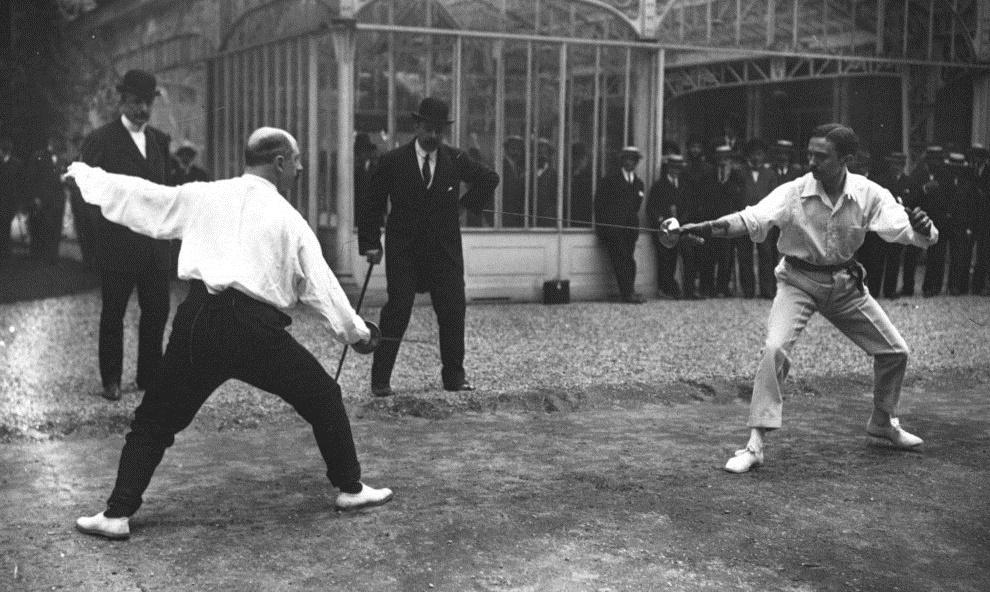
Of Honor
“Ne tirez l’épée que pour servir le Prince , conserver vôtre honneur ou défendre vôtre vie.”
“Draw not your sword, but to serve your king, preserve your honor, or defend your life.”
—le sieur Labat, L’art des armes, 1696, from Andrew Mahon’s translation, The Art of Fencing, 1734
“Never lose on purpose, you must always fence to win for your honor!”
—Lajos Csiszar, quoted by student Roger Jones, 2000. The quote dates to the 1950s, and probably earlier.
“To paraphrase Theodore Roosevelt, ‘the things that will destroy American fencing are victories at any price, prestige at any price, expenses first instead of honor first, and love of subsidies and the state-supported athlete theory of ‘amateur sports.'”
—Roger Jones, “Poor Technique?” in American Fencing, March 1966
Given the current state of USA Fencing, it’s quite clear that the future Roger Jones feared has come to pass. Roger was on the US Epee Team in 1955 and was an alternate in 1956, and was also a member of the US and FIE Rules Committees. He believed foremost in honor in fencing. Full disclosure: Roger was a friend of mine, whom I first met when he contacted me while writing a review of one of my books for Naval History Magazine as I recall (Roger was also a retired reservist US Navy Captain). It became quickly apparent when the subject passed to fencing — he’d read my letters to American Fencing magazine in which I deplored the recommendation of gamesmanship, or “cheating within the rules” as he termed it — that our views were similar, and for a reason: Italo Santelli was one of our fencing grandfathers and we’d both been trained by masters descended from Santelli. In fact, Roger had trained under Lajos Csiszar at the same time as my second master, Dr. Eugene Hamori. See also the Roger Jones quotes above.
“It is happily true that in England we no longer curb the indiscreet utterance of undisciplined lips with cold steel, nor adopt the crude method of letting in light upon the mind through a hole in the body.”
—Henry Arthur Colmore Dunn, Fencing, 1899
“So in their own sense Duelling cannot properly vindicat[e] any opprobrious epithet, but that of a Coward.”
—Wm. Anstruther, Essays, Moral and Divine, 1701
“I mention these to caution you on all occasions to be on your Guard, and not to trust any man whatever who is your adversary. For many have been deceived by not taking care of themselves in these cases, tho’ their adversaries have been men of strict honour, as they thought, and that they would not be so base and villainous as to be guilty of any thing below the character of Brave Men and Gentlemen. Experientiæ Docet.”
—Donald McBane, Expert Sword-man’s Companion, 1728. McBane, a Scot, was a veteran soldier wounded several times in action, as well as a swordsman, duelist, fencing master, occasional pimp, and prize fighter. He is also the man for whom “Soldier’s Leap” is named in Scotland. Good advice not only for a duel, but for life in general. Experientiæ Docet is an abbreviated form of Experientiæ Docet Stultos: Experience Teaches Fools. McBane appears to be making a subtle joke at his own expense.
“The honor of some adversaries can never be relied on safely. In a selfish or revengeful spirit, many persons might be disposed to commit assassination, for which reason, friends and time are always indispensable.”
“No boast, threat, trick, or stratagem, which may wound the feelings, or lessen the equality of the combatants, should ever enter into the contemplation of a gentleman.”
—Joseph Hamilton, The Approved Guide Through All the Stages of a Quarrel, 1829. The first quotation is in the vein of McBane, above. Many have honor in the mundane, when there is little risk to life, limb, property, money, or reputation; far fewer have honor where there is much risk or peril.
“Eh bien! les duellistes poitevins qui ont laissé à bon titre le renom d’adversaires dangereux, Bourbeau (un cousin de l’ancien ministre), Lemaire, le fameux de Pindray — jen passe — n’étaient pas classés parmi les forts tireurs. Je le tiens de mon vieux professeur, le père Nerrière, un maître de l’école de Lafaugère que M. Legouvé a peut-être connu et qui m’a répété plus d’une fois que de Pindray, redoutable, terrible sur le terrain, n’avait travaillé sérieusèment à la salle qu’après ses duels les plus retentissants.”
“Well! The duelists of Poitou who have left good title to being renowned as dangerous adversaries, Bourbeau (a cousin of the former minister), Lemaire, the famous de Pindray—I pass over others—were not classified among the strongest fencers. I learned from my old professor, Nerrière the father, a master of the school of Lafaugère that Mr. Legouvé has perhaps known and who told me more than once that de Pindray, deadly, terrible on the field of honor, trained seriously in the salle only after he had fought his most sensational duels.”
—Arthur Ranc, in the preface to Jules Jacob’s Le jeu de l’épée, revised by Émile André, 1887.
In other words, the best sport fencers did not usually make the best duelists. See also the quote below.
“I mention this affair to show that something more than skill is necessary when using a naked weapon or shotted pistol; and the most able fencer and the first-rate shot are not always the best men in the field.”
—Andrew Steinmetz, The Romance of Duelling, 1868.
“To avoid those Desperate Combats, my Advice is for all Gentlemen, to take a hearty Cup, and to Drink Friends to avoid Trouble.”
—Donald McBane, The Expert Sword-Man’s Companion, 1728. Again, good advice in general.

More From the Latin
Praemonitus praemunitus.
Forwarned is forearmed.
—quoted in Captain Blood: His Odyssey by Rafael Sabatini
Occasionem cognosce.
Recognize an opportunity.
Quaere verum.
Seek the truth.
Festina lente.
Make haste slowly.
Aut inveniam viam aut faciam.
Either I shall find a way or I shall make one.

Pen & Sword
“Pour un oui, pour un non, se battre, —ou faire un vers!”
“For a yes, for a no, to fight, —or write a verse!”
—Edmund Rostand, Cyrano de Bergerac, 1897.
“La plume s’associe fréquemment á l’épée…C’est que la littérature est une escrime intellectuelle et la polémique, á plus forte raison: arguments et objections y cliquettent autant que lames d’acier.“
“The pen is frequently associated with the sword…This is because literature is an intellectual fencing and controversy, even more so: arguments and objections click and clatter as much as steel blades.”
—Emma Lambotte, L’Escrimeuse, 1937. Mme. Lambotte was a noted Belgian poet and the muse and patron of painter James Ensor—and a fencer as well.
“Le fleuret, c’est la grammaire; l’épée c’est l’éloquence. Racine et Boileau écrivaient au fleuret; Shakespeare et Victor Hugo — à l’épée.”
“The foil is grammar; the epee is eloquence. Racine and Boileau wrote with the foil; Shakespeare and Victor Hugo — with the epee.”
—Aurélien Scholl, in the preface to Deux Écoles d’armes: L’escrime et le duel en Italie et en France by Daniel Cloutier, 1896. My translation. Today we might amend this to say “classical foil is grammar,” modern foil having departed, several decades ago, far from the rigor and conventions of classical foil.
The classical Italo-Hungarian foil I was taught almost fifty years was an excellent foundation even for modern epee, and held its own at all levels of domestic and international foil competition. But today’s “modern foil” is now the antithesis of the classical, of the epee, and of combat with sharps, in particular in having abandoned the requirement of the threat made by an extending or extended point directed at the target. A sophistry has taken its place: an invalid attack (aka a “bent arm” attack, an “attack in invitation,” what amounts to a suicidal attack with sharps) is today a valid attack solely because it is now defined as one, via the perverse mental gymnastics that argue that “it doesn’t matter if the point is not initially directed at the target during an attack because it will eventually arrive there.” But it likely won’t if the attacker first runs onto the adversary’s point, contrary to the likelihood of a point already directed at the target. The modern answer to this reality? To simply disallow it in the rules.
“Tomando ora la espada, ora la pluma.”
“Now taking up the sword, now the pen.”
—Garcilaso de la Vega, Égloga III (v.40), early 16th century. Garcilaso was a 16th century Spanish soldier-poet and true Renaissance man. He died in 1536 of wounds suffered in battle at Le Muy, France. Armas y lettras—arms and letters—is a common theme in 16th and 17th century Spanish literature.
“Nunca la lanza embotó la pluma ni la pluma la lanza.”
“The lance never blunted the pen nor the pen the lance.”
—Sancho Panza in Don Quixote by Miguel de Cervantes
“I’ll make thee glorious by my pen,
and famous by my sword;”
—James Graham, Marquis of Montrose, “I’ll never love Thee more,” 1642 or 1643. Sir Walter Scott reversed glorious and famous, apparently not appreciating the attachment of glory to the pen. Montrose, a Scottish hero, led a guerrilla campaign through the Highlands against Cromwell’s forces. In the end he was hanged, instead of being beheaded as was due given his rank. His body was decapitated after his death, and his head was piked at the Tollbooth in Edinburgh.
To the Reader.
Harke, Reader, would’st be learn’d ith’ Warres,
A Captaine in a gowne?
Strike a league with Bookes and Starres,
And weave of both the Crowne?
Would’st be a Wonder? Such a one
As would winne with a Looke?
A Schollar in a Garrison?
And conquer by the Booke?
Take then this Mathematick Shield,
And henceforth by its Rules,
Be able to dispute ith Field,
And combate in the Schooles.
Whil’st peacefull Learning once agen
And th’ Souldier do concorde,
As that he fights now with her Penne,
And shes writes with his Sword.
RICH LOVELACE
A. Glouces. Oxon.
—Richard Lovelace, the famous cavalier poet, in the preface to Pallas Armata: The Gentlemen’s Armorie by G. A. (probably Gideon Ashwell according to sword scholar J. D. Aylward), 1639
“…the penny siller [silver] slew mair souls than the naked sword slew bodies.”
—Sir Walter Scott, Rob Roy, 1818. Not the pen, but something like it in that it can be used for both good and evil.
“[H]ow much more cruel the pen may be than the sword.”
—Robert Burton, The Anatomy of Melancholy, 1621
“Benbu itchi.”
“Pen and sword in accord.”
—Japanese, 17th century or earlier.
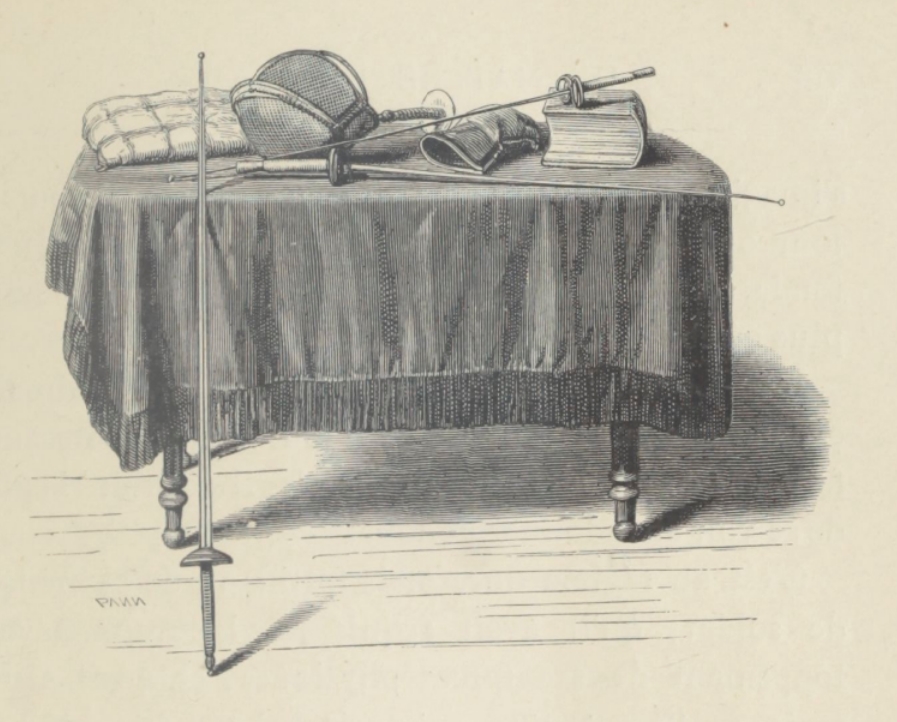
Fencing Language
“Hé là!”
—Literally, “Hey there!” Often shouted during a vigorous exchange ending in a successful touch, or at least it once was until recently. More embarrassingly, it is sometimes shouted in expectation of a touch that ultimately fails. In Cyrano de Bergerac is the shout “Hé! Là donc!”—that is, “Hey! There thus!” Many old French masters and fencers believed in absolute silence during swordplay, while many Italians permitted some expressions. An occasional Hé là! or similar ejaculation is acceptable in my opinion; anything else is boorish.
“Hé là, Pamela!”
—Dr. Francis Zold, in lessons he gave throughout his life. I once asked Chaba Pallaghy, an elite Hungarian and US fencer and international official who knew Dr. Zold well, what it meant, he said it was simply something that the gentleman, scholar, and swordsman said. So many times I heard him say this in my lessons when I did something well. It is as imprinted upon my fencing soul in the same manner as, “One more, one more, yes, very nice,” as spoken by Dr. Eugene Hamori in his lessons to me.
“When a young Country Gentleman comes to Town, and Steps in to a Fencing-School, and hears a Master desire his Scholar to Play Feint a La Teste, Botte Coupe, Flancanade, Under Counter; or to Dequarte and Volt; he is amazed at these Terms, and is perswaded, that there is a kind of Conjuring Magick in the Art…”
—Sir William Hope, A New, Short, and Easy Method of Fencing, 1714
“Mardieu, depuis le temps je me serois mis en garde, j’aurois gagné la mesure, je l’aurois rompue, j’aurois surpris le fort, j’aurois pris le temps, j’aurois coupé sous le bras, j’aurois marqué tous les batemens, j’aurois tiré la flanconade, j’aurois porté le coup de dessous, je me serois allongé de tierce sur les armes, j’aurois quarté du pied gauche, j’aurois marqué feinte à la pointe et dedans et dehors, j’aurois estramaçoné, ébranlé, empiété, engagé, volté, porté, paré, riposté, carté, passé, désarmé et tué vingt hommes.”
“God’s Death, in the time it would take to put myself on guard, I would gain the measure, retreat a step, surprise the forte, take the tempo, make a coupé beneath the arm, make all the beats, make a flanconnade, make a thrust below, lunge in tierce in opposition, make an inquartata, feint with the point inside and outside, make a cut, concuss my enemy, invade, engage, volt, thrust, parry, riposte, chase, pass, disarm, and kill twenty men.”
—Chasteauforte, in Cyrano de Bergerac’s Le Pedant Joué, 1654, written in 1645. Chasteauforte takes a beating while he talks about his prowess as a swordsman. The character probably derives from Plautus’ Miles Gloriosus, the boastful cowardly soldier, and from experience as well. As the Spanish might put it, He who boasts of it did not do it. If you want to be taken seriously, prove yourself with deeds, not words.
Mardieu is an exclamation deriving from mordieu or mort de Dieu = God’s death. Surpris le fort is to be found nowhere else in the literature of sword; it may be intended to indicate grasping the adversary’s blade at the forte with one’s hand, a common technique when grappling. It may also indicate a prise de fer or even simply a proper thrust, fort against foible. Or, it may be satire, suggesting that Chasteauforte is so foolish a fencer as to attempt with his own blade to seize the fort of his adversary’s, rather than the foible. The phrase “j’aurois quarté du pied gauche” (I would have quartered with the left foot) refers to what today is known as the inquartata, typically a counter-attack made while pivoting on the left foot in order to remove the body from the line of the adversary’s thrust.
The real Cyrano de Bergerac was a redoubtable swordsman who fought literally dozens of duels and affrays, and reportedly once singlehandedly routed a mob of a hundred or more, although it was likely far fewer. He also had a large nose, and was a famous French writer whose work includes the stories of trips to the moon and sun, a pair of the first science fiction and fantasy novels. Rostand’s Cyrano is a Gascon, based on his name, de Bergerac. However, the real Cyrano was a Parisian. My translation.
“Enter Petro drest like a French Fencing Master.
Pet. Signior Barberacho has sent me to teach you de Art of Fencing.
Sir Signall Buffoon. Illustrissimo Signior Monsieur, I am the person who am to learn.
Tickletext. Stay Sir stay,—let me ask him some few questions first, for Sir I have play’d at Back-Sword and cou’d have handled ye a weapon as well as any man of my time in the University.
Sir Sig. Say you so Mr. Tickletext, and I‘faith you shall have about with him
[Tick. Gravely goes to Petro.
Tick. Hum—hum—Mr. Monsieur—pray what are the Guards that you like best?
Pet. Monsieur, eder de Quart or de Terse, dey be both French and Itallian; den for your Parades, degaements, your advancements, your Eloynements, and Retierments: dey be de same;
Tick. Cart and Horse, what new found inventions and words have we here,—Sir I wou’d know, whether you like St. Georges Guard or not.
Pet. Alon—Monsieur, Mette vous en Guard! take de Flurette.
Sir Sig. nay faith and troth Governor thou that have a Rubbers with him.
[Tick. Smiling refuses.
Tick. Nay certo Sir Signal,—and yet you shall prevail;—well Sir, come your ways?
[Takes the Fluret.
Pet. Set your right foot forward, turn up your hand so—dat be de Quart—now turn it dus—and that be de Terse.
Tick. Hocus Pocus, Hicksius Doxius—here be de Cart, and here be de Horse—why, what’s all this for, hah, Sir—and where’s your Guard all this while?
Sir Sig. Ay, Sir, where’s your Guard, Sir, as my Governour says, Sir, hah?
Tick. Come, come, Sir, I must instruct you, I see; Come your ways, Sir.—
Pet. Attende, attende une peu—trust de right hand and de right leg forward together.—
Tick. I marry Sir, that’s a good one indeed: What shall become of my Head then, Sir? what Guard have I left for that, good Mr. Monsieur, hah?
Pet. Ah, Morbleu, is not dis for everyting?
Tick. No, marry is not it, Sir; St. George’s Guard is best for the Head whilst you live—as thus, Sir.
Pet. Dat, Sir, ha, ha—dat be de Guard for de Back-Sword.
Tick. Back-sword, Sir, yes, Back-sword, what shou’d it be else?
Pet. And dis be de Single Rapier.
Tick. Single-Rapier with a Vengeance, there’s a weapon for a Gentleman indeed; is all this stir about Single-Rapier?
Pet. Single-Rapier! What wou’d you have for de Gentleman, de Cudgel for de Gentleman?
Tick. No, Sir, but I wou’d have it for de Rascally Frenchman, who comes to abuse Persons of Quality with paltry single Rapier.—Single Rapier! Come, Sir, come—put your self in your Cart and your Horse as you call it, and I’ll shew you the difference.”
—Aphra Behn, The Feign’d Curtizans; or, a Night’s Intrigue, 1679. Satire on a fencing lesson and fencing language, in other words, with sallies against French masters and backsword versus smallsword or, as it is called here, single rapier. Aphra Behn was the first professional woman writer in the UK. She was also briefly a spy.
“For at Broad-Sword, all the Blows, Chops, Strokes, Pitches, Thro’s, Flirts and Slips, are perform’d over the Point of the Sword, unless you fall to the Leg: But at Small-Sword, all Thrusts, Passes, Pushes, Assaults, Essays and Passages, are commonly made under the Shell, (unless it be Cart or Ters over Arm,) close to the Fort of your Opponents Weapon, with a Longe, or you cannot reach to do Execution.”
“The next thing I shall proceed to, is to the Terms of Art and Variety of Assaults, Pushes, Thrusts, Essays, Passes and Passages, all which are lodged under the Notion of True and False Play. True Play is a clean made Pass, Push, Assault or Thrust, directly perform’d, without change or alteration of the Point of your Weapon at any part or place of your Opponent you discover lies most open, or in answering your Opponent from his Assault. False Play or Falsifying, I call Quibles, Dazzels, Feints, Fallacies, Shams, Decoi’s and Enganuo’s, all which I shall explain in their Order.”
—Zachary Wylde, The English Master of Defence, 1711. Much of Mr. Wylde’s charming fencing vocabulary is his, and his alone.
“From a room beyond, the door of which was closed, came the stamping of feet, the click and slither of steel upon steel, and dominating these sounds a vibrant, sonorous voice speaking a language that was certainly French; but such French as is never heard outside a fencing-school. “Coulez! Mais, coulez donc!…So! Now the flanconnade—en carte…And here is the riposte…Let us begin again. Come! The ward of tierce…Make the coupé, and then the quinte par dessus les armes…O, mais allongez! Allongez! Allez au fond!” the voice cried in expostulation. “Come, that was better.” The blades ceased.”
—Rafael Sabatini, Scaramouche, 1921

Revenge with a Sword
“Honor and revenge have no alliance; therefore, reparation for offence or injury, is all that can be fairly sought for, or conceded.”
—Joseph Hamilton, The Approved Guide Through All the Stages of a Quarrel, 1829. In other words, a duel must be fought for the sake of honor alone. A combat for the sake of revenge is a mere single combat, yet should, paradoxically, still be fought with honor, at least until the villain, Hollywood style, betrays his honor, which is probably why the rencontre is being fought in the first place.
“Oui, s’écria-t-il, voici la fille de Nevers!….Viens donc la chercher derrière mon épée, assassin! toi qui as commandé le meurtre, toi qui l’as achevé lâchement par derrière!… Qui que tu sois, ta main gardera ma marque. Je te reconnaîtrai. Et, quand il sera temps, si tu ne viens pas à Lagardère, Lagardère ira à toi!”
“Yes, cried he, here is the daughter of Nevers!….Come therefore and search for her behind my sword, assassin! You who have commanded murder, you who have achieved it by backstabbing cowardice! Whoever you are, your hand has my mark. I will recognize you. And when the time comes, if you will not come to Lagardère, Lagardère will come to you!”
—Lagardère, in Paul Feval’s Le Bossu, 1857. Feval, along with Dumas (who probably inspired him) et al, helped establish the swashbuckling genre in literature. He also wrote a series each of vampire and crime detection novels. The phrase, “Si tu ne viens pas à Lagardère, Lagardère ira à toi!” became proverbial in France. My translation.
“In both men the same grim determination prevailed. The opponent must be killed; there could be no half-measures here.”
—Rafael Sabatini, Scaramouche, 1921
“The next morning, Inigo began the track-down. He had it all carefully planned in his mind. He would find the six-fingered man. He would go up to him. He would say simply, “Hello, my name is Inigo Montoya, you killed my father, prepare to die,” and then, oh then, the duel.”
—William Goldman, The Princess Bride, 1973
“I shall write villain upon him with my rapier’s point.”
—Sir Arthur Conan Doyle, Micah Clarke, 1894
“Then I’ll take her when you’re dead.”
—Peter Blood, in Captain Blood by Rafael Sabatini, 1922. Captain Blood engages Captain Levasseur in a rencontre on the beach of Virgin Magra, Sabatini’s joke on the name of Virgin Gorda. In the novel the duel is but briefly described, but is one of the highlights of the 1935 film version with Errol Flynn. The film duel appropriates for its finale the trick of fence described in Sabatini’s The Black Swan. The duel was filmed at Three Arch Bay, just south of Laguna Beach. Naturally, the duel, only briefly described, is over a woman’s honor on the one hand, and over her possession on the other.
“‘Proud and insolent youth,’ said Hook, ‘prepare to meet thy doom.’
‘Dark and sinister man,’ Peter answered, ‘have at thee.'”
—J. M. Barrie, Peter and Wendy (also Peter Pan, Peter Pan and Wendy), 1911.
Too often the phrase “Have at thee”—which means “I shall attack you” or ‘I’m going to attack you”—is altered ludicrously in film and stage to “Have at me!” or even more ludicrously is changed to something on the order of “Let’s do this” on the assumption that the audience is filled with idiots.

Some Shakespeare
“He jests at scars that never felt a wound.”
—Wm. Shakespeare, Romeo and Juliet, Act 2, Scene 2.
“MERCUTIO O calm, dishonourable, vile submission!
Alla stoccata carries it away.
[Draws]
Tybalt, you rat-catcher, will you walk?
TYBALT What wouldst thou have with me?
MERCUTIO Good king of cats, nothing but one of your nine
lives; that I mean to make bold withal, and as you
shall use me hereafter, drybeat the rest of the
eight. Will you pluck your sword out of his pitcher
by the ears? make haste, lest mine be about your
ears ere it be out.
TYBALT I am for you.
[Drawing]
ROMEO Gentle Mercutio, put thy rapier up.
MERCUTIO Come, sir, your passado.
[They fight]”
***
“MERCUTIO Zounds, a dog, a rat, a mouse, a
cat, to scratch a man to death! a braggart, a
rogue, a villain, that fights by the book of
arithmetic!”
—Wm. Shakespeare, Romeo and Juliet, Act 3, Scene 1. The “book of arithmetic” reference is to forms of rapier play emphasizing geometry, the extreme form of which was the Spanish verdadera destreza mocked by poet and playwright Francisco de Quevedo.
“HAMLET This likes me well. These foils have all a length?
***
OSRIC A hit, a very palpable hit.
***
LAERTES A touch, a touch, I do confess ‘t.
***
HAMLET Come, for the third, Laertes: you but dally;
I pray you, pass with your best violence;
I am afeard you make a wanton of me.”
—William Shakespeare, Hamlet
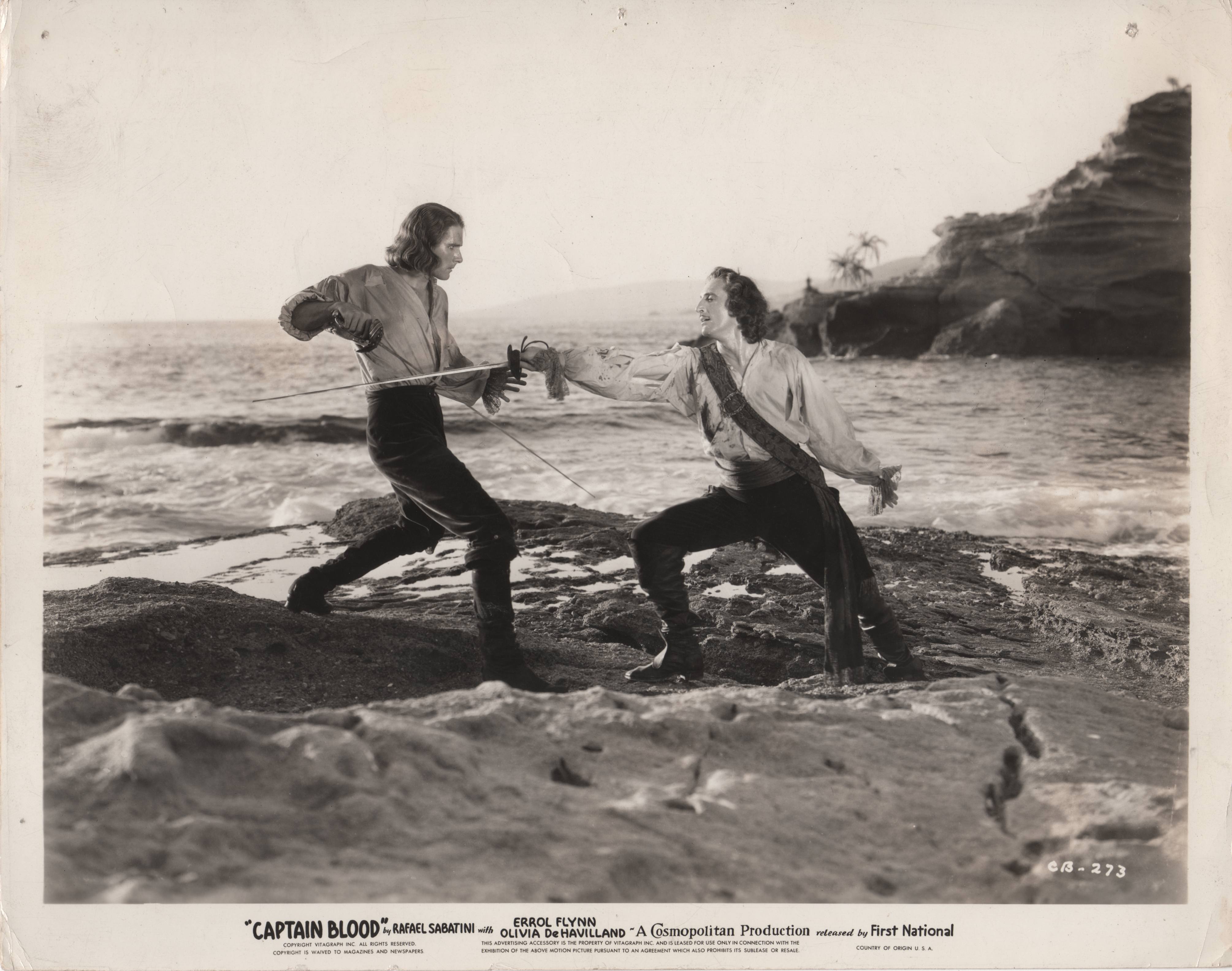
More from Swashbuckling Literature & Film
“Villain, unhand the Lady, and defend thy self. [Draws
***
Have at thee—St. George for England.”
—Lovewell in Love and a Bottle by George Farquhar, 1698
“Un pour tous! Tous pour un!”
“One for all! All for one!”
—Alexandre Dumas, Les Trois Mousquetaires, 1844. The lines are often misquoted or poorly translated as “All for one and one for all!”
“Les coquilles tintent, ding-don.
* * *
Prince, demande á Dieu pardon!
Je quarte du pied, j’escarmouche,
Je coupe, je feinte…
(Se fendant.)
Hé! Là donc!
(Le vicomte chancelle; Cyrano salue.)
A la fin de l’envoi, je touche.”
“The shells ring, ding dong.
* * *
Prince, ask God for pardon!
I thrust in fourth, I skirmish,
I cutover, I feint…
(Lunging.)
Hey! There thus!
The viscount staggers; Cyrano salutes.
At the end of the refrain, I touch.”
—Edmund Rostand, Cyrano de Bergerac, 1897. My translation. The phrase “Je quarte du pied” is almost certainly shorthand for a phrase Cyrano himself used in his 1654 play, Le Pedant Joué: “j’aurois quarté du pied gauche.” The term refers to the inquartata, generally defined as a counter-attack made while pivoting a quarter turn on the right (leading, left for a left-hander) foot toward the outside in order to remove the body from the line of the adversary’s attack. Escarmouche means to skirmish–to aggressively reconnoiter, in other words. The word may also hint at the character Scaramouche–a “little skirmisher” who is often beaten–in the Italian commedia dell’arte. Rafael Sabatini’s famous novel Scaramouche is a classic of the character and of expert swordplay.
“Without more words they fell to and for a space there was no advantage to either blade. Peter was a superb swordsman, and parried with dazzling rapidity; ever and anon he followed up a feint with a short lunge that got past his foe’s defence, but his shorter reach stood him in ill stead, and he could not drive the steel home. Hook, scarcely his inferior in brilliancy, but not quite so nimble in wrist play, forced him back by the weight of his onset, hoping suddenly to end all with a favourite thrust, taught him long ago by Barbecue [Long John Silver] at Rio; but to his astonishment he found this thrust turned aside again and again. The he sought to close and give the quietus with his iron hook, which all this time had been pawing the air; but Peter doubled under it and, lunging fiercely, pierced him in the ribs.”
J. M. Barrie, Peter and Wendy, 1911
“Your swordsmanship? Where did you learn the blade?”
“In Spain, señorita, where there are no eyes like yours.”
—The Mark of Zorro starring Douglas Fairbanks, 1920
“He heard them, wheeled about, flung off his coat, and disengaged his sword, all with the speed of lightning and the address of the man who for ten years had walked amid perils, and learned to depend on his blade.”
“‘You fence skillfully,’ said he, sneering, ‘too skillfully for an honest man. Will you now tell me without any more of this, precisely what the Princess Sophia was doing here with you?'”
—Rafael Sabatini, “The Tragedy of Herrenhausen” in The Historical Nights Entertainment, 1917. The story concerns the Swedish Count of Konigsmark and his affair, physical or otherwise, with the Princess Sophia Dorothea, wife of the unfaithful and crude yet intellectually enlightened Georg Ludwig, ruler of Hanover in Germany and the future George I of Great Britain. Most historians believe the Count was murdered on the order of Georg Ludwig. His brother is credited with inventing the colichemarde blade although the form was around before him. If the brother had any part in its more modern invention and use, the inspiration may have come from some of the by light, well-balanced Spanish rapier blades thick at the forte, or even from some of the rapier-style colichemarde blades found in some Dutch or German transitional swords. More likely, Konigsmark might be credited with naming the blade perhaps because he wore one, thereby popularizing an already exiting form.
“He was born with a gift of laughter and a sense that the world was mad.”
“Oh, you are surely mad! M. de La Tour d’Azyr is reputed the most dangerous sword in France.”
“Have you never noticed that most reputations are undeserved?”
“The slender, wickedly delicate blades clashed together, and after a momentary glizade were whirling, swift and bright as lightnings, and almost as impossible to follow with the eye.”
—Rafael Sabatini, Scaramouche, 1921. The gift of laughter quote was added to a Yale dormitory during construction in the 1930s, then ordered covered over with ivy when it was discovered by Yale dons that the quote was from a “mere” popular novelist. It has since been restored.
“The light of guttering candles fell upon the two small-swords where they lay, the one glittering brightly, the other its murderous steel horribly bent and dimmed…”
—Jeffery Farnol, Sir John Dering, 1923
“Clash and ring of vicious steel that flickered in close and deadly action; stamp of feet and hiss of quick-drawn breath; skill and scorn of death against murderous craft and imperious will. To and fro, up and down, back and forth, they fought with no stay or respite now, changing their ground with nimble volts and dexterous passes, while slowly yet surely, Adam compelled his enemy in the one direction.”
“Sir,” he sighed, “as one swordsman and maître d’armes academique to another, I do here acknowledge a palpable hit and cry: ‘Touché!’ Indeed, you have tongue nimble and unexpected as your sword. Sir, I can appreciate wit, I can admire swordcraft, but though you possess both, I regret to say you prove yourself so extreme detestable that I propose to rid myself of you once and for all.”
—Jeffery Farnol, Adam Penfeather, Buccaneer, 1940
“Rash, you think? Precipitate on both sides? Absolutely, the pair of them going off at half-cock like that, in a place where both were imposters and liable to have to do some awkward explaining–aye, but when two such as Black Bilbo and Long Ben Avery cross swords, d’ye see, then sense and reason take wing, wi’ a wannion, and naught’s to matter save the bright eyes and whirling point o’ th’adversary. There isn’t an instant to draw a breath, or spit a curse (like “Ha, villain!” or “Government ponce!”), or mess about with the furniture, for this is world title stuff, from prime to octave, high lines and low, wi’ imbroccata, stoccata, alongez, and all that jazz, the two lithe figures shuffling, gliding and lunging with what looks like a bright buzz-saw flickering and clashing between them, too fast for the eye to follow.”
—George MacDonald Fraser, The Pyrates, 1984
“Kiss my steel!” cried the gallant gaily, and the little Milburn, seeing the chance to deliver the best riposte in the whole encounter, cried: “Kiss my arse!” and died happy.
—George MacDonald Fraser, The Reivers, 2007
“Inigo Montoya: You are using Bonetti’s Defense against me, ah?
Man in Black: I thought it fitting considering the rocky terrain.
Inigo Montoya: Naturally, you must expect me to attack with Capo Ferro?
Man in Black: Naturally, but I find that Thibault cancels out Capo Ferro. Don’t you?
Inigo Montoya: Unless the enemy has studied his Agrippa… which I have!
* * *
Inigo Montoya: You are wonderful.
Man in Black: Thank you; I’ve worked hard to become so.
Inigo Montoya: I admit it, you are better than I am.
Man in Black: Then why are you smiling?
Inigo Montoya: Because I know something you don’t know.
Man in Black: And what is that?
Inigo Montoya: I… am not left-handed.
Man in Black: You are amazing.
Inigo Montoya: I ought to be, after 20 years.
Man in Black: Oh, there’s something I ought to tell you.
Inigo Montoya: Tell me.
Man in Black: I’m not left-handed either.”
—Dialogue from the film The Princess Bride, 1987. The fencing masters named are real, but the associated tactics are mere Hollywood, likely intended as homage or just mere color. The duel was choreographed by Bob Anderson. In the novel, this dialogue does not exist. Instead, the masters and tactics are part of the narrative description. Author and screenwriter William Goldman also mentions “McBone,” a likely deliberate alteration of, or error for, Scottish swordsman and fencing master Donald McBane.
Truly ambidextrous fencers are rare. In almost fifty years I’ve met only one, Professor Ted Cotton, although my wife Mary Crouch could likely become one if she so chose, one of the founders of fencing in Huntsville, John Jordan, could also fence well enough left-handed, two of our current members routinely switch hands, and I myself can fence tolerably well with my offhand and have begun to use it regularly. Professor Cotton would wear a back-zip jacket and had a body cord down each arm, and would fence his opponents left or right as he thought best. Italian epee great Edoardo Mangiarotti, a right-hander, was taught to fence left-handed by his father in order to give him a competitive advantage, but it is said that he could fence just as well right-handed.
Copyright Benerson Little, 1977-2025. First posted December 19, 2018. Last updated January 15, 2025.
 Swordplay & Swashbucklers