
Latest Work

"Packed with insight and adventure, Little’s book is sure to strike a note with armchair swashbucklers of all ages.”

"As colorful as a Howard Pyle illustration and as compelling as an Errol Flynn film." "This is a fresh, lively approach to the subject."

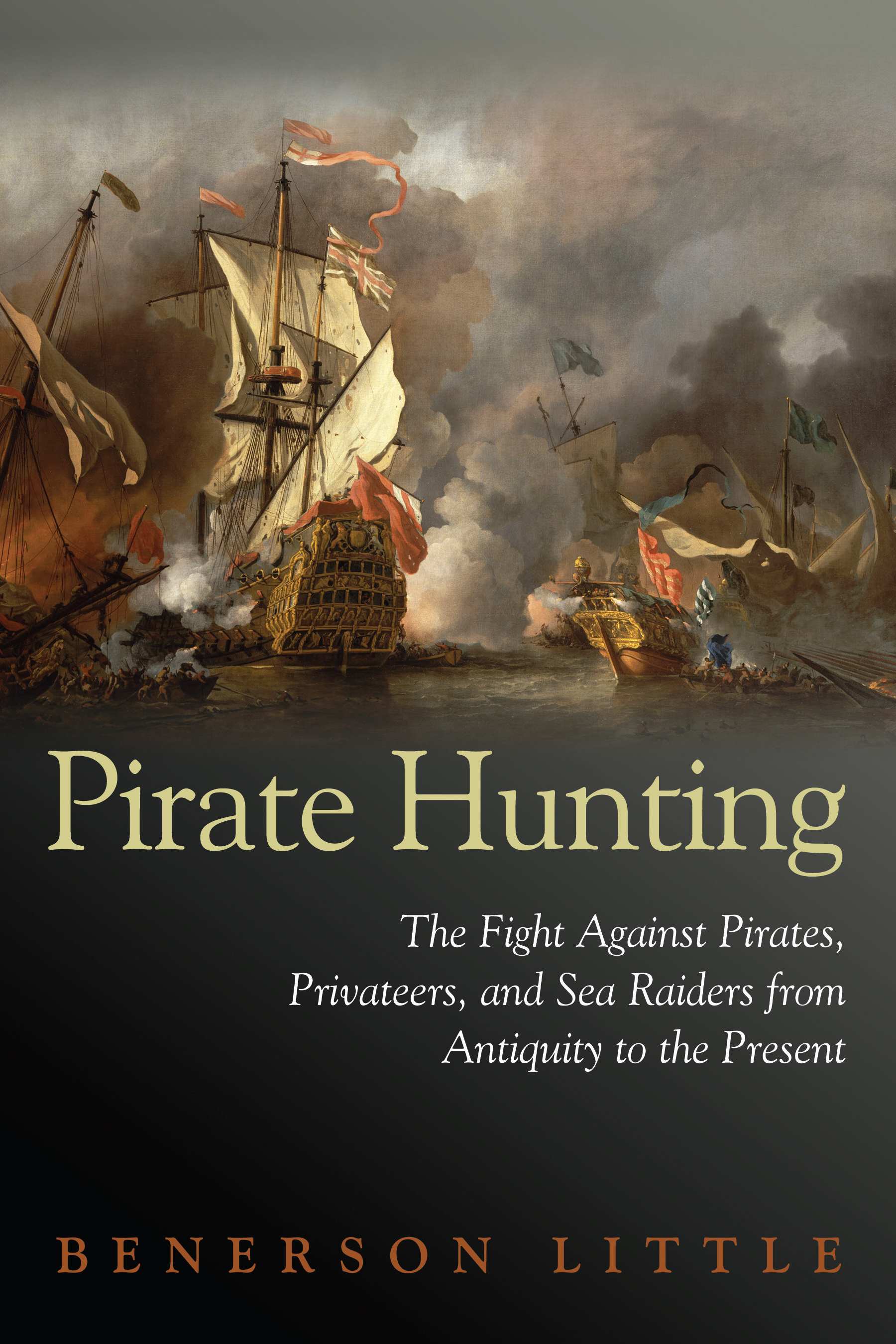



For Halloween: Ghostly & Gothic Nautical Adventure In Fiction
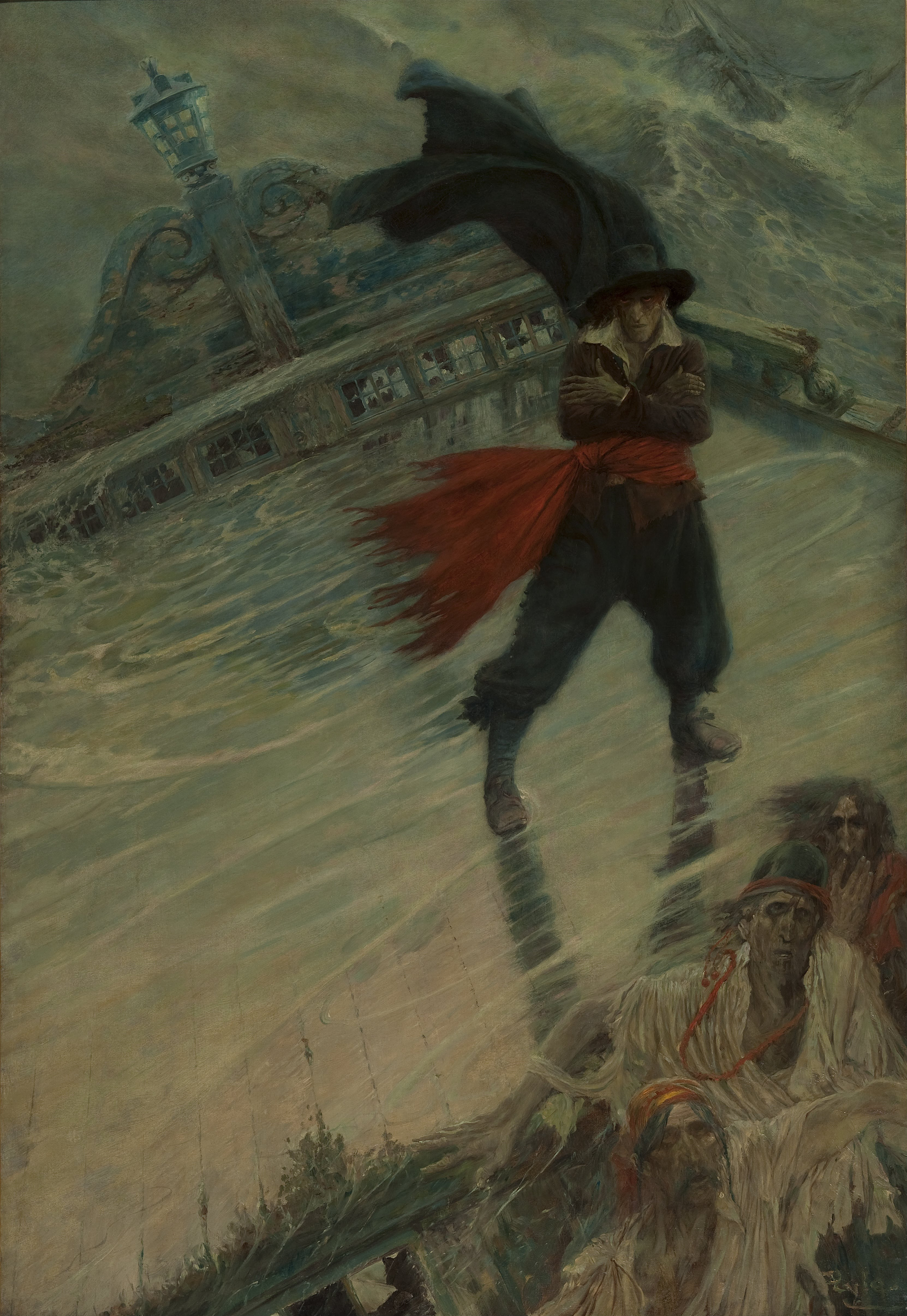
In keeping both with my post on Ghosts & Monsters for Halloween: Cinematic Nautical Romances & Swashbuckling Adventure and with my urge to procrastinate by writing easy blog posts rather than finishing more complex ones, not to mention the Annotated Captain Blood, here are a few books, short stories, and a poem suitable to sea roving adventure on All Hallow’s Eve. I’ve included nothing I haven’t read, which means there are some likely future additions.
Fantasy pirate and horror pirate are not my favorite genres although I’ve read plenty, usually in the weeks leading up to Halloween, a holiday we celebrate well thanks to a daughter born on the day, and to the women in my life in general, all of whom could be described as fey. I’ve had friends and readers suggest to me that I write fantasy pirate novels — “That’s where the money is,” they say — but so far I’m unwilling to give up my firm belief that the true pirate swashbuckler will one day regain its rightful place. But enough digression. Onward to Halloween pirates and other ghostly ghastly seafarers and sea victims in fiction!
The Phantom Ship by Frederick Marryat, 1839
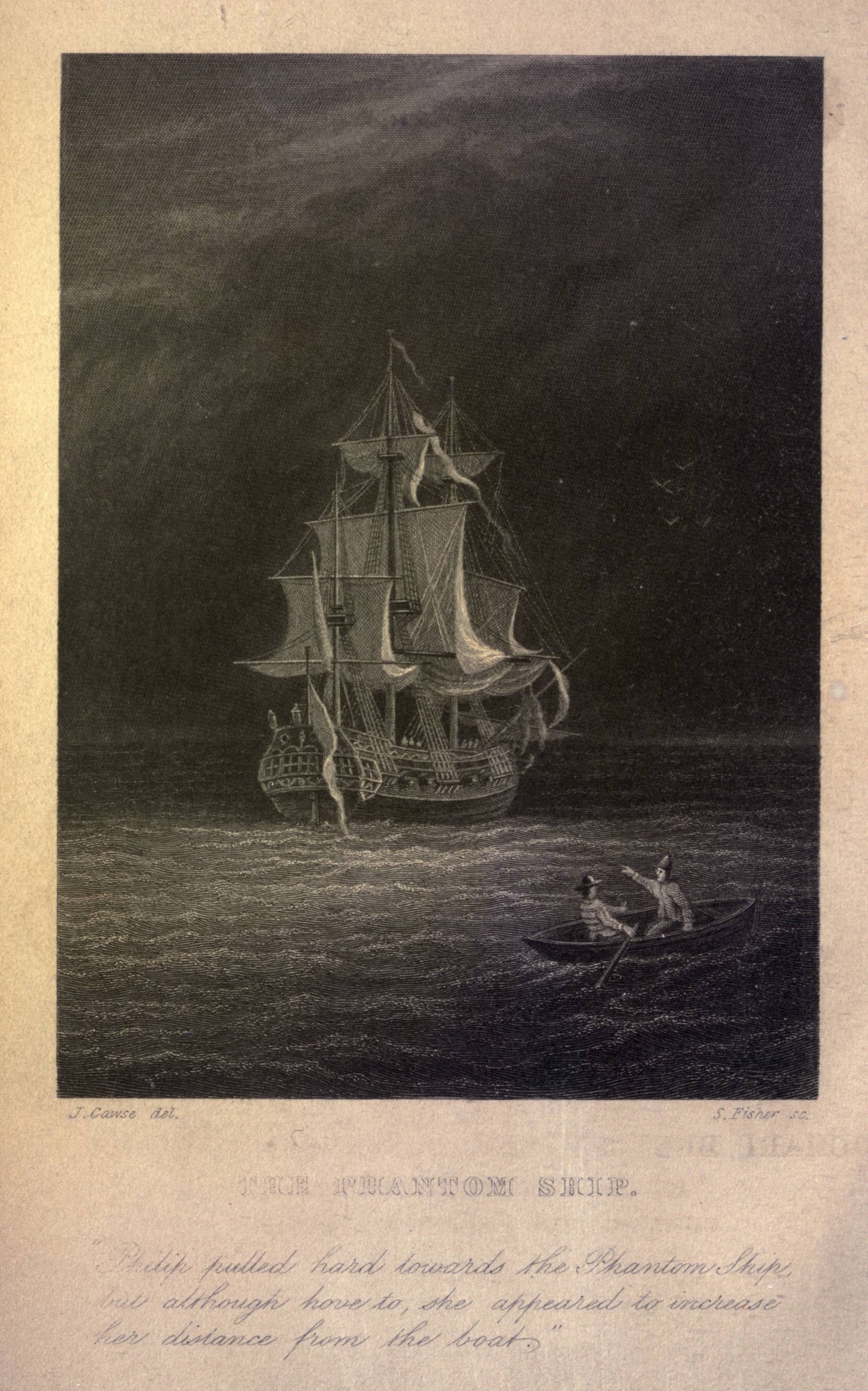
The Flying Dutchman, the sins of Vanderdecken the father visited upon the son, along with with true love, buried treasure, an odyssey of redemption, a cackling supernatural messenger incarnate and evil, plus ghosts, Arabian magic, and even, briefly, a werewolf tale! All written by a former post captain in the Royal Navy. No impossible ship-handling here! (Other than the spectral ship, of course.) A grand fun read. Ignore the reviews early and modern, including one believed to have been written by Poe — critics, especially successful writers engaging in literary criticism, are often insufferably jealous narcissists practicing unintended comedy.
The Rime of the Ancient Mariner by Samuel Taylor Coleridge, 1798
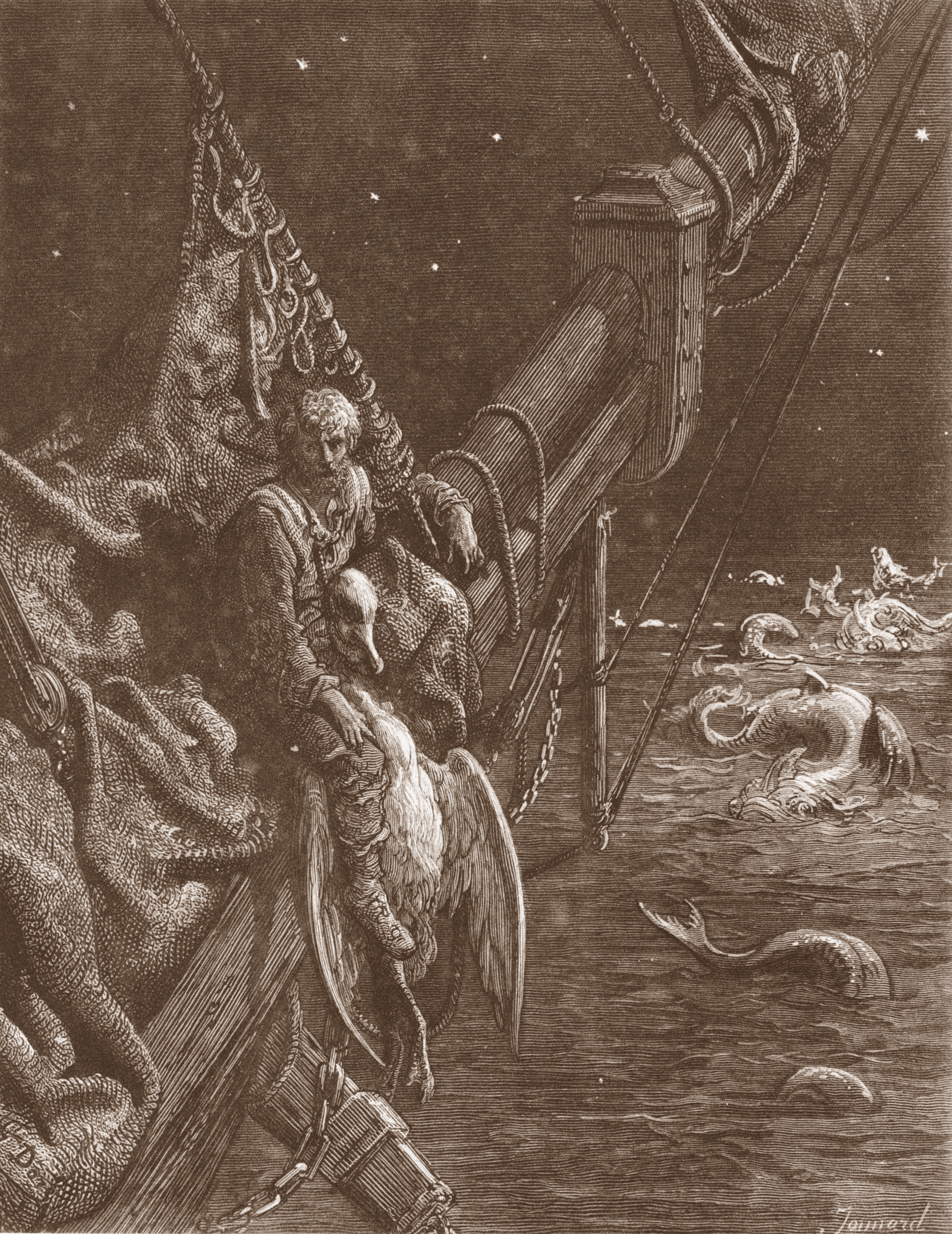
“Water, water, every where, // Nor any drop to drink[!]” A cursed sea voyage, an albatross that brought fair winds murdered and hung ’round the killer’s neck — the ancient mariner tells his dark tale to a wedding guest. The poem was inspired in part by the killing of an albatross by a pompous officer named Hatley during the disastrous 1719 – 1722 South Sea privateer voyage commanded by George Shelvocke: shipwreck and marooning, mutiny, self-rescue, quasi-piracy, even that horror of horrors, a lawsuit afterward! A trifle as compared to the voyage of the Ancient Mariner.
The Ghost Pirates by William Hope Hodgson, 1909
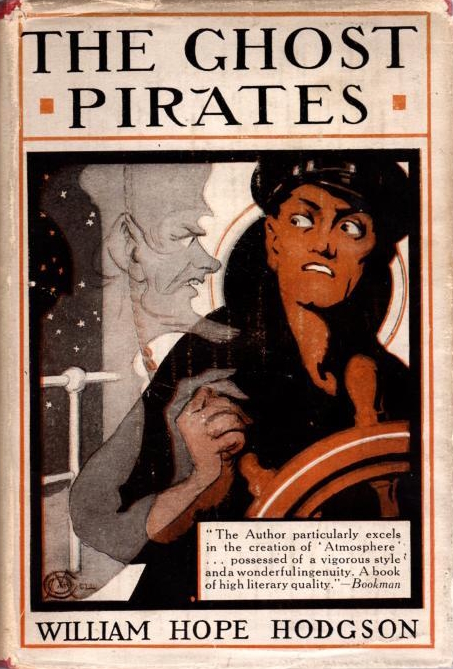
A classic, and surely the greatest of the ghosts at sea genre. The taut writing suits the mood: evil creatures — demons? zombies? ghosts? beings from another realm? — slowly, methodically, terrifyingly taking over an age of sail merchantman and killing its crew. Few novels bring a sense of deadly dread to life so well. To climb aloft is no escape…
“The Ghost-Ship” by Richard Middleton, 1912

I first read this story in The Jolly Roger: Pirate Stories for Boys (Milton Bradley Company, 1928), a collection of pirate fact and fiction whose plate of pirate flags, copied exactly from that in The Blackwall Frigates by Basil Lubbock (1922), was recommended by screenwriter Casey Robinson as the source for the flag used in Captain Blood starring Errol Flynn. “The Ghost-Pirate” was originally published in a collection of the author’s short stories in 1912. Alas, there is only one pirate ghost tale, but to my great pleasure the collection includes two stories not on writing but on being a writer. Middleton’s amused, wordly-wise, self-deprecating take on writers, writing, and publishing closely mirrors my own. Nothing has changed in more than a century but the tools. As for “The Ghost Ship,” it’s a jovial domestic tale of a ghost pirate ship commanded by Bartholomew Roberts cast ashore during a storm into small town known for its own ghosts, and the subtle mayhem that ensues.
On Stranger Tides by Tim Powers, 1987
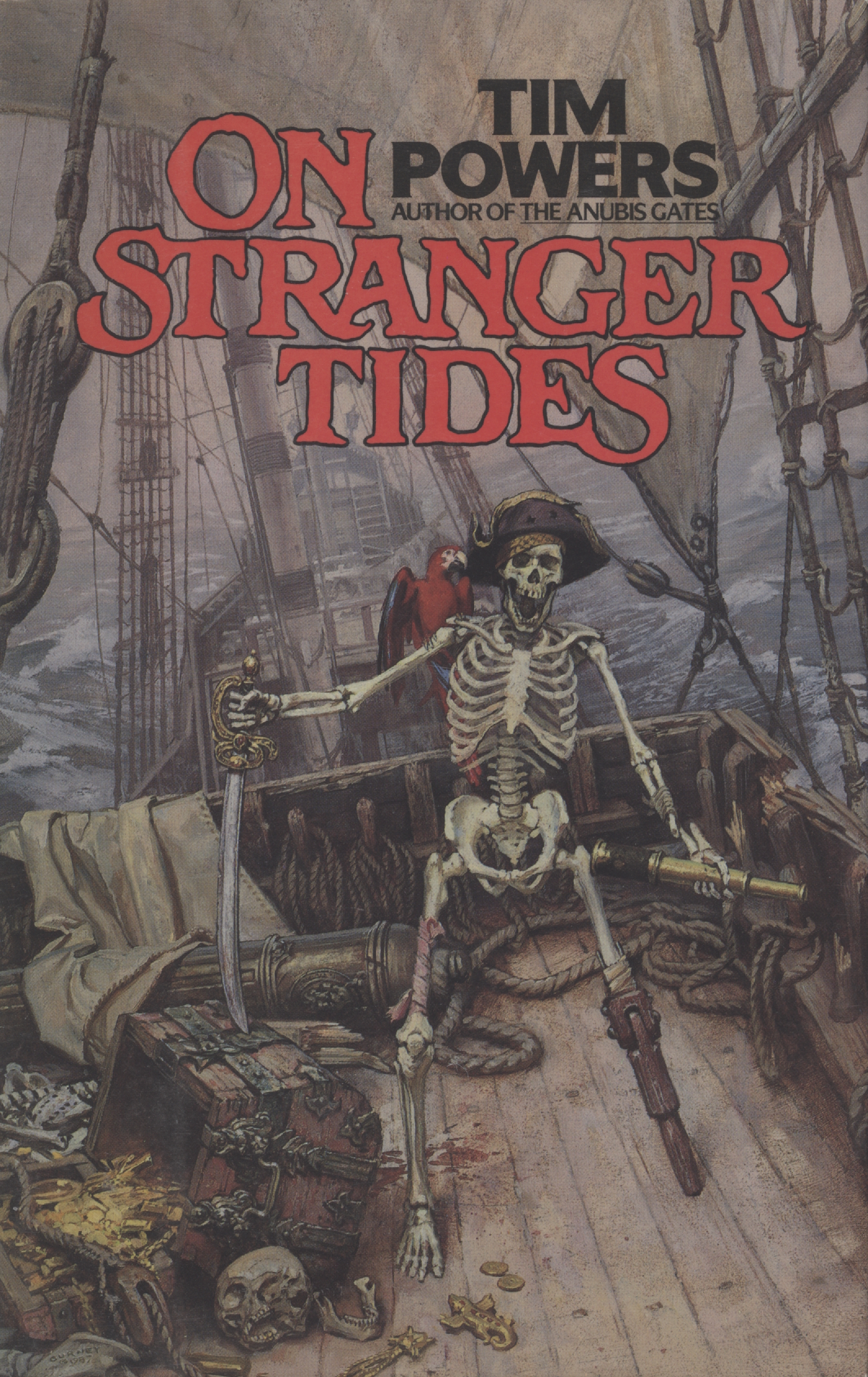
Inspired perhaps by imagining if the magical nonsense ascribed to Blackbeard by pseudonymous pirate chronicler Charles Johnson, Powers’s novel has influenced, indeed inspired, much of both Disney’s The Pirates of the Caribbean film franchise (including the plot, obviously, of the 4th installment, On Stranger Tides) and also the Monkey Island video games (and perhaps The Adventures of Amina al-Sirafi by Shannon Chakraborty too). Without doubt the best of the fantasy pirate genre, no contest. Pirates, voodoo, zombies, murder, treachery, romance, the fountain of youth, and great cover art.
Never mind the anachronisms and especially the inaccuracies in sea fighting. Until I wrote The Sea Rover’s Practice (a bit of self promotion here), there was no book or other source on detailed tactics of sea rovers of the late 17th and early 18th centuries, and most of what was written on the subject was inaccurate or, in the case of many novels, culled and cribbed from accounts of sea fights during the Napoleonic Wars, much of which doesn’t apply directly to a century prior, or was copied from historically-incorrect novelists, even from some who had been tallship sailors — tactics and language changed in ways major and minor from the late 17th century to the 19th. I wrote SRP because I couldn’t find a book on the subject and it took me several years of in-depth research, far more time than any novelist has on their hands to research a story. And, to make the devil’s argument, vodou is a legitimate Creole religion but its magic isn’t real in the manner described in the novel, so does it really matter if the pirate tactics in it are inaccurate too? It’s the story that matters, or so I write even as endeavor to be as historically as possible in my own fiction.
The Mystery of the Sea by Bram Stoker, 1902
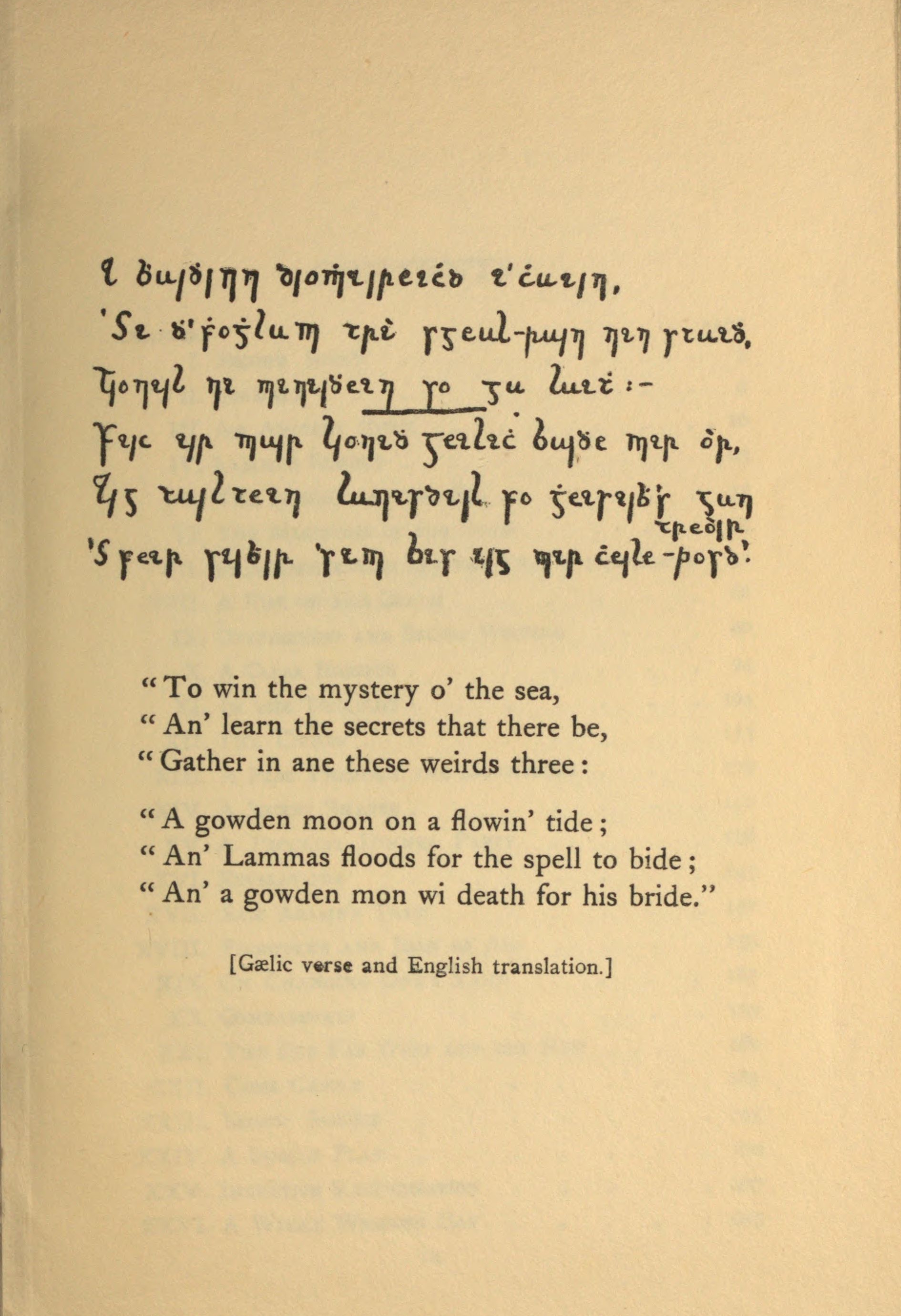
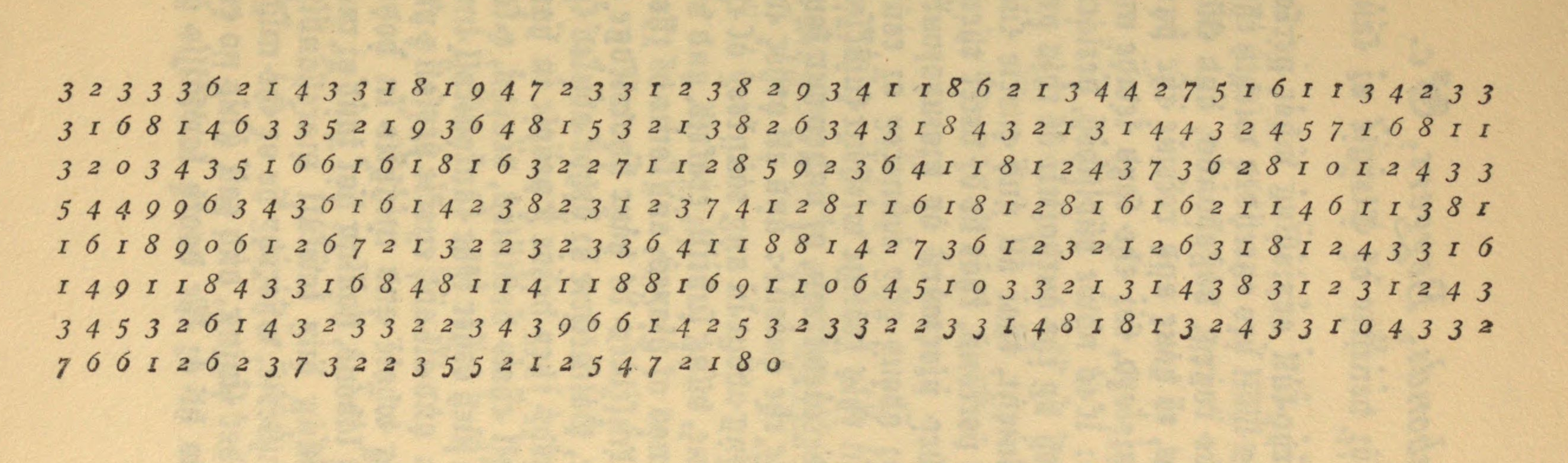
Stoker didn’t just write about vampires! The Mystery of the Sea is classic Gothic by the sea: a Papal treasure lost with the sinking of the Spanish Armada, ghosts trudging by the sea, a fey old woman, the second sight, a cipher, a rugged Scottish coast, romance with a rich independent patriotic American woman, classic gallantry including aquatic rescue, and, naturally, bad guys too, for what would be a treasure hunt without them?
The Haunted Island by Peter Lunn, 1946
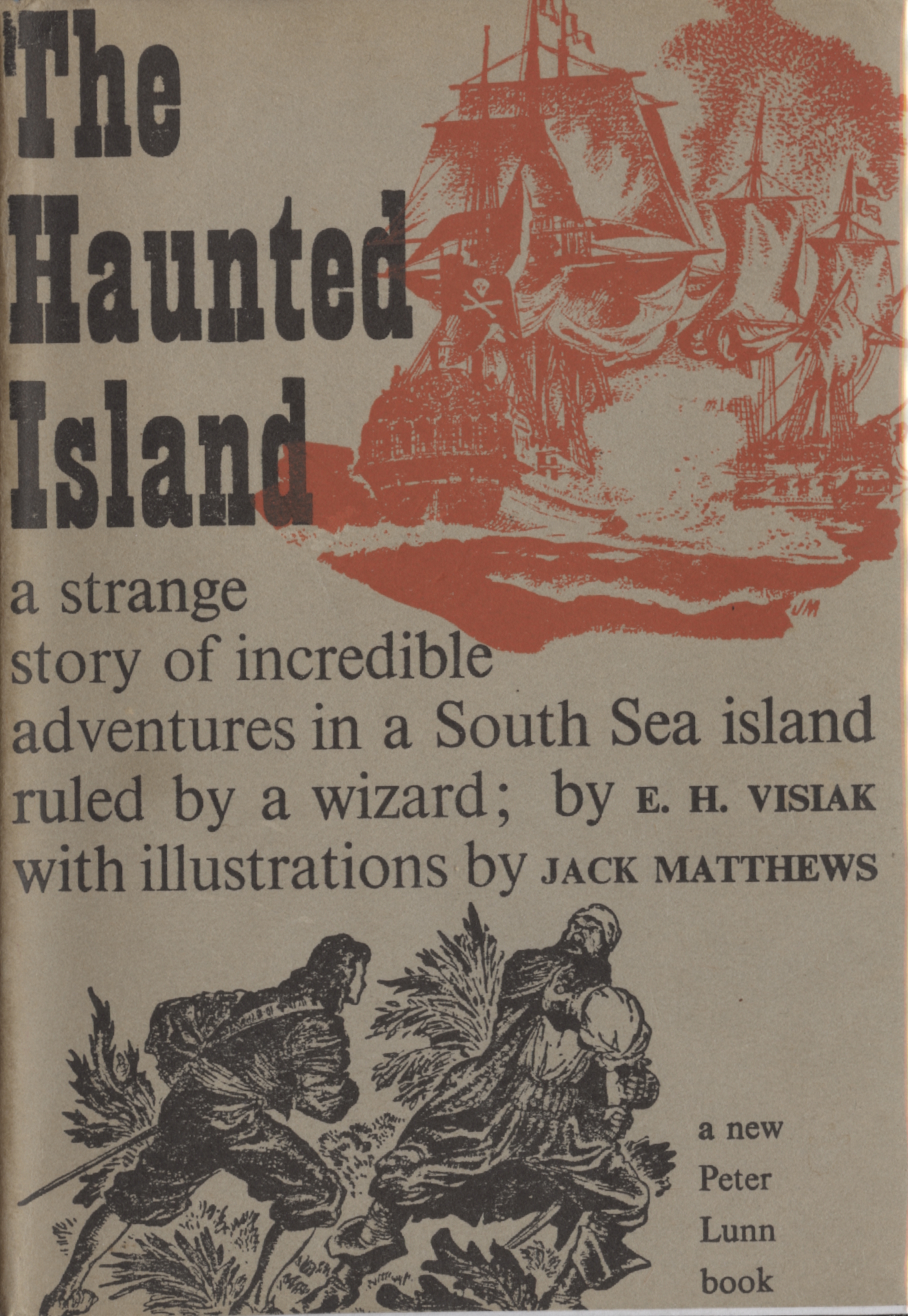
Pirates and magic! No, Disney’s Pirates of the Caribbean, you’re not the first to combine the twain. Or is it magic after all? Read and find out! The author had clearly done his homework, or at least had read Exquemelin and a few other core buccaneer authors, for the general details are accurate enough for light fiction. And the illustrations by Jack Matthews are exemplary, far more accurate than most buccaneer depictions even today. They’re not Pyle or Wyeth, but they serve well to correctly bring the period to life. As usual, the novel is composed of pirate truths and tropes derived from popular pirate histories and much better pirate novels such as Treasure Island. If it pales in comparison to the works of Stevenson and Sabatini, no matter — it’s still a quick fun read.
Pirate’s Doom by E. R. G. R. Evans, 1930
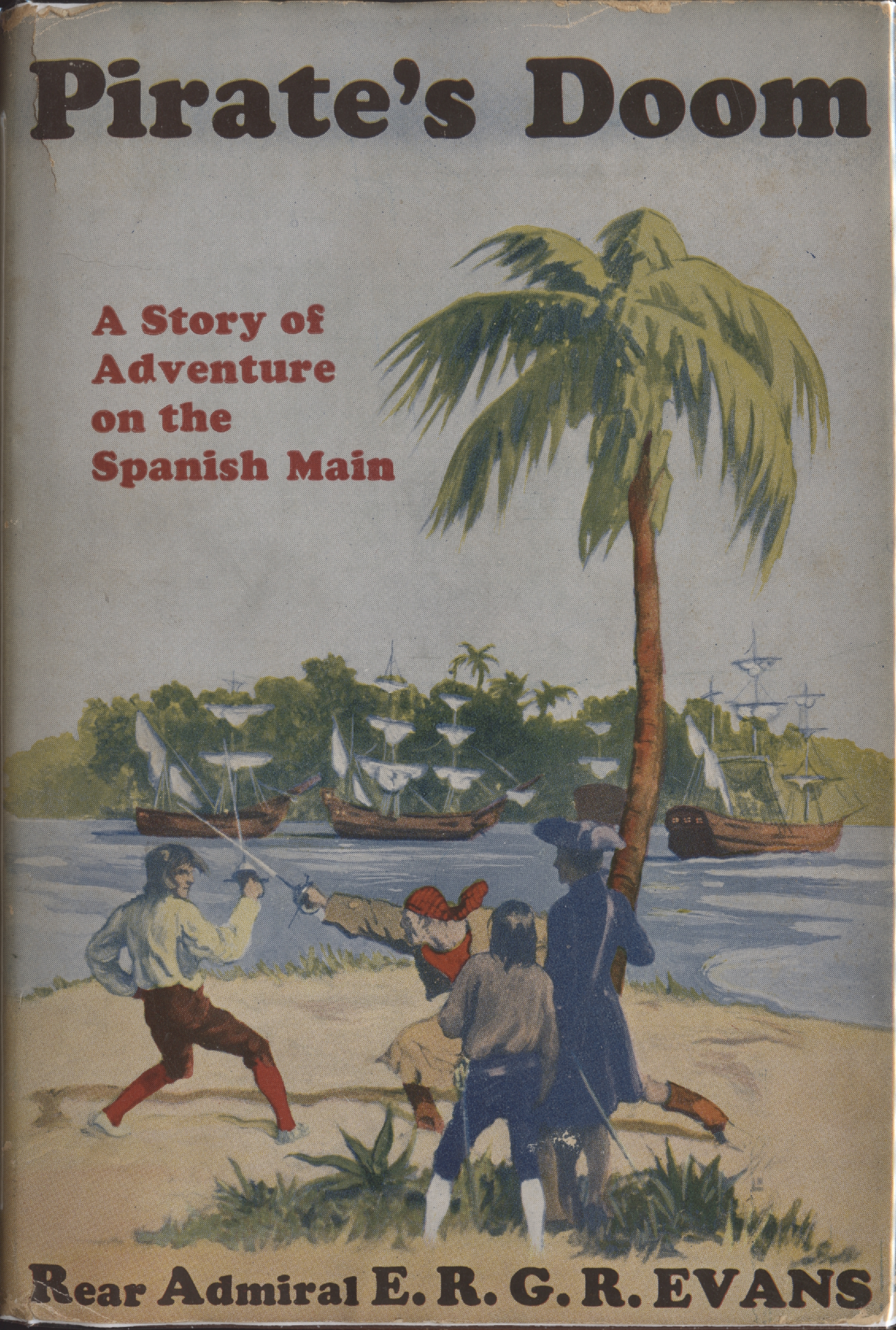
An adventure mostly set in reality but a few apparently supernatural elements: a pirate captain drawn in part from the evil messenger Shriften in The Phantom Ship and who can appear and disappear, so it seems, at will; another who seems proof against wounds; and a ghost ship. The author, who wrote quite a few maritime adventures for boys, gained early fame as a destroyer captain during close action in WWI. Like many novels of this sort from this era, it seems cobbled together from more famous works. Treasure Island it’s not, but it’s still a fun, easy read. It does have the occasional bigotry common to the era, but thankfully few of them. In keeping with famous buccaneer, explorer, naturalist, privateer, and naval officer William Dampier, along with some of his contemporaries, the author finds a pirate crew of “ferocious-faced negroes, dark-skinned Italians, and low-visaged seamen, who…were Turks” to be a “motley band of buccaneers” clearly inferior to the stout English pirates among whom the hero finds himself. With my olive skin I suppose I’d be in the motley crew too, but then so would Captain Peter Blood and his creator, the “dark-skinned” Italian-Englishman Rafael Sabatini (not to mention bestselling swashbuckling novel authors Frank Yerby and Alexander Dumas, both of whom were Black), thus I’d be in excellent company.
Notably, yet not usual for the period in which the novel was written and its intended audience, there are unfortunately no women in the novel. Even Treasure Island has Jim’s mother. The author’s dedication says it all: “To the sea-loving boys of // the Empire, and all those // who would go adventuring”//. Perhaps women would just have been in the way, but that’s not been my experience in a life with some notable adventure. In fairness, this isn’t the only novel on this page that has no women in it.
Postscript: did the screenwriters of The Sea Hawk (Howard Koch and Seton I. Miller, 1940) and The Spanish Main (Aeneas MacKenzie, original idea and treatment by the star, Paul Henreid, 1945) read this book? It’s quite the coincidence that Admiral Evans writes in a single sentence of three ships: the Barracuda, the Albatross, and the Sea Hawk! The Barracuda is the pirate ship featured in The Spanish Main (and also the nom de guerre of the hero), and the Albatross is the privateer featured in The Sea Hawk… Or maybe Evans was simply prescient or maybe it’s another commonly uncommon coincidence. Maybe.
The Pirate by Sir Walter Scott, 1822
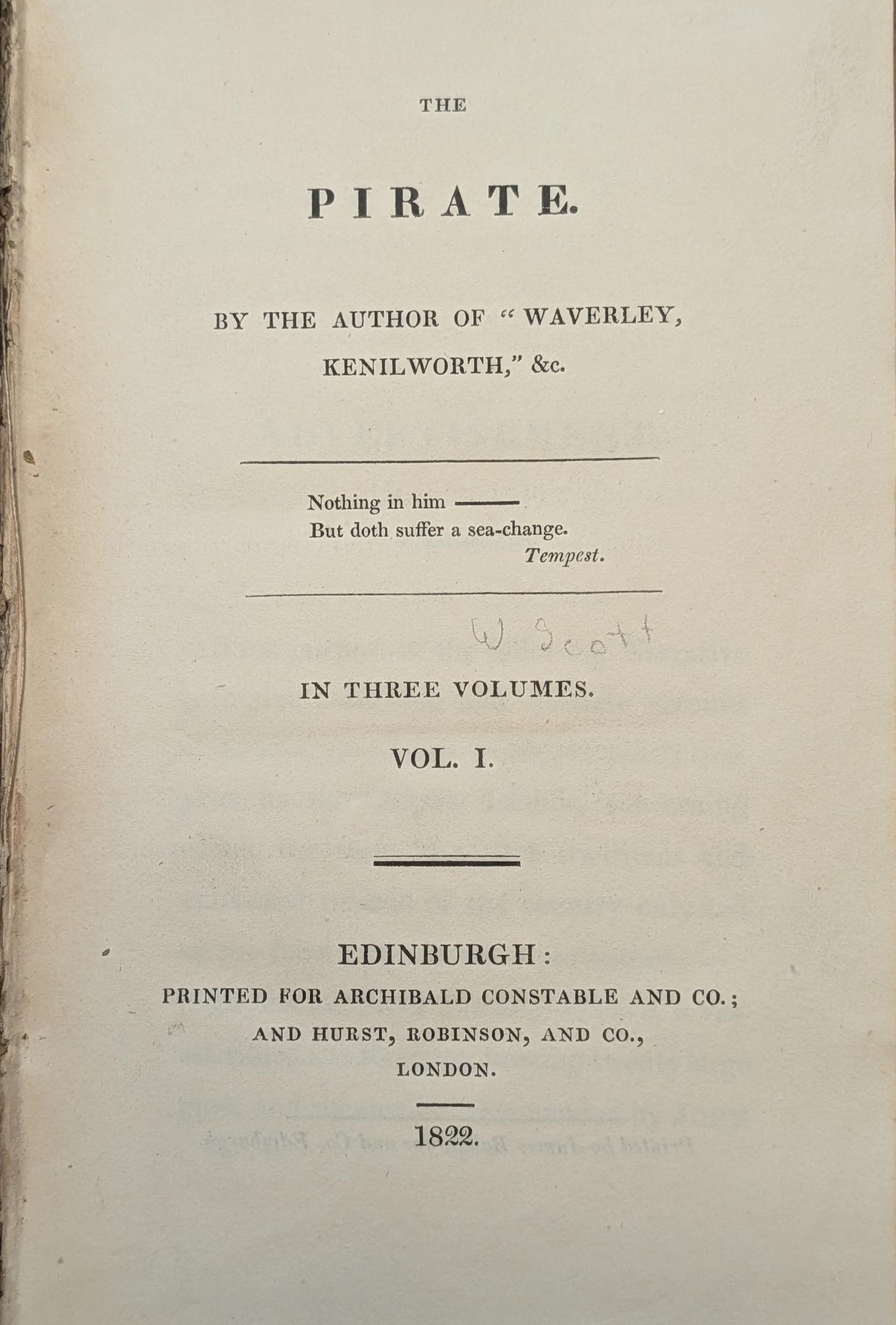
One of Scott’s romantic Waverly novels, the tale has no ghosts but those from the past and has only Gothic elements rather than the whole, but it still has enough remote island moodiness to qualify for this list. No less than Anais Nin as a teenager wanted to read this adventure of old sins, young love, remote windswept locale, and, of course, attack by pirates. Inspired by Scottish pirate John Gow (born circa 1698, hanged 1725), it takes place circa 1689. Never mind the anachronism: it’s fiction after all. Best read by the fireside during an evening storm with a sea-peaty Scotch whiskey in-hand, preferably one from the Scottish islands. Extra points if read in this manner by the seaside in winter (double extra if on a Scottish isle in winter). So famous was Scott that his name is not only not on the title page above, but is nowhere to be found in the book. “By the author of…” suffices.
And, Last But By No Means Least…
“Cap’n Goldsack” by William Sharp, Illustration by Howard Pyle, 1902
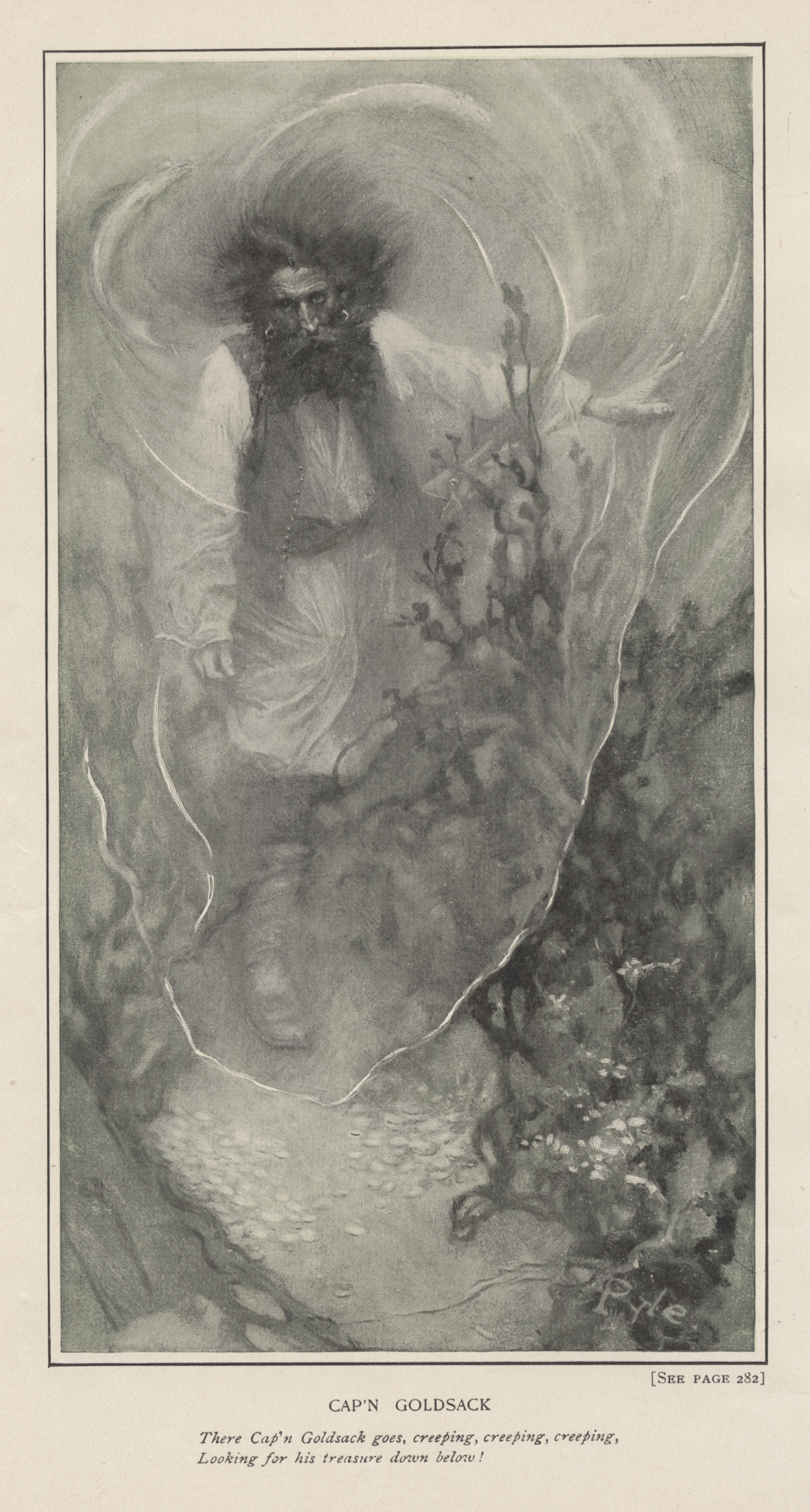
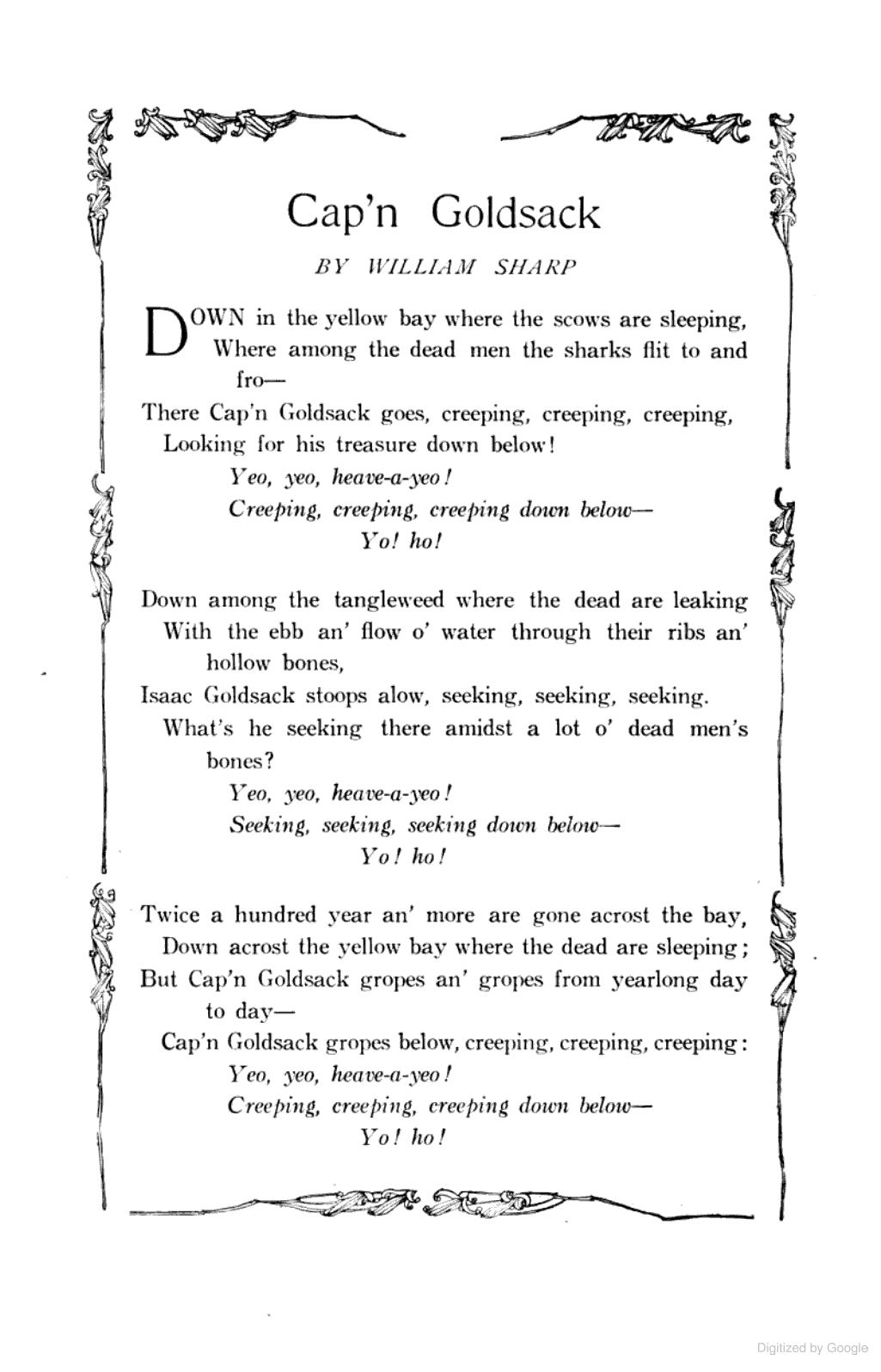
Copyright Benerson Little 2026. First published October 19, 2026. Last updated October 26, 2026.
The Eyes Have It! Or Do They? Where to Look When Crossing Swords
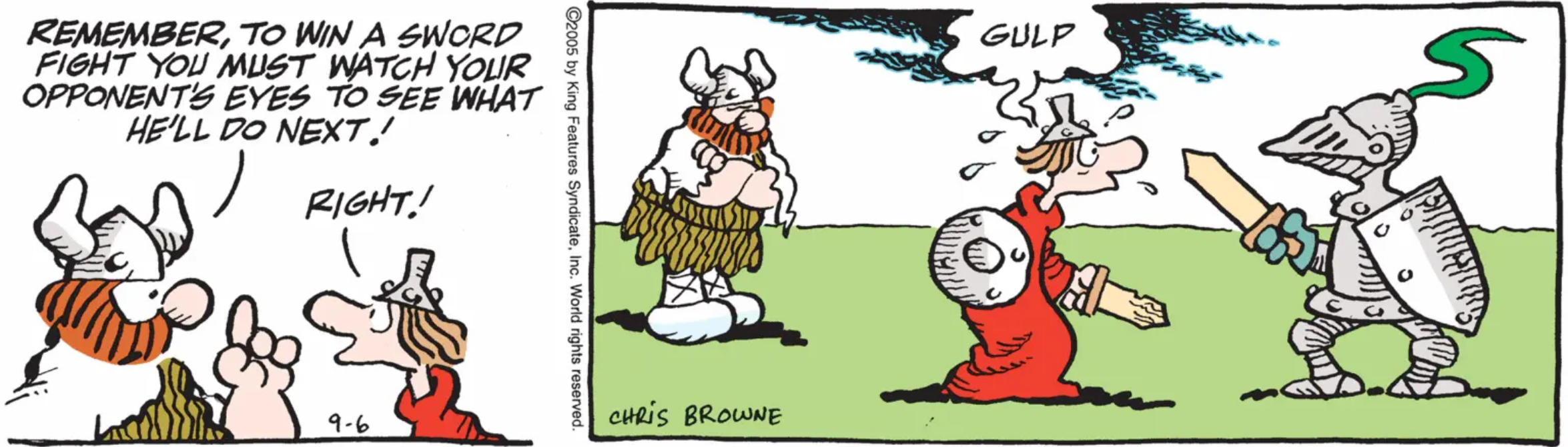
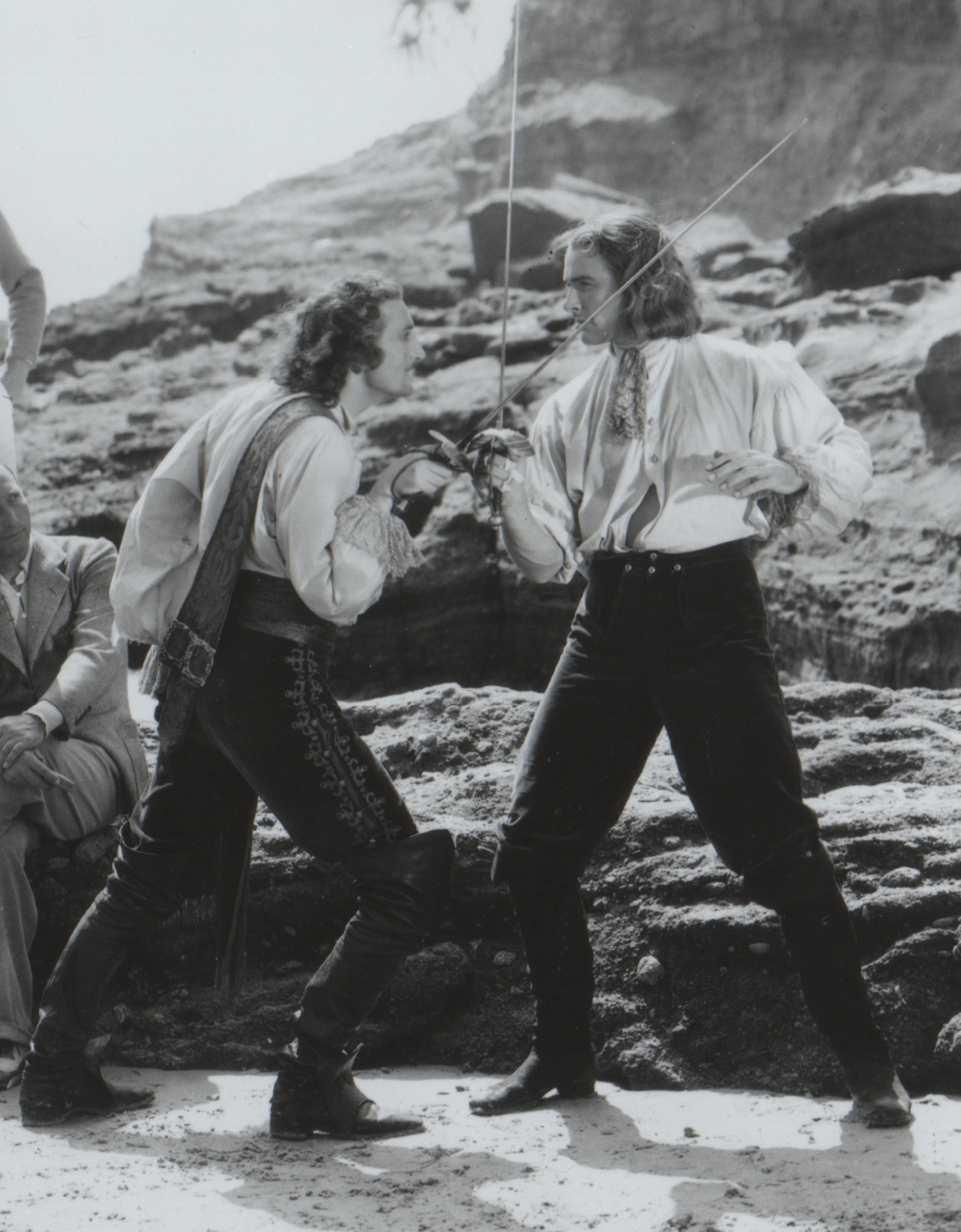
The scene is a familiar one: a fencing master admonishes a student to keep their eyes on those of the adversary when crossing swords, for “the eyes are the mirror of the soul” or “the eyes never lie” or “the eyes give away the adversary’s intention.”
Or some such superficial scripted pithiness.
But is this really where you should look when crossing swords? Or is this advice just a creation of fiction and film, a common trope that sounds great but would get you hit in a bout or killed with sharps?
After all, anyone who’s ever been deceived in love or even by a common salesperson knows that the eyes can lie, that the eyes can conceal intent, the eyes can hide the true soul, even if at times they can indeed do the opposite.
To answer the question, we’ll take a look at the advice of some fencing masters and duelists over centuries. The reader may then pick and choose. First, a few notes and comments.
Fencing Masks
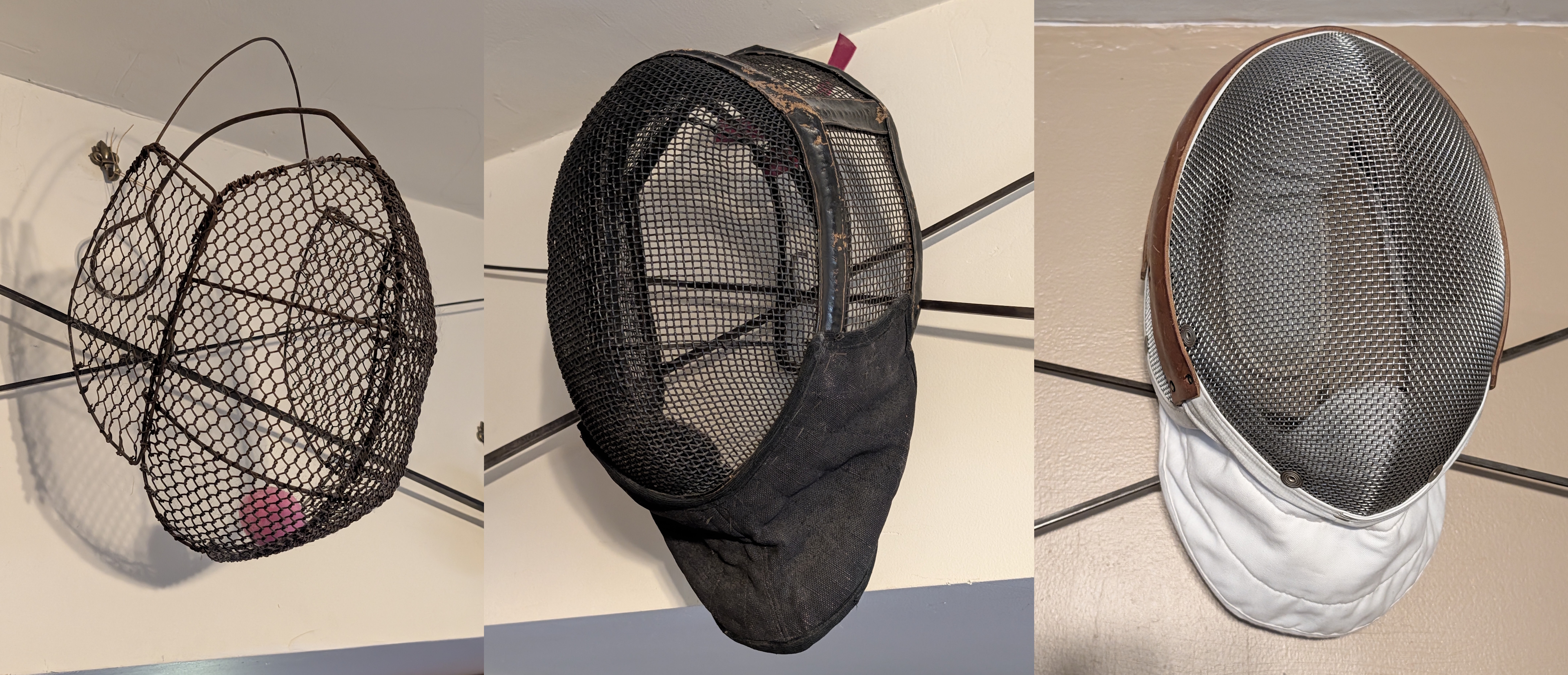
Notably, our question is complicated by the fact that fencers for the past century and a half (a small number used them two centuries ago) have trained and competed while wearing fencing masks. The adversary’s eyes could still be easily seen through early masks with their large mesh, but less so when the mesh was made closer and stronger in the late 19th century. Even so, it is possible to see the adversary’s eyes to a limited degree through the mesh of modern masks if, like a soldier in the jungle focusing not on the immediate flora but beyond it, you focus not on the mesh, but just beyond it. Still, masks present a problem in answering the question, even more so in the late 19th and early 20th centuries when duelists trained with masks but fought without them.
Briefly in the very late last century masks with a clear Lexan plastic polycarbonate section in front of the eyes were tried but soon abandoned for reasons of safety — there was no guarantee a blade might not find its way between mesh and polycarbonate or even through the polycarbonate itself. The primary inspiration behind the clear masks was not so that fencers could “sound the depths of an adversary’s soul” or even “evaluate an adversary’s state of mind,” but so that the video audience could see the fencers’ eyes. In the late 90s the International Olympic Committee considered dropping fencing from the Games, and since then the FIE (fencing’s international body) has bent over backward to make fencing audience-friendly at the expense of swordplay’s soul. (Fact: sophisticated fencing will never be audience-friendly.)
Other Martial Arts: Boxing & Escrima
I’ve boxed and practiced escrima and although I’m no expert in either, the experience was instructive. Historically, some boxers have focused on the adversary’s eyes and used peripheral vision to watch the hands, while others, including many today, focus on the neck or collarbone or upper torso (or just “forward”) and use peripheral vision to pick up hand movement. Focus on one hand and you’re likely to get hit with the other. Likewise do eskrimadors tend to focus not on the eyes but on the chest, and use peripheral vision to watch weapons and weapon hands — and they do bear watching, for a mistake can easily result in broken fingers and more.
Weapons in Both Hands
The question is also complicated by whether the adversary is armed with a single sword or has another weapon in the off-hand — watch one hand or weapon too closely and you’re liable to get hit with the other, as in boxing and escrima. However, in the case of early modern and modern Western swordplay and its common stance of lead foot matching lead hand, an off-hand weapon, typically used for defense, is usually held farther back and is shorter than the lead, making the focus on the primary hand less of a liability than it would be in boxing or any of the “hands and feet” martial arts. Peripheral vision picks up the offhand weapon.
Practical Experience
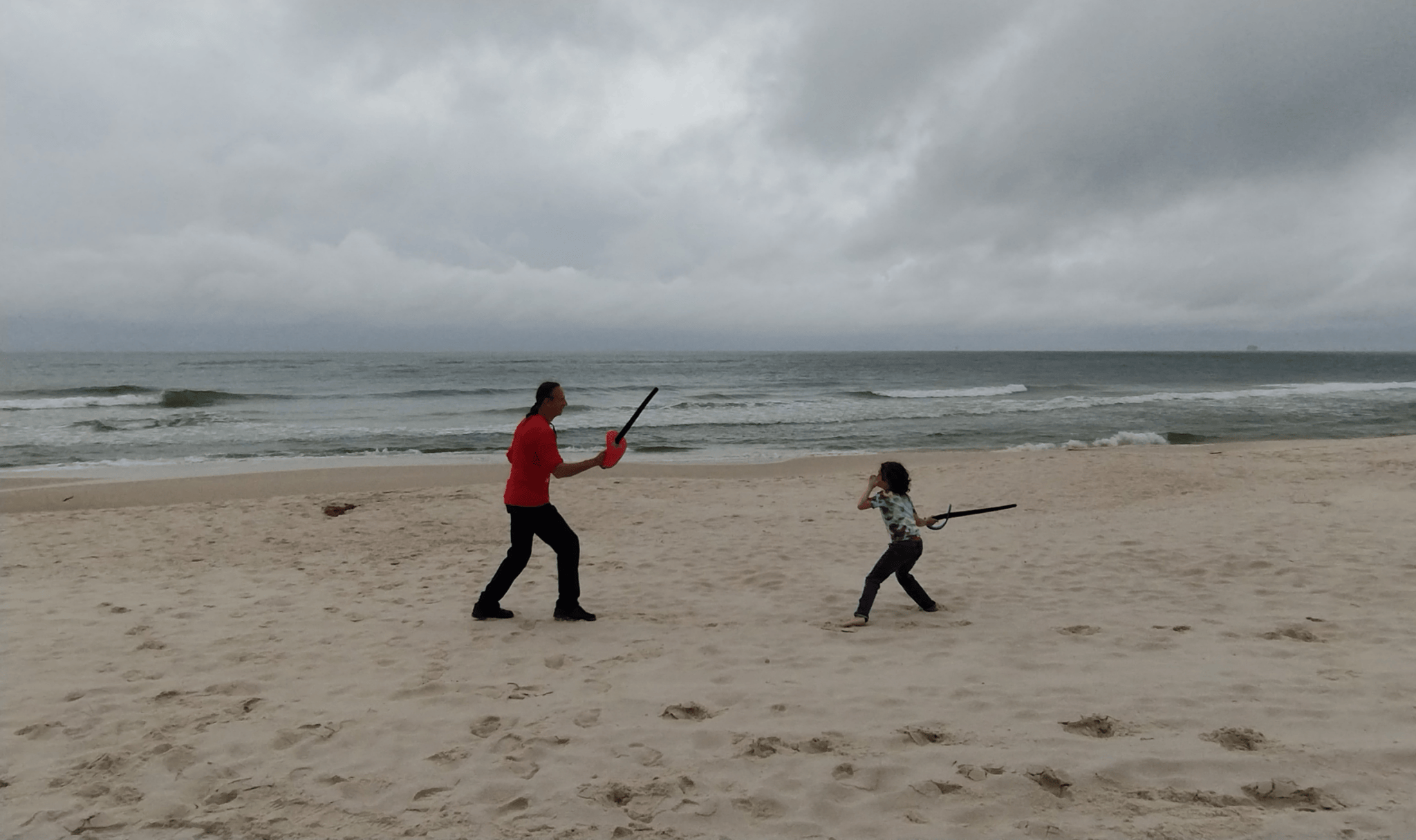
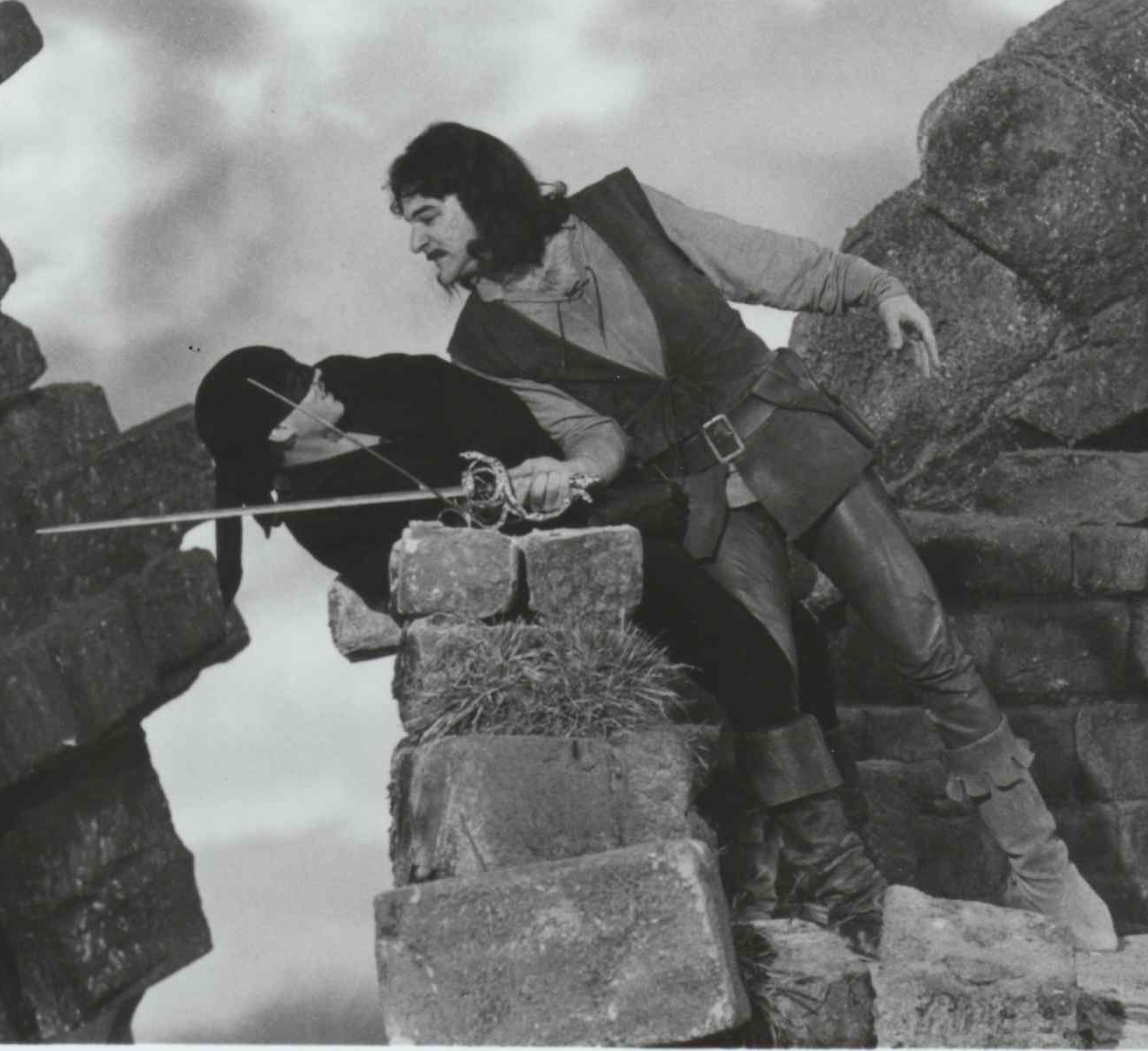
I can attest after a conservative estimate of four hundred hours or more fencing vigorously with my two youngest children — furious fencers both — with foam swords and without masks, that the utility of watching the eyes rather than the weapon is far over-hyped. As Donald McBane noted, an occasional glance may be useful, but watching the eyes takes your focus off the threat and you get hit. Only once with each child did I get away with cheap shots like glancing over the shoulder and hitting when they looked away, or feinting at the face to make them blink, then finishing low. These worked only when they were very young, although admittedly I explained immediately afterward what I’d done so they wouldn’t be surprised again.
I never had the opportunity to take tempo on either child because I saw hesitation in their eyes, and on several occasions I was hit when I found myself caught up in the emotion — elation, fury, joy, focus — in their eyes. The most useful information I gained from looking into their eyes was that they were serious about running me through. Figuratively, of course, or mostly so. We were fencing for fun, which is the only way to fence. (And no, only now are my wife and I slowly introducing them to modern fencing — we don’t want to spoil the joy of swordplay nor burn them out as is all too common these days as children much too young are garbed, armed, and thrust onto the strip with too little preparation. Ours can already handle sword and dagger, all sorts of terrain, and multiple adversaries! In other words, no modern helicopter parent or helicopter parent-pleasing coach has ruined, or will ruin, swordplay for them.)
Likewise fencing with my wife with padded sabers by Go-Now of Poland, without masks (which requires a bit of care because the swords are not soft “bonkers” sometimes used in therapy or just for a bit of safe violent fun), I was unable to use what I saw in her eyes to much effect, and too much time spent on her intense eyes meant I got hit because I wasn’t watching her sword.
A Caveat
Remember, the advice below is general advice. Your eyes will shift when fencing, in particularly onto targets as you attempt that final thrust.
A Brief Selection of Fencing Masters on the Subject
Note: the great majority of fencing masters don’t even bother to discuss the subject! And most of those who do were teaching fencers how to fight with real swords. The loss of a single touch in a sport fencing bout because the eyes stray might not matter much — but in a fight with sharps it could be fatal.
With all this in mind, here we go:
Ridolfo Capo Ferro, 1610: in rapier play, watch the adversary’s hand.
Francesco Antonio Marcelli, 1686: in single rapier play, watch the eyes or watch for movement.
Sir Wm. Hope, 1694: with the smallsword and backsword, keep your eyes on the adversary’s or sword hand, not on the point or middle of the blade. Do not look at the eyes for they are deceptive.
Donald McBane, 1728: with the smallsword, shearing sword, broadsword, and backsword, watch the wrist and point. Occasionally check the eyes to check the adversary’s temper, but only seldom lest you be deceived.
John Godfrey, 1747: with the smallsword and backsword, watch the weapon hand or point.
Joseph Roland, 1809: with the smallsword, focus on the adversary’s sword, not on the eyes as is “generally supposed.”
Clovis Deladrier, 1948: in epee fencing, watch the guard.
My own masters, Dr. Francis Zold and Dr. Eugene Hamori (1977 onward): in foil, saber, and epee, focus on the guard and point (doubly so in epee, for the combination of guard and point positions are vital). Use your peripheral vision to track distance from the adversary’s lead shoulder, and to note the adversary’s footwork.
The best advice to my mind is the combined advice of Donald McBane and of my own fencing masters.
As a side note, remember that not only can the eyes be deceptive, but so can footwork, blade-work, tempo, distance, body language, and more. The hand, in a very simple example, when subtly drawn back can entice the opponent, who confuses watching the hand or guard with judging distance by it, into range.
Remember, fencing, whether as sport or duel, is a finished skill of violent or pretend-violent competition that permits honorable deception, that is, within the accepted customs and rules.*
Everything in swordplay can be used to deceive.
Copyright Benerson Little 2026. First published 24 September 2026.
* Gamesmanship is nothing more than cheating within the rules, to quote former member of the US epee team in 1955 and 1956 Olympic Games epee team member alternate and FIE rules committee member Roger Jones, and its practitioners should be shunned. Cheating is entirely dishonorable and its practitioners should be banned from the sport.
Arr! Arrg? Yar? In Honor of Talk [Authentically] Like a Pirate Day!
Talk Like a Pirate Day! [Authentically Even, By the Powers!]
I apologize up front for this hasty homage and celebration of Talk Like a Pirate Day, for it is composed largely of text of posts of mostly authentic pirate speech I’ve made on Facebook on TLAP Day over the past decade or so. The quotes are fun and instructive.
Before I begin, I want to render honors to those who inspired this day created by “Ol’ Chumbucket and Cap’n Slappy” aka John Baur and Mark Summers in 2002: Captain John Smith (whose sea fight description was transcribed aka plagiarized into several 17th century seafaring texts), Mark Twain (yes indeed did Tom, Huck et al know how to talk like pirates!), Robert Louis Stevenson, J. M. Barrie, Jeffrey Farnol, Wallace Beery, and Robert Newton.
Several authors over the past quarter century, myself included, have identified Robert Newton as the most significant origin of caricatured “pirate speech” aka “talk like a Hollywood pirate.”
Newton starred first in Disney’s Treasure Island as Long John Silver, followed by two more pirate films, reprising his role in one of them as Long John Silver, and then again in a TV series. The earliest non-fiction author I recall identifying Newton as the origin of our idea of pirate speech is maritime historian David Cordingly in 1997.
However, the real credit should probably go to George MacDonald Fraser in his comic novel The Pyrates, 1983/84, in which he clearly identifies the origin of Hollywood pirate speech as Robert Newton and his iconic West Country accent.
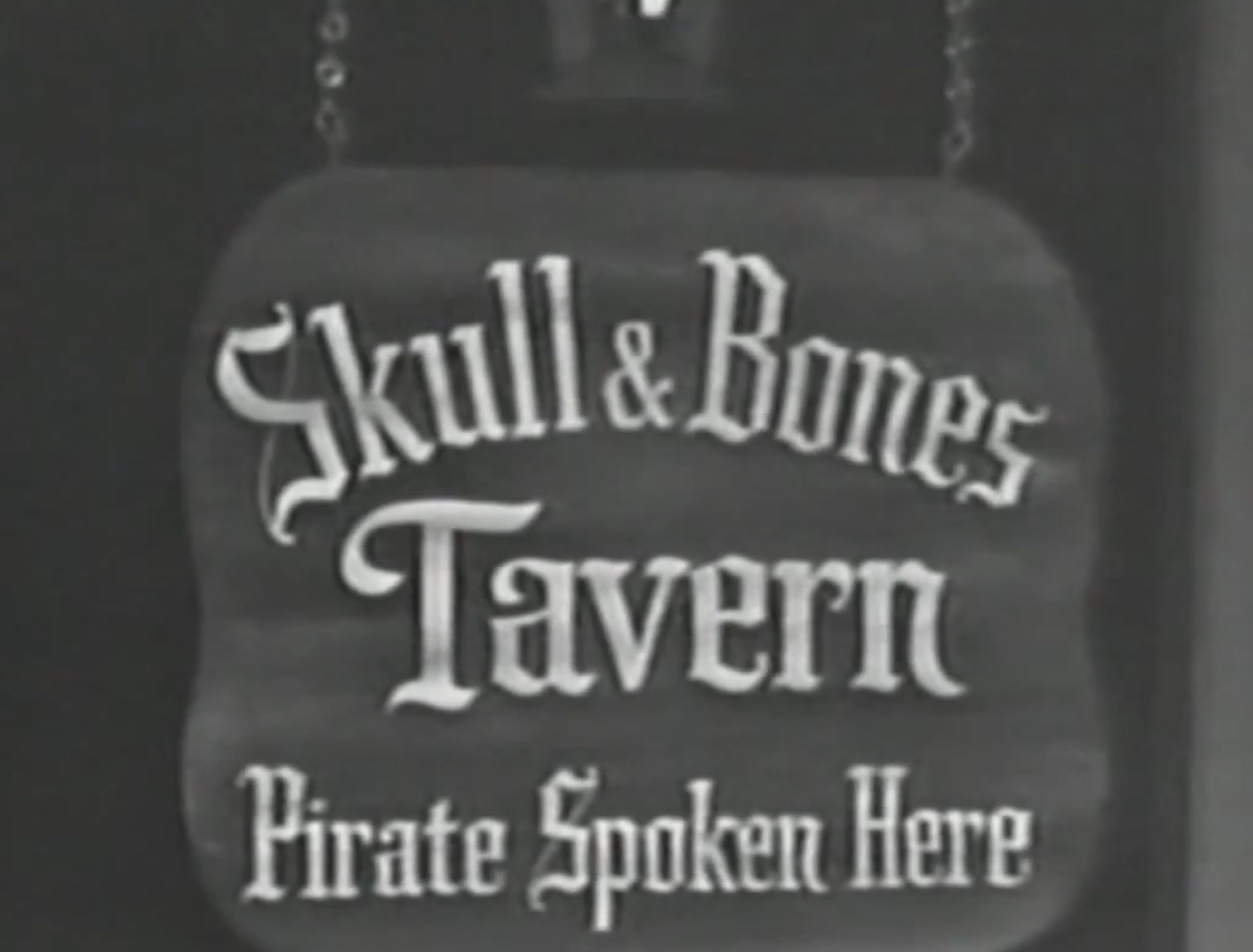
“Talking like a pirate” has been popularly recognized at least since the early to mid 19th century, Tom Sawyer being a well-known early example. Hollywood quickly recognized and accepted pirate tropes and created many, including pirate speech. Comedy was a prime venue for pirate talk, as in a 1963 episode of The Red Skelton Hour.
Hollywood Favorites
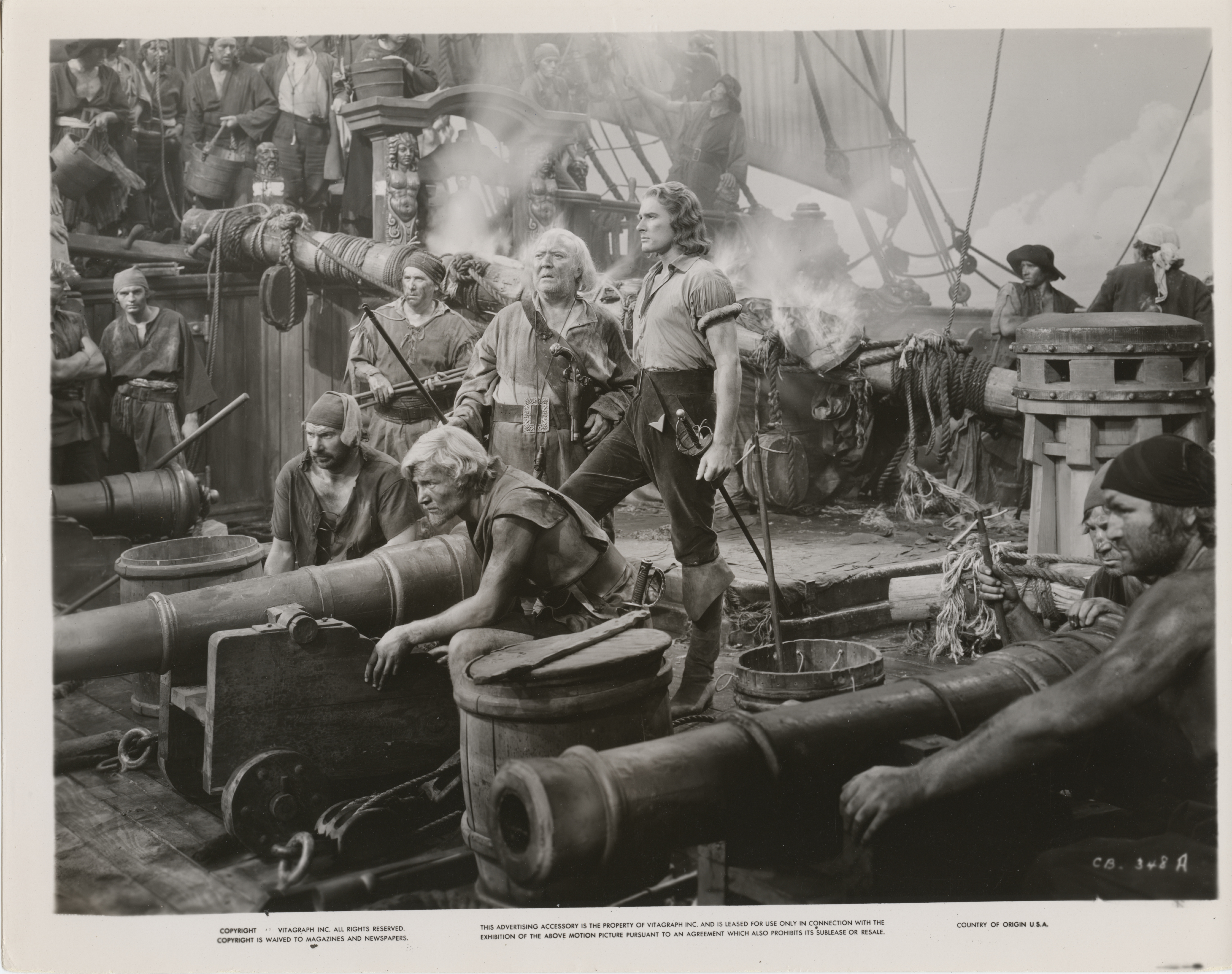
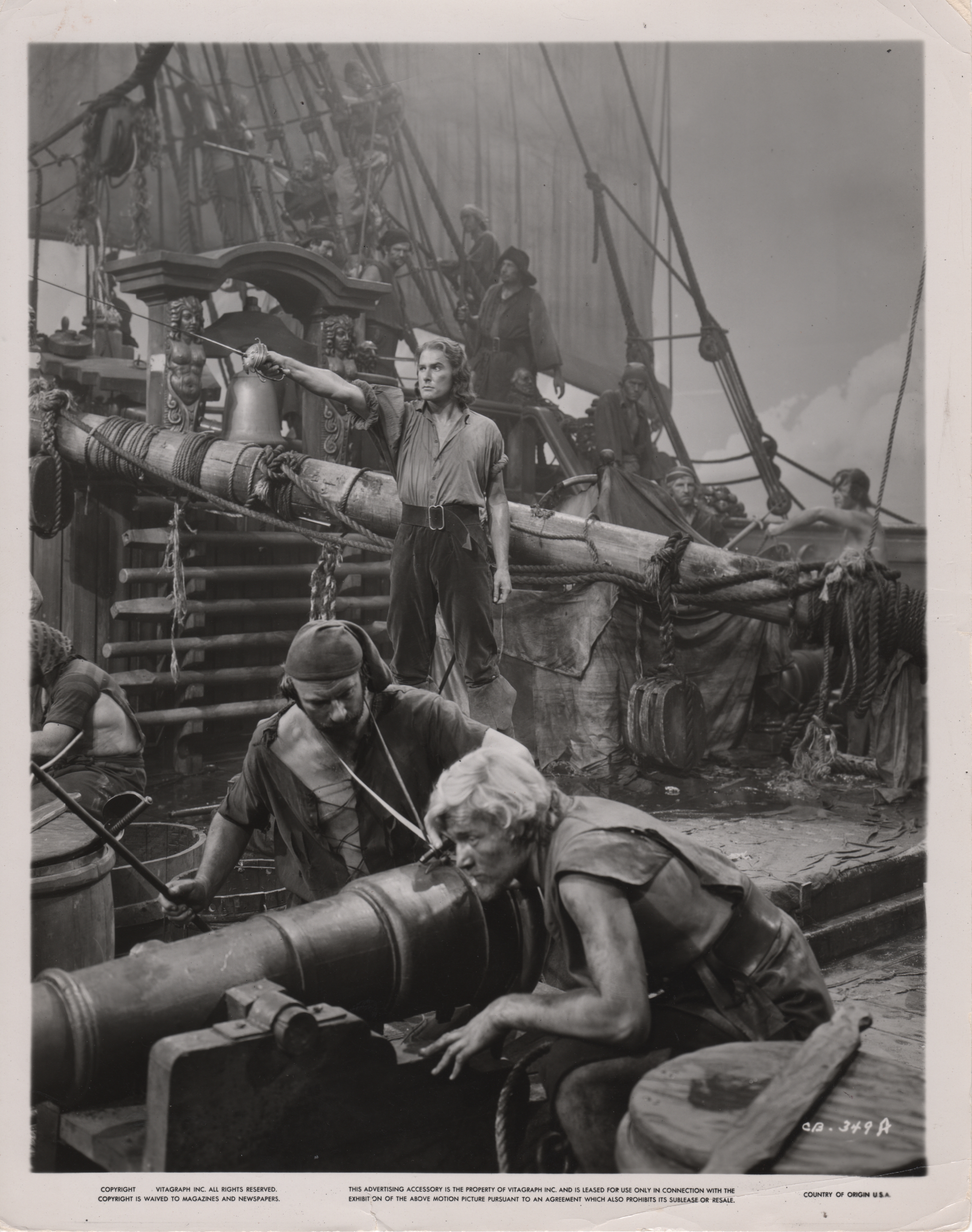
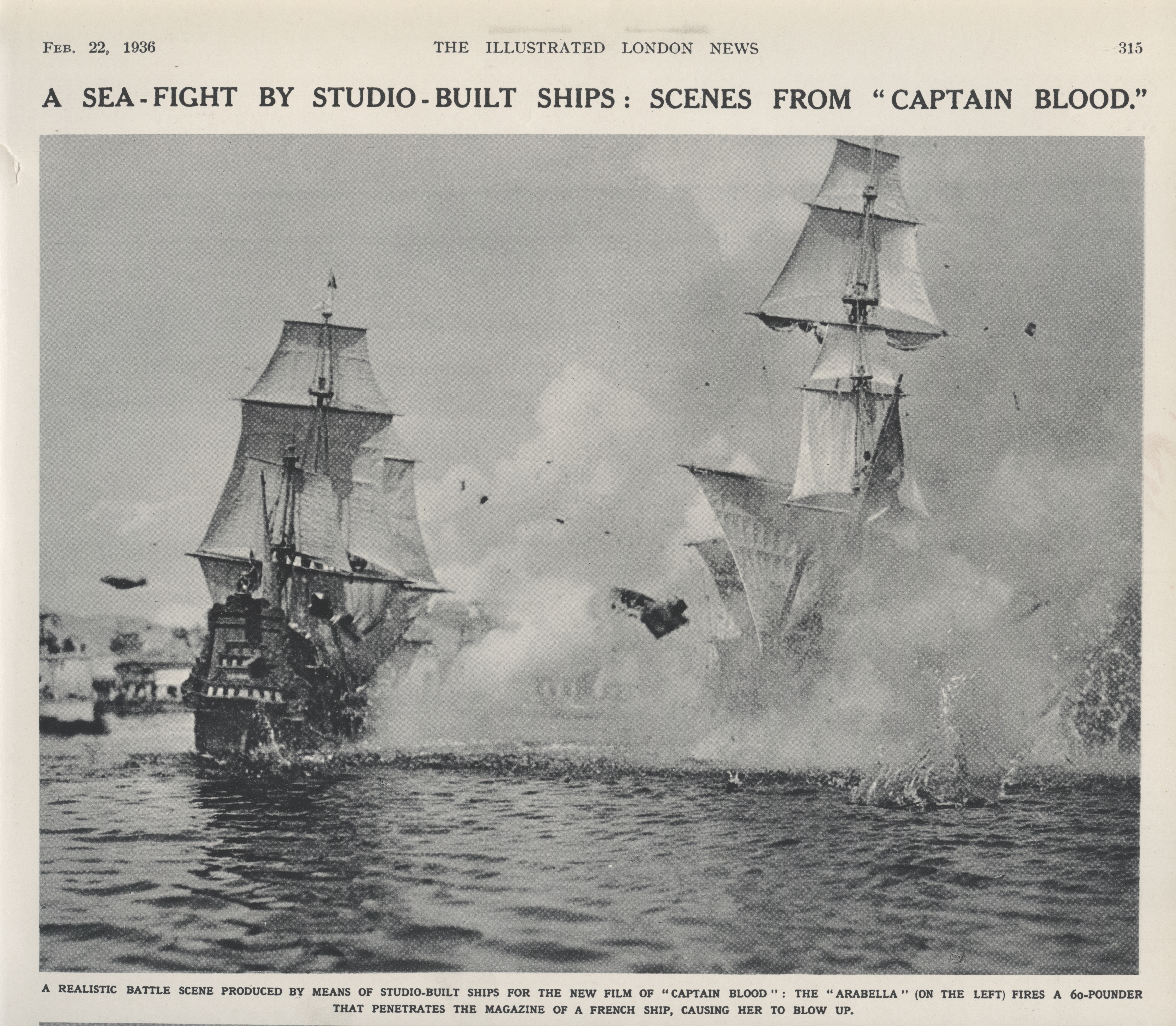
“On, now, Jeremy!” cried Blood. “Straight into them before they recover their wits. Stand by, there! Prepare to board! Hayton … the grapnels! And pass the word to the gunner in the prow to fire as fast as he can load. … Musketeers to the prow!”
—the fictional Captain Peter Blood in Captain Blood: His Odyssey by Rafael Sabatini (1922), during the finale against the French fleet at Port Royal, Jamaica, set in the year 1689.
“All right, my hearties, follow me!”
—Errol Flynn as the fictional Captain Peter Blood in Captain Blood (Warner Bros., 1935, Casey Robinson screenwriter) during the finale against the French fleet at Port Royal, Jamaica, from the gun’l, his ship sinking, just before he swings Hollywood-style from ship to ship, leading his men in a boarding action. The line is not in the published script, but apparently was written or adlibbed during filming. The original line was “Over we go, lads!” Flynn also uses much of Sabatini’s language above prior to boarding.
Real Pirate Speeches & Exhortations in Battle
“Yes, follow me and doe not lye behind, for if I doe amise* You will all fair the worse for itt.”
—Captain Richard Sawkins, English buccaneer captain, landing himself first and leading the attack against the “stokadoes” on the río Puebla Nueva (in the modern district of Remedios, Panama) in 1680, as quoted by buccaneer “E. P.,” doubtless Edward Povey. Sawkins “went up corragiously with some brisk men with him, butt their was provided Mollattas and hunters with their launces which came to oppose him. He fierd his Pistole and shott downe one Musteese, the rest fiering and lodeing as fast as they could, but the Spaniards coming in upon them so fast that kill’d capt. Sawkins and 3 men more.” The buccaneers were forced to take to their heels.
* Probably amiss: to go amiss, to fail.
“Have a good courage. We must either defend ourselves like good soldiers, or lose our lives with all the riches we have gotten. Do as I shall do, who am your Captain. At other times we have fought with fewer men than we have in our company at present, and yet we have overcome greater numbers than there possibly can be in this town. The more they are, the more glory we shall attribute unto our fortune, and the greater riches we shall increase unto it.”
—Captain François L’Ollonois, aka Jean David Nau, prior to the attack on Gibraltar on Lake Maracaibo in 1666, as quoted by Alexandre Exquemelin, buccaneer-surgeon and buccaneer chronicler who likely sailed under him, from the 1684 English edition (Crooke) of The Buccaneers of America. The speech, while it might be authentic, might also be embellished, recreated and revised from poor memory, or even apocryphal, added after the fact for editorial emphasis. L’Ollonois, a bloody-minded buccaneer and murderer, was killed by Native Americans on the Darien coast in 1669, burned, and his ashes reportedly scattered to the wind.
“You are too experienced to not understand the peril we are running, and too brave to fear it. It is necessary here to be cautious of all yet to risk all, to defend and attack at the same time. Valor, deception, fear, and even despair must all be put to use on this occasion; where, if we fall into the hands of our enemies, nothing awaits us but all sorts of infamies, from the most cruel of torments to, finally, the end of life. We must therefore escape their barbarity; and to escape, we must fight.”
—Captain Laurens de Graff, Dutch buccaneer in the service of French flibustiers, prior to his fight against the Capitana and Almirante of the Armada de Barlovento in 1685, each ship twice the size of de Graff’s Neptune and throwing twice its weight in iron, as quoted (and perhaps embellished, and clearly edited) by Alexandre Exquemelin in the French edition of The Buccaneers of America. De Graff was later wounded in the action, but ordered his men to carry him back on deck when he noticed his ship’s guns slacking their fire. The Spanish men-of-war took enough of a beating that they fled the scene overnight. (My translation.)
Sea Battle
“Come chearly my Hearts! It is a Prize worth fighting for… Hold fast Gunner, do not Fire till we hail them with our speaking Trumpet; Port edge towards him; so, now we are fairly along side of him, and within Musket shot: Come, my brave Men, run out your Guns, and give him a Broadside, a Volley of small Arms, and a Huzza. Well done, my Hearts! He returns our Compliment, by firing his Broadside upon us. What chear, my Hearts, is all well betwixt Decks? Yea, yea, only he has rak’d us through and through; no Force, it is his Turn next; but give not Fire again, till We are within Pistol shot: Port edge towards him, he plies his Small shot. Come, Boys, Load and fire our small Arms briskly at him… Starboard a little; Give fire, Gunner! (That was well done!) This Broadside hath made their Deck thin, but the small Shot at first did gaul us. Clap in some Case-shot in the Guns you are now a loading; Brace too the Fore-top-saiI, that we may not shoot a head; He lies broad off to the Southward, to bring his other Broadside to bear upon us. (Starboard hard!) Get to Larboard Fore-tack; trim your Topsails, run out your Larboard Guns. He fires his Starboard Broadside upon us. He pours in his small Shot. Starboard give not fire until he fall off, that the Prize may receive our full Broad-side. Steady: Port a little; give fire Gunner! His Fore-mast is by the board. This last Broad-side hath done great Execution. Cheerly my Mates, the day will be ours!”
—Sturmy’s Mariner’s Magazine, 1669, with a slight update from Kelly’s The Modern Navigator’s Compleat Tutor, 1733. Exclamations added. This text, with occasional minor variation, is found in several various period books on seamanship, including a book on ships, seamanship, and sea fights by Captain John Smith of Pocohontas fame (or infamy).
“[H]owever nothing daunted at the disadvantage of Fight, we made a resolution rather than drown in the Sea, or beg Quarter of the Spaniard, who we used to Conquer, to run the extreamest hazard of Fire and Sword, and after a sharp Contest, still birding with our Fusees as many as durst peep over Deck, we boarded one of them, and carried her; so with her we took the second; and the third had certainly run the same fate, had not she scoured away in time…”
—Buccaneer John Cox
“Shee fierd a Harkquebus att us, att which wee presented them with a whole Volley; she fier severall small gunns at us, and wounded 3 men. one of them after-wards died. wee laid her aboard and tooke her. She had about 30 hands in her, fitted out for an Armadillo to come downe to the Isle of Plate, to see what a posture we lay in…”
“A Barkque wee gave chase to butt could nott fetch her upp. she seeing all our cannoes getts into Pennamau and makes alarme. their was by Relacion putt on board the shipp and Barkques which came out to fight us 300 Soldados and Armed men. wee had about 3 howers dispute and tooke them all. wee killed and wounded many men. And Brave vallient capt. Peter Harriss was shott in his cannoe through both his leggs, bordeing of a greate shipp. their was nott any gott cleare only on [one] small Barkque that rann into Pennamau againe. itt being all done and Quiatt, the Spanish Gen’ll being kill’d wee tooke his Chief captaine, one capt. Berralto, who being an Antient Seaman in those seas we caused him to be our Pylott, he being the commdr. of that shipp that carried away the Riches from Pennamau to Limma about 12 years since, that same time when Sr. Henry Morgan tooke Pennamau. this capt. Berralto was much burnt, and his peopple most of them kill’d and blowne upp, for as thay fought us thay had scatter’d loose powder on their decks, which tooke a fier by some accident or other, that wee seeing itt borded them and tooke them. these 7 sayle of shipps we tooke att Pennamau was not above half unloded. their lading was flower, linnen and woolen cloath, one greate shipp half laden with Iron. wee desierd of capt. Berralto which wear the best saylors. he told us on his word the Trinnity was the best in the South Seas, soe wee pitched on her for Admirall, putting capt. Harriss abord that was wounded. the Doctors cutting of one legg itt fester’d so that itt pleased god he died, so wee lost that Valliant brave Soldiar. then wee putt in capt. Rich’d Sawlkings into the Shipp Trinity and made him Our Admirall.”
“[A]bout the middle of August one night, as the greate shipp had us in a towe, we saw a saile in the darke. wee lett goe their towe, and made what saile we could to her, comes in half a hower up with her, and ha’ls her. Shee fierd a Harkquebus att us, att which wee presented them with a whole Volley; she fier severall small gunns at us, and wounded 3 men. one of them after-wards died. wee laid her aboard and tooke her. She had about 30 hands in her, fitted out for an Armadillo to come downe to the Isle of Plate, to see what a posture wee lay in; their was on Borde 2 very Honorable gentlemen, which came out for ther Pleasure to see us, wee being term’d amounge them a strainge sort of Peopple and cal’d by the name of Laddron [Ladrones, that is, thieves, a common Spanish term for pirates—Povey is making a joke.].”
“[W]ee had two men of war cannoes gon to windward for goates and had found, by relacion, 150 fatt ones, butt sleepeing alnight by a fier att the Sea Side and in the morning went to fetch their goates, lookeing out to se if the Sea weir cleare of shipps Spyed within 3 leagues of the Island 3 greate saile of Shipps, Admirall, Vise Adm’ll and Rear Adm’ll; seeing thiss, made what hast they could to their cannoes and soe on borde shipp, leaveing all their goates behind them bound. as soone as thay came near the Shipp thay warned us with 3 Motions, that wee understoode their was 3 saile. wee gott all our peopple that weir on shore off and what other things wee could, gott our anchor on bord, had nott time to gett the Other butt lett him slipp, hoysted in Our launch and canno’s. by thiss time thay weir came within sight of us; so near that wee could se a weapon florrished on the quarter deck of the Adm’ll. wee understoode wee had left one of our Strikears on shore that had gott under a tree to Sleepe, sent a cannoe for him but could not finde him, soe came of to the Shipp and left him their. [This was Will, the Moskito striker. His marooning may have helped to inspire Robinson Crusoe.] these 3 shipps Clings the wind and stands After us. the reare Adm’ll which was the least had 12 gunns, their Vise Adm’ll 16 and their Adm’ll 24. Our new capt., being Jno. Watkins, would have gon aborde the Adm’ll if the Party had beene willing; wee could wronge them by sayling att our Pleasures, bye or large, soe that wee played with them a day and a night. then wee concluded twas our time to goe downe and take Arrica, the Place that wee made an attempt att before.”
—Buccaneer Edward Povey. His unedited personal journal is one of the most authentic sources of “pirate language” in English.
Pirate Swordplay Speech
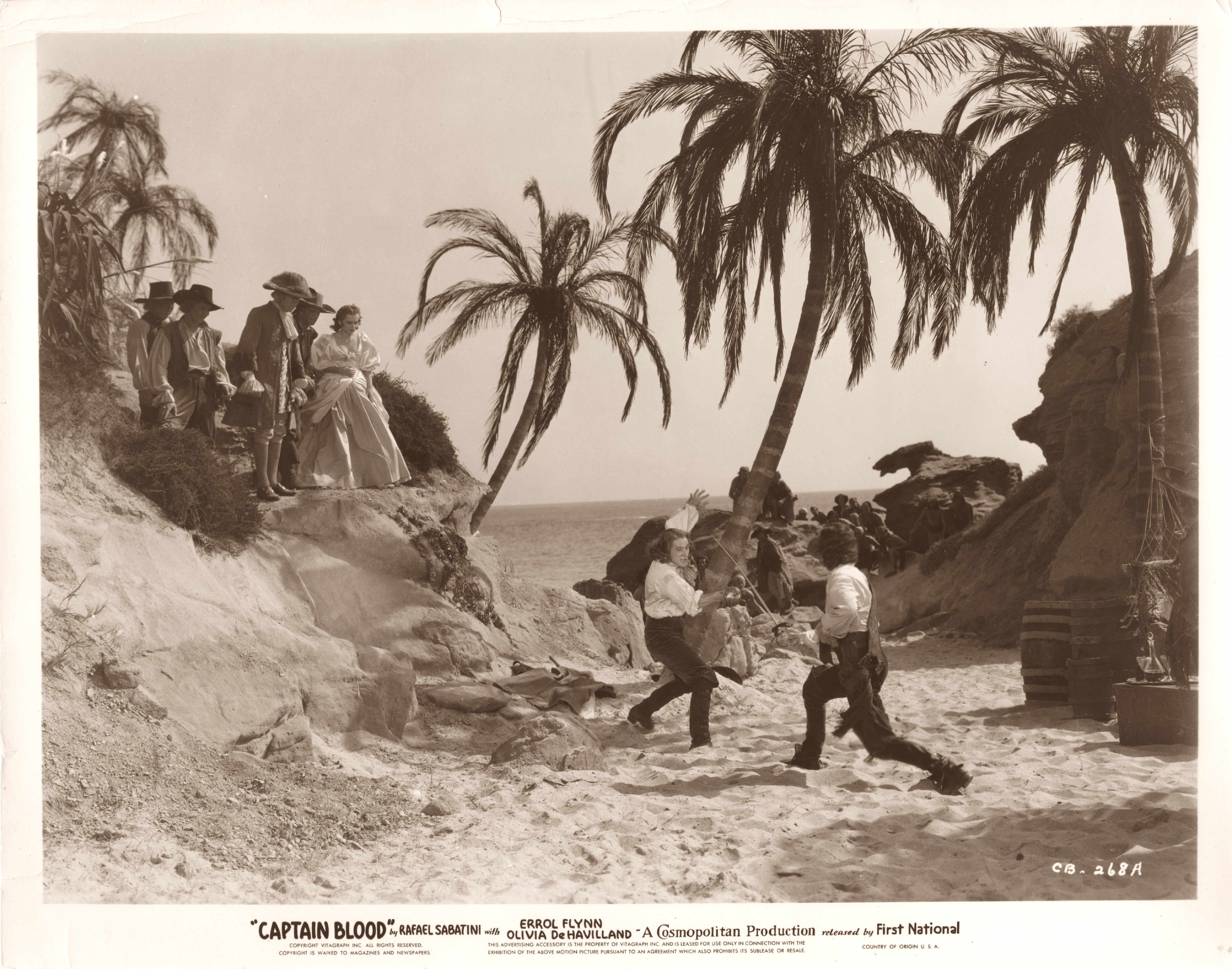
“Voilà! With this I shall avenge the insult you have given me,” said Capt. Laurens de Graff as he drew his sword.
Or, in the original French: “Voilà,” dit Laurent mettant l’épée à la main, “ce qui me venger de l’injure que tu mas faite.”
—Alexandre Exquemelin in his French edition quoting Laurens de Graff
“On Thursday afternoon Admiral Lorenzo [Laurens de Graff], seeing how we suffered [from thirst and hunger], told the General [Nicolas Van Horn] that they should cast us ashore as I wanted them to do. The General grew angry and told me he would put us to the sword. At these words the Admiral drew his cutlass with such agility that before the General had put himself on guard Lorenzo had cut him in the arm and ear. They [the pirates] stopped them and I heard the admiral call his soldiers and send him [Van Horn] to his ship which was the almiranta [Van Horn’s St. Nicolas], and from this day we saw him no more.”
—Fray Avila describing the sack of Veracruz in 1683, excerpted from The Golden Age of Piracy by Benerson Little. The duel took place in 1683 on the Isla de Sacrificios near Veracruz, between Dutch buccaneer captains Laurens de Graff and Nicolas Van Horn. The duel, fought with cutlasses, lasted but a moment, with de Graff the easy victor: Van Horn was a poseur, while de Graff was an adventurer well-skilled in arms. It is the only documented duel between buccaneer or pirate captains during the Golden Age of Piracy. Of course, de Graff’s words may be apocryphal. The Spanish eyewitness to the duel doesn’t mention them and Alexandre Exquemelin, who quotes de Graff, wasn’t present at the duel. My translation.
There are but few descriptive accounts of swordplay among sea rovers during the so-called Golden Age of Piracy, and none that give a good sense of the language, so here’s the next best thing. The first below is a newspaper account, which may be embellished or even made up, the second is an excerpt from Lieutenant Robert Maynard’s account of the action. In the hand-to-hand — or more accurately, sword and pistol — action, the two sides were of roughly equal numbers: the English naval seamen killed all the pirates while losing none of their own, although they had numerous wounded. So much for the idea that the early 18th century black flag pirates were great warriors! That’s what happens when you spend all of your time robbing merchant seamen who can’t fight back…
“Maynard and Teach themselves two begun the Fight with their Swords, Maynard making a thrust, the point of his Sword went against Teach’s Cartridge Box, and bended it to the Hilt, Teach broke the Guard of it, and wounded Maynard’s Fingers but did not disable him, whereupon he Jumpt back, threw away his Sword, and fired his Pistol, which wounded Teach, [Abraham] Demelt struck in between the with his Sword, and cut Teach’s Face pretty much; in the Interim both Companies engaged in Maynard’s Sloop, one of Maynard’s Men being a Highlander, engaged Teach with his broad sword, who gave Teach a cut on the Neck, Teach saying, well don Lad, the Highlander reply’d, if it be not well done, I’ll do it better, with that he gave him a second stroke, which cut off his Head, laying it flat on his Shoulder…”
—The Boston News-Letter, February 23, 1719 (Old Style)
“Immediately thereupon, he enter’d me with ‘o Men; but 12 stout Men I left there, fought like Heroes, Sword in Hand, and they kill’d every one of them that enter’d, without the loss of one Man on their [the Royal navy] Side, but they were miserably cut and mangled… We kill’d 12, besides Blackbeard, who fell with five Shot in him, and 20 dismal Cuts in several Parts of his Body…”
—Lieutenant Robert Maynard’s account of the hand-to-hand combat
A Drinking [Former] Pirate, Or Buccaneer and Privateer, If You Prefer
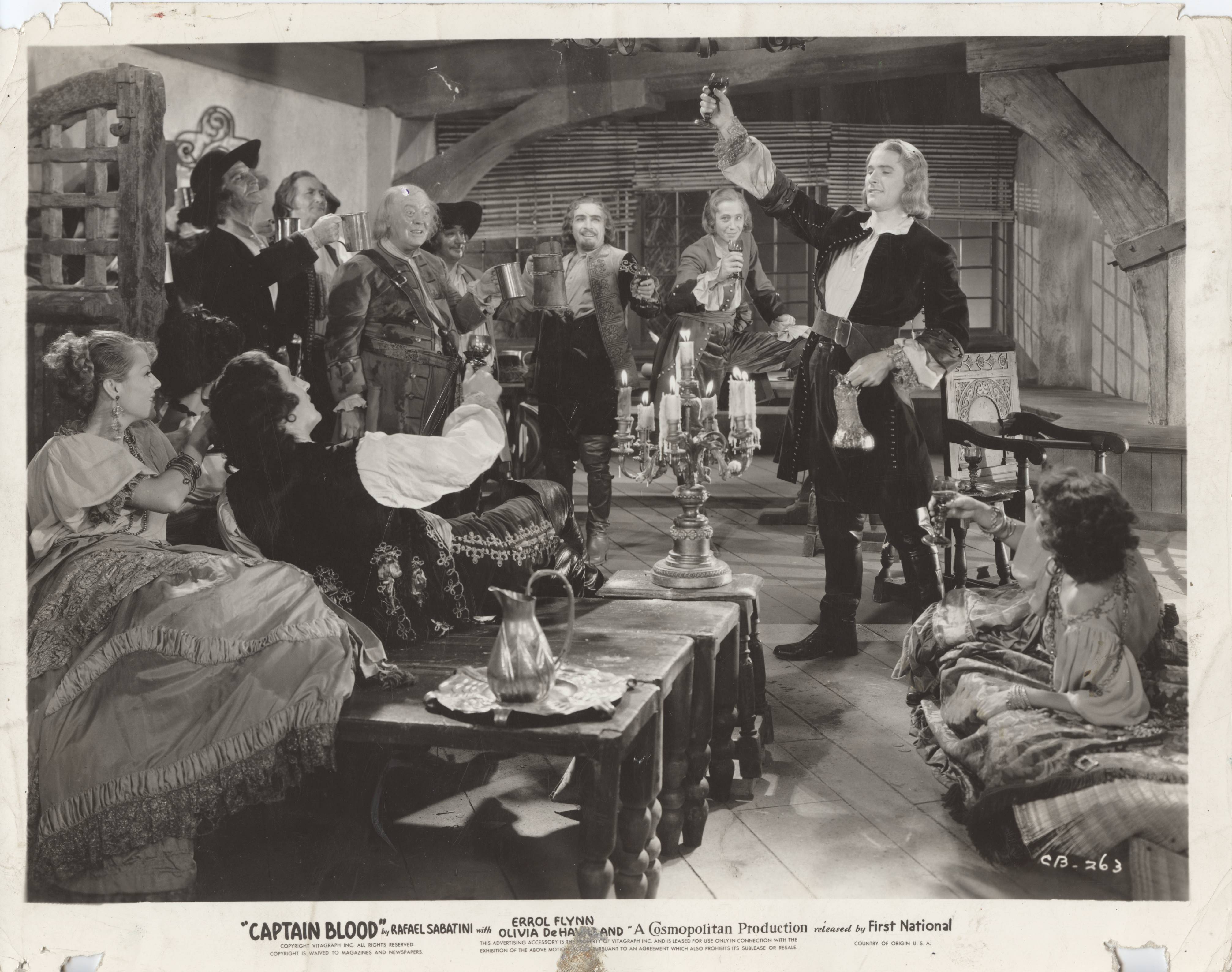
“In his drink Sir Henry [Morgan] reflects on the Government, swears, damns, and curses most extravagantly…”
—Calendar of State Papers, Colonial, America and West Indies.
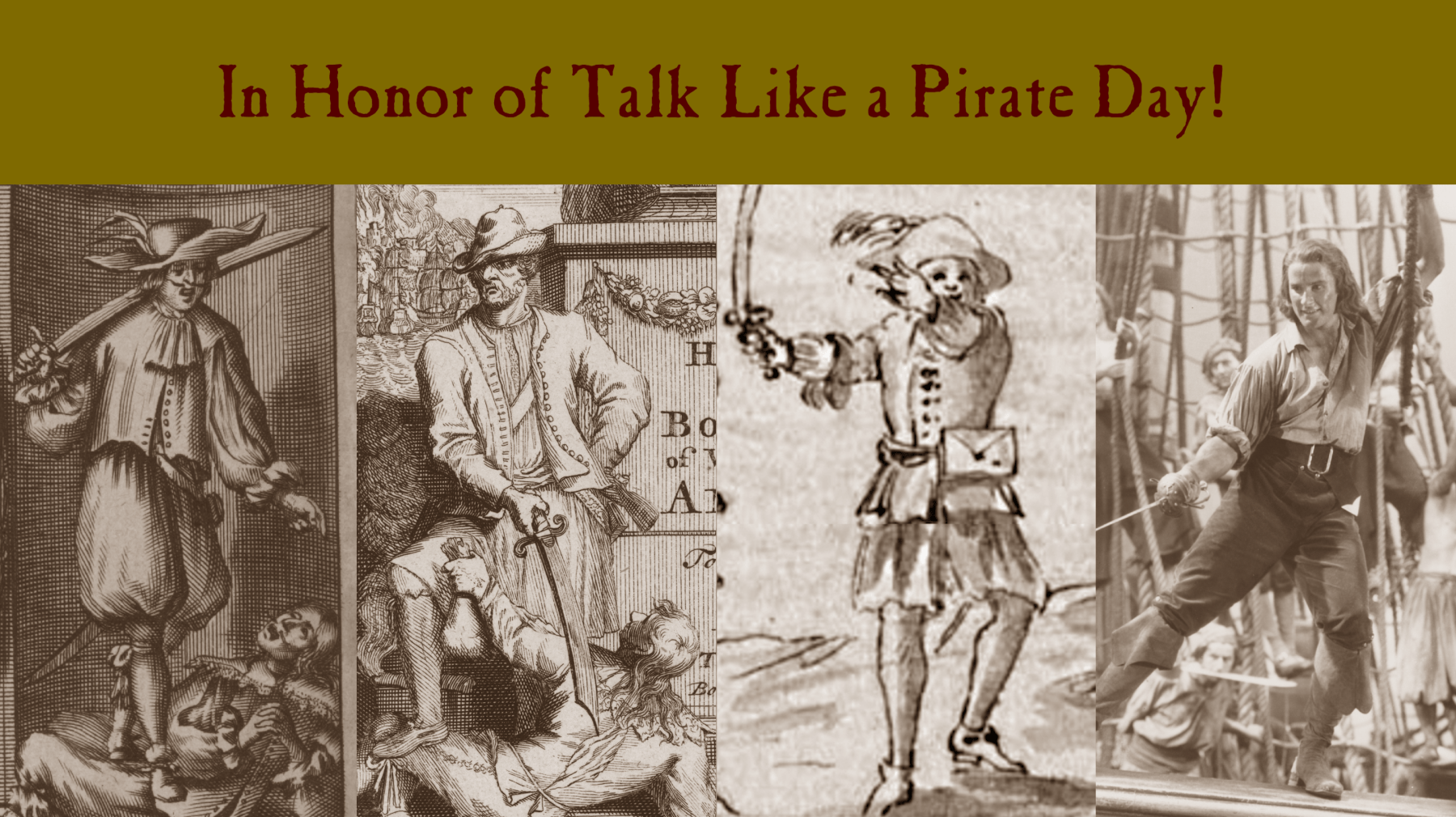
The probably French buccaneer on the far left in the illustration at the head of the page is a detail from De Americaensche Zee-Roovers by A. O. Exquemelin, 1678, in the Library of Congress; the probably Dutch buccaneer at left center is a detail from Historie der Boecaniers, of Vrybuyters van America by Alexandre Exquemelin, 1700; the French buccaneer at right center is an eyewitness illustration, that is, what one truly looked like, a detail from a chart of Petit Goave drafted in 1688 by Paul Cornuau, Archives Nationale d’Outre-Mer; and on the far right is Errol Flynn in a detail from a publicity still for Captain Blood, Warner Bros. 1935.
Copyright Benerson Little 2026. First posted 18 September 2026.

Pirates & Brigands & Jack Tar: This “Naval Practice Cutlass” Is Not What You Think It Is (But Charles Dickens Knew!)
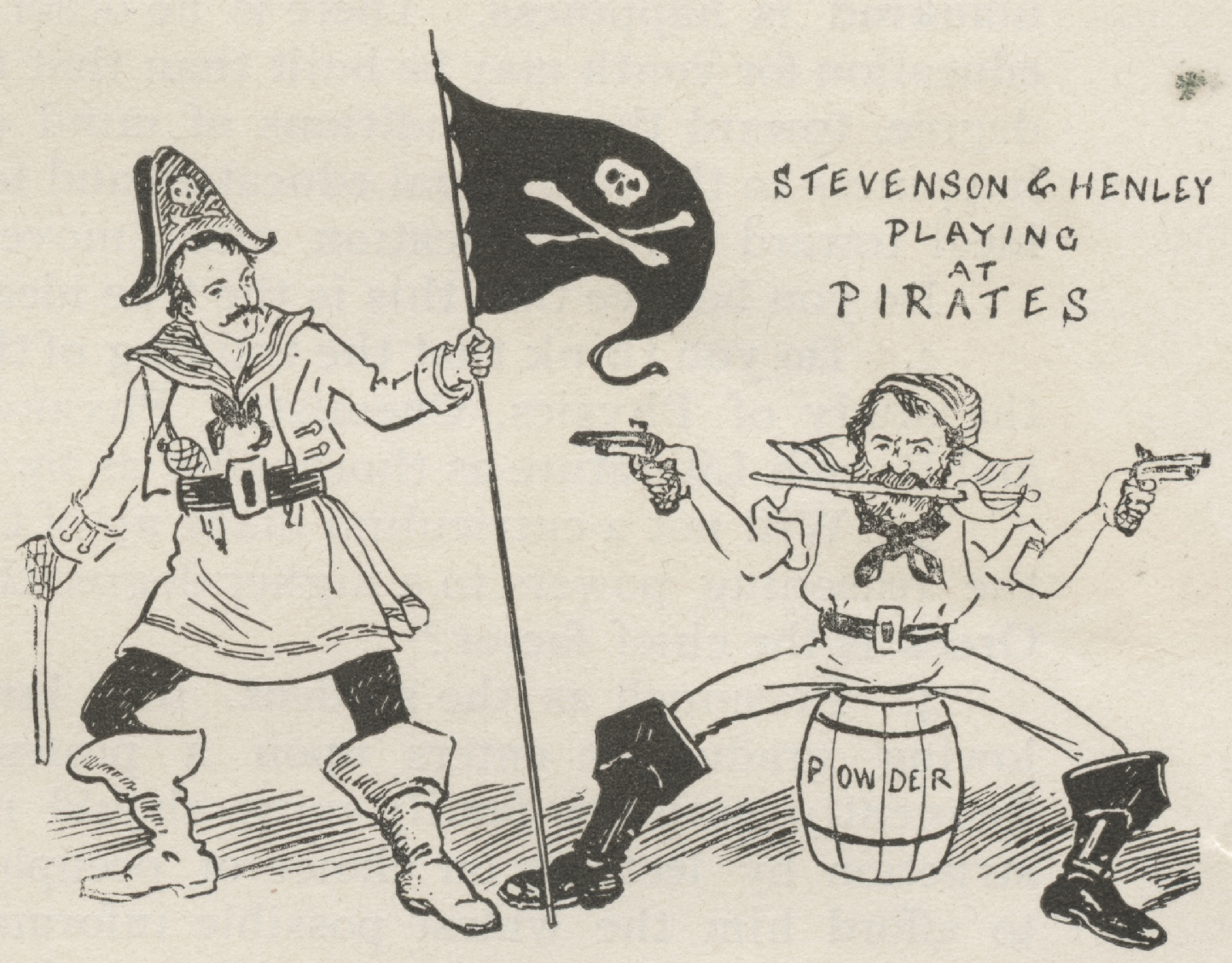
“Jack Tar — armed literally to the teeth — with a combat sword in each hand for use, and a third between his teeth for ornament, encountered and overcame with ease eight ‘piratical skunks,’ seven slain with bloodless slaughter, the eighth contemptuously discomfited with a ‘quid o’ bacca.'” (Excerpted from “Realism” by Philip Beck, in The Theatre, September 1, 1883.)
This is the popular personification of the English seaman of the oak and iron era, the seaman of Drake and Myngs and Nelson — Jack Tar as he came to be known! His cutlass gripped by his powerful horny hand! No brigand, no pirate, nor even scimitar-armed Barbary corsair could stand against the doughty English (or rather, British!) seaman blade-in-hand! Much less in both hands and between his teeth, long before Roronoa Zoro (Zorro l’Ollonois in English — two famous names!) independently developed this famous three-sword style in the pirate manga, anime, and live action series One Piece.

Notwithstanding the clashing and sparking of swashbuckling blades we’re going to discuss, you may consider this short essay as a Public Service Announcement as much as a rendering of sword history. Yes, it mentions pirates and brigands and Jack Tars, and cutlass practice and swordplay and fencing tempo, but it is ultimately a PSA intended to correct the record, thus:
Every once in a while, when searching for swords within my areas of interest for research or occasionally for purchase, I’ll run across a nineteenth century “naval practice cutlass” with a steel blade and iron or steel basket hilt. Recently I found one quite by accident, listed at a tenth of what I’ve often seen these swords priced at, and so I purchased it.
Typically these are listed by auction houses and antiquarian arms dealers as practice cutlasses dating variously to circa 1860, or to “the Great White Fleet” or “the Spanish-American War,” or “between WWI and WWII.” Of course, the inability of dealers to properly date an arme blanche, even a practice one, more precisely is always a red flag. More on this in a moment. For now, we’ll assume the style of the “practice cutlass” I purchased was in service for a long time, as real and practice weapons often are.
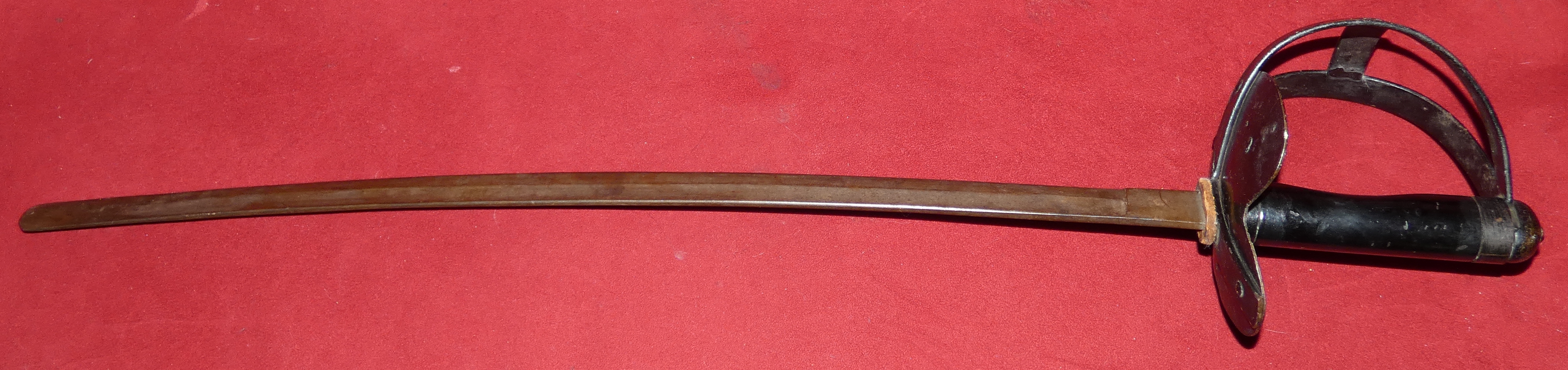
My new “practice cutlass” is in near-mint condition, the blade largely un-nicked, the blackening of the basket hilt largely unscratched, and, curiously, a gold tint to the blade (quite common with some of these swords) still quite obvious. I was immediately taken with its excellent balance permitting credible feint attacks in spite of its weight. Most cutlasses, including practice weapons and blunted re-enactment arms, are clumsy affairs, more suited to direct attacks and strong simple parries at close quarters. But not this one! It has a lovely balance, one that immediately feels perfect in the hand. For a cutlass, it is sturdy with a solid feel, yet light at the tip in spite of its two and a quarter pound weight. Moulinets? With ease! The blade practically spins in the hand.


Immediately I contacted my friend and armes blanches expert and collector, not to mention expert designer and craftsman in models and miniatures, comic artist, raconteur, and more, Jim McDougall for his expert opinion. I paraphrase his reply: the blade appears to be a cut-down 19th century saber blade, the hilt sturdy but rather crudely put together, the grip emulating a circa 1900 style, and a generally ersatz appearance. (Any error in this summary of his words to me is mine alone.)
These observations would not alone implicate the “practice cutlass” as being fake, but there’s more: naval cutlass practice in the 19th century was of two forms. In the first, sailors (or “seamen” in the UK) drilled the general cuts and parries with real cutlasses but without contact. Forget Hollywood and novelists — no one used real swords for practice with contact, ever. Such practice spoils the edge and is likely to break blades as well, given that the blades of sharps are not tempered for countless bending and beating as practice blades are, not to mention the inherent dangers of practicing with pointed, sharp-edged swords.
In the second, sailors exercised with practice cutlasses with leather basket hilts and wooden blades — short-bladed singlesticks in other words. The use of heavy steel blades for practice with contact, which was done for example by Hungarian sabreurs in the pre-Santelli era, requires heavily-padded fencing masks and jackets. When such protective equipment was seen shipboard, it was associated not with steel-bladed practice weapons but with singlesticks, a particularly useful practice given the sailor/seaman’s natural tendency to hit hard and hit often. Notably, neither secondary history nor period primary sources on naval cutlass drill and naval swordplay describe practice with steel-bladed practice cutlasses.
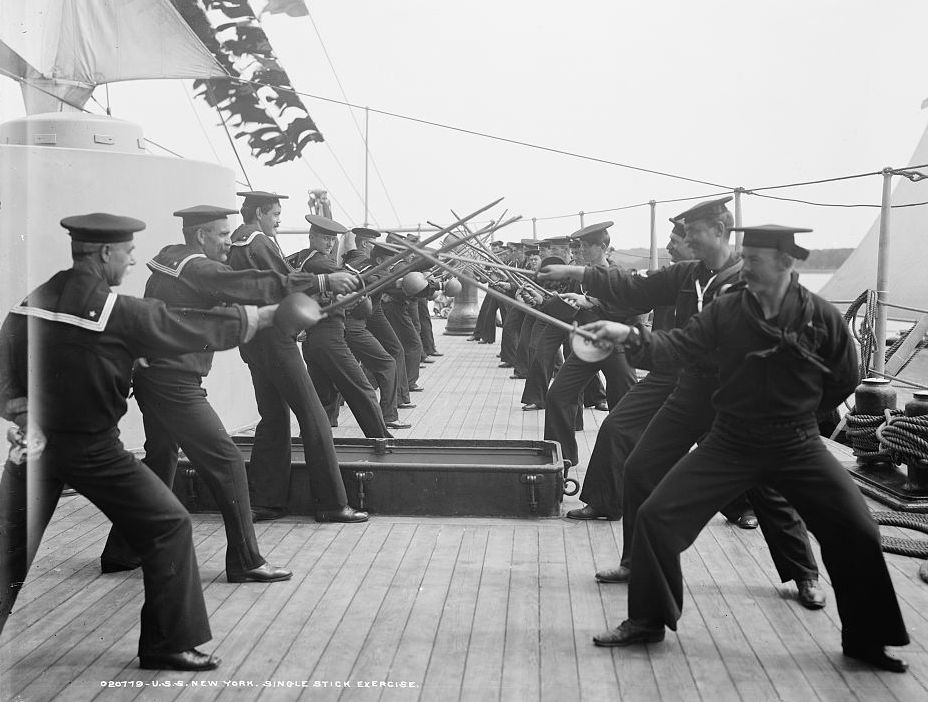
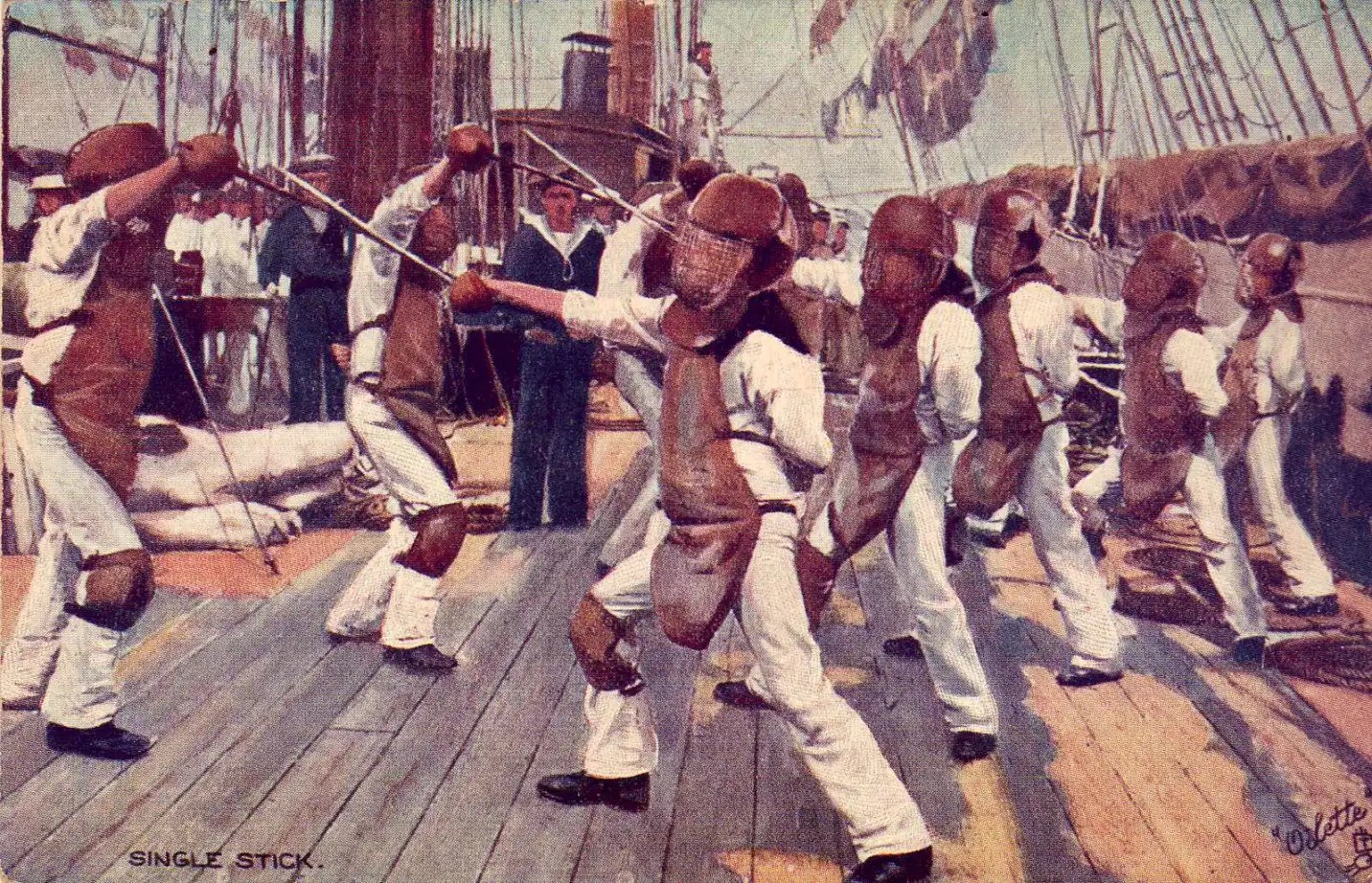

After Jim’s reply, I went through my extensive fencing library, both of real and digital volumes, then searched further online. Catalogs were an obvious source, and which quickly rewarded me, thus:

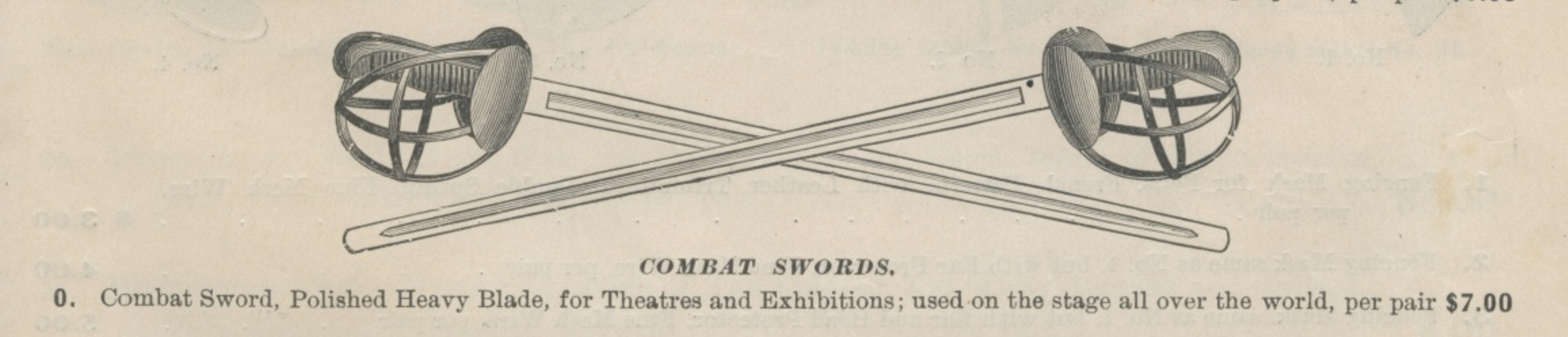
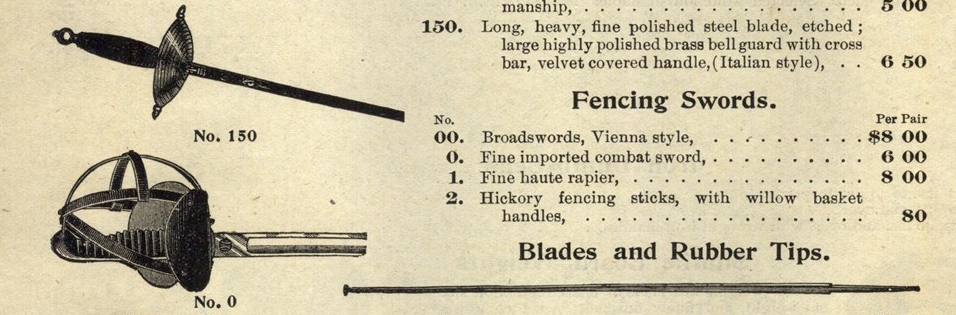
As is now obvious, my “naval practice cutlass” is in fact a theatrical sword known as a “combat sword” used, as one ad above notes, “for Theatres and Exhibitions; used on the stage all over the world.” Combat swords like these were “common theatrical properties” in the 19th century, and these swords and their stage combats were a common feature of 19th century British popular theater, particularly among the provincial theaters and touring troupes in the first half of the century, although their combats were performed throughout the century and in other theaters as well. So associated with the theater was the combat sword that Robert Louis Stevenson is holding one in the image at the top of the page. (Side note: the article that accompanies the image is about Stevenson and Henley’s new play, Admiral Guinea, in which Treasure Island villain Blind Pew features prominently.)
Charles Dickens (probably; he was at the very least the editor of the piece) gives perhaps the second best description (and also the best, farther below) of the 19th century practice of stage combat with “combat swords” in the popular theater:
“Broad-sword combats were at one time very popular interludes at minor theatres. They were often quite distinct performances, prized for their own sake, and quite irrespective of their dramatic relevancy. It cannot be said that they suggested much resemblance to actual warfare. Still they demanded of the performers skill of a peculiar kind, great physical endurance and ceaseless activity The combat-sword was an unlikely looking weapon, very short blade with a protuberant hilt of curved bars to protect the knuckles of the combatant. The orchestra supplied a strongly accentuated tune, and the swords clashed together in strict time with the music. The fight raged hither and thither about the stage, each blow and parry, thrust and guard, being a matter of strict pre-arrangement. The music was hurried or slackened accordingly as the combat became more or less furious. “On, two, three, and under; one, two, three, and over;” “robber’s cuts;” “sixes;” the encounter had an abundance of technical terms. And each performer was allowed a fair share of the feats accomplished: they took turns in executing the strangest exploits.
“Alternately they were beaten down on one knee, even lower still, till they crawled serpent-wise about the boards; they leaped into the air to avoid chopping blows at their lower members; they suddenly spun round on their heels, recovering themselves in time to guard a serious blow, aimed with too much deliberation, at some vital portion of their frames; occasionally they contrived an unexpected parry by swiftly passing the sword from the right hand to the left. Now and then they fought a kind of double combat, wielding a sword in either hand. Altogether, indeed, it was an extraordinary entertainment, which evoked thunders of applause from the audience. The eccentric agility of the combatants, the peculiarities of their method of engagement, the stirring staccato music of the band, the clashing of swords and the shower of sparks thus occasioned, were found quite irresistible by the numberless playgoers… Of late, however, the broad-sword combat has declined as a theatrical attraction, if it has not altogether expired. The art involved in its presentment is less studied, or its professors are less able than once was the case.” (Excerpted from “Alarums and Excursions” in All the Year Round, March 9, 1872, edited by Charles Dickens.)
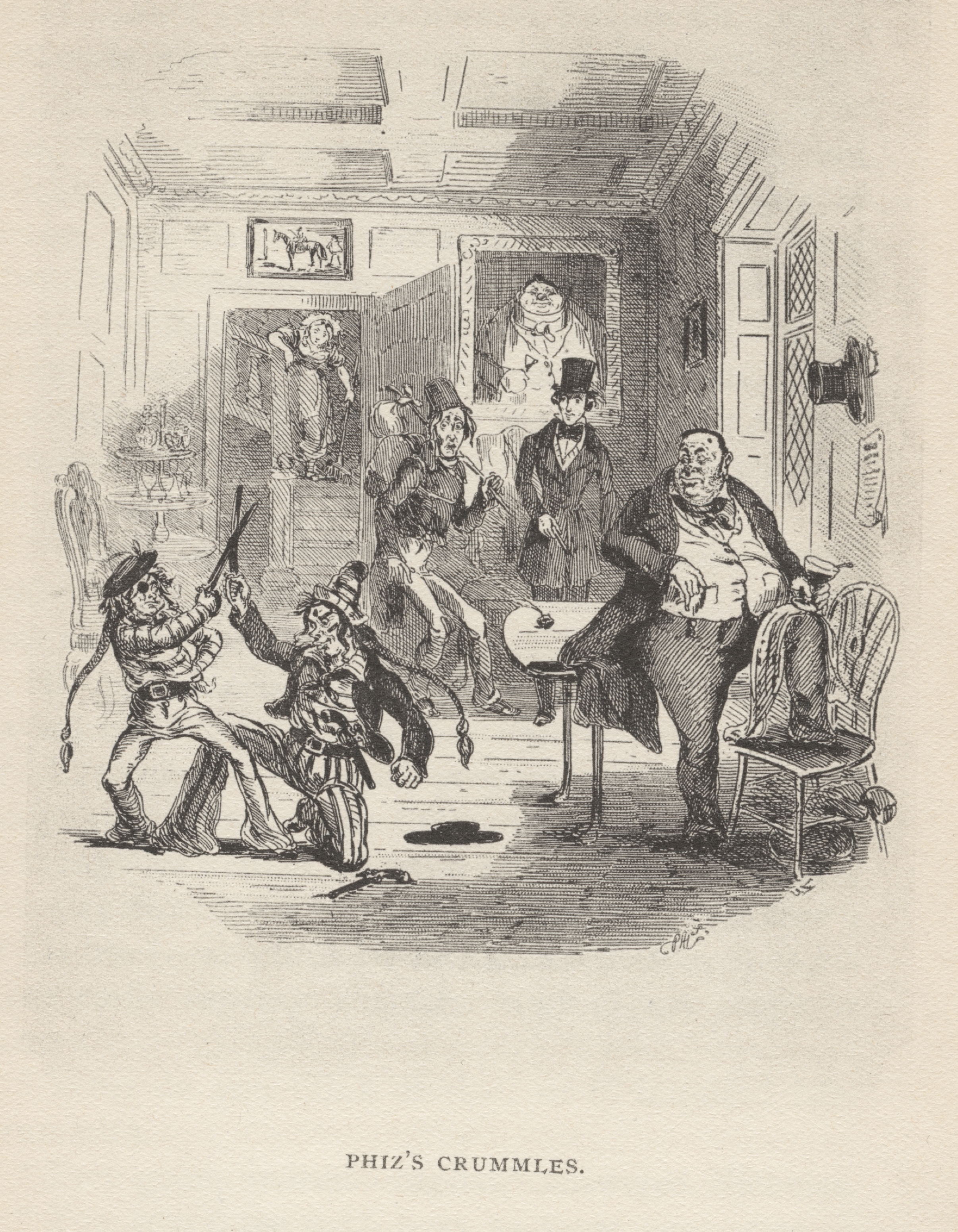
From Nicholas Nickleby by Charles Dickens we have a surely experience-based description of a rehearsal combat between two young actors dresses as Jack Tars and armed with combat swords. Dickens was once a young player in the “minor theatre” in Great Britain, and more than one historian considers his description of such theater in Nicholas Nickleby to be based on his own experience. Some scholars even point to specific persons who likely inspired some of the theater characters.
“Nicholas was prepared for something odd, but not for something quite so odd as the sight he encountered. At the upper end of the room, were a couple of boys, one of them very tall and the other very short, both dressed as sailors — or at least as theatrical sailors, with belts, buckles, pigtails, and pistols complete— fighting what is called in playbills a terrific combat, with two of those short broad-swords with basket hilts which are commonly used at our minor theatres. The short boy had gained a great advantage over the tall boy, who was reduced to mortal strait, and both were overlooked by a large heavy man, perched against the corner of a table, who emphatically adjured them to strike a little more fire out of the swords, and they couldn’t fail to bring the house down, on the very first night.
“‘Mr. Vincent Crummies,’ said the landlord with an air of great deference ‘This is the young gentleman.’
“Mr. Vincent Crummles received Nicholas with an inclination of the head, something between the courtesy of a Roman emperor and the nod of a pot companion; and bade the landlord shut the door and begone.
“‘There’s a picture,’ said Mr. Crummles, motioning Nicholas not to advance and spoil it. ‘The little ‘un has him; if the big’un doesn’t knock under, in three seconds, he’s a dead man. Do that again, boys.’
“The two combatants went to work afresh, and chopped away until the swords emitted a shower of sparks: to the great satisfaction of Mr. Crummles, who appeared to consider this a very great point indeed. The engagement commenced with about two hundred chops administered by the short sailor and the tall sailor alternately, without producing any particular result, until the short sailor was chopped down on one knee ; but this was nothing to him, for he worked himself about on the one knee with the assistance of his left hand, and fought most desperately until the tall sailor chopped his sword out of his grasp. Now, the inference was, that the short sailor, reduced to this extremity, would give in at once and cry quarter, but, instead of that, he all of a sudden drew a large pistol from his belt and presented it at the face of the tall sailor, who was so overcome at this (not expecting it) that he let the short sailor pick up his sword and begin again. Then, the chopping recommenced, and a variety of fancy chops were administered on both sides; such as chops dealt with the left hand, and under the leg, and over the right shoulder, and over the left; and when the short sailor made a vigorous cut at the tall sailor’s legs, which would have shaved them clean off if it had taken effect, the tall sailor jumped over the short sailor’s sword, wherefore to balance the matter, and make it all fair, the tall sailor administered the same cut and the short sailor jumped over his sword. After this, there was a good deal of dodging about, and hitching up of the inexpressibles in the absence of braces, and then the short sailor (who was the moral character evidently, for he always had the best of it) made a violent demonstration and closed with the tall sailor, who, after a few unavailing struggles, went down, and expired in great torture as the short sailor put his foot upon his breast, and bored a hole in him through and through.
“‘That’ll be a double encore if you take care, boys,’ said Mr. Crummies. ‘You had better get your wind now, and change your clothes.'”
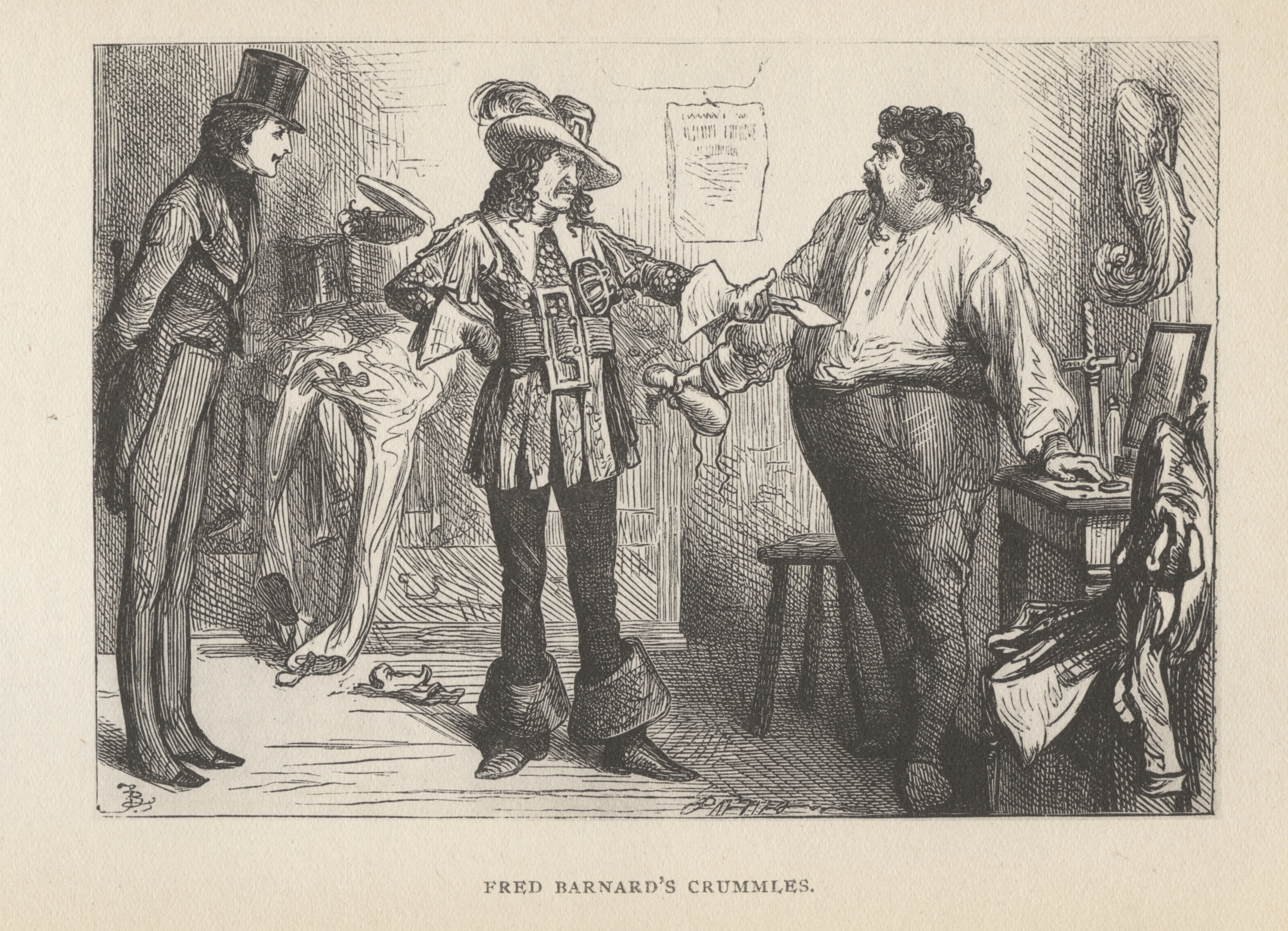
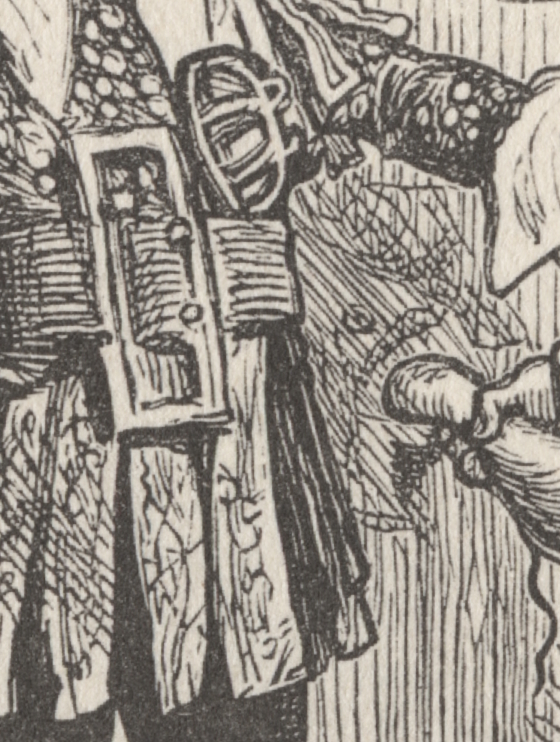
In The Adventures of a Strolling Player, Simon Tomkins (a pseudonym) describes a comical end to Hamlet during the duel, fought not with foils or stage rapiers but with combat swords: “Not being able to procure foils Hamlet and Laertes were obliged to indulge in those deadly weapons technically known as combat swords which are greatly used by stage robbers, pirates, and British sailors. As fencing would have proved rather ineffective with these clumsy instruments and as Laertes was not au fait in that elegant accomplishment, it was judged expedient at rehearsal to change the received mode for that of a cut and thrust melodramatic description. But alas! Polonius’s son by no means justified the encomiums of the gentleman from Normandy who gave him such report for art and exercise in his defence, for he missed half the blows and when Hamlet was striking down he was usually striking up and vice versa; in brief they performed what actors call the ‘double misses.’ This excited much derision from the audience…”
“Snifkins [playing Hamlet] brought the duel to an end as quickly as possible, but when he rushed upon his father in law instead of that gentleman suffering himself to be quietly run through the body as every Claudius has from the days of Shakespeare, he presented a sword and reeling forward exclaimed ‘Come on old cock I’ll teach you to fight the round eights!’ A touch however was sufficient to destroy his equilibrium and having prostrated his arch enemy, Hamlet died as quickly as possible and the curtain descended amidst hisses and derisive laughter.”


Philip Beck provides more detail in 1883: “Time was, and not long since, when a combat generally consisted what is technically known as round eights, singles, threes, broken fives, primes (pronounced preams), double primes, and passes. Very popular was a mysterious combination known as the ‘Glasgow Tens;’ so also was another desperate encounter, carefully arranged, and called ‘The Gladiators,’ this last being a combat fought to music, each blow being struck to its accompanying note or chord in the orchestra.” (Excerpted from “Realism” by Philip Beck, in The Theatre, September 1, 1883.)
Walter Herries Pollock (“Stage Swordsmanship,” The Theatre, June 1, 1896) notes that the swordfights were fought only with the “cutting” edges, and the thrust was used only to deliver the final blow: it was “delivered between the arm and body to make an end at last of the principal villain.” There is a late but fine example of this thrust ‘twixt arm and body in the 1924 silent film Peter Pan, in which John “kills” a pirate.
Actor Frank Price in 1892 described a stage combat he had once had with Irishman George St. George, a stage name of course; the Irishman noted that he would not be hired in England under his real Irish name, so prevalent was anti-Irish sentiment. “I was playing the heavy part,” Price writes, “and in the last scene George and I had a grand sword combat, during which the air was thick with eights, fives, Glasgow tens, and occasional bad language when a stroke was missed or a shin damaged. After great excitement George, having guarded a head blow from me, was wont to kill me in the effective but mysterious manner adopted on the stage.”
A few years later Price was traveling in disguise as an Arab for safety in Egypt during the “Soudan War” (the Mahdist War, 1881-1899) when he came across a red-whiskered Arab in his path. After mangling an Arabic expression intended to determine whether the Arab before him was friend or foe and not receiving the reply he was told to expect from a friendly Arab, Price and his likely enemy drew their swords and fought, Price using all of his stage combat skill in round eights and Glasgow tens and more. But just as he forced a head parry and was about to deliver the killing stroke, his Arab adversary shouted, “Murther alive! I’m kilt!” It was George St. George, also traveling in disguise for safety. (From Frank Price, “A Grand Combat,” The Era Almanac, 1892.)
What were the “Glasgow tens” and similar patterns? The best description I’ve found so far is in Cut and Thrust: The Subtlety of the Sabre by Leon Bertrand, 1927, in which the author refers to the “Glasgow cuts”: “Hero and villain would cross swords on either side with the points raised, the blades meeting with rare swish. These manœuvres were continued, the wide sweeping cuts describing a downward course until steel met steel again. If the encounter had to be prolonged these movements were repeated in toto — and then somebody had to die. Nobody was deceived. Rather, both principals gave an idea they were sharpening each other’s blades for the Sunday joint.” One imagines a repeated series of tierces and secondes — a series often still seen in Hollywood and on stage even today. These are not exchanges of attack, parry-riposte, counter-parry-riposted, &c, but of blades flung into position and clashing against each other. Perhaps more adept stage fencers might have thrown an occasional head cut parried by a quinte. Perhaps.
Likewise the “one, two, three, and under” and “one, two, three, and over” noted above Dickens: the former is probably a clashing of blades in tierce, seconde, tierce, then a thrust to the flank, the latter reversed, a clashing of blades in seconde, tierce, seconde, and a thrust to the torso high.
Unsurprisingly, fight director William Hobbs (The Three Musketeers, The Four Musketeers, The Duellists, and many more, plus innumerable stage combats) is quite familiar with the old series of blade contacts, in his Stage Combat (1980) listing The Square Eights, The Round Eights, The Glasgow Tens (which he writes was known in England as The Long Elevens), and even The Drunk Combat. He describes them perhaps more lively than I have, as “whacks at the blade.”
A real sword fight based on old stage combat techniques notwithstanding, Philip Beck also noted that by the late 19th century many actors were now taught conventional swordplay, even if, he writes tongue-in-cheek, it is “one, two, and third in your bosom” — probably an “un, deux, trois” (three disengages, each in the opposite direction, the first two as feints, the third “thrust home”) although it might more broadly be any two feints prior to the final, a form of attack many modern sport fencers are now, sadly, unfamiliar with except occasionally in theory or, even more rarely, as an exercise in blade control and timing, much less actually able to perform when actually fencing.
William Hobbs notes that Felix Bertrand of Salle Bertrand trained many actors in swordplay. Other sources point to William McTurk, assistant fencing master and later fencing master at King’s College London, and, according to J. D. Aylward in The English Fencing Master, Baptiste Bertrand of Salle Bertrand on Warwick Street in London, leading the effort to train actors in proper swordplay and thus they may be considered the late 19th century founders of the modern schools and efforts at theatrical and film swordplay in the UK although many actors on their own learned to fence in order to improve stage swordfights. Aylward blames Captain Alfred Hutton “and his circle” for educating the public in swordplay; no longer would theatergoers be satisfied with the mere clashing of combat swords. Even so, Leon Bertrand in his 1927 Cut and Thrust: The Subtlety of the Sabre notes that the “Glasgow tens” were still seen occasionally on stage and even in some of the silent films of the day.

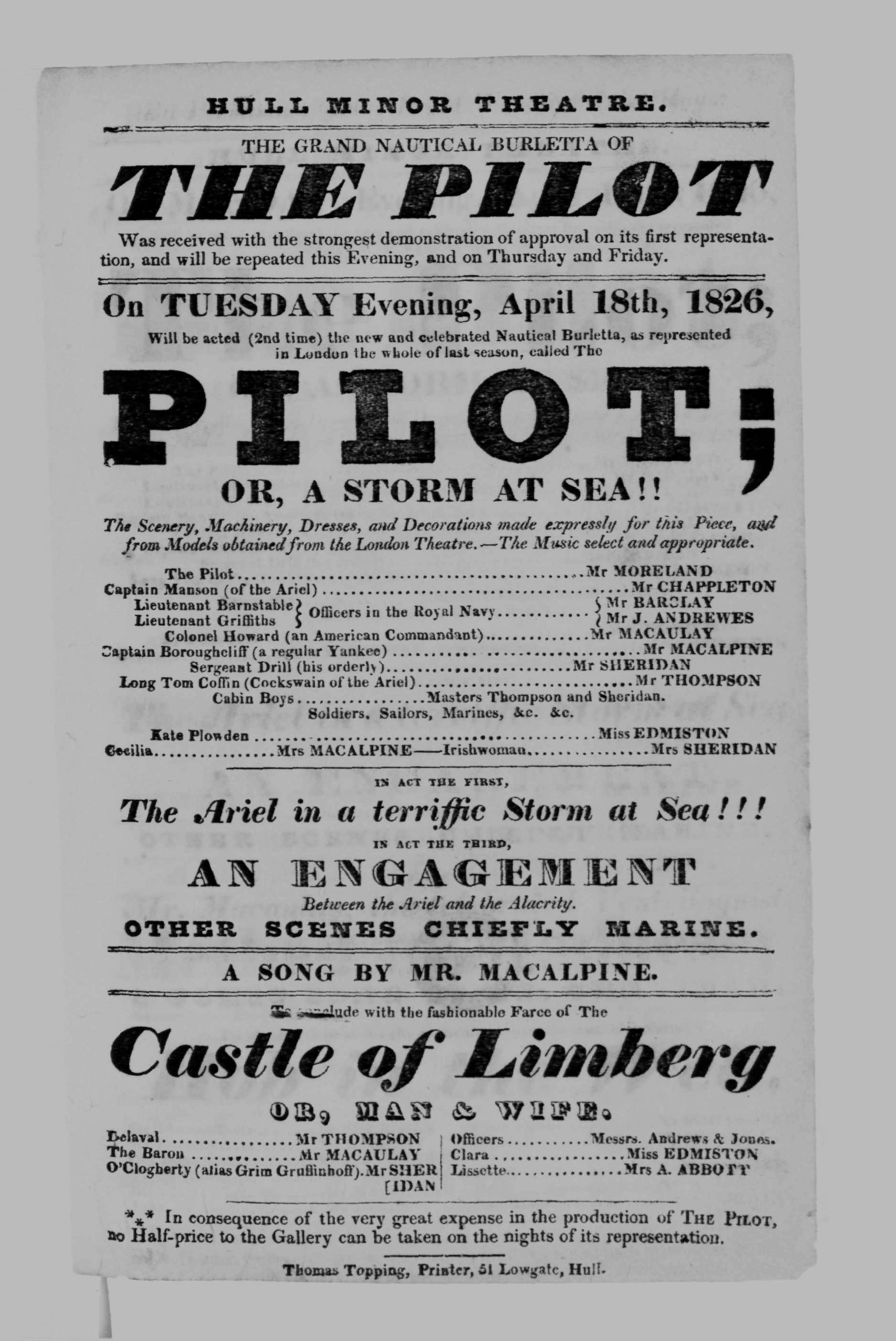
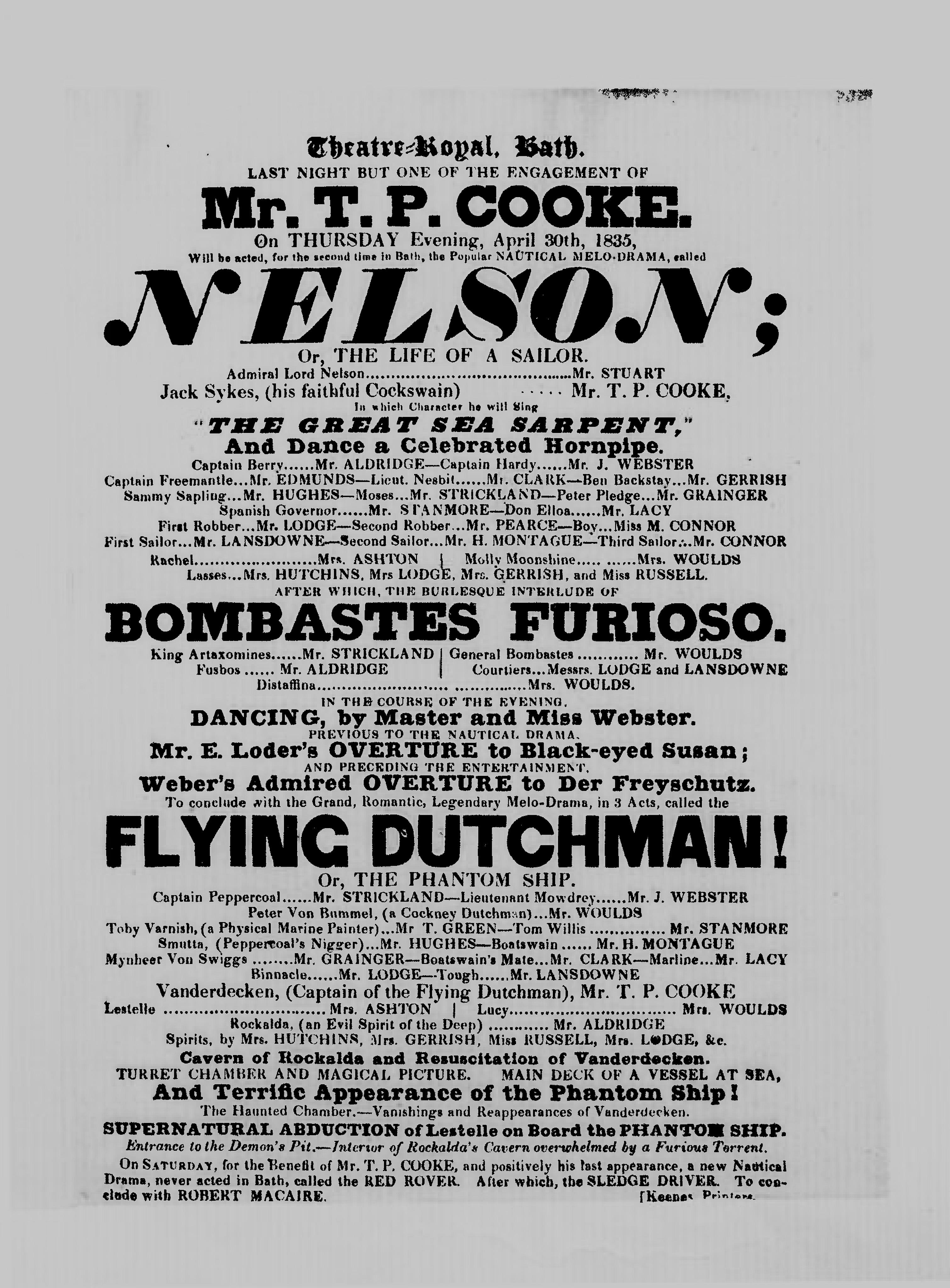
Above, early 19th century nautical melodrama playbills. Courtesy of the British Library.
The combat sword doubtless owes its origin to the popularity of nautical theater in which the swords were used in choreographed combats composed of Jack Tars dispatching various villains, usually pirates, bandits, and Moors. These nautical dramas — melodramatic compositions of nautical cliches and tropes extolling the vigorous virtues of British seamen — were one of the most common presentations in the popular theater of 19th century Britain, with Jack Tar its hero and the athletic combat sword-wielding, hornpipe-dancing T. P. Cooke its most famous actor. Begun during the Napoleonic wars when the British Navy prevented Bonaparte from invading and set the stage for his defeat on land, the playful entertainment struck a chord with the working and middle classes and remained popular past mid-century. Sword combats also became a routine part of burlesques during the same period.

But as the nautical melodrama and the burlesque began to fade in popularity, the combat sword found its way into other productions, even being used to represent Medieval broadswords on occasion. Pollock notes that in the late 19th century in which he wrote, “the combat-sword, alack, is dead in almost all London theaters. It survived for a time in various burlesques, at the Olympic, for instance, in Robson’s days, and later yet; and it may very likely drag on an existence is some outlying and country theaters.”
The musical rhythm of and musical accompaniment to these popular stage combats made for safe, or at least safer, choreography, and helped rouse the audience to greater and greater excitement — just as in film swordplay today. Additionally, the weight of the combat sword made for slower movements, ideal for the stage — the audience could follow them.* The basket-hilt provided good hand protection, and this is probably the reason for its design, as Dickens noted, and not to emulate the rare true basket-hilt cutlass.
On the other hand, as I’ve pointed out in my post on Buccaneer Cutlasses, even a dull cutlass can split skin, break bones, and put eyes out, and any error in choreography could result in serious and possibly fatal injury. Thus the typical timing of the combats to musical accompaniment with a regular beat. No irregular rhythms here even though they’re ideally suited to real combat. It bears repeating: stage combat is not simply an imitation of real combat without real hits. (For further information on stage/film sword combat, see The Duel on the Beach in Captain Blood and The Duel on the Beach in Film.)

The gold tint present on many examples of combat swords was probably applied to make the blades stand out more to the audience. It was often noted how difficult it was for swordplay to stand out on the often poorly-lighted 19th century stage. Between the poor general lighting and the bright footlights, it could be difficult to follow blade movement unless the blades were broad and, as we see here, brightened with gold tint or paint. At the end of the century Pollock noted the difficulty of seeing foils on stage, and that larger hilts were developed and attached to thicker blades so that the audience could better follow the swordplay, a practice that continued well into the development of cinema — thus the anachronistic rapier hilts with Italian epee blades used in Captain Blood (1935), for example.
This practice of tinting or painting may have been applied to other swords used on the stage as well, particularly the narrow quadrangular foils that began to replace the combat sword in the latter half of the 19th century. On one of my walls are two fully functional foils, each more than a century old. One has a decorative figure eight guard, the other an etched round guard and etched blade. These are not Toledo wall hangers, but foils that could be used for fencing and indeed were, based on the nicks on blades and guards. Curiously and importantly, the blades of both have remains of gold tinting or paint, very similar in color and tone to the combat sword, leading me to believe that these are not, as I had first assumed, presentation foils, perhaps given as awards for fencing victory or service, but are in fact stage weapons — exactly the sort that begin to replace the combat sword when William McTurk and his contemporaries and their heirs began instructing actors in legitimate swordplay adapted for the stage.

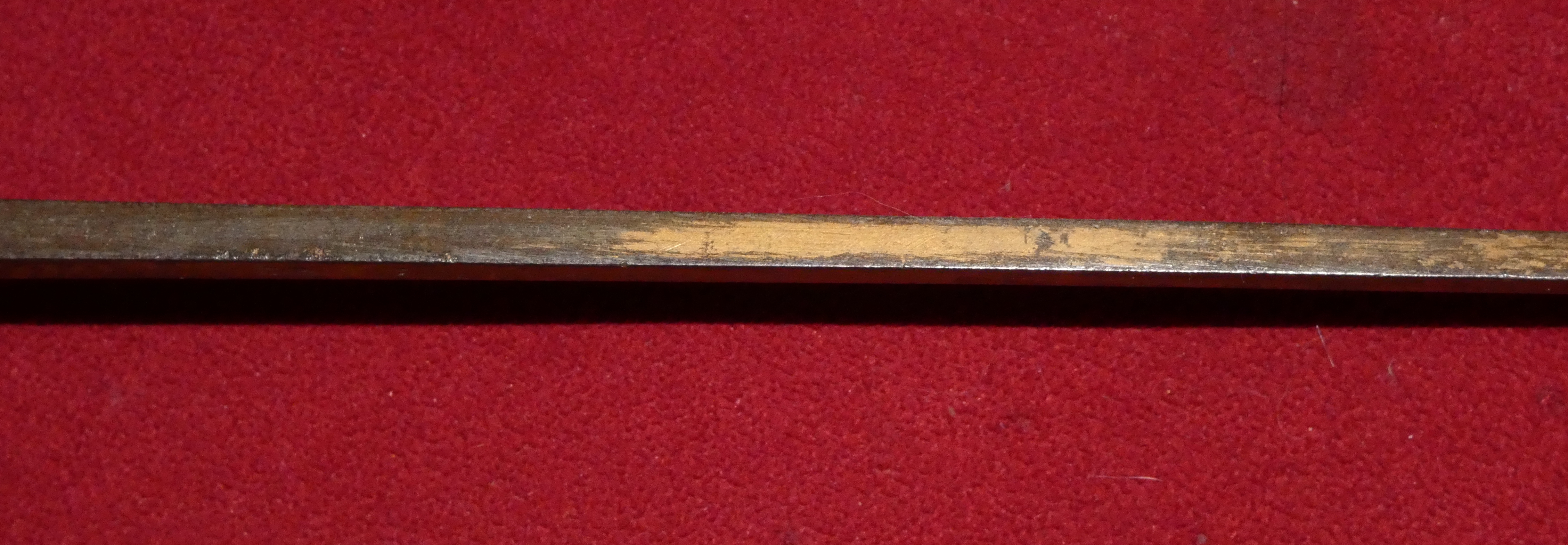

Occasionally an astute arms seller or observer posting on the Internet points out that the iron-hilted, steel-bladed purported naval practice cutlasses under discussion are absolutely not such at all, but are “gymnastics” or “gymnasium” weapons used, obviously, in gymnasiums. The first point is entirely correct, and the second is correct after a fashion too, but they miss the swords’ actual or at least original use. So, were these stated “combat swords” ever used in gyms? It seems certain. First, they are ideal for individual practice, not only in cuts and parries but also for strengthening hand and forearm — I much prefer mine for solo practice rather than a replica wood singlestick cutlass.
Second, most examples found today are in excellent condition, with few if any nicks, indicating that they were not used on the stage or for any form of blade-to-blade contact. Third, there is occasional evidence that some surely did make their way into gyms. For example, regarding various existing exercise equipment in a military gym, “To these soon will be added the discus and bar bells, leaping pole, foils, combat swords; masks and gloves; and this is a complete a gymnasium as may be found in or out of the Army.” (Excerpted from “A Military Gymnasium,” Army and Navy Journal, 19 April 1884, bold italics mine.) I suspect that the majority sold in the late 19th and early 20th centuries ended up in gymnastic, not stage, use.
So, should these sword be considered of value to collectors? Of course! Their 19th century stage combats were as popular as any of our favorite film sword combats today, and their swords were as functional and historical as the foils, epees, and sabers used then for sport and for preparing for duels or battlefield combat. And, if used by a famous actor, combat and other stage swords were just as popular and just as expensive as any film sword today that was once used by Errol Flynn or in Star Wars. Who for example might not wish to own one of these or even the Hollywood foils used by Errol Flynn and Olivia de Havilland for Captain Blood publicity stills? In 1876 The Illustrated Sporting New Yorker noted that a drama editor in the city had purchased the sword used by famous actor George Frederick Cooke (no relation to T. P. Cooke) in the final act of Richard III during his notable American tour in the early 19th century. The writer notes tongue-in-cheek that the sword is the forty-ninth “original Cooke” combat sword now on display.
If the combat sword was good enough for Charles Dickens who gave us a pirate with “the one eye and the patch across the nose” in The Perils of Certain English Prisoners and Robert Louis Stevenson who gave us swashbucklers galore, it’s good enough for armchair, stage, and real swashbucklers anywhere!
Copyright Benerson Little 2025. First published 19 August 2025. Last updated on November 18, 2025.
* Heavier weapons are not only easier for an audience to follow, but also for directors and judges, or as they’re called today, referees and judges (the latter are seldom used anymore in modern fencing), to follow. Some years ago my close friend, also my former fencing master, Dr. Eugene Hamori, a Hungarian by birth, along with a Polish fellow Olympic medalist, proposed to the FIE to fix the numerous issues with modern saber by using heavier sabers of roughly 16 ounces — a mere return to the one to one-and-a-half pound weight of sport sabers in the 1920s and 30s. The proposal was ignored: the status quo will have nothing but the status quo — to keep fencing in the Olympic Games no matter the cost, no matter the degree of change from true swordplay to sport nonsense — and modern fencing will continue its decline into pure sport rather than the sport version of martial combat with swords.

The Pirate Captain & His Burning Prey Upon the Background Billows: An Iconic Image

Arguably only a few illustrators have matched, and none have surpassed, Howard Pyle (1853-1911) for his iconic pirate images and their contribution to the modern myth of pirates and piracy. Whether of picturesque and picaresque buccaneers, or of pirate attacks, duels, buried treasure, or extortion of prisoners, his illustrations, with few exceptions, have inspired imitation and homage.
Of all Pyle’s strikingly evocative pirate art, his painting of Captain Keitt for his novella The Ruby of Kishmoor is considered by many to be the pinnacle of his work. We see it above: the pirate captain, clearly inspired by Captain Kidd, braced seaman-fashion on the poop of his pirate ship The Good Fortune in the trough of the sea, his prey, the Rajah of Kishmoor’s great ship The Sun of the East, burning in the background upon the crest of a swell, its mainsail shot to pieces.
The ship’s lantern rises behind the pirate captain, and curiously — and surely for reasons or artistic composition — behind it the ensign staff flying the Jolly Roger. I quibble here: the lantern would historically have been astern of the flagstaff, outboard of the hull, the other inboard. Curiously, the lanterns, and in fact the stern decoration and color, of both ships appear similar if not identical (and somewhat similar ones can also be seen on Disney’s pirate ship the Black Pearl).
Keitt wears an 18th century style cocked hat (aka tricorn) with gold trim, setting off his rather ratty black hair and long mustachios framing a stern face that hints of evil, an expression suggesting he might be posing for a painter, recalling perhaps the pirate portraits in Exquemelin’s The Buccaneers of America. Or perhaps he has been caught off guard, or has been asked a stupid question.
A ratty kerchief is tied around his neck rather than a cravat, and he wears a crimson just-au-corps, waistcoat, and long swashbuckling sash. His wide loose breeches are the seaman’s, and on his feet he wears boots of some sort, perhaps intended as “sea boots” although such were worn largely by fishermen and by seamen of this era only in cold weather. The boots are a deliberate cliché or trope: even more than a century ago the audience expected to see pirates in boots, though most often of those for riding with tops folded over. Pirates wore shoes and stockings or, especially if poor, went barefooted. The idea of “pirate boots” derives via popular illustrators from those of cavaliers and musketeers.
Hanging from a buff baldric is a Spanish “bilbo” style rapier with large curved shells although he would likely have worn a cutlass instead, and from a waist-belt. A short-barreled pistol is stuffed into the sash, and Keitt holds a speaking trumpet in his hand, perhaps with which to verbally abuse those victims doubtless left behind on the burning, sinking ship — he surely no longer has any need of the trumpet for hailing. Perhaps he uses it to bellow at his crew rather than pass orders via his subordinate officers.
There is a somber aspect to the painting: those aboard The Sun of the East who did not perish in the battle and boarding action have surely been left to the severe mercy of the sea.

N. C. Wyeth’s frontispiece and dust jacket art for the US edition of Rafael Sabatini’s Captain Blood: His Odyssey (1922) is almost as famous as Pyle’s painting. Clearly an homage to his teacher’s famous painting, Wyeth’s work embraces the image of Sabatini’s eponymous hero, even if he depicts the famous literary buccaneer in more mid-17th century style rather than of the 1680s. It’s not entirely Wyeth’s fault. Foremost, he intends to evoke the novel and its hero, rather than portray them with complete historical accuracy. Further, Sabatini himself occasionally misuses terms for period dress, for example writing doublet when clearly he intends the just-au-corps, the long coat worn in the 1680s and after.
Still, Wyeth’s painting is true enough to the novel, and clearly he had read it. The illustration was first painted then later used for a novel because it was close enough, as with Wyeth’s dust jacket art and frontispiece for The Black Swan. In the painting above, Peter Blood’s hair and eyes are accurately presented — black and blue — and he has a small mustache as he did in the serialized novel but which he had lost when the novel was published.
He wears a doublet with silver-laced black sleeves, although this ought to be a black and silver just-au-corps. He wears a falling collar of Mechlin lace rather than a cravat of one, and a bullion-encrusted baldric. His hat is rather tall for the period but has the required crimson ostrich plume. The crimson feather is there to add color, but all in all Peter Blood’s dress is close enough to Sabatini’s description: “scrupulously dressed in black with silver lace, a crimson ostrich plume curled about the broad brim of his hat affording the only touch of colour.”
We can easily forgive Wyeth our quibbling criticisms, for, to repeat ourselves, the painting is intended to be figurative and evocative. It is, to quote a past editor of mine in regard to book illustrations, intended to entice potential readers to buy the book.
In the background a Spanish galleon burns, clearly an abandoned prize, although the burning of prizes, but for an English man-of-war (with a Dutch admiral, curiously) burned by the French, is not mentioned in the novel. Perhaps the image is of the Spanish fleet’s flagship Milagrosa which was to be “scuttled” after being defeated by Blood’s buccaneers. More likely, it is a generic image of one of the unnamed Spanish galleons captured by Captain Blood.
In practice burning was often easier than scuttling, particular with larger ships. Buccaneers did occasionally burn prizes, typically keeping some crew and passengers as prisoners while turning the rest loose in a boat, and occasionally sank smaller prizes as well. More often though they were likely to keep the prize or leave it with its crew and passengers, first cutting a mast down or taking some of its sails so that word of the buccaneers might not be swiftly carried to the nearest port.
Of note are the orange-gold clouds with red-black plumes of smoke in front. A sun, perhaps, setting on the galleon and Spanish Empire? Gold for plunder, and red-black for the two colors Sabatini repeatedly uses as themes in the novel?
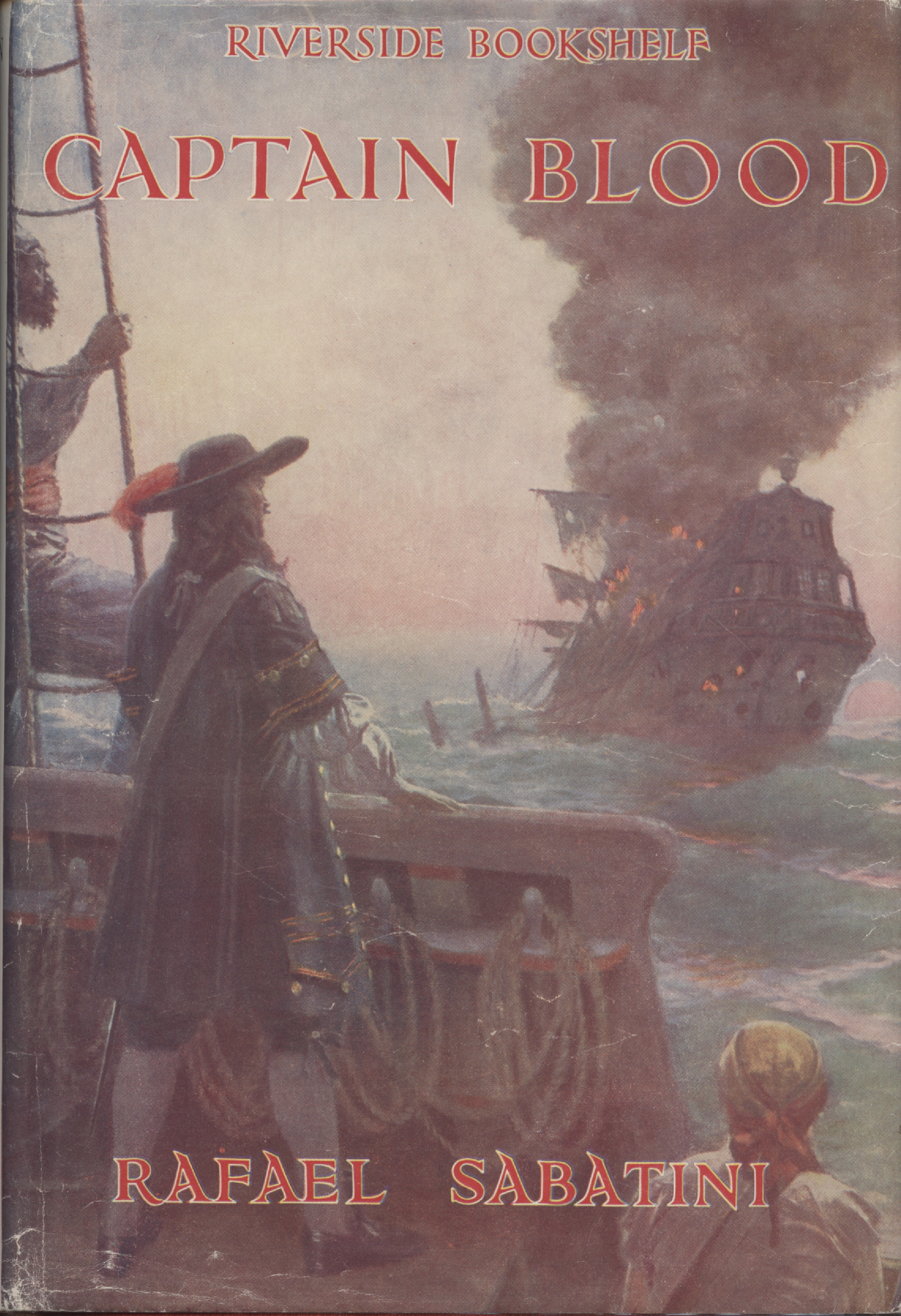
From the 1927 et al Riverside Press Cambridge (a Houghton Mifflin imprint) edition of Captain Blood: His Odyssey, the dust jacket and front cover art by Clyde Osmer Deland (1872-1947). Although the painting is more historically accurate — no boots, correct just-au-corps and hat — it lacks the eye-catching flair of an illustration by Pyle or Wyeth, even if a burning sinking ship draws the eye. And again there’s that damned mustache that’s not in the novel! Here, Deland has no excuse, given that he painted the illustrations several years after the novel’s publication.
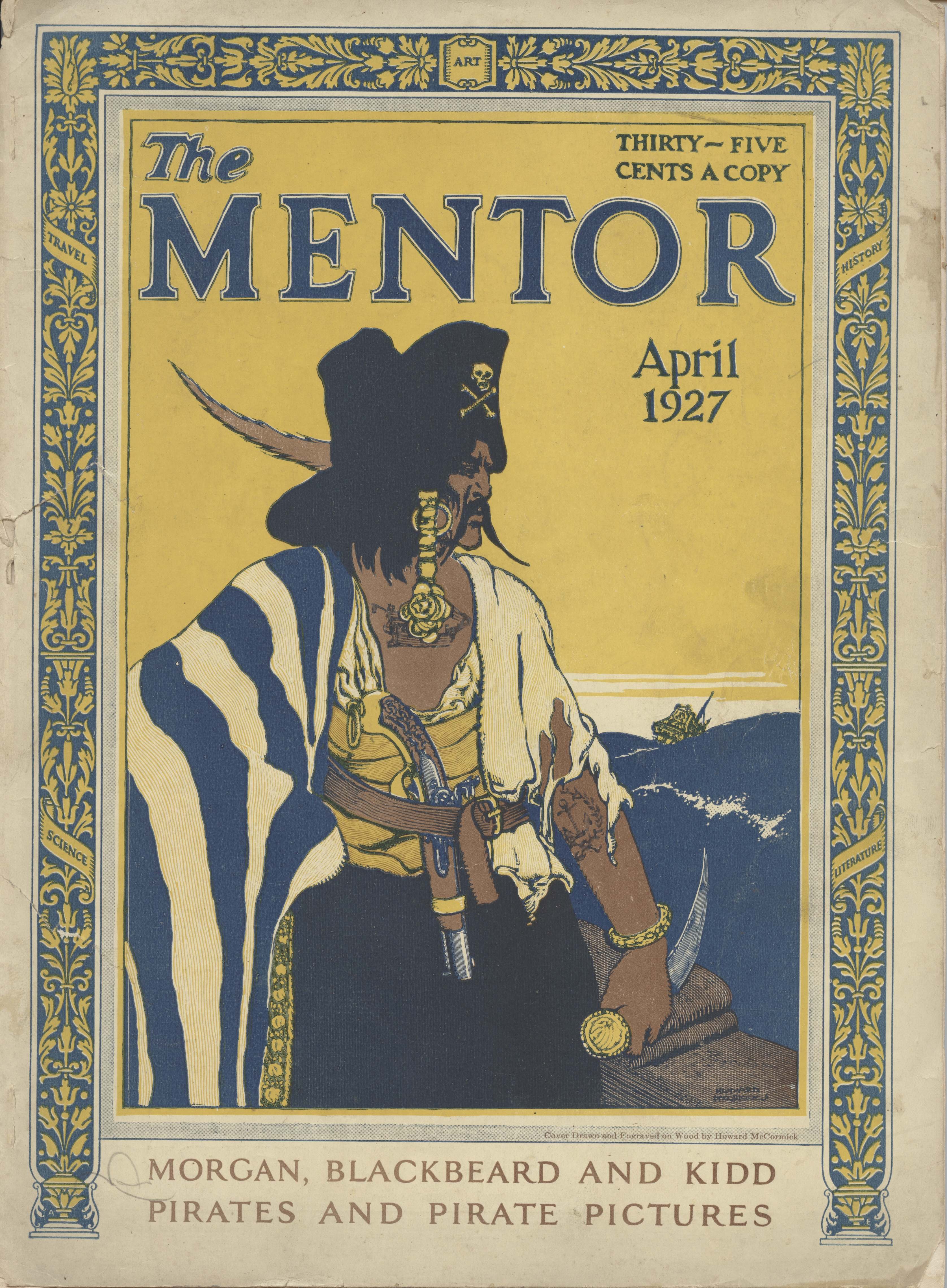
The ship is not burning in the illustration above, but the magazine cover was clearly inspired by Pyle and Wyeth’s paintings. The pirate depiction, in particular its resemblance to the much later Captain Jack Sparrow, is discussed here.

Another Wyeth painting hinting at an homage to his teacher Howard Pyle and which has influenced our idea of the pirate captain and his burning prey on the billows. The blue-green tropical sea is up, giving us the mountain-like billows we like to see — and which also aid in composition. The burning ship is clearly a Spanish galleon, of a style much-used by Wyeth and discussed here. That it has just been plundered is obvious: booty is piled on the poop, including a classic Pyle-style treasure chest with curved top. The buccaneer captain is almost identical to one Wyeth painted for the September 22, 1921 issue of Wall Street Number magazine, a Life magazine publication, discussed here.
The galleon rests on a crest, with the buccaneer ship below in the trough, suggesting the rover is sailing away. Classic Wyeth clouds frame the galleon, and the skull and bones — an anachronism — flies at the stern but we can see only the lower part of the field, as in Pyle’s painting at the top of the page, clearly an homage.

Yet another homage, this time Peter Hurd (1904-1984) to his teacher N. C. Wyeth. Although Hurd was best-known for his paintings and illustrations of life in the Southwest US, he edited and illustrated Marauders of the Sea, a collection of excerpts from pirate stories, 1935, with an introduction by N. C. Wyeth. In the painting, two ships are closely engaged, one of them afire. Here, the pirate captain is not standing the deck of his ship. Rather, the composition is clearly arranged after late 17th century paintings and illustrations of pirate and men-of-war captains and admirals, as will be discussed in more detail shortly.
Hurd’s pirate captain reminds us of the famous depictions of Exquemelin’s buccaneers shown farther below. His eyes are blue and his hair black, like Peter Blood’s, but he also has a Spanish-style mustache and a scar across his cheek. He wields a classic shell-hilt cutlass with large brass rather than iron shells, though all the large shells I’ve seen on cutlasses were iron — only smaller shells might be made of brass. His face is scarred, his jacket is either Spanish or an earlier English doublet, and he wears breast and backplate which Peter Blood did fictitiously and some captains of men-of-war did in reality. Whether any buccaneer captains actually did is entirely speculative, for there is no record of them doing so.
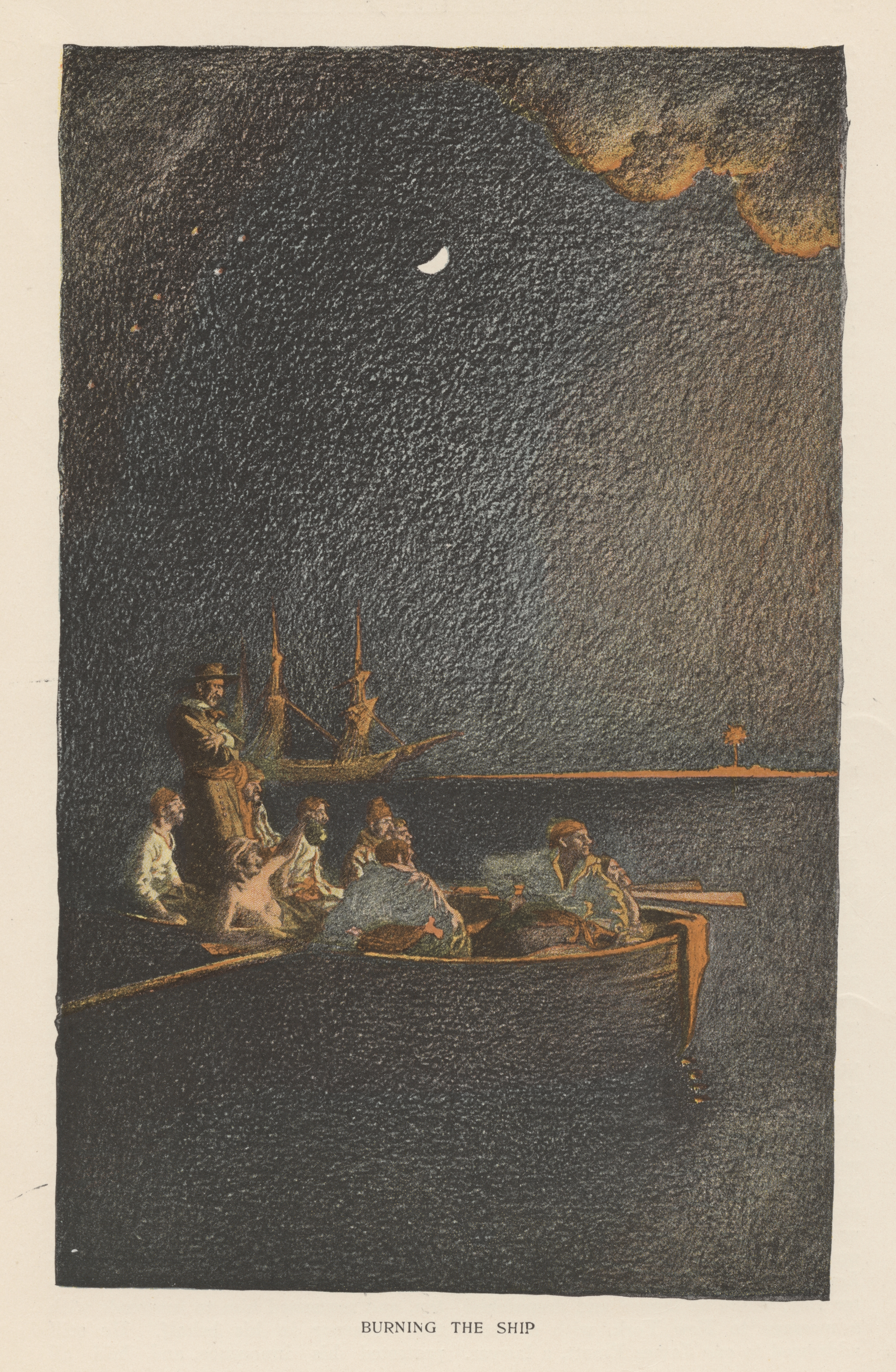
In the image above we “see” not a recently captured prize burning just out of sight but the Quedagh Merchant, a rich ship of the Mughal Emperor captured off the coast of India in 1698, converted to use by Captain Kidd, and burned at Santo Domingo (Hispaniola) in the Caribbean after a return voyage home.
Other Notable Homages
I’ve chosen one authorized imitation of Wyeth’s “Captain Blood,” one authorized inspiration of the Pyle/Wyeth paintings, and also several notable homages, five of them to Howard Pyle’s “famous painting at the top” Captain Keitt,” and rest to Pyle and perhaps to Wyeth and others as well — an homage to homages and to the original.


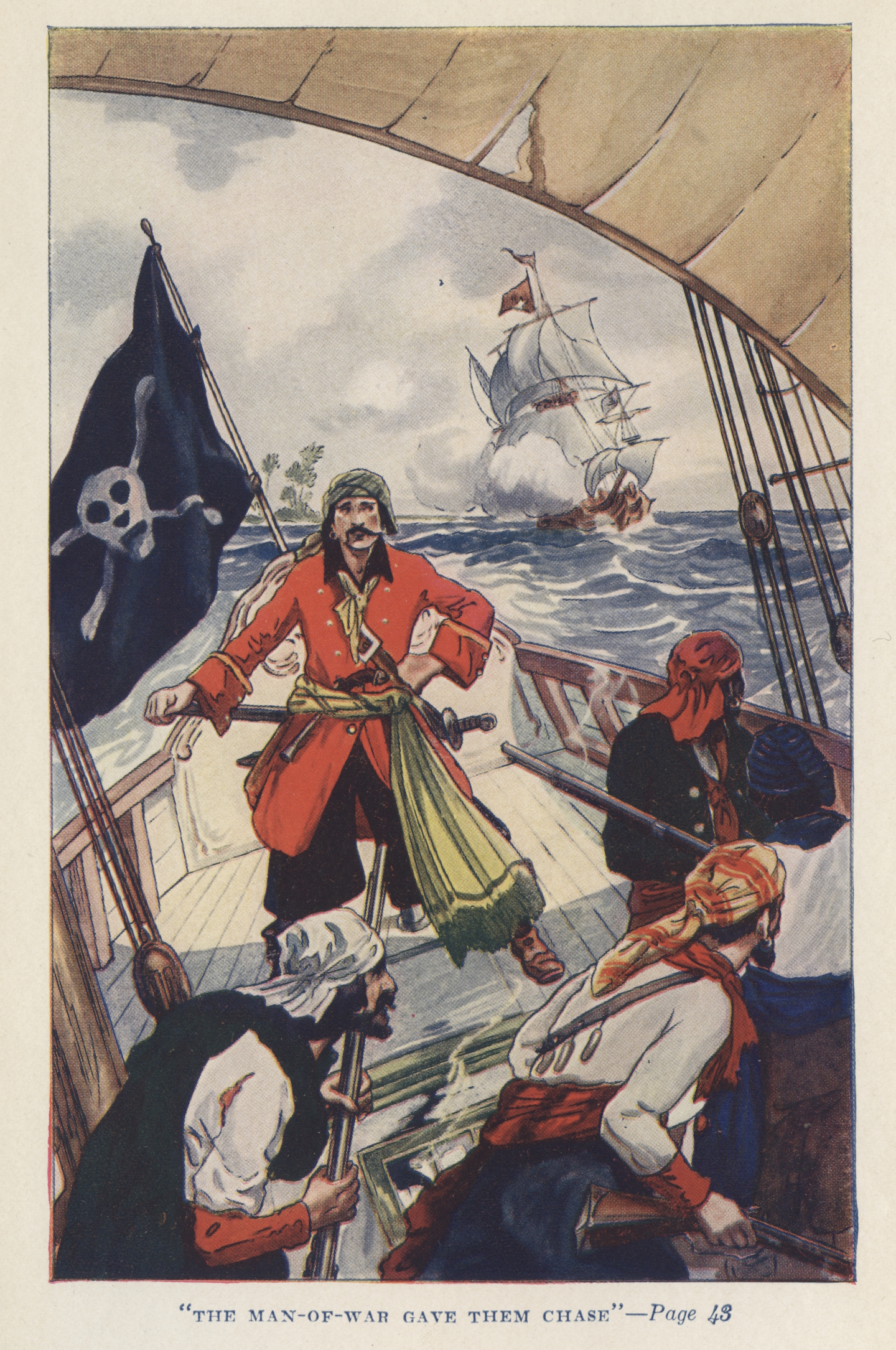
Three illustrations by George Alfred Williams, the first from The Boy’s Book of Pirates and the Sea Rovers by George Alfred Williams (New York: Frederick A. Stokes Company, 1913). It is a likely homage to Pyle’s painting — and only five years afterward. The second and third are from The Pirates of Panama or The Buccaneers of America by John Esquemeling (New York: Frederick A. Stokes, 1914). Both are clearly homages to Pyle’s famous painting. All three doubtless contributed to the image of the iconic image of the pirate captain and his burning ship on the background billows.


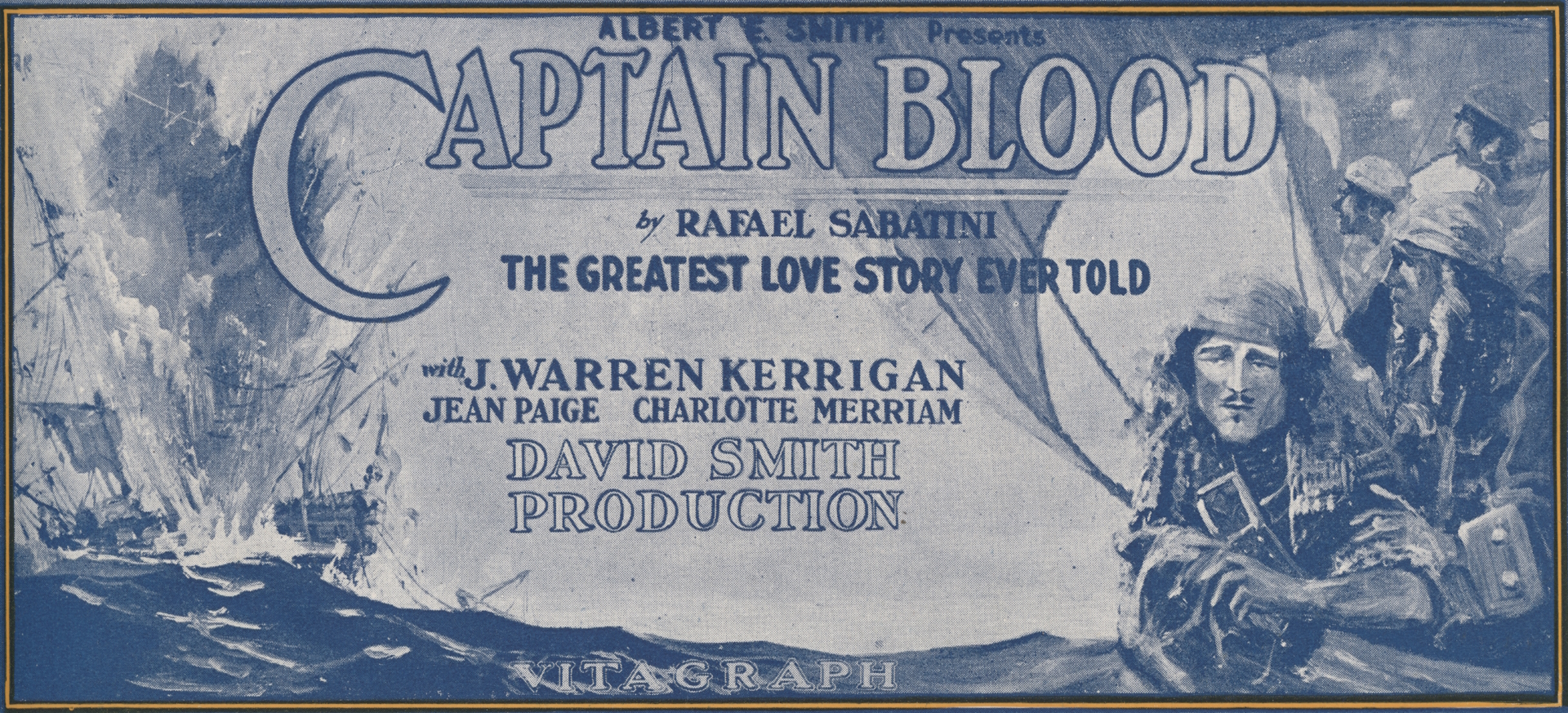
The first image of the four just above is the front cover of the program for the 1924 film version of Captain Blood (Vitagraph) at Astor Theatre, Broadway and 45th, in New York City. The image was also used on a poster for the film. The cover style has been copied from a combination of the dust jacket of the 1922 US release of the novel and of the front board of the book. I’m no fan: here Captain Blood looks more like an unadventurous bourgeois dressed as a pirate for a costume party, rather than the long, lean, hawk-faced adventurer-physician-buccaneer described in the novel.
The likeness is intended to represent J. Warren Kerrigan who played the starring role. Perhaps the unknown illustrator was getting a dig in at Kerrigan and felt the same way I do about him. The actor famously told The Denver Times during the First World War that “I am not going to war. I will go, of course, if my country needs me, but I think that first they should take the great mass of men who aren’t good for anything else, or are only good for the lower grades of work.” Clearly he was no Sabatini-esque hero in real life, nor even an Errol Flynn, at least in regard to courage, panache, dignity, and empathy.
The bottom image is a copy of one of the many posters designed for the 1924 film, clearly inspired by both Pyle and Wyeth. Atypically, the ship is exploding rather than simply burning, although the latter often led to the former.
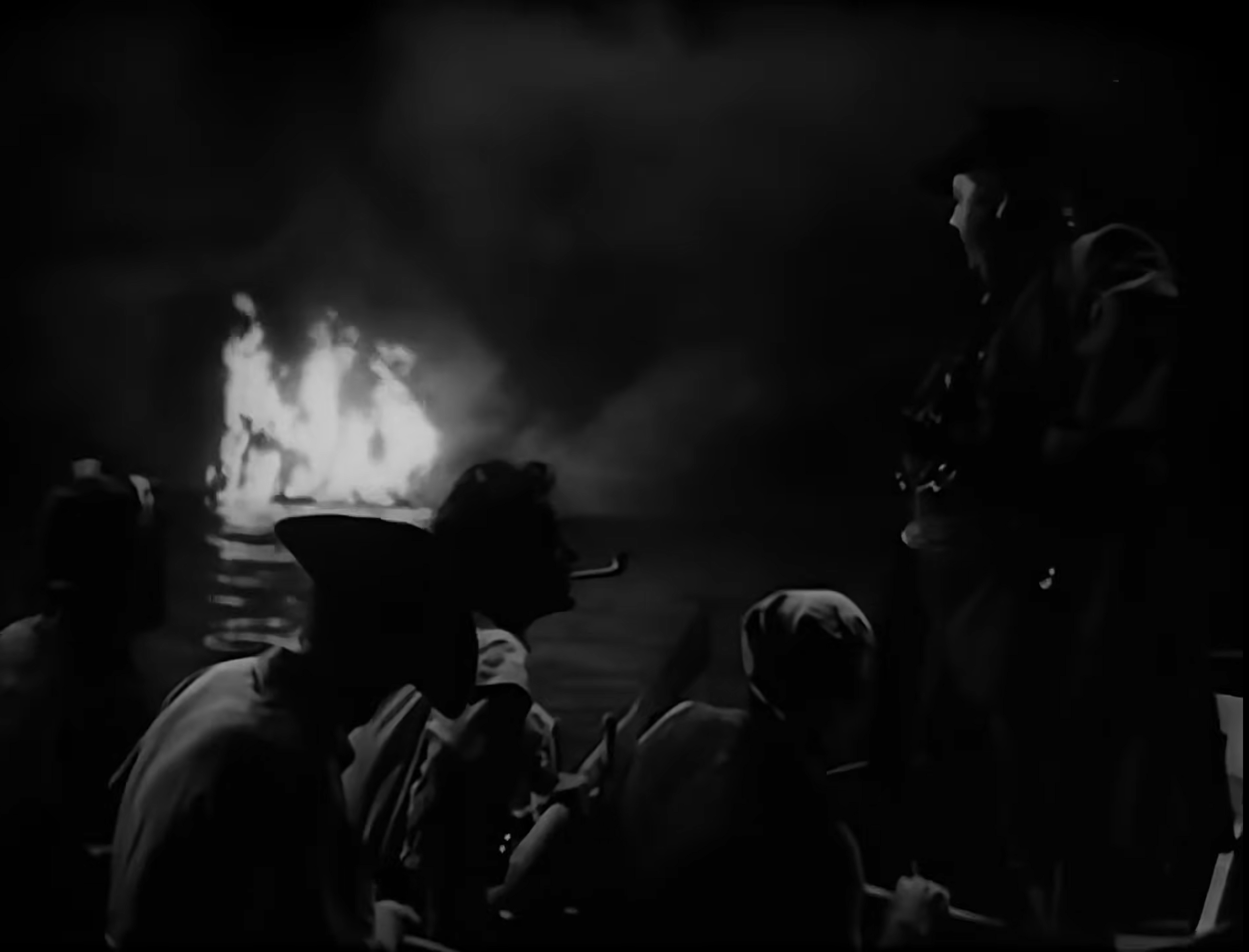
Clearly inspired by Howard Pyle’s illustration of Captain Kidd burning the Quedagh Merchant, here Captain Kidd burns a captured “English galleon” at Madagascar. Compare with the Pyle illustration above.
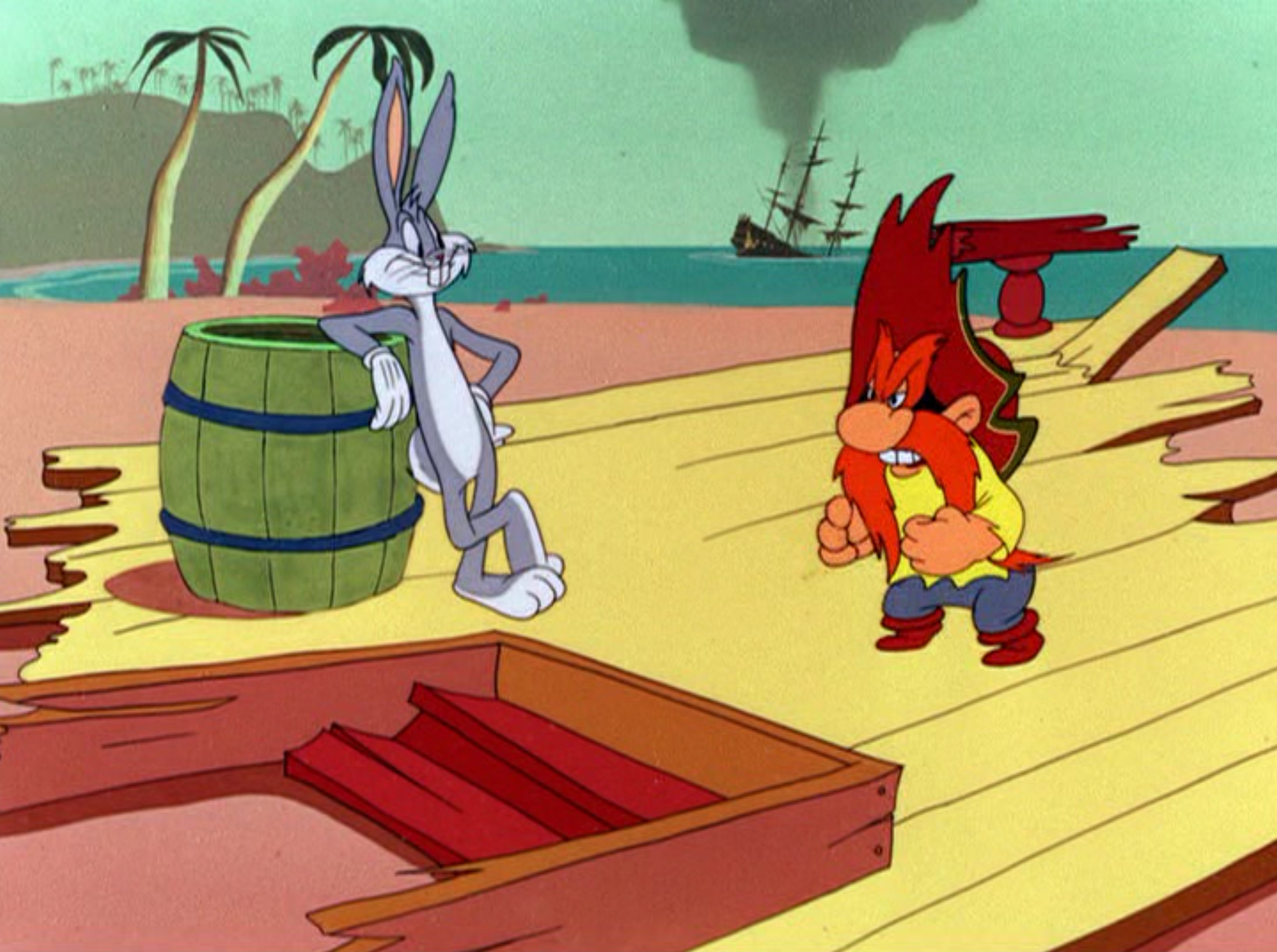
The writers and artists of “Buccaneer Bunny” (Warner Bros. Looney Tunes, 1948) clearly intended an homage to Pyle and Wyeth. It’s basically a reverse or mirror image of the Captain Blood cover art and frontispiece done by N. C. Wyeth. DVD screen capture.

Above is a possible homage to Pyle and Wyeth: Errol Flynn as Brian Hawke just having rescued Alice Kelley as Princess Padma from the burning ship of the Mughal Emperor. Compare with The Goonies screen capture below.

In the painting above there is no burning ship, but one firing a broadside instead. Even so, the image is clearly inspired by the paintings of Pyle and Wyeth, and as much by the illustrations from Alexandre Exquemelin’s The Buccaneers of America discussed below. The painting, artist unknown but suggested by some to be Ed Kohn, has hung for many years in the Pieces of Eight store adjacent to the Pirates of the Caribbean ride at Disneyland. Originally it hung in the Pirates Arcade Museum (mostly an arcade) before the shop replaced it in 1980. It may depict Fortune Red, the animatronic fortune teller in the arcade.

Above, an homage if you like, and clearly a comic riff, on Pyle’s famous painting. A damsel-in-distress has been added — and Chunk’s tongue too… From the attic scene in The Goonies, 1985. Compare with the Against All Flags screen capture above it.
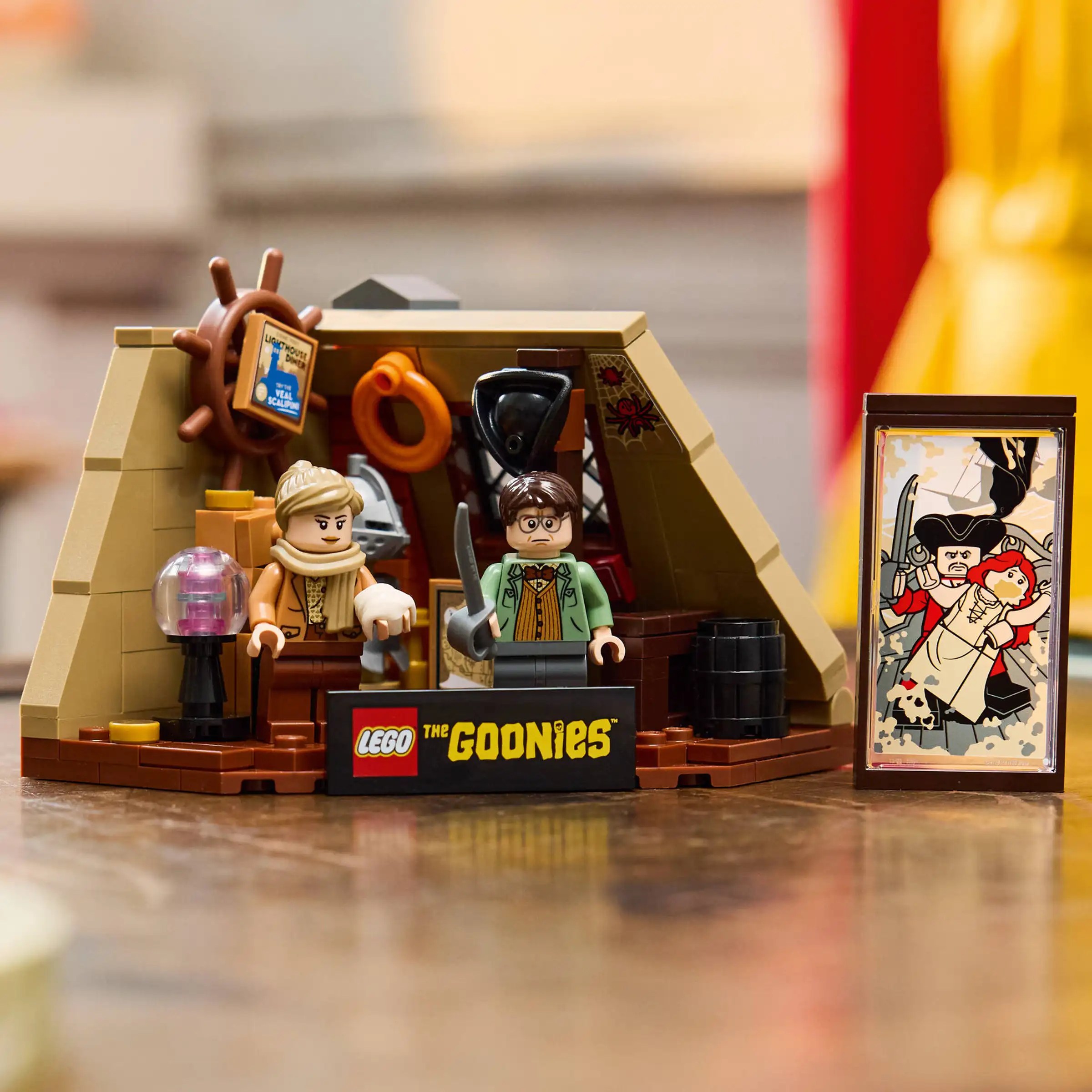
The Goonies painting as imagined by Lego, part of a kit (“The Goonies: The Walshes’ Attic”) to accompany The Goonies ship and the film scenes depicted inside.

I hesitated to post the image above, of Arnold Schwarzenegger as Captain Blood by William Stout. The film was under consideration in 1994, and, although I have great respect for the former Governor of California as an action hero, I am overjoyed that the film never made it into production. The proposed script was of a sort commonly pitched by studio executives, producers, and screenwriters: one intended solely to make money (art, artist, and audience be damned).

Above is an homage by arts and entertainment polymath Jim (James R.) Silke (1931-present) to Howard Pyle’s famous painting (see “After Howard Pyle” below the signature on the painting above) featuring Maureen O’Hara as Spitfire Stevens in Against All Flags (1952), also starring Errol Flynn. The 2005 work was commissioned by Brian Peck.

My good friend Antón Viejo Alonso brought the image above to my attention. Drawn by noted portrait artist and film costume concept illustrator Darrell Warner for Pirates of the Caribbean: Dead Men Tell No Tales (Disney Studios, 2017), it is clearly an homage to the Howard Pyle painting at the top of the page.
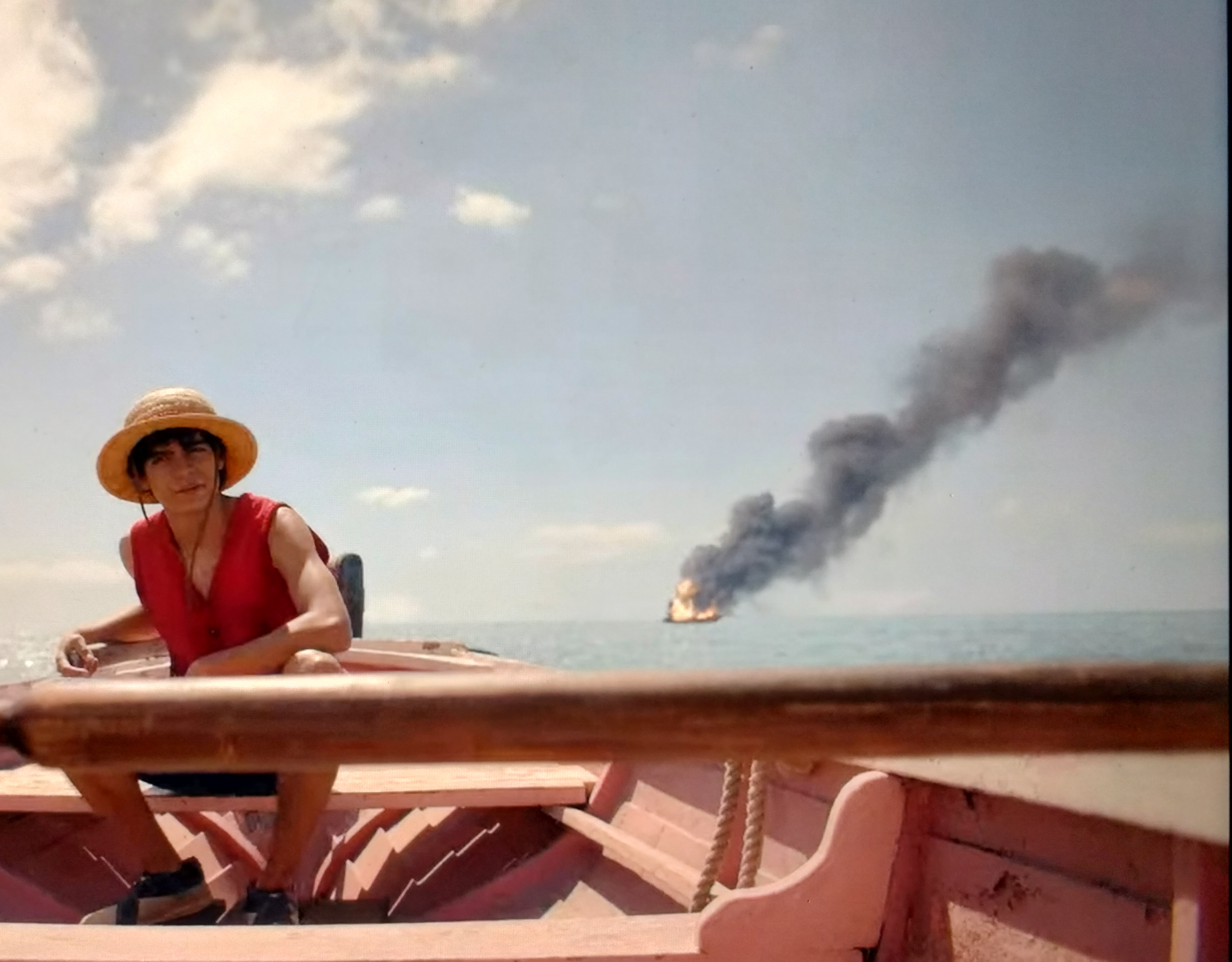
A cropped image from Netflix’s live action 2023 release of One Piece, with pirate-captain-to-be Monkey D. Luffy (played by Iñaki Godoy) in the foreground (foresea? :-)) with a burning ship in the “backsea,” clearly an homage to Pyle, Wyeth, et al. Furthering this argument is the fact that the scene with burning ship is not in the original manga written and illustrated by Eiichiro Oda nor in the anime based on it produced by Toei Animation. (N. B. there is a similar scene when the [Spoiler Alert!] Going Merry burns and sinks much farther along in the voyages of the Straw Hat Pirates, which is perhaps an homage [Spoiler Alert!] to Peter’s Blood’s loss of his beloved Arabella).
Inspirations & Influences
The most likely inspiration — the seed planted in the subconscious — might well be some of the original illustrations in Alexandre Exquemelin’s early Dutch, Spanish, and English editions of The Buccaneers of America. They include several portraits of famous buccaneers, although we have no idea how accurate the depictions are, but this matters little in regard to inspiration.
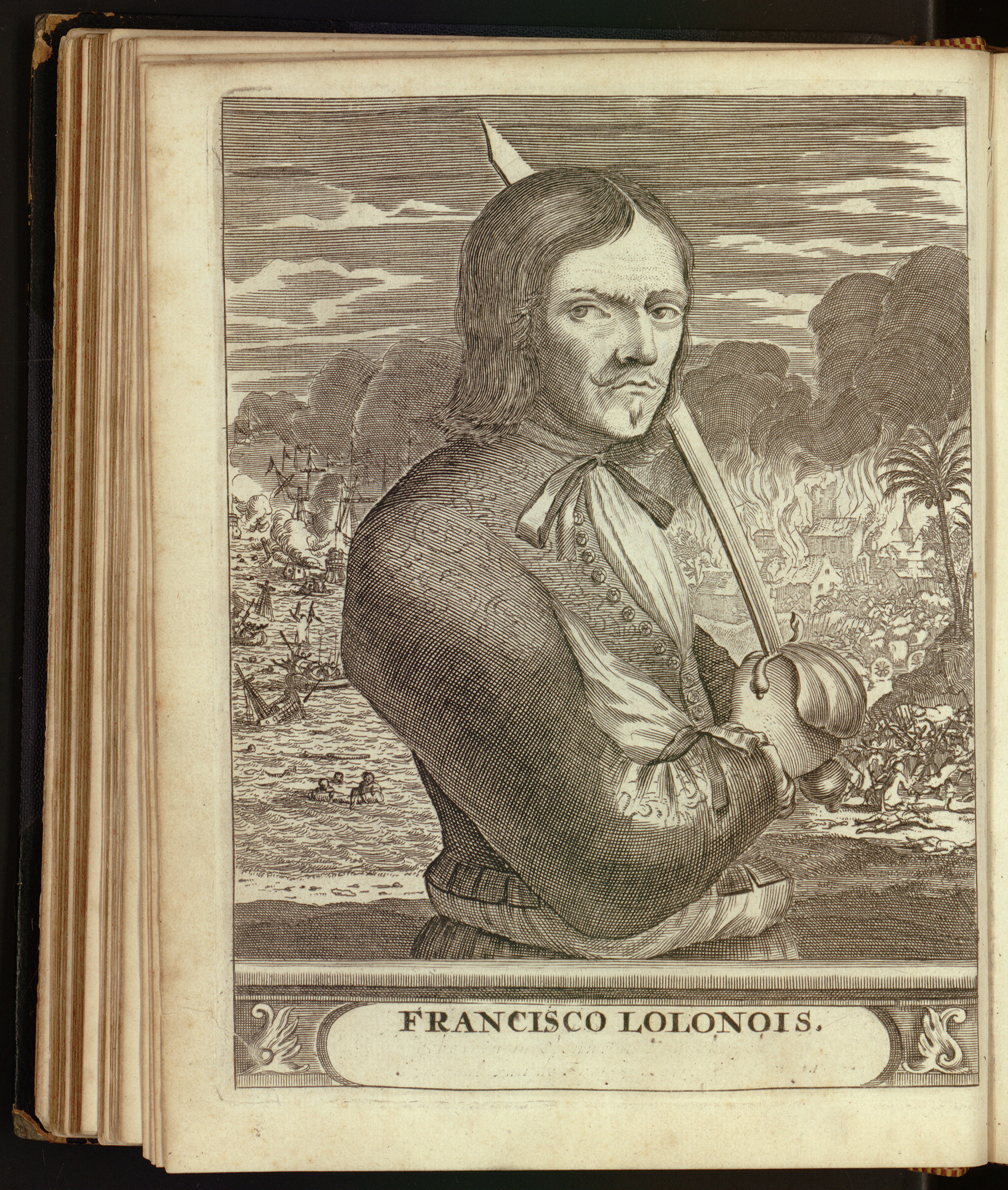
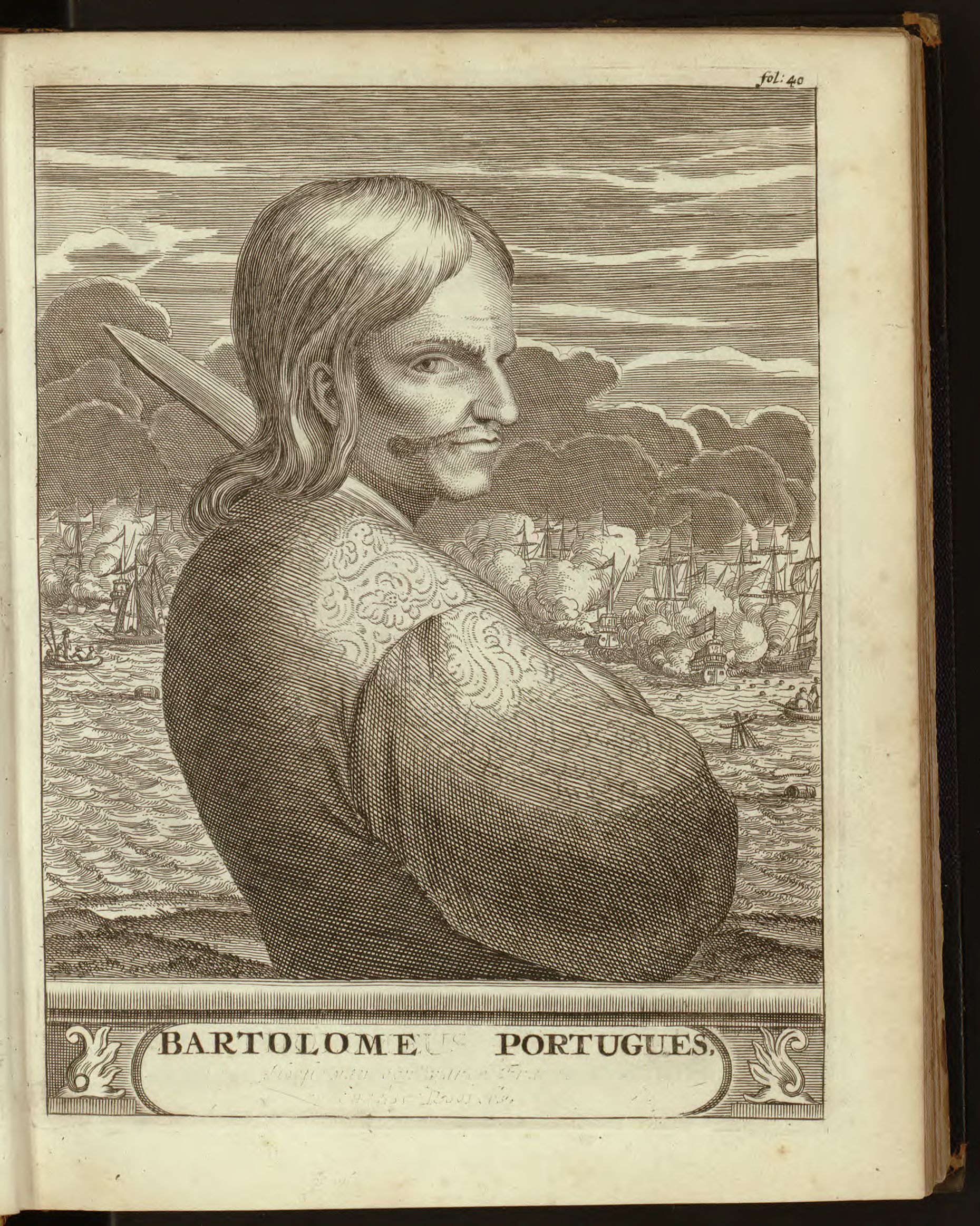

The three illustrations above are Spanish edition copies of the originals in the Dutch 1678 edition: Francois L’Ollonois, Bartholomew Portuguese, and Henry Morgan. All show battles, including sea fights, raging in the background, with billowing smoke suggesting that some ships may be afire. None of these buccaneer captains — as far as we know — are standing on the the decks of the ships. It took Howard Pyle’s genius to compose a portrait evoking the adventure and romance, at least as we believe it to have been, of piracy on the high seas.
The illustrations in Exquemelin’s books were doubtless inspired by a common form of portraiture associated with fighting seamen and soldiers, officers in particular for typically only they could afford portraits or had enough social status that a patron might commission a portrait of them.
The two portraits above are typical of those of the era: the subject in the foreground, with a depiction of a major associated action in the background. Myngs, prior to becoming an admiral, led a number of raids on the Spanish Main, with buccaneers-as-privateers as his consorts, after the English captured Jamaica from Spain. The portrait of Montague shows us a burning ship, but it may not be that of an enemy. It appears to be of English build, and is therefore more likely the HMS Royal James, Montague’s flagship burned by a Dutch fireship in 1672, resulting in Montague’s death.
Not quite yet a buccaneer or pirate in the photograph above, nor yet a burning ship on the background billows — but aspirations enough. 🙂
Copyright Benerson Little 2024. First posted 24 September 2024. Last updated April 6, 2026.

The Duel on the Beach, Part V: In Reality

If you’ve read any or all of parts I though IV of this series (In Fiction, In Film, in Rafael Sabatini’s novel The Black Swan, and of the duel between Flynn and Rathbone in Captain Blood, you might be wondering if novelists and Hollywood have depicted buccaneer and pirate duels, a common trope of the genre, accurately. Like much that is popular buccaneer and pirate image, the answer is “yes and no,” or more precisely, “sort of sometimes, but mostly no.” If anything, the duels imagined on page and screen have caught some of the spirit of historical buccaneer and pirate duels, rather than actual practice.
One thing we’re sure of is that the real duels probably did not look like those engaged in by the swordsmen in the plate above!
N. B. Besides the links above, more information about dueling, swordplay, and swords among sea rovers and mariners of the era in general can be found in Buccaneer Cutlasses: What We Know; in chapter 17 of The Buccaneer’s Realm; and in chapter 8 of The Golden Age of Piracy, which has more detail and analysis than is found in this post.
We know that buccaneers and pirates fought duels occasionally, although detailed accounts of individual duels, with an exception or two, do not exist. Further, we know even less about the tactics and techniques of individual duels. In fact, only rarely do we even know what weapons were used in specific duels. Often the description is as spare as, “Here it was that our quartermaster, James Chappel, and myself fought a duel together on shore,” as buccaneer-surgeon Basil Ringrose wrote.
And why were duels fought among buccaneers and pirates? For the same reason they’ve always been fought: usually out of some misguided form of honor, although doubtless there were occasionally good reasons to fight. The gamut of human emotion easily gave rise to duels: jealousy, envy, avarice, lust, deep-seated insecurity, narcissism, pride and its exaggeration hubris, competition, and more. Specifically, pirates might fight over injured pride, insult, gambling, or a woman’s attention. Personal conflict, rum, and the confines of a vessel at sea doubtless fueled many of these deadly challenge fights.
(Numerous books and studies investigate the social origins of the European mania for dueling, and some include analysis of the actual practice of dueling. Among my favorites are V. G. Kiernan, The Duel in European History; François Billacois, The Duel: Its Rise and Fall in Early Modern France; and, probably my most favorite, Pascal Briost et al, Croiser Le Fer: Violence et Culture de l’Epée dans la France Moderne.)

According the Francis Rogers in a journal entry dated 1705 in regard to the Jamaica colonists, “Sword, or sword and pistol, is the common challenge to decide their affronts; except among the ordinary or sea-faring there the fuzee [flintlock musket] or cutlass is the weapon.”
It was not just buccaneers who were inclined to fight duels: the practice was commonplace. Quoting Francis Rogers again on the subject of Jamaican colonists, “They seldom want courage, being too forward in duelling on very slight occasions, standing much on their honour and scorning little base litigious actions.” Likewise the French and French colonists, and the Dutch as well. And Spaniards, including Spanish pirates? Likewise surely, given Iberian honor.
Among the late 17th century buccaneers and boucaniers (cattle and swine hunters who often sailed with buccaneers, some even becoming full-time buccaneers), the fusil boucanier aka “buccaneer gun” — a very long-barrelled, heavy caliber, typically (but not always) club-butted musket used to hunt cattle, swine, and Spaniards — was the primary dueling arm, at least among French buccaneers (the English and Dutch may have used it or another), and not the cutlass or other sword.
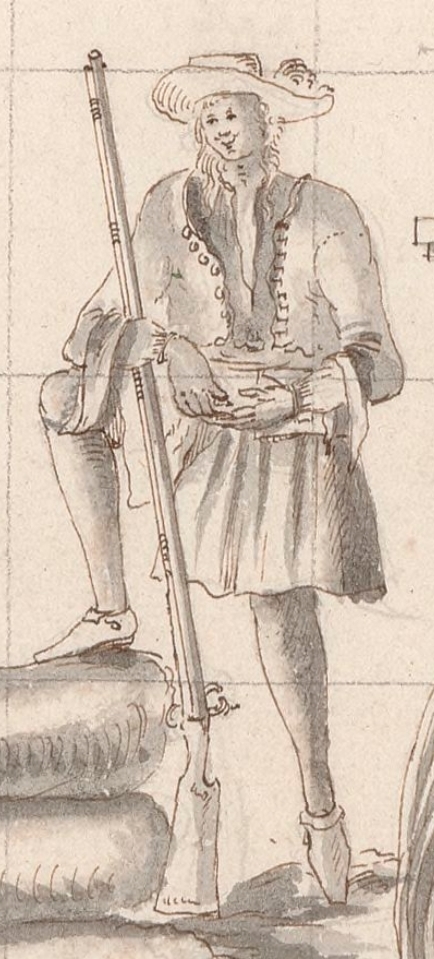
According to buccaneer-surgeon-author Alexandre Exquemelin, these musket duelists drew lots to see who would fire first, then stood at a predetermined distance apart. One hundred yards was a likely distance, in that it required reasonable skill to hit a man-sized target at this range. First the winner of the draw fired, then, if still standing, the loser. A surgeon examined any dead body to make sure there had been no back shooting. Such duels could only be fought ashore.
Cutlass duels were likely as well, but unfortunately we lack the descriptions of many duels, and in the case of affrays, especially when liquor was involved, the pistol or musket might be the weapon grabbed first. At sea, Captain Bartholomew Sharp once took a pistol shot at one of his buccaneer crew, Richard Hendricks, barely missing killing him. All involved were drunk. Ashore, Captain John Coxon took a shot at Captain Peter Harris, possibly with a musket. A duel, perhaps, or an angry affray. In any case, the shot fired in anger was due to personal animosities and competition among leaders. Captain Robert Searles, who sacked St. Augustine in 1668 and, drunk and otherwise engaged, permitted the treasure ship Trinidad to escape with much of the city’s treasure during the sack of Panama in 1670, was killed by another buccaneer while cutting logwood at Laguna de Términos, Mexico, although the circumstances are unclear: a duel, an affray–or murder?
No matter the weapon used, duels were usually fought ashore, for two primary reasons: there was more space in which to fight than in the close confines of a vessel, and the time required for a ship to anchor or even for the adversaries simply to be rowed ashore gave time for hot heads to cool. This is not to suggest that duels might never have been fought aboard ship, but if they were they were rare among buccaneers and the evidence for them is largely non-existent but for one source that states that some duels were fought aboard ship among buccaneers, a Dutch practice perhaps.
The source that suggests this is Zeer Aanmerkelijke Reysen Gedaan door Jan Erasmus Reining by Dr. David van der Sterre. Published in 1691, the book is a biography of Captain Jan Erasmus Reyning, one of many colorful buccaneers of the era. Van der Sterre said he met him at Curaçao and wrote a book based on the tales Reyning told. However, the book is of a common style of the era, that of the heavily-embellished biography and it is difficult to tell what is true and what is imagined.
According to the book, duels were common, including between captains and members of the crew due to the aggressive independent nature of buccaneers and their sense of each being primus inter pares or first among equals. One captain reportedly threw two cutlasses onto the deck of his vessel, challenging an impudent crewman. They then fought “like lions” until the crewman fell overboard, at which point the captain followed, hoping to cut him down in the sea.
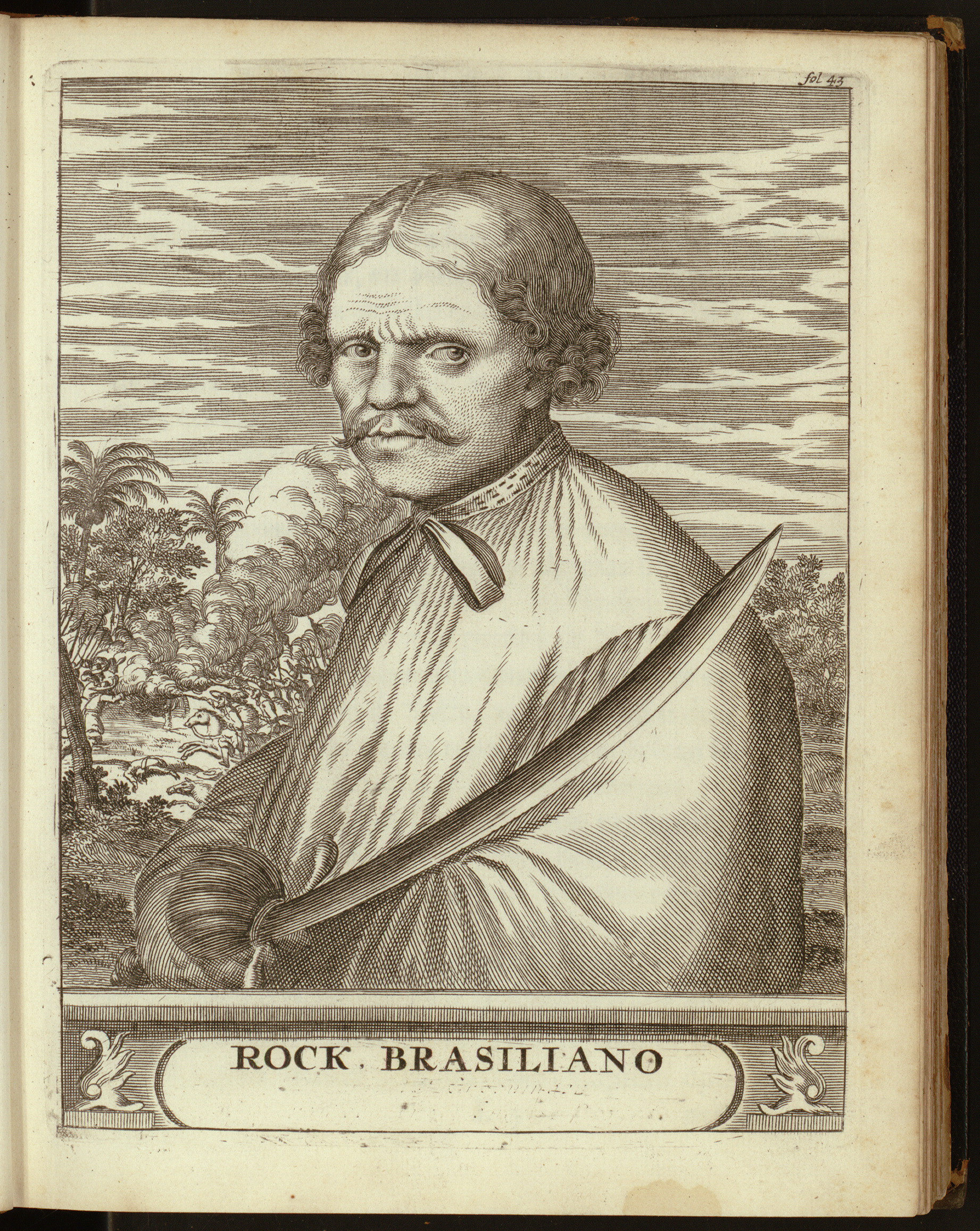
Van der Sterre also describes a duel, again aboard ship, between the infamous, probably borderline psychotic, Captain Roc Brasiliano, aka Captain Rocky aka Gerrit Gerritsen, and Reyning, the latter in command of a buccaneer vessel sailing in consort with Brasiliano in 1668. Reportedly, Captain Rocky struck Reyning’s close friend Jelles de Lecat, later better-known as Captain Yellows and who was serving as Rocky’s quartermaster, for which Reyning challenged him.
The two fought on deck with “houwers” (hewers, hackers — slang for cutlasses; the term sabel or saber, a general term for cutting sword, is also used), with several wounds received each, Reyning having the upper hand in the end. Van der Sterre writes that Rocky ordered his surgeon not to attend to Reyning’s wounds. In response, Reyning threatened to throw the surgeon’s instruments and medicines overboard; Rocky and the surgeon relented. Later, ashore at the Cayman Islands, Captain Rocky acquired a Spanish rapier and challenged Reyning again, who replied that he had a brace of pistols ready. The two vessels soon parted company and the adversaries did not fight again.
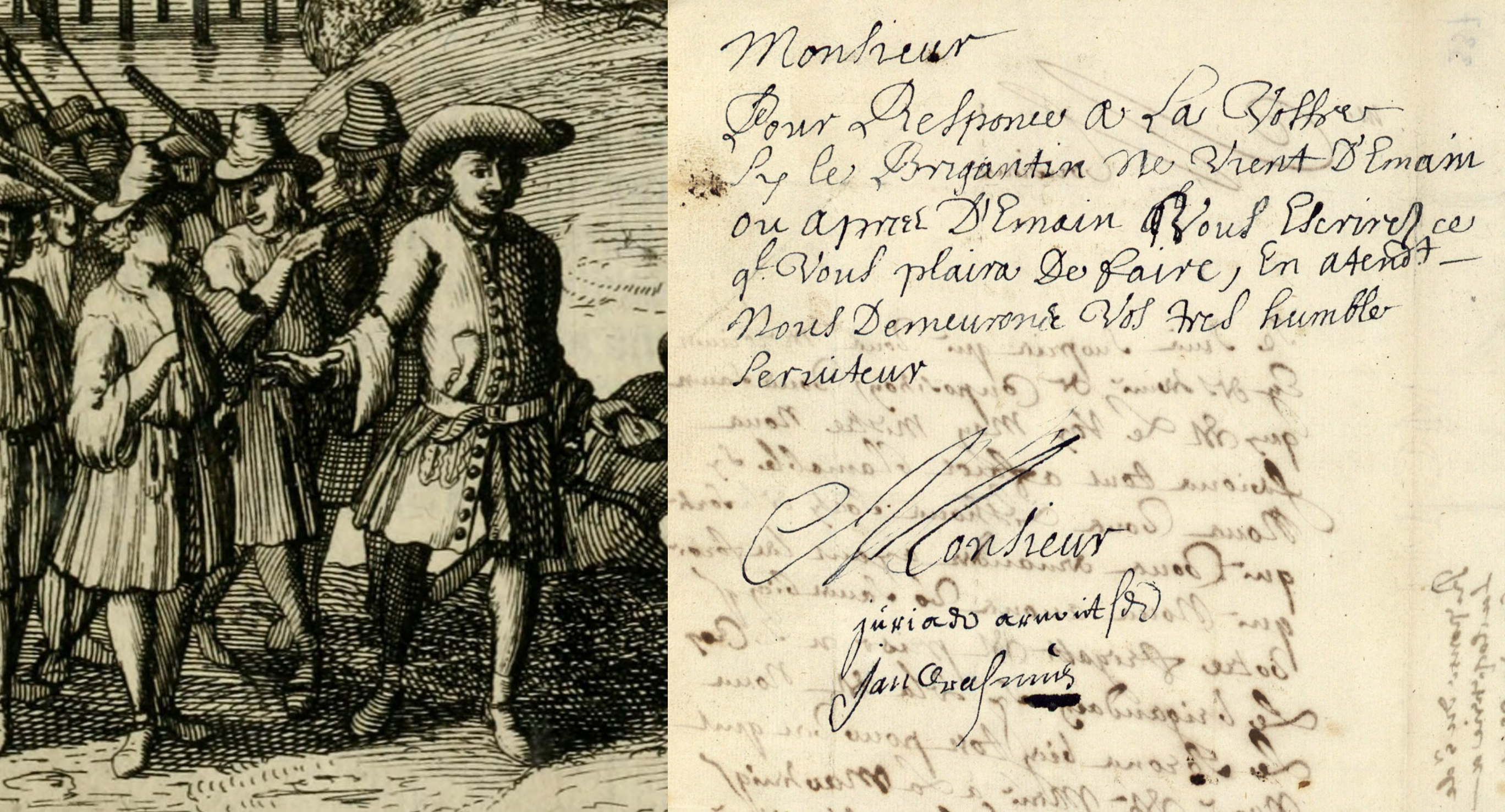
I’ve gone into detailed analysis of this duel in The Golden Age of Piracy. Suffice it here to note that the vessel was small, and that any duel fought in such conditions would force the adversaries to fight close, likely resulting in severe cutting wounds. But the duelists’ wounds, although requiring the ministrations of a surgeon (Rocky had three cuts, Reyning two), were not incapacitating. I suspect the duel, if it occurred, took place ashore or was grossly embellished, or both. Its description is highly detailed, a rarity in accounts of duels of the era. The exceptions are notable: Donald McBane’s personal accounts of his duels for example.
Could the duel have happened as described? Sure. And the fact that each man was wounded multiple times rings true, and one exchange — one man cut in the knee while the other was cut in the head, a classic, if bungled, attack at the knee which the adversary attempts to “slip” and cut at the head — is entirely likely. In fact, the bungling is quite realistic, for sword fights were rarely clean-cut (apologies for the pun!). But light cuts to the head, not to mention all the wounds received here, practically demand longer distance, ashore in other words. In all of my attempts at practical reconstruction of such duels in confined areas, as on a small vessel, both I and my adversary came to close distance, with stout blows (and black bruises) given from our hickory-bladed cutlasses, which, if made with real weapons, would have been severe. Of course, it’s also possible that neither duelist really wanted to seriously hurt the other, much less get hurt, and played it cautiously, hoping simply to draw enough blood to end the fight — which in this case was ended when Rocky took a cut to the forehead and, possibly, could no longer see, a common end to duels with cutting blades.
Further, the duel is corroborated nowhere else, including in Exquemelin’s detailed account of Roc Brasiliano’s life, although Van der Sterre considers this a deliberate slight against his hero. More so, Reyning’s biography is written with a novelist’s eye for detail — with an eye to popular consumption, that is, making it rather suspect. And all other accounts of duels among buccaneers, and even of seafaring men in general of the era, indicate that they were fought ashore. It’s also not unknown for old seafaring adventurers to exaggerate or even invent “sea stories,” taking great pleasure in misleading the gullible.
Without doubt the most famous duel among buccaneers, really a quick affray, is that between the famous Dutch buccaneer in French service Laurens de Graff and the dilettante Dutch buccaneer in French service Nicolas Van Horn. The two men despised each other. In particular, de Graff considered Van Horn a pompous fool who had by lack of patience recently lost them the treasure of the Honduras urca. The two captains, along with French gentleman-buccaneer Michel, sieur de Grammont, were co-commanders of the brutal 1683 sack of Veracruz. As the buccaneers loaded their ships with plunder and slaves on Isla Sacrificios, where they had moved from the city for security, de Graff and Van Horn’s contempt for each other came to a head.
Historical sources are uncertain on the real reason or reasons for the duel. There was the urca incident. According to Exquemelin, on the morning of the duel an English buccaneer reported that Van Horn had called de Graff a coward. Van Horn was reportedly angry that de Graff had prevented him from decapitating a dozen prisoners in retaliation for Spanish soldiers firing at French buccaneers who were fetching cornmeal to feed prisoners. Some say there was an argument over what to do next, after the sack of the city: Van Horn wanted to attack the treasure fleet in the offing, but de Graff wanted to depart with what they had, rather than risk losing it. An English governor later wrote that they fought over the division of spoils. And some Spaniards wrote later that the men fought over who could choose how the spoils were divided.
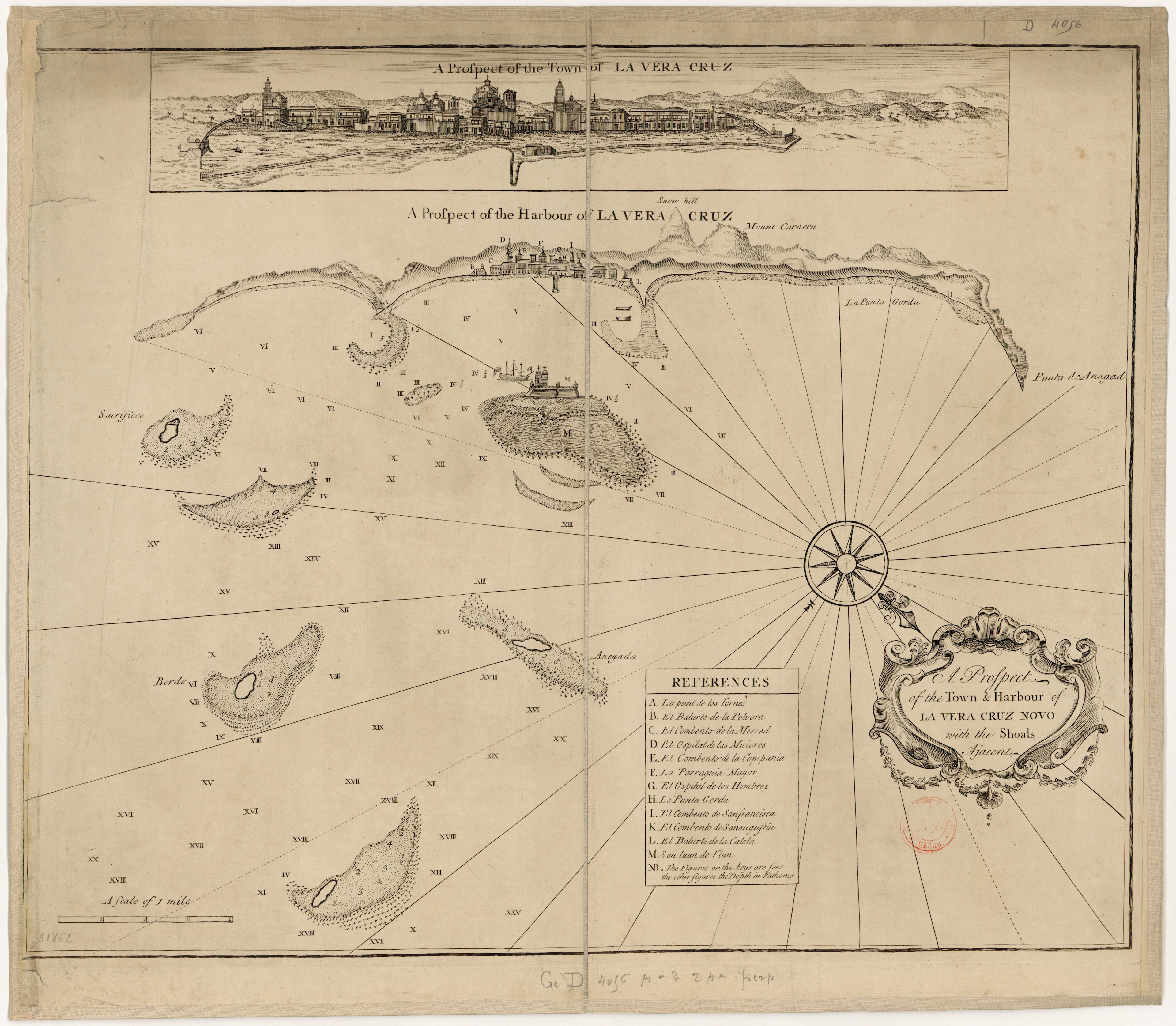
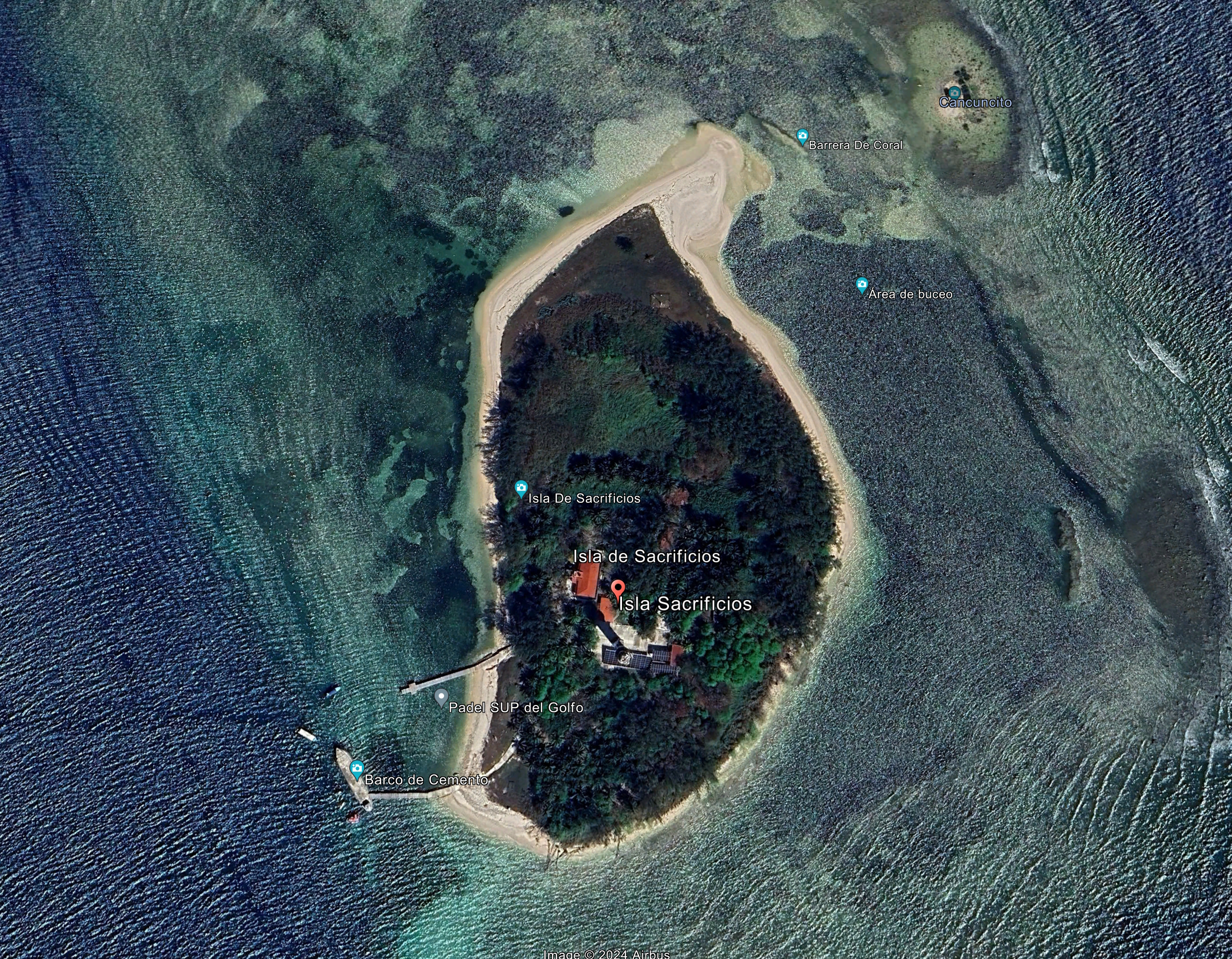
But no matter. Alexandre Exquemelin claims de Graff drew his sword, faced Van Horn, and said, “Voilà! With this I shall avenge the insult you have given me.” If so, Van Horn was damned slow in heeding the warning and drawing his own cutlass and coming on guard.
The fight was a quick one.
According to Fray Avila describing the sack of Veracruz in 1683, “On Thursday afternoon Admiral Lorenzo [Laurens de Graff], seeing how we suffered [from thirst and hunger], told the General [Nicolas Van Horn] that they should cast us ashore as I wanted them to do. The General grew angry and told me he would put us to the sword. At these words the Admiral drew his cutlass with such agility that before the General had put himself on guard Lorenzo had cut him in the arm and ear. They [the pirates] stopped them and I heard the admiral call his soldiers and send him [Van Horn] to his ship which was the almiranta [Van Horn’s St. Nicolas, soon to become de Grammont’s Hardi], and from this day we saw him no more.”
Call de Graff’s cutlass stroke Dutch buccaneer iado if you like. We can speculate on how de Graff made his cut or cuts: a single cut upward from the scabbard striking wrist and forehead; a single blow from high to low after drawing (“lugging out” was the term in English for drawing a sword); or two cuts, perhaps the first from low to high cutting the wrist, and the second from high to low cutting the forehead. Or any of several other possibilities. Van Horn died some days afterward, possibly of gangrene, or possibly of a pestilence that swept through his crew. His death was formally laid at the feet of de Graff, who, when he was considered for a commission as a French officer a few years later, had to petition for and receive a royal pardon for killing Van Horn.

Not quite Flynn versus Rathbone aka Peter Blood versus Levasseur, but nonetheless a duel between pirate captains on a sandy shore in the 1680s — about as close historically as we can get to that most famous of film duels!
Although cutlasses were probably the norm for duels among buccaneers when muskets were not used, and likely enough among buccaneer captains, smallswords may have been used on occasion although we have no record of this. A small but fair number of buccaneers, French in particular, were gentlemen who would have been trained in the use of the smallsword, would have preferred it for formal combat, and may have carried it even in battle.

The sieur de Grammont noted above had fought at least one duel long before becoming a buccaneer: he ran his sister’s suitor thrice through. Also among these French gentlemen-buccaneers were famous buccaneer-author Raveneau de Lussan; the sieur de Chauvelin who served under de Grammont aboard one of his consorts, a half-galley and who was killed in Florida in the aftermath of an aborted attempt on St. Augustine; and the sieur d’Hulot, a veteran of two campaigns against Algiers and the Algerine corsairs, and who would later command the regular French forces on Saint-Domingue. Alas, we have no record of any duels among these smallsword-wielding gentlemen, much less of any smallsword duels on the beach.

An interesting adoption of an army dueling practice was reportedly undertaken by Red Sea pirates circa 1693-94. According the deposition of pirate Samuel Perkins in 1698, fourteen pirates, variously from the crews of captains Thomas Tew, Josiah Raynor, William Mason, and Edward Coats, divided into two factions of seven each on St. Mary’s island some five years prior, “to fight for what they had (thinking they had not made a voyage sufficient for so many) and that one of the said Sevens were all killed, and five of the other, so that the two which survived enjoyed the whole Booty.”
What weapons were used is unknown, but cutlasses are likely. And the amount of booty? If this took place in the year 1693, Tew’s crew shared 1,200 pounds (the equivalent of 6,000 pieces-of-eight) per man, an extraordinary sum, making it unlikely any crew would fight to increase this — unless they had lost their shares gaming. Such losses might make desperate men even more desperate, willing enough to fight in a group duel in which most were likely to be killed. A year prior, the crew of Edward Coats shared 500 pounds per man, still a large booty and three or more times what would be considered a profitable voyage among the Caribbean buccaneers.

It was not uncommon for army regiments, particularly during winter quarters or in garrison, to settle conflicts this way, each choosing their best swordsmen to fight those of the other. Sometimes all fought at the same time, sometimes only one from each side would fight, the victor staying up to fight the next until defeated, then another would take his place.
Famous Scottish soldier, swordsman, duelist, fencing master, and prize fighter Donald McBane describes one such compound duel, its occasion being McBane’s theft of fourteen prostitutes from a Dutch regiment — the Scotsman had a profitable side gig of gambling and prostitution. The “next Day came Twenty-four Swords Men and Demanded the Lasses again, or else give them Satisfaction, we made up Twenty-four Men and Drank together; then we Fought two and two, there was Eleven of the Dutch Killed and Seven of our Men, our Bargain was, that if they beat us, we were to give them the Lasses and Pay them a Tribute, and on the contrary, they were to Pay us Tribute: We fought a Second Time, I being of the Royal it fell to me to Fight first, the first Time I was soon done, but the Second Time before I put I my Sword, I Fought Eight of them so it ended, and they promised to Pay their Tribute, we buried our Dead and parted…” But the Dutch didn’t pay, and shot four of the six men sent for the tribute two or three days afterward.
Early eighteenth-century pirates of the Black Flag reportedly fought duels with pistols ashore, to be followed by cutlasses if necessary, at least according to pirate chronicler and liar-when-convenient Charles Johnson (a pseudonym). The articles of Bartholomew Roberts and his crew reportedly provided that “The Quarter-Master of the Ship, when the Parties will not come to any Reconciliation, accompanies them on Shore with what Assistance he thinks proper, and turns the Disputants Back to Back, at so many Paces Distance: At the Word of Command, they turn and fire immediately, (or else the Piece is knocked out of their Hands:) If both miss they come to their Cutlashes, and then he is declared Victor who draws the first Blood.” Note that this quotation is from a secondary source, albeit a period one, not an primary source; no original examples of pirate articles from the 1714 – 1726 Black Flag era exist.
There were other methods of dueling with pistols during this era, and it is possible that pirates may have used some of them as well. For example, Donald McBane describes a form of pistol duel in which a cloak is held up in each duelist’s left hand so that neither man can see the other, then on cue pistols are fired through the cloak.
One wonders at the description of pistol dueling — generally considered in the popular historical fiction mind to have been a deadly form of honor combat — engaged in first among the Black Sail pirates of Roberts’s crew, to be followed by cutlasses merely to first blood. This is in fact unsurprising: 19th century sources note that pistol duels were far less dangerous than sword duels, and this in an era in which pistols were more accurate than in the late 17th and early 18th centuries. One commentator wrote that only one in six pistol duelists were wounded, and only one in fourteen killed. In sword duels, one or both duelists were nearly always wounded or killed, although another commentator noted that pistol wounds were usually far more dangerous than sword wounds. Pistol dueling grew in popularity as a means of showing one’s “bottom” aka courage, yet it was less dangerous by far than sword duels (unless one got shot), at least until the development of the epee de combat and light Italian dueling sabre in the late 19th century, much of whose swordplay and design were intended to minimize the risk of fatal wounds in an era in which dueling remained popular yet the law had begun to severely punish dueling’s most severe results.
Notably, in spite of their romance and implied associated courage, all forms of dueling were less dangerous than the battlefield of sea or shore.
Charles Johnson describes an early 18th century challenge and its aftermath among pirates. Assuming he is telling the truth, the bosun of Captain Evans, a pirate, challenged his captain to a duel with sword and pistol “on the next shore they came to.” Unsurprisingly — challenges are easy, following up on them much more difficult — the bosun declined to fight, for which Captain Evans caned him. The bosun in turn shot him through the head and leaped overboard to swim ashore but was taken up by the pirates. For this murder the pirate crew resolved to torture the bosun, but the gunner, inflamed with passion, shot him through the body instead. The bosun, not killed, begged a week for repentance. He “should repent and be damned to him,” said another pirate, who then shot the bosun dead.
Thus ends our brief foray into the reality of piratical duels on the beach. As I close this latest blog post, here’s something to note: duels in film and fiction must be exaggerated in order to keep the viewer or reader’s attention. Not so with reality: even a simple, short duel is exciting for the simple reason that real bloodshed is likely.
N. B. The captions at the foot of the first image above read “Outside parry with the forte” & “The thrust made against those who raise their sword when parrying.” The latter thrust would be typically made if the adversary delays the riposte, or as a “high-low” feint attack. Many period masters would disagree with the extension of the un-armed hand, preferring to keep it by the head, ready to parry or oppose.
Copyright Benerson Little 2024. First published August 20, 2024. Last updated September 23, 2025.

Howard Pyle’s Famous “An Attack on a Spanish Galleon” — and Some Real Galleons Too!
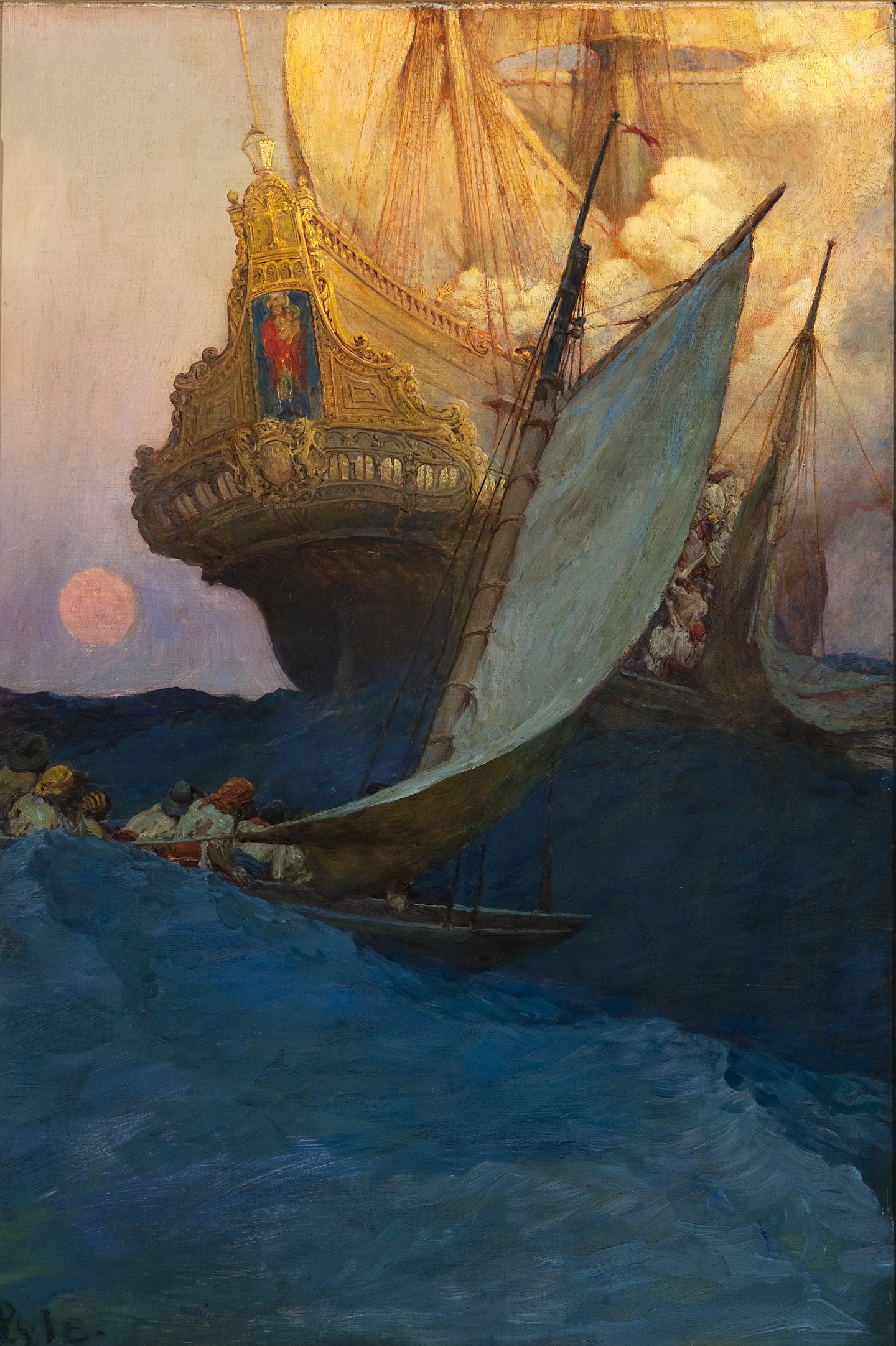
Perhaps the most famous of Howard Pyle’s many piratical paintings and drawings, and certainly the most evocative, “Attack on a Spanish Galleon” has inspired many homages (and plagiarisms) in book illustrations, cinema, and advertising — not mention dreams of Spanish treasure in the minds of both armchair and real sea-going adventurers!
The illustration accompanies several other of Pyle’s most famous buccaneer paintings in “The Fate of a Treasure Town,” an article written by Howard Pyle about the 1697 sack of Cartagena de Indias and published in Harper’s Monthly Magazine, December 1905. The article includes some of Pyle’s most famous buccaneer paintings, including “The Buccaneer was a Picturesque Fellow,” “Extorting Tribute from the Citizens” (used as the cover of The Buccaneer’s Realm, for what it’s worth), and “So the Treasure Was Divided.” Of the most famous paintings of his buccaneer, as opposed to pirate, series, only “Which Shall be Captain?” for “The Buccaneers,” a book of poetry, by Don C. Seitz in Harper’s Monthly Magazine, January 1911, and “How the Buccaneers Kept Christmas,” in Harper’s Weekly, December 16, 1899, are missing.
Charles D. Abbott in Howard Pyle: A Chronicle (Harper & Brothers, 1925) considers these four paintings as the culmination of Pyle’s paintings in “the pirate vein,” although he argues that the painting of “Captain Keitt, standing on the slanting deck of ship with a high sea running behind and a burning galleon in the distance, is perhaps the best of all of Howard Pyle’s pirate pictures.” Even so, he notes that “The one called ‘Attack on a Galleon,’ with its marvelous golds and greens, is a splendid achievement in design.”
Although the attack on a galleon scene in illustration, fiction, and film in general was surely inspired by buccaneer-surgeon-author Alexandre Exquemelin’s The Buccaneers of America (first ed. 1678), Pyle’s was likely factually-inspired by Exquemelin’s possibly apocryphal tale of Pierre Le Grand who captured a Spanish treasure ship by boarding at night. The small buccaneer crew had only one craft and boarded by stealth, catching the Spanish captain and crew off-guard — they had disregarded the distant buccaneer craft as of no threat to a great galleon.
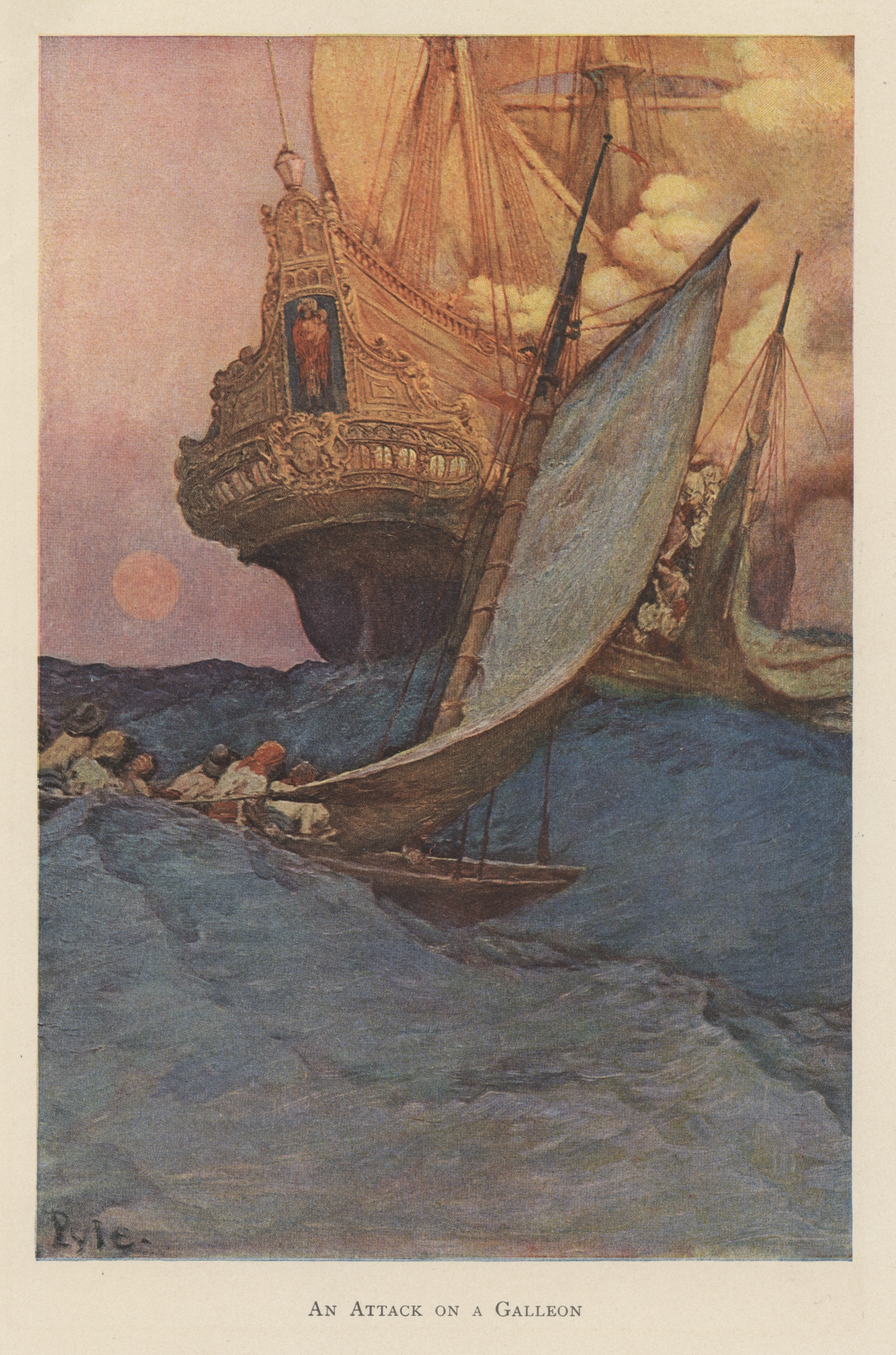
The story may be apocryphal but it has the ring of truth. We know that historically other buccaneers captured Spanish vessels by boarding from small boats, canoes, and periagers (piraguas, pirogues), that sea rovers in general have successfully made similar attacks over the millennia, and that modern naval special operations forces use the tactic as well. (For more information on the tactics of Golden Age buccaneers, pirates, privateers, and naval commerce raiders, see The Sea Rover’s Practice.)
In the painting, one buccaneer boat is already alongside, its boarders streaming up the side and into the waist, and another, gaff-rigged, a dugout canoe perhaps, is captivatingly astern, surely preparing to board as well. The smoke billowing from the deck indicates a fierce fight on deck — muskets and pistols, and probably the upper deck great guns and swivel guns as well, are in action — or possibly even that the ship may be afire, although in the latter circumstance it is unlikely that buccaneers would board, for a fire aboard ship was feared more than any other hazard of the sea.
At the stern, probably on the poop deck, one can sea a Spaniard in a broad Spanish hat, often referred to as a “two-hand hat” (or perhaps it is one of the buccaneers instead?) and aft of him, perhaps on the poop-royal (also known as the topgallant poop, Sp. chopeta/chopa/imperial, Fr. dunette sur dunette/carrosse), a pair of hands in submission and supplication.
A question that continues to perplex me is what time of day does this attack take place? Is that a golden full moon just up over the horizon at sunrise, given its red-orange color? Or is it a sunset, suggesting the setting and settling of a Spanish treasure voyage? Or even of the Spanish Empire in the Americas?

From the left drawing above it’s easy to see that Pyle changed the early conception of the galleon’s stern, eventually elongating it greatly for effect. Even so, the stern is historically-based. Without any doubt, as his inspiration Pyle used the well-known illustration, shown below, by 17th century Dutch artist Wenceslaus Hollar in 1647, and with poetic license narrowed the stern even further. Not only is the Hollar drawing quite similar, but Pyle used it in a later illustration, copying it almost exactly.
The illustrations by Hollar below show a form of mid-17th century Dutch ship used for both East and West India voyages. By the 1660s Dutch sterns, had become a bit lower and less narrow at the upper transom. Even so, some of the East and West India-men shown below, built in the 1640s and 1650s, would have survived in the 1660s and even 1670s or later. Importantly, approximately one third of Spanish ships were Dutch-built, including some treasure ships sent to the Americas, making Pyle’s Dutch-style Spanish galleon historically-correct, or largely so.


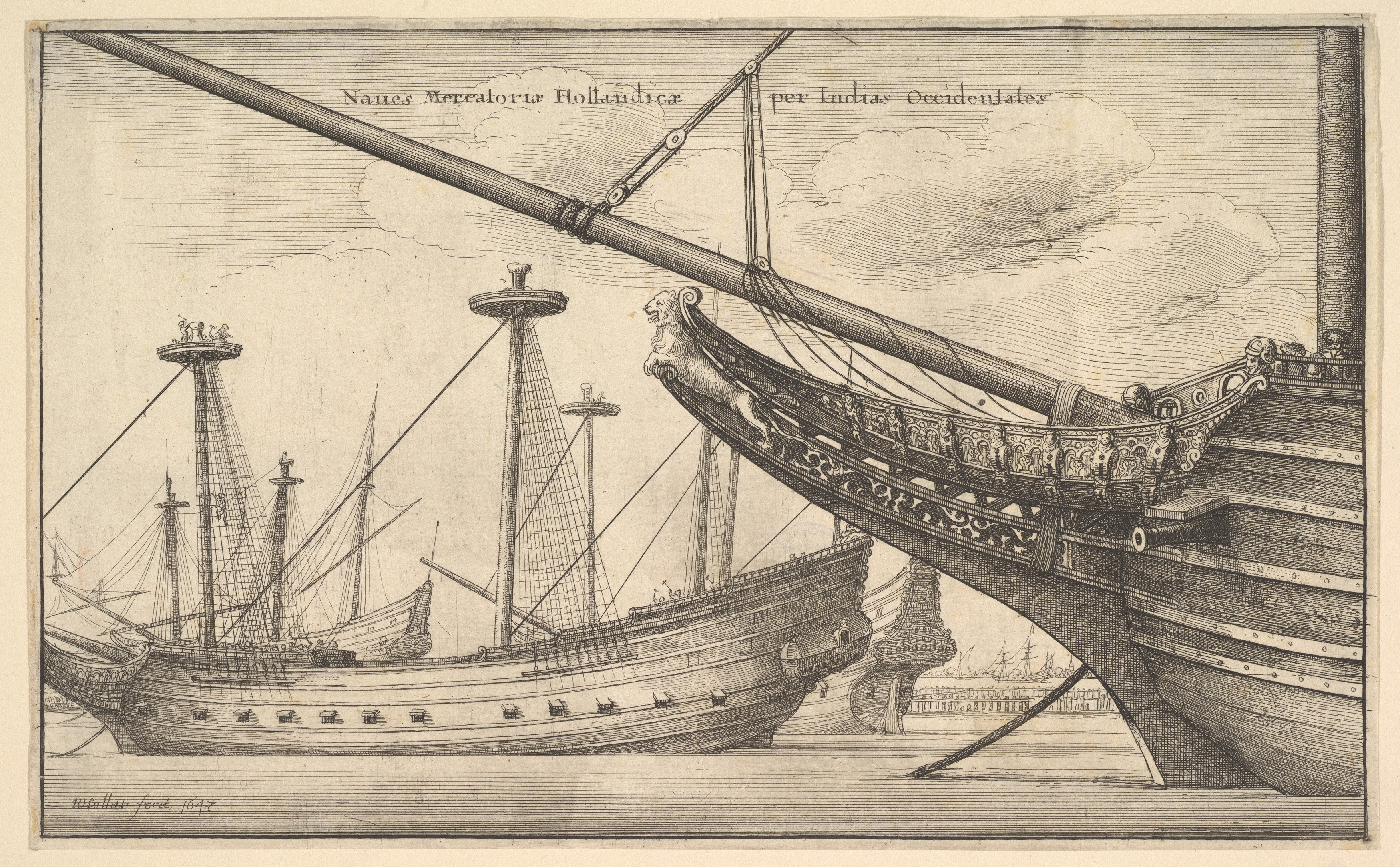

In the comparison above, Pyle has largely kept the structure and decoration with minor modification. Importantly and correctly, he has added a large Catholic religious icon representing the ship’s name at the stern. This was the usual practice aboard Spanish ships of the era, nearly all of which had religious names although some had secular nicknames. So far, the only exception I’ve found to the religious name rule is among some Spanish privateers. Occasionally, a religiously-named Spanish privateer or man-of-war might display the Spanish arms as its main icon at the stern, but it would still display a religious icon representing its name somewhere below or above the arms. Here we can assume that Pyle’s galleon’s name begins with Nuestra Señora given that the icon appears to be of Madonna and Child.
It’s possible that Pyle may have been originally inspired by “Wager’s Action off Cartagena, 28 May 1708” by English painter Samuel Scott. Painted at some point in the 1740s, Scott depicts a classical 17th century Spanish galleon, although in fact the galleon in question, the San Jose, whose remains along with possibly a billion dollars in treasure, are currently undergoing careful salvage off Cartagena de Indias, Colombia, probably looked nothing like this. (Details in the section below on real galleons.) In any case, Pyle may have been familiar with this famous painting, and sought out similar but more detailed images, and found those of Hollar. Notably, Pyle’s billowing smoke and orange colors are similar to Scott’s. (Compare with the image of what is probably the San Jose’s actual stern later in this post.)
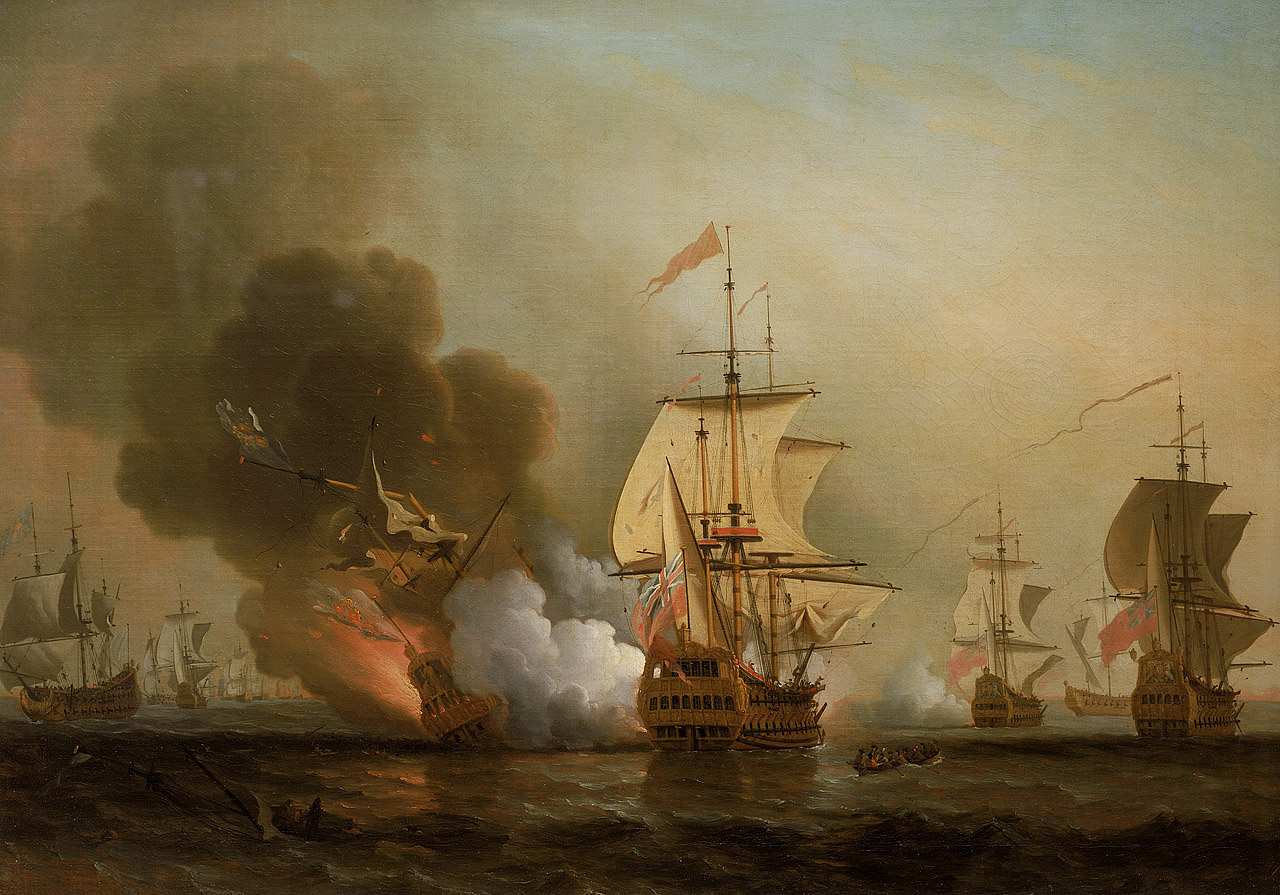
A word or two on the term galleon. Originally, in the late 16th and early 17th centuries, it referred to a stout ship with specific characteristics that was built for war and trade. Spanish galleons were noted in particular for their very high sterns. By the late 17th to early 18th centuries the term galleon could refer to (1) in its narrowest definition, a treasure ship of a type built to very specific guidelines for use in the Carrera de Indias (the trade to the Spanish Americas from Spain and from the Spanish Philippines), (2) any Spanish treasure ship of any sort, (3) any Spanish ship with a very high stern and multiple stern galleries, and (4) any ship of war or trade similar to those of Spanish galleons, in particular those of Portugal (occasionally still referred to as carracks as well), Venice, Genoa, and “Turkey” (the Ottoman Empire).
Further, some Spanish officials in the late 17th century incorrectly referred to Spanish men-of-war of the frigate type as galleons, retaining language from earlier in the century. True Spanish galleons, as described in (1) were largely no more by the 1640s except for a small number specifically built for the treasure fleets. Arguably, the last true galleons, and there were but few by this time, were built in the 1690s, yet privateer Woodes Rogers in A Cruising Voyage Round the World (1712) describes one in the first decade of 18th century in the South Sea (the Pacific Spanish Main): “[S]he was call’d the Ascension, built Galeon-fashion, very high with Galleries, Burden between 4 and 500 Tun…” He later refers repeatedly to the ship as a “Galleon” — and oddly, to neither of the Manila galleons as galleons, but only one or the other as the “Manila Ship.”
Although the life of a ship in this era was often less than twenty years, some were in use for thirty to forty years, ensuring that older forms of ships were still well-represented.
Pyle also painted a somewhat similar illustration in 1898, published eventually in Collier’s magazine, December 10, 1904, and it clearly shows that his inspiration was taken from Hollar’s Dutch East Indiaman.


Imitations & Homages
Pyle’s galleon, or its inspiration, has spawned numerous imitations, right down to the present. Many, most perhaps, are homages. Below are a few representative images.
A clear copy of Pyle’s ship used here for the cover of Collier’s magazine, December 10, 1921. No attempt has been made to alter the galleon’s stern — already readers knew, thanks to Pyle, what a galleon should like.

His treasure ship has often been used in advertising, for example in this add from The Saturday Evening Post, October 22, 1927, for 1847 Rogers Bros Silverplate. “Time and Tides are Kindly to Comely Captain Housewife,” reads the caption. Sexist, yet the series of ads does feature a variety of often clearly independent pirate women as opposed to more common images of domesticity. Doubtless the illustrations of sexy pirate women were intended not only to attract the attention of women readers, but also as lure to inspire husbands to buy the cleverly marketed “Pieces of Eight” set of silverware and associated pieces.
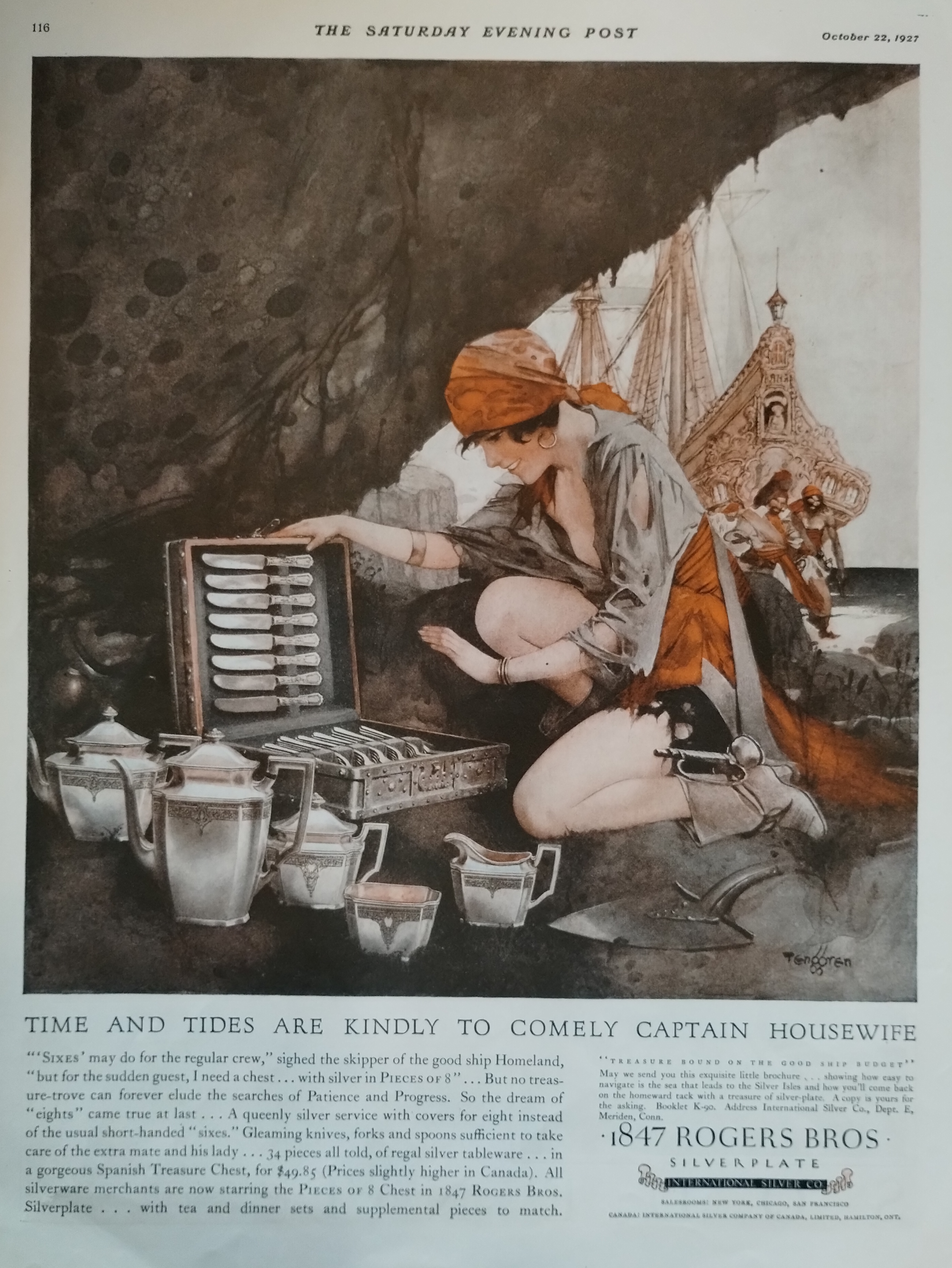
The detail below clearly shows the galleon to be a copy of Pyle’s famous ship. An homage, probably, but also good marketing, immediately evoking the pirates and buccaneers of Howard Pyle and Douglas Fairbanks.

Below is a galleon by well-known Saturday Evening Post artist Anton Otto Fischer, quite clearly in homage to Howard Pyle, based on the galleon in Pyle’s “The Burning Ship” and Hollar’s India-men. The image emphasizes pink-gold hues of ship and cloud and tropical blue sea. Both Fischer and his wife were students of Howard Pyle; Fischer was also an experienced tall ship sailor whose favorite subjects to paint and illustrate were of ships, seamen, and the sea.
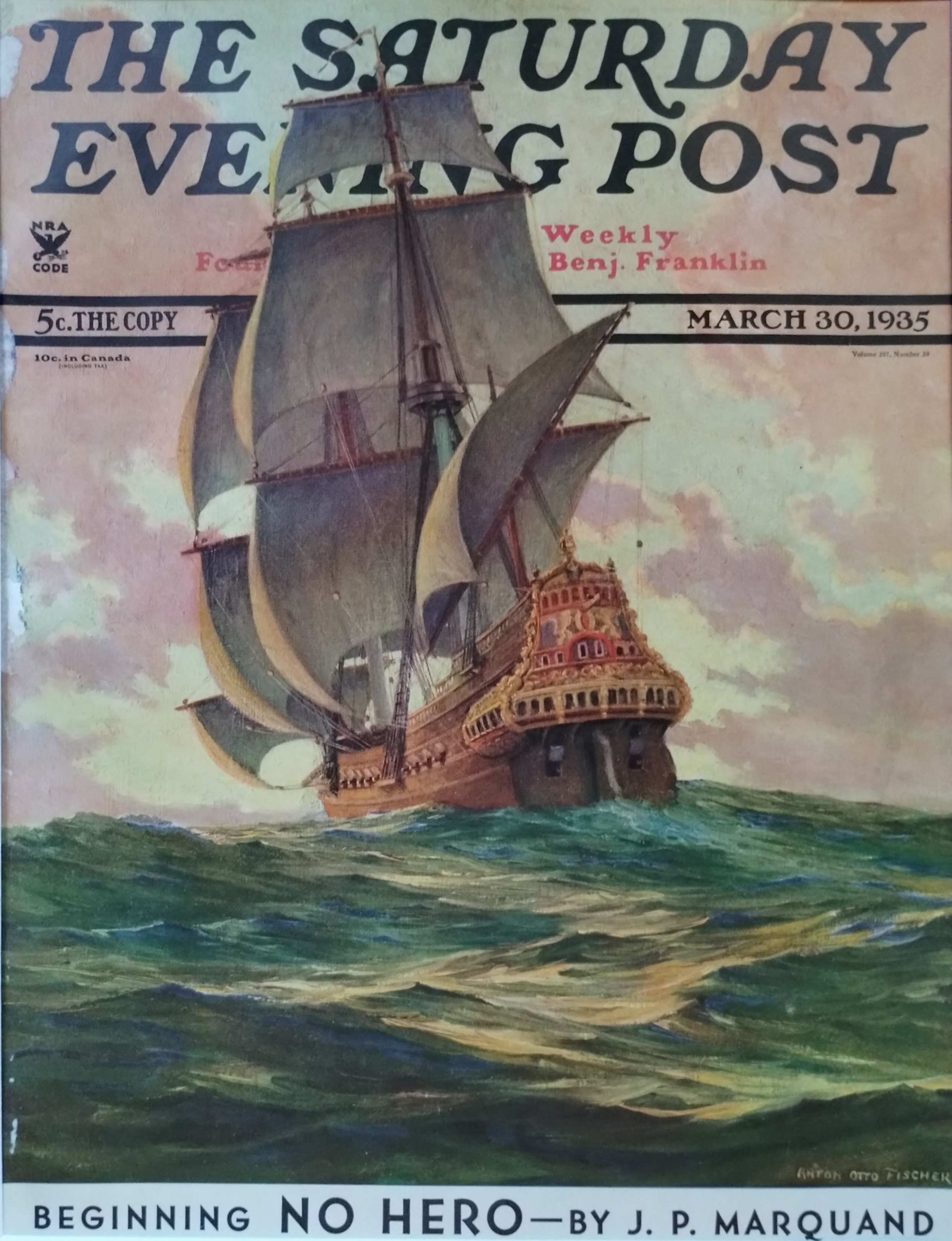
A dinner plate dating from 1923 – 1936 — an era of cinematic pirate adventurers Douglas Fairbanks and Errol Flynn, and the buccaneer novels of Rafael Sabatini and Jeffery Farnol — shows likely influence of Howard Pyle’s galleon. That said, as seen above and below, there were real ships with similar sterns.


Below, the 1935 beverage and tobacco menu from the famous Cunard White Star Line for its UK to America runs. The painting used for the cover is by Scottish illustrator Alistair K. Macdonald. The galleon is clearly inspired by Howard Pyle.
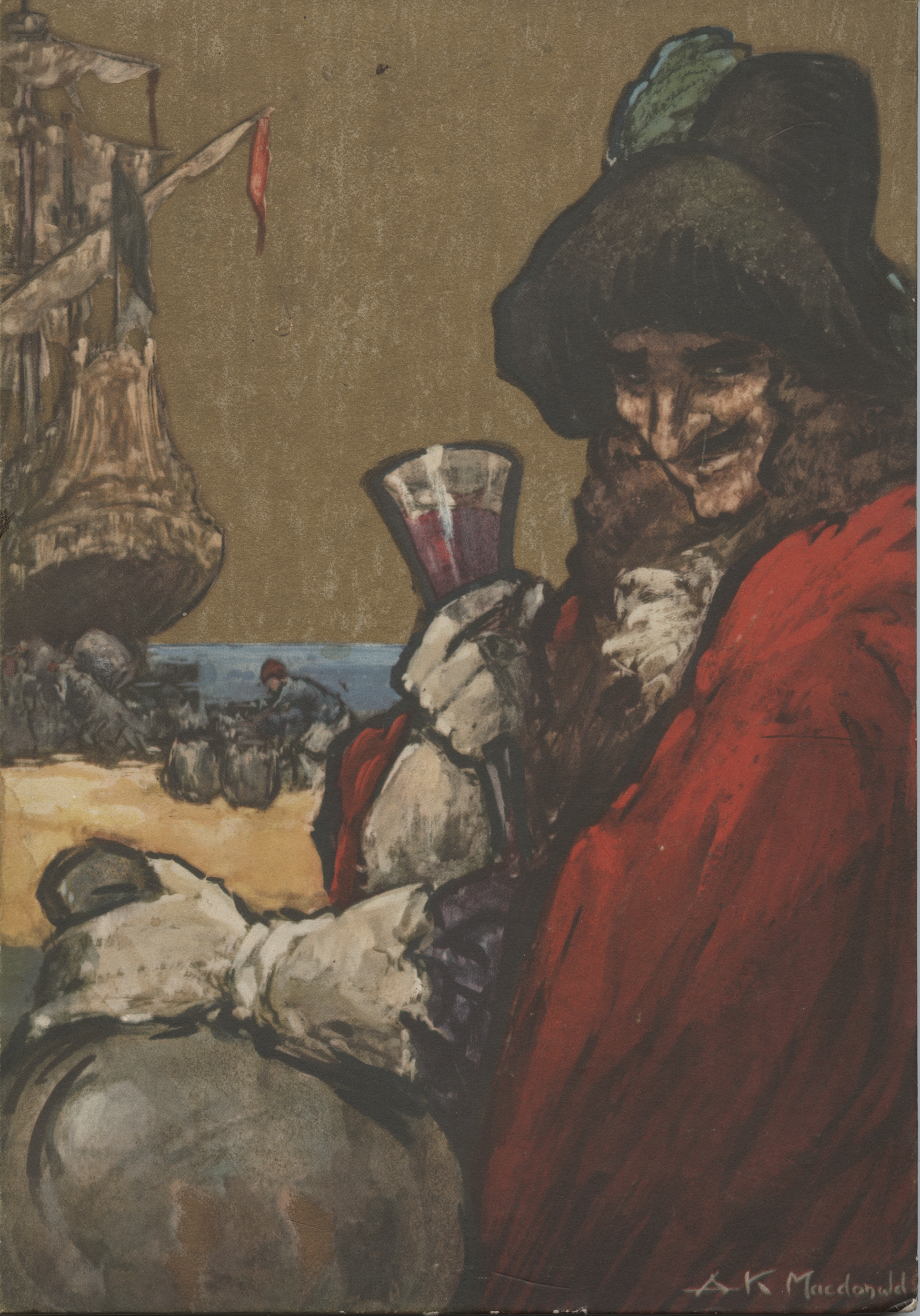
I almost forgot about several famous galleons, at least one of them an English one, all painted by N. C. Wyeth — perhaps Howard Pyle’s most famous student. All clearly evoke Pyle’s galleon. Homages from student to teacher, without doubt.


I cannot decide if the Cinco Llagas aka Arabella of the 1935 Captain Blood was inspired by Pyle’s painting or not. Without doubt the designers were familiar with Pyle’s galleon, although technically the Arabella is a frigate.

Likewise the Wicked Wench, which was clearly inspired by the Arabella, as I’ve discussed here.

Even so, the galleon — surely the Arabella! — in this 1935-1936 Spanish poster for Captain Blood (Warner Bros., 1935) was copied from or inspired by Pyle’s famous galleon. And appropriately so, given Pyle’s overwhelming influence on pirate films of the era. Note that the forecastle appears to have been appropriated from any of many N. C. Wyeth Elizabethan galleons, or even earlier galleons.

The stern of the Spanish galleon in The Spanish Main (1944) starring Paul Henreid and Maureen O’Hara may well have been influenced by Pyle’s painting, in particular the ascending pointed carved decoration at the top of the stern transom. Compare with that of the Urca de Lima in the television series Black Sails later in the post.
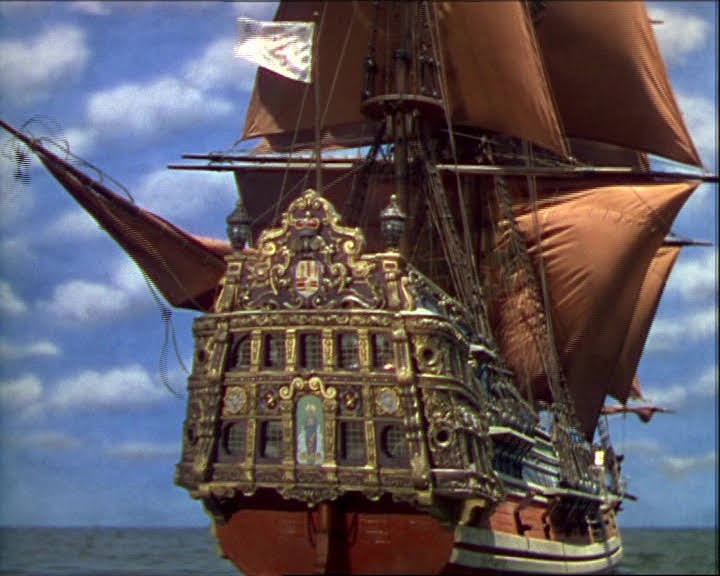

Pyle’s influence is clear in this shot from a Quick Draw McGraw cartoon from 1961:
Famous science fiction and fantasy illustrator Frank Frazetta honored Howard Pyle with an homage to his famous galleon in 1973.

N. C. Wyeth’s grandson, Jamie Wyeth, a famous and outstanding painter in his own right and son of iconic artist Andrew Wyeth, did the artwork for the plate below, a clear homage to both his grandfather and to the man who taught his father, Howard Pyle. In this case it is a “pirate galleon” — clearly a Spanish galleon fallen into the hands of buccaneers per classic trope. (N. B. Buccaneers didn’t fly the black flag with skull and bones, although at least one crew did fly the red banner of no quarter with skull and bones. But it’s the image that counts in storytelling, and we’ve come to expect the black flag on all pirate ships of all eras. See The Golden Age of Piracy for more details.)


Almost certainly the “galleons” (they appear to be manned with English marines) below, especially the one of the left, in this art by cartoonist François Ruyer for a puzzle is an homage to Pyle’s famous painting, with their excessive height and pirates attempting to board one of them via boat. Even the sky color evokes Pyle’s painting.

Likewise an earlier image by Jean-Jacques Loup for Heye, “Captain Flint’s Party,” for a puzzle evokes galleon sterns reaching for the moon, so to speak:

The box cover of Sea Legends (1996), an MS-DOS video game inspired by the 1993 version Sid Meier’s 1993 Pirates! Gold. The Spanish galleon was clearly inspired more by Frazetta space galleon above, in turn inspired by the Howard Pyle.
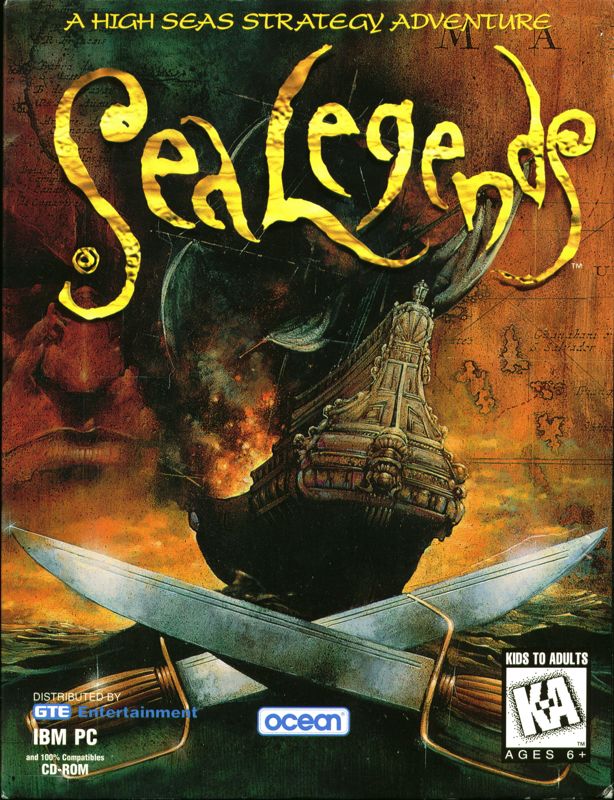
The stern of the Jolly Roger below from Peter Pan (2003) is clearly an homage to Pyle’s galleon.

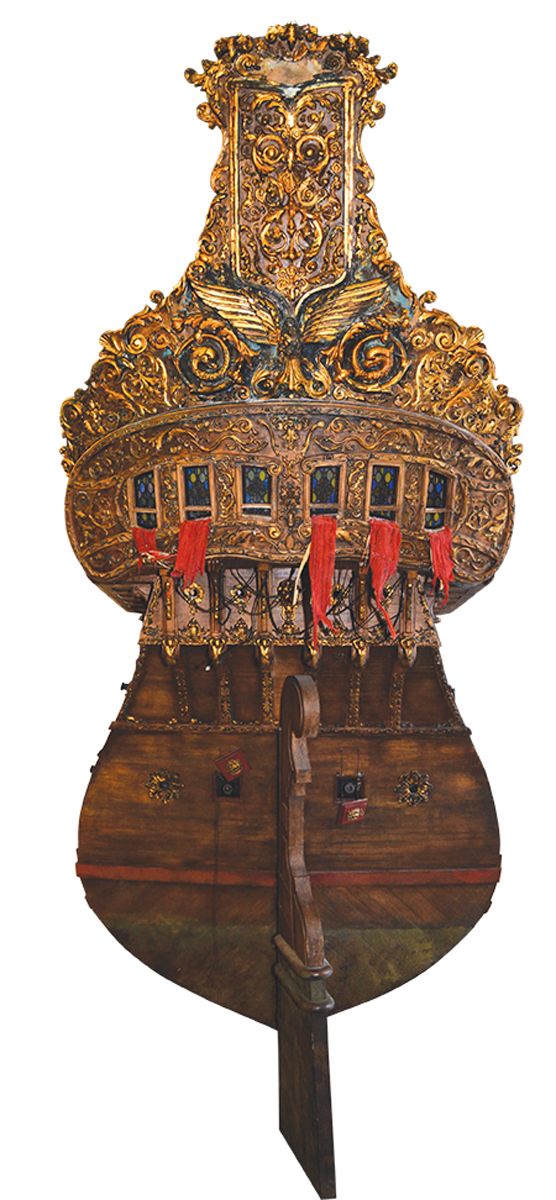
It’s entirely possible that Pyle’s galleon even influenced the design of the Urca de Lima in the Starz dramatic series Black Sails, shown below. (Compare also to the galleon used in The Spanish Main above.) Although I was the historical consultant for all four seasons, I don’t know this for certain as I had no input into sets, including ship design, unfortunately — otherwise the ships might have been more historically accurate. Some of them in reality would not have been seaworthy.
And on a nitpicking the note, urca is the Spanish word for a type of ship originally designed by the Dutch but in use by all Western European seagoing nations. It was known as a fluyt, flute, flutte, or, in English, a pink. It had a rounded stern, not a flat one as the television galleon has, and a very small narrow transom (which might have provided some additional excuse for Pyle’s very narrow upper section of the transom for his Spanish galleon, even though it’s not an urca). In other words, the Black Sails galleon should be an urca instead. It bears noting that an urca is NOT a galleon — yet one might be referred to colloquially as a Spanish galleon if carrying Spanish treasure…

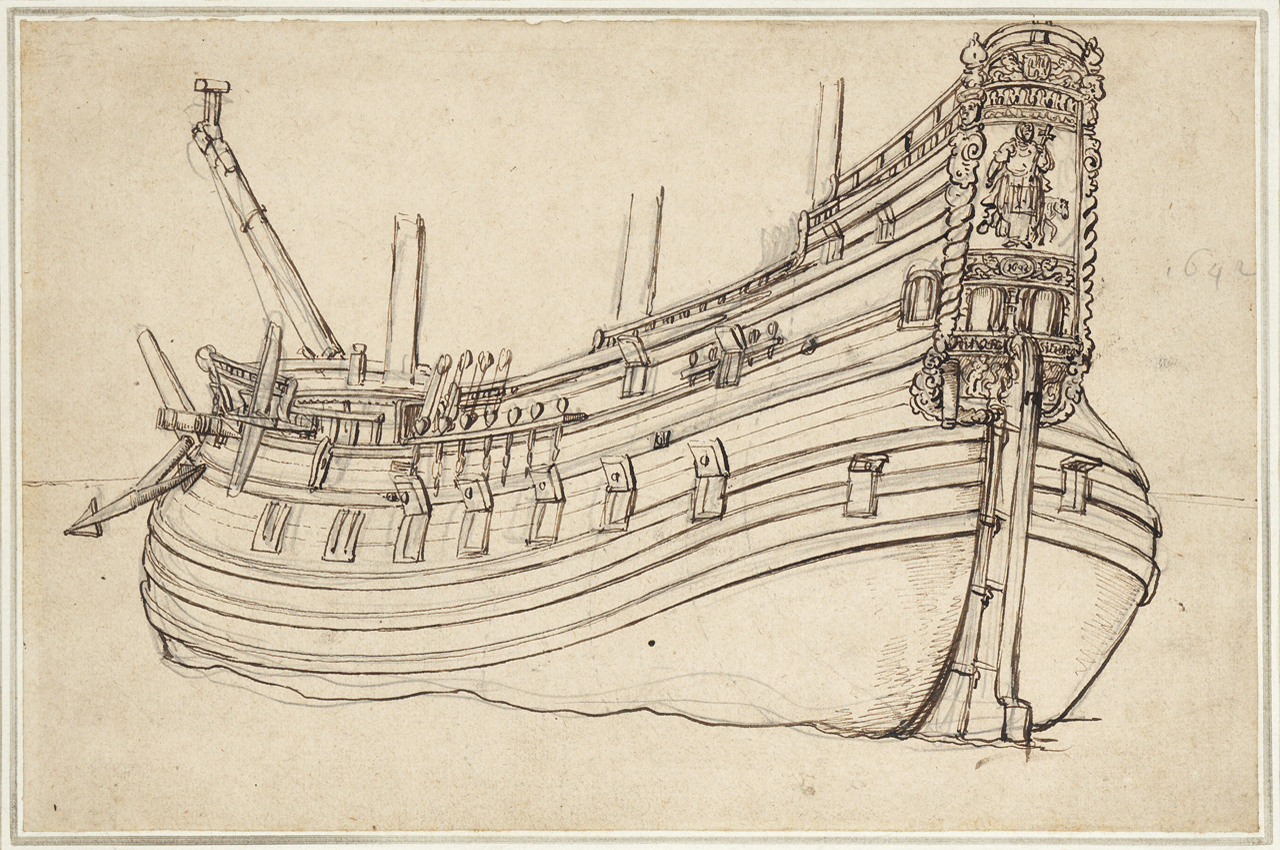

But I digress a bit under the influence of historical accuracy! Even so, this brings us to a good subject: what did Spanish galleons and their sterns actually look like from 1650 to 1700?
Spanish Galleons 1650 to 1700
For the first forty years or so of the 17th century, the large or main transom of Spanish galleons was typically “stepped” (in layman’s language), with the upper part or parts overhanging the lower, rather than flat as soon would be the case. The Spanish galleon Santa Teresa, shown in the three images below, is a good example of this style of very common early 17th century Spanish sterns.


The “Vista de Sevilla” (“View of Seville”), circa 1660, artist unknown, gives us a good view of the sterns of Spanish galleons with enclosed galleries, and the changes that came mid-century. The sterns, although still very high, all now appear “modern” in the sense that the double transom, the upper overhanging the lower, has disappeared.


Below is an illustration of “The Spanish fleet sailing from Havana in 1662.” However, neither the Flota de Nueve Espana nor the Flota y Armada de Tierra Firme sailed from Havana in 1662, nor was it likely that either fleet was there at any time that year. More likely, the year was 1661 or 1663. Note the very high sterns of the two larger ships.

Below is a Spanish two-decker man-of-war, the illustration dating probably to the 1660s, almost certainly the Spanish flagship Nuestra Señora del Pilar given the iconography on the stern. Mounting 64 guns (or 70 in one account), of which 20 were 28-pounders and 28 were 18-pounders (some of which would have been placed on the lower gundeck with the 28s), the ship was destroyed when attacked by four fireships in 1676 at the Battle of Palermo. Admirals Don Diego de Ibarra and Don Francisco de la Cerda perished in the flames along with 200 of the ship’s 740 man crew.
Although a frigate rather than a true galleon, the ship shows many of characteristics of Spanish galleons, and men-of-war as shown below often carried Spanish treasure and escorted treasure ships, earning them the appellation of galleon even if incorrect. Note the high stern, the religious iconography, the clinker planking on the upper-works, the channels mounted above the upper gundeck ports, the musketeer loopholes in the waist (identical to Dutch practice), the jeer capstan on the forecastle, and the two open wraparound external galleries, known as corredores, typical of Spanish treasure ships although not always to be found.

Another Spanish man-of-war stern, 1660s, with two open stern galleries that wrap around the hull. The ship may be the Santa Ana of 54 guns, vice-admiral at the Battle of Palermo in 1676, given the stern iconography. If so, she mounted 16 bronze 24-pounders, 26 bronze 18-pounders (some of which would have been mounted on the lower gundeck with the 24s), and 6 iron 16-pounders. She was likely burned but not destroyed at the Battle of Palermo in 1676.

Below are three very similar versions of the galleon Nuestra Señora del Mar, San José y San Francisco, showing details of her shipwreck in the Bermuda Islands in 1691. The ship was launched in Pasajes, Spain in 1681. Of 862.5 Spanish tons (toneladas), she was mounted with only 29 guns, a not uncommon practice for a large Spanish galleon, for much of her space was taken up with cargo. Note the color scheme, the style of painted decoration, the painted scroll-work on the upper-works, and three open external galleries. Each was, per Spanish period references, probably only thirty-three inches deep. The uppermost is at the level of the poop deck or even the poop royal if there is one.


Below, a Spanish galleon with three open stern galleries, flying the royal colors, enters Havana harbor in the second half of the 17th century, probably 1660s to 1680s.

However, in spite of our romance with the open-gallery, high stern Spanish galleon, many did not have the open galleries, but had closed galleries as shown just below in this Spanish galleon at Portobello, 1688.

As noted previously, ships of other nations were sometimes referred to as galleons in the second half of the 17th century, including some of those of Portugal (also occasionally still referred to as carracks as well), Venice, Genoa, and the Ottoman Empire (colloquially referred to as “Turkish” galleons).


The 1680s brought on changes in Spanish shipbuilding, including in its men-of-war and in its remaining true galleons. Although the latter often still had high sterns, they were soon reduced, more in keeping with European construction in general. And although galleons or treasure ships with multiple open, wraparound galleries or corredores were still seen, the enclosed gallery became much more common as did the open gallery, often two or three in number, that did not wrap around to the sides, the latter particularly evident in the 1680s.
Below are Spanish treasure ships at anchor at Portobello in 1683. The multiple galleries and high sterns are clearly still evident although it appears that not all wrap around the sides but are open only at the stern, as above.

The same treasure ships, or at least ships of the same fleet, at anchor in Portobello in 1682, as drawn by a different artist :

Through the 1680s and 1690s, Spanish men-of-war, which often escorted treasure ships and even carried treasure themselves, were changing, their designs becoming sleeker and more in line with other European navies.

Below is one of a series of proposed Spanish men-of-war, 1691. Although never built, they reflect the new trends in Spanish ship design, including lower sterns and a semi-closed single stern gallery.

Even the last Spanish treasure galleons to be built had similar features. Below is the stern of what scholars generally believe to be the famous San Jose, launched in 1698 and sunk at Cartagena de Indias by Wager’s fleet in 1708, with a treasure aboard estimated by some to be worth as much as 17 billion dollars US today. Compare this drawing with Scott’s painting above of Wager’s action against the San Jose.

With the accession of a Frenchman to the Spanish throne in the early 18th century, over which the War of the Spanish Succession had been fought, Spanish ship design became more contemporary with that of other European sea powers. Gone was the conservatism that too often hindered Spanish shipbuilding. Below is a Spanish treasure ship of the new style. It has a projecting gallery that wraps around the stern (not all Spanish treasure ships and men-of-war had this), with a shade built overhead for the section of the gallery at the transom:
A closer look at these Spanish sterns in the first half of the 18th century. The stern gallery still wraps around the hull.

A simple pen and ink view of a Spanish man-of-war with what appear to be two projecting, probably wraparound, galleries, from a Spanish chart of Isla Vieques off the coast of Puerto Rico, 1721:

Design changes notwithstanding, the high-sterned Spanish treasure ship was in use into the first quarter of the 18th century. I’ve already mentioned Woodes Rogers’s description of one in the South Sea. Below is a depiction of a Spanish treasure ship by Gueroult du Pas in 1710.

And it is these high-sterned Spanish galleons that always have captured our imagination, and continue to do so. Howard Pyle’s famous treasure galleon has helped to keep that imagination not only alive but enhanced. Even the romantically evocative dust jacket below must have been influenced by his famous galleon, with its high stern and colors of sunset or sunrise!

In fact, these iconic images of Spanish galleons from fiction, film, and more aren’t far off from those created by eyewitnesses in the 17th century, including these found on a Spanish 1669 chart of Cartagena de Indias!


Details from “Cartaxena con 46 piésas,” 1669, courtesy of the French National Library.
Copyright Benerson Little 2024-2026. First posted March 27, 2024. Last updated September 3, 2026.

A Corsican Vendetta — Against the Pirates of the Caribbean!

Far too little-known are the Spanish corsarios of the Caribbean — the Spanish privateers and pirates who attacked the English, French, and Dutch in the service of Spain and of their own material interests! — yet the exploits of some deserve a book, an honest film documentary, or even a Hollywood film. I’ve already described the exploits of Italian corsario-in-Spanish-service Mateo Guarín, but those of the Corsican brothers Juan and Blas Miguel [It. Giovanni and Biagio Michele] are equally epic, and the final fatal exploit of Blas Miguel was in the service of a blood vendetta.
The tale begins with Juan Miguel. He arrived in Havana in late 1681 or early 1682 with a patente de corso — a privateering commission — dated 15 October 1681, from Juan de Arechaga, the governor of Yucatan, Mexico, to cruise along the coasts of Yucatan, Cozumel, and Tabasco for smugglers and pirates. Cuban waters were clearly beyond his commission’s authority, but Juan Miguel had a purpose in mind: to cruise new waters for greater plunder.
It’s entirely possible that Miguel had turned to el Corso in reprisal or revenge for attacks by pirates and consequent lost cargoes, just as some English merchant captains had turned to buccaneering after attacks by Spanish corsarios: he may be the Juan Miguel who, along with Captain Francisco de Ojeda, was plundered by English buccaneers in 1679 while sailing from Veracruz to Portobello. However, Juan Miguel was a common name, therefore this is speculation.

As a corsario Juan Miguel commanded an armed piragua, which often was nothing more than a very large dugout canoe, the largest of which could carry 125 men, with one or two masts and a short bowsprit, and armed with no more than two, or perhaps a few, wrought iron swivel guns known as patereroes (Sp. pedreros) on the gunwales. He was in the company of as many as two other corsario captains. One of them, Antonio Gómez, would soon command a small frigate captured in the bay of Santa Lucía, Cuba, and in 1683 would die in action against a smuggling sloop manned entirely or mostly so by buccaneers on hiatus from buccaneering, at Santiago de Trinidad, Cuba, a common location for smuggling and for fights between buccaneering smugglers and Spanish corsarios. The other captain was Juan Cañedo, although he may have associated with Miguel in Cuba instead.
Juan Miguel, with a new commission from Cuban authorities, soon put to sea again and captured smuggling canoes along the coasts of Honduras and Cuba. Along the latter coast he also captured an English bark smuggling logwood, and burned two other captured vessels because he lacked enough men for prize crews. Soon afterward, companion captain Juan Cañedo captured the English buccaneer John Spring (probably Captain Springer who gave his name to Springer’s Key and fought in the South Sea alongside Captain Bartholomew Sharp and others), among whose crimes was the decapitation of a priest in Guaurabo (Guayabon, modern Guayabo?), Cuba. Miguel’s next prize was a smuggling sloop, probably English, with 58 slaves and 46 boxes of sugar aboard.

Unfortunately, we know nothing more of Juan Miguel after this except that he died “in battle against the French from Petit Goave.” In other words, he was killed in action at the hands of French flibustiers. This has led some scholars to suggest that he was killed at the hands of Laurens de Graff, and from there they have leapt to the conclusion that he (as Miguel Curro) was captain of one of the several vessels of the Armada de Vizcaínos and was killed during a battle between the fleet and de Graff.
This Armada of Biscay, or informally, Basque Armada, referred to as La Armada de Nuestra Señora del Rosario by its admiral who would die of wounds received while attacking an English ship in an attempt to make off with its French prize, was a private pirate-hunting flotilla (three fragatas of thirty, thirteen, and twelve guns respectively, and one “barco de remos” or oared vessel) dispatched, largely unsuccessfully it turned out, to make up for perceived deficiencies in the Armada de Barlovento (Windward Fleet) of the Spanish navy. Given the privae armada’s apparent preference for trade over pirate hunting (pirate hunting has seldom been profitable), its failures are unsurprising.
However, neither Juan’s name nor his brother’s is listed among the those of the Armada captains, and it is highly unlikely that a local Mexican corsario commanded one of the ships of an armada financed and outfitted by the Compañía Guipuzcoana in Guipuzcoa (Gipuzkoa), Spain. Other scholars, looking more carefully at the evidence, consider it likely that Juan Miguel was killed during the sack of Campeche, Mexico in 1685 by buccaneers under the command of Laurens de Graff and Michel, sieur de Grammont, having returned to Yucatan after his cruises in Cuban waters.
In any case, Juan’s death triggered a vendetta: his brother Blas would avenge him by striking not at the homes and plantations of the buccaneer leaders, as Mateo Guarín had done, but at Petit Goave, the flibustier home port on French Hispaniola that had replaced Tortuga more than a decade prior. He would strike at the very heart of la flibuste and avenge not only his brother but all those who had died at the hands of the bloody French buccaneers.

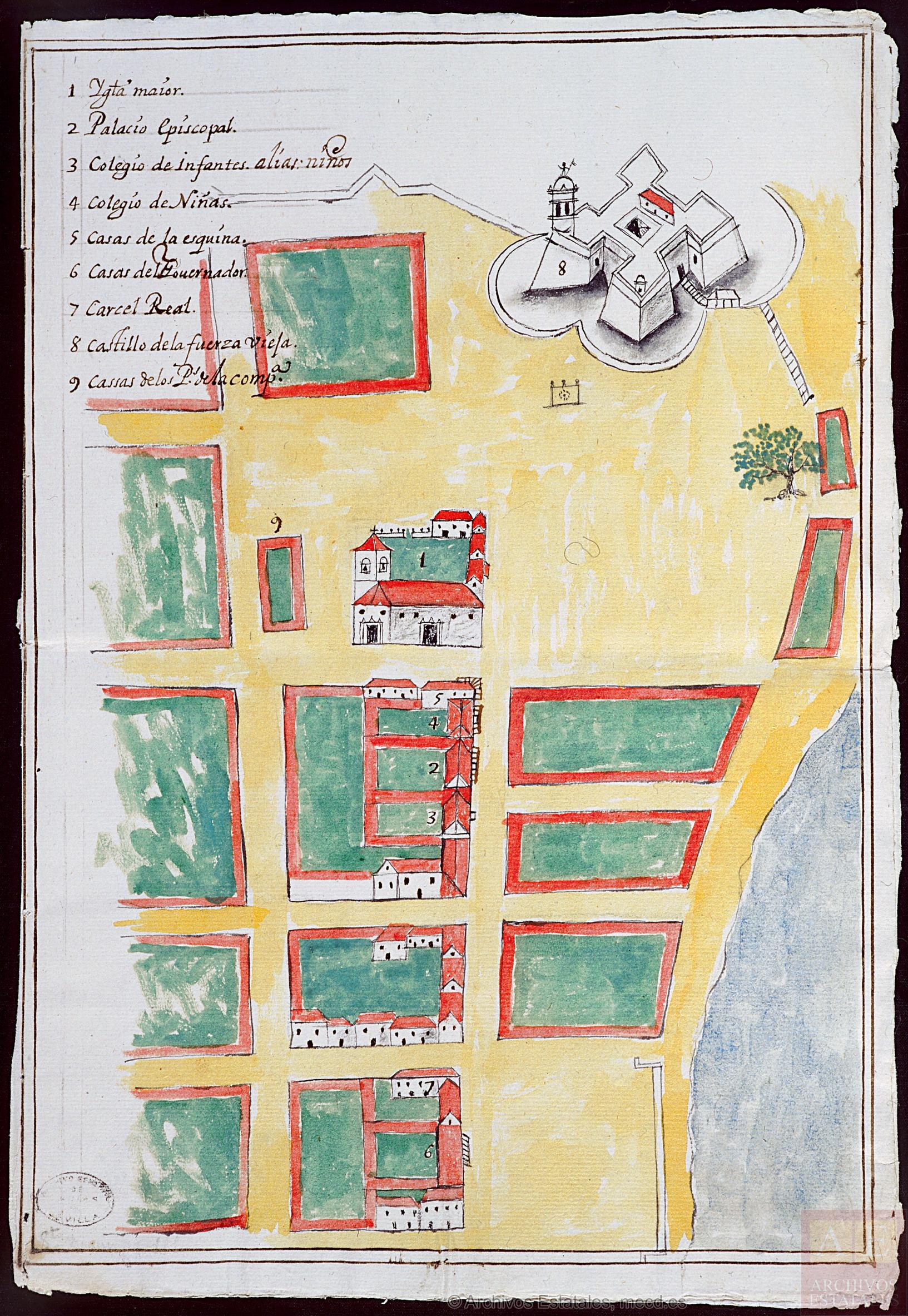
Blas Miguel sought and was presented with a patente de corso “contralos enemigos piratas…y aquellos contrabentores” (against enemy pirates and any smugglers) dated February 26, 1687 by acting governor Don Andres de Munibe, “castellano del castillo del morro y Governador delas Armas,” in Havana. A copy of the commission still exists. Miguel also claimed to have had a commission from the “Viceroy.” However, no such commission exists in the archives, and there were only two Viceroys: New Spain and Peru. He probably meant that his commission from Munibe was issued under the aegis of the Viceroy.
Miguel’s privateering commission, its authority based on the Ordenza de Corso of 1674, which authorized Spanish privateering in the Americas, and on the Real Cédula of 1680 which authorized Cuban governors to take additional action to protect Cuban shores, also names Miguel’s vessel: a piragua called El Cachimbo, a Native American word meaning tobacco pipe. It may be the same Cachimbo commanded by Capitan Juan Nicolao who in late 1686 captured an English turtling sloop owned by Arthur Burham of Jamaica. In early 1689 Nicolao captured three more English turtling sloops. If the two vessels are the same, we assume that Miguel hired it, or it was purchased by his various investors.
Given that French records describe the vessel both as a pirogue and as a demi-galère (half-galley), it is likely that was in fact the latter, known in Spanish as both a galera and a bergantin (a term that could mean two different vessels, here it is not to be confused with the French brigantin or English brig or brigantine). Although the piragua/pirogue/periager was specifically a large dugout canoe with oars and sails, the terms were also often used generally to indicate any large undecked (but for very small decks at the bow and stern) vessels that had both oars and sails, including half-galleys and barcos luengos (not to be confused with barques-longues — yes, the names of vessel types varied according to region, nationality, the passage of time, and confusion by lubbers who often used inaccurate terms). For more details on the half-galley, see the illustrations below and also the post on Mateo Guerín.


At what point Miguel chose Petit Goave as his target is unknown. Over several months he recruited eighty-three men (one source claims eighty-four), including himself, and added a second vessel as a consort, which would serve as a backup in case he lost the Cachimbo, as well as to ferry some of the corsarios and, hopefully, some of the plunder on the return voyage. Spanish records describe it as a balandra, which was a small coastal vessel, often a sloop (a single-masted, fore-and-aft-rigged vessel) but not necessarily one. French records describe it both as a bateau (boat) and as a brigantin, a small two-masted vessel square-rigged on the foremast and fore-and-aft-rigged on the main. Given that it was described as both, it was probably a very small brigantin. Mateo Guerín, that famous Italian corsario in Cuban service, loaned Blas Miguel the money for the brigantin.

We know the names of eleven of his officers and crew. Blas Miguel (in French records, variously Bras Miguel, Brasse Miqael, Blas Michel, Blas Michelet), about forty years old, a native of Corsica, commanded the expedition, and said he came to “pillage, steal, and burn the Quarter [of Petit Goave].” Santos de Acosta was his second-in-command. Lieutenant Diego Ruiz and Soriano Pardo, the latter from Santiago, were also officers of unspecified duties. Teniente de Guerra — “Lieutenant of War,” probably a militia officer — Juan Quijano was also aboard, likewise of unspecified duty.
Pasqual Juan (in French records Pasqual Ouan — phonetic French for Juan — therefore possibly Juan Pasqual; also Pasqual Onan, Pascoualles Onan [likely transcription errors], Pascoualle Ouan, Pascual Ouan),* a Native American from Campeche, Mexico, about twenty years old, said he came to “destroy and pillage [Petit Goave] entirely, to kill and massacre all the whites [pour tuer et massacrer tous les blancs], and take away the women.” He was considered by the French to be one of the chiefs (Chefs) and principal authors of the expedition, although this was probably untrue. More on this later.
Louis Martín, twenty years old, a native of Santiago de Cuba, said he came to “search for life [chercher la vie — to make a living?] and had heard the Oidor [a judge of the Audiencia] and others say to give no quarter to anyone and to plunder the Quarter entirely.” Juan de Piqueras (“Piqueray” in French records), a mulatto from Cartagena de Indias, thirty-six years old, came for the same reason as his companions.
Juan Antonio Sanete, a mulatto, thirty-four years old, likewise a native of Cartagena de Indias, said he came ir corsario (“pour fair la course,” to go privateering). Juan Eusebe Servan, twenty-nine years old, a native of Havana who lived at Trinidad de Cuba, likewise came for privateering. Juan Miguel, (no known relation to Blas Miguel), a pardo (typically taken to mean a person in Spanish America of mixed white, black, and Native American ancestry), was also a member of the crew.
According to French records, the crew was multi-national, in equal parts “whites, mulattoes, Native Americans, and Blacks.” The Native Americans among the crew — “Indes” in French records — were likely both Native Americans and mestizos. Spanish corsario crews in the Americas are typically described as broadly of mixed race and ethnicity in accounts of the period.
Additionally, it was common to have a few Italians, Corsicans, and Sardinians among the crew, along with a few “Levanters,” also known as “Greeks,” as well. Levanters hailed from the Eastern Mediterranean, the Greek Islands in particular. Blas Miguel is described in his commission not only as Corsican, but also as a pardo, perhaps due to mixed Italian and North African ancestry. English accounts of the era typically note this various multi-ethic composition of Spanish privateer, pirate, and guarda-costa crews (often such crews were all three), in blatantly racist language.
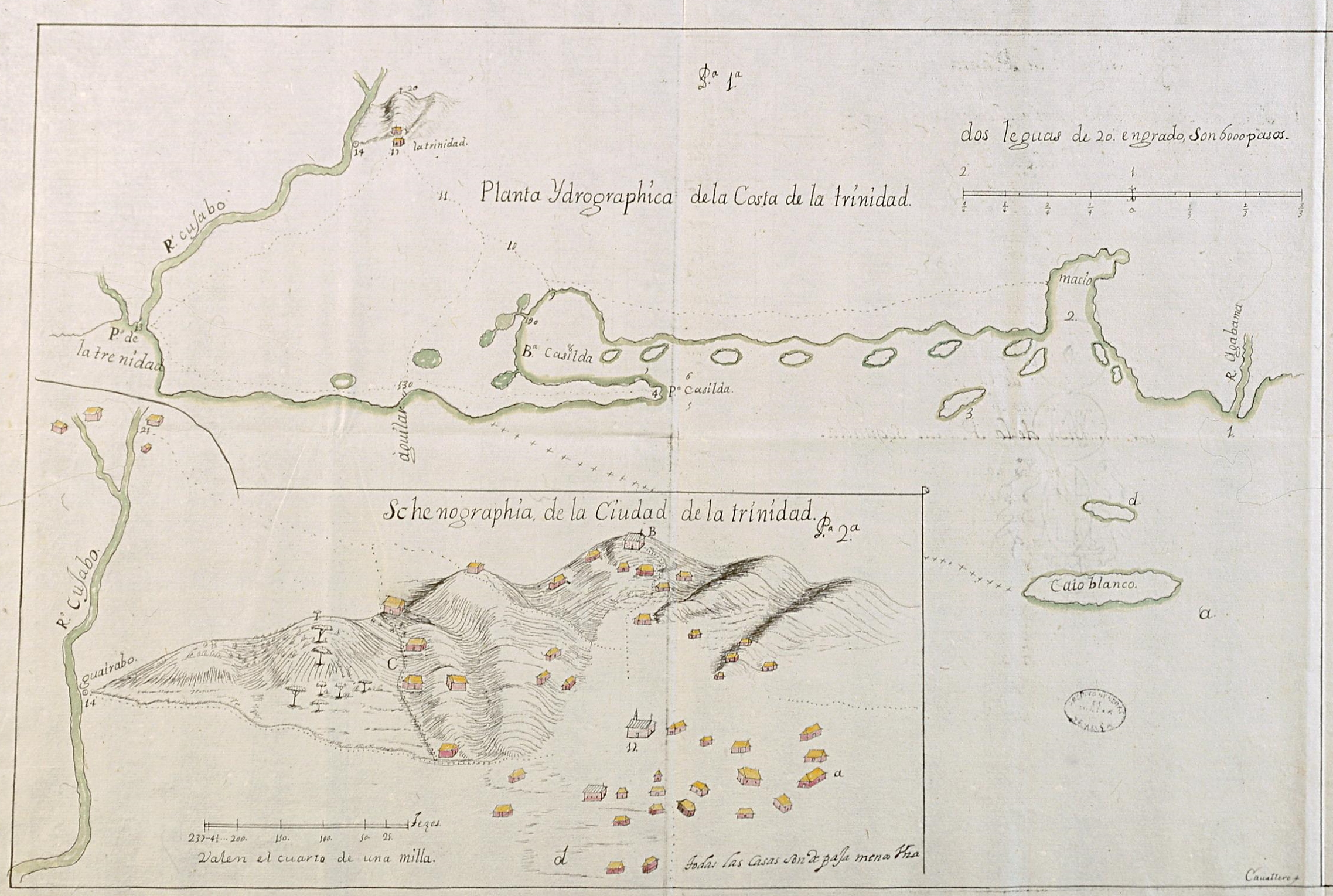

In June 1687 Blas Miguel set sail from Casildo, two leagues east of Trinidad de Cuba. At the Río Zaza they came across two registro ships, one from Cartagena de Indias and one from Puerto Bello, and may have recruited some seamen from them, including Piqueras and Sanete. At Santiago de Cuba the expedition remained for twenty days recruiting, bringing the number to a final eighty-three. Here part of the crew had a change of heart and deserted ashore, including Luis Martín. But the local judge ordered them all to return aboard, or face arrest and two hundred “strokes of the cane.” The corsarios put to sea, sailed to Baracoa, and remained there a month, making final preparations.
In early August the punitive and plundering expedition set sail. En route near Petit Goave they captured two canoes with four persons aboard each, one of which held a Frenchman named Saint-Anthoine from nearby Léogâne whom they forced to serve as a guide. No flibustier vessels were in port as the Spanish corsarios came near Petit Goave on August 10, 1687. Blas Miguel may have had advance intelligence, or knew the general patterns of the buccaneers of Petit Goave, or sent a canoe ahead in advance, or was advised of this by Saint Anthoine. Or even by all of these methods.

Leaving the brigantin to stand off from shore, Blas Miguel, with sixty men divided into four companies to go ashore, and a small sailing crew to remain aboard, approached Petit Goave at dawn. He had originally intended to land at midnight, but Saint-Anthoine cleverly dissuaded him, by telling Miguel they could capture the Quarter “without the loss of a hair” at dawn, but at midnight would be in danger of killing each other in the dark. Blas Miguel agreed.
At the fortalice that served more as a corps du garde than as a harbor defense at Petit Goave, only three or four men were on duty. Their officer, a veteran former buccaneer captain named Vigneron who had commanded the four-gun barque Louise and had sailed with Laurens de Graff, Jean Rose, La Garde, and other famous flibustiers. As the Cachimbo began putting men ashore, Vigneron challenged it. “D’ou estoit le canot? [“Whence the canoe?” aka “Where do you come from?]” he shouted.
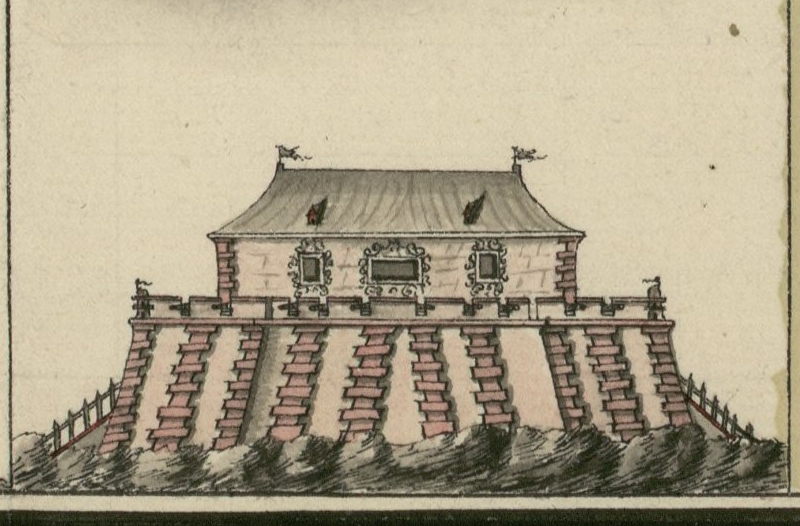
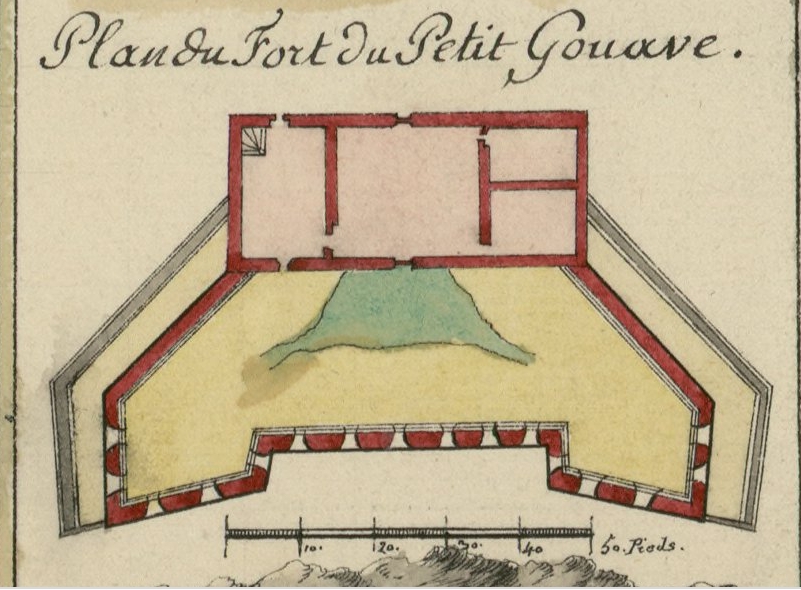
Saint-Anthoine replied, “Saint Anthoine qui vient de Léogane. [Saint Anthony who comes from Léogane.” Again Vigneron demanded, “D’ou estoit le canot?” This time Saint Anthoine responded aggressively and repeatedly: “Saint-Anthoine aux armes! [Saint Anthony, to arms!]” We imagine the prisoner-guide was immediately killed by his captors for warning the French.
Vigneron, and probably his men too, fled the fort, for they were too few to hold it, and ran through the town shouting, “Aux armes!” The four corsario companies surged ashore. Two of them, including Blas Miguel, occupied the fort while the other two, soon guided by former Spanish slaves and mulattas captured from Spanish territory, headed east toward the several rich Maisons. The attackers knew that any French armed assistance could come only from Acul across the bay; Léogane was two days away.
The exact armament of the corsarios is unknown. Only two weapons are mentioned incidentally in French records: the machete and bayonet. However, the primary weapon would have been a long firearm. The standard military weapons of Spanish infantry, militia included, at the time, were the mosquete and arcabus, both matchlocks, which were not the ideal firearms for raids. Even so, it is likely that some raiders were armed with the arcabus, which was smaller in caliber than the mosquete and did not require a rest.

Other raiders were probably armed with the escopeta, a light flintlock (usually a Miquelet lock) musket commonly used for hunting and a much better long arm for raiding. (Note: the escopeta was not a “shotgun,” and therefore, by flawed reasoning, a blunderbuss, pirate reenactors and Hollywood script writers unreasonably enamored with the blunderbuss notwithstanding. The definition of the escopeta as a shotgun came later, as cartridge arms with rifling were introduced, and smoothbore muzzleloaders began to be used as shotguns, a purpose to which they were well-suited.) Some corsarios were likely armed with carabinas (carbines): short-barreled flintlock muskets used by cavalry and dragoons, including those of Spanish regulars and militia in the Americas.
Some corsarios may have also been armed with pistols; the 1674 Ordenza de Corso permitted this, although likely some would have been armed with them without the legal authorization. All or nearly all would have been armed with a machete or cutlass (alfanje in Spanish, also often sable). The term machete is noted twice in French records, and may have meant machete, a common tool and weapon, or more generally to indicate a short cutting sword, whether cutlass or machete.
Corsarios who considered themselves hidalgos (gentlemen), likely many of them, may have been armed with cup-hilt rapiers and parrying daggers instead of cutlasses, as in the illustration at the head of this post. At least one bayonet is noted, probably fixed in a musket barrel. It may have been a hunting bayonet rather than the military bayonet now becoming quite common, and may have been carried by many corsarios. Most attackers were probably armed with some form of knife: a bayonet, dagger, or other fixed blade, or a large folding knife of a form common to Spaniards.
The French defenders were of two sorts: flibustiers and former flibustiers who would have been armed with the famous long-barreled fusil boucanier, a pistol or two, and a cutlass (Fr. coutelas, sabre), and habitans in the militia who were by this time typically armed with the fusil boucanier and a bayonet or cutlass, or with both edged weapons. Some, officers particularly, may have been armed with pistols as well.
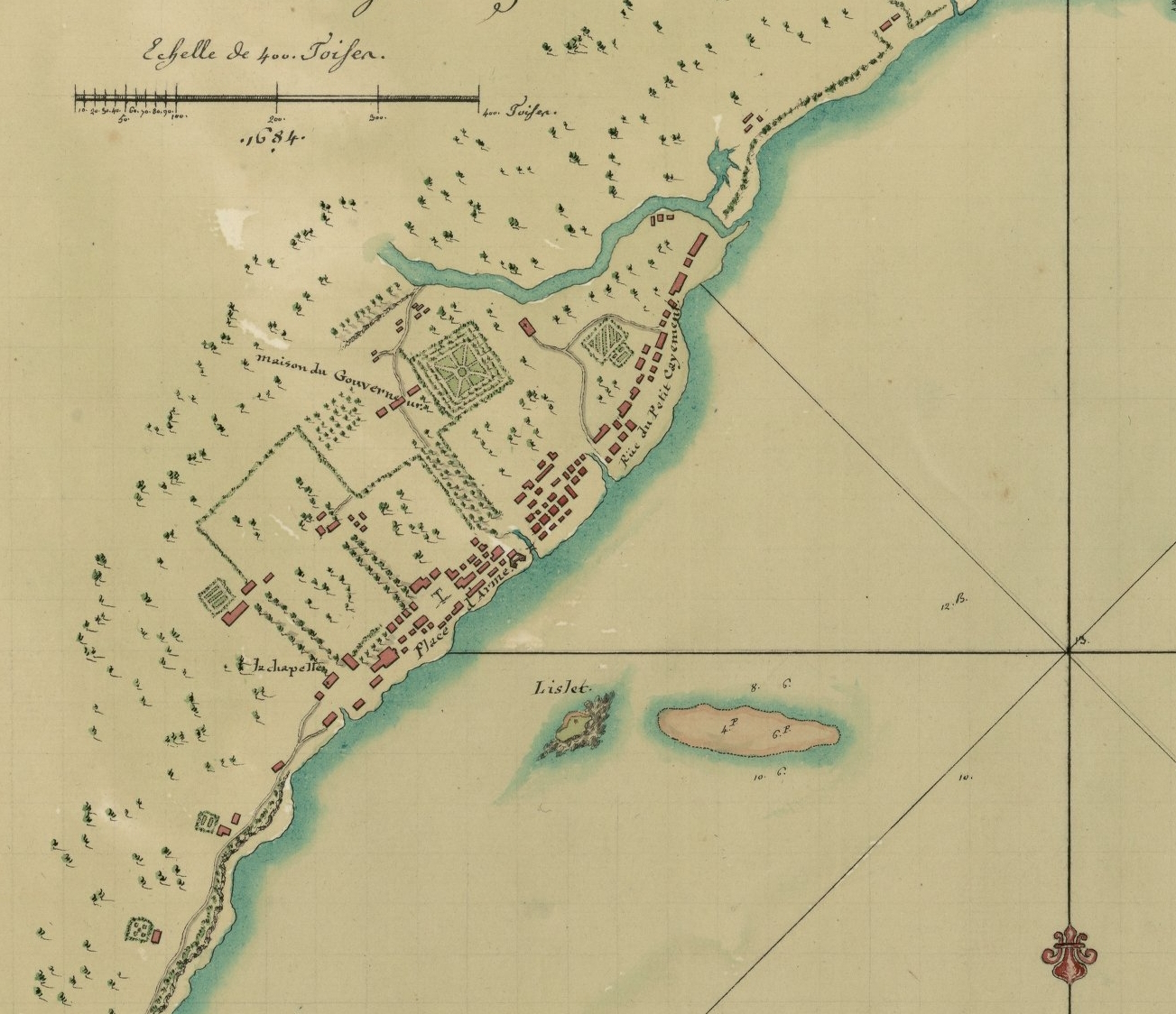
As the corsarios attacked, one company assaulted the home of Procureur Général du Conseil Supérieur [Président in some accounts] et Capitaine de Milice du Quartier du Petit Goave, Jean Drageon-Dupuy (also Dupuis), to the east. The militia captain, just awakened, attempted to fire on four or five attackers, we imagine with a fusil boucanier — loaded with a ball and seven or eight swan shot, as buccaneers often did, it was a superior close quarters firearm (far superior, for example, to the blunderbuss). But his weapon missed fire, and one of his attackers cut off his head with a machete.
When the attackers came upon his pregnant wife, she pleaded for her husband’s life, then, seeing him dead, she pleaded for good quarter for herself. And for a short time, quarter was granted to her while the corsarios pillaged. In the house they murdered a young boy with twenty-eight cutlass blows, then returned and bayoneted Drageon-Dupuy’s wife, killing her and her unborn child in spite of the grant of quarter.
Meanwhile, an officer of the sieur Novays arrived on scene, and with his men killed three corsarios of a dozen or so who had ranged through the streets and had killed a resident. The officer and his men also soon put to flight all those who had attacked the house; the corsarios fled with only their arms.
Commanded by Blas Miguel’s lieutenant — probably Santos de Acosta — the two companies headed toward two or three other rich Maisons, plundering them of valuables, arms, and powder, and breaking their furniture and furnishings. But within an hour to an hour and a half, depending on the witness’s account, a French militia force of two dozen or so, both cavalry and infantry, arrived and counter-attacked, killing Miguel’s lieutenant and two other corsarios, and forced the rest to retreat under fire to the fort.
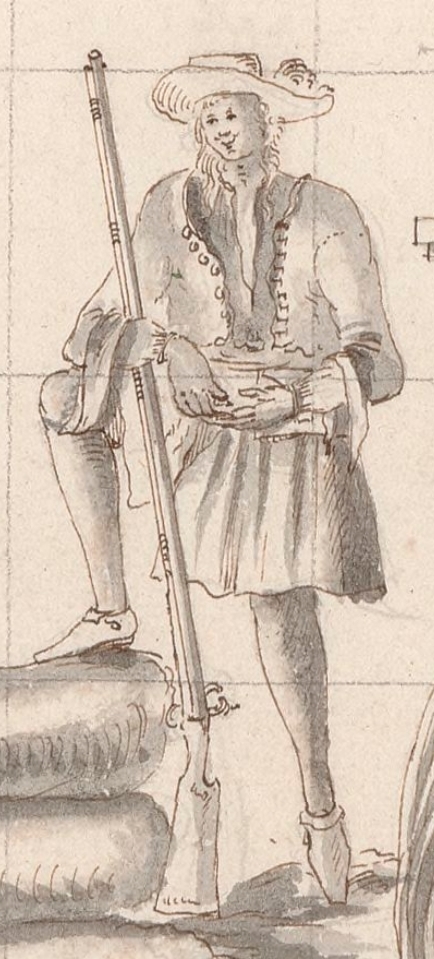
Each side fired furiously at the other; three French militiamen were killed, and four more, including an officer, were wounded. The French militia also fired on the half-galley and brigantin, forcing them to stand off from near the shore. Meanwhile, five corsarios, with what plunder they might have carried in their pockets and nine or ten Spanish mulatta women, who may have been free or slaves when originally captured by the French, slipped into the corsario boat and escaped to the half-galley.
During the firefight, the French wounded many corsarios and killed seventeen. (The number is probably the total killed during entire day. If this number is correct, there were sixty-four corsarios ashore, suggesting companies of fifteen plus one officer each.)
A former flibustier named Brasse slipped into the water during the battle and with only a machete or cutlass captured the half-galley’s canoe and the prisoner in it (or took its coxswain prisoner; the account is not entirely clear). Soon, the corsarios realized they had no way out. Blas Miguel sent a “femme de mauvaise vie” — a “fallen woman,” a prostitute — with a letter stating that the corsarios would give back their plunder if the French permitted them to depart.
Instead, the French redoubled their fire and soon Blas Miguel and his men surrendered. The official record states that forty-seven surrendered and were imprisoned in “cachots” — dungeons — but the term is probably figurative, indicating warehouses and other buildings quickly converted for use as jails.

The following day a Conseil de Guerre (a Council of War) composed of fourteen militia officers was convened. The council interrogated six of the corsario prisoners, using a militia cornet of horse, the sieur Jean Duquesnot, to translate. Blas Miguel claimed to have had two commissions but had left them in his piragua. We know he had one patente de corso. It was common practice to carry a copy ashore, but he had not. Having no commission at hand, he was considered to be a pirate.
Justice was swift. Forty-two corsarios, or “forbans” — pirates — as the French referred to them, were sentenced to be “hanged and strangled until death” the following day for “plundering, burning houses, and raping and massacring even women.”
Blas Miguel and Pasqual Juan were sentenced to be broken on the wheel the day after, for their being the chiefs and principal authors of the raid. Two, a young boy and a Black slave, were spared because they had been forced aboard the punitive plundering expedition. This makes forty-six, not forty-seven; we may assume one corsario had died of his wounds in the interim.
The sentencing leaves us with an obvious question, at least once the evidence is examined closely. Why was Pasqual Juan sentenced to be broken on the wheel? French records state that this was because he was one of the “chiefs” and “principal authors” of the raid. But was he? Spanish records do not record his name among those of the officers. He was a very young man, a Native American, and a native of Campeche, Mexico, a city that had been brutally sacked by French buccaneers two years before.
And he was also an angry young man who said he came, among other reasons, to kill and massacre all the whites in Petit Goave. He was the only interrogated prisoner to claim this. Very likely he was neither an officer nor an author of the raid. Instead, he was almost certainly broken on the wheel for his testimony that he came to kill white people. To the colonial mind, any form of rebellion against the European hierarchy must be violently, horribly suppressed.
Such racial animosity toward white foreigners is unsurprising. As buccaneers they had not only raided, plundered, tortured, raped, and burned Spanish towns, but also often captured free men, women, and children of color and sold them as slaves. And alongside this lay the enormity of the commercial enslavement of Africans, and often of Native Americans as well, throughout the Americas.
Slavery touched everything. But no faction or people in the Americas had entirely clean hands, although it is surely accurate to say that European hands were the dirtiest. Even so, it can sometimes be difficult to draw a distinct line between European nations in the Americas and the Native American and African cultures they had begun to blend with. Even during the Colonial Era the Americas would never be a mirror-image of Europe.
The seeds of the early nineteenth century Caribbean and Latin American Wars of Independence were already sown, although Spain would manage to hold onto Cuba until the Spanish American War with the United States.

On August 11, 1687, forty-two corsarios were hanged. Maps of Petit Goave show only a single small gallows at the shore. If it alone were used the hangings would have taken all day. Perhaps other gallows were erected, or perhaps Governor Hender Molesworth was correct when he wrote that “About a hundred Spaniards landed lately at Petit Guavos in the night, and, the place being thinly inhabited, made themselves masters of the castle, but were all put to the sword by the French, except some who were reserved to be hanged, and the captain, whom they racked to death for having no commission.” Perhaps the sentence of death by hanging was figurative and the French simply put some to death by firearm and sword and hanged the rest.


On the following day, August 12, 1687, Blas Miguel and Pasqual Juan were broken alive on the wheel. Father Jean-Baptiste Labat, that eyewitness chronicler of all things Caribbean in the late 17th and early 18th centuries, left us with a description of the horrible punishment, often known as rouer in French. It is truly a death by torture: the executioner used a hammer, heavy wooden staff, or perhaps even an “epée dans un bâton” or “stick-sword” (see Louis de Gaya, 1678) to break the bones of the condemned who was bound with his arms and legs outstretched, often to a wheel although this was not mandatory. In the West Indies a cross was sometimes used, for example. In either case the wheel or cross was typically mounted on a platform for better view and ease of execution of sentence.
Labat described the condemned mounting the scaffold, kneeling, praying, then undressing and stretching out upon a cross. With a hammer the executioner then broke each of the long bones in the condemned’s arms and legs several times. If the condemned was fortunate, a priest might cover his face with a handkerchief during the excruciating process. The executioner ended the agony — if the condemned were not already dead from the trauma — by strangling him with a rope, first permitting a priest to ask the condemned for, and perhaps receive, a last act of contrition. We imagine that strangling was not always used, and a final blow was made instead.
Thus ended the vendetta of Blas Miguel to avenge his brother’s death at the hands of the French at Petit Goave. At least Laurens de Graff was not present to laugh in Blas Miguel’s face as he went to die.
But soon enough the Spanish would take a double measure of revenge, as would the soul of Blas Miguel, a few years later during King William’s War. In 1690 a force of 2,600 Spaniards attacked Saint-Domingue. At the plain of Limonade they faced the French under Governor Jean-Paul Tarin de Cussy. At first, the powerful Spanish force withered under accurate fire of French buccaneers who had demanded to fight on the plain, but a sudden charge by lanceros — typically men of color afoot, armed with lances — who had lain hidden nearby broke the French line. De Cussy and his lieutenant, Franquenay, stood their ground and died upon it. The invading Spanish force plundered the French capital Cap François, murdered all the men they found, raped women, and carried away women, children, and slaves, in part in retribution for decades of bloody, brutal buccaneer raids.
In 1695, during a during a joint English-Spanish raid, a double measure of revenge against Laurens de Graff was had: the former buccaneer was roundly criticized and shamed, whether deservedly or not, for his lackluster defense against and retreat from the Spanish attack, so much so that he was called to France to face charges. Worse, at least we hope it was to him, his wife Anne and his children were captured. But once more Petit Goave was not attacked, and de Graff was no fool and so ignored the royal command.
A measure of revenge against Petit Goave did come in 1697 at the hands of the English Navy. Arriving after chasing and losing the quasi-naval privateering fleet of the baron de Pointis which had just sacked Cartagena de Indias, Rear Admiral Mees was tasked by Admiral Nevill to destroy Petit Goave, now a nest of lawful flibustier privateers, many of whom had just returned from Cartagena de Indias. He organized a detachment of 897 men, placing almost two thirds of them in boats. Launching some 16 or 17 leagues from Petit Goave, Mees led four hundred men ashore at 3:30 AM one mile east of the town.


They quickly captured the fort, which had only one cannon mounted, and six of the guard, the rest escaping. Quickly the English captured the remaining small nearby batteries of cannon while most of the inhabitants fled. Those who did not flee were captured and placed in the fort under guard. Soon, though, English sailors started to do what they were well-known to do ashore: get drunk and start plundering, for many houses were rich with plunder and shops rich with goods. After an hour or two, Mees was forced to set fire to the town, fearing his men in their drunken state might not stand against a counter-attack.
As the town burned, and houses exploded due to the powder stored within them, the French were able to make only small counter-attacks from hedges and trenches, many armed with swivel guns. The English captured two French colors, killed an Ensign and another officer, wounded an officer on horseback, and killed and wounded an unknown number more while taking casualties of thirty killed and thirty more wounded of their own. One English volunteer officer with eight men forced thirty French to retreat from a trench, and killed their officer. In the end, the attack amounted to little more than a mere punitive raid.
Afterward, the spirit of Blas Miguel must surely have wondered what its former incarnation might have done with four hundred veteran professional fighting men instead of a mere eighty-three various volunteers.
The description of the raid has been drawn largely from the following:
El Corso en Cuba Siglo XVII by César García del Pino (Havana: Editorial de Ciencias Sociales, 2001);
La Defensa de la Isla de Cuba en la Segunda Mitad del Siglo XVII by Francisco Castillo Meléndez (Seville: Diputación Provincial, Sevilla, 1986);
“Audition des Espanols qui sont mis a terre au Petit Goave prisonniers au fort de dit lieu,” ANOM, C9/1/1;
“Lettre et mémoire de Cussy au marquis de Seignelay, Port-Paix, 27 August 1687,” ANOM/C9A/1;
“Jugement du Conseil de Guerre, Petit-Goave, 11 August 1687,” reprinted in Loix et constitutions des colonies françoises de l’Amérique sous le Vent by Louis-Élie Moreau de Saint-Méry;
“Lieutenant Governor Molesworth to William Blathwayt,” August 8, 1685 (Old Style), Calendar of State Papers, Colonial, America and West Indies, 1685-1688.
The description of the English raid on Petit Goave has been drawn from “An account of the Burning of Petit Guavas the 28th June 1694…,” published in The Sergison Papers, 1950.
* Curiously, the French translator, or the transcriptionist/clerk, wrote “Jean” for “Juan” in most cases, did not do so in the case of Pasqual Juan, but wrote “Ouan” instead. Did Pasqual Juan pronounce his name differently? Was Spanish perhaps a second language? Or was Ouan in fact an indigenous name? If so, I have been unable to trace it.
Copyright Benerson Little 2023-2024. First posted on June 14, 2023. Last updated March 25, 2024.

Pirate Ships, Pirate Prey, & Pirate Hunters: Eyewitness Illustrations & Accompanying Stories

Modern histories of so-called Golden Age pirates — those circa 1655 to 1730 — are often filled with images of pirate ships, many of which are implied to be accurate representations. In fact, there are few eyewitness images of actual buccaneer and pirate ships of this era — perhaps no more than five!
Most period images of buccaneer and pirate ships, not mention of pirate prey and pirate hunters, were drawn not by eyewitnesses in the Caribbean or in other places pirates roved but in England and Europe by the professional illustrators of various editions of books on buccaneers and pirates. These artists never saw the vessels they drew, probably had little if any input from eyewitnesses who had seen them, and were often clearly inept when it came to accurate representation (Hollywood also has always often had this problem and still does).
Even when the illustrator had a good description, the result often hit far from the mark, as we’ll see below. There were no professional artists such as the Willem van de Velde father and son, or Pierre Puget, or any of a number of maritime painters of the era to paint the Caribbean and its people, landscapes, and vessels. This is history’s loss.
Modern scholarly reconstructions in the form of illustration or model — Whydah, Queen Anne’s Revenge, &c — are based on limited eyewitness accounts and scarce records of the actual ships, with reference to hopefully similar ships found in period maritime paintings, drawings, and construction records. At best they are intelligently conjectural. But conjectural they are, even if they are the best we might ever do.
Nonetheless, there exist eyewitness illustrations of at least five Golden Age sea roving vessels we can for the most part put names, captains, and adventures to. In other words, they are illustrations of real buccaneer or pirate vessels made by illustrators and painters who actually saw them or were provided a high degree of detail by eyewitnesses. Additionally, there is an illustration of two others that is almost certainly based on eyewitness descriptions taken firsthand by the illustrator.
The first two are Spanish-built pirate/privateer half-galleys, one for certain, the other almost certain. The third and fourth are of a captured Spanish merchantman soon to be converted by flibustiers to piracy, and its captor. The fifth is a pirate which had recently plundered on the Guinea coast. The sixth and seventh are pirates, one English, one French, one of whom was destroyed by a pair of English men-of-war.
Further, we have illustrations of the two most famous Spanish pirate hunting ships — even if unsuccessful more often than successful — along with an excellent, highly detailed, quite accurate drawing of the HMS Drake, a sixth rate used for pirate hunting in the 1680s Caribbean, and the HMS Bonetta, which was dispatched against a pirate but did not engage it — plus a reasonable image each of the pirate hunters HMS Drake and HMS Falcon. At another time we’ll look at a painting of what may be the most famous of all pirate prey of the era; I’ve more research to do before I commit my argument to print.
We’ll take a look at all nine, with accompanying swashbuckling history in depth. As with the eyewitness images of buccaneers and boucaniers I found in the French National Library, I found several, but not all, of these eyewitness images of vessels likewise largely unnoted and unnoticed.
A Spanish Half-Galley (Galeota) Commanded by Cuban-Italian Corsario Mateo Guarín, 1685

Commissioned by the governor of Cuba, Fernández de Córdoba, in 1683 to make reprisals against English and French pirates and smugglers. In January 1684, Guarín led a raid on Siguatey (Cigateo, aka Eleuthera) and New Providence in the Bahamas.
Mateo Guarín (sometimes Marín) was an Italian privateer — a corsario — from Venetia (the surrounding region of Venice, Italy) in Spanish service. In Italian his name was Matteo Guarino. It was not unusual to find Italian adventurers in Spanish service in the Caribbean; another will be discussed in another post soon.
An English account of the raid: “At the beginning of January about two hundred of their choicest men were fitted out from Havana, well armed, in two barco-luengos, the one of forty, the other of thirty oars. They went to a-small uninhabited island called St. Andrews, where they took an English sloop which was there for cutting timber. They made the three men in her their pilots, and came to the back of Providence on 18th January and waited through the night. At daybreak they landed 120 of their men at the town, while fifty assailed the shipping—six vessels—in the harbour. The people in the town being surprised fled from it to the woods, those in the ships also deserted them and fled on board a New England vessel of ten guns. This and one more ship stood out to sea; the rest were all pillaged and three men murdered.
“The Spaniards killed no one in the town, but kept it till four o’clock in the afternoon, in which time they took away all the wrought and unwrought plate that they could find, a quantity of English dry-goods, and such provisions as they wanted, and loaded their booty, valued by the English at 14.000l., in a pink that they took in the harbour. While the Spaniards were in possession of the town, fourteen Englishmen got together and drove all the Spaniards before them. They would have driven them from the town and retaken the plunder if they had had powder and ball enough, and if the inhabitants had known of a rallying point, and had found but fifty firearms they might have saved all. All might also have been saved by the ship of ten guns if she had but stayed. But three men were killed, but many were carried off prisoners by the Spaniards, as suspected of being pirates.” There was a much more brutal raid against New Providence later in 1684; it is unknown if Guarín participated.
In 1684 Guarín was surprised by that famous Dutch flibustier-in-French-service, Laurens de Graff, at the large Isle of Pines (Isla de Pinos, today Isla de Juventud) off the southern coast of Cuba, but escaped the more heavily-armed and -manned buccaneer.
De Graff was the greatest of buccaneers in the 1680s. In fact, certain aspects of Rafael Sabatini’s famous character Captain Blood are based on him. Caribbean Spaniards had great enmity toward the Dutch buccaneer not only because he was so successful, but because he had deserted Spanish service as a gunner of the Armada de Barlovento and later co-led the brutal sacks of Veracruz and Campeche. De Graff had long ranged and raided along the Cuban coast, and gathered intelligence there as well, in particular from a source named [Juan?] Montiel who provided detailed information on ship movements from Havana, doubtless in return for trade goods or money.
This desperate desire for vengeance against buccaneers and against de Graff in particular ranged across the Spanish Main, but would usually turn out poorly for all the Spanish pirate hunters sent against de Graff, including Capitán Guarín who made the bold personal decision to become de Graff’s principal nemesis.
In October 1684 Guarín attacked the HMS Bonneta (Bonito in colonial records; see the section on Bannister below for an image and more information) of no more than four guns along the south coast of Cuba as it was sailing to Santiago de Trinidad, Cuba to demand the return of captured English seamen from a sloop belonging to Derick Cornelison. The small English man-of-war (see also Bannister below) had sent a boat ashore for water, per treaty. Guarín captured the boat and its eight-man crew, stole the English jack it had flown for protection, and hoisted it aboard a pirate-hunting piragua.
In Captain Stanley’s words: “I at once got up sail, but had no sooner done so than I saw the galley and a periago coming under sail and oars, the galley flying the Spanish flag with a red ensign and the periago the King’s jack, which he had taken in my boat. I fired at the galley when she came within range, and she at me, and we were engaged from nine to eleven, when they got into the creek where there was not water for me to follow them.” The English captain slipped away before more galleys and piraguas might arrive: there were two of the former and seven of the latter in Santiago de Trinidad. Afterward he provided protection to nearby English turtling sloops nearby, and soon afterward rescued four English turtling sloops from the French flibustier Captain Bréha who was robbing them of provisions.
In early 1685, commanding a half-galley, known in Spanish as a galeota, Guarín raided Nipe on the island of Hispaniola, not far from the flibustier haven of Petit Goave. The corsario and his crew flew the white flag of France for deception, but also apparently fought under it — a violation of the laws of war, in addition to any charges of piracy. Guarín and his crew carried away forty slaves, soon declared in Baracoa and Puerto Principe, Cuba, as good plunder worth approximately 8,800 pesos de ocho reals (pieces-of-eight). The corsarios probably carried away little other plunder, given the small agricultural nature of the settlement.
An official French account notes that two demi-galères (half-galleys, galeotas) attacked Nipe for a second time later that year, but that their original intended target was the plantation belonging to Governor de Pouançay via an extortion attempt at ransom. The attackers changed their minds when their threat was rebuffed. The second attack on Nipe failed due to the town becoming alarmed before the raid began. It is unknown whether this second attack was led by Guarín.
By good fortune, French engineer Pierre de Cornuau had been sent to French Hispaniola to survey and draw charts of French ports. His chart of Nipe, drawn the same year as Guarín’s raid, shows the Spanish half-galley (see the image above). It is quite typical of the form (more on this below), and Cornuau, who probably did not see the half-galley himself, certainly had it described to him by eyewitnesses.

As will be seen in the next section, Cornuau’s simple drawing is a very accurate rendering of these vessels as used by the Spanish in the Caribbean. It has a single carriage gun (cannon) mounted at the bow, a pair of gallows for sweeps (oars) amidships, two masts and two furled lateen sails, and a flagstaff at the stern for the ensign. Missing in the drawing, but probably mounted on the actual vessel, are a handful of swivel guns (small cannon mounted on yokes), probably of the chamber-loaded sort known as patereroes in English. “The galleys are what are called half-galleys in the straits, and carry eighty to a hundred and twenty men; the periagos carry from fifty to seventy,” wrote Lieutenant-Governor Hender Molesworth. One account of Guarín’s half-galley arms it with “sixty-five men, one “Cushee-piece” and six patararoes,” another with eight patararoes (breech-loading swivel cannon mounted on the rails).
Soon afterward, in company with corsario Alexandro Thomás de Léon, Guarín captured the small flibustier frigate Coronet, commanded by Jean Baptiste. Interrogated at Trinidad, Cuba, the French captain gave up exceptional detail regarding the plantation of Laurens de Graff on Saint-Domingue, and also on that of Michel, sieur de Grammont, another of the greatest buccaneers of the 1680s. He also learned that at his plantation de Graff had a mulatta wife or mistress he had “seized” from Veracruz, named Olaya de Escurre, with whom he had a son. (De Graff had only two lawfully married wives as far as we know: he divorced Petronilla de Guzman of the Canary Islands to marry the wealthy widow Anne Dieu-le-Veut on Saint-Domingue after he became a French officer.) It is possible that de Escurre was his mistress from his years when he lived in Veracruz in the service of the Armada de Barlovento as a gunner, or that he in fact enslaved her, or otherwise carried her away as human plunder, during the sack of Veracruz.
Guarín, commanding two piraguas, or quite probably galeotas (piragua and pirogue are often used mistakenly for half-galley/galeota), built for the purpose in Havana, possibly including the one shown above, captured the guardhouse then sacked the plantation, taking numerous slaves as plunder and liberating a number of formerly free mulatta women who had been carried away as slaves from Veracruz. Among the prisoners was the young son of de Graff and de Escurre, whose capture the governor of Cuba hoped might force de Graff into negotiations and thereby reduce raids on Spanish ships and towns. De Graff was not present when his plantation was raided.
In February 1686, commanding two piraguas (according to Spanish records) or two “galleys” (according to English records, thus we will assume one was the half-galley shown above), Guarín attacked two English smugglers: the Swallow pink (a flute) of 22 guns commanded by Edward Goffe, and the Ann sloop of 6 guns commanded by [William?] Peartree, off the Tayabacoa River, Cuba, near Trinidad. (Spanish records Hispanicize the names as “Gafi y Peltre.”) The English captains claimed to be seeking to wood and water, as was permitted by treaty, a common, usually false, claim made by smugglers. Rebuffed at Trinidad, they sailed SE ten leagues to the small cays off the Tayabacoa.
The Spaniards soon arrived and attacked; the battle was brutal and bloody. According to Goffe, “the Governor of Trinidad sent two galleys out, one of forty and one of eighty-five men, the latter of which, as the master confesses, was present at the sack of New Providence. Both galleys came up to my ship’s side, and without hailing poured in a volley, which killed two men and wounded five or six, and then making fast to my ship’s side tried to board her. Having the sloop’s crew on board we defended ourselves, and after about half an hour’s engagement, there were about sixty Spanish pirates killed and thirty-eight wounded. The smaller galley managed to clear herself, but the larger we captured and brought into Jamaica.”
Guarín’s account is similar, but with ugly accusations of murder. He states that he lost 24 men killed in the battle, with 50 more abused and murdered after the battle, including his lieutenant hanged by the English victors, and 30 more of his men put ashore. He himself was severely wounded, and, along with his surgeon, carpenter (a Maltese), and a mulatto from Havana named Juan Cristián, was carried into Jamaica.
Guarín and his comrades were tried for piracy; he and Juan Cristián were sentenced to hang. Although Guarín’s commission was sufficient to protect him from prosecution for piracy for his attack on the Swallow and the Ann, it could not protect him from prosecution for his attack on New Providence and for seizing the boat and eight crewmen of the HMS Bonetta. Even so, by good fortune both men were reprieved when the Spanish Assiento (slave trade) representative in Jamaica, Don Santiago del Castillo, contacted the Spanish ambassador in London, Don Pedro de Ronquillo, who petitioned King James II to release the convicted pirates.
In fact, Lieutenant-Governor Molesworth had already reprieved him pending the recommendation of King James II: “The Spanish captain referred to in my last has been found guilty of piracy, for robbing a sloop from Nevis and stealing Capt. Stanley’s boat. For reasons relating to our Spanish trade, and understanding that he had treated those under his power well and had apologised to Captain Stanley, soon after committing the fact, for not knowing his to be a King’s ship, I have granted his reprieve. I am since glad that I did so, for I find that the Spanish Governors will be very much concerned for him, and particularly those who have obliged me most by granting restitution of prisoners. Lately I have received a letter from the Governor of Santiago, in Cuba, demanding him in the same manner as I have demanded prisoners, and making such excuses for him that I conceive, if he had been executed, it would have passed current among Spanish Governors that he had suffered only for carrying out the Spanish King’s Commission. This would have raised a great clamour against us and would have endangered all our traders who are or may in future fall into their power. I have therefore reprieved him till the King’s pleasure be known.”
By October, 1686, Guarín and his comrades were free men again but his adventures afterward were tame by comparison. With a new vessel provided by investors, possibly another half-galley, he transported the governor of Florida to St. Augustine, patrolled the Cuban coast, and, on July 4, 1688 was dispatched unsuccessfully aboard his piragua or half-galley along with an urca (a Spanish fluyt) to seek a pirate frigate, brigantine, and canoe at Santa Lucía, Cuba, believed at the time to have been commanded by the notorious Dutch flibustier-in-French-service Jan Willems aka Captain Yanky (also Yankey).
Guarín soon found himself imprisoned again, but this time not by his English or French enemies, but by his compatriot cubanos in Havana. His vessel was seized after he was accused by some local hidalgos of having sold slaves captured at the Bahamas and Saint-Domingue that actually had belonged to them before being plundered by English and French buccaneers. One scholar suggests this was a false accusation to protect the governor against accusations of engaging in contraband.
According to Spanish law, as a Capitán de Mar y de Guerra, a title accorded him by his privateering commission (patente de corso), he should have been immune to such accusations. Even so, Guarín spent a year and a half in jail, and the last we hear of him is that his case was pending at the Council of the Indies. There is no record of this bold corsario taking to sea again.
For more information on this and other Cuban corsarios, see El Corso en Cuba Siglo XVII by César García del Pino (Havana: Editorial de Ciencias Sociales, 2001), and La Defensa de la Isla de Cuba en la Segunda Mitad del Siglo XVII by Francisco Castillo Meléndez (Seville: Diputación Provincial, Sevilla, 1986). The English eyewitness account and associated correspondence can be found in the Calendar of State Papers Colonial, America and West Indies, 1685-1688.
A Captured Spanish Half-Galley Commanded by Nicolás Brigaut in 1686

By the mid-1680s most major Spanish ports had at least one galeota used for intercepting smugglers, pirate hunting, and raids of reprisal, and also as an advice (dispatch) vessel. Of shallow draft, with the ability to maneuver under both sail and oar, the vessels were ideal for their purpose. They could attack from and escape over shallow waters, attack in calms at the bow or stern of smugglers and pirates and thereby avoid their broadsides, and could travel close inshore and up-river for raids on French and English settlements.
Most had two masts with a single lateen sail on each, approximately thirty oars or sweeps, a long thrusting prow or beakhead, one or two carriage guns in the bow, and often four or more patereroes (swivel cannon) on the rails at the bow and stern. Sweeps were stowed on gallows amidships when not in use. Recognizing their utility, both the French and English began using them, either constructing them themselves or using captured Spanish ones. In English the vessel was typically referred to as a half-galley, in French as a demi-galère or sometimes, confusingly, a pirogue, and in Spanish as a galeota or occasionally, again confusingly, a piragua.
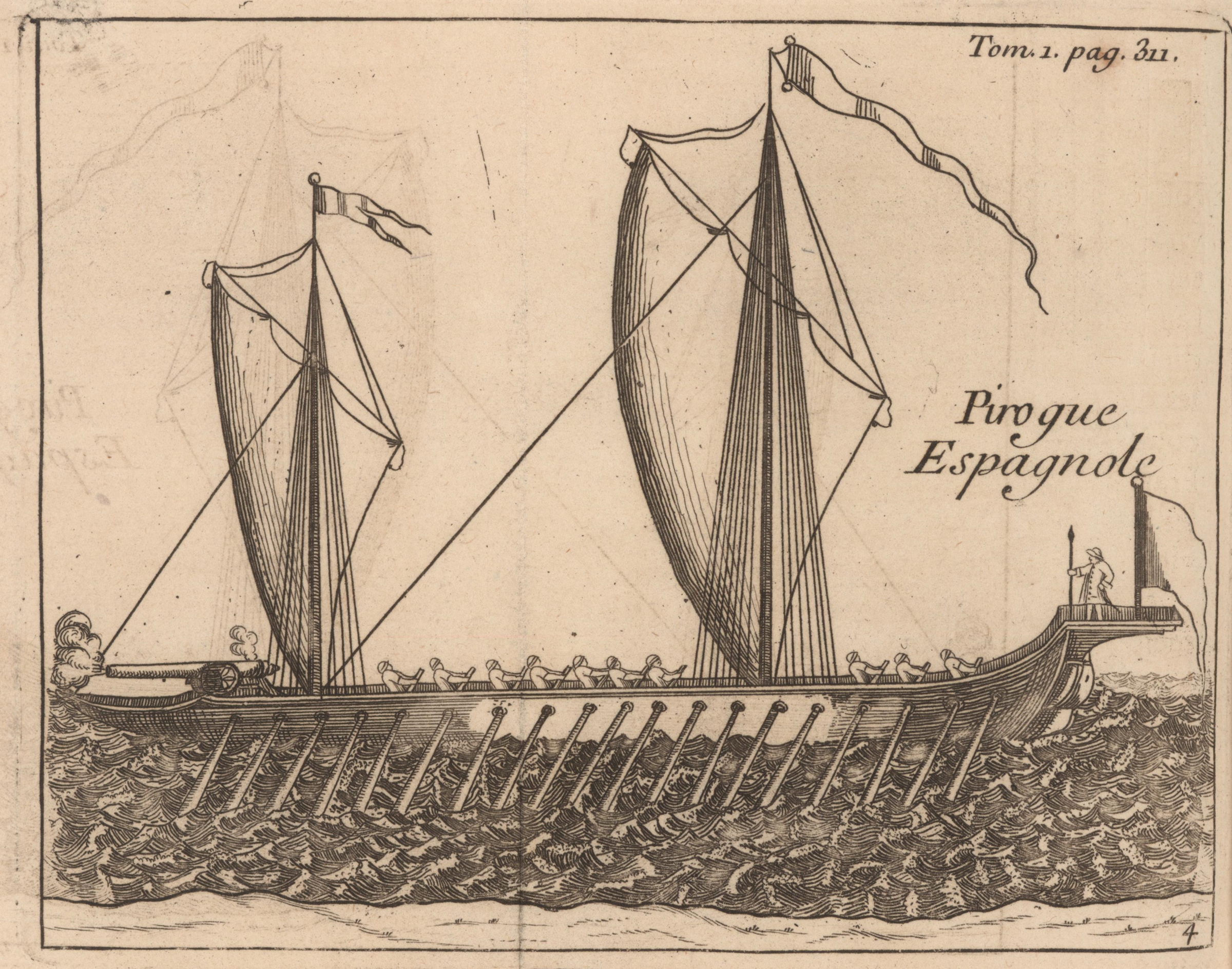

Michel, sieur de Grammont, the “general” of the buccaneers at the sack of Campeche (Laurens de Graff was the buccaneer “admiral”), brought away a half-galley with him after the town and surrounding region were attacked at length and then abandoned in 1685. In April of the following year Grammont’ set about to attack St. Augustine, Florida via the southern passage at Matanzas.
With Grammont’s flotilla was the half-galley captured at Campeche, armed with two carriage guns (remember, at sea a cannon is called a gun, back then and even today) at the bow and now commanded by Capitaine Nicolás Brigaut. His job was to collect intelligence, secure provisions, capture Native American interpreters, and prevent a warning from getting to St. Augustine while doing so. He easily captured a few soldiers from the watchtower—they rowed out to find out who he was and thereby discovered to their dismay who he was. The buccaneers tortured at least two of them for information regarding the defenses of St. Augustine.

It wasn’t long before word got to St. Augustine in spite of Brigaut’s precautions, and a small force commanded by José Begambre was sent against Brigaut and his marooned flibustiers. According to one account, the pirate captain sent two boatloads of men ashore, and according to another they fought from the half-galley. In any case, after a four hour battle the small Spanish force withdrew with casualties.
First point to Brigaut and his men! But plans seldom work as well in reality as in theory. Fortune turned against the pirates in the form of accident or ignorance of the local waters, and the half-galley wrecked on Matanzas Bar.
Worse, two more forces under the commands of Capitán Antonio de Argüelles, who had successfully ambushed attacking pirates in 1683, and Sargento Mayor (in other words, “Major”) Pedro de Aranda y Avellaneda, the former with nine soldiers and the latter with forty, arrived the following morning. The pirates had come ashore and, according to one account, made simple trenches from which to defend against a counterattack. After a second firefight, the Spanish again withdrew with casualties. The pirates had lost the element of surprise and feared more reinforcements. Brigaut sent several men in a ship’s boat to warn Grammont with instructions to pick the stranded pirates up at Mosquito Bar, the location today of New Smyrna Beach. The pirates headed south during the night.
Five leagues shy of their destination the gallant Brigaut and his gallant crew — or so we suppose they were gallant, at least in battle — were set upon by fifty or sixty Native Americans intent upon freeing the pirates’ prisoners. Again Brigaut’s flibusters put their attackers to flight. Unfortunately, one of Brigaut’s prisoners, Juan López, escaped and brought word to St. Augustine. Almost immediately gallant Capitán Francisco de Fuentes and fifty gallant men — again, we suppose they were gallant — headed south in two pirogues to attack Brigaut and his men at Mosquito Bar. Meanwhile, news spread fast in St. Augustine that as many as seven pirate ships had been seen, and that Grammont and his sloop were preparing to make a landing to the north now that the southern approach had been thwarted. Clearly the attack was not yet defeated.
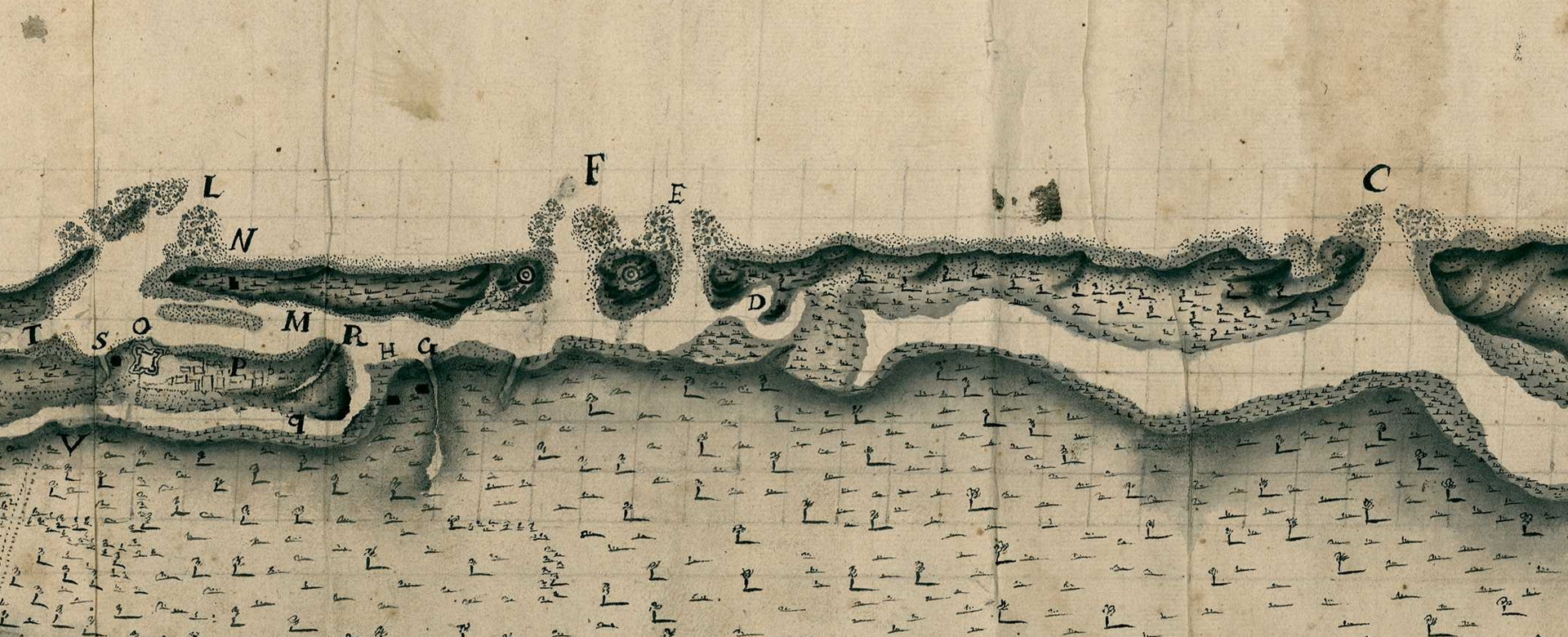
And at Mosquito Bar the substance was of life and death, of raw survival, and, unfortunately for the buccaneers, luck was on the side of the Spanish by means of the timely accident that Brigaut’s men were separated into two parties. Luck, or Fortune if you will, often has poor timing, almost as if on purpose. The Spaniards slaughtered the nineteen pirates in the smaller group, then attacked the larger and massacred all but three, their desperate courage notwithstanding. Those they spared were not, by the way, any of the four remaining Spanish prisoners held by the pirates, which strongly suggests either that nearly everyone was slaughtered in an orgy of violent fear and rage that refused to distinguish between friend and foe, or that the Spanish believed the prisoners had deserted to the pirates, which Spaniards sometimes did, and so they put them to the sword as well.
Only here, in this description of slaughter, does our Hollywood image of Hollywood actors acting in Hollywood style — our cultural interpretation, in other words — begin to fail us as we — rather, if we — imagine soldiers and pirates sweating profusely in the combination of heat, humidity, rage, and fear, their hands and faces blackened with spent gunpowder, their burning eyes squinting from salt and the sea glare; as we imagine the sand sticking to the blood of those killing and of those dying or dead, most of whom probably called upon God both to kill and to save; as we imagine the flies swarming over and upon the dark purple that now stained, however briefly, the windswept battlefield dotted with the living and the dead among the coastal scrub.
We don’t know for sure if the Spaniards simply refused to grant quarter and slaughtered the pirates and prisoners in battle, or massacred them immediately after they surrendered, and it’s even possible that the pirates killed their prisoners themselves. Pirates liked to hold hostages, and French pirates sometimes decapitated their terror-stricken hostages — well, most were probably terror-stricken, but there may have been a few stubbornly courageous hold-outs who were merely afraid but not terror-stricken — when their demands weren’t met. Of course, hostage- and head-taking is something we find deplorable today, at least in “the real world,” but we generally condone in film and on television, at least if the hostage takers are the good guys and they don’t decapitate except in a fair fight. Terrorists and drug cartels behead the innocent — but surely our beloved swashbucklers don’t.

Even so, the pirates probably shouted something on the order of “Matamos los rehenes!” in Spanish at their attackers, which means “We are going to kill the hostages!” although the Spanish is actually in the present indicative tense, not the future simple, which is a more common usage in Spanish than in English when threatening future action. Just so you know.
A fair number of pirates could speak Spanish as a second language because it was useful for interrogating and torturing and tactical pretending and such. And some pirates were Spanish, siding with the English buccaneers and French flibustiers and against their own for profit, and probably a few for revenge — conversos and “crypto-Jews,” for example, although the Spanish interrogations of Spanish-born pirates I’ve seen are silent on the issue. Still, it’s likely some were.
At any rate, “Matadlos, no nos importa!” the Spaniards probably shouted back at the pirates, which means, more or less, “Go ahead and kill them, we don’t care!” although the phrase was more likely something on the order of “Go ahead and kill them you murdering French dogs, you pirates, thieves, and cutthroats, you sons of whores and cuckolds, you mostly Lutheran [which is what Spaniards called all Protestants] therefore un-Christian except in name French cowards who torture the innocent and rape virgins and bugger each other, and bugger your ugly French-pox’d mothers too!” Or likely something along these lines. Such language is common among soldiers and sailors of all eras.
As for the battle itself, likely the truth lies betwixt, as often it does: most of the pirates probably died in battle, and the rest, given that there was some quarter given, were summarily put to the sword in a violent assault right after they surrendered, which seems a reasonable if uncivilized thing to do to the pirates who had sacked Veracruz and Campeche, raping and murdering and torturing as they did. There is speculation that the Spaniards may have given no quarter due to the mistaken belief, carried by escaped prisoner Juan López to St. Augustine, that the Spanish renegade Alonso de Avesilla, who had guided the pirates during the 1683 attack on the city, was in command of the half-galley.
However, Avesilla (possibly the same Spanish corsario known as Augustino Alvares who commanded a barco luengo in 1683) reportedly had died at the flibustier home port Petit Goave two years before; his name may have been given out by the pirates as a joke. The three spared pirates were the white French captain Brigaut and a black pirate named Diego, a “native” of St. Christopher’s (therefore his real name might have been James or Jacques), until they could be interrogated, and a boy on account of his age. Diego, by the way, given that he was spared with Brigaut, may even have been Brigaut’s quartermaster, that is, his second-in-command, making him the highest ranking black — of full African origin, in other words — pirate officer of the so-called “golden age” discovered to date.

Brigaut confessed and was put to death — “Confess and be hanged!” has a long history in literature as well as in murderous hypocrisy of both the religious and political sort — at St. Augustine alongside Diego the Black Pirate who probably thought that piracy was a far better way of life than slavery (assuming he had been a slave), or at least until it came time to be hanged or garroted. Long before this Grammont had abandoned his attack on St. Augustine.
The official French account of the incident at Matanzas, sent from Governor de Cussy of Tortuga and Saint-Domingue to his superior in France, the Marquis de Seigneley, only barely resembled reality. Brigaut wasn’t a pirate, he was merely seeking provisions. The law permitted this seeking of provisions, water, and shelter in extremis. In fact, Brigaut wasn’t even mentioned by name, although his commander, the sieur de Grammont, briefly was.
Most of the few lines describing the incident were devoted to the sad story of a young Parisian of good family, the sieur de Chauvelin, who was reportedly given quarter, taken before the governor of St. Augustine, then put to death in spite of his quality as a gentleman. Further, during the battle itself it was twenty, or maybe seventy, pirates — or rather, twenty or seventy innocent French privateers attacked while innocently seeking provisions per international agreement — standing valiantly against three hundred Spaniards, who prevailed only after reinforcements arrived.
Governor de Cussy heard this story from a flibustier captain named du Marc, who had recently escaped from Spanish imprisonment and who probably had the story second hand, or even third or fourth hand. In any event, according to the French version, the beastly Spaniards weren’t hanging pirates who had come to sack St. Augustine, to plunder, murder, and rape. Rather, they were murdering young Parisian gentlemen who were only seeking provisions. Or murdering at least one young Parisian gentleman, and if one, then probably others, naturally. All we really know from du Marc’s version of this story is that a young man named Chauvelin, of adventurous spirit, joined a band of flibustiers and probably died on or near a pretty Florida beach.

So, was the half-galley depicted above the one commanded by Brigaut? Probably, or more than probably, for my research strongly suggests that there were only two half-galleys at French Hispaniola in the late 1680s: Nicolás Brigaut’s, captured at Campeche in 1685 by the sieur de Grammont, then home-ported at Petit Goave, and lost in 1686 at Matanzas, Florida; and one built by the French and apparently home-ported at Cap François, the French capital of Saint-Domingue. The latter was sent in 1686 to look for remnants the pirate Banister’s crew at Samana after a pair of English men-of-war destroyed his ship, the Golden Fleece. A third, Spanish, which I originally believed to have been captured in 1687 at Petit Goave, in fact escaped to Cuba.
Brigaut’s half-galley would have been home-ported at Petit Goave, and the illustration is part of a 1688 chart of Petit Goave. Paul Cornuau, who drew the chart, had been at Hispaniola since at least 1684 and would have been familiar with the vessel. In fact, it is entirely possible that the two flibustiers standing in the foreground might be members of its crew, perhaps even Brigaut and Diego, but unfortunately we’ll never know.
I’ve used numerous sources for this account, more than I’m inclined to list here. However, interested readers can start with “Grammont’s Landing at Little Matanza’s Inlet, 1686,” by Luis R. Arana and Eugenia B. Arana in El Escribano: The St. Augustine Journal of History, 9, no. 3 (1972); “The Testimony of Thomás de la Torre, a Spanish Slave” by Alejandra Dubcovsky in The William and Mary Quarterly, Vol. 70, No. 3 (July 2013); and The Struggle for the Georgia Coast by John E. Worth (Tuscaloosa: University of Alabama Press, 2007).
The 14-gun Saint-Roze & a 6-gun Bark Commanded by Laurens de Graff & Jean Charpin

It is no accident that Laurens de Graff looms large in these histories of eyewitness images of piratical vessels: he was the greatest of buccaneers in the 1680s, a period also in which French engineers were drafting charts of French Caribbean ports and illustrating them with local ships and buccaneers.
In the year 1687 de Graff was still cruising as a buccaneer in French service, but had been offered and accepted a commission as a regular military officer in the service of the French king. However, before he could take up said commission, he must first receive his pardon for the death of Captain Nicolas Van Horn in a duel at Campeche in 1685, his letters of naturalization as a French citizen, and his commission as an officer.
So while he waiting he did what he knew best: he cruised for Spanish plunder. Late in the previous year he lost his famous Neptune, with which he had fought the two greatest ships of the Armada de Barlovento, forcing them to withdraw. While chasing a Spanish bark near Cartagena de Indias, he ran aground on an unknown rock or reef. The crew of the Spanish bark ran their vessel aground and set it afire, but Laurens quickly set out in a canoe, boarded it, put the fire out, and put his crew aboard
This small six-gun bark, which may be seen on the right side of the image above, replaced his grounded and foundered Neptune. In March 1687 Laurens and his one hundred fifty men — imagine them all crammed into the small bark! — raided the coast of Costa Rica and ascended the Matina Valley. In August thirty of his crew abandoned the cruise and returned to Petit Goave, and in October Laurens and the rest of his crew returned, having first captured the Santa Rosa of seventy-six tons (probably toneladas de mercante, roughly equal to ninety de guerra, close to English tonnage) and fourteen guns near Cartagena. The small Assiento ship was en route to Curacao to buy slaves, and therefore had approximately 75,000 pieces-of-eight aboard — and each man’s share would come to roughly 500 pieces-of-eight, quite a profitable cruise in the end!
The Santiago, a frigate of the private pirate-hunting Armada de Vizcaínos (the Armada of Biscay, or informally, Basque Armada, referred to as La Armada de Nuestra Señora del Rosario by its former admiral), commanded by Fermín de Salabarría who had once served as general of the galleons of the Philippines, set out in pursuit but ran aground; the ship was lost on June 26, 1688. The armada had some minor successes, but largely failed at its purpose, apparently preferring trade and smuggling to less profitable pirate hunting.
At Petit Goave Laurens received his pardon, naturalization, and commission as an officer, and also orders from Governor de Cussy to occupy Île-à-Vache. Everyone knew war was coming, and preparations had begun in earnest. Unfortunately, in spite of his now official status as a French major responsible for helping defend Saint-Domingue, de Graff had almost immediately set sail again as a buccaneer, with the Saint-Roze as his flagship and the small Spanish bark, the latter almost certainly commanded by his lieutenant Jean Charpin.
Receiving word of this, Governor de Cussy set sail in the French man-of-war Le Marin and intercepted de Graff and Charpin and ordered them to abandon their plans to cruise against the Spanish, and return to Petit Goave. The incident, illustrated by Parthenay, is shown below.

To pacify the restive buccaneers, de Cussy granted land at Cul de Sac to one hundred fifty of them. The remainder sailed with de Graff and Charpin sailed to Île-à-Vache to follow de Cussy’s orders and occupy the often disputed island.
Well, sort of.
Whether instigated by de Graff who would profit from the voyage, or by French buccaneers who had no intention of sitting on their butts occupying an island when they could be cruising against the Spanish, seventy or eighty of them signed articles, with Jean Charpin as their captain and Mathurin Desmarestz as their quartermaster, and set sail aboard the Saint-Roze with de Graff’s blessing — after all, as owner of the ship, he would profit handsomely from a successful cruise.
The articles are notable because they are one of the few original sets that exist; most sets of known articles are described accurately in other sources, for example, in Alexandre Exquemelin’s works. However, although their articles are described in such sources, they are not recorded as written in individual sets of articles. For this reason I’ve included those of the Saint-Roze here, in their original French and in translation. The translation is mine, and any errors in it are therefore mine. I’ve annotated the English translation. (Additional extensive details on buccaneer articles can be found in The Buccaneer’s Realm.)

Copie de la charte-partie faite entre
M. Charpin, commandant la Sainte-Rose, et son équipage qui sont convenus entre eux de lui donner dix lots pour lui, que pour son commandement et pour son navire.
Tous les bâtiments pris en mer ou à l’ancre portant huniers qui ne se donneront point voyage; les bâtiments seront brûlés et les agrès seront pour le bâtiment de guerre.
Item. Tous les bâtiments pris, le capitaine aura le choix; et le non-choix demeurera à l’équipage sans que le capitaine y puisse rien prétendre.
Item. Le capitaine se réserve ses chaudières et son canot de guerre; et les chaudières qui seront prises seront pour l’équipage.
Item. Tous bâtiments pris hors de la portée du canon avec les canots de guerre seront pillage. Tous ballots entamés entre deux ponts ou au fond de cale, pillage.
Item. Or, argent, perle, diamant, musc, ambre, civette et toutes sortes de pierreries, pillage.
Item. Celui qui aura la vue des bâtiments aura 100 pièces de 8 si la prise est de valeur ou double pillage.
Item. Tout homme estropié au service du bâtiment aura 600 pièces de 8 ou 6 nègres a choix s’il s’en prend.
Item. Tout homme convaincu de lâcheté perdra son voyage.
Item. Tout homme faisant faux serment et convaincu de vol perdra son voyage et sera dégradé sur la première caye.
Item. Tout canot de guerre qui sortira en course qui prendra au-dessus de 500 pièces sera pour l’équipage dudit canot.
Item. Tous nègres et autres esclaves qui seront pris par le canot reviendront au pied du mât.
Item. Pour les Espagnols qui ne seront point guéris, étant arrivé en lieu, l’équipage s’oblige de donner une pièce de 8 pour lesdits malades pour le chirurgien par jour l’espace de 3 mois étant arrivé à terre.
Item. M. de La Borderie et M. Jocom se sont obligés de servir l’équipage de tout ce qui leur sera nécessaire pendant le voyage; et l’équipage s’oblige de leur donner 180 pièces de 8 pour leur coffre; et ceux des chirurgiens qui seront pris avec les instruments qui ne seront point garnis d’argent seront pour le chirurgien.
Ladite charte ne pourra se casser ni annuler que nous n’ayons fait voyage tous ensemble.
Fait à l’île à Vache, ancré et affourché le 18 de février 1688.
Ainsi signé : Jean Charpin et Mathurin Desmarestz, quartier-maître de l’équipage.
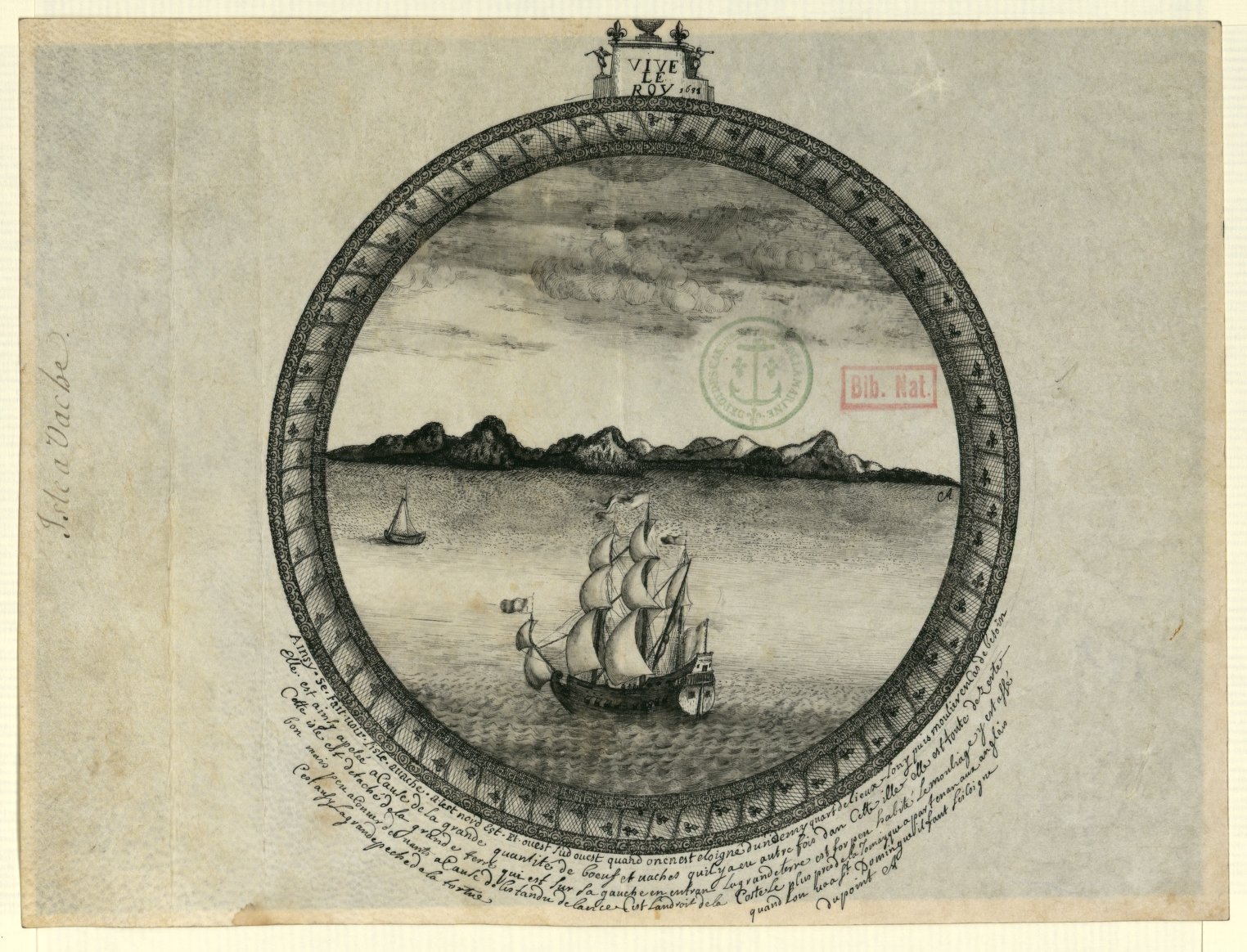
Copy of the charter-party made between
Mr. Charpin, commander of the Sainte-Rose, and his crew who agreed among themselves to give him ten shares for himself, for his command and for his ship. [Captains were typically given extra shares as “owners” of their vessels; this is how they could get rich. Charpin’s ten shares would include two for his service as captain, as compared to the common buccaneer’s single share. This leaves eight shares for the vessel; such determination was based on the size and state of the vessel, and its armament, as judged by the crew. Such determination often worked out to roughly one share per ten tons or per gun (a general rule of thumb is one gun per ten tons for determining a vessels’s armament), although it was just as often less than this, as it is here.]
All vessels taken at sea or at anchor carrying topsails which will not give themselves a voyage [i.e. be kept as prizes]; the vessels will be burned and the rigging will be [used] for the man-of-war [the Saint-Roze].
Item. All vessels taken, the captain will have a choice; and those he does not choose will remain with the crew without the captain being able to claim anything from it. [Typically this means that the captain could swap his ship for another, if better.]
Item. The captain reserves his cauldrons and his war canoe [canoes and pirogues were often used in the Caribbean instead of common ship’s boats]; and the cauldrons that will be taken will be for the crew. [Cauldrons, whether for cooking or for boiling cane juice were valuable and were common plunder. Here, the captain is probably claiming ownership over the ship’s cookroom cauldrons and the ship’s main boat or canoe.]
Item. Any vessels taken out of cannon range with war canoes [armed canoes or boats] will be plundered. All bales [already] started [opened] between two decks or in the hold, pillage. [There was a distinction between plunder and pillage; the former was shared among the entire crew, owners, and government, the latter was usually shared only among the crew. The article indicates that bales found already open ‘tween decks or in the hold are pillage, not plunder. Of course, it would be hard to prove how many were already “started”…]
Item. Gold, silver, pearl, diamond, musk, amber, civet and all kinds of precious stones, pillage. [This is a significant article, indicating that much valuable plunder will remain in the crew’s hands, not the owner’s or government’s. However, coin/specie is almost certainly excluded by custom from the definitions of gold and silver.]
Item. Whoever has the [first] sighting of the [captured] vessels will have 100 pieces-of-8 if the catch is valuable or double plunder [double share, if it is not valuable].
Item. Any man crippled [maimed] in the service of the vessel [cruise] will have 600 pieces-of-8 or 6 blacks [slaves] according to his choice. [See also the article on surgeon payment below.]
Item. Any man convicted of cowardice will lose his voyage [his shares and other profit will be confiscated and divided among the rest of the crew].
Item. Any man falsely sworn and convicted of theft will lose his voyage [see article above] and be degraded [stripped of the name and quality of a flibustier and marooned without food or clothes, according to a 1697 source] on the first key [the first island encountered].
Item. Any war canoe that goes out cruising that takes [captures] over 500 pieces [-of-eight] [it] will be for [divided among] the crew of said boat.
Item. All blacks and other slaves [Native Americans, mulattos, and mestizos were often taken as slaves] who will be taken by the canoe will return to the foot of the mast [i.e. will be considered as pillage; pillage was typically divided at the foot of the mainmast, as were other division of spoils].
Item. For the Spaniards [wounded Spanish prisoners] who will not [cannot] be cured, having arrived in place [to put them ashore?], the crew undertakes to give a piece of 8 for the said patients for the surgeon per day for the space of 3 months having arrived on land. [This appears to be payment to the ship’s surgeon for having treated wounded Spaniards. It probably also applies to any wounded, as an eyewitness description suggests: a piece-of-eight a day per patient to the surgeon for up to forty days, and the same to each wounded flibuster.]
Item. M. de La Borderie and M. Jocom are obliged to supply the crew with everything they will need during the voyage; and the crew undertakes to give them 180 pieces of 8 for their chest; and those of the [Spanish] surgeons who will be captured with the instruments which will not be lined with silver will be for the [ship’s] surgeon. [This article applies to the two surgeons: they must supply all instruments and medicines for the voyage, for which they are to be paid 180 pieces-of-eight for their surgeon’s chests. Any captured surgeon’s chests belong to the ship’s surgeons unless the instruments &c are of silver, in which case they are pillage.]
Said charter cannot be broken or canceled until we have cruised together.
Done at Ile à Vache, at anchor and in harbor, 18 February 1688.
Thus signed: Jean Charpin and Mathurin Desmarestz, quartermaster of the crew.
Captain Jean Charpin, known among Caribbean Spaniards as Juanillo, was of mixed race, probably white and Native American. A native of Sanlúcar de Barrameda in Spain, his father French, his mother Spanish, he was, like his former captain Laurens de Graff, a renegade who had deserted Spanish service. He had served at de Graff’s side since at least 1683. As a side note, Spanish records indicate that one of the crew of the Saint-Roze was a Genoese married to a Cuban woman at Guanauacoa.
The Saint-Roze set a course for the isle of Roatan in the Gulf of Honduras and careened there. The island was a well-known rendezvous of buccaneers, and soon the crew of the Saint-Roze was increased by the addition of a group of buccaneers — or more correctly, pirates — who according to French and Spanish records had returned overland from the South Sea (here, the Pacific coast of the Spanish Main) via the Coco River on the borders of Nicaragua and Honduras. Without doubt they were part of Pierre Picard’s expedition (as was buccaneer-author Raveneau de Lussan). Some scholars suggest instead that they many have recently left service under Jan Willems aka Yankey after he attacked the bodegas on the Rio Dulce and the Honduras urca at Puerto Caballos.

In any case, the new arrivals were commanded by a Huguenot named Jean Fantin who had previously served under the mutineer captain Pierre Pain aboard the French man-of-war La Trompeuse as quartermaster, and then under the Dutch flibustier-in-French-service (there were a lot of them) Captain Yankey aboard the Hardy. Having careened, the buccaneers set sail and plundered Trujillo and Olancho in Honduras, gaining only small plunder, six thousand pieces-of-eight of which were acquired via the ransom of local officials. From Honduras the buccaneers sailed to Cuba, cruised off Havana to no profit, went ashore to shoot pigs and cattle for provisions, and slipped away from an armadilla sent after them.
From Cuba the buccaneers sailed to New Castle in Pennsylvania (modern Delaware), capturing en route a Dutch merchantman of 120 tons and fourteen guns. They also captured an English sloop trading from Barbados to the Bermudas. After plundering the sloop and taking it as a prize the buccaneers gave the merchant crew the Saint-Roze which was becoming unseaworthy, and was certainly unfit for a voyage to the far side of the world. The merchant seamen sailed the Saint-Roze to Barbados where it was eventually sold for scrap, having been determined to be unfit for sea anymore and unrepairable — buccaneers had a deserved reputation as lazy seamen, often failing to do necessary maintenance and repairs. Charpin’s rovers soon released the merchant captain too, and returned his sloop to him as well.
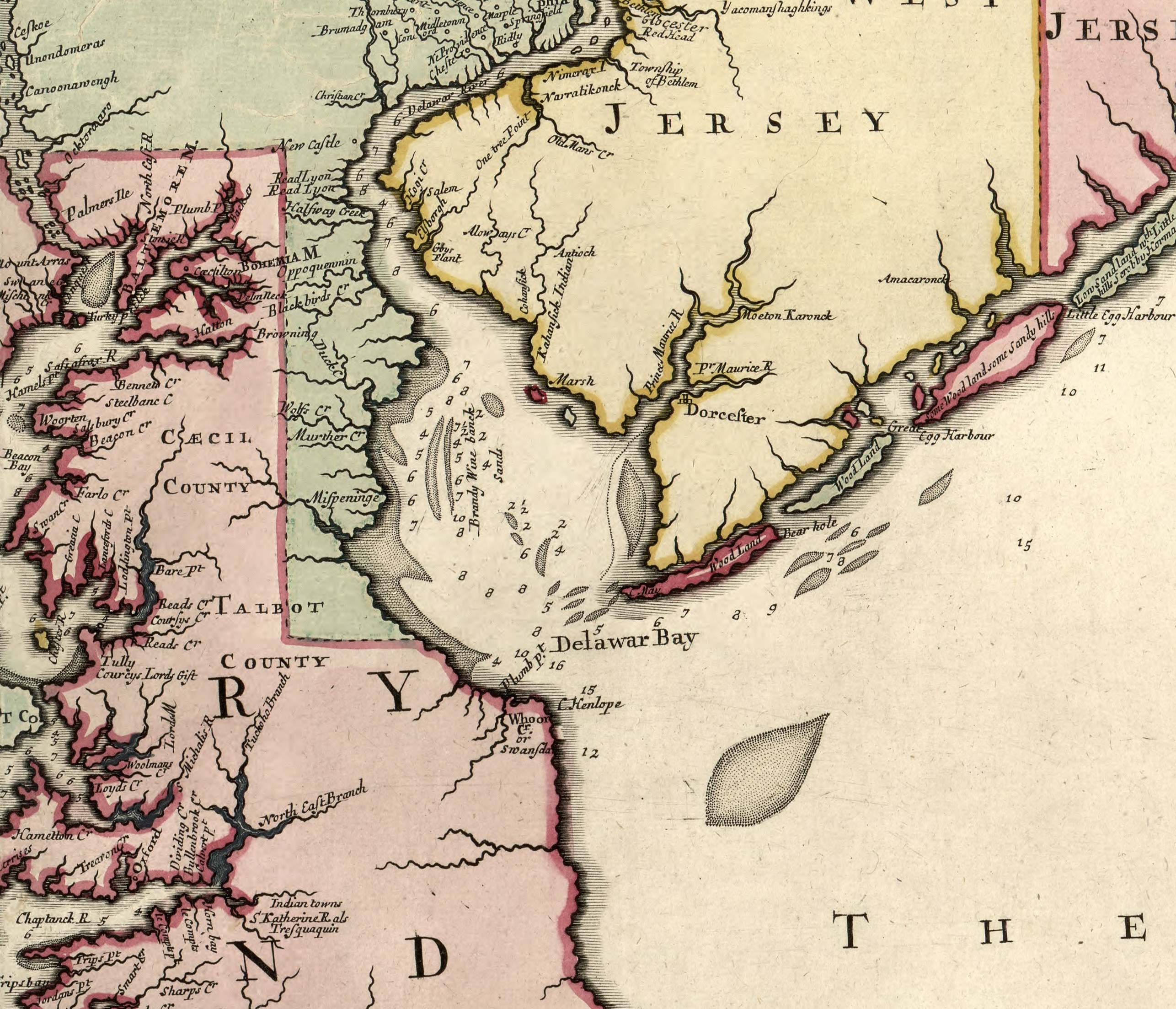
The buccaneers sold the cargo of the Dutch prize, now named the Dauphin, in New Castle, “Pennsylvania” (the region, including New England, was always a haven for pirates) for provisions. The buccaneers sailed to Boa Vista in the Cape Verdes, originally intending to plunder the Guinea Coast. Here they debated their next course: Guinea, the Red Sea, or the South Sea. Conflict set in: Jean Fantin was elected captain and claimed the Dutch prize as his own, contrary to the articles of the Saint-Roze. While there, a flotilla under the command of Jean du Casse arrived, en route to raid Surinam. Charpin appealed to du Casse regarding the Dutch prize, but was rebuffed. Du Casse also turned a blind eye to the buccaneers’ capture of a richly-laden sixteen-gun Spanish merchantman, commanded by Francisco Dias de Padilla, from Havana, other than to attach it as a fireship to his squadron, and persuade, by threat of force, the buccaneers to join his expedition.

After du Casse’s desultory and generally unprofitable raid on Surinam, Charpin returned to Petit Goave in command of the Dauphin and, at least until 1695 and probably until King William’s War ended in 1697, served as a French flibustier corsaire (a buccaneer-privateer), operating largely in the Caribbean although at one point, in concert with Captain Picard and other flibustiers, he cruised far north to raid Rhode Island.
His quartermaster Mathurin Desmarestz (a nomme de guerre, his real name was Isaac Veyret) upon his return took a commission as captain of a French privateer flute, the Machine, of three hundred tons and eight guns out of Martinique. In 1690, in consort with a barque commanded by the sieur de Montauban, he captured a rich Spanish galleon, the Jesús Nazarena y Nuestra Señora del Carmen, nicknamed the Ballestera and commanded by Pedro Fernandez de Valenzuela. Desmarestz and the Ballestera cruised the Caribbean for another year, then, having armed the ship with thirty-two guns and manned it with three hundred men, set sail for the Red Sea, to include encounters with Henry Every… But that’s another story!
But as or more interesting perhaps is the tale of the Spanish prize captured at the Cape Verdes, now commanded by Jean Fantin. The Huguenot captain and his crew returned to Martinique where they were commissioned as corsaires. Joining du Casse’s flotilla again, they sailed to St. Christopher where approximately one hundred ten of the crew assisted du Casse in mounting a six-gun battery ashore to dislodge the English defenders. As they did so, the remaining eight English aboard mutinied, “overcame” the dozen remaining French buccaneers, and set sail for Antigua where they were commissioned as an English privateer and recruited another seventy to eighty buccaneers for their crew.
Why does this matter? Because among these eight mutineer Englishmen were William Kidd and Robert Culliford (also Colliver), both of whom would meet again on the far side of the world, one as a failed pirate hunter, the other as a Red Sea pirate. In fact, both may have been with Fantin in the South Sea under Picard or with Yankey when he raided Honduras, or even were with Charpin aboard the Saint-Roze at Île-à-Vache. Kidd was made captain of the former French privateer, now named the Blessed William — and his crew would soon run away with the ship while Kidd was ashore, and turn pirate. The rest is history.
And to add a curious footnote: the Santa Rosa is almost certainly the same Spanish Assiento slave ship owned by the company of Don Juan Coymans that in January 1686 was intended to carry 600 slaves to Portobello from Jamaica. In December 1684 it had sailed from Jamaica to Portobello with 304 slaves aboard. In March 1686 Lieutenant-Governor Hender Molesworth of Jamaica, having lost the service of the HMS Ruby, ordered the ship impressed and fitted out to hunt the pirate Bannister (see below), in company with the HMS Bonneta. However, the expedition does not appear to have actually sailed; the arrival of the HMS Falcon and HMS Drake precluded any need to impress the Spanish ship.
For more details on Charpin, Fantin, and Veyret, see the Dictionnaire des Flibustiers des Caraïbes by Jacques Gasser (Les Sables d’Olonne, France: Editions Beaupre, 2017). Details on the Coymans Assiento can be found in numerous scholarly studies.
A Pirate Ship Captured at Baradaires, Saint-Domingue in 1687 by Flibustier Jean de Bernanos

In October 1687, upon hearing word that a pirate — described in French as a forbin, that is, a true pirate, not a flibustier — was on the coast, after having plundered the Guinea Coast of Africa and probably attempting to sell a cargo of slaves illicitly — Governor de Cussy dispatched the sieur de Franquesney aboard the man-of-war Le Marin to seize the pirate. No fool when it came to dealing with pirates, Franquesney recruited veteran buccaneer Jean de Bernanos, who recruited fifteen flibustiers to augment the naval seamen in case push came to shove.
At Baradieres the French man-of-war trapped the pirate who, hoping to ingratiate its crew with the warship’s captain and crew, fired a twelve-gun salute, but to no avail. Bernanos and his men boarded and seized the small frigate and its cargo. For his service, Bernanos was awarded the ship, although almost certainly not its cargo which would have been seized by the local government as piratical goods. To date, I have found no records indicating who the captain and crew of the pirate ship were, nor even their nationality.

Little is known of Jean de Bernanos, aka Captain La Sound or Lessone, prior to his becoming a flibustier except that he had formerly been a captain of cavalry, in France as far as we know. One author reports his birth place and year as Metz, France, 1645, while others suggest his birth date and place are unknown. He is found first in written records as having crossed the Isthmus of Panama in 1679 with eighty-five buccaneers under his command and two hundred Native American allies. Forewarned of his coming by the leader of rival tribe, Spanish forces from Panama intercepted Bernanos at Cheapo and forced the buccaneers to retreat.
In 1680 Bernanos and his flibustiers aboard their ninety-ton, six-gun frigate joined John Coxon and company in the sack of Portobello, but declined to join the English buccaneers on their journey across the Isthmus of Darien and into the South Sea, a voyage made famous by the adventures of escapades primarily under the command of the famous rogue Bartholomew Sharp. Bernanos and his buccaneers turned back after the attack on the Spanish gold mines.
Bernanos next appears in command of a five-vessel flotilla: his Schitié of eight guns and eighty men; Grogniet’s Saint-Joseph of six guns and seventy men; Blot’s Guagone (or Quagone) of eight guns and ninety men; Vigneron’s barque Louise of four guns and thirty men; and Petit’s “bateau” Rusé of four guns and forty men. In May 1684 Bernanos’s buccaneers and their Native American allies ascended the Orinoco River and attacked Santo Tome de Guyana, capturing the local fort after a six-hour battle. Little plunder was found. Bernanos and his buccaneers burned the small town and carried away several important prisoners whom they ransomed at Port of Spain, Trinidad, for ten thousand pieces-of-eight and various goods and supplies. One scholar suggests the expedition up the Orinoco was in search of fabled treasure that did not exist.
Bernanos appears to have afterward retired to his plantation on Tortuga until brought back into service against the pirate at Baradieres. King William’s War broke out effectively in 1688, and in 1689 we find Bernanos in command of a twenty-gun, one-hundred fifty-man privateer, quite possibly the captured pirate vessel in the image above.
In May 1690 he attacked a flotilla of English turtle fishing vessels, but all escaped except for one bark, the Calapatch (a calapatch is the top shell of a turtle), who valiantly attacked the privateer, permitting the escape of its companions.
Soon afterward Bernanos captured a considerable Spanish prize but the prize crew mutinied, sold the cargo at the pirate haven of St. Thomas — a Danish colony — where they recruited more men and turned pirate “against all flags” but reportedly perished in the end.
In 1692 Bernanos was commissioned as a major in the French army and was given command of the fortification at Port-de-Paix, Saint-Domingue. Described as a “brave man…, captain of cavalry, who had been a privateer…,” he died defending Port-de-Paix against a combined English and Spanish attack in 1695.
For more information on Bernanos, see the Dictionnaire des Flibustiers des Caraïbes by Jacques Gasser (Les Sables d’Olonne, France: Editions Beaupre, 2017).
The Golden Fleece of Joseph Banister and the Saint-Nicolas aka Le Favori aka La Chavale of Michel Andresson and soon François Rolle, 1686
The image above shows two ships, the Golden Fleece, a pirate, commanded by Joseph Bannister, and La Chavale, a flibustier but soon to be pirate, commanded by Michel Andresson. Drawn by ship’s clerk John Taylor, it was one of many that illustrated his manuscript of his life at Port Royal, Jamaica in 1687. However, although Taylor did sail aboard the HMS Falcon for a few months, he was not present during the attack on Bannister’s ship, described below, in 1686, although he pretends he was; the details were described to him by officers and crew of the HMS Falcon.
If you’ve read Captain Blood: His Odyssey by Rafael Sabatini, you’re familiar with the escape of Peter Blood and the Arabella from Port Royal, Jamaica, a scene Sabatini may have been influenced to write by the escape from Port Royal in early 1685 under the guns of Charles Fort by Captain Joseph Bannister (or Banister), commanding the 30-, 36-, or 40-gun, 400 ton merchantman Golden Fleece. The ship had been trading from London to Port Royal under his command at least as early as 1680, when she sank in nine fathoms while at anchor in the harbor. The Golden Fleece discharged her entire lading but, due to a lack of local goods, had loaded little in its place. The ship was top-heavy and when her crew went to one side to scrape the hull, the Golden Fleece overset, drowning several of her crew. With the help of several divers the ship was refloated and refitted, but at a loss of £1,000 to her owners, one of whom was surely Bannister.

In early May 1684, Bannister, heavily in debt probably due to losses from the 1680 accident, put to sea from Port Royal, claiming to be bound to New England for trade but intending piracy instead. He recruited one hundred men from local sloops and probably the French buccaneer haven at Petit Goave, and petitioned the French for a privateering commission, which was denied, although he apparently received some backing from the famous buccaneer Michel, sieur de Grammont. In July Bannister, his ship, and crew were captured by the English pirate hunting guardships HMS Ruby, HMS Bonetta, and a half-galley while he was catching and salting turtle for provisions in the Cayman Islands. Wisely, the pirates did not put up a fight. Bannister had “115 men on board, most the veriest rogues in these Indies,” according to Sir Thomas Lynch.
Bannister and his crew were held for piracy, having captured a Spanish canoe with two men aboard and kept the men as prisoners. But Bannister was able to communicate with allies in Jamaica, who provided him with money to pay the Spaniards for their canoe and cargo, and even to pay them wages while they had been in his custody. The Spaniards would not testify against Bannister, and so the grand jury, with a vote of nine opposed and four in favor, refused to find a true bill. Bannister, not believed likely to run due to security (a bond) provided by friends, was ordered held for a second attempt at trial for piracy. Meanwhile, he dispatched the Golden Fleece to London and back under another captain, but the voyage failed to bring him any profit. He therefore made his plans and preparations to once more attempt piracy.
As Lieutenant-Governor Hender Molesworth (1638 – 1689) of Jamaica described it, “About ten days since Captain Bannister one dark night sailed in a desperate manner passed the fort. He had, it is said, fifty men ready in the hold with plugs to stop shot-holes. But the sentries being careless, the night dark, and the wind fresh, he was abreast of the fort before Major Beckford, the commander, was warned, and had passed fourteen of the guns. Beckford did all that he could, but could only place three shot in him. He at once sent me word of the occurrence, which was a great surprise to me, for I thought that Bannister’s want of credit would prevent him from ever getting the ship to sea again.” Bannister had slipped his cables; John Taylor claimed he had 160 men aboard.

The sloop HMS Bonetta (or Boneta, 4 guns, 57 tons; Bonito in colonial records), commanded by Edward Stanley, sailed after Bannister and ordered him to return but the renegade declined, giving assurances he had no intention of turning pirate, which he soon did. For the next year Bannister mixed first with French buccaneers then set out on his own, capturing Spanish vessels. A demand by the HMS Ruby that de Grammont, in whose flotilla he consorted for a while, turn him over for sailing under a foreign commission was rebuffed, ostensibly because the French claimed Bannister had no commission from them. The English captain did not insist, given the size and number of the French ships, which included those of de Grammont, Laurens de Graff, and Jan Willems aka Yankey — the three most powerful and famous of the 1680s. Bannister is believed to have remained with the French buccaneers, and was probably with them at the sack of Campeche soon afterward. But if so, it was to little profit.
Meanwhile, in late 1685 two hired sloops manned with English naval seamen searched for two months but failed to find him. In January he was reported at the French buccaneer haven at Petit Goave, and in March Lieutenant-Governor Hender Molesworth ordered the impressment of the Spanish Assiento slave ship Sancta Rosa (see above!) to be used in the search for Bannister, given that the HMS Ruby was undergoing repairs. However, the arrival of two new men-of-war precluded this. In May 1686 Bannister was reported careening at Samana Bay on Hispaniola. Immediately the newly arrived HMS Falcon and HMS Drake were dispatched. The two men-of-war spent nearly all their powder pummeling the Golden Fleece as it lay on its side careened. Bannister’s men had built gun emplacements and returned fire (a detail that would inspire part of the plot of The Black Swan by Sabatini), killing and wounding some of the English naval seamen. The Golden Fleece was damaged so badly that the pirates burned it in the end. Taylor’s drawing, a rather crude one, shows a large ship with raised forecastle and quarterdeck, but no poop deck (or a very short one).

Occasionally a rabid pirate fan (typically on Wikipedia, often the encyclopedia of misinformation) will argue that this cannonading of a careened pirate ship was a pirate victory against the English navy, but it’s hard to claim victory when you lost your forty-gun pirate man-of-war while your enemies are still afloat and need only re-arm, and now you must cruise in a small sloop, and will end up as shortly to be described. For the English men-of-war, the fight was half-victory, half failure but — not defeat. The pirate ship was destroyed but the pirates remained at large.
Nearby, but not attacked, was a small captured urqueta (a flibot or small fluyt) manned by French buccaneers who took the marooned pirates aboard. The English buccaneers soon departed in a small Spanish bark or sloop captured by the French. Bannister, now sailing under a false name, and his men cruised the Mosquito Coast until captured by the HMS Drake after gaining intelligence of him from some of his former crewmen, all of whom had abandoned Bannister and six others, and ran away with the bark, abandoning him among the Mosquito Indians.

Bannister was captured “in disguise a-roasting a plantain, in a pore Indian wigwam.” One of his men fired a musket at the English seamen, for which he was killed in return. The other three of Bannister’s crew were captured as well. The pirate captain and the three of his crew were hanged in January 1687 aboard the pirate hunter as it sailed within view of Port Royal. It was “a spectacle of great satisfaction to all good people and of terror to the favourers of pirates, the manner of his punishment being that which will most discourage others,” according to the Governor of Jamaica. After the Drake anchored with the hanged pirates as an example, the bodies were cut down and tossed into the sea near Gun Key. Two boys who had sailed with him were pardoned and turned loose in Port Royal, but both were hoisted aloft by “their armholes, at the mizonpeek” while the four pirates were hanged. One of the boys, according to Charles Johnson, grew up to be the possibly fictional pirate captain William Lewis.
The French flibustiers at anchor near Bannister careening at Samana Bay were commanded at the time by Michel Andresson, often known as Captain Michel. Another of the famous French buccaneers of the 1680s, he succeeded to command of Laurens de Graff’s Le Tigre in 1682, and in 1683 commanded the company of buccaneers that stormed the southern bastion at Vera Cruz. In 1684 he was with de Graff and others off Cartagena when they were attacked by three Spanish slave ships converted to men-of-war; the buccaneers captured or destroyed the ships sent after them. De Graff took command of the thirty-four gun San Francisco Javier y San Lucas Evangelista and renamed it Le Neptune, and Andresson took command of La Paz (probably a nickname for the San Joseph) and renamed it La Mutine.
In company with Captain Brouage, Andresson captured two Dutch ships trading at Cuba, and carried the plunder to Boston for sale — New England Puritans were well-known for their hypocritical avarice (see link noted above). After some minor unprofitable adventures, most of Andresson’s crew deserted him in 1685 to cross the Isthmus of Darien into the South Sea (see buccaneer-author Raveneau de Lussan for details!). He soon joined an old comrade-in-arms, François LeSage and was given command of his Dutch prize, the Saint-Nicolas, renamed Le Favori, a 100-ton, fourteen-gun flute originally intended to trade illicitly along the Spanish Main. Its crew of flibustiers were described as some of the most seditious and mutinous in the Caribbean.
The small ship, called La Chavale by John Taylor, who would have had it described to him by English naval officers and crew who had destroyed Bannister’s ship, is clearly a small flute, known as an urqueta by the Spanish, a pink by the English, and a flibot by the French, as is described in other sources. If Taylor is correct about the name, it reflects a name-change under Andresson’s command.
After a failed attempt to sail into the South Sea via the Strait of Magellan, Andresson, now separated from Le Sage, headed to the Caribbean to repair, careen, and provision for a second attempt into the South Sea. At Samana he met Joseph Bannister; the English attack had been focused only the English pirate, and the French escaped harm. After the departure of the English pirates whom they rescued, the French sailed to the Guinea Coast, first being nearly destroyed by an English merchantman, the Baudan, where they deposed Andresson and elected their quartermaster, François Rolle, a Dutchman (real name Frantz Rools) as captain. The buccaneers sailed into the South Sea, where they remained until 1693.
The voyage is noteworthy because a complete manuscript written by one of the crew exists, and also because during their attack on Acaponeta, Mexico in 1688, the buccaneers carried a red flag of no quarter — the pavillon sans quartier — with a skull and crossed bones beneath. It is the only known instance of buccaneers flying the skull and bones, although likely it was flown at other times. As for Captain Rolle, he went ashore at Cayenne at the end of his voyage in 1693. He married a Dutchwoman there, purchased a large plantation, and remained there until his death in 1722 at the approximate age of eighty.

The Bannister text above was taken largely from a draft appendix for the forthcoming Annotated Edition of Captain Blood: His Odyssey, ed. Benerson Little. Details on both Bannister and the Andresson/Rolle voyage can be found in the author’s book, The Golden Age of Piracy. The Calendar of State Papers, America and West Indies, 1685 – 1688 has numerous details regarding Bannister (search both Banister and Bannister). For more information on the French buccaneers described above, see the Dictionnaire des Flibustiers des Caraïbes by Jacques Gasser (Les Sables d’Olonne, France: Editions Beaupre, 2017). The original journal of the French voyage can be found digitized in the French National Library, and also in the Bulletin of the Société des Sciences et Arts de Bayonne (Bayonne: Lamaignère, 1894), edited by Edward Ducéré, and in The Last Buccaneers in the South Sea 1686 – 1695, edited by Peter T. Bradley (both with one problematic transcription error — Panama for Samana — although the original manuscript clearly shows the latter).
The Capitana and Almirante of the Armada de Barlovento, 1685: The Santo Cristo de Burgos and the Nuestra Señora de la Concepción

In 1685 Laurens de Graff commanded Le Neptune, as noted previously, now mounted with forty-eight or fifty guns (many were probably swivels) and carrying a crew of three hundred, at the equally brutal sack of Campeche, Mexico. He was one of the few buccaneers, flibustiers, or outright pirates of the age of sail ever to command a great, heavily-armed ship.
After the sack—rape is surely a better word—of Campeche, the raiders scattered at the sight of the Armada de Barlovento, although the pirate hunting armada picked off a few of them. Three days later, off the north Yucatán coast of Mexico, near Alacrán (Scorpion) reef, de Graff’s lookout sighted two ships. The larger was the Nuestra Señora de Jonjón, an urca or frigate of roughly 335 tons and twenty to thirty guns.
The smaller vessel was the eight-gun Jesús, María y José, a patache or small escort ship of unknown rig, formerly known as the Sevillana. Both were part of the pirate hunting Armada de Barlovento. The Jesús, María y José immediately set all sail and a course away from the pirates, desperate to inform the famous, now elderly Admiral Andrés de Ochoa y Zárate that the greatest of pirates was nearby. The Jonhón wisely kept her distance. Soon enough, the captain of the patache informed the admiral of the opportunity to destroy the man who so successfully scourged the Spanish Main.
Within a day the main force of the Armada de Barlovento came in sight of de Graff, and a powerful squadron it was. The Spanish Capitana or flagship was the Dutch-built Santo Cristo de Burgos, of 650 tons and fifty-six guns, her stern with an image of Christ crucified, wearing a skirt that fell to beneath the knees. Aboard her was the Armada’s commander-in-chief, Andrés de Ochoa, ill to the point of physical incapacitation but who would refuse to leave his quarterdeck. The Almirante or vice-admiral was the Dutch-built Nuestra Señora de la Concepción, of fifty-two guns, probably 550 tons, and commanded by Antonio de Astina.

The two great ships were typically Dutch, although both appear, unusually, to have the semi-open stern gallery seen on some Spanish ships at this time. Both of the large pirate hunters were more lightly armed than we might expect—in fact, over-gunning is an historical error often made in novels and films, especially those depicting ships of the seventeenth and early eighteenth centuries. Based on the armament of similar ships of the Armada de Barlovento circa 1700, the Burgos was probably armed with twelve pounders on the gundeck, perhaps a few sixteen or eighteen pounders (culverins) as well, with demi-culverins shooting eight pound shot on the deck above, and four pounders on the “castillos,” that is, on the forecastle and quarterdeck, and possibly the poop.
The Concepción was likely armed with twelve pounders, or even ten pounders if twelves were unavailable, on the gundeck, sakers of five or six pound shot on the upper, with smaller guns on the quarterdeck and, possibly, the poop. Accompanying these two great ships was the recently captured pirate ship Reglita, itself originally a Spanish prize, of twenty-two guns, probably of six or four pound shot, commanded by présador or prize-master Pedro de Iriarte.
And it was by these three ships that De Graff found himself trapped to leeward in his Neptune of as many as fifty guns, though we must doubt that these were all great guns, given the tonnage of his ship. His ship probably had ports for no more than thirty-five to forty great guns of probably no more than eight and four pound shot; the rest were almost certainly various swivel cannon. Put plainly, he was heavily out-gunned.
Unable to gain the weather gage so necessary to give him a fighting chance against two large men-of-war—or to escape them—de Graff ordered the Neptune to lie by and prepare for battle. In the language of the day, he had “catch’d a Tartar.” The Armada was not idle either. During the night, the two powerful Spanish men-of-war brought flibustier prisoners aboard to help man the guns against their flibustier brethren—or die.
The battle began early the next morning. De Graff could surely have fought off, perhaps even captured, one of these great men-of-war, but two at once? Still, de Graff knew his business and just how serious the situation was. Before battle began he spoke boldly to his crew, as recounted by buccaneer-surgeon Alexandre Exquemelin:
“You are too experienced to not understand the peril we are running, and too brave to fear it,” he said. “It is necessary here to be cautious of all yet to risk all, to defend and attack at the same time. Valor, deception, fear, and even despair must all be put to use on this occasion; where, if we fall into the hands of our enemies, nothing awaits us but all sorts of infamies, from the most cruel of torments to, finally, the end of life. We must therefore escape their barbarity; and to escape, we must fight.”
The great ships of the Armada sailed bravely down upon the waiting Neptune and her cornered pirate crew. Coming into range, the Burgos fired a warning shot from a bow chaser. The Neptune made no response. Onward sailed the Burgos, the Concepción not far behind. And here the Armada made its first tactical mistake, sailing on each side of the Neptune. In this position, the Spaniards could not fire on the enemy without also firing into each other. Only in Hollywood can two ships sail closely one on each side of another ship and destroy it, as in Pirates of the Caribbean: At World’s End. In reality, it could be suicide or nearly so. Of course, Rafael Sabatini, doubtless inspired by Exquemelin’s description of the battle, got the tactic right in Captain Blood, with his hero emulating de Graff by sailing between the Spanish men-of-war Milagrosa and Hidalga.

De Graff shouted orders to fire starboard and larboard. First one side, then the other of the Neptune blazed iron into the pair of pirate hunters. Immediately de Graff topped the broadsides off with an enormous discharge of musketry. Buccaneer surgeon Alexandre Exquemelin claimed that the musketry alone killed or wounded fifty Spaniards, and this might be true: filibusters and buccaneers were known for their ability with their long-barreled muskets. The Burgos, ready to fight, let loose its own powerful broadside in return.
Spanish records, however, give a slightly different account of this first phrase d’armes, perhaps truthfully, perhaps to cover up a grave error. Admiral Andrés de Ochoa y Zárate, the records suggest, believed de Graff would speak to him, surely to discuss terms, and so approached the pirate. After all, de Graff was out-numbered, out-gunned, and out-manned. But when the admiral’s ship came into close range, de Graff let his great guns do the talking.
For the next twelve hours de Graff maneuvered his ship defensively such that his enemy could seldom or never bring two broadsides to bear on him at once. Never did de Graff gain the weather gage, yet in spite of this the Armada ships never boarded him. In fact, they feared to do so. De Graff had a large crew that was clearly proving its prowess in open sea battle. If the Spaniards were to board, they first had to outmaneuver him, and both ships must board him, one first, then the other alongside the first. Once one had boarded, the other must cease firing, but the pirate had no such restriction. Perhaps most threatening, they knew too well de Graff’s prowess as a gunner. He might slaughter far too many of their men as they came near to board, for boarders, if there are many of them, must be massed on deck just before they board, and thus are vulnerable.
And de Graff made sure the Armada captains and crews understood how dangerous it would be to try to board. At one point, De Graff ordered his helmsmen to close with the Burgos and his gun crews to aim a broadside at close range at the mainmast. In this age broadsides were not fired as in Hollywood films, all guns firing at once or almost so, with each gun captain simultaneously touching his match to his gun. Rather, these great guns were often fired by a few gunners, gunner’s mates, or officers who went from one gun to the next and then the next, or they were aimed and fired by individually by each gun’s captain, all in order to ensure good aim.

In either case, a real broadside in this era was a ragged slow-motion series of ear-cracking explosions of fire and smoke that ripped from iron into wood and flesh. Buccaneer-surgeon Alexandre Exquemelin claims that de Graff himself aimed the gun that dismasted the Burgos. And it’s likely de Graff did aim several or more of his guns in this broadside, but the mainmast of the Burgos, although damaged, did not fall. Even so, the broadside was so effective that the Spaniards abandoned any thought of boarding the Neptune.
Surely emulating the famous previous fight of de Graff’s Le Tigre against the situado (payroll) ship La Francesa, the larger, less maneuverable Neptune twisted and turned as the fight continued, engaging first one ship, then the other, but taking no unnecessary risks. De Graff wanted to batter his enemies down, one then the other, however long it took. The Concepción, valiantly bearing the brunt of the fight, fired at least sixty full broadsides at the Neptune, and Burgos at least fourteen. The Spanish officers would later claim their powder was bad, and maybe it was. Yet it was powerful enough to kill five Spanish gunners when their great gun exploded.
But de Graff’s powder was not bad, and moreover, his crew knew how to load, aim, and fire accurately. Smoke covered the water between the ships as they blazed away. Men bled and died on each side, including de Graff himself, wounded in the leg. He was carried below and his crew lost heart. But as soon as de Graff heard his guns slacking, he rose, climbed back to his quarterdeck, and, sword in one hand, pistol in the other, and rallied his filibuster crew.
The battle continued until nightfall, when all three ships stood off from each other to tend to their wounded, knot their shattered rigging, repair the leaks in their hulls, and pump the water from their holds. The Neptune was in terrible condition. Although only nine of her crew had been killed and but ten or twelve wounded, the Neptune herself had taken a beating, for the Spanish broadsides had not been ineffective. Her foretopmast was shattered. Far worse, she had been hulled at the waterline by so many round shot that she was listing severely due to the water that continued to flood her hold in spite of the plugs pounded into the hull by his carpenter and mates. Through the night de Graff’s crew worked to lighten Neptune, to right her and prepare her for battle on the morn.
At dawn the next morning the Neptune had finally gained the weather gage—and the Burgos and Concepción were in no mood to engage her again. Their crews were battered and almost beaten, with dozens killed and wounded. They had expended most of their powder and shot, and the upper works of the Burgos were shattered. During the night the elderly admiral had been given his last rites in expectation of his death: he would live but two more days. With a single exception, the Armada officers believed that calling off the fight was the best course. Only Pedro de Iriarte wanted to chase the pirate and renew the fight, more for the sense of honor and reputation than for tactical wisdom. Surely every one of them felt shamed by their failure to capture, at odds of two to one of ships and guns in favor, this notorious pirate who had once been one of them.
This account is an edited, abbreviated version that appears in The Golden Age of Piracy: The Truth Behind Pirate Myths. Citations can be found in the endnotes of the book (I’m frankly too lazy to add them here. 🙂 ).
Copyright Benerson Little 2023. First posted 26 January 2023. Last updated 23 February 2023.

“Dreams of Glory” — Captain Blood! (Updated!)


I’ve seen myself in comics before — Calvin & Hobbes, Bloom County, Peanuts, Shoe, Hagar the Horrible, Popeye, and even in an imagined sense in Buz Sawyer, Prince Valiant, and The Phantom — but never so closely as in the image above. This is my dream of glory as a child! And likewise many friends and acquaintances of mine, particularly those who’ve lived lives of real or armchair swashbuckling from childhood onward.
The comic was drawn by William Steig, best-known today for Shrek. However, he drew a series of “Dreams of Glory” comics in the 1940s and 50s (I hope I have the dates correct) for various upscale magazines, primarily The New Yorker. Most if not all of the comics were published in a single volume in 1953.
I’ve updated this…
View original post 275 more words

“Captain Blood” on Halloween!
A vampire — surely Lugosi himself! — riff on Captain Blood, with a Moby Dick reference no less, by friend and arms historian Jim McDougall. 🙂
Is the ship the Arabella, the Pequod, or the Demeter? 🙂
Comic copyright by Jim McDougall, 2021-2022. Blog copyright Benerson Little 2022. First posted October 17, 2021.

“The Buccaneer Was a Picturesque Fellow” by Howard Pyle

And indeed he was a picturesque — and picaresque! — fellow, the buccaneer! Howard Pyle’s painting of this romantic sea rover has influenced the imaginations of half a dozen generations of readers, writers, illustrators, costume designers, film-makers, and game designers. Currently on view at the Delaware Art Museum, the painting was one of four created for an article, “The Fate of a Treasure Town,” also by Pyle, published in Harper’s Monthly Magazine, December 1905.
In fact, the paintings accompanying the article are some of Pyle’s most famous buccaneer and pirate images. In addition to the picturesque buccaneer, there is “An Attack on a Galleon,” “Extorting Tribute from the Citizens” (used as the cover of The Buccaneer’s Realm, for what it’s worth), and “So the Treasure Was Divided.” Of the most famous paintings of his buccaneer, as opposed to pirate, series, only “Which Shall be Captain?” for “The Buccaneers” by Don C. Seitz, in Harper’s Monthly Magazine, January 1911, and “How the Buccaneers Kept Christmas,” Harper’s Weekly, December 16, 1899, are missing. (High resolution images are available on Wikimedia Commons.)
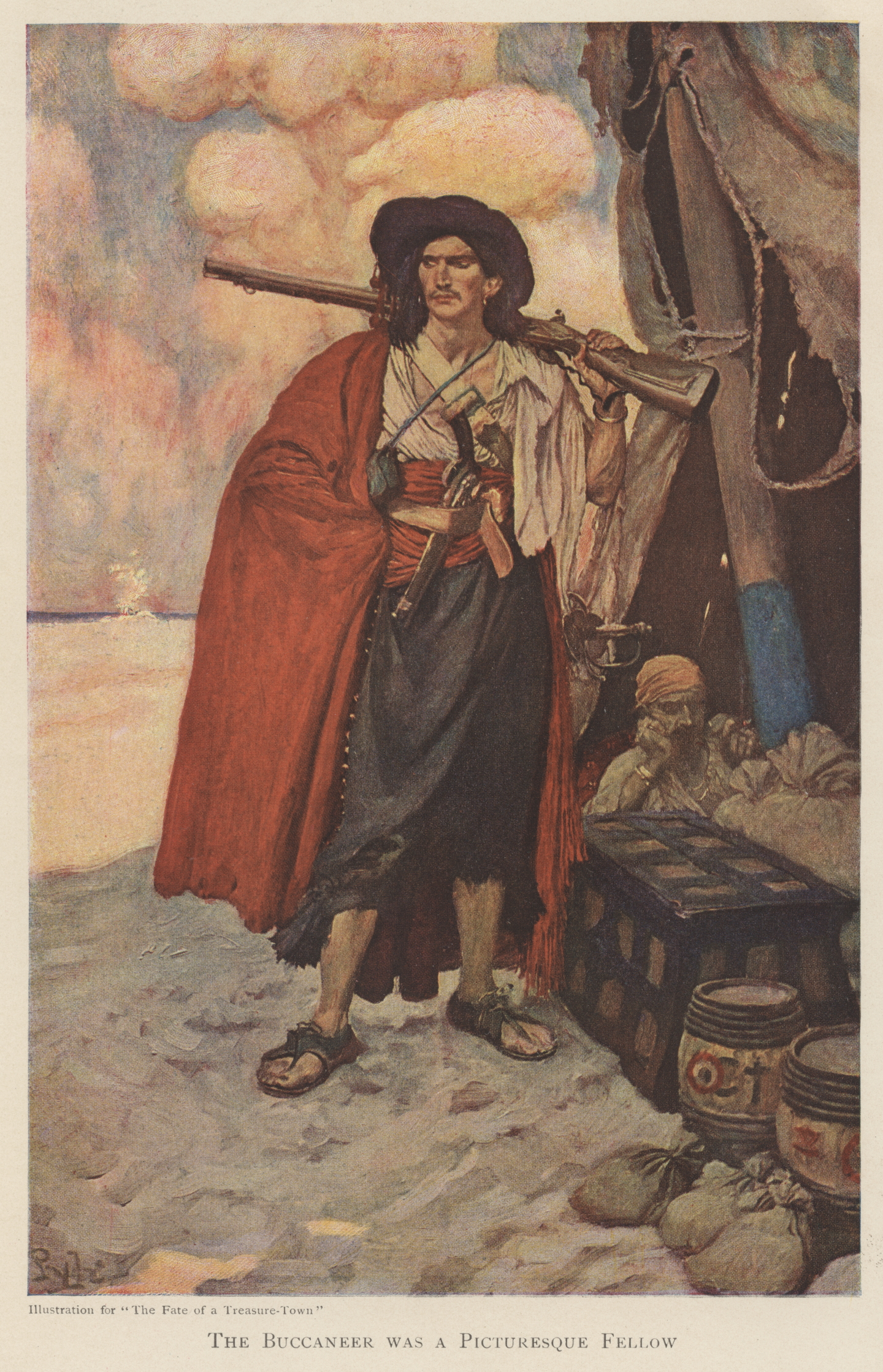
Pyle’s article opens with romantic tropical buccaneering scene-setting, then shifts in detail to the sack of Cartagena de Indias in 1697, a privately-funded French privateering expedition that was composed of hired ships and troops of the French navy and army, with a large body of French buccaneers and Caribbean militia in support. The Baron de Pointis, commander of the expedition, swindled the buccaneers out of their agreed share, so they returned and extored more treasure from the citizenry. Pyle’s painting, “Extorting Tribute from the Citizens,” shows buccaneers actively engaged in this pursuit. (On a side note, the painting was used for the dust jacket of The Buccaneer’s Realm, my second book.)
But few people have actually the read the article or even know about the sack of Cartagena de Indias, and it’s the images themselves that have caught our imagination. In particular, film-makers, illustrators, and Disney have borrowed heavily from the paintings: from The Black Pirate of Douglas Fairbanks and the Captain Blood of Michael Curtiz, to Disney’s Pirates of the Caribbean attraction and films, to the sea rover art of Don Maitz, Pyle’s influence is impossible to deny.

From a historical standpoint, the paintings are far more evocative than accurate, although clearly Pyle attempted to get historical details correct. But this wasn’t easy. He had to interpret written descriptions and also — the bane of truth-seeking historians and researchers everywhere! — appeal to popular tropes as well. For popular works, some degree to catering to popular expectations is considered mandatory, or so I’ve been advised (and immediately resisted, bound by nature to do my best to keep within the limits of fact and fact-finding, at least as much as possible).
For Pyle, it was not the buccaneer or pirate’s sea roving escapades that made him appealing: “It is not because of his life adventures and daring that I admire this one of my favorite heroes; nor is it because of blowing winds nor blue ocean nor palmy islands which he knew so well; nor is it because of gold he spent nor treasure he hid. He was a man who knew his own mind and what he wanted.”
He conveyed this well with his picaresque — sorry, picturesque — buccaneer even if it appears that the young man evokes a purely romantic image of a sea roving adventurer rather than a real one.

Let’s take a quick look at his arms, accoutrements, and clothing and compare them to the historical. We’ll begin with his hat. Spotting the red ball tassels, we assume the hat is intended to evoke Spain — it’s the somewhat tropish hat of a Spanish flamenco dancer or mounted matador. Perhaps the buccaneer captured it, or, I think more likely, the buccaneer is in fact a Spaniard, a mestizo perhaps. We know that there were Spanish renegados among the buccaneers. Let’s keep this in mind as we look at the rest of him.
He’s wearing two gold earrings — small simple hoops. Most European-derived buccaneers did not wear earrings, with the occasional exceptions of the Dutch (single pearl, single ear) and fops (single pearl, single ear). However, all too often our impression of pirates is influenced by our ethnocentrism: some Africans, Native Americans, mulattos, and mestizos in the Americas did in fact wear earrings. Pyle probably added earrings as part of the expected pirate cliché, but to my mind, the earrings, considered historically, are more evidence that this buccaneer is a Spanish mestizo renegade, as is the perhaps fanciful bracelet on his wrist. His dark hair and olive skin — also “Spanish” clichés — are to me more evidence of his Hispano-American origin.

He has a red cloak over his shoulders, but would a buccaneer wear one? Probably not in the daytime, given the highs in the upper 80s and lows in the upper 70s year-round in Cartagena de Indias, although in some areas of the Caribbean cloaks, jackets, blankets, “ruggs,” &c were worn or used, typically at night. That said, a 1680s image, if not eyewitness then at least based on eyewitness descriptions does show a Spanish pirate or privateer with a cloak! More on this below.
Further, French priest and eyewitness Jean-Baptiste Labat described the admiral of the Armada de Barlovento in the Caribbean as wearing a cloak, but he was an old man and perhaps needed the cloak to keep his old bones warm at sea. And Spaniards wearing them are depicted in period images of New Spain, see the last image below for example. Perhaps, as with the Spaniard’s ruff which was often added historically as a satirical symbol — Spaniards no longer wore ruffs –, Pyle added the buccaneer’s cloak as a mere symbol of dress to indicate that the man is a Spaniard. This isn’t the first time Pyle put a cloak on a buccaneer: he also did so in his painting, “How the Buccaneers Kept Christmas,” Harper’s Weekly, December 16, 1899.
His “musket” is a bit of an anachronism: it is a Jaeger or Jaeger-type hunting rifle. Developed in the late 17th century in the region later to become known as Germany, there is no indication they were ever used by buccaneers. These Caribbean sea rovers used the long fusil boucanier, especially among the French, and various other muskets at times. However, there are instances of carbines (Sp. carabinas) in use on occasion at sea and ashore, and we will assume this is what Pyle meant to represent. His pistol could represent any number of sea pistols in use at the time, and is close to their common size. Its lock is indeterminate, but it hints of a Spanish Miquelet style.

His rapier, or possibly broadsword, is a shell-hilt, of what could be a Spanish-style doble concha, although the true cup-hilt (taza) was far more common. All or nearly all English, French, and Dutch buccaneers carried cutlasses, although there are documented indications of a few exceptions for smallswords and broadswords. However, the rapier — espada ropera — was still in common use in Spain, Portugal, and Spanish-governed parts of Italy at the time, not only among gentlemen (and most Spaniards considered themselves gentlemen!), but also among soldiers and almost surely among some seamen and artilleros. In fact, the eyewitness, or nearly so, image below of a Spanish privateer or pirate from the 1680s shows him wearing a Spanish rapier. Curved quillons were uncommon on Spanish swords of the era, although they did begin to show up on some at the end of the 17th century. Again, although for Pyle the rapier may have been a necessary trope, historically it would point the buccaneer being a Spaniard, Portuguese, Italian, or Corsican.
His sash is a bit wide, at least from what eyewitness images suggest, but his belt is correctly worn over it. The pouch or box on his right may be a cartouche box worn on a strap in a rather un-buccaneer style. His breeches, buttoned at the sides, are quite typical of those shown worn by Spaniards in the era, although Pyle may have depicted this style to evoke the swashbuckler or pirate as he did in other paintings, “I Had Met My Equal” for example.
And last, his sandals: most buccaneers, according to eyewitness descriptions and images, wore conventional shoes, or boucanier shoes made from skin pulled from the hocks of hogs (see here for details), or went barefoot, at least among the poorest sort. However, as noted not all buccaneers were English, French, or Dutch. Some were Spanish renegades, including Spanish Native Americans and mestizos, and we know that some of both groups wore sandals at the time.
The image below was drawn by a French engineer in the 1680s, almost certainly based on local eyewitness accounts of French pirates or privateers who attacked Nipe on Saint-Domingue (modern Haiti). There is no chance Pyle ever saw this image, yet his picturesque buccaneer evokes it well! The Spaniard is even wearing a cloak! Many Spanish pirates and privateers — most, some eyewitnesses noted — were men of color: Native Americans, mestizos, Africans, and mulattos. Is this what Pyle intended, a Spanish or mestizo renegade buccaneer? I can’t be entirely certain, but the evidence and my gut assure it is.
Bookends, Bookcovers, & More…
The painting has inspired a variety of objects and art, ranging from bookends to bookcovers to game miniatures. The bronze-clad bookends below, “Pirate’s Den” by Peter Manfredi (1930) for the Pompeian Bronze Co., are three dimensional copies of Pyle’s painting.
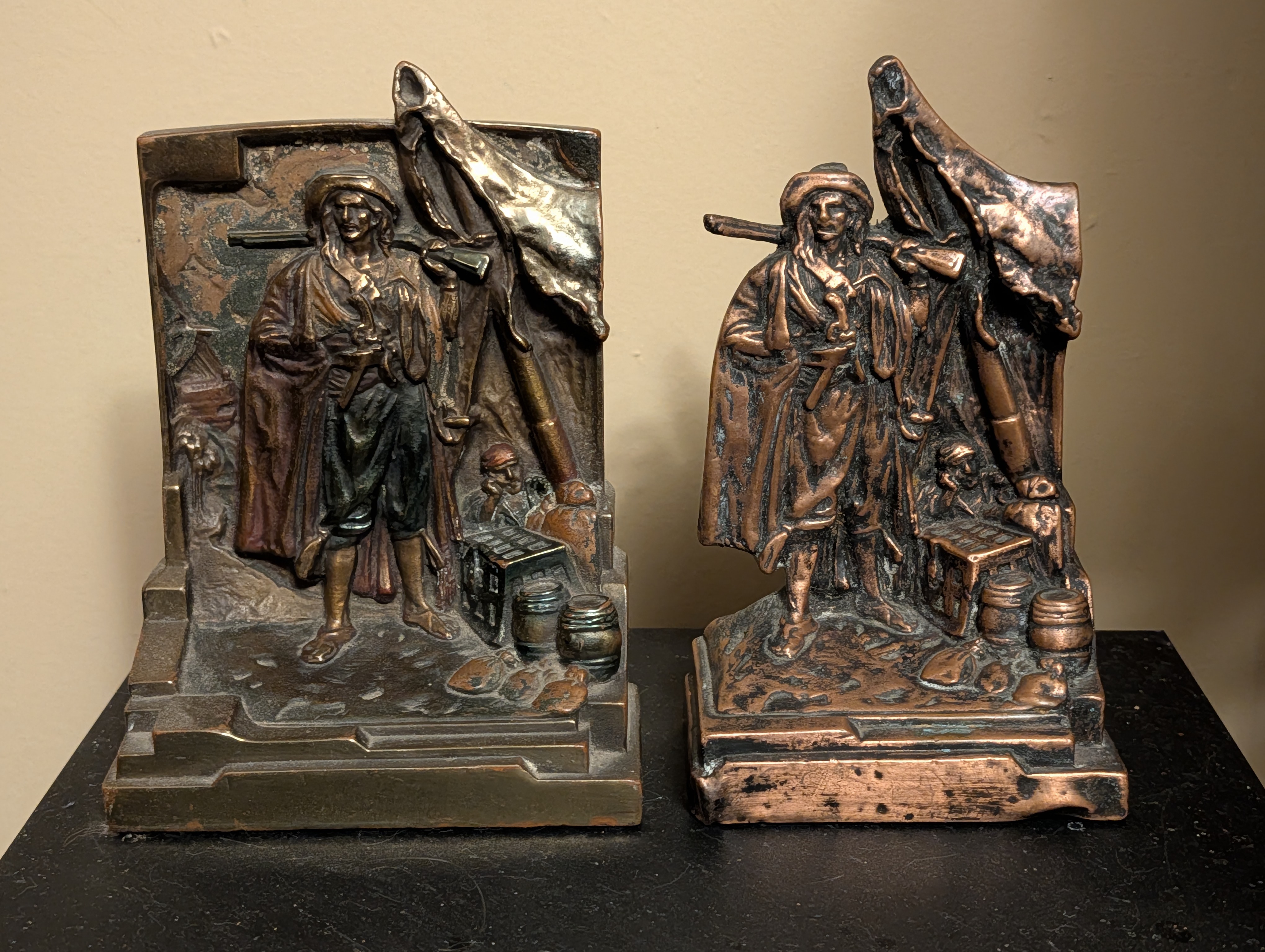
The Pompeian statuette bookend on the right below, “Buccaneer” by Peter Manfredi (1930), was clearly inspired by Pyle’s painting. On the left is “Miss Pirate” by the same sculptor and year for Pompeian Bronze Co., Brooklyn.
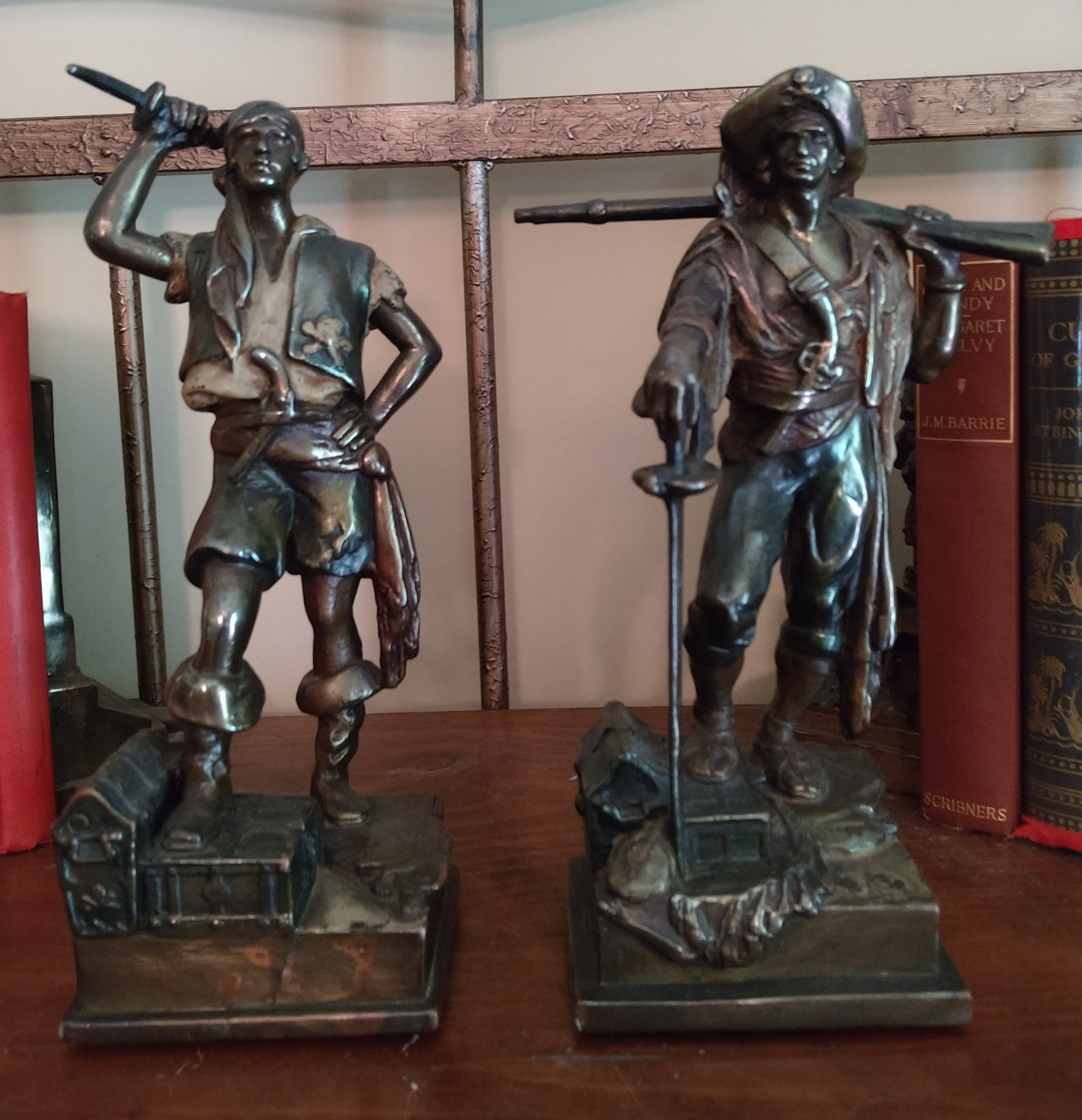
In The Black Swan (20th Century-Fox, 1942), only loosely based on Rafael Sabatini’s novel of the same name, Tyrone Power’s costume is clearly based on, and probably an homage to, Pyle’s famous painting. The hat with tassels hanging from it, the cape, the sash, the rapier, are all clearly intended to evoke Pyle’s picturesque buccaneer.


The image was clearly the inspiration for this detail on the 1952 “one sheet” (full size 27″ by 41″) poster for Against All Flags starring Errol Flynn, Maureen O’Hara, and Anthony Quinn.

The image has been used often on the covers of trade paper editions of Captain Blood: His Odyssey by Rafael Sabatini. The one below is published by the Naval Institute Press. Pyle’s painting doesn’t evoke the urbane and sedulous Captain Peter Blood, but it does evoke the buccaneers he led. In fact, part of the novel takes place during the sack of Cartagena de Indias, although Sabatini moves the attack on the beautiful city up in time.

The painting inspired the cover of a mass market edition of Cup of Gold by John Steinbeck, a fictional, and quite literary, account of famed buccaneer Henry Morgan.

CrossGen published a series of six comic books 2003-2004 by Chuck Dixon, Steve Epting, and Frank D’Armata featuring a Spanish female pirate hunting captain, Donessa Cinzia Elena Marie Esperanza Diego-Luis Hidalgo (seriously!). Captured by buccaneers in 1687, she turns them into pirate hunters to seek out and destroy their pirate lord in return for the location of a great treasure. Commanding El Cazador, she is known by her English and French crew as Lady Sin and Captain Sin. She appears on the cover of Issue 5 (March 2004) in an homage to Pyle’s Picturesque Buccaneer. My many thanks to Antón Viejo Alonso for reminding me of this comic book cover!

The Naxos re-release of these film music classics by the Brandenburg Philharmonic Orchestra uses the picturesque buccaneer on the “album” cover, albeit reversed. Good music too!
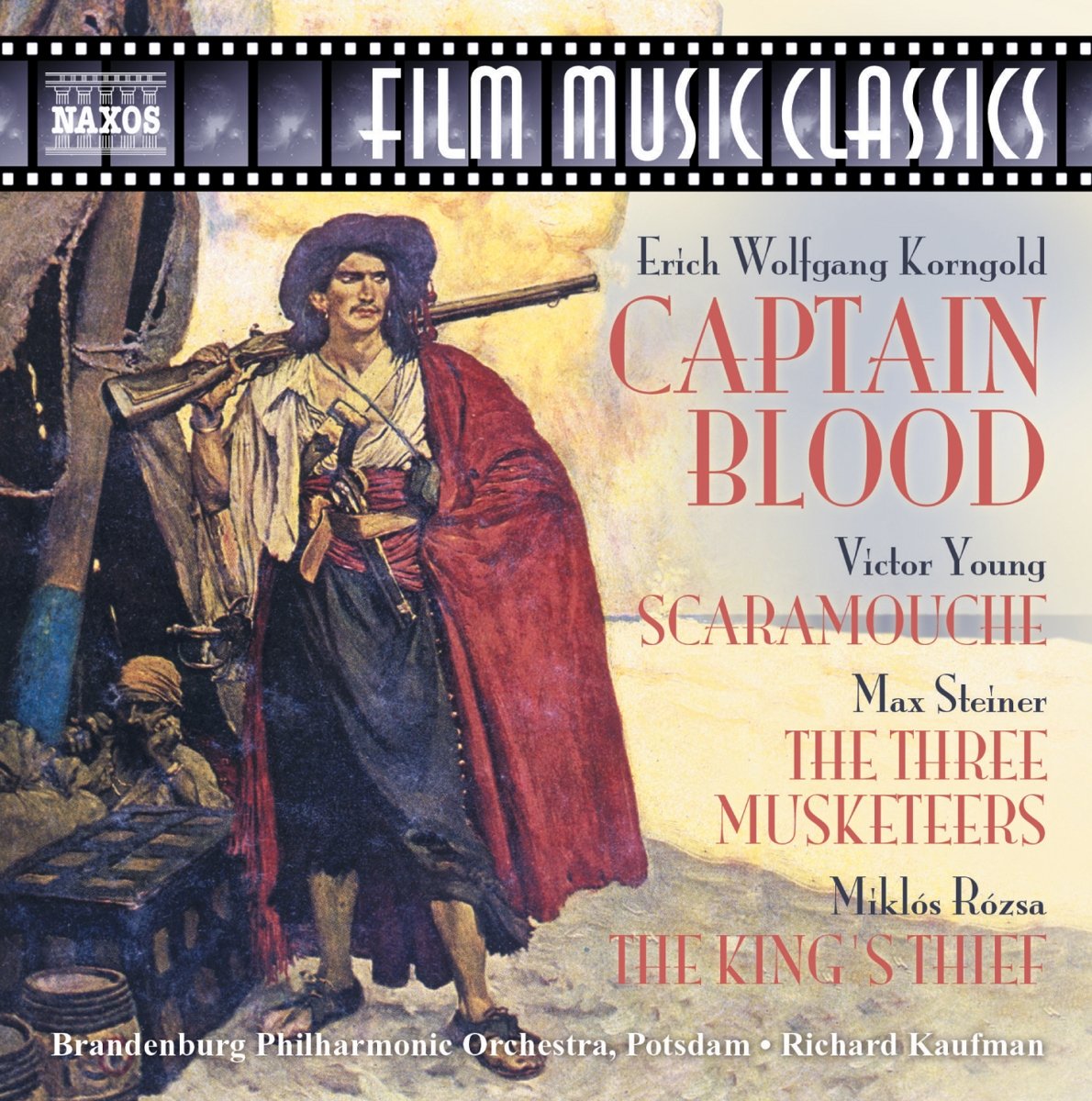
Firelock Games created a special edition figure as an homage to Howard Pyle for its popular (and quite historically accurate) Blood & Plunder tabletop wargame. (Full disclosure: I’ve done quite a bit of consulting for Firelock Games.)

Even produce growers, or at least one of them, have appropriated the swashbuckling image…
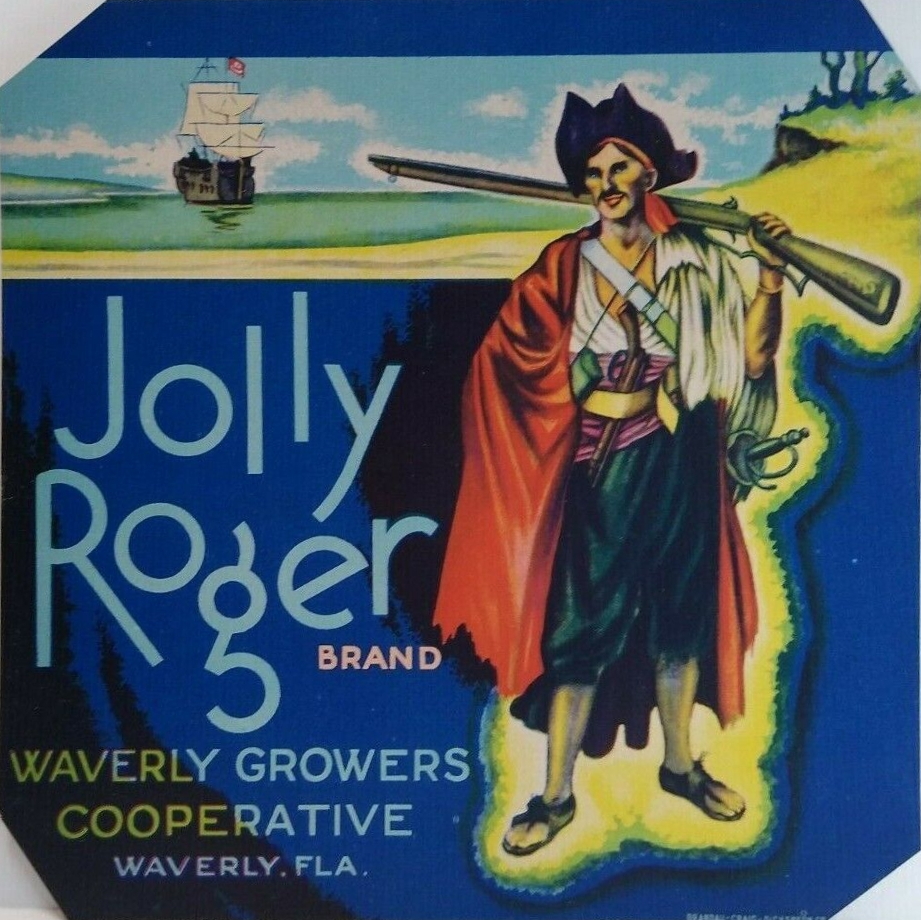
Perhaps the most significant homage to Pyle’s painting came from another great illustrator: Norman Rockwell. But Rockwell’s buccaneer is no longer the youthful adventurer with a touch of arrogance, but a tired grizzled veteran with torn cloak and shirt, a sash of a different color, a hat that has long lost its tassels, and a leg lost to a broadside, yet who keeps sailing the Main with his buccaneer brethren even as he begins to long for home. There are a few anachronisms, as there always are in such paintings: his pistol is of a later era, as is the cutlass that has replaced his rapier, and his boots are entirely fanciful and unhistorical — pirates didn’t wear any such footwear. But I find no real fault with such details. As I said, these are evocative, not historical images.
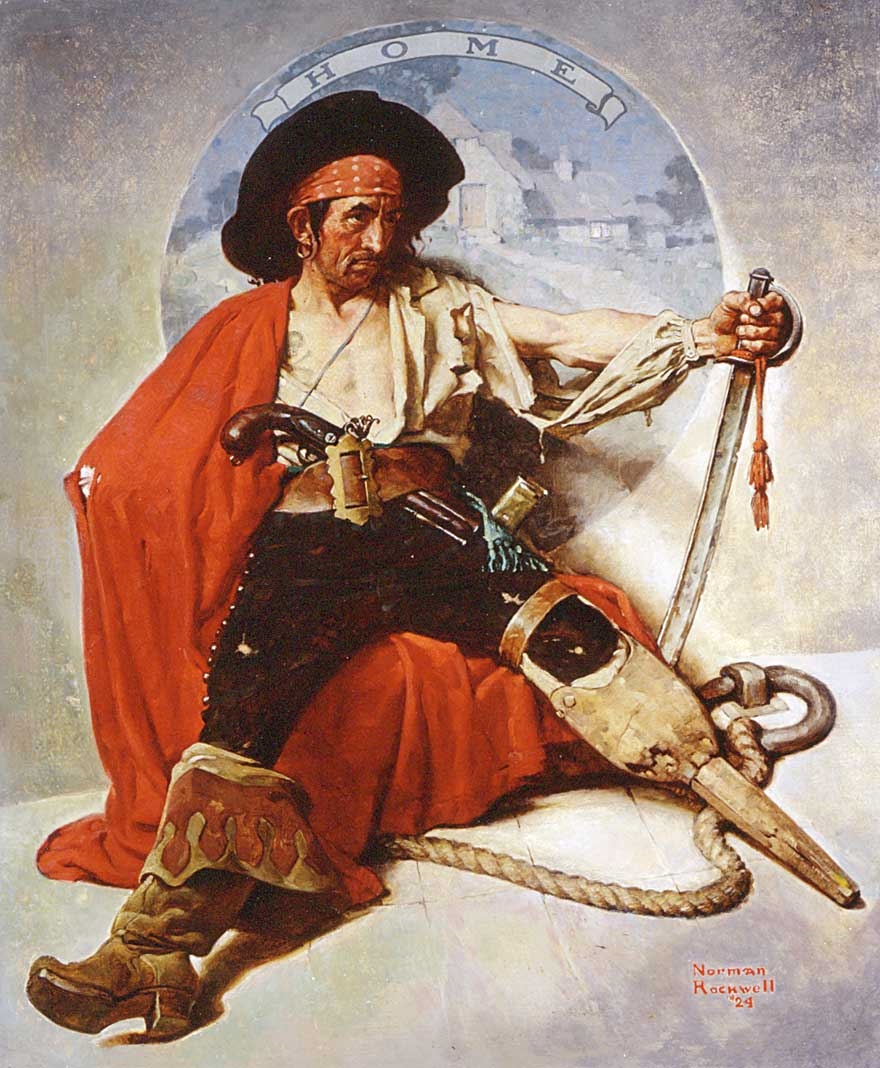
But I do find fault with the home Rockwell has the buccaneer dream of, for it evokes Olde England as N. C. Wyeth might have painted it — perhaps even the Admiral Benbow Inn! — and not Spanish America. I imagine our Spanish renegade buccaneer, young and old, longing instead for a place along the Spanish Main: Campeche or Veracruz, Havana or Matanzas, Puerto Bello or Maracaibo. Or perhaps he’s even from Spain! But no matter: he has chosen to sail with the hated buccaneers, and might never see his home or family again. But let us remember that these are only paintings, only part of the story: we might fill and finish the buccaneer’s tale as we please.

Copyright Benerson Little 2022 – 2026. First posted August 17, 2022. Last updated October 20, 2026.
MISC NEWS
At the Museo Naval de Madrid a few years ago.
Treasure Light Press
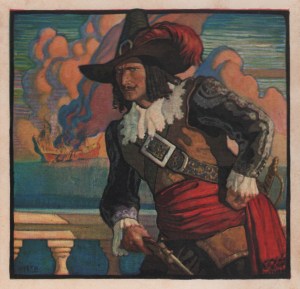
A new venture, to publish "Exceptional Annotated Editions of Classic Swashbuckling Adventure," beginning with the 100th Anniversary Annotated Edition of Captain Blood: His Odyssey by Rafael Sabatini. See Treasure Light Press's news & blog posts below.

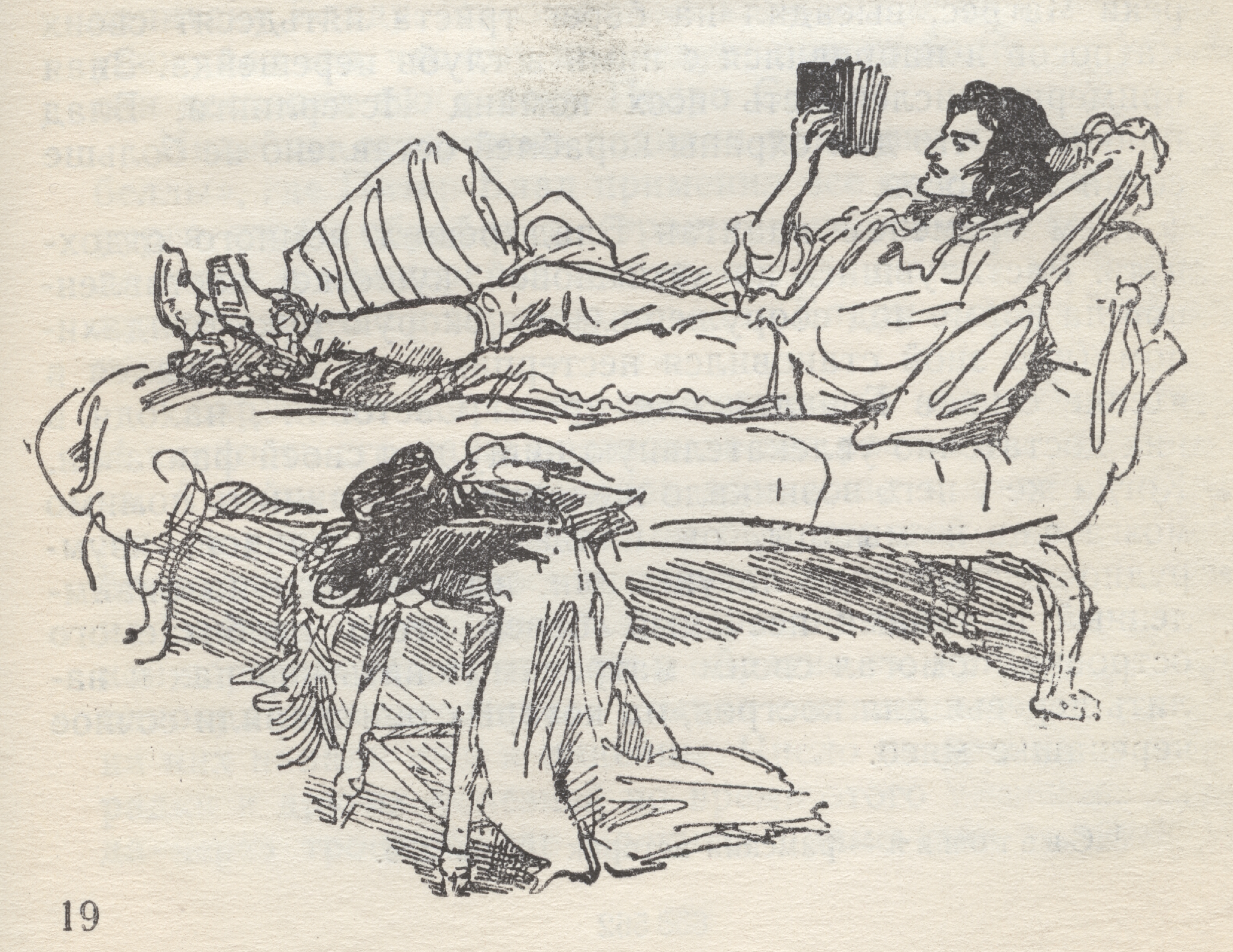



"My hours of leisure I spent in reading the best authors, antient and modern, being always provided with a good number of books; and when I was ashore, in observing the manners and dispositions of the people, as well as learning their language, wherein I had a great facility by the strength of my memory." —Jonathan Swift, Gulliver's Travels, 1726
Latest Posts
-
For Halloween: Ghostly & Gothic Nautical Adventure In Fiction
In keeping both with my post on Ghosts & Monsters for Halloween: Cinematic Nautical Romances & Swashbuckling Adventure and with my urge to procrastinate by writing…
-
The Eyes Have It! Or Do They? Where to Look When Crossing Swords
The scene is a familiar one: a fencing master admonishes a student to keep their eyes on those of the adversary when crossing swords, for…
-
Arr! Arrg? Yar? In Honor of Talk [Authentically] Like a Pirate Day!
Talk Like a Pirate Day! [Authentically Even, By the Powers!] I apologize up front for this hasty homage and celebration of Talk Like a Pirate…
-
Pirates & Brigands & Jack Tar: This “Naval Practice Cutlass” Is Not What You Think It Is (But Charles Dickens Knew!)
“Jack Tar — armed literally to the teeth — with a combat sword in each hand for use, and a third between his teeth for…
-
The Pirate Captain & His Burning Prey Upon the Background Billows: An Iconic Image
Arguably only a few illustrators have matched, and none have surpassed, Howard Pyle (1853-1911) for his iconic pirate images and their contribution to the modern…
-
The Duel on the Beach, Part V: In Reality
If you’ve read any or all of parts I though IV of this series (In Fiction, In Film, in Rafael Sabatini’s novel The Black Swan,…
-
Howard Pyle’s Famous “An Attack on a Spanish Galleon” — and Some Real Galleons Too!
Perhaps the most famous of Howard Pyle’s many piratical paintings and drawings, and certainly the most evocative, “Attack on a Spanish Galleon” has inspired many…
-
A Corsican Vendetta — Against the Pirates of the Caribbean!
Far too little-known are the Spanish corsarios of the Caribbean — the Spanish privateers and pirates who attacked the English, French, and Dutch in the…
-
Pirate Ships, Pirate Prey, & Pirate Hunters: Eyewitness Illustrations & Accompanying Stories
Modern histories of so-called Golden Age pirates — those circa 1655 to 1730 — are often filled with images of pirate ships, many of which…
-
“Dreams of Glory” — Captain Blood! (Updated!)
Originally posted on Treasure Light Press: https://benersonlittle.files.wordpress.com/2022/10/dreams-of-glory-captain-blood-lr-1.jpg Comic by William Steig, The New Yorker, 1952. I’ve seen myself in comics before — Calvin & Hobbes,…
-
“Captain Blood” on Halloween!
Originally posted on Treasure Light Press: https://benersonlittle.files.wordpress.com/2022/10/adjusted-captain-blood-dracula-jim-mcdougall-1.jpg “Captain Blood” by Jim McDougall, 13 April 2021. Courtesy of and copyright by Jim McDougall. A vampire —…
-
“The Buccaneer Was a Picturesque Fellow” by Howard Pyle
And indeed he was a picturesque — and picaresque! — fellow, the buccaneer! Howard Pyle’s painting of this romantic sea rover has influenced the imaginations…
-

Creating that Ship-at-Sea Sensation While Armchair Adventuring: Some Progressively Tongue-in-Cheek Suggestions
A practical, yet certainly tongue-in-cheek, post about creating a buccaneering sensory environment while reading Captain Blood in your armchair, playing Blood & Plunder or Oak…
-

Captain Blood, Not Jack Sparrow: The Real Origin of Disney’s Wicked Wench Pirate Ship
It’s an epic image, one that anyone who’s ever cruised through the Pirates of the Caribbean attraction at one of the Disney theme parks is…
-

The Duel on the Beach, Part IV: Flynn versus Rathbone in Captain Blood!
Classic film buffs, fencers, armchair adventurers, real swashbucklers, and romantics of many other stripes may debate over which film duel is the “best.” But no…


