
Home » Theatrical Swordplay
Category Archives: Theatrical Swordplay

Pirates & Brigands & Jack Tar: This “Naval Practice Cutlass” Is Not What You Think It Is (But Charles Dickens Knew!)
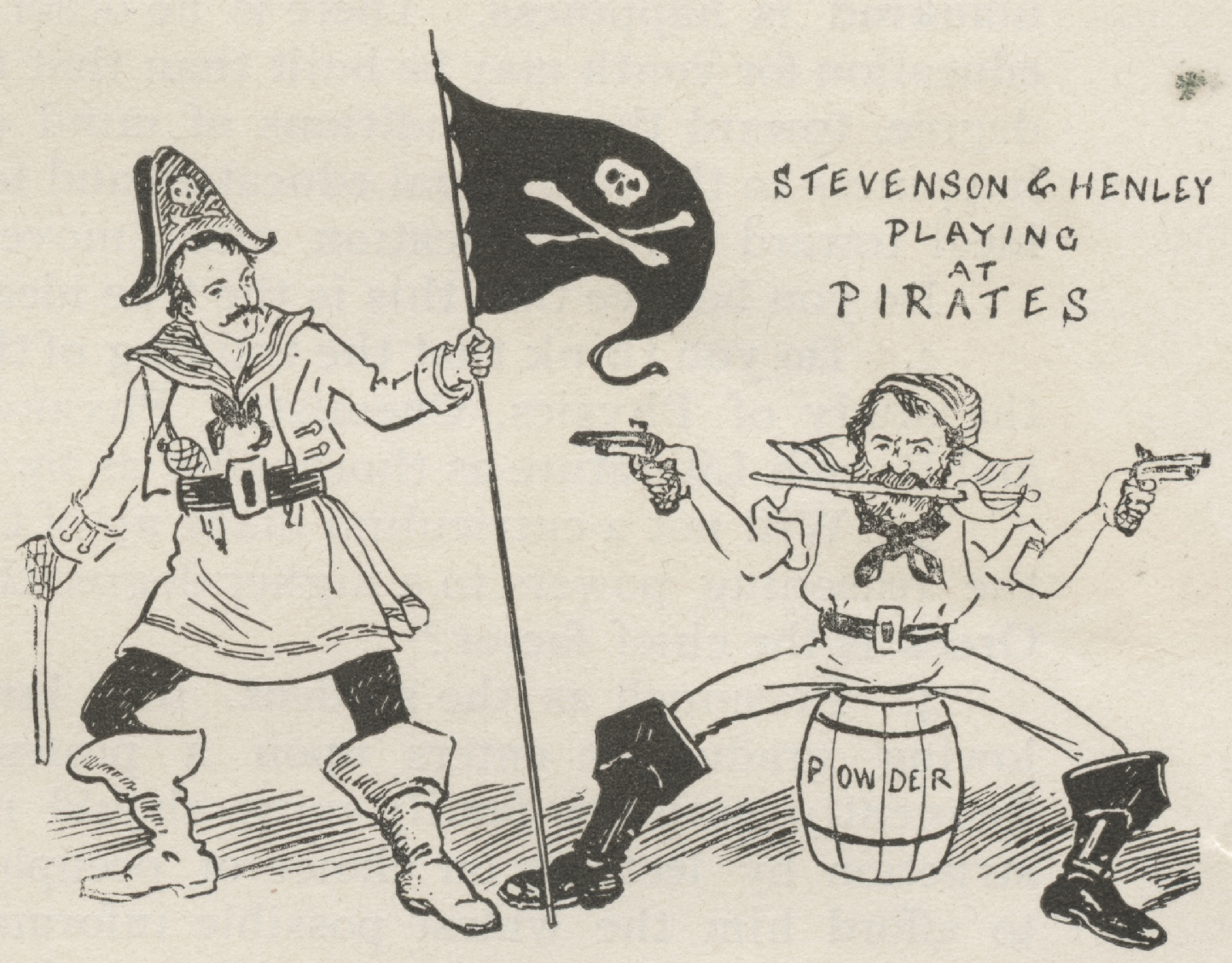
“Jack Tar — armed literally to the teeth — with a combat sword in each hand for use, and a third between his teeth for ornament, encountered and overcame with ease eight ‘piratical skunks,’ seven slain with bloodless slaughter, the eighth contemptuously discomfited with a ‘quid o’ bacca.'” (Excerpted from “Realism” by Philip Beck, in The Theatre, September 1, 1883.)
This is the popular personification of the English seaman of the oak and iron era, the seaman of Drake and Myngs and Nelson — Jack Tar as he came to be known! His cutlass gripped by his powerful horny hand! No brigand, no pirate, nor even scimitar-armed Barbary corsair could stand against the doughty English (or rather, British!) seaman blade-in-hand! Much less in both hands and between his teeth, long before Roronoa Zoro (Zorro l’Ollonois in English — two famous names!) independently developed this famous three-sword style in the pirate manga, anime, and live action series One Piece.

Notwithstanding the clashing and sparking of swashbuckling blades we’re going to discuss, you may consider this short essay as a Public Service Announcement as much as a rendering of sword history. Yes, it mentions pirates and brigands and Jack Tars, and cutlass practice and swordplay and fencing tempo, but it is ultimately a PSA intended to correct the record, thus:
Every once in a while, when searching for swords within my areas of interest for research or occasionally for purchase, I’ll run across a nineteenth century “naval practice cutlass” with a steel blade and iron or steel basket hilt. Recently I found one quite by accident, listed at a tenth of what I’ve often seen these swords priced at, and so I purchased it.
Typically these are listed by auction houses and antiquarian arms dealers as practice cutlasses dating variously to circa 1860, or to “the Great White Fleet” or “the Spanish-American War,” or “between WWI and WWII.” Of course, the inability of dealers to properly date an arme blanche, even a practice one, more precisely is always a red flag. More on this in a moment. For now, we’ll assume the style of the “practice cutlass” I purchased was in service for a long time, as real and practice weapons often are.
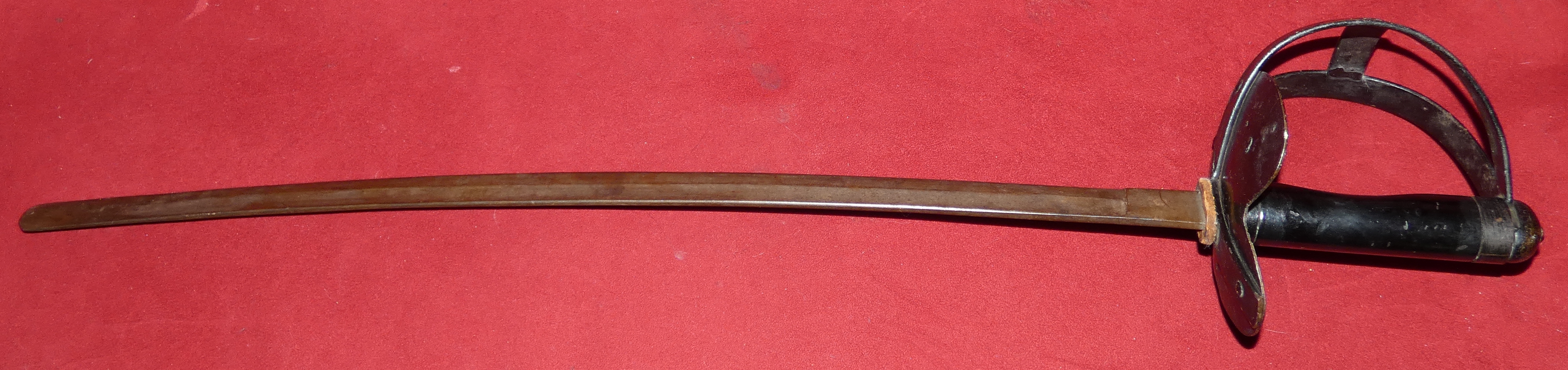
My new “practice cutlass” is in near-mint condition, the blade largely un-nicked, the blackening of the basket hilt largely unscratched, and, curiously, a gold tint to the blade (quite common with some of these swords) still quite obvious. I was immediately taken with its excellent balance permitting credible feint attacks in spite of its weight. Most cutlasses, including practice weapons and blunted re-enactment arms, are clumsy affairs, more suited to direct attacks and strong simple parries at close quarters. But not this one! It has a lovely balance, one that immediately feels perfect in the hand. For a cutlass, it is sturdy with a solid feel, yet light at the tip in spite of its two and a quarter pound weight. Moulinets? With ease! The blade practically spins in the hand.


Immediately I contacted my friend and armes blanches expert and collector, not to mention expert designer and craftsman in models and miniatures, comic artist, raconteur, and more, Jim McDougall for his expert opinion. I paraphrase his reply: the blade appears to be a cut-down 19th century saber blade, the hilt sturdy but rather crudely put together, the grip emulating a circa 1900 style, and a generally ersatz appearance. (Any error in this summary of his words to me is mine alone.)
These observations would not alone implicate the “practice cutlass” as being fake, but there’s more: naval cutlass practice in the 19th century was of two forms. In the first, sailors (or “seamen” in the UK) drilled the general cuts and parries with real cutlasses but without contact. Forget Hollywood and novelists — no one used real swords for practice with contact, ever. Such practice spoils the edge and is likely to break blades as well, given that that the blades of sharps are not tempered for countless bending and beating as practice blades are, not to mention the inherent dangers of practicing with pointed, sharp-edged swords.
In the second, sailors exercised with practice cutlasses with leather basket hilts and wooden blades — short-bladed singlesticks in other words. The use of heavy steel blades for practice with contact, which was done for example by Hungarian sabreurs in the pre-Santelli era, requires heavily-padded fencing masks and jackets. When such protective equipment was seen shipboard, it was associated not with steel-bladed practice weapons but with singlesticks, a particularly useful practice given the sailor/seaman’s natural tendency to hit hard and hit often. Notably, neither secondary history nor period primary sources on naval cutlass drill and naval swordplay describe practice with steel-bladed practice cutlasses.
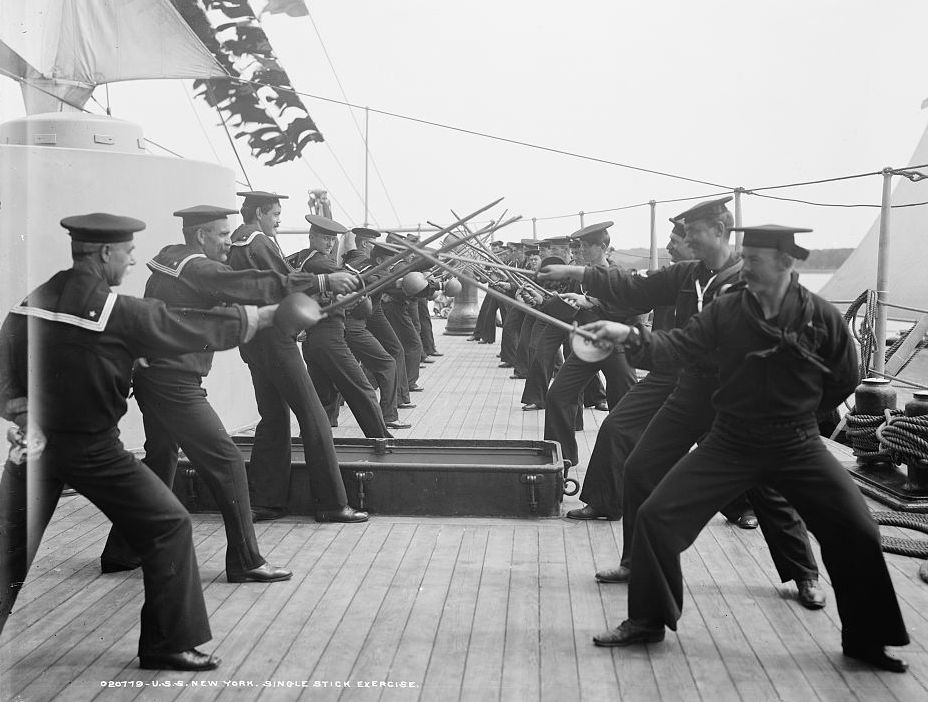
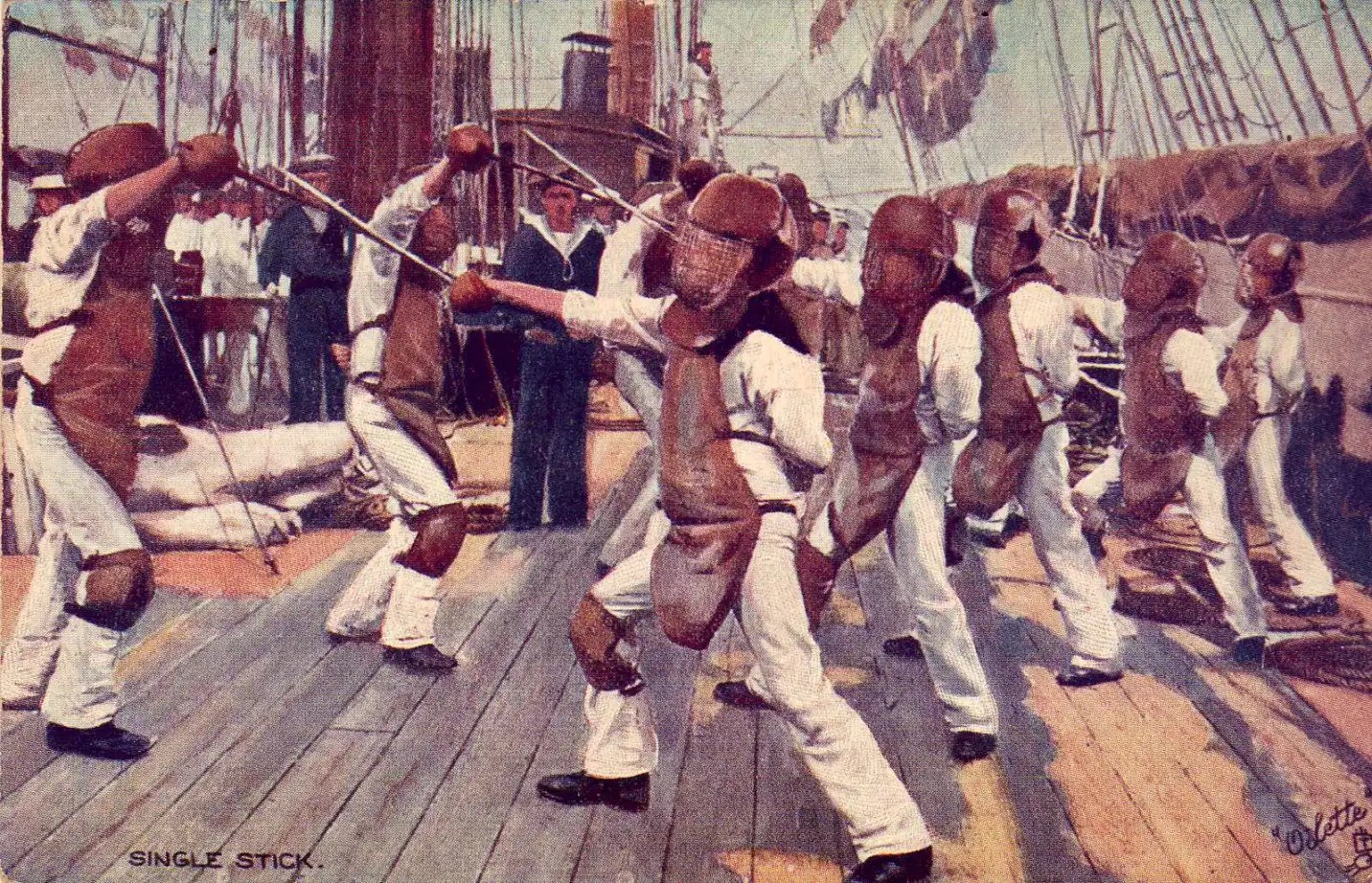

After Jim’s reply, I went through my extensive fencing library, both of real and digital volumes, then searched further online. Catalogs were an obvious source, and which quickly rewarded me, thus:

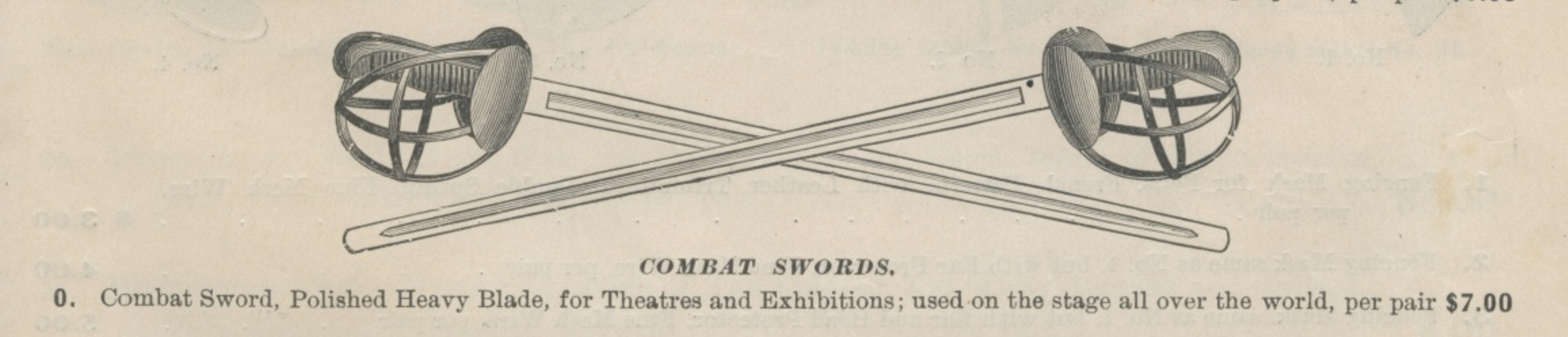
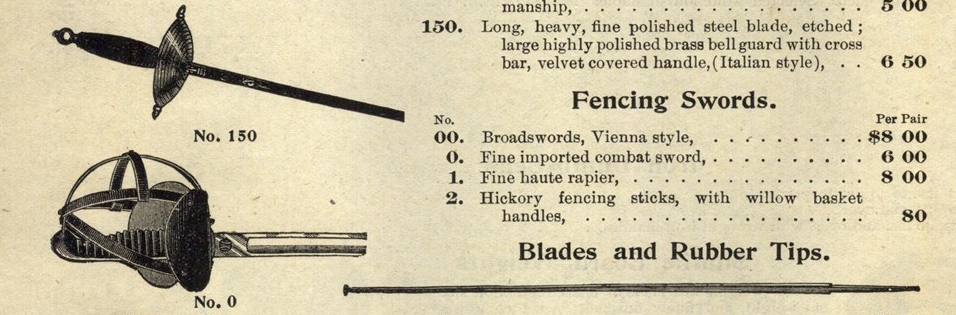
As is now obvious, my “naval practice cutlass” is in fact a theatrical sword known as a “combat sword” used, as one ad above notes, “for Theatres and Exhibitions; used on the stage all over the world.” Combat swords like these were “common theatrical properties” in the 19th century, and these swords and their stage combats were a common feature of 19th century British popular theater, particularly among the provincial theaters and touring troupes in the first half of the century, although their combats were performed throughout the century and in other theaters as well. So associated with the theater was the combat sword that Robert Louis Stevenson is holding one in the image at the top of the page. (Side note: the article that accompanies the image is about Stevenson and Henley’s new play, Admiral Guinea, in which Treasure Island villain Blind Pew features prominently.)
Charles Dickens (probably; he was at the very least the editor of the piece) gives perhaps the second best description (and also the best, farther below) of the 19th century practice of stage combat with “combat swords” in the popular theater:
“Broad-sword combats were at one time very popular interludes at minor theatres. They were often quite distinct performances, prized for their own sake, and quite irrespective of their dramatic relevancy. It cannot be said that they suggested much resemblance to actual warfare. Still they demanded of the performers skill of a peculiar kind, great physical endurance and ceaseless activity The combat-sword was an unlikely looking weapon, very short blade with a protuberant hilt of curved bars to protect the knuckles of the combatant. The orchestra supplied a strongly accentuated tune, and the swords clashed together in strict time with the music. The fight raged hither and thither about the stage, each blow and parry, thrust and guard, being a matter of strict pre-arrangement. The music was hurried or slackened accordingly as the combat became more or less furious. “On, two, three, and under; one, two, three, and over;” “robber’s cuts;” “sixes;” the encounter had an abundance of technical terms. And each performer was allowed a fair share of the feats accomplished: they took turns in executing the strangest exploits.
“Alternately they were beaten down on one knee, even lower still, till they crawled serpent-wise about the boards; they leaped into the air to avoid chopping blows at their lower members; they suddenly spun round on their heels, recovering themselves in time to guard a serious blow, aimed with too much deliberation, at some vital portion of their frames; occasionally they contrived an unexpected parry by swiftly passing the sword from the right hand to the left. Now and then they fought a kind of double combat, wielding a sword in either hand. Altogether, indeed, it was an extraordinary entertainment, which evoked thunders of applause from the audience. The eccentric agility of the combatants, the peculiarities of their method of engagement, the stirring staccato music of the band, the clashing of swords and the shower of sparks thus occasioned, were found quite irresistible by the numberless playgoers… Of late, however, the broad-sword combat has declined as a theatrical attraction, if it has not altogether expired. The art involved in its presentment is less studied, or its professors are less able than once was the case.” (Excerpted from “Alarums and Excursions” in All the Year Round, March 9, 1872, edited by Charles Dickens.)
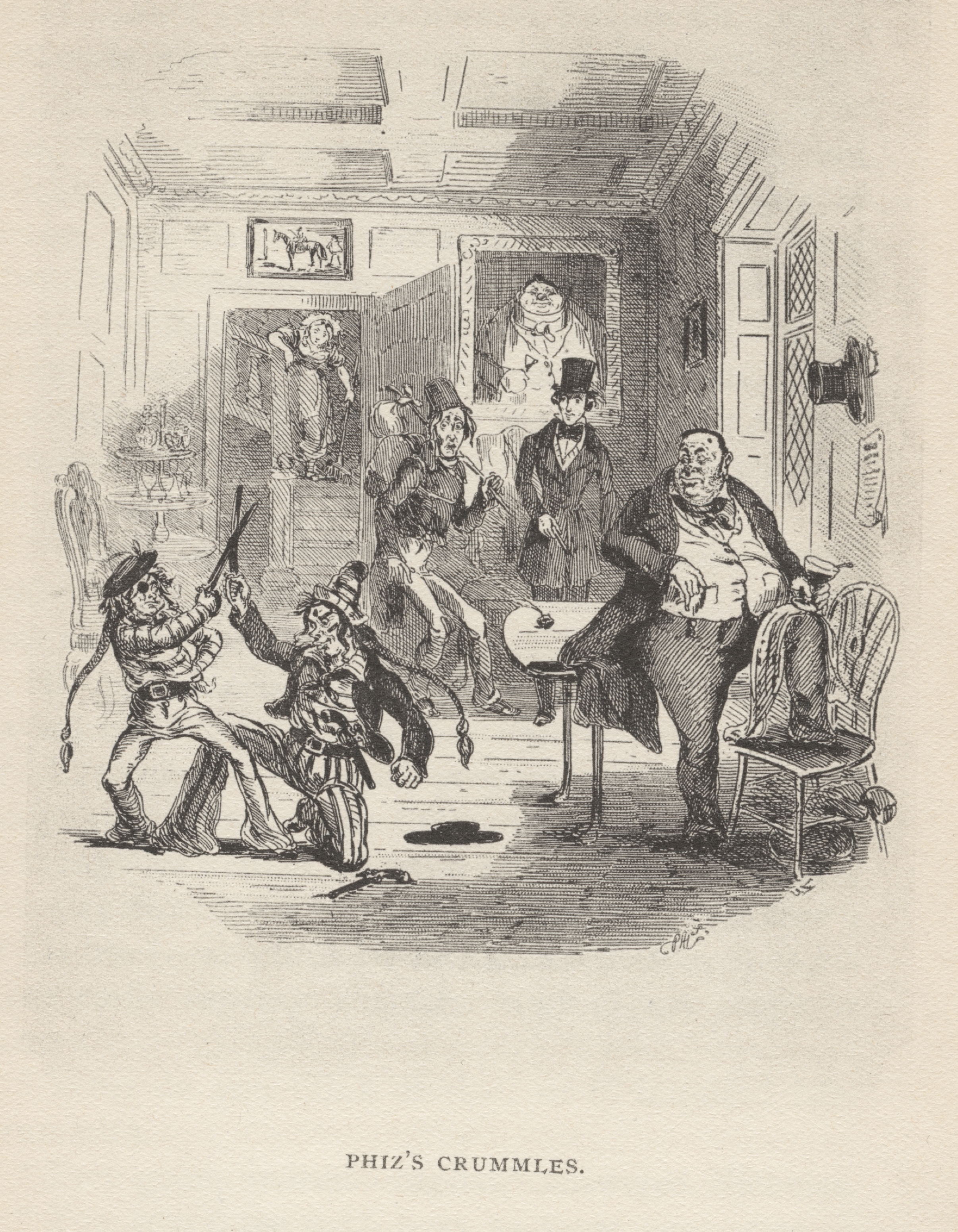
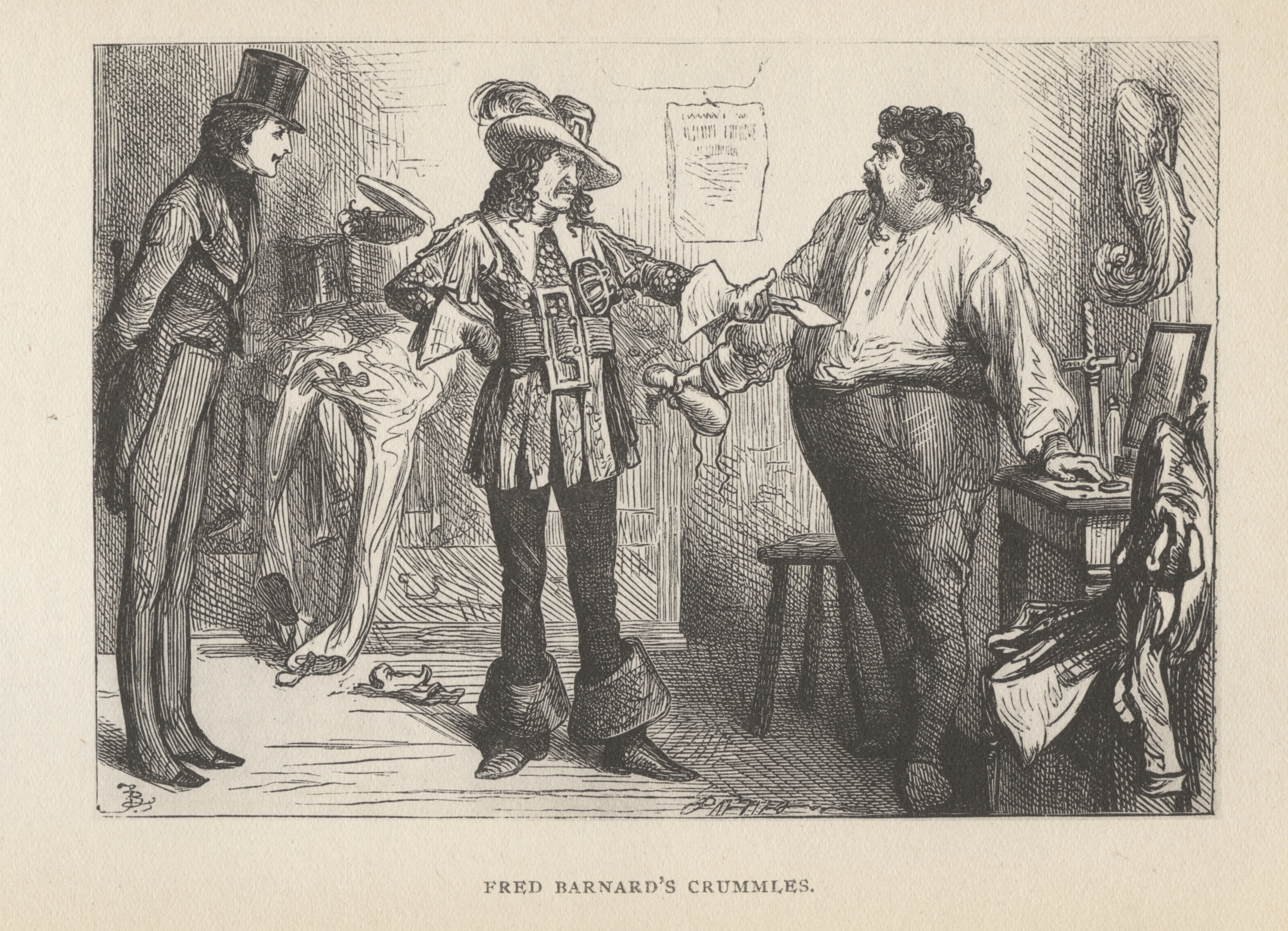
From Nicholas Nickleby by Charles Dickens we have a surely experience-based description of a rehearsal combat between two young actors dresses as Jack Tars and armed with combat swords. Dickens was once a young player in the “minor theatre” in Great Britain, and more than one historian considers his description of such theater in Nicholas Nickleby to be based on his own experience. Some scholars even point to specific persons who likely inspired some of the theater characters.
“Nicholas was prepared for something odd, but not for something quite so odd as the sight he encountered. At the upper end of the room, were a couple of boys, one of them very tall and the other very short, both dressed as sailors — or at least as theatrical sailors, with belts, buckles, pigtails, and pistols complete— fighting what is called in playbills a terrific combat, with two of those short broad-swords with basket hilts which are commonly used at our minor theatres. The short boy had gained a great advantage over the tall boy, who was reduced to mortal strait, and both were overlooked by a large heavy man, perched against the corner of a table, who emphatically adjured them to strike a little more fire out of the swords, and they couldn’t fail to bring the house down, on the very first night.
“‘Mr. Vincent Crummies,’ said the landlord with an air of great deference ‘This is the young gentleman.’
“Mr. Vincent Crummles received Nicholas with an inclination of the head, something between the courtesy of a Roman emperor and the nod of a pot companion; and bade the landlord shut the door and begone.
“‘There’s a picture,’ said Mr. Crummles, motioning Nicholas not to advance and spoil it. ‘The little ‘un has him; if the big’un doesn’t knock under, in three seconds, he’s a dead man. Do that again, boys.’
“The two combatants went to work afresh, and chopped away until the swords emitted a shower of sparks: to the great satisfaction of Mr. Crummles, who appeared to consider this a very great point indeed. The engagement commenced with about two hundred chops administered by the short sailor and the tall sailor alternately, without producing any particular result, until the short sailor was chopped down on one knee ; but this was nothing to him, for he worked himself about on the one knee with the assistance of his left hand, and fought most desperately until the tall sailor chopped his sword out of his grasp. Now, the inference was, that the short sailor, reduced to this extremity, would give in at once and cry quarter, but, instead of that, he all of a sudden drew a large pistol from his belt and presented it at the face of the tall sailor, who was so overcome at this (not expecting it) that he let the short sailor pick up his sword and begin again. Then, the chopping recommenced, and a variety of fancy chops were administered on both sides; such as chops dealt with the left hand, and under the leg, and over the right shoulder, and over the left; and when the short sailor made a vigorous cut at the tall sailor’s legs, which would have shaved them clean off if it had taken effect, the tall sailor jumped over the short sailor’s sword, wherefore to balance the matter, and make it all fair, the tall sailor administered the same cut and the short sailor jumped over his sword. After this, there was a good deal of dodging about, and hitching up of the inexpressibles in the absence of braces, and then the short sailor (who was the moral character evidently, for he always had the best of it) made a violent demonstration and closed with the tall sailor, who, after a few unavailing struggles, went down, and expired in great torture as the short sailor put his foot upon his breast, and bored a hole in him through and through.
“‘That’ll be a double encore if you take care, boys,’ said Mr. Crummies. ‘You had better get your wind now, and change your clothes.'”
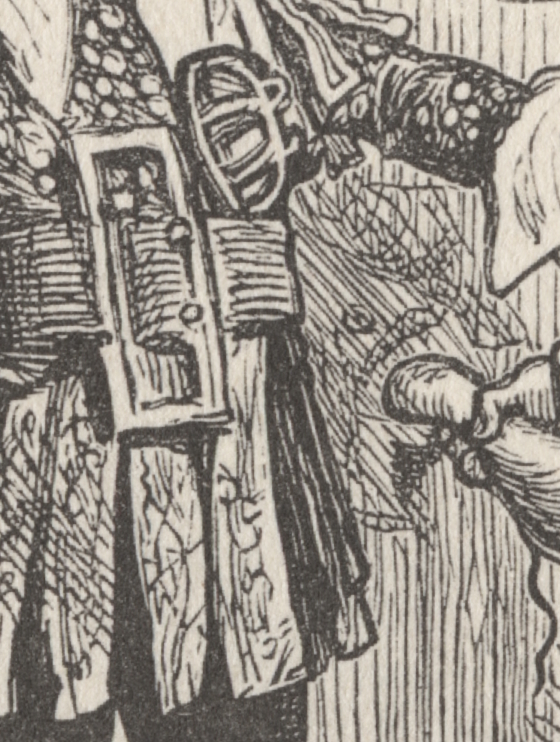
In The Adventures of a Strolling Player, Simon Tomkins (a pseudonym) describes a comical end to Hamlet during the duel, fought not with foils or stage rapiers but with combat swords: “Not being able to procure foils Hamlet and Laertes were obliged to indulge in those deadly weapons technically known as combat swords which are greatly used by stage robbers, pirates, and British sailors. As fencing would have proved rather ineffective with these clumsy instruments and as Laertes was not au fait in that elegant accomplishment, it was judged expedient at rehearsal to change the received mode for that of a cut and thrust melodramatic description. But alas! Polonius’s son by no means justified the encomiums of the gentleman from Normandy who gave him such report for art and exercise in his defence, for he missed half the blows and when Hamlet was striking down he was usually striking up and vice versa; in brief they performed what actors call the ‘double misses.’ This excited much derision from the audience…”
“Snifkins [playing Hamlet] brought the duel to an end as quickly as possible, but when he rushed upon his father in law instead of that gentleman suffering himself to be quietly run through the body as every Claudius has from the days of Shakespeare, he presented a sword and reeling forward exclaimed ‘Come on old cock I’ll teach you to fight the round eights!’ A touch however was sufficient to destroy his equilibrium and having prostrated his arch enemy, Hamlet died as quickly as possible and the curtain descended amidst hisses and derisive laughter.”


Philip Beck provides more detail in 1883: “Time was, and not long since, when a combat generally consisted what is technically known as round eights, singles, threes, broken fives, primes (pronounced preams), double primes, and passes. Very popular was a mysterious combination known as the ‘Glasgow Tens;’ so also was another desperate encounter, carefully arranged, and called ‘The Gladiators,’ this last being a combat fought to music, each blow being struck to its accompanying note or chord in the orchestra.” (Excerpted from “Realism” by Philip Beck, in The Theatre, September 1, 1883.)
Walter Herries Pollock (“Stage Swordsmanship,” The Theatre, June 1, 1896) notes that the swordfights were fought only with the “cutting” edges, and the thrust was used only to deliver the final blow: it was “delivered between the arm and body to make an end at last of the principal villain.” There is a late but fine example of this thrust ‘twixt arm and body in the 1924 silent film Peter Pan, in which John “kills” a pirate.
Actor Frank Price in 1892 described a stage combat he had once had with Irishman George St. George, a stage name of course; the Irishman noted that he would not be hired in England under his real Irish name, so prevalent was anti-Irish sentiment. “I was playing the heavy part,” Price writes, “and in the last scene George and I had a grand sword combat, during which the air was thick with eights, fives, Glasgow tens, and occasional bad language when a stroke was missed or a shin damaged. After great excitement George, having guarded a head blow from me, was wont to kill me in the effective but mysterious manner adopted on the stage.”
A few years later Price was traveling in disguise as an Arab for safety in Egypt during the “Soudan War” (the Mahdist War, 1881-1899) when he came across a red-whiskered Arab in his path. After mangling an Arabic expression intended to determine whether the Arab before him was friend or foe and not receiving the reply he was told to expect from a friendly Arab, Price and his likely enemy drew their swords and fought, Price using all of his stage combat skill in round eights and Glasgow tens and more. But just as he forced a head parry and was about to deliver the killing stroke, his Arab adversary shouted, “Murther alive! I’m kilt!” It was George St. George, also traveling in disguise for safety. (From Frank Price, “A Grand Combat,” The Era Almanac, 1892.)
What were the “Glasgow tens” and similar patterns? The best description I’ve found so far is in Cut and Thrust: The Subtlety of the Sabre by Leon Bertrand, 1927, in which the author refers to the “Glasgow cuts”: “Hero and villain would cross swords on either side with the points raised, the blades meeting with rare swish. These manœuvres were continued, the wide sweeping cuts describing a downward course until steel met steel again. If the encounter had to be prolonged these movements were repeated in toto — and then somebody had to die. Nobody was deceived. Rather, both principals gave an idea they were sharpening each other’s blades for the Sunday joint.” One imagines a repeated series of tierces and secondes, perhaps with an occasional quinte replacing a tierce — a series often still seen in Hollywood and on stage even today. These are not exchanges of attack, parry-riposte, counter-parry-riposted, &c, but of blades flung into position and clashing against each other.
Likewise the “one, two, three, and under” and “one, two, three, and over” noted above Dickens: the former is probably a clashing of blades in tierce, seconde, tierce, then a thrust to the flank, the latter reversed, a clashing of blades in seconde, tierce, seconde, and a thrust to the torso high.
Unsurprisingly, fight director William Hobbs (The Three Musketeers, The Four Musketeers, The Duellists, and many more, plus innumerable stage combats) is quite familiar with the old series of blade contacts, in his Stage Combat (1980) listing The Square Eights, The Round Eights, The Glasgow Tens (which he writes was known in England as The Long Elevens), and even The Drunk Combat. He describes them perhaps more lively than I have, as “whacks at the blade.”
A real sword fight based on old stage combat techniques notwithstanding, Philip Beck also noted that by the late 19th century many actors were now taught conventional swordplay, even if, he writes tongue-in-cheek, it is “one, two, and third in your bosom” — probably an “un, deux, trois” (three disengages, each in the opposite direction, the first two as feints, the third “thrust home”) although it might more broadly be any two feints prior to the final, a form of attack many modern sport fencers are now, sadly, unfamiliar with except occasionally in theory or, even more rarely, as an exercise in blade control and timing, much less actually able to perform when actually fencing.
William Hobbs notes that Felix Bertrand of Salle Bertrand trained many actors in swordplay. Other sources point to William McTurk, assistant fencing master and later fencing master at King’s College London, and, according to J. D. Aylward in The English Fencing Master, Baptiste Bertrand of Salle Bertrand on Warwick Street in London led the effort to train actors in proper swordplay and may be considered the late 19th century founders of the modern schools and efforts at theatrical and film swordplay in the UK although many actors on their own learned to fence in order to improve stage swordfights. Aylward blames Captain Alfred Hutton “and his circle” for educating the public in swordplay; no longer would theatergoers be satisfied with the mere clashing of combat swords. Even so, Leon Bertrand in his 1927 Cut and Thrust: The Subtlety of the Sabre notes that the “Glasgow tens” were still seen occasionally on stage and even in some of the silent films of the day.

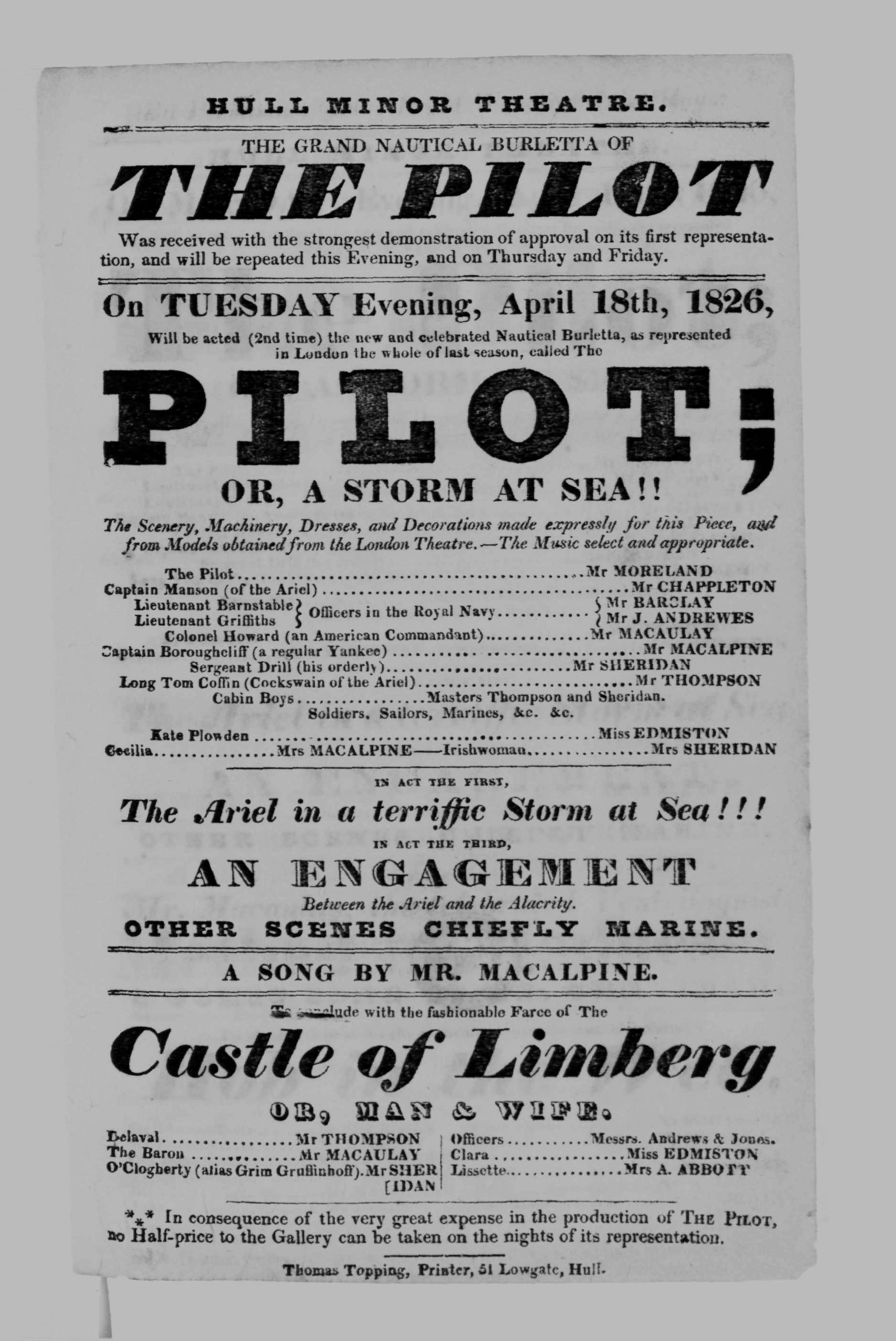
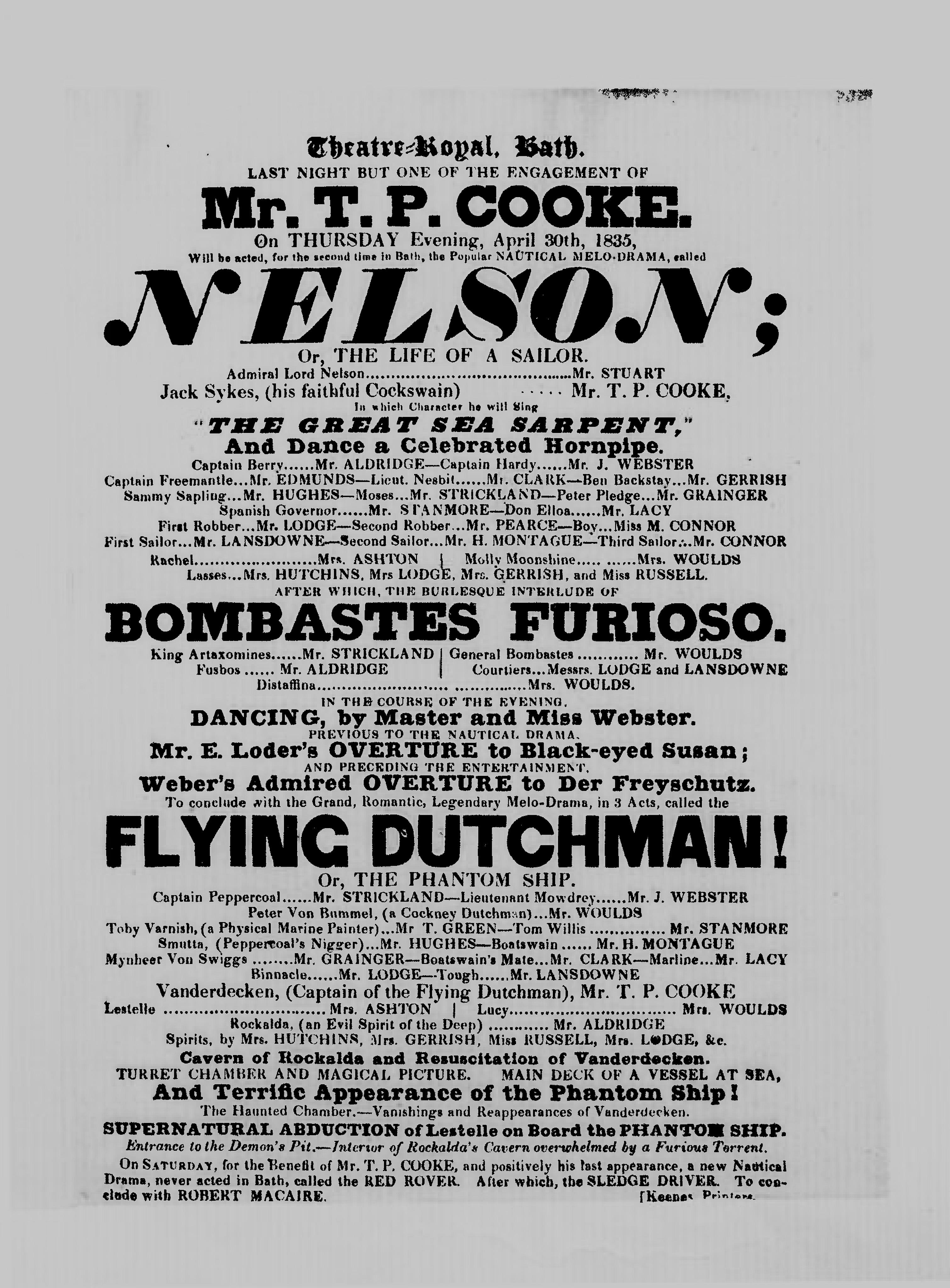
Above, early 19th century nautical melodrama playbills. Courtesy of the British Library.
The combat sword doubtless owes its origin to the popularity of nautical theater in which the swords were used in choreographed combats composed of Jack Tars dispatching various villains, usually pirates, bandits, and Moors. These nautical dramas — melodramatic compositions of nautical cliches and tropes extolling the vigorous virtues of British seamen — were one of the most common presentations in the popular theater of 19th century Britain, with Jack Tar its hero and the athletic combat sword-wielding, hornpipe-dancing T. P. Cooke its most famous actor. Begun during the Napoleonic wars when the British Navy prevented Bonaparte from invading and set the stage for his defeat on land, the playful entertainment struck a chord with the working and middle classes and remained popular past mid-century. Sword combats also became a routine part of burlesques during the same period.

But as the nautical melodrama and the burlesque began to fade in popularity, the combat sword found its way into other productions, even being used to represent Medieval broadswords on occasion. Pollock notes that in the late 19th century in which he wrote, “the combat-sword, alack, is dead in almost all London theaters. It survived for a time in various burlesques, at the Olympic, for instance, in Robson’s days, and later yet; and it may very likely drag on an existence is some outlying and country theaters.”
The musical rhythm of and musical accompaniment to these popular stage combats made for safe, or at least safer, choreography, and helped rouse the audience to greater and greater excitement — just as in film swordplay today. Additionally, the weight of the combat sword made for slower movements, ideal for the stage — the audience could follow them.* The basket-hilt provided good hand protection, and this is probably the reason for its design, as Dickens noted, and not to emulate the rare true basket-hilt cutlass.
On the other hand, as I’ve pointed out in my post on Buccaneer Cutlasses, even a dull cutlass can split skin, break bones, and put eyes out, and any error in choreography could result in serious and possibly fatal injury. Thus the typical timing of the combats to musical accompaniment with a regular beat. No irregular rhythms here even though they’re ideally suited to real combat. It bears repeating: stage combat is not simply an imitation of real combat without real hits. (For further information on stage/film sword combat, see The Duel on the Beach in Captain Blood and The Duel on the Beach in Film.)

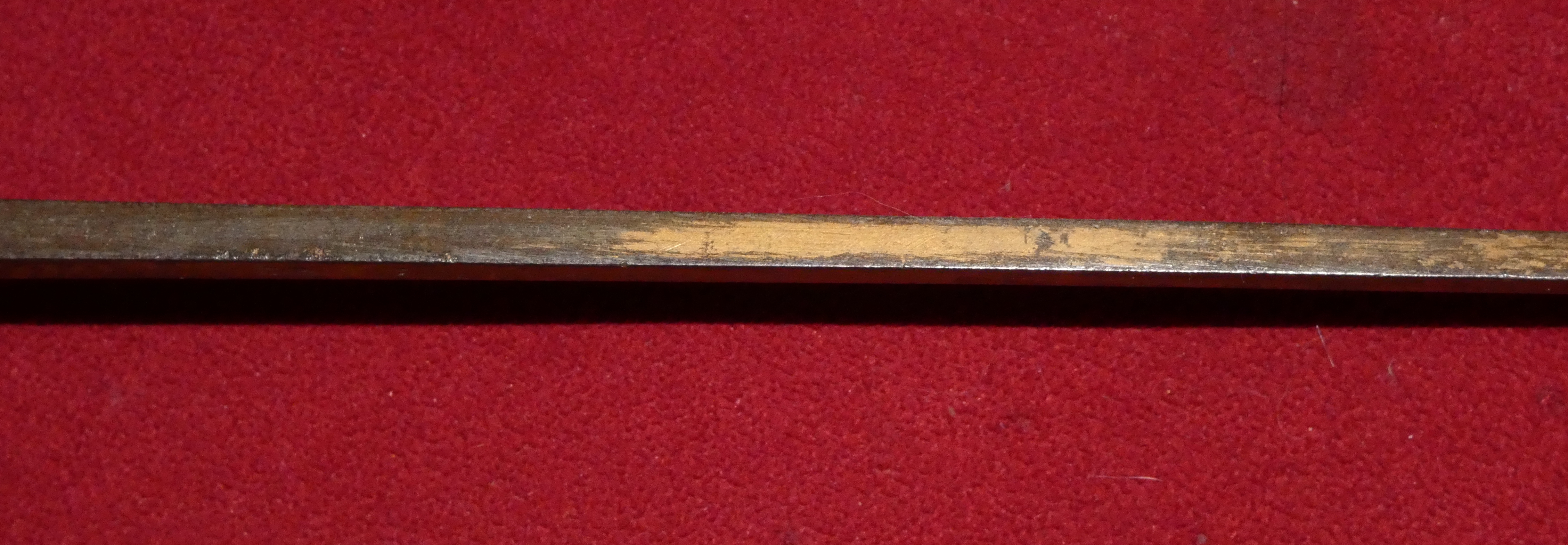
The gold tint present on many examples of combat swords was probably applied to make the blades stand out more to the audience. It was often noted how difficult it was for swordplay to stand out on the often poorly-lighted 19th century stage. Between the poor general lighting and the bright footlights, it could be difficult to follow blade movement unless the blades were broad and, as we see here, brightened with gold tint or paint. At the end of the century Pollock noted the difficulty of seeing foils on stage, and that that larger hilts were developed and attached to thicker blades so that the audience could better follow the swordplay, a practice that continued well into the development of cinema — thus the anachronistic rapier hilts with epee blades used in Captain Blood (1935), for example.
This practice of tinting or painting may have been applied to other swords used on the stage as well, particularly the narrow quadrangular foils that began to replace the combat sword in the latter half of the 19th century. On one of my walls are two fully functional foils, each more than a century old. One has a decorative figure eight guard, the other an etched round guard and etched blade. These are not Toledo wall hangers, but foils that could be used for fencing and indeed were, based on the nicks on blades and guards. Curiously and importantly, the blades of both have remains of gold tinting or paint, very similar in color and tone to the combat sword, leading me to believe that these are not, as I had first assumed, presentation foils, perhaps given as awards for fencing victory or service, but are in fact stage weapons — exactly the sort that begin to replace the combat sword when William McTurk and his contemporaries and their heirs began instructing actors in legitimate swordplay adapted for the stage.


Occasionally an astute arms seller or observer posting on the Internet points out that the iron-hilted, steel-bladed purported naval practice cutlasses under discussion are absolutely not such at all, but are “gymnastics” or “gymnasium” weapons used, obviously, in gymnasiums. The first point is entirely correct, and the second is correct after a fashion too, but they miss the swords’ actual or at least original use. So, were these stated “combat swords” ever used in gyms? It seems certain. First, they are ideal for individual practice, not only in cuts and parries but also for strengthening hand and forearm — I much prefer mine for solo practice rather than a replica wood singlestick cutlass.
Second, most examples found today are in excellent condition, with few if any nicks, indicating that they were not used on the stage or for any form of blade-to-blade contact. Third, there is occasional evidence that some surely did make their way into gyms. For example, regarding various existing exercise equipment in a military gym, “To these soon will be added the discus and bar bells, leaping pole, foils, combat swords; masks and gloves; and this is a complete a gymnasium as may be found in or out of the Army.” (Excerpted from “A Military Gymnasium,” Army and Navy Journal, 19 April 1884, bold italics mine.) I suspect that the majority sold in the late 19th and early 20th centuries ended up in gymnastic, not stage, use.
So, should these sword be considered of value to collectors? Of course! Their 19th century stage combats were as popular as any of our favorite film sword combats today, and their swords were as functional and historical as the foils, epees, and sabers used then for sport and for preparing for duels or battlefield combat. And, if used by a famous actor, combat and other stage swords were just as popular and just as expensive as any film sword today that was once used by Errol Flynn or in Star Wars. Who for example might not wish to own one of these or even the Hollywood foils used by Errol Flynn and Olivia de Havilland for Captain Blood publicity stills? In 1876 The Illustrated Sporting New Yorker noted that a drama editor in the city had purchased the sword used by famous actor George Frederick Cooke (no relation to T. P. Cooke) in the final act of Richard III during his notable American tour in the early 19th century. The writer notes tongue-in-cheek that the sword is the forty-ninth “original Cooke” combat sword now on display.
If the combat sword was good enough for Charles Dickens who gave us a pirate with “the one eye and the patch across the nose” in The Perils of Certain English Prisoners and Robert Louis Stevenson who gave us swashbucklers galore, it’s good enough for armchair, stage, and real swashbucklers anywhere!
Copyright Benerson Little 2025. First published 19 August 2025. Last updated on November 18, 2025.
* Heavier weapons are not only easier for an audience to follow, but also for directors and judges, or as they’re called today, referees and judges (the latter are seldom used anymore in modern fencing), to follow. Some years ago my close friend, also my former fencing master, Dr. Eugene Hamori, a Hungarian by birth, along with a Polish fellow Olympic medalist, proposed to the FIE to fix the numerous issues with modern saber by using heavier sabers of roughly 16 ounces — a mere return to the one to one-and-a-half pound weight of sport sabers in the 1920s and 30s. The proposal was ignored: the status quo will have nothing but the status quo — to keep fencing in the Olympic Games no matter the cost, no matter the degree of change from true swordplay to sport nonsense — and modern fencing will continue its decline into pure sport rather than the sport version of martial combat with swords.

The Duel on the Beach, Part IV: Flynn versus Rathbone in Captain Blood!

Classic film buffs, fencers, armchair adventurers, real swashbucklers, and romantics of many other stripes may debate over which film duel is the “best.” But no matter the standard, the duel between Errol Flynn as the hero Peter Blood and Basil Rathbone as the villain Levasseur in Captain Blood (1935) as choreographed by Fred Cavens always makes the top few, often at number one. For me, there is no contest. There are a few far more historically accurate film duels (in fact, there are only a few historically accurate film duels at all), and there are a few film duels more technically proficient (for example, The Mark of Zorro), but none in my opinion exceed this one in sheer excitement, drama, swashbuckling swordplay, and watching pleasure.*
Of the duel, George MacDonald Fraser (author of The Pyrates, the Flashman series, and more, plus screenwriter of The Three and Four Musketeers, historian, swordsman, journalist, and soldier) in The Hollywood History of the World regards it as “the most famous of screen duels…” and “Flynn v. Rathbone (Captain Blood) belongs in some swordsmen’s Valhalla of its own…” I cannot agree more.
The duel certainly had something to do with the resurgence of fencing’s popularity in the US in the mid- to late 30s as well: “No doubt, it was ‘Captain Blood’ that brought about the renaissance of the duel [in film].” (Risher, 1936. See also Grant, 1937).
The 1935 release, a remake of the silent 1924 film, was hotly anticipated although the potential cost of filming ships at sea had put its production at risk for several years. Sea stories were expensive to film with real ships, and “three completed shooting scripts” had attempted to solve the problem, in part by reducing the number of ships. The solution was finally found in “process-shots” — miniature ships, fort, and town filmed for the sea battles and cannonadings. In fact, few scenes were filmed on location; the duel was arguably the most vital one. (Jackman, 1936.)
Newspapers and film magazines ate up rumors, often created by Warner Bros. studio as part of its publicity campaign, regarding who would star in the film. At one point Robert Donat and Jean Muir were rumored to star, and later Bette Davis in Muir’s place. Many others were considered as well. But it was Irish-Australian newcomer Errol Flynn who landed the lead and after some re-shoots fell naturally into the role.
Costing a reported $1,000,000, the film was directed by Hungarian-born Michael Curtiz, and also starred nineteen-year-old Olivia de Havilland fresh from stage and film performances in A Midsummer Night’s Dream. Basil Rathbone and an array of established character actors filled out the cast, supplemented by a number of real life adventurers among the ship crews and extras. Erich Wolfgang Korngold, whose film music would change Hollywood forever, wrote the score, most of it original, some adapted from Liszt. Anton Grot designed the sets and Dwight Franklin provided the historical consulting. Casey Robinson adapted the novel to the screenplay, simplifying it greatly but keeping the essentials. Released at Christmas, the swashbuckling romance was an immediate blockbuster and launched Flynn and de Havilland to stardom.
Historical note: the film premiered on December 19, 1935, was released in New York City on December 26, and had its national release on December 28. Movie theater tickets cost about a quarter, the equivalent of not quite six dollars today. Movies were one of the principal forms of entertainment of all classes at the time, but especially of the working and middle classes, and were clearly quite affordable — at least for those who had work. The world was still in the grip of the Great Depression and unemployment in the US was twenty percent. Franklin Delano Roosevelt was President of the United States, and the combination of Nazism in Germany, Fascism in Italy, and authoritarian military rule in Japan would soon plunge the world into war.
This post is a bit long and detailed, and occasionally technical when it comes to buccaneer history, fencing, and swords. Feel free therefore to jump around if you prefer, or just scroll through and check out the images. The major sections are marked. Reading the other “Duel on the Beach” posts is recommended but not required: In Fiction, in The Black Swan, In Film, and In Reality. Some of the in-depth historical details below have been drawn from the annotations Treasure Light Press is writing for its forthcoming edition of Captain Blood.
The Duel: The Novel Versus the Film
The 1935 duel was composed entirely from scratch: the novel by Rafael Sabatini provides no significant detail. The author does include plenty of dramatic tension leading up to the swordfight in the novel, but for the assault itself we have only dialogue and minor notes.
[Spoiler Alert! Skip to the next header if you haven’t read the novel — or if you have and don’t need the refresher!].
In the novel, Peter Blood and the crew of his ship the Arabella, believed by their consort Captain Levasseur and his crew of La Foudre to be well on their way back to Tortuga after the capture of a Spanish ship, have in fact been driven to the island of “Virgin Magra” (see below) where they discover Levasseur about to torture the son of the Governor d’Ogeron of Tortuga.
Levasseur has kidnapped the young man and his sister, murdering a Dutch captain and seizing his brig in the process. The cruel pirate, modeled on the infamous l’Ollonois and described as having served under him, is in lust with Madeleine d’Ogeron, and she believes she is in love with him until his murderous brutality is revealed. Now Levasseur intends to hold both for ransom, with the threat of “not marrying” Madeleine first if his demands are not met. It’s a classic set up of romantic adventure, with nuance as only Sabatini can add.


But just in time, Peter Blood and a handful of his officers and crew arrive as the marplot. After distracting Levasseur’s crew with an offer to pay the anticipated ransom for the woman and her brother up front, and casting their portion of the ransom in the form of pearls before swine, Peter Blood intends to remove Madeleine and her brother to his forty-gun Arabella, but Levasseur will have none of it.

From the novel:
“Levasseur, his hand on his sword, his face a white mask of rage, was confronting Captain Blood to hinder his departure.
“You do not take her while I live!” he cried.
“Then I’ll take her when you’re dead,” said Captain Blood, and his own blade flashed in the sunlight. “The articles provide that any man of whatever rank concealing any part of a prize, be it of the value of no more than a peso, shall be hanged at the yardarm. It’s what I intended for you in the end. But since ye prefer it this way, ye muckrake, faith, I’ll be humouring you.”
He waved away the men who would have interfered, and the blades rang together.”
There is really no more description of the duel except the following lines:
“It was soon over. The brute strength, upon which Levasseur so confidently counted, could avail nothing against the Irishman’s practised skill. When, with both lungs transfixed, he lay prone on the white sand, coughing out his rascally life, Captain Blood looked calmly at Cahusac across the body.”
A decade later Sabatini made up for the lack of detail by writing “The Duel on the Beach” (1931) and the novel based on it, The Black Swan (1932), in which a Peter Blood-like hero, Charles de Bernis, fights a duel with a Levasseur-like villain, Tom Leach. I’ve discussed the duel in detail here. In fact, this fictional duel probably inspired elements of the Captain Blood film duel.
However, in the film two of the principal characters have been changed due to the streamlining of the novel for the script: Madeleine d’Ogeron has been replaced by Arabella Bishop (Olivia de Havilland) and her brother by diplomat Lord Willoughby (Henry Stephenson).
The Dueling Terrain in the Novel: The Dunes and Beach of Virgin Magra

In the novel, the duel takes place on Virgin Magra (the Meager — Skinny, that is — Virgin), which is nothing more than Sabatini’s joke on Virgin Gorda (the Fat Virgin) in the British Virgin Islands. Virgin Gorda is arguably, depending on one’s eye, rather skinny than fat, and meager as compared to other islands in produce.
Even so, it is one of the most beautiful islands in the Caribbean. Mangrove, cactus including prickly pear, various scrub, and short deciduous trees (20 to 40 feet high) including allspice and quite a few others, made up most of the flora in the 17th century.
Coconut trees grow in small numbers on the island today but were probably not present in the 17th century. In fact, in the 17th century most Caribbean coconut palms, an introduced species, were on the Main, not the islands. Some small shrub palms up to fifteen feet tall probably did grow on the island, however. Species of Royal Palms grow on the island today but have been cultivated, and probably did not exist on there in the 17th century.
Sabatini is correct when he describes salt ponds on the island: in past centuries there were several bordered by mangrove swamps. Among the animals the visiting buccaneers might have encountered are sea turtles, iguanas, and large flocks of flamingos and ducks.


The Spanish and Dutch attempted small settlements in the mid-17th century on Virgin Gorda without success. In the second half of the 17th century Virgin Gorda was visited by loggers for boat- and shipbuilding timber, but these visitors established no permanent settlements. The island was probably also visited occasionally by salt-rakers.
In 1680 the English established small settlements on Virgin Gorda and nearby Tortola, the latter predominant, but the islands were soon raided by Spanish privateers or pirates, depending on one’s point of view. In the summer of 1687 the island was still apparently largely depopulated thanks to the Spanish raids.
A few families had probably been reinstalled at a small settlement at St. Thomas Bay, which would one day become known as Spanish Fort. Some authorities, based on period records, note fourteen free white males, a few free white females, and three slaves on the island at roughly this time. Very likely they hid from the buccaneer visitors, or at least from Levasseur and his French, were we to combine fact with fiction.

Given that Levasseur anchored his small eighteen-gun frigate La Foudre in the north lagoon, known as Gorda Sound and North Sound today, for repairs, the duel would have to be fought on one of the lagoon’s beaches. Although today there is only a significant dune presence at Savanna Bay, or as it was known in the 17th century, West Bay, there were other dune systems in the past, almost certainly some of them at the lagoon.
Hills — and a lazy lookout — would have screened the Arabella anchored to the southwest from view. Of course, Levasseur would have been advised to keep a good lookout (we know Peter Blood would have). Even so, Spanish pirates would surely have thought twice about attacking one or two stout buccaneer frigates.
Virgin Gorda in the 17th century has everything we imagine necessary for a duel on the beach between pirate captains — except coconut palms.
The Terrain in the Film: Three Arch Bay at Laguna Beach
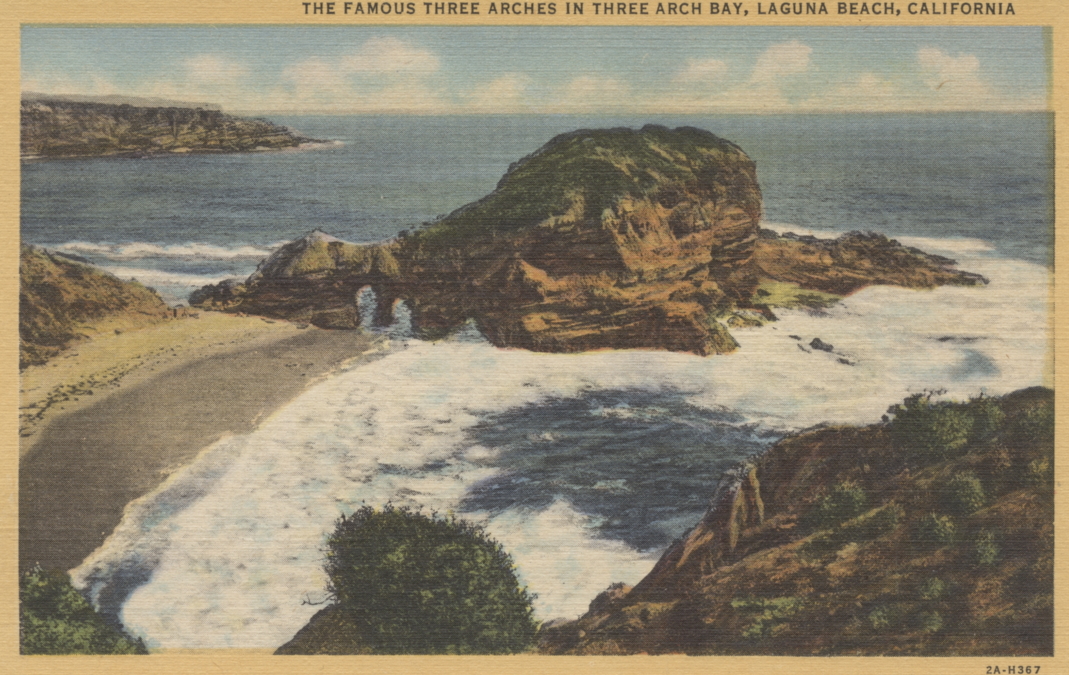
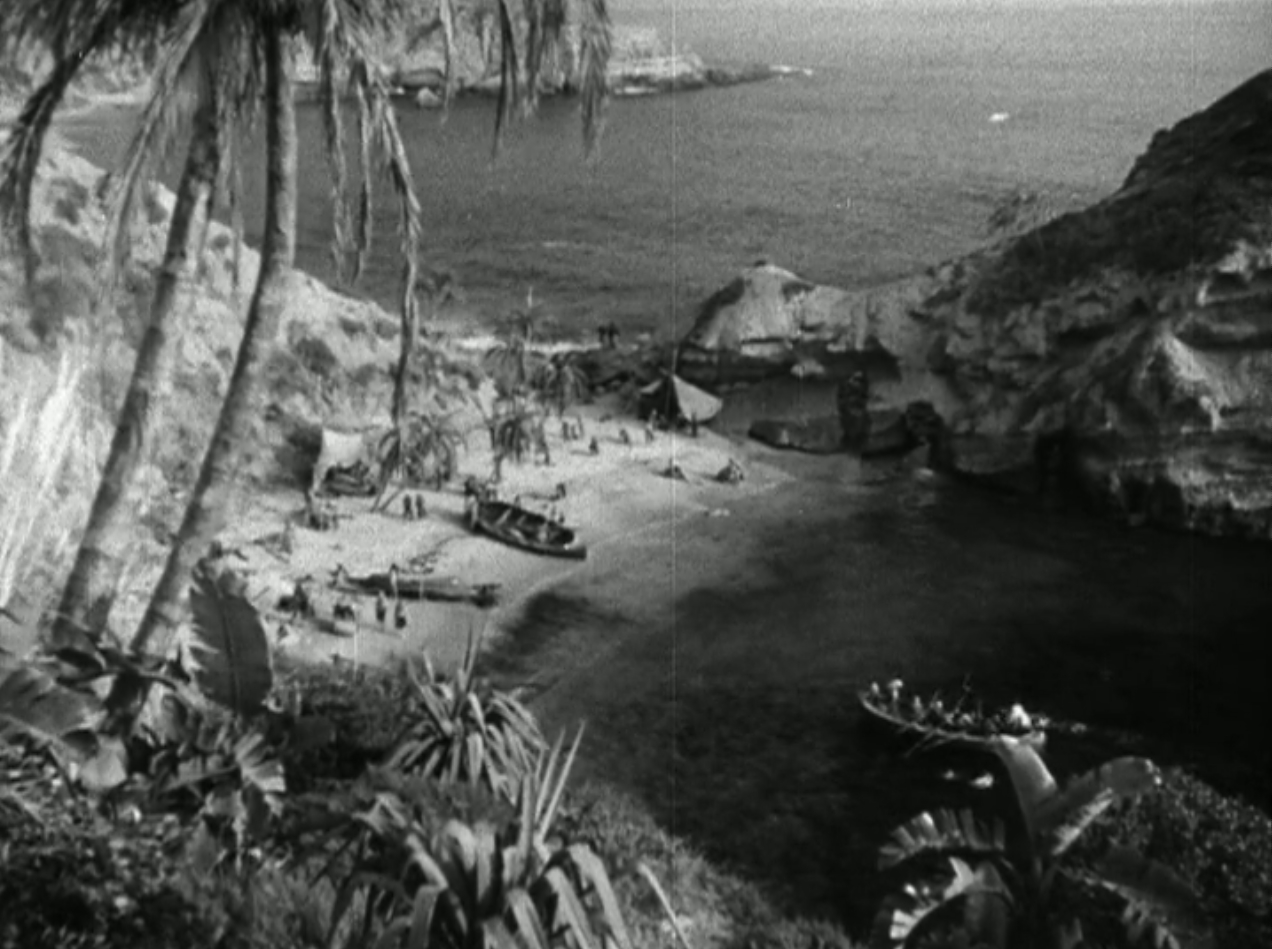

The duel in the film was shot not on Catalina Island, as many fans often assume, but at Three Arch Bay at Laguna Beach. It is a classic Southern California vista: a sunny sandy shore amidst grand, craggy, evocative rocks. We will assume that the palm trees in the background were put there by the set designers and their crews, notwithstanding that Southern California (I lived in San Diego for twenty years and in LA for five) is known for its various palm trees, although the coconut is not one of them. The romantic vista adds to the scene, almost as a third character. The shot below is but one of many the beach was perfectly suited for, even demanded.
In fact, the location was chosen specifically to make the duel more exciting. From the original script by Casey Robinson: “The nature of our location will help a good deal here, for the fight not to be on the flat, but will range over the rocks and cliff edges of the rough country.”


Coincidentally, there is one location on Virgin Gorda that does look similar: “The Baths,” where sandy shore meets rock formations. It’s too far south, though, to answer the novel’s description of action and location, but following a novel closely has never stood in the way of Hollywood.

The Hero: Peter Blood

If you’ve read the novel or seen the 1935 film, you already know Peter Blood’s history: a physician (with surgical skill) accused of treason for treating a wounded rebel during the 1685 Monmouth Rebellion, he was convicted and sentenced to ten years transportation as an indentured servant at Barbados. During a Spanish raid of reprisal he and a number of his fellow rebels-convict board the Spanish frigate at anchor while the crew is indulging in pillage and rapine ashore, capture it, and destroy the Spaniards in their boats the following morning. The rebels-convict escape to Tortuga, an island just off the north coast of Saint-Domingue (modern Haiti), and become buccaneers.
Given Peter Blood’s martial experience and Spanish imprisonment previous to setting down as a physician and eventually turning buccaneer, he would certainly be quite familiar with the French, Dutch, and Spanish schools of fence with thrusting weapons — the smallsword and the Spanish rapier — and also the cutlass given his Dutch naval experience, and would surely be able to handle a sword well-enough to defend himself in a variety of circumstances.
Importantly, the novel is a swashbuckling romance, with associated noble notions of duty, honor, and “right as might” rather than the opposite. These virtues set the stage for the duel in which Peter Blood rescues a swooning heroine in danger of sexual assault, a theme Sabatini often returns to in his novels and which often defines his heroes. Although swooning damsels are thankfully less popular today, the virtue of standing up for and defending the oppressed, whatever their sex and circumstances, will hopefully never go out of fashion — and likewise that Levasseurs everywhere will sooner or later get their just desserts via sword or otherwise.
A much more detailed history &c will be provided in Captain Blood: His Odyssey, the Annotated Edition when finally published by Treasure Light Press.
The part is played by Errol Flynn in the 1935 film. Although a bit young for the role at twenty-six — Sabatini’s hero was in his early thirties — Flynn didn’t depart too far from the character as described by the author. His dress is not quite as sartorial as Sabatini described, and Hal Wallis of Warner Bros. Studio was often incensed that Flynn even wore a lace cravat, much less anything that might be regarded as “feminine.” Wallis was reportedly furious with historical consultant Dwight Franklin, and with director Curtiz for taking his advice, something I can relate to from personal experience: inevitably there’s someone in the mix, even if not the director or one or more of the writers, who doesn’t like the historical consultant’s advice — an art director, for example. But Franklin was right, even though he had never seen eyewitness images of buccaneers drawn in the 1680s: some of them are wearing lace cravats!
The Fictional & Historical Villain: Captain Levasseur

The character of Levasseur, played with panache and an exaggerated French accent by Basil Rathbone, is based on two historical characters. Sabatini appropriated the name and some of the character from the real Captain François Levasseur, a Huguenot soldier of fortune, military engineer, and de facto governor of Tortuga from roughly 1640 to 1652. During his tenure he heroically repelled a major Spanish attack and despicably persecuted local Catholics in the name of Calvinism, among other crimes.
Neither the character of Levasseur nor the name was based, as a page or two on Wikipedia (far more often than not a terribly inaccurate resource on pirates and piracy, not to mention many other subjects) have stated, on the early 18th century French pirate, Olivier Levasseur aka La Buse (a nickname which might mean the “Buzzard” — the swift but proverbial stupid European bird of prey, not the American carrion eater — or “Mouth” or “Cow Dung” depending on spelling).
By his own admission, not to mention obviously, one of Sabatini’s his principal sources was Alexandre Exquemelin’s The Buccaneers of America, whose English and French editions were first published in the 1680s. The polylingual Sabatini read both. Each covers material the other doesn’t, and he found plenty of detail on Levasseur in the French. The real Levasseur (or Le Vasseur) was murdered by two of his closest associates — captains and companions in fortune hunting, practically family to him, according to Exquemelin — reportedly because he had raped the beautiful mistress, possibly also a slave, possibly a prostitute according to 17th century Caribbean historian Jean-Baptiste du Tertre, of one of them named Tibaut (or Thibaut). They intended to put an end to his tyranny.
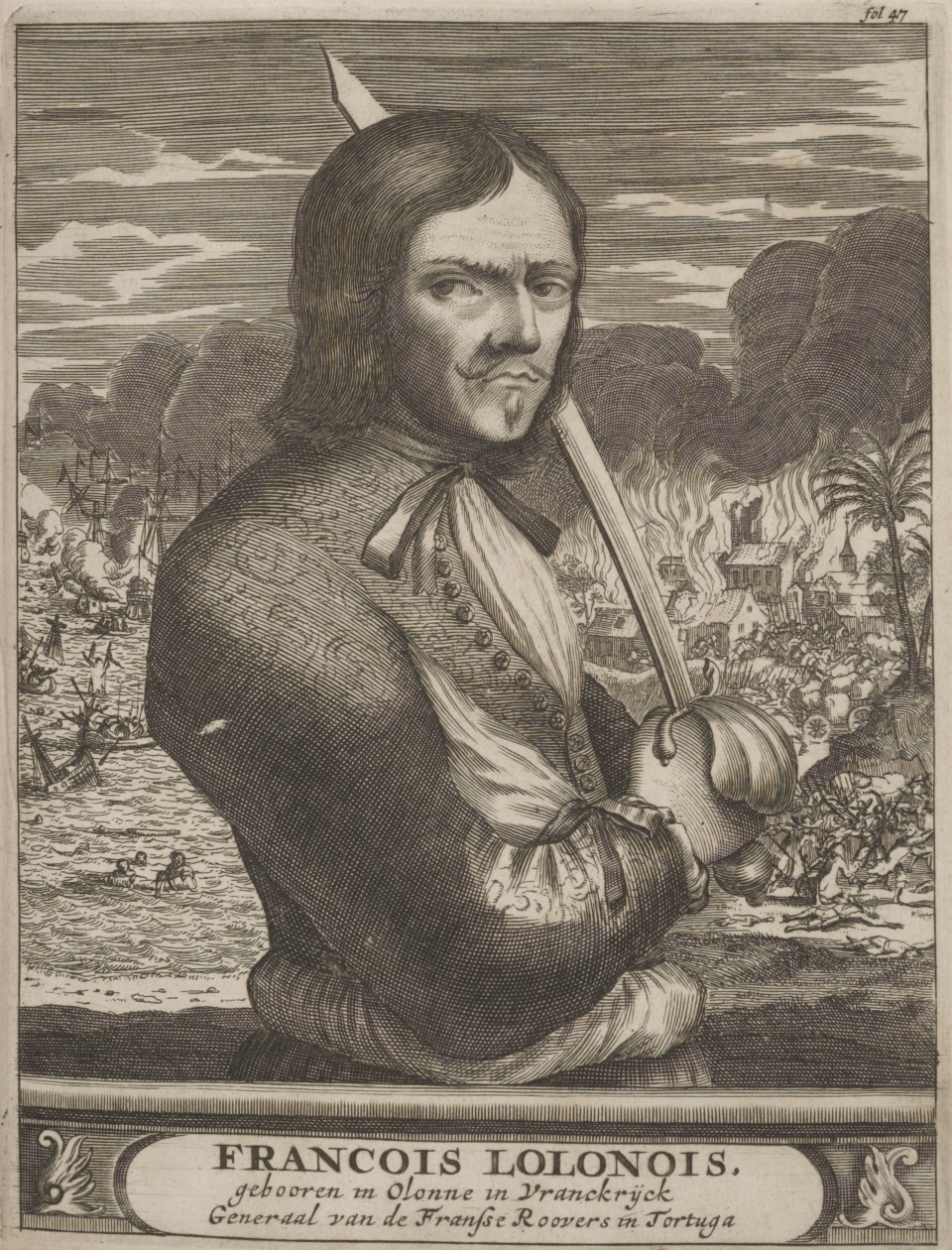
Appropriate to his namesake fictional character, Levasseur was killed on the shore of Basse Terre, Tortuga at one of his warehouses by his two confreres and several of their associates: the eventual coup de grace was one or more thrusts with daggers. Perhaps his compadres killed him in part to protect Tibaut’s mistress — or perhaps just so Tibaut could keep her for himself. Reportedly just before he died Levasseur begged for a priest because he wanted to die a Catholic. Or at least du Tertre says he so pleaded.
More likely, du Tertre, a priest in anti-Reformation mode as all were, invented this to curry favor with his largely Catholic audience, not to mention keep his priestly credentials in good standing. Sabatini carried Levasseur’s unconscionable behavior over to his fictional French buccaneer who kidnaps the besotted daughter of the governor of Tortuga — his inamorata — and clearly intends to rape her if she resists his advances.
Sabatini also based the character on François l’Ollonois (or L’Ollonais as Sabatini spells it according the edition he studied), aka Jean-David Nau, &c — a vicious French buccaneer noted not only for his successes against the Spanish, but for his murder and torture of Spanish prisoners beyond that of most of his brutal brethren, few of whom would have cut the heart from a living prisoner and taken a bite from it, for example. That said, he was not the only French buccaneer to decapitate prisoners on occasion, and the torture of prisoners by buccaneers was common, horrid, and often at its worst in the search for plunder. Sabatini notes that the fictional Levasseur had learned his trade as the lieutenant of l’Ollonois.
A former indentured servant to a boucanier, l’Ollonois became a buccaneer circa 1660, rose quickly to command, and so served until his brutal and well-deserved torture and death at the hands of Native Americans on the Isthmus of Darien in 1669. His executioners burned and scattered his remains. Sabatini has clearly based the character of his Levasseur on both the original Levasseur and l’Ollonois.
The l’Ollonois lieutenant who would have been the fictional Levasseur’s historical counterpart was one of the following, or even all of them: Michel le Basque (Michel de Maristegui according to some scholars, the sieur d’Artigny according to du Tertre), a retired buccaneer and French officer who had captured a considerable Spanish prize not long before he commanded the ground force at Maracaibo in 1666, and commanded le Dauphin, l’Ollonois’s former ship, in 1668 (by now l’Ollonois commanded the Saint-Jean of 26 guns); the literate Moise Vauclin who commanded the buccaneer vice-admiral at Maracaibo, of 10 guns and 90 men; or Pierre le Picard who commanded a brigantin of 40 men at Maracaibo in 1666, separated from L’Ollonois in 1668, and guided Henry Morgan to Maracaibo in 1669. The fictional Levasseur’s previous experience at Maracaibo as L’Ollonois’ quartermaster or lieutenant would, of course, well-serve the plot of Captain Blood: His Odyssey.
One or more of these men probably also have served as the inspiration for Cahusec, the fictional Levasseur’s quartermaster (second-in-command, or lieutenant as Sabatini his it), whose name Sabatini almost certainly took from François de Rotondy, sieur de Cahuzac, who attacked the English under Edward Warner at St. Kitts (Saint-Christophe) Island in 1629 at the Battle of l’Anse-aux-Papillons.
Now that our brief exposition of history is complete, on to the actors, choreographers, and the film duel itself!
Actors as Adversaries: Errol Flynn as a Swordsman

It is common for Hollywood publicity machines to endow their stars with qualities and skills they don’t actually have, or to grossly exaggerate them, and the fencing skill of swashbuckling stars, with some notable exceptions, was treated no differently.
Errol Flynn has long had a reputation as a swordsman — Olivia de Havilland (Benham, 1937) said that he could fence, among his many other athletic accomplishments — but according to the film’s choreographer and fencing master Fred Cavens, not to mention Flynn himself, the swashbuckling actor was not much of a fencer, Hollywood promotional media notwithstanding. Cavens stated in 1941 that Flynn “fences execrably.” (Brady, 1941.) In fact, Cavens doubled for Flynn more than studios were willing to admit publicly. It is doubtful that Flynn knew anything about fencing prior to meeting Cavens on the set of Captain Blood.
Film historian Rudy Behlmer was more nuanced: “Flynn, on the other hand, did not have the discipline for constant practice. Fortunately, he was a quick study and a natural athlete, and this, together with his form and flair, made his duelling look good on the screen.” (Behlmer, 1965.) An accurate assessment, in my opinion.

Basil Rathbone, who played Levasseur and was in fact a skilled fencer, said that “Mr. Flynn and Mr. [Tyrone] Power were fine actors, we all know that, but they did not know swords… The only actor I actually fought with on screen was Flynn, and that’s the only time I was really scared. I wasn’t scared because he was careless, but because he didn’t know how to protect himself. I knew how to protect myself, but it’s like a professional fighter in boxing — fighting someone who doesn’t know how to fight. But sometimes the fellow doesn’t know how to fight will do something outrageous and you’ll find yourself injured. I stayed away from Flynn as much as I could, and, as he was eventually going to ‘kill’ me, it didn’t look bad on the screen.” (Jones, 1972.)
Maureen O’Hara in her autobiography ‘Tis Her wrote of her work with Flynn on Against All Flags (1952), “As you might expect, Flynn was an excellent fencer.” Even so, she also wrote, “I was flattered when critics said that I had outfenced Errol Flynn!” And so she had, being far more diligent at learning to fence from Cavens, and, as a woman actor in Hollywood, having far to prove to sexist producers and directors.

Douglas Fairbanks Jr., a swashbuckler in both film and life, also commented on Flynn’s swordplay: “‘Errol Flynn was good at staging a scene, especially in close ups, but I think he was better at other kinds of fencing,’ he added, pleased with his joke.” (Page, 1968.)
Flynn had little to say in his autobiography My Wicked Wicked Ways about his swordsmanship, perhaps because he was trying to avoid the stereotype that dogged him for so long. Even so, he admitted his lack of fencing skill:
“I don’t know much about fencing, but I know how to make it look good. You only have to stand still and look forward, your head proud, and let the sword point straight out, you and the sword both unmoving, and it is dramatic. Let the sword point dip two inches, and the gesture can look very clever and dangerous.” In fact, this is an excellent en garde with the epee de combat, or late 19th and early 20th century dueling sword, and for that matter, with rapier and smallsword as well.

In fairness to Flynn, Hollywood fencing master Ralph Faulkner (more on him below) stated that Flynn “could memorize every movement in a sword script and remember them six weeks later.” (Folkart, 1987.)
None of this lack of fencing ability stopped the Warner Bros. or other studio publicity machines from claiming otherwise. In fact, Warner Bros. in its press package claimed that Flynn was trained for Captain Blood by “Professor Guiseppe Valcori, Italian fencing expert,” whose existence no amount of research can confirm — because he’s an invention of Warner Bros. In fact, Flynn was trained for the film by Fred Cavens.
Actors as Adversaries: Basil Rathbone as a Swordsman

Basil Rathbone, on the other hand, was a skilled, albeit non-competitive fencer — a “good club fencer” in the parlance of the day, and there is no shame in this by any standard. In his autobiography In and Out of Character he notes that he studied in London under famous masters Léon Bertrand and Félix Gravé.
Bertrand, in addition to his family’s 19th century French fencing heritage, was a graduate of the Italian National Fencing Academy in Naples (he was made a knight of the Order of the Crown of Italy in 1927) and succeeded Professor Magrini as the leading teacher of Italian saber in the UK. He was the fourth generation heir of the Betrands who had instructed Napoleon I and III, along with some British royalty, were the successors of the great Henry Angelo, and in Rathbone’s time taught in Hanover Square. Gravé founded his London salle in 1900, established the British Academy of Fencing Masters in 1931, taught not only competitive fencing but stage fencing, and had many women students (and modern fencing would be the better for it if fencers adhered to his principals on sportsmanship and deportment).
Reading the books and articles of these two famous masters, it is easy to see how Rathbone came by his noble, elegant form. Later he studied, for five years according to Rudy Behlmer, under Fred Cavens, in Rathbone’s words “the greatest swordsman of them all,” with additional preparation by Cavens for various films.
Occasionally one runs across a Hollywood history describing the Captain Blood duel as between two actors ignorant of fencing, but this is arrant ignorant nonsense compounded by a lack of research: by all accounts, including eyewitness and other firsthand, Rathbone was a competent fencer, if not a competitor. There is no shame in being a club fencer; many of us who were once serious competitors tire of competition or find other pressing interests and so become club fencers for reasons of recreation and study — for sheer pleasure, in other words. (Plus it’s always fun to watch or even be the “dark horse” club fencer who knocks a nationally-ranked competitive fencer, or even just a commonly arrogant one, out in the direct elimination rounds.)

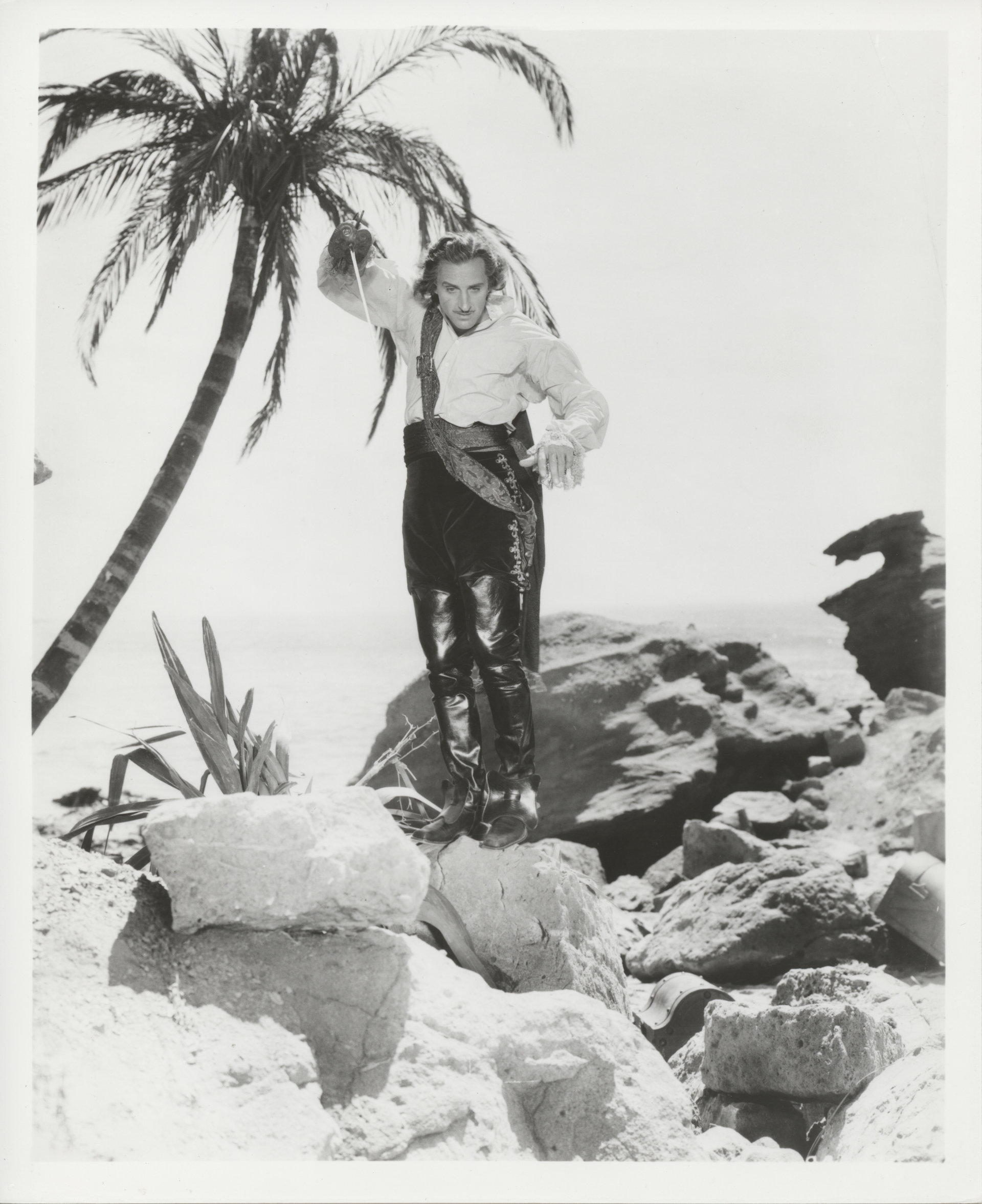
According to his autobiography, Rathbone took up fencing “because in the early days, when I was training for to be an actor, you went for a job on the understanding that the producer knew you could fence, that you could sing and that you could dance.” He further noted, “I enjoyed swordsmanship more than anything because is was beautiful. I thought it was a wonderful exercise, a great sport. But I would not put it under the category of sport; I would put it under the category of the arts. I think it’s tremendously skillful and very beautiful.” (Jones, 1972.) “It’s the finest exercise I’ve discovered yet, requiring speed, timing, endurance.” (Whitaker, 1936.)
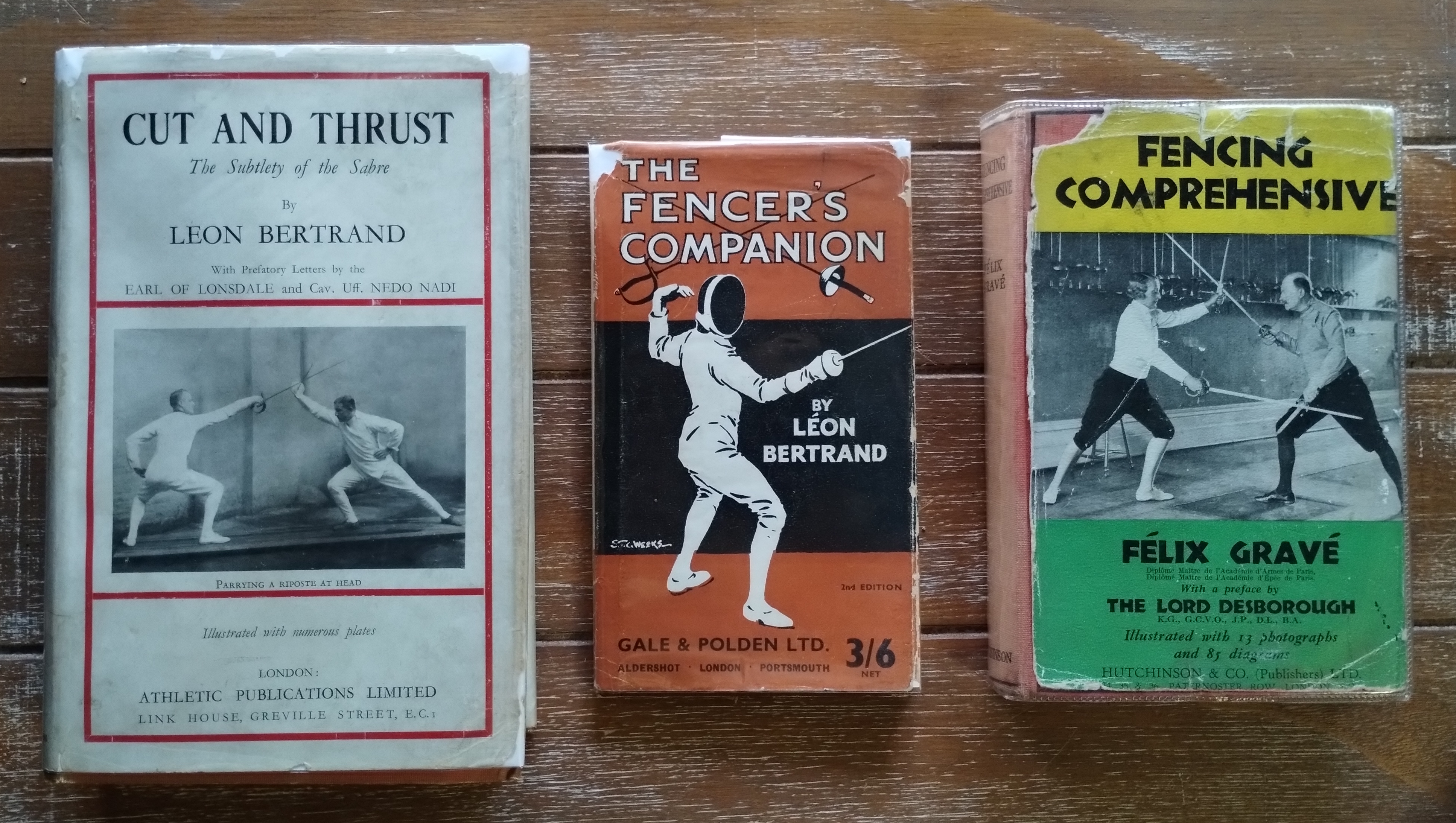
Rathbone had a deserved reputation as a good fencer among the Hollywood crowd. Cavens noted that in swashbuckling films the “villains, especially Basil Rathbone, are splendid fencers, but the heroes…are ineffectual.” He further said that Rathbone was able to handle himself throughout with ease [i.e. not doubled in The Mark of Zorro].” (Cavens quoted by Brady, 1941.) Even so, he also noted that, “He has excellent form and is the most colorful of all the people I have taught. I doubt that he would do well in competition, but for picture purposes he is better than the best fencer in the world.” (Cavens quoted by Behlmer, 1965.)
Cavens ranked Rathbone a close second to Cornel Wilde as the best of all the actors he had trained. Wilde, in addition to being a movie star, had been a top-ranked US national saber fencer, originally trained in Hungary. (Gunson, 1947.) Fencing master Ralph Faulkner described Rathbone as an accomplished swordsman (Folkart, 1987), and Douglas Fairbanks Jr. stated that “Basil Rathbone was very good” (Page, 1968).

Long, Lean, and Lithe
One visual aspect of the duel that immediately stands out is that of two long, lean, lithe swordsmen — literally almost living swords themselves — engaged in mortal combat. Fred Cavens noted that “the ideal duelist is tall, lithe, quick on his feet, and with a nice swift coordination of of eye and muscle.” (Whitaker, 1936.) Both Flynn and Rathbone easily met this ideal.
Agesilao Greco, in his great book La Spada e la sua Disciplina d’Arte (1912), described the dueling sword — the spada or épée de combat — in terms that could apply not only to long sharp thrusting swords themselves, but to those who, with similar physical characteristics, wielded them, perfectly imagining the idealized adversaries in Captain Blood as played by Flynn and Rathbone:
“La spada è acuta, pungente, affilata, forbita, fatale, formidabile, lucida, nuda, fina, forte, ben temprata, nobile, perfetta.“
“The epee is pointed, biting, sharp, forbidding, fatal, formidable, shiny, naked, fine, strong, well-tempered, noble, perfect.” (Author’s translation.)
That said, there are outstanding fencers who are not only not long, lean, and lithe, but are short, stocky, and appear awkward, lacking any sense of classical form but who should never be underestimated. But it’s those built like Flynn and Rathbone who arguably look best in screen duels.
Fred Cavens put it best: “Film fencers should have perfect grace and form, qualities which are not necessary in competition… I have seen Olympic champions who had such atrocious form they couldn’t appear in pictures because audiences would laugh at them. But they would be extremely dangerous in a real duel.” (Behlmer, 1965.)

Flynn, and probably Rathbone as well to some degree, are also responsible for popularizing “6′ 2″ and 180 pounds” as the masculine ideal in height and weight. Fan pages and unauthorized biographies often list the height of both men as 6′ 2″ inches, although in fact both men appear to have been around 6′ 1″ tall. Flynn, according to accounds, weighed 180 to 185 pounds. Rathbone in his autobiography gives his own weight as consistently 172 pounds (and it’s not improbable that he claimed a couple of pounds he didn’t have, as slender men often do).
But it was Flynn who really set the ideal, thanks to a 1936 article in the Los Angeles Times: “but he [Flynn] also started a vogue for handsome young six-foot-and-over-super-huskies as leading men which hasn’t been equaled before in screen history…it began to be realized how six feet two inches and 180 pounds of 26-year-old virility could knock ’em over at the box office.” (Wolfenden, 1936.)
And so it went from there. I still recall in the 70s and 80s men trying to impress women, and even other men in locker rooms, by their purported “6′ 2″ and 180 pounds.” The fact that many of them stood an inch or two shorter than me, who’s a hair over 6′ 1″, seemed to matter not at all to them.
So engrained was this ideal that George MacDonald Fraser in his comic, occasionally satirical, novel The Pyrates (1984) made his Boy Scout-ish naval hero, Capt. Benjamin Avery, “everything that a hero of historical romance should be; he was all of Mr Sabatini’s supermen rolled into one, and he knew it… For the record, this wonder boy was six feet two, with shoulders like a navvy and the waist of a ballerina…”
Fraser didn’t forget Rathbone: “gentlemen-adventurers proud and lithe and austere and indistinguishable from Basil Rathbone…” Further, the character of “Bilbo is Basil Rathbone playing a raffish Captain Hook.” The novel is an homage to the Golden Age of piratical swashbuckling books and films of the 20s, 30s, and 40s.
The Swords


Historically, if thrusting swords were used in a late 17th century duel among the English and Europeans other than the Spanish, Portuguese, and some Italians, they would usually have been smallswords with double-edged flat or hexagonal (or similar) rapier-like blades in form but shorter, or three-cornered blades, including Colichemarde blades quite broad at the forte. We can’t rule out an occasional “transitional rapier” (a modern term) with perhaps longer blades and possibly larger hilts. At least one was recovered from the Sedgemoor battlefield in 1685 (which battle plays a great role in the novel and film), probably dating 1640 to 1660.
Sabatini describes long rapiers as being used, and probably intended Spanish cup-hilts or transitional rapiers. However, the term was also used as slang for smallsword in the late 17th century, given that both swords were used for thrusting, so it could still be correct to say that “rapiers” were used. Historically, however, cutlasses would have most often been used (more on this in part five).
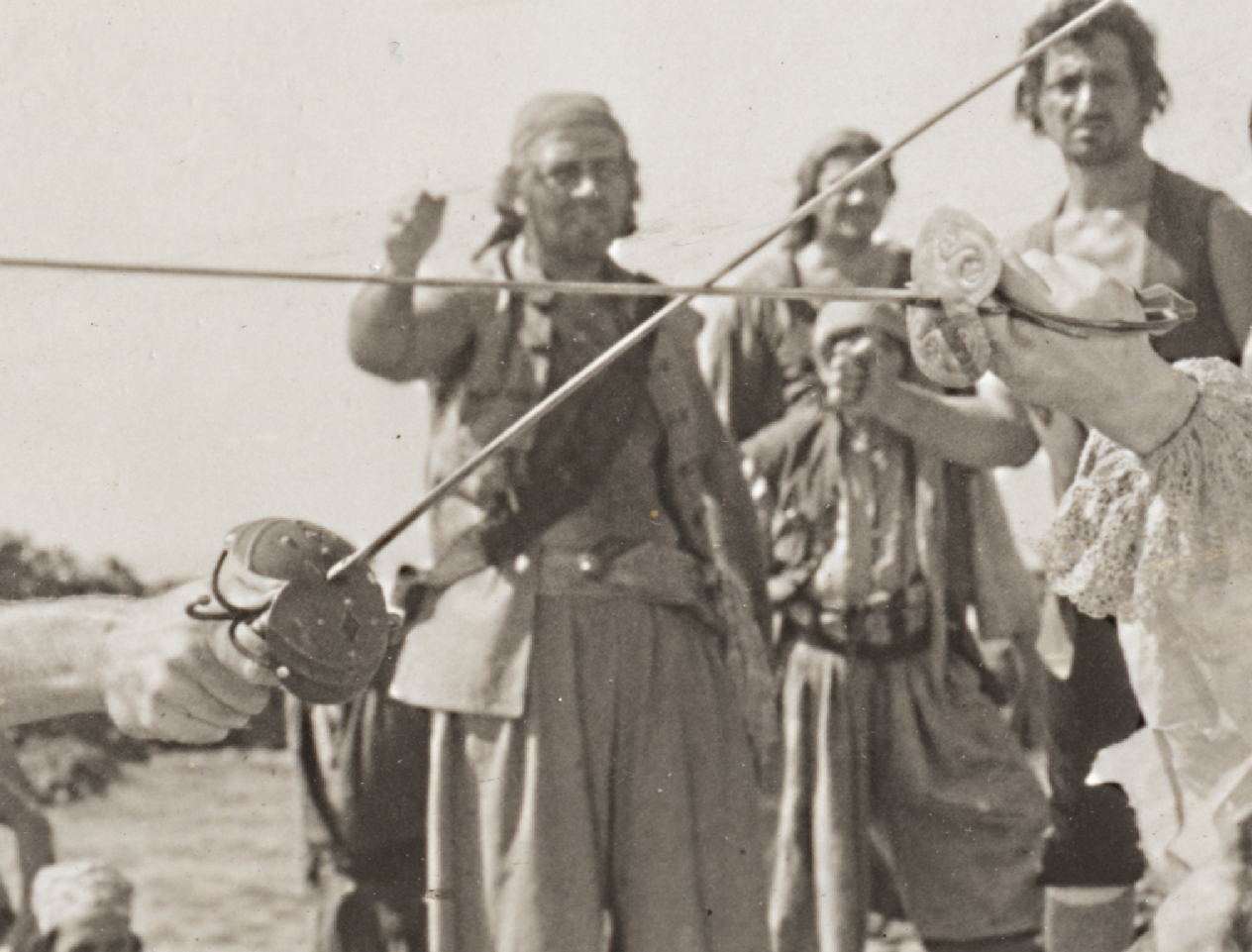

In the film, both swords are theatrical “rapiers” mounted with sport epee blades, known in the past as “hollow,” three-cornered, or triangular blades. They are stiffer by comparison to foil and saber blades, and show up well on screen. Since the 19th century it was recognized how difficult it is to see foils onstage, given their small hilts and narrow blades. In the latter part of the 19th century, as actors began to be trained in legitimate swordplay and stage duels came to reflect reality more, foils were often replaced by swords with larger hilts, typically rapier hilts or fanciful rapier hilts, and thicker blades — thus the anachronistic rapiers with sport epee blades used in Captain Blood.
The hilts of both swords used in the film duel are a bit fanciful, neither corresponding exactly to historical swords. Flynn’s appears to something of a reduced Pappenheimer hilt (for example, a Norman type 67 but with no side rings), with two solid shells, a pair of curved quillons, and a knuckle guard, perhaps also resembling a shallow Spanish bilbo-hilt (Norman type 82) with smaller shells.
Rathbone’s rapier hilt appears to be nothing more than a common smallsword hilt (Norman type 112) but with enlarged shells, rings, and quillons. One might argue it is instead a small-hilted Spanish “dueling rapier” or “Spanish smallsword” (as some call it) — an espadín — of a sort that was introduced 1680 to 1700 and became even more common after a Bourbon began sitting on the Spanish throne. Most of these have very large (as compared to French smallswords) rounded shells, or smaller, shallower cup-hilts, or smaller “bilbo” hilts, but occasionally one with large mostly flat shells, as with Rathbone’s, is seen. Perhaps a bretteur or spadassin (a thug with a sword), as Levasseur clearly was, preferred the longer blade of the transitional rapier or espadín to that of French smallsword in order to gain an advantage. That said, the heavier transitional rapier and Spanish smallswords would be at a disadvantage in speed as compared to the true smallsword.

The sword designer — Fred Cavens, perhaps, or more likely pirate historian and costume designer Dwight Franklin — was probably thinking of swords that would evoke “Cavalier” or “Musketeer” rapiers of some sort. As noted in a caption above, Flynn’s may have been inspired by that of Captain Keitt in Howard Pyle’s famous painting.
The enlarged hilts of the theatrical rapiers used provided a better film image, or so the thinking probably went, than the smaller, but more legitimate, authentic smallsword hilts. Plus, viewers have been conditioned by fiction and film to expect rapiers no matter the era, no matter how anachronistic. For filming, the larger rubber buttons or points d’arrêt were removed — more on this below!
Choreographer & Choreography
The duel was choreographed by famous swordfight director Fred Cavens. He began fencing at twelve years old circa 1894, was teaching other boys how to fence at fourteen, and graduated at eighteen from the famous L’École Normale de Gymnastique et d’Escrime Militaires de Belgique in Brussels, a school modeled on the famous French military school at Joinville-le-Pont near Paris. At twenty-one he was a full-fledged fencing master in the Belgian army.
After his service in the Belgian Army, Cavens emigrated to the US in 1919, soon after both his marriage to a Belgian dancer in an opera company and the end of World War One. He was invited by some American sportsmen, fencers we assume, to open a salle in Santa Barbara, California, leading to an introduction to various film studios, whose swordplay on camera to date, other than that choreographed by fellow Belgian master Henry J. Uyttenhove, was often little more than knife-sharpening actions, often in long shots, or was entirely doubled (which generally demanded long shots in order to carry out the deception). (Anon., 1936.) Leon Bertrand, the famous fencing master (and who helped train Rathbone in London) noted that the old “Glasgow tens” and other clunky hack and slash patterns of the 19th century popular theater were still seen in some silent pictures in the 1920s. Cavens et al would finally end their reign — mostly. Bad swordplay in film is still too common today.
Cavens by his own account came to Hollywood in 1921, although he is often incorrectly credited with film choreography as early as 1920. His first major role in fencing choreography in film as far as we know was the swordplay for the 1922 short film The Three Must-Get-Theres, a parody of Douglas Fairbanks’s 1921 The Three Musketeers. The comic film is quite funny, even brilliant at times, and is possibly the best send-up of swordplay and musketeers I’ve seen. Although there are moments of common “blade sharpening” fake swordplay, most of the fencing is of outstanding caliber. In fact, director and star Max Linder was an accomplished fencer who had competed in epee, if not also in foil and saber. The film, by the way, is available on YouTube in a couple of versions, and also on a Grapevine DVD. The latter is by far the better version.

Fairbanks loved the swordplay in the comic film and first met Cavens on the set of Dorothy Vernon of Haddon Hall, a production starring Fairbanks’s wife Mary Pickford. Fairbanks quickly hired him for Don Q, Son of Zorro (1925) and then for his genre-establishing 1926 swashbuckler The Black Pirate the following year, in which during a rehearsal he hit Fairbanks in the face, causing a wound in front of visitors. Cavens also choreographed the swordplay in Fairbanks’s The Man in the Iron Mask (1929), among his many, many credits from the 1920s to 1950s. By 1934 his major film choreography also included Ashes of Vengeance, The Dangerous Maid, The Three Musketeers, The Sea Hawk, The Road to Yesterday, and The Count of Monte Cristo. (Anon. 1934, Behlmer, 1965.)
Cavens had a theory of romantic realism — a bit more romance, a bit less realism, with authentic if at times theatrical fencing — for filming swordplay on the screen, a theory that worked quite well in practice from the audience’s perspective.
“For the screen, in order to be well photographed and also grasped by the audience, all swordplay should be so telegraphed with emphases that the audience will see what’s coming.” (Cavens quoted in Behlmer, 1965.) This, of course, is a form of false tempo, discussed here, that would likely get a fencer killed in a duel. But it works well for the audience — and that’s the goal.
It is in fact an improvement upon a method already known in the late 19th century English theater. As described by William Herries Pollock in 1896: “To make it [stage swordplay] effective both to an expert and a lay audience a man must be, like Henry Irving, a good swordsman; but it is, after all, in its component phrases, as simple as it can be made showy.”
Behlmer further quoted Cavens: “All movements — instead of being as small as possible, as in competitive fencing — must be large, but nevertheless correct. Magnified, is the word. The routine — there must be a routine, and so well learned the actor executes it subconsciously — should contain the most spectacular attacks and parries it is possible to execute while remaining logical to the situation. In other words, the duel should be a fight and not a fencing exhibition, and should disregard at times classically correct guards and lunges. The attitudes arising naturally out of fighting instinct should predominate. When this occurs the whole performance will leave an impression of strength, skill and manly grace.”

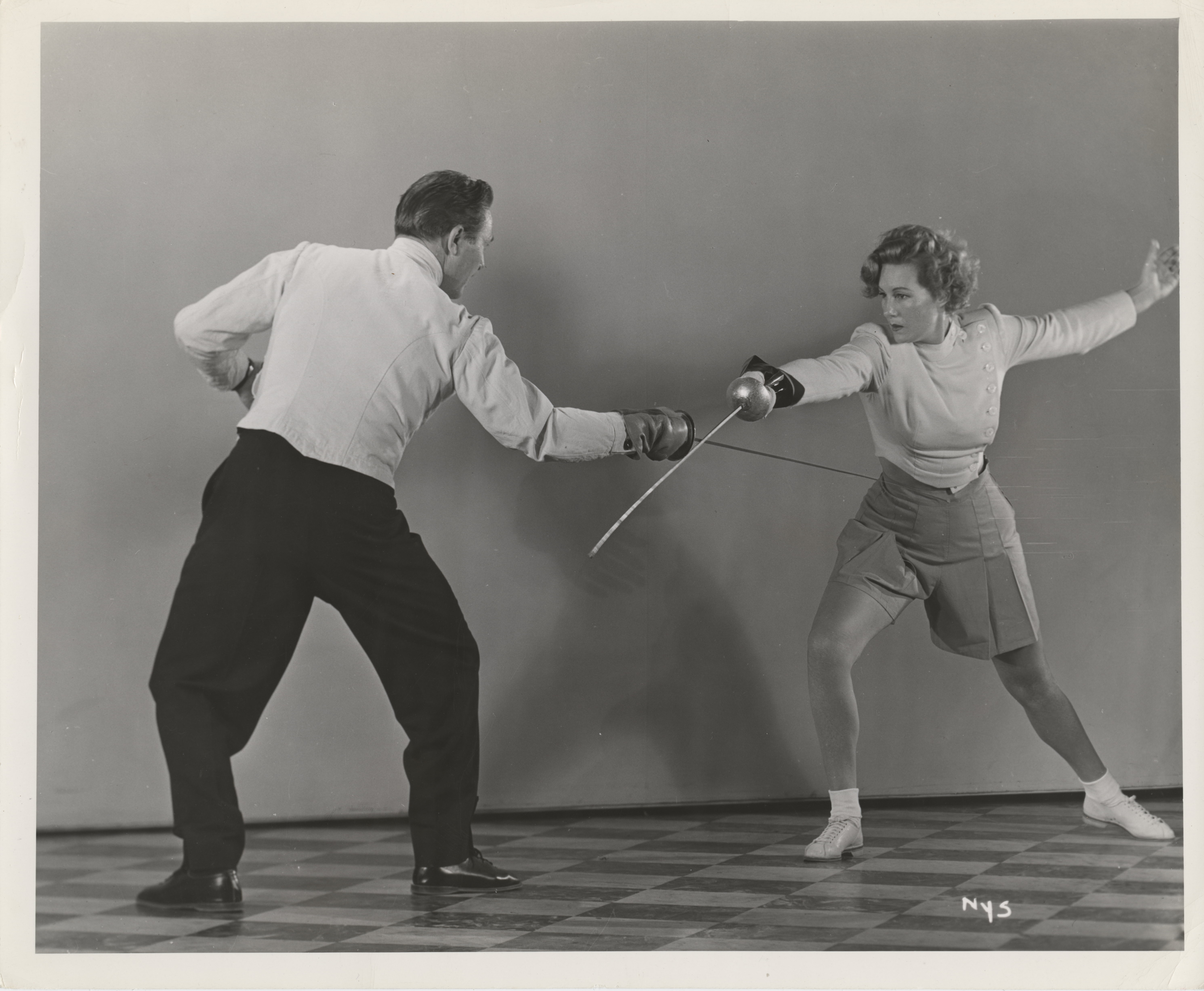
Cavens prepared actors, ranging from Flynn and Rathbone to Maureen O’Hara, Binnie Barnes, Jean Peters, and many others, thoroughly, teaching them not only the scripted swordplay itself, but also fencing in general. Maureen O’Hara in her autobiography described her preparation for At Sword’s Point (1952): “I trained rigorously for six weeks with Fred Cavens and his son to perfect my stunts for the picture. Fred Cavens was an outstanding Belgian military fencing master and had trained all the great swashbucklers in Hollywood. He taught me intricate attacks and parries, envelopments, disengagements, and coupes. Physically, I’ve never worked harder for a role.” For The Corsican Brothers (1941), Cavens coached Douglas Fairbanks Jr. for a month prior to filming. (Brady, 1941.)
His process was described by Thomas Brady: “Cavens’s greatest value to a producer is his ability to prepare a fight with the precision of a choreographer. No impromptu bout, he says, looks truly exciting to the camera. His technique with a picture follows a regular pattern. First, with the director and the camera man, he examines the sets to be used for fights and learns in general what the action must be and how much time it shall take. Then, in the esoteric language of the swordsman he writes down every move the attacking fencer will make. For a three-minute fight in Fox’s “The Mark of Zorro,” Cavens’s “score” ran to 750 words. Tyrone Power and Basil Rathbone had to memorize it… Even when Cavens and his own son fight a duel on the screen, as in “The Corsican Brothers,” they memorize a “ballet” routine beforehand.” (Brady, 1941.)
Cavens preferred actors to fencing for film choreography. “If skilled fencers fight for the camera, they have certain reflexes, result of long training, that must be overcome. Their work is too fast, also, to register. Actors are not burdened by these reflexes, and they remember to act, which is important.” (Cavens quoted by Coons, 1936.)
“A movie duel, under Cavens’ direction, is ‘broader’ than a real encounter, but technically correct as to all the fine points. The ‘broadness’ permits the opponents to register dramatic reactions. (Coons, 1936.)
The Duel Master Scene in the shooting script by Casey Robinson includes the following notes, which depart from Sabatini for whom Levasseur was a mere thug and bully in both his life and his swordsmanship:
“The details of this duel must naturally, be worked out by an expert in this line. We wish to emphasize here the general nature that this fight must have. Usually duels in pictures are contests between some agile, brilliant, hero and a slow and dull witted, even though powerful villain. Such is not the case here. Here we must have a great fight between two truly great swordsmen, equally matched in quickness, brilliance, and skill. It is not a fight to the first advantage or the first spilling of blood, but a fight to the death. It is a vicious, terrific battle in which both men take a great deal of punishment before the final conclusion. In other words, the fight would be routined not after the order of duels that have been shown in pictures, but rather after the order of some of the great rough and tumble encounters that have made their pictures famous notably, the fight in ‘The Spoilers’. Thus, before the battle is finished, part of Blood’s clothes have been cut away and he is very much marked up by Levasseur’s sword.”
Note that dueling was still in vogue in France, Italy, and Hungary at the time of filming (although WWI had diminished the practice significantly, only WWII would almost entirely put a stop to it), thus the comments on first advantage and first blood have more than purely Hollywood relevance. In fact, my first fencing master, an active swordsman during the 1930s and trained by the famous Italo Santelli, had fought at least one duel in Budapest in the 1930s. Fred Cavens had acted as directeur de combat for several duels and had fought as many more. (Anon., 1934.)
[Quick aside: until a couple or so decades ago, referees in modern fencing in the US were referred to as directors, from directeur de combat, the person who supervised a formal duel. If the competition were non-electric, the director might be referred to as the President of the Jury, for the president presided over four judges. Today, the term “referee” is used, the powers-that-be rather incredulously arguing that the name change would make fencing more accessible to the still largely imaginary audience. “One fool makes many,” according to the proverb.]
According to the LA Times, Cavens also trained “one hundred fifty men…in the art of being pirates at the Warner Studio” for Captain Blood. “They go to school every day for eight hours to fence under the tutelage of Fred Cavens… He is also teaching them how to climb riggings and other tricks of the trade.” (Kendall, 1935.) Certainly Cavens would have trained the pirates in cutlass-play, but as for teaching “pirates” to climb aloft, although Cavens would certainly know how this was done given his experience on Douglas Fairbanks’s The Black Pirate (1926), we imagine Sailor Vincent (see below) or some other salty seafarer was actually responsible for this aspect of training.
Filming the Duel
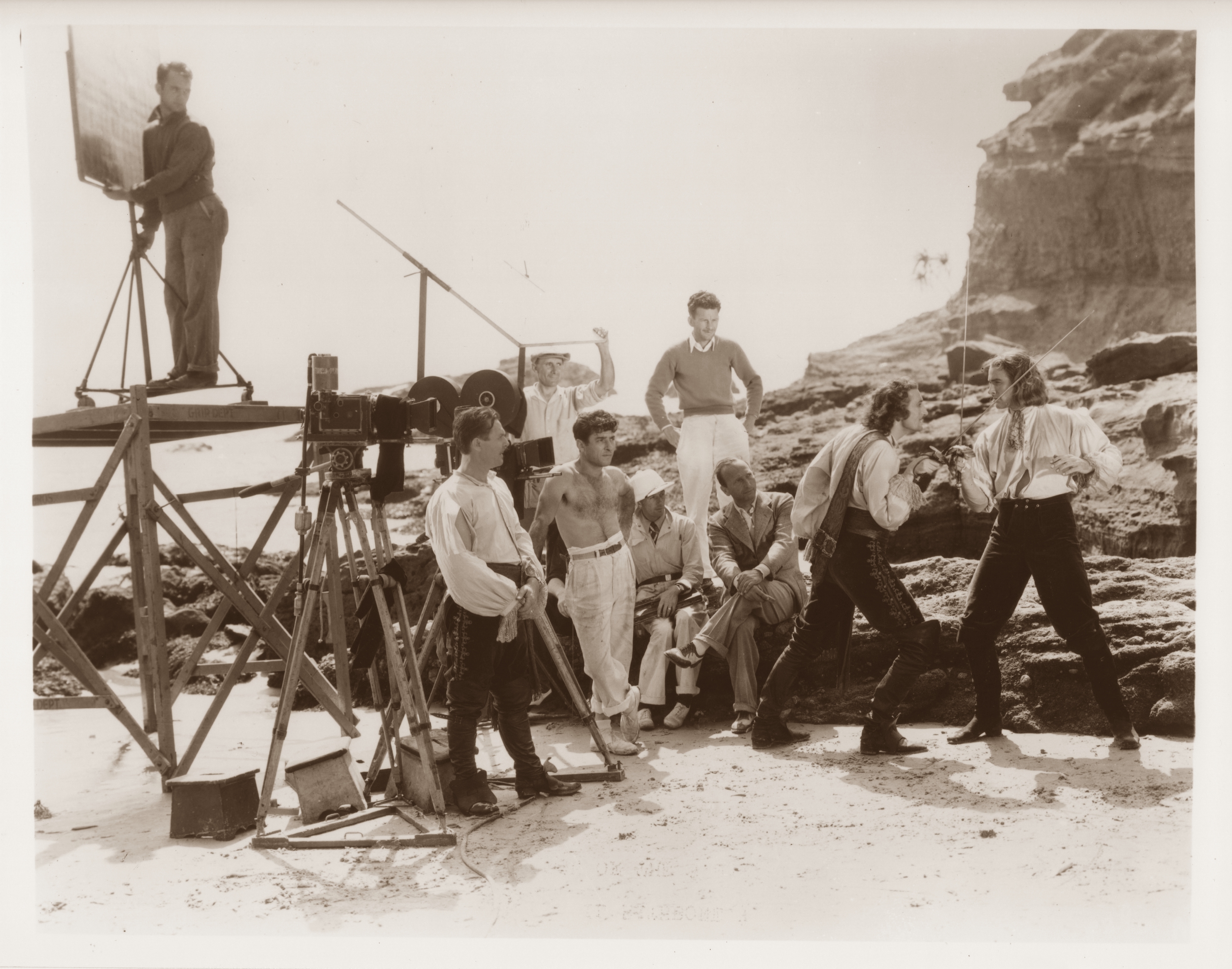
Shooting a duel could take days, and one author (Matzen, 2010) notes that shooting this one was hindered by “bad weather, milky gray skies, [and] audio challenges brought on by the pounding surf,” and two actors who could not fence — in fact, it was only Flynn who could not fence. The Virgin Magra scenes, including the “pearls before swine” build up to the duel, were shot September 16 through 18 and 24 through 26, with delays caused by cloud cover, aircraft, and high fog. Some takes were shot with artificial light (Florczak, 2022).
“These scenes take, Lord knows, how many set-ups. For instance, they will not take a long shot alone; they’ll take a master shot, then a medium shot and then take some close-ups. Any fight that lasts five minutes on the screen could easily take two days to shoot,” said Basil Rathbone (Jones, 1972).
According to Rudy Behlmer (1965), “When the duel is shown to the director, he, and perhaps the cinematographer, may alter the set, props and lighting. After which, the duel routine is broken up into master shots, close-ups, special angles, etc., and photographed with either principals or doubles, depending upon the actors’ capabilities and the specific shot.
There is a myth that director Michael Curtiz engaged in swordplay himself during the filming: “Curtiz, who is quite the swordsman himself, having been a member of the Hungarian Olympic team in 1912, would fight with each of them first, to show how he wanted it done.” (Whitaker, 1936.)
This of course, is nonsense, at least regarding the Olympic Games, and probably in its entirety as well. Curtiz, although apparently fond of claiming he was on the 1912 Hungarian team, does not appear to been an Olympian. I have not found his Hungarian names (Manó Kertész Kaminer and Kertész Mihály) or anything similar among the fully detailed records of the foil, epee, and saber events from first pools to final of the 1912 Games. Even so, numerous biographies repeat the myth as fact, although occasionally the word “allegedly” is used. For good reason did Cavens, not Curtiz, choreograph the duel.
Doubling of the sword-fighting actors was common at the time, including in Captain Blood. “The villains, especially Basil Rathbone, are splendid fencers, but the heroes, according to Mr. Cavens, are ineffectual fellows when it comes to cold steel… And when the script demands that he [Errol Flynn] resort to the sword to defend his honor, Warner Brothers resorts to Mr. Cavens.” (Brady, 1941.)
However, Fred Cavens, as proved by the photo below, as well as others farther down, doubled Rathbone, not Flynn, when necessary during the duel. In fact, Hal Wallis complained of the dailies of the duel, noting that the wigs and costumes of the doubles were terrible as compared to those of the actors. The photos below show he had good reason. Thankfully, the doubles were used only in the long shots, as far as I can tell, in the final cut.


Flynn was doubled as necessary by Caven’s assistant, Ralph Faulkner, soon to become one of Cavens’s principal Hollywood heirs. Faulkner was 1928 Pacific Coast foil and epee champion, and a member of the US Olympic saber team at the 1928 and 1932 Games. Regarding the 1932 games, “One of the mysteries in the competition between Poland and the United States was the removal of Ralph Faulkner, the only Southern Californian on the team, from the American line-up. Faulkner had been entered in the contest with Hungary and had succeeded in taking two of the three bouts for America in her score against that country.” (Durbin, 1932.)
A mystery indeed! [And a brief digression!] The Hungarians ruled saber for fifty years; their national saber championship was tougher than the Games themselves, so deep were the Hungarians in elite sabreurs. That Faulkner could win two of three bouts against the Hungarian team that would win gold is amazing — no other fencer at the 1932 Games won more than one bout against them (in fact, for fifty years a total of slightly more than 30 Hungarian sabreurs won nearly every elite competition in the world) — and should have guaranteed his inclusion in the bronze medal bout against Poland. However, the elitist East Coast prejudice against his Southern California roots is not out of the question, and this probably cost the US a medal: the US lost to Poland by a single touch.

One of the methods of excluding “outsiders” was via cheating by side judges and bout directors during qualifying championships: the director had one and a half votes, and each of the two side judges watching a single fencer had one vote each and could therefore overrule even an honest director. The other method, common in the first half of the 20th century, was exclusion by the committee “choosing the best fencers” or even by a team captain during events. I’m speculating, of course, but these latter two means were probably the way Faulkner, an outsider, was excluded from the bronze medal team match — and entirely from the individual events in the 1928 and 1932 Games.
[Warning: further fascinating digression ahead!] In fact, until the 1950s team selection in US saber fencing was reportedly largely ruled by the “New York saber Mafia,” as many non-New York fencers called the narrow-minded, cliquish US saber fencing establishment, and a number of deserving fencers failed to make the US team due to prejudice against them, including at times of race and religion. The brilliant Herb Spector, described by one of my masters, Dr. Eugene Hamori, as the best saber fencer in the world in a two-touch bout, springs immediately to mind, among others. I have both met Herb on numerous occasions and fenced him once in competition: he was the personification of the highest praise of Dr. Francis Zold, my first fencing master, that of being both a gentleman and swordsman.
This unsportsmanlike, even dishonorable, practice arguably had its roots in the at-the-time elitist Fencers Club of New York. (The Fencers Club of NY still exists, although some suggest that its past arrogant elitism may have passed into the hands of the New York Athletic Club. Please note that no suggestion of dishonorable or unsportsmanlike conduct is herein made toward either club today, in part because I don’t like wasting my time with NY lawyers, or any lawyers, although the sense of crass elitism remains according to some observers.)
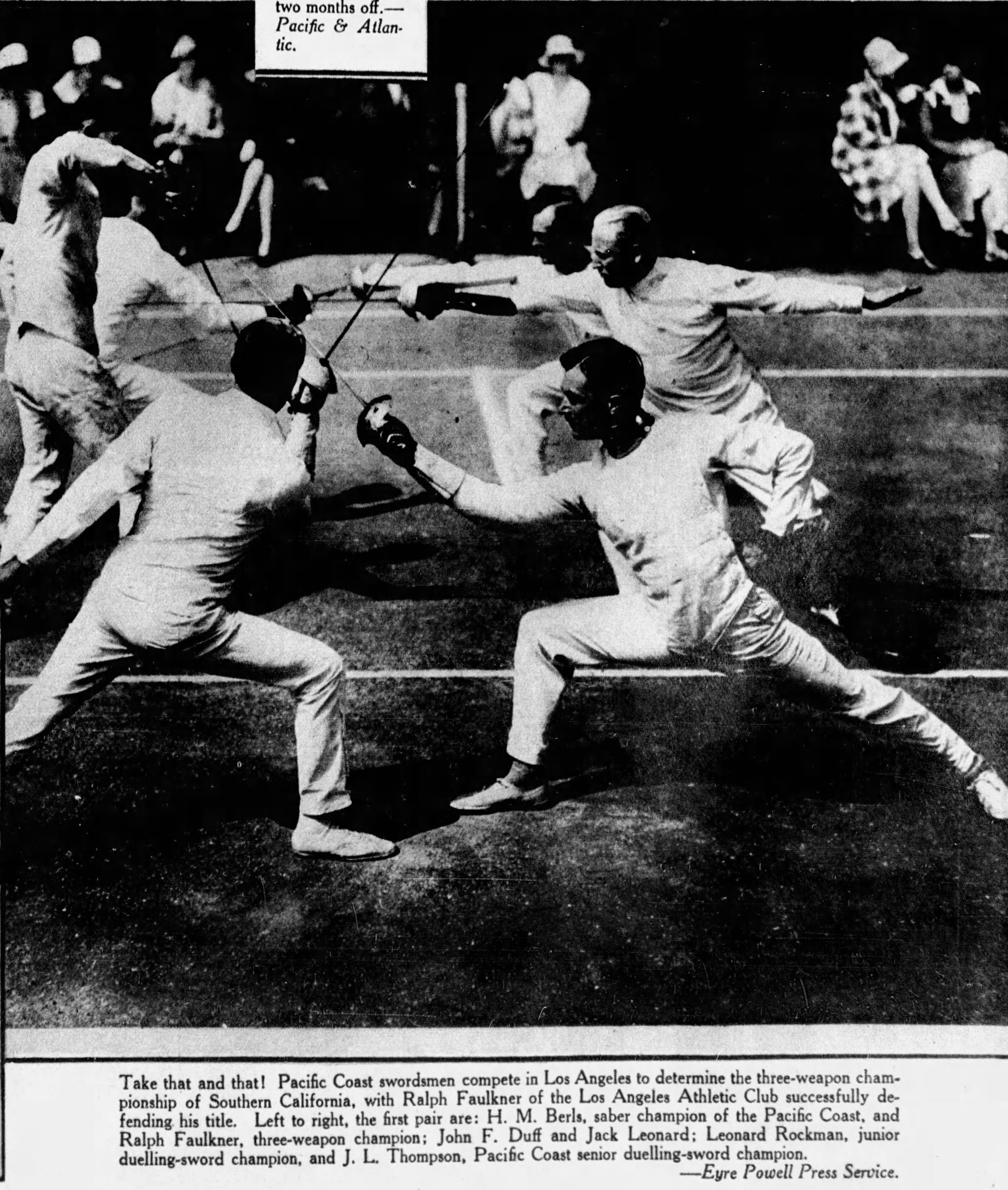
Faulkner himself confirmed bias as the reason he was only permitted to compete as part of the US Olympic saber team in both 1928 and 1932, and not in the individual saber events: the controlling Eastern Establishment “didn’t feel a savage from out West could be superior.” (Folkart, 1987.)
The “Mafia’s” spine, at least in regard to the Olympic Games, was broken when Hungarian gold medalist saber fencers, including one of my own masters, Dr. Eugene Hamori, defected to the US after the Soviet Union brutally crushed the democratic Hungarian uprising in 1956 during the Olympic Games. The Hungarians’ technique was so superior and clean that any cheating against them would have been far too obvious.
And if this clear superiority didn’t stop the mischief, I’ve seen how some of these Hungarians dealt with cheating directors and side judges clearly in cahoots with the opposing fencer: they would drop the opponent to the strip with a welting chest cut, making the hit overtly clear even to the most willfully blind. (I’ve also seen the technique used once by a Hungarian Olympic medalist in New Orleans frustrated with the director, a friend of his and also an Olympic medalist — and the fencer he dropped to the ground was also a friend. Temper, temper… Or tempo, tempo?)
However, even as late as the 1970s the “Mafia’s” influence was still apparent to some degree, at least in the Junior Olympics, according to several fencers I knew. As a good friend of mine noted at the time, he could beat any of the elite junior New York competitors anywhere in the US and world — except in New York City. A bout director there even shrugged in apology to him once, after the two side judges were repeatedly, and clearly deliberately, blind to his clean on-target touches made with undisputed priority.
Faulkner was still teaching fencing at his salle, Falcon Studios, aka the Faulkner School of Fencing, in Hollywood, when I first started learning in 1977. By then he gave lessons seated and was nearly blind, or so I was told, but his lessons were still extraordinarily instructive in blade-work. I was advised to take a lesson just to say I had, if nothing more, but never managed to do so in part because I was well-satisfied with my own swashbuckling master, Dr. Francis Zold. (I was also an impecunious college student in LA without a car.) Many Hollywood and stage fencing choreographers — Anthony De Longis comes quickly to mind — studied under Faulkner and by their own admissions owe much to him. Maestro Faulkner died in 1985 at the age of ninety-five.

But back to the filming of the duel! Flynn was noted in the production of later films as having a drinking problem on set, which in the case of swordplay would be quite dangerous.
Whether Flynn drank during the filming of the duel in Captain Blood is not noted anywhere I can find. According to Maureen O’Hara in her autobiography, “I enjoyed working with Errol because he was a pro. He always came to work prepared. He rehearsed hard and practiced his fencing sequences very meticulously with Fred Cavens… He also knew his lines, something I greatly respect in an actor. Of course, there was one glaring inconsistency with his professionalism. Errol also drank on the set, something I greatly disliked. You couldn’t stop him; Errol did whatever he liked. If the director prohibited alcohol on the set, then Errol would inject oranges with booze and eat them during breaks. We worked around his drinking. Everything good that we got on film was shot early in the day. He started gulping his “water” early in the morning and by four P.M. was in no shape to continue filming.”
Flynn himself describes in his autobiography how when filming a boarding scene during the production of Captain Blood he fell to the ground with an attack of malaria or blackwater fever. He cured the shaking, shivering weakness of the attack with a bottle of Cognac suggested, he says, by the crew. He was called on the carpet by Jack Warner the following day as the result of this drinking: “The script girl tipped me off. They had rushes of the scene I finished after the bottle of cognac. In the film I was waving the sword about like a Cossack, shouting lines that weren’t in the script, and had almost fallen off the boat. A bit of real drunken acting.”
The filming of the duel was publicized in small ways in advance of the movie’s release. The press package claimed, for example, that “Actor Breaks Three Rapiers in Duel,” which is probably true in reference to blades. Hilts might break, but are generally much sturdier. It would be surprising if spare rapiers and blades were not on set during filming. Even so, according to a press clipping, a “rush order for additional rapiers was sent out when Errol Flynn…broke three of them during the filming of scenes in which he has a duel with a rival pirate…”
Also according to the Warner Bros. publicity package for the film and often repeated as fact, Flynn “received two small wounds during his battle with Basil Rathbone.” A separate publicity clip for newspaper release noted four: the “most serious wound was on the actor’s head, slightly above the left temple. He also was cut by his opponent, Basil Rathbone, near the right eye, on the neck and on the right forearm.”
And according to one reporter, “they really drew blood too, so that Flynn had some actual wounds to be doctored after that exciting buccaneering day.” (Whitaker, 1936.)
Although injuries do occur on occasion in well-prepared, well-choreographed swordfights, those listed here are probably pure invention for the sake of publicity: Rathbone in his autobiography states that he never hurt anyone when filming any fencing scene, nor was hurt by anyone. The photograph of Flynn below shows the “wounds” — and they appear to be nothing more than those created by a make-up artist for the scene. If Flynn were wounded during the filming of the duel, it would have therefore been by Fred Cavens, and surely due to Flynn’s own error. I think it also possible but highly unlikely that Cavens would have deliberately hit Flynn as a reminder to be careful — or not to do anything too stupid or too dangerous that might hurt his film adversary. (This can, however, be an effective teaching method with a blunt tip used during an egregious error made by a student without a jacket, although not all students these days are suitable to this practice.)

At one point, again according to the press package, Flynn fell off a cliff at Three Arch Bay during filming:
“Flynn was doing a scene depicting a duel with rapiers between himself as Pirate Blood and Basil Rathbone, who portrays the role of Levasseur, French buccaneer and Blood’s rival. In order to give the scene added drama, Director Michael Curtiz had Flynn drive Rathbone at swordspoint onto a small ledge on the side of a cliff overlooking the bay. The cliff was not quite perpendicular, however, sloping off gently so that the ledge was about ten or twelve feet shoreward and forty feet above the water line.
“With the cameras grinding, Flynn backed Rathbone onto the ledge according to instructions. For several minutes the rapiers of the duelists flashed. Then, suddenly, a shout of dismay rose.
“Flynn had tripped on a small rock and toppled outward from the ledge. Slowly at first, he strove to regain his footing, but in vain. When he finally realized there was no chance of saving himself, he put all his power into an outward leap. He soared out from the ledge, cut cleanly into the water, missing the base of the cliff a mere matter of inches. He swam to the beach unaided.
“A less powerful man than Flynn could not possibly have put the force behind his leap to clear the base of the cliff… [He] suffered nothing worse than a slightly lacerated knee which scraped a submerged rock.” Although it’s entirely possible that the incident did take place, Hollywood clearly does love hyperbole, not only for the sake of publicity, but for its own sake. Flynn even reportedly “rescued” Olivia de Havilland after a wave swept her into the ocean (Amburn, 2018). Separating fact from fiction in Hollywood is difficult, and fans often prefer the fantasy.

The shooting of the duel wrapped up near dusk on the final day (probably September 26). Rathbone tells an anecdote (Jones, 1972) about how “Sailor Vincent,” the nominal head of the pirate extras and, according to the press package, an “all-Navy welterweight boxing champion,” asked Flynn and Rathbone near the end of a day’s shooting if they were going to wrap it up that day or give the extras another day to get paid. “Our reputations as swordsmen were at stake,” Rathbone said, and so they decided to finish the shooting that day. They were probably quite ready to get past the exhausting shooting of the duel.
“Now what we had to do was this:” Rathbone said, “a man stood with a stopwatch, and he timed the waves coming in. There was a short routine in which Flynn had to get me, kill me, and I had to fall exactly as a wave was coming in. If I fell exactly as a wave was coming it, it would cover me with water and as it went back out again, there I would be lying on the ground with my eyes wide open. You try lying with your eyes wide open, and sea water in them without blinking. Well, we did it! Exactly to the second, we timed the swordplay which took fifteen seconds. At the end of fifteen seconds I had to fall and the wave had to come in and I had to fall into the wave. This happened exactly to the second.
“The thing that Flynn and I expected was that Sailor Vincent would come across and say, “Well, thanks for nothing!” Instead of that, all the extras applauded loudly. They were so thrilled at the sheer skill of it because this required beautiful timing and Flynn and I worked very hard on the sequence.”
After a few more shots, and with the sun soon too low at 4:30 to shoot, filming of the duel finished and everyone went home. Rathbone noted that had they failed to get the final scene correct, they would have had to shoot again the next day because he would have had to wait for a new, dry costume.

The Myth of “Sharp Tips” Used in the Film Duel
There has long been a myth that director Michael Curtiz demanded that the tips be removed from the rapiers so they wouldn’t show up on film, and therefore the actors fought their duel with sharp points. This myth, among other issues, demonstrates a lack of understanding of how practice fencing swords are constructed and used.
The rapiers used in the duel were mounted with “dry” (i.e. non-electrical — electrical scoring was introduced the following year at the Olympic Games) epee blades, which might be considered a reasonable facsimile of the “three cornered” blades of many smallswords of the 1680s. Unlike modern epee blades, which are wider at the forte (the third nearest the hilt) and thicker at the foible (the third nearest the point), epee blades for most of the 20th century tended be narrower at both forte and foible than modern blades.
Practice dry epee blades were not, and are not, sharp, but instead are forged with a flat tack-like tip, often only slightly larger in diameter than the distal end of the blade. For “dry” practice in the 1930s (which was nearly all practice back then) either a hard rubber “button” was placed over the flat tip, or a point d’arrêt with three small sharp points was lashed to it with linen thread, dental floss, or very narrow (1/16″) cloth tape. There was no sharp point beneath. See the image below.
For shooting a duel scene in any film of the era, the rubber buttons or other points d’arrêt were typically removed, leaving the flat tips which made for better visuals. The flat tips are not as obvious on film but still could be dangerous, to eyes in particular, and required well-rehearsed actors for safety. The flat tips could also scratch or even make shallow cuts in the worst cases, but were not a significant threat to life or limb except, as just noted, to eyes. Typically only a wound from a broken blade might be life threatening.

However, according to some sources citing cameraman Hal Mohr (Davis, 1971, for example), the tips of the blades were broken off at Curtiz’s demand, leaving sharp points. This not only strains belief but is easily disproved. Breaking a fencing blade is relatively easy but breaking it immediately behind the flat tip is not. It would usually require a strong cutting tool or a hacksaw blade to cut the blade just behind the tip, and would indeed leave a much more dangerous point, something no fencing master would permit in the hands of even a talented amateur such as Rathbone, much less an unskilled fencer like Flynn.
I once choreographed and engaged in some fencing with sharp, pointed scimitars for a documentary. For safety it was necessary that both of us were highly skilled with pointed and edged weapons, we rehearsed and memorized the routine thoroughly beforehand, and during actual filming we worked at about half the speed we were capable of. Anything else with sharp or pointed swords could easily have led to serious injury or fatality. Fencing on stage with “sharps” was occasionally done in the 19th century, according to Pollock — with expected occasionally bloody consequences.
Notably, of the many original still photographs of the Flynn-Rathbone duel in my collection, at least of those in which the points are in focus, none show sharp or broken points, but instead, as expected, the typical flat points of practice epee blades. See below, for example. The photographs of the duel were taken at various stages of the its filming. The flat tips can even be seen in some of the scenes on film when watched frame-by-frame. Further, it is hard to believe that if Rathbone and Flynn had fenced with sharp points, Rathbone would not have mentioned such a dangerous undertaking in interviews or his autobiography. Again, we have a myth promoted by the Warner Bros. publicity machine and accepted at face value by much of the public.
Its ultimate origin is probably in a dueling trope common to 19th century swashbuckling romantic adventure novels: two erstwhile duelists, or their seconds, hastily break off the tips of their foils so they can fight for real. Walter Herries Pollock shreds this nonsense in his 1896 article on stage fencing: the tips would need to be filed, a noisy and lengthy process, or they would need to be snapped, an impossibility to do so such that each would be the same length. A trope, in other words, made into a myth. (Pollock.)


The Musical Accompaniment

The film score was composed by Erich Wolfgang Korngold, who largely created the modern practice of classical composition for film music. Korngold had not quite four weeks to compose it (November 10 to December 8, 1935; he was paid for a total of only five and a half weeks work), and was assisted by his long-term orchestrator and collaborator Hugo Friedhofer. Nearly all of the film’s music is original, with one major exception and a few minor associated additions. In addition, two minor pieces — songs sung by Spanish soldiers and seamen — were composed by Milan Roder, another long-term collaborator of Korngold’s. Throughout the process, Korngold was, unusually, monitored closely by Hal Wallis (who closely monitored everything, not always successfully, on the picture).
The major exceptions to original music, of course, were the scores for the duel on the beach and the climactic battle scene at the finale. Reportedly, the film’s preview had been moved up in order to meet a Christmas release date, and the score had to be completed within twenty-four hours. Out of time, Korngold adapted Frans Liszt’s symphonic poem Prometheus to the duel, a circumstance that apparently offended his sense of artistry and professionalism. He also adapted Liszt’s Mazeppa and used it for the climactic battle scene as well as for parts of the Spanish attack on Port Royal. These adaptations led him to refuse to have the credits list him as composer, and instead as musical arranger, in spite of his having composed the majority of the film score. For this reason the score was not nominated for an Academy Award, sadly. Korngold’s original film compositions — “opera without words” and “symphonic poems” — and method of scoring changed Hollywood film music forever. (See Carroll, Kalinak, and Winters for much more detail, in particular Carroll for an outstanding biography and Kalinak for a detailed study of the music in the film.)

According to Brendan G. Carroll, Korngold gave Friedhofer the Liszt score along with a new introduction and coda at 8:30 PM the day before it was required. Friedhofer spent the night arranging the adaptation. At 7:00 AM a messenger picked up the orchestration for copying. It was recorded that afternoon. That said, elements of the Liszt’s Prometheus also appear, as least as far as my untrained ear can tell, in the tracks “Peter is Bound — Pirates!” and “A Timely Interruption,” the latter of which is really a continuation of the former.
The 2001 Tsunami Captain Blood soundtrack (TSU 0141) above is the only one I’m aware of with the entire film score, including the duel. The thirty-one tracks provide an hour’s worth of neo-romantic swashbuckling listening pleasure. Out-of-print and now often listed at high prices by vendors hoping to make a quick extra buck, if you’re patient you can usually find a reasonably-priced copy. It’s my favorite of all the vinyl and CD Captain Blood soundtracks, and probably my favorite of all the full swashbuckler scores available on CD (or whatever else soundtracks are published via these days — I’ve never stopped listening to and collecting vinyl and CDs even as I’ve added other media to our collection, although I did long ago abandon cassette tapes).
Liszt’s Prometheus is also excellent listening. It’s often included on collections with Liszt’s Preludes, in which case you can also enjoy the overture to the old Flash Gordon film serial, a “space opera” — which was by definition a Western set in outer space. Our most popular modern version, arguably of both space operas and Westerns, is Star Wars and its many serializations. Star Wars has also taken over most of the old classic swashbuckling genres, to my dismay.
The Duel!

And now the duel itself. The best way to enjoy it — in fact, the only way — is to watch it. For those with an interest in the actual fencing details of the choreography, I’ve included a few annotations below. Fencing enthusiasts, feel free to disagree with my observations and assessments!
The fight really was between two true adventurers. Flynn was an Irish-Australian born and raised in Tasmania. In his autobiography describes himself in his youth as a “devil in boy’s clothing,” and after numerous misadventures leading to his eighteenth year he entered several years of seafaring adventure and fortune hunting — tobacco planting, gold mining, and various sea trades — associated with Papua New Guinea. An athlete but never a fencer, he does fondly describe playing with a sword an ancestor had taken from Captain William Bligh during the infamous mutiny, and he denounces his father for giving it away to the Naval and Military Club at Hobart.
Rathbone was the Patrols Officer of the Second Battalion of the Liverpool Scottish during WWI, and was awarded the Military Cross for heroism for his intelligence collection patrols, in particular one in which he led a small party across “No Man’s Land” into the German trenches for intelligence during daylight. At one point Baron von Richtofen, better known as the Red Baron, and his Flying Circus, which included future Nazi leader and convicted war criminal Hermann Goerring, flew a mere one hundred feet overhead, strafing the British line. In the enemy trenches, Rathbone, using his service revolver, shot and killed a German soldier. Documents taken from the soldier’s pockets indicated that a retreat was imminent. Rathbone led his men out safely under heavy machinegun fire. (Rathbone, 1962.)

The duel could not have been easy to film and fight in the sand, a surface which presents its own special difficulties. The rear foot tends to slip on the lunge. Turning the foot onto its inner edge is helpful (as some 17th and 18th century masters note), as is pushing more outward than directly behind on the lunge with the rear foot, as is maneuvering the fight onto the area of wet compacted beach between the soft dry sand above and the wet saturated sand below, or onto an area of vegetation. But at least the implausible “pirate boots” — buccaneers and pirates didn’t wear them unless on horseback, and it was rare to take a canter or gallop around the quarterdeck of a ship — would keep sand out!
The duel begins with Flynn wearing what at first appears to be a sleeveless waistcoat but is in fact a coat with different-colored sleeves or a long-sleeved waistcoat, with a baldric worn over a sash, apparently sewn or otherwise un-historically attached to the sash to keep the former from bouncing around. Rathbone is in his shirtsleeves, but likewise with a baldric worn over a sash. Eyewitness images of buccaneers in the 1680s — the only eyewitness images of any European-derived sea rovers during the Golden Age of Piracy — do show sashes on French buccaneers, but not baldrics. Sword-belts were worn instead, given their convenience, and they’re also not as hot. If a baldric were worn, it would typically have been worn beneath a sash to prevent it from bouncing around. (Why baldrics over sashes rather than under them as more practical? So the baldrics could be removed while leaving the romantic sashes in place.) I’ll discuss this further in part five of this series.
And now, for fun, a brief look at some of the swordplay itself. One of these days I may annotate the entire duel, but I’ve lost my old notes and haven’t the time at the moment to review it in its entirely again. A few instances will suffice for now.
The duel begins as several of Peter Blood’s officers begin escorting Arabella Bishop to a small bluff en route to their ship. Cahusec tries to restrain Levasseur but he’ll have none of it. “You do not take her while I live!” he shouts and draws his sword. “Then I’ll take her when you’re dead!” Blood replies, drawing his own sword, tossing his hat, and beginning to remove his baldric and waistcoat. Cahusec tries one more time to dissuade his captain, but fails.
Levasseur runs at Blood and thrusts in tierce. Blood parries tierce and shifts aside for additional protection against the the attack. The men move to open ground where Levasseur makes a half lunge, thrusting in quarte. Returning to his guard, Levasseur makes several change beats from quarte to tierce and back, followed by a few disengages in the same line against Blood’s en garde in quarte.
Levasseur feints outside (tierce), then inside (quarte), and finishes with a thrust without lunging in the low line, which is parried quinte (low quarte) by Blood, who ripostes with a quick extension but no lunge. Both men are clearly engaging in reconnaissance.
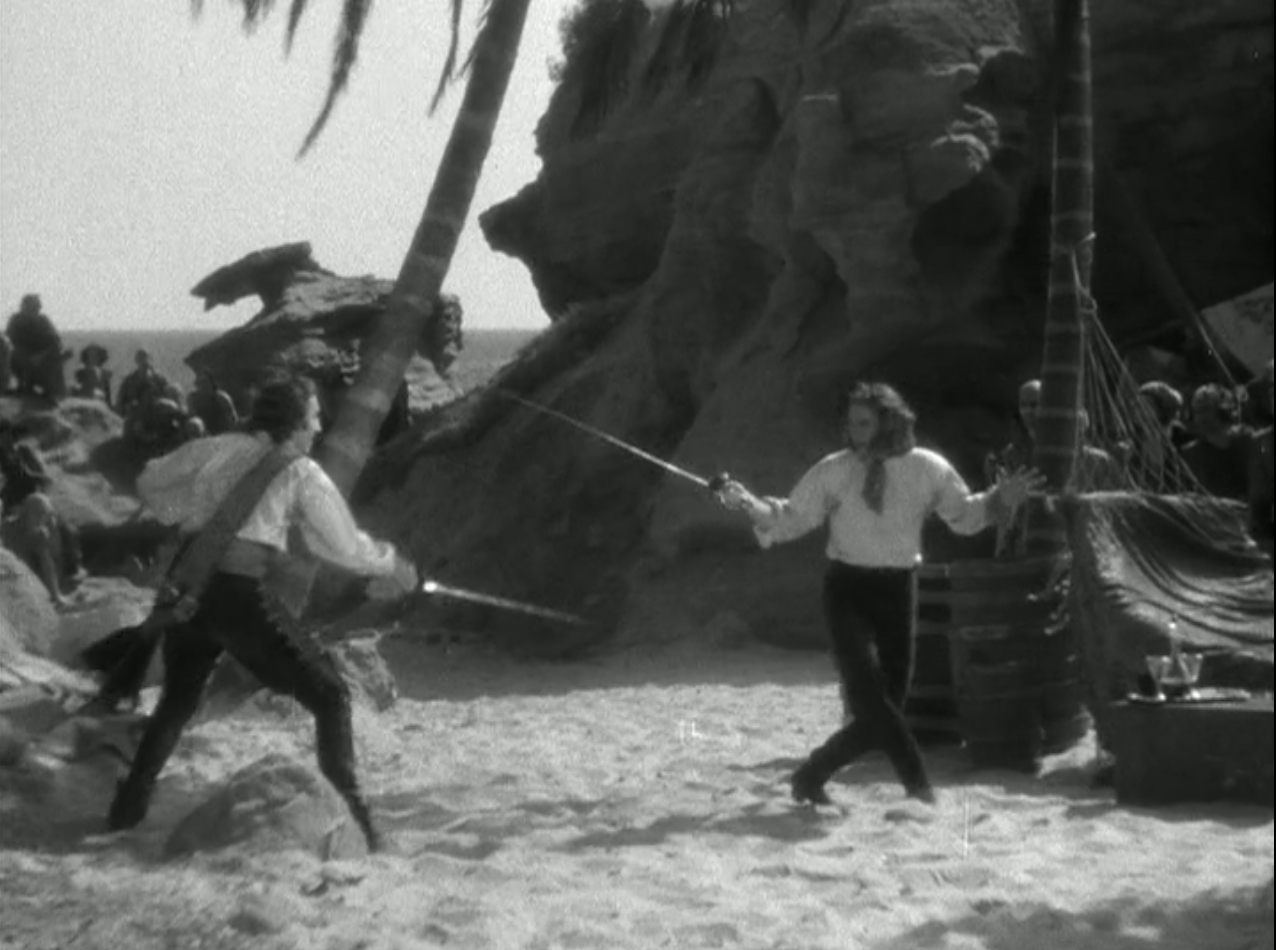
Now, in a wide shot, Blood traverses to his left. Levasseur attempts a wide, too obvious head feint, saber-like (this is theatrical swordplay, after all), to the inside, then cuts to the outside. Flynn makes a half-quarte parry, followed by a tierce which parries the attack, and ripostes low in seconde. Flynn parries another attack in tierce, again ripostes seconde, then attempts a head cut which is parried by Levasseur who ripostes inside, which is parried by Flynn in prime. Flynn makes a quick attack in seconde which is parried, and — very nicely and correctly — recovers quickly with a circular parry in the high line to protect himself just in case.
Flynn traverses to the left again, then attempts a flashy, and very “telegraphed,” head attack that would evolve in later films to a “triple moulinet,” which would become his signature move in his film swordplay. And every time I see it, I shout “Time him! Time him! Time him!” in my head to his adversary. Flashy, yes. And just asking to receive a time thrust to the throat! (Of course, moments before Rathbone had done much the same, if less flambouyantly…)
And so it goes, all very swashbuckling and theatrical.
For the sake of time, for now at least, I’m skipping over most of the following swordplay. As the duel progresses toward the rocks upon which Levasseur will meet his end, there are a couple of long shots which clearly show Rathbone and Flynn doubled by Cavens and Faulkner. Certainly, the publicity still below proves that Cavens doubled Rathbone in one of these shots, and in the same shot on film it is easy to recognize Cavens briefly. Faulkner is almost certainly doubling Flynn in the same shot. The studio was concerned about these obvious doubles — yet in fairness, the film used a great deal of old sea battle shots in the finale, and this is quite obvious.

I do want to mention my three favorite phrases (a phrase is a complete exchange, from start to finish, in fencing, for example: attack, parry, riposte, counter-riposte, counter-attack, &c, until there is a hit or the fencers break distance). All three take place in the final moments of the duel.
First is a croisé in sixte by Levasseur, which is beautifully parried by Blood with a prime, followed immediately by the classic, and very flashy, bind-thrust riposte in tierce (or sixte) to the head, the blade arcing from low to high, almost as a moulinet, although the hit doesn’t quite land. In the right circumstances the technique can disarm the adversary. But nicely done, still!
This is soon followed by Levasseur binding Blood’s blade from sixte to septime, with Blood countering with a yielding parry in tierce as he falls. Again, nicely done!
(We might call this techique “The Levasseur” and it can be a highly effective indeed unless the adversary knows his yielding parries or is exceptional at avoiding the blade, to paraphrase Inigo Montoya: a feint-bind in seconde followed immediately by a feint-bind in counter-seconde, then quickly change direction and bind sixte to septime with a flanconnade thrust…)
A quick side note: previous to this Levasseur falls, and Blood gallantly permits him to get up. But when Blood falls, Levasseur does his best to take advantage of the situation, showing the difference in their characters.
And now the two men are face-to-face at “handy grips!” Here we have the obligatory close-up, hilt-to-hilt, deadly fury in each man’s eyes!
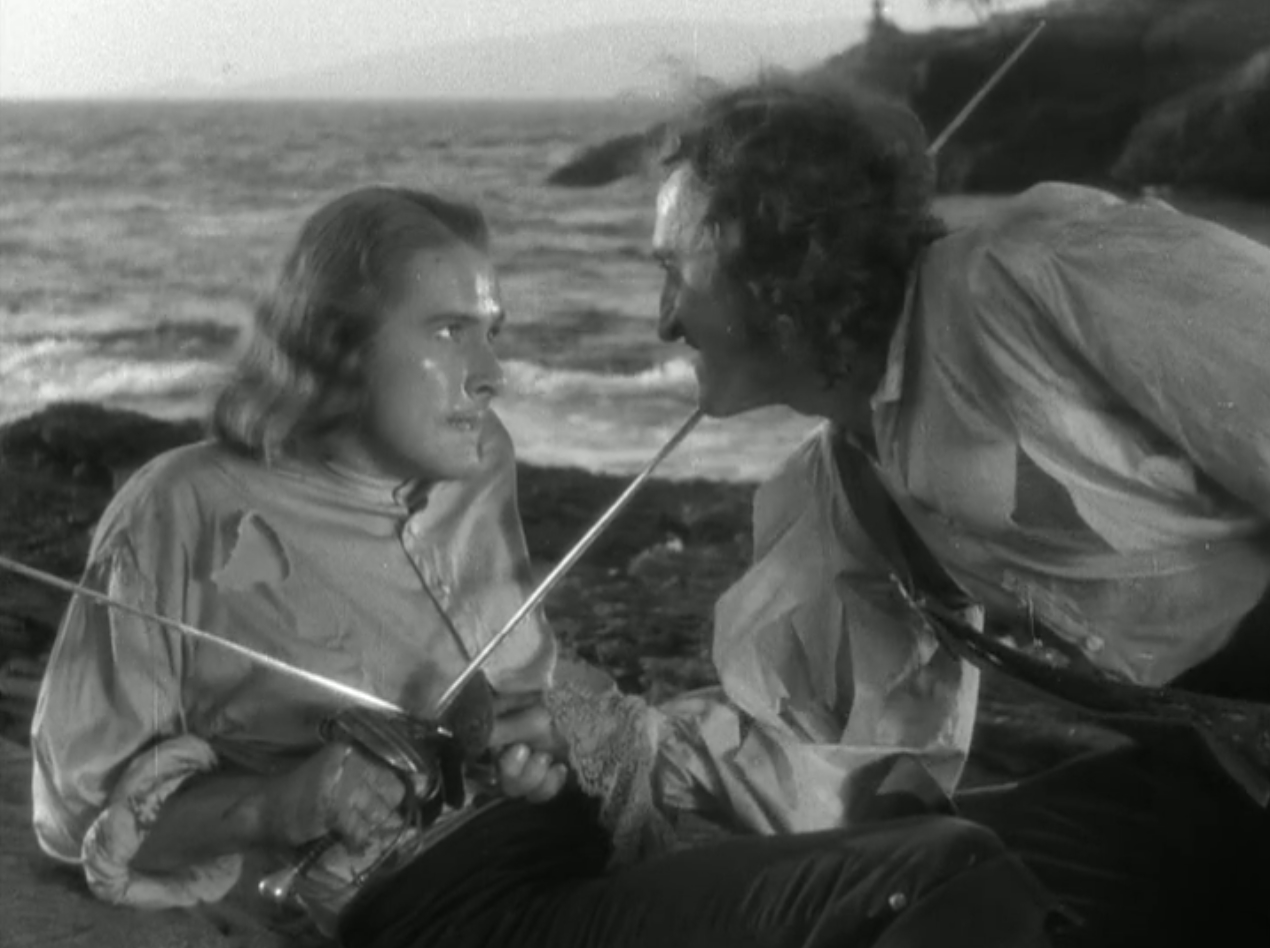
The adversaries quickly get to their feet, surprisingly without punching or pommeling each other, for the final engagement in which, moments after a quick, beautiful bind with transfer in sixte which is parried in prime, Blood kills Levasseur by lunging off the line — an esquive or, arguably in the language of the day, a volt — and “pinking” him, to use a 17th century term, from side to side. I strongly suspect the finish was inspired by the one in the duel in Rafael Sabatini’s The Black Swan, published three years before.
The film duel from start to finish is just under three minutes, yet time stands still for that short time, so exciting is the swordplay and acting. A timeless scene of piratical yet noble swashbuckling indeed!

And, in the latest news (and it’s about time!), Captain Blood has recently been re-released (January 2026) on 4K, Blu-ray, and DVD by Criterion! (But what’s up with that Frank Frazetta / John Carter of Mars sword?) 🙂
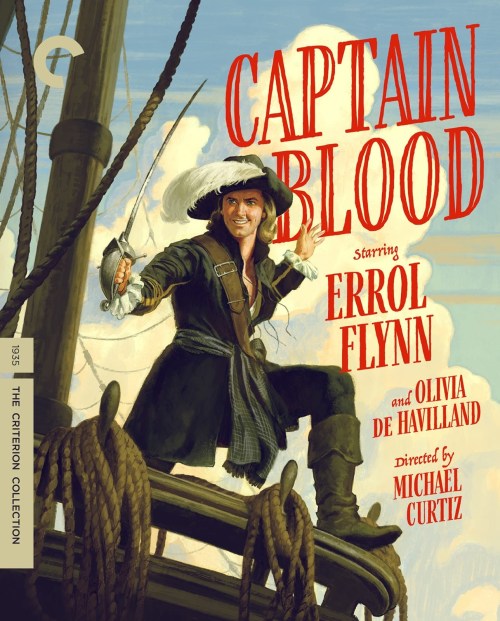
Next in the series: The Duel on the Beach in Reality!
Select Bibliography
Ellis Amburn. Olivia de Havilland and the Golden Age of Hollywood. Lanham, MD: Rowman & Littlefield, 2018.
Anon. “Frederic Cavens, 79, Taught Stars Fencing.” New York Times, May 2, 1962.
Anon. “Sealing Wax, Cabbages and Kings.” New York Times, September 30, 1934.
Rudy Behlmer. “Swordplay on the Screen: The Best of it Has Been Due to Belgian Fencing Masters.” Films in Review, June-July 1965.
Laura Benham, “Nothing Short of a Miracle.” Picture Play Magazine, March, 1937.
Leon Bertrand, Cut and Thrust: The Subtlety of the Sabre. London: Athletic Publications Ltd., 1927.
Thomas Brady. “Meet Hollywood’s Fencing Master.” New York Times, October 5, 1941.
Brendan G. Carroll. The Last Prodigy: a Biography of Erich Wolfgang Korngold. Hong Kong: Amadeus Press, 1997.
Richard Cohen. By the Sword. New York: Random House, 2002.
Robbin Coons. “Villains Die by the Sword as Movies Turn to Dueling.” Santa Ana Journal. March 8, 1936.
John Davis. “Captain Blood.” The Velvet Light Trap, No. 1, June 1971.
Edith Durbin. “Rolph and Doug Watch Hungary Win at Sabers.” Los Angeles Times, August 12, 1932.
Jean-Baptiste Dutertre. Histoire generale des Antilles habitées par les François. Paris: Thomas Jolly, 1667.
Alexandre Exquemelin. [John Esquemeling]. The Buccaneers of America. London: Crooke, 1684.
——. [Alexander Olivier Exquemelin]. Histoire des Avanturiers Flibustiers qui se sont Signalez dans les Indes. 2 vols. Paris: Jacques Le Febvre, 1699.
Robert Florczak. Errol Flynn: the Illustrated Life Chronology. Guilford, CT: The Lyons Press, 2022.
Errol Flynn. My Wicked, Wicked Ways. New York: G. P. Putnam’s Sons, 1959.
Burt A. Folkart. “Ralph B. Faulkner, 95, Film Swordsman, Dies.” Los Angeles Times, January 31, 1987.
George MacDonald Fraser. The Hollywood History of the World. New York: Random House, 1989.
Maxwell Reid Grant. “D’Artagnan Comes Back.” Modern Mechanix, March, 1937.
Victor Gunson. “Those Who Take the Sword (In Movies) Must First Learn How From Fred Cavens.” Daily Herald, Circleville, Ohio. August 13, 1947.
Fred W. Jackman. “The ‘Process-Shot’: Economies Made ‘Captain Blood’ Possible.” American Cinematographer, February 1936.
Russ Jones. “Rathbone.” Flashback magazine, June 1972.
Kathryn Kalinak. Settling the Score: Music and the Classical Hollywood Film. Madison, WI: University of Wisconson Press, 1992.
Read Kendall. “Out and About in Hollywood.” Los Angeles Times, September 13, 1935.
Benerson Little. The Buccaneer’s Realm: Pirate Life on the Spanish Main, 1674 – 1688. Washington DC: Potomac Books, 2007.
——. The Golden Age of Piracy: The Truth Behind Pirate Myths. New York: Skyhorse, 2016.
Robert Matzen: Errol & Olivia: Ego & Obsession in Golden Era Hollywood. Pittsburg: Golden Knight Books, 2010.
Maureen O’Hara. ‘Tis Her. New York: Simon & Schuster, 2004.
Don Page. “Another Fairbanks Roams Sherwood Forest.” Los Angeles Times, January 19, 1968.
Walter Herries Pollock. “Stage Swordsmanship.” The Theatre, June 1, 1896.
Basil Rathbone. In and Out of Character. New York: Doubleday, 1962.
Donna Risher. “Clang of Rapiers Resounds In Filmdom As Movies Hark Back to Days of Duels.” Albany Democrat-Herald, April 18, 1936.
Casey Robinson. Captain Blood Shooting Script. Warner Bros., 1935.
Rafael Sabatini. Captain Blood: His Odyssey. New York: Houghton Mifflin, 1922.
——. The Black Swan. New York: Houghton Mifflin, 1932.
Warner Bros. Captain Blood Press and Publicity Package, 1935.
Alma Whitaker. “Stars Who’ve Learned Fencing for Films Make It Latest Indoor Sport.” Los Angeles Times, February 2, 1936.
Ben Winters. Korngold in America: Music, Myth, and Hollywood. Oxford: Oxford University Press, 2025.
John R. Woolfenden. “Flock of Handsome Brutes Spring Up as Leading Men.” Los Angeles Times, May 17, 1936.
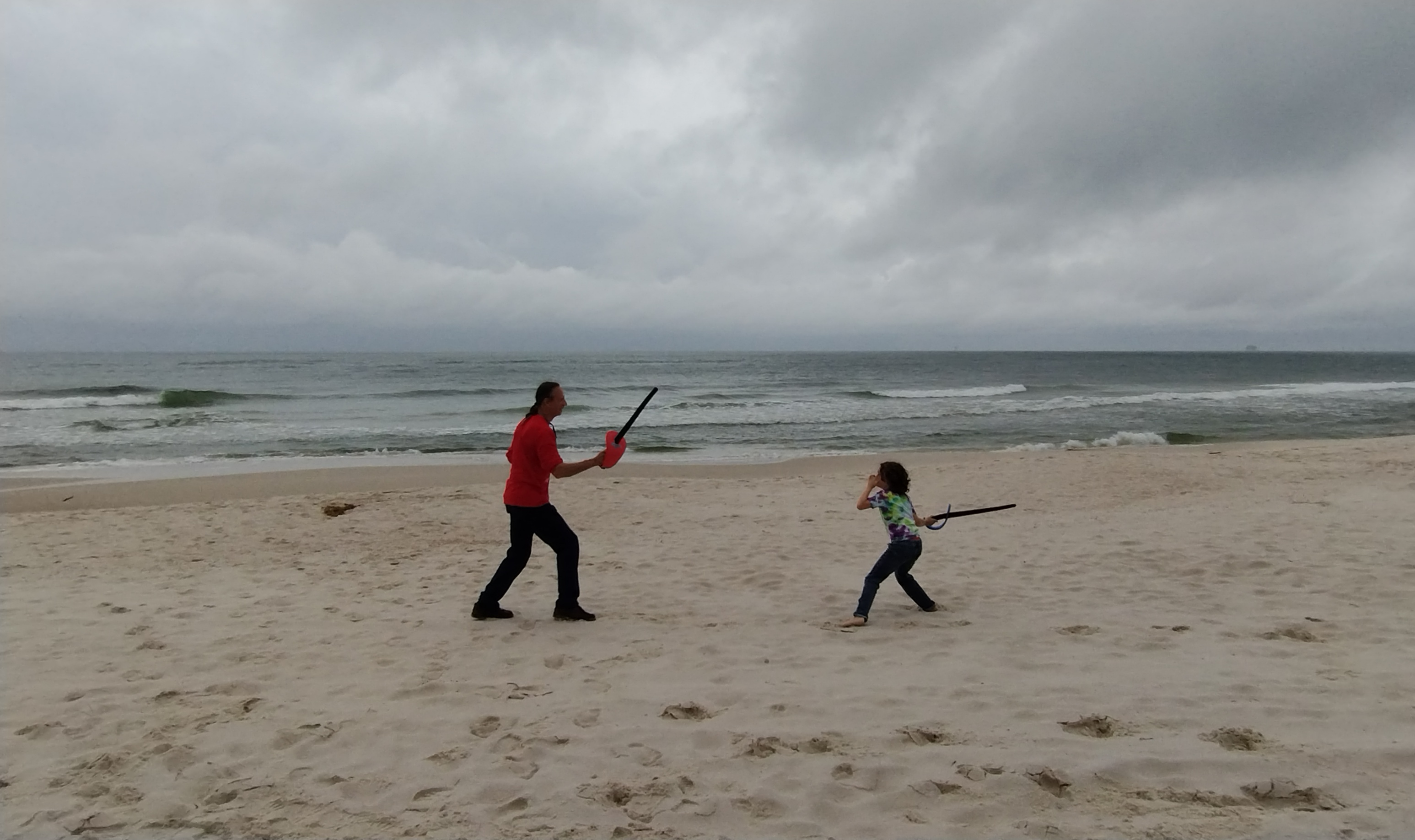
*My personal top three duels: Captain Blood, The Mark of Zorro, and The Princess Bride.
Copyright Benerson Little 2022-2026. First posted 29 March 2022. Last updated January 2, 2026.

Fencing Books For Swordsmen & Swordswomen
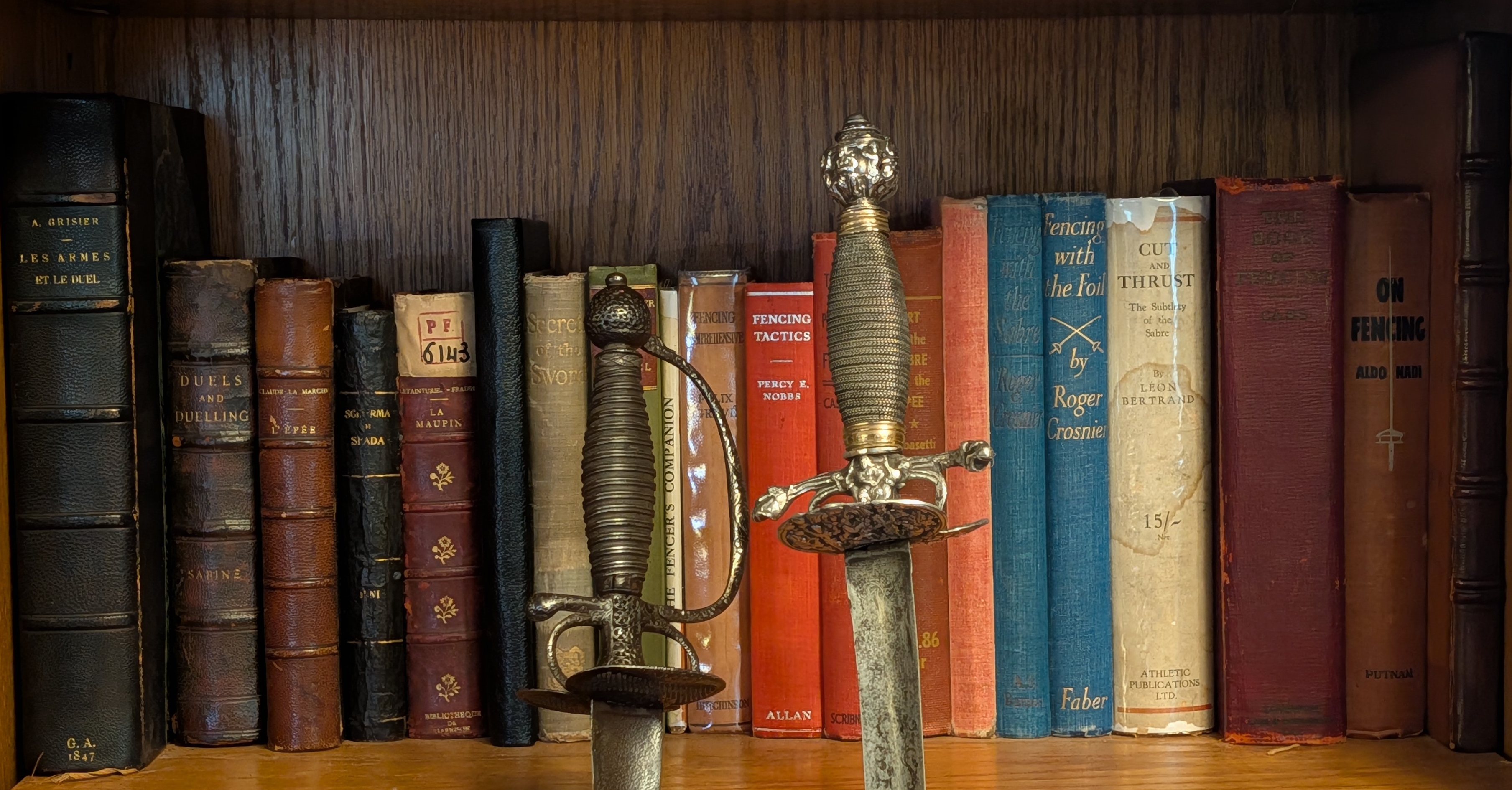
The content in this post is more background on than digression from the general subjects of this blog–swordplay and swashbucklers–, for what is either without fencing technique? The following fencing books are my recommendations for fencers across the spectrum, from early modern historical to “classical” to modern “Olympic” competitive. It includes sections on the modern Olympic weapons, classical fencing, rapier, smallsword, various cut & thrust, theory, Japanese texts, and more.
The list below, although quite long, is not exhaustive—there are many good fencing books not listed (and some more bad than good as well). Some are not listed simply because I have not yet read them. The history list in particular is abridged due to sheer volume, but less so than in past years, and I have not yet begun to include much in the way of mid-19th century works or of books on swords as opposed to swordplay. Fencing books can be very useful, but are no substitute for proper instruction and diligent practice, as I learned from my fencing masters, Dr. Francis Zold and Dr. Eugene Hamori. See the end of the list for suggestions on acquiring the books listed here, or for that matter, many books in general.
The first fencing book I ever read, in 1975 or 1976, was Bob Anderson’s All About Fencing, along with a beginning text by Nancy Curry or Muriel Bower, I can’t recall which, probably the former. These were followed by, once I started fencing in 1977 under Dr. Zold at USC, either Curry or Bower’s book (the latter I think, given Bower’s association with USC), then Charles Selberg’s Foil (and when it was published, his Revised Foil), Michel Alaux’s Modern Fencing, Marvin Nelson’s Winning Fencing, and, in 1980, Imre Vass’s Epee Fencing, soon followed by Laszlo Szabo’s Fencing and the Master. From that point my interest in fencing texts exploded.
My earliest years of fencing education, however, were dominated by fencing lessons, verbal instruction, and oral histories, not fencing books. Notably, my epee instruction was derived in large part from Vass via Dr. Hamori’s own knowledge of the weapon and in consultation with his close friend József Sakovits (trained by Imre Vass) who was one of the world’s greatest epeeists and later Hungarian national coach. The general method of instruction used by my masters was derived directly from Szabo, his master Italo Santelli, and other notable Hungarian masters such as Gyorgi Piller–yet never for four years were the works of Vass or Szabo recommended to me. They were, in essence, above my ability at the time.
As Italo Santelli put it, fencing is something you do, not something you write (and therefore read) about! Thus were my early years filled with learning to fence not by reading but by fencing and fencing lessons. That said, the study of fencing texts does have an important place in learning to fence: it broadens one’s knowledge of the subject. Fencing books provide a map to the world of swordplay. They can also point out errors in technique, training, and tactics (although a fencing master is always better for this), and can reorient one’s perspective in certain cases.
Associated fencing quotations can be found here.
N. B. If you take the broad study of swordplay seriously, you will find yourself compelled to consider the following questions major and minor, for example: Does offense or defence put the fencer in the strongest position, or does a balance between the two? Should the fencer extend fully before lunging or simply begin with the point, extending and lunging near simultaneously? Where should the fencer primarily look when fencing — at the hilt and blade, at the eyes (if they could be seen), or broadly at the whole, or in combination, shifting from one to another? Should the fencer emphasize power (strength and speed) or finesse, or both? Tactically, is the strategic fencer or the opportunistic fencer generally superior?
Essays on Fencing & Life
So rare are these essays that I’ve found only two to list so far, although occasionally the subject is touched upon in prefaces to fencing books. I’ve listed Lambotte’s first, as her entire short work is on the subject. The first third of Bertrand’s book qualify as an essay on fencing & life, thus the book is the only one to get a double entry.
Arguably, Bazancourt’s Secrets of the Sword and Burton’s The Sentiment of the Sword occasionally connect fencing to life in general, and Gravé’s Fencing Comprehensive has a sense of this as well. All three are noted below.
L’Escrimeuse by Emma Lambotte, 1937. A delightful essay on fencing, on being a woman fencer, on fencing’s connection to and reflection of life, and on the characters of various fencing nationalities, among many other brief subjects. Mme. Lambotte was a noted Belgian poet and the muse and patron of painter James Ensor.
Cut and Thrust: The Subtlety of the Sabre by Leon Bertrand, 1927. The first five chapters of Bertrand’s book qualify as essays on fencing and life, ranging from a defense of fencing as sport to a defense of dueling to physical and mental exercise. See the full entry below.
Modern Epee
Why have I placed Modern Epee—that is, epee as fenced from the 1930s to the present in its various forms—first among books on technique? Because it’s the best starting point for most budding fencers today, even if their ultimate goal is classical or historical fencing. It is by far the most popular modern competitive weapon (it looks like swordplay, its judging is simple, it much more resembles sword-fighting with sharps than either modern foil or saber, it is very “democratic” in that the weaker fencer always stands a chance, as some have put it), and—if taught appropriately via a classical foundation as it should be—is also an excellent foundation for historical and classical fencing. Modern competitive foil and saber have become largely useless for this, both as fenced and as taught, for they’ve given up the classical notion derived from combat that attacks in invitation–with the point non-threatening and/or the arm not extended or extending–would be suicidal with real weapons.
It should be noted that some modern epeeists consider not only classical epee technique (point d’arrêt technique, especially non-electrical, and true dueling technique), but also “modern classical” (electrical pre-Harmenberg, so to speak) technique to be obsolete. This narrow view has no basis in fact except to some degree in the case of some elite (world class, that is) epeeists. Purely classical and modern classical epeeists can, and often do, fence as far as a solid A, or national, level, and classical technique is the foundation of elite epee technique. In fact, elite women’s epee retains a significant amount of so-called classical technique, and the compiler of this list is well-acquainted with a Greek-American epeeist some 80-plus years old whose classical, very old school straight arm dueling technique can still give even young elite epeeists fits.
Note, however, that the definition of classical fencing has changed over time and continues to change today. More than a century ago foil was considered the classical school and epee the modern, and French duellists of a century ago were classified according to three schools: foil, foil-epee, and epee! In fact, one need only read Achille Edom’s 1910 book on epee fencing (see below) to realize that much of what is considered new in epee is in fact more than a century old. In other words, epeeists should not consider older epee texts, nor any epee style of the past century or more, as unworthy of practical study, modern fads, to which epee is highly susceptible, notwithstanding.
Fencing with the Epee by Roger Crosnier, 1958. A thorough description of modern classical epee technique, still very useful today. Prof. Crosnier’s book on foil fencing (see the Foil section) should be read hand-in-hand with his epee text.
Epee Fencing: A Complete System by Imre Vass, 1965 in Hungarian, 1976 1st English edition, revised English editions 1998, 2011. The most thorough epee text ever written. That said, highly recommended for epee coaches at all levels, recommended only with caution for intermediate to advanced fencers (at least three to five years or more significant experience)—but not for beginners. There is much useful, often profound, material, but some sections can be skipped entirely by some fencers, and others require sufficient epee fencing experience in order to profit from them. The revised editions were edited by fencer and publisher Stephan Khinoy, and amplify and supplement the original text in places.
The latest edition suggests the need for such classical training today, in spite of the so-called “new paradigm” (see Harmenberg below, his book was also originally published by Khinoy). I agree. Even for those relatively few fencers (as compared to the entire body of epeeists) who wish to and are able to emulate Harmenberg’s sport methods, a solid base of “modern classical” epee training is still necessary. For most epeeists, even superior amateurs, modern classical technique is all they’ll ever need.
Again, caution is advised when studying the book; it’s best to have a solid understanding of fundamental epee technique and theory before reading it. In fact, it helps to understand the Italian school in order to understand Vass’s theoretical framework: Luigi Barbasetti’s book on foil (see below) is a good start. Vass trained international medalists József Sákovics and Béla Rerrich, both of whom went on to become leading epee masters and national coaches, the former in Hungary, the latter in Sweden, with numerous international champions to their credit. He also trained four-time Olympic gold medalist in epee Győző Kulcsár, who later as a fencing master trained two-time Olympic gold medalist in epee Timea Nagy. József Sákovics, considered by many to be the first “modern” epee fencer, died in 2009, Béla Rerrich in 2005, and Győző Kulcsár in 2018.
La Spada: Metodo del Maestro Caposcuola Giuseppe Mangiarotti by Edoardo Mangiarotti, the Comitato Olimpico Nazionale Italiano, Scuola Centrale Dello Sport, and Federazione Italiana Scherma, 1971. Epee as taught by the famous Guiseppe Mangiarotti: a thorough exposition of his method. Beginner-friendly, too, at least if you read Italian or have a working knowledge of fencing technique and language along with a background in Romance languages other than Italian. Includes excellent illustrations of blade positions, better perhaps than in any other epee text. (Side note: the book even includes illustrations from the works of Vass and Szabo. Kingston and Cheris in this section also have excellent illustrations of blade positions.)
Prof. Mangiarotti, who studied under Italo Santelli as well as under other masters Italian and French, was an Olympic fencer, seventeen-time Italian national epee champion, father of famous champion Edoardo Mangiarotti as well as of noted fencers Dario and Mario Mangiarotti, and founder of a famous epee school in Milan, still in existence, that blended the French and Italian schools and produced champions for decades. Edoardo won 13 Olympic medals and 26 World Championship medals, and was known for his fluid, very Italian footwork as well as for his strategy of attacking hard and fast early on to get touches, then playing a defensive game. Highly recommended: it is my second-favorite “modern” epee fencing book. See also Mangiarotti and Cerchiari in the “Combined Modern Epee, Foil, and Saber Texts” below. For the French school, see Alaux and Cléry in the same section.
Epee Combat Manual by Terence Kingston, 2001, 2004. Highly recommended beginning to intermediate text. Should be required reading for new epeeists. Pair with How to Fence Epee by Schrepfer (below). Unfortunately, Kingston’s book is unavailable in the US anymore, and his web store ships only to the UK and EU (or I suppose he still ships to the EU after Brexit–a lot of small businesses are having issues doing so).
Fencing: Steps to Success by Elaine Cheris, 2002. Actually an epee and foil text, but the epee stands out more to me, and is very useful to both recreational and competitive fencers. Includes training drills as well as excellent illustrations of technique, including from the fencer’s point of view. The book is a good companion to Kingston’s book above. Cheris is one of the great US fencers in both epee and foil.
Epee 2.0: The Birth of the New Paradigm by Johan Harmenberg, 2007. For advanced epeeists and coaches only. There is a second edition–Epee 2.5 I think–that I have not yet read, therefore some or all of the criticisms below might be valid for the new edition. Importantly, the book is suited, in Harmenberg’s own words, only to truly advanced fencers, although this has not stopped many insufficiently experienced epeeists, and even their coaches, from foolishly assuming they can emulate its technique and tactics—and in doing so, impale themselves by repeatedly running onto their adversary’s point from distance much too close. This is often quite funny to watch, especially in the case of exceptionally tall epeeists, with their naturally slower tempo, who throw away their height advantage.
Although there is very useful material in the book, some of Harmenberg’s recommendations are controversial and not all masters agree with the described training regimen, except, again, perhaps in the case of elite epeeists. Further, Harmenberg at times appears to take more credit than he deserves, albeit innocently, given that other epeeists were also knocking at the door of his new style, and had been for some time. Harmenberg, however, was arguably the first elite epeeist to succeed with it at the Olympic and World Championship levels. That is, the first to use “outstripping” attacks—beating the double touch timing by a hair—to the body as a primary technique and tactic, although others, the Soviets notably, had already been using the fleche in renewed attacks to great effect in an outstripping rather than conventional tempo. (Vass calls these sorts of touches “combat” techniques; a better term might be “sport” techniques.) It was also common to see some epeeists below the international level in the 60s and early 70s use technique similar to Harmenberg’s, but they were unable to succeed with it against elite modern classical, aka conventional, epeeists at the international level.
Additionally, some of his criticisms, even though thoroughly honest, of the modern classical technique are not entirely valid. For example, his objection to epeeists who use, and their masters who teach, attacks with a fully extended arm prior to the lunge is somewhat misplaced: although many French fencers and masters did adhere to the technique during the heyday of dueling with the epee, this was done primarily to prevent serious injury and death by emphasizing long distance and straight-arm attacks on the arm. There has long been a debate on whether the attack with extension first or with point only first is faster in practice, and the issue is confounded by en gardes with a near-fully extended arm, and with renewed attacks made with extended arm, for example immediately after a counter-attack that falls short.
Even so, the lunge with near-simultaneous extension (likewise, the “progressive attack”) has been commonplace three or more centuries prior up to today, was used even by some French epee dueling masters, and some lineages of masters had never taught otherwise. (“Historical” fencers, please don’t bother to argue with me on this smallsword history, simply open up and read the first two dozen period smallsword manuals you lay your hands on.)
Still, many early epee masters (and some saber masters too) did teach that the simple attack via lunge, almost always to the arm, must be made with the arm fully extended first, although others argued correctly that simultaneous or near-simultaneous extension and lunge was faster, as Harmenberg likewise deduced (as did masters in past centuries). Indeed, if you intend to hit the body with an attack, you’d better not extend first then lunge! If you do, you’ll lose a tempo, warn your adversary, and probably get successfully parried or counter-attacked. Early epee masters generally avoided recommending attacks to the body due to the increased risk of double touches—and the increased risk of jail time for murder or manslaughter. (Roughly seventy percent of modern epee touches are made to the body thanks to the flat tip of the epee which is less effective to the arm when compared to the old jacket-tearing points d’arret which were highly analogous to the sharp point of a dueling epee.)
The argument remains as to whether Harmenberg’s described techniques and tactics are truly revolutionary, or merely one of the final steps in the evolution of sport epee, in that the “paradigm” takes complete advantage of the 20th to 25th of a second tempo provided by the electrical apparatus, and entirely disregards any consideration of classical tempo so necessary were swords real — sharp, that is, and intended to put holes in an adversary.
The book is based on the Swedish epeeist’s experiences leading up to his 1977 world championship and 1980 Olympic gold. In other words, however profound the book may be to sport fencing, its author’s ideas were not new in 2007—only their publication was.
Epee Fencing by Steve Paul et al, published by Leon Paul, 2011. A very useful text for the modern competitor. Positive criticisms: thorough and well-illustrated. Negative criticisms: 100% emphasis on epee as pure sport (as opposed to epee as dueling swordplay or martial art modified for sport) and a magazine-style layout (or in imitation of a badly-designed webpage?), including a thin magazine-like cover that will not hold up to much wear.
How to Fence Epee: The Fantastic 4 Method by Clément Schrepfer, 2015. Translated from the original French edition, Faire de l’épée: La méthode des 4 fantastiques, by Brendan Robertson. Not a manual of technique per se, but suggestions on how to use it. A very useful book, with only little to find disagreement with, and mostly in terms of style or tradition and not practicality. Highly recommended, especially for beginning to intermediate epeeists. An excellent companion volume to the Epee Combat Manual by Kingston (above) or Learn Fencing — Épée below.
Learn Fencing — Épée by Peter Russel, 2015. A generally good introduction to modern epee for beginners. Quibbles: the black background and resolution of some of the photos makes for difficult viewing and therefore comprehension at times, and the description of beats is inadequate, essentially relegating the beat to a reconnaissance action with the foible. This may be an artifact of the ignorance of the beat many modern fencers have (I blame their coaches for following the fad of not teaching a complete technique). Numerous times over the past fifteen years I’ve been told by visiting fencers that they’ve never encountered a beat as strong as mine and suggest I must have extraordinary forearm strength. Nonsense! It’s all technique! My wife, smaller and less strong than I am, has a beat as powerful. As Vass (noted above) put it, the beat (use the middle of the blade, not the foible except for reconnaissance) can be used to open the target, delay the adversary’s response, provoke a reaction, and loosen the adversary’s grip, thus further delaying the response. Enough ranting. 🙂 (Last quibble: poor copyediting on the cover, in which Épée is spelled Épeé, but books shouldn’t be judged by their covers.)
Put plainly, the book is Harmenberg’s exposition of how HE fences. Tellingly, whenever I ask elite European fencers and masters about the book, they shrug their shoulders. If they do happen to know who Harmenberg is, their answer is something on the order of, “Well, if it worked for him, good, but there are many other ways to fence epee…” That said, far too many epee teachers in the US have adopted his theory, all too often too early for their students and quite imperfectly, although lately I see this fad–and there are many fads in fencing–fading.
See also the “Combined Modern Epee, Foil, and Saber Texts” section, especially Alaux, Barth/Beck, Cléry, de Beaumont, Deladrier, Lidstone, Lukovich, Mangiarotti/Cerchiari, and Vince, as well as the “Epee de Combat” section in general, and Castello and Gravé in the “Classical Fencing” section.
The Epee de Combat or Dueling Sword:
Epee for Actual Combat, In Other Words (and Almost Immediately for Sport as Well)
All of these works are of use to the modern epeeist, and all demonstrate that there is, overall, little new in modern epee fencing. Even the pistol grip was growing in popularity in France by 1908, although its use in dueling was prohibited and it would be the Italians who found in it the perfect replacement for the romantic rapier grip used on their fiorettas and spadas. Only the tactics and techniques of “out-stripping” (of trying to hit a 25th to a 20th of a second before one gets hit), and of the unrealistic abomination of flicking (and arguably, of foot touches), are new. In fact, by 1900, if not earlier, epee was often judged not according to the realities of sharp swords, but according to a perceptible difference in timing when both fencers hit–in other words, who hit first, much akin to the modern electrical apparatus (unfortunately).
Double touches, including “outstripping” touches of which modern epeeists are so fond (hitting just enough prior to the adversary’s hit that it will be considered a single touch, when with real swords both fencers would be hit) have long been the bane of the salle or sport fencer, even long before the advent of electrical scoring and its too short timing–there have always been fencers trying only to get the first hit, however they may, as if playing tag. There is an unfortunate natural tendency to turn fencing into a game of mere “who hits first” tag. As for the flick, it is new only to epee: it was used by a fair number of foilists in the 19th century and almost certainly in the two immediately prior centuries as well, and there are references as late as the 1930s noting what can be done with a very flexible blade rather than a stiff one. Flicks and foot touches are too dangerous to attempt with an epee de combat: they would cause little damage while leaving the user vulnerable to more damaging, even fatal, thrusts, not to mention that the blade of a real dueling epee is too stiff to permit the flick. Some old dueling epee masters even proscribed the “thrown thrust” common in epee, because, like the flick would if it could be used with a dueling sword (it can’t because the dueling blade is too stiff), it wounded only the skin, not the muscle beneath; the latter wound was more likely to end the contest.
Le jeu de l’épée by Jules Jacob, as reported by Émile André, 1887. Lessons of the fencing master who essentially created modern epee in the 1870s. By the third quarter of the19th century the foil had become a “weapon” of pure sport, although it had been heading in this direction since the late 17th century. M. Jacob adapted smallsword technique to create a form of swordplay suitable to surviving a duel with the 19th century épée de combat, or mere epee, as its modern descendant is called. The technique emphasized longer distance and hits to the arm—and thereby also reduced convictions for manslaughter and murder. It some came to be known as the “modern school,” as opposed to the “traditional school”–foil fencing, that is.
The book outraged many foil purists, who subsequently went into sophistic denial when his epee technique proved far superior to foil technique in a duel: Jacob’s less technically proficient epeeists were deadly against even highly skilled foilists, who maintained that the only difference between the technique of the salle and of the duel was the accompanying mental attitude. (If true, attitude was clearly deficient among the fleurettistes who fought duels with Jacob’s épéistes.) The book plainly points out the difference between the jeu de salle (sport fencing) and the jeu de terrain (swordplay of the duel), and reminds us that many of the best duelists were usually not “forts tireurs”—good sport fencers, that is. The same would doubtless be true today. Highly recommended. There is, I believe, an English translation now available.
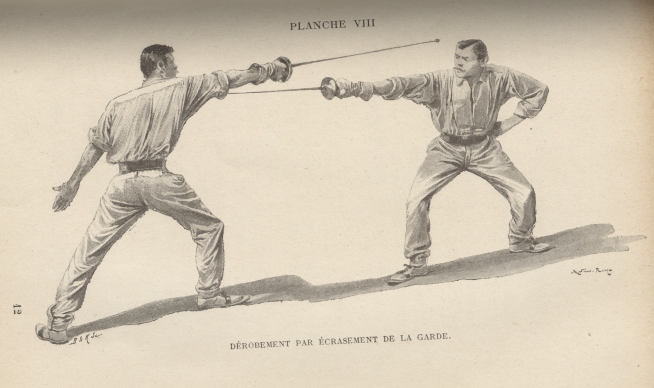
L’Épée by Claude La Marche [Georges-Marie Felizet], illustrated by Marius Roy, 1884, reprinted 1898 or 1899; also The Dueling Sword, an English translation edited and translated by Brian House, 2010. Very thorough, and in its translation was for a long time the only early French epee and epee dueling manual available in English. Real swordplay, in other words, and useful even to epeeists today. To a degree the book is a somewhat foil-based response to the purely epee-based technique of M. Jacob (see above). M. La Marche differs from M. Jacob on some points, particularly on the value of attacks to the body, of which M. La Marche is in favor, as were smallswords-men (and smallswords-women).
The modern trend in epee, at least at the elite levels, and among instructors who train less skilled fencers as if they were elite fencers, emphasizes attacks to the body. Where to emphasize attacks—arm or body—has been an ongoing re-argument ever since the flat electric tip was introduced to replace the much superior “pineapple” tip in the early 1960s, rendering arm shots more difficult. The epee fencing argument over arm versus body derives from late nineteenth century dueling practice—arms hits could easily settle honor in the modern age in which killing a man in a duel would surely send the perpetrator to prison, and the longer distance that facilitated them was simply safer. For reasons that would take up too much space here in discussion, the body was also the primary target in the smallsword era—but the dangers of this distance were mitigated by the use of the unarmed hand to parry and oppose as necessary, and by the extensive use of opposition and prises de fer. Similar varying perspectives are seen in sport epee today. Notably, and often forgotten by some fencing teachers, roughly thirty percent of epee touches today are to the arm, not the body, even with the emphasis on the body as the better target for the flat modern epee point. A highly recommended book, and useful even to modern competitive epee fencers.
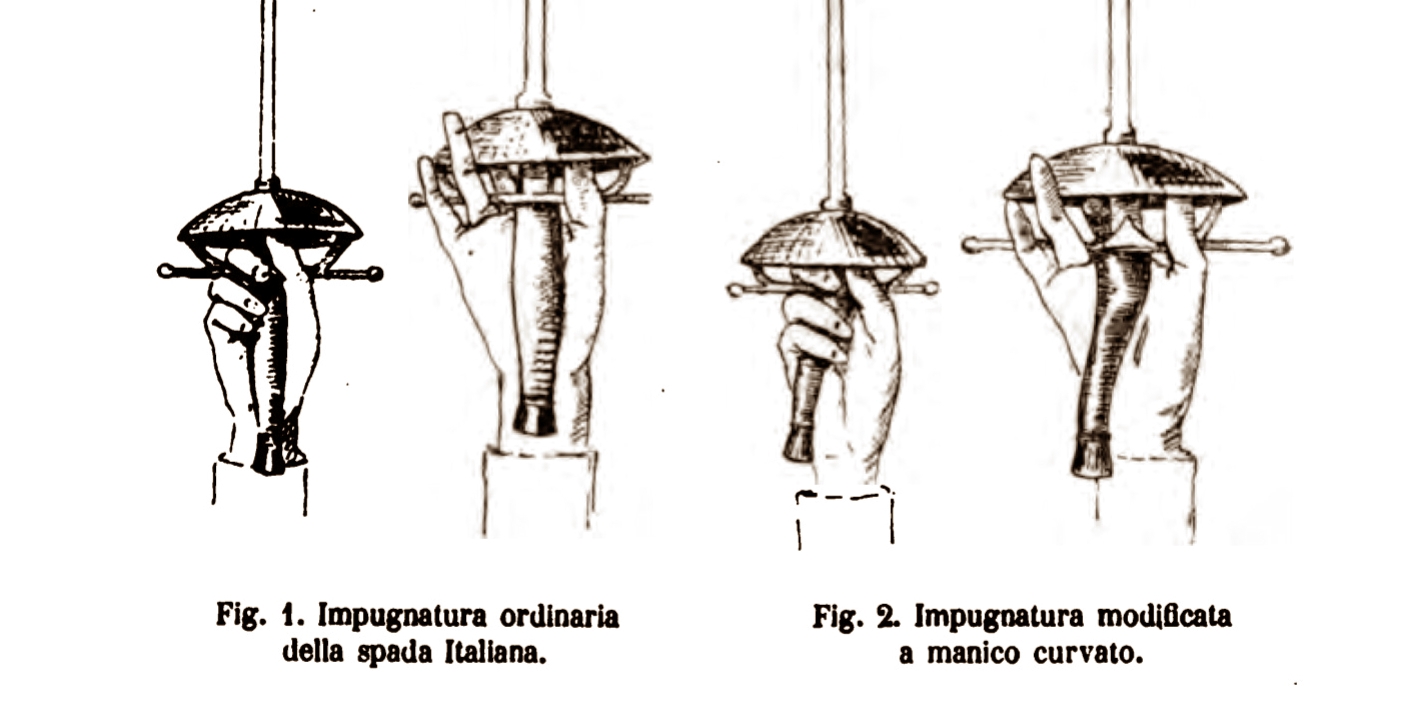
Manuale Teorico-Pratico per la Scherma di Spada e Sciabola by Giordano Rossi, 1885. A manual of the Italian dueling sword and dueling saber, very practical, very classically Italian although it does include some “modern” usages, including his preferred Italian spada with a curved grip, akin to a later French grip, with a significant set to the blade, although it doesn’t seem that this style of Italian grip won many fencers over — but did it perhaps influence the French to increase the curve of their grip? I haven’t seen any French foils or epees circa the 1880s with such a severe curve, and haven’t run across any Italian foils or epees with it either, for that matter. Rossi invented the grip in response to the Italian use of the, as he terms it, l’impugnatura del fioretto misto (mixed foil grip — the use of a wrist strap, perhaps?). He claims his design strengthens the grip of the little and ring fingers, negating the need for the ugly and uncomfortable wrist strap. Italian foils and epees rarely have a set to the blade, for it must be made beyond the thick ricasso. In the old Italian system of lines (quarte, mezzo-cierco, tierce, seconde) was entirely functional without a set to the blade. That said, I’m still uncomfortable with sixte in an Italian foil or epee without a set to the blade — I tend to hit farther inside than I prefer.
In any case, the book demonstrates a technique quite useful to epee, and in fact the influence of the Italian school would become a significant part of modern epee.
L’Art du Duel by Adolphe Eugene Tavernier, 1885. Advice on dueling. Suggests tactics and techniques for the epee duel, including how to deal with the inexperienced adversary, the average one and, of course, the expert swordsman. Of interest to the student of fencing history and the duelist, and one of the few books to deal with the subject of tactics against fencers of various levels of competence.
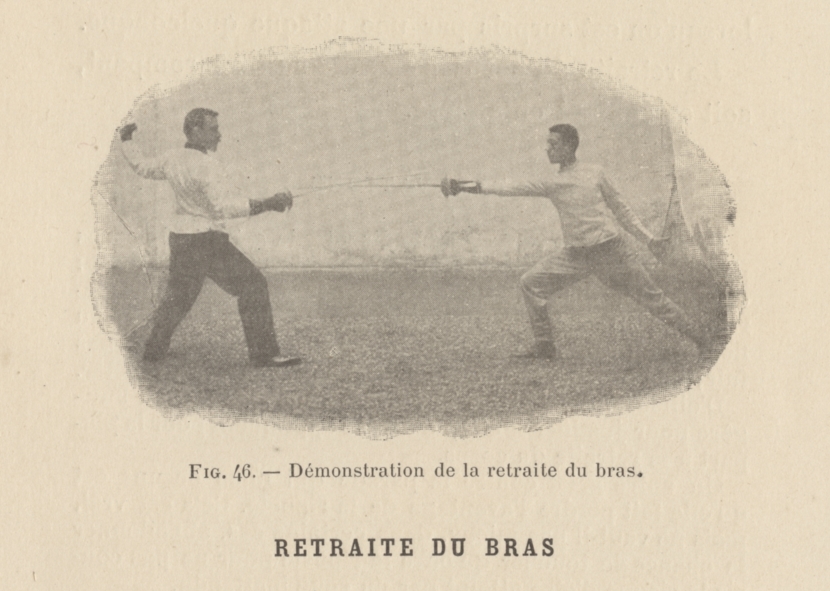
L’Escrime a l’épée by Anthime Spinnewyn and Paul Manoury, 1898. Excellent work on the epee de combat, with much practical advice on epee fencing, training, and teaching applicable even today. Among the many worthwhile admonitions is that the recovery from the lunge is just as important as the lunge itself–both must be as fast as possible, especially if the epees are pointed.

Les Armes et le Duel by Augustin Grisier, 1847. A magnificent treatise on mid-19th century fencing and dueling by a swashbuckling master, with a fascinating (and, as expected, long) preface — or more correctly, a “Préface en forme de causerie ou causerie en forme de préface” — by Alexandre Dumas. The book discusses dueling, technique, the two contemporary schools (one traditional, one modern, of course!), briefly the bayonet, fencing masters, and more. It might be included in any of several categories on this page.
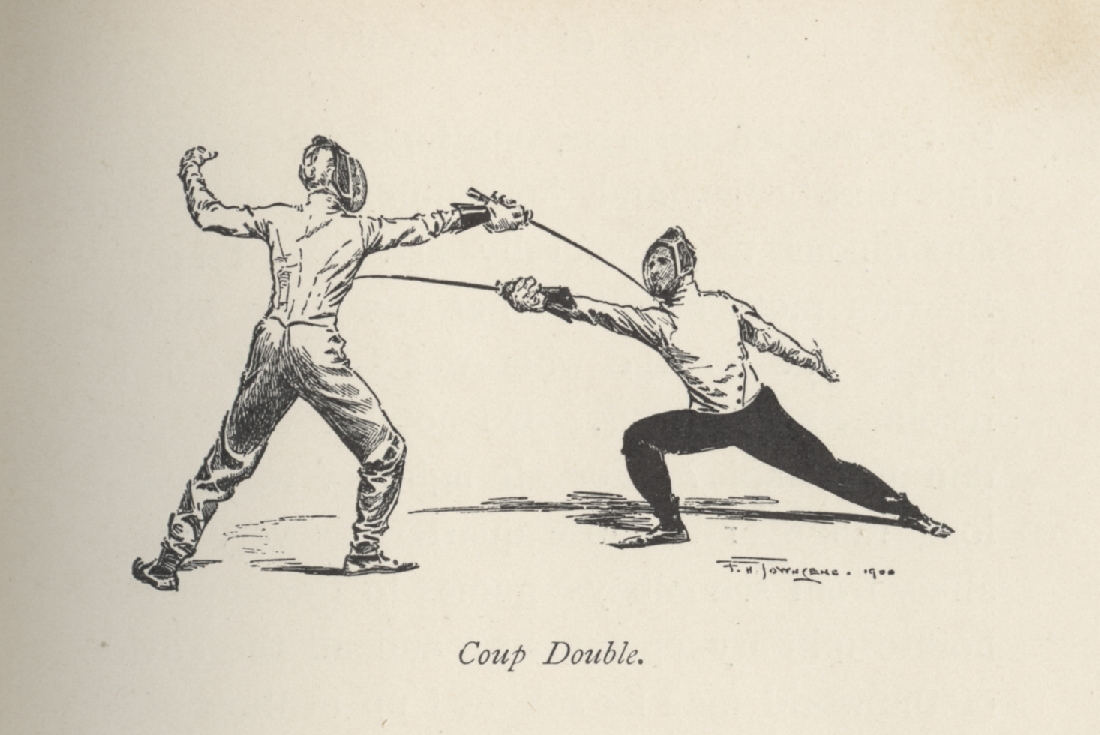
Les secrets de l’épée by Baron César de Bazancourt, 1862, published in English as Secrets of the Sword in 1900, reprint 1998. Practical advice on hitting and not getting hit from the mid-19th century. Much of the advice sounds quite modern. Likewise highly recommended.
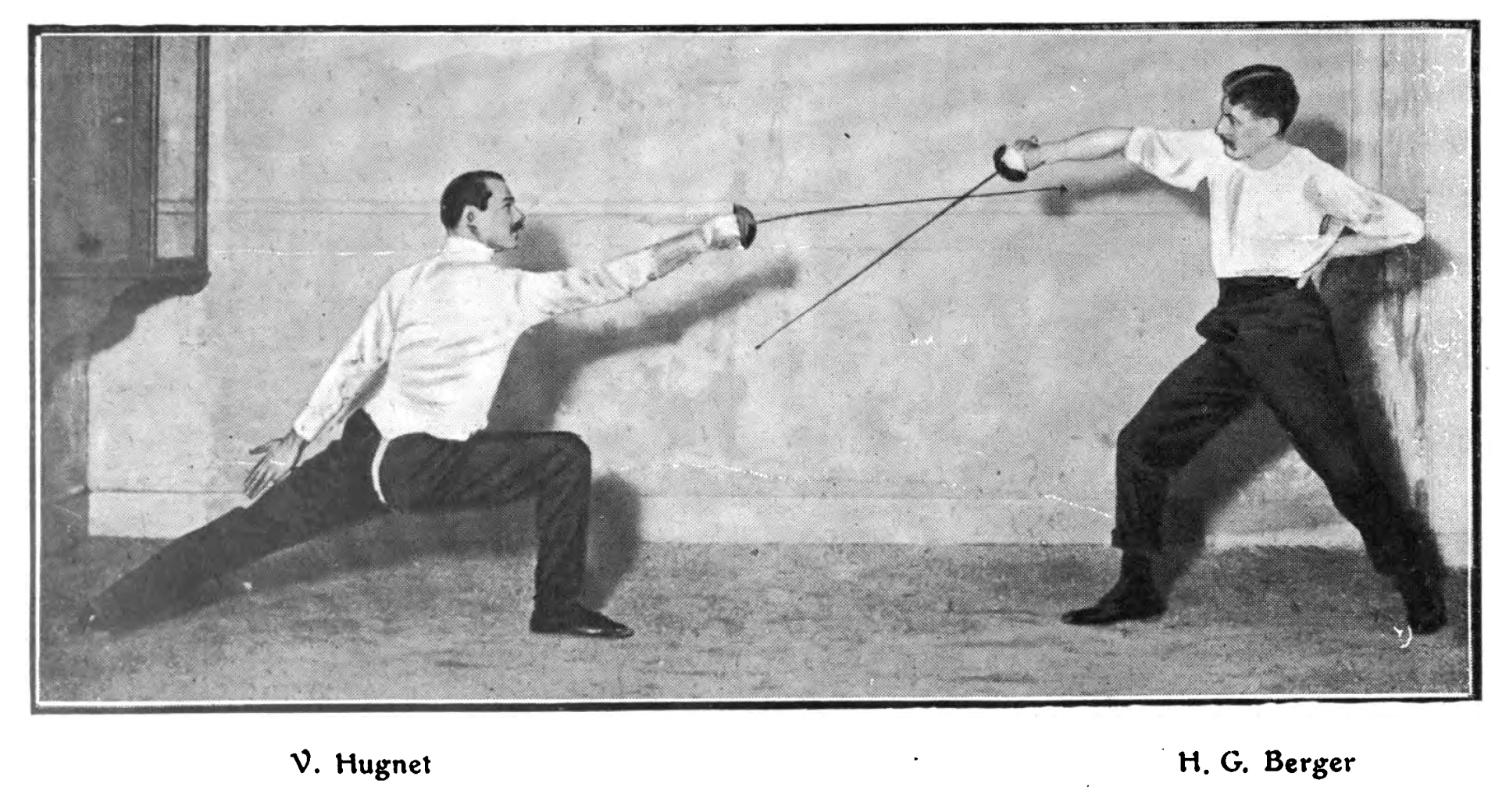
L’escrime, le duel & l’épée by Achille Edom, 1908. A remarkably prescient and practical work, one of my favorites, and one that demonstrates plainly that there is little new in epee fencing today. In particular, M. Edom, a Frenchman, recommends the more physical Italian style over the French, prefers the Greco offset guard and the pistol grip, and bemoans the rise of sport technique such as wide angulations to the wrist—thrusts that with dueling epees (with sharp points, that is) would not stop a fully developed attack to the body, leaving the attacker with a wound to the wrist, and the attacked with a possibly fatal wound to the chest, neck, or head.
The origin of these angulations was due much in part to the single point type of point d’arrét used by many at the time: a small ring was soldered to a real pointed blade a centimeter or so from the tip, then wrapped with heavy thread to act as a barrier to full penetration. Unfortunately, this heavy wrapping prevented hits at the shallow angles a real point was capable of, thus a new emphasis on unrealistic wide angulations. The three point “dry” and four point electrical, and later “pineapple” electrical points d’arrét greatly corrected this, but the subsequent modern flat point (brought into use in the early 1960s in order to quit tearing up the new nylon jackets perhaps?) inspired the popularity of severe angulations once more. In fact, almost any stop thrust to the arm would not arrest a fully developed attack, although you might have the satisfaction, as your adversary’s attacking blade penetrates your chest, of pinning his (or her) arm to his (or her) chest as he (or she) runs up your blade. Highly recommended.
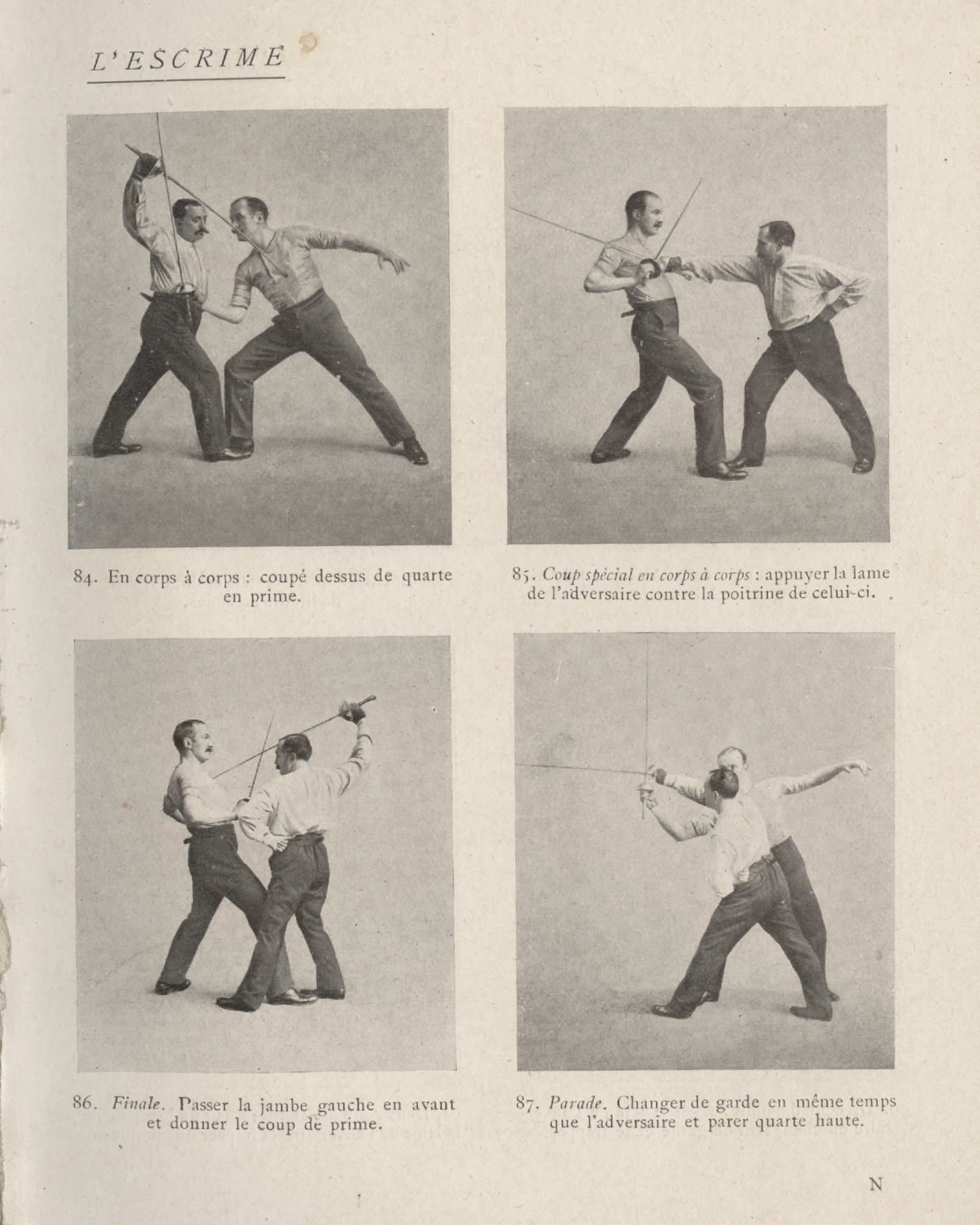
L’Escrime by J. Joseph-Renaud, 1911. One of the best of a number of outstanding epee books published during the Golden Age of epee and of books on the subject, by far. The author does by far a superior job explaining the faults in French foil for dueling, comparing French foil to Italian (thus explaining why Italians successfully trained with their foil for the duel with the spada or epee de combat but the same could not be said of the French), and explaining a wide variety of epee technique, both that which is correct and that which is faulty but commonly seen. Thoroughly illustrated with photographs, the volume is of great use to the modern epeeist, historical or classical epeeist, and fencing historian and theorist. Joseph-Renaud is a member of the community of epee masters for whom the lunge must always be preceded by a fully extended arm, and he does not recommend attacks to the body. Much of the reasoning for this is to protect the duelist from a potentially mortal wound in himself or in his adversary, the latter of which would result in criminal prosecution and the former of which, well… In fact, as smallswords-men of past centuries, and even the author himself, knew, the lunge with the arm extending near simultaneously (just a hair ahead, that is) is the fastest attack by lunge, and mandatory if one is attacking the body, not the arm. (And, to play devil’s advocate here, most of us would admit if we were honest that our point control during an attack with lunge is superior if we fully extend first…)
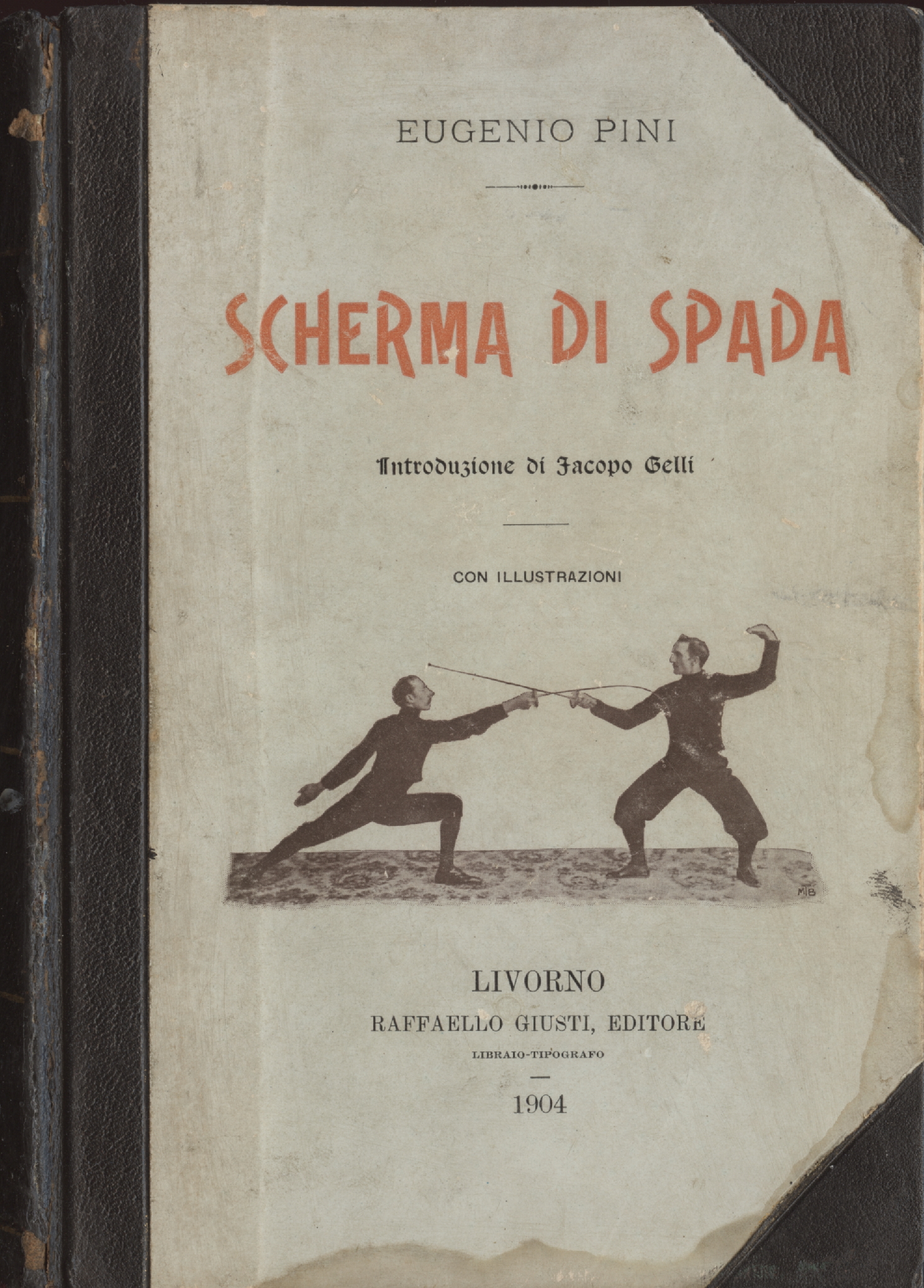
Tratto Pratico e Teorico Sulla Scherma di Spada, by Eugenio Pini, 1904. Excellent and thorough practical treatise on swordplay with the Italian spada or dueling sword by the Italian master who epitomized a form of swordplay that melded the Italian and French schools (more former than latter, though) and emphasized physical strength and speed–so no, this emphasis on power and speed isn’t new to fencing, nothing really is, in fact. At the time the book was written, the school of the Italian dueling sword was based on the fioretta or foil, which was used for training instead of the spada itself. Pini points out correctly that at the time the French schools had separated foil from epee, and epeeists were now taught with the epee rather than the foil, although this would soon change as French foilists, unhappy at being usurped by the “modern school” of epee and its epeeists, would attempt to reassert their dominance via a foil-based school of epee. For a long time the Hungarian school, via the Italian, kept up this tradition of training epeeists first as good foilists. In fact, it’s how I was trained almost fifty years ago. However, the modern divergence between foil and epee has made this almost impossible. Pini was a redoubtable swordsman whom some described as a panther when fencing. Like many masters of the era, he was a redoubtable duelist also.
The Sentiment of the Sword: A Country-house Dialogue by explorer, adventurer, linguist, scholar, writer, and swordsman Sir Richard Burton, 1911. As with Bazancourt’s book which inspired this Anglo version, not strictly an epee manual, but still useful for understanding swordplay in the sense of the need to hit and not get hit, as opposed to hitting according to conventions which deny touches not made in accordance with said conventions, but which in a duel would be quite real, and in many cases fatal. (Thus the practical and, if in a duel, fatal flaw in foil fencing.) Burton’s book also has some quite modern advice on learning to fence. Burton had used a real sword many times in bloody combat, and was known as an extraordinarily fierce warrior. Highly recommended.
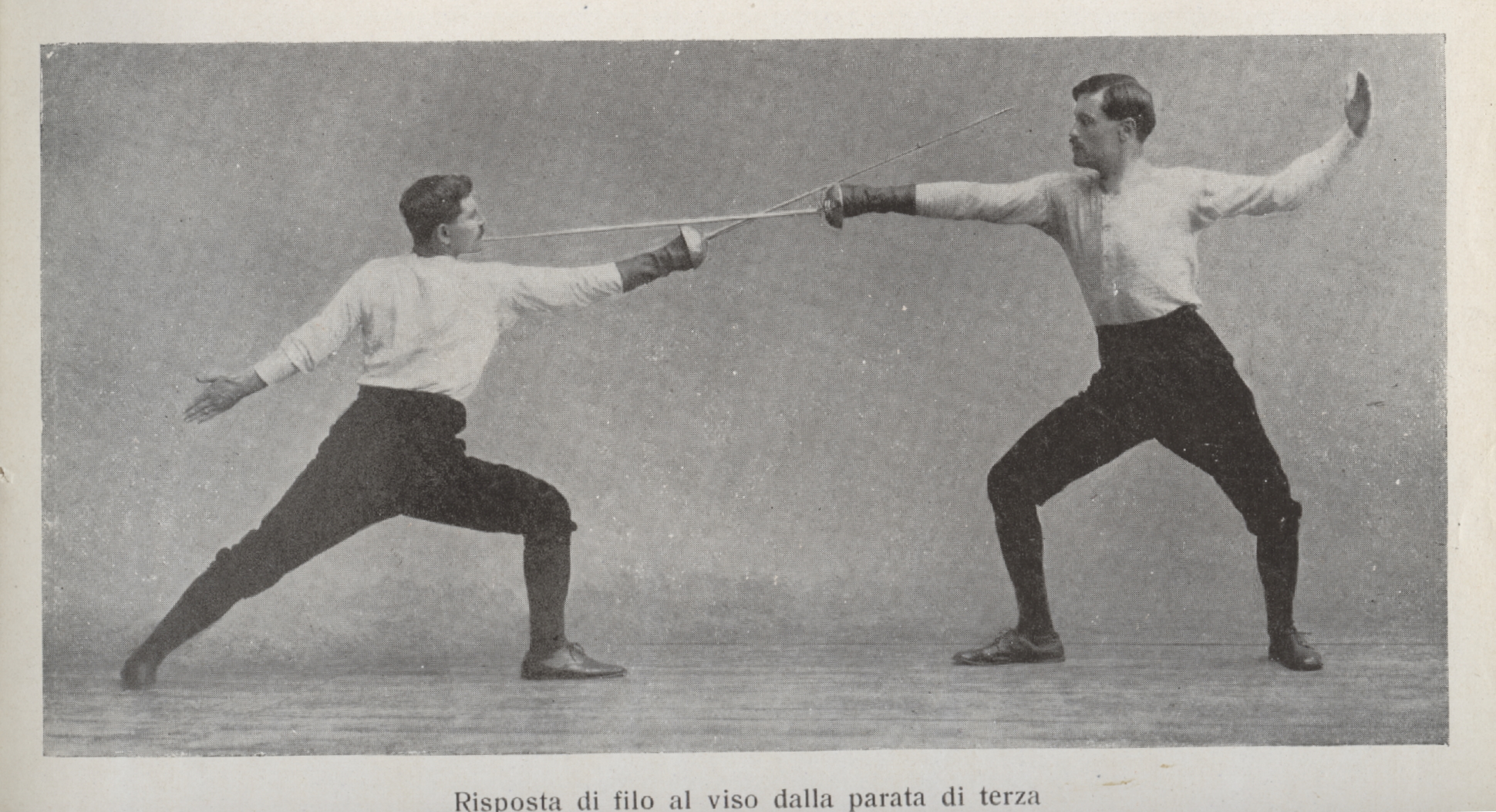
La Spada e la Sua Disciplina d’Arte by Agesilao Greco, 1912. Another of my favorites: a practical, very Italian text on the dueling sword, with, among other things, demonstrations of the Italian grip versus the French (e.g. showing that opposition with the Italian grip can overcome the extra length afforded by holding the French grip toward the pommel) and, a rarity in epee books, French especially, numerous bind thrusts to the head (filo al viso; in fairness to the French, Joseph Renaud describes and illustrates a stop thrust au visage with esquive).
The text also includes many examples of filo thrusts (bind thrusts, strong opposition thrusts) to the torso, which are often downplayed in French texts of the era, given the possibility of killing one’s adversary with them (better to hit the arm a few times and go home than worry through an investigation and possible conviction for manslaughter or murder; some period French texts do discuss these thrusts, particularly those of the “foil-epee” and “foil” French dueling schools). The book also includes descriptions of the Italian spada (noting that at the time they were of equal length, i.e. the Italian had a slightly longer blade), clothing and equipment, &c. The photographs are clear and well-posed. Unbelievably, my copy, signed, was never read: most of the pages are still uncut. Highly recommended.
Agesilao Greco was, along with his brother Aurelio, the greatest of a great family of fencers dating to the mid-19th century. The brothers highly influenced the Italian form of epee fencing for both dueling and sport. The Greco Academy of Arms in Rome still exists and still trains world class fencers. It also has a nationally-recognized fencing museum, the Casa Museo Accademia d’Armi Musumeci Greco that I’ve been told is well worth visiting. Greco’s description of the dueling spada is as elegant as the sword is; I’ve included it here and here. Agesilao was also known as an inveterate duelist with a fiery temper, and as a master and competitor he, according to William Gaugler, fenced every, or nearly so, famous fencer during his lifetime. His book on the spada was the most popular book on the subject in Italian in his era.
Épée, par J.-Joseph Renaud, 1913, in L’Escrime: fleuret, par Kirchoffer; épée, par J. Joseph Renaud; sabre, par Léon Lécuyer. Excellent advice on training, competition, and dueling, including a technical argument and diagram describing when to use sixte and its counter, and when to use quarte. This latter matter is more important than it seems, for most fencing instructors teach the usual parries and imply that any of the two classical French parries can be used in their appropriate quadrants in any circumstances (true in theory but not in practice) and should be varied in order to keep the adversary guessing (true in both theory and practice, but often difficult given that most fencers under stress have a preferred parry).
There are instances in which only a single parry—even in epee and smallsword, in which low line parries may be used in the high line as well, often providing several possibilities in each quadrant—is viable. For example, quinte (low quarte) against a powerful wide-angled attack, especially if directed toward the abdomen. Any other parry will often be forced or will fail to defeat the angulation. In fact, this is why the quinte parry was introduced. Or, against a wide, high, powerful, angulated thrust to the body in the high outside line (same handed epeeists), in particular when delivered via flèche by a tall strong fencer with his hand in tierce, a circle-sixte or even a circle-tierce will likely be forced even if timed well. A true prime will not defeat the angulation, and a common septime (Italian prime, mezocierco) must be taken too far out of line, exposing the arm to a simple disengage over the top. Octave and seconde cannot be taken effectively, for they too are likely to be forced. Only quarte or quinte (really just a low quarte) taken with the point out of line, with a riposte to the head or possibly the neck or shoulder, is viable in most cases. A modified prime (high sixte/septime) can work but can be difficult to execute if the attacker is tall and strong. Best to stop such attacks on their preparation.
The book includes a discussion of the Italian school. Although M. Renaud grudgingly admits that Italian foilists are equal to their French counterparts, he disparages Italian epee and by implication its rapier origins, stating categorically that the French invented epee fencing and the Italians were no match for French epeeists. In fact, the Italian epee school would soon rise to equal prominence with the French, with Edoardo Mangiarotti becoming one of the great epeeists of the 20th century. (These include Frenchman Lucien Gaudin of the early 20th century, Hungarians József Sákovics and Győző Kulcsár of the mid- and late century. Johan Harmenberg (1976 – 1980) should probably make the list as well. Were I to include possible twenty-first century epee greats as well, I’d suggest Timea Nagy and Géza Imre of Hungary, and Laura Flessel-Colovic of France. Doubtless other epeeists could join this list.)
Naturally, M. Renaud avoids any discussion of what might happen were French epeeists to trade their epees for Italian dueling spadas. Compare his comments on the Italian school to those of Achille Edom above. Side bar: he notes that most French epee schools of the era had outside gardens for practice, in addition to the indoor salle. Pity we don’t have these today…
“Technique du Duel en Une Leçon Suivi des Règles usuelles du Combat à l’épée” by Georges Dubois, published in La Culture Physique, 1908. Excellent work based on the author’s experience preparing would-be duelists for the duel, including those who have never held a weapon before (whom he advises to constantly counter-attack with a retreat). Disposes with many myths regarding dueling: he points out that most duelists weren’t fencers, and suggests that the epee was designed to help keep both combatants alive and thereby avoid the charge of manslaughter or murder. Never was a weapon so well designed to keep adversaries from killing each other, the author notes.
L’Escrime de Duel by Georges Dubois, 1913. A more conventional epee text intended for dueling than his Technique du Duel above. He does not dismiss foil, as many epee masters did. He discusses the Italian school, provides realistic technique for dueling, discusses preparation for a duel including how to prepare a novice duelist with no fencing experience for a duel twenty-four hours later, and breaks down several demonstration bouts and actual duels for the purposes of educating the reader. He recommends that both attacks and counter-attacks be directed toward what some masters in English have called the “shoulder hole” (the area between the deltoid and the pectoral) because one is more likely to hit even the advanced target when the point is aimed here, given that the target arm was near-certain to be extended on both attack and counter-attack (a fact often forgotten by many epee fencers today who constantly target the bent arm in the adversary’s en garde, and miss as the target arm is extended). Many masters today emphasize thrusting to the shoulder hole — but if over-emphasized the student may forget that it’s also useful to target the lower extending arm in tempo.
See also the “Classical Fencing” section below.
Combined Modern Epee, Foil, and Saber Texts
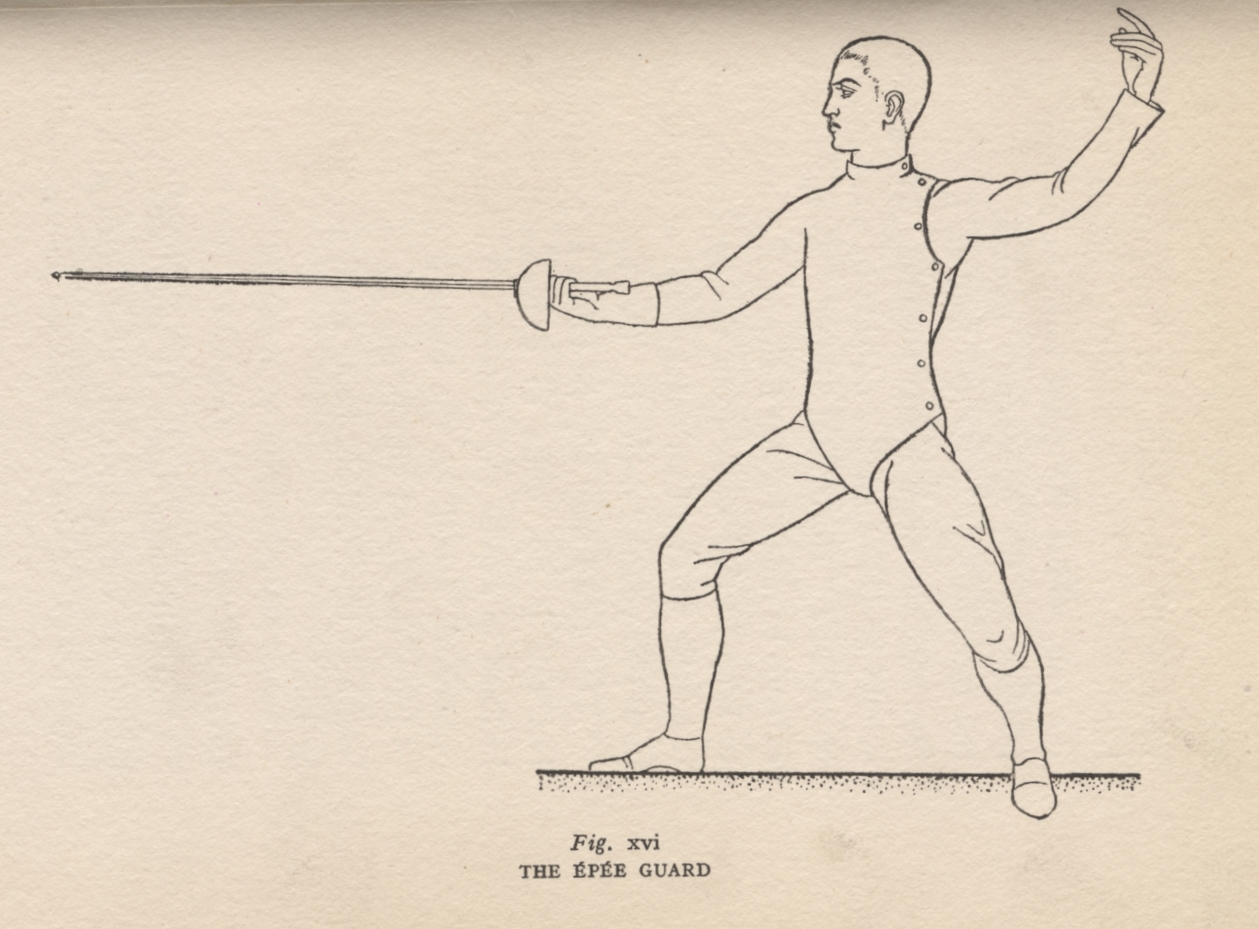
The Art of Fencing by R. A. Lidstone, 1930 and Fencing: A Practical Treatise on Foil, Épée, Sabre by R. A. Lidstone, 1952. The second significantly revised book is more thorough, with a very useful, clearly written epee section with plenty of exercises for master and pupil. Discusses tactics, unusual epee en gardes, and, in the foil section, unusual displacements, most of them Italian. It even describes Professor Guissepe Mangiarotti’s “jump back”—an epee counter-attack made while leaping back and landing on the front foot. The second edition is an excellent practical work drawing from both the French and Italian, highly recommended. In fact, along with Szabo’s work, the second edition is one of the most useful books on fencing on this entire page. For fencing historians, a comparison of the first edition to the second edition shows how much, and how quickly, modern fencing changed during the first half of the twentieth century.
Fencing by Joseph Vince, 1937, 1940, revised edition 1962. Illustrated by US saber champion, designated Olympic team member (until he suddenly abandoned competitive fencing for the stage), and swashbuckling actor Cornel Wilde. Vince was a US national coach and national saber champion who kept a salle in Beverly Hills for decades, and, until 1968 when he sold it to Torao Mori, owned Joseph Vince Company, a fencing equipment supplier that provided, among its complete line, classically dashing fencing jackets of a fit and style unfortunately no longer seen. In fact, my first fencing jacket was a “Joseph Vince, Beverly Hills” made of a heavy, high thread count cotton with silver-colored buttons. The left, that is, unarmed, sleeve was lighter and cuffed. An elegant style truly to be found no more.
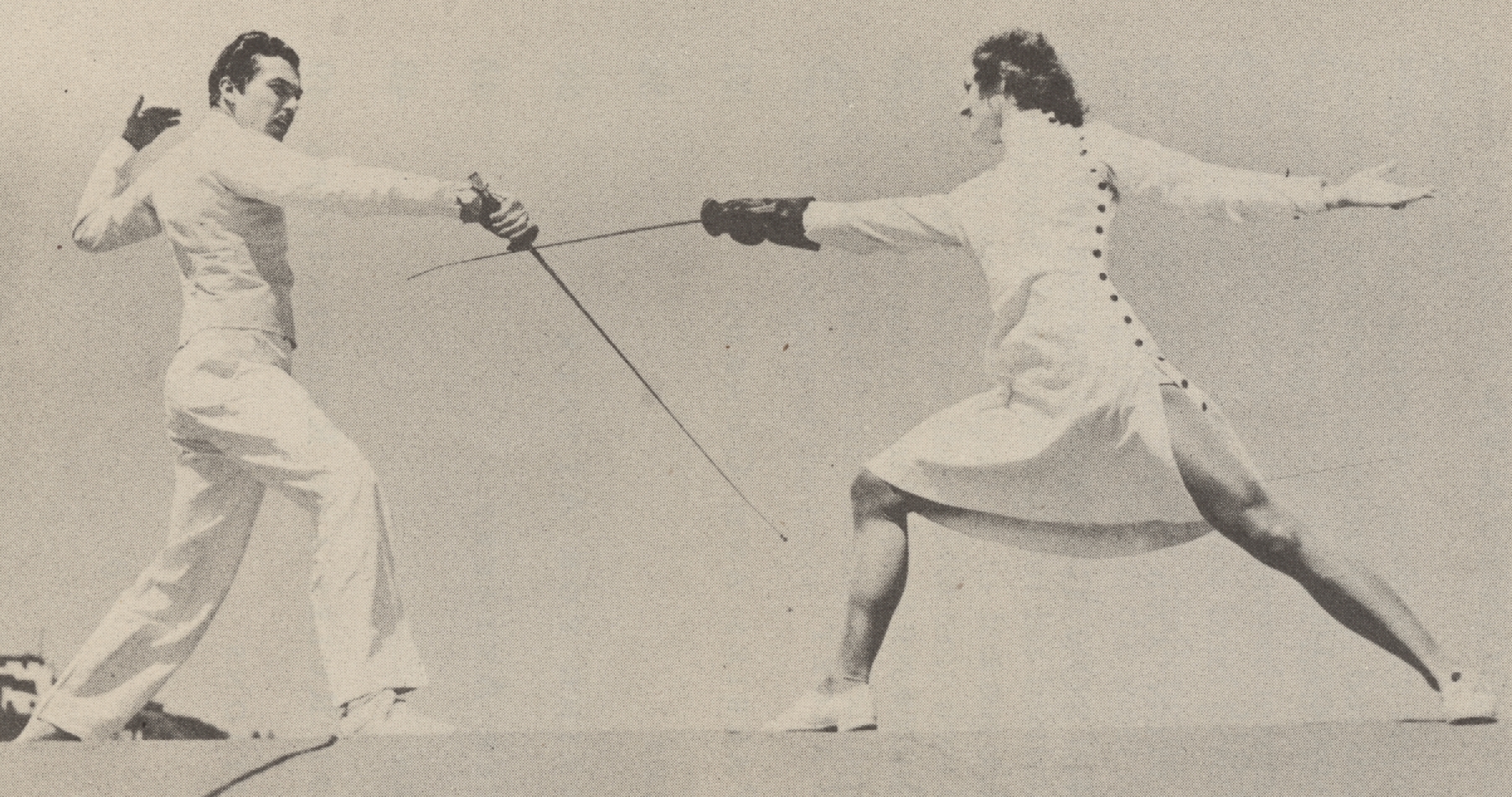
Fencing for All by Victor E. Lawson, 1946. The front cover gives the title as How to Fence. A very short basic text, only slightly more than a pamphlet, notable only to the fencing historian, particularly him or her interested in the history of women’s fencing. Lawson’s book actively promotes women fencers, although most appear to be aspiring actresses and models, and the caption of one photograph strongly suggests that Lawson’s goal is to promote his fencing salle in NYC as a means of attaining poise &c for actresses (I use the now generally discarded feminine of “actor” here because “female actor” sounds a bit stilted, and in Lawson’s day he appears to have been recruiting women primarily, not men). Notwithstanding his purpose, Lawson’s little book does actively promote women fencers, and has several useful photographs of women in fencing attire of the 1940s, quite different from today. It also has a good summary of fencing rules at the time. Other titles in the series include Police Jiu Jutsu, Scientific Boxing, and How to Be a Detective–everything to to prepare the reader to be the dark sword of a film noir.
Modern Fencing: A Comprehensive Manual for The Foil—The Epee—The Sabre by Clovis Deladrier, 1948, reprint 2005. Strong epee section. Includes exercises, lesson plans, and excellent practical advice. Readers should not be put off by some terms and practices that seem dated, for example Deladrier’s use of the classic older terms low quarte for septime and low sixte for octave, and his preference for the center-mount epee guard. The epee section is worth serious study. The teaching advice and lesson plans for advanced epeeists called upon to teach at times is also a useful review for experienced epee coaches. Deladrier was the fencing master at the US Naval Academy.
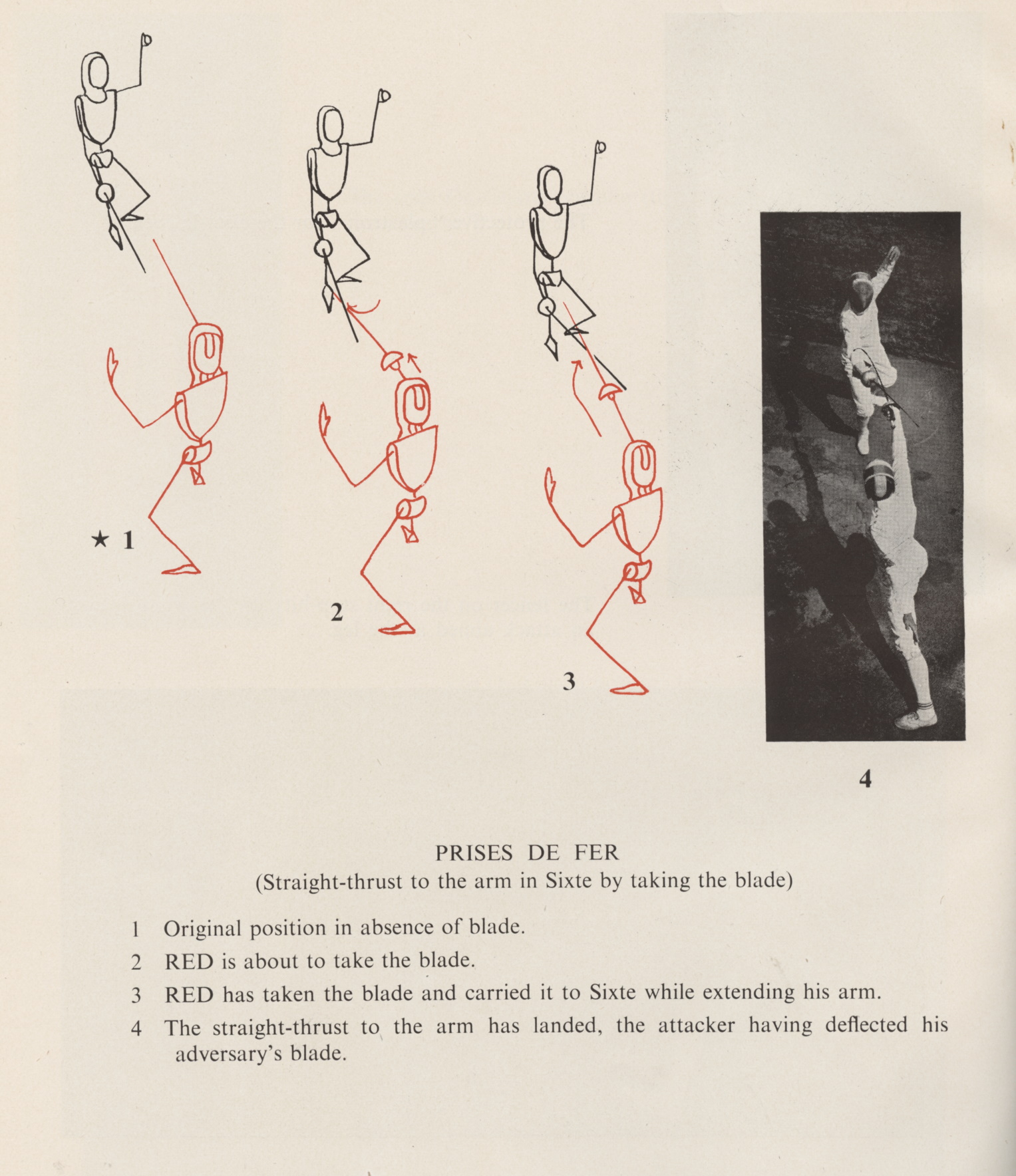
Fencing Technique in Pictures, 1955, edited by C-L. de Beaumont, assisted by Roger Crosnier, with contributors Léon Bertrand, Bela Balogh, and Raymond Paul. Basic foil, epee, and saber instruction by a who’s who of UK fencing masters of the past century, in line drawings and photographs, the former of which look a bit like the robots in the old comic book, Magnus, Robot Killer. Useful information, still applicable today. The book is one of three on this page attempting to show action in sequence in more than two or three steps using photographs or illustrations, the other two being Bertrand and Anderson. I suspect the format of the images and size and color of the book may have influenced Bac Tau’s excellent edition (see below) which in some ways might be an homage. “Dedicated by permission to The Rt. Hon. Sir WINSTON CHURCHILL K. G., O. M., C. H., M. P. First Honorary President of The Amateur Fencing Association.”
Fencing: Ancient Art and Modern Sport by C-L de Beaumont, 1960, 1970, revised edition 1978. Solid “classical” text on electric foil and epee, and dry saber by a noted British master and Olympic fencer. Excellent, perhaps best anywhere, description of the character and characteristics of epee fencing (de Beaumont was an epeeist). Good chapters on tactics and training.
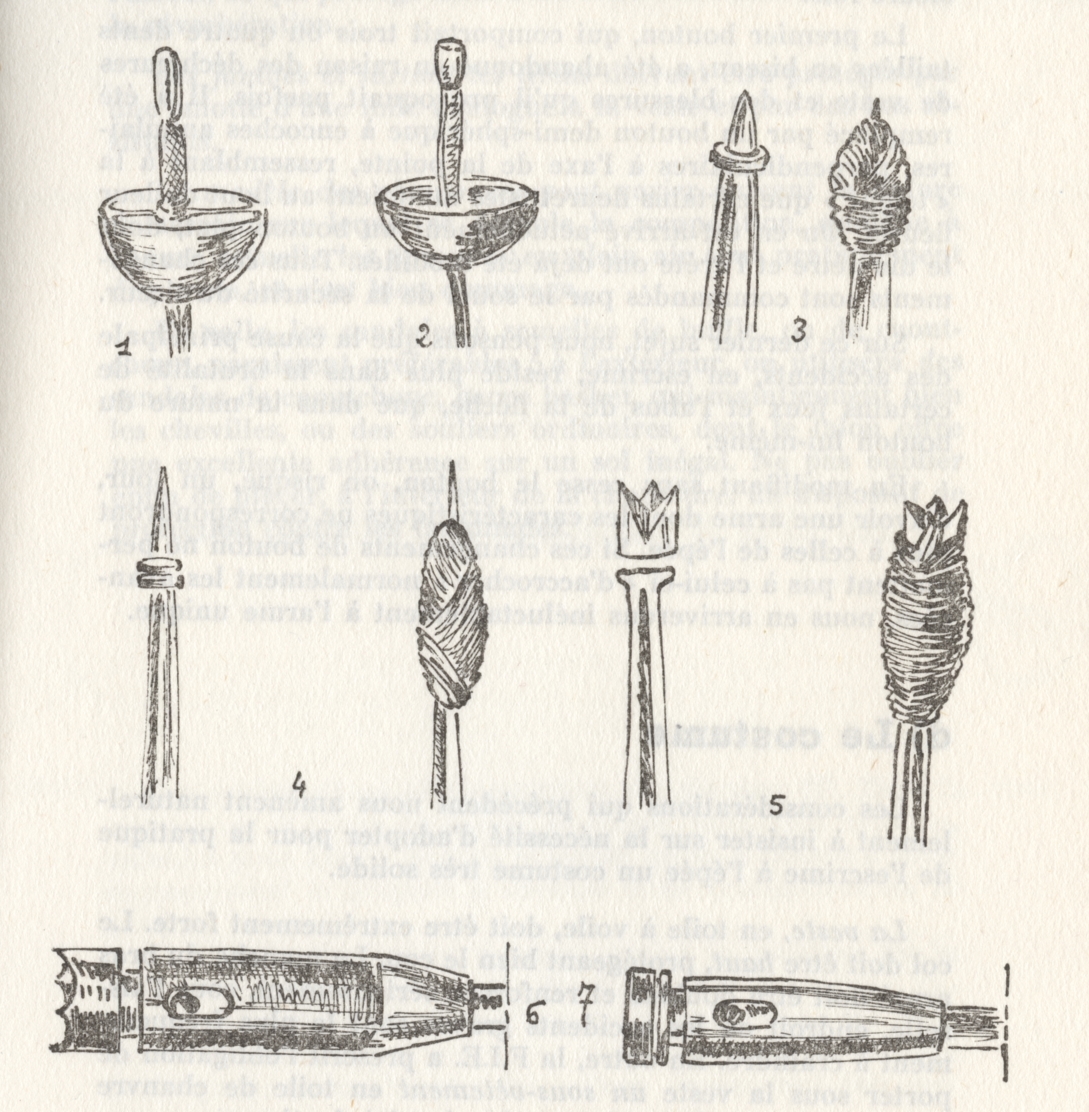
Escrime by Raoul Cléry, 1965. A thorough, practical text, absolutely one of the best, by one of the great French masters. Highly recommended. The epitome of the French school in foil and epee, but the saber is Hungarian and is so noted. While serving as Commandant of the Fencing Division at the military school at Antibes, Lt. Cléry wrote his Traité d’Escrime de Pointe: Le Fleuret et L’Epée (Société Française de Presse, 1948) upon which his later work is heavily based. The five books in the latter work’s bibliography (Edom, André, Renaud, Prévost & Jollivet, and the 1908 rules) are also all outstanding, practical works.
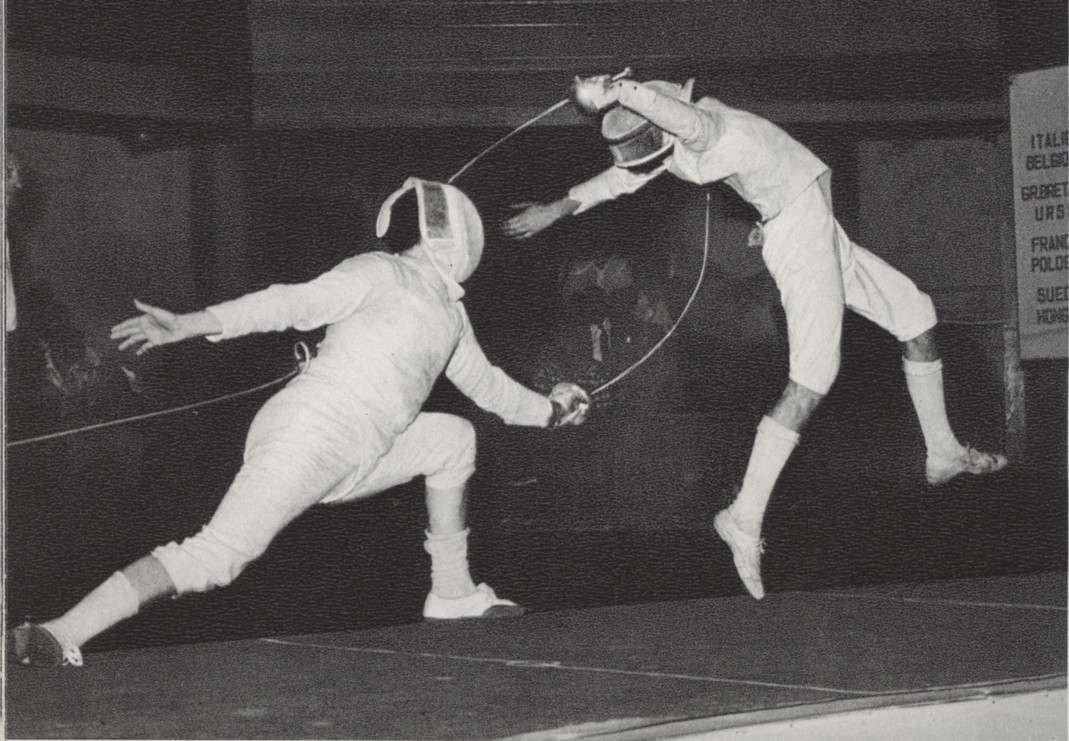
La Vera Scherma by Edoardo Mangiarotti and Aldo Cerchiari, 1966. A very useful book for all three weapons, although I’m naturally more disposed to its epee section, particularly given Mangiarotti’s fame in the spada. Exceptionally well-illustrated. In Italian, and the modern classical Italian school, of course. An excellent beginning to intermediate text on all three weapons. One of the virtues of this book is the use of photographs of technique in action, showing what fencing actions actually look like as performed by elite fencers. Most fencing books use posed photographs or otherwise idealistic illustrations, providing elevated expectations of the often unattainable except at slow speed with a conforming partner. There is nothing wrong with illustrating the ideal, providing it is pointed out that it is exactly that, an ideal, seldom to be seen in practice even by elite fencers. The book also includes line drawings of ideal technique.
Modern Fencing: Foil, Epee, and Saber by Michel Alaux, 1975. A thorough introduction to all three weapons by one of the great French masters who taught in the US. Short but good sections on bouting tactics, lessons, and conditioning. Excellent text for the novice fencer through intermediate fencer. The French school, of course.
Fencing: The Modern International Style by Istvan Lukovich, 1975, 1986. By the author of the noted Electric Foil Fencing. Excellent if brief epee section, very useful to both epeeists and their teachers in that it covers and explains most of what most epeeists will ever need to know. The Hungarian school. Highly recommended for all three weapons.
L’Escrime by Jacques Donnadieu, Christian Noël, and Jean-Marie Safra, 1978. Solid introductory to intermediate text, quite well-illustrated with many photographs of fencing technique, including of technique in competitive action. I’m also somewhat partial to the book given that its images, taken as they were at the time I began fencing, are nostalgic.
Fencing: Techniques of Foil, Epee and Sabre by Brian Pitman, 1988. Solid beginning to intermediate text.
Fencing by Bac H. Tau, 1994[?]. A tome that includes thorough sections on training, tactics, and weapon repair. Excellent section on physical training for fencing, along with other highly useful appendices. Deserves far more attention than it has received. Highly recommended: a delightful book to read. The book size, cover color, design, and illustrations may have been influenced by–in homage to?–Fencing Technique in Pictures, edited by C – L. de Beaumont, 1955.
Foil, Saber, and Épée Fencing by Maxwell R. Garret, Emmanuil G. Kaidanov, and Gil A. Pezza, 1994. A very useful beginning to intermediate text.
Fencing: What a Sportsman Should Know About Technique and Tactics by David A. Tyshler and Gennady D. Tyshler, 1995. Excellent information but an at times poor translation from Russian. Supplement with the Tyshler DVDs (available from many fencing equipment suppliers), or better yet, simply refer to the DVDs. David Tyshler was a Russian master and Olympic and world championship medalist; Gennady Tyshler is a leading Russian master. Quite a few excellent fencing and teaching materials produced by the Tyshler’s are now available online.
The Complete Guide to Fencing, edited by Berndt Barth and Emil Beck, 2007. The German school. A thorough, up-to-date text. Good sections on theory, performance, and athletic training (with a useful emphasis on high rep exercises). Good epee section, much derived from the highly successful Tauberbischofsheim school of epee founded by the largely self-taught Emil Beck.
Modern Foil
The technique described in many of the books in this section is based on the 20th century rule that a foil attack consists either of a fully extended arm with point threatening—aimed at, that is—the valid target, or the later rule which permitted an extending arm with point threatening relaxed, and correctly so, in order to accommodate the highly useful and historically proven progressive attack. These rules were rooted in dueling practice and therefore make more sense if we want fencing technique to reflect its dueling origins.
However, the modern interpretation of an attack is a sophistry that permits the point to be aimed away from the target during the extension: if it will end up at the target in the end, it is therefore a valid attack, or so the sophists argue and thereby permit. The old duelists knew better. To make counter-attack against a valid attack with extended or extending arm aimed at the target would likely result in a double hit. However, a counter-attack against a “bent-arm” attack, in particular one with the point not directed at the target, might well result in a single hit, thus the validity of the counter-attack over the attack in this instance. In the former instance, the attacker’s point would continue forward and hit in spite of the counter-attack; in the latter it probably would not.
In other words, a valid attack should not consist of a bent, non-extending arm at any point, especially one with the point aimed at something other than the valid target. Attacks in invitation or otherwise with a bent non-extending arm are quite simply not in the spirit of staying alive. In other words, were the swords pointed, the modern attack would be simply suicidal. Unfortunately, right-of-way in foil and saber have abandoned this principal, permitting attacks with a bent-arm and the point well out-of-line. Put more simply, fence epee until foil and saber are fixed—if ever they are.
Fencing with the Foil by Roger Crosnier, 1955. One of the best expositions of modern classical foil of the French school ever written in English. Excellent explanations of practical theory, including on tempo and the progressive attack. Frankly, excellent throughout. Epeeists should read it together with Crosnier’s epee text, foilists together with Lukovich’s foil text.
Foil Fencing by Muriel Bower [Muriel Taitt], 1966 et al. Numerous editions, prefer the latest (1996, Muriel Taitt). Solid beginning foil text, used over the four decades by thousands of beginning fencers, including in 1977 by the compiler of this list of books in a beginning class taught by Dr. Francis Zold. Or at least I think it was this text. Perhaps it was Curry’s instead? The second editon of Bower’s version includes as co-author Torao Mori–a noted competitive fencer and fencing master–who took over the Joseph Vince Co. fencing supplier on Crenshaw Blvd (and where I purchased my first fencing mask, jacket, and glove in 1977).
Fencing by Nancy L. Curry, 1969. Solid beginning foil text although dated in terms of “modern” foil technique and rules. Even so, a good text on core technique. The book is clearly intended to accompany a college-level beginning fencing class and here it succeeds, describing in basic terms the fundamentals that can be covered in a single semester. As with a few other texts, it has useful images of fencing technique taken from above in order to show correct relationships. Nit-picking here: in the acknowledgements, a reference to the famous Castello fencing supplier is written as Costello, a typo and surely not a hat tip to Abbott and Lou…
All About Fencing: An Introduction to the Foil by Bob Anderson, 1970, 2nd printing 1973. The book is unique in that the reader can, by flipping pages, see properly executed technique, and in a manner superior even to much of the modern fencing video available. There is a hint of two of sexism common to the era—Anderson states that only men can cope with the epee and sabre, for example, which is nonsense—, but few fencing books of the first seven or eight decades of the 20th century do not take such a view. Some might disagree with some of his brief fencing history as well, but the history in many fencing books is open for debate, based as it often is on common understanding as opposed to rigorous analysis.
Anderson was a British Olympic fencer and Olympic coach who became Hollywood’s leading swordplay choreographer, following in the footsteps of Fred Cavens, Ralph Faulkner, and Jean Herrimans. The fencing in Star Wars, The Princess Bride, and Alatriste are but three of his many film works. (His book is also one of the first two books on fencing the compiler of this list ever read. In fact, the book was in the Mount Miguel HS library—seldom anymore will you find fencing books in high school libraries.) Mr. Anderson died on January 1, 2012, and was inexplicably and inexcusably snubbed by both the 2012 and 2013 Oscars during the In Memoriam segment.
Electric Foil Fencing by Istvan Lukovich, 1971, 1998. Perhaps the most thorough electrical foil text, with excellent sections on fencing theory and requirements. Valuable even today, in spite of being written and published prior to the modern debasement of right-of-way conventions (i.e. attacks in invitation or “bent arm” attacks legitimized), although foil and saber were already inclining in this direction when Lukovich wrote his book. I strongly recommend studying this text hand-in-hand with Barbasetti’s book on foil; this will provide the student with a thorough understanding of the classical and modern foil games, and how one developed into the other — not to mention provide a thorough understanding of foil theory.
Foil and The Revised Foil by Charles Selberg, 1975 and 1993 respectively. Thorough and very useful, with a good section on tactics. In general, the Hungarian (or Italo-Hungarian) school. Highly recommended, but prefer the 1993 Revised Foil. Selberg also produced an extensive selection of instructional videos. Now on DVD, they are available from Selberg Fencing at http://www.selbergfencing.com/.
Basic Foil Fencing by Charles Simonian, 2005. A solid introductory text.
Foil Lessons With Victor by David A. Littell, 1994. A twenty-three page foil monograph far more useful than its brevity might suggest. It’s based on the author’s lessons from fencing master Victor Bukov. Useful in all three weapons, it presents a variety of tactical methods of attack, heavily distance-based. Readers familiar with Hungarian theory and practice (and thereby Russian and general East European) will recognize the descriptions.
“Modern” Saber
By “modern” I intend the saber techinique introduced or even created by Italo Santelli et al in the very early 20th century in Hungary. I understand fully that this weapon — Hungarian saber, in essence — no longer exists except in the hands of some aging fencers. It is otherwise vestigial, even if some vestiges remain strong. The school and weapon were deliberately destroyed by the flawed electrification of the saber and the degrading of right-of-way conventions, solely for the purpose of opening saber medals to more than the very few nations who dominated the weapon for almost a century. I have included the Borysiuk text because it follows in the tradition of detailed, scholarly even, fencing texts and is the only thorough modern electrical saber text in English.
Cut and Thrust: The Subtlety of the Sabre by Leon Bertrand, 1927. The author was the fourth generation of famous English masters of French descent, the family having taught not only many great English fencers, but some English royalty plus Napoleons I and III. Leon Bertrand studied widely, including saber under Italo Santelli and then in Italy, receiving both a fencing master’s certificate and a knighthood as part of his latter experience. The first third of his book is a delightful foray into fencing as sport, dueling, exercise (and why fencing is the premier means thereof, or should be), with numerous anecdotes along the way. The saber text itself is solid, presenting the Italian school that developed into the Hungarian; one might argue that his technique is Italo-Hungarian. The author, by the way, is a proponent of the full extension prior to lunging, and of focusing on the entire fencer and blade, and not on the hilt/blade or other area along. The book’s tone and technique are quite familiar to me: in fact, my first fencing master, Dr. Francis Zold, would have known Bertrand from his time with Santelli. Bertrand was also one of the two London masters who trained actor Basil Rathbone, one of the best Hollywood actor-fencers. (More detail on Rathbone and Hollywood fencing can be found here.) Bertrand’s saber book is one of my favorite fencing texts, possibly in my top three. Highly recommended!
Modern Sabre Methodology by Zoltán Beke and József Polgár, 1963. Translated from the Hungarian. Not “modern” in the sense of the most recent form of saber fencing, but “modern” in the sense of twentieth century Hungarian saber before saber’s debasement via the electrical scoring system and the degeneration of the interpretation of right-of-way. Worth acquiring if you can find an affordable copy, but if you do it will likely be by accident, unfortunately. Mine was. A very thorough exposition of every technique in the Hungarian saber repertoire. Not for beginners! One of my favorite passages is its excellent, simple definition of tempo, along with the very useful discussion following, all suitable to all three weapons—or to all swords in all places in all eras, in fact. It is also, from a historical perspective, easy to see how Hungarian saber influenced Hungarian epee, and therefore modern epee. I highly recommend studying this text hand-in-hand with Bertrand’s Cut and Thrust: The Subtlety of the Sabre and Barbasetti’s work on saber: collectively these will provide the student with a thorough understanding of the classical (i.e. Italian) and modern (i.e. classical modern Hungarian) saber schools, and how one developed into the other — not to mention provide a thorough understanding of saber theory.
Fencing With the Saber by Roger Crosnier, 1965. Excellent, thorough work on “Hungarian” saber, second only to that of Beke and Polgár above. A suitable companion to Prof. Crosnier’s works on foil and epee. Note, however, that the terminology and categorization of technique is of the classical French school, not the Hungarian. The fundamentals are still useful today. Naturally, Prof. Crosnier does not permit the attack with the arm in invitation or otherwise bent…
Modern Saber Fencing by Zbigniew Borysiuk, 2009. Only if the modern “weapon” known as electric saber appeals to you. Still, a very good book, and the only thorough one on the subject in print in English. Unintelligible conventions plus attacks with the un-extending arm held low in invitation while leaving the body nakedly exposed plus awkwardly cramped footwork plus hitting with the flat of the blade do not saber fencing make. The flat merely chastises: it’s the edge that cuts. The rest is simply too tiresome to debate.
The Cléry and Lukovich titles in the “Epee, Foil, and Saber” section have excellent instruction on Hungarian saber. Cléry also includes some detailed history of the origin of the Hungarian school. The Beck/Barth text includes excellent information on modern post-Hungarian saber. As noted above, the famous Hungarian saber technique was destroyed principally by the electrification of saber, said by knowledgeable world class fencers and FIE sources to have been a compound decision based on the likelihood that the obvious flaws in electric saber would permit a less strict technique, particularly when aided by a debasement of right-of-way, and would thereby open international saber medals to more than the handful countries with the critical mass of elite saber coaches and sabreurs able to master in-depth the clear, clean technical repertoire of the Hungarian weapon; such technique was mandatory for correct judging.
For half a century Hungary reigned over twentieth century saber, and maintained a strong grip on it even after a number of sabreurs defected during the Melbourne Olympic Games in response to the 1956 Hungarian uprising against the Soviet Union. Recent US gains in modern electrical saber were based in part on the early willingness of US coaches to embrace the new “weapon,” while some of their European counterparts, who had previously excelled in saber, attempted to continue the use of traditional Hungarian technique.
Theory, Teaching, and Training
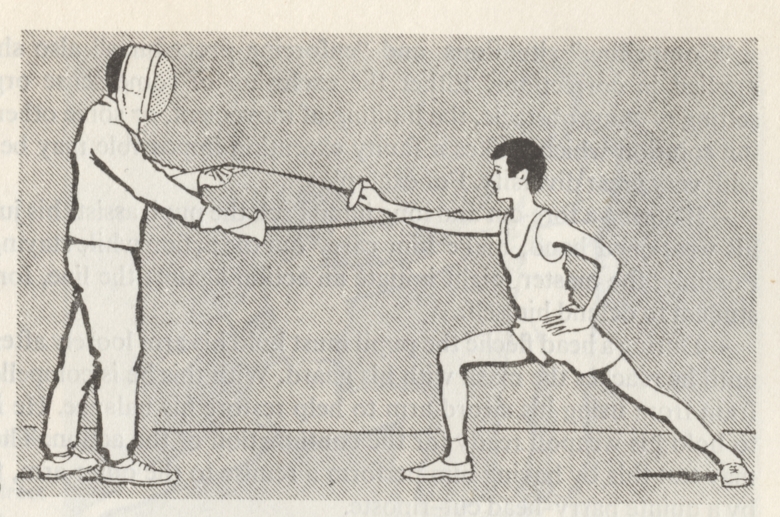
Fencing and the Master by László Szabó, 1977, 1997. Forward by Dr. Eugene Hamori, a student of Szabó’s (and my second fencing master and close friend), in the 1997 edition. The best book ever written on the subject of teaching fencing: the fencing coach’s vade-mecum. Highly recommended. Excellent material on theory and other aspects of fencing, besides the practical. Intermediate to advanced fencers will also find it useful, in particular for its sections on tactics, preparation, drilling, and stealing distance. Szabó, who trained a number of Hungarian champions, was one of Italo Santelli’s three protégés and a close friend of Dr. Francis Zold, my first fencing master.
László Duronelli and Lajos Csiszar were the other two Santelli protégés. Csiszar was master for many years at the University of Pennsylvania after emigrating to the US. Among his students were Dr. Eugene Hamori and Roger Jones, the latter of whom one day contacted me about writing a review of one of my books; during our conversation we realized we had the same ultimate fencing roots and identical views, therefore quite understandably, on honor in fencing. (Roger was a US team epeeist in ’55, an Olympic alternate in ’56, member of the FIE rules committee, and a strong proponent of honor in fencing as opposed to cheating and gamesmanship aka “cheating within the rules.”) Duronelli was master for many years at the fencing salle at Semmelweis High School, run by Semmelweis University, in Budapest. This delightfully old school salle, which has produced many champions, is still in existence, with László Szepesi, who helped bring saber gold to France, as its current master (or at least he was when my wife and I visited some years ago). Eugene Hamori along with Krisztina Nagy (a very talented fencer and master in both HEMA longsword and modern Olympic saber) escorted us on the visit to the salle. Dr. Hamori passed away in 2025.
A Dictionary of Universally Used Fencing Terminology by William M. Gaugler, 1997. A well-researched fencing dictionary although it could have been even longer — but then, only fencing aficionados like myself might read it. “Universally Used (But Not Always Agreed Upon) Fencing Terminology would be a more accurate title.
Escrime: Enseignement et entraînement by Daniel Popelin, 2002. In French. The theory and practice of teaching fencing and training fencers. Rather than use the typical pyramidal view of fencing from its base to its competitive elite at the point, M. Popelin suggests a truncated pyramid, whose range is from beginner to national level, to indicate the majority of fencers, and a cylinder on top of this to indicate international and aspiring-to-international fencers. He astutely notes that the majority of fencers do not seriously train to become elite fencers, for many reasons, and thus fencers should be trained differently according to their needs. In other words, the training of the “club” fencer, no matter how talented, should be different from that of the elite competitor. Or put another way, simply because a technique, classical or otherwise, is not used at the elite level is no reason for non-elite competitors to abandon it or, worse, never learn it.
Understanding Fencing by Zbigniew Czajkowski, 2005. Highly recommended for fencers and coaches interested in practical theory. Czajkowski is a leading Polish master whose students in all three weapons have earned gold at the Olympics and world championships.
One Touch at a Time by Aladar Kogler, 2005. The psychology and tactics of competitive fencing, by an Olympic fencing coach and noted sports psychologist. Recommended.
Theory, Methods and Exercises in Fencing by Ziemowit Wojciechowski, circa 1986. By a world-class fencer and master. Foil-based, but still an excellent book for fencers and coaches of all three weapons. Good information on evaluating and dealing with an opponent’s tactical style, especially in foil, although, again, still useful in epee and saber.
See also Joseph Roland, The Amateur of Fencing, in the “Historical Fencing” section below.
“Classical Fencing”
(Modern Non- Electrical Technique)
Some of the books below (Barbasetti, Gaugler) use one of the several classical Italian parrying systems and numberings, as opposed to the French or modified French systems and numbering preferred by most teachers today. (There are also several French-based numbering systems, each differing slightly in the naming of a parry or two, or in the use of a parry, for what it’s worth.) All of the books below are useful to the modern electrical game, epee particularly, and to foil and saber at their fundamental level. At some point foil and saber may return to a more classical standing, rather than their present sport-dominated extreme artificiality, notwithstanding that foil has always been highly artificial, or at least the French school was and now all schools are, for the past 150 to 200 years, and moderately artificial prior to that. Even in the heyday of dueling there was a distinction between “school play” and “fencing with sharps.” See also the texts listed in the “Epee de Combat” section.
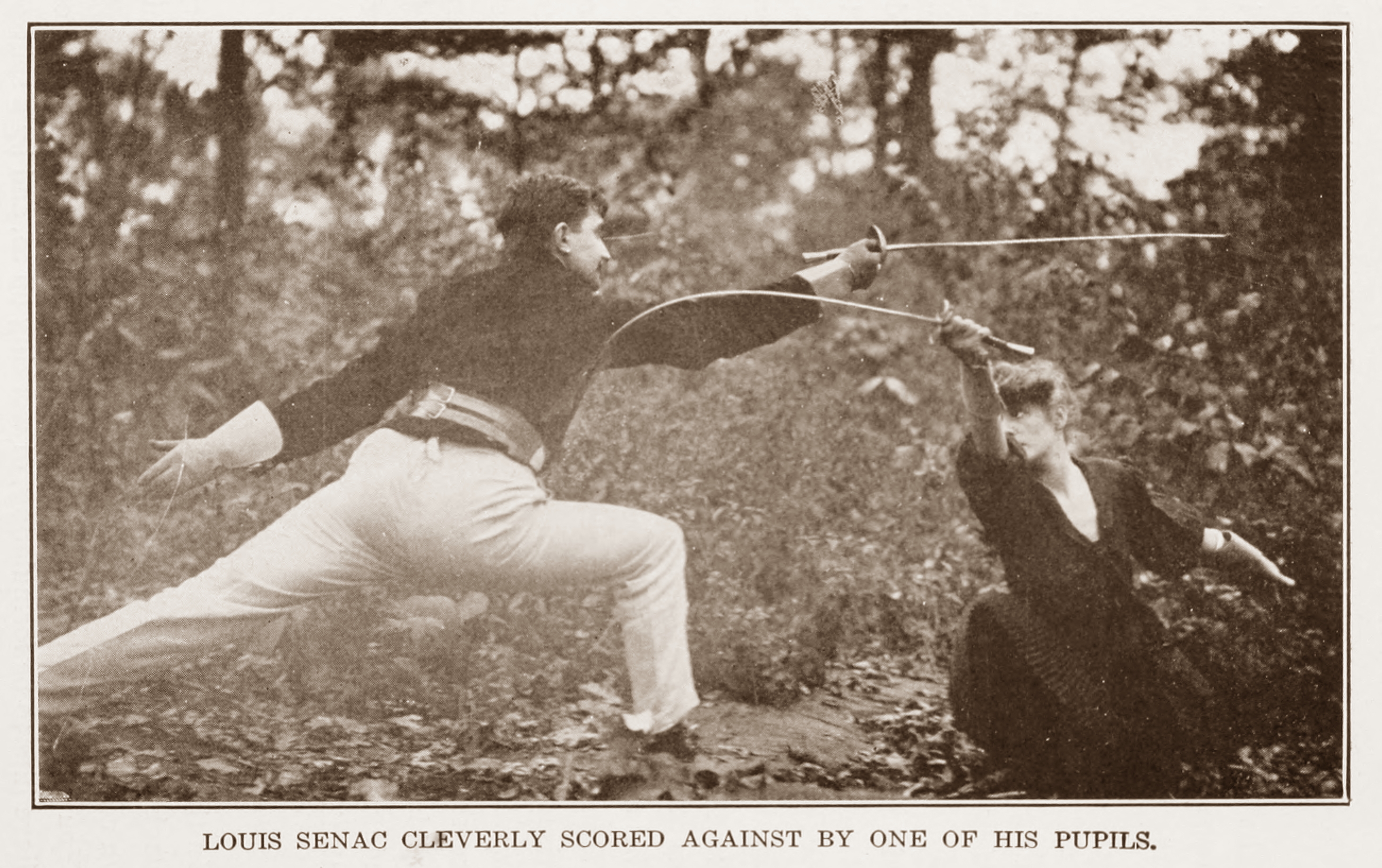
The Art of Fencing by Louis and Regis Senac, with a section on saber by Edward Breck, 1904 (hardcover), also 1915 & 1936 (softcovers, with foil and saber by Breck). Part of the Spalding Athletic Library, the book is particularly useful to fencing historians as it covers a transition period in modern fencing, has illustrations of clearly expert women fencers (unfortunately unidentified), has lengthy fencing equipment adds (1905), shorter equipment ads (1915), and the 1905 Amateur Fencing League of America fencing competition rules (1915, 1936). The book’s downside–but only occasional–is its excessively evangelical attitude in promoting the French school, an attitude associated with patronizing and common-at-the-time claims that one must be an overly-muscular athlete to fence well in the “inferior” Italian school. Blame the psychological reaction of inferiority by spindly and otherwise un-athletic French fencers to the hyper-muscular Italian swordsman Eugenio Pini for this. One can also be lean and still very strong, as with the whipcord muscles of some of Rafael Sabatini’s heroes, a physical type well-suited to fencing and found in reality as often as in fiction. To my mind, there is no excuse, other than long-term injury or disease, not to be fit: with strong muscles, good flexibility, and excellent aerobic and anaerobic endurance. Although the book nobly promotes women’s fencing and notes that at least one woman fencer was more than a match for any man, it does recommend fencing to women in part because it “reduces surplus adipose tissue, making their figures trim and comely, rounds their muscles, develops their busts,” &c. Perhaps this was mere marketing and not sincerely-held chauvinism.
Réglement d’Escrime by the Ministère de la Guerre, France, 1909 and other editions. A short treatise on foil fencing for the French military that provides a detailed look at the classical French school. Useful for classical fencers and historians, and, frankly, any fencers interested in French technique given that it remains sound today, at least as a foundation. Oddly, one would have expected the French military to have adopted the new epee technique rather than foil at this time, and even more so, would have emphasised the saber instead of either, given that it was still in use as a practical military arm at the time.
The Fencer’s Companion by Léon Bertrand, 1934 to 1958 and possibly later. A delightful little book, hardcover but pocket-sized, with enough information on all three weapons to substantially educate fencers from novice to intermediate-advanced, with fundamental lessons required at all levels of fencing. The book also includes useful advice on teaching fencing. Prof. Bertrand — son, grandson, and great grandson of famous British fencing masters of French descent, was one of the most influential masters in the history of modern fencing in the UK. Among his many students was famous actor (and decent fencer, and by decent I intend the classical definition, that is, very good) Basil Rathbone. Bertrand’s book on saber (see above) is one of my top five favorite fencing books.
Among Prof. Bertrand’s useful advice is to learn to fence from the beginning with both hands, starting with the weak hand first for balance. It’s advice unlikely to be followed often but it has excellent virtues, and will likely be the subject of a blog post one of these days. More than a quarter century ago I began learning to fence left-handed in order to give left-handed lessons as well as right. During COVID I seriously incorporated left-handed footwork, drills, and fencing into my regimen, equal those of my right-handed, with quite useful results. Prof. Bertrand also has advice for fencing against classical Italian fencers, in which the counter-quarte and Italian prime (a high septime) dominate. (Note for readers of Imre Vass: his “destructing parries” in quarte and septime correspond to–are equivalent to–these two classical Italian parries that in combination “cut the line” or “destroy” feint attacks in the high line and will parry high-low and low-high feint attacks in the inside line.)
I’d not be surprised to find that The Fencer’s Companion influenced All About Fencing: An Introduction to the Foil by Bob Anderson, in particular the images of technique in action. Whereas Prof. Bertrand includes a series of photos depicting various actions as shown above, Anderson took this a step further so that by flipping pages the reader can see the technique in action, similar to a primitive film. See also Bob Anderson’s book on this page.
The Book of Fencing by Eleanor Baldwin Cass, 1930. The book is particularly noteworthy as it was, and remains, one of only a handful of fencing texts written by a woman, even including modern texts. Ms. Cass was an American, and the book was, not surprisingly, published in Boston, birthplace both of conservative American Puritanism (which later traveled largely to the US South, go figure), as well as liberal progressive thought. The epee section is sparse, as is often the case with many three-weapon texts, but the foil section is classically thorough. The book is also a great source on much of the fencing history of the day, and thus quite useful to the fencing historian.
The Art of the Foil by Luigi Barbasetti, 1932. The Italian foil. An outstanding book that should be studied hand-in-hand with Imre Vass’s book on electrical foil. Barbasetti’s book includes a succinct but thorough history of fencing, a good section on tactics, and a glossary of fencing terms in English, French, Italian, and German. A useful book for epeeists as well. Barbasetti was one of several Italian fencing masters who carried Italian technique to Hungary and Austria, including to the Austro-Hungarian Normal Military Fencing School of Wiener-Neustadt in 1895 where he re-organized it. (Alfred Tusnady-Tschurl, one of my “fencing grandfathers”—the fencing masters of my own fencing masters—was a graduate and had studied under Barbasetti.) Italo Santelli was the most notable of these Italian immigrant masters. Santelli famously said that fencing is something you do, not something you write about—thus there is no book by Santelli in this list.
The Theory and Practice of Fencing by Julio Martinez Castelló, 1933, & Theory of Fencing, 1931. One of my favorite dozen or so fencing books. The author was trained in the early 20th century Spanish school, which was based on the best of the French and Italian, including a modified modified French grip that gave it the (theoretical) point control of the French grip with the strength of the Italian grip. (This grip is illegal in modern competition, although a pistol grip variation without an external weighted pommel exists that is legal, if you can find it.) The Neapolitan Italians were the first to formally attempt to combine the French and Italian schools on any scale, followed by the Spanish and, via the Italians, the Hungarians, although fencing “schools” have always adopted technique from each other and adapted it to their own methods. However, in both editions the author notes that the book, which he wrote to help “young men and women in the many schools and colleges” in the US, including those without a teacher, is not based entirely on any particular system, although he says the foil is mostly French, the saber Italian, and the duelling sword (epee) from his own experience.
The author notes that at the time he wrote his book the French school predominated in the US, and this remained largely true at least until the 1970s, in foil and epee especially, in spite of an influx of elite Hungarians in the 50s and 60s. (I was often told in the late 70s and early 80s that I fenced epee like a pentathlete, rather than conventionally, French, that is: in fact, I fenced like a Hungarian, although notably my lessons from two Hungarian masters and one French master–the famous Michel Sebastiani, French-Corsican, and a former pentathlete–were seamless and very similar.) Saber in the US was by the 70s largely Hungarian, at least among the best sabreurs. Castelló also writes that the predominant saber school circa 1930 was Italian, but in fact by then the Hungarian school, based on the Italian but modified to suit Hungarian attributes, was dominant. But this is a quibble, yet I’ll add one more: Castelló repeats the canard about the saber target being limited from the waist up because it was a cavalry weapon, i.e. one didn’t hit the horse. This is arrant nonsense, still repeated today. The target in saber is based on an old Italian rule that limited the target to the area above the waist in order to protect a duelist’s manhood. This is noted in numerous late 19th century Italian texts.
Castelló had also self-published a smaller volume, Theory of Fencing, in 1931. Copies could be ordered from the author himself for $2. The more detailed 1933 version was released by noted publishing house Charles Scribner’s & Sons. Both books–the later book is simply an expansion of the first in both text and illustration–are excellent sources of fundamental fencing theory and technique, knowledge often far too lacking in many fencers today. Castelló included an excellent description of the two most classical epee styles–“straight arm” and “bent arm”–and associated technique and tactics. (See Lidstone’s later edition above for others.)
Among Castelló’s students was Joseph Velarde, the West Point Military Academy fencing master whose stand against racial discrimination opened US collegiate fencing competition to Black fencers. By coincidence I once worked alongside Velarde’s son, a former US Marine Corps officer, many years ago. A decade before that I had first fenced with and competed against the founders of the old M.A.R.S. Fencing Club at the Marshall Space Flight Center in Huntsville, Alabama, most of whom were among the Apollo engineers who put humankind on the Moon. (The fourth was and is a brilliant Byzantine iconographer and the finest fencer I’ve ever seen in the old school straight arm epee technique.) One of these veritable musketeers, Joe Dabbs, who has since passed away, had trained for years under Velarde. I have remained friends with all of these old M.A.R.S. fencers for almost half a century, and most were active fencers until recently as age and old injuries restrained them, although I still fence with one of them regularly (Elias Katsaros, with French grips and true “hit and not get hit” dueling practice only!). John Jordan and Donny Philips—the other two members of the Four Musketeers—are also still with us. (And John, in his nineties, although he does not fence anymore, still has a fencer’s mind as sharp as a rapier and does forty pushups and situps, plus some dumbbell curls, daily.)
The Art of the Sabre and the Epee by Luigi Barbasetti, 1936. By one of the great early twentieth century masters. The epee section is quite sparse, and refers the student to the foil for much technique, a quite common practice in many of the Italian schools, given the similarity in technique and practice between the two weapons. Castello’s book (see above) has a far more thorough epee section. Barbasetti’s saber section should be studied hand-in-hand with Bertrand’s book on saber, and with Beke and Polgár’s book on saberas well. See above.
Fencing Comprehensive by Félix Gravé, 1934. A delightful and, too my mind, too short fencing treatise covering foil and epee, filled with pithy fencing wisdom that has never been out-of-date. The author’s general observations are also noteworthy. For example, the truly classical fencer in form and technique is born, not made. (Not to worry, those of you in the majority who weren’t born to fit into the classical mold–even in the days of “classical fencing” such fencers were rare, and one need not fit this mold in order to be a great fencer. Anyone who tells you otherwise is ignorant and probably, to quote The Princess Bride, selling something.) Gravé has good advice for teaching, on dealing with some of the more common types of fencer, on tactics in general, and for conducting a duel. For the fencing historian, he has several drawings of period fencing grips, the French interchangeable epee system (l’épée démontable), various guards (coquilles), pommels, points d’arrêts, the development of the fencing mask, &c. Interestingly and happily, he mentions women epeeists, and has an illustration of the clothing they should wear (“men’s,” basically) long before epee was permitted to women in competition, a fact that pleases me immensely. Like Bertrand above, Gravé taught famous actor (and decent fencer, see above for the definition of decent) Basil Rathbone.
On Fencing by Aldo Nadi, 1943, reprint 1994. A famous Italian fencer’s thoughts, pompous, patronizing, and otherwise, on technique and competition. For Nadi, there was only one correct way to fence: his. Held up as a god by many modern “classical fencers,” Nadi despised the French grip as much as many of the same “classical fencers” today despise the pistol grip and advocate the Italian and [Nadi-despised] French grips. Let no one claim that blind self-irony and hypocrisy, often humorous, even hilarious, never reigns among pseudo-experts, or for that matter, among quite a few true experts. Even so, the book has some quite useful advice on fencing.
Nadi also wrote an autobiography so pompous and self-indulgent that he could find no publisher during his lifetime. It was finally published in the 90s perhaps, I’ll have to check the date: I have so far been unable to get past the first few pages. Nadi also wanted to be an actor, but never managed more than a bit part in Key Largo. Reportedly, fencing audiences around the world cheered when Humphrey Bogard shot Nadi’s character.
The Science of Fencing by William M. Gaugler, 1997. A thorough modern description of purely classical Italian foil, epee, and saber technique. Pedagogical, as one would expect, and almost old school military in its technical presentation. Professor Gaugler, a student of Aldo Nadi and other great classical Italian masters, passed away in 2011.
Fencing Tactics
Many books touch on fencing tactics, but to date I’ve found one devoted exclusively to the subject — and it’s one of the best books on the subject of fencing in general I’ve ever read.
Fencing Tactics by Percy E. Nobbs, 1936. By the 1908 Canadian Olympic Foil Medalist, the book is a delight to read and study, easily one of a handful of the most practical fencing books ever written, certainly one of my handful of favorites even if I don’t agree with everything–and is a book generally unknown to nearly all fencers these days. It is also one of only two books by Canadians on this list (see also Bac H. Tau), and both are outstanding. However, take heed: the book is based on classical notions of tempo and right-of-way, and in some ways is an exposition largely of how the author fenced (similar to the books of Nadi and Harmenberg, for example).
Mr. Nobbs covers tactics in depth, better explains the difference between the classical Italian (and by implication, Italo-Hungarian) school versus the French, discusses opposition thoroughly, points out how important footwork is to tactics, and captures well the spirit and practice of each of the three modern weapons. He also describes the difference between free fencing (loose play), competition fencing, and exhibition fencing–and particularly how one should fence and behave in each form. For example, the superior fencer should trade touches with the weaker in free fencing, rather than simply trying to hit as many times as possible.
Mr. Nobb’s discussion of opposition is quite useful, with educational observations on the role played by the bend in the blade as it hits, something that would not occur with real swords and their very stiff blades. This blade bending is less relevant today with electrical scoring in epee, but is still pertinent in the conventional weapons: for example, a counter-attack without priority but whose blade bends as it hits can help exclude the arriving valid attack. In other words, the valid attack might have arrived were the blade to remain straight. The book also describes useful footwork beyond the conventional advance, retreat, lunge, and recovery, most of which is seen today, but not all. We rarely see, for example, the stolen march (forward crossover, lunge) today, although I was in fact taught it decades ago. Still, some epeeists today occasionally use a crossover followed by a fleche, often as a suprise attack after the command “Fence!” is given. Nor do we see the reverse rassemblement (standing as in a rassemblement but by bringing the rear foot forward) to make a counter-attack, a practice once used in foil.
Amusingly, Nobbs includes an epee counter-attack that concludes with a reverse-crossover-spin-jump-retreat! I’m no fan of turning the back in any martial practice, and the described technique would not only run afoul of the modern rule against doing so, and is clearly also pre-electrical, for the fencer executing the technique would be wound up in the reel cord. Still, it would be a swashbuckling delight if executed without error although to what real purpose I cannot fathom: a half-retreat crossover accelerating into a long jump backward would work as well or better and is far more stable–and you can keep your eyes on your adversary the entire time. It’s a conundrum that such a dubious technique–unless I’m missing something–would be included in an otherwise practical work. An inside joke? Probably. In fact, I don’t even care for exposing my back in the fleche when running past an adversary, and prefer instead to fleche straight at my opponent, a technique centuries old and well-described by Sir Wm. Hope. A quick trivium: until the 1940s, in “dry” (non-electric) epee if one fencer passed another, he or she could turn around and continue fencing facing the other way, provided a halt had not been called. Nobbs also provides the third different definition of copertino I’ve run across: fencing language is both used and abused by fencing masters.
Recalling my first fencing master, Dr. Francis Zold, who told me much the same thing, Nobbs points out that the premise of competitive epee at the time, that a hit arriving at the arm of the attacker first would count while that of the attacker would not because the attacker’s body hit would be stopped or delayed by the defender’s arm hit, is flawed. In fact, the majority of counter-attacks to the arm or the body would not halt a fully developed attack. It’s a purely sport technique when done deliberately. The book is one of those I delight in discovering. And it’s printed on high quality laid paper too! Highly recommended–but have a thorough working knowledge of at least intermediate fencing technique first.
Historical Fencing
That Is, To Hit and Not Get Hit–At Least in Theory
Rapier & “Transitional” Rapier
Libro de Jeronimo de Carranza, que trata de la filosfia de las armas y de su destreza, y de la aggression y defension Christiana by Jeronimo de Carranza, 1582. Add to this the works of his student, don Luis Pacheco y Narvaez. The book is the exposition of la verdadera destreza, or true art, and as such is necessary for understanding one of the major schools of Spanish rapier. The style is based much on complex geometric forms derived from the simple theory that discovering the shortest safest path in attack or defense is the basis of speed (in fact, it is but one component). From this proposition the school became wrapped in unnecessary esoterica including elements of mathematics and philosophy that have little if any practical bearing on practical swordplay. Yet it was this esoterica that made it surely lucrative for fencing masters whose students were, as many are today, eager for “secret knowledge.” The system was scathingly and brilliantly lampooned by famous poet, swordsman, and Spanish national treasure Francisco de Quevedo in El Buscón. Quevedo reportedly (some argue that this story is a myth) once humiliated Narvaez in a duel: with his rapier he removed Narvaez’s hat. In fairness, it can be argued that the verdadera destreza was an early effort at scientific or rational fencing theory that, albeit with different emphasis, would come to dominate the smallsword in the late 18th and early 19th centuries.
Part of my bias against attaching philosophy, metaphysics, “secret knowledge,” and other such “floral appendages” to fencing is that the allure is primarily to make fencing lucrative to some fencing teachers’ bank accounts and all too often to enrich the teachers’ egos as well as their wallets. I’ve seen a number of modern teachers practice this in Olympic, classical, and historical fencing. It is a pompous, pretentious, and, often to many students, ultimately disappointing practice. Fencing has more than enough fascinating allure, and its lessons are easily applied to life: it need not be wrapped up mysteriously and excessively in mathematics, philosophy, and, to be plain, alchemy. Or, more generally, in esoteric bullsh*t.
That said, one of the best ways to look at the destreza verdadera form may be to consider it as the truly Spanish Baroque style of swordplay, caught up in all that was good and bad in the excesses of the Spanish Baroque period. And if nothing else, at least it suggests you consider that all the arts and sciences are connected.
Escuela de Principiantes y Promptuario de Questiones en la Philosophia de la Berdadera Destreça de las Armas by Don Pedro Texedo Sicilia de Tervel, 1678. As with the Destreza Indiana below, the author’s name alone is quite evocative. Add to this the author’s image in the front papers, evoking the aloof, Roman-nosed Spanish don (not quite a myth by any means), and we have a book right out of a Hollywood swashbuckler. It has everything for the fencer enraptured by the destreza verdadera, including excellent illustrations of swashbuckling swordsmen—Spaniards, we assume, although their Spanish dress includes baldrics rather than the narrow sword-belts worn by Spaniards at the time except when in military dress, which was basically French—holding classic cup-hilt rapiers and standing on “magic” geometric circles. Discusses rapier and dagger, single rapier, and rapier and target.
The author’s image page includes references to theologia, obtica, practica, astrologia, speculativa, arismetica, matematica, musica, and philosophia, which is quite an education: only by reading the book is the question answered as to whether some or all apply to the destreza verdadera. “All,” I imagine Texedo would say. Further, I am unsure who the audience was: the book was published in Naples, under Spanish rule at the time; the clothing and baldric are a bit curious (perhaps of Spaniards in Naples? Or in Sicily? Or of Italians in Spanish dress?); and the dedication is to His Majesty the King of Spain, of course.
The book’s purpose is clear, though, according to Texedo’s motto: Omnia Contra Tela is shorthand for “unum omnia contra tela Latinorum” from Virgil’s Aeneid, book VIII. The complete phrase translates as “alone sufficient against all the weapons of the Latins” (Benjamin Apthorp Gould, 1826; Latin translation should always be left to serious scholars). Given that destreza is written beneath the motto, it’s pretty certain that Texedo held his practice of philosophical swordplay in high regard.
I imagine Don Pedro Texedo, whom I rank among my favorite Spanish swordsmen, as equal to “John de Nardes of Seville in Spain, who with the dagger alone, would encounter the single rapier and worst him.” (William Higford, 1658. “Juan de Nardes” of Seville is probably Juan Domínguez of Sevilla, with documents dated 1639 identifying him according to a detailed list in “Esgrimidores Sevillanos” in Revista de archivos, bibliotecas y museos, vol. 24 (1911). He is not listed among the Seville masters named in the Bibliografía é historia de la esgrima española by Enrique de Leguina y Vidal (1904), although notably Florentino de Pancorvo of Seville is described as being particularly able in single dagger versus single rapier.)
Las Tretas de la Vulgar y Comun Esgrima, de Espadas Sola, y Con Armas Dobles by Manuel Cruzado y Peralta, 1702. My many thanks to Pradana who corrected my description of this book. When I reviewed it ten to fifteen years ago, I simply read the title and scanned the text for examples of “common” Spanish rapier, and so I assumed it was a book overall on the comun technique. Pradana pointed out that the text is in fact a criticism of the common method. Mea culpa! He later emailed me to point out that I was partly correct: the text does include descriptions of the common method, as I was certain I had read (in spite of my mediocre Spanish). Thankfully I now do a more detailed review and re-review of sources prior to formal publication. In regard to “comun” texts, Pradana recommends Domingo Luis Godinho. Although I’m aware of this author I haven’t yet reviewed the book, but will post a summary when I do.
Illustracion de la Destreza Indiana by Don Francisco Santos de la Paz and Capitan Deigo Rodriguez de Guzman: Lima, 1712. Noteworthy primarily because it was the first fencing book, to my knowledge, published in the Americas. The authors’ names alone conjure assignations and affrays fought with rapier and poniard, or capa y espada, at night, not to mention the myth of duels on deck between noble pirate captains and treacherous Spaniards, although to be accurate we should drop the “noble” from pirate captains all of the time unless fictional (for example, Captains Peter Blood and Charles de Bernis), and “treacherous” from Spaniards most of the time. Trust me on this, I write books on the subject. See also Edward Blackwell in the “Smallsword” section below.
Gran Simulacro by Ridolfo Capo Ferro, 1610, 1629. A beautiful 2004 hardcover edition, Italian Rapier Combat: Capo Ferro’s ‘Gran Simulacro,’ edited by Jared Kirby, is available, as is a 2012 softcover reprint.
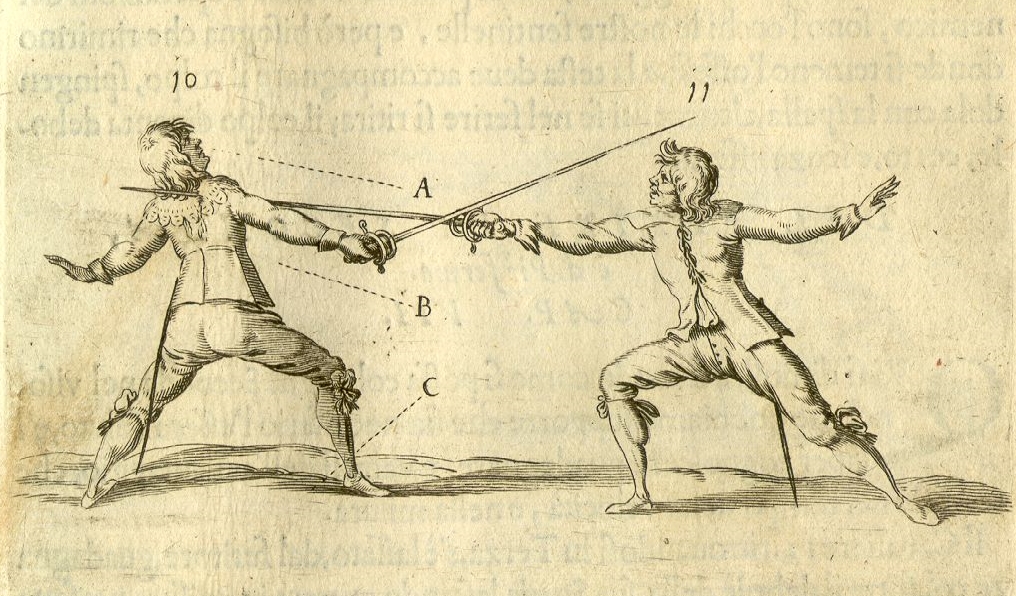
L’Arte di Ben Maneggiare la Spada by Francesco Ferdinando Alfieri, 1653. Beautifully and graphically illustrated treatise of the Italian spada, both of single sword and sword and dagger. Highly recommended.
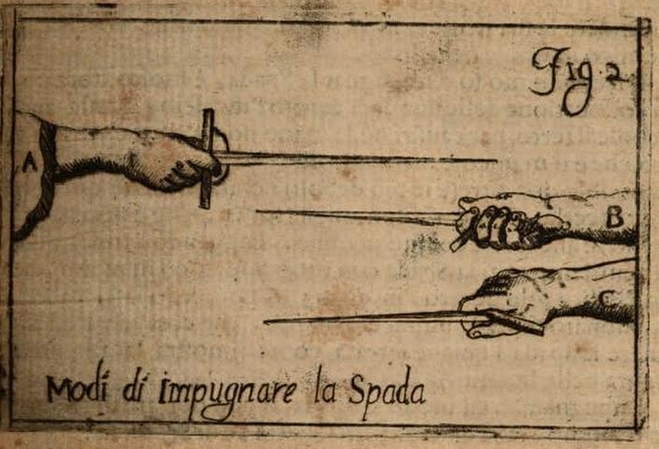
Regole Della Scherma by Francesco Antonio Marcelli, 1686. Detailed, practical study of the Italian spada, including single sword, sword and dagger, and sword versus other arms and vice versa, for example the saber or scimitar versus rapier. A very practical book with sound, practical advice useful in rapier, smallsword, and epee. Dedicated to Queen Christina of Sweden, who had abdicated her throne and now resided in Rome. Greta Garbo starred as Queen Christina in an excellent film of the same name.
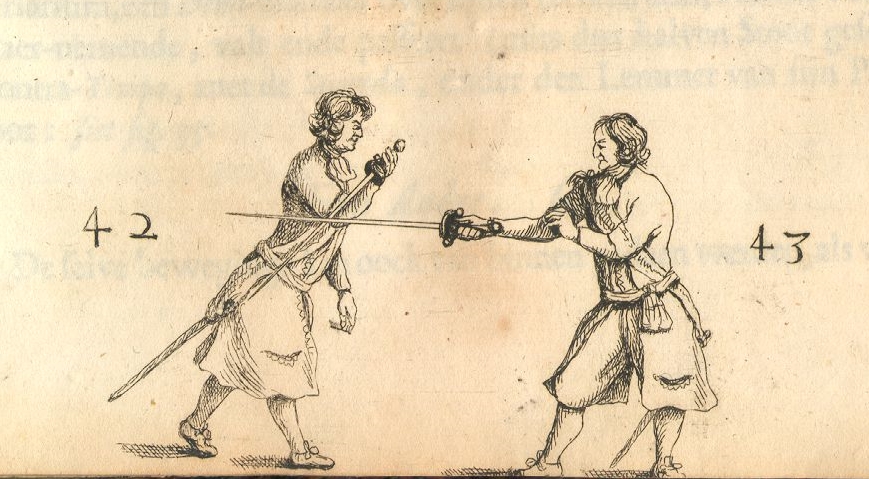
Grondige Beschryvinge Van de Edele ende Ridderlijcke Scherm-ofte Wapen-konste by Joannes Georgius Bruchius, 1671. A Dutch text presaging the persistent influence of the rapier into the age of the smallsword in Northern European schools—the Dutch, the various German, and others. Notably, in spite of the date and obvious transitioning to a lighter weapon, the book still uses much Italian rapier terminology. Solid technique for the duelist, soldier, and brawler, much of it looking remarkably similar to modern epee. The author references various illustrations throughout the book, in order that the reader may put them together in different described sequences. Clever, but unfortunately cumbersome too, as one might expect.
The book illustrates one of the most practical uses of what Alfred Hutton, in saber, refers to as “high octave”—used, that is, here as a yielding parry from quarte to exclude the adversary’s blade after running him through. Immediately closing the distance and commanding the adversary’s blade was vital. An adversary is seldom dead or disabled immediately, after all, and this technique would prevent him (or, rarely, her) from making a killing thrust in revenge, assuming a perfect world of course. Not everything goes according to plan, or so Fortune is said to say and without doubt often proves. Some nineteenth century saber masters recommended its use to counter-parry a quarte riposte made in opposition, suggesting that it was the only parry that could be made quick enough, which at the distance of direct riposte may be true. Hollywood is occasionally enamored of the technique, but it’s usually cringeworthy to watch the lovefest, so stilted, weak, and inappropriate in execution—unbelievable, in other words—it usually is.
See George Silver in the “Broadswords…” section below for a passionate argument against the rapier.
Smallsword (Epee de Rencontre, Epee de Cour, Espadin)
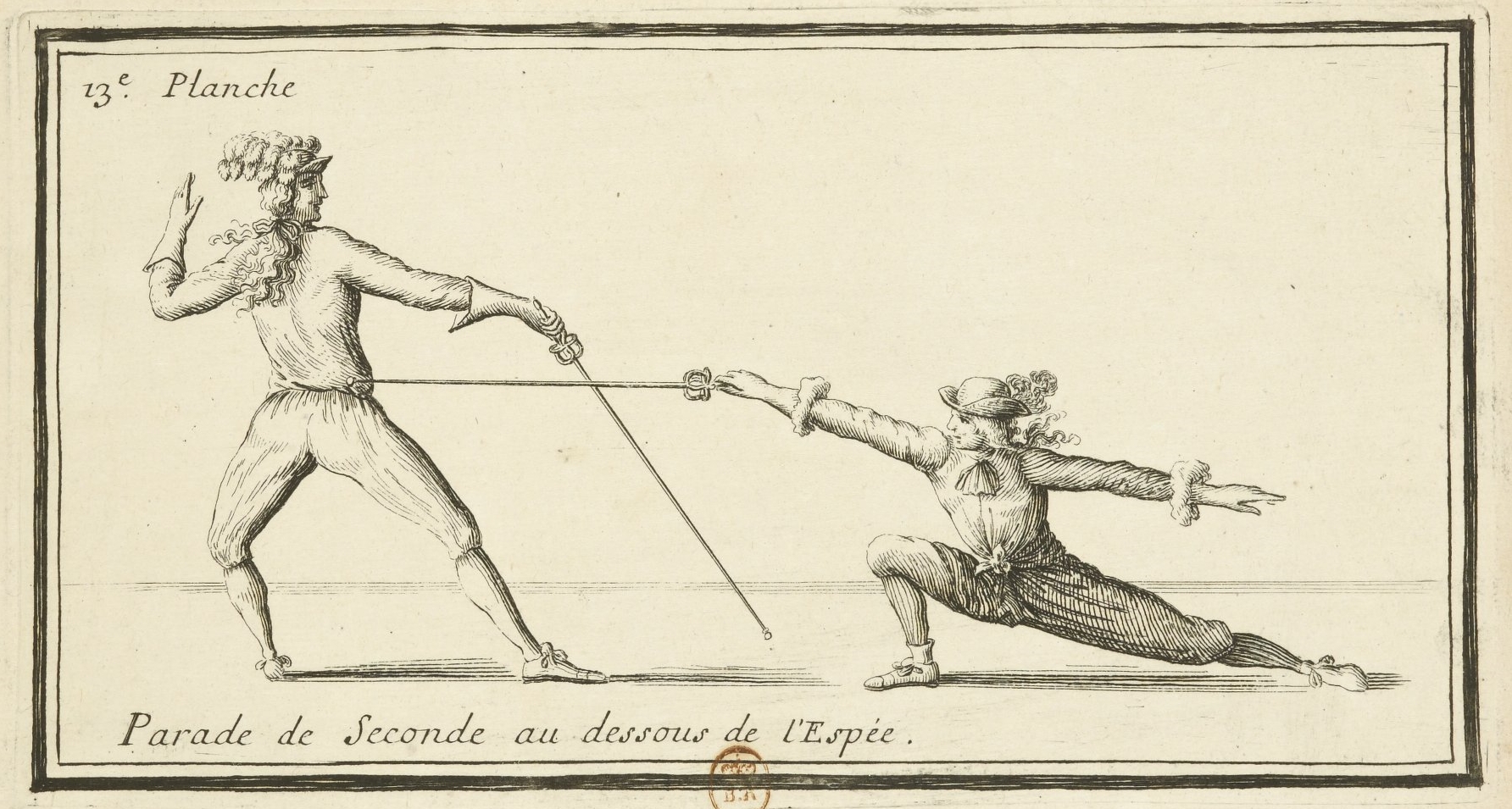
Les Vrays Principes de l’Espée Seule by the sieur de la Touche, 1670. The establishment of the modern French school of the smallsword, whose principals went largely unchanged for more than three centuries, and remain much in place today. Fencing for the French court. Although the technique is practical as described, or at least what would soon be considered conventional, and later classical, the illustrations show a lunge absurdly long, one that could hardly be recovered from in good time or in good defense. Perhaps it was to please Louis XIV and his tastes in elegance and dance.
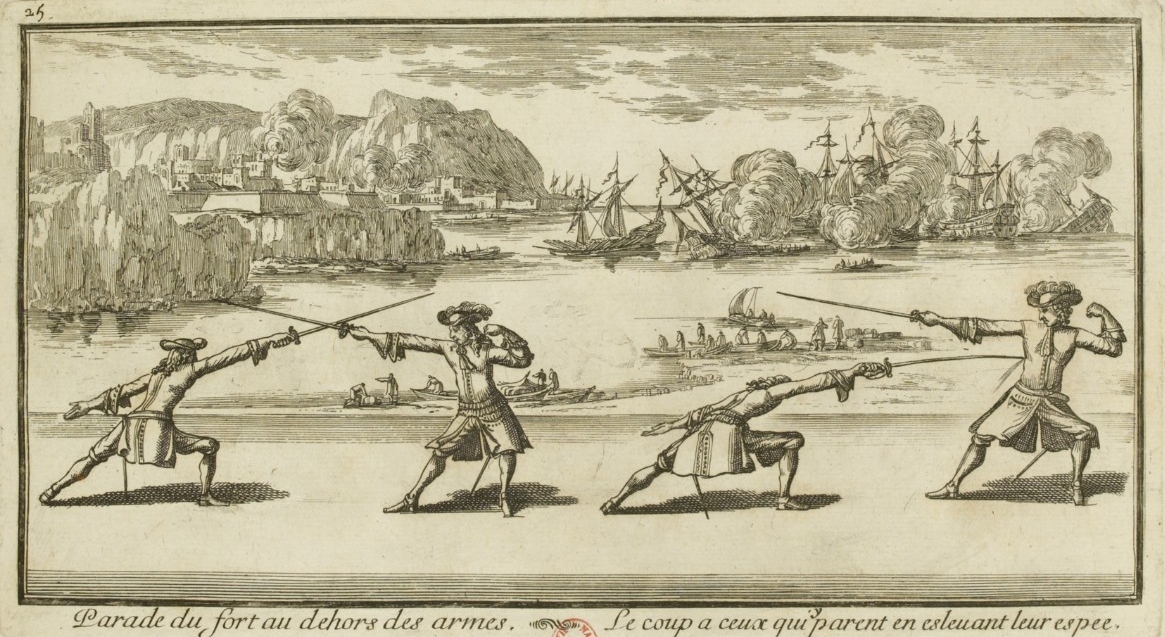
Le Maître d’Armes ou L’Exercice de l’Epée Seule dans sa Perfection by Andre Wernesson, Sieur de Liancour, 1692. An excellent study of the smallsword, albeit in some ways more suited to gentilshommes of the French court than to adventurers in the field, although the author does cover commanding and other disarms. Julie d’Aubigny, aka Mademoiselle la Maupin, the opera singer and duelist, among other occupations and pastimes, may well have studied under Wernesson, maître en fait d’armes to the Petit Ecurie, given her swashbuckling father’s position at court as the secretary to the comte d’Armagnac. (She might also have studied under Jean or François Rousseau, maîtres en fait d’armes to the Grande Ecurie.)
La Maupin, among her many adventures, was convicted and subsequently sentenced in absentia to be burned to death by the Parlement d’Aix for seducing a novice and burning a corpse in the associated convent. The verdict, however, was delivered against the sieur d’Aubigny; La Maupin’s masculine disguise apparently fooling, or perhaps pretending to fool, the right people. The criminal seductress’s former protector, the comte d’Armagnac, petitioned Louis XIV to overturn the decision, which he did, doubtless given his strong inclination toward attractive talented women. Clearly, independent women were hard to come by—and apparently hard to spot when dressed as a man fleeing a convent and prosecution.
L’art des armes by le sieur Labat, 1696. English translation, The Art of Fencing by Andrew Mahon, 1734. Another excellent study of the smallsword, although Labat, like de Liancour, was not quite as practical-minded regarding the smallsword in sudden rencontres, street fights, and the battlefield as some authors, McBane for example, were. From his work, as well as Hope’s below, it is easy to see the origins of sport fencing, aka foil fencing. In fact, I suspect that most fencers of this era far preferred “school play” to the possibility of injury or death in a real rencontre.
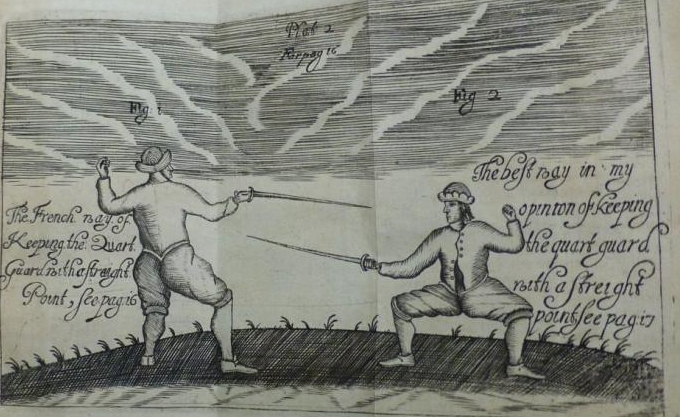
The Compleat Fencing-Master by Sir William Hope, 1692, 1710. Largely a reprint of Hope’s earlier work, the Scots Fencing Master, or Compleat Small-Swordman, 1687. An excellent work, highly recommended. Hope was an astute amateur, and his observations on fencing concepts are valuable to both the historical and modern fencer. Additionally, he has much practical advice for fighting with “sharps.” A favorite.
The Sword-Man’s Vade-Mecum by Sir William Hope, 1691, 1694, 1705. Excellent advice for surviving a fight with “sharps.” That is, practical considerations for dueling and “rancounters” (rencontres) or street fights. Likewise a favorite.
The Fencing-Master’s Advice to His Scholar by Sir William Hope, 1692. Rules and advice, including technique, for “school play”—that is, for sport fencing. Ever wonder where foil conventions and rules come from? In spite of most historical texts noting that conventions originally derived for reasons of safety, it is clear that sport, convenience, and appearance also played a major role, perhaps even the greater one, starting in the late 17th century, if not much earlier. And double likewise, a favorite.
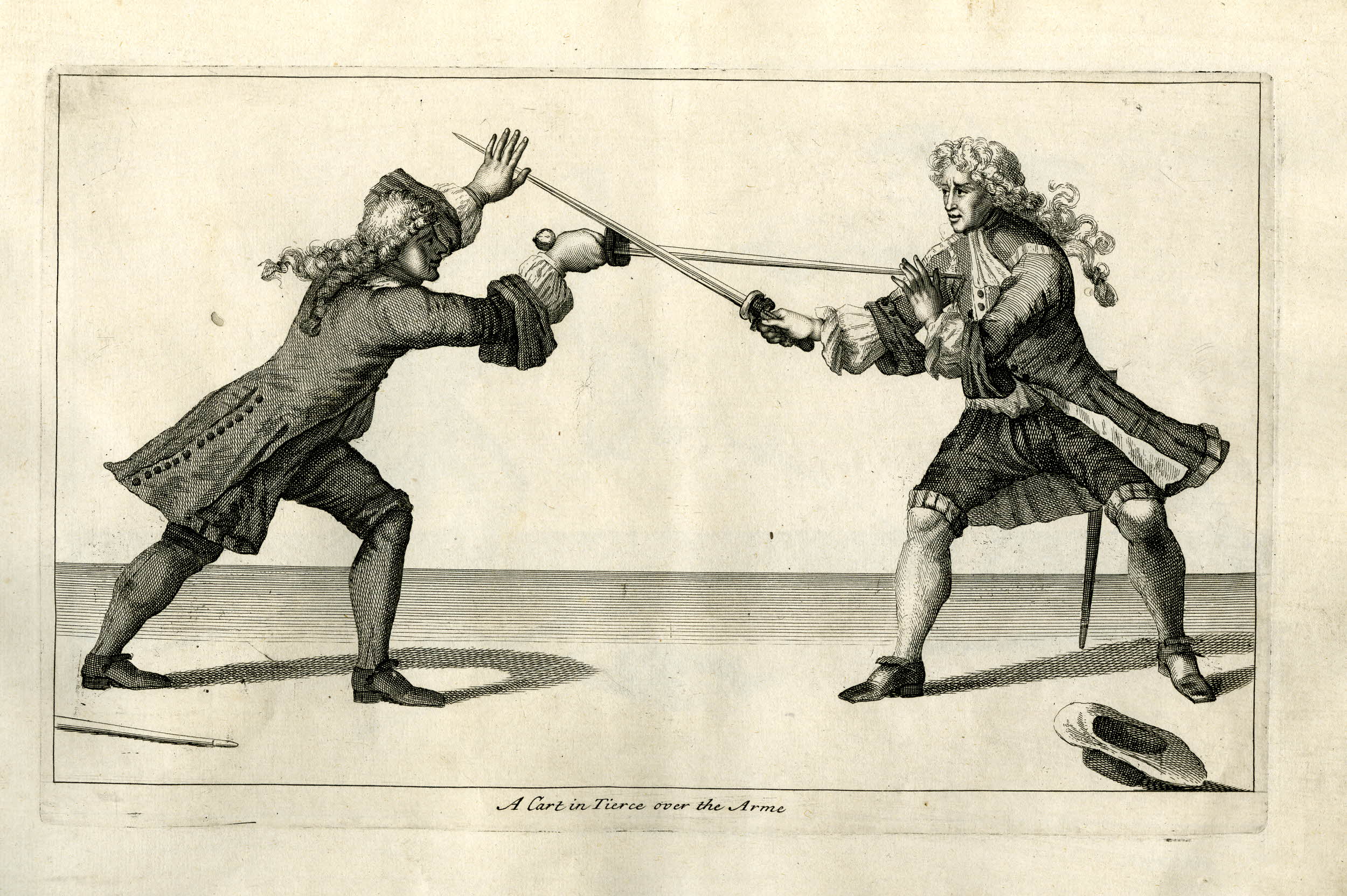
The Art of Fencing Represented in Proper Figures Exhibiting the Several Passes, Encloses, Disarms, &c. by Marcellus Laroon, various editions suggested to date from the 1680s to circa 1700 but almost certainly correctly close to the latter year. Illustrations and single line descriptions only, very useful to the historian not only of fencing but of period dress. (I’ve relied heavily on these images for Fortune’s Whelp, for example.) Figures are in a variety of fencing positions, most with smallswords, some with buttoned foils. Worthy of much study. A number of images are suggestive of, or even imitated from, 17th century rapier and “transitional rapier” illustrations, making it at quite possible, or even probable, that the French school was not yet entirely in full force even in the English smallsword, or that the Dutch immigrant illustrator Laroon, who bore a facial scar from an affray with swords, was showing his Dutch influence. (See Bruchius in the “Rapier & Transitional” Rapier section, for example.) Very much a favorite.
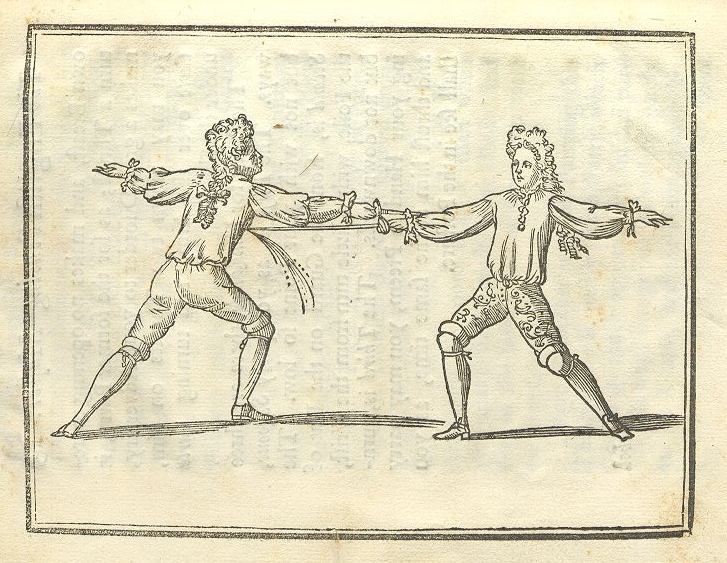
The English Fencing-Master: or, the Compleat Tuterour of the Small Sword by Henry Blackwell, 1702. A short text thereby suggesting that “Compleat Tuterour” is hyperbole, with decent illustrations showing wounds with spurting blood for emphasis. Includes more proof that the modern sixte thrust aka “carte over the arm” was well in use much earlier than some fencing historians suggest. Charming spelling of seconde: “Sagoone.” But the spelling of carte, tierce, and prime are conventional. Blackwell includes a good but brief discussion of flanconnade, one of my favorite thrusts in its several varieties: it secures the adversary’s blade, is perfectly placed for additional opposition with the unarmed hand (were this still legal), and, thrust low, avoids the ribs and their cartilage which might impede the thrust (assuming the adversaries are fencing with “sharps” of course). Blackwell’s recommended en garde is with the arm mostly extended, as is the case with many smallsword texts—it’s simply a safer guard with a real thrusting sword than the common foil guard of the past two centuries. See also Edward Blackwell below!
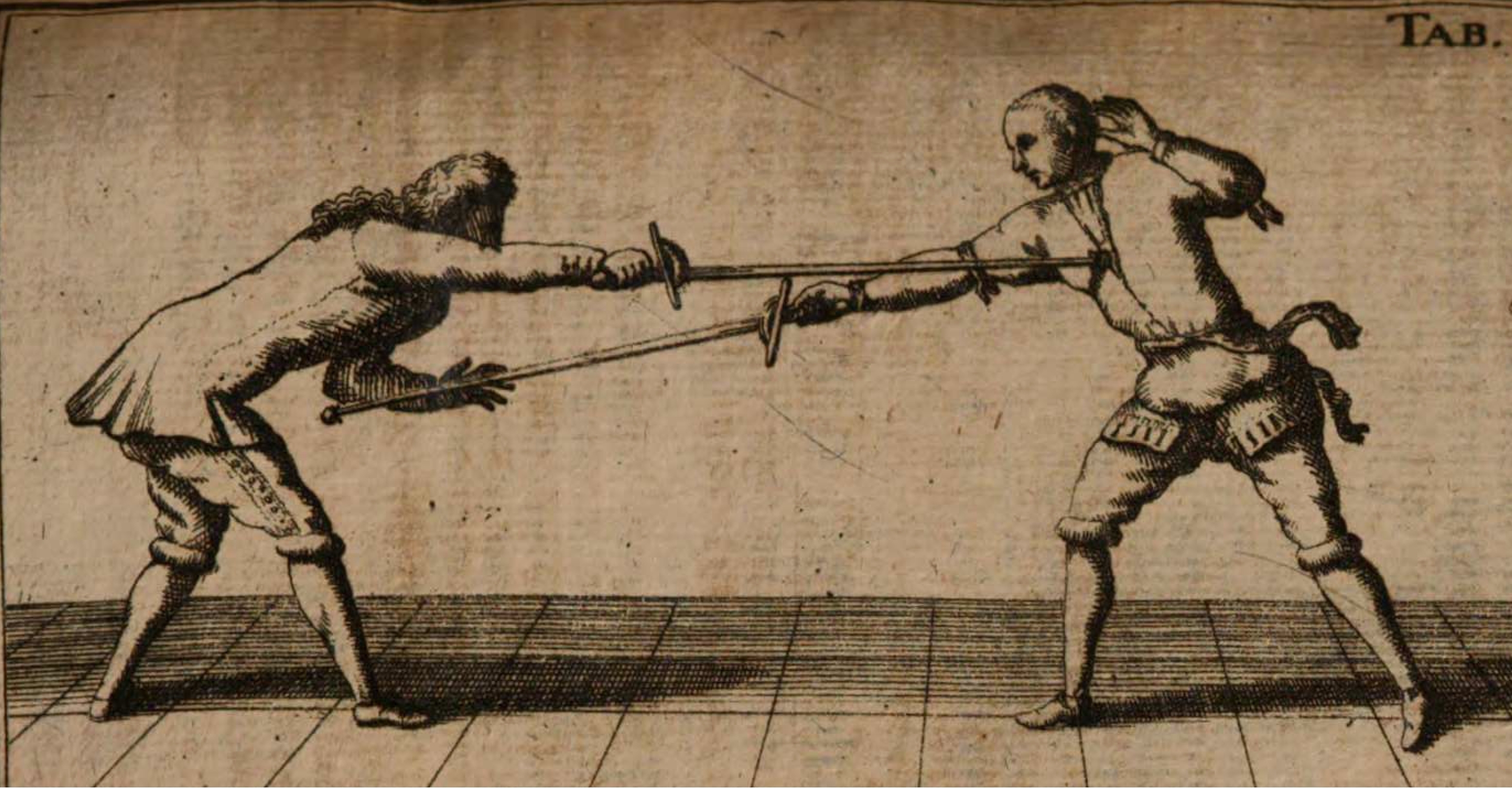
Der Geöffnete Fecht-Boden by B. Schillern, 1706. German text showing the influence of the rapier even with the smallsword into the 18th century. Compare with Doyle’s French-influenced German text below and with Bruchius’s Dutch text in the “Rapier” section above.
Advertisement, Especially to Fencing Masters by Sir William Hope, probably 1707. An advertisement with argument for Hope’s new book detailing his new method of fencing using the hanging guard. Excellent, if brief and not entirely complete, discussion as to why swordplay on the battlefield is different from that of the duel. (He doesn’t provide reasons why cutting weapons, or cut and thrust, are preferred: cuts may not kill but often disable more quickly that thrusts, it is easier to change direction and defend while doing so with a cutting weapon, thrusts may stick in the adversary and thereby be problematic for mounted troops–many have been dismounted by a thrust stuck in an enemy.) Hope is less convincing when it comes to his argument that his method is new, and not merely a restatement of one of the Walloon or German styles.
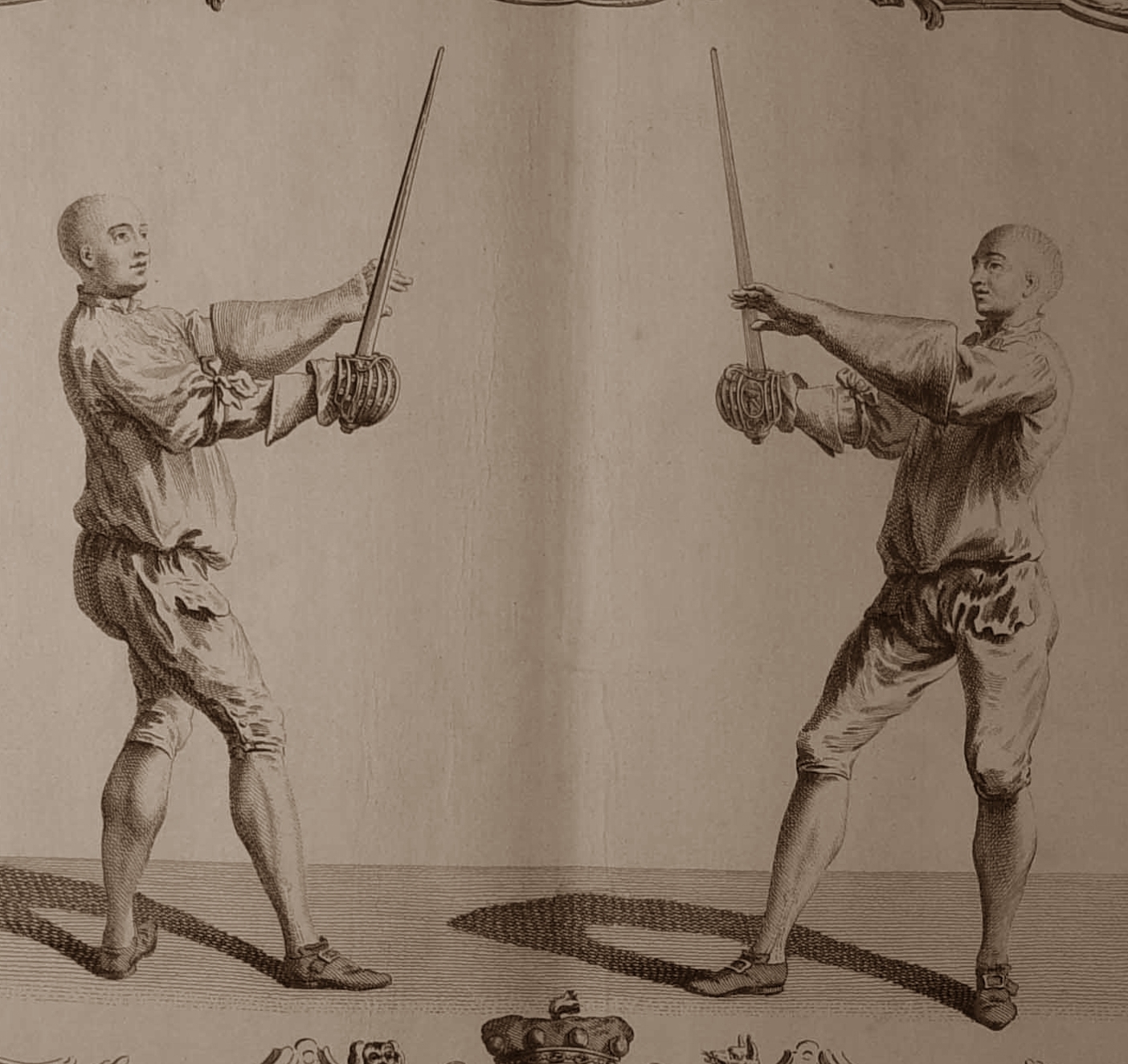
New Method of Fencing by Sir William Hope, 1707, 1714, et al. Hope’s exposition of his conversion to the hanging guard, known by many as the “falloon” (from Walloon) guard, as opposed to the more common guards in quarte and tierce, for the smallsword, sheering sword, and backsword. The book has been reprinted in Highland Swordsmanship, edited by Mark Rector, 2001. Among his excellent advice for swordplay on the battlefield, Hope recommends a stout gauntlet on the unarmed hand for parrying.
The English Master of Defence: or, the Gentleman’s Al-a-Mode Accomplishment by Zackary Wylde, 1711. A difficult read at times, especially for those without a strong base in classical fencing, smallsword, and backsword/broadsword technique, not to mention in English syntax and phrases circa 1700, but the language is colorful, the writer charmingly self-confident, and his descriptions—once deciphered—proof that there is little new in “modern” fencing. Covers smallsword, broadsword, quarterstaff, and wrestling.
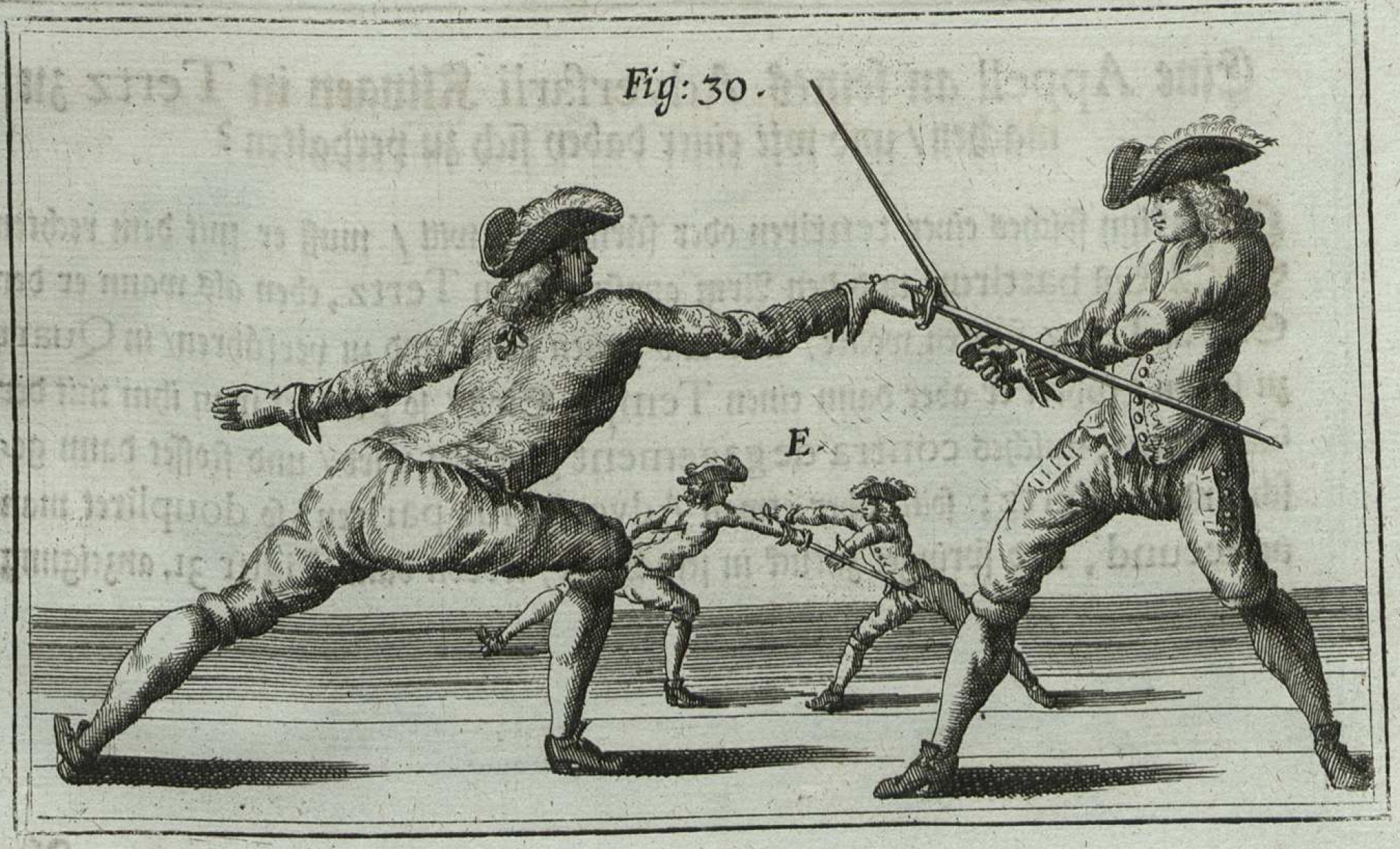
Neu Alamodische Ritterliche Fecht- und Schirm-Kunst by Alexander Doyle, 1715. An Irishman introduces Germans to the French school, with plenty of parries and oppositions with the unarmed hand, plus disarmings, grapplings, and trips/throws to satisfy advocates of the native German schools. Almost as well-illustrated as Girard below, and in some ways I almost prefer Doyle’s illustrations. An excellent reference for the practical-minded swordsman.

Expert Sword-Man’s Companion by Donald McBane, 1728. McBane was a Scottish soldier, swordsman, fencing master, duelist, prize fighter, and collateral pimp whose deeds and escapades began in the late 17th century and continued into the 18th. Highly recommended, almost certainly the best text on practical swordplay for the duel, affray, rencontre, street fight, &c, based as it is on his own extensive experience wetting his blade with the blood of adversaries, and occasionally wetting theirs with his own. Literary connection: in The Princess Bride the author refers to McBane as “McBone.” The book has been reprinted at least three times in recent years: a 2015 edition edited by Keith Farrell in Scotland, a 2017 edition edited by Jared Kirby, and a 2001 edition edited by Mark Rector in Highland Swordsmanship (readers of this last edition may choose to disregard the photographs of McBane’s technique and refer instead to McBane’s descriptions and original illustrations which are unfortunately not reproduced in this edition). Very much my favorite historical fencing text.
A Compleat System of Fencing: or, the Art of Defence, In the Use of the Small-Sword by Edward Blackwell, 1734, in Williamsburg, Virginia. The first fencing text published in North America and the first in English in the Americas as well, sub-titled Wherein The most necessary Parts thereof are plainly laid down; chiefly for Gentlemen, Promoters and Lovers of that SCIENCE in North America. Given the last names plus the similarity of titles and technique, Edward Blackwell is surely related to Henry Blackwell, most likely as father and son. The book includes a good introduction as to why one should fence—Americans, take note! It’s apparently long been a problem promoting swordplay in British-derived North America!—as well as solid descriptions of swordplay, including how to deal with a low guard, in “Master and Scholar” format (Sir Wm. Hope has used this format too).
As with Henry, the book has a good description of the flanconnade, and the likely son has corrected the likely father’s spelling of “Seconde.” Good discussion of time and counter-time, along with a reminder that foilists have long been inclined to impale themselves by attacking into an attack (so have many epeeists, too, but foilists tend to regard double hits as imaginary). Like his likely father, the son prefers a more extended guard, and not the scandalously “crooked Arm” so popular with foilists since the 19th century—but at least most of them extended from beginning to end during their attacks until recently—and also with aggressive “ignorants” of the smallsword era who did not extend during their attacks. Yes, attacks with a bent arm are those of the fencing illiterate, thus one might argue that both modern foil and saber fencers are quite unlettered (and some epeeists are too). See also Henry Blackwell above.
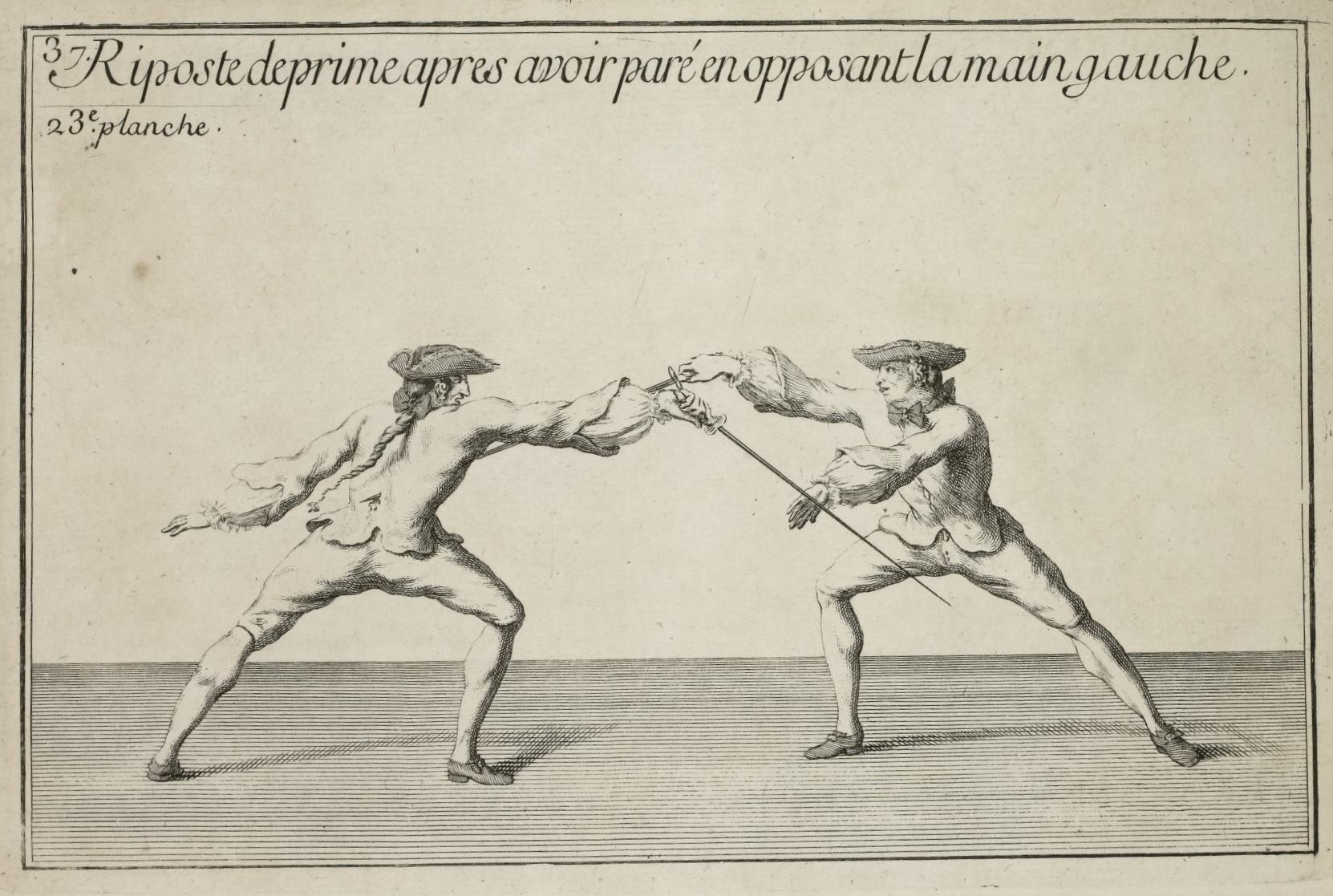
Traité des Armes by P. J. F. Girard, 1737, 1740, et al. Possibly the best book on the smallsword ever written. Not only beautifully illustrated, the book describes smallsword technique in detail, including its use on the battlefield against other weapons. It emphasizes practical swordplay for the duel as well as for the affray or rencontre, even against foreign fencing styles, and for battle. Girard was a naval officer. Highly recommended.
A Treatise Upon the Useful Science of Defence, Connecting the Small and Back-Sword, and Shewing the Affinity Between Them by Capt. John Godfrey, 1747. Practical book on smallsword and backsword, including a very useful analysis of backsword prizefighters, and some notes on boxing as well.
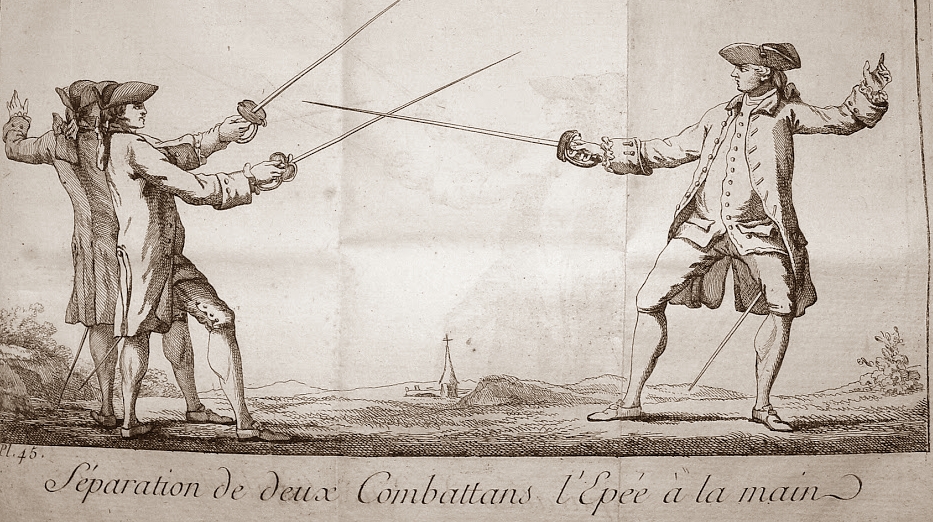
L’Art des Armes by Guillaume Danet, 1766. Excellent work on the smallsword, with practical exposition of the theory and practice, along with useful associated exotica, including how to break up a duel (grasp the shell of one adversary’s sword and direct your point at the other). However, the Internet being what it is—as useful to the lazy in their laziness, fools in their folly, and idiots in their idiocy, as it is to those largely unafflicted with these defects of behavior and intellect—the illustration is unfortunately reproduced on occasion to demonstrate, quite incorrectly, how to fight two adversaries simultaneously.
Among much useful commentary, Danet demonstrates his functional knowledge of fencing history and texts; decries commanding the blade (seizing the adversary’s sword) and disarmaments, but discusses them anyway because the fencer should know how to defend against them; discusses and decries volts and the passata soto (under another name); and wishes that parries with the unarmed hand had never been invented, although he distinguishes between parries with the hand and opposition of the hand, the latter of which he approves.
Danet provides the modern definition of fencing time: the time it takes to perform any single action of hand or foot. On the other hand, his renaming of parries is confusing to modern fencers, and was to his contemporaries as well. La Boëssière père, via his son (see below) was highly critical of Danet in general (not unusual in itself for fencing masters to criticize each other, often pompously), although it is easy to see from both that the “practical” swordplay of the smallsword was in danger of descending into near-complete artificiality, which in the next century it did.
In spite of its many virtues, my fondness for the book is actually based much on Rafael Sabatini’s affection for it, on which he founded much of his description of French swordplay, particularly in Scaramouche. Danet’s style of fencing is very much in keeping with the style of Sabatini’s logical intellect, and therefore of Sabatini’s swashbuckling heroes, although Sabatini, being half Italian, did not shrink from occasional cunning, nor did he object to his swordsmen partaking occasionally from the Italian school. From Danet is the inspiration for Andre-Louis Moreau’s new theory of swordplay, although in reality it would be nullified by an arrest, not to mention difficult to execute even with a cooperative adversary. But don’t let this spoil the excellent novel, which among its many virtues great and small is an evocative description of a fencing lesson that stirs me to this day. And in many ways Sabatini’s theory was correct at its core: the fencer should force his or her adversary into a pre-selected avenue of no escape.
Sabatini also used the historical person of Danet in the short story, “The Open Door” in Turbulent Tales (1946). For more details on Sabatini and Danet, not to mention, and far more importantly, on Sabatini’s works in general, I highly recommend Romantic Prince: Reading Rafael by Ruth Heredia, 2015. I am honored to have assisted Ruth on the subject of swordplay in Sabatini’s works.
The Fencer’s Guide by Andrew Lonnergan, 1771. Practical smallsword-play described with some occasionally uncommon fencing language: the practices of whirling, wrenching, and lurching, for example, which are synonyms for three conventional techniques. A more scholarly and readable update on Wylde is one way of looking at the book. Lonnergan also includes a very useful discussion of the backsword and spadroon, as well as some very practical advice for and against the cavalry, dragoons, and Hussars or light horse—whether the adversary wears breastplate and helmet determines to a great degree the swordplay used. He has brief useful advice for the fencer armed with a walking stick (it must be wielded a bit differently, having no edge or point), and sees no reason that an athletic fencer cannot use the various volts, night thrust (passata soto), grapplings, &c, which by now many masters had lost favor with. However, see Danet above.
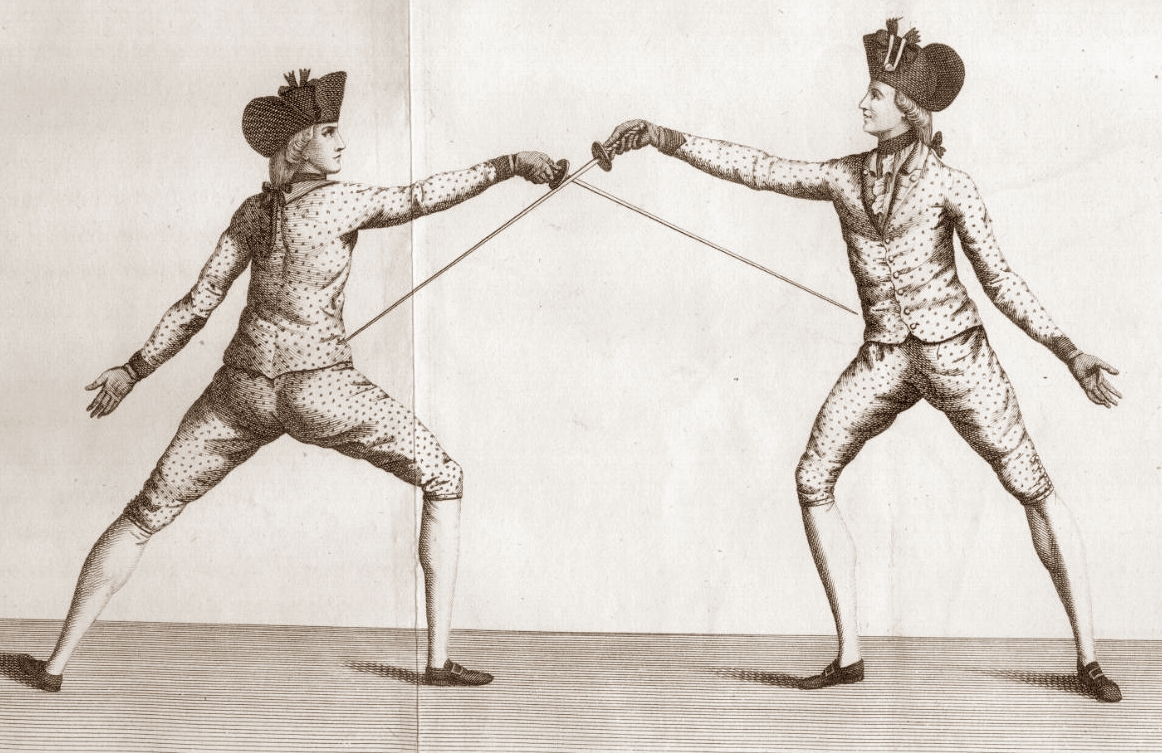
The Army and Navy Gentleman’s Companion; or a New and Complete Treatise on the Theory and Practice of Fencing by John McArthur, 1784. Solid exposition of the smallsword, with conventional language—McArthur doesn’t use Lonnergan’s romantically descriptive flourishes when naming some techniques. Again, here is yet another book proving that there is really nothing new in modern fencing. As with many fencing books, it includes some useful and some not so useful tidbits, for example, the deflecting of a pistol with a smallsword, something I suggest should not have been tried except in extremis and was probably most successful when used with a strong cutting sword—a broadsword, backsword, saber, or cutlass—that, rather than deflect the pistol, severed some of the fingers or the hand holding it instead. Very much worth reading, as for that matter are all the smallsword texts listed here, in order to expand one’s perspective on the theory and practice of Western thrusting swords.
The School of Fencing by Domenico Angelo, 1787. Several modern reprints available. The height of the 18th century French school, though by now the smallsword was mostly an accoutrement of dress, occasional dueling arm, and for some military officers, a badge of office. Fencing for the gentleman. The book is not my favorite, even though it was also published under “Escrime” in Diderot’s famous encyclopedia. Perhaps it’s the illustrations: I cannot image any serious swordsman or swordswoman posing so delicately. For the latter part of the 18th century I much prefer Danet, Lonnergan especially, and even McArthur (whose illustrations are likewise a bit too delicate to represent the soldier and fighting seaman in my opinion).
The Amateur of Fencing by Joseph Roland, 1809. Highly recommended for all fencers. Although the technical material is quite useful to the smallsword fencer and worth reading by the modern fencer. In particular, Roland, first quoting McArthur above, recommended the study of fencing to navy men, for “they are more frequently at close quarters with the enemy than the military are.” But the book’s real value lies in his philosophy of teaching fencing and learning to fence. Specifically, he attempts to go beyond the mere mechanical practices of teaching fencing and of fencing itself, practices still far too common even today. In fact, such mechanical description is the entire content, or nearly so, of most books on fencing, then and now. Roland wished to go beyond this and develop a sense of tempo, tactics, awareness, and independence in the student.
Most valuable are several of his admonitions, for example, “[T]he pupil, who I wish at all times to make use, but not too hastily, and without partiality, of his own judgement, and not upon every occasion to take for certain evidence any proposition upon the authority alone of a master, merely because he is a master, or that the same may be found in print.” Although there are masters who have embraced this philosophy today (including mine), the majority do not appear to have done so and remain instead “mechanical.” Of these, too many reign at the center of a cult of personality, with the result that their students are anything but independent on the piste or, unfortunately, in life.
Traité de l’Art des Armes by La Boëssière fils, 1818. An explication by the son of the school of the father (a contemporary of Angelo and Danet, among others). Highly recommended, especially for the student of the smallsword or of fencing history and theory in general. A superb text, with useful observations (practiced too little today, both in the making and the study of) for teaching students, including the young, the old, and women too, along with practical tidbits, for example an early discussion of the use of the fencing mask (masque de fil-fer, that is, iron wire), instructions on how to mount and button a fleuret d’assaut, and a criticism of the quality of the “new” foil blades, something common throughout the history of fencing it seems: I’m old enough, for example, to have used the superbly-balanced, light, long-lasting non-maraging Prieur foil and epee blades forged in the 1970s (there were no maraging blades back then).
Traité de l’ Art de faire des Armes by Louis-Justin Lafaugère, 1820. Perhaps, along with the only secondarily-described method of Jean-Louis (see below), the last of the great treatises of the smallsword. After this date, and until the development of the épée de combat, we find with few exceptions mostly foil fencing in the form of what was once known as “school play”—sport fencing, or worse, le jeu de salon, in a form unsuitable for combat with sharps. Lafaugère, a redoubtable fencer and swordsman (there is a difference), wrote in detail of the many variations of feints and their many combinations, making the book, to some, overly complex. The only modern text comparable in similar complexity is Imre Vass’s grand epee book (see the “Modern Epee” section above) in which he details feint attacks in similar fashion.
Un Maître d’armes Sous la Restauration : Petit Essai Historique by Arsène Vigeant, 1883. Strictly speaking, a biography of one history’s most swashbuckling and talented swordsmen and fencing masters, Jean-Louis. Like Alexandre Dumas who gave us some of the greatest swashbuckling and historical novels ever written, Jean-Louis was of mixed black and white French Caribbean descent. The book is listed here because Vigeant includes a detailed description of Jean-Louis’s teaching method, along with many of his drills, quite modern and still useful today. In any case, Jean-Louis’s story alone is a magnificent read. His daughter, if I recall correctly, was a quite talented fencer, too. For those of you who don’t read French, Michel Alaux includes a detailed biography of Jean-Louis (see the “Combined Modern” section above). Jean-Louis’s salle survived into the 20th century, and Alaux was its master for some years.
Backsword, Broadsword, Saber, &c.
Paradoxes of Defence by George Silver, 1599, reprint 1968 et al. A vigorous defense of English cut-and-thrust swordplay for dueling or battle, and excoriation of the rapier and rapier play. Contains perhaps the best description ever put to paper of the virtues of fencing, as well as the best examination for qualification as a fencing master or expert. Yes, if you want to be an expert swordsman or swordswoman, you must be able to routinely defeat unskilled fencers and not be thrown by their irregular technique and tactics! If you can’t, you’re merely a common fencer best suited to engaging others of your ilk. The fencing may not be pretty when you engage the unskilled, the hack, the ferrailleur, or the extremely unconventional, but you must be able to defeat any inferior fencer, not just those with conventional technique and tactics. Further, you must be able to hold your own against your equals, no matter their style, and force superior fencers to work hard for their victories—and occasionally, defeat them by doing so.
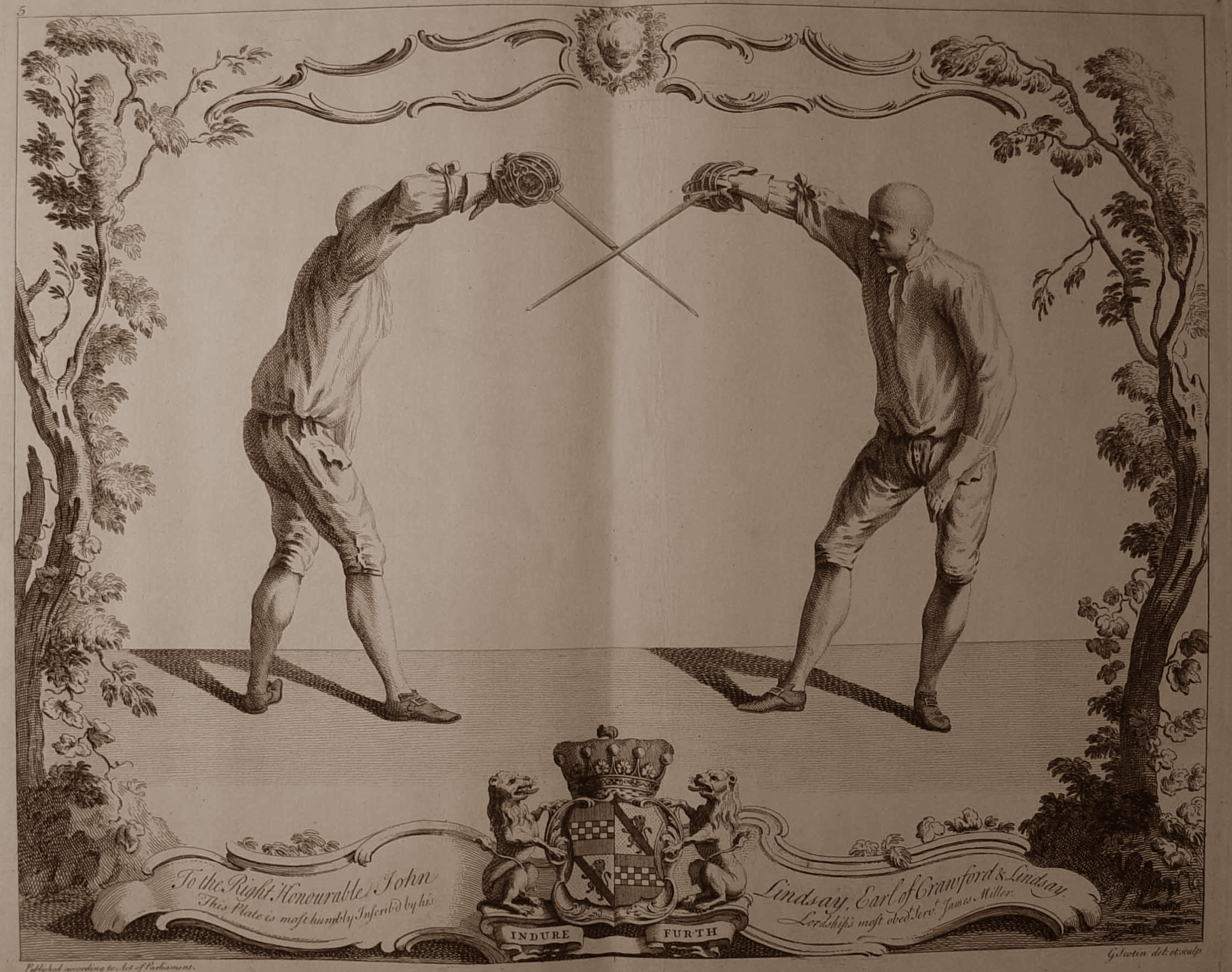
A Treatise on Backsword, Sword, Buckler, Sword and Dagger, Sword and Great Gauntlet, Falchon, [&] Quarterstaff by Capt. James Miller, 1738. Plates with a column of descriptive notes on the front page. Half a dozen or more of the fifteen plates apply to the basket-hilt backsword, and two to the falchion, and therefore to the cutlass. Excellent illustrations of positions poorly illustrated or described in other cutting sword texts of the period. Sir Wm. Hope was a fan of the “great gauntlet,” particularly on the battlefield. Miller was a soldier, later a stage gladiator.
The Use of the Broad Sword by Thomas Page. Norwich, England: M. Chase, 1746. 18th century broadsword technique, including that of the Scottish Highlanders, applicable also to the backsword and cutlass.
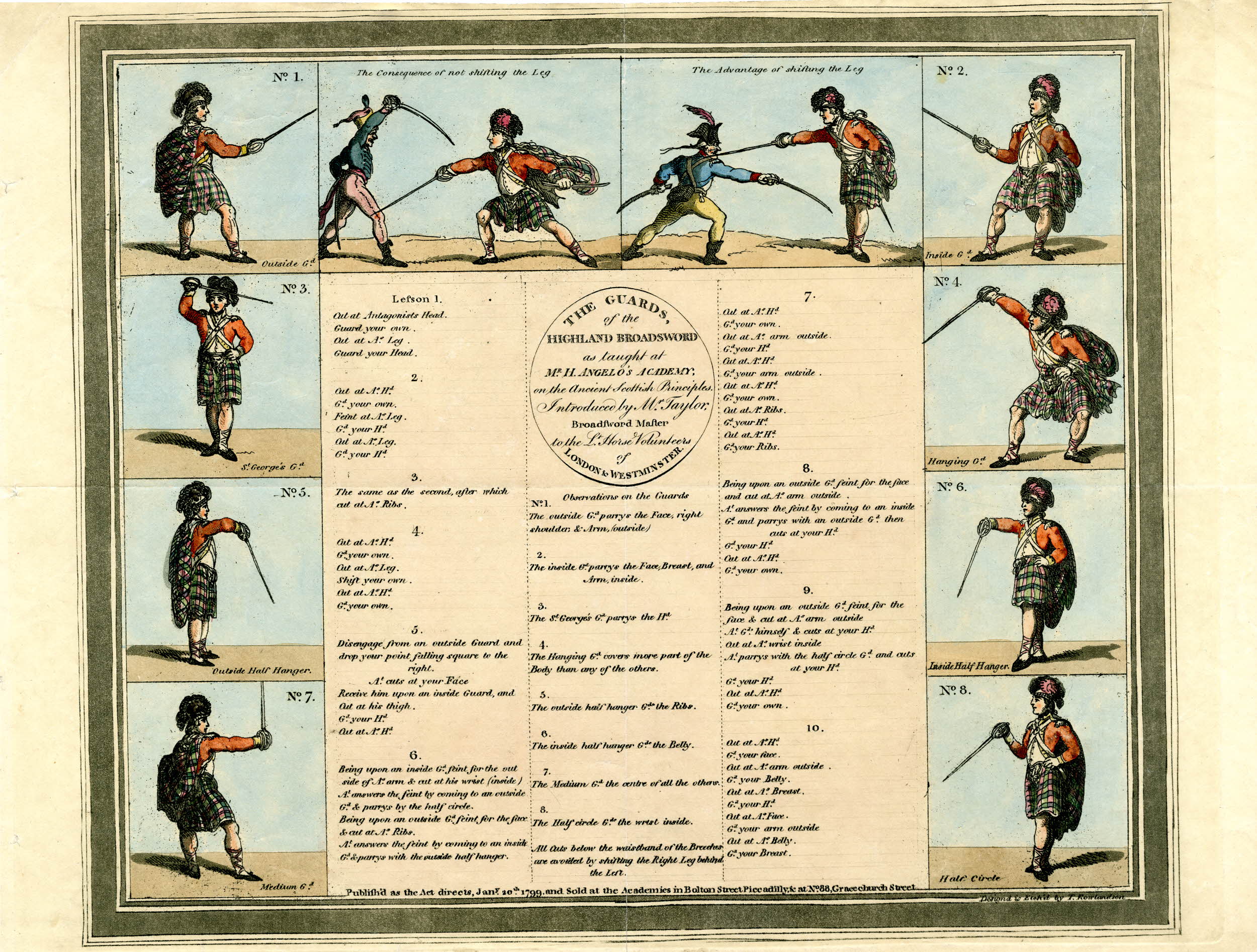
Highland Broadsword, edited by Paul Wagner and Mark Rector, 2004 (1790 – 1805). Five late 18th and early 19th century broadsword manuals (Anti-Pugilism by “a Highland Officer,” 1790; MacGregor’s Lecture on the Art of Defence, 1791; On the Use of the Broadsword by Henry Angelo, 1817; The Art of Defence on Foot with the Broad Sword and Saber, by R. K. Porter, 1804; and Fencing Familiarized, by Thomas Mathewson, 1805). Practical cut-and-thrust swordplay.
The Broad Swordsman’s Pocket Companion, “Designed by Capt. Wroughton,” ca. 1830. One of the last real English broadsword manuals of the era of Empire—actually, a book of plates only—before cut and thrust began to be absorbed by the rise in popularity of saber, not that there was actually much difference. Short, well-illustrated with colored prints of military fencers wearing fencing masks and armed with singlesticks. The book is exactly what it says.
The Art of the Dueling Sabre by Settimo del Frate explaining Guiseppe Radaelli’s saber method, translated and explained by Christopher Holzman, 2011. Del Frate’s original works were published in 1868 and 1872. Indispensable, along with the Wright/Masiello/Ciullini work below, for understanding Radaelli’s method of saber. It changed Italian saber fencing forever, and is the root of the Hungarian school.
Lessons in Sabre, Singlestick, Sabre & Bayonet, and Sword Feats; or, How to Use a Cut-And-Thrust Sword by J. M. Waite, 1880. Superb text on practical swordplay, highly recommended.
The Broadsword: as Taught by the Celebrated Italian Masters, Signors Masiello and Ciullini, of Florence, by Francis Vere Wright, Ferdinando Masiello, and [first name unknown] Ciullini, 1889. An English text on the Italian school of the light or dueling saber established by Guiseppe Radaelli in the 1870s. Maestro Masiello was a student of Radaelli; Ciullini probably was as well. Soon this Radaellian school would be transformed by Italo Santelli (a student of Carlo Pessina, who was a student of both Radaelli and Masaniello Parise) and László Borsody into the Hungarian saber school that would lead to Hungary’s half century reign in international sport saber competition. For those interested in the debunking of fencing myths, the book clearly states why the modern saber target is restricted to the area above the waist (and no, it has nothing to do with sabers once having been used on horseback): it was considered “unchivalrous” to hit below the belt. That is, the Italians wanted to keep their manhood undivided.
Cold Steel by Alfred Hutton, 1889, modern reprints available. Practical swordplay for the light saber (sorry, Star Wars fans, it’s not what you think) or even backsword, and also the “great sword” and stick. Highly recommended.
Broadsword and Singlestick by R. C. Allanson-Winn, 1890, reprints 2006, 2009. Excellent work on practical cut-and-thrust swordplay, most highly recommended. Quite English in its pragmatism.
See also Wylde, McBane, Godfrey, and Lonnergan in the Smallsword section above.
Cutlass
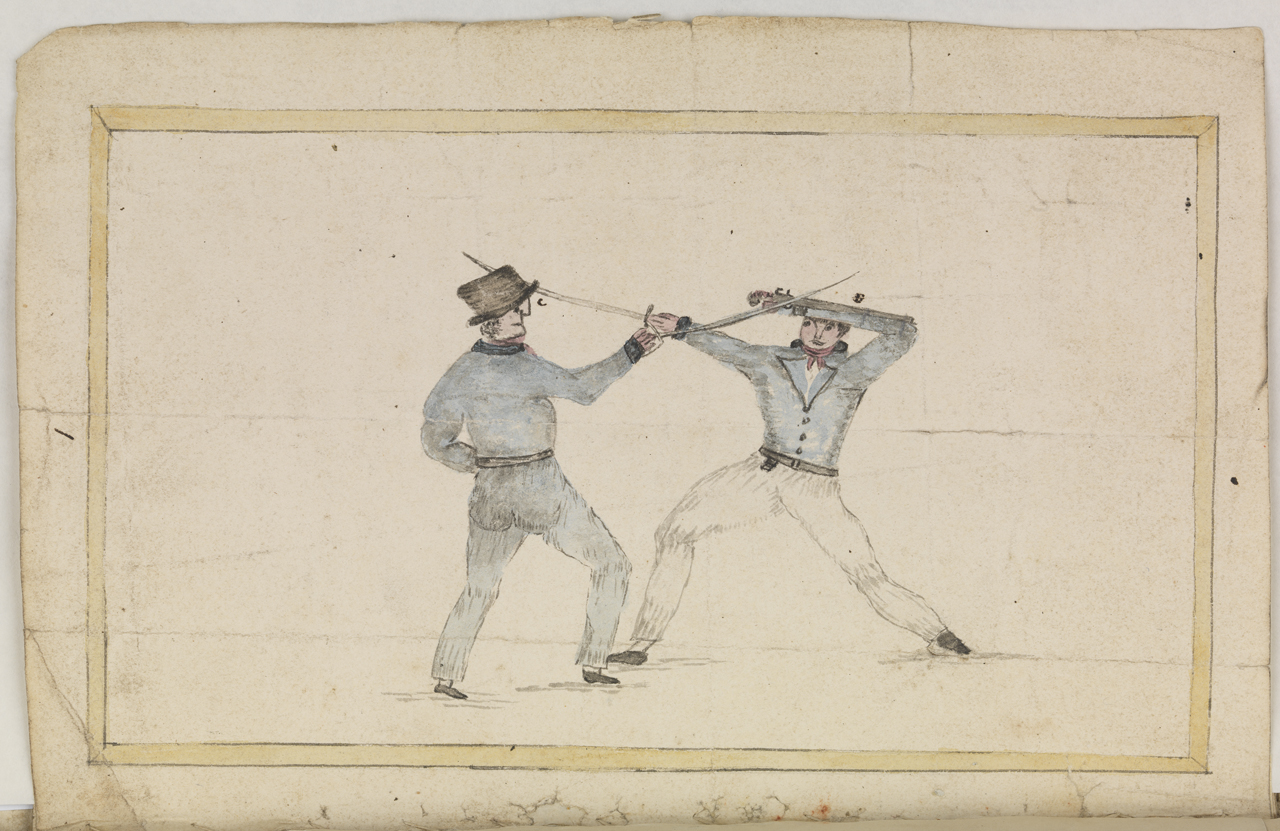
In spite of the popular—and correct—association of the cutlass with piracy, privateering, and naval boarding actions of the 17th through early 19th centuries, there are for all practical purposes no cutlass texts prior to the late 18th. Even Roland (see the Smallsword section above), who recommended fencing in particular for naval officers and crews because they had the most need of it given the prevalence of boarding actions, and Girard and McArthur who were naval officers, do not really describe it—Girard not at all, McArthur only briefly by identifying its guards and cuts as those of broadsword, and Roland largely by quoting McArthur.
Cutlass play, at least as described in cutlass manuals, of the later era was based almost entirely on the broadsword and saber technique of the time. However, given the cutlass’s useful abilities at close distances (those of riposte and of grappling), there were doubtless techniques used in earlier periods but not noted later, for example grazing parry-ripostes made in a near-single tempo, short powerful cleaving cuts, plus a variety of techniques suitable when grappling, not the least of which would have been pummeling. F. C. Grove in the introduction to Fencing (London: Longmans, Green, and Co., 1893) wrote: “One of us once saw a sailor of extraordinary strength seize a cutlass close to the hilt, where the edge is blunt, and break it short off.” Quite unconventional even by 17th century standards, yet for the seaman armed with a cutlass in action, not at all surprising. Marcelli (see the “Rapier” section above) notes something I’ve not seen elsewhere but becomes quite obvious when practicing cuts with a cutlass: the weapon is capable of fatal strokes at grappling distance.
Besides the study of backsword, broadsword, and saber texts, I recommend those of the dusack as well. Practice with a knowledgeable partner is also required, as is cutting practice in order to get a good feel for the weapon. The very few texts below are merely representative of saber technique of the later period: it is by no means a complete list. I have described late 17th century cutlass technique, or at least what we know of it, in The Sea Rover’s Practice, The Buccaneer’s Realm, and The Golden Age of Piracy, especially in the last book. Additionally, those interested may want to review my blog post, Buccaneer Cutlasses: What We Know, as it includes some information on technique. Marcelli and Girard have some discussion of opposing a saber against a rapier or smallsword, and Marcelli also vice versa, much of which is applicable to the cutlass. Likewise Captain Miller in the “Backsword” section has two plates showing falchion or hanger guards (inside and outside) applicable to the cutlass.
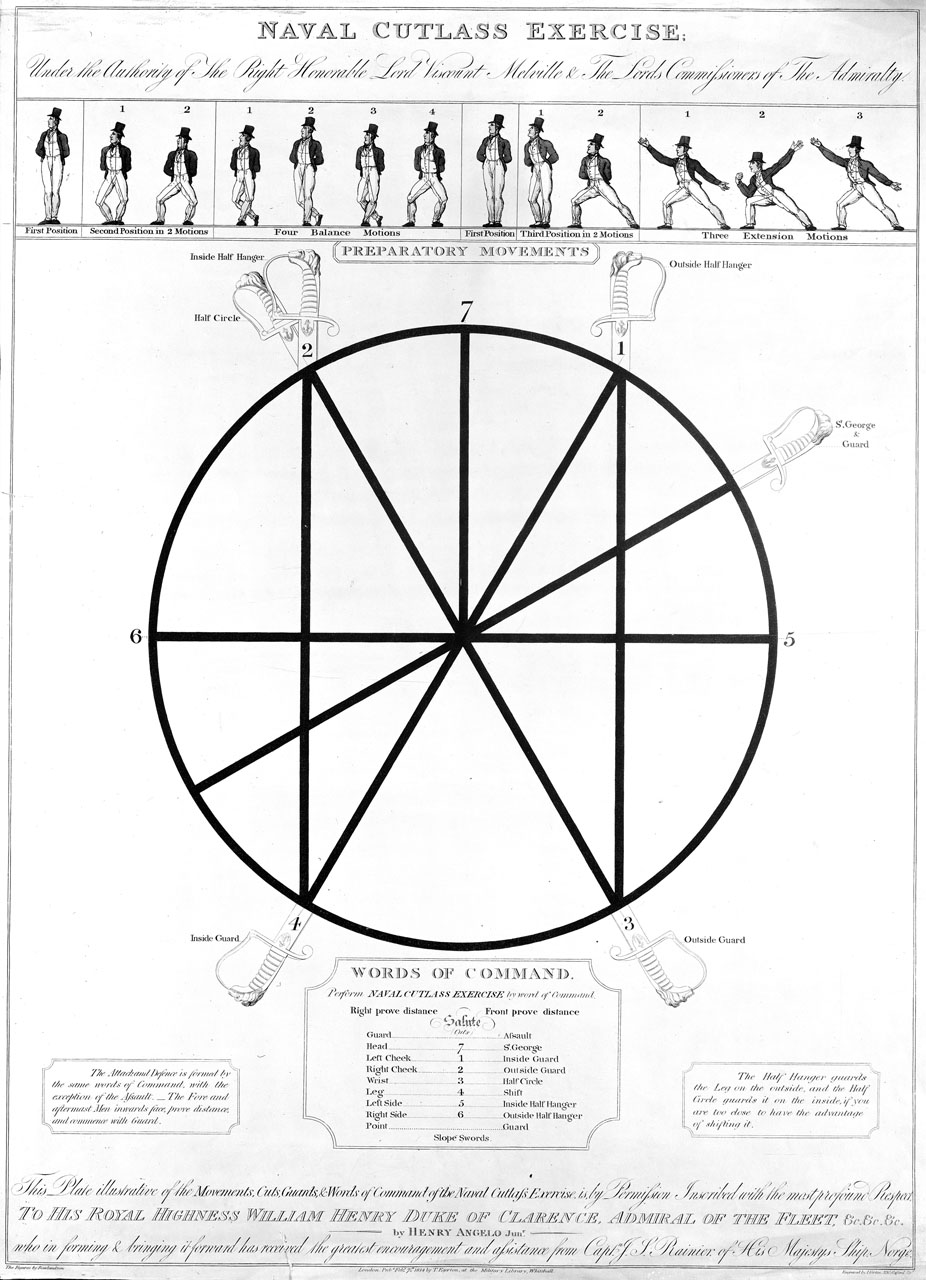
Naval Cutlass Exercise by Henry Angelo, 1813. A detailed illustration of footwork, cuts, and “words of command.” Based entirely on the broadsword, it might as well be broadsword, so why bother—except that Angelo was paid for it by the Royal Navy. In his defense, McArthur (see the “Smallsword” section above) agrees that cutlass and hanger guards and cuts are the same as those of the broadsword. Nonetheless, there are techniques one can use with a cutlass at the distance of “handy-grips” that cannot be used with a broadsword or other longer cutting sword.
Naval Cutlass Exercise “For the Use of Her Majesty’s Ships,” 1859. Includes a good general illustration of cuts and guards, as well as well-regulated military-style (naturally) drills for cuts, guards (equivalent to parries), and points (thrusts, that is). The brief “Concluding Observations” include a vital one for combat: “…but he must ever be “on guard” to meet the impromtu [sic] hit of such as cannot help returning [riposting], whether hit or not.”
The Ship and Gun Drills of the U. S. Navy, by the Naval Department, Division of Militia Affairs, 1914. Seaman’s manual with brief instruction on the USN “Sword Exercise.” The attacks and parries are simple and functional, and the illustrations useful.
British Naval Swords and Swordsmanship by John McGrath & Mark Burton, 2013. Includes a couple of good chapters on British naval swordsmanship, but as can be expected given the source material, the discussion is by and large of the late 18th century and afterward. Includes a description of British naval fencers as well. Required background reading for the student of cutlass swordplay and required technical reading for the collector of British naval swords.
Stage Swordplay / Theatrical Fencing / Stage Combat & Choreography
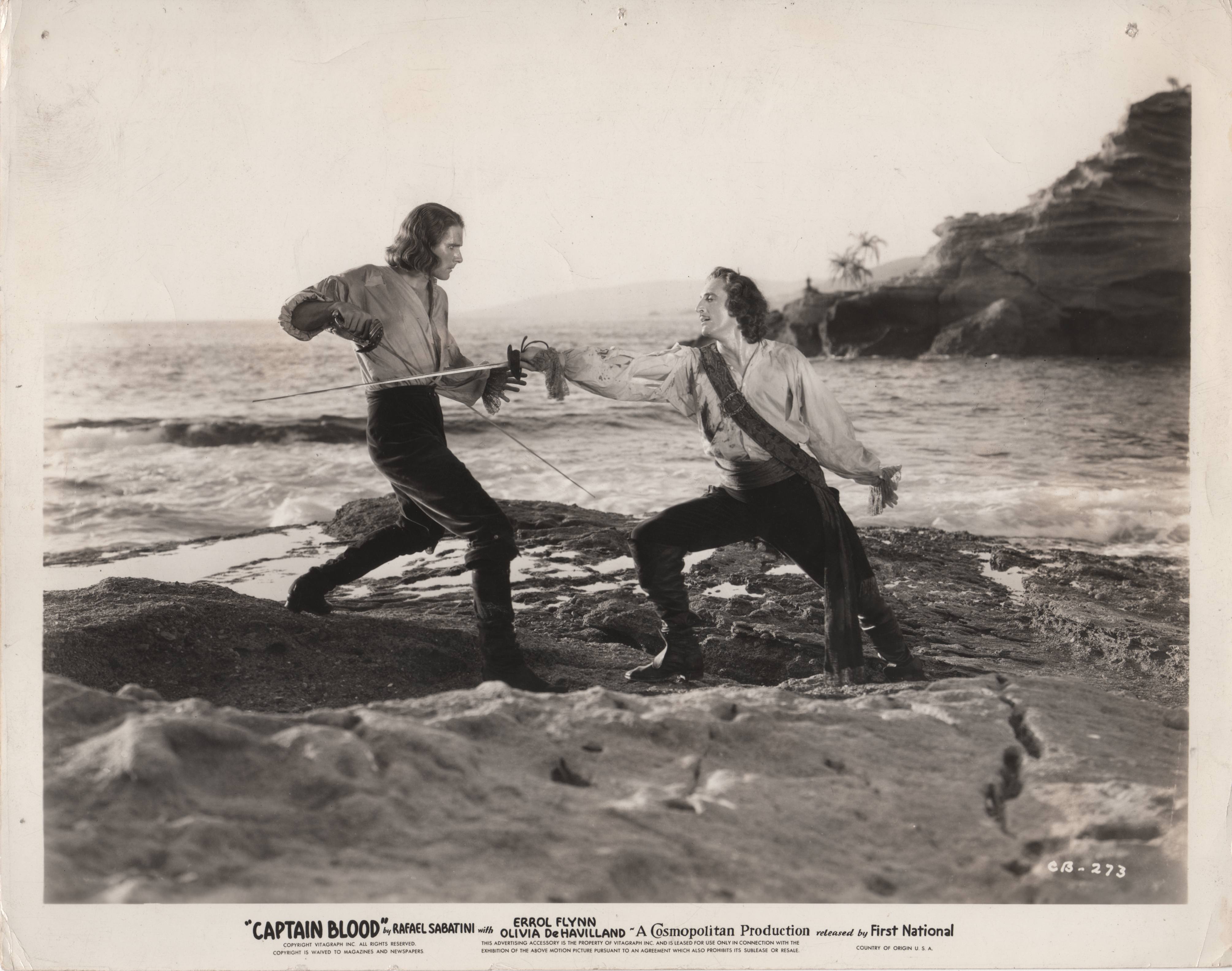
At some point many fencing teachers will be approached to choreograph swordplay, most often for a local production. The task must no be approached lightly. The choreographer’s job is prepare a swordplay script to be executed: the choreographer’s duty is to prepare actors to safely execute the script. In general, actors should be used for staged swordplay, not fencers unless they are both skilled and have classical training. Stage swordplay is intended to convey the illustion of combat; fencers are trained to hit and may forget this even when choreographed. Further, the tempo is much different between stage swordplay and fencing for sport or actual combat: a predictable tempo is required for safety in the former, but broken tempo for the latter. Broken tempo in a choreographed swordfight can lead to injury. In particular, the eyes are at great risk. Again, fencing teachers should not undertake stage fencing choreography lightly.
Sword and Masque by Julius Palffy-Alpar, 1967. By a Hungarian fencing master, the book is largely a beginning fencing book with a smaller section devoted to stage fighting. Although it does briefly cover period swords and provides samples of choreography for famous stage fight scenes, it offers little to the fencing teacher regarding training and safe techniques. Far more useful is the book by William Hobbs.
Stage Combat: “the action to the word” by William Hobbs, 1980. By a stage and film swordfight choreographer who ranks with Henri Uyttenhove, Fred Cavens, Ralph Faulkner, Jean Heremans, and Bob Anderson and whose credits include the 1973/74 The Three Musketeers and The Four Musketeers (the best musketeer films by far, in my opinion), The Duellists (the most historically accurate swordplay, ever), and numerous stage fights produced among others by Laurence Olivier and played among others by Peter O’Toole, Albert Finney, and many others. Hobbs covers the history of stage fighting, orchestration, the use of dramatic surprise, safety and rehearsals, safe sword technique, historical accuracy, fight notation, and more. Hobbs is adamant about using actors — modern fencers and fencing does not look historical. (Here I understand but disagree in part — if skilled and classically trained in their first lessons, rare today but fairly common when I first learned to fence almost fifty years ago, modern fencers can portray historically accurate stage swordplay, with one caveat: most cannot act. Better, though is the use of fencing masters and experienced fencing teachers, for they have the necessary control, thus the routine long shot doubling by Fred Cavens et al in the films of the 20s, 30s, and 40s.) Laurence Olivier’s foreward is worth the read as well. Highly recommended. Note that Hobbs’s numbering of parries is his own, designed for actors to learn: it will be confusing to anyone who learned to fence in the past four hundred years.
Additional information on stage swordplay, particularly on the subjects of tempo and of choreography associated with Fred Cavens, can be found here and here.
Bibliography
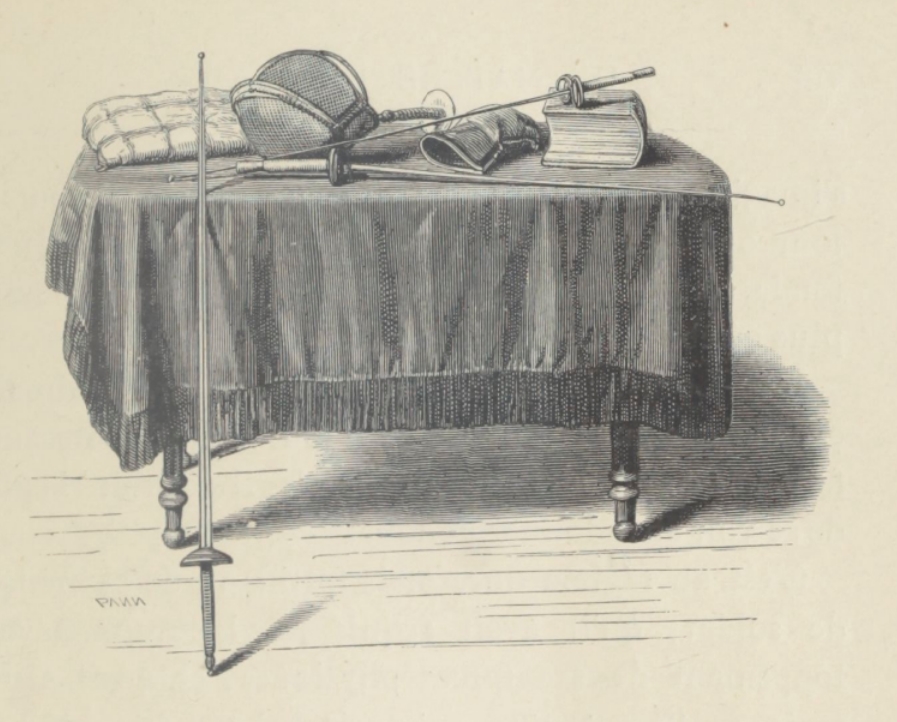
La Bibliographie de l’Escrime Ancienne et Moderne by Arsène Vigeant, 1882. Not as complete as the bibliography below, but highly useful nonetheless. M. Vigeant had a thorough understanding of both swordplay itself and its history.
A Complete Bibliography of Fencing & Duelling by Carl A. Thimm, 1896. A very useful, largely complete bibliography through the late 19th century. Reprints from 1968 and 1999 are available, though often pricey. Look instead for the free pdf on Google books unless you find that fortune generally favors you or you have plenty of money to spend, the latter, of course, being one way or another proof that fortune has favored you at least once.
The History of Fencing & Swordplay
Schools and Masters of Fence by Egerton Castle, 1885, reprints 1968, 2003. European fencing to the late 19th century. Highly recommended.
Old Sword Play by Alfred Hutton, 1892, reprint 2001. A brief description of European fencing technique over the ages by a noted English fencing master.
The Sword and the Centuries by Alfred Hutton, 1901, reprint 1995. A history of European fencing and swords. A classic.
IIIe Congrès International d’Escrime, Brussels, 1905. For those interested in the arguments and squabbles that created modern sport fencing rules—and how sport interests came to dominate in epee competition, rather than having epee competition emulate dueling or the jeu de terrain as closely as possible.
The English Master of Arms: From the Twelfth to the Twentieth Century by J. D. Aylward, 1956. Excellent work covering not only English fencing masters, but necessarily the development of fencing in the British Isles as well. One of my favorites. Aylward’s book on the smallsword in England is also highly recommended for anyone with an interest in smallswords or late seventeenth and eighteenth century fencing or dueling.
Swordsmen of the Screen: From Douglas Fairbanks to Michael York by Jeffrey Richards, 1977. The history of swordsmen and swordswomen in film to 1977. Swashbuckling actors and the fencing masters who doubled for them. Worth the read if you’re into film swashbucklers.
Martini A-Z of Fencing by E.D. Morton, 1988. Not a book on fencing history per se, but a compendium that includes much fencing history, as well as fencing terms, concepts, and trivia. One of Mr. Morton’s entries is Rafael Sabatini. I disagree with most of Mr. Morton’s criticisms of Sabatini, including his claim that much of what he wrote about ships &c is in error. Sabatini did make errors, but they’re not nearly so egregious as Mr. Morton claims, with the exception of presenting a ship’s stern to cannon-fire in order to minimize damage (in fact, this would, as Mr. Morton notes, be more dangerous). Vanity aside, I hesitate to note that I am in fact an expert in this area, and can easily point out where Mr. Morton is incorrect. Notwithstanding that the majority of Mr. Morton’s entries are valid, readers must take the Sabatini entry with a grain of salt.
En garde: Du duel à l’escrime by Pierre Lacaze, 1991. Well-illustrated popular history of mostly French fencing and swordplay.
The History of Fencing by William M. Gaugler, 1998. A detailed history and analysis of the Italian schools into the first half of the 20th century, with a fair, if quite limited, discussion of French schools. The modern schools, including the revolutionary Hungarian (or Hungarian-Italian) saber school, are unfortunately and inexplicably not described. Gaugler’s book has detailed description of the technique presented in a number of books listed in this post, along with fencing-related biographical details of many of the authors.
Escrime by Gerard Six, photography by Vincent Lyky, 1998. “Coffee table” fencing book covering everything from history to technique, albeit briefly, and mostly French. Well-photographed.
The Secret History of the Sword by Christoph Amberger, 1999. By a veteran of the Mensur, also known as fighting for scars—which is by most definitions the purpose of macho male one-ups-man-ship. Most of us, just like Tom Sawyer, are proud of our scars. Highly recommended—the book that is, but we can include scars as well, as proof of a life well-lived and of a fortunate one also, in that we’re still alive to show off our scars.
Croiser le Fer: Violence et Culture de L’épée dans la France Modern (XVIe-XVIIIe Siècle) by Pascal Brioist, Hervé Drévillon, and Pierre Serna, 2002. Excellent scholarly study of swordplay and dueling in France from the 16th to 18th centuries. Highly recommended.
By the Sword by Richard Cohen, 2002. A history of fencing, including the modern schools, by a British Olympic fencer. Arguably the only thorough modern history of fencing. Highly recommended; my favorite book by far on the history of fencing.
Reclaiming the Blade by Galatia Films, DVD, 2009. A mostly well-intentioned attempt to “reclaim” authentic Western swordplay and historical fencing, but unfortunately marred by the heavy-handed, ideological manner in which it attacks sport fencing and some other forms of swordplay, not to mention by its egregious overuse of Hollywood references and interviews—Hollywood depictions of swordplay are usually divorced entirely from reality, thereby undercutting the argument. At its best, the documentary extols Western swordplay. At its worst, it further divides rather than unites the several major fencing communities.
To pick a bone with—or perhaps cross swords with?—the film’s makers, although many modern competitive fencers often do not practice the ideal of “hitting and not getting hit,” there are plenty, epeeists especially, or at least veteran epeeists, who do understand the concept well, can execute it exceptionally well when necessary, and are happy to argue the point, weapon in hand, with any fencer of any sort. In fact, some of us trained entirely under masters who fenced when dueling was still practiced and the saber was still a military arm—and who understood that it was entirely acceptable to practice both forms of swordplay, that is, sport or recreational, and practical training for combat with real weapons. To promote the so-called reality of historical and classical fencing is double-edged and often cuts hypocritically: excessive “contre-temps” or double-touches have been the bane of fencing for centuries, and modern “historical” and “classical” fencers are no more immune to them than were the fencers of the past whom they seek to emulate.
As for those who would compare “classical fencing” poses with photographs of modern fencers in action in order to prove the “sloppiness” of modern fencing: I can show them the same awkward action shots in their “classical fencing.” All it takes is a camera and an unposed subject.
Japanese Texts
Tengu Geijutsuron (The Demon’s Sermon on the Martial Arts) by Issai Chozanshi [Niwa Jurozaemon Tadaaki], translated by William Scott Wilson, 2006. Includes the famous story illustrating the psychology of swordplay, Neko no Myojutsu (The Mysterious Technique of the Cat). Originally written in the early 18th century.
Heihō Kaden Sho (The Sword and the Mind) by Kamiizumi Hidetsuna, Yagyū Muneyoshi, and Yagyū Munenori, translated by Hiroaki Sato, 1985. Originally compiled in the 17th century.
Go Rin No Sho (A Book of Five Rings) by Miyamoto Musashi, translated by Victor Harris, 1974. Completed in 1645, shortly before the author’s death. Numerous editions available, including an excellent translation by William Scott Wilson. A classic on swordplay, strategy, and tactics. Every fencer — and everyone in general — should read it.
The Unfettered Mind by Takuan Sōhō, translated by William Scott Wilson, 1986. Three essays on swordsmanship (Fudōchishinmyōroku, Reirōshū, and Taiaki) by a Zen master and contemporary of Musashi. Written in the early 17th century. Highly recommended.
Suggestions on Acquiring the Books Above
Several of the listed titles (Borysiuk, Czajkowski, Harmenberg, Holzman, Kogler, Lukovich, Szabo, and Vass) were available directly from the publisher, Swordplay Books Online (http://www.swordplaybooks.com/), but with the passing of its owner/editor the titles are largely available now only from fencing suppliers while their stock lasts, and from other common sources. Many fencing books in print may be ordered from various online retailers, and occasionally may be found in bookstores. However, most of the titles listed above are out of print. Some of the older titles are in the public domain and are available as .pdf files on Google Books, archive.org (an excellent site but for its terrible practice of making some books still under copyright available, thus cheating their authors and publishers), and other electronic book sites. College students and faculty may be able to access some titles digitally or in traditional print via their university libraries.
Some of the seventeenth and eighteenth century titles in English are published as fairly inexpensive reprints by Gale ECCO and EEBO (Early English Books Online), along with similar cheap—in the sense of cheaply reproduced from mediocre quality digital scans or old microfiches—facsimile reprint publishers, and are available via Amazon and other online bookstores. However, please note that most of these versions DO NOT INCLUDE FOLDOUT PLATES, so if you’re looking for the illustrations you may have to look elsewhere. Some of these and other old fencing texts may be found in various national digital libraries, often of much better quality, and with complete foldout plates.
A reader of this post, Pradana (see Cruzado y Peralta in the rapier section above), recommends Freelance Academy Press https://www.freelanceacademypress.com/, Fallen Rook Publishing http://www.fallenrookpublishing.co.uk/publications/, and AGEA Editora http://ageaeditora.com/en/ as sources for modern reprints.
Bookfinder.com compares prices of books in and out of print among online retailers, including independent booksellers. Fetchbook.info compares prices among online retailers and some of the major independent bookstores, but my browser warns that the site is a security risk. Abebooks.com and Alibris.com permit title searches through the stock of thousands of independent booksellers; I personally recommend Abebooks although some “drop shipment” booksellers — at times unreliable in their descriptions — now are among the sellers since Amazon (unfortunately) purchased the site. Search all of these sites to get an idea of price range before searching on eBay: although some books on eBay are good, even great, deals, some are grossly overpriced or over-bid.
Overall, I recommend Abebooks.com if you don’t have a local independent brick-and-mortar store carrying fencing books (unlikely) or willing to order for you. Those of you who never had to rely pre-Internet on book vendors for online searches won’t quite appreciate how useful and cost-effective Abebooks &c are: “back in the day,” booksellers doing searches for customers would typically mark up the price of a book found at another vendor by one hundred percent—plus shipping. Naturally, they didn’t inform you of this practice.
Some fencing books can be found on Amazon.com, but ALWAYS price compare first, especially with used or antiquarian editions. Many Amazon book vendors have a bad — frankly, unethical — practice of listing out of print volumes at ridiculously high prices. About nine out of ten I’d say. I’ve seen a used copy of one of my books listed for about $300 by an Amazon vendor, when it could be found on other sites for as little as $25 in the same condition. Similarly with fencing books. Two more reasons to avoid Amazon: the company often packs books, softcovers especially, with other items, leading to damaged books. A call to Amazon customer service about this resulted only in hilarious escalation from representative to supervisor to “specialist” with no solution other than a promise to “forward your [my] concerns to the appropriate team.” Their scripts don’t cover the issue other than to offer a refund after the book is returned. I didn’t want a replacement: I wanted Amazon to stop damaging books. This request perplexed them immensely, for their was no answer to it in their scripts. Last, Amazon’s cutthroat pricing on books, in which the company apparently loses money, is designed to corner your book sales market at the expense of local bookshops and major chains. I’d rather support bookstores than a rapacious enterprise.
Many fencing suppliers carry fencing books in stock, although the number of titles is often limited. Some libraries carry fencing books, but the selection these days is usually slim. Compare to my high school library which had three or four books on fencing, and we didn’t have, and never had, a fencing club or team.
Most of the sport fencing books listed above are dated in regard to modern competitive rules, practices, and uniform and equipment requirements. Always refer to the current USA Fencing rule book and USA Fencing operations manual, or other appropriate national fencing regulations for HEMA, historical, classical, and other organizations, for competition rules and regulations. USA Fencing rules, such as they now are, are available for download at USA Fencing’s website.
Copyright 2008-2026 Benerson Little. Last updated February 10, 2026.
 Swordplay & Swashbucklers