
Home » Uncategorized (Page 5)
Category Archives: Uncategorized
The Night Thrust; or, More Politely, the Passata Soto
“This subterfuge is termed a Night-Thrust; being a short method of deciding a skirmish in the dark.”
–Andrew Lonergan, The Fencer’s Guide, 1777.
But Edward was no longer there, or at least not where Lynch expected. Completely covered by the inky darkness, Edward had lunged backward, his left hand dropping to the ground, his body bending inward, his blade shooting forward at Lynch’s belly: the Italians called this passata soto, but some of Edward’s English contemporaries called it the “night thrust” for its utility in the darkness.
Benerson Little, Fortune’s Whelp, 2015
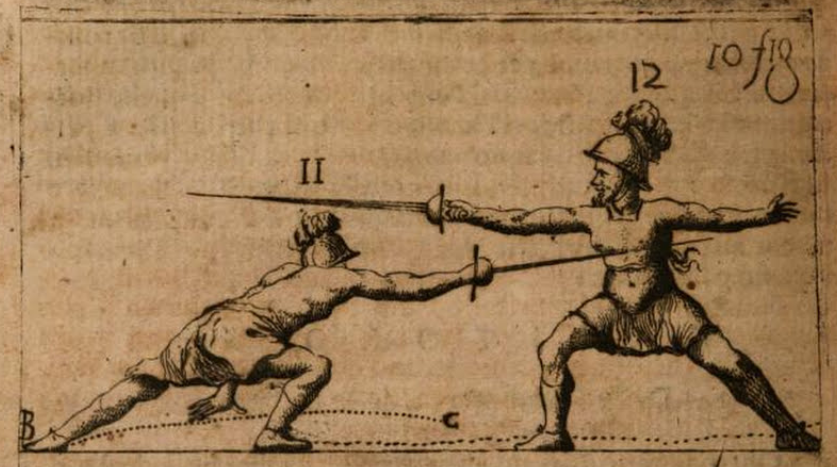
The Classic Passata Soto or “Night Thrust”
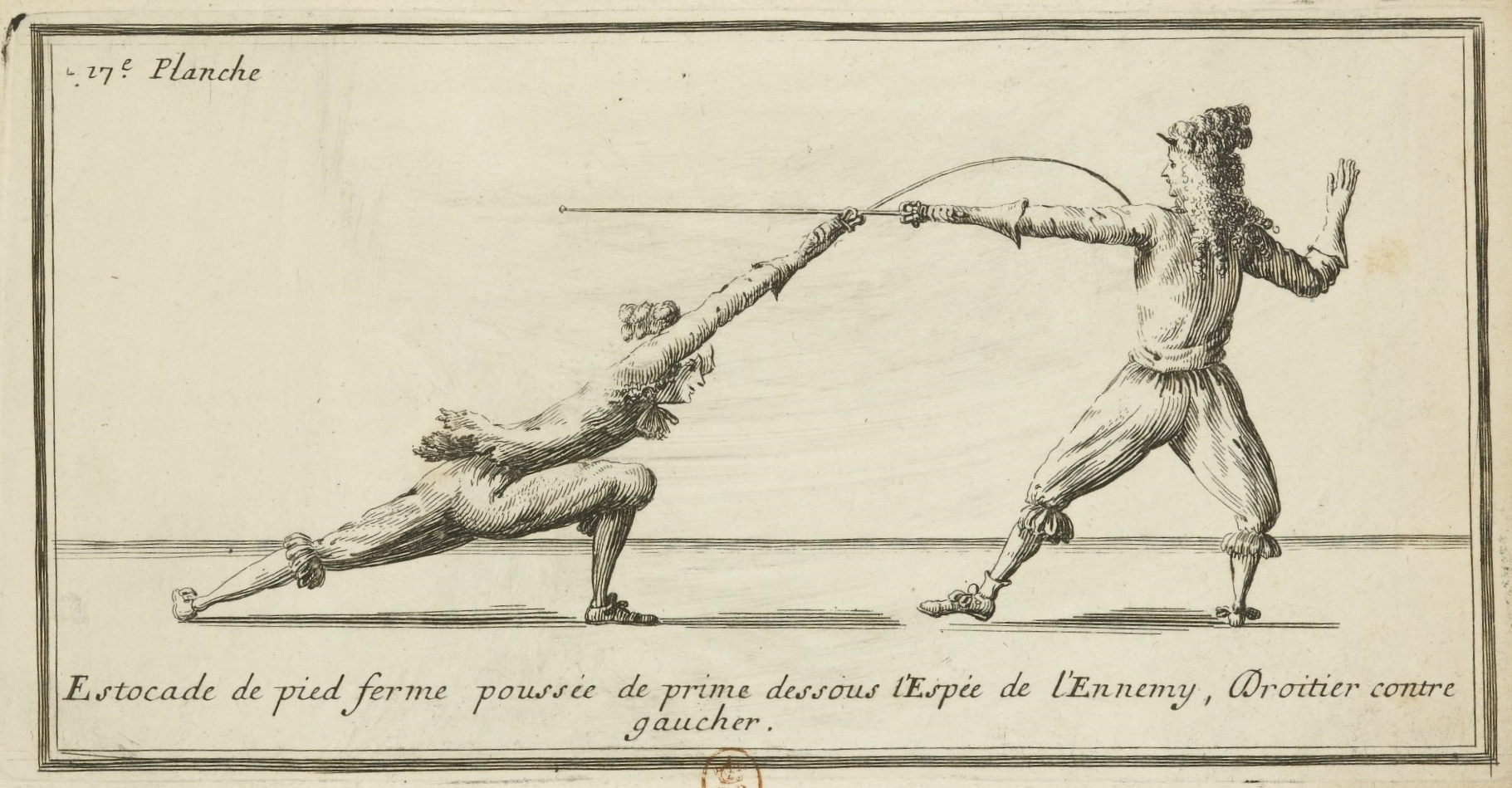
A staple of many Western fencing texts since the Renaissance, the passata soto, or passata sotto, also known variously as the sbasso, sottobotta, and cartoccio on occasion, the various dessous of the French masters of the smallsword and the passata di sotto of the modern, is usually defined as a counter-attack made by lowering the body while simultaneously thrusting, extending the rear foot in a reverse lunge, and placing the unarmed hand on the ground for support. Occasionally the technique is recommended as an attack with a true lunge, rather than a reverse. Andrew Lonergan provides an eighteenth century definition and exercise of the passata soto under the name of night thrust:
“On Guard in Quarte; and disengage a Quarte-over-the-arm [modern sixte]. I now batter [beat] with a Tierce; and begin to advance my left foot to form my Pass upon you in Tierce. Now when you see my left foot move, slip your left foot back, so as to pitch yourself on that knee; stoop your head so that your arm now turned into a Segonde may cover it, hold your left hand extended toward the ground, that it may sustain you, in case you should totter; thus my point will pass over your head, and I shall fall upon yours.”
And his reasoning why such “athletic” techniques should not be abandoned:
“Though these methods of Disarming, and Passing, Volting, and that of the Night Thrust, seem to be almost abolished by the refiners of these arts; I cannot conceive why a man, who is naturally strong and active, should not avail himself of such advantages, especially when improved by our athletic exercises, so engaging to an English subject, and forbidding to all others.”
In the old Italian schools, the body was usually bent at the waist. In some of the old French, the body was lowered by a very low reverse lunge. The adversary may be hit either with the extending arm or by impaling upon it, or both.

In terms of the modern French school, the “passata di sotto” is classified as an esquive, specifically une passe dessous with the back leg extended or both legs deeply bent.
With real weapons, the adversary is ideally impaled, usually in the belly which is, were the swords real, a good place to hit because there are no ribs and cartilage to potentially prevent the point from entering or otherwise diminish its penetration. There is also some anecdotal evidence to suggest that in some cases belly wounds may be more quickly incapacitating.

A very long low lunge which made going forward might slip under the adversary’s guard, as in Rafael Sabatini’s novel The Black Swan (1932), and which made in reverse might serve aid a counter-attack by lowering of the body. (An analysis of the duel in the novel may be found here: The Duel on the Beach, Part II: The Black Swan.)
Long low lunges like this are often identified with, or confused with, the passata soto. Note, however, that fencing language is highly malleable and definitions vary: one master’s passata soto might include only the classic reverse lunge with a bend at the waist, while another’s may include any lowering of the body in attack or counter-attack. Most masters, however, consider it to be a counter-attack with esquive, the body lowering in place or with a reverse lunge, and not a long low lunge forward.

The passata soto is not without significant drawbacks, which is probably why Lonergan recommended its use at night and nowhere else. Foremost, it must be well-timed. Too late, and the fencer attempting it may get hit in the face, neck, or upper torso. Too soon, and the fencer attempting it throws away the advantage of the surprise mandatory to its success. Used too often, and the adversary may learn how to trigger it with a feint, and then take advantage of the poor position the classical passata soto leaves the fencer in.
And it is this poor position that is the major drawback of the passata soto, in particular with real weapons. With the unarmed hand on the ground, the torso bent sideways, and the rear leg extended well behind, the fencer is in a bad position for defense after a failed attack or, even if the swords were real, after impaling the adversary. Few wounds are immediately incapacitating, including ultimately fatal wounds: many duelists and battlefield swordsmen were wounded or killed after giving an adversary a fatal wound. Even with a mortal wound to the heart, an adversary may live as long as ten seconds. Even assuming an average of four, that’s plenty of time to even things up.
In the case of dry (non-electric) weapons, the judges and director (referee) will determine whether a hit was made, whether it was in time, and whether a hit on the fencer who ducked is valid via rules regarding replacing of target. In the case of electrical weapons, the machine will make the determination in epee, and the machine and director in foil and saber.
For the fencer armed with a rapier on poniard, placing the poniard-armed hand on the ground is giving up half of one’s offense and defense, to be replaced by almost blind trust.
From the position of the passata soto, a prime or lifted sixte/septime beat or bind, or a St. George parry or opposition (modern saber quinte) accompanied by the use of the unarmed hand to help ward off the adversary’s blade, plus an urgent recovery forward or backward, all performed near-simultaneously, is the only viable option if the passata soto has failed to hit or otherwise halt the adversary.
Such recovery, however, is invariably slow, and a loss of balance may ensue if the unarmed hand is removed from the ground too soon to assist in parrying or opposing, for example. Further, the long low position leaves the fencer vulnerable if the arrest fails, whether by missing the adversary or failing to immediately incapacitate him. In particular, the head, neck, and subclavian area are exposed. Fatal thrusting wounds can be given in any of the three areas. It’s likely that execution at night might alleviate some of these weaknesses in the technique, but it would need to be a dark night with little ambient light.
Historical Techniques Similar to Passata Soto
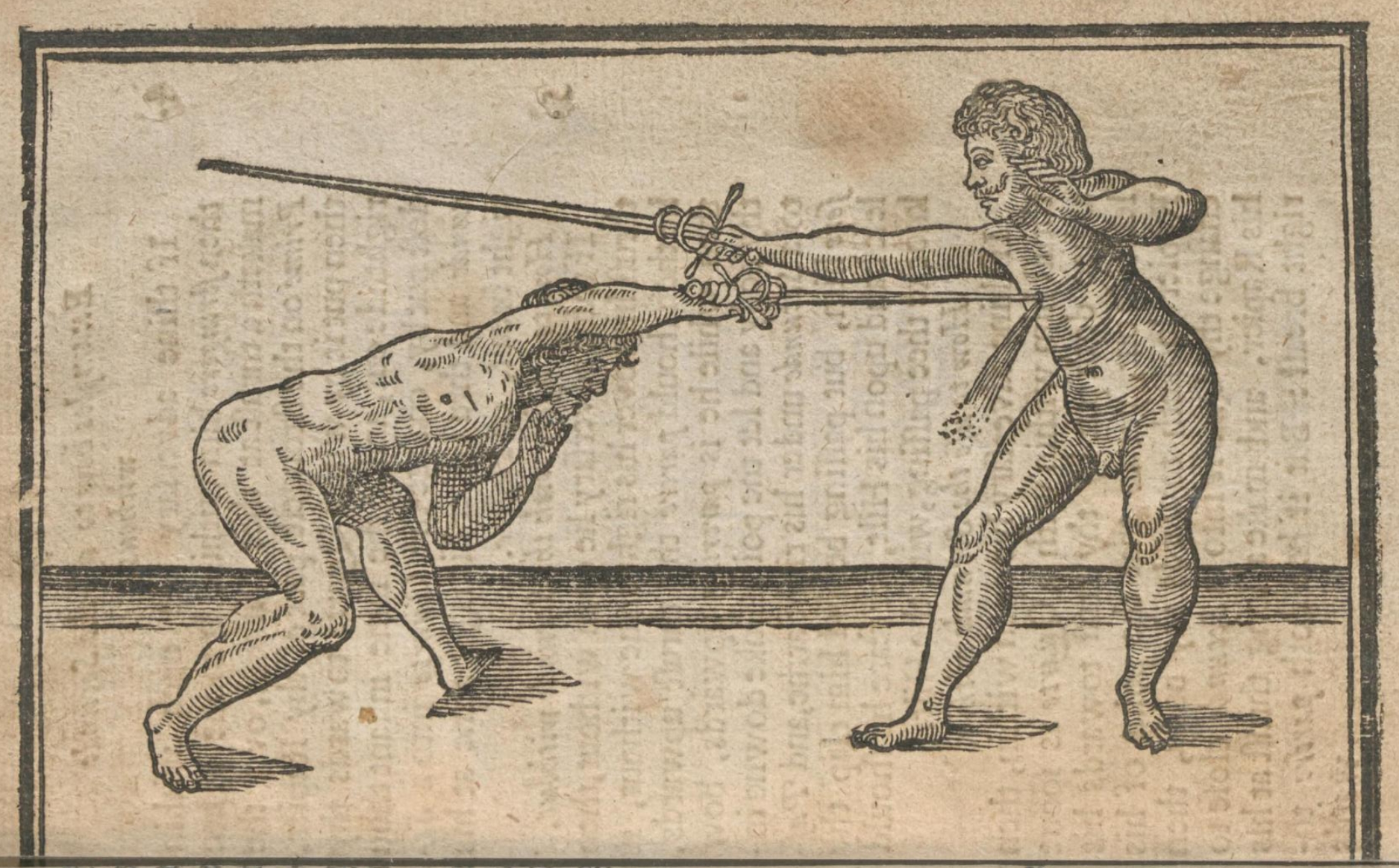
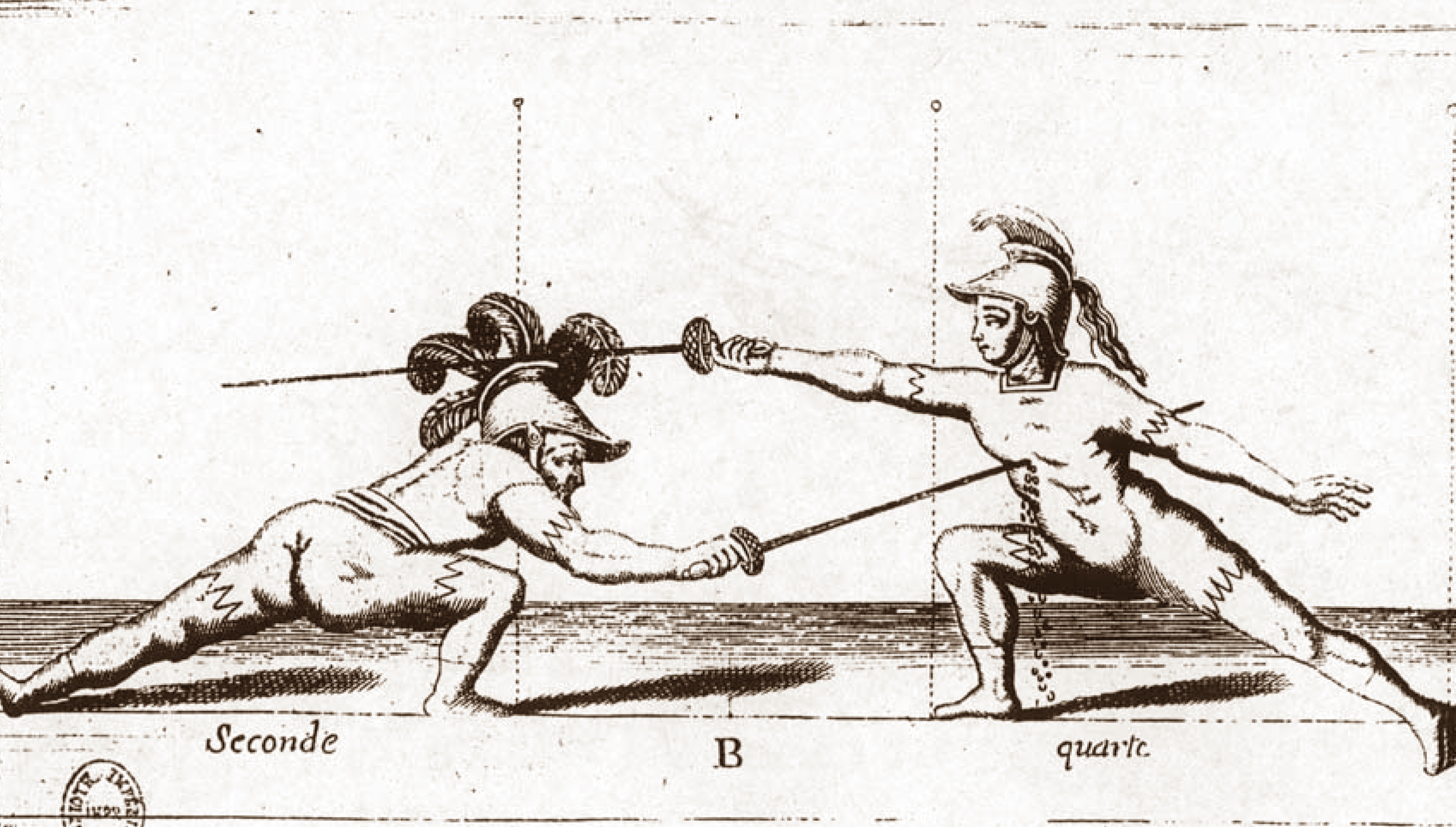
There are better methods, past and present. In particular, these methods, while not reducing the target quite as much, leave the fencer in a much better position should the counter-attack fail, or, with real weapons, should the adversary be hit but not be immediately incapacitated. Some masters, Sir William Hope for example, believed also that a lowered position better-protected the torso.
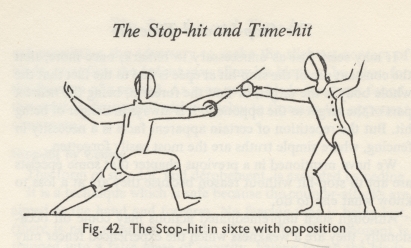
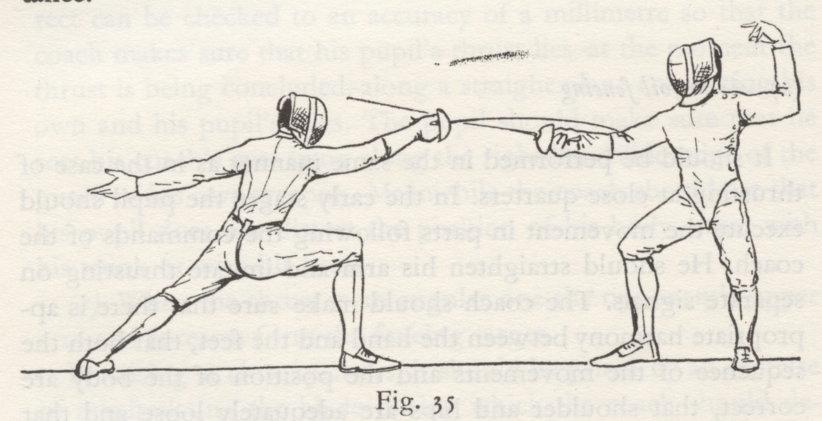
In general they consist of a lowering of the body to a lesser degree, often with a parry or beat first, or with a thrust in opposition. Below are a series of images depicting this in various forms over time.

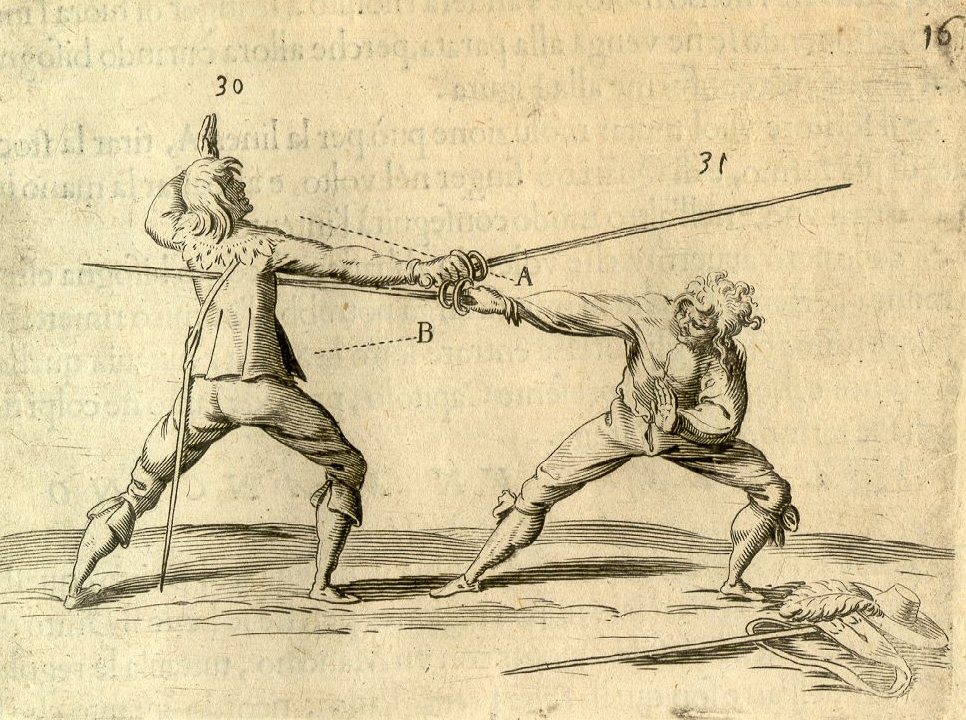


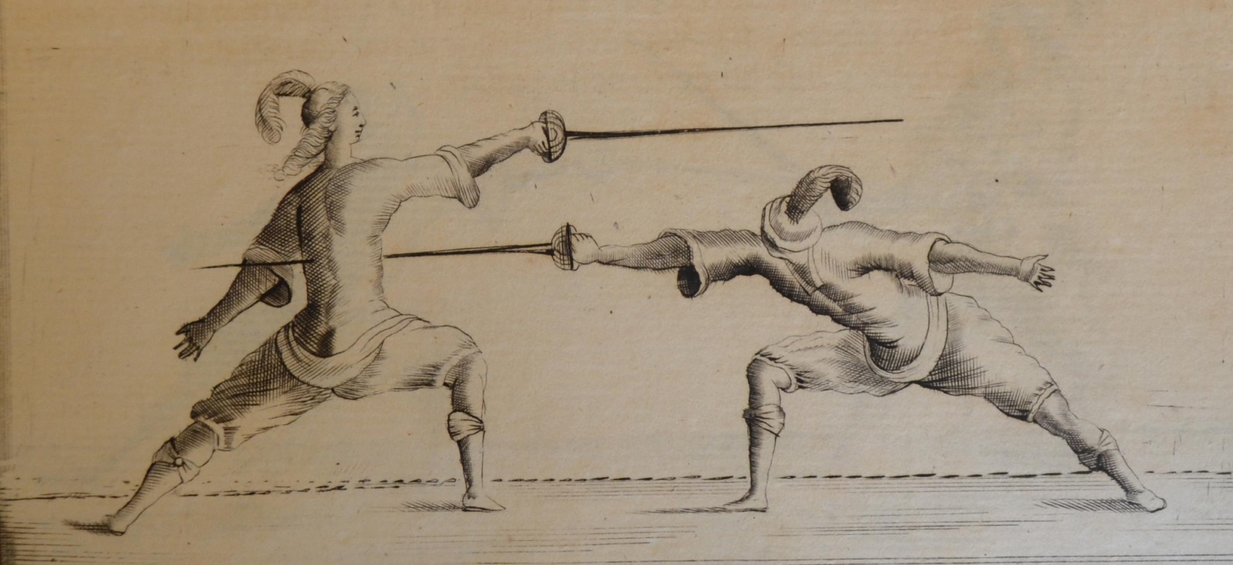

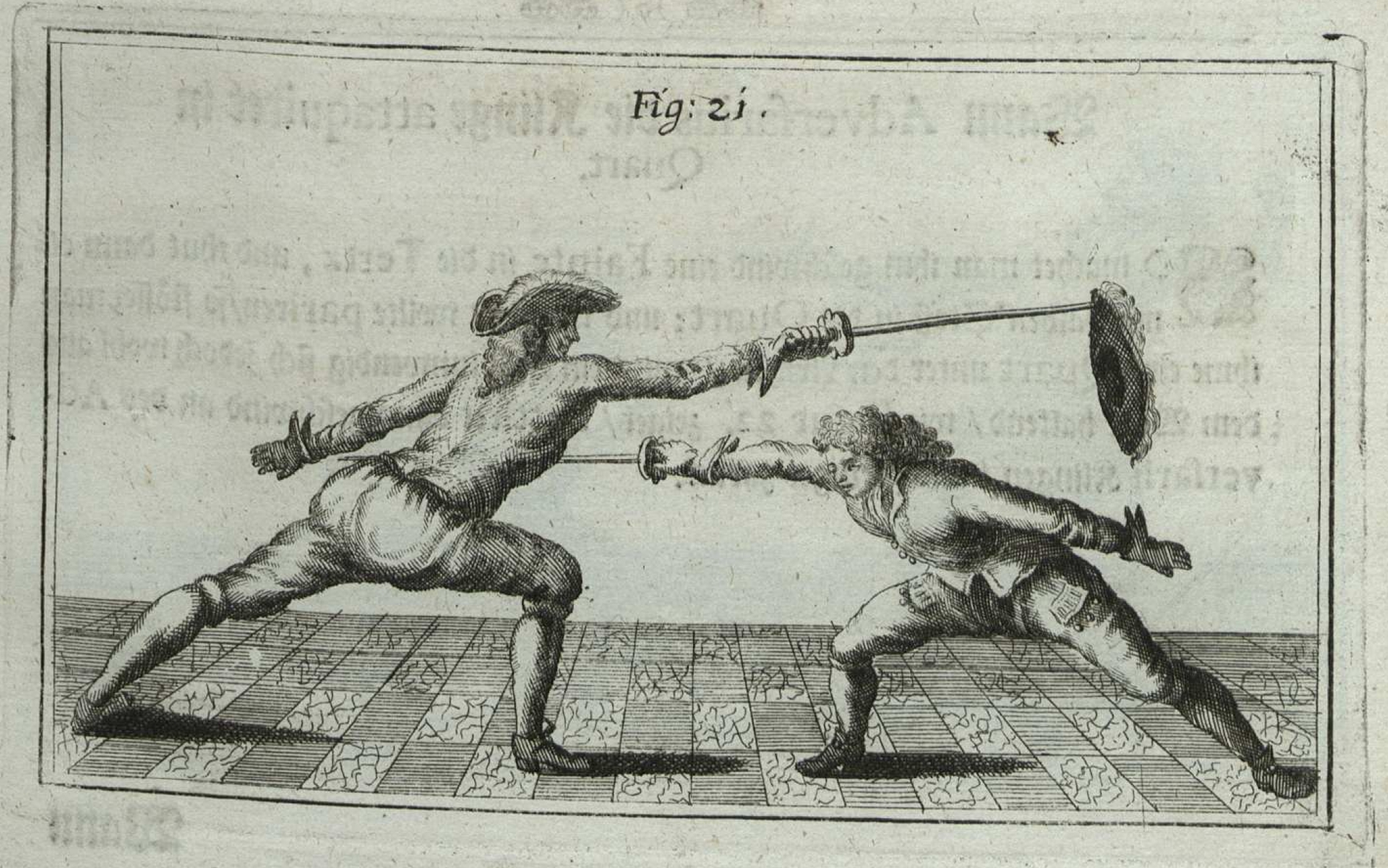


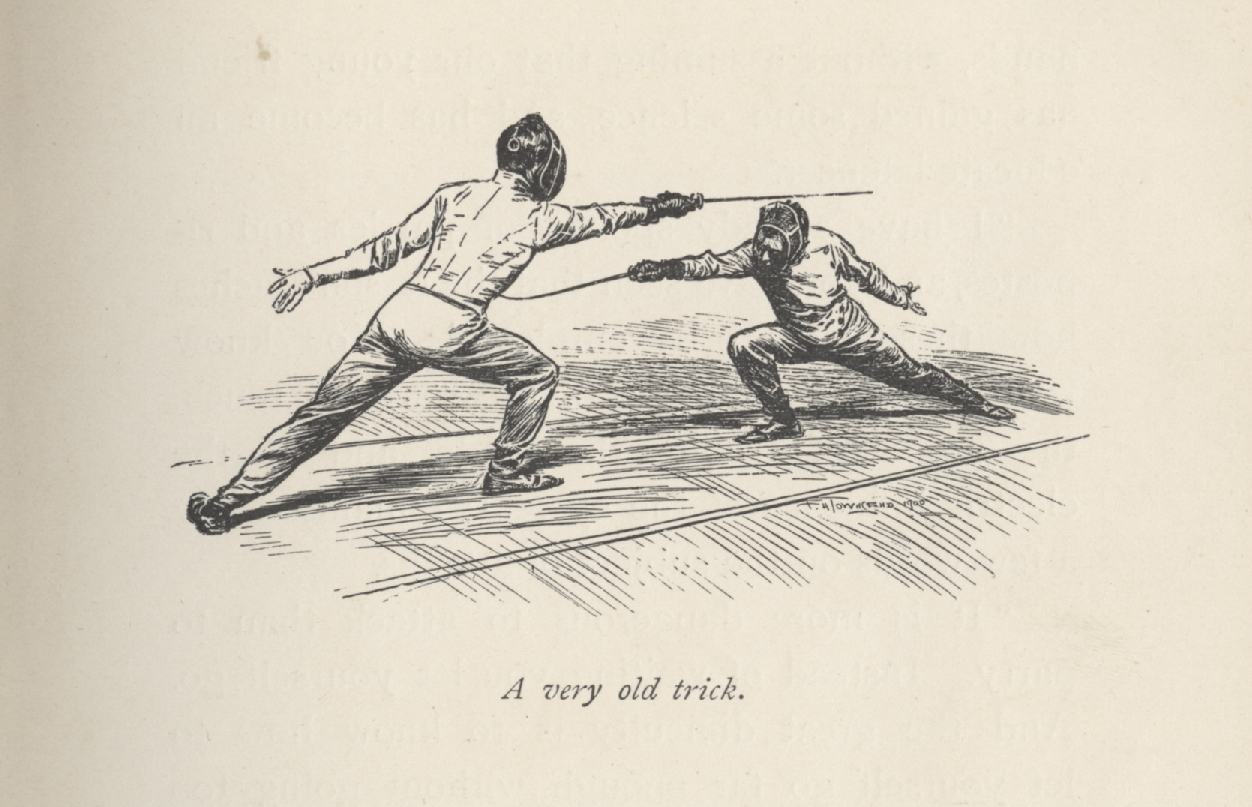
The Passata Soto in Film
The passata soto is seldom shown in film, unfortunately, but here are four associated examples:


The Passato Soto in Modern Fencing
In modern competitive fencing, the technique is still occasionally seen in its classical form, in particular against a flèche, but more often is seen in the modified form of “squatting.” This is not a new technique! It was noted by Jean Joseph-Renaud more than a century ago. He correctly–as expected–notes that the latter form is easier.
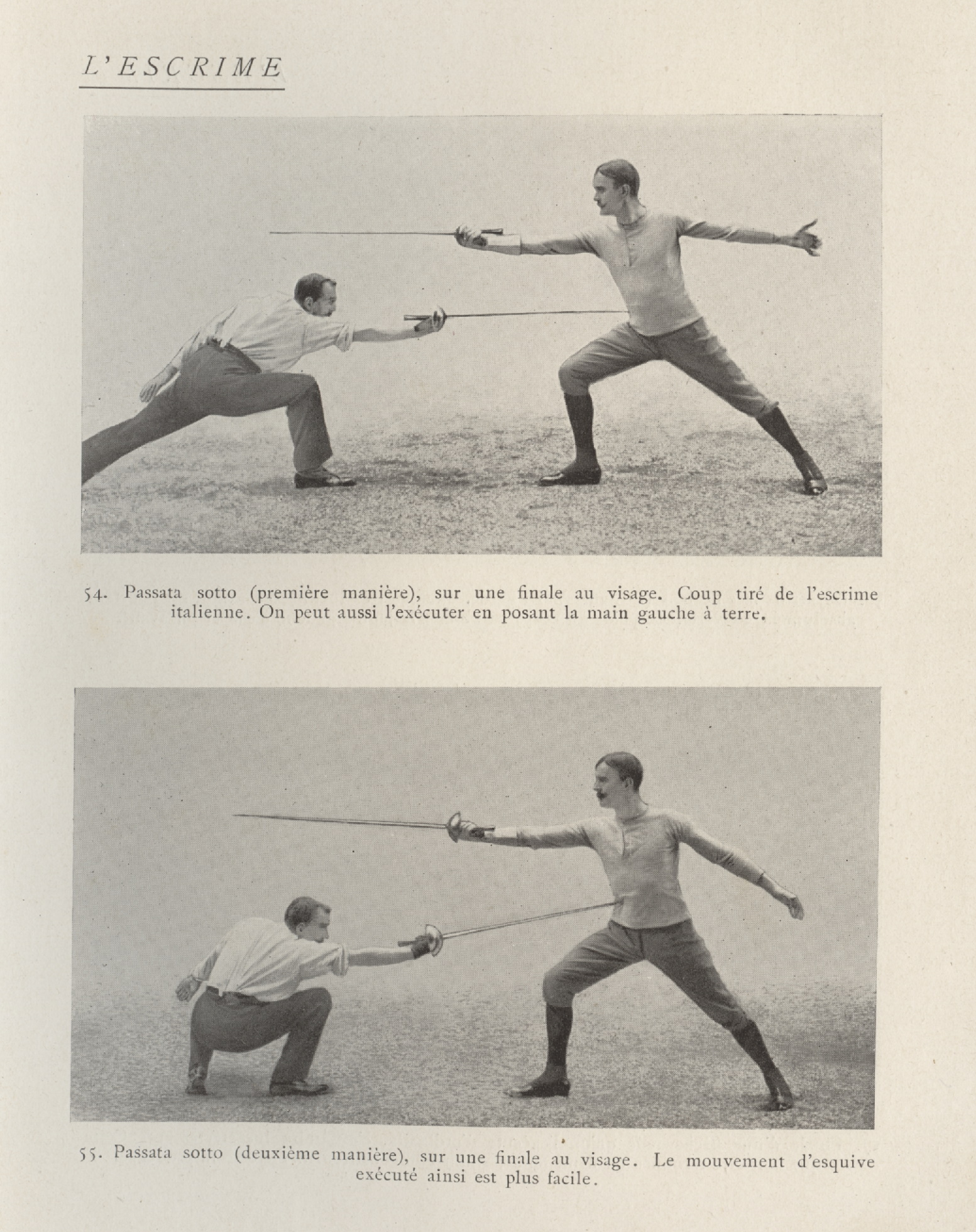

In the spring of 1978 I saw it well-used by a University of Southern California epeeist–I made up the weakest third of the USC epee team, having fenced for less than a year–at a large collegiate meet at the University of California San Diego. The score was la belle (4-4), with no time limit for the final touch as I recall. (It was a nice rule that, of no time limit for the last touch! It’s long since been sadly abolished in the name of expediency…)
Suddenly both fencers stopped and pulled off their masks, but for no reason other than that they had heard the bell on the adjacent strip and, their adrenalin up for the la belle touch, mistook it for theirs. The young director… Hold on for a moment. Today the director, from directeur de combat, the person who “directs” a duel, is called a “referee,” solely because the foolish powers that be thought it would make fencing more spectator friendly… Seriously.
But back to our anecdote. The young college-age director, rather than enforcing the halt and putting the fencers back on guard, said “I didn’t call halt!”
You know what surely happened next. Without putting masks back on, immediately the opposing team’s fencer flèched while ours dropped into a beautiful passata soto. We got the touch and the bout. Neither fencer, thankfully, was hit in the unprotected face. Or at least that’s how I recall it happened.


In modern usage, although infrequently seen, is a form known as the “turning” passata soto. The description is best left to R. A. Lidstone:
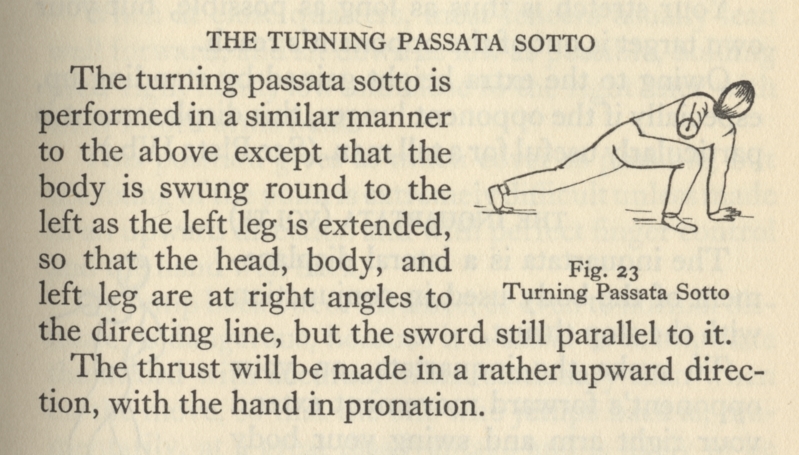
In competitive use, the modern form most often takes the form of ducking or squatting, shown below. Ducking has been used for at least seventy-five years in modern fencing.

Copyright Benerson Little 2017-2023. Last updated October 24, 2023.
Did Pirates Wear Eye Patches?
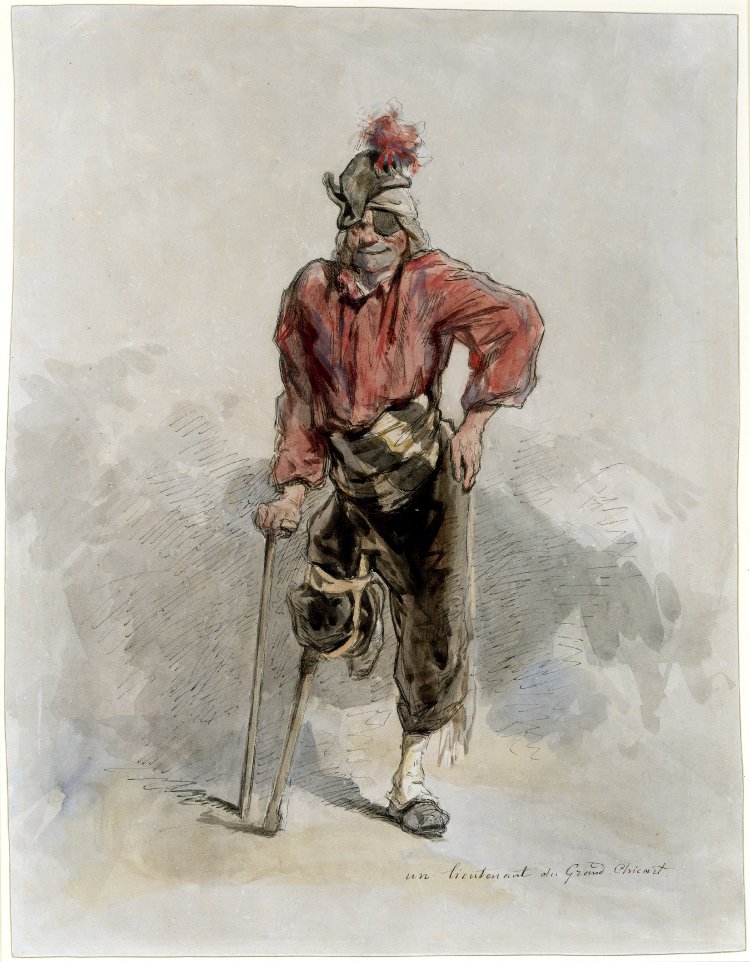
Costume illustration of an eye-patched, peg-legged seaman by Paul Gavarni for the Carnival in Paris. The popular image–trope, if you prefer–of the disabled seaman had been in place for more than a half a century by now, if not longer, in both Britain and France. This image was created between 1838 and 1843. British Museum.
So, “Did pirates wear eye patches?”
The short answer: Only if they had lost eyes to disease or injury, and this was no more prevalent among pirates than among fighting seamen and soldiers. In other words, the eye patch is in no way a sign or symbol of the pirate per se, nor even of the seaman in general.
Still, the question is a good one, if only to give us a reason to dig into related history.
The Mythbusters television show and other speculators have recently added to the myth by working backward from the proposition, that is, “If pirates wore eye patches, why would they have worn them?” rather than looking first at primary sources to see if there is any evidence that pirates wore them at all. There isn’t, other than as noted below.
The associated suggestions that pirates may have worn eye patches to improve night vision or daylight lookout observations or to enable them to fight below decks isn’t supported by any primary source material. In fact, the loss of sight in an eye, even by wearing an eye patch, causes significant loss in both depth perception and visual breadth, making movement aboard a vessel, aloft especially, very dangerous. It would also make visual observation by a lookout much more difficult.
As for fighting below decks, pirates and other seamen didn’t really do much of it: it was much easier to flush crew below decks by tossing grenades and firepots into breaches chopped into decks and bulkheads with boarding axes. In other words, the mere idea that eye patches might have been used to aid in fighting below decks shows a clear lack of understanding of the subject.
In other words: There is no historical evidence at all for any of these purported reasons why a pirate might have worn eye patches! Mythbusters and other popular “documentaries” are entertainment, not serious history. This includes “The History Channel,” now known I think as History.com: it’s “docu-tainment,” not real history. Trust me on this: if you’re being interviewed as an expert for a TV “documentary” and produce too many facts against the episode’s premise, the producers won’t put you on screen!
Again, let me emphasize: if a pirate wore an eye patch it was because he had lost an eye or was disfigured in his eye, and for no other reason!
The origin of the modern myth that pirates wore eye patches is largely literary. However, its roots lay deep in reality, both in the fact that eyes were often lost to disease and battle trauma, and that a one-eyed person often looks fearsome or sinister. The latter sense goes back millennia, and probably farther. Homer’s Cyclops, Polyphemus, is an early instance.
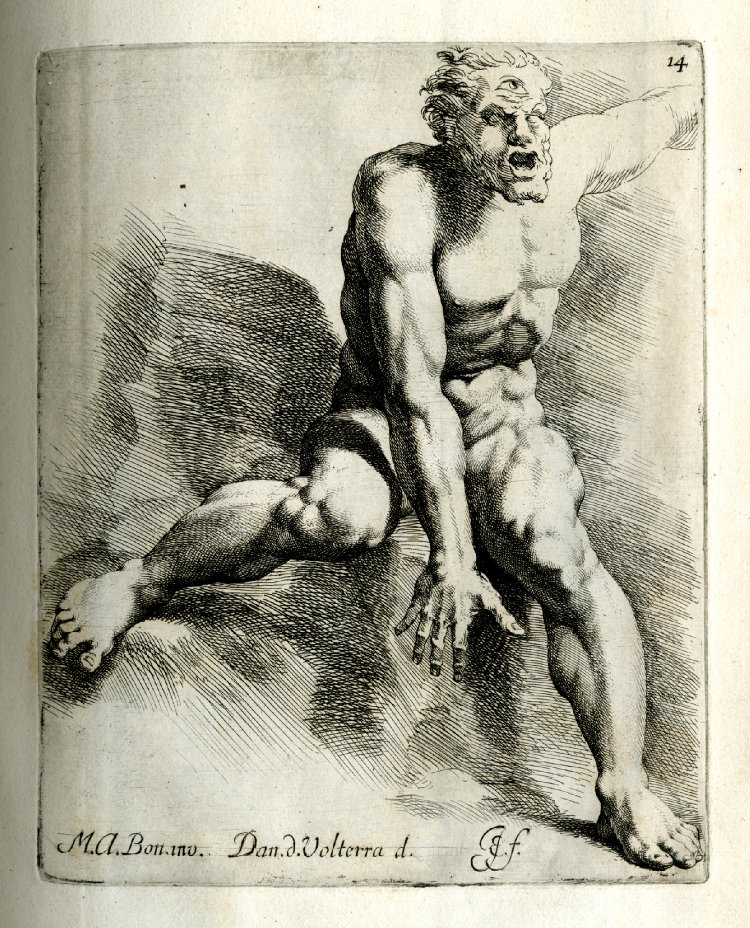
Polyphemus by Jan de Bisschop, after Daniele da Volterra, after Michelangelo, after Pellegrino Tibaldi, 1671. Odysseus, aka Ulysses by the Romans, blinded him. British Museum.
Some versions of Bernal Diaz’s The Discovery and Conquest of Mexico describe the fierce old musketeer Heredia, sent to frighten Native Americans, as a one-eyed, one-legged (or game-legged) soldier. The same work describes how Cortez’s enemy, Narvaez, lost an eye in battle.

A British army pensioner with eye patch and wooden leg. Again, the image was not restricted to naval seamen, much less, and popularly, pirates. By Isaac Robert Cruikshank, late eighteenth or early to mid-nineteenth century. British Museum.
Among seafaring journals and other records of the Golden Age of Piracy, there is only occasional mention of one-eyed seamen, usually in lists of those wounded in battle. Exquemelin’s various editions of The Buccaneers of America famously list compensation for the wounded, including the loss of an eye, and it is here that the primary source of the myth of pirates and eye patches is probably to be found, in combination with other works such as Bernal Diaz’s. The loss of an eye in battle was fairly common, in fact: seafarer Edward Coxere describes the use of oakum and tallow to stuff an eye socket in order to heal the wound, for example. Notably, none of the several eyewitness images of buccaneers or flibustiers from the 1680s show any with any of the usual Hollywood characteristics: wooden legs, eye patches, parrots, hooks, &c. This is to be expected. The large number of images of seamen, usually naval, with eye patches dates to a century later.
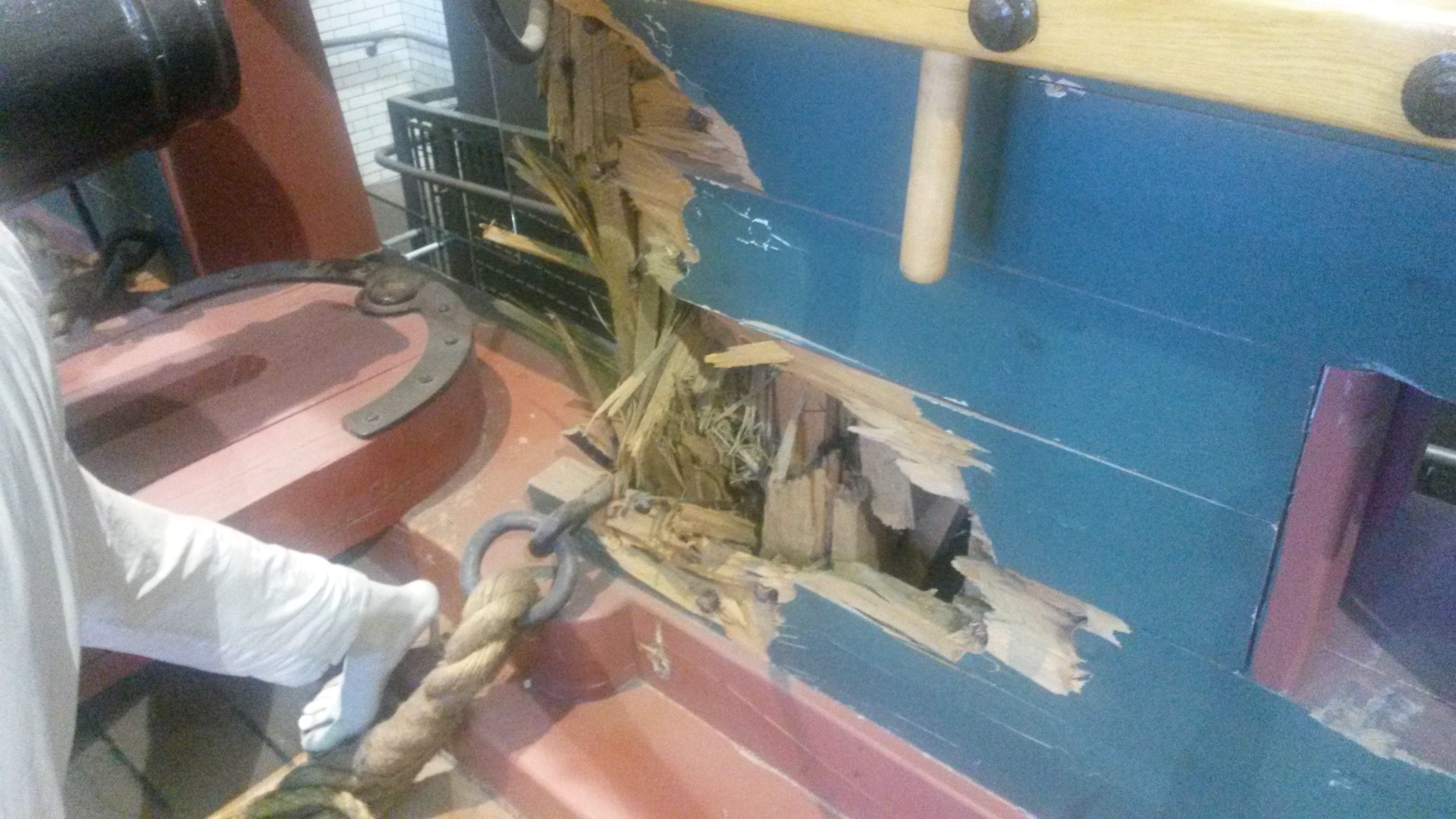
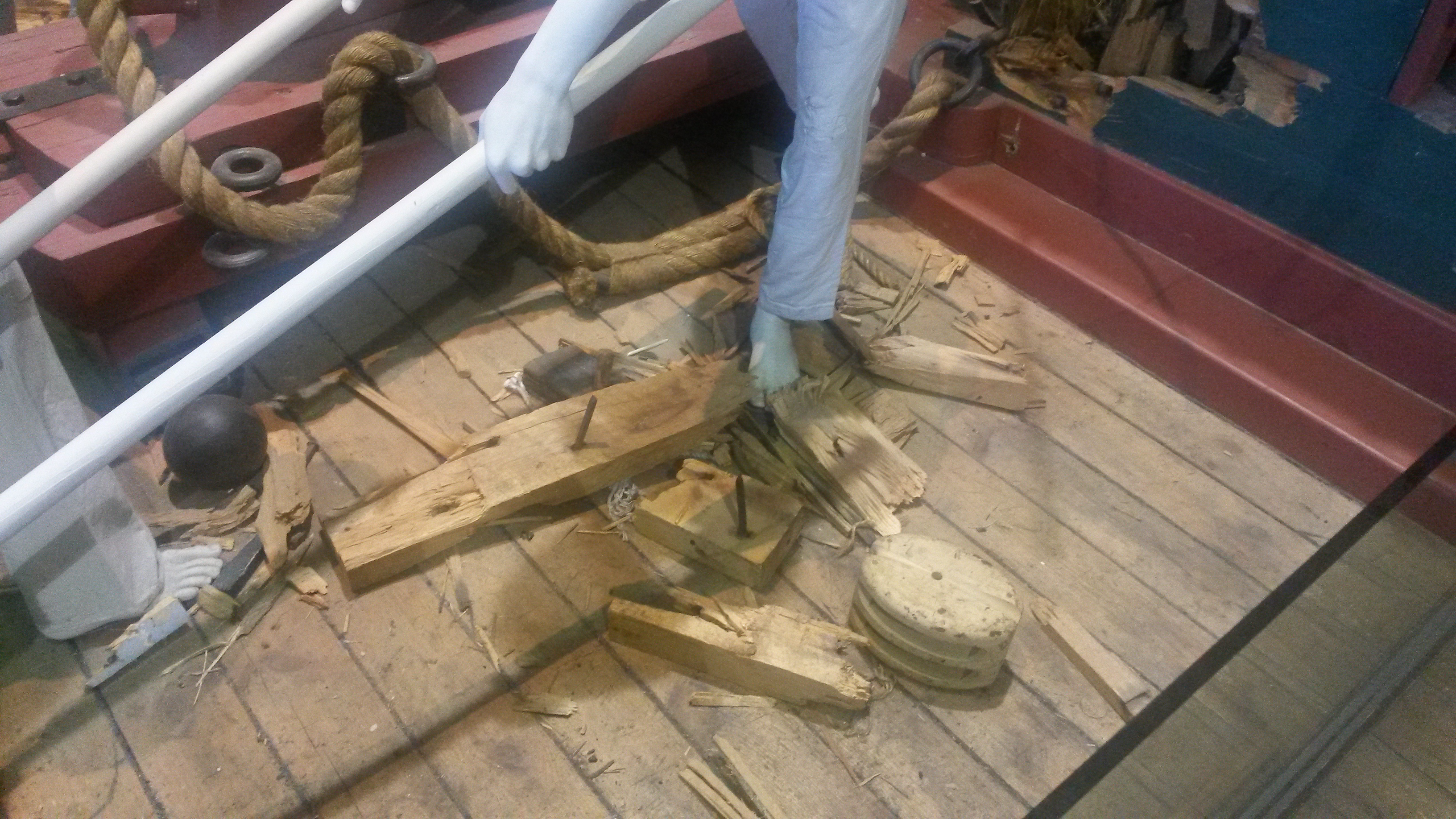
Images of splinters produced by round shot during an accurate test of the damage done in action. Author’s photos taken at the Erie Maritime Museum.
As a friend, “Tweeds Blues,” pointed out recently, it seemingly would not be surprising to find a fair number of one-eyed naval, privateer, and pirate seamen, given the damage done by splinters in action. Here I feel the need to point out yet again that Mythbusters is entertainment: one episode even suggested that splinters didn’t cause much damage in a naval action. In fact they did: there are hundreds, if not thousands, of accounts of the damage done, not to mention at least one accurate test that proves the horrible extent of damage splinters can do. The Mythbusters test parameters were simply incorrect, not to mention that overwhelming historical evidence was largely ignored, as were previous–and more accurate, historically correct–tests. The images above show splinters resulting from round shot striking a correctly-built hull section. The test was conducted by the Maritime Museum in Erie, Pennsylvania, home of the Flagship Niagara.

Admiral Don Blas de Lezo y Olavarrieta. Blas de Lezo is best-known for successfully defending Cartagena de Indias against British attack in 1741. Injuries received during his naval career included the loss of an eye, his left hand, his left leg below the knee, and the laming of his right arm. Museo Naval, Madrid.
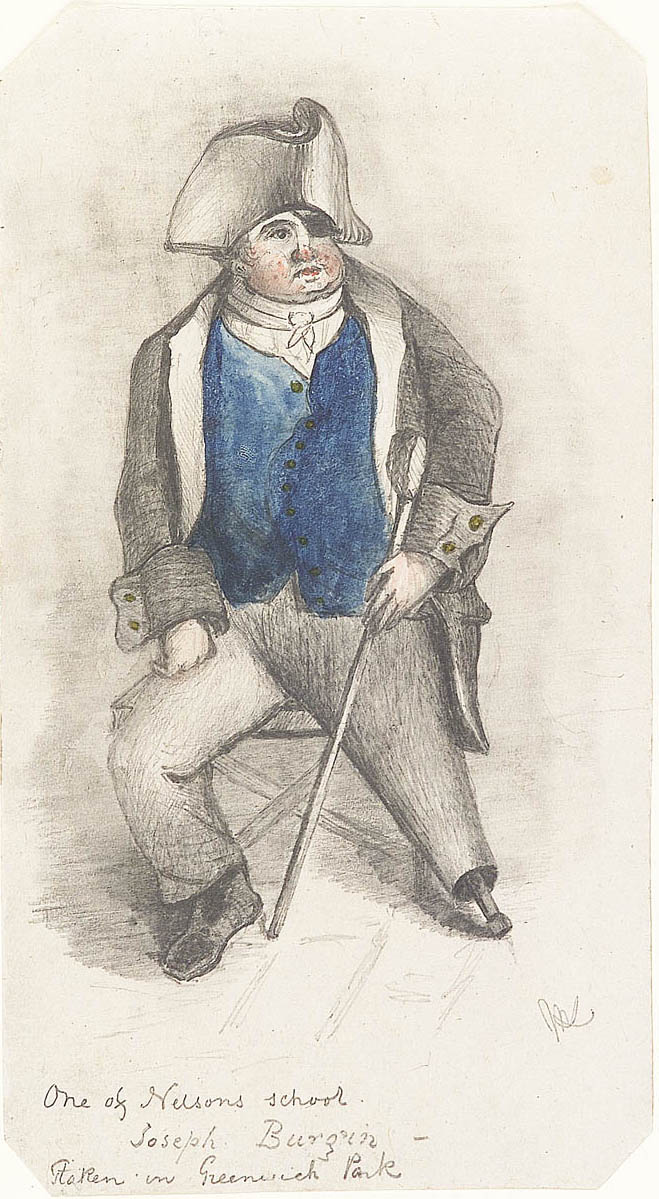
Joseph Burgin, a Greenwich pensioner, who lost and eye and a leg in action in the Royal Navy in the early eighteenth century. National Maritime Museum, Greenwich.
Of course, the most famous example of a naval mariner with an eye patch is arguably, at least in the UK and probably the US, that of Lord Admiral Horatio Nelson, who lost the sight in one eye during the capture of Calvi on Corsica in 1793–except that did not actually wear an eye patch. This has not stopped the popular assumption that he did from becoming prevalent, and, although out of our period, this has still influenced the idea of the one-eyed mariner, and therefore one-eyed pirate. Admiral Nelson also lost an arm. Some would argue, at least in the Hispanic world, that Bras de Lezo (second image above) is the most famous eye-patched admiral.
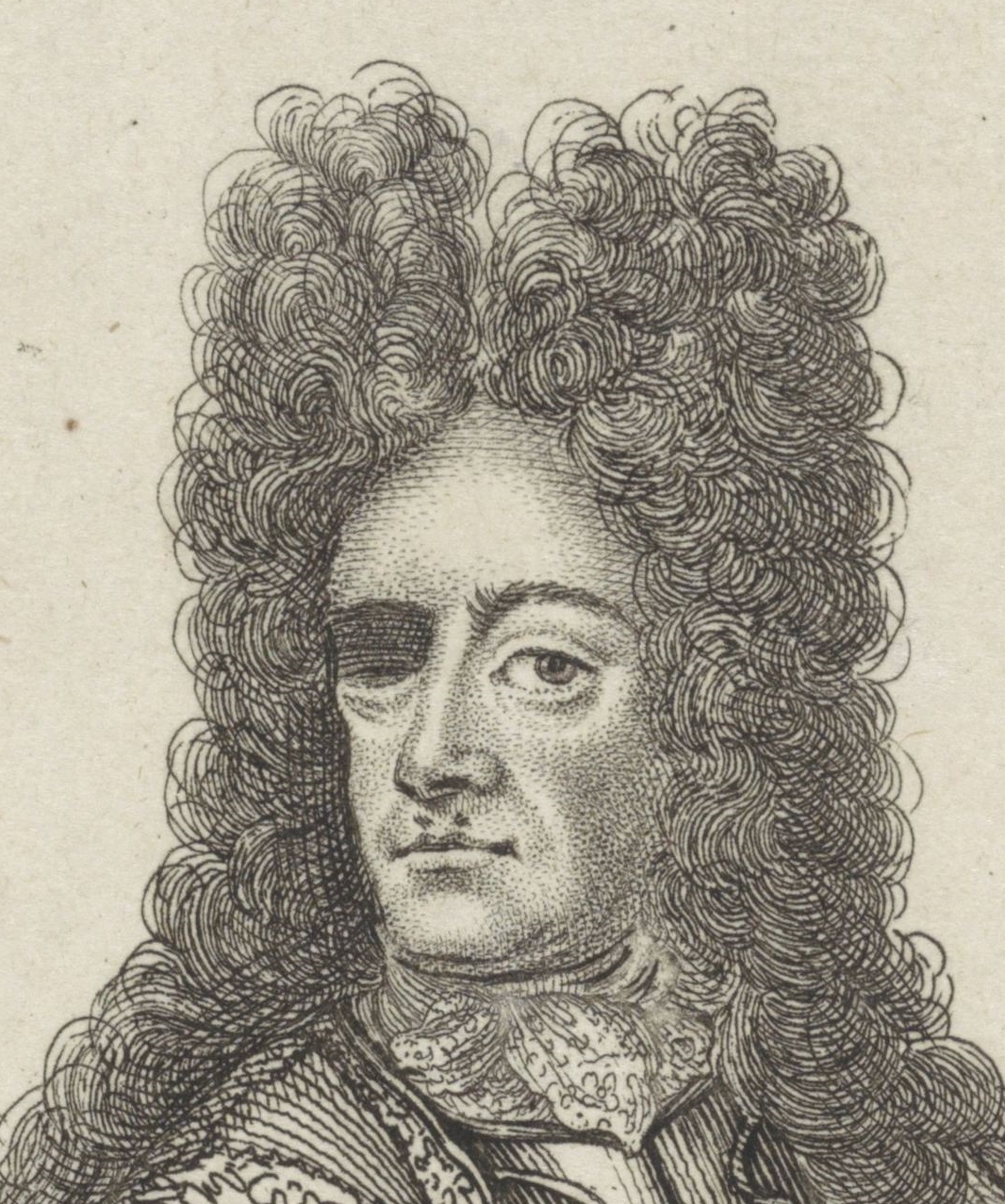
“Portret van Johann Karl von Thüngen,” the German field marshal. Period images of him show this eye patch worn without a thong, string, or other tie. Anonymous, 1675 – 1711. Rijksmuseum.
The fact is, patches were commonly used to cover any facial disfigurement. In the seventeenth century diarist and navy secretary Samuel Pepys wore a black patch, or possibly a large beauty patch, to cover a large cold sore. Similarly, King William III advised a soldier to remove the black patch covering the scar on his face because “It’s more honourable in a Soldier to wear a Scar than a Patch.” (For the latter reference, see Coke in the sources listed below.)

Scottish soldier Sir William Brog, 1635, with a patch covering a scar on his nose. (And an earring too.) Pring by Crispijn van Queborn. British Museum.
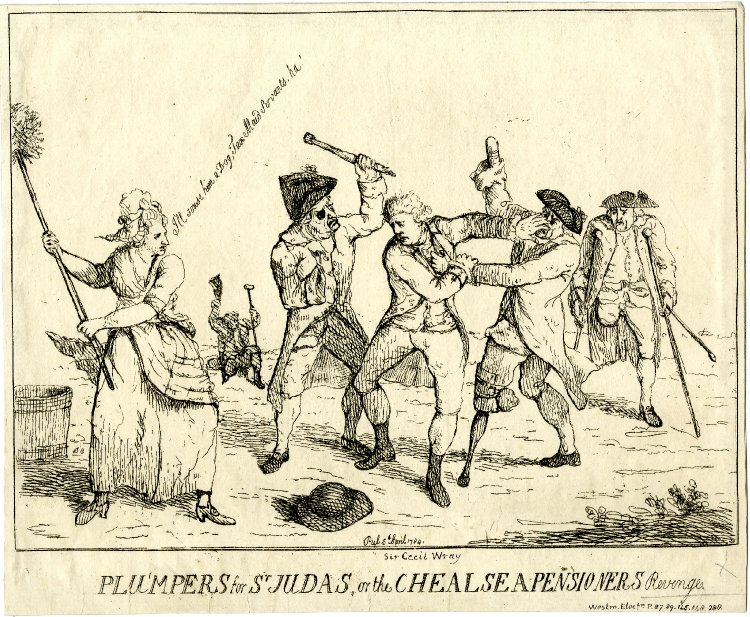
Eye patches, stumps aloft and ‘alow, not to mention peg legs. “Plumpers for Sr Judas, or the Chealsea Pensioners Revenge,” a satirical print, 1784. British Museum.
By the late eighteenth century the image of the eye-patched, peg-legged seaman was iconic, probably the result of the increased number of British naval actions brought on by the American Revolution and, especially, the Napoleonic Wars. Notably, in reality most such disabled seamen were pensioned from service, as shown above. These satirical images are probably the material origin of the popular identification of the naval seaman, and therefore the pirate, with eye patches.
Even with its legitimate historical roots in fact, this pirate myth, like many, didn’t come fully into being until the mid-nineteenth century, a hundred or more years after the Golden Age of Piracy. Sir Walter Scott in The Fortunes of Nigel describes “The noble Captain Colepepper, or Peppercull, for he was known by both these names, and some others besides, had a martial and a swashing exterior, which, on the present occasion, was rendered yet more peculiar, by a patch covering his left eye and a part of the cheek. The sleeves of his thickset velvet jerkin were polished and shone with grease, — his buff gloves had huge tops, which reached almost to the elbow; his sword-belt of the same materials extended its breadth from his haunchbone to his small ribs, and supported on the one side his large black-hilted back-sword, on the other a dagger of like proportions.” Here is the epitome of the swashbuckler, easily translated to the pirate.
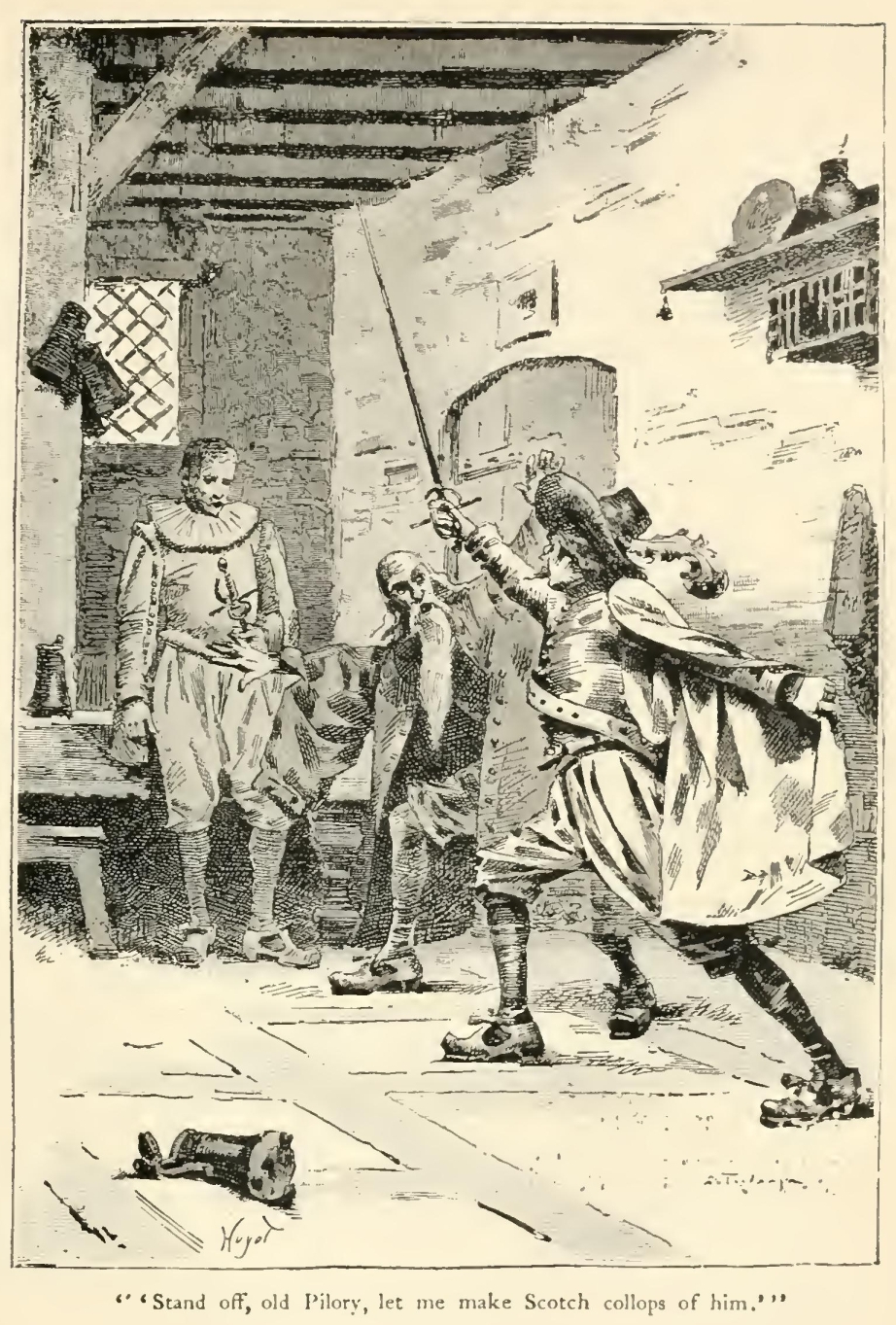
The bold and swaggering Captain Colepepper, from The Fortunes of Nigel by Sir Walter Scott. Nineteenth century, unknown edition.
Not long after, Charles Dickens described a pirate with “the one eye and the patch across the nose” and soon afterward similarly did many writers of popular fiction. However, many of our principle originators or propagators of pirate myths—Robert Louis Stevenson, J. M. Barrie, N. C. Wyeth, for example—do not appear to have bothered with this myth, although Barrie’s Captain Hook probably did encourage other images of pirates missing a vital part such as a limb or eye, and Howard Pyle in The Ruby of Kishmoor equips a pirate, one of the four in the short tale, with an eye patch.
In 1926 Douglas Fairbanks propagated nineteenth century pirate myths, as well as a few he helped create, across the world with his film The Black Pirate. In it he established the modern pirate swashbuckler stereotype, based much on Howard Pyle’s Book of Pirates, Peter Pan, and probably Captain Blood (one of whose characters, by the way, was one-eyed, although he lost the eye at Sedgemoor, not at sea). Around the same time, we begin to see pirate book cover art and other illustrations showing pirates with eye patches. But it would take later films, such as The Black Swan and The Crimson Pirate to make the eye patch an obvious, routine part of the stereotypical pirate costume.

Publicity still from The Black Swan, 1942. An eye-patched Anthony Quinn is on the right.
Sources
Roger Coke. A Detection of the Court and State of England. 4th ed. London: J. Brotherton and W. Meadows, 1719. Vol. 2:472.
Bernal Díaz del Castillo. Historia Verdadera de la Conquista de la Nueva España. Reprint, Madrid: Don Benito Cano, 1795. See vol. 1:213.
Edward Coxere. Adventures by Sea of Edward Coxere. Edited by E. H. W. Meyerstein. London: Oxford University, 1946.
Charles Dickens. “The Perils of Certain English Prisoners.” 1857. Reprinted in Charles Dickens’s Stories from the Christmas Numbers. New York: MacMillan, 1896. Page 144.
Alexandre Exquemelin [John Esquemeling]. The Buccaneers of America. London: Crooke, 1684. Reprint, New York: Dorset Press, 1987. Page 60.
Benerson Little. The Golden Age of Piracy: The Truth Behind Pirate Myths. New York: Skyhorse Publishing, 2016. Prologue.
——. “El Mito Pirata” in Desperta Ferro 17 (August 2015), 52-55.
Heidi Mitchell. “Does Reading in Dim Light Hurt Your Eyes?” Wall Street Journal online, April 8, 2013, http://www.wsj.com.
Mythbusters, Episode 71.
Samuel Pepys. Diary. September 26, 1664.
Walter Scott. The Fortunes of Nigel. Boston: Samuel H. Parker, 1822. Page 255.
The Telegraph. “Nelson didn’t wear eye-patch, says historian.” January 19, 2005.
Copyright Benerson Little, 2017. Last updated August 14, 2025.
Pirates & Earrings
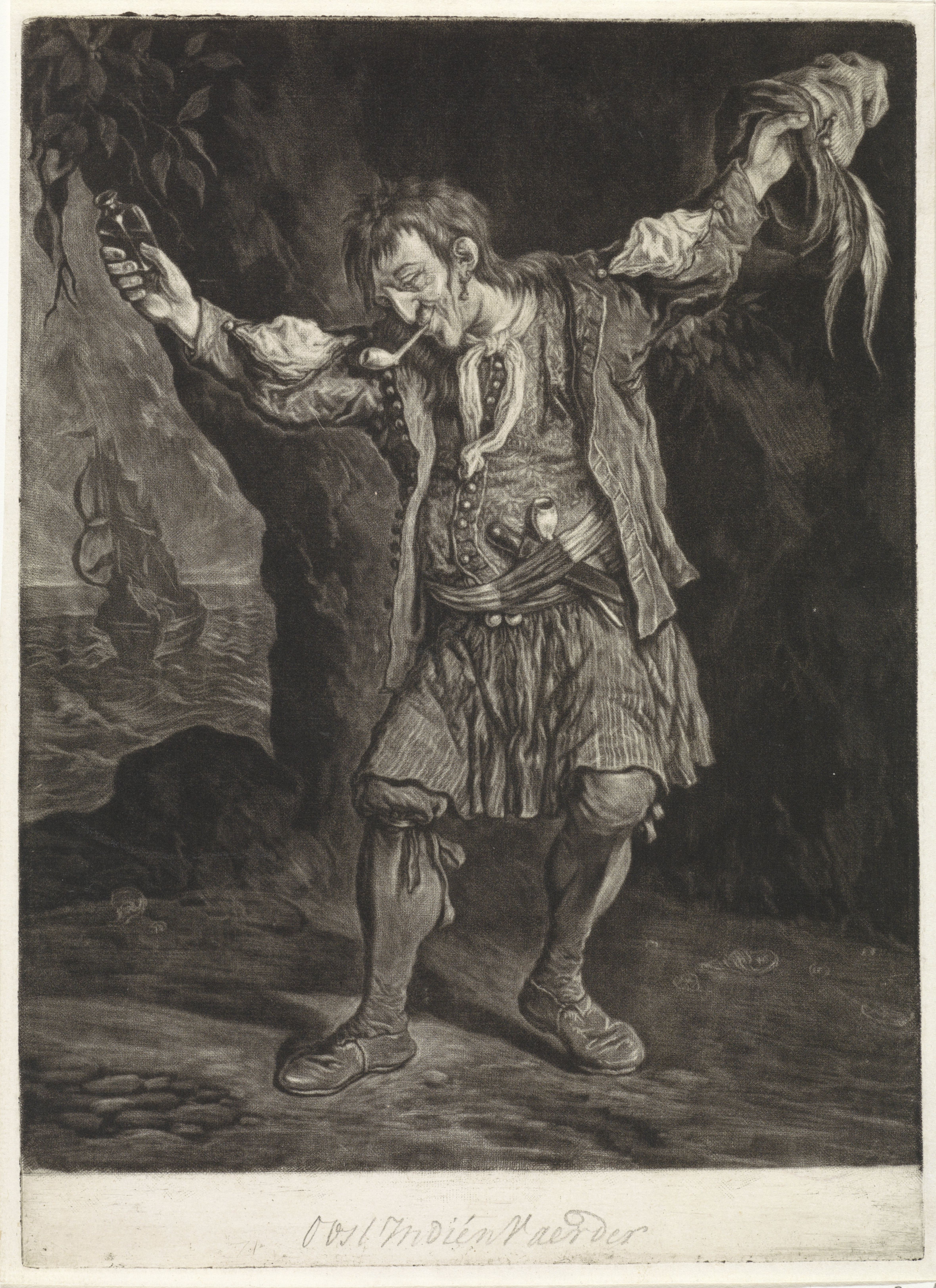
A Dutch seaman in Amsterdam dancing in celebration of the recapture of the city of Namur in September 1695. By Cornelis Dufart, 1695. Rijksmuseum.
Quite often today, reenactors, students of authentic pirate portrayals of the late seventeenth and early eighteenth centuries, aka the “Golden Age of Piracy,” and the makers of any television documentary or drama, or any film, about pirates who wants to be taken seriously will generally drop the pirate earrings and other pirate caricature, or at least minimize them. However, this practice, while avoiding “Hollywood” cliché, has one problem:
There were “Golden Age” seafarers who wore earrings.
The same goes for pirates of the “Golden Age” from circa 1655 to 1730.
As is the case with much of our perception of what is and is not correct and authentic about “pirates,” the myth or reality really applies much more broadly, to seafarers in general, and from there to the question of whether the myth or reality applies across the board to seafarers or only to a specific subset. For example, I was asked during a Reddit AMA a while back about the “crossing the line” ceremony originating from pirates. It doesn’t actually originate with sea thieves, but from mariners in general, unless all mariners were sea thieves. (Of course, some might argue that at least through the Middle Ages all seafarers were potential pirates…) Sea rovers may have practiced the various “crossing the line” ceremonies, just as seamen in general did, but it was foremost a maritime practice, not one specific to piracy. And I say various practices because there were different cultural practices, and different “lines” to cross as well.
So, put simply, were earrings a conventional part of pirate dress, or of maritime dress, in general during the period 1655 to 1730?
I’m going to keep the answer just as simple, for this is not the place to address the variety of seafarers, sea thieves, and their national and local customs and dress.
And the simple answer to both is…no.
Even so, many answers are really not so simple as they seem, and so it is with this one. There are three exceptions to the earring rule, and they apply not only to pirates and privateers, but to mariners in general.
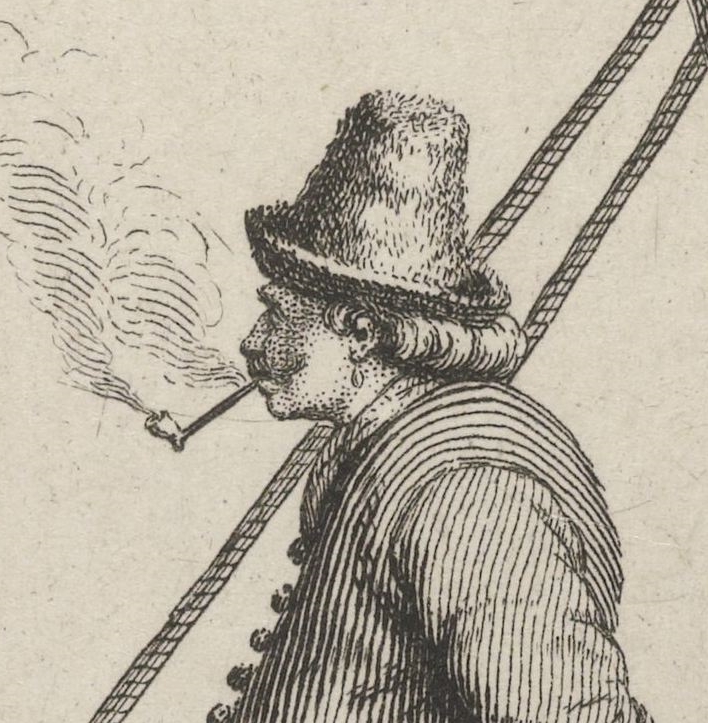
“Matelot de Brabant / Brabantsche Schipper” by Bernard Picart, circa 1690 to circa 1733. Note the single pearl in the earring, apparently common among Dutch seamen. Rijksmuseum.
First is the Dutch exception. Earrings were common in the mid to late seventeenth century and into the eighteenth on many Dutch seafarers, as is clear by the several images I’ve posted here. The seaman in the image above wears an earring in the left ear, and the seamen in the Dufart images below mirror each other, one in the left, the other in the right. From the images it’s impossible to tell if the Dutchmen are wearing an earring on the other ear as well.
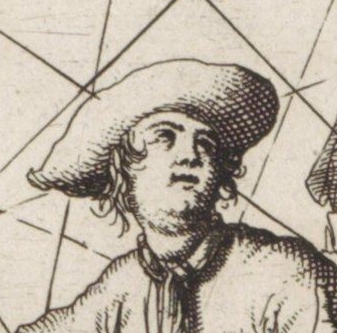
An earring or a wisp of hair? Dutch or possibly Norwegian seaman, late seventeenth century. Pas-keart van de Cust van Noorwegan by Joannes van Keulen.
So, if you want to be a sea rover and wear an earring and be historically accurate, be a Dutch pirate or privateer. That said, many serious pirate and privateer reenactors are opposed even to this out of concern that it gives the wrong impression: either in general, or because most of the early eighteenth century pirates were “Anglo-American,” or because there are only a “few” Dutch images of seafarers with earrings (although a “few” images would well suffice to support “facts” such reenactors are in favor of). For me, fact–truth–should outweigh this. First, given the large number of buccaneers or flibustiers of Dutch origin in the late seventeenth century, it would not be surprising to find earrings on some buccaneers. Second, not all of the early eighteenth century “Anglo-American” pirates were in fact British or Irish derived, and separate from them were French and Spanish pirates whose crews doubtless included some Dutch members.
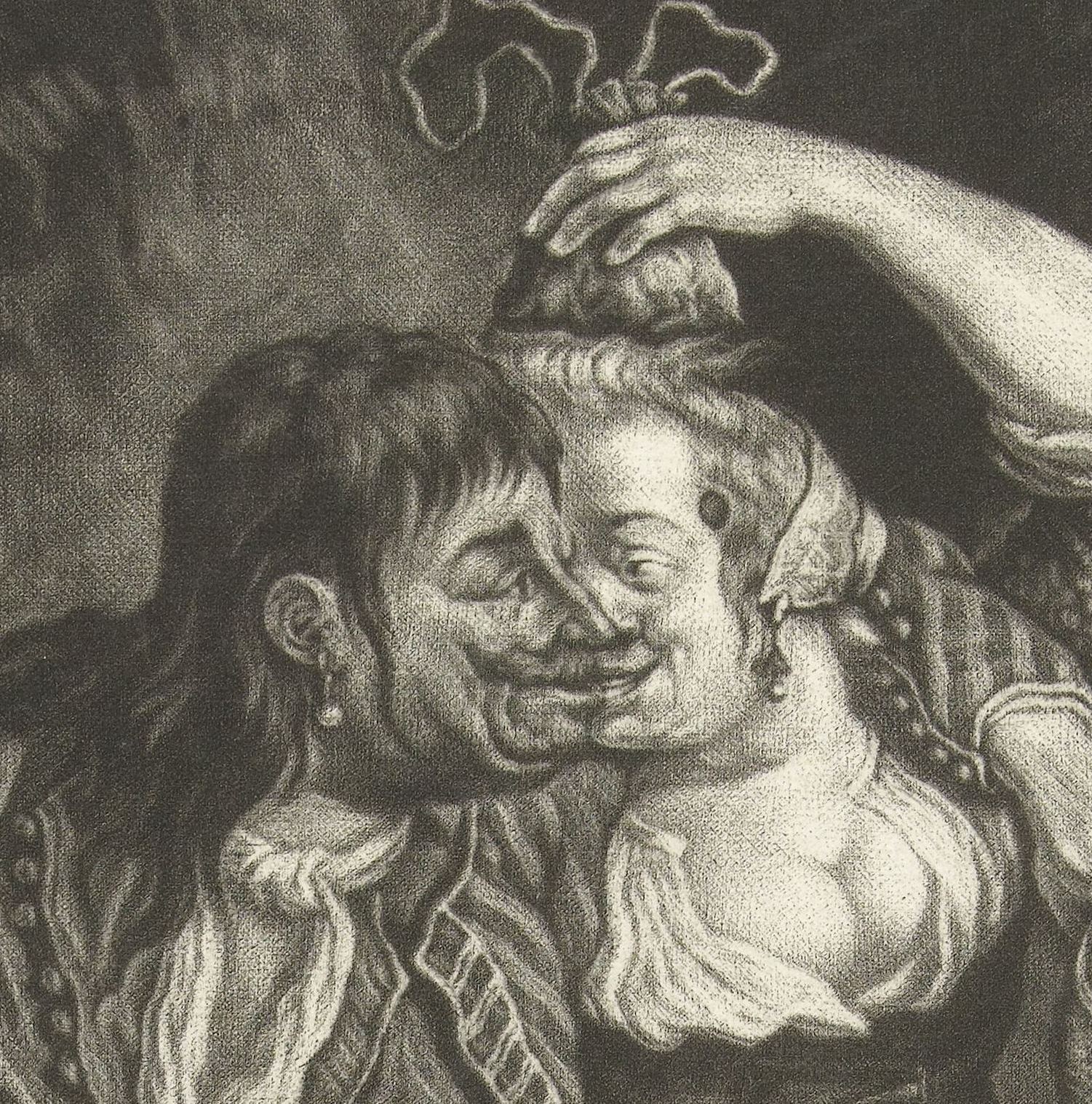
Detail of a Dutch seaman in Amsterdam dancing with a woman in celebration of the recapture of the city of Namur in September 1695. By Cornelis Dufart, 1695. Rijksmuseum.
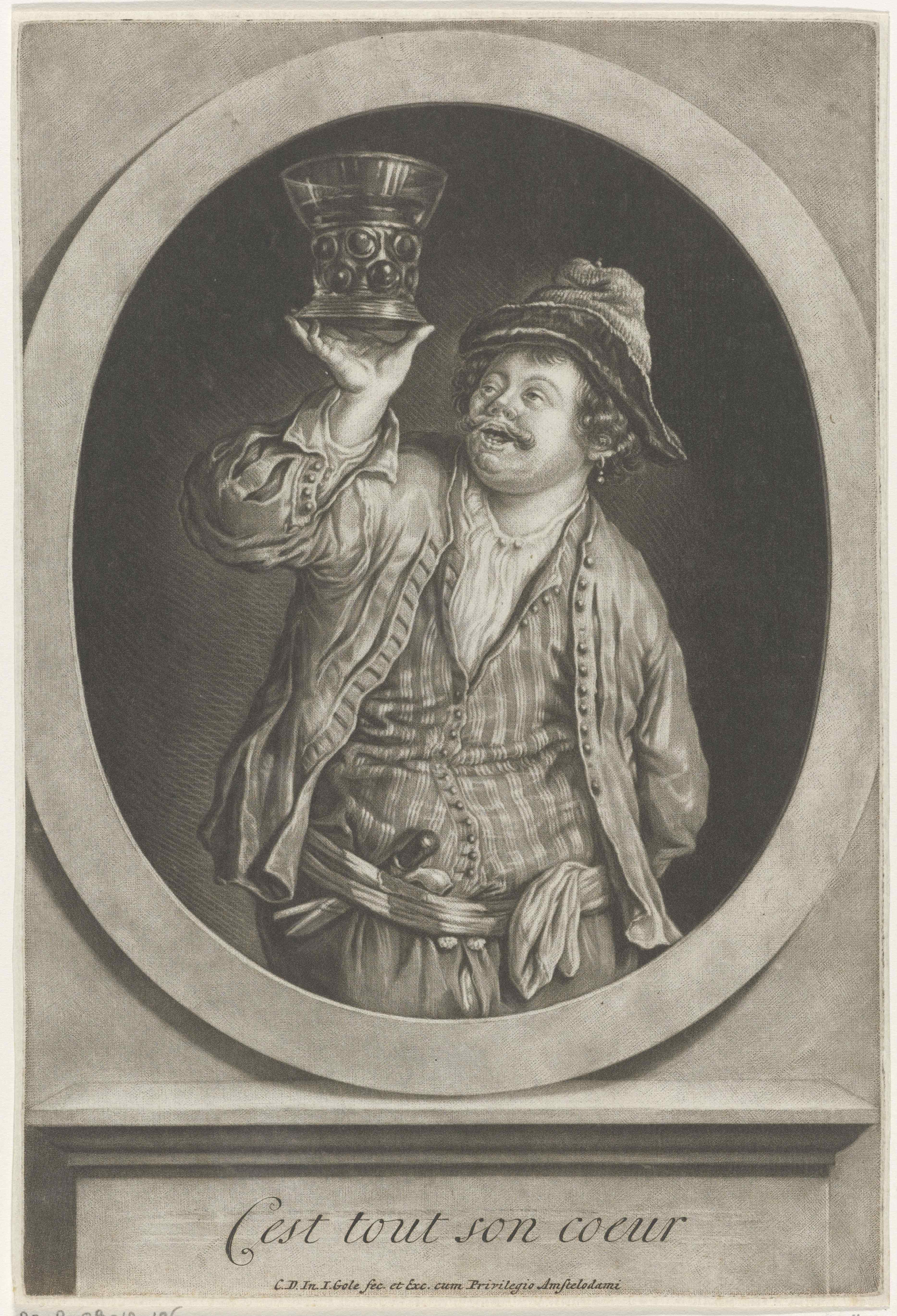
Dutch seaman with a rummer (Dutch roemer, a large drinking glass). Note the obvious earring. Jacob Gole, after Cornelis Dusart, after a fairly similar illustration lacking knife, pipe, and earring by Abraham Bloteling, 1670 – 1724. Using other artist’s and engraver’s illustrations as templates was common. Rijksmuseum.
Second is the fop exception. Through much of the seventeenth century, including the last quarter, and into the eighteenth century some French fops, and some English onesas well for they generally followed French fashion, were in the habit of wearing an earring, perhaps even one in each ear. The common assumption is that men’s earrings in England and Scotland went out of fashion after the death of Charles I, but this is not entirely the case. They became less popular, and were restricted largely to the foppish gentleman and would-be gentleman–a more restricted group of “gallants” than in the first half of the century.
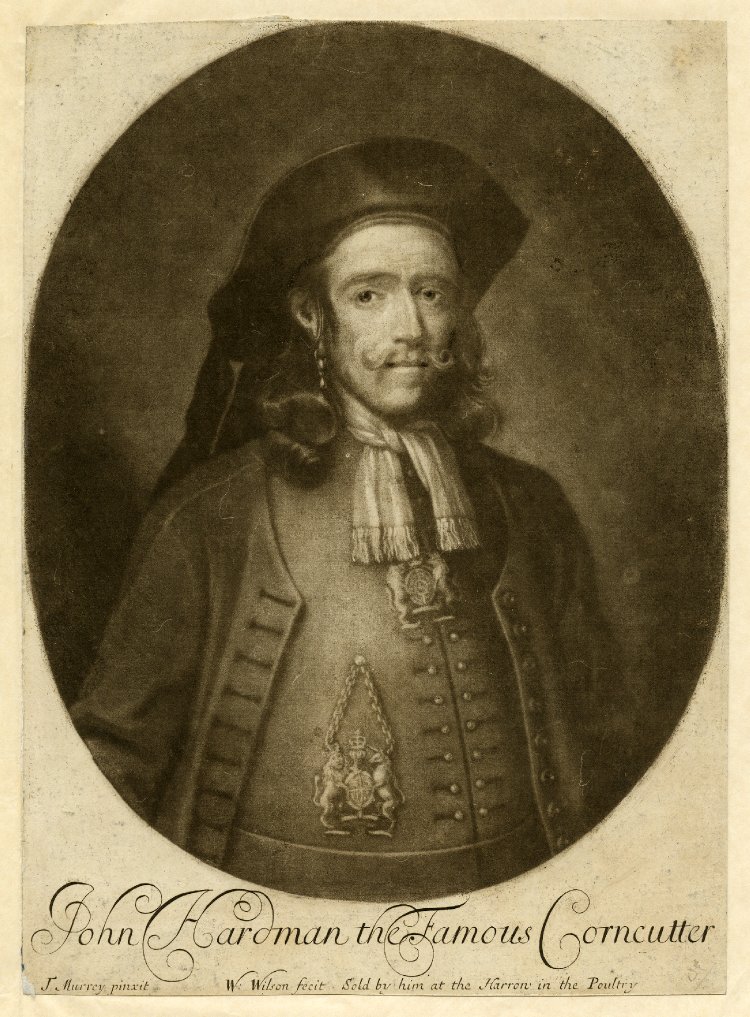
“John Hardman the Famous Corncutter.” Hardman was a specialist in corns and bunions, and it is speculated, given the royal device hanging from his waistcoat, that he may have worked on King William III’s feet. Little is known about Hardman, and at least one early nineteenth century writer suggests he was Dutch given the English royal arms he is wearing (the author notes the large number of Dutchmen in London during the reign of William III), but possibly due in part as well to his mustache and earrings, and quite possibly because the author did not want to recognize an Englishman as a possible mountebank. Even so, it remains possible that Hardman was merely a flamboyant Englishman. Although the name’s roots are Germanic, it was and is a fairly common English surname. Note the long earring. British Museum.
References to earrings on men in the second half of the seventeenth century include a letter written by George Fox (of the Society of Friends, or Quakers) in 1654, but not published, I don’t believe, prior to the 1690s: “a company of them playing at bowls, or at tables, or at shuffle-board; or each taking his horse, that hath bunches of ribbons on his head, as the rider hath on his own (who, perhaps, hath a ring in his ear too)…” This isn’t too long after the execution of Charles I, when we might still see earrings (and which many secondary texts say is about the last time Englishmen wore earrings), and is at the beginning of the Golden Age of Piracy, assuming a start date of 1655 with the capture of Jamaica.

Henri de Lorraine, Count of Harcourt (1601-1666), known as “le Cadet la Perle” due to his bravery in battle. Earrings were quite common on military men in England, Scotland, and France in the first half of the seventeenth century, and on artists and others as well: a 1650 self-portrait of Rembrandt shows him wearing a pearl earring and a self-portrait of Ferdinand Bol shows him wearing a small gold hoop. Print by Nicolas de Larmessin, 1663. British Museum.

Goldsmith Louis Roupert, 1668. Print by Louis Cossin based on a painting by Pierre Rabon. Rijksmuseum.
Similarly, note the illustration below. Published in 1653 as part of an appendix satirizing the English gallant and his ostentatious dress and body ornamentation, it does prove that even at this date some English gallants still wore not only one, but two earrings at times. The author, Dr. John Bulwer, compares earring-wearing and other ostentation to that of foreign savages and heathens, or even to pre-Christian Britons, and appears to approve only of plain sober dress, as one might expect during the Age of Cromwell–up with the cropped Roundheads, down with the long-haired Royalists! “Children of vanity” is Bulwer’s disparaging, if also accurate on occasion, term for those who excessively ornament themselves. He also mocks gallants for wearing patches, starched collars (yellowed in fact with starch), flowing locks, mustaches, and so on. He is no less sparing of women. Curiously, Dr. Bulwer’s portrait shows him with flowing locks, a mustache, and goatee.
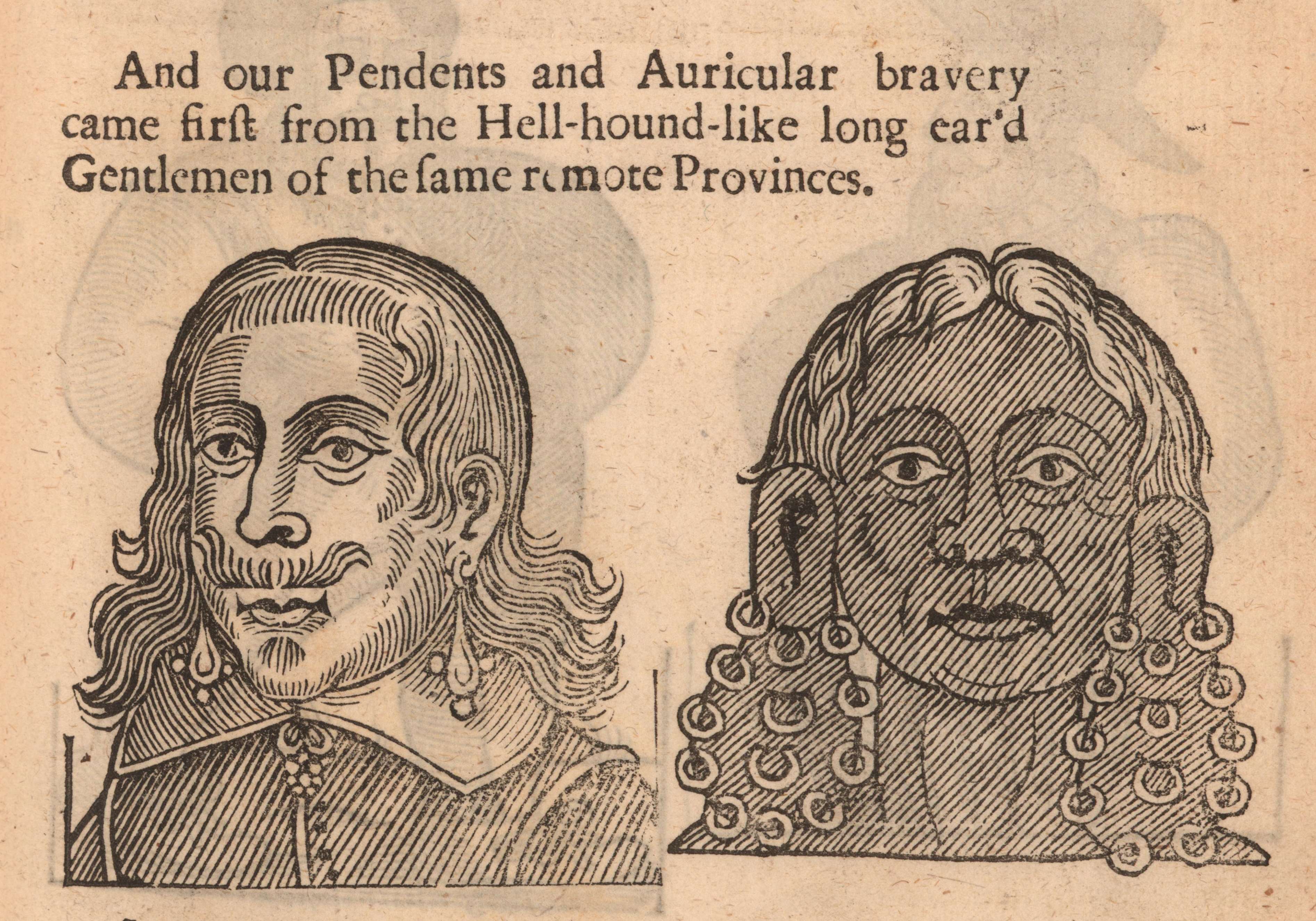
Illustration from “An Appendix of the Pedigree of the English Gallant” in Anthropometamorphosis: Man Transform’d: Or, the Artificiall Changling by John Bulwer. London: William Hunt, 1653. Dr. Bulwer’s work Anthropometamorphosis, in which he details the great variety of body ornamentation worldwide, is extraordinarily detailed for the era, sophisticated even by modern standards, even if more than a little bit patronizing. Dr. Bulwer is perhaps best known for proposing a system of sign language for the deaf.
Moving on to William Wycherly and The Plain-Dealer (one of my favorite plays), with a reference to the jewel in the ear and gunpowder spot on the hand, circa 1673, in the middle of the age of buccaneers. Originally I had considered the possibility that this might refer to the sea captain and not the fop, but other instances (George Fox above, for example), plus a re-reading, plus the opinion of a professor emeritus of seventeenth century English literature, have persuaded me that fops wore earrings more often than we think (the professor thought so, by the way)—enough to be an obvious reference for the audience. We’ll deal with gunpowder spots in another blog soon.
Head now to The Works of Mr. Thomas Brown: Amusements Serious and Comical, a comical and satirical group of works published in 1700, and we have the following: “I had honestly, deserved a better Reward than a Patch-box, a Toothpicker, and a small Ear-ring amounted to, and therefore need not disquiet my self upon that Score.. Thus you fee, Madam…” The gentleman has received several useful implements (but not what he was seeking) from his inamorata: an ear picker to clean his ears, a patch box for patches (fops wore them), and a single earring. The last might be simply a love token, but to what end if it can’t be displayed–worn, that is?
That French fops wore them is uncontested. By way of a nautical example, in 1704 the comte de Forbin, a famous, and arguably quite pompous at times, commerce-raiding French naval captain refused passage to a French monk who had been authorized travel from Livorno, Italy to France aboard the French warship by Cardinal de Janson. The monk wore a single gold earring with a large pearl, and Forbin specifically notes his foppish airs, that is, that he acted like a “petit-maître“–a fop or dandy. There were at the time a fair number of priests and monks as addicted to trappings of the flesh as to world beyond, if not more. In any case, it didn’t help that the monk was “haughty and arrogant.” In fact, it was probably this behavior that set Forbin off. But the captain’s reply to the monk was that the cardinal’s order said nothing about giving passage to a monk wearing an earring and giving the airs of a fop–so get off my ship.
In sum, if you want to be a sea rover with an earring but don’t want to be Dutch you might considering being a bit of a fop. This isn’t so very far-fetched, for their are examples of pirates wearing jewelry in a fashion that might be considered foppish. Quoting from The Golden Age of Piracy: The Truth Behind Pirate Myths, an overly fashionable pirate “might wear a ‘necklace of pearls of extraordinary size and inestimable price, with rubies of surpassing beauty’ as Captain Nicolas Van Horn did, or a gold chain with a ‘gold toothpicker hanging at it’ as Captain John James did (and many of his crew also wore gold chains), or a ‘gold chain round his neck, with a diamond cross hanging to it’ as Captain Bartholomew Roberts reportedly did.” (Citations to the quotations above can be found in the endnotes to The Golden Age of Piracy. The quotation is from the prologue.)
Even so, I do tend to agree a bit more with reenactors who object to this exception out of concern for the wrong impression. That said, I still would not be surprised to find a foppish pirate wearing an earring. Devotees of the early eighteenth century Anglo-American pirates will argue quite factually that most were seamen. This doesn’t alter the fact that there may have some foppish seamen–I’ve known some modern ones who’d fit this description, although they’re in the minority–and there were a few non-seamen as well who might fit the fop bill, including the dilettante pirate Stede Bonnet. In my experience, both in studying seamen of the past as well as having known and worked with many modern seamen–naval, commercial, tall ship–during my life, mariners as a group are not homogeneous even though they may express attributes common to their profession. In other words, they too have personalities and often express them through their clothing, hair, and other body ornamentation.
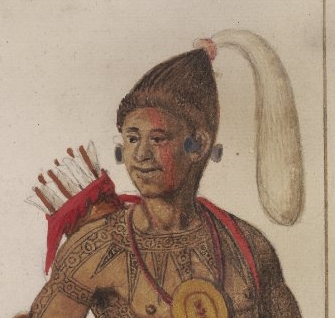
Detail from a late sixteenth century watercolor of a Timucuan casique of Florida, by John White. Note the large “earring” or ear piercing. Such ornamentation was common among Native Americans. British Museum.
The third exception is that of Native Americans, Africans, and mixed races. This should be an obvious exception, but the fact that it is so often overlooked strongly suggests an ethnocentric–that is, a “white-centric” or “Euro-centric”–bias in the view of piracy and of the maritime in general. A fair number of English, French, and Dutch pirates and privateers, although not the majority, were non-white. The majority of Spanish pirates and privateers originating in the Caribbean were non-white. Many of these seafarers of color, particularly those of full African and Native American blood, probably wore earrings in one form or another.

Painting by Mexican artist Miguel Cabrera, circa mid-eighteenth century. The man is wearing an earring. The wearing of earrings among blacks and many men of mixed races was also common in the seventeenth century as well.
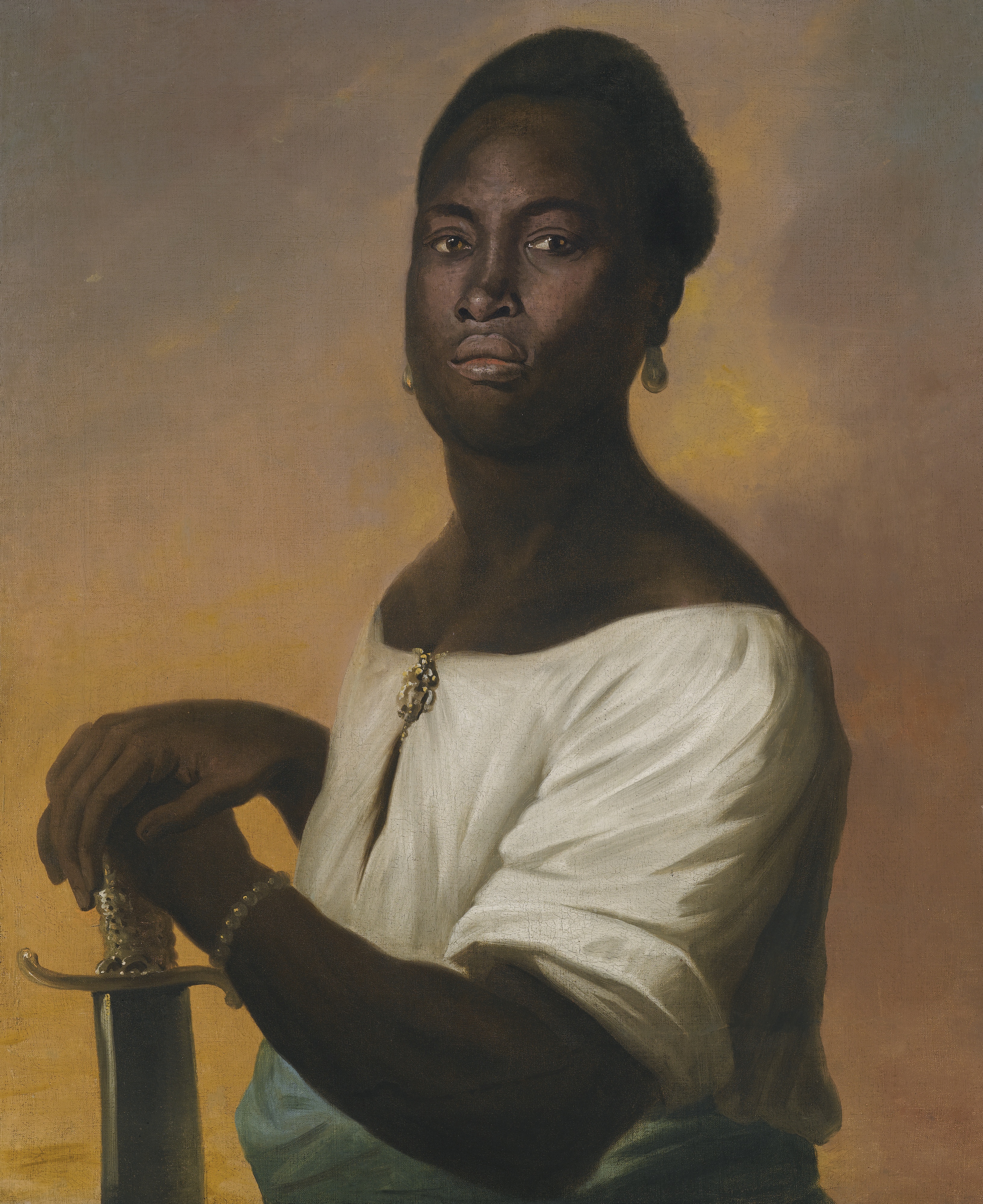
An African with a sword, quite possibly a West African slave trader. Seventeenth century. Sotheby’s.
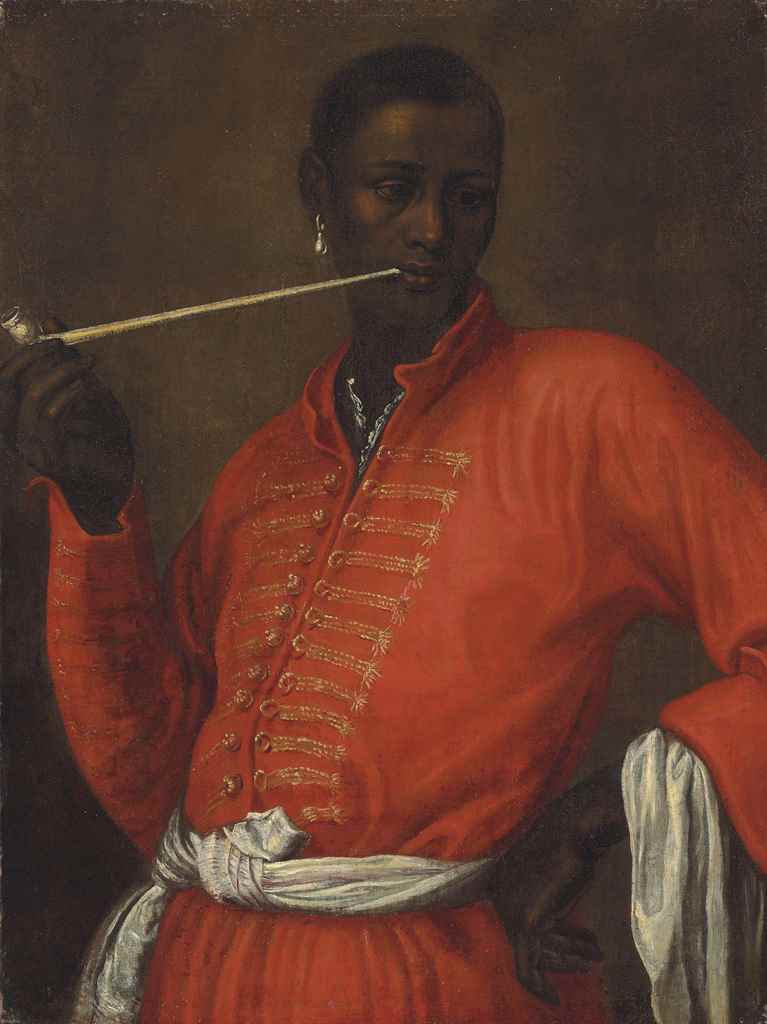
Dutch school, a Moor, possibly a West African slave trader, smoking a churchwarden pipe. Seventeenth century. Christie’s.
Many period descriptions and images of Native American males mention or show earrings. Africans, and those of African descent, in European and American context in the seventeenth century are often shown wearing earrings, typically a single one. A large number of seventeenth century Dutch paintings show black servants and slaves wearing earrings, as does a painting of black Moor in North Africa and as does one of a possible West Indian slave trader.
One final note:
Earrings were a fashion statement!
Seamen of this era, including sea rovers, did not wear them to improve eyesight, pay for a funeral, or for any other nonsensical reason, no matter how reasonable such myths may seem when un-examined or otherwise taken at face value. Unfortunately, in spite of the wealth of accurate information readily available on the Internet, it has paradoxically fostered, or perhaps enhanced is more accurate, an intellectual laziness and willingness to believe anything in print.
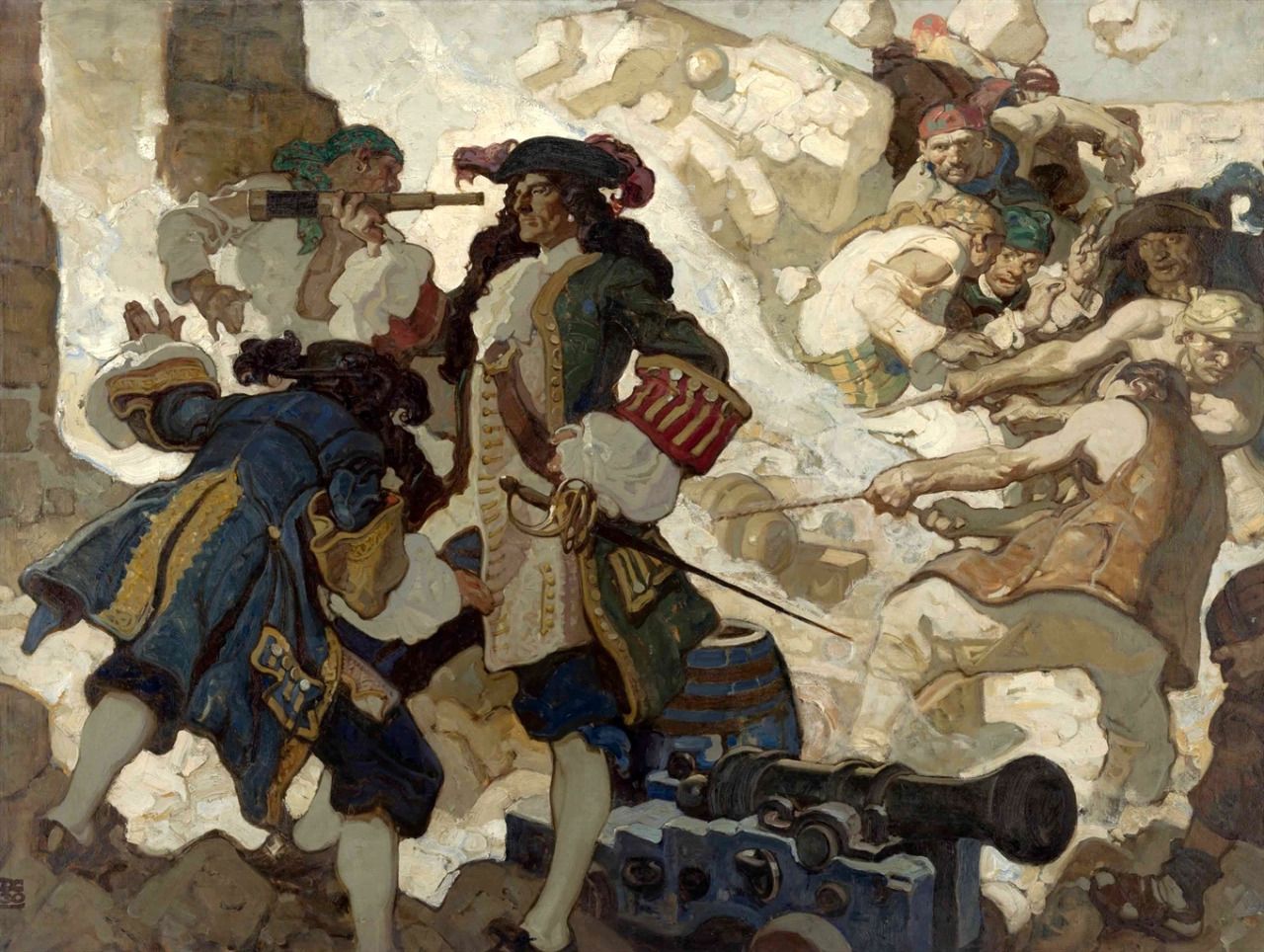
Dean Cornwell, “From the old fort Blood surveyed Don Miguel’s squadron…,” oil on canvas, 1930, for the magazine serial edition of Captain Blood Returns. Mort Künstler Collection.
So, digressing slightly in order to speak historically about a fictional character, would Capt. Peter Blood actually have worn a large pearl earring as Rafael Sabatini described he did in Captain Blood Returns (aka The Chronicles of Captain Blood in the UK)? Of course he would have, for he meets two criteria: he has had service in the Dutch navy under de Ruyter and is, almost, a fop in his style of dress!
Copyright Benerson Little 2017. First posted July 2017. Last updated July 9, 2019.
Piracy Defined Through the Ages
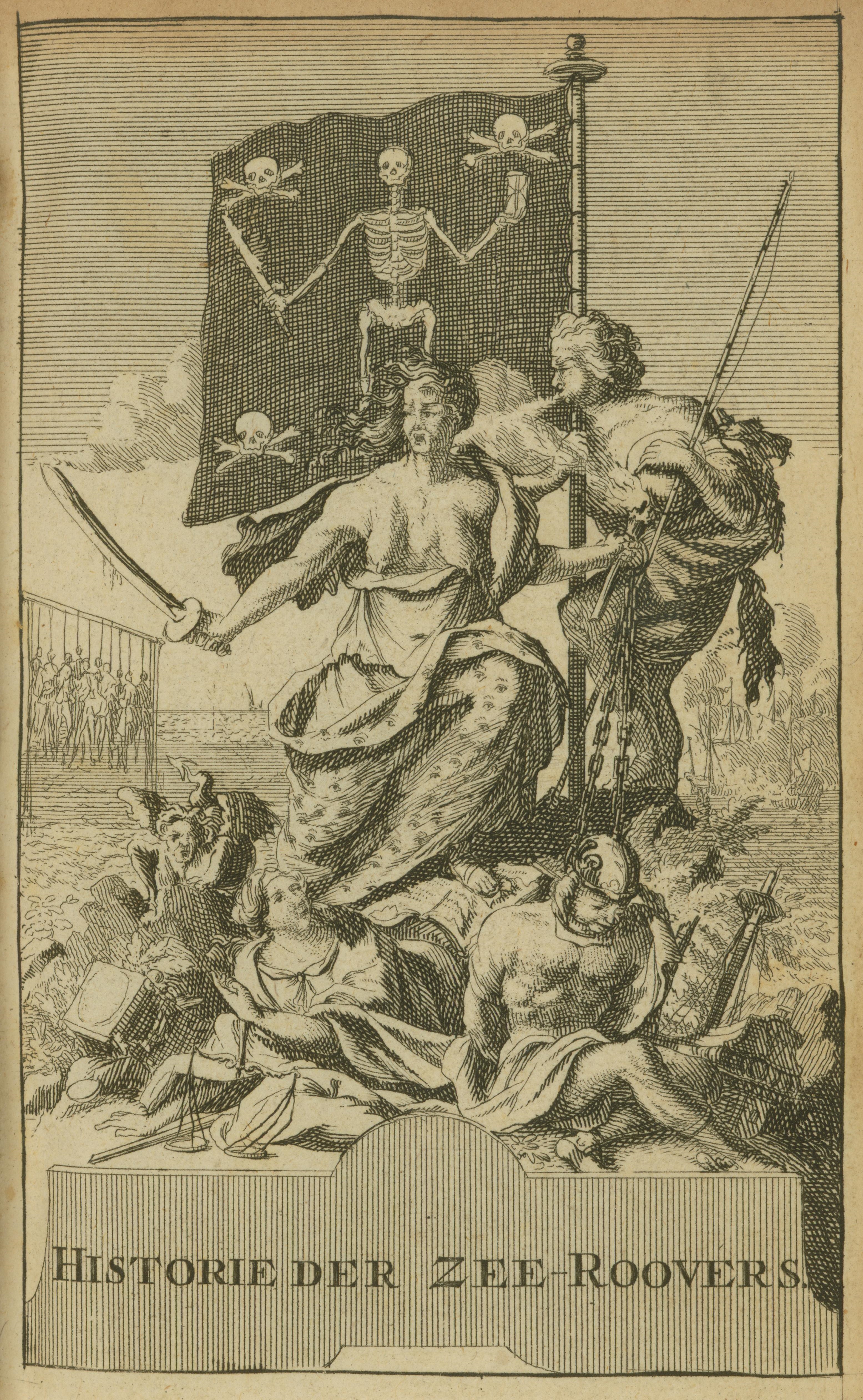
Historie der Engelsche Zee-Roovers by Charles Johnson (Amsterdam: Hermanus Uytwerf, 1725).
Strangers, who are ye? Whence sail ye over the wet ways? On some trading enterprise, or at adventure do ye rove, even as sea-robbers, over the brine, for they wander at hazard of their own lives bringing bale to alien men?
—Homer, Odyssey, book III (8th century BC, earlier oral tradition: translated by S. H. Butcher and Andrew Lang)
For in early times the Hellenes and the barbarians of the coast and islands, as communication by sea became more common, were tempted to turn pirates, under the conduct of their most powerful men; their motives being to serve their own cupidity and to support the needy. The would fall upon a town unprotected by walls, and consisting of a mere collection of villages, and would plunder it; indeed, this came to be the main source of their livelihood, no disgrace yet being attached to such an achievement, but even some glory.
—Thucydides, The Peloponnesian War, book 1, chapter 1 (5th century BC: translated by Richard Crawley, 1952)
[M]uch less would pirates coming to his land be let go scatheless for long, men whose care it was to lift their hands and seize the goods of others, and to weave secret webs of guile, and harry the steadings of herdsmen with ill-sounding forays.
—Apollonius Rhodius, Argonautica, book III (3rd century BC: translated by Robert Cooper Seaton, 1912)
For the Illyrians [the sea rovers of Queen Teuta] were not then the enemies of this people or that, but the enemies of all mankind.
—Polybius, The Histories, II:12 (2nd century BC: translated by W. R. Paton, 1922)
As if a man that lies at the mercy of common Pirates [praedonibus: of the robbers or plunderers], should promise them a certain Sum of Money for the saving of his Life: ‘Tis no deceit to recede from it, tho’ he had given his Oath for the performance: for we are not to look upon Pirates [pirata] as Open and Lawful Enemies: but as the Common Adversaries of Mankind [communis hostis omnium]. For they are a sort of men with whom we ought to have neither Faith, nor Oath in common.
—Marcus Tullius Cicero, De Officiis 3:29.107 (44 BC: translated by R. l’Estrange, 1720)
Not contented that suddenly he was become rich, [as] of a needy [person] he practiced piracy [piraticam] against his own Country.
—Marcus Junianus Justinus, Trogi Pompeii Historiis, book XXII (2nd century AD?: translated by N. Bailey, 1732)
For when that king had asked the man what he meant by keeping hostile possession of the sea, he answered with bold pride, ‘What thou meanest by seizing the whole earth; but because I do it with a petty ship, I am called a robber, while thou who dost it with a great fleet art styled emperor.’
—St. Augustine, The City of God (early 5th century AD, repeating a story told by Cicero in de Republica five centuries earlier.)
In the same year, the pagans [Danes, Vikings], coming from the northern regions to Britain with a naval armament, made descents in all quarters, plundering, ravaging, and slaughtering, like most cruel wolves, not only beasts of burthen, oxen and sheep, but priests and Levites as well, and multitudes of monks and nuns.
—Roger de Hoveden, Annals (post 1189?, of the year 793 AD: translated by Henry T. Riley)
Still they killed a great many people and made great depredations on the shore.
—The Saga of the Jómsvíkings (12th century AD, of the 10th century: translated by Lee M. Hollander, 1955)
…who the malefactors and disturbers of our peace were, who being in two cogs of Campen wickedly and craftily committed divers robberies, depredations, discords, and slayings of many of our lieges along the coasts of the aforesaid country…
—Patent Rolls, 48 Ed. III. Pt. I, m. 2 d. (1374: from Marsden, Documents Relating to the Law and Custom of the Sea. The term pirate does not appear to be used in the Middle Ages in reference to the practitioners of piratical acts until the 15th century.)
I mene pyratys of the Se, Which brynge folk in pouerte.
—John Lydgate, The Pilgrimage of the Life of Man (1426: from the French of Guillaume de Deguileville, 1330, 1355)
…which notwithstondyng, divers and monyfold spoliations and robberies [have] been daily had, committed, an doon uppon the se unto the said subgettis of the said most high and myghty princes, his most dere cosyns, as well by their enemyes as by other pirattis and robbers…
—Patent Rolls, 6 Hen. VII, m. II d. (1490: from Marsden, Documents Relating to the Law and Custom of the Sea.)
Because, upon the relation of some of our lieges we are informed that many spoilers, pirates, exiles, and outlaws, arrayed in warlike fashion on the sea, have there assaulted out subjects and faithful lieges, spoiled their ships, goods, and merchandise, and are daily busying themselves and intending with all their strength to assault, rob, and spoil them…
—Patent Rolls, 3 Hen. VIII, pt. I, m. 7 (1511: from Marsden, Documents Relating to the Law and Custom of the Sea)
Her Majestie, understanding by the grevious and sondrie complaints made by her subjects of the great spoiles by them dailie sustained at the hands of such as now of late hath so infested the narrowe seas…Wherefore her Majestie’s pleasure and commandment is that, yf you shall finde any notorious pyrates at the seas, you do apprehend them…
—Landsdowne MSS. 155, f. 166 (1576: from Marsden, Documents Relating to the Law and Custom of the Sea)
Pirate: [the word] signifies one who goes to sea for adventure [daring enterprise or hazardous exploit]…the word was not in ancient times one of ugliness and vituperation, being piracy exercised by industry and right, a private war of the strongest against the weakest.
—Nicot, Thresor de la langue française (1606: author’s translation)
Moreover, pirates are those who range the seas without licence from their prince; who when they are met with, are punished more severely by their own lords, then when they fall into the hands of strangers.
—Sir Richard Hawkins, The Observations of Sir Richard Hawkins, Knight (1622: regarding his South Sea voyage of 1594)
And the pyrate pillaged Phillipps’ bark…And there were aboard Morgan Phillipps’ bark divers men passengers, whereof the pyrate too but one, and 12 or 14 women, all which were ravished [raped] by the pyrate’s company…
—“The examination of Hugh Baker” in The Council Book of the Corporation of Youghal (1623: published 1878)
Yea, and many times a Pirat who are commonly the best manned, but they fight only for wealth, not for honour or revenge, except they bee extremely constrained.
—John Smith, A Sea Grammar (1627)
[A]nd therefore in England, a pirat is called a rover and robber upon the sea.
[P]irata est hostis humani generis… [A pirate is an enemy of all mankind…]
—Edward Coke, The Third Part of the Institutes of the Laws of England, chapter 49 (1644)
‘Tis true, he’s a Rover of Fortune, yet a prince, aboard his little wooden world.
—Aphra Behn, The Rover (1677: the pirate or sea rover has long been a popular romantic image)
[I]n their Company sailed also a small Algierman of 14 Guns, pitifully manned wth about 40 Moors he hath been out of Algier these two yeares, and all his Slaves being escaped from him, dares not returne, so resolves to turne Pyrat, and take every Vessell…she can master.
—Thomas Baker, Journal (1679)
Then Sir T. P. [Thomas Pinfold] said it was impossible they should be Pirates, for a Pirate was hostis humani generis, but they were not Enemies to all Mankind; therefore they could not be Pirates: Upon which all smiled, and one of the Lords asked him, Whether there ever was any such thing as a Pirate, if none could be a Pirate but he that was actually in War with all Mankind? To which he did not reply, but only repeated what he had said before. Hostis humani generis, is neither a Definition, nor so much as a Description of a pirat, but a rhetorical invective to show the odiousness of that crime.
—Matthew Tindall, An Essay Concerning the Laws of Nations (1694: concerning the trial of privateers commissioned by the exiled James II.)
Pirate: a sea rover [escumeur de mer, écumeur de mer, “a skimmer or parasite” of the sea], one who sails the sea without a commission from any Prince, to steal, to pillage.
Forban: a pirate, a sea rover [escumeur de mer], who takes from all Nations without any commission.
Corsaire: a pirate, a sea rover [escumeur de mer], who roves [va en course] with a commission from a State or a sovereign Prince.
—Dictionnaire de L’Académie française, 1st Edition (1694: author’s translations)
They [the buccaneers in the South Sea] scare shew’d one Instance of true Courage or Conduct, tho they were accounted such fighting Fellows at home.
—Privateer, Bahamas governor, and pirate hunter Woodes Rogers, A Cruising Voyage Round the World (1712)
They villify us, the scoundrels do, when there is only this difference, they rob the poor under the cover of Law, forsooth, and we plunder the rich under the protection of our own Courage.
—attributed to pirate Samuel Bellamy by Charles Johnson in A General History of the Pirates (1726, of events of 1717: the quote is almost certainly invented by Charles Johnson, and inspired by the exchange between the pirate Dionides and Alexander the Great, as reported by St. Augustine, Cicero, and others.)
[B]ut now that war was declared against Spain, they [the pirates] would have an opportunity of enriching themselves in a legal way by going a privateering, which many of them had privately done.
—William Snelgrave, A New Account of Some Parts of Guinea and the Slave Trade (1734, in reference to events of 1719)
That pirates had no God but their money, nor Saviour but their arms.
—a pirate in Ned Low’s crew, quoted in The Four Years Voyages of Capt. George Roberts (1726: the quote dates to 1722, and might be invented)
The Pyrates, tho’ singly Fellows of Courage, yet wanting such a Tye of Order, some Director to unite that Force, were a contemptible Enemy, neither killed nor wounded us a man in taking them, and must ever, in the same Circumstances, be the Fate of such Rabble.
—John Atkins, A Voyage to Guinea, Brazil, & the West Indies (1735: of the capture of Bartholomew Roberts’s Royal Fortune and his crew in 1722. Roberts was killed in the action.)
“A Pirate is a Sea-Thief, or Hostis humani generis [Enemy of all mankind], who to enrich himself, either by surprise or open force, sets upon Merchants and others trading by Sea, ever spoiling their Lading, if by an possibility he can get the master, sometimes bereaving them of their Lives and sinking their Ships; the Actors wherin, Tully calls Enemies to all, with whom neither Faith nor Oath is to be kept.”
—Charles Molloy, De Jure Maritimo Et Navali (1722: Tully is a common period nickname for Cicero.)
Pirate, Corsaire ou Forban: A thief of the sea, a sailor who cruises the seas with a vessel armed for war, to steal the vessels of friends or enemies, without distinction. He differs from a privateer [armateur] in that the latter makes war as an honest man, attacking and stealing only the enemy’s vessels, and in that he is authorized by a commission from the admiral.
— Alexandre Savérien, Dictionnaire historique, théorique et pratique de marine (1758: here a privateer is referred to as an armateur, the term for one who fits out a privateer, and not as a corsaire. Author’s translation.)
Forban: a corsair, who practices piracy without a commission from any Prince, and who attacks both friend and enemy.
—Dictionnaire de L’Académie française, 4th Edition (1762: the definition of pirate is unchanged from the 1694 edition)
Lastly, the crime of piracy, or robbery and depredation upon the high seas, is an offence against the universal law of society, a pirate being, according to sir Edward Coke, hostis humani generis…The offence of piracy, by common law, consists in committing those acts of robbery and depredation on the high seas, which, if committed on land, would have amounted to felony there. But by statute, some other offenses have been made piracy also…
—William Blackstone, Commentaries on the Laws of England, vol. 4 (1769)
[I]f any person, upon the high seas, or in any river, haven, or bay, out of the jurisdiction of any particular state, commit murder or robbery, on board a vessel, he shall be deemed a pirate and a felon, and shall suffer death.
—Act of Congress (1790)
As therefore he [the pirate] has renounced all the benefits of society and government, and has reduced himself afresh to the savage state of nature, by declaring war against all mankind, all mankind must declare war against him.
—The Trial of the Twelve Spanish Pirates (1834: government quoting from Blackstone’s Commentaries in the indictment.)
Noncommissioned vessels of a belligerent nation may at all times capture hostile ships, without being deemed, by the Law of Nations, Pirates. But they have no interest in the prizes they take, and the property so seized is condemned…
—Byerley Thomson, The Laws of War, Affecting Commerce and Shipping (1854: notwithstanding this reasoning, many rovers were hanged by an enemy as “pirates” in past centuries simply because they lacked a commission.)
Privateering is nothing more than piracy organized and legal.
—Théodore Ortolan, Règles internationales et diplomatie de la mer (1864)
Piracy: depredation without authority, or transgression of authority given, by despoiling beyond its warrant. [Then repeats Blackstone’s definition.]
Pirate: a sea robber… Also an armed ship that roams the seas without any legal commission, and seizes or plunders every vessel she meets.
—W. H. Smyth, The Sailor’s Word-Book (1867)
It is because a pirate is dangerous to everybody that he bears a caput lupinum, may be seized by anybody, and punished anywhere.
—Montague Bernard, A Historical Account of the Neutrality of Great Britain During the American Civil War (1870: “caput lupinum” means “wolf’s head,” and indicates an outlaw who may be killed on sight, like a wolf)
Those only are considered as principal or real pirates who use violence, or who go below to rummage for plunder, or who take part in frightening the persons robbed.
—Ernest Alabaster, Notes and Commentaries on Chinese Criminal Law (1899)
Piracy: commerce without its folly-swaddles, just as God made it.
—Ambrose Bierce, The Devil’s Dictionary (1911: definition originally published between 1881 and 1906)
The submarine warfare did not mean only the sinking of ships, but it was a crime against humanity in that it sank thousands of harmless merchantmen. In the whole history of warfare between nations that had never been sanctioned. It is rank piracy, and the pirates must receive the punishment.
—Lloyd George, quoted in the New York Times (1918: legal opinion was largely against the Prime Minister’s sentiment.)
Piracy suits my master, and that is all there is to it. His ship is his kingdom, he comes and goes as he pleases, and no man can command him. He is a law unto himself.
—Daphne du Maurier, Frenchman’s Creek (1942: again the popular view of a pirate as independent free-roving operator.)
Yes I am a pirate//Two hundred years too late//The cannons don’t thunder//There’s nothing to plunder//I’m an over forty victim of fate…
—Jimmy Buffet, A1A, “A Pirate Looks at Forty” (1974)
Piracy: Those acts of robbery and depredation upon the high seas which, if committed on land, would have amounted to a felony. Brigandage committed on the sea or from the sea.
—Black’s Law Dictionary, 5th Edition (1979: this definition is essentially Blackstone’s)
Piracy consists of any of the following acts: (a) any illegal acts of violence or detention, or any act of depredation, committed for private ends by the crew or the passengers of a private ship or a private aircraft, and directed: (i) on the high seas, against another ship or aircraft, or against persons or property on board such ship or aircraft; (ii) against a ship, aircraft, persons or property in a place outside the jurisdiction of any State; (b) any act of voluntary participation in the operation of a ship or of an aircraft with knowledge of facts making it a pirate ship or aircraft; (c) any act of inciting or of intentionally facilitating an act described in subparagraph (a) or (b).
—United Nations Convention on the Law of the Sea (UNCLOS), Article 101 (1982/1994: current international law, originally drafted in 1958 as part of the UN Convention on the High Seas)
Pirate: One who robs and plunders on the sea, navigable rivers, etc., or cruises about for that purpose; one who practices piracy; a sea robber.
Piracy: The practice of the crime of robbery and depredation on the sea or navigable rivers, etc., or by descent from the sea upon the coast, by persons not holding a commission from an established civilized state.
—The Oxford English Dictionary, 2nd edition (1989)
Pirate: an adventurer who sails the seas to pillage merchant ships or the coasts.
Piracy [Piraterie]: an act of maritime brigandage conducted by pirates.
—La Trésor de la Langue Française informatisé (2002)
Pirate: one who commits or practices piracy.
Piracy: an act of robbery on the high seas: also: an act resembling such robbery.
—Merriam-Webster’s 11th Collegiate Dictionary (2003)
Whoever, on the high seas, commits the crime of piracy as defined by the law of nations, and is afterwards brought into or found in the United States, shall be imprisoned for life.
—18 USC §1651 (2007, current US law: unchanged since 1909, and little changed since 1819 except for the substitution of life imprisonment for the death penalty. See UNCLOS above for current law of nations.)
Whoever, being a seaman, lays violent hands upon his commander, to hinder and prevent his fighting in defense of his vessel or the goods intrusted to him, is a pirate, and shall be imprisoned for life.
—18 USC §1655 (2007, current US law: largely unchanged since 1790.)
Whoever, upon the high seas or other waters within the admiralty and maritime jurisdiction of the United States, by surprise or open force, maliciously attacks or sets upon any vessel belonging to another, with an intent unlawfully to plunder the same, or to despoil any owner thereof of any moneys, goods, or merchandise laden on board thereof, shall be fined under this title [Piracy and Privateering] or imprisoned not more than ten years, or both.
—18 USC §1659 (2007, current US law: penalty increased from that of 1909, otherwise essentially unchanged)
Whoever, being engaged in any piratical cruise or enterprise, or being of the crew of any piratical vessel, lands from such vessel and commits robbery on shore, is a pirate, and shall be imprisoned for life.
—18 USC §1661 (2007, current US law: largely unchanged since 1909, and very similar to law enacted in 1820)
So began a tense five-day standoff in which the pirates repeatedly threatened to kill the captain.
—New York Times (2009: regarding the Somali pirate attack on the cargo ship Maersk Alabama and the taking of her captain, Richard Phillips, hostage.)
We can finally do it! We can leave this crappy town and live the life we’ve all dreamed of…Haven’t you heard? Haven’t you been watching the news? Pirating is back, my friends, swashbuckling adventure on the high sea, the stuff we’ve all dreamed about, and it’s all happening right here: Somalia.
—Cartman, in South Park, “Fatbeard” (2009)
Copyright Benerson Little 2017. Posted 7 June 2017.
Commands at Sea: The Boatswain’s Call, Pipe, or Whistle, with a Note or Two on Boatswain Speech as Well

Title page to William Shakespeare’s The Tempest, from volume one of The Works of Shakespear edited by Alexander Pope. London: Jacob Tonson in the Strand, 1725.
Ah, the Bard! As someone once pointed out in writing, and I wish I could recall who it was (unless I’m imagining or mis-recalling this), the opening to the Tempest is one of the most evocative in its brevity in all of literature. It brings ship and storm to life immediately. In related fashion, I’m pretty sure it was George MacDonald Fraser who wrote words to the effect that “Enter Mariners wet” is one of the great stage directions of all time. Or perhaps I’m confusing his observation with the former, or even inventing the former from the latter.
But, in this brief yet related digression from swordplay and swashbuckling at sea and ashore, we’re more concerned with another line in the play: “[T]end to the master’s whistle…,” that is, listen to and obey (the “Aye, aye!” spoken or unspoken) the musical commands, shrill, some said, from the ship master’s silver whistle.
Notably, it’s not the boatswain’s whistle Shakespeare mentions, but the master’s, for in the sixteenth century and into the seventeenth the boatswain was not the only officer authorized a whistle. As Nathaniel Boteler wrote in 1634 in A Dialogicall Discourse Concerninge Marine Affaires Betwene the Highe Admirall and a Captaine att Sea, first published in 1685 and known today as the eponymous Boteler’s Dialogues:
“ADMIRAL. How many be the officers that carry whistles in a ship of war?”
“CAPTAIN. They are three: The Master, the Boatswain, and Coxswain, for though the Captain my do the same at his pleasure, yet it is neither usual, nor necessary.”
By the late 17th century, it appears that the silver whistle or “call” was used primarily by the boatswain.
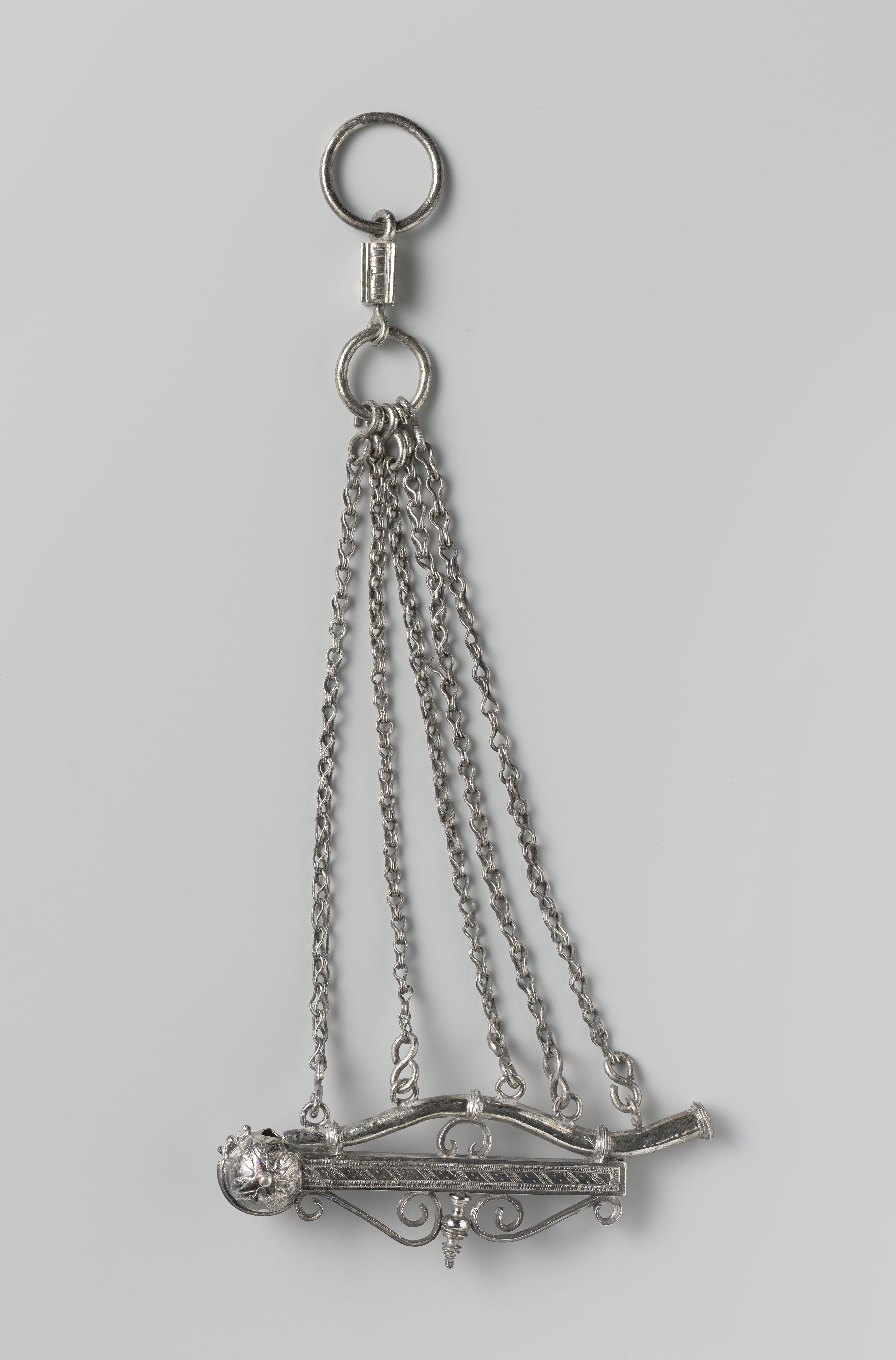
Dutch boatswain’s (or other officer’s) whistle, early 17th century, Rijksmuseum.
Before going further, and with no offense intended to anyone, I want to make sure that readers understand that boatswain is pronounced “bos’n” or “bosun.” I’ve heard “cocks-wayne” rather than the correct “cox’n” (cockswain, one who commands and helms–steers–a ship’s boat) before–including from persons well-educated but clearly un-nautical, not to mention clearly forgetting the first rule of the pronunciation of a new word: look it up!
The boatswain’s whistle, both as a badge of office for any ship’s officer as well as a functional instrument with a large variety of “calls” for ordering hands about, has been around since at least the 13th century according the USN Bluejacket’s Manual (1941 edition), in more or less similar traditional form. It also notes that, although the whistle is commonly referred to as the boatswain’s pipe in the US Navy, the term “call” in reference to it dates to “about” 1671. A writer commenting in 1679 upon the lack of religious fervor among English seamen during the English-Dutch war at sea 1672 to 1673, complains that “a Lieutenant’s Command for a Rope for the Boat, shall be sooner answered with Boatswain’s Call, than the Bell for Prayers…”
However the Reverend Henry Teonge, chaplain aboard the HMS Assistance 1676 to 1678, still referred to it as the boatswain’s whistle: “He had a neat coffin, which was covered with one of the King’s jacks, and his bo’sun’s silver whistle and chain laid on the top (to show his office) between two pistols crossed with a hanger drawn.”
The English boatswain had other badges of office as well, including a short cane or “bamboo,” its tip whipped with marline, for encouraging laggard seamen by cracking it on their backs and pates, although sometimes a simple rope’s end served as well. And there was the cat-of-nine-tails too, a dark badge of office best kept out of sight except when in use. But it was the boatswain’s whistle that was his definitive badge of office, and I’m sure that boatswains of the past were just as proud of their silver call as boatswain’s today are: “It is not so much by his fine Silver-call, as the illustrious Chain that it hangs by, that is the distinguishing Badge of his Post, and which he’s as proud of as my Lord Mayor is of his, and prouder,” wrote Ned Ward in 1707.
The whistle was an important means of directing seamen about their duties. Again, Ned Ward: “The Boatswain is a Kind of a Jack with a Box, for let him but whistle once, and you have a hundred or more Cartesian Puppets, pop up upon Deck, and run about, and streight disappear again in an Instant.”
In the 17th and 18th centuries an English boatswain’s duties included the custody, keeping, repair, and management of all rigging, anchors and cables, and sails; the hoisting in and out of cargo, stores, and boats; the management of all of the ship’s colors; the calling up, via his whistle, of gangs, watches, &c. for, as Boteler put it, “exertions of the their works and spells (as they call them), and to see that they do them thoroughly; and to keep them in peace in in order with one another.” This last duty was that of what on land was handled by the Provost Marshal. At sea, it was the boatswain who punished seamen for their shortcomings. This included everything from flogging wrongdoers to placing them in the bilboes to ducking them at the main yardarm. In the Dutch navy, the boatswain’s duties include keelhauling as well (see “Keelhauling, in Living Color”).
In battle the boatswain and his mates, along with some of the other crew if the occasion warranted, were tasked not only with repairs to the rigging, but often with managing the sails. Shortened sail was typically used in battle in order to reduce the number of crewmen required to manage it, leaving the majority to handle the guns great and small, and the small arms as well.
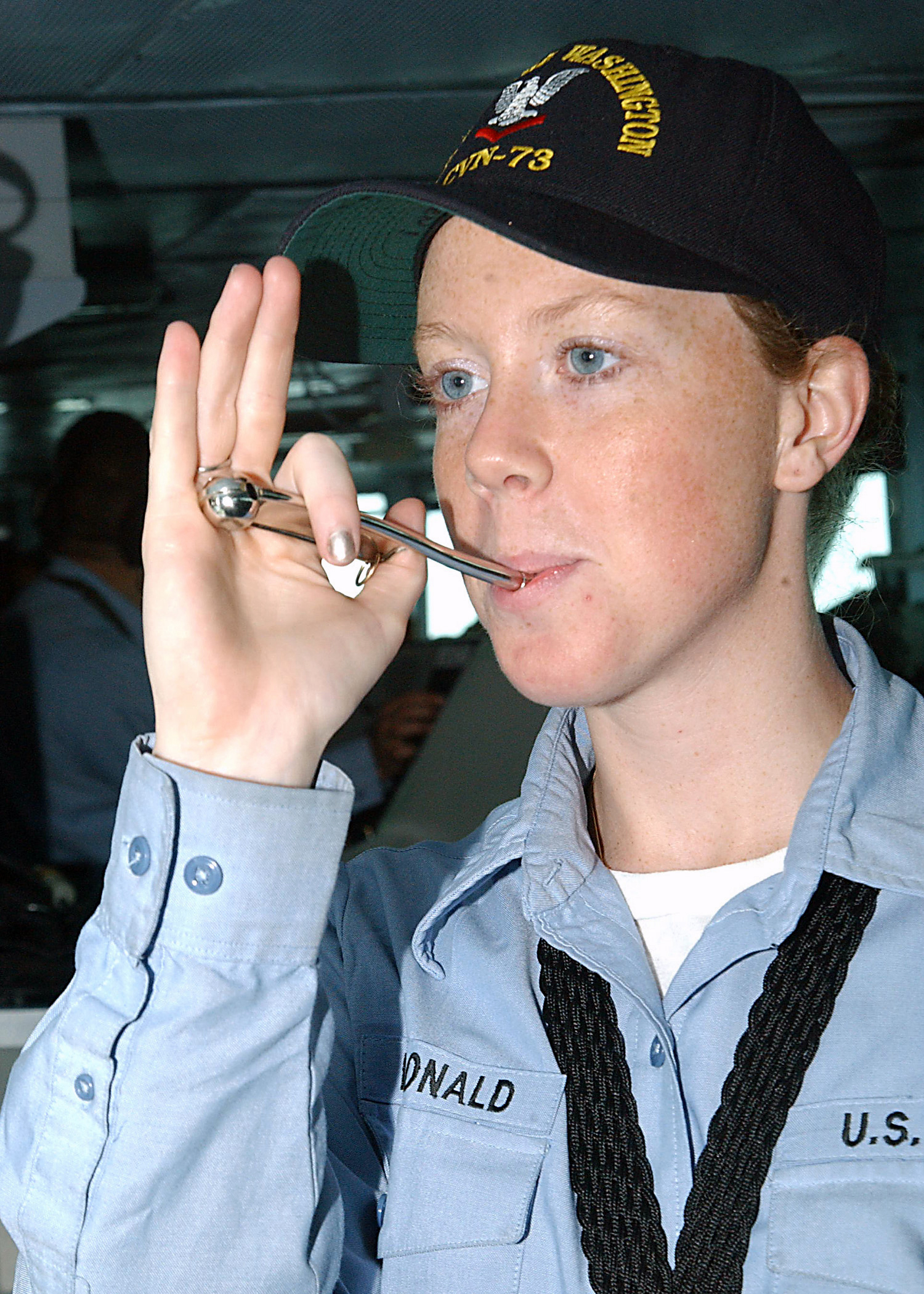
At sea aboard USS George Washington (CVN 73) Sep. 9, 2002: Boatswain’s Mate 3rd Class Bethany McDonald. (U.S. Navy photo by Photographer’s Mate Airman Jessica Davis.)
In the modern US Navy, the boatswain–thankfully, after a brief period of insanity in which ratings were abolished, they’re now restored–has similar duties, in particular in regard to the various rigging aboard modern ships, the hoisting of boats and stores, and so on. The boatswain’s pipe remains ever present, and modern US Navy boatswain’s calls, performed by the US Navy band, can be found here.
The most common call I remember was “Piping the Side,” that is, the piping of a captain, admiral, or on occasion, some dignitary over the side during a formal ceremony shipboard or ashore. I remember various other calls shipboard as well, on both surface ships and submarines, but for the life of me I can’t remember them in detail except that “All Hands” was common, or perhaps it was “Pass the Word,” and, like everything else, the calls came over the 1MC (the general PA aboard a US Navy ship or shore command) except in the case of the piping the side ceremony, for we were always present for them.
But boatswains then and now had other means to motivate seamen: language, particularly when spiced with “cursing and swearing.” Sailors in general have long been known for their use of foul language, and boatswains in particular had, and have, a reputation for creativity, eloquence, wide vocabulary, and, as often as not, lyricism in their swearing. Ned Ward noted that:
“He must certainly believe there can be no such Thing as Hell-fire under Salt-water, else he would never be giving himself so oft as he does to the Devil; but how frequently soever he damns himself, he is sure to damn others much oftener. In short, he’s a Fellow that will throw away ten times more Oaths and Strokes in hoisting out a Barge, than in boarding an Enemy.”
The boatswain’s excuse for his language is a simple one: “But, Zounds, he’ll cry, what would have me do? A man without Noise, is a Thing without a Soul, and fit for nothing but a Pissing-Post.”
As for my own experience, I never knew a real US Navy boatswain, at least not a Chief Boatswain’s Mate, who couldn’t out-swear anyone except another boatswain. A boatswain’s work–dealing with fouled lines, for example–naturally inspires foul language, which in turns lubricates the work at hand and helps get it done. At times I’d swear it has motivated not only crew but rigging or equipment itself.
My favorite example of a boatswain’s cursing, however, or perhaps my second favorite (I’ll save a particular modern description for a later post), may be that of Ned Ward’s Royal Navy boatswain, whose elegant oxymoron is straight to the point:
“Get up, all Hands to Prayers, and be damned.”
Indeed.
REFERENCES (Not Cited in Detail Above)
Anon. Observations on the Last Dutch Wars, in the Years 1672 and 1673. London: 1679.
Nathaniel Boteler. Boteler’s Dialogues. Edited by W. G. Perrin. London: Navy Records Society, 1929.
Benerson Little. Chapter 14, “Tarpaulin Cant and Spanish Lingua,” in The Buccaneer’s Realm: Pirate Life on the Spanish Main, 1674-1688. Washington DC: Potomac Books, 2007.
Henry Teonge. The Diary of Henry Teonge. Edited by G. E. Manwaring. New York: Harper & Brothers, 1927. (Teonge’s original manuscript was first published in 1825.)
United States Navy. Bluejacket’s Manual. 1941.
Ned [Edward] Ward [By the Author of the London Spy]. The Wooden World Dissected in the Character of a Ship of War, 7th ed. London: Booksellers of London and Westminster, 1760. Originally published in 1707.
Copyright Benerson Little 2017. Last updated May 3, 2017.

Fencing Books For Swordsmen & Swordswomen
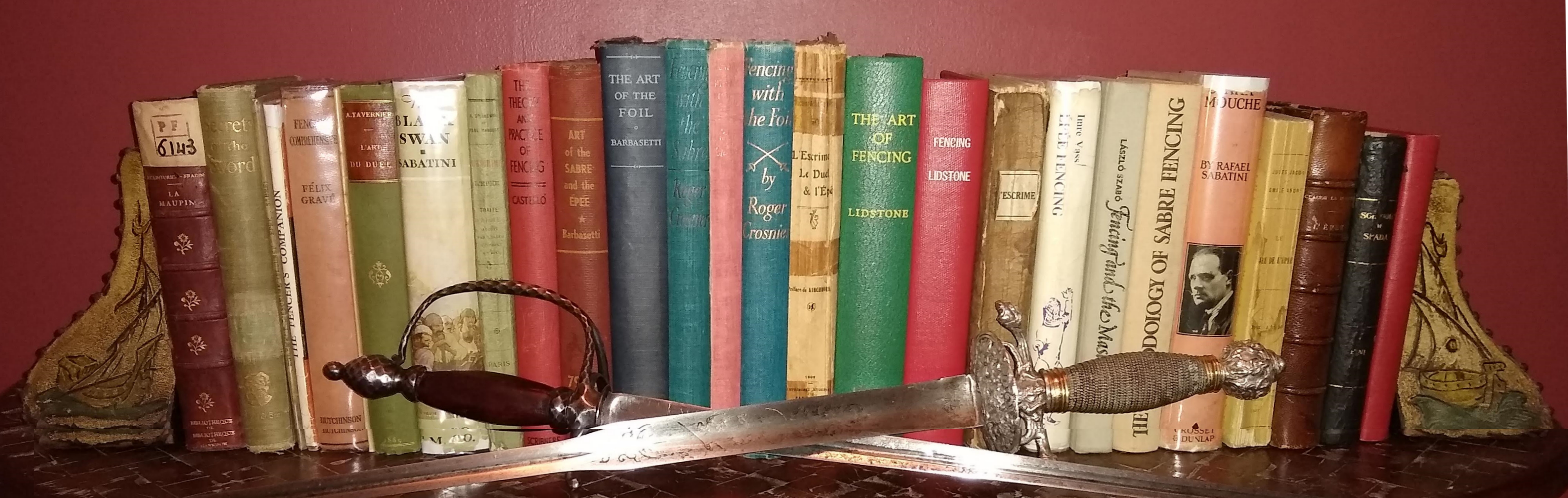
The content in this post is more background on than digression from the general subjects of this blog–swordplay and swashbucklers–, for what is either without fencing technique? The following fencing books are my recommendations for fencers across the spectrum, from early modern historical to “classical” to modern “Olympic” competitive. It includes sections on the modern Olympic weapons, classical fencing, rapier, smallsword, various cut & thrust, theory, Japanese texts, and more.
The list below, although quite long, is not exhaustive—there are many good fencing books not listed (and some more bad than good as well). Some are not listed simply because I have not yet read them. The history list in particular is abridged due to sheer volume, but less so than in past years, and I have not yet begun to include much in the way of mid-19th century works or of books on swords as opposed to swordplay. Fencing books can be very useful, but are no substitute for proper instruction and diligent practice, as I learned from my fencing masters, Dr. Francis Zold and Dr. Eugene Hamori. See the end of the list for suggestions on acquiring the books listed here, or for that matter, many books in general.
The first fencing book I ever read, in 1975 or 1976, was Bob Anderson’s All About Fencing, along with a beginning text by Nancy Curry or Muriel Bower, I can’t recall which, probably the former. These were followed by, once I started fencing in 1977 under Dr. Zold at USC, either Curry or Bower’s book (the latter I think, given Bower’s association with USC), then Charles Selberg’s Foil (and when it was published, his Revised Foil), Michel Alaux’s Modern Fencing, Marvin Nelson’s Winning Fencing, and, in 1980, Imre Vass’s Epee Fencing, soon followed by Laszlo Szabo’s Fencing and the Master. From that point my interest in fencing texts exploded.
My earliest years of fencing education, however, were dominated by fencing lessons, verbal instruction, and oral histories, not fencing books. Notably, my epee instruction was derived in large part from Vass via Dr. Hamori’s own knowledge of the weapon and in consultation with his close friend József Sakovits who was one of the world’s greatest epeeists and later Hungarian national coach. The general method of instruction used by my masters was derived directly from Szabo, his master Italo Santelli, and other notable Hungarian masters such as Gyorgi Piller–yet never for four years were the works of Vass or Szabo recommended to me. They were, in essence, above my ability at the time.
As Italo Santelli put it, fencing is something you do, not something you write (and therefore read) about! Thus were my early years filled with learning to fence not by reading but by fencing, fencing, and more fencing. That said, the study of fencing texts does have an important place in learning to fence: it broadens one’s knowledge of the subject. Fencing books provide a map to the world of swordplay. They can also point out errors in technique, training, and tactics (although a fencing master is always better for this), and can reorient one’s perspective in certain cases.
Associated fencing quotations can be found here.
N. B. If you take the broad study of swordplay seriously, you will find yourself compelled to consider the following questions major and minor, for example: Does offense or defence put the fencer in the strongest position, or does a balance between the two? Should the fencer extend fully before lunging or simply begin with the point, extending and lunging near simultaneously? Where should the fencer primarily look when fencing — at the hilt and blade, at the eyes (if they could be seen), or broadly at the whole, or in combination, shifting from one to another? Should the fencer emphasize power (strength and speed) or finesse, or both? Tactically, is the strategic fencer or the opportunistic fencer generally superior?
Essays on Fencing & Life
So rare are these essays that I’ve found only two to list so far, although occasionally the subject is touched upon in prefaces to fencing books. I’ve listed Lambotte’s first, as her entire short work is on the subject. The first third of Bertrand’s book qualify as an essay on fencing & life, thus the book is the only one to get a double entry.
Arguably, Bazancourt’s Secrets of the Sword and Burton’s The Sentiment of the Sword occasionally connect fencing to life in general, and Gravé’s Fencing Comprehensive has a sense of this as well. All three are noted below.
L’Escrimeuse by Emma Lambotte, 1937. A delightful essay on fencing, on being a woman fencer, on fencing’s connection to and reflection of life, and on the characters of various fencing nationalities, among many other brief subjects. Mme. Lambotte was a noted Belgian poet and the muse and patron of painter James Ensor.
Cut and Thrust: The Subtlety of the Sabre by Leon Bertrand, 1927. The first five chapters of Bertrand’s book qualify as essays on fencing and life, ranging from a defense of fencing as sport to a defense of dueling to physical and mental exercise. See the full entry below.
Modern Epee
Why have I placed Modern Epee—that is, epee as fenced from the 1930s to the present in its various forms—first among books on technique? Because it’s the best starting point for most budding fencers today, even if their ultimate goal is classical or historical fencing. It is by far the most popular modern competitive weapon (it looks like swordplay, its judging is simple, it much more resembles sword-fighting with sharps than either modern foil or saber, it is very “democratic” in that the weaker fencer always stands a chance, as some have put it), and—if taught appropriately via a classical foundation as it should be—is also an excellent foundation for historical and classical fencing. Modern competitive foil and saber have become largely useless for this, both as fenced and as taught, for they’ve given up the classical notion derived from combat that attacks in invitation–with the point non-threatening and/or the arm not extended or extending–would be suicidal with real weapons.
It should be noted that some modern epeeists consider not only classical epee technique (point d’arrêt technique, especially non-electrical, and true dueling technique), but also “modern classical” (electrical pre-Harmenberg, so to speak) technique to be obsolete. This narrow view has no basis in fact except to some degree in the case of some elite (world class, that is) epeeists. Purely classical and modern classical epeeists can, and often do, fence as far as a solid A, or national, level, and classical technique is the foundation of elite epee technique. In fact, elite women’s epee retains a significant amount of so-called classical technique, and the compiler of this list is well-acquainted with a Greek-American epeeist some 80-plus years old whose classical, very old school straight arm dueling technique can still give even young elite epeeists fits.
Note, however, that the definition of classical fencing has changed over time and continues to change today. More than a century ago foil was considered the classical school and epee the modern, and French duellists of a century ago were classified according to three schools: foil, foil-epee, and epee! In fact, one need only read Achille Edom’s 1910 book on epee fencing (see below) to realize that much of what is considered new in epee is in fact more than a century old. In other words, epeeists should not consider older epee texts, nor any epee style of the past century or more, as unworthy of practical study, modern fads, to which epee is highly susceptible, notwithstanding.
Fencing with the Epee by Roger Crosnier, 1958. A thorough description of modern classical epee technique, still very useful today. Prof. Crosnier’s book on foil fencing (see the Foil section) should be read hand-in-hand with his epee text.
Epee Fencing: A Complete System by Imre Vass, 1965 in Hungarian, 1976 1st English edition, revised English editions 1998, 2011. The most thorough epee text ever written. That said, highly recommended for epee coaches at all levels, recommended only with caution for intermediate to advanced fencers (at least three to five years or more significant experience)—but not for beginners. There is much useful, often profound, material, but some sections can be skipped entirely by some fencers, and others require sufficient epee fencing experience in order to profit from them. The revised editions were edited by fencer and publisher Stephan Khinoy, and amplify and supplement the original text in places.
The latest edition suggests the need for such classical training today, in spite of the so-called “new paradigm” (see Harmenberg below, his book was also originally published by Khinoy). I agree. Even for those relatively few fencers (as compared to the entire body of epeeists) who wish to and are able to emulate Harmenberg’s sport methods, a solid base of “modern classical” epee training is still necessary. For most epeeists, even superior amateurs, modern classical technique is all they’ll ever need.
Again, caution is advised when studying the book; it’s best to have a solid understanding of fundamental epee technique and theory before reading it. In fact, it helps to understand the Italian school in order to understand Vass’s theoretical framework: Luigi Barbasetti’s book on foil (see below) is a good start. Vass trained international medalists József Sákovics and Béla Rerrich, both of whom went on to become leading epee masters and national coaches, the former in Hungary, the latter in Sweden, with numerous international champions to their credit. He also trained four-time Olympic gold medalist in epee Győző Kulcsár, who later as a fencing master trained two-time Olympic gold medalist in epee Timea Nagy. József Sákovics, considered by many to be the first “modern” epee fencer, died in 2009, Béla Rerrich in 2005, and Győző Kulcsár in 2018.
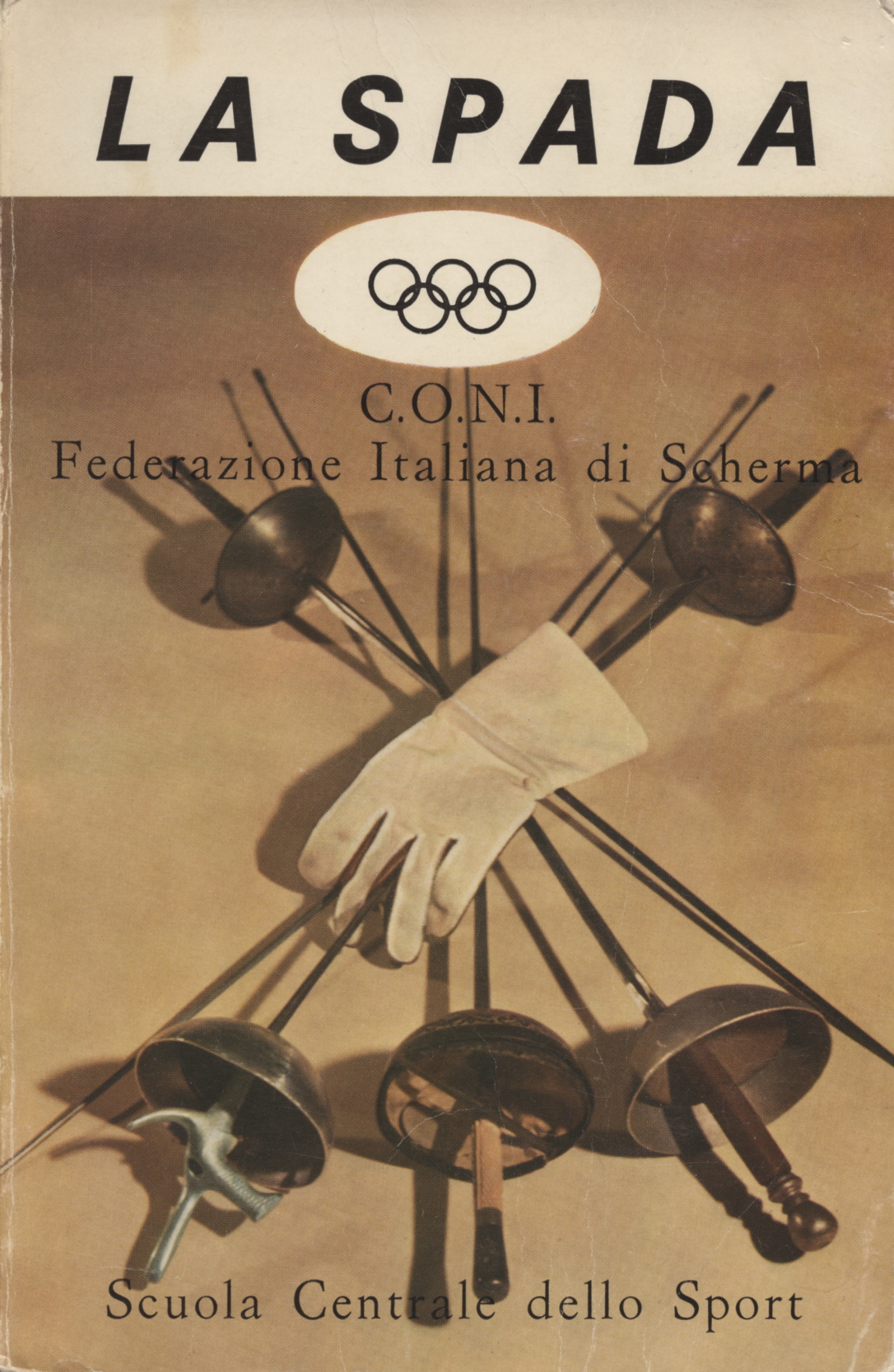
La Spada: Metodo del Maestro Caposcuola Giuseppe Mangiarotti by Edoardo Mangiarotti, the Comitato Olimpico Nazionale Italiano, Scuola Centrale Dello Sport, and Federazione Italiana Scherma, 1971. Epee as taught by the famous Guiseppe Mangiarotti: a thorough exposition of his method. Beginner-friendly, too, at least if you read Italian or have a working knowledge of fencing technique and language along with a background in Romance languages other than Italian. Includes excellent illustrations of blade positions, better perhaps than in any other epee text. (Side note: the book even includes illustrations from the works of Vass and Szabo. Kingston and Cheris in this section also have excellent illustrations of blade positions.)
Prof. Mangiarotti, who studied under Italo Santelli as well as under other masters Italian and French, was an Olympic fencer, seventeen-time Italian national epee champion, father of famous champion Edoardo Mangiarotti as well as of noted fencers Dario and Mario Mangiarotti, and founder of a famous epee school in Milan, still in existence, that blended the French and Italian schools and produced champions for decades. Edoardo won 13 Olympic medals and 26 World Championship medals, and was known for his fluid, very Italian footwork as well as for his strategy of attacking hard and fast early on to get touches, then playing a defensive game. Highly recommended: it is my second-favorite “modern” epee fencing book. See also Mangiarotti and Cerchiari in the “Combined Modern Epee, Foil, and Saber Texts” below. For the French school, see Alaux and Cléry in the same section.
Epee Combat Manual by Terence Kingston, 2001, 2004. Highly recommended beginning to intermediate text. Should be required reading for new epeeists. Pair with How to Fence Epee by Schrepfer (below). Unfortunately, Kingston’s book is unavailable in the US anymore, and his web store ships only to the UK and EU (or I suppose he still ships to the EU after Brexit–a lot of small businesses are having issues doing so).
Fencing: Steps to Success by Elaine Cheris, 2002. Actually an epee and foil text, but the epee stands out more to me, and is very useful to both recreational and competitive fencers. Includes training drills as well as excellent illustrations of technique, including from the fencer’s point of view. The book is a good companion to Kingston’s book above. Cheris is one of the great US fencers in both epee and foil.
Epee 2.0: The Birth of the New Paradigm by Johan Harmenberg, 2007. For advanced epeeists and coaches only. There is a second edition–Epee 2.5 I think–that I have not yet read, therefore some or all of the criticisms below might be valid for the new edition. Importantly, the book is suited, in Harmenberg’s own words, only to truly advanced fencers, although this has not stopped many insufficiently experienced epeeists, and even their coaches, from foolishly assuming they can emulate its technique and tactics—and in doing so, impale themselves by repeatedly running onto their adversary’s point from distance much too close. This is often quite funny to watch, especially in the case of exceptionally tall epeeists, with their naturally slower tempo, who throw away their height advantage.
Although there is very useful material in the book, some of Harmenberg’s recommendations are controversial and not all masters agree with the described training regimen, except, again, perhaps in the case of elite epeeists. Further, Harmenberg at times appears to take more credit than he deserves, albeit innocently, given that other epeeists were also knocking at the door of his new style, and had been for some time. Harmenberg, however, was arguably the first elite epeeist to succeed with it at the Olympic and World Championship levels. That is, the first to use “outstripping” attacks—beating the double touch timing by a hair—to the body as a primary technique and tactic, although others, the Soviets notably, had already been using the fleche in renewed attacks to great effect in an outstripping rather than conventional tempo. (Vass calls these sorts of touches “combat” techniques; a better term might be “sport” techniques.) It was also common to see some epeeists below the international level in the 60s and early 70s use technique similar to Harmenberg’s, but they were unable to succeed with it against elite modern classical, aka conventional, epeeists at the international level.
Additionally, some of his criticisms, even though thoroughly honest, of the modern classical technique are not entirely valid. For example, his objection to epeeists who use, and their masters who teach, attacks with a fully extended arm prior to the lunge is somewhat misplaced: although many French fencers and masters did adhere to the technique during the heyday of dueling with the epee, this was done primarily to prevent serious injury and death by emphasizing long distance and straight-arm attacks on the arm. There has long been a debate on whether the attack with extension first or with point only first is faster in practice, and the issue is confounded by en gardes with a near-fully extended arm, and with renewed attacks made with extended arm, for example immediately after a counter-attack that falls short.
Even so, the lunge with near-simultaneous extension (likewise, the “progressive attack”) has been commonplace three or more centuries prior up to today, was used even by some French epee dueling masters, and some lineages of masters had never taught otherwise. (“Historical” fencers, please don’t bother to argue with me on this smallsword history, simply open up and read the first two dozen period smallsword manuals you lay your hands on.)
Still, many early epee masters (and some saber masters too) did teach that the simple attack via lunge, almost always to the arm, must be made with the arm fully extended first, although others argued correctly that simultaneous or near-simultaneous extension and lunge was faster, as Harmenberg likewise deduced (as did masters in past centuries). Indeed, if you intend to hit the body with an attack, you’d better not extend first then lunge! If you do, you’ll lose a tempo, warn your adversary, and probably get successfully parried or counter-attacked. Early epee masters generally avoided recommending attacks to the body due to the increased risk of double touches—and the increased risk of jail time for murder or manslaughter. (Roughly seventy percent of modern epee touches are made to the body thanks to the flat tip of the epee which is less effective to the arm when compared to the old jacket-tearing points d’arret which were highly analogous to the sharp point of a dueling epee.)
The argument remains as to whether Harmenberg’s described techniques and tactics are truly revolutionary, or merely one of the final steps in the evolution of sport epee, in that the “paradigm” takes complete advantage of the 20th to 25th of a second tempo provided by the electrical apparatus, and entirely disregards any consideration of classical tempo so necessary were swords real — sharp, that is, and intended to put holes in an adversary.
Put plainly, the book is Harmenberg’s exposition of how HE fences. Tellingly, whenever I ask elite European fencers and masters about the book, they shrug their shoulders. If they do happen to know who Harmenberg is, their answer is something on the order of, “Well, if it worked for him, good, but there are many other ways to fence epee…” That said, far too many epee teachers in the US have adopted his theory, all too often too early for their students and quite imperfectly, although lately I see this fad–and there are many fads in fencing–fading.
The book is based on the Swedish epeeist’s experiences leading up to his 1977 world championship and 1980 Olympic gold. In other words, however profound the book may be to sport fencing, its author’s ideas were not new in 2007—only their publication was.
Epee Fencing by Steve Paul et al, published by Leon Paul, 2011. A very useful text for the modern competitor. Positive criticisms: thorough and well-illustrated. Negative criticisms: 100% emphasis on epee as pure sport (as opposed to epee as dueling swordplay or martial art modified for sport) and a magazine-style layout (or in imitation of a badly-designed webpage?), including a thin magazine-like cover that will not hold up to much wear.
How to Fence Epee: The Fantastic 4 Method by Clément Schrepfer, 2015. Translated from the original French edition, Faire de l’épée: La méthode des 4 fantastiques, by Brendan Robertson. Not a manual of technique per se, but suggestions on how to use it. A very useful book, with only little to find disagreement with, and mostly in terms of style or tradition and not practicality. Highly recommended, especially for beginning to intermediate epeeists. An excellent companion volume to the Epee Combat Manual by Kingston (above) or Learn Fencing — Épée below.
Learn Fencing — Épée by Peter Russel, 2015. A generally good introduction to modern epee for beginners. Quibbles: the black background and resolution of some of the photos makes for difficult viewing and therefore comprehension at times, and the description of beats is inadequate, essentially relegating the beat to a reconnaissance action with the foible. This may be an artifact of the ignorance of the beat many modern fencers have (I blame their coaches for following the fad of not teaching a complete technique). Numerous times over the past fifteen years I’ve been told by visiting fencers that they’ve never encountered a beat as strong as mine and suggest I must have extraordinary forearm strength. Nonsense! It’s all technique! My wife, smaller and less strong than I am, has a beat as powerful. As Vass (noted above) put it, the beat (use the middle of the blade, not the foible except for reconnaissance) can be used to open the target, delay the adversary’s response, provoke a reaction, and loosen the adversary’s grip, thus further delaying the response. Enough ranting. 🙂 (Last quibble: poor copyediting on the cover, in which Épée is spelled Épeé, but books shouldn’t be judged by their covers.)
See also the “Combined Modern Epee, Foil, and Saber Texts” section, especially Alaux, Barth/Beck, Cléry, de Beaumont, Deladrier, Lidstone, Lukovich, Mangiarotti/Cerchiari, and Vince, as well as the “Epee de Combat” section in general, and Castello and Gravé in the “Classical Fencing” section.
The Epee de Combat or Dueling Sword:
Epee for Actual Combat, In Other Words (and Almost Immediately for Sport as Well)
All of these works are of use to the modern epeeist, and all demonstrate that there is, overall, little new in modern epee fencing. Even the pistol grip was growing in popularity in France by 1908, although its use in dueling was prohibited and it would be the Italians who found in it the perfect replacement for the romantic rapier grip used on their fiorettas and spadas. Only the tactics and techniques of “out-stripping” (of trying to hit a 25th to a 20th of a second before one gets hit), and of the unrealistic abomination of flicking (and arguably, of foot touches), are new. In fact, by 1900, if not earlier, epee was often judged not according to the realities of sharp swords, but according to a perceptible difference in timing when both fencers hit–in other words, who hit first, much akin to the modern electrical apparatus (unfortunately).
Double touches, including “outstripping” touches of which modern epeeists are so fond (hitting just enough prior to the adversary’s hit that it will be considered a single touch, when with real swords both fencers would be hit) have long been the bane of the salle or sport fencer, even long before the advent of electrical scoring and its too short timing–there have always been fencers trying only to get the first hit, however they may, as if playing tag. There is an unfortunate natural tendency to turn fencing into a game of mere “who hits first” tag. As for the flick, it is new only to epee: it was used by a fair number of foilists in the 19th century and almost certainly in the two immediately prior centuries as well, and there are references as late as the 1930s noting what can be done with a very flexible blade rather than a stiff one. Flicks and foot touches are too dangerous to attempt with an epee de combat: they would cause little damage while leaving the user vulnerable to more damaging, even fatal, thrusts, not to mention that the blade of a real dueling epee is too stiff to permit the flick. Some old dueling epee masters even proscribed the “thrown thrust” common in epee, because, like the flick would if it could be used with a dueling sword (it can’t because the dueling blade is too stiff), it wounded only the skin, not the muscle beneath; the latter wound was more likely to end the contest.
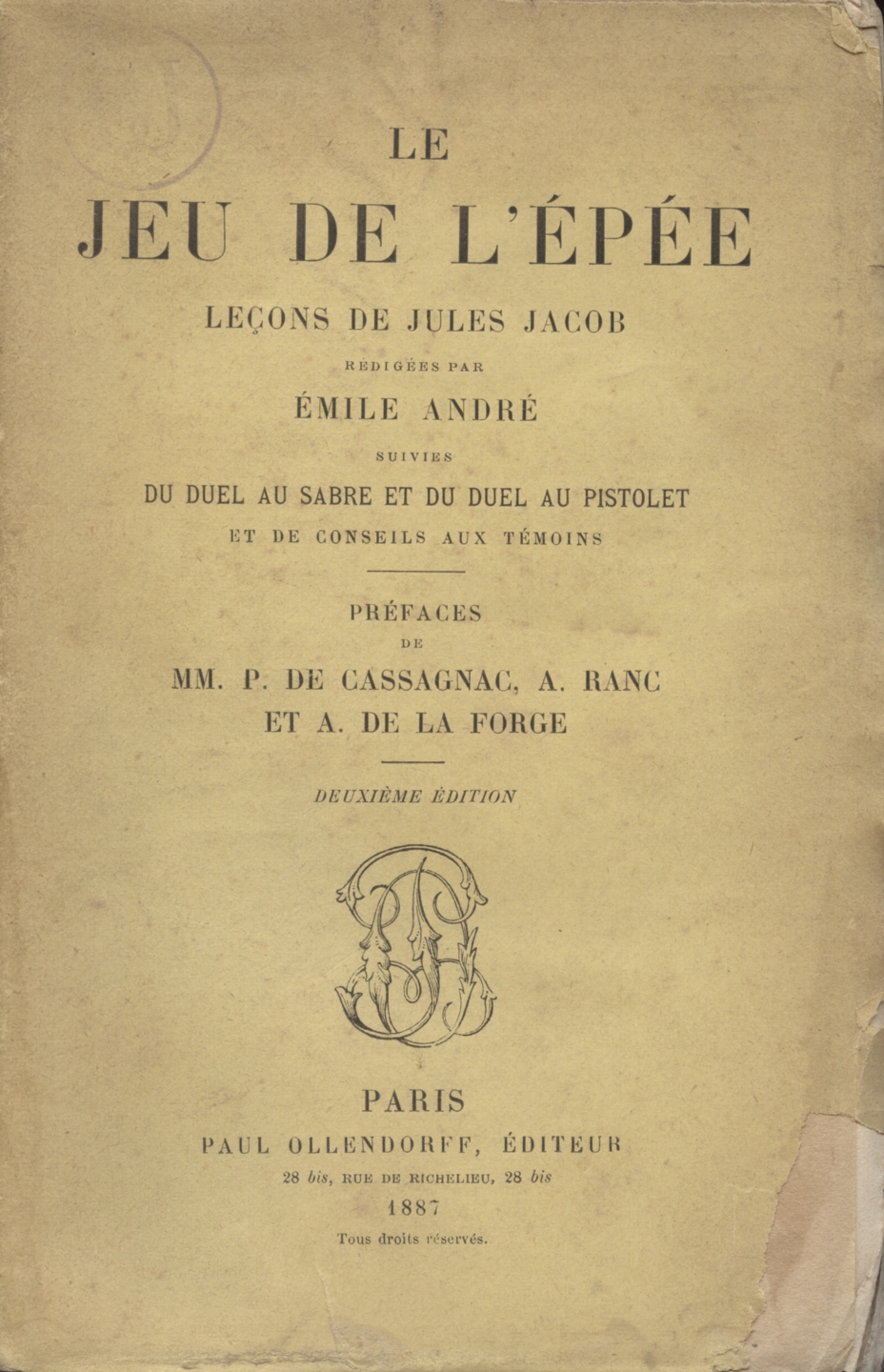
Le jeu de l’épée by Jules Jacob, as reported by Émile André, 1887. Lessons of the fencing master who essentially created modern epee in the 1870s. By the third quarter of the19th century the foil had become a “weapon” of pure sport, although it had been heading in this direction since the late 17th century. M. Jacob adapted smallsword technique to create a form of swordplay suitable to surviving a duel with the 19th century épée de combat, or mere epee, as its modern descendant is called. The technique emphasized longer distance and hits to the arm—and thereby also reduced convictions for manslaughter and murder. It some came to be known as the “modern school,” as opposed to the “traditional school”–foil fencing, that is.
The book outraged many foil purists, who subsequently went into sophistic denial when his epee technique proved far superior to foil technique in a duel: Jacob’s less technically proficient epeeists were deadly against even highly skilled foilists, who maintained that the only difference between the technique of the salle and of the duel was the accompanying mental attitude. (If true, attitude was clearly deficient among the fleurettistes who fought duels with Jacob’s épéistes.) The book plainly points out the difference between the jeu de salle (sport fencing) and the jeu de terrain (swordplay of the duel), and reminds us that many of the best duelists were usually not “forts tireurs”—good sport fencers, that is. The same would doubtless be true today. Highly recommended. There is, I believe, an English translation now available.
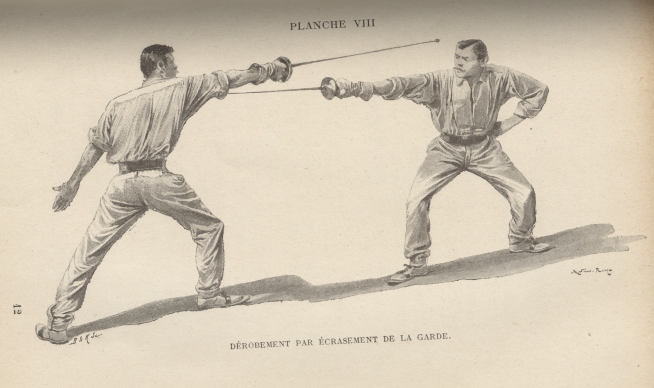
L’Épée by Claude La Marche [Georges-Marie Felizet], illustrated by Marius Roy, 1884, reprinted 1898 or 1899; also The Dueling Sword, an English translation edited and translated by Brian House, 2010. Very thorough, and in its translation was for a long time the only early French epee and epee dueling manual available in English. Real swordplay, in other words, and useful even to epeeists today. To a degree the book is a somewhat foil-based response to the purely epee-based technique of M. Jacob (see above). M. La Marche differs from M. Jacob on some points, particularly on the value of attacks to the body, of which M. La Marche is in favor, as were smallswords-men (and smallswords-women).
The modern trend in epee, at least at the elite levels, and among instructors who train less skilled fencers as if they were elite fencers, emphasizes attacks to the body. Where to emphasize attacks—arm or body—has been an ongoing re-argument ever since the flat electric tip was introduced to replace the much superior “pineapple” tip in the early 1960s, rendering arm shots more difficult. The epee fencing argument over arm versus body derives from late nineteenth century dueling practice—arms hits could easily settle honor in the modern age in which killing a man in a duel would surely send the perpetrator to prison, and the longer distance that facilitated them was simply safer. For reasons that would take up too much space here in discussion, the body was also the primary target in the smallsword era—but the dangers of this distance were mitigated by the use of the unarmed hand to parry and oppose as necessary, and by the extensive use of opposition and prises de fer. Similar varying perspectives are seen in sport epee today. Notably, and often forgotten by some fencing teachers, roughly thirty percent of epee touches today are to the arm, not the body, even with the emphasis on the body as the better target for the flat modern epee point. A highly recommended book, and useful even to modern competitive epee fencers.
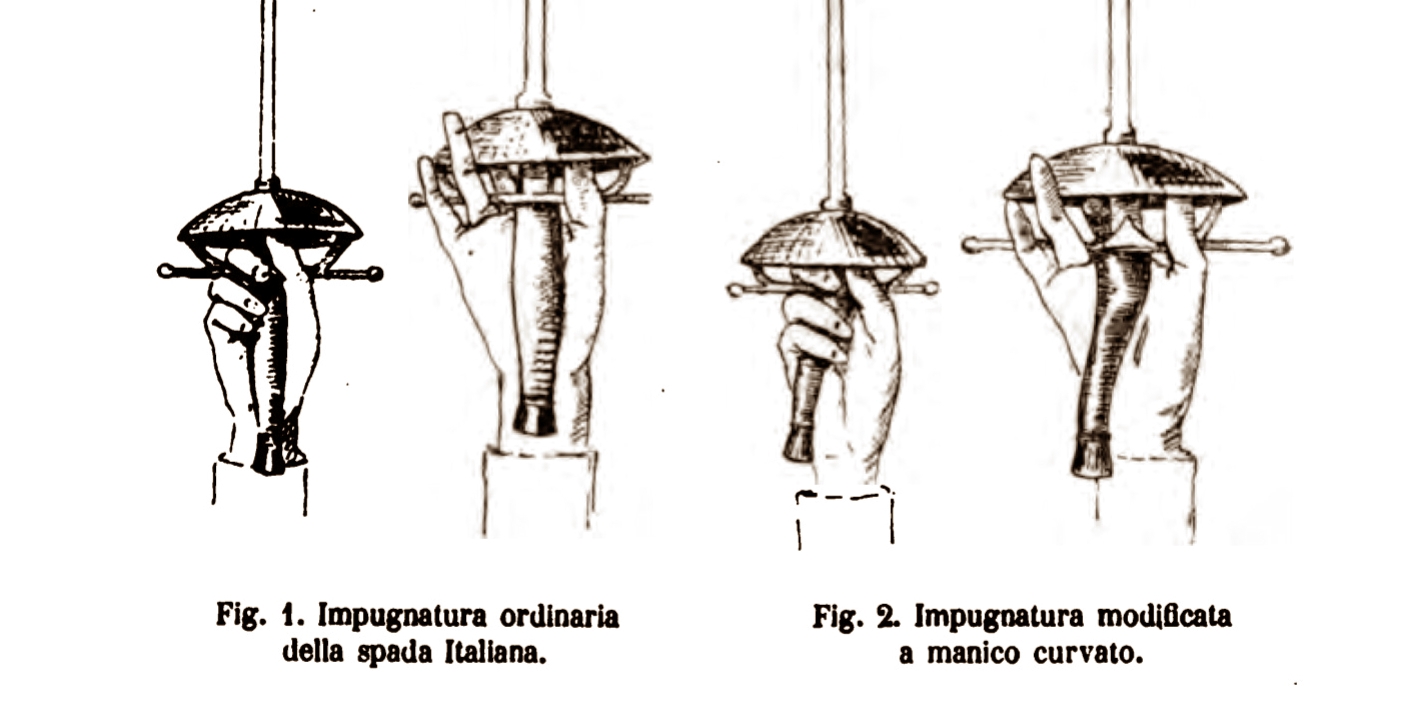
Manuale Teorico-Pratico per la Scherma di Spada e Sciabola by Giordano Rossi, 1885. A manual of the Italian dueling sword and dueling saber, very practical, very classically Italian although it does include some “modern” usages, including a choice of Italian spada with a curved grip, akin to a later French grip, with a significant set to the blade, although it doesn’t seem that this style of Italian grip won many fencers over–but did it perhaps influence the French to increase the curve of their grip? I haven’t seen any French foils or epees circa the 1880s with such a severe curve. The book demonstrates a technique quite useful to epee, and in fact the influence of the Italian school would become a significant part of modern epee.
L’Art du Duel by Adolphe Eugene Tavernier, 1885. Advice on dueling. Suggests tactics and techniques for the epee duel, including how to deal with the inexperienced adversary, the average one and, of course, the expert swordsman. Of interest to the student of fencing history and the duelist, and one of the few books to deal with the subject of tactics against fencers of various levels of competence.
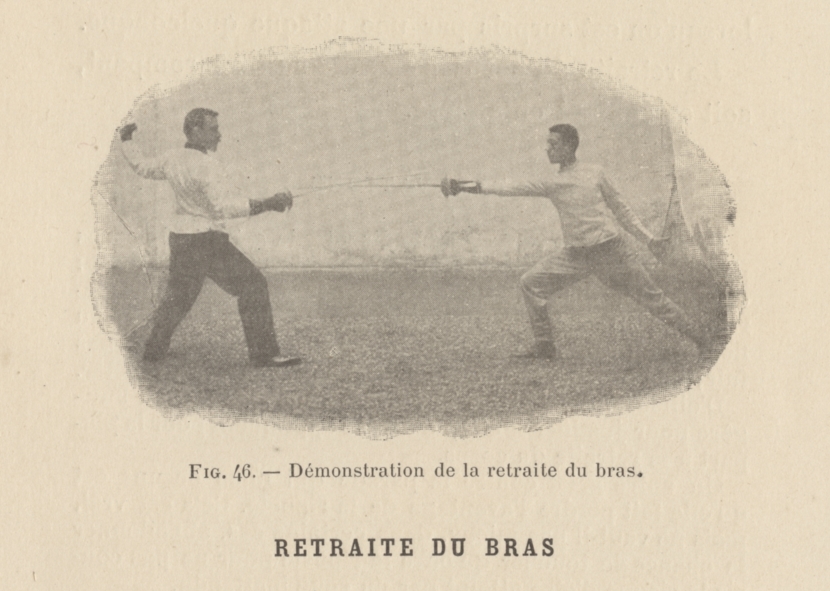
L’Escrime a l’épée by Anthime Spinnewyn and Paul Manoury, 1898. Excellent work on the epee de combat, with much practical advice on epee fencing, training, and teaching applicable even today. Among the many worthwhile admonitions is that the recovery from the lunge is just as important as the lunge itself–both must be as fast as possible, especially if the epees are pointed.

Les Armes et le Duel by Augustin Grisier, 1847. A magnificent treatise on mid-19th century fencing and dueling by a swashbuckling master, with a fascinating (and, as expected, long) preface — or more correctly, a “Préface en forme de causerie ou causerie en forme de préface” — by Alexandre Dumas. The book discusses dueling, technique, the two contemporary schools (one traditional, one modern, of course!), briefly the bayonet, fencing masters, and more. It might be included in any of several categories on this page.
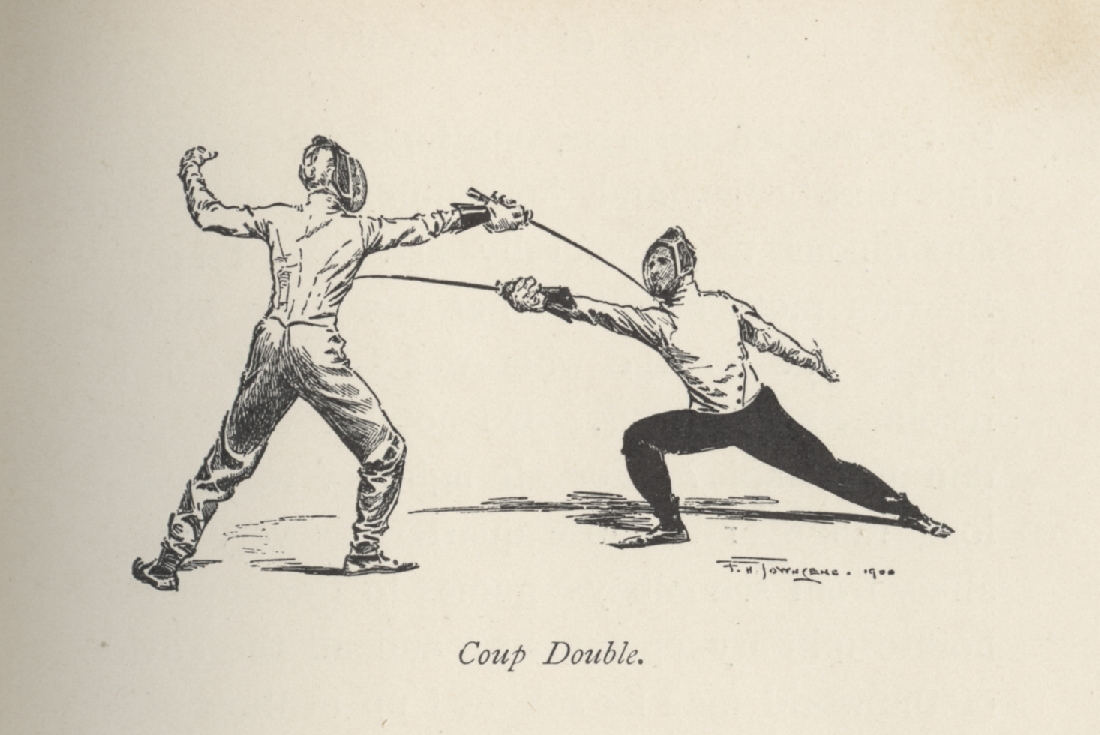
Les secrets de l’épée by Baron César de Bazancourt, 1862, published in English as Secrets of the Sword in 1900, reprint 1998. Practical advice on hitting and not getting hit from the mid-19th century. Much of the advice sounds quite modern. Likewise highly recommended.
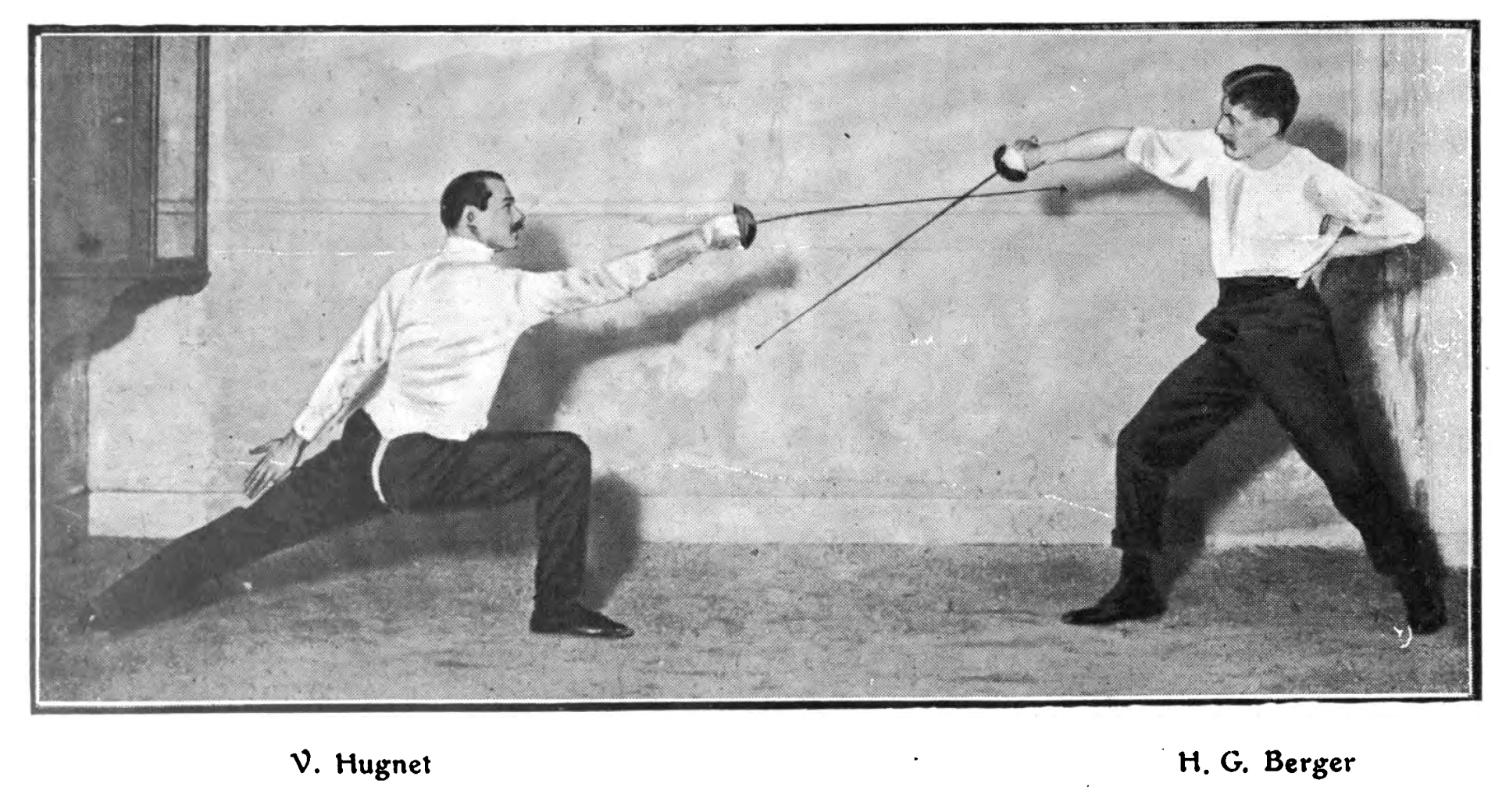
L’escrime, le duel & l’épée by Achille Edom, 1908. A remarkably prescient and practical work, one of my favorites, and one that demonstrates plainly that there is little new in epee fencing today. In particular, M. Edom, a Frenchman, recommends the more physical Italian style over the French, prefers the Greco offset guard and the pistol grip, and bemoans the rise of sport technique such as wide angulations to the wrist—thrusts that with dueling epees (with sharp points, that is) would not stop a fully developed attack to the body, leaving the attacker with a wound to the wrist, and the attacked with a possibly fatal wound to the chest, neck, or head.
The origin of these angulations was due much in part to the single point type of point d’arrét used by many at the time: a small ring was soldered to a real pointed blade a centimeter or so from the tip, then wrapped with heavy thread to act as a barrier to full penetration. Unfortunately, this heavy wrapping prevented hits at the shallow angles a real point was capable of, thus a new emphasis on unrealistic wide angulations. The three point “dry” and four point electrical, and later “pineapple” electrical points d’arrét greatly corrected this, but the subsequent modern flat point (brought into use in the early 1960s in order to quit tearing up the new nylon jackets perhaps?) inspired the popularity of severe angulations once more. In fact, almost any stop thrust to the arm would not arrest a fully developed attack, although you might have the satisfaction, as your adversary’s attacking blade penetrates your chest, of pinning his (or her) arm to his (or her) chest as he (or she) runs up your blade. Highly recommended.
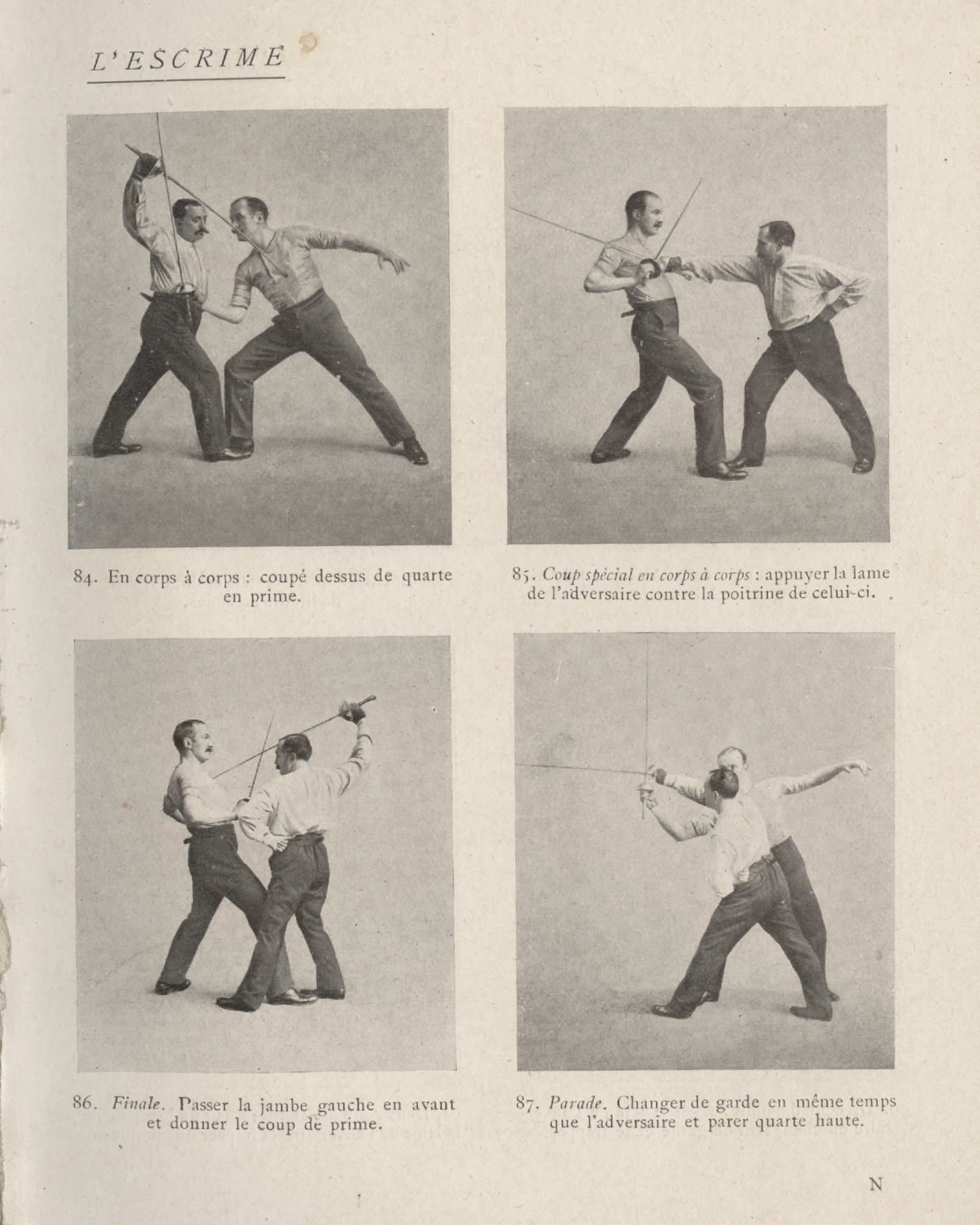
L’Escrime by J. Joseph-Renaud, 1911. One of the best of a number of outstanding epee books published during the Golden Age of epee and of books on the subject, by far. The author does by far a superior job explaining the faults in French foil for dueling, comparing French foil to Italian (thus explaining why Italians successfully trained with their foil for the duel with the spada or epee de combat but the same could not be said of the French), and explaining a wide variety of epee technique, both that which is correct and that which is faulty but commonly seen. Thoroughly illustrated with photographs, the volume is of great use to the modern epeeist, historical or classical epeeist, and fencing historian and theorist. Joseph-Renaud is a member of the community of epee masters for whom the lunge must always be preceded by a fully extended arm, and he does not recommend attacks to the body. Much of the reasoning for this is to protect the duelist from a potentially mortal wound in himself or in his adversary, the latter of which would result in criminal prosecution and the former of which, well… In fact, as smallswords-men of past centuries, and even the author himself, knew, the lunge with the arm extending near simultaneously (just a hair ahead, that is) is the fastest attack by lunge, and mandatory if one is attacking the body, not the arm. (And, to play devil’s advocate here, most of us would admit if we were honest that our point control during an attack with lunge is superior if we fully extend first…)
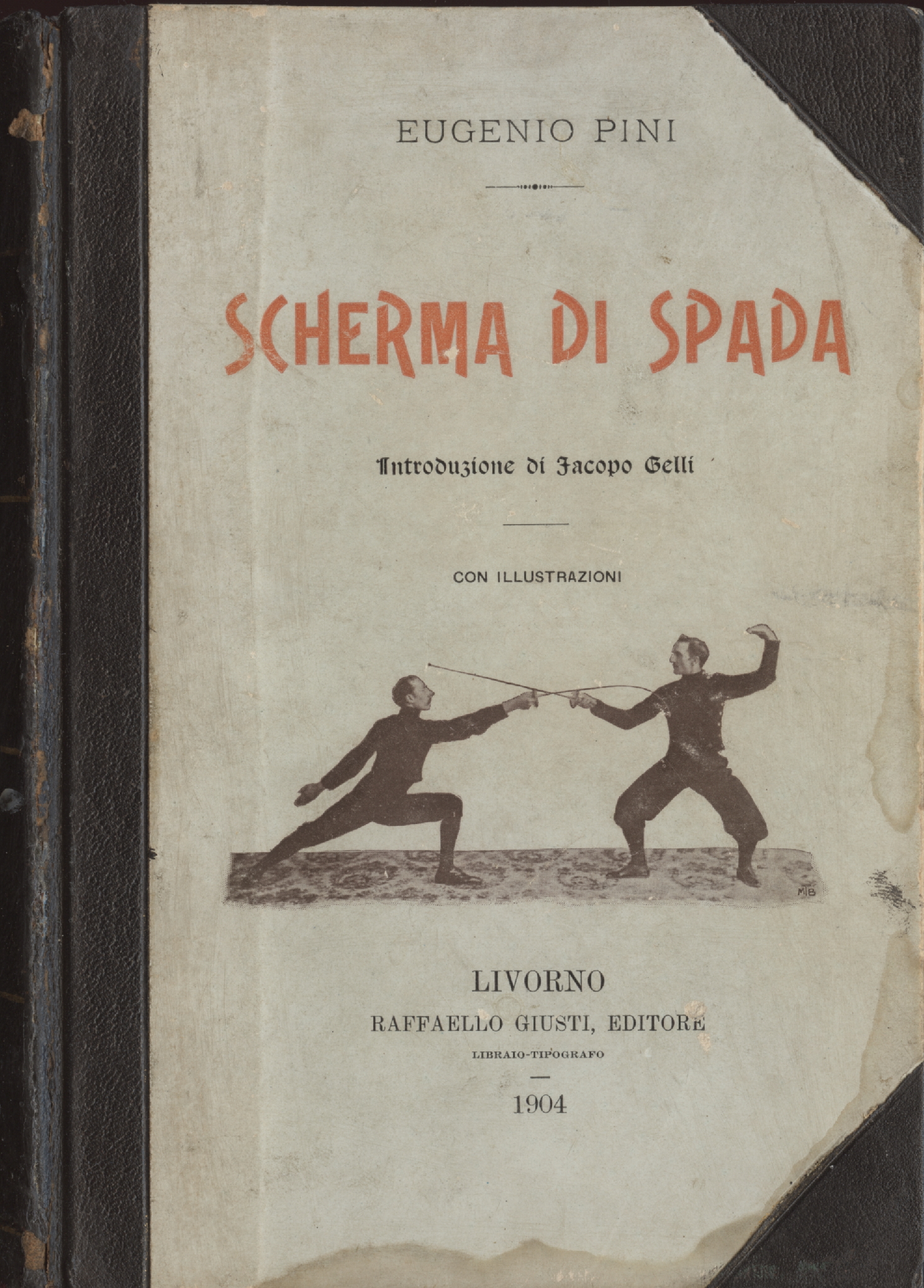
Tratto Pratico e Teorico Sulla Scherma di Spada, by Eugenio Pini, 1904. Excellent and thorough practical treatise on swordplay with the Italian spada or dueling sword by the Italian master who epitomized a form of swordplay that melded the Italian and French schools (more former than latter, though) and emphasized physical strength and speed–so no, this emphasis on power and speed isn’t new to fencing, nothing really is, in fact. At the time the book was written, the school of the Italian dueling sword was based on the fioretta or foil, which was used for training instead of the spada itself. Pini points out correctly that at the time the French schools had separated foil from epee, and epeeists were now taught with the epee rather than the foil, although this would soon change as French foilists, unhappy at being usurped by the “modern school” of epee and its epeeists, would attempt to reassert their dominance via a foil-based school of epee. For a long time the Hungarian school, via the Italian, kept up this tradition of training epeeists first as good foilists. In fact, it’s how I was trained almost fifty years ago. However, the modern divergence between foil and epee has made this almost impossible. Pini was a redoubtable swordsman whom some described as a panther when fencing. Like many masters of the era, he was a redoubtable duelist also.
The Sentiment of the Sword: A Country-house Dialogue by explorer, adventurer, linguist, scholar, writer, and swordsman Sir Richard Burton, 1911. As with Bazancourt’s book which inspired this Anglo version, not strictly an epee manual, but still useful for understanding swordplay in the sense of the need to hit and not get hit, as opposed to hitting according to conventions which deny touches not made in accordance with said conventions, but which in a duel would be quite real, and in many cases fatal. (Thus the practical and, if in a duel, fatal flaw in foil fencing.) Burton’s book also has some quite modern advice on learning to fence. Burton had used a real sword many times in bloody combat, and was known as an extraordinarily fierce warrior. Highly recommended.
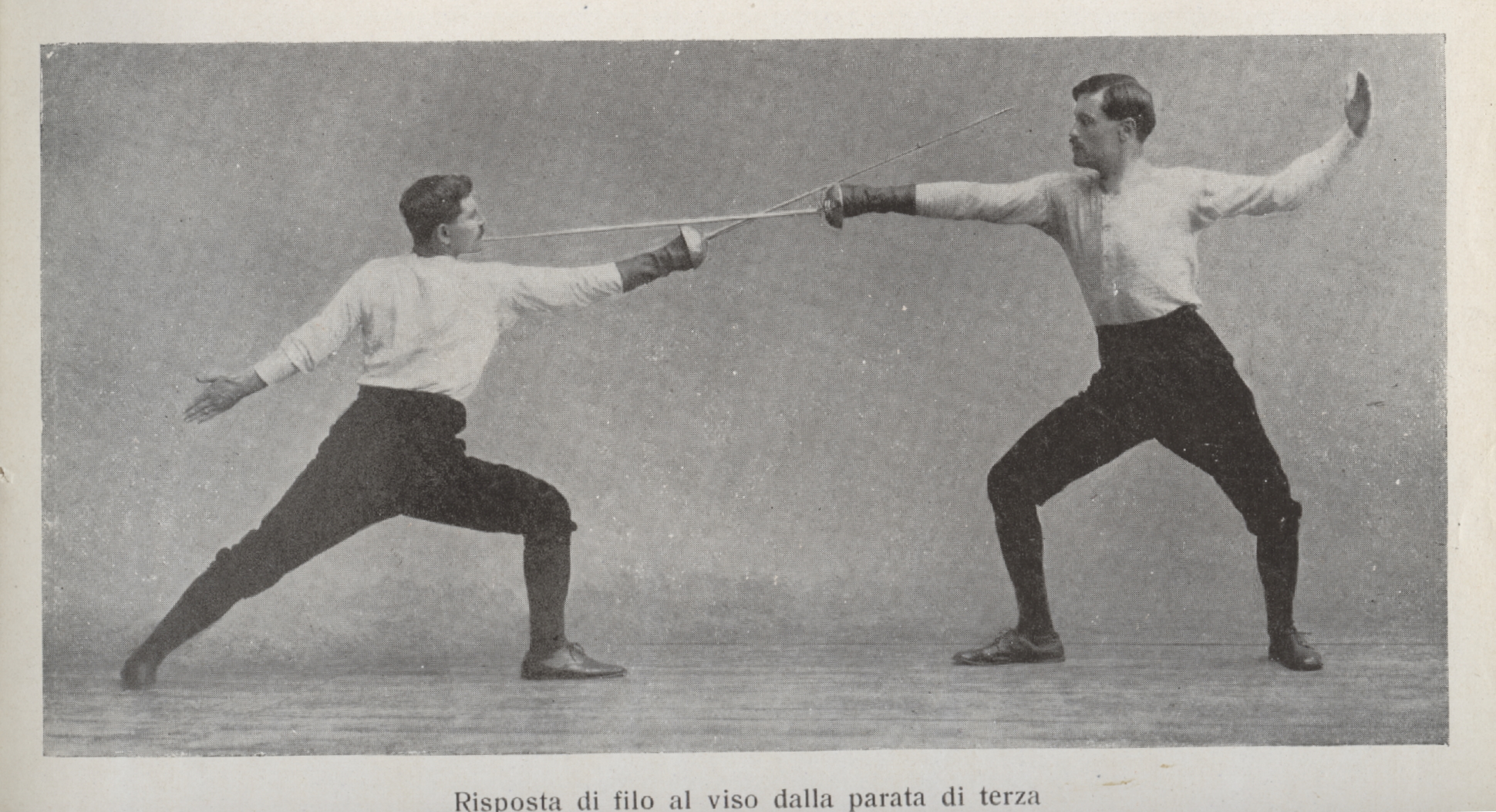
La Spada e la Sua Disciplina d’Arte by Agesilao Greco, 1912. Another of my favorites: a practical, very Italian text on the dueling sword, with, among other things, demonstrations of the Italian grip versus the French (e.g. showing that opposition with the Italian grip can overcome the extra length afforded by holding the French grip toward the pommel) and, a rarity in epee books, French especially, numerous bind thrusts to the head (filo al viso; in fairness to the French, Joseph Renaud describes and illustrates a stop thrust au visage with esquive).
The text also includes many examples of filo thrusts (bind thrusts, strong opposition thrusts) to the torso, which are often downplayed in French texts of the era, given the possibility of killing one’s adversary with them (better to hit the arm a few times and go home than worry through an investigation and possible conviction for manslaughter or murder; some period French texts do discuss these thrusts, particularly those of the “foil-epee” and “foil” French dueling schools). The book also includes descriptions of the Italian spada (noting that at the time they were of equal length, i.e. the Italian had a slightly longer blade), clothing and equipment, &c. The photographs are clear and well-posed. Unbelievably, my copy, signed, was never read: most of the pages are still uncut. Highly recommended.
Agesilao Greco was, along with his brother Aurelio, the greatest of a great family of fencers dating to the mid-19th century. The brothers highly influenced the Italian form of epee fencing for both dueling and sport. The Greco Academy of Arms in Rome still exists and still trains world class fencers. It also has a nationally-recognized fencing museum, the Casa Museo Accademia d’Armi Musumeci Greco that I’ve been told is well worth visiting. Greco’s description of the dueling spada is as elegant as the sword is; I’ve included it here and here. Agesilao was also known as an inveterate duelist with a fiery temper, and as a master and competitor he, according to William Gaugler, fenced every, or nearly so, famous fencer during his lifetime. His book on the spada was the most popular book on the subject in Italian in his era.
Épée, par J.-Joseph Renaud, 1913, in L’Escrime: fleuret, par Kirchoffer; épée, par J. Joseph Renaud; sabre, par Léon Lécuyer. Excellent advice on training, competition, and dueling, including a technical argument and diagram describing when to use sixte and its counter, and when to use quarte. This latter matter is more important than it seems, for most fencing instructors teach the usual parries and imply that any of the two classical French parries can be used in their appropriate quadrants in any circumstances (true in theory but not in practice) and should be varied in order to keep the adversary guessing (true in both theory and practice, but often difficult given that most fencers under stress have a preferred parry).
There are instances in which only a single parry—even in epee and smallsword, in which low line parries may be used in the high line as well, often providing several possibilities in each quadrant—is viable. For example, quinte (low quarte) against a powerful wide-angled attack, especially if directed toward the abdomen. Any other parry will often be forced or will fail to defeat the angulation. In fact, this is why the quinte parry was introduced. Or, against a wide, high, powerful, angulated thrust to the body in the high outside line (same handed epeeists), in particular when delivered via flèche by a tall strong fencer with his hand in tierce, a circle-sixte or even a circle-tierce will likely be forced even if timed well. A true prime will not defeat the angulation, and a common septime (Italian prime, mezocierco) must be taken too far out of line, exposing the arm to a simple disengage over the top. Octave and seconde cannot be taken effectively, for they too are likely to be forced. Only quarte or quinte (really just a low quarte) taken with the point out of line, with a riposte to the head or possibly the neck or shoulder, is viable in most cases. A modified prime (high sixte/septime) can work but can be difficult to execute if the attacker is tall and strong. Best to stop such attacks on their preparation.
The book includes a discussion of the Italian school. Although M. Renaud grudgingly admits that Italian foilists are equal to their French counterparts, he disparages Italian epee and by implication its rapier origins, stating categorically that the French invented epee fencing and the Italians were no match for French epeeists. In fact, the Italian epee school would soon rise to equal prominence with the French, with Edoardo Mangiarotti becoming one of the great epeeists of the 20th century. (These include Frenchman Lucien Gaudin of the early 20th century, Hungarians József Sákovics and Győző Kulcsár of the mid- and late century. Johan Harmenberg (1976 – 1980) should probably make the list as well. Were I to include possible twenty-first century epee greats as well, I’d suggest Timea Nagy and Géza Imre of Hungary, and Laura Flessel-Colovic of France. Doubtless other epeeists could join this list.)
Naturally, M. Renaud avoids any discussion of what might happen were French epeeists to trade their epees for Italian dueling spadas. Compare his comments on the Italian school to those of Achille Edom above. Side bar: he notes that most French epee schools of the era had outside gardens for practice, in addition to the indoor salle. Pity we don’t have these today…
“Technique du Duel en Une Leçon Suivi des Règles usuelles du Combat à l’épée” by Georges Dubois, published in La Culture Physique, 1908. Excellent work based on the author’s experience preparing would-be duelists for the duel, including those who have never held a weapon before (whom he advises to constantly counter-attack with a retreat). Disposes with many myths regarding dueling: he points out that most duelists weren’t fencers, and suggests that the epee was designed to help keep both combatants alive and thereby avoid the charge of manslaughter or murder. Never was a weapon so well designed to keep adversaries from killing each other, the author notes.
L’Escrime de Duel by Georges Dubois, 1913. A more conventional epee text intended for dueling than his Technique du Duel above. He does not dismiss foil, as many epee masters did. He discusses the Italian school, provides realistic technique for dueling, discusses preparation for a duel including how to prepare a novice duelist with no fencing experience for a duel twenty-four hours later, and breaks down several demonstration bouts and actual duels for the purposes of educating the reader. He recommends that both attacks and counter-attacks be directed toward what some masters in English have called the “shoulder hole” (the area between the deltoid and the pectoral) because one is more likely to hit even the advanced target when the point is aimed here, given that the target arm was near-certain to be extended on both attack and counter-attack (a fact often forgotten by many epee fencers today who constantly target the bent arm in the adversary’s en garde, and miss as the target arm is extended). Many masters today emphasize thrusting to the shoulder hole — but if over-emphasized the student may forget that it’s also useful to target the lower extending arm in tempo.
See also the “Classical Fencing” section below.
Combined Modern Epee, Foil, and Saber Texts
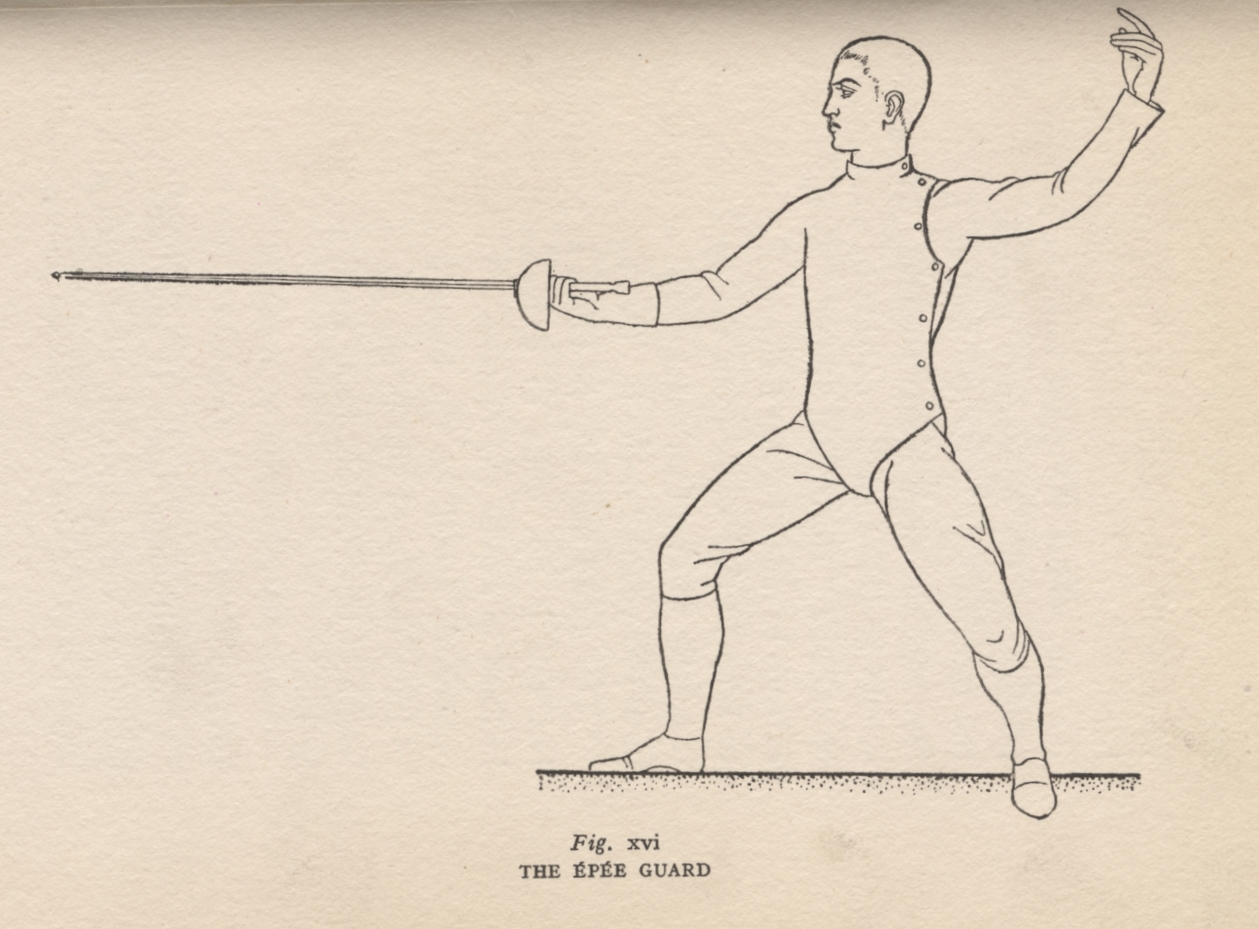
The Art of Fencing by R. A. Lidstone, 1930 and Fencing: A Practical Treatise on Foil, Épée, Sabre by R. A. Lidstone, 1952. The second significantly revised book is more thorough, with a very useful, clearly written epee section with plenty of exercises for master and pupil. Discusses tactics, unusual epee en gardes, and, in the foil section, unusual displacements, most of them Italian. It even describes Professor Guissepe Mangiarotti’s “jump back”—an epee counter-attack made while leaping back and landing on the front foot. The second edition is an excellent practical work drawing from both the French and Italian, highly recommended. In fact, along with Szabo’s work, the second edition is one of the most useful books on fencing on this entire page. For fencing historians, a comparison of the first edition to the second edition shows how much, and how quickly, modern fencing changed during the first half of the twentieth century.
Fencing by Joseph Vince, 1937, 1940, revised edition 1962. Illustrated by US saber champion, designated Olympic team member (until he suddenly abandoned competitive fencing for the stage), and swashbuckling actor Cornel Wilde. Vince was a US national coach and national saber champion who kept a salle in Beverly Hills for decades, and, until 1968 when he sold it to Torao Mori, owned Joseph Vince Company, a fencing equipment supplier that provided, among its complete line, classically dashing fencing jackets of a fit and style unfortunately no longer seen. In fact, my first fencing jacket was a “Joseph Vince, Beverly Hills” made of a heavy, high thread count cotton with silver-colored buttons. The left, that is, unarmed, sleeve was lighter and cuffed. An elegant style truly to be found no more.
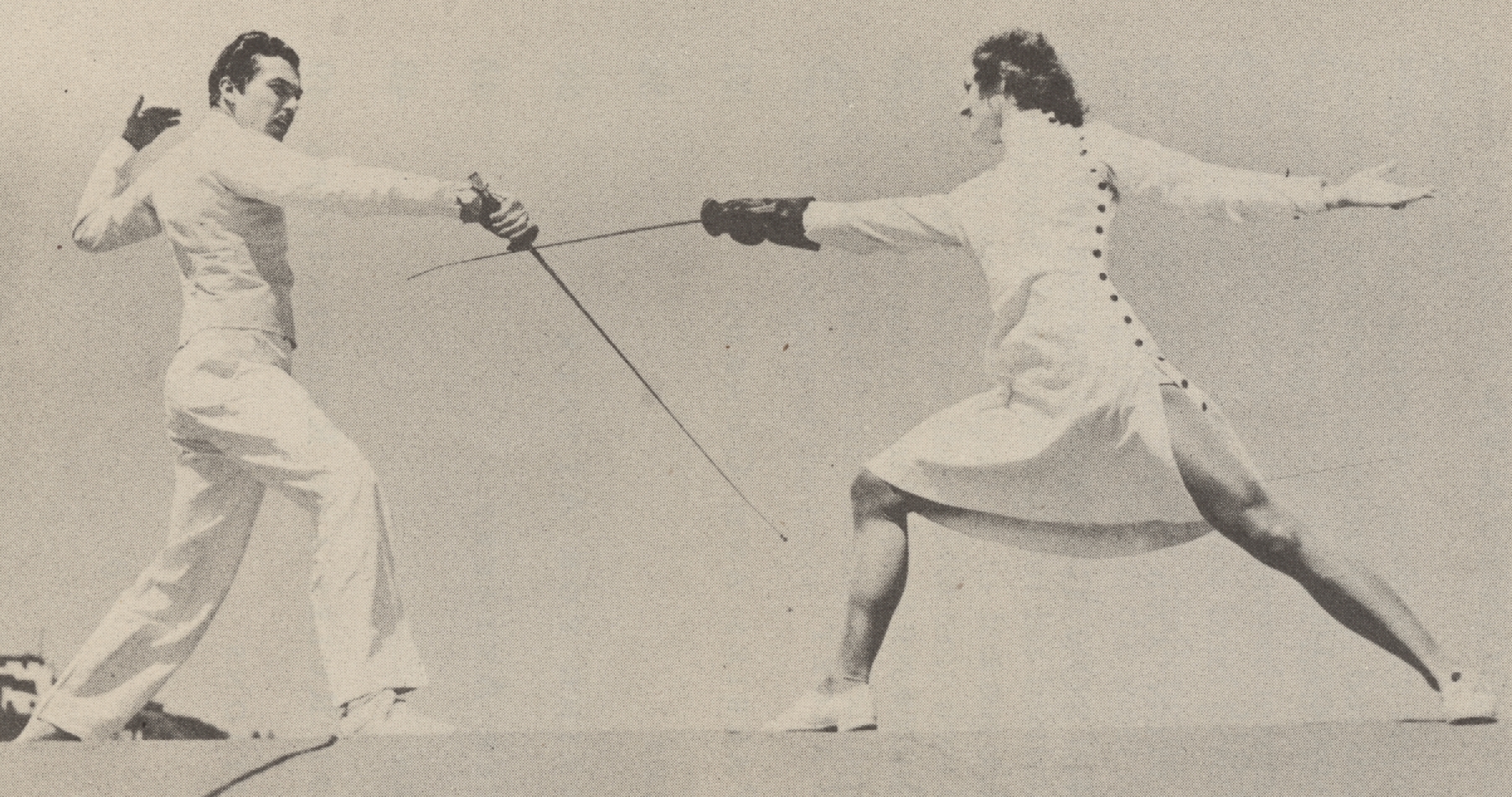
Fencing for All by Victor E. Lawson, 1946. The front cover gives the title as How to Fence. A very short basic text, only slightly more than a pamphlet, notable only to the fencing historian, particularly him or her interested in the history of women’s fencing. Lawson’s book actively promotes women fencers, although most appear to be aspiring actresses and models, and the caption of one photograph strongly suggests that Lawson’s goal is to promote his fencing salle in NYC as a means of attaining poise &c for actresses (I use the now generally discarded feminine of “actor” here because “female actor” sounds a bit stilted, and in Lawson’s day he appears to have been recruiting women primarily, not men). Notwithstanding his purpose, Lawson’s little book does actively promote women fencers, and has several useful photographs of women in fencing attire of the 1940s, quite different from today. It also has a good summary of fencing rules at the time. Other titles in the series include Police Jiu Jutsu, Scientific Boxing, and How to Be a Detective–everything to to prepare the reader to be the dark sword of a film noir.
Modern Fencing: A Comprehensive Manual for The Foil—The Epee—The Sabre by Clovis Deladrier, 1948, reprint 2005. Strong epee section. Includes exercises, lesson plans, and excellent practical advice. Readers should not be put off by some terms and practices that seem dated, for example Deladrier’s use of the classic older terms low quarte for septime and low sixte for octave, and his preference for the center-mount epee guard. The epee section is worth serious study. The teaching advice and lesson plans for advanced epeeists called upon to teach at times is also a useful review for experienced epee coaches. Deladrier was the fencing master at the US Naval Academy.
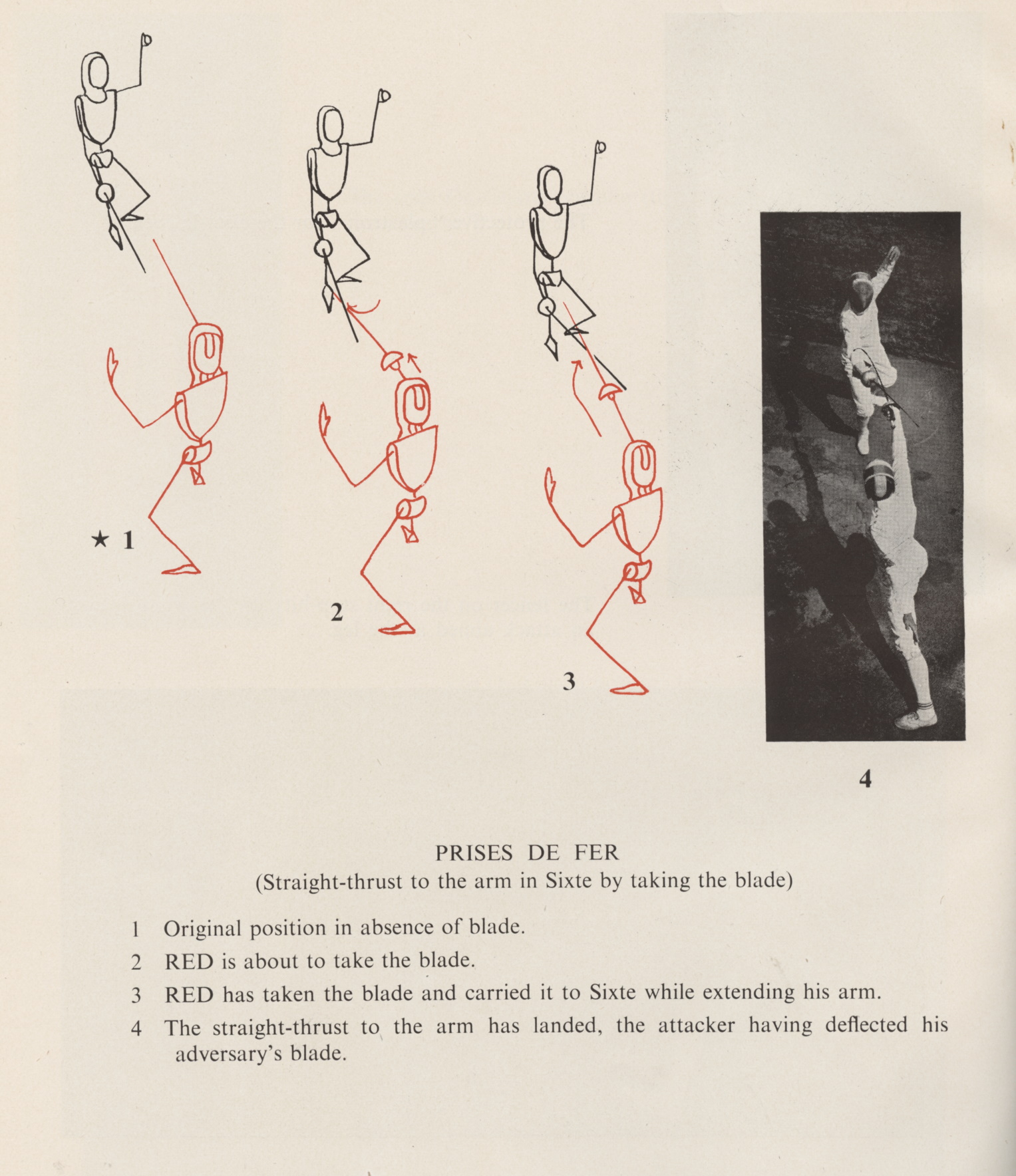
Fencing Technique in Pictures, 1955, edited by C-L. de Beaumont, assisted by Roger Crosnier, with contributors Léon Bertrand, Bela Balogh, and Raymond Paul. Basic foil, epee, and saber instruction by a who’s who of UK fencing masters of the past century, in line drawings and photographs, the former of which look a bit like the robots in the old comic book, Magnus, Robot Killer. Useful information, still applicable today. The book is one of three on this page attempting to show action in sequence in more than two or three steps using photographs or illustrations, the other two being Bertrand and Anderson. I suspect the format of the images and size and color of the book may have influenced Bac Tau’s excellent edition (see below) which in some ways might be an homage. “Dedicated by permission to The Rt. Hon. Sir WINSTON CHURCHILL K. G., O. M., C. H., M. P. First Honorary President of The Amateur Fencing Association.”
Fencing: Ancient Art and Modern Sport by C-L de Beaumont, 1960, 1970, revised edition 1978. Solid “classical” text on electric foil and epee, and dry saber by a noted British master and Olympic fencer. Excellent, perhaps best anywhere, description of the character and characteristics of epee fencing (de Beaumont was an epeeist). Good chapters on tactics and training.
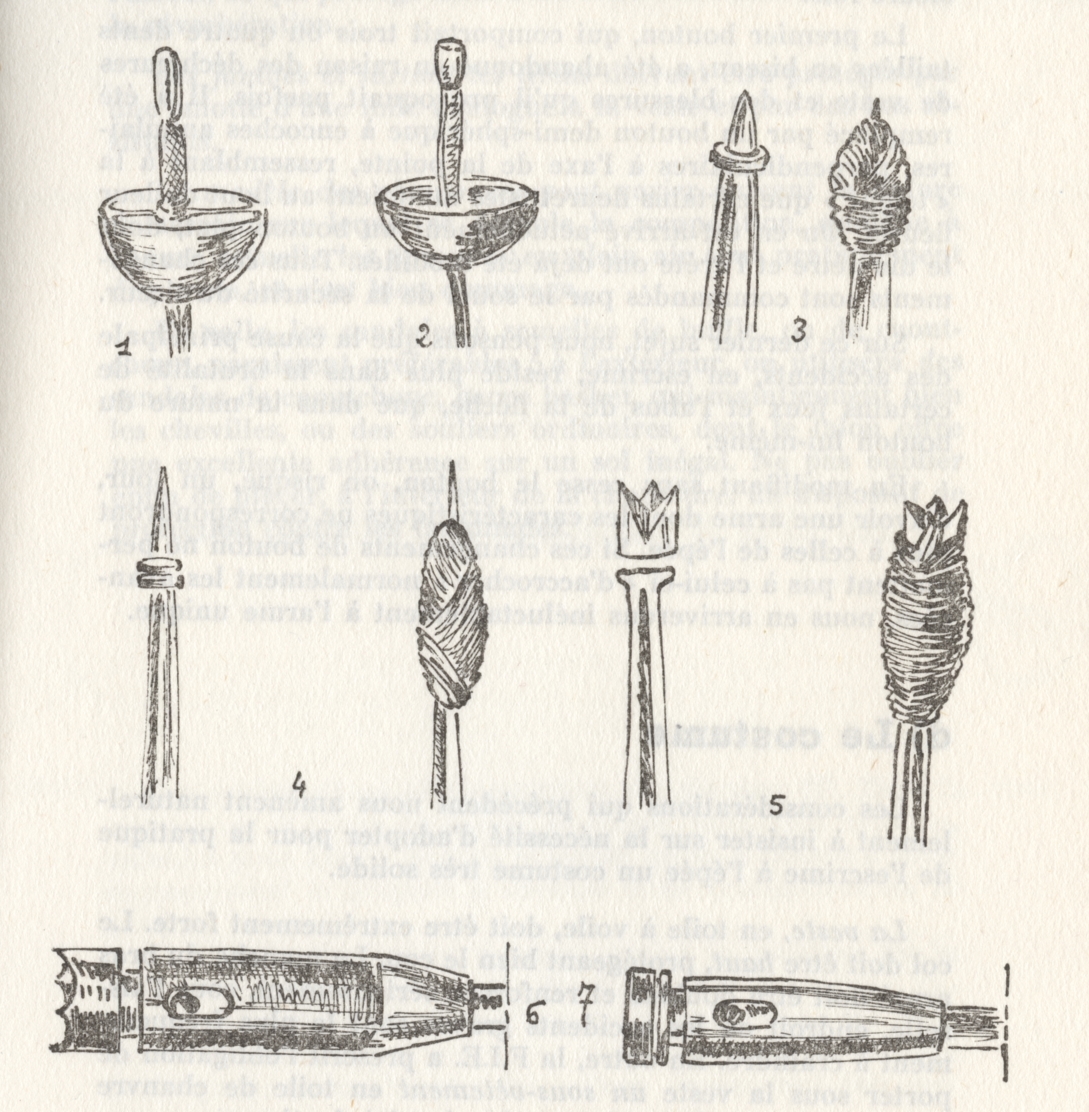
Escrime by Raoul Cléry, 1965. A thorough, practical text, absolutely one of the best, by one of the great French masters. Highly recommended. The epitome of the French school in foil and epee, but the saber is Hungarian and is so noted. While serving as Commandant of the Fencing Division at the military school at Antibes, Lt. Cléry wrote his Traité d’Escrime de Pointe: Le Fleuret et L’Epée (Société Française de Presse, 1948) upon which his later work is heavily based. The five books in the latter work’s bibliography (Edom, André, Renaud, Prévost & Jollivet, and the 1908 rules) are also all outstanding, practical works.
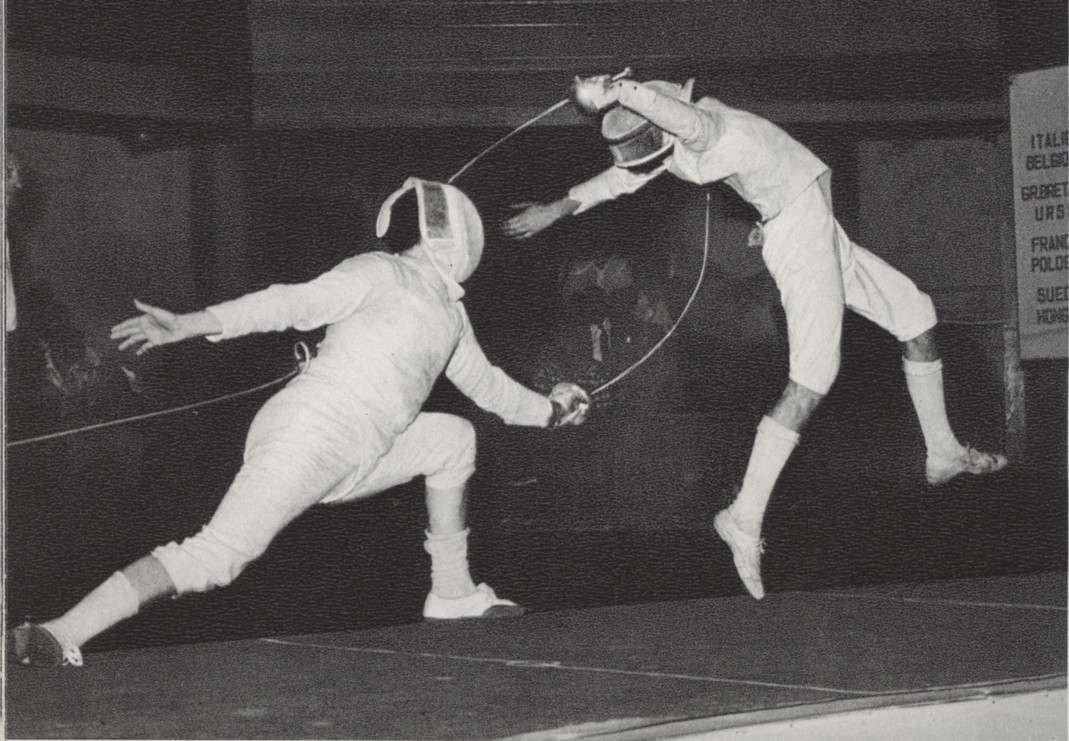
La Vera Scherma by Edoardo Mangiarotti and Aldo Cerchiari, 1966. A very useful book for all three weapons, although I’m naturally more disposed to its epee section, particularly given Mangiarotti’s fame in the spada. Exceptionally well-illustrated. In Italian, and the modern classical Italian school, of course. An excellent beginning to intermediate text on all three weapons. One of the virtues of this book is the use of photographs of technique in action, showing what fencing actions actually look like as performed by elite fencers. Most fencing books use posed photographs or otherwise idealistic illustrations, providing elevated expectations of the often unattainable except at slow speed with a conforming partner. There is nothing wrong with illustrating the ideal, providing it is pointed out that it is exactly that, an ideal, seldom to be seen in practice even by elite fencers. The book also includes line drawings of ideal technique.
Modern Fencing: Foil, Epee, and Saber by Michel Alaux, 1975. A thorough introduction to all three weapons by one of the great French masters who taught in the US. Short but good sections on bouting tactics, lessons, and conditioning. Excellent text for the novice fencer through intermediate fencer. The French school, of course.
Fencing: The Modern International Style by Istvan Lukovich, 1975, 1986. By the author of the noted Electric Foil Fencing. Excellent if brief epee section, very useful to both epeeists and their teachers in that it covers and explains most of what most epeeists will ever need to know. The Hungarian school. Highly recommended for all three weapons.
L’Escrime by Jacques Donnadieu, Christian Noël, and Jean-Marie Safra, 1978. Solid introductory to intermediate text, quite well-illustrated with many photographs of fencing technique, including of technique in competitive action. I’m also somewhat partial to the book given that its images, taken as they were at the time I began fencing, are nostalgic.
Fencing: Techniques of Foil, Epee and Sabre by Brian Pitman, 1988. Solid beginning to intermediate text.
Fencing by Bac H. Tau, 1994[?]. A tome that includes thorough sections on training, tactics, and weapon repair. Excellent section on physical training for fencing, along with other highly useful appendices. Deserves far more attention than it has received. Highly recommended: a delightful book to read. The book size, cover color, design, and illustrations may have been influenced by–in homage to?–Fencing Technique in Pictures, edited by C – L. de Beaumont, 1955.
Foil, Saber, and Épée Fencing by Maxwell R. Garret, Emmanuil G. Kaidanov, and Gil A. Pezza, 1994. A very useful beginning to intermediate text.
Fencing: What a Sportsman Should Know About Technique and Tactics by David A. Tyshler and Gennady D. Tyshler, 1995. Excellent information but an at times poor translation from Russian. Supplement with the Tyshler DVDs (available from many fencing equipment suppliers), or better yet, simply refer to the DVDs. David Tyshler was a Russian master and Olympic and world championship medalist; Gennady Tyshler is a leading Russian master. Quite a few excellent fencing and teaching materials produced by the Tyshler’s are now available online.
The Complete Guide to Fencing, edited by Berndt Barth and Emil Beck, 2007. The German school. A thorough, up-to-date text. Good sections on theory, performance, and athletic training (with a useful emphasis on high rep exercises). Good epee section, much derived from the highly successful Tauberbischofsheim school of epee founded by the largely self-taught Emil Beck.
Modern Foil
The technique described in many of the books in this section is based on the 20th century rule that a foil attack consists either of a fully extended arm with point threatening—aimed at, that is—the valid target, or the later rule which permitted an extending arm with point threatening relaxed, and correctly so, in order to accommodate the highly useful and historically proven progressive attack. These rules were rooted in dueling practice and therefore make more sense if we want fencing technique to reflect its dueling origins.
However, the modern interpretation of an attack is a sophistry that permits the point to be aimed away from the target during the extension: if it will end up at the target in the end, it is therefore a valid attack, or so the sophists argue and thereby permit. The old duelists knew better. To make counter-attack against a valid attack with extended or extending arm aimed at the target would likely result in a double hit. However, a counter-attack against a “bent-arm” attack, in particular one with the point not directed at the target, might well result in a single hit, thus the validity of the counter-attack over the attack in this instance. In the former instance, the attacker’s point would continue forward and hit in spite of the counter-attack; in the latter it probably would not.
In other words, a valid attack should not consist of a bent, non-extending arm at any point, especially one with the point aimed at something other than the valid target. Attacks in invitation or otherwise with a bent non-extending arm are quite simply not in the spirit of staying alive. In other words, were the swords pointed, the modern attack would be simply suicidal. Unfortunately, right-of-way in foil and saber have abandoned this principal, permitting attacks with a bent-arm and the point well out-of-line. Put more simply, fence epee until foil and saber are fixed—if ever they are.
Fencing with the Foil by Roger Crosnier, 1955. One of the best expositions of modern classical foil of the French school ever written in English. Excellent explanations of practical theory, including on tempo and the progressive attack. Frankly, excellent throughout. Epeeists should read it together with Crosnier’s epee text, foilists together with Lukovich’s foil text.
Foil Fencing by Muriel Bower [Muriel Taitt], 1966 et al. Numerous editions, prefer the latest (1996, Muriel Taitt). Solid beginning foil text, used over the four decades by thousands of beginning fencers, including in 1977 by the compiler of this list of books in a beginning class taught by Dr. Francis Zold. Or at least I think it was this text. Perhaps it was Curry’s instead? The second editon of Bower’s version includes as co-author Torao Mori–a noted competitive fencer and fencing master–who took over the Joseph Vince Co. fencing supplier on Crenshaw Blvd (and where I purchased my first fencing mask, jacket, and glove in 1977).
Fencing by Nancy L. Curry, 1969. Solid beginning foil text although dated in terms of “modern” foil technique and rules. Even so, a good text on core technique. The book is clearly intended to accompany a college-level beginning fencing class and here it succeeds, describing in basic terms the fundamentals that can be covered in a single semester. As with a few other texts, it has useful images of fencing technique taken from above in order to show correct relationships. Nit-picking here: in the acknowledgements, a reference to the famous Castello fencing supplier is written as Costello, a typo and surely not a hat tip to Abbott and Lou…
All About Fencing: An Introduction to the Foil by Bob Anderson, 1970, 2nd printing 1973. The book is unique in that the reader can, by flipping pages, see properly executed technique, and in a manner superior even to much of the modern fencing video available. There is a hint of two of sexism common to the era—Anderson states that only men can cope with the epee and sabre, for example, which is nonsense—, but few fencing books of the first seven or eight decades of the 20th century do not take such a view. Some might disagree with some of his brief fencing history as well, but the history in many fencing books is open for debate, based as it often is on common understanding as opposed to rigorous analysis.
Anderson was a British Olympic fencer and Olympic coach who became Hollywood’s leading swordplay choreographer, following in the footsteps of Fred Cavens, Ralph Faulkner, and Jean Herrimans. The fencing in Star Wars, The Princess Bride, and Alatriste are but three of his many film works. (His book is also one of the first two books on fencing the compiler of this list ever read. In fact, the book was in the Mount Miguel HS library—seldom anymore will you find fencing books in high school libraries.) Mr. Anderson died on January 1, 2012, and was inexplicably and inexcusably snubbed by both the 2012 and 2013 Oscars during the In Memoriam segment.
Electric Foil Fencing by Istvan Lukovich, 1971, 1998. Perhaps the most thorough electrical foil text, with excellent sections on fencing theory and requirements. Valuable even today, in spite of being written and published prior to the modern debasement of right-of-way conventions (i.e. attacks in invitation or “bent arm” attacks legitimized), although foil and saber were already inclining in this direction when Lukovich wrote his book. I strongly recommend studying this text hand-in-hand with Barbasetti’s book on foil; this will provide the student with a thorough understanding of the classical and modern foil games, and how one developed into the other — not to mention provide a thorough understanding of foil theory.
Foil and The Revised Foil by Charles Selberg, 1975 and 1993 respectively. Thorough and very useful, with a good section on tactics. In general, the Hungarian (or Italo-Hungarian) school. Highly recommended, but prefer the 1993 Revised Foil. Selberg also produced an extensive selection of instructional videos. Now on DVD, they are available from Selberg Fencing at http://www.selbergfencing.com/.
Basic Foil Fencing by Charles Simonian, 2005. A solid introductory text.
Foil Lessons With Victor by David A. Littell, 1994. A twenty-three page foil monograph far more useful than its brevity might suggest. It’s based on the author’s lessons from fencing master Victor Bukov. Useful in all three weapons, it presents a variety of tactical methods of attack, heavily distance-based. Readers familiar with Hungarian theory and practice (and thereby Russian and general East European) will recognize the descriptions.
“Modern” Saber
By “modern” I intend the saber techinique introduced or even created by Italo Santelli et al in the very early 20th century in Hungary. I understand fully that this weapon — Hungarian saber, in essence — no longer exists except in the hands of some aging fencers. It is otherwise vestigial, even if some vestiges remain strong. The school and weapon were deliberately destroyed by the flawed electrification of the saber and the degrading of right-of-way conventions, solely for the purpose of opening saber medals to more than the very few nations who dominated the weapon for almost a century. I have included the Borysiuk text because it follows in the tradition of detailed, scholarly even, fencing texts and is the only thorough modern electrical saber text in English.
Cut and Thrust: The Subtlety of the Sabre by Leon Bertrand, 1927. The author was the fourth generation of famous English masters of French descent, the family having taught not only many great English fencers, but some English royalty plus Napoleons I and III. Leon Bertrand studied widely, including saber under Italo Santelli and then in Italy, receiving both a fencing master’s certificate and a knighthood as part of his latter experience. The first third of his book is a delightful foray into fencing as sport, dueling, exercise (and why fencing is the premier means thereof, or should be), with numerous anecdotes along the way. The saber text itself is solid, presenting the Italian school that developed into the Hungarian; one might argue that his technique is Italo-Hungarian. The author, by the way, is a proponent of the full extension prior to lunging, and of focusing on the entire fencer and blade, and not on the hilt/blade or other area along. The book’s tone and technique are quite familiar to me: in fact, my first fencing master, Dr. Francis Zold, would have known Bertrand from his time with Santelli. Bertrand was also one of the two London masters who trained actor Basil Rathbone, one of the best Hollywood actor-fencers. (More detail on Rathbone and Hollywood fencing can be found here.) Bertrand’s saber book is one of my favorite fencing texts, possibly in my top three. Highly recommended!
Modern Sabre Methodology by Zoltán Beke and József Polgár, 1963. Translated from the Hungarian. Not “modern” in the sense of the most recent form of saber fencing, but “modern” in the sense of twentieth century Hungarian saber before saber’s debasement via the electrical scoring system and the degeneration of the interpretation of right-of-way. Worth acquiring if you can find an affordable copy, but if you do it will likely be by accident, unfortunately. Mine was. A very thorough exposition of every technique in the Hungarian saber repertoire. Not for beginners! One of my favorite passages is its excellent, simple definition of tempo, along with the very useful discussion following, all suitable to all three weapons—or to all swords in all places in all eras, in fact. It is also, from a historical perspective, easy to see how Hungarian saber influenced Hungarian epee, and therefore modern epee. I highly recommend studying this text hand-in-hand with Bertrand’s Cut and Thrust: The Subtlety of the Sabre and Barbasetti’s work on saber: collectively these will provide the student with a thorough understanding of the classical (i.e. Italian) and modern (i.e. classical modern Hungarian) saber schools, and how one developed into the other — not to mention provide a thorough understanding of saber theory.
Fencing With the Saber by Roger Crosnier, 1965. Excellent, thorough work on “Hungarian” saber, second only to that of Beke and Polgár above. A suitable companion to Prof. Crosnier’s works on foil and epee. Note, however, that the terminology and categorization of technique is of the classical French school, not the Hungarian. The fundamentals are still useful today. Naturally, Prof. Crosnier does not permit the attack with the arm in invitation or otherwise bent…
Modern Saber Fencing by Zbigniew Borysiuk, 2009. Only if the modern “weapon” known as electric saber appeals to you. Still, a very good book, and the only thorough one on the subject in print in English. Unintelligible conventions plus attacks with the un-extending arm held low in invitation while leaving the body nakedly exposed plus awkwardly cramped footwork plus hitting with the flat of the blade do not saber fencing make. The flat merely chastises: it’s the edge that cuts. The rest is simply too tiresome to debate.
The Cléry and Lukovich titles in the “Epee, Foil, and Saber” section have excellent instruction on Hungarian saber. Cléry also includes some detailed history of the origin of the Hungarian school. The Beck/Barth text includes excellent information on modern post-Hungarian saber. As noted above, the famous Hungarian saber technique was destroyed principally by the electrification of saber, said by knowledgeable world class fencers and FIE sources to have been a compound decision based on the likelihood that the obvious flaws in electric saber would permit a less strict technique, particularly when aided by a debasement of right-of-way, and would thereby open international saber medals to more than the handful countries with the critical mass of elite saber coaches and sabreurs able to master in-depth the clear, clean technical repertoire of the Hungarian weapon; such technique was mandatory for correct judging.
For half a century Hungary reigned over twentieth century saber, and maintained a strong grip on it even after a number of sabreurs defected during the Melbourne Olympic Games in response to the 1956 Hungarian uprising against the Soviet Union. Recent US gains in modern electrical saber were based in part on the early willingness of US coaches to embrace the new “weapon,” while some of their European counterparts, who had previously excelled in saber, attempted to continue the use of traditional Hungarian technique.
Theory, Teaching, and Training
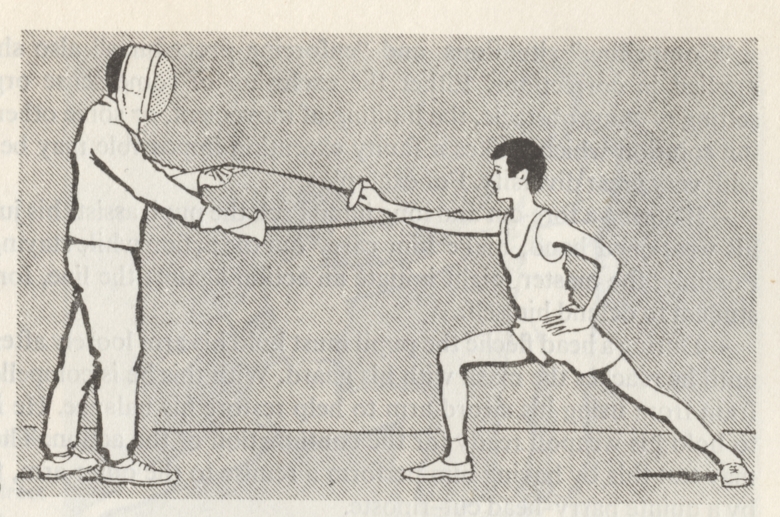
Fencing and the Master by László Szabó, 1977, 1997. Forward by Dr. Eugene Hamori, a student of Szabó’s (and my second fencing master), in the 1997 edition. The best book ever written on the subject of teaching fencing: the fencing coach’s vade-mecum. Highly recommended. Excellent material on theory and other aspects of fencing, besides the practical. Intermediate to advanced fencers will also find it useful, in particular for its sections on tactics, preparation, drilling, and stealing distance. Szabó, who trained a number of Hungarian champions, was one of Italo Santelli’s three protégés and a close friend of Dr. Francis Zold, my first fencing master.
László Duronelli and Lajos Csiszar were the other two Santelli protégés. Csiszar was master for many years at the University of Pennsylvania after emigrating to the US. Among his students were Dr. Eugene Hamori and Roger Jones, the latter of whom one day contacted me about writing a review of one of my books; during our conversation we realized we had the same ultimate fencing roots and identical views, therefore quite understandably, on honor in fencing. Duronelli was master for many years at the fencing salle at Semmelweis High School, run by Semmelweis University, in Budapest. This delightfully old school salle, which has produced many champions, is still in existence, with László Szepesi, who helped bring saber gold to France, as its current master (or at least he was when my wife and I visited some years ago). Eugene Hamori along with Krisztina Nagy (a very talented fencer and master in both HEMA longsword and modern Olympic saber) escorted us on the visit to the salle.
A Dictionary of Universally Used Fencing Terminology by William M. Gaugler, 1997. A well-researched fencing dictionary although it could have been even longer — but then, only fencing aficionados like myself might read it. “Universally Used (But Not Always Agreed Upon) Fencing Terminology would be a more accurate title.
Escrime: Enseignement et entraînement by Daniel Popelin, 2002. In French. The theory and practice of teaching fencing and training fencers. Rather than use the typical pyramidal view of fencing from its base to its competitive elite at the point, M. Popelin suggests a truncated pyramid, whose range is from beginner to national level, to indicate the majority of fencers, and a cylinder on top of this to indicate international and aspiring-to-international fencers. He astutely notes that the majority of fencers do not seriously train to become elite fencers, for many reasons, and thus fencers should be trained differently according to their needs. In other words, the training of the “club” fencer, no matter how talented, should be different from that of the elite competitor. Or put another way, simply because a technique, classical or otherwise, is not used at the elite level is no reason for non-elite competitors to abandon it or, worse, never learn it.
Understanding Fencing by Zbigniew Czajkowski, 2005. Highly recommended for fencers and coaches interested in practical theory. Czajkowski is a leading Polish master whose students in all three weapons have earned gold at the Olympics and world championships.
One Touch at a Time by Aladar Kogler, 2005. The psychology and tactics of competitive fencing, by an Olympic fencing coach and noted sports psychologist. Recommended.
Theory, Methods and Exercises in Fencing by Ziemowit Wojciechowski, circa 1986. By a world-class fencer and master. Foil-based, but still an excellent book for fencers and coaches of all three weapons. Good information on evaluating and dealing with an opponent’s tactical style, especially in foil, although, again, still useful in epee and saber.
See also Joseph Roland, The Amateur of Fencing, in the “Historical Fencing” section below.
“Classical Fencing”
(Modern Non- Electrical Technique)
Some of the books below (Barbasetti, Gaugler) use one of the several classical Italian parrying systems and numberings, as opposed to the French or modified French systems and numbering preferred by most teachers today. (There are also several French-based numbering systems, each differing slightly in the naming of a parry or two, or in the use of a parry, for what it’s worth.) All of the books below are useful to the modern electrical game, epee particularly, and to foil and saber at their fundamental level. At some point foil and saber may return to a more classical standing, rather than their present sport-dominated extreme artificiality, notwithstanding that foil has always been highly artificial, at least for the past 150 to 200 years, and moderately artificial prior to that. Even in the heyday of dueling there was a distinction between “school play” and “fencing with sharps.” See also the texts listed in the “Epee de Combat” section.
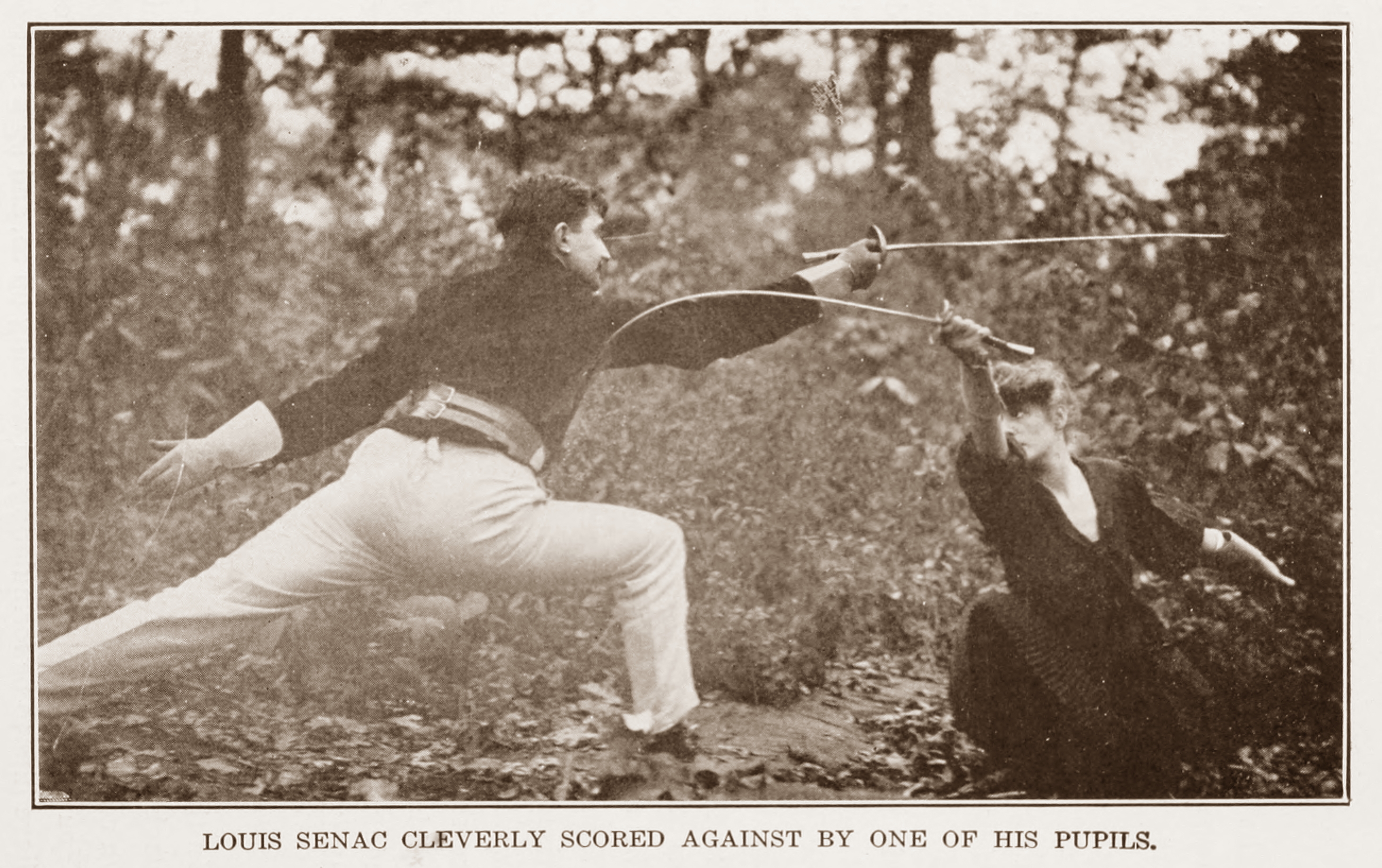
The Art of Fencing by Louis and Regis Senac, with a section on saber by Edward Breck, 1904 (hardcover), also 1915 & 1936 (softcovers, with foil and saber by Breck). Part of the Spalding Athletic Library, the book is particularly useful to fencing historians as it covers a transition period in modern fencing, has illustrations of clearly expert women fencers (unfortunately unidentified), has lengthy fencing equipment adds (1905), shorter equipment ads (1915), and the 1905 Amateur Fencing League of America fencing competition rules (1915, 1936). The book’s downside–but only occasional–is its excessively evangelical attitude in promoting the French school, an attitude associated with patronizing and common-at-the-time claims that one must be an overly-muscular athlete to fence well in the “inferior” Italian school. Blame the psychological reaction of inferiority by spindly and otherwise un-athletic French fencers to the hyper-muscular Italian swordsman Eugenio Pini for this. One can also be lean and still very strong, as with the whipcord muscles of some of Rafael Sabatini’s heroes, a physical type well-suited to fencing and found in reality as often as in fiction. To my mind, there is no excuse, other than long-term injury or disease, not to be fit: with strong muscles, good flexibility, and excellent aerobic and anaerobic endurance. Although the book nobly promotes women’s fencing and notes that at least one woman fencer was more than a match for any man, it does recommend fencing to women in part because it “reduces surplus adipose tissue, making their figures trim and comely, rounds their muscles, develops their busts,” &c. Perhaps this was mere marketing and not sincerely-held chauvinism.
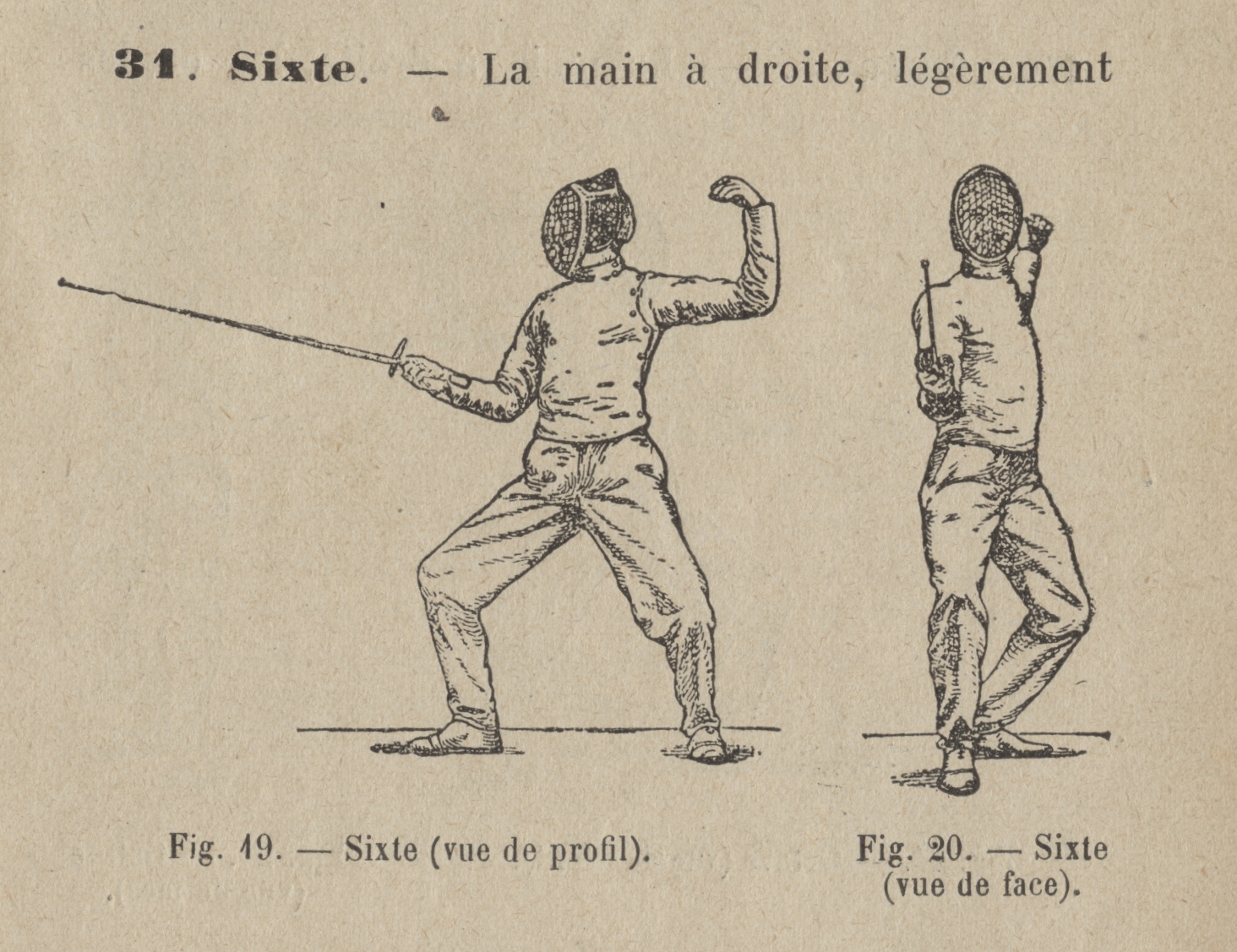
Réglement d’Escrime by the Ministère de la Guerre, France, 1909 and other editions. A short treatise on foil fencing for the French military that provides a detailed look at the classical French school. Useful for classical fencers and historians, and, frankly, any fencers interested in French technique given that it remains sound today, at least as a foundation. Oddly, one would have expected the French military to have adopted the new epee technique rather than foil at this time, and even more so, would have emphasised the saber instead of either, given that it was still in use as a practical military arm at the time.
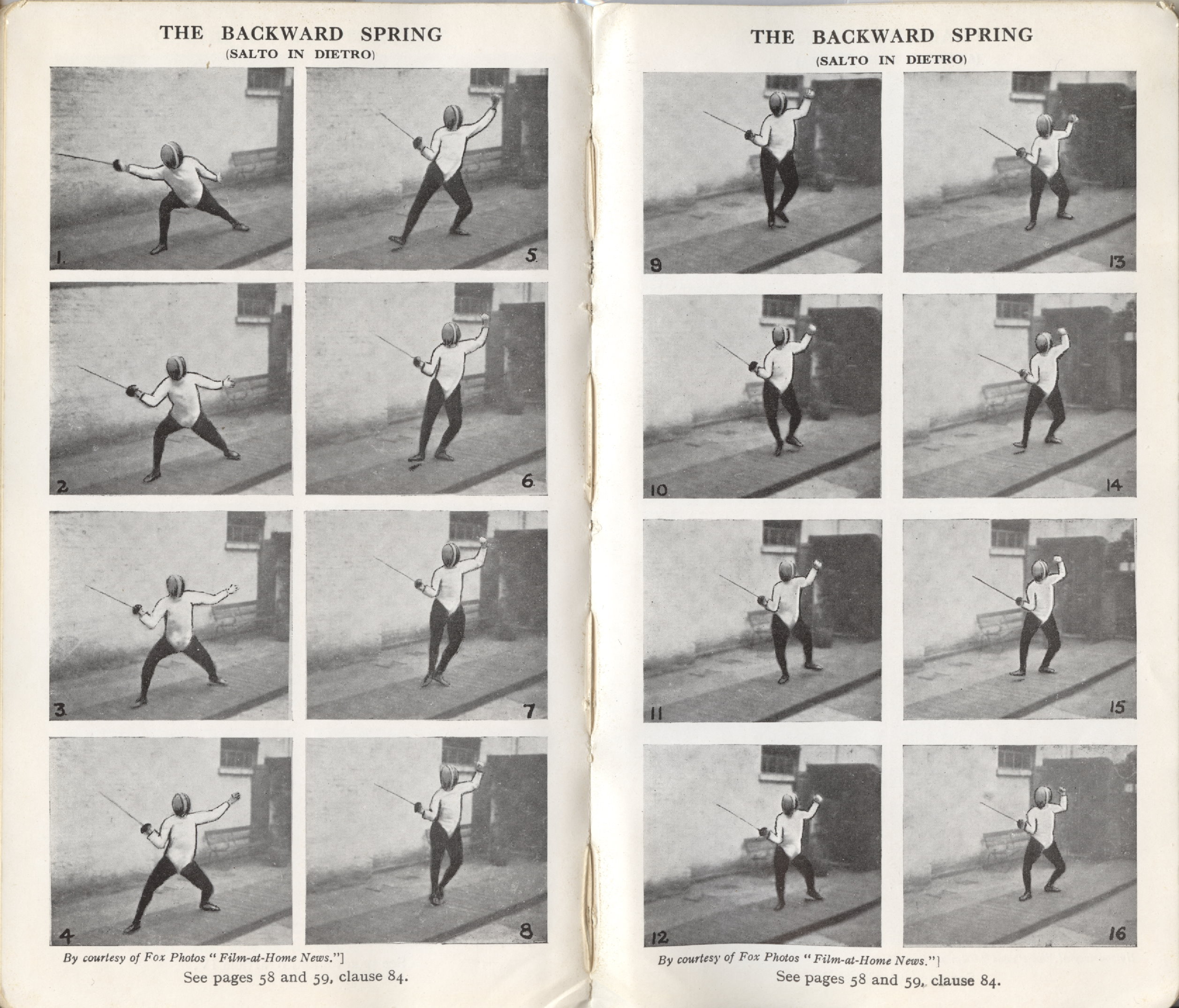
The Fencer’s Companion by Léon Bertrand, 1934 to 1958 and possibly later. A delightful little book, hardcover but pocket-sized, with enough information on all three weapons to substantially educate fencers from novice to intermediate-advanced, with fundamental lessons required at all levels of fencing. The book also includes useful advice on teaching fencing. Prof. Bertrand — son, grandson, and great grandson of famous British fencing masters of French descent, was one of the most influential masters in the history of modern fencing in the UK. Among his many students was famous actor (and decent fencer, and by decent I intend the classical definition, that is, very good) Basil Rathbone. Bertrand’s book on saber (see above) is one of my top five favorite fencing books.
Among Prof. Bertrand’s useful advice is to learn to fence from the beginning with both hands, starting with the weak hand first for balance. It’s advice unlikely to be followed often but it has excellent virtues, and will likely be the subject of a blog post one of these days. More than a quarter century ago I began learning to fence left-handed in order to give left-handed lessons as well as right. During COVID I seriously incorporated left-handed footwork, drills, and fencing into my regimen, equal those of my right-handed, with quite useful results. Prof. Bertrand also has advice for fencing against classical Italian fencers, in which the counter-quarte and Italian prime (a high septime) dominate. (Note for readers of Imre Vass: his “destructing parries” in quarte and septime correspond to–are equivalent to–these two classical Italian parries that in combination “cut the line” or “destroy” feint attacks in the high line and will parry high-low and low-high feint attacks in the inside line.)
I’d not be surprised to find that The Fencer’s Companion influenced All About Fencing: An Introduction to the Foil by Bob Anderson, in particular the images of technique in action. Whereas Prof. Bertrand includes a series of photos depicting various actions as shown above, Anderson took this a step further so that by flipping pages the reader can see the technique in action, similar to a primitive film. See also Bob Anderson’s book on this page.
The Book of Fencing by Eleanor Baldwin Cass, 1930. The book is particularly noteworthy as it was, and remains, one of only a handful of fencing texts written by a woman, even including modern texts. Ms. Cass was an American, and the book was, not surprisingly, published in Boston, birthplace both of conservative American Puritanism as well as liberal progressive thought. The epee section is sparse, as is often the case with many three-weapon texts, but the foil section is classically thorough. The book is also a great source on much of the fencing history of the day, and thus quite useful to the fencing historian.
The Art of the Foil by Luigi Barbasetti, 1932. The Italian foil. An outstanding book that should be studied hand-in-hand with Imre Vass’s book on electrical foil. Barbasetti’s book includes a succinct but thorough history of fencing, a good section on tactics, and a glossary of fencing terms in English, French, Italian, and German. A useful book for epeeists as well. Barbasetti was one of several Italian fencing masters who carried Italian technique to Hungary and Austria, including to the Austro-Hungarian Normal Military Fencing School of Wiener-Neustadt in 1895 where he re-organized it. (Alfred Tusnady-Tschurl, one of my “fencing grandfathers”—the fencing masters of my own fencing masters—was a graduate and had studied under Barbasetti.) Italo Santelli was the most notable of these Italian immigrant masters. Santelli famously said that fencing is something you do, not something you write about—thus there is no book by Santelli in this list.
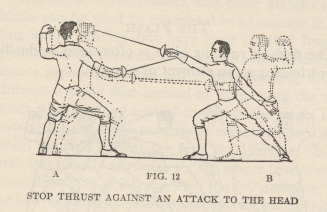
The Theory and Practice of Fencing by Julio Martinez Castelló, 1933, & Theory of Fencing, 1931. One of my favorite dozen or so fencing books. The author was trained in the early 20th century Spanish school, which was based on the best of the French and Italian, including a modified modified French grip that gave it the (theoretical) point control of the French grip with the strength of the Italian grip. (This grip is illegal in modern competition, although a pistol grip variation without an external weighted pommel exists that is legal, if you can find it.) The Neapolitan Italians were the first to formally attempt to combine the French and Italian schools on any scale, followed by the Spanish and, via the Italians, the Hungarians, although fencing “schools” have always adopted technique from each other and adapted it to their own methods. However, in both editions the author notes that the book, which he wrote to help “young men and women in the many schools and colleges” in the US, including those without a teacher, is not based entirely on any particular system, although he says the foil is mostly French, the saber Italian, and the duelling sword (epee) from his own experience.
The author notes that at the time he wrote his book the French school predominated in the US, and this remained largely true at least until the 1970s, in foil and epee especially, in spite of an influx of elite Hungarians in the 50s and 60s. (I was often told in the late 70s and early 80s that I fenced epee like a pentathlete, rather than conventionally, French, that is: in fact, I fenced like a Hungarian, although notably my lessons from two Hungarian masters and one French master–the famous Michel Sebastiani, French-Corsican, and a former pentathlete–were seamless and very similar.) Saber in the US was by the 70s largely Hungarian, at least among the best sabreurs. Castelló also writes that the predominant saber school circa 1930 was Italian, but in fact by then the Hungarian school, based on the Italian but modified to suit Hungarian attributes, was dominant. But this is a quibble, yet I’ll add one more: Castelló repeats the canard about the saber target being limited from the waist up because it was a cavalry weapon, i.e. one didn’t hit the horse. This is arrant nonsense, still repeated today. The target in saber is based on an old Italian rule that limited the target to the area above the waist in order to protect a duelist’s manhood. This is noted in numerous late 19th century Italian texts.
Castelló had also self-published a smaller volume, Theory of Fencing, in 1931. Copies could be ordered from the author himself for $2. The more detailed 1933 version was released by noted publishing house Charles Scribner’s & Sons. Both books–the later book is simply an expansion of the first in both text and illustration–are excellent sources of fundamental fencing theory and technique, knowledge often far too lacking in many fencers today. Castelló included an excellent description of the two most classical epee styles–“straight arm” and “bent arm”–and associated technique and tactics. (See Lidstone’s later edition above for others.)
Among Castelló’s students was Joseph Velarde, the West Point Military Academy fencing master whose stand against racial discrimination opened US collegiate fencing competition to Black fencers. By coincidence I once worked alongside Velarde’s son, a former US Marine Corps officer, many years ago. A decade before that I had first fenced with and competed against the founders of the old M.A.R.S. Fencing Club at the Marshall Space Flight Center in Huntsville, Alabama, most of whom were among the Apollo engineers who put humankind on the Moon. (The fourth was and is a brilliant Byzantine iconographer and the finest fencer I’ve ever seen in the old school straight arm epee technique.) One of these veritable musketeers, Joe Dabbs, who has since passed away, had trained for years under Velarde. I have remained friends with all of these old M.A.R.S. fencers for almost half a century, and most were active fencers until recently as age and old injuries restrained them, although I still fence with one of them regularly (Elias Katsaros, with French grips and true “hit and not get hit” dueling practice only!). John Jordan and Donny Philips—the other two members of the Four Musketeers—are also still with us. (And John, in his nineties, although he does not fence anymore, still has a fencer’s mind as sharp as a rapier and does forty pushups and situps, plus some dumbbell curls, daily.)
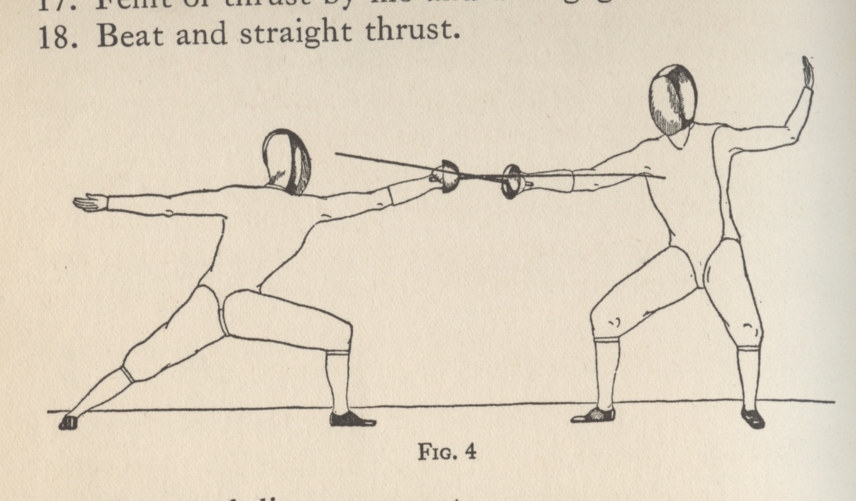
The Art of the Sabre and the Epee by Luigi Barbasetti, 1936. By one of the great early twentieth century masters. The epee section is quite sparse, and refers the student to the foil for much technique, a quite common practice in many of the Italian schools, given the similarity in technique and practice between the two weapons. Castello’s book (see above) has a far more thorough epee section. Barbasetti’s saber section should be studied hand-in-hand with Bertrand’s book on saber, and with Beke and Polgár’s book on saberas well. See above.
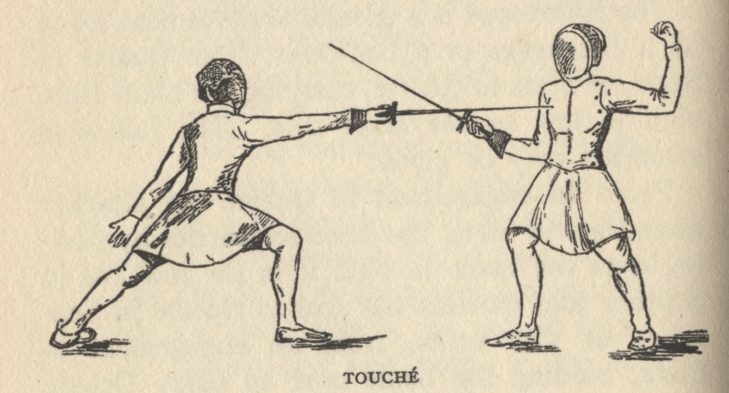
Fencing Comprehensive by Félix Gravé, 1934. A delightful and, too my mind, too short fencing treatise covering foil and epee, filled with pithy fencing wisdom that has never been out-of-date. The author’s general observations are also noteworthy. For example, the truly classical fencer in form and technique is born, not made. (Not to worry, those of you in the majority who weren’t born to fit into the classical mold–even in the days of “classical fencing” such fencers were rare, and one need not fit this mold in order to be a great fencer. Anyone who tells you otherwise is ignorant and probably, to quote The Princess Bride, selling something.) Gravé has good advice for teaching, on dealing with some of the more common types of fencer, on tactics in general, and for conducting a duel. For the fencing historian, he has several drawings of period fencing grips, the French interchangeable epee system (l’épée démontable), various guards (coquilles), pommels, points d’arrêts, the development of the fencing mask, &c. Interestingly and happily, he mentions women epeeists, and has an illustration of the clothing they should wear (“men’s,” basically) long before epee was permitted to women in competition, a fact that pleases me immensely. Like Bertrand above, Gravé taught famous actor (and decent fencer, see above for the definition of decent) Basil Rathbone.
On Fencing by Aldo Nadi, 1943, reprint 1994. A famous Italian fencer’s thoughts, pompous, patronizing, and otherwise, on technique and competition. For Nadi, there was only one correct way to fence: his. Held up as a god by many modern “classical fencers,” Nadi despised the French grip as much as many of the same “classical fencers” today despise the pistol grip and advocate the Italian and [Nadi-despised] French grips. Let no one claim that blind self-irony and hypocrisy, often humorous, even hilarious, never reigns among pseudo-experts, or for that matter, among quite a few true experts. Nadi also wrote an autobiography so pompous and self-indulgent that he could find no publisher during his lifetime. It was finally published in the 90s perhaps, I’ll have to check the date: I have so far been unable to get past the first few pages. Nadi also wanted to be an actor, but never managed more than a bit part in Key Largo. Reportedly, fencing audiences around the world cheered when Humphrey Bogard shot Nadi’s character.
The Science of Fencing by William M. Gaugler, 1997. A thorough modern description of purely classical Italian foil, epee, and saber technique. Pedagogical, as one would expect, and almost old school military in its technical presentation. Professor Gaugler, a student of Aldo Nadi and other great classical Italian masters, passed away in 2011.
Fencing Tactics
Many books touch on fencing tactics, but to date I’ve found one devoted exclusively to the subject — and it’s one of the best books on the subject of fencing in general I’ve ever read.
Fencing Tactics by Percy E. Nobbs, 1936. By the 1908 Canadian Olympic Foil Medalist, the book is a delight to read and study, easily one of a handful of the most practical fencing books ever written, certainly one of my handful of favorites even if I don’t agree with everything–and is a book generally unknown to nearly all fencers these days. It is also one of only two books by Canadians on this list (see also Bac H. Tau), and both are outstanding. However, take heed: the book is based on classical notions of tempo and right-of-way, and in some ways is an exposition largely of how the author fenced (similar to the books of Nadi and Harmenberg, for example).
Mr. Nobbs covers tactics in depth, better explains the difference between the classical Italian (and by implication, Italo-Hungarian) school versus the French, discusses opposition thoroughly, points out how important footwork is to tactics, and captures well the spirit and practice of each of the three modern weapons. He also describes the difference between free fencing (loose play), competition fencing, and exhibition fencing–and particularly how one should fence and behave in each form. For example, the superior fencer should trade touches with the weaker in free fencing, rather than simply trying to hit as many times as possible.
Mr. Nobb’s discussion of opposition is quite useful, with educational observations on the role played by the bend in the blade as it hits, something that would not occur with real swords and their very stiff blades. This blade bending is less relevant today with electrical scoring in epee, but is still pertinent in the conventional weapons: for example, a counter-attack without priority but whose blade bends as it hits can help exclude the arriving valid attack. In other words, the valid attack might have arrived were the blade to remain straight. The book also describes useful footwork beyond the conventional advance, retreat, lunge, and recovery, most of which is seen today, but not all. We rarely see, for example, the stolen march (forward crossover, lunge) today, although I was in fact taught it decades ago. Still, some epeeists today occasionally use a crossover followed by a fleche, often as a suprise attack after the command “Fence!” is given. Nor do we see the reverse rassemblement (standing as in a rassemblement but by bringing the rear foot forward) to make a counter-attack, a practice once used in foil.
Amusingly, Nobbs includes an epee counter-attack that concludes with a reverse-crossover-spin-jump-retreat! I’m no fan of turning the back in any martial practice, and the described technique would not only run afoul of the modern rule against doing so, and is clearly also pre-electrical, for the fencer executing the technique would be wound up in the reel cord. Still, it would be a swashbuckling delight if executed without error although to what real purpose I cannot fathom: a half-retreat crossover accelerating into a long jump backward would work as well or better and is far more stable–and you can keep your eyes on your adversary the entire time. It’s a conundrum that such a dubious technique–unless I’m missing something–would be included in an otherwise practical work. An inside joke? Probably. In fact, I don’t even care for exposing my back in the fleche when running past an adversary, and prefer instead to fleche straight at my opponent, a technique centuries old and well-described by Sir Wm. Hope. A quick trivium: until the 1940s, in “dry” (non-electric) epee if one fencer passed another, he or she could turn around and continue fencing facing the other way, provided a halt had not been called. Nobbs also provides the third different definition of copertino I’ve run across: fencing language is both used and abused by fencing masters.
Recalling my first fencing master, Dr. Francis Zold, who told me much the same thing, Nobbs points out that the premise of competitive epee at the time, that a hit arriving at the arm of the attacker first would count while that of the attacker would not because the attacker’s body hit would be stopped or delayed by the defender’s arm hit, is flawed. In fact, the majority of counter-attacks to the arm or the body would not halt a fully developed attack. It’s a purely sport technique when done deliberately. The book is one of those I delight in discovering. And it’s printed on high quality laid paper too! Highly recommended–but have a thorough working knowledge of at least intermediate fencing technique first.
Historical Fencing
That Is, To Hit and Not Get Hit–At Least in Theory
Rapier & “Transitional” Rapier
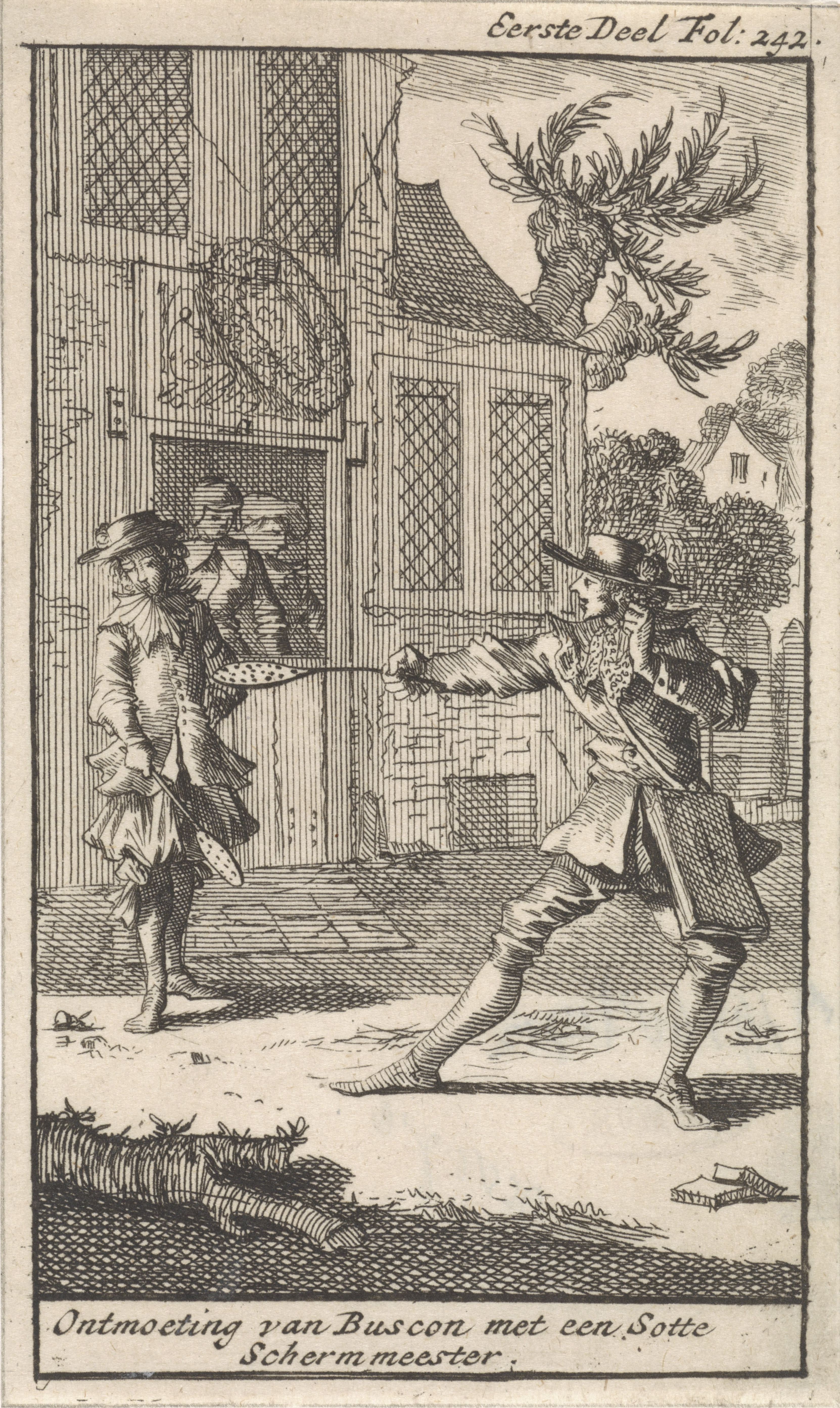
Libro de Jeronimo de Carranza, que trata de la filosfia de las armas y de su destreza, y de la aggression y defension Christiana by Jeronimo de Carranza, 1582. Add to this the works of his student, don Luis Pacheco y Narvaez. The book is the exposition of la verdadera destreza, or true art, and as such is necessary for understanding one of the major schools of Spanish rapier. The style is based much on complex geometric forms derived from the simple theory that discovering the shortest safest path in attack or defense is the basis of speed (in fact, it is but one component). From this proposition the school became wrapped in unnecessary esoterica including elements of mathematics and philosophy that have little if any practical bearing on practical swordplay. Yet it was this esoterica that made it surely lucrative for fencing masters whose students were, as many are today, eager for “secret knowledge.” The system was scathingly and brilliantly lampooned by famous poet, swordsman, and Spanish national treasure Francisco de Quevedo in El Buscón. Quevedo reportedly (some argue that this story is a myth) once humiliated Narvaez in a duel: with his rapier he removed Narvaez’s hat. In fairness, it can be argued that the verdadera destreza was an early effort at scientific or rational fencing theory that, albeit with different emphasis, would come to dominate the smallsword in the late 18th and early 19th centuries.
Part of my bias against attaching philosophy, metaphysics, “secret knowledge,” and other such “floral appendages” to fencing is that the allure is primarily to make fencing lucrative to some fencing teachers’ bank accounts and all too often to enrich the teachers’ egos as well as their wallets. I’ve seen a number of modern teachers practice this in Olympic, classical, and historical fencing. It is a pompous, pretentious, and, often to many students, ultimately disappointing practice. Fencing has more than enough fascinating allure, and its lessons are easily applied to life: it need not be wrapped up mysteriously and excessively in mathematics, philosophy, and, to be plain, alchemy. Or, more generally, in esoteric bullsh*t.
That said, one of the best ways to look at the destreza verdadera form may be to consider it as the truly Spanish Baroque style of swordplay, caught up in all that was good and bad in the excesses of the Spanish Baroque period. And if nothing else, at least it suggests you consider that all the arts and sciences are connected.
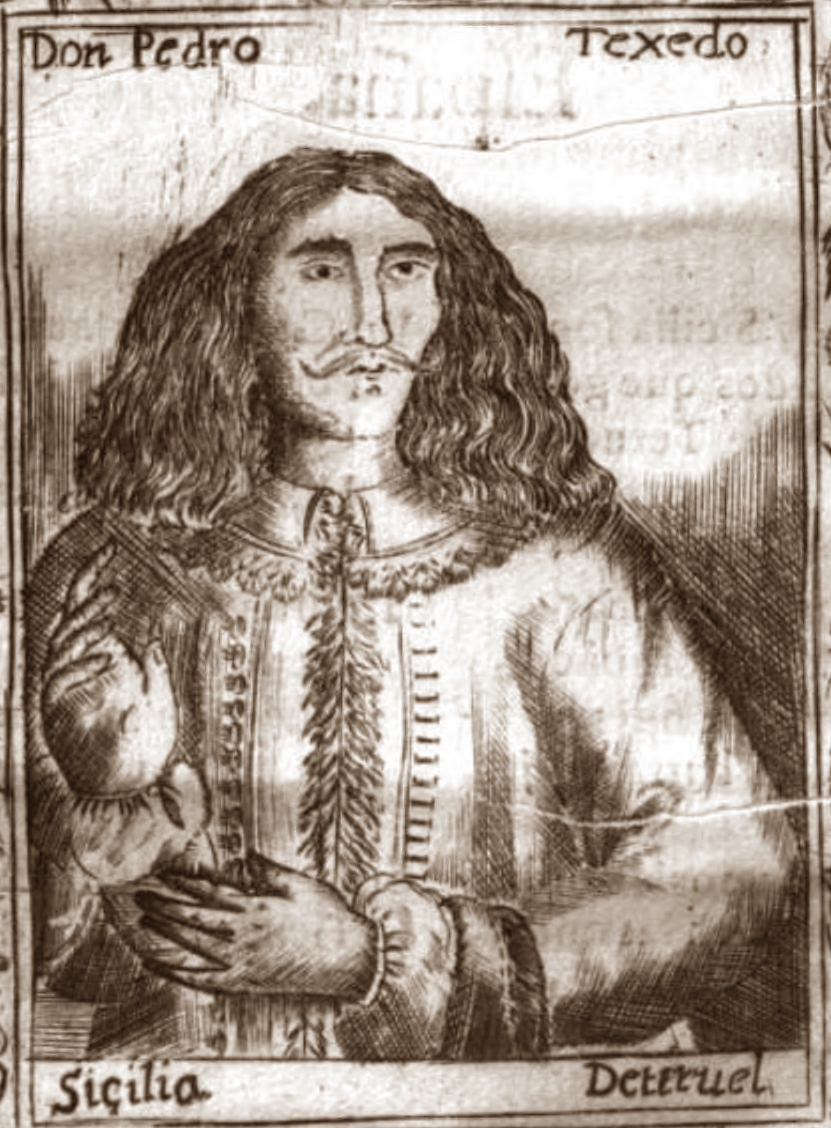
Escuela de Principiantes y Promptuario de Questiones en la Philosophia de la Berdadera Destreça de las Armas by Don Pedro Texedo Sicilia de Tervel, 1678. As with the Destreza Indiana below, the author’s name alone is quite evocative. Add to this the author’s image in the front papers, evoking the aloof, Roman-nosed Spanish don (not quite a myth by any means), and we have a book right out of a Hollywood swashbuckler. It has everything for the fencer enraptured by the destreza verdadera, including excellent illustrations of swashbuckling swordsmen—Spaniards, we assume, although their Spanish dress includes baldrics rather than the narrow sword-belts worn by Spaniards at the time except when in military dress, which was basically French—holding classic cup-hilt rapiers and standing on “magic” geometric circles. Discusses rapier and dagger, single rapier, and rapier and target.
The author’s image page includes references to theologia, obtica, practica, astrologia, speculativa, arismetica, matematica, musica, and philosophia, which is quite an education: only by reading the book is the question answered as to whether some or all apply to the destreza verdadera. “All,” I imagine Texedo would say. Further, I am unsure who the audience was: the book was published in Naples, under Spanish rule at the time; the clothing and baldric are a bit curious (perhaps of Spaniards in Naples? Or in Sicily? Or of Italians in Spanish dress?); and the dedication is to His Majesty the King of Spain, of course.
The book’s purpose is clear, though, according to Texedo’s motto: Omnia Contra Tela is shorthand for “unum omnia contra tela Latinorum” from Virgil’s Aeneid, book VIII. The complete phrase translates as “alone sufficient against all the weapons of the Latins” (Benjamin Apthorp Gould, 1826; Latin translation should always be left to serious scholars). Given that destreza is written beneath the motto, it’s pretty certain that Texedo held his practice of philosophical swordplay in high regard.
I imagine Don Pedro Texedo, whom I rank among my favorite Spanish swordsmen, as equal to “John de Nardes of Seville in Spain, who with the dagger alone, would encounter the single rapier and worst him.” (William Higford, 1658. “Juan de Nardes” of Seville is probably Juan Domínguez of Sevilla, with documents dated 1639 identifying him according to a detailed list in “Esgrimidores Sevillanos” in Revista de archivos, bibliotecas y museos, vol. 24 (1911). He is not listed among the Seville masters named in the Bibliografía é historia de la esgrima española by Enrique de Leguina y Vidal (1904), although notably Florentino de Pancorvo of Seville is described as being particularly able in single dagger versus single rapier.)
Las Tretas de la Vulgar y Comun Esgrima, de Espadas Sola, y Con Armas Dobles by Manuel Cruzado y Peralta, 1702. My many thanks to Pradana who corrected my description of this book. When I reviewed it ten to fifteen years ago, I simply read the title and scanned the text for examples of “common” Spanish rapier, and so I assumed it was a book overall on the comun technique. Pradana pointed out that the text is in fact a criticism of the common method. Mea culpa! He later emailed me to point out that I was partly correct: the text does include descriptions of the common method, as I was certain I had read (in spite of my mediocre Spanish). Thankfully I now do a more detailed review and re-review of sources prior to formal publication. In regard to “comun” texts, Pradana recommends Domingo Luis Godinho. Although I’m aware of this author I haven’t yet reviewed the book, but will post a summary when I do.
Illustracion de la Destreza Indiana by Don Francisco Santos de la Paz and Capitan Deigo Rodriguez de Guzman: Lima, 1712. Noteworthy primarily because it was the first fencing book, to my knowledge, published in the Americas. The authors’ names alone conjure assignations and affrays fought with rapier and poniard, or capa y espada, at night, not to mention the myth of duels on deck between noble pirate captains and treacherous Spaniards, although to be accurate we should drop the “noble” from pirate captains all of the time unless fictional (for example, Captains Peter Blood and Charles de Bernis), and “treacherous” from Spaniards most of the time. Trust me on this, I write books on the subject. See also Edward Blackwell in the “Smallsword” section below.
Gran Simulacro by Ridolfo Capo Ferro, 1610, 1629. A beautiful 2004 hardcover edition, Italian Rapier Combat: Capo Ferro’s ‘Gran Simulacro,’ edited by Jared Kirby, is available, as is a 2012 softcover reprint.
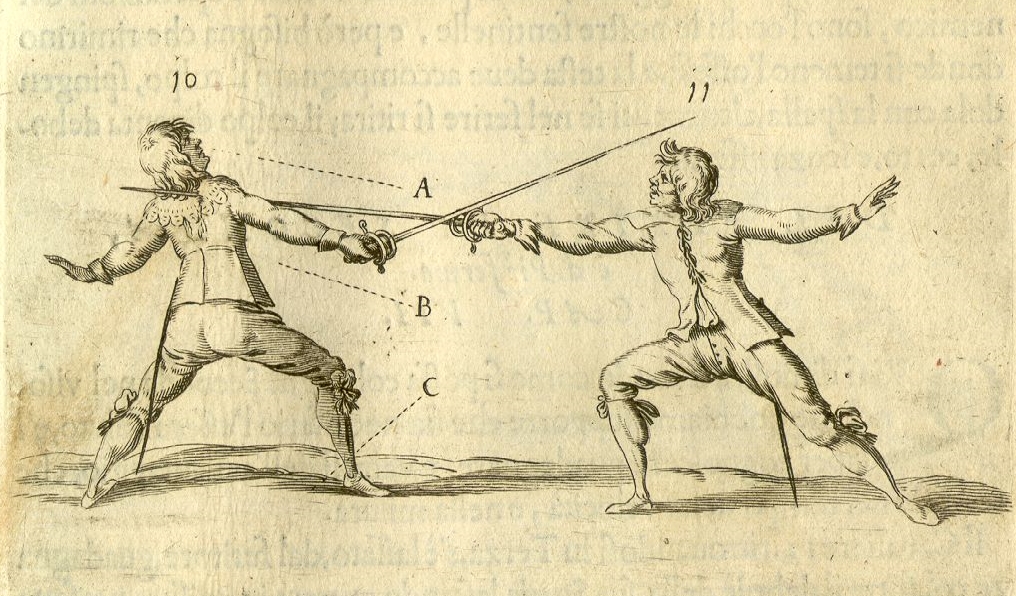
L’Arte di Ben Maneggiare la Spada by Francesco Ferdinando Alfieri, 1653. Beautifully and graphically illustrated treatise of the Italian spada, both of single sword and sword and dagger. Highly recommended.
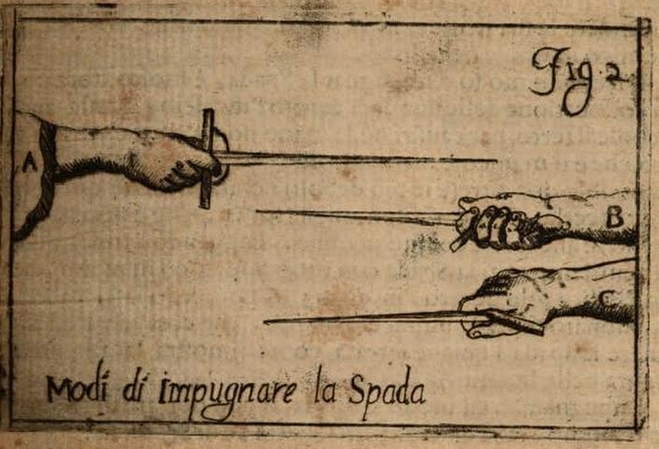
Regole Della Scherma by Francesco Antonio Marcelli, 1686. Detailed, practical study of the Italian spada, including single sword, sword and dagger, and sword versus other arms and vice versa, for example the saber or scimitar versus rapier. A very practical book with sound, practical advice useful in rapier, smallsword, and epee. Dedicated to Queen Christina of Sweden, who had abdicated her throne and now resided in Rome. Greta Garbo starred as Queen Christina in an excellent film of the same name.
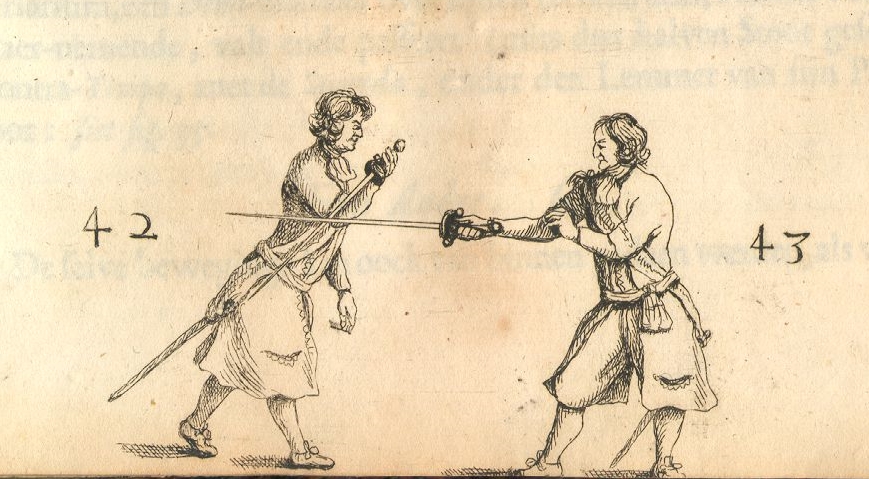
Grondige Beschryvinge Van de Edele ende Ridderlijcke Scherm-ofte Wapen-konste by Joannes Georgius Bruchius, 1671. A Dutch text presaging the persistent influence of the rapier into the age of the smallsword in Northern European schools—the Dutch, the various German, and others. Notably, in spite of the date and obvious transitioning to a lighter weapon, the book still uses much Italian rapier terminology. Solid technique for the duelist, soldier, and brawler, much of it looking remarkably similar to modern epee. The author references various illustrations throughout the book, in order that the reader may put them together in different described sequences. Clever, but unfortunately cumbersome too, as one might expect.
The book illustrates one of the most practical uses of what Alfred Hutton, in saber, refers to as “high octave”—used, that is, here as a yielding parry from quarte to exclude the adversary’s blade after running him through. Immediately closing the distance and commanding the adversary’s blade was vital. An adversary is seldom dead or disabled immediately, after all, and this technique would prevent him (or, rarely, her) from making a killing thrust in revenge, assuming a perfect world of course. Not everything goes according to plan, or so Fortune is said to say and without doubt often proves. Some nineteenth century saber masters recommended its use to counter-parry a quarte riposte made in opposition, suggesting that it was the only parry that could be made quick enough, which at the distance of direct riposte may be true. Hollywood is occasionally enamored of the technique, but it’s usually cringeworthy to watch the lovefest, so stilted, weak, and inappropriate in execution—unbelievable, in other words—it usually is.
See George Silver in the “Broadswords…” section below for a passionate argument against the rapier.
Smallsword (Epee de Rencontre, Epee de Cour, Espadin)
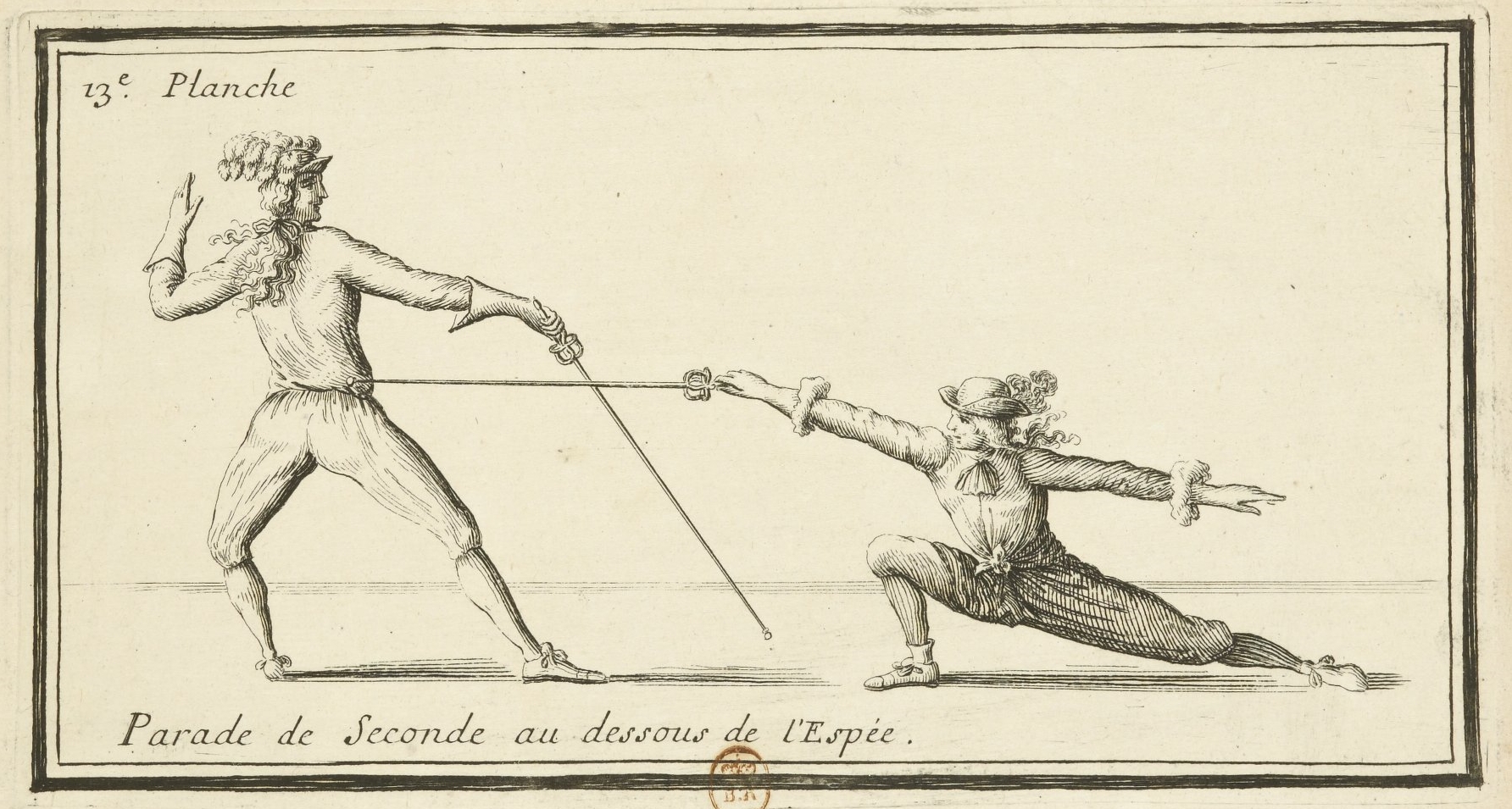
Les Vrays Principes de l’Espée Seule by the sieur de la Touche, 1670. The establishment of the modern French school of the smallsword, whose principals went largely unchanged for more than three centuries, and remain much in place today. Fencing for the French court. Although the technique is practical as described, or at least what would soon be considered conventional, and later classical, the illustrations show a lunge absurdly long, one that could hardly be recovered from in good time or in good defense. Perhaps it was to please Louis XIV and his tastes in elegance and dance.
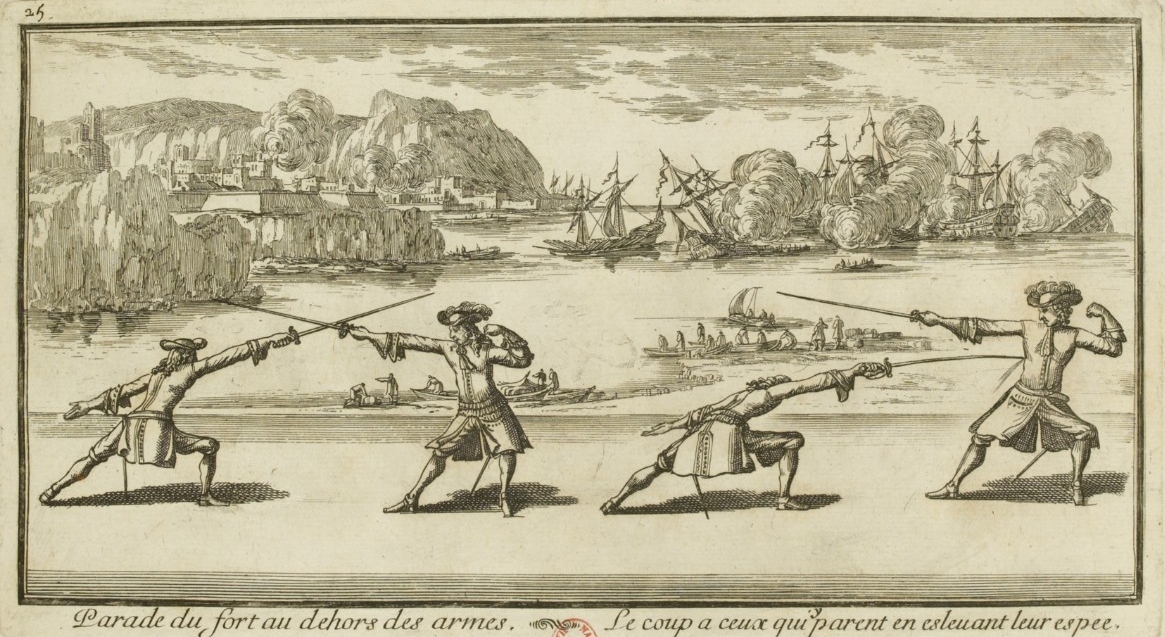
Le Maître d’Armes ou L’Exercice de l’Epée Seule dans sa Perfection by Andre Wernesson, Sieur de Liancour, 1692. An excellent study of the smallsword, albeit in some ways more suited to gentilshommes of the French court than to adventurers in the field, although the author does cover commanding and other disarms. Julie d’Aubigny, aka Mademoiselle la Maupin, the opera singer and duelist, among other occupations and pastimes, may well have studied under Wernesson, maître en fait d’armes to the Petit Ecurie, given her swashbuckling father’s position at court as the secretary to the comte d’Armagnac. (She might also have studied under Jean or François Rousseau, maîtres en fait d’armes to the Grande Ecurie.)
La Maupin, among her many adventures, was convicted and subsequently sentenced in absentia to be burned to death by the Parlement d’Aix for seducing a novice and burning a corpse in the associated convent. The verdict, however, was delivered against the sieur d’Aubigny; La Maupin’s masculine disguise apparently fooling, or perhaps pretending to fool, the right people. The criminal seductress’s former protector, the comte d’Armagnac, petitioned Louis XIV to overturn the decision, which he did, doubtless given his strong inclination toward attractive talented women. Clearly, independent women were hard to come by—and apparently hard to spot when dressed as a man fleeing a convent and prosecution.
L’art des armes by le sieur Labat, 1696. English translation, The Art of Fencing by Andrew Mahon, 1734. Another excellent study of the smallsword, although Labat, like de Liancour, was not quite as practical-minded regarding the smallsword in sudden rencontres, street fights, and the battlefield as some authors, McBane for example, were. From his work, as well as Hope’s below, it is easy to see the origins of sport fencing, aka foil fencing. In fact, I suspect that most fencers of this era far preferred “school play” to the possibility of injury or death in a real rencontre.
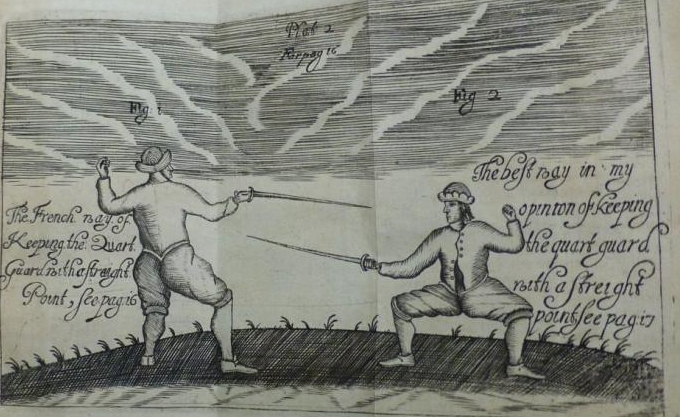
The Compleat Fencing-Master by Sir William Hope, 1692, 1710. Largely a reprint of Hope’s earlier work, the Scots Fencing Master, or Compleat Small-Swordman, 1687. An excellent work, highly recommended. Hope was an astute amateur, and his observations on fencing concepts are valuable to both the historical and modern fencer. Additionally, he has much practical advice for fighting with “sharps.” A favorite.
The Sword-Man’s Vade-Mecum by Sir William Hope, 1691, 1694, 1705. Excellent advice for surviving a fight with “sharps.” That is, practical considerations for dueling and “rancounters” (rencontres) or street fights. Likewise a favorite.
The Fencing-Master’s Advice to His Scholar by Sir William Hope, 1692. Rules and advice, including technique, for “school play”—that is, for sport fencing. Ever wonder where foil conventions and rules come from? In spite of most historical texts noting that conventions originally derived for reasons of safety, it is clear that sport, convenience, and appearance also played a major role, perhaps even the greater one, starting in the late 17th century, if not much earlier. And double likewise, a favorite.
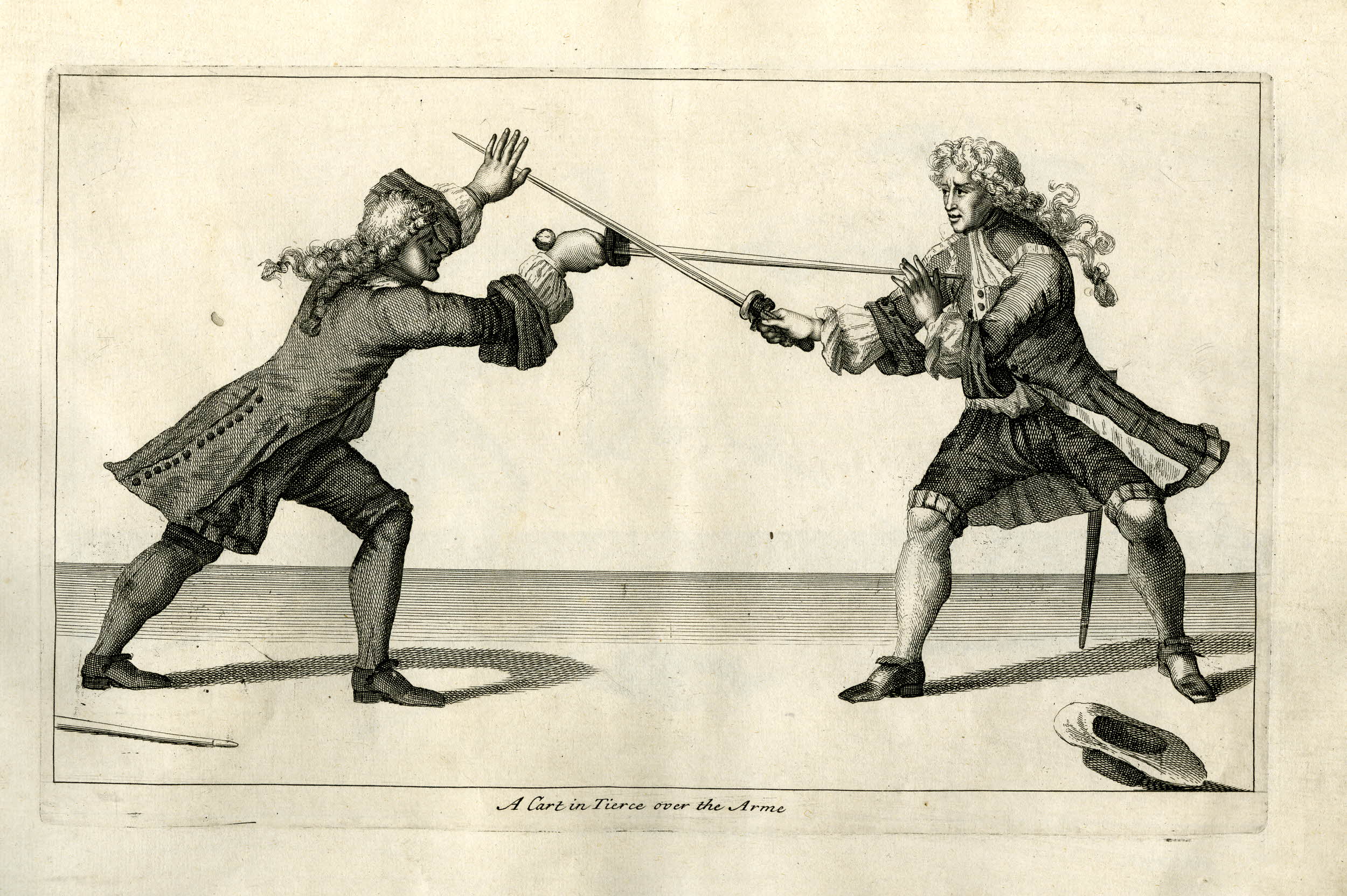
The Art of Fencing Represented in Proper Figures Exhibiting the Several Passes, Encloses, Disarms, &c. by Marcellus Laroon, various editions suggested to date from the 1680s to circa 1700 but almost certainly correctly close to the latter year. Illustrations and single line descriptions only, very useful to the historian not only of fencing but of period dress. (I’ve relied heavily on these images for Fortune’s Whelp, for example.) Figures are in a variety of fencing positions, most with smallswords, some with buttoned foils. Worthy of much study. A number of images are suggestive of, or even imitated from, 17th century rapier and “transitional rapier” illustrations, making it at quite possible, or even probable, that the French school was not yet entirely in full force even in the English smallsword, or that the Dutch immigrant illustrator Laroon, who bore a facial scar from an affray with swords, was showing his Dutch influence. (See Bruchius in the “Rapier & Transitional” Rapier section, for example.) Very much a favorite.
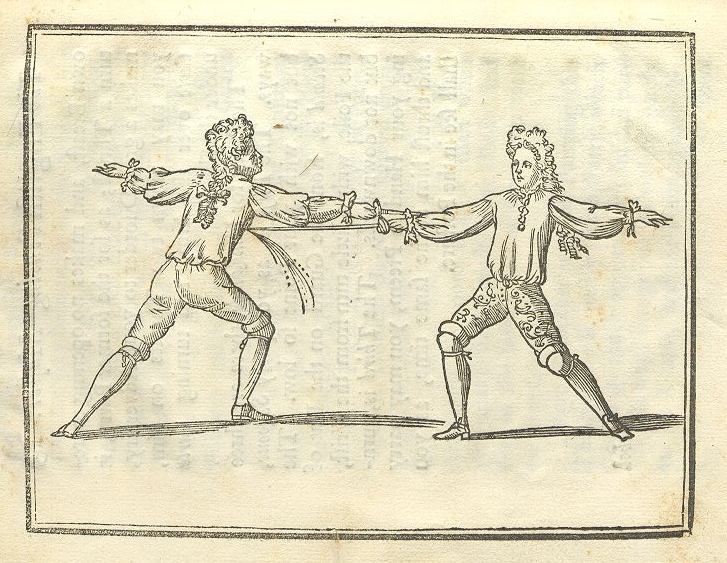
The English Fencing-Master: or, the Compleat Tuterour of the Small Sword by Henry Blackwell, 1702. A short text thereby suggesting that “Compleat Tuterour” is hyperbole, with decent illustrations showing wounds with spurting blood for emphasis. Includes more proof that the modern sixte thrust aka “carte over the arm” was well in use much earlier than some fencing historians suggest. Charming spelling of seconde: “Sagoone.” But the spelling of carte, tierce, and prime are conventional. Blackwell includes a good but brief discussion of flanconnade, one of my favorite thrusts in its several varieties: it secures the adversary’s blade, is perfectly placed for additional opposition with the unarmed hand (were this still legal), and, thrust low, avoids the ribs and their cartilage which might impede the thrust (assuming the adversaries are fencing with “sharps” of course). Blackwell’s recommended en garde is with the arm mostly extended, as is the case with many smallsword texts—it’s simply a safer guard with a real thrusting sword than the common foil guard of the past two centuries. See also Edward Blackwell below!
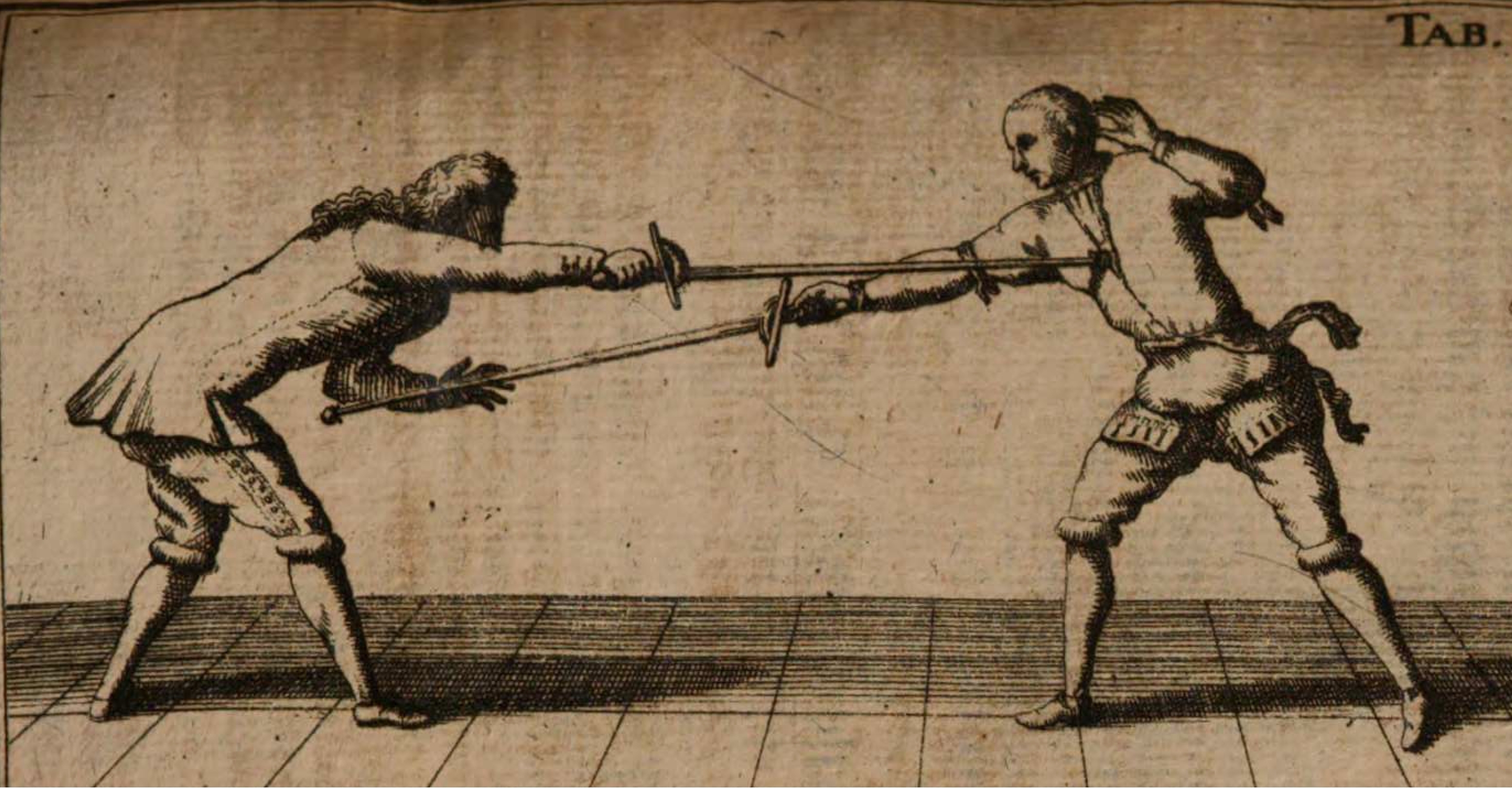
Der Geöffnete Fecht-Boden by B. Schillern, 1706. German text showing the influence of the rapier even with the smallsword into the 18th century. Compare with Doyle’s French-influenced German text below and with Bruchius’s Dutch text in the “Rapier” section above.
Advertisement, Especially to Fencing Masters by Sir William Hope, probably 1707. An advertisement with argument for Hope’s new book detailing his new method of fencing using the hanging guard. Excellent, if brief and not entirely complete, discussion as to why swordplay on the battlefield is different from that of the duel. (He doesn’t provide reasons why cutting weapons, or cut and thrust, are preferred: cuts may not kill but often disable more quickly that thrusts, it is easier to change direction and defend while doing so with a cutting weapon, thrusts may stick in the adversary and thereby be problematic for mounted troops–many have been dismounted by a thrust stuck in an enemy.) Hope is less convincing when it comes to his argument that his method is new, and not merely a restatement of one of the Walloon or German styles.
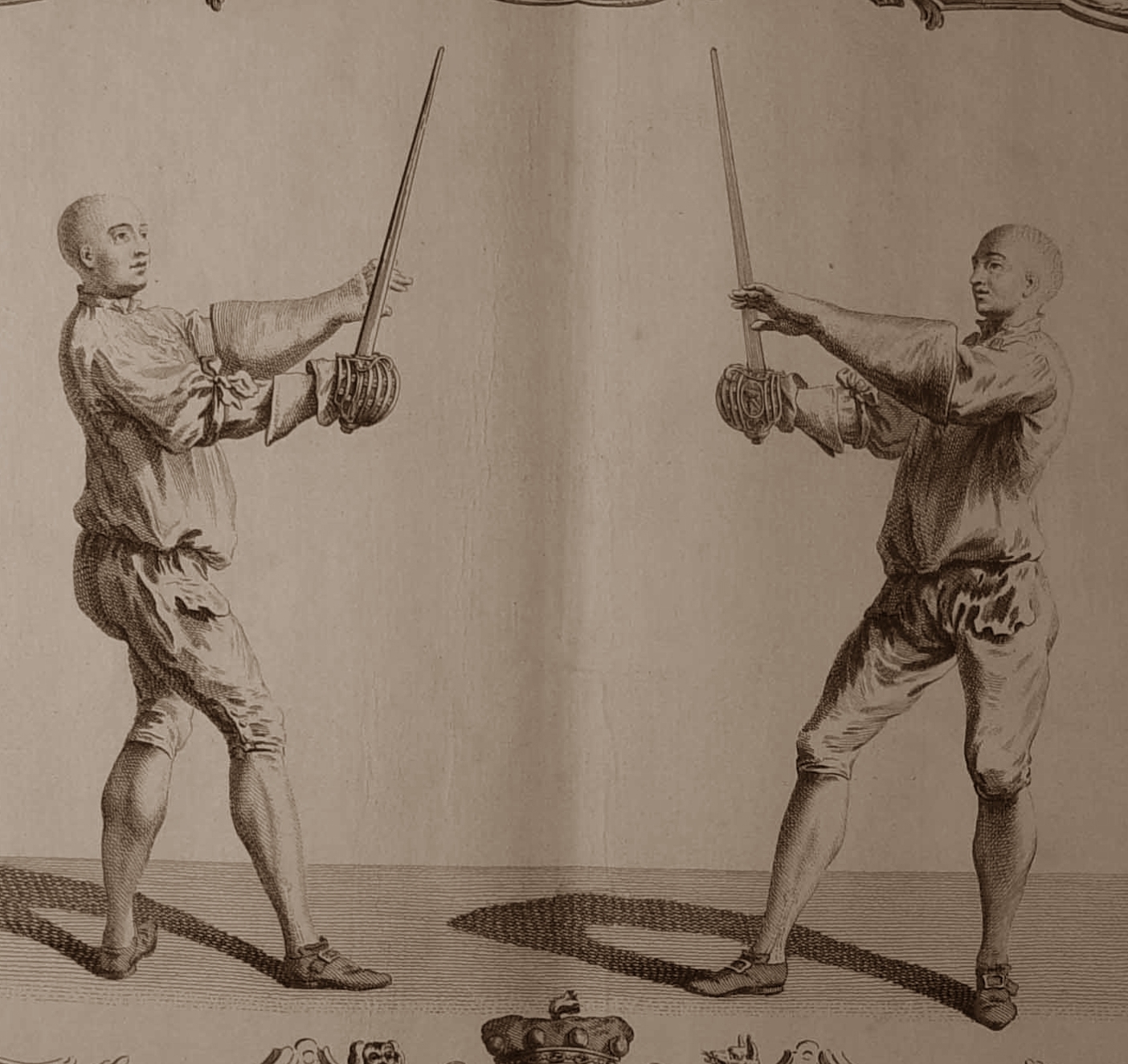
New Method of Fencing by Sir William Hope, 1707, 1714, et al. Hope’s exposition of his conversion to the hanging guard, known by many as the “falloon” (from Walloon) guard, as opposed to the more common guards in quarte and tierce, for the smallsword, sheering sword, and backsword. The book has been reprinted in Highland Swordsmanship, edited by Mark Rector, 2001. Among his excellent advice for swordplay on the battlefield, Hope recommends a stout gauntlet on the unarmed hand for parrying.
The English Master of Defence: or, the Gentleman’s Al-a-Mode Accomplishment by Zackary Wylde, 1711. A difficult read at times, especially for those without a strong base in classical fencing, smallsword, and backsword/broadsword technique, not to mention in English syntax and phrases circa 1700, but the language is colorful, the writer charmingly self-confident, and his descriptions—once deciphered—proof that there is little new in “modern” fencing. Covers smallsword, broadsword, quarterstaff, and wrestling.
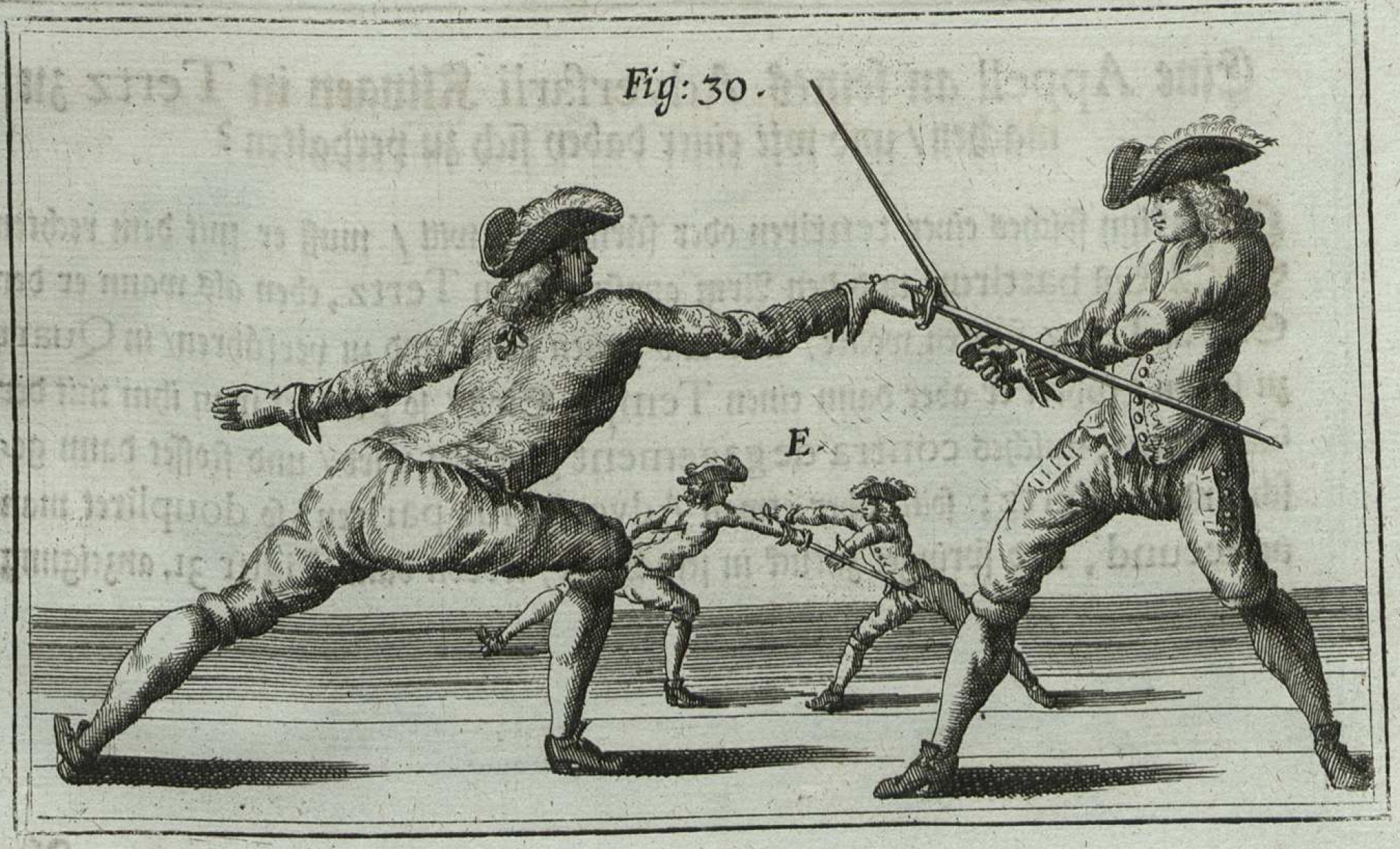
Neu Alamodische Ritterliche Fecht- und Schirm-Kunst by Alexander Doyle, 1715. An Irishman introduces Germans to the French school, with plenty of parries and oppositions with the unarmed hand, plus disarmings, grapplings, and trips/throws to satisfy advocates of the native German schools. Almost as well-illustrated as Girard below, and in some ways I almost prefer Doyle’s illustrations. An excellent reference for the practical-minded swordsman.

Expert Sword-Man’s Companion by Donald McBane, 1728. McBane was a Scottish soldier, swordsman, fencing master, duelist, prize fighter, and collateral pimp whose deeds and escapades began in the late 17th century and continued into the 18th. Highly recommended, almost certainly the best text on practical swordplay for the duel, affray, rencontre, street fight, &c, based as it is on his own extensive experience wetting his blade with the blood of adversaries, and occasionally wetting theirs with his own. Literary connection: in The Princess Bride the author refers to McBane as “McBone.” The book has been reprinted at least three times in recent years: a 2015 edition edited by Keith Farrell in Scotland, a 2017 edition edited by Jared Kirby, and a 2001 edition edited by Mark Rector in Highland Swordsmanship (readers of this last edition may choose to disregard the photographs of McBane’s technique and refer instead to McBane’s descriptions and original illustrations which are unfortunately not reproduced in this edition). Very much my favorite historical fencing text.
A Compleat System of Fencing: or, the Art of Defence, In the Use of the Small-Sword by Edward Blackwell, 1734, in Williamsburg, Virginia. The first fencing text published in North America and the first in English in the Americas as well, sub-titled Wherein The most necessary Parts thereof are plainly laid down; chiefly for Gentlemen, Promoters and Lovers of that SCIENCE in North America. Given the last names plus the similarity of titles and technique, Edward Blackwell is surely related to Henry Blackwell, most likely as father and son. The book includes a good introduction as to why one should fence—Americans, take note! It’s apparently long been a problem promoting swordplay in British-derived North America!—as well as solid descriptions of swordplay, including how to deal with a low guard, in “Master and Scholar” format (Sir Wm. Hope has used this format too).
As with Henry, the book has a good description of the flanconnade, and the likely son has corrected the likely father’s spelling of “Seconde.” Good discussion of time and counter-time, along with a reminder that foilists have long been inclined to impale themselves by attacking into an attack (so have many epeeists, too, but foilists tend to regard double hits as imaginary). Like his likely father, the son prefers a more extended guard, and not the scandalously “crooked Arm” so popular with foilists since the 19th century—but at least most of them extended from beginning to end during their attacks until recently—and also with aggressive “ignorants” of the smallsword era who did not extend during their attacks. Yes, attacks with a bent arm are those of the fencing illiterate, thus one might argue that both modern foil and saber fencers are quite unlettered (and some epeeists are too). See also Henry Blackwell above.
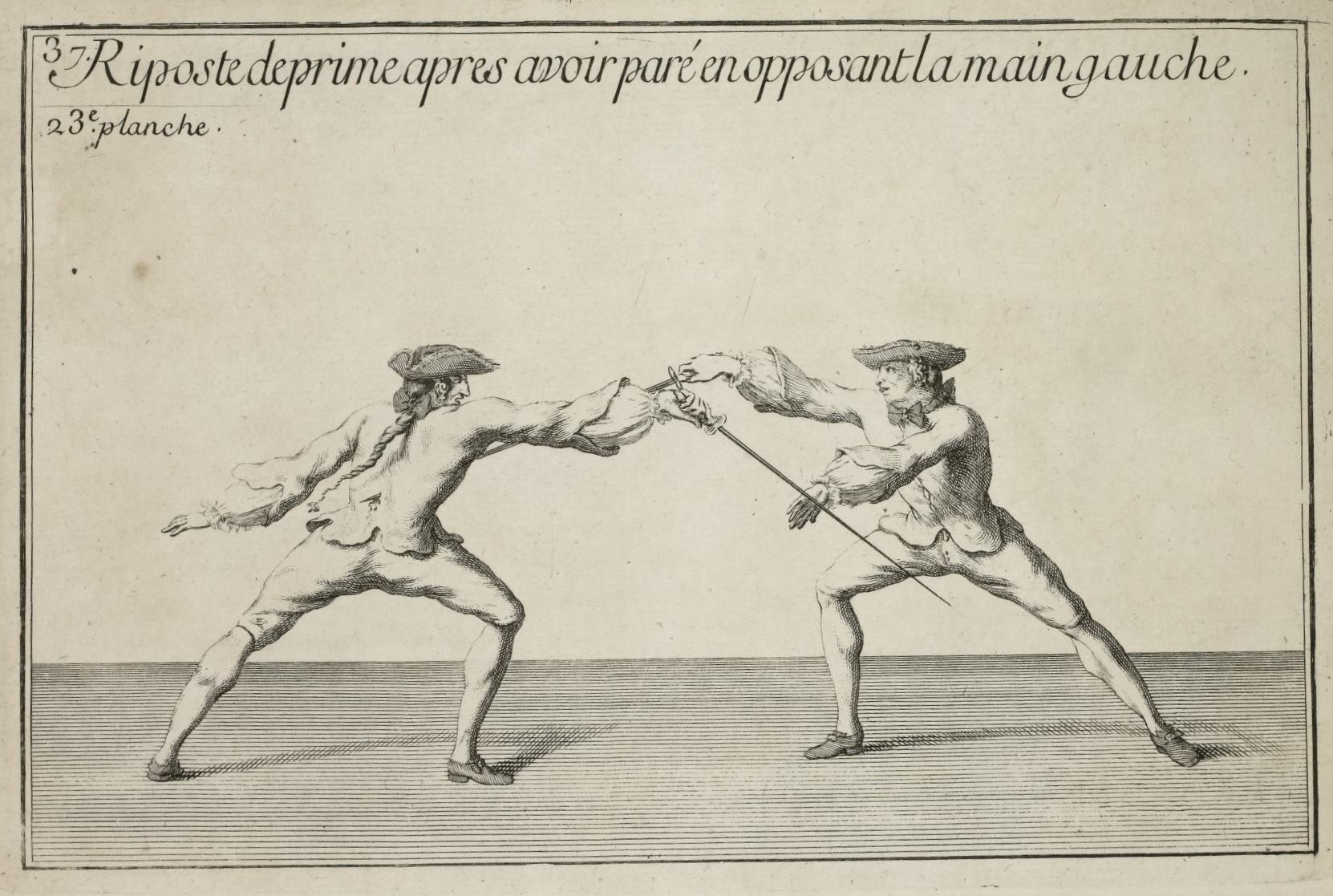
Traité des Armes by P. J. F. Girard, 1737, 1740, et al. Possibly the best book on the smallsword ever written. Not only beautifully illustrated, the book describes smallsword technique in detail, including its use on the battlefield against other weapons. It emphasizes practical swordplay for the duel as well as for the affray or rencontre, even against foreign fencing styles, and for battle. Girard was a naval officer. Highly recommended.
A Treatise Upon the Useful Science of Defence, Connecting the Small and Back-Sword, and Shewing the Affinity Between Them by Capt. John Godfrey, 1747. Practical book on smallsword and backsword, including a very useful analysis of backsword prizefighters, and some notes on boxing as well.
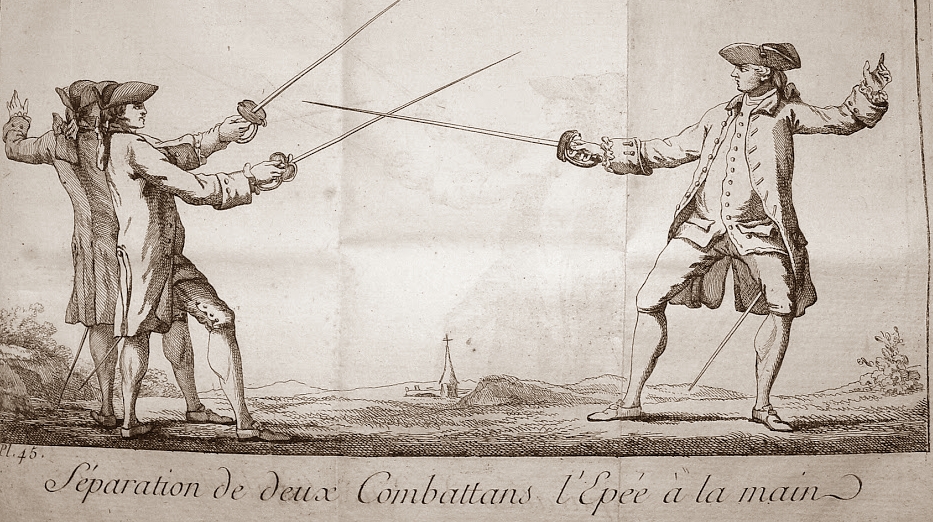
L’Art des Armes by Guillaume Danet, 1766. Excellent work on the smallsword, with practical exposition of the theory and practice, along with useful associated exotica, including how to break up a duel (grasp the shell of one adversary’s sword and direct your point at the other). However, the Internet being what it is—as useful to the lazy in their laziness, fools in their folly, and idiots in their idiocy, as it is to those largely unafflicted with these defects of behavior and intellect—the illustration is unfortunately reproduced on occasion to demonstrate, quite incorrectly, how to fight two adversaries simultaneously.
Among much useful commentary, Danet demonstrates his functional knowledge of fencing history and texts; decries commanding the blade (seizing the adversary’s sword) and disarmaments, but discusses them anyway because the fencer should know how to defend against them; discusses and decries volts and the passata soto (under another name); and wishes that parries with the unarmed hand had never been invented, although he distinguishes between parries with the hand and opposition of the hand, the latter of which he approves.
Danet provides the modern definition of fencing time: the time it takes to perform any single action of hand or foot. On the other hand, his renaming of parries is confusing to modern fencers, and was to his contemporaries as well. La Boëssière père, via his son (see below) was highly critical of Danet in general (not unusual in itself for fencing masters to criticize each other, often pompously), although it is easy to see from both that the “practical” swordplay of the smallsword was in danger of descending into near-complete artificiality, which in the next century it did.
In spite of its many virtues, my fondness for the book is actually based much on Rafael Sabatini’s affection for it, on which he founded much of his description of French swordplay, particularly in Scaramouche. Danet’s style of fencing is very much in keeping with the style of Sabatini’s logical intellect, and therefore of Sabatini’s swashbuckling heroes, although Sabatini, being half Italian, did not shrink from occasional cunning, nor did he object to his swordsmen partaking occasionally from the Italian school. From Danet is the inspiration for Andre-Louis Moreau’s new theory of swordplay, although in reality it would be nullified by an arrest, not to mention difficult to execute even with a cooperative adversary. But don’t let this spoil the excellent novel, which among its many virtues great and small is an evocative description of a fencing lesson that stirs me to this day. And in many ways Sabatini’s theory was correct at its core: the fencer should force his or her adversary into a pre-selected avenue of no escape.
Sabatini also used the historical person of Danet in the short story, “The Open Door” in Turbulent Tales (1946). For more details on Sabatini and Danet, not to mention, and far more importantly, on Sabatini’s works in general, I highly recommend Romantic Prince: Reading Rafael by Ruth Heredia, 2015. I am honored to have assisted Ruth on the subject of swordplay in Sabatini’s works.
The Fencer’s Guide by Andrew Lonnergan, 1771. Practical smallsword-play described with some occasionally uncommon fencing language: the practices of whirling, wrenching, and lurching, for example, which are synonyms for three conventional techniques. A more scholarly and readable update on Wylde is one way of looking at the book. Lonnergan also includes a very useful discussion of the backsword and spadroon, as well as some very practical advice for and against the cavalry, dragoons, and Hussars or light horse—whether the adversary wears breastplate and helmet determines to a great degree the swordplay used. He has brief useful advice for the fencer armed with a walking stick (it must be wielded a bit differently, having no edge or point), and sees no reason that an athletic fencer cannot use the various volts, night thrust (passata soto), grapplings, &c, which by now many masters had lost favor with. However, see Danet above.
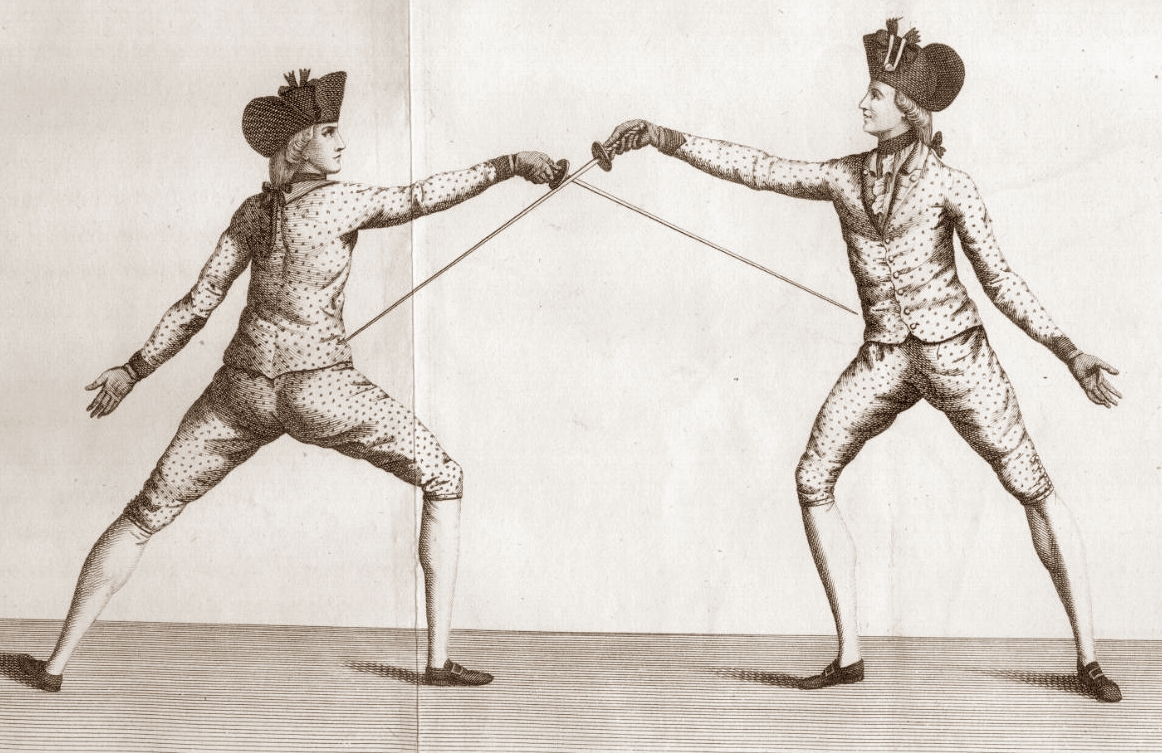
The Army and Navy Gentleman’s Companion; or a New and Complete Treatise on the Theory and Practice of Fencing by John McArthur, 1784. Solid exposition of the smallsword, with conventional language—McArthur doesn’t use Lonnergan’s romantically descriptive flourishes when naming some techniques. Again, here is yet another book proving that there is really nothing new in modern fencing. As with many fencing books, it includes some useful and some not so useful tidbits, for example, the deflecting of a pistol with a smallsword, something I suggest should not have been tried except in extremis and was probably most successful when used with a strong cutting sword—a broadsword, backsword, saber, or cutlass—that, rather than deflect the pistol, severed some of the fingers or the hand holding it instead. Very much worth reading, as for that matter are all the smallsword texts listed here, in order to expand one’s perspective on the theory and practice of Western thrusting swords.
The School of Fencing by Domenico Angelo, 1787. Several modern reprints available. The height of the 18th century French school, though by now the smallsword was mostly an accoutrement of dress, occasional dueling arm, and for some military officers, a badge of office. Fencing for the gentleman. The book is not my favorite, even though it was also published under “Escrime” in Diderot’s famous encyclopedia. Perhaps it’s the illustrations: I cannot image any serious swordsman or swordswoman posing so delicately. For the latter part of the 18th century I much prefer Danet, Lonnergan especially, and even McArthur (whose illustrations are likewise a bit too delicate to represent the soldier and fighting seaman in my opinion).
The Amateur of Fencing by Joseph Roland, 1809. Highly recommended for all fencers. Although the technical material is quite useful to the smallsword fencer and worth reading by the modern fencer. In particular, Roland, first quoting McArthur above, recommended the study of fencing to navy men, for “they are more frequently at close quarters with the enemy than the military are.” But the book’s real value lies in his philosophy of teaching fencing and learning to fence. Specifically, he attempts to go beyond the mere mechanical practices of teaching fencing and of fencing itself, practices still far too common even today. In fact, such mechanical description is the entire content, or nearly so, of most books on fencing, then and now. Roland wished to go beyond this and develop a sense of tempo, tactics, awareness, and independence in the student.
Most valuable are several of his admonitions, for example, “[T]he pupil, who I wish at all times to make use, but not too hastily, and without partiality, of his own judgement, and not upon every occasion to take for certain evidence any proposition upon the authority alone of a master, merely because he is a master, or that the same may be found in print.” Although there are masters who have embraced this philosophy today (including mine), the majority do not appear to have done so and remain instead “mechanical.” Of these, too many reign at the center of a cult of personality, with the result that their students are anything but independent on the piste or, unfortunately, in life.
Traité de l’Art des Armes by La Boëssière fils, 1818. An explication by the son of the school of the father (a contemporary of Angelo and Danet, among others). Highly recommended, especially for the student of the smallsword or of fencing history and theory in general. A superb text, with useful observations (practiced too little today, both in the making and the study of) for teaching students, including the young, the old, and women too, along with practical tidbits, for example an early discussion of the use of the fencing mask (masque de fil-fer, that is, iron wire), instructions on how to mount and button a fleuret d’assaut, and a criticism of the quality of the “new” foil blades, something common throughout the history of fencing it seems: I’m old enough, for example, to have used the superbly-balanced, light, long-lasting non-maraging Prieur foil and epee blades forged in the 1970s (there were no maraging blades back then).
Traité de l’ Art de faire des Armes by Louis-Justin Lafaugère, 1820. Perhaps, along with the only secondarily-described method of Jean-Louis (see below), the last of the great treatises of the smallsword. After this date, and until the development of the épée de combat, we find with few exceptions mostly foil fencing in the form of what was once known as “school play”—sport fencing, or worse, le jeu de salon, in a form unsuitable for combat with sharps. Lafaugère, a redoubtable fencer and swordsman (there is a difference), wrote in detail of the many variations of feints and their many combinations, making the book, to some, overly complex. The only modern text comparable in similar complexity is Imre Vass’s grand epee book (see the “Modern Epee” section above) in which he details feint attacks in similar fashion.
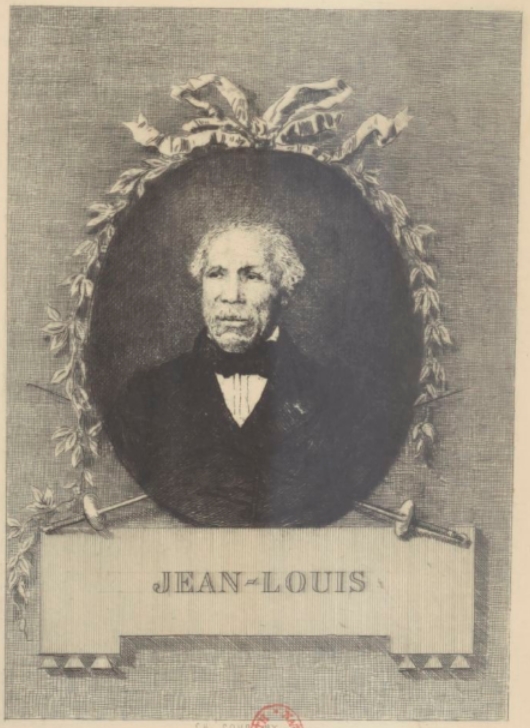
Un Maître d’armes Sous la Restauration : Petit Essai Historique by Arsène Vigeant, 1883. Strictly speaking, a biography of one history’s most swashbuckling and talented swordsmen and fencing masters, Jean-Louis. Like Alexandre Dumas who gave us some of the greatest swashbuckling and historical novels ever written, Jean-Louis was of mixed black and white French Caribbean descent. The book is listed here because Vigeant includes a detailed description of Jean-Louis’s teaching method, along with many of his drills, quite modern and still useful today. In any case, Jean-Louis’s story alone is a magnificent read. His daughter, if I recall correctly, was a quite talented fencer, too. For those of you who don’t read French, Michel Alaux includes a detailed biography of Jean-Louis (see the “Combined Modern” section above). Jean-Louis’s salle survived into the 20th century, and Alaux was its master for some years.
Backsword, Broadsword, Saber, &c.
Paradoxes of Defence by George Silver, 1599, reprint 1968 et al. A vigorous defense of English cut-and-thrust swordplay for dueling or battle, and excoriation of the rapier and rapier play. Contains perhaps the best description ever put to paper of the virtues of fencing, as well as the best examination for qualification as a fencing master or expert. Yes, if you want to be an expert swordsman or swordswoman, you must be able to routinely defeat unskilled fencers and not be thrown by their irregular technique and tactics! If you can’t, you’re merely a common fencer best suited to engaging others of your ilk. The fencing may not be pretty when you engage the unskilled, the hack, the ferrailleur, or the extremely unconventional, but you must be able to defeat any inferior fencer, not just those with conventional technique and tactics. Further, you must be able to hold your own against your equals, no matter their style, and force superior fencers to work hard for their victories—and occasionally, defeat them by doing so.
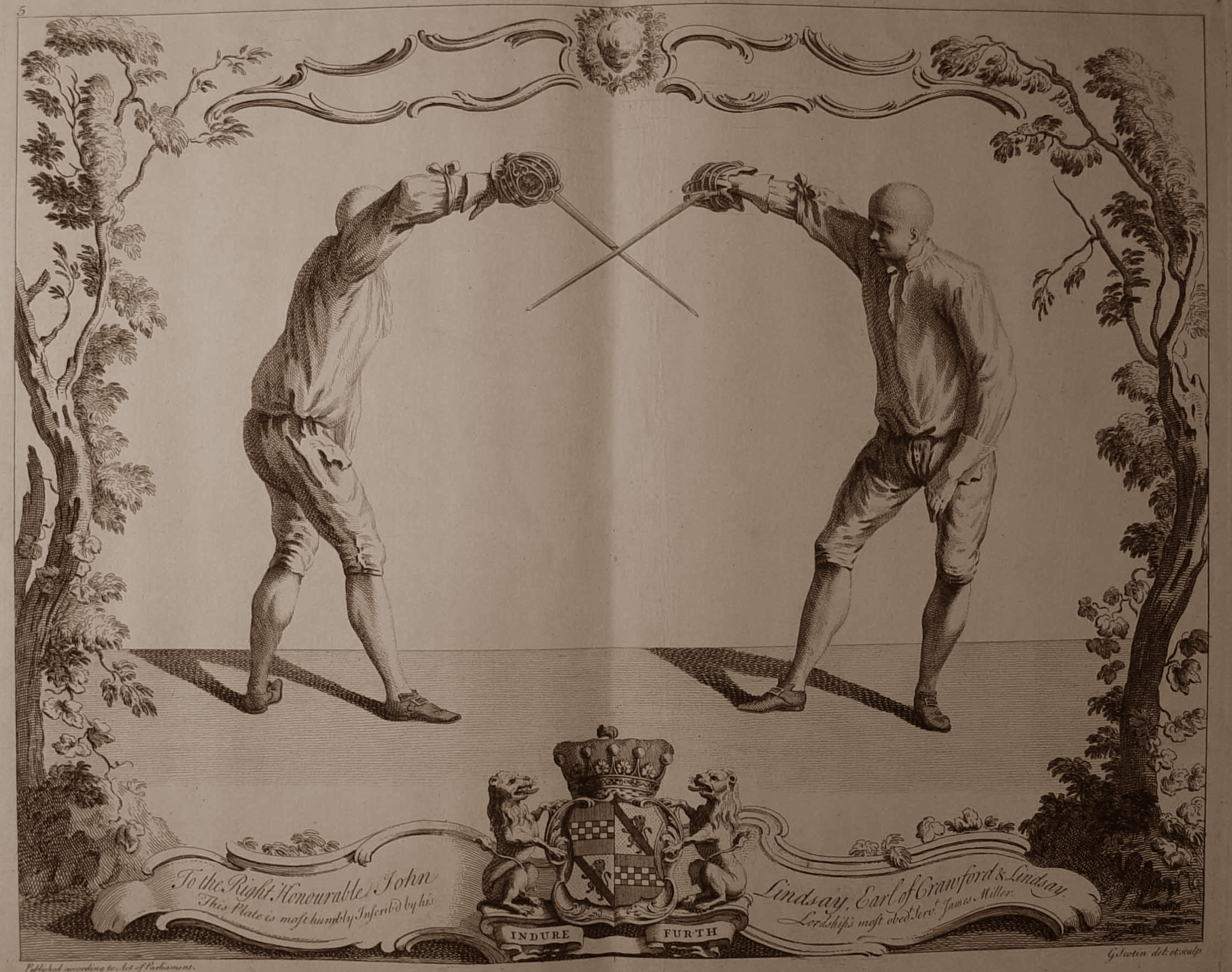
A Treatise on Backsword, Sword, Buckler, Sword and Dagger, Sword and Great Gauntlet, Falchon, [&] Quarterstaff by Capt. James Miller, 1738. Plates with a column of descriptive notes on the front page. Half a dozen or more of the fifteen plates apply to the basket-hilt backsword, and two to the falchion, and therefore to the cutlass. Excellent illustrations of positions poorly illustrated or described in other cutting sword texts of the period. Sir Wm. Hope was a fan of the “great gauntlet,” particularly on the battlefield. Miller was a soldier, later a stage gladiator.
The Use of the Broad Sword by Thomas Page. Norwich, England: M. Chase, 1746. 18th century broadsword technique, including that of the Scottish Highlanders, applicable also to the backsword and cutlass.
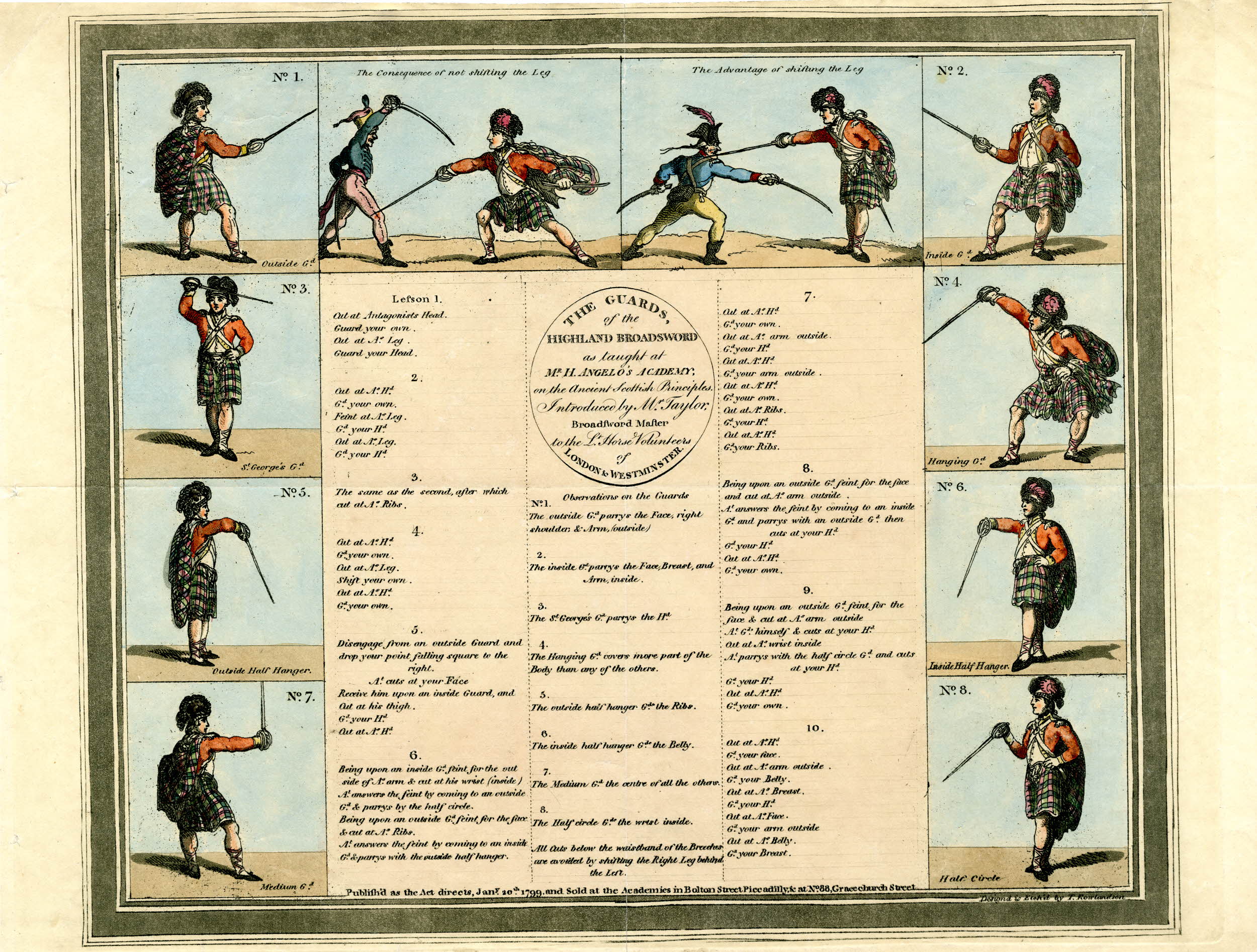
Highland Broadsword, edited by Paul Wagner and Mark Rector, 2004 (1790 – 1805). Five late 18th and early 19th century broadsword manuals (Anti-Pugilism by “a Highland Officer,” 1790; MacGregor’s Lecture on the Art of Defence, 1791; On the Use of the Broadsword by Henry Angelo, 1817; The Art of Defence on Foot with the Broad Sword and Saber, by R. K. Porter, 1804; and Fencing Familiarized, by Thomas Mathewson, 1805). Practical cut-and-thrust swordplay.
The Broad Swordsman’s Pocket Companion, “Designed by Capt. Wroughton,” ca. 1830. One of the last real English broadsword manuals of the era of Empire—actually, a book of plates only—before cut and thrust began to be absorbed by the rise in popularity of saber, not that there was actually much difference. Short, well-illustrated with colored prints of military fencers wearing fencing masks and armed with singlesticks. The book is exactly what it says.
The Art of the Dueling Sabre by Settimo del Frate explaining Guiseppe Radaelli’s saber method, translated and explained by Christopher Holzman, 2011. Del Frate’s original works were published in 1868 and 1872. Indispensable, along with the Wright/Masiello/Ciullini work below, for understanding Radaelli’s method of saber. It changed Italian saber fencing forever, and is the root of the Hungarian school.
Lessons in Sabre, Singlestick, Sabre & Bayonet, and Sword Feats; or, How to Use a Cut-And-Thrust Sword by J. M. Waite, 1880. Superb text on practical swordplay, highly recommended.
The Broadsword: as Taught by the Celebrated Italian Masters, Signors Masiello and Ciullini, of Florence, by Francis Vere Wright, Ferdinando Masiello, and [first name unknown] Ciullini, 1889. An English text on the Italian school of the light or dueling saber established by Guiseppe Radaelli in the 1870s. Maestro Masiello was a student of Radaelli; Ciullini probably was as well. Soon this Radaellian school would be transformed by Italo Santelli (a student of Carlo Pessina, who was a student of both Radaelli and Masaniello Parise) and László Borsody into the Hungarian saber school that would lead to Hungary’s half century reign in international sport saber competition. For those interested in the debunking of fencing myths, the book clearly states why the modern saber target is restricted to the area above the waist (and no, it has nothing to do with sabers once having been used on horseback): it was considered “unchivalrous” to hit below the belt. That is, the Italians wanted to keep their manhood undivided.
Cold Steel by Alfred Hutton, 1889, modern reprints available. Practical swordplay for the light saber (sorry, Star Wars fans, it’s not what you think) or even backsword, and also the “great sword” and stick. Highly recommended.
Broadsword and Singlestick by R. C. Allanson-Winn, 1890, reprints 2006, 2009. Excellent work on practical cut-and-thrust swordplay, most highly recommended. Quite English in its pragmatism.
See also Wylde, McBane, Godfrey, and Lonnergan in the Smallsword section above.
Cutlass
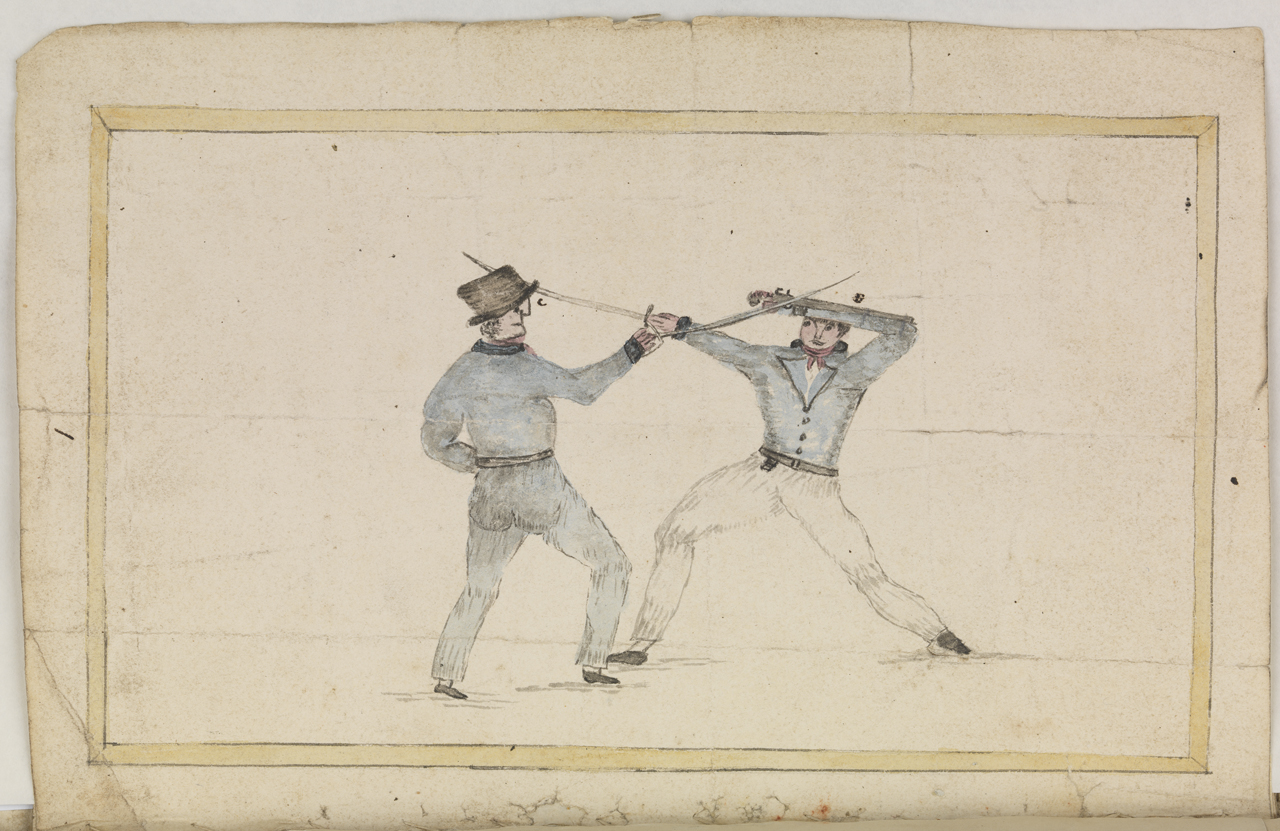
In spite of the popular—and correct—association of the cutlass with piracy, privateering, and naval boarding actions of the 17th through early 19th centuries, there are for all practical purposes no cutlass texts prior to the late 18th. Even Roland (see the Smallsword section above), who recommended fencing in particular for naval officers and crews because they had the most need of it given the prevalence of boarding actions, and Girard and McArthur who were naval officers, do not really describe it—Girard not at all, McArthur only briefly by identifying its guards and cuts as those of broadsword, and Roland largely by quoting McArthur.
Cutlass play, at least as described in cutlass manuals, of the later era was based almost entirely on the broadsword and saber technique of the time. However, given the cutlass’s useful abilities at close distances (those of riposte and of grappling), there were doubtless techniques used in earlier periods but not noted later, for example grazing parry-ripostes made in a near-single tempo, short powerful cleaving cuts, plus a variety of techniques suitable when grappling, not the least of which would have been pummeling. F. C. Grove in the introduction to Fencing (London: Longmans, Green, and Co., 1893) wrote: “One of us once saw a sailor of extraordinary strength seize a cutlass close to the hilt, where the edge is blunt, and break it short off.” Quite unconventional even by 17th century standards, yet for the seaman armed with a cutlass in action, not at all surprising. Marcelli (see the “Rapier” section above) notes something I’ve not seen elsewhere but becomes quite obvious when practicing cuts with a cutlass: the weapon is capable of fatal strokes at grappling distance.
Besides the study of backsword, broadsword, and saber texts, I recommend those of the dusack as well. Practice with a knowledgeable partner is also required, as is cutting practice in order to get a good feel for the weapon. The very few texts below are merely representative of saber technique of the later period: it is by no means a complete list. I have described late 17th century cutlass technique, or at least what we know of it, in The Sea Rover’s Practice, The Buccaneer’s Realm, and The Golden Age of Piracy, especially in the last book. Additionally, those interested may want to review my blog post, Buccaneer Cutlasses: What We Know, as it includes some information on technique. Marcelli and Girard have some discussion of opposing a saber against a rapier or smallsword, and Marcelli also vice versa, much of which is applicable to the cutlass. Likewise Captain Miller in the “Backsword” section has two plates showing falchion or hanger guards (inside and outside) applicable to the cutlass.
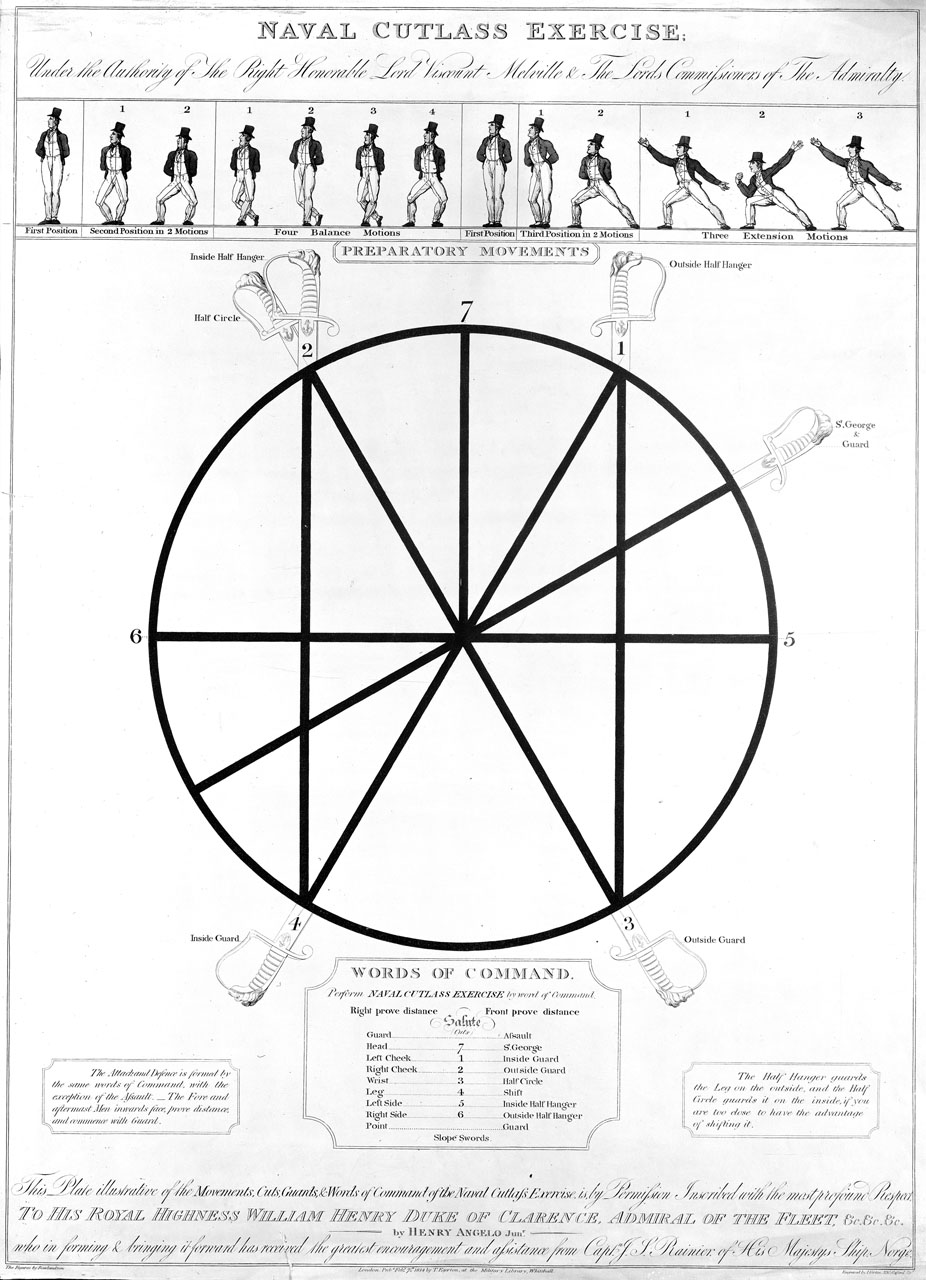
Naval Cutlass Exercise by Henry Angelo, 1813. A detailed illustration of footwork, cuts, and “words of command.” Based entirely on the broadsword, it might as well be broadsword, so why bother—except that Angelo was paid for it by the Royal Navy. In his defense, McArthur (see the “Smallsword” section above) agrees that cutlass and hanger guards and cuts are the same as those of the broadsword. Nonetheless, there are techniques one can use with a cutlass at the distance of “handy-grips” that cannot be used with a broadsword or other longer cutting sword.
Naval Cutlass Exercise “For the Use of Her Majesty’s Ships,” 1859. Includes a good general illustration of cuts and guards, as well as well-regulated military-style (naturally) drills for cuts, guards (equivalent to parries), and points (thrusts, that is). The brief “Concluding Observations” include a vital one for combat: “…but he must ever be “on guard” to meet the impromtu [sic] hit of such as cannot help returning [riposting], whether hit or not.”
The Ship and Gun Drills of the U. S. Navy, by the Naval Department, Division of Militia Affairs, 1914. Seaman’s manual with brief instruction on the USN “Sword Exercise.” The attacks and parries are simple and functional, and the illustrations useful.
British Naval Swords and Swordsmanship by John McGrath & Mark Burton, 2013. Includes a couple of good chapters on British naval swordsmanship, but as can be expected given the source material, the discussion is by and large of the late 18th century and afterward. Includes a description of British naval fencers as well. Required background reading for the student of cutlass swordplay and required technical reading for the collector of British naval swords.
Bibliography
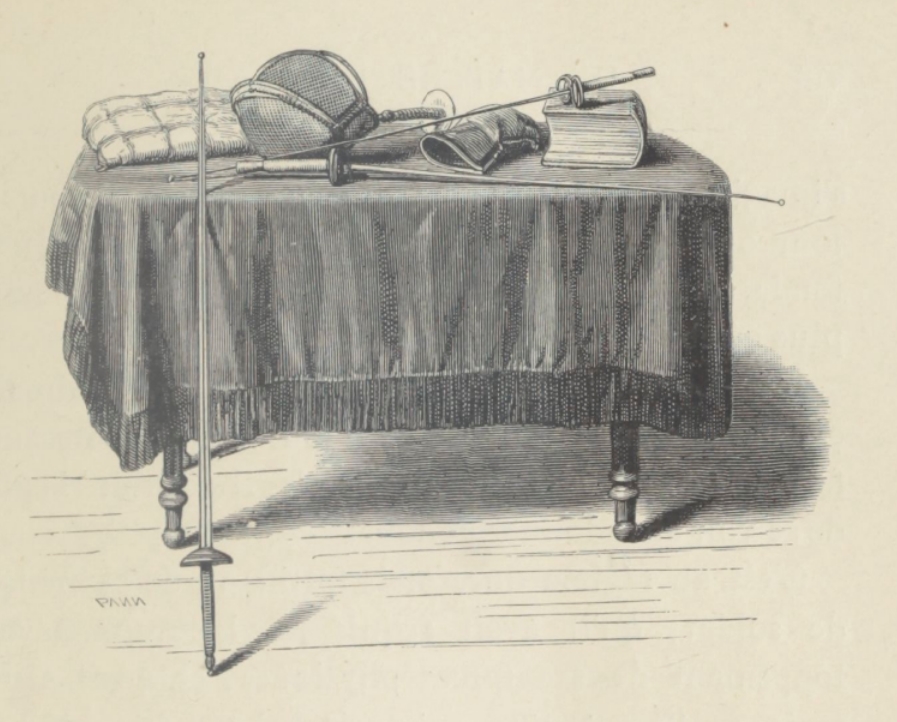
La Bibliographie de l’Escrime Ancienne et Moderne by Arsène Vigeant, 1882. Not as complete as the bibliography below, but highly useful nonetheless. M. Vigeant had a thorough understanding of both swordplay itself and its history.
A Complete Bibliography of Fencing & Duelling by Carl A. Thimm, 1896. A very useful, largely complete bibliography through the late 19th century. Reprints from 1968 and 1999 are available, though often pricey. Look instead for the free pdf on Google books unless you find that fortune generally favors you or you have plenty of money to spend, the latter, of course, being one way or another proof that fortune has favored you at least once.
The History of Fencing & Swordplay
Schools and Masters of Fence by Egerton Castle, 1885, reprints 1968, 2003. European fencing to the late 19th century. Highly recommended.
Old Sword Play by Alfred Hutton, 1892, reprint 2001. A brief description of European fencing technique over the ages by a noted English fencing master.
The Sword and the Centuries by Alfred Hutton, 1901, reprint 1995. A history of European fencing and swords. A classic.
IIIe Congrès International d’Escrime, Brussels, 1905. For those interested in the arguments and squabbles that created modern sport fencing rules—and how sport interests came to dominate in epee competition, rather than having epee competition emulate dueling or the jeu de terrain as closely as possible.
The English Master of Arms: From the Twelfth to the Twentieth Century by J. D. Aylward, 1956. Excellent work covering not only English fencing masters, but necessarily the development of fencing in the British Isles as well. One of my favorites. Aylward’s book on the smallsword in England is also highly recommended for anyone with an interest in smallswords or late seventeenth and eighteenth century fencing or dueling.
Swordsmen of the Screen: From Douglas Fairbanks to Michael York by Jeffrey Richards, 1977. The history of swordsmen and swordswomen in film to 1977. Swashbuckling actors and the fencing masters who doubled for them. Worth the read if you’re into film swashbucklers.
Martini A-Z of Fencing by E.D. Morton, 1988. Not a book on fencing history per se, but a compendium that includes much fencing history, as well as fencing terms, concepts, and trivia. One of Mr. Morton’s entries is Rafael Sabatini. I disagree with most of Mr. Morton’s criticisms of Sabatini, including his claim that much of what he wrote about ships &c is in error. Sabatini did make errors, but they’re not nearly so egregious as Mr. Morton claims, with the exception of presenting a ship’s stern to cannon-fire in order to minimize damage (in fact, this would, as Mr. Morton notes, be more dangerous). Vanity aside, I hesitate to note that I am in fact an expert in this area, and can easily point out where Mr. Morton is incorrect. Notwithstanding that the majority of Mr. Morton’s entries are valid, readers must take the Sabatini entry with a grain of salt.
En garde: Du duel à l’escrime by Pierre Lacaze, 1991. Well-illustrated popular history of mostly French fencing and swordplay.
The History of Fencing by William M. Gaugler, 1998. A detailed history and analysis of the Italian schools into the first half of the 20th century, with a fair, if quite limited, discussion of French schools. The modern schools, including the revolutionary Hungarian (or Hungarian-Italian) saber school, are unfortunately and inexplicably not described. Gaugler’s book has detailed description of the technique presented in a number of books listed in this post, along with fencing-related biographical details of many of the authors.
Escrime by Gerard Six, photography by Vincent Lyky, 1998. “Coffee table” fencing book covering everything from history to technique, albeit briefly, and mostly French. Well-photographed.
The Secret History of the Sword by Christoph Amberger, 1999. By a veteran of the Mensur, also known as fighting for scars—which is by most definitions the purpose of macho male one-ups-man-ship. Most of us, just like Tom Sawyer, are proud of our scars. Highly recommended—the book that is, but we can include scars as well, as proof of a life well-lived and of a fortunate one also, in that we’re still alive to show off our scars.
Croiser le Fer: Violence et Culture de L’épée dans la France Modern (XVIe-XVIIIe Siècle) by Pascal Brioist, Hervé Drévillon, and Pierre Serna, 2002. Excellent scholarly study of swordplay and dueling in France from the 16th to 18th centuries. Highly recommended.
By the Sword by Richard Cohen, 2002. A history of fencing, including the modern schools, by a British Olympic fencer. Arguably the only thorough modern history of fencing. Highly recommended; my favorite book by far on the history of fencing.
Reclaiming the Blade by Galatia Films, DVD, 2009. A mostly well-intentioned attempt to “reclaim” authentic Western swordplay and historical fencing, but unfortunately marred by the heavy-handed, ideological manner in which it attacks sport fencing and some other forms of swordplay, not to mention by its egregious overuse of Hollywood references and interviews—Hollywood depictions of swordplay are usually divorced entirely from reality, thereby undercutting the argument. At its best, the documentary extols Western swordplay. At its worst, it further divides rather than unites the several major fencing communities.
To pick a bone with—or perhaps cross swords with?—the film’s makers, although many modern competitive fencers often do not practice the ideal of “hitting and not getting hit,” there are plenty, epeeists especially, or at least veteran epeeists, who do understand the concept well, can execute it exceptionally well when necessary, and are happy to argue the point, weapon in hand, with any fencer of any sort. In fact, some of us trained entirely under masters who fenced when dueling was still practiced and the saber was still a military arm—and who understood that it was entirely acceptable to practice both forms of swordplay, that is, sport or recreational, and practical training for combat with real weapons. To promote the so-called reality of historical and classical fencing is double-edged and often cuts hypocritically: excessive “contre-temps” or double-touches have been the bane of fencing for centuries, and modern “historical” and “classical” fencers are no more immune to them than were the fencers of the past whom they seek to emulate.
Japanese Texts
Tengu Geijutsuron (The Demon’s Sermon on the Martial Arts) by Issai Chozanshi [Niwa Jurozaemon Tadaaki], translated by William Scott Wilson, 2006. Includes the famous story illustrating the psychology of swordplay, Neko no Myojutsu (The Mysterious Technique of the Cat). Originally written in the early 18th century.
Heihō Kaden Sho (The Sword and the Mind) by Kamiizumi Hidetsuna, Yagyū Muneyoshi, and Yagyū Munenori, translated by Hiroaki Sato, 1985. Originally compiled in the 17th century.
Go Rin No Sho (A Book of Five Rings) by Miyamoto Musashi, translated by Victor Harris, 1974. Completed in 1645, shortly before the author’s death. Numerous editions available, including an excellent translation by William Scott Wilson. A classic on swordplay, strategy, and tactics. Every fencer — and everyone in general — should read it.
The Unfettered Mind by Takuan Sōhō, translated by William Scott Wilson, 1986. Three essays on swordsmanship (Fudōchishinmyōroku, Reirōshū, and Taiaki) by a Zen master and contemporary of Musashi. Written in the early 17th century. Highly recommended.
Suggestions on Acquiring the Books Above
Several of the listed titles (Borysiuk, Czajkowski, Harmenberg, Holzman, Kogler, Lukovich, Szabo, and Vass) were available directly from the publisher, Swordplay Books Online (http://www.swordplaybooks.com/), but with the passing of its owner/editor the titles are largely available now only from fencing suppliers while their stock lasts, and from other common sources. Many fencing books in print may be ordered from various online retailers, and occasionally may be found in bookstores. However, most of the titles listed above are out of print. Some of the older titles are in the public domain and are available as .pdf files on Google Books, archive.org (an excellent site but for its terrible practice of making some books still under copyright available, thus cheating their authors and publishers), and other electronic book sites. College students and faculty may be able to access some titles digitally or in traditional print via their university libraries.
Some of the seventeenth and eighteenth century titles in English are published as fairly inexpensive reprints by Gale ECCO and EEBO (Early English Books Online), along with similar cheap—in the sense of cheaply reproduced from mediocre quality digital scans or old microfiches—facsimile reprint publishers, and are available via Amazon and other online bookstores. However, please note that most of these versions DO NOT INCLUDE FOLDOUT PLATES, so if you’re looking for the illustrations you may have to look elsewhere. Some of these and other old fencing texts may be found in various national digital libraries, often of much better quality, and with complete foldout plates.
A reader of this post, Pradana (see Cruzado y Peralta in the rapier section above), recommends Freelance Academy Press https://www.freelanceacademypress.com/, Fallen Rook Publishing http://www.fallenrookpublishing.co.uk/publications/, and AGEA Editora http://ageaeditora.com/en/ as sources for modern reprints.
Bookfinder.com compares prices of books in and out of print among online retailers, including independent booksellers. Fetchbook.info compares prices among online retailers and some of the major independent bookstores, but my browser warns that the site is a security risk. Abebooks.com and Alibris.com permit title searches through the stock of thousands of independent booksellers; I personally recommend Abebooks although some “drop shipment” booksellers — at times unreliable in their descriptions — now are among the sellers since Amazon (unfortunately) purchased the site. Search all of these sites to get an idea of price range before searching on eBay: although some books on eBay are good, even great, deals, some are grossly overpriced or over-bid.
Overall, I recommend Abebooks.com if you don’t have a local independent brick-and-mortar store carrying fencing books (unlikely) or willing to order for you. Those of you who never had to rely pre-Internet on book vendors for online searches won’t quite appreciate how useful and cost-effective Abebooks &c. are: “back in the day,” booksellers doing searches for customers would typically mark up the price of a book found at another vendor by one hundred percent—plus shipping. Naturally, they didn’t inform you of this practice.
Some fencing books can be found on Amazon.com, but ALWAYS price compare first, especially with used or antiquarian editions. Many Amazon book vendors have a bad — frankly, unethical — practice of listing out of print volumes at ridiculously high prices. About nine out of ten I’d say. I’ve seen a used copy of one of my books listed for about $300 by an Amazon vendor, when it could be found on other sites for as little as $25 in the same condition. Similarly with fencing books. Two more reasons to avoid Amazon: the company often packs books, softcovers especially, with other items, leading to damaged books. A call to Amazon customer service about this resulted only in hilarious escalation from representative to supervisor to “specialist” with no solution other than a promise to “forward your [my] concerns to the appropriate team.” Their scripts don’t cover the issue other than to offer a refund after the book is returned. I didn’t want a replacement: I wanted Amazon to stop damaging books. This request perplexed them immensely, for their was no answer to it in their scripts. Last, Amazon’s cutthroat pricing on books, in which the company apparently loses money, is designed to corner your book sales market at the expense of local bookshops and major chains. I’d rather support bookstores than a rapacious enterprise.
Many fencing suppliers carry fencing books in stock, although the number of titles is often limited. Some libraries carry fencing books, but the selection these days is usually slim. Compare to my high school library which had three or four books on fencing, and we didn’t have, and never had, a fencing club or team.
Most of the sport fencing books listed above are dated in regard to modern competitive rules, practices, and uniform and equipment requirements. Always refer to the current USA Fencing rule book and USA Fencing operations manual, or other appropriate national fencing regulations for HEMA, historical, classical, and other organizations, for competition rules and regulations. USA Fencing rules, such as they now are, are available for download at USA Fencing’s website.
Copyright 2008-2025 Benerson Little. Last updated October 2, 2025.
Keelhauling, in Living Color
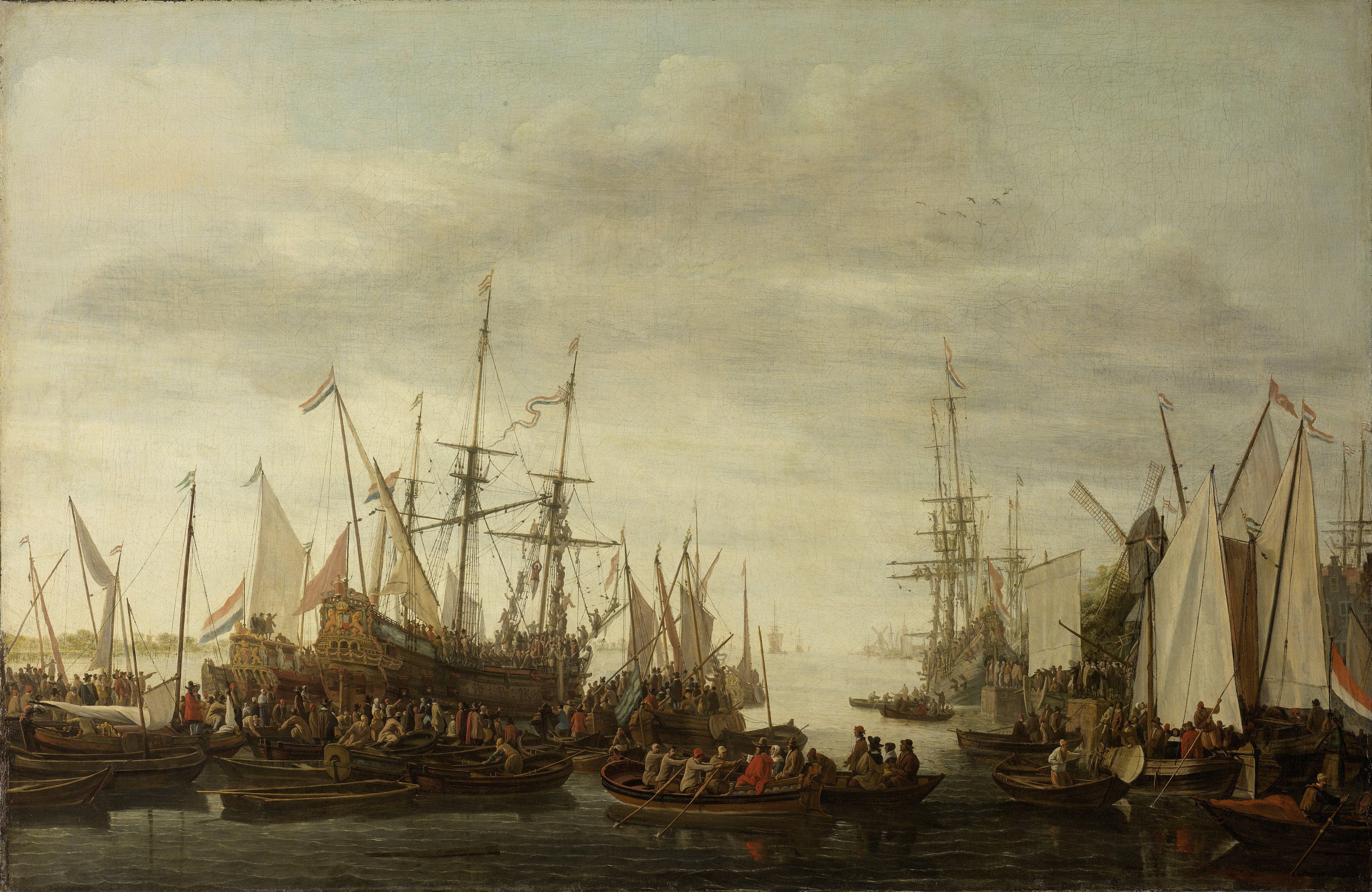
The Keelhauling of the Ship’s Surgeon of Admiral Jan van Nes. Lieve Pietersz Verschuier. 1660 – 1686. Note the enormous crowd gathered for the punishment. (Rijksmuseum.)
As is the case with much pirate history, a great deal of it is wrong, often either anachronistic or culturally mis-associated, or not specifically associated with piracy per se, but with the maritime in general. And so it is with keelhauling, a Dutch practice at first, to which the French and a few other nations later added their small marks.
But keelhauling had little to do with piracy, but this hasn’t stopped it from being including in discussions about pirates and piracy, nor included in pirate fiction and film, most notably and recently in the fourth season of Black Sails. (Full disclosure: I was the historical consultant to Black Sails for all four seasons.)
The original Dutch practice, as described in “A Relation of Two Several Voyages Made into the East-Indies” by Christopher Frick and Christopher Schewitzer, 1700:
“He that strikes an Officer, or Master of the Ship, is without hopes of pardon to be thrown into the Sea fasten’d by a Rope, with which he is thrown in on one side of the Ship, and drawn up again on the other, and so three times together he is drawn round the Keel of the Ship, in the doing of which, if they should chance not to allow Rope enough to let him sink below the Keel, the Malefactor might have his brains knockt out. This Punishment is called Keel-halen, which may be call’d in English “Keel-drawing.” But the Provost hath this Priviledge more than the other, that if any one strikes him on Shoar, he forfeits his hand, if on Board, then he is certainly Keel-draw’d.”
There are several notations of keelhauling and other punishments in the journal of Dutch Admiral Maarten Harpertszoon Tromp in 1639. Typically the keelhauled seaman was drawn three times beneath the ship, apparently not too tightly for he was usually whipped on his “wet bum” with a rope’s end afterwards. For lesser offenses, ducking from the yardarm was employed. In some cases, a seaman convicted of serious offenses might be ducked, keelhauled, whipped, lose his wages, and be discharged. In the case of infirmity due to age or illness, the physical punishments might be stayed, and the seaman discharged instead.
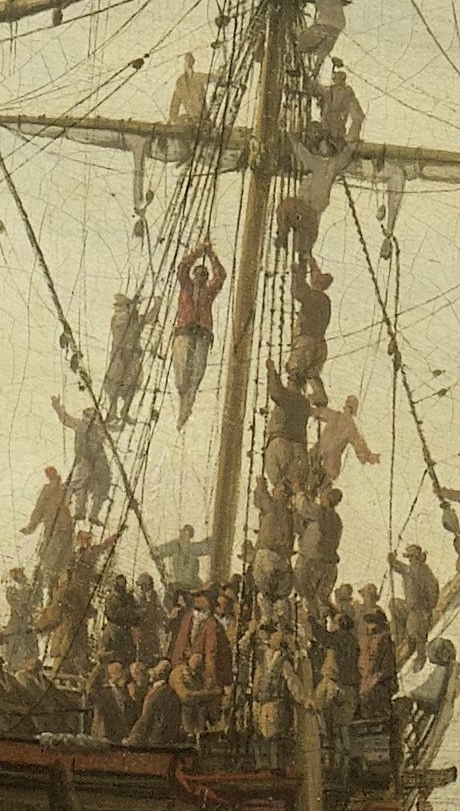
Detail of the victim, from the painting above. The keelhauling line has been rove through a block at the end of the mainyard, and would be similarly rigged on the opposite side. (Rijksmuseum.)
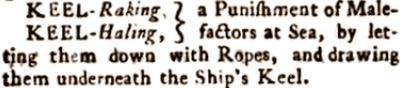
From An Universal Etymological English Dictionary, edited by Nathan Bailey, 1765.
A mid-1850s century French version, described by a former midshipman in the British navy and published in Onward magazine, November 1869, was conducted slightly differently:
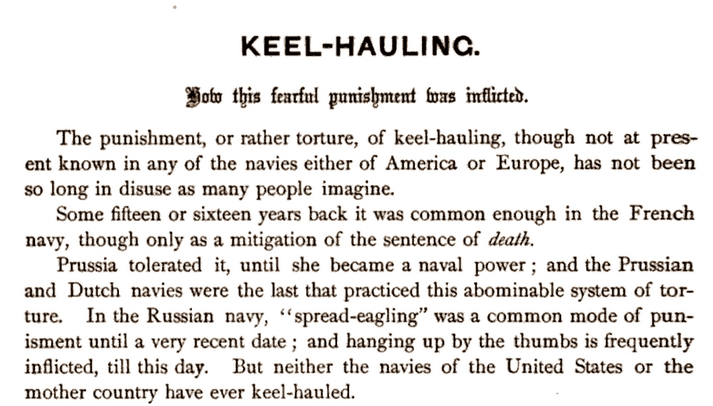
The writer continues with a description of what he witnessed:
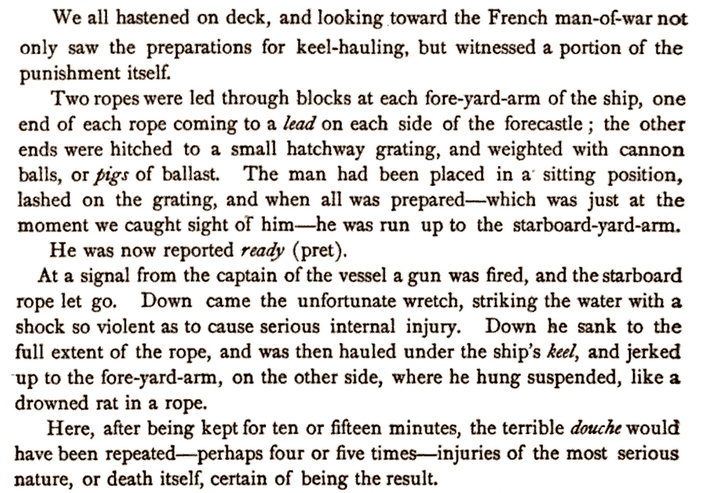
Terrible indeed!
N. B. Spanish Keelhauling
I’ve also seen one reference to the Spanish using keelhauling: Gemelli-Careri, describing his voyage aboard the Manila galleon in 1697, notes that he heard tell of a passenger, during the senas ceremony, being made to “facendogli passere sopra il Vascello,” from which event he died. The period English translation gives this as keelhauling, although sopra means over, not under. So, while it might be keelhauling, it might also be ducking, which is more likely given the ceremony of senas, or signs of land. Ducking might be inconvenient, even frightening to some, but wasn’t usually fatal. Keelhauling often was.
N. B. Keelhauling’s Ancient Origin?
A number of web articles and books, both popular and scholarly, note that keelhauling is of ancient origin. However, this is probably not the case. Scholar Henry A. Ormerod in Piracy in the Ancient World (1924) claims that an image on an ancient Greek vase shows keelhauling, and he has reproduced the image as the frontispiece to his book. However, I see nothing in the image to suggest keelhauling per se. Instead, it appears to depict some form of water torture of prisoners who had their hands tied and were thrown overboard, perhaps pulling them back to the surface as they begin to drown. However, the image does not appear to show keelhauling as we define it—the dragging of a victim beneath the vessel from one side to another. In fact, the victims have only one line attached: keelhauling generally requires two.
Similarly, some scholars and other writers note that the Lex Rhodia of 800 BCE describes keelhauling as a punishment for piracy, but there are actually only a few short paragraphs of the Lex Rhodia that still survive and they don’t discuss punishment for piracy, so I’m not sure where this idea originated. It may be a misreading of Ormerod, who suggests that it may have described punishments for piracy. The only line that refers to piracy is in regard to responsibility for paying the ransom of a ship to pirates. This is a common problem in history: the repetition of misinformation or incomplete information as fact.
My thanks to writer Sylvia Tyburski, whose questions to me on the subject caused me to review the facts on the purportedly ancient origin of keelhauling! I’ll post a link to her article as soon as it’s available.
Copyright Benerson Little 2017. Last updated July 10, 2018.
Of Buccaneer Christmas, Dog as Dinner, & Cigar Smoking Women
Classic romanticized buccaneers! The pirate captain and his woman ashore on a Caribbean island or an isolated part of the Main, perhaps to share plunder or while careening, or simply to celebrate the holiday. We can always count on Howard Pyle to make the romantic appeal to our imaginations. And indeed, buccaneers did celebrate Christmas (and probably smoked cigars on occasion too), as I discuss below.

“How the Buccaneers Kept Christmas,” Howard Pyle, Harper’s Weekly, December 16, 1899, a special two-page image suitable for framing. In fact, I have it matted and framed.
BUCCANEER CHRISTMAS & DOG FOR DINNER
We do have multiple brief accounts of one buccaneer Christmas. Buccaneers, like other Europeans and European-derived Christian peoples, did observe the holiday, far more often with raucous, inebriated celebration than with religious devotion.
William Dampier noted that the captains of salt ships at Saltudos, or Salt Tortuga–where the very real Dr. Henry Pitman, inspiration for Sabatini’s novel Captain Blood, His Odyssey, was marooned–were always well-supplied with rum, sugar, and lime juice for visiting “privateers,” the euphemism for buccaneers, as opposed to the term “pirates.” Piracy after all was a crime.
“I have seen above 20 Sail at a time in this Road come to lade Salt; and these Ships coming from some of the Caribbe Islands, are always well stored with Rum, Sugar and Lime-juice to make Punch, to hearten their Men when they are at work, getting and bringing aboard the Salt, and they commonly provide the more, in hopes to meet with Privateers, who resort hither in the aforesaid Months, purposely to keep a Christmas, as they call it; being sure to meet with Liquor enough to be merry with, and are very liberal to those that treat them.”
Clearly, a buccaneer Christmas at any time of the year was a drunk-fest.
Our most famous description of an actual buccaneer Christmas dates to 1681, during the final days of the South Sea voyage of Captain Bartholomew Sharp and his companions in arms, in plunder (often as wishful as real), and in debauchery.
Sharp, already having been deposed once as captain once during the voyage during a stay at Juan Fernandez Island, a stay which coincidentally began on Christmas Day. Now, at the end of the voyage and almost home, with numbers depleted by buccaneer desertions, accidents, and deaths in battle, with the remaining crew on short allowance, Sharp remained a divisive leader, not for the least reason that by gambling with his fellow buccaneers he had increased his profit by leaps and bounds, leaving some of his comrades with little profit during the course of a long bloody voyage–not the best way to show leadership by any means.
On December 7th, according to buccaneer surgeon Basil Ringrose (I almost wrote Rathbone!), “This day our worthy Commander, Captain Sharp, had very certain intelligence given him that on Christmas Day, which was now at hand, the company or at least a great part thereof, had a design to shoot him; he having appointed that day some time since to be merry. Hereupon he made us share the wine amongst us, being persuaded they would scarce attempt any such thing in their sobriety. The wine we shared fell out to three jars to each mess.”
Mess size varied, as did Spanish jar size. Five to seven to a mess was common, but could even have been as small as four men. Spanish wine jars often, but not always, held a Spanish arroba, roughly four and a quarter gallons. At 750 milliliters to a modern wine bottle, we do some simple math and find that each mess received the rough equivalent of slightly more than sixty-four modern bottles of wine per mess, to last eighteen days: or, three and a half bottles of wine per day per mess. This wine may have been stronger than what we’re familiar with. It might have been very similar to Peruvian wine fortified with modern Pisco, the latter of which is usually 80 proof when sold in the US, but I’m speculating here based on a description of some of the wine found by buccaneers on the Peruvian coast. (And no, I won’t touch the “Who first came up with Pisco–Peru or Chile?” argument. We’ll leave the swords and poniards sheathed for now.)
Buccaneer surgeon Basil Ringrose provided the details: “This day being Christmas day, for celebration of that great festival we killed yesterday in the evening a sow. This sow we had brought from the Gulf of Nicoya, being then a sucking-pig of three weeks old, more or less, but now weighted about fourscore-and-ten pounds. With this hog’s flesh we made our Christmas dinner, being the only flesh we had eaten ever since we turned away our prizes under the equinoctial and left the island of Plata. We had this day several flaws of wind and some rain…” The holiday was celebrated roughly in the latitude of Rio de Janeiro.

An Ossabaw Island pig long-descended from Spanish and Canary Island stock, perhaps quite similar to the buccaneers’ Christmas pig. (The Livestock Conservancy.)

“Cinghiale. Sanglier. Wildschwein. Keuler. Wild boar. Wildzwein.” A sanglier or wild boar as seen in Europe and the Caribbean from European stock. Sangliers were prized for their taste. 1879. (Rijksmuseum.)
Sharp himself is a bit more direct: “When to Solemnize that Festival as well as we could, we eat the only Hog we had left, drank some Jars of Wine, and made our selves as merry as we were able, which I did the rather that my Men might not Mutiny.”
How they seasoned the pig is not noted. Given that their only way at sea of cooking was in a copper kettle, they would have boiled the flesh rather than roasting it over coals and seasoning it with a pimentade of lime juice, salt, hot peppers (pimento, or chili peppers as we know it), probably allspice, and perhaps a black or similar common pepper, as was common. The seasoning would have been similar in the copper pot, assuming they had the ingredients. The buccaneers would have served it with coarse boiled cornmeal (imagine a coarse polenta or coarse yellow grits, the latter are hard to find anymore) seasoned with salt and manteca (pig lard), which had been their only fare since departing the isle of Plata.
However, diarist John Taylor who visited Jamaica in 1687 wrote that Sharp’s buccaneers also served dog for Christmas dinner:
“Soe that they killed one hog, which was all they had left, and a spanell dog which they bought of one of their quartermaster for 40 dollars, on Christmas Day for their dinner.”
Alas poor beast, alas man’s best friend! But Taylor was no eyewitness, he was just repeating what he had heard from local sources. There was in fact a dog, a little curly shaggy-coated canine, like that of a poodle. And, according to one buccaneer, John Cox, who was there, they did in fact eat him:
“When we took the two Barks at Nicoya, we had a little sucking Pigg in one of them, which we kept on Board ever since for our Christmas days Dinner, which now was grown to be a large Hogg; so we killed it for Dinner, but thinking it not enough for us all, we bought a Spaniel-Dogg of the Quarter-Master for forty pieces of eight, and killed him; so with the Hogg and the Dogg, we made a Feast, and we had some Wine left, which made us merry: This being the only think we had eaten that had blood in it since our departure from the Duke of York‘s Island.”
But no one’s memory is perfect. Did they in fact eat dog for Christmas dinner? Was Cox inspired to exaggerate based solely on the rhyme of Hogg and Dogg? Do we see the interfering hand of an editor trying to “sex up” the manuscript? Again Basil Ringrose comes to the rescue, writing of a day in late January, well after Christmas, just prior to making landfall in the Leeward Islands:
“On that day [January 26, 1682], therefore, a little Spanish shock-dog, which we had found in our last wine-prize taken under the equinoctial and had kept alive till now, was sold at the mast by public cry for 40 pieces-of-eight, his owner saying that all he could get for him should be spent upon the company at a public merriment. Our Commander, Captain Sharp, bought the dog, with intention to eat him, in case we did not see land very soon.”
The money raised was added to one hundred more pieces-of-eight that were left over from a previous sharing of plunder, in which the boatswain, carpenter, and quartermaster had refused to accept shares owing to some disagreement “with the sharers.” The coins were laid up, to be spent ashore in celebration of their return to the Caribbean from the South Sea.
Two days later the buccaneers sighted Barbados, but were scared off by the barge belonging to the English man-of-war Richmond lying at anchor Bridgetown harbor. Two days after that the buccaneers sent a canoe ashore at Antigua, or Antigo as they called it, and from here they went their separate ways.
So it was not a Christmas dog after all! Or was it? We hope it was part of no Christmas dinner except to have gnawed any scraps ravenous buccaneers may have cast his way. “Perros Ingleses!” we have heard Spaniards call the buccaneers, or at least buccaneer surgeon Alexandre Exquemelin said they did on one occasion, and surely in fact on many. But dog don’t eat dog, or so they say, and we hope, more from Ringrose and the buccaneer arrival at Antigua and not necessarily from common proverb, that Cox was wrong and that Sharp may have been mostly joking about eating the dog.
Mostly.
WITH A WILLING WOMAN IN A HAMMOCK
So, would buccaneers have celebrated Christmas as in Pyle’s image above? With a willing woman in a hammock, smoking a cigar? It’s a common image in fiction, that of a romance between a pirate and a lady on the seashore. We almost imagine this as the setting in the aftermath of The Black Swan by Rafael Sabatini, but when we recall the noble manner in which the romance unfolded, his gentlemanly behavior, her lady-like sensibilities, we can’t imagine Priscilla Harradine smoking a cigar. On the other hand, we recall her attraction to men of adventure and her propensity for slipping off to swim nude, and we think perhaps she might after all.

The cover of the 1947 Editorial Molino Argentina edition.
For the sake of romantic notions, combined with the fact of romantic relations between buccaneers and some women, I will forego a discussion of the often profoundly disturbing treatment of women by pirates at times, a fact often ignored or only hinted at it film. You may find these sordid details in The Golden Age of Piracy: The Truth Behind Pirate Myths, and in other works as well.
Some, probably many, buccaneers were married but they did not take their wives, or their women in general for that matter, to sea with them, the one known exception being John Beare who took his woman, the daughter of a rum punch woman in Port Royal, to sea at least once dressed as a man. Accused of piracy by the English–and yes, he was in fact a pirate–he fled to Havana where he married his true love and began serving as a Spanish privateer, or, as the English would have it, a Spanish pirate. Perhaps Beare did celebrate a Christmas ashore while careening, his inamorata waiting languidly in a hammock.
We also have the example of Dutchman Jacobus (James) Marquess, or “Copas” [Cobus] for short, a buccaneer “lingusiter”–also known as a “truchman” or interpreter–in the South Sea with Bartholomew Sharp. Copas fell in love, or perhaps merely deeply in lust, with a “Mustees” Spanish woman at the island of El Cavallo while the buccaneers were ashore taking in water over the course of four days and three nights. Many of his companions worried that he was a turncoat who intended to betray them to the Spanish. A Native American boy also ran away while at the island, perhaps with Copas.
“[T]he woman lieing on borde one or two nights, was very familiar with one Copas a dutch a man, who formerly had saild with the Spaniards…but was mainly Inamoured with thiss women, makeing her severall presents of some Vallew,” wrote a buccaneer who is best identified as Edward Povey.
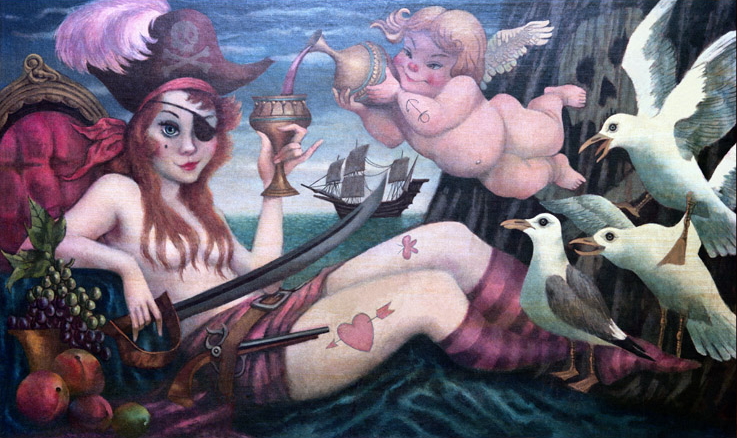
Not in a hammock, yet in a recumbent pose with hints of Venus rising from the waves. Inspired in part perhaps by Howard Pyle’s painting above and perhaps by Spitfire Stevens (Maureen O’Hara) in Against All Flags, and therefore by popular visions of Anne Bonny, the painting is likely ultimately inspired by the redhead that once was part of the Disney Pirates of the Caribbean attraction. The painting, which hangs in the bar in the California version of the ride, is entitled “A Portrait of Things to Come,” suggesting the redhead becomes a pirate after the “bride auction.” Disney Image.
Copas pretended to go hunting but deserted to her instead, leaving all but two hundred pieces-of-eight of his plunder behind–some 2,200 pieces of eight, plus jewels and other goods. He must truly have been in love, indeed! Or perhaps he thought he could sell his knowledge of the buccaneers to their enemies. Alas, this instance of buccaneer love did not occur over Christmas, but late in May, 1681.
Raveneau de Lussan, buccaneer author, wrote that during the occupation of Guayaquil by French flibustiers in 1687, he was almost seduced away by the “widow of the local treasurer,” who suggested they hide in the woods until the pirates were gone, and then they could marry and he would have “her husband’s office in addition to her own extensive holdings.” Quite an offer! But de Lussan turned it down, and again, this flibustier love did not occur over Christmas, but in April. Spring is the time for love, so it is said. Or perhaps just for mating.
If any buccaneers did take their wives or inamoratas with them to sea, I imagine it may have been some of the early flibustiers and boucaniers who did so with their “Amazon wives who could shoot and hunt well,” as one chronicler noted of them, supporting the expeditions and perhaps even participating in the assaults themselves.
CIGAR SMOKING WOMEN
But IF a buccaneer did have his woman with him at Christmas (and here I speak of buccaneers solely as men only because, although there may have been one or more women in disguise among them as actual crew members, to date we know of none–Jacquotte Delahaye is a 20th century fiction, and Anne Dieu-le-Veut was a wealthy shore-based widow, not a flibustière), might she have smoked a cigar?
To find an answer we must first know if people smoked cigars in the 17th century Caribbean or anywhere else for that matter. Many modern pirate researchers and reenactors decry as incorrect the cigar-smoking pirates in Black Sails, for example, and one even called me out–incorrectly–on the subject after he read the prologue to The Golden Age of Piracy.
We turn first to Jean-Baptist Labat, priest and also chronicler of the late 17th and early 18th century Caribbean for the answer:
“We do not use pipes in the Americas; the Spanish, Portuguese, many English and French, nearly all blacks, and all our Caribs smoke bouts [“ends”], or as the Spanish say, cigars… It is rare to find a Spaniard without his provision of cigars.”
(Notably, Labat mis-heard cigaro and wrote it as cigale, or cicada in French. His description of cigars is quite modern: six to seven pouces long, and five to six lignes in diameter, roughly six and a half to seven and a half inches long, and around half an inch in diameter.)

Detail from a Dutch print by Crispijn van de Passe, 1641, showing an imaginary English merchant’s wife with wine and tobacco. (Rijksmuseum.)
We turn next to buccaneer-surgeon and author Alexandre Exquemelin who preceded Labat. He writes in the French edition of his buccaneer book that in “America one uses very little snuff, but smokes much tobacco. From tobacco leaves…they make small rolls which the Spanish call cigarros and which they smoke without a pipe.”
So Spaniards and others smoked cigars. But did buccaneers? Most buccaneers were English, French, and Dutch, although there were many other peoples, nationalities, and ethnicities among them, including Spanish, Portuguese, Italian, and other European origins, plus African, Native American, even Asian via Mexico via the Manila galleon, plus a variety of mixed races. They were, in other words, a variety of white, black, and brown of many origins. And there were Spanish pirates of course!
The English, French, and Dutch chewed tobacco or more commonly smoked it in pipes, small to medium bowl size among the English and French, large among the Dutch. White clay pipes were the most expensive and typically from England and the Netherlands; terracotta pipes were cheaper and often made locally; and wooden pipes were the cheapest (and doubtless the worst to smoke).
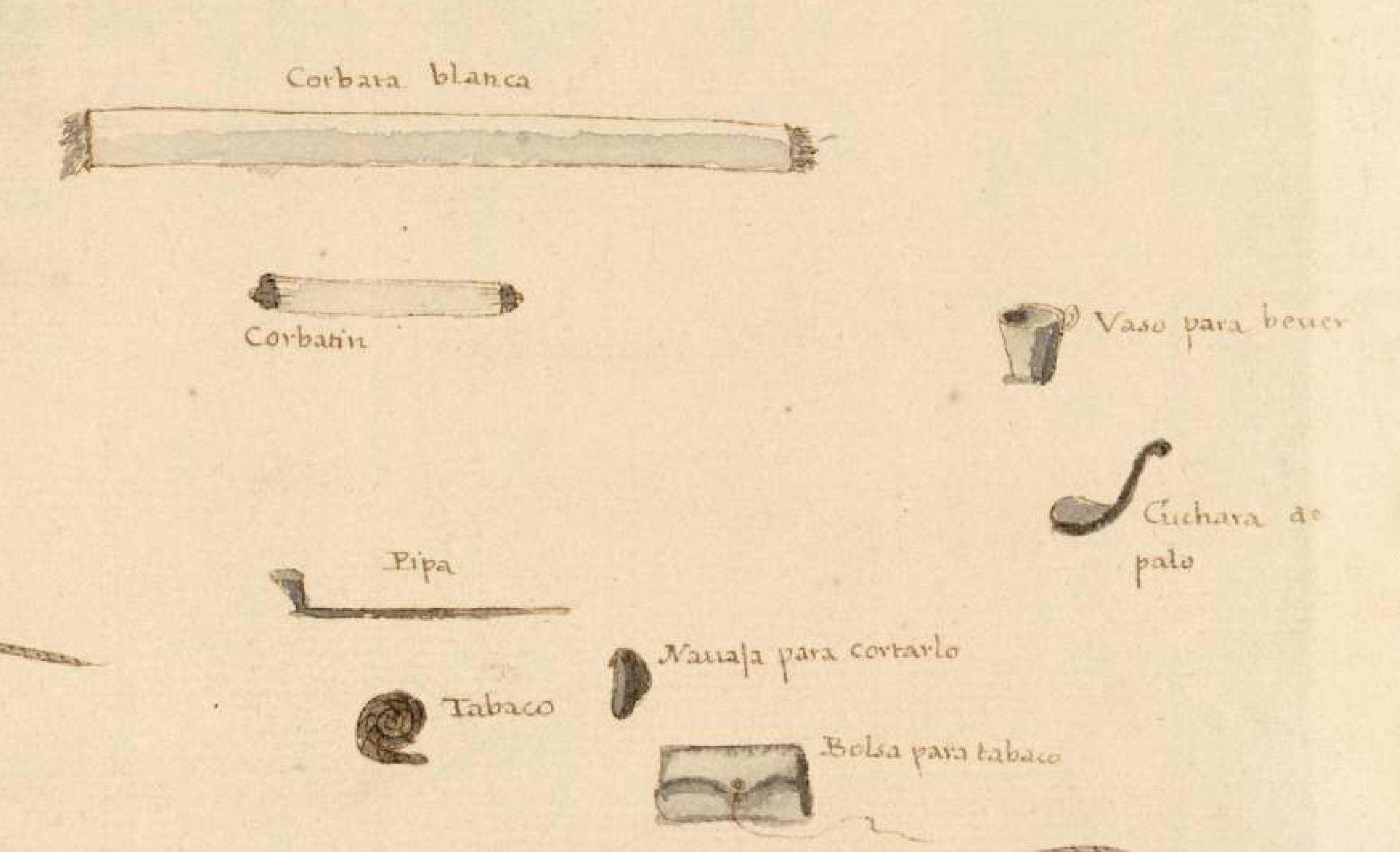
Some of the personal items of a typical Spanish naval officer in the first half of the 18th century, including a pipe, roll tobacco, a folding Navaja for cutting the roll, and a pouch for tobacco. Detail from the Álbum de Construcción Naval by Juan José Navarro de Viana y Búfalo, Marqués de la Victoria, circa 1719 to 1756.

Some of the personal items of a typical Spanish naval seaman in the first half of the 18th century, including pipes, cigars and roll tobacco, a folding pocket knife or Navaja for cutting the roll tobacco, and a pouch for tobacco and comb. Detail from the Álbum de Construcción Naval by Juan José Navarro de Viana y Búfalo, Marqués de la Victoria, circa 1719 to 1756.
However, Spanish buccaneers among them would likely have smoked cigars (or seegars as they became known among the English by the early 18th century), and some English, French, and Dutch may have preferred them at sea as they did ashore. Certainly some African slaves and former slaves among the buccaneers smoked cigars, and it’s probable that some English, French, and Dutch buccaneers smoked captured cigars, if only by cutting them up and smoking the tobacco in their pipes. There is no question that cigars were smoked at sea: the 18th century Spanish Álbum de Construcción Naval of the Marqués de la Victoria shows the cigar along with the pipe among the forms of tobacco used by Spanish seamen. Having smoked both pipe and cigar, I can say that a cigar is no more dangerous aboard a wooden ship than is a pipe: both can be hazardous if appropriate measures are not taken.
Ah, but did women smoke cigars? Well, we know that among the English, French, and Dutch many women smoked pipes, along with many African women in the Caribbean. And there were Native American women who smoked cigars. So why not Spanish women of any ethnicity? And why not cigars, given that they were the predominant means on the Spanish Main of taking tobacco? In fact, we know that in the 18th century there were Spanish creole women who smoked cigars, thus it’s almost certain they did in the 17th century as well.
Alexandre Exquemelin, the buccaneer-surgeon and buccaneer-author who gave us The Bucaniers of America, notes in his French edition that it was as unusual to see a Spanish woman in the Americas who didn’t smoke as it was to see a woman in France who did. (He also did not understand the allure of tobacco, for his medical experience had taught them that smoking was contrary to good health.)
Likewise John Cockburn, writing of the year 1735 in which he was captured by a Spanish guarda costa, or as the English would probably have it, a Spanish pirate, noted the following of three Spanish friars who had just crossed some mountains in Nicaragua:
“The gentlemen gave us some seegars to smoke, which they supposed would be very acceptable. These are leaves of tobacco rolled up in such a manner, that they serve both for a pipe and tobacco itself. These the ladies, as well as gentlemen, are very fond of smoaking; but indeed, they know no other way here, for there is no such thing as a tobacco-pipe throughout New Spain, but poor awkward tools used by the negroes and Indians.”
And who’s to say the woman in Pyle’s painting isn’t Spanish, after all? It is a romantic notion.
Of course, Pyle’s use of a woman smoking a cigar is even more provocative than merely putting her recumbent and languid in a hammock. Since the late seventeenth century, smoking in women has often been seen as a sign of promiscuity rather than as a notion of budding equality. But Pyle’s image is not merely a sexual provocation: it is an image of aggressive independence. This woman is no wallflower, she is no quiet being who fully accepts the purely feminine role imposed upon her. Rather, she is a suitable companion adventurer: a modern progressive woman even by the standards of Pyle’s day. I wouldn’t usually consider Howard Pyle as a feminist per se, but in this case I think he has already proved the argument.
SELECT BIBLIOGRAPHY
Cockburn, John. The Unfortunate Englishmen: or, a Faithful Narrative of the Distresses and Adventures of John Cockburn. “New edition.” London: Hamilton and Co. Shakespeare Library, 1794 (63-64).
[Cox, John]. The Voyages and Adventures of Capt. Barth. Sharp, and Others, in the South Sea. London: P. A. Esq. [Philip Ayers], 1684.
de Lussan, Raveneau. Journal du Voyage Fait a la Mer de Sud, avec les les Flibustiers de l’Amerique en 1684. et Annés Suivantes. Paris: Jean Baptiste Coignard, 1690.
——. Journal of a Voyage into the South Seas in 1684 and the Following Years with the Filibusters. 1689. Reprint, translated and edited by Marguerite Eyer Wilbur. Cleveland: Arthur C. Clark Company, 1930.
——. Journal of a Voyage Made by the Freebooters into the South Sea, 1684, and in the Following Years. 1699. In The History of the Buccaneers of America by Alexandre Exquemelin [Joseph Exquemelin]. Reprint, Boston: Sanborn, Carter and Bazin, 1856.
——. Les Flibustiers de la Mer du Sud. 1695. Reprint, edited by Patrick Villiers. Paris: Éditions France-Empire, 1992.
[Dick, William]. “A Brief Account of Captain Sharp . . .” In The Buccaneers of America by Alexander Exquemelin [John Esquemeling], 257–83. 1684. Reprint, New York: Dorset, 1987.
Exquemelin, Alexandre [Alexander Olivier O’Exquemelin]. Histoire des Avanturiers Flibustiers qui se sont Signalez dans les Indes. 2 vols. Paris: Jacques Le Febvre, 1699. See also his 1686 edition.
Labat, Jean-Baptiste. Nouveau Voyage aux Isles de l’Amerique. The Hague: P. Husson et al, 1724.
Lepers, Jean Baptiste. La Tragique Histoire des Flibustiers: Histoire de Saint-Domingue et de l’Ile de la Tortue, Repaires des Flibustiers, Écrite vers 1715 par le Rév. P. Lepers. Edited by Pierre-Bernard Berthelot. Paris: G. Crés, 1922.
Little, Benerson. The Buccaneer’s Realm: Pirate Life on the Spanish Main, 1674–1688. Washington, DC: Potomac Books, 2007.
——. The Golden Age of Piracy: The Truth About Pirate Myths. New York: Skyhorse Publishing, 2016.
——. The Sea Rover’s Practice: Pirate Tactics and Techniques, 1630–1730. Washington, DC: Potomac Books, 2005.
Navarro de Viana y Búfalo, Juan José. Álbum de Construcción Naval del Marqués de la Victoria. Museo Naval de Madrid.
[Povey, Edward?]. “The Buccaneers on the Isthmus and in the South Sea. 1680–1682.” In Jameson, Privateering and Piracy.
Pyle, Howard. How the Buccaneers Kept Christmas. An illustration in Harper’s Weekly, December 16, 1899.
Ringrose, Basil. “The Buccaneers of America: The Second Volume.” In Exquemelin, Buccaneers of America (Crooke, 1684).
——. Buccaneer Atlas: Basil Ringrose’s South Sea Waggoner. Edited by Derek Howse and Norman J. W. Thrower. Berkeley: University of California Press, 1992.
——. “Captains Sharp, Coxon, Sawkins, and Others . . .” In The History of the Buccaneers of America by Alexander Exquemelin [Joseph Esquemeling], 180–313. 1699. Reprint, Boston: Sanborn, Carter and Bazin, 1856.
Sabatini, Rafael. The Black Swan. Boston: Houghton Mifflin, 1931.
Sharp, Bartholomew. Captain Sharp’s Journal of His Expedition. In A Collection of Original Voyages by William Hacke. 1699. Facsimile reprint, edited by Glyndwr Williams. New York: Scholars’ Facsimiles & Reprints, 1993.
Taylor, John. Jamaica in 1687: The Taylor Manuscript at the National Library of Jamaica. Edited by David Buisseret. Kingston: University of West Indies Press, 2008.
Copyright Benerson Little 2017-2024. Last updated December 3, 2024.
Buccaneer Cutlasses: What We Know

Eyewitness image of a flibustier with captured Spaniards in chains. From the French chart Carte particulière de la rivière de la Plata by Paul Cornuau, probably 1684 based on a nearly identical chart he drew of the River Plate dated 1684. (French National Library.)
EXQUEMELIN’S HEROES & THEIR CUTLASSES
Although the fusil boucanier–the long-barreled “buccaneer gun” of which more blog posts are forthcoming–was the primary weapon of the buccaneer and flibustier, the cutlass was an invariable part of their armament, which also included one or two pistols and a cartouche box (sometimes two) that often held as many as thirty cartridges each. Grenades, firepots, and boarding axes were additional specialty weapons. English/black bills were fairly common aboard English men-of-war of the era (and halberds aboard the French) as well. Some seamen (and we assume some buccaneers) carried broadswords or backswords instead of cutlasses, and English seamen were known as adepts with cudgels and handspikes (see Samuel Pepys re: the latter). In a separate post I’ll discuss broadswords, backswords, cudgels, and handspikes.
Yet in spite of all the romance of buccaneers and their swords–cutlasses usually in reality, but often rapiers in cinema–we don’t know as much about the swords themselves as we would like. Much of what we think we know is based on conjecture, and this conjecture is based on what little we know about cutlasses and hangers of the late 17th century. Unfortunately, the archaeological evidence is for all practical purposes non-existent in regard to demonstrable buccaneer swords 1655 to 1688.
Cinema, the source of much of the popular image of the pirate cutlass, almost always gets these swords wrong. Typically they are anachronistic, often imitations of nineteenth century “soup bowl” hilts (and occasionally authentic 19th century cutlasses) drawn from prop stocks. Money is always a concern in film-making, and it is much cheaper to use existing swords than to make historically accurate ones in large quantities, or, too often, even in small quantities. Good historical consulting and the willingness to follow it is, of course, mandatory, but some filmmakers take the view of “Who cares? Hardly anyone will notice, what matters is that the swords look cool or ‘Rock and Roll’ or otherwise meet audience expectations, and anyway, we don’t have the budget for accurate ones, the actors and computer graphics have consumed it all.” On occasion, though, we do see fairly accurate swords in cinema–just not very often.
Our typical idea of a “true” pirate cutlass is taken from the illustrations, such as that above, in Alexandre Exquemelin’s The Buccaneers of America. First published in Amsterdam in 1678 in Dutch, the illustrations have been copied to other editions, typically with little or no alteration. Herman Padtbrugge, draftsman and engraver, may have been the illustrator according to the British Museum. It is unknown how much influence Exquemelin had on him, or on whomever was the illustrator. In other words, it is unknown how accurate the physical representations the buccaneers are, nor how accurate their arms and accoutrements. The cutlasses depicted in Exquemelin may simply reflect the illustrator’s Dutch nationality and familiarity with Dutch arms. Notably, the large seashell-like shells of the hilt do have an obvious maritime flavor, and are the perfect arme blanche with which to equip a buccaneer in an illustration.
Even so, the cutlasses are accurate representations of classical late seventeenth century Dutch or German weapons with large iron shell-hilts, manufactured well into the mid-18th century with basically no design changes. Basically, these cutlasses are German-style dusacks with simplified hilts. Similar shell hilts were manufactured by other European nations, albeit typically with somewhat smaller shells. The English, for example, produced some cutlasses or hangers with somewhat smaller but similar shells during the 1660s. The Dutch and German shells are usually quite large and often scalloped, the pommels often heavy for balance, the blades mildly to strongly curved, often with clip points. (Notably, cutlasses or hangers seen in paintings of Dutch naval captains and admirals have only small shells.)
Typically these large shell-hilts may have had a single shell on the outside, with or without a thumb ring on the inside, although usually with one; or a large outside shell and smaller inside shell, both most commonly facing toward the pommel; or a large outer shell with a small inner shell that narrows into a thumb ring. A thumb ring may be present or absent in the case of two shells; occasionally it may be separate from the inner shell. These heavy-hilted cutlasses may have two short quillons with no knuckle bow, or a conventional short or medium upper quillon along with a lower quillon converted to a knuckle bow as in the image below. Pommel style and grip style and material–wood, bone, antler, brass, shagreen (“fish skin,” ray skin) over wood, wire over wood, leather over wood, or even iron–vary widely. Blade balance varies just as widely, with some heavy-bladed cutlasses balanced more like cleavers than fencing swords. This is not a criticism: cleaving strokes with a cutlass are quite effective at close range.
The cutlass wielded by Rock the Brazilian above appears, on close examination, to have a single outside scalloped shell, two quillons (although it’s possible the lower quillon might actually be a knuckle bow, but I doubt it is), a heavy pommel, and a thumb ring.
L’Ollonois above holds a typical Dutch or German scalloped shell-hilt cutlass of the late 17th century. Its shell is medium to large, the quillons small and curved, the pommel round and heavy, the blade moderately curved and with a clip point useful for thrusting. It appears it may have a thumb ring or an inner shell, probably the former, or both.


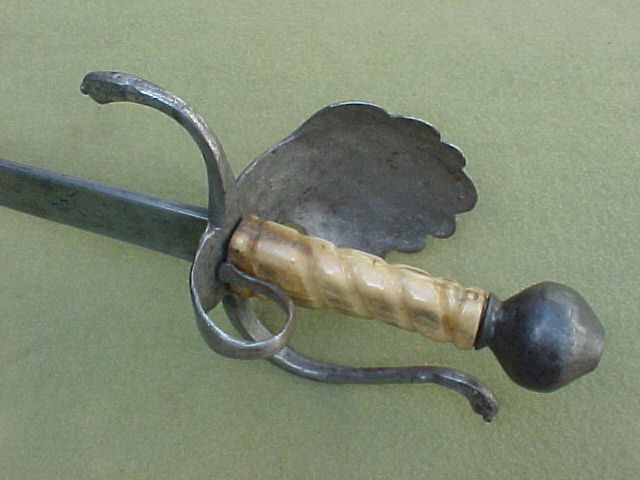
EYEWITNESS IMAGES OF BUCCANEER & FLIBUSTIER CUTLASSES
What we do not know is how common these swords were among buccaneers and flibustiers. Doubtless there at some among them, given how common these cutlasses were. However, the most direct evidence we have of the sort of cutlasses used by these adventurers comes from several drawings of flibustiers in the 1680s by Paul Cornuau, a cartographer sent to survey French Caribbean ports, in particular those of Saint-Domingue (French Hispaniola, modern Haiti). Typically he included local figures flanking his cartouches, and most of these figures are flibustiers and boucaniers. Notably, these are eyewitness illustrations! (See also the The Authentic Image of the Real Buccaneers of Captain Blood: His Odyssey by Rafael Sabatini (Updated) and The Authentic Image of the Boucanier pages for other eyewitness images.)
In the image at the very top of the page, the flibustier holds a cutlass with a small hilt of indeterminate shape, without a knuckle bow, and with a strongly curved clip point blade. There is no baldric: he wears a sword belt of the sort common at the time, with a pair of hangers with loops (one of them is not shown) hanging from the belt itself. None of these period images of flibustiers show baldrics, although they were a common way of carrying a smallsword into the 1680s for civilian use, and prior to this by infantry and other military branches. However, most infantry began abandoning them in this decade, if not earlier, and they remained in use afterward primarily by mounted troops and Scottish Highlanders.
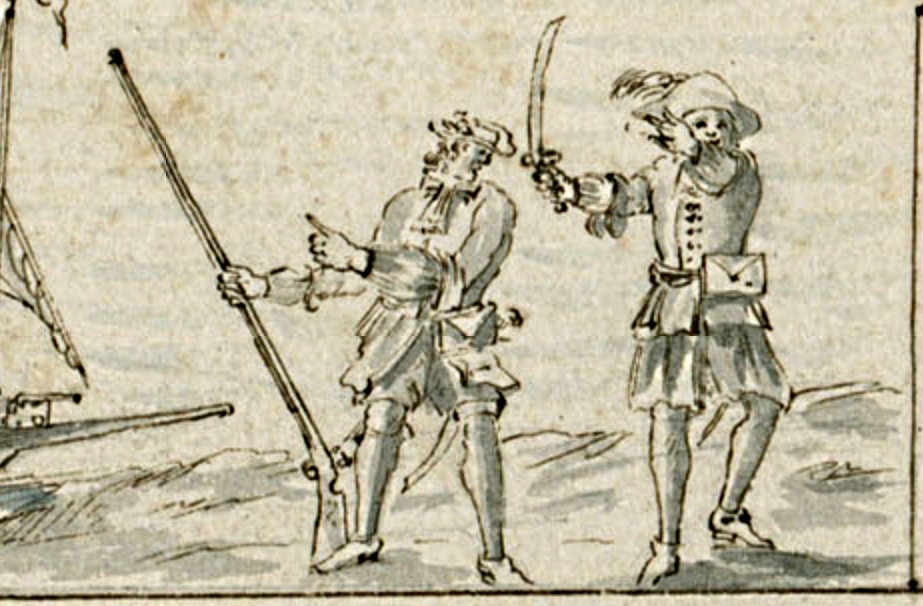
In the image above, we can tell little of the cutlass belonging to the flibustier on the left except that it has a clip point and that it may be of brass, based on its probably monster, beast, dog, or bird pommel, although some iron pommels have a similar profile, and some iron hilts have similar brass pommels. It appears to lack a knuckle bow. Its scabbard is worn from the belt. The flibustier on the right holds a cutlass with a moderately curved blade and clip point. Its hilt has two shells, both small and scalloped. Its pommel may also be of some sort of beast or bird, although we cannot be certain, and there is no knuckle bow. Again, the scabbard is worn from the belt. A similar illustration of a flibustier (on the Authentic Image post, of a flibustier at Île-à-Vache, 1686, from a chart by P. Cornuau) shows only a scabbard with an obvious clip point. It, too, is worn from the belt.
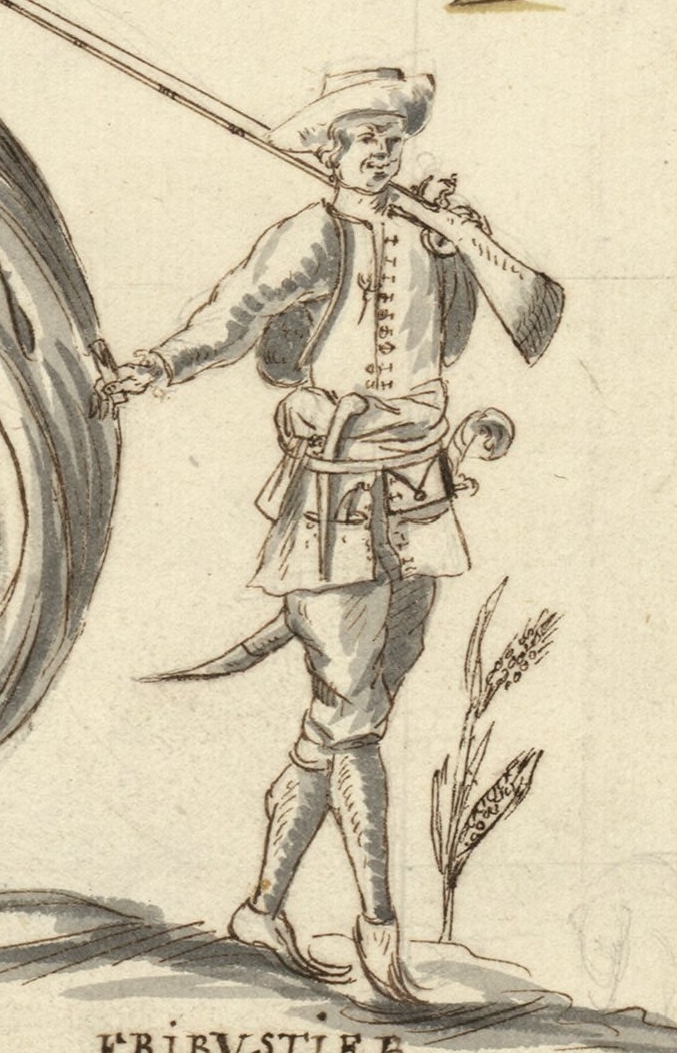
In the image above we have more detail of the hilt. It is clearly of the monster, beast, dog, or bird pommel type, almost always brass. There is a bit of shell showing, but what sort we can’t tell other than that it is scalloped, although if brass we know it is comparatively small. Again, there is no knuckle bow. Notably, the scabbard, which also has a chape (metal protection for the tip of the scabbard), does not necessarily reveal the blade form: it may be with or without a clip point.
So, what would these cutlasses depicted by Cornuau actually have looked like? And what is their origin? For the latter answer, the cutlasses could be of Dutch, English, or possibly French origin. There are numerous English cutlasses and hangers of this form still extant, and of the Dutch as well; the Dutch are often credited as the likely creators of this form. There is less information, though, and few examples, of French cutlasses from this period, although the French may have produced similar arms. There are numerous examples from English and Dutch naval portraits. Most of these swords appear be gilded brass hilts. Although some flibustiers and buccaneers may have carried cutlasses with gilded hilts, most were probably simple brass or iron.
PERIOD EXAMPLES
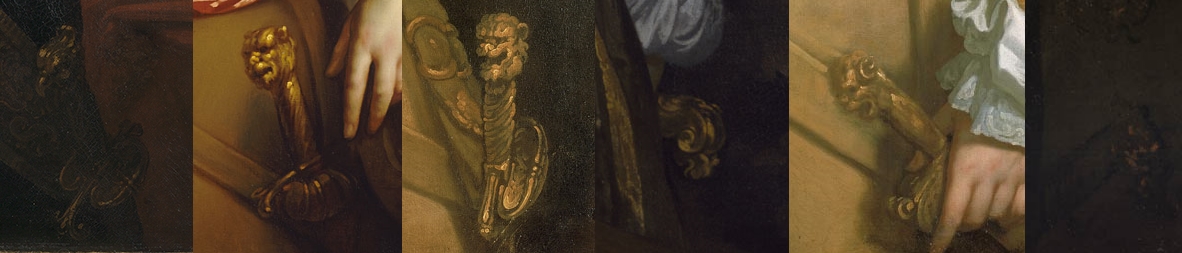
Starting with brass-hilt cutlasses similar to most of those in the Cornuau illustrations, we see a variety of shells and pommels above, although most grips appear to brass, or possibly wire, twisted in a sharply ascending manner. Pommels include a bird of prey, lions, and one or two indeterminate forms similar to that shown in the illustration above of the flibustier armed and equipped to march against a town or city.
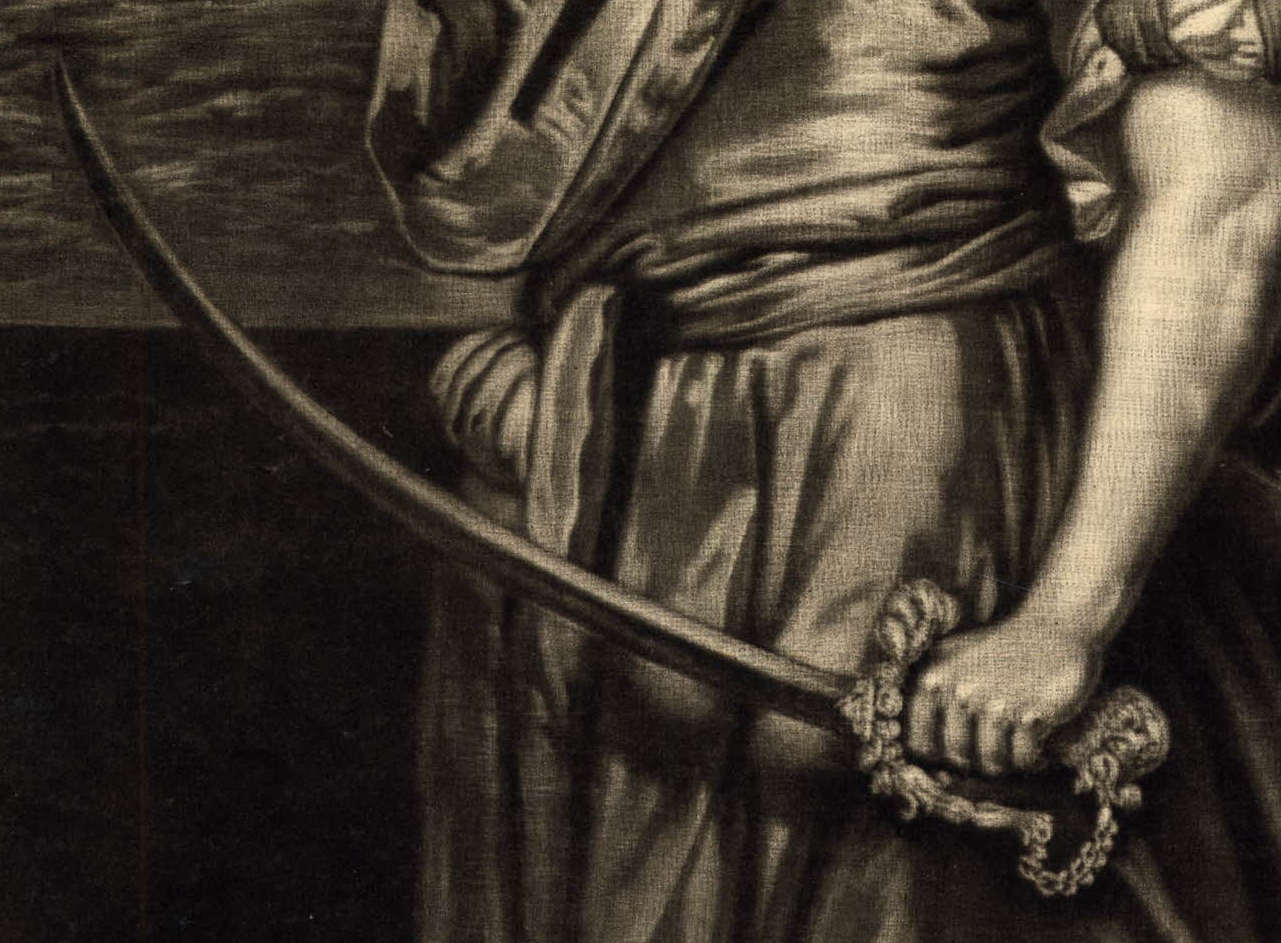
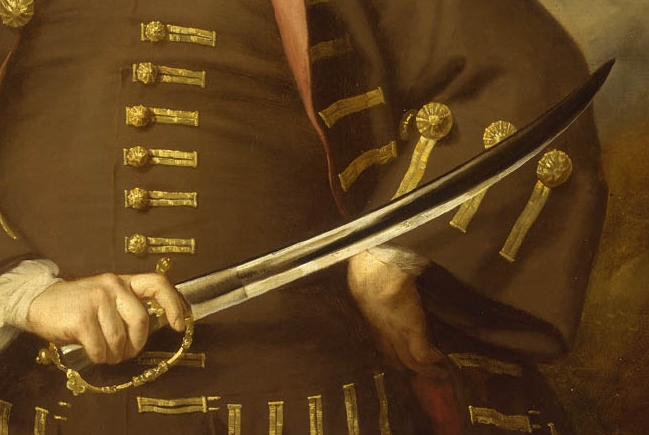
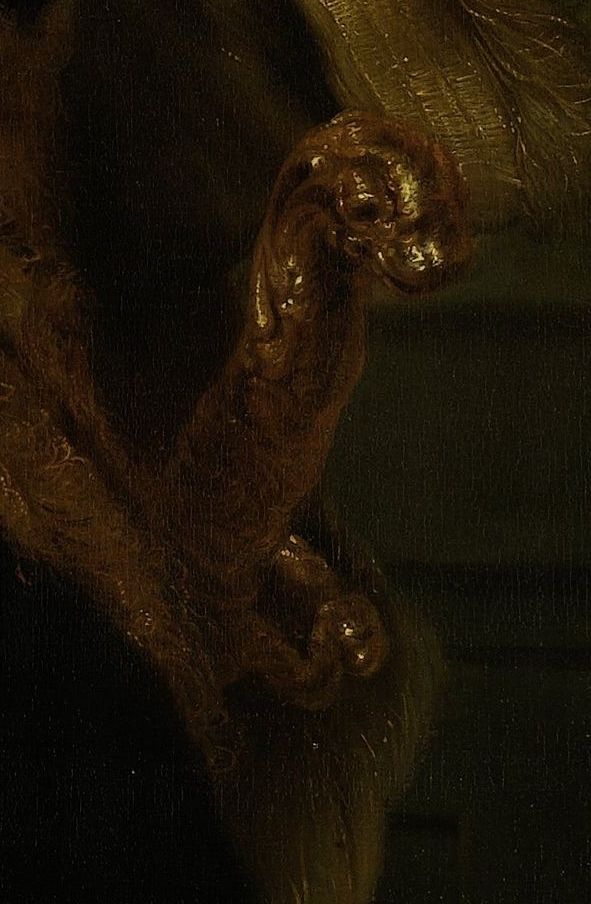
If we consider that this form of cutlass is likely Dutch in origin, it behooves us to look closely at one. The image above is of the hilt of the cutlass of famous Dutch admiral Michel de Ruyter. Note that it too lacks a knuckle bow.
Below are several hilts with a variety of knuckle bows. The 4th from the left looks somewhat like a transitional rapier or smallsword hilt, but it appears it may lack the usual arms of the hilt, plus the sword hangs low from the belt and at a steep angle, making it possible that it is a hanger or cutlass. The last image has a knuckle bow of chain, as if a hunting hanger, which it might well be. Again, we see dog or monster pommels, and also lion pommels.
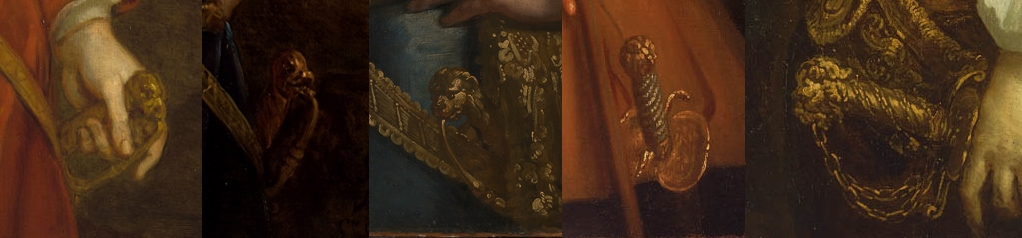
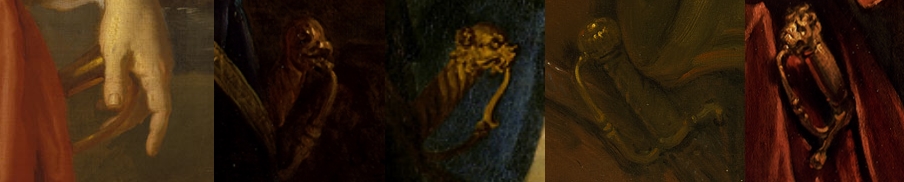
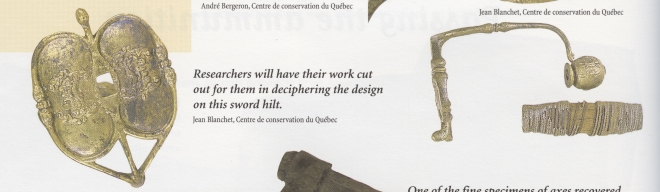
The hilt shown above may be that of a hanger or cutlass, or other cutting or cut-and-thrust sword such as a broadsword or backsword. The shells, while identical to those of a period smallsword, are, with the form of the knuckle bow, very similar to those found on some late 17th century brass-hilted English naval cutlasses. However, it is impossible to know what sort of blade was mounted in the hilt. The Elizabeth and Mary was ferrying New England militia, who were armed with a variety of non-standard arms.
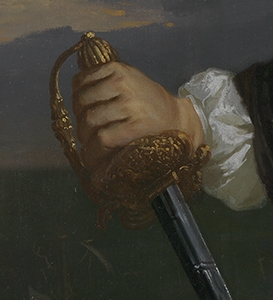
Note the similarity of the sword of Sir Christopher Myngs–possibly a transitional sword with a “rapier” style blade, or a light cut-and-thrust broadsword–to that of the shipwreck hilt.
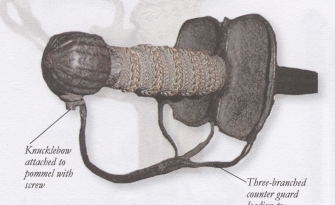
Thankfully, there remain a fair number of extant examples of hangers and cutlasses other than the few shipwreck artifacts, although maritime or naval provenance is often difficult to prove. A few examples are shown below. Note that two of them have iron shells and/or knuckle guards, with brass pommels. Some buccaneer cutlasses could have been of this form.

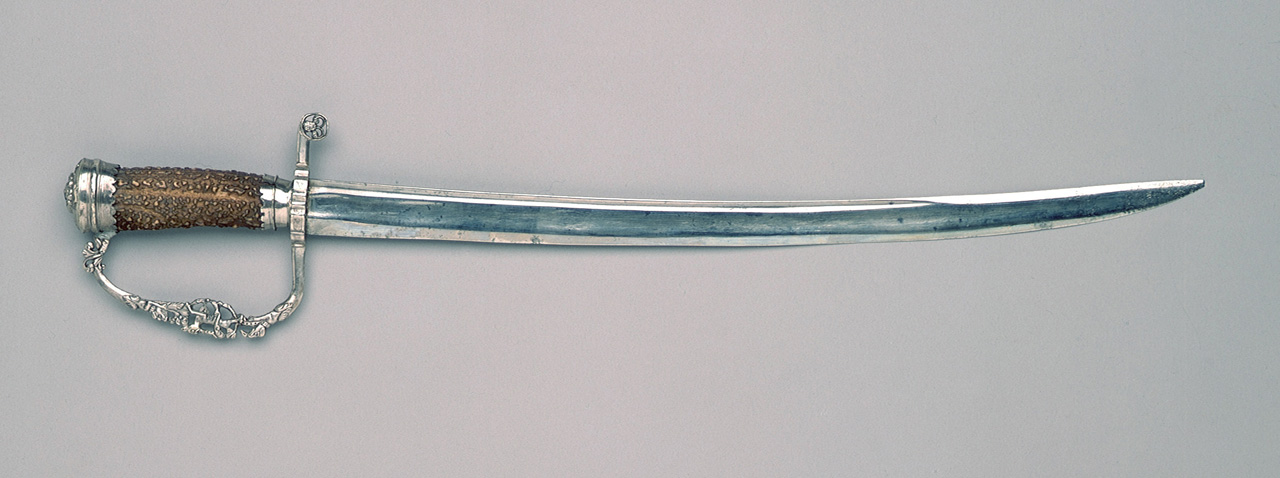
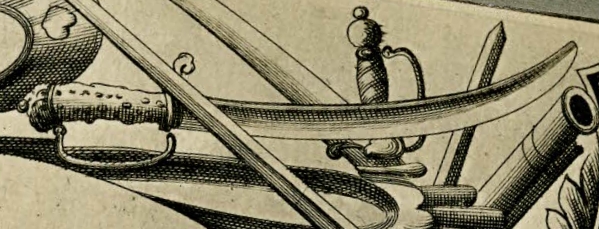
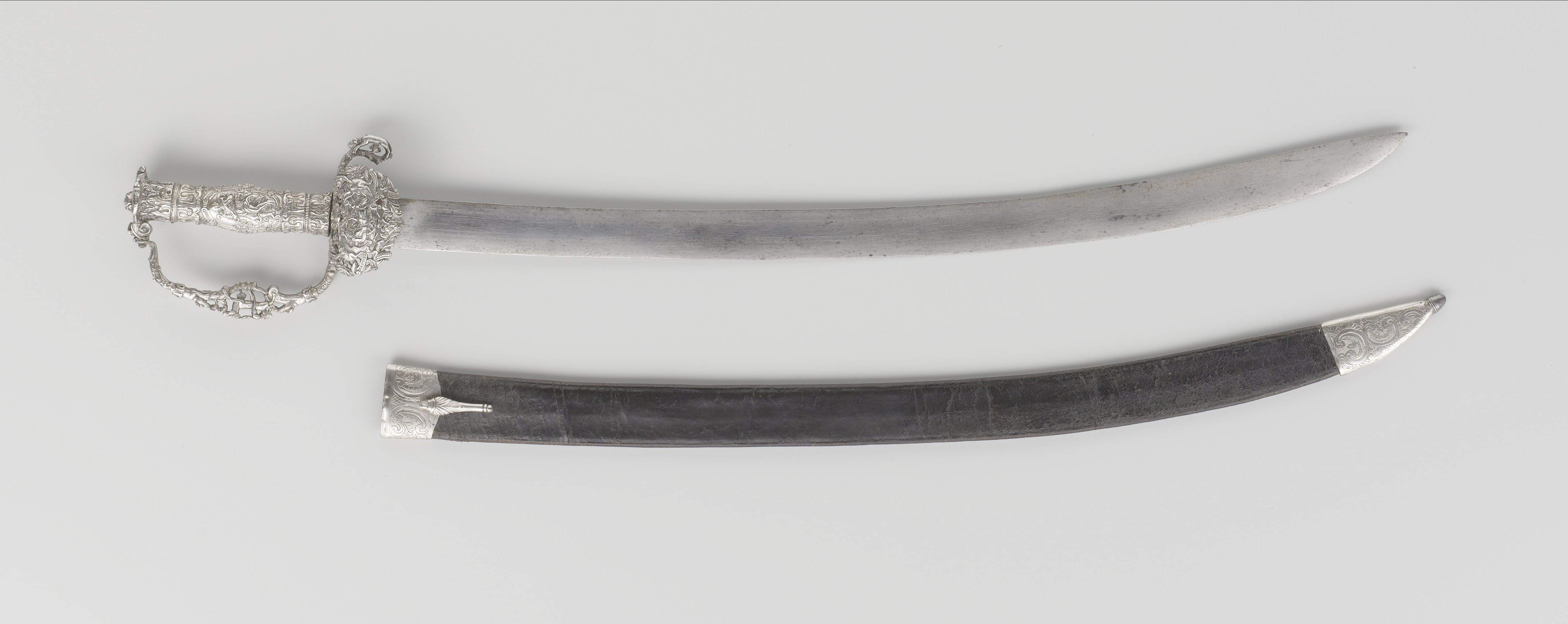
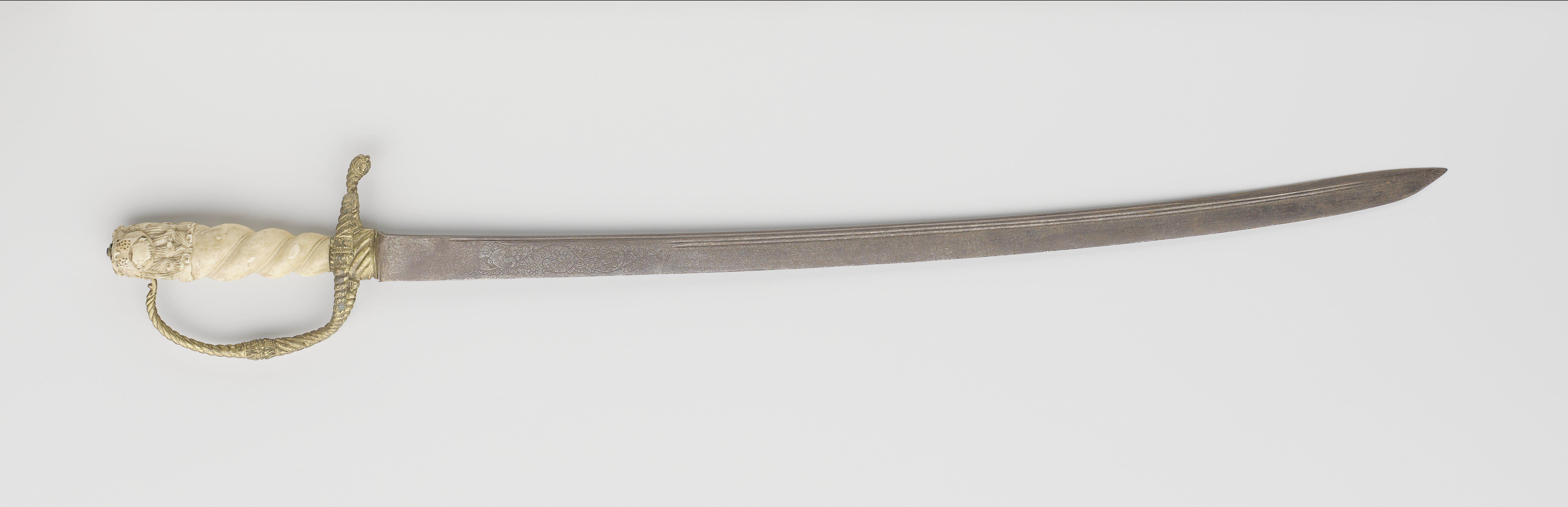
In addition to online sources, several good illustrations of brass-hilt cutlasses, which were typically more ornate than iron-hilted, can be found in William Gilkerson’s Boarders Away, With Steel (Lincoln, RI: Andrew Mowbray, 1991). Images of cutlasses from Harvey JS Withers’s collection for sale and sold can not only be found online, but in his book, The Sword in Britain, volume one. There are other available sources as well, including several additional reference in this blog.
Below is a detail from an illustration of the famous Jean Bart–a Flemish corsaire in French service–showing him with a cutlass. (Several other period images show him armed with a smallsword, but at least in the image below he is on the deck of a ship.) The cutlass has what appears to be a bird pommel, a small outside un-scalloped shell (or possibly a disk shell), an upper quillon, and a clip point. The hilt is probably brass, and, given its owner, might be gilded.
The illustration of Bart’s cutlass may represent a common cutlass carried by French naval and privateer officers, or it may represent Bart’s Flemish nationality. It appears to be a fairly accurate representation of a Dutch or English cutlass or hanger as discussed previously, although, if we look at the pistol in the belt, we may draw some reservations about its accuracy. The pistol, carried as many were, tucked behind the sash or belt on the right side to protect the lock and make for an easy left-handed (non-sword hand) draw, has errors: both the belt-hook and lock are shown on the left side of the weapon, for example, and the lock is inaccurately drawn. The lock should be on the right side, and the cock and battery are unrealistic. It is possible, but highly unlikely, that the pistol represents a double-barreled pistol with double locks.
OTHER CUTLASS HILT FORMS & SOURCES
Other forms were doubtless used, including the Dutch/German discussed above, as well as the very common smaller iron shell-hilt cutlasses as in the example below. Both William Gilkerson in Boarders Away, With Steel (Lincoln, RI: Andrew Mowbray, 1991) and Michel Petard in Le Sabre d’Abordage (Nantes: Editions du Canonnier, 2006) include a fair number of illustrations of common iron-hilted 17th and early 18th century cutlasses. These cutlasses range from a simple outside shell with no thumb ring, to inside and outside shells (the inside typically smaller) with or without thumb rings. On occasion the inside shell faces forward, especially if small. Invariably either an upper and lower quillon exist, or an upper quillon and knuckle bow. Grip material varies as with the Dutch cutlass first described, although wood and bone are the most common materials.

Another common enough form with a pair of bows, one for the knuckles, the other for the back of the hand, is shown below. This form is occasionally seen combined with small shells on brass hilts as well, as in an example above.


Of the late seventeenth century cutlass identified as French, Michel Petard in his excellent Le Sabre d’Abordage describes only one form, shown below. It is iron-hilted and has a single simple outside shell, a small quillon, a knuckle bow carried to an un-ornamented pommel. Almost certainly there were brass-hilted versions of this sword; the French grenadier sword of roughly the same date is identical, except in brass. It’s quite possible, even likely, that some flibustiers carried swords like these, both iron- and brass-hilt versions, but they do not appear to match those in Cornuau’s illustrations.

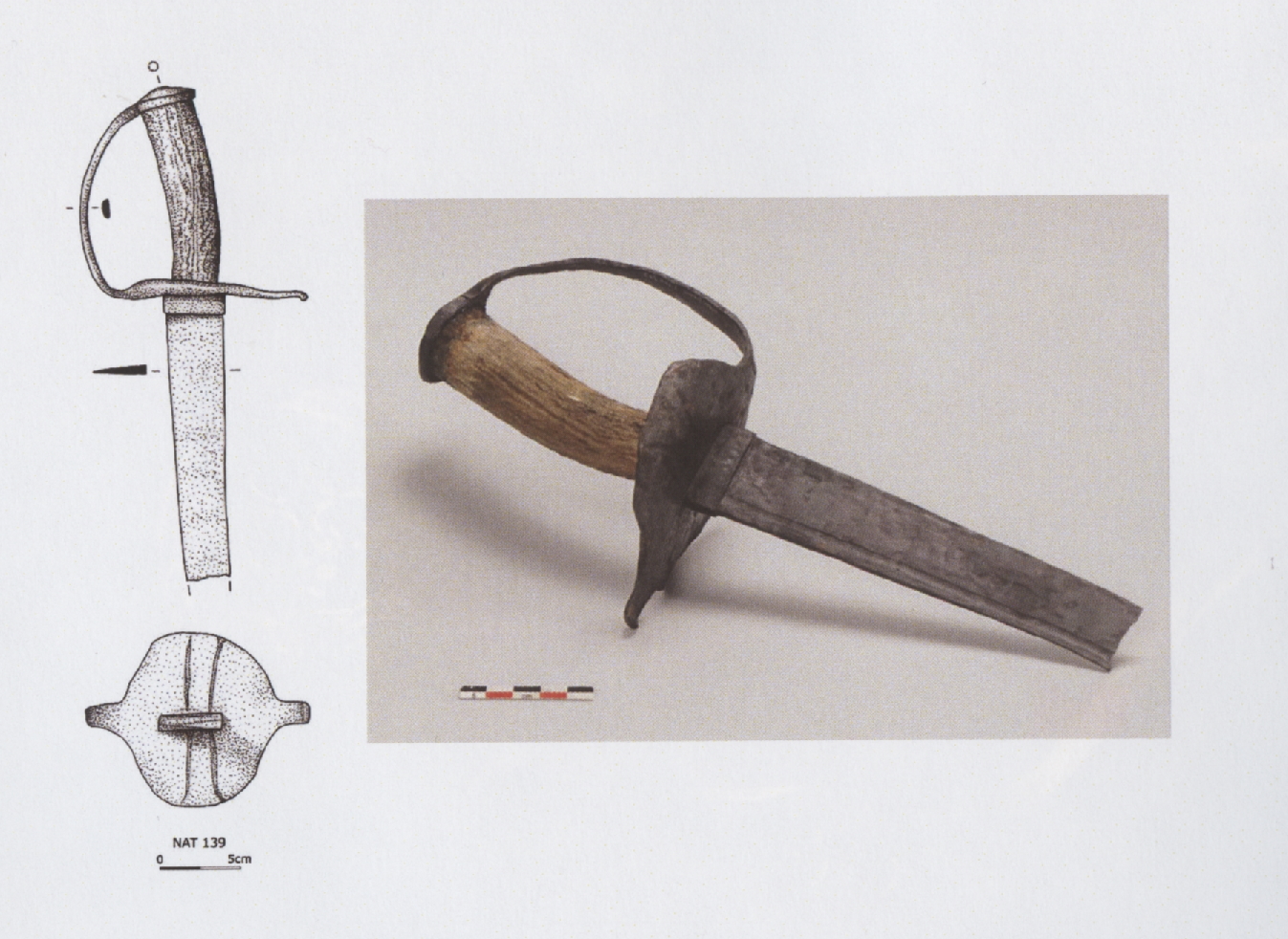
French paintings of admirals and other officers are typically of no help in identifying French cutlasses or hangers. Most of these portraits are highly stylized and show officers in full armor. When swords are shown at all they are typically smallswords (epees de rencontre).
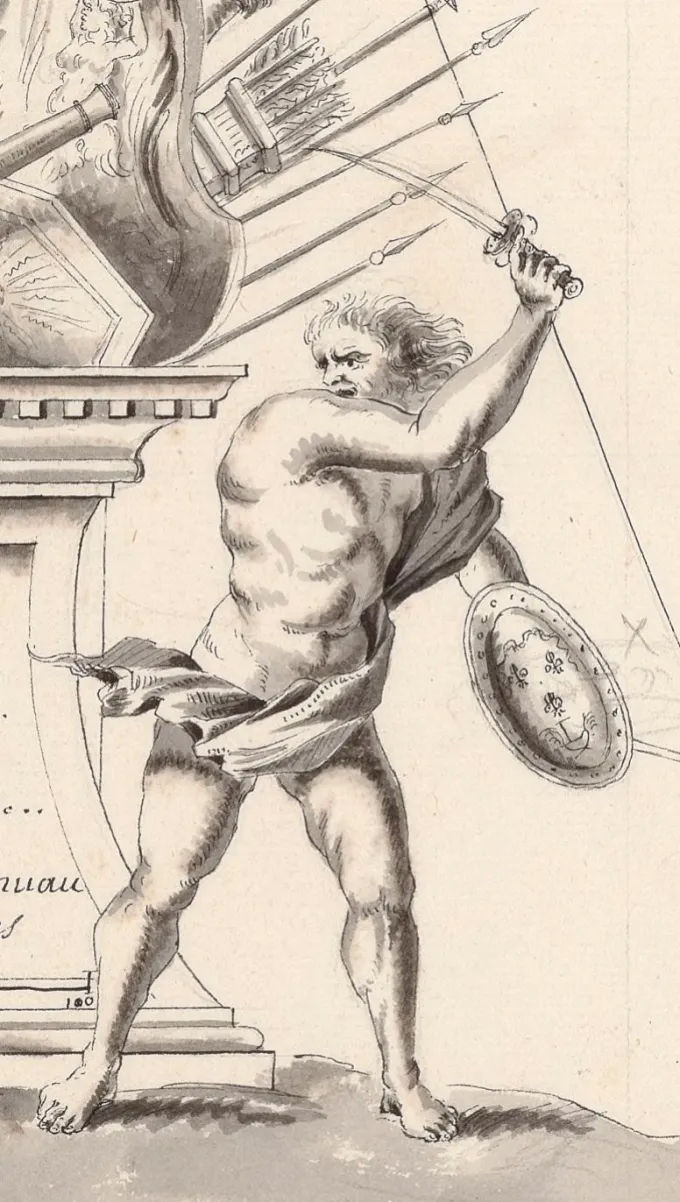
In Cornuau’s allegorical image above, perhaps of France as Neptune or Mars, the swordsman wields a cutlass of indeterminate shell construction (possibly a simple flat disk, as in the case of some 17th and 18th century hangers and cutlasses, see image below, or a crudely drawn double shell hilt), a cap pommel, and mildly curved blade with a sharp, non-clip point and a single fuller along the back of the blade. Again, it is unknown whether this cutlass is intended to portray a flibustier weapon. Similar examples from the 17th and 18th centuries are known, including a Spanish cutlass. In general, these cutlasses consist of a simple roundish shell with a small upper quillon and a knuckle bow, or of a simple roundish shell with a small upper and lower quillon forged from the same piece of iron.
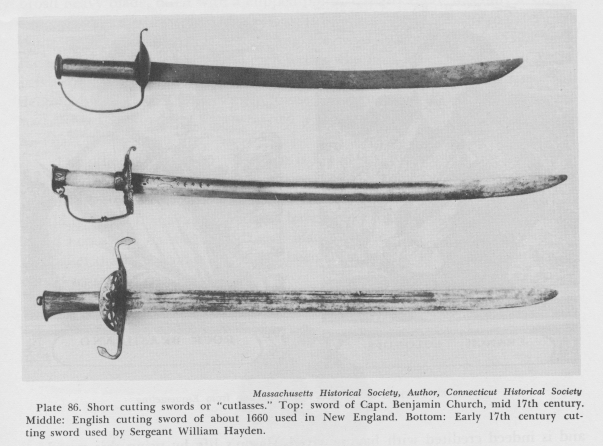
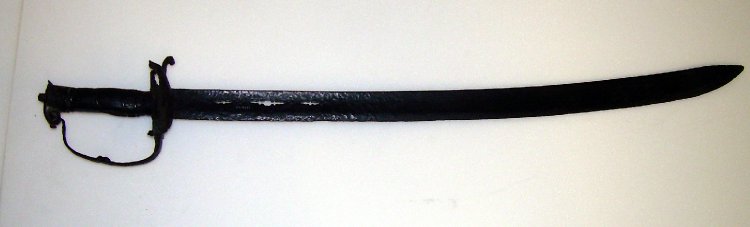
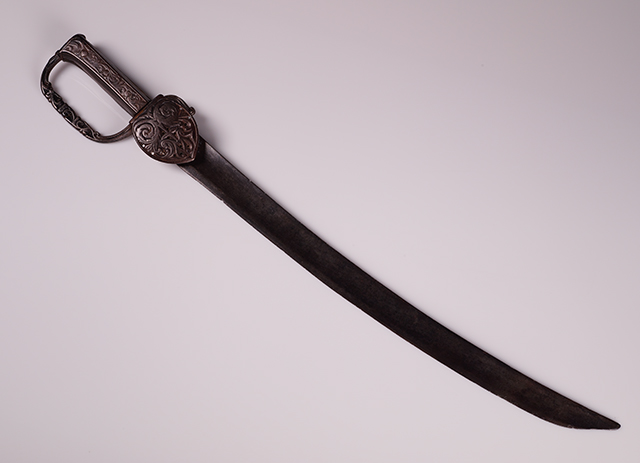
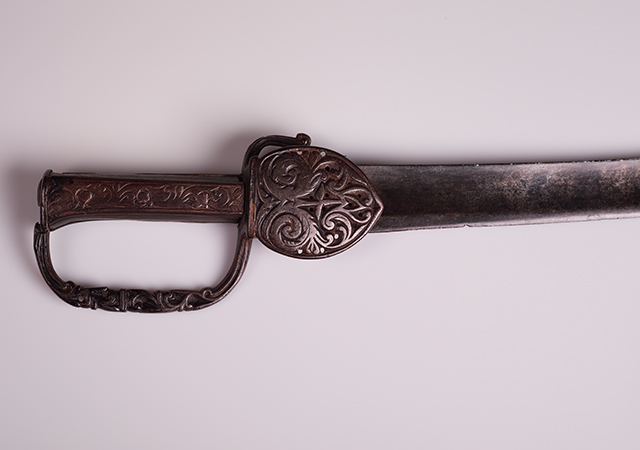
The sword above is identified by the Mariner’s Museum as a 17th century Spanish naval hanger (cutlass, that is). The shell, quillon, and knuckle guard are iron, as are the plates on either side of the handle. The hilt is without doubt that of an espada ancha (wide or common sword) of New Spain from the 17th or 18th century, commonly used by rancheros and mounted troops as both a weapon and tool similar to a machete. Although most had straight blades, the curved blade of this one does not necessarily mark is as maritime, although surely some of these swords were found aboard Spanish vessels in the Caribbean, particularly those sailing from Mexican ports such as Veracruz. A lack of blade markings is common. Chamberlain and Brinkerhoff in Spanish Military Weapons in Colonial America, 1700-1821 note that swords like this are commonly seen from the late 18th to early 19th centuries. In other words, the date may be incorrect.
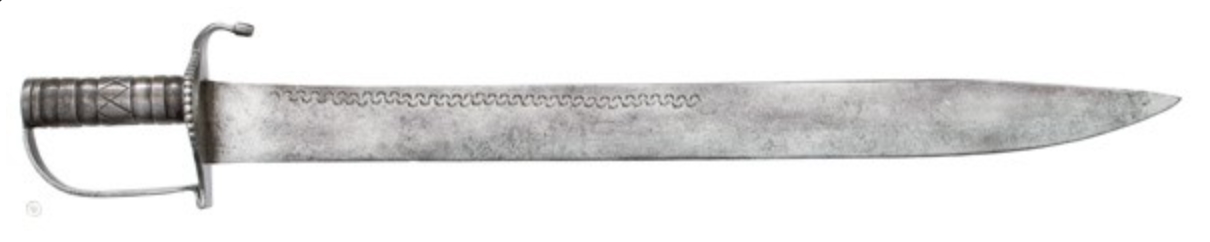

Another reportedly (by an auction house) 17th century Spanish cutlass above. Iron-hilted, 22″ blade. The design is similar to the previous: knuckle guard, small upper quillion, small shell or outer guard. It too appears to be an espada ancha; I’d like to know how the auction house dated it. Its date too may be incorrect.
From the first quarter of the 18th century, the Spanish cutlass hilts above were authorized in 1717. The French influence is obvious.
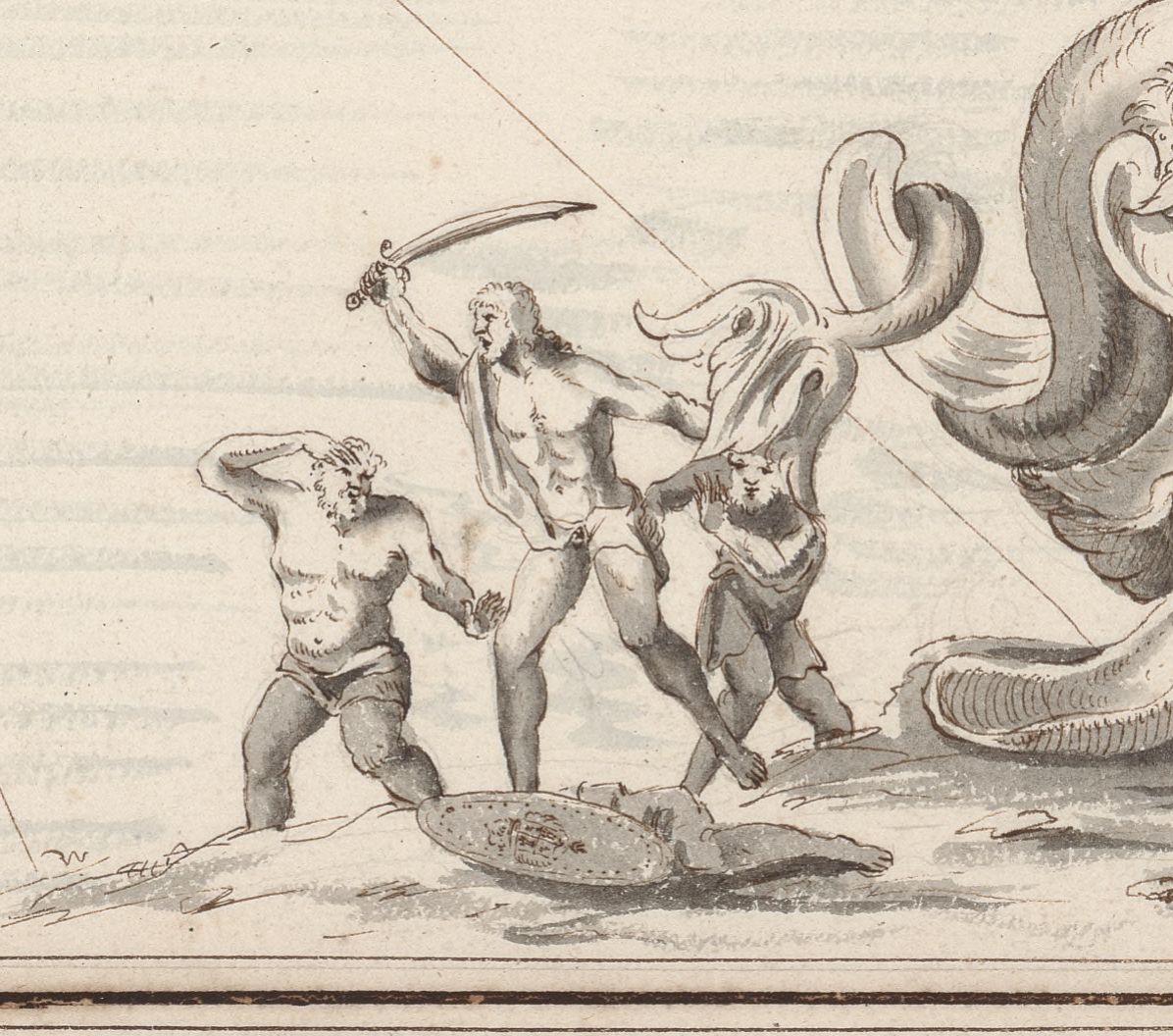
The allegorical image above by Cornuau, shows a man–again perhaps France depicted as Neptune or Mars–wielding a falchion or falchion-like cutlass with a simple hilt, round pommel, and curved blade with clip point. At the man’s feet lies a corpse cloven in half through the torso. It is unknown whether this cutlass is intended to portray a flibustier weapon. That said, there were similar mid- to late 17th century cutlasses and hangers, the one below for example.
Another form that may have been seen among buccaneers is that of the Eastern European short scimitar or saber, or even long as depicted below.
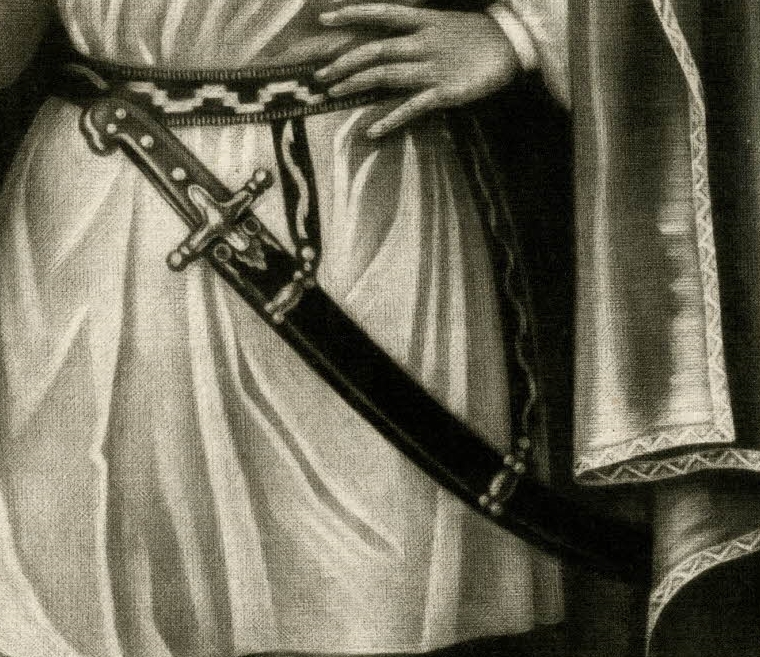
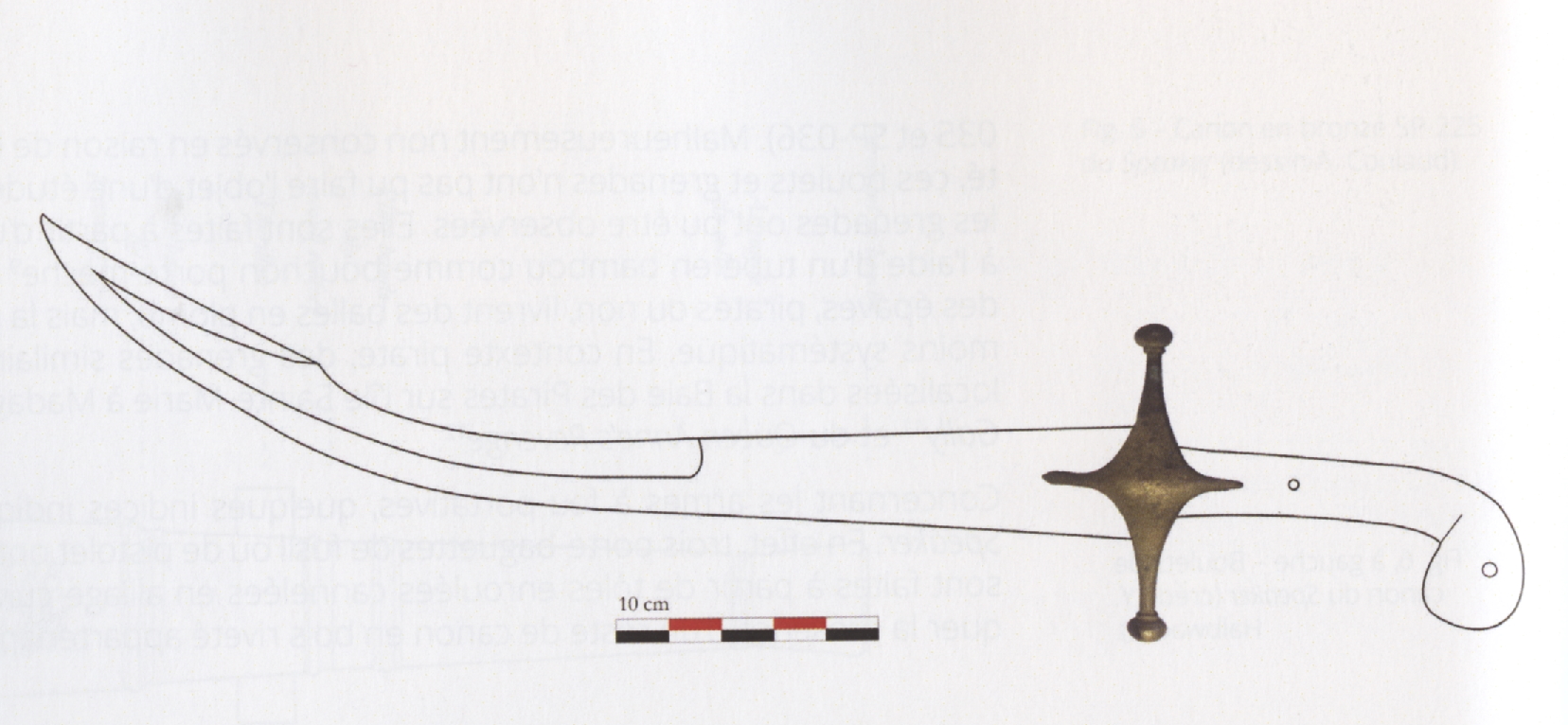
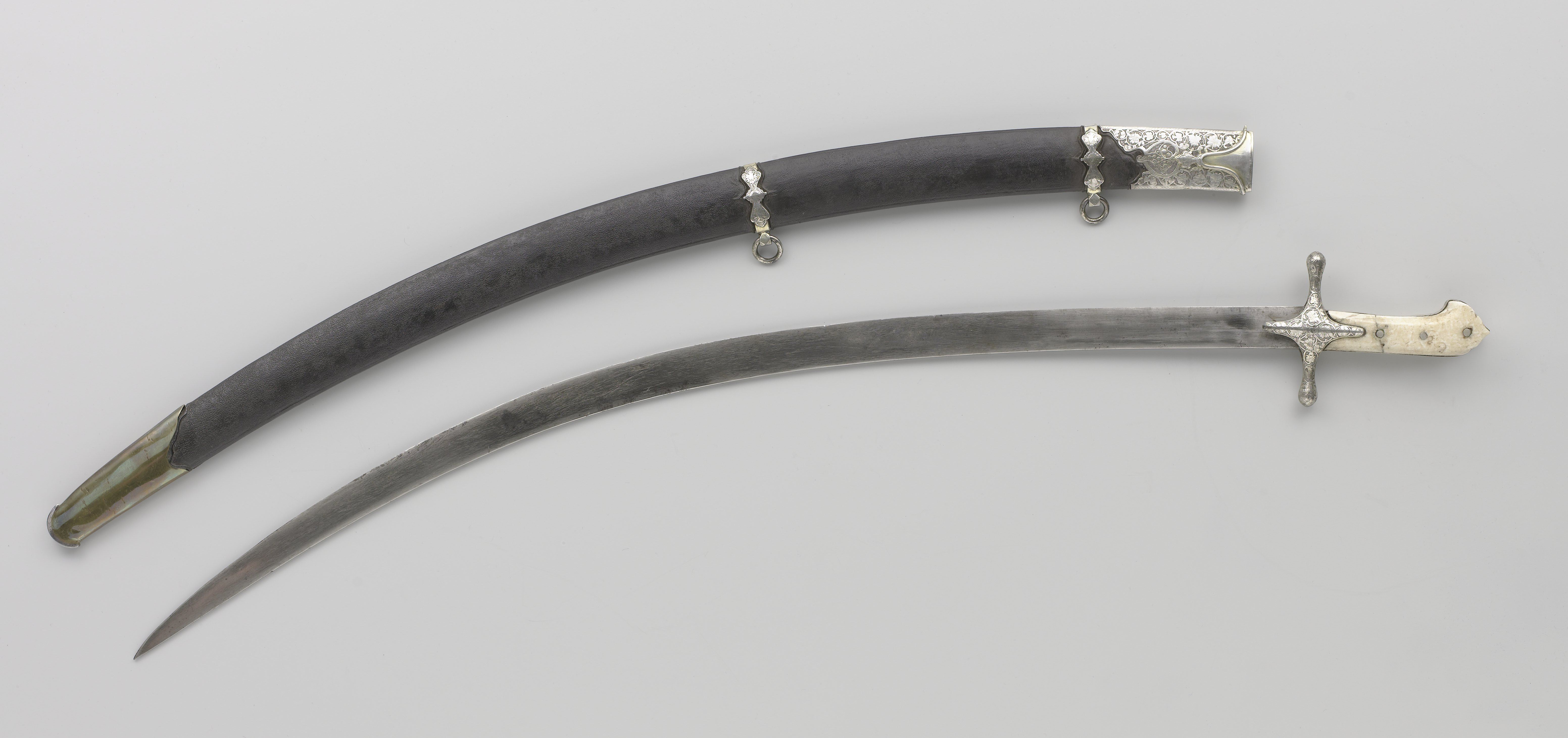
CUTLASS DESIGN AND USE
A few notes on the design and use of the cutlass are in order. Note that a thumb ring serves a very useful purpose in a sword with an unbalanced hilt, that is, one in which the outside shell is significantly larger than the inner, or in which the inside shell is entirely absent: it permits a stronger grip, preventing the blade from turning as a cut is made. If one’s grip is not firm when cutting with an unbalanced hilt, the blade may turn slightly and cut poorly or not at all. In cutlasses with a single large outside shell, any looseness in the grip will cause the cutlass to turn in the hand toward the heavier side. The thumb ring also provides some protection to the thumb against cuts.
Ideally, for a cutting blade to cut properly, a “draw” or drawing action must be made if the blade is straight or mostly straight. Some backsword and broadsword texts make obvious note of this, that the blade must be drawn toward its wielder in order to cut. (It may also be pushed away, in the 18th century this was known as a “sawing” cut.) However, the diagonal cuts from high outside to low inside, and high inside to low outside, have a natural “drawing” motion as the arm is brought toward the body. To make a powerful drawing cut is fairly easy: simply draw the elbow toward the body as the cut is made. A lightly laid on cut with a straight edge, one made with small arm movement, will require a deliberate drawing motion.
Sweeping cuts are the most common sort of drawing cuts, but they are dangerous in practice unless one is mounted (and moving quickly) on a horse, or has a shield, targe, or other defense in the unarmed hand. Sweeping cuts are easily “slipped”–avoided–and as such leave the attacker vulnerable to a counter stroke in tempo. They are also subject to counter-attacks in opposition. Tighter cuts may also be made with a natural draw, and this sort of cutting action is generally preferable when fighting without a shield or targe, as is the case in boarding actions. Note that wide sweeping cuts are more likely to injure one’s companions in a boarding action, and to get caught up in rigging and fittings.
In particular, a straight-bladed cutlass or other sword requires a drawing action in order to cut well. A curved blade has a natural cutting action, and the more curve there is the less drawing action must be added–the severe curve suffices. However, the greater the curve the less suitable for thrusting a sword is. A direct thrust made with such a sword (see the two heavily-curved examples of Tromp’s swords, for example) will result not in the tip penetrating the adversary, but with the first inch or two of the edge hitting. It is very difficult to push the edge of a sword deeply into tissue, and most wounds caused this way are superficial. Note that the clip point found on many cutlasses is designed to make a curved blade more effective at thrusting.
I am going to devote only a few words to the popular misconception that a heavily-curved sword, such as a scimitar, can be used to thrust effectively. Its true thrusts must be hooked, and the typical example one finds in discussions by self-appointed “experts” is that of a hooked (aka angular) thrust made after one’s adversary has parried quart (four, inside). In theory, the attacker can roll his hand into tierce (pronated), and slip around the parry with a hook thrust. This will only work if the attacker also has a shield or targe in his (or her) unarmed hand, or is wearing a breastplate: otherwise there is nothing to prevent the adversary’s riposte. In other words, try this with a curved cutlass, and while you may be able to make a thrust (which may or may not penetrate ribs) as an arrest or stop hit against a riposte, you will almost certainly also be on the receiving end of a powerful cut. In other words, try this at your peril in the 17th century.
I can think of only one exception to this advice: Andrew Lonergan (The Fencer’s Guide, 1777) notes that the Hussar saber, with its curved blade, has a natural cavé or angulation against quart, tierce, or prime parries (or any other parries, in fact). Notably, he’s referring to action on horseback with horses typically moving at speed–the rider, executing the natural angulation with the saber, can escape the riposte as he rides by, while simultaneously cutting or thrusting with cavé, which at speed will push not the point but the edge through neck or arm. This is much more difficult to do with a simple thrust or thrust with lunge, and, as noted lacks the protection of riding past. “The bent of their swords will afford them an unavoidable Quarte-over-the-arm, or a Cavè [sic: the wrong accent is used on cavé in the original text].” N.B. a thrust, or rather, a thrusting cut can be made with the edge at the tip, but requires great force (i.e. from horseback at a canter or gallop) and is, as Lonnergan notes, primarily effective against the soft tissue and joints of the arms and neck.
One of the most effective cuts with the cutlass is a powerful drawing cut, vertically high to low, the hand drawn down and backwards, from close quarters distance, or even when grappling if the blade is free. It is a highly effective cut: I have cut through twelve inches of brisket with it.
All this said, cleaving–non-drawing–blows can cut through skin and muscle, and even break bones. One need only to test this with a common kitchen cleaver to see the efficacy of such blows, although they are generally inferior to those made with a natural drawing action. Also, a cleaving blow, even with a dull blade, can still break bones. Getting hit on the head with a heavy cutlass would be akin to getting hit with a steel rod.
The grossly exaggerated Thomas Malthus edition of Alexandre Exquemelin’s The History of the Bucaniers (1684) notes the following of the cutlass in buccaneer hands:
“Never did the Spaniards feel better carvers of Mans-flesh; they would take off a Mans Arm at the shoulders, as ye cut off the Wing of a Capon; split a Spanish Mazard [head or skull] as exactly as a Butcher cleaves a Calf’s Head, and dissect the Thorax with more dexterity than a Hangman when he goes to take out the Heart of a Traitor.”
But this may not be much of an exaggeration. Of an English seamen put in irons aboard a Portuguese carrack circa 1669 out of fear he might help lead a mutiny, passenger Father Denis de Carli wrote:
“He was so strong, that they said he had cleft a man with his cutlass, and therefore it was feared he might do some mischief in the ship, being in that condition [drunk for three days on two bottles of brandy].”
Cutlass balance determines how well the cutlass may be wielded in terms of traditional fencing actions, and which forms of cuts work best. A heavily-balanced cutlass, with much of its weight forward around the point of percussion (that is, near the end of the blade), makes for very effective cleaving and close cutting actions, and will cut well with even crude swings. However, it is less effective for skilled fencing. A well-balanced cutlass–less point or tip heavy–is a more effective fencing sword, in that it permits quicker actions such as cut-overs, but requires a bit more training or finesse to cut well. In other words, give a cleaver to an unskilled seaman, but a better-balanced cutlass to one with reasonable skill at swordplay. All this said, a skilled “complete” swordsman or swordswoman can fence pretty damn well with anything.
Switching to a discussion of how the cutlass is held, the cutlass grip, like that of period broadswords and backswords, is a “globular” one–the thumb is not placed on the back of the grip or handle. Placing the thumb on the back of the handle, assuming there is even room (typically there is not), given the weight a cutlass and its impact against its target, may result in a sprained thumb, possibly a broken one, and at the very least the thumb being knocked from the grip, thus losing control of the weapon. The “thumb on the back of the handle” grip is suitable for lighter weapons only.
Shells are quite useful–mandatory, in my opinion–to protect the hand. A single outside shell, especially in conjunction with an upper quillon and a knuckle bow, provides merely adequate protection to the hand. The inside hand and forearm remain vulnerable to an attack or counter-attack (best made in opposition). The addition of an inner shell, typically smaller, goes far to maintain adequate protection to the hand. As already noted, inner shells were usually smaller, given that the inner part of the hand (the fingers, basically) is smaller than the outer, typically 1/3 to 2/5’s of the entire fist. Again, though, differently-sized shells, especially if the difference is significant, will unbalance the weapon, making a thumb ring useful for gripping well and preventing the edge from turning and thereby not cutting.
But perhaps the cutlass’s greatest virtue, and what would have made some of its technique unique as compared to the broadsword and saber (from which late 18th through early 20th century cutlass technique was drawn), was its utility at “handy-grips.” I’ve covered this subject elsewhere, but besides the close cleaving or drawing cut described above, pommeling would have been common, and “commanding” (seizing the adversary’s hilt or blade) and grappling would have been common as well. F. C. Grove in the introduction to Fencing (London: Longmans, Green, and Co., 1893) wrote: “One of us once saw a sailor of extraordinary strength seize a cutlass close to the hilt, where the edge is blunt, and break it short off.” This was an extraordinary example of a surely commonplace tactic.
There are few descriptions of the cutlass in action, but of those that exist, they are quite illustrative. Of a fight between English slavers and Africans on the Guinea Coast in 1726, William Smith wrote:
“[F]or they press’d so upon us that we were Knee deep in the Water, and one of them full of Revenge, and regardless of his Life, got out into the Water behind me, resolving to cleave my Skull with a Turkish Scimitar, which Ridley perceiving, leap’d out of the Canoe, and just came time enough to give him a BackStroke, which took the Fellow’s Wrist as Was coming down upon my Head, and cut his Hand off almost. Ridley with the violent Force of the Blow at once snap’d his Cutlass and disarm’d the Negroe, whose Scimitar falling into the Water, Ridley laid hold’of, and us’d instead of his Cutlass.”

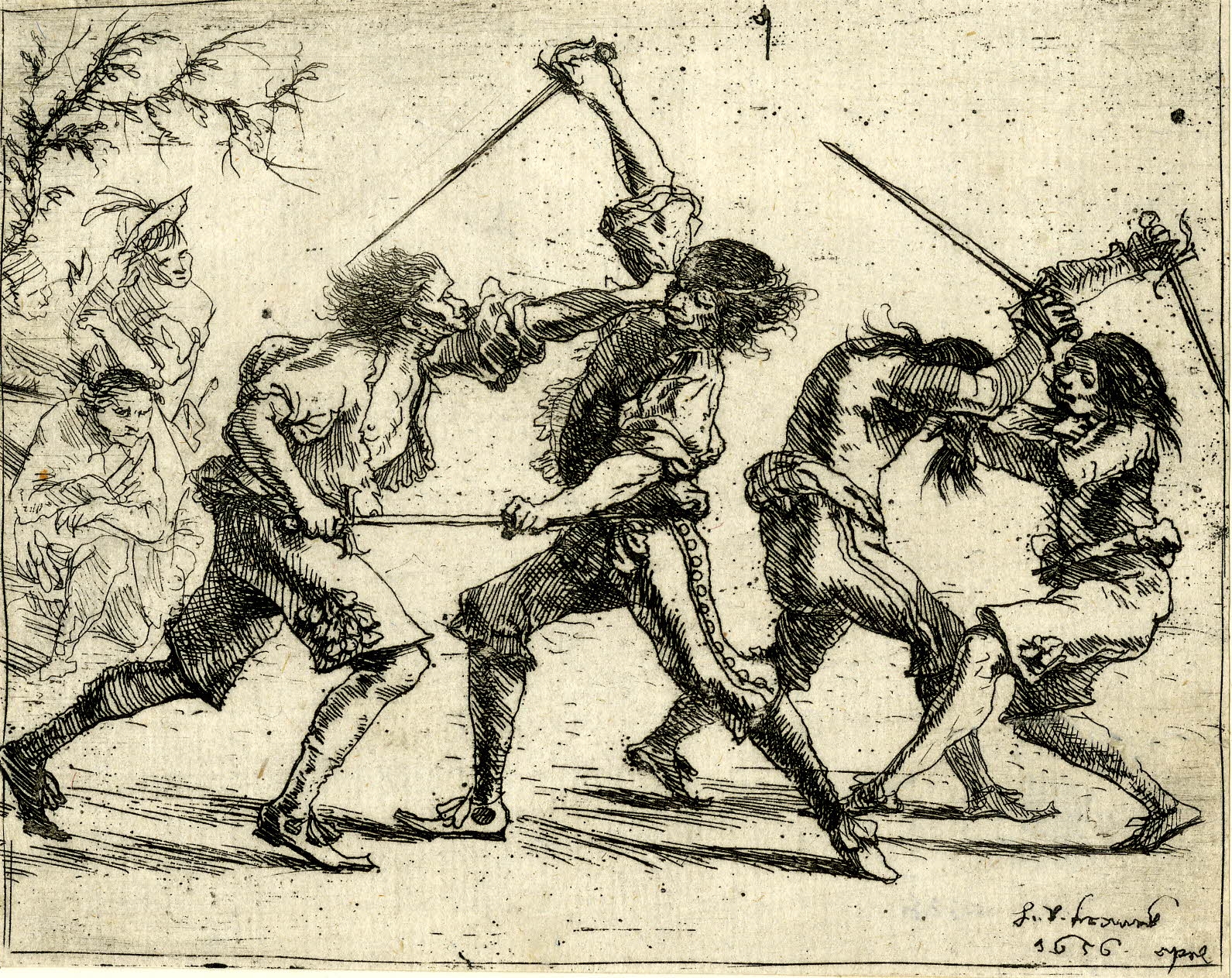
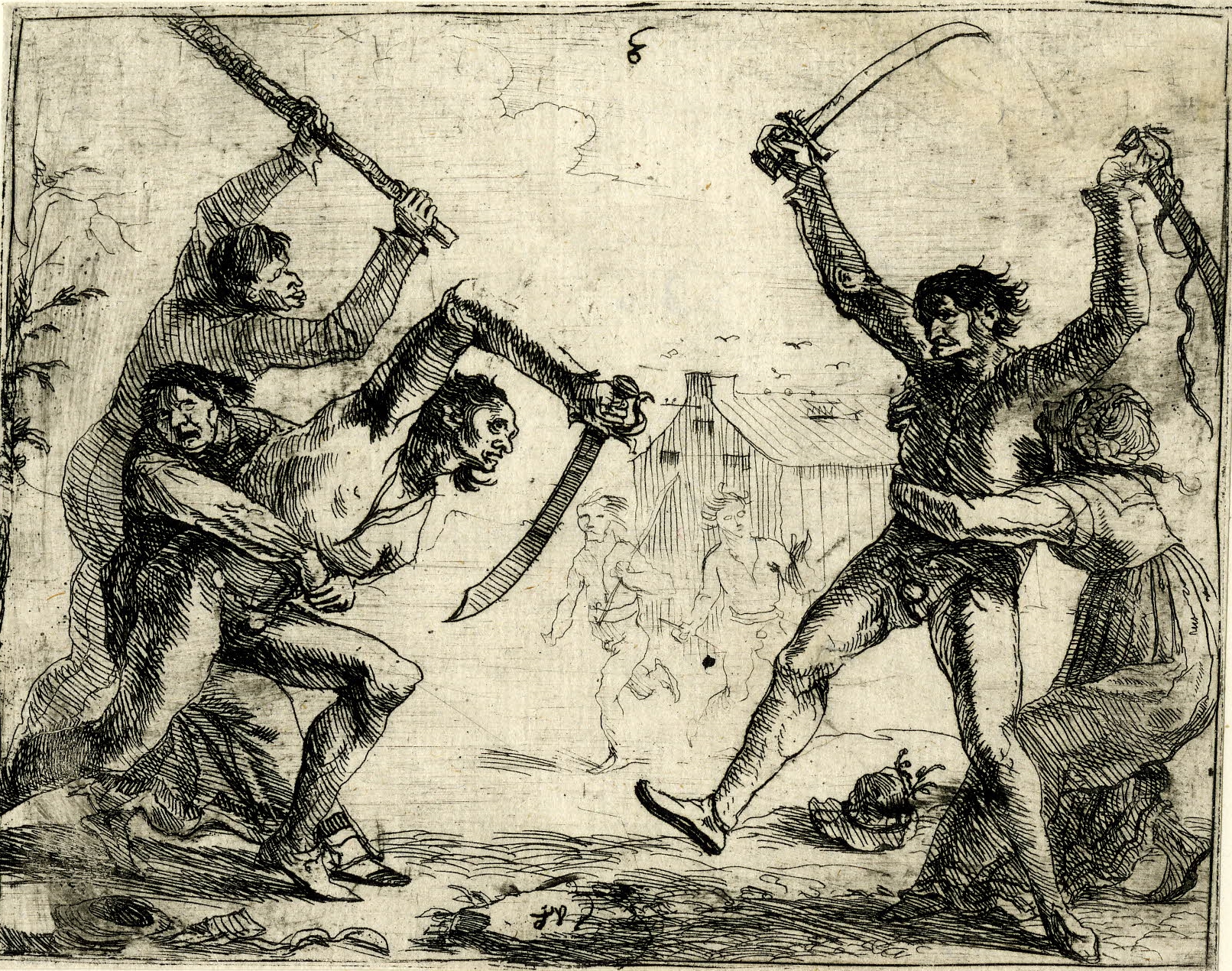

There are unfortunately no cutlass texts dating to the age of the buccaneer, and few fencing texts discuss even related weapons until the 18th century. The only 17th century exception I can think of offhand is Francesco Antonio Marcelli’s treatise on the rapier (Regole Della Scherma, 1686), in which he devotes a few pages to saber versus rapier, noting quite correctly that the saber, and therefore also falchion, cutlass, &c., is a killing weapon even at very close range. See below. In The Golden Age of Piracy I discuss to a fair degree what we know from period accounts about how the cutlass may have been used.
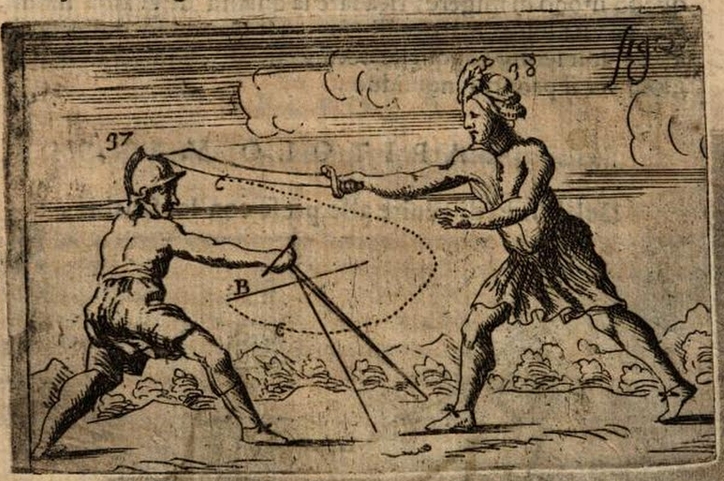
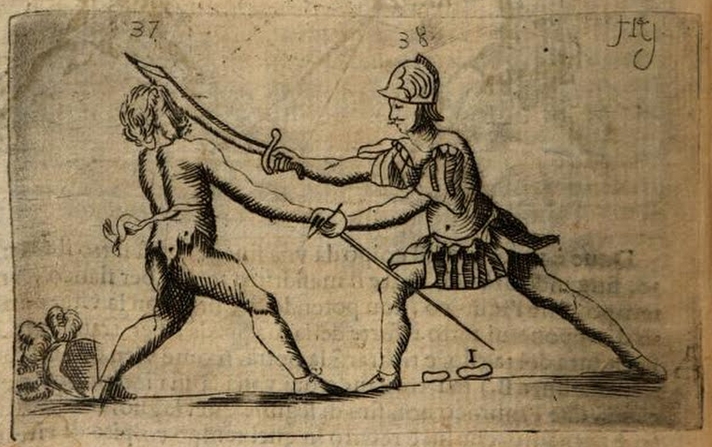
I’ve discussed training in the cutlass elsewhere, including a few notes in my Fencing Books For Swordsmen & Swordswomen post. In Sea Rover’s Practice I note that there was clearly some instruction at sea, although it may have often been ad hoc as was often the case ashore. Late seventeenth century French privateer captain Duguay-Trouin hired a fencing prévôt (assistant to a fencing master) to help school his crew in swordplay (and later found himself in a rencontre, swords drawn, with the man in the street), and mid-eighteenth century English privateer captain “Commodore” Walker had training sessions aboard his ship, the officers practicing with foils, the seamen with singlesticks.
The only pirate captain we know of who was said to have held swordplay practice aboard ship is John Taylor in the Indian Ocean in the early 18th century, according to prisoner Jacob de Bucquoy (Zestien Jaarige Reize Naa de Indiën, Gedaan Door Jacob de Bucquoy, 1757, page 69). Taylor’s pirate crew reportedly held practices, as Commodore Walker would later do, with foils and single-sticks. I am a bit leery of this report, however. Although it certainly may be true, it is tied to a criticism of Dutch East Indiamen captains and crews, with de Bucquoy suggesting that the pirates were more disciplined and trained in a manner that the East Indiaman crews were not. Most historical accounts show a great deal of indiscipline among pirate crews.
However, it is impossible to maintain proficiency in arms without practice, thus it is likely that pirates practiced swordplay. The question is to what degree, and whether the practice was formal or informal. Further, there is the question of whether or not pirate captains deliberately outfitted their vessels with foils and single-sticks or “cudgels” as they were commonly known. Doubtless Duguay-Trouin and Commodore Walker did, but, assuming the Taylor account is correct, Taylor’s were probably from captured stocks. That said, singlesticks are easily crafted (but not so foils). Please note that real weapons were not used for fencing practice! This would soon enough destroy their tips and edges, not to mention that it would be very dangerous even with protection. Fiction and film have, for ease of plot not to mention laziness or ignorance, given many the false idea that swordplay was practiced with real swords. A single-stick or cudgel, by the way, differs from a real sword “only that the Cudgel is nothing but a Stick; and that a little Wicker Basket, which covers the Handle of the Stick, like the Guard of a Spanish Sword, serves the Combatant, instead of defensive Arms.” (Misson’s Memoirs and Observations in His Travels Over England, 1719.)
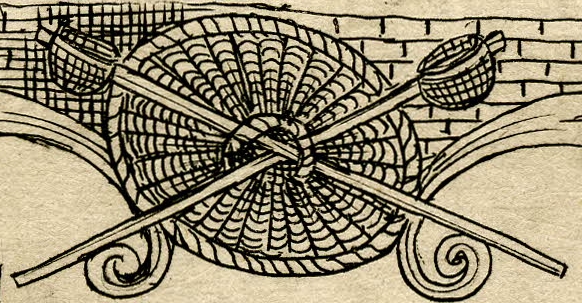
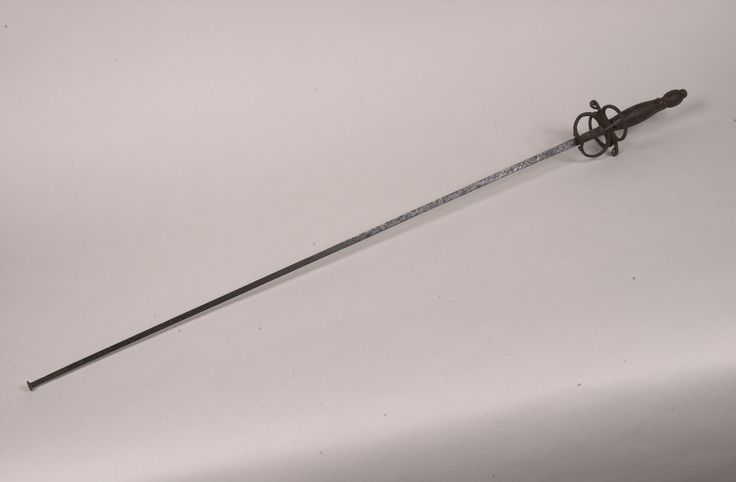
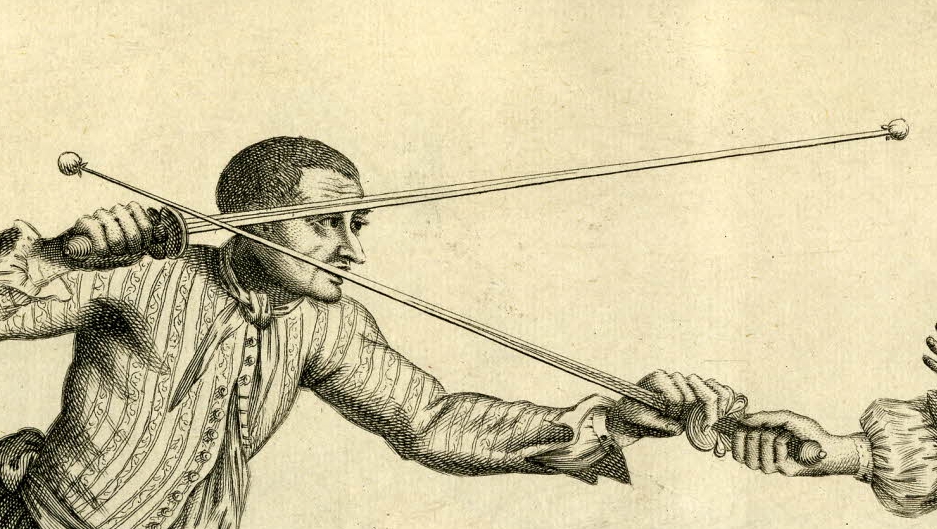
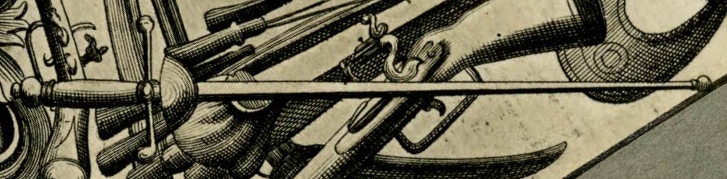
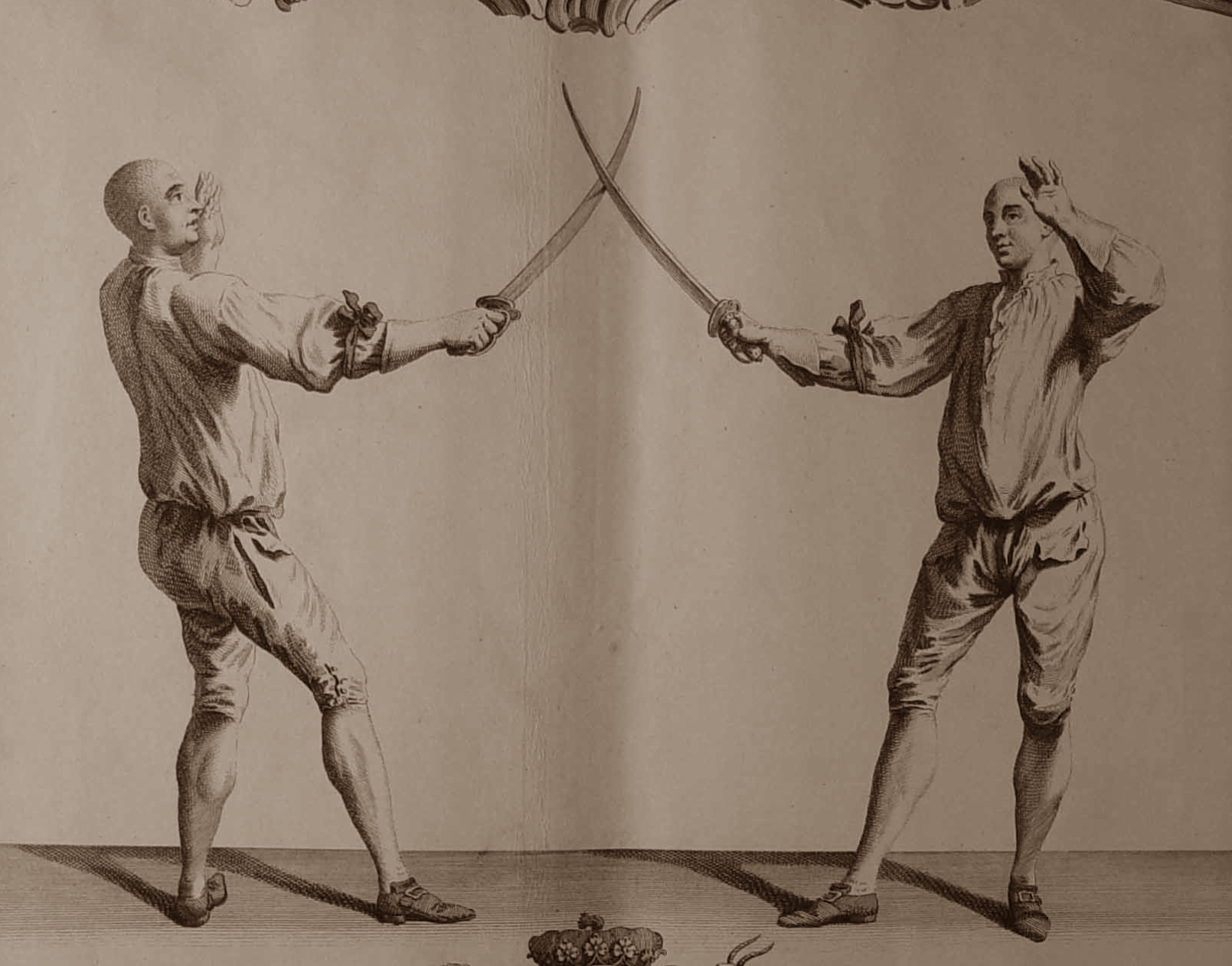

Possibly one of the more practical texts, and even then incomplete, is that of Lieutenant Pringle Green in manuscript in the National Maritime Museum, Greenwich. He discusses boarding actions and associated combat, with some ideas of his own. Although more than a century later than our period, there is likely a fair similarity between the two eras. See the images below.
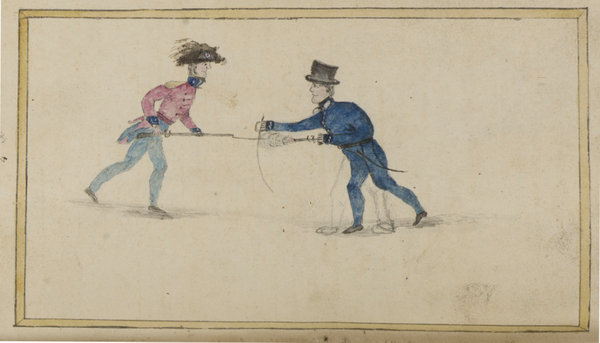
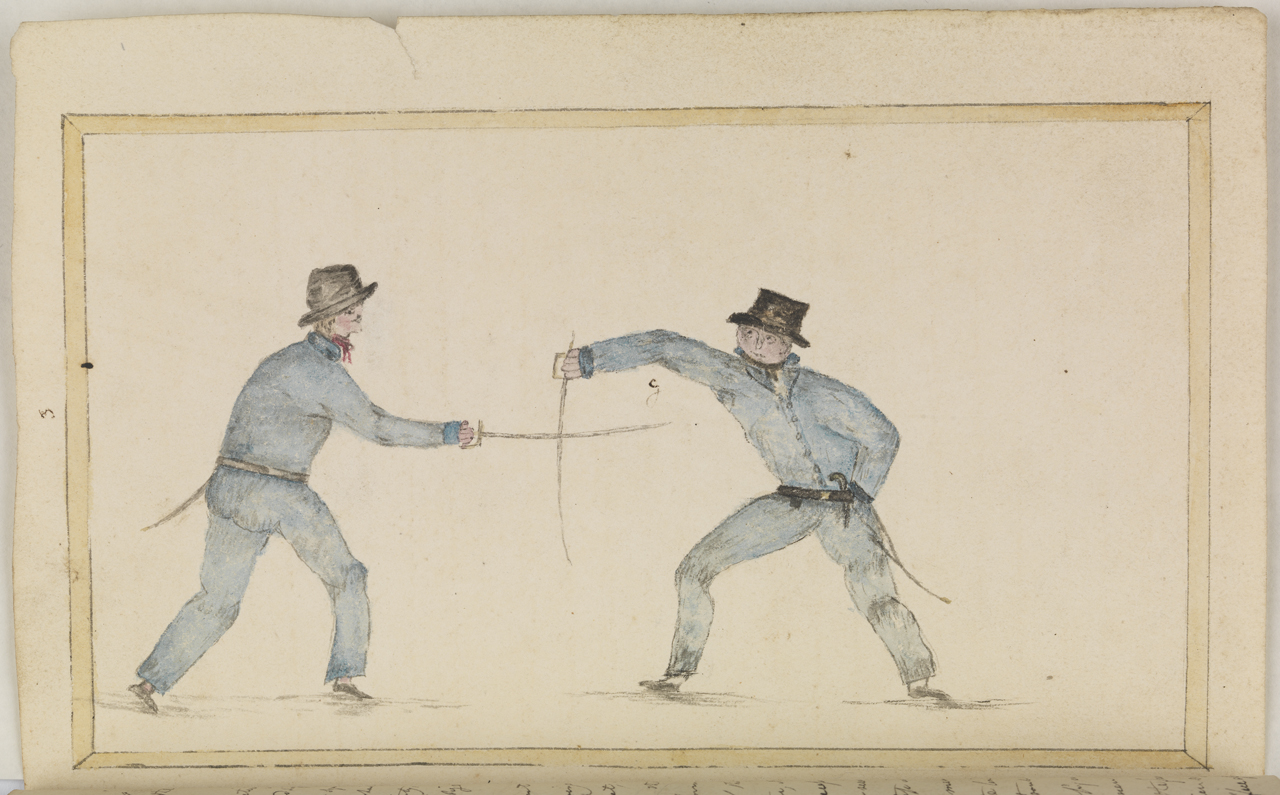
Lieutenant Green’s text makes a few important notes. First, the seaman armed with a cutlass must know more than just protect left (inside, quarte), protect right (outside, tierce), protect head (St. George, modern saber quinte), and cut & thrust. High seconde and prime–“falloon” or hanging guards–are useful for parrying, and are mandatory to parry a musket, as he illustrates, as also half-pikes (Girard illustrated this with the smallsword in the mid-eighteenth century). The low seconde and prime parries are just as important. Second, the pistol can be used to parry when reversed along the forearm. In fact, even when holding the pistol by the grip a parry can be made, and also a forehand blow with the barrel. However, it is well to remember that Pringle Green’s text is not an exposition of hand-to-hand naval combat in actual practice, but his ideas on how it might be done better. Caveat emptor.
I’ll also point out here a rather irksome issue on occasion, that some students of historical swordplay still attempt to argue that parries with cutting swords were made with the flat rather than the edge. This is nonsense. There are some forms of swordplay, Filipino escrima and some Caribbean and Central American machete practice for example, that parry with the flat. Notably, these weapons do not have guards, and if parries are not used sparingly, and made carefully, fingers will be lost (which is almost certainly why serious sparring and actual combat with these weapons is often either in “absence of blade” and emphasizes tempo actions, or involves grappling and other manipulations in order to control the adversary’s blade). However, the forms of cutting swordplay with Western battlefield weapons–saber, broadsword, backsword, hanger, cutlass–all show the use the of the edge for parrying in texts, illustrations, and other accounts. The objection is that a parry will damage the cutting edge. And so it will. But typically the forte is used for parrying, which is seldom sharp, and even if it is, is seldom used for cutting. Moreover, those who argue for the flat rather than the edge, in spite of overwhelming evidence to the contrary, forget one thing: each time the adversary parries your blade, it will be nicked. A blade is going to get damaged in combat. In fact, there are plenty of historical accounts of swordsmen proudly noting their “saw-toothed” blades as proof of just how desperate the combat was. It is also much easier to control a heavier weapon in the parry when parrying with the edge, and more powerful parries may be made this way.
THE TERMS HANGER VERSUS CUTLASS
In regard to the myth that ‘hanger’ was the sole term used to refer to the common cutting sword at sea–to the cutlass, in other words–in the 17th century, and that ‘cutlass’ was only an eighteenth century term, I’ve excerpted the following from a Mariner’s Mirror article I wrote a few years ago (“Eyewitness Images of Buccaneers and Their Vessels,” vol. 98, no. 3, August 2012). I added it to the original draft after a pre-publication editorial reader for the journal suggested I may have used the term cutlass in error. I had to prove I was correct.
From my article: “Still debated today are the issues of whether hanger or cutlass is the more appropriate English name for the short cutting sword or swords used by late seventeenth century mariners, and whether the words refer to the same or different weapons. Hanger and cutlass (also cutlash, cutlace) are each found in English language maritime texts of the mid to late seventeenth century. In some cases there appears to be a subtle distinction made between them; in others they are used interchangeably.
“The English 1684 Malthus edition of Exquemelin’s The Buccaneers of America refers only to ‘cutlace’ or, more generically, sword as the buccaneer’s arme blanche. There is also at least one reference in the Calendar of State Papers, Colonial, dating to the 1680s, associating the term cutlass with Caribbean pirates.[1] The 1684 Crooke and 1699 Newborough editions of Exquemelin refer to both hanger and cutlass, and use the terms interchangeably in reference to the sword of the notorious buccaneer Jean David Nau, better known as l’Ollonais. (Hanger once, cutlass twice, as well as a note that his men were armed with cutlasses.)
“It is possible that the description of l’Ollonais’s use of his sword to mutilate and murder prisoners may have given first rise to the reputation of the cutlass as the arm of the romanticized ‘cutthroat pirate’, a reputation enhanced by Charles Johnson’s pirate history forty years later, and then by Robert Louis Stevenson and other nineteenth century novelists. Even so, the cutlass already had a sanguine reputation, doubtless inspired in part by its descriptive, alliterative name: ‘by the bloudy cut-throat cuttleaxe of swaggering Mars’ wrote Thomas Coryate in 1611. By the eighteenth century, cutlass was the predominant English term for the seaman’s short-bladed cutting sword.”[2]
In the British colonies in America, the term cutlass was often used rather than hanger in lists of militia and trade arms as well: Caribs “well armed with new French fuzees, waistbelts and cutlasses” (August 3, 1689); “100 cutlasses” (Maryland, February 4, 1706); “100 cutlaces with broad deep blades” (Maryland, June 23, 1708); “2,000 cutlasses” (South Carolina, July 8, 1715). That said, some colonies used the term hanger instead in the same period. (All citations from the Calendar of State Papers, Colonial, America and West Indies.)
The earliest Caribbean reference to cutlasses I’ve found to date is in “The Voyages of Captain William Jackson (1642-1645),” a first-hand account describing Jackson’s most famous plundering voyage from one end of the Caribbean to the other: “The Armes delivered out to each company were, Muskitts, Carbines, Fire-locks, Halfe-pikes, Swords, Cutlases, & ye like offentius weapons…” Notably the term “hangers” is not used. English naval inventories of the 17th century tend to list “hangers” and “swords” as the two sorts of swords carried aboard, sometimes listing both, sometimes only one, confusing the issue. (And no, for the occasional “expert” who wants to argue, the term hanger in naval inventories at this time refers to short cutting swords, not sword hangers.) Worse, I’ve seen “swords and cutlasses” listed among the arms of various merchantmen. Almost certainly swords other than cutlasses and, among some officers, smallswords, were commonly carried aboard ship. Certainly they were aboard Spanish men-of-war, which had a large proportion of soldiers aboard: perhaps the earliest “Bilbao hilt” cutting sword, popular in the 18th century, dates to the 1660s and was found aboard a Spanish wreck. [See Sydney B. Brinckerhoff, Spanish Military Weapons in Colonial America, 1700-1821, regarding the Bilbao hilt. Jackson’s journal was published in Camden Miscellany vol. 13, 3rd series vol. 34, 1924; the quote refers roughly to September-October 1642.]
There are plenty of other seventeenth century references to the cutlass as the predominant maritime sword or term for maritime cutting sword, as opposed to the hanger: a July 1667 report of a Dutch descent on the English coast describes the attackers carrying muskets and with cutlasses drawn; there are at least two references in the papers of Charles II to Biscayners and Dunkirkers (privateers) assaulting English merchant captains with cutlasses; the 1682 inventory of the English merchantman St. Christopher of South Carolina included “ten swords & Cutlases;” mariner Robert Everard noted a cutlass among the arms of a dying French pirate who had boarded his ship, the Bauden, in 1686 (another witness referred to it as a scimitar, a generic term for a sword with a curved blade); the 1690s broadside ballad “A Satyr on the Sea-Officers” included the line, “With Monmouth cap, and cutlace by my side…,” clearly denoting its naval use; and witnesses to the fight between the Dorrill and the pirate ship Mocha in 1697 noted that the pirates were armed with “cutlashes”; and an authority-abusing Scottish captain, part of the Scottish expedition to Darien, was described thusly: “Capt. Drummond sent his men with drawn cutlasses on board a ship, Adventure, John Howell, master, and bade deponent, who was piloting her, to anchor her under the guns of his ship.” In the Deposition of William Fletcher, May 2, 1700, the said ship master described being his beating by pirates “with the flat of the Curtle-axes.” See also the endnotes below for other seventeenth century cutlass references associated with pirates and sea rovers.
It is quite possible that the distinction between cutlass and hanger was originally determined by the blades: a broad bladed weapon with a short blade length used by soldiers and seamen was originally defined as a “curtle-axe” (Shakespeare even uses the word) or cutlass, while one with a narrower blade was a hanger. Cutting blades heavy “at the tip” are excellent for cleaving cuts even at close distance: anyone who’s used a cutlass with such a blade for cutting practice will recognize this immediately, as will anyone who’s used a Filipino bolo knife. I’m speculating, of course, but the cutlass may have found preference at sea due to its greater ability at close quarters. Clearly, swords by both names were used, but the name cutlass stuck perhaps due to its greater efficacy.
This theory of cutlass versus hanger is supported by the French definition of coutelas from the 1694 edition of Le Dictionnaire de l’Académie française: “Coutelas. s. m. Sorte d’ espée courte & large, qui ne tranche que d’ un costé. Coutelas bien tranchant. coutelas de Damas. un coup de coutelas. il luy a fendu la teste de son coutelas, avec son coutelas.” That is, a kind of sword with a short wide blade, which cuts only one side. A 1708 Maryland arms list notes “100 cutlaces with broad deep blades” (cited above), suggesting that the term had become associated more broadly with short cutting swords in general.
Further, to those who still insist that “hanger” was the more common word, note that the 1678 English translation of Louis de Gaya’s treatise of arms does not translate “coûteau de chasse” as “hunting hanger” but as “hunting cutlass.”
It bears repeating that longer swords were often carried in addition to cutlasses, given that we find accounts of “cutlasses and swords” and “hangers and swords” in ship inventories (although the occasional ignorant Internet pedant, more often than not a re-enactor) will attempt to assert that the term hangers refers only to sword-belts.
An associated trivium is in order: the French term hassegaye (from Old French azagaie, Arabic az-zaġāyah, etc.) derives from an old word meaning “short spear,” and in the nineteenth century meant a short boarding pike. However, in the late seventeenth century it’s described as the word for the cutlass a ship’s captain wielded in action by holding it aloft, usually to inspire the crew as well as to intimidate the enemy. By waving it, the captain was demanding surrender, that is, ordering enemy colors and topsails “amain”–lowered, that is. “C’est un coutelas que le Capitaine tient en la main au bras retroussé pendent le combat.”
In any case, I leave you with a quote from a witness to de Ruyter’s raid on Barbados in 1665: “I did see him [de Ruyter] on the poope, with a cane in one hand, and a cuttle axe in the other, and as he stayed [tacked] I did see most part of his quarter carried away.” The cutlass may even have been the one whose hilt is depicted above. [From “A True Relacion of the Fight at the Barbados Between the Fort and Shipping There…,” in Colonising Expeditions to the West Indies and Guiana, 1623–1667,” edited by V. T Harlow (London: Hakluty Society, 1925). The “cane” was almost certainly de Ruyter’s long admiral’s baton.
MORE INFORMATION
For more information on the use of the cutlass at sea and ashore 1655 to 1725, in particular on its effectiveness as well as on its use in dueling, see The Golden Age of Piracy: The Truth About Pirate Myths, chapter 8. (My publisher won’t appreciate my repeating the information here; by agreement I am not supposed to.) Both The Sea Rover’s Practice and The Buccaneer’s Realm also include information on the cutlass and other swords; the latter has an entire chapter devoted to associated late 17th century swords and swordplay. In sum, there’s a bit more information. For example, Bras de Fer missing his Spanish adversary and cutting through his hat instead, then tripping over a root as he attempted to renew his attack; the possibility of techniques similar to those used with the dusack (e.g. grazing and yielding actions in a single tempo); &c.
That said, I will add a note to dueling here even though far more information is in The Golden Age of Piracy (including the only confirmed description of a duel fought between buccaneer captains). Although it’s unlikely that duels were regularly, or even occasionally, fought aboard ships, for reasons and evidence discussed in The Golden Age of Piracy, it doesn’t mean there weren’t occasional affrays with swords aboard ship. Peter Drake, an Irish officer, one of the so-called “Wild Geese” who left Ireland after the defeat of James II, describes how in 1701, as he joined a Dutch regiment in Dublin and waited aboard a Dutch ship to sail to the Netherlands, “Among the recruits we had two prize-fighters, who, getting drunk, fell to quarrelling; the company declaring, each for the one whose cause he espoused, an uproar ensued, and several strokes were exchanged.” But this was a brawl more than anything else, and among soldiers, not seamen. Note that prize-fighters fought primarily with various swords, as well as with quarterstaff, and occasionally with fists. (Peter Drake, The Memoirs of Peter Drake [Dublin: S. Powell for the Author, 1755]. Stanford University reprinted the memoirs in 1960, edited by Paul Jordan-Smith.)
SUGGESTIONS ON PURCHASING REPLICA BUCCANEER CUTLASSES
If for whatever reason — historical research, reenactment, swashbuckling flair for your wall, modern piracy — you want a reasonably historically accurate cutlass replica, you’re sadly and mostly-but-not-entirely out of luck. There are only a handful of sword-makers who forge what can be termed historically accurate functional cutlasses, and they’re typically priced at US$500 to $1000 or more. Few typically have stock on hand; most are commissioned orders that may take months or years for delivery. Loyalist Arms stocks a small variety of cutlasses suitable to the era. Likewise, At the Royal Sword periodically stocks a few mostly historically-accurate cutlass and hanger replicas suitable to the buccaneer and early 18th century pirate eras. Cold Steel has a hunting hanger and a “pirate” cutlass that are suitable, if not as accurate as might be desired (although I like them both). In particular, the “pirate” cutlass is more of a dusack; removing the side rings would make it more appropriate to the buccaneer era. Even so, it is something of an homage to the shell hilt cutlasses of reality and Hollywood, a “sea beast” of a cutlass, yet with beautiful balance. CAS Iberia has a “shell guard cutlass” with a large outer shell and a much smaller inner shell tapering into a thumb ring. It’s the closest on the market to the cutlasses shown in the famous illustrations of Roc Brasiliano aka Gerritt Gerritson alias “Rocky” and the infamous l’Ollonois. It, the dusack, and the hunting hanger are quite functional and nice pieces for the price. Note that most cutlass replicas on the market are historically inaccurate, anachronistic, or pure fantasy (some have elements of all three); many are wall-hanger junk that could not be used for actual combat.
NOTES
[1] CSPC, 1681-1685, no. 1509. January 19, 1684. “A Relation of the capture of Providence by the Spaniards. On Saturday, 19th January, about 3 o’clock, Juan de Larco with two hundred and fifty Spaniards came down the harbour and landed at Captain Clarke’s, half a mile to east of Charlestown. Captain Clarke being out of doors near the waterside, some men in ambush shot him through the thigh and cut his arms with a cutlass, and then they marched away with all haste to the town, firing into some houses as they went…”
Another instance described in CSPC, 1677-1680, no. 1624. December 30, 1680, deposition of Robert Oxe.”The Spaniards killed two men and cruelly treated the deponent, hanging him up at the fore braces several times, beating him with their cutlasses, and striking him in the face after an inhuman cruel manner.” The Spanish pirate hunters were commanded by Captain Don Felipe de la Barrera y Villegas. Under his command were Juan Corso and Pedro de Castro, two captains noted for their reprisal cruelty against English and French seamen.
[2] Thomas Coryate, ‘Laugh and be Fat’ in Coryat’s Crudities (reprint London, 1776), vol. 3:n.p. Regarding foreign terms for cutlass, the original Dutch edition of Exquemelin’s work (1678) uses sabel (saber), as does David van der Sterre’s 1691 biography of Caribbean sea rover Jan Erasmus Reyning, but a 1675 English-Dutch dictionary notes kort geweer as the Dutch term for cutlass. Exquemelin’s Spanish edition (1681) uses ‘alfange’ (alfanje), whose root is the Andalusian Arabic alẖánǧar or alẖánǧal, from the Arabic ẖanǧar, a dagger or short sword, which some scholars have suggested is the origin of the English word hanger. The OED (2nd ed.) doubts this and derives it instead from the Dutch hangher. Although the Spanish connection to the Low Countries, and thus a connection to the Dutch term, appears suggestive, the English use of hanger predates Spanish rule. Alfanje is typically translated as cutlass, hanger, or scimitar. Exquemelin’s French editions (1686, 1688, 1699) refer to both coutelas and sabre, noting that flibustiers were armed in one instance with a good coutelas, in another a coutelas or sabre. Labat, describing the early flibustiers, notes each having a well-tempered coutelas among their arms. Most etymologists consider cutlass to be derived from coutelas. Saber, sabre, and the Dutch sabel derive from the German sabel, with authorities noting the term’s Slavic origin.
Regarding the various spellings of cutlass in the mid-seventeenth to early eighteenth centuries: cutlass, cutlace, cutlash, curtlass, curtelass, courtlass, courtelass, and curtle-axe are all common.
Copyright Benerson Little 2016-2018. Originally published December 31, 2016, last updated March 6, 2025.
Walking the Plank: An Associated Image

“Kapitein Lambert Hendrikszoon laat 125 zeerovers ophangen aan de ra’s van zijn schepen of in zee gooien voor de haven van Algiers, ca. 1619, Jan Luyken, 1682 – 1684.” (Rijksmuseum.)
In The Golden Age of Piracy: The Truth Behind Pirate Myths, I’ve devoted an entire chapter to this myth of walking the plank. The image above is of a Dutch flotilla commanded by Captain Lambert Hendrikszoon circa 1619 harshly negotiating a peace treaty with Algiers, notorious for its “Barbary corsairs.” Note that a corsair was a privateer, not a pirate, although often the Barbary corsairs were referred to as pirates–after all, they were not “Christians.” Even so, they were lawfully commissioned and were pirates only if they went to sea without a commission to hunt prey. A major part of Barbary corsair plunder consisted of prisoners–Christians, often–taken as slaves. This was naturally an objectionable, heinous, barbaric (note the origin of the word) practice. Yet Europeans often hypocritically failed to note the irony that Barbary corsairs were enslaving people who themselves engaged in the slave trade of Africans, Native Americans, mixed races, and sometimes even of Asians–and, at least to the early 18th century, North Africans.

Detail. (Rijksmuseum.)
In the detail below, Algerine prisoners are being murdered in reprisal, in this case via “walking the plank”–but clearly no plank was necessary.
An Early Skull & Crossbones at Sea, and More
Invariably as one of my books is published, my continued research uncovers relevant information ranging from corrections to supplementary material. In the past I have posted this information in a pdf file, often quite lengthy, but for this book I intend to post on the book’s page (GAoP above) and also especially on this blog.
And for my first supplement, a painting by Jacob Gerritsz, mid-seventeenth century, of an allegorical ship representing the Holy Roman Catholic Church. The painting is intended as anti-Calvinist propaganda demonstrating that Calvinists and other “Reformers,” including Calvin himself firing a musket at the ship, cannot harm the Holy Church. One of the banners the ship flies is a skull and crossbones, the earliest I’ve seen to date. The flag is merely a symbol here, representing death, but could the painter have been aware of the flag flying for real somewhere?

“Das Schiff der Kirche” by Jacob Gerritsz, circa 1640 to 1649. Copyright DHM/Museum Catharijneconvent Utrecht.
Probably not, for why would the Church depict a ship (one of decidedly Spanish design) representing the Church flying a pirate banner? This is hardly the message the Vatican would like to present as an argument against Calvinism. More likely would be Calvinism, in the Roman Catholic Church’s eye, flying the flag of piracy.
Detail from “Das Schiff der Kirche” by Jacob Gerritsz.
The fact is, although the skull and bones was used extensively as a mortuary symbol, and may have been flown at this time by some Barbary corsairs, it does not appear to have been regularly flown, with extensive attached symbolism, until the coming of the Anglo-American pirates in the early 18th century. Details, of course, are discussed in The Golden Age of Piracy: The Truth About Pirate Myths.
The same black flag with skull and crossbones is similarly used in an allegorical poem of the early 18th century, prior to the American pirates who flew the skull and bones, to represent the banner of Charon, ferry-master of the Styx in Hades.
The death’s head in the painting above has a frightening three dimensional aspect, which would take a talented pirate to replicate with paint and brush. Most, we imagine–and we can only imagine, having no existing pirate flags from the Golden Age from 1655 to 1725, only written descriptions–would be simple fabric cutouts or simple painted images. However, in The Golden Age of Piracy I do discuss the flag of Jean Thomas Dulaien who sailed shortly after the period, for which we have a written description, as well as images of a purported drawing and of a purported woodblock made from the drawing. All are similar but none exactly matches the other. The original flag was reportedly destroyed on the order of Louis XIV.
Except for a skull and bones flown on a red field–a flag of no quarter–by French flibustiers in 1688, and perhaps before and after, we have no evidence of their use among pirates and other sea rovers of European origin until the early 18th century, the first in 1700, and the rest circa 1715 and afterward. They may have been in use prior to this time by some of the Barbary corsairs. Details can be found in the first chapter of The Golden Age of Piracy: The Truth Behind Pirate Myths.
Banners with skull and bones have reportedly been around a long time, although depictions of them in art prior to the eighteenth century are difficult to find. Below is one by Hulderich Froelich of Basil, Switzerland, part of his 1588 Todtentanzes or “Dance of Death” series, one of which is Zwen Todentäntz, deren der eine zu Bern. Charles Hill, in his Episodes of Piracy in the Easter Seas, 1519 to 1851, published serially in the 1919 and 1920 editions of The Indian Antiquary, points this illustration out. Froelich’s “Dance of Death” along with others, is discussed in fair detail in here.
For the curious, what might the skull and crossbones, or skeleton, have looked like on real pirate flags of the early 18th century? We have only one likely authentic example of one, and it’s only a purported drawing of the flag of a French pirate, and of a woodcut believed to have been made from the drawing. More on them in a moment. The following are skulls and bones taken from a few late seventeenth century image showing various representations.

Detail from a portrait of Ernst Eberhard Friedrich, Count of Hohenlohe-Langenburg. Circa 1671. After Johann Georg Kreutzfelder, print made by Jacob von Sand. British Museum.
Detail from the Dance of Death series. After Abraham van Diepenbeeck (border), after Hans Holbein the Younger, print made by Wenceslaus Hollar. 1651. British Museum.
Detail from the Dance of Death series. After Abraham van Diepenbeeck (border), after Hans Holbein the Younger, print made by Wenceslaus Hollar. 1651. British Museum.
As for the one real “Golden Age” pirate flag we have an image of (there are no existing examples of real pirate flags from this era), it just barely makes it into the era, as at 1729 it’s late for the period that generally is regarded to end at 1725 or 1728. It’s also not the flag of a pirate of an Anglo-American pirate, but a French one, from France and returning to France. The pirate in question is Jean-Thomas Dulaien, whom I’ve discussed along with his flag in The Golden Age of Piracy. The first image below was reportedly created from the original flag, which was reportedly destroyed by order of Louis XIV; the second is of a woodblock or woodblock print made from the image.

The purported Dulaien original, copied from the actual flag. Clearly, if the image is accurate (there’s no reason to believe it is not), the skull, bones, and man with cutlass and hourglass was painted on. The original flag was, according to reports at the time, destroyed.
The purported woodcut image made from the original illustration. Clearly it is only a representation of the original image, and not an entirely accurate reflection.
Likewise, since publication I’ve also identified earlier images of the red flags of the Islamic corsairs, one dating to 1711, the others probably 1707 to 1711. Clearly these sea-going flags were around prior to the Anglo-American pirates who used similar flags, as were others I’ve noted in the book itself.
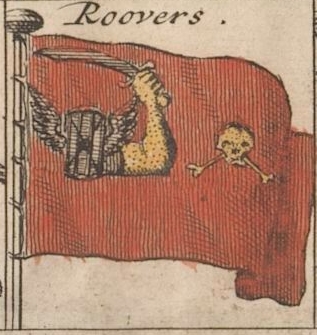
Schouw-park aller Scheeps-vlaggen des geheelen Water-Waerelds, 1711. The flag is shown among Barbary and Turkish sea flags. This flag is popularly, and incorrectly, attributed to the pirate Christopher Moody. (Rijksmuseum.)

Ottoman corsair flag from Nieuwe Tafel van alle de Scheeps Vlaggen des Gehele Water-Waerelds op Nieus Vermeerdert en Verbeeterdt, probably dating 1707 to 1711, possibly slightly later, based on some of the English flags shown. The Rijksmuseum incorrectly dates it 1650 to 1700.

Algiers red banner with death’s head, from Nieuwe Tafel van alle de Scheeps Vlaggen des Gehele Water-Waerelds op Nieus Vermeerdert en Verbeeterdt, dated as immediately above.
And last, a note on the purported flag of Blackbeard. Historian Ed Fox has pointed out that, according to The Mariner’s Mirror (1912, vol. 2, no. 3) the horned Blackbeard flag first appears in The Book of Buried Treasure by R. D. Paine (Ralph Delahaye), 1911. The book was reprinted in 1981 by Arno Press. The drawing is fanciful but is based on a legitimate period description of a pirate flag. A later artist or publisher ascribed it, with minor modification emphasizing devil horns, to Blackbeard.

Copyright Benerson Little 2016-2018. Originally published December 19, 2016, last updated December 9, 2018.
The Authentic Image of the Boucanier
Before we get, finally, to the swordplay, swashbuckling or not, of the late seventeenth century sea rover, we’ll take a closer look at the boucaniers who often accompanied buccaneers or flibustiers on their roving adventures, to use a polite term. Victims and objective observers were more likely to name these adventures for what they typically were: attacks and raids composed in part or all of killing, maiming, murder, torture, rapine, slaving, and rape, all foremost in the name of greed, and secondarily, although not always even then, in the name of national agendas. All was justified via the Black Legend (La Leyenda Negra) of Spain, an empire no less culpable than the privateers and pirates who attacked its far flung outposts. From these hunters did the buccaneers–the English-aligned Caribbean sea rovers–take their name. The boucaniers were hunters (chasseurs) of cattle and swine on Hispaniola, particularly on the French-claimed west, including on Île-à-Vache, and also in a small number at Samana on the Spanish-claimed east.
An oft-reproduced, typically with small changes, of a boucanier. However, this is not an eyewitness image and has some apparent inaccuracies. From Exquemelin’s 1688 Histoire des avanturiers qui se sont signalez dans les Indes.
Boucaniers hunted in small groups with packs of dogs, typically focusing on wild cattle for their hides, or on wild pigs for their flesh, which the boucaniers smoked slowly into boucan, and for their fat, which the boucaniers rendered into lard (manteca). Often attacked by Spanish raiding parties, the boucaniers–already expert shots–developed quick-firing techniques, and also the practice of keeping up a constant volume of fire, as opposed to firing conventionally in volleys (a practice also seen among the Spanish conquistadores in the Americas).
There were usually only a few hundred at most of these hunters, typically two hundred to five hundred depending on the decade. When hunting was bad, or if the market was bad, they might sail with buccaneers temporarily, or become full-time buccaneers (many buccaneers began their careers as the engages or indentured servants of boucaniers), or serve as hunters of escaped slaves, or volunteer to serve the English at Jamaica or the windward islands as hunters. Boucaniers were in particular demand during the early years of Caribbean buccaneering, circa 1655 to 1670 or so, as hunters for provisioning the various privateering, quasi-piratical, and sometimes entirely piratical voyages.
I have described their general details elsewhere, particularly in The Buccaneer’s Realm (pages 39-51), and readers interested in further detail may also consult the works of the priests and cultural observers Jean Baptiste Du Tertre, Jean Baptiste Labat, and, to a lesser extent, Jean Baptist Lepers (a bit of a pattern here), and also buccaneer surgeon Alexandre Exquemelin, all of whose citations are given below. This blog post will focus on how boucaniers actually dressed and accoutered themselves, comparing written descriptions with secondhand illustrations and, in particular, with detailed eyewitness illustrations made by French engineers and cartographers in the 1680s. Again, as I noted in the previous post, these images have been largely overlooked and not analyzed in detail until I did so three years ago. Further, I did not have access to several of the illustrations below at the time I made my first analysis.
As is the case with our image or visual idea of the buccaneer, that of the boucanier has been influenced by illustrators who have interpreted written eyewitness descriptions, and these interpretations have been copied over the centuries. The illustration taken from Exquemelin’s 1688 French edition (above) has been reproduced, often altered in minor ways, over the centuries, but it has serious flaws. The musket is strongly suggestive of a fusil boucanier, given its length and large butt (although the lock is incorrectly placed on the left side), but it is otherwise incorrect in its details. The image is also largely incorrect in general except for the shirt and breeches. De Fer’s 1698 map of the Americas below includes a similar illustration with similar mistakes, given that it was clearly made by an engraver interpreting written descriptions and not from personal experience.
Boucanier depicted in Nicolas De Fer’s 1698 map L’Amérique. As with the illustration above, this is not an eyewitness image and has some inaccuracies. (Courtesy of the Bibliotheque Nationale de France.)
De Fer’s image shows a boucanier as described in Exquemelin, with a reasonable, if inaccurate in their details, imagining of a fusil boucanier, a cropped hat, and a sheath holding several hunting knives. Smaller vignettes show boucaniers dressing pigs and smoking their flesh, hunting with dogs, stretching a cowhide to dry, and relaxing by a fire.
But we can do better! Once more cartographer Paul Cornuau comes to the rescue. Below is his eyewitness illustration of a boucanier firing at a wild cow or bull who has a quizzical, almost “Looney Tunes” look on his face. The boucanier’s dog is keeping the bovine beast at bay. The dog is as described by Exquemelin: with “a long flat head, sharp muzzle, savage air, thin lean body.” This is pretty much the form of all wild dogs subsequently domesticated, even today. The hunting of wild cattle was dangerous, and both Exquemelin and William Dampier note its hazards. Exquemelin describes how boucaniers often hunted cattle from trees, then had an engagé run up and hamstring the dead or dying animal, just in case.
Boucanier firing his fusil boucanier at a wild cow or bull, from a 1685 map of Cap François by Cornuau. (Courtesy of the Bibliothèque Nationale de France.)
Taking a look at the boucanier’s dress, we find a shirt and the sort breeches worn by flibusters and common working men on Saint-Domingue. The hat is clearly the cropped hat described by Exquemelin (Dampier also notes a “crop’t hat”): the brim left long in the front but cut short the rest of the way around, akin to a modern baseball cap, the difference being that it appears that a small amount of brim was left at the back and sides. At the boucanier’s waist is what appears to be a large sheath to hold three or four “Flemish” knives, as described by Exquemelin and Labat, and confirmed shortly by other illustrations. His legs appear to be bare, and on his feet are surely the “field expedient” boucanier shoes–“souliers de cochon“–made from the skin cut from the hocks of wild pigs, which Du Tertre and Labat describe and which I’ll discuss in a moment.

Boucanier carrying a pig carcass at Léogane, from an eyewitness illustration by Cornuau, 1685. (Courtesy of the Bibliothèque Nationale de France.)
Above is a boucanier carrying a gutted wild pig, its head removed but the skin still on. This was doubtless for convenience as the boucanier headed back to the ajoupa or camp (also known as a boucan). How the carcass is slung is open for conjecture: Dampier describes logwood cutters as cutting a beef carcass into four quarters, one per man who would then cut a hole in his and sling over his head “like a frock.” This may be what we see here, but with a pig carcass. The boucanier’s dress is as we see above, with little more detail except the hat, which is clearly cropped at the sides and back, with a long brim in front. The shoes are similar, obviously the “souliers de cochon” to be described in a moment: they have neither heel nor tongue, and extend beyond the toes. He carries a fusil boucanier, with a typical notch in the stock where the butt begins.
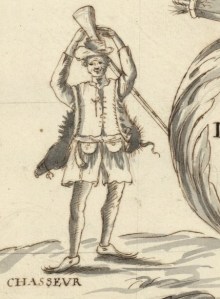
An eyewitness image of a boucanier, described as a “Chasseur” (hunter) in the legend) at Cap Francois, 1685, from a map by Paul Cornuau. (Courtesy of the Bibliothèque Nationale de France.)
Above is another boucanier with a pig carcass slung, this one by the legs. His mouth is tied for some reason. Examined at the highest available resolution, the pig appears to be slung via holes cut into its carcass and worn like a jacket. This boucanier is clowning around a bit, holding his fusil boucanier with heavy butt over or on his head. His hat is probably of the cropped sort, his jacket is short, his breeches common, his legs bare, and his shoes surely the “souliers de cochon.” Around his neck (as in the case of a flibustier described in the previous post) is a musket tool, and at his waist appear to be two small pouches slung from his belt, and a small powder horn. Although boucaniers are typically described as wearing a large cartouche box holding thirty paper cartridges, clearly not all did, until this boucanier wears his at the small of his back on his belt. Boucanier belts were often of cowhide with the hair still on, and even at times of crocodile (and therefore probably caiman too). Note that buccaneer and boucanier belts tend to be narrow, and never more than of moderate width, unlike what we see in Hollywood films.
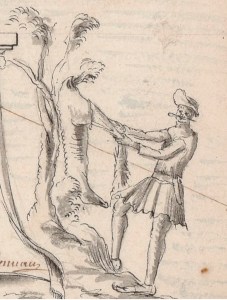
Boucanier skinning a wild pig, an eyewitness image from a chart by Cornuau of Nipe on Saint-Domingue, 1685. (Courtesy of the Bibliothèque Nationale de France.)
Above is a boucanier skinning a pig hung by the neck from a branch. Very likely, the carcass is hung from the same hole the boucanier probably thrust his head through in order to carry it, as described above. Typically, a pig carcass was gutted, skinned, and deboned, and the flesh cut into long strips roughly one and a half inches square and up to six feet long, then often salted (it would last longer this way), then smoked slowly on a barbecue over coals, on which were thrown the skin, bones, and offal for it was believed they gave the boucan–smoked pig–better flavor. (Note that boucan can mean the grill or barbecue, the smoked pig flesh itself, and the place.) This boucanier wears a cropped hat, has “souliers de cochon” on his feet, has a large sheath for three or four knives at his waist (we’ll see a better illustration soon). In his mouth is a probably Flemish knife of the sort commonly seen in this era.
Below is a boucanier stretching a hide, almost certainly a cowhide, to dry. William Dampier describes the process well as it was practiced at Laguna de Términos by cattle hunters among the logwood cutters, and the practice of scraping and drying the hides was likely the same among the hunters of Hispaniola. Of particular note in this illustration are the musket, cropped hat, knife sheath, and shoes. The musket is probably a fusil boucanier drawn poorly in perspective, therefore too short, but it could be that it is simply a shorter weapon. The hat is clearly cropped closely on the sides but left long at front. The sheath is the best illustration yet of the boucanier’s way of carrying several knives in a single sheath. It appears there is one large knife and several small. The small item hanging from the sheath is without doubt, as someone whose name unfortunately has momentarily slipped my mind, a sharpening steel.

Boucanier staking a hide to dry, an eyewitness image from a chart of Léogane by Paul Cornuau, 1685. (Courtesy of the Bibliothèque Nationale de France.)
The shoes are notable, especially the apparent projection at the toes, and they are distinct from the illustrations of shoes worn by Cornuau’s buccaneers (although one does indeed appear to be wearing “souliers de cochon,” and these may be what Fray Juan de Avila refers to as shoes of pigskin worn by the buccaneers who attacked Veracruz in 1683). Dutertre and Labat describe boucanier shoes as being cut from pig hocks (Dutertre) or from pig or cattle hocks (Labat)–peeled from the leg is a better description–into which the feet were thrust. These crude untanned shoes were trimmed to size, then tied at the ankle and just past the toes with raw pigskin laces. (We should also note that Exquemelin does describe boucaniers as also wearing shoes made of cowhide, which may be conventional shoes or similar crude shoes.)
Unfortunately, the details of precisely how these crude shoes were made are lacking in these descriptions. To our rescue is a description of Cuban hunters in 1803 who wore the same footwear: “Besides his untanned shoe, the chasseur often contrives in the woods a curious defence for his feet, which is greatly preferable. Having skinned the thighs and hocks of the wild hog, he thrusts his foot into the raw hide as far as he can force it, then cuts a small slip at the instep, and with his knife takes off the superfluous skin behind, adapting the remainder to his ancle and the lower part of his leg. The pliant hide takes the shape of a close short half boot, fitting like a glove on the foot, with a lengthened useless projection beyond the toe, something resembling the modern fashion of our beaux. This contrivance will last a march of weeks, or months; but once taken off, the skin dries, shrivels, and becomes useless.”
This is a rather nasty sort of footwear by modern standards, but boucaniers were invariably described as leading rather nasty lives: their hair and beards often matted with blood, their clothing black with dried blood, and, we may assume, seldom if ever bathing.
Notably, these crude shoes were also worn by the Jamaica equivalent of the French boucaniers. These English pig hunters, whose general practice was much the same as their French counterparts but for the manner in which they “jerck’t hog” (salted and smoked in two sides with the skin on), wore shoes made of “the skine of the hinde leggs of these hoggs…without ever sending it either to the tanners or curriers.” (John Taylor, his manuscript published in Jamaica in 1687, edited by David Buisseret, p. 135).

Detail of a hog butcher’s knife sheath, from December by Caspar Luyken, 1698 – 1702. (Rijksmuseum.)
The knife sheathes shown in the boucanier illustrations above are probably similar in construction to those in the two seventeenth century Dutch images immediately above and below.
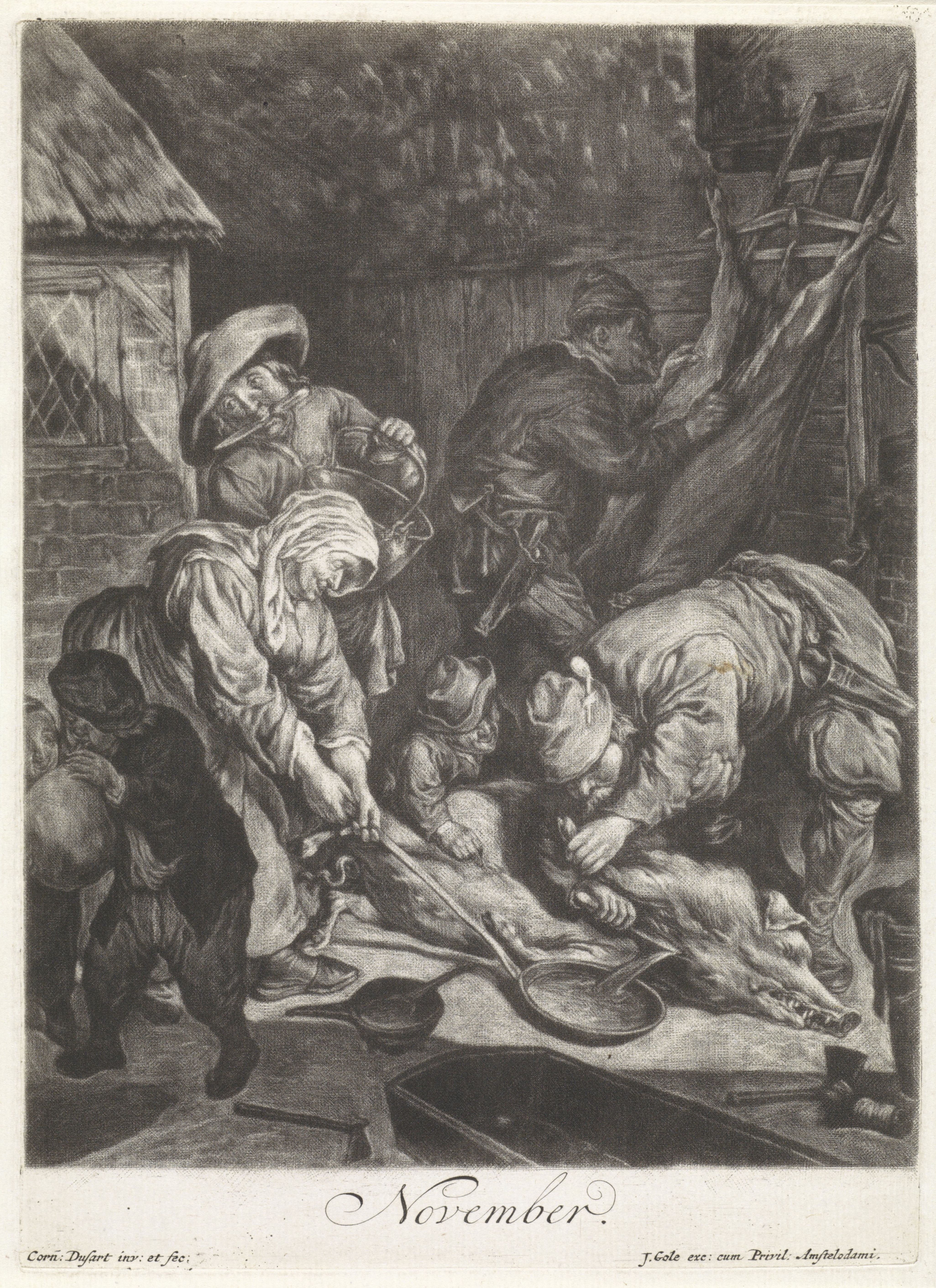
November by Cornelis Dusart, 1679 – 1704. The butcher has a knife sheath similar to those of the boucaniers. Note that the child on the left with the “balloon” is actually inflating a pig bladder. My father described the same practice when he was a child and his family slaughtered hogs for the winter. (Rijksmuseum.)
A boucanier in conversation with a flibustier (cropped out), an eyewitness illustration from a chart of Île-à-Vache by Paul Cornuau, 1686. (Courtesy of the Bibliothèque Nationale de France.)
Above is a boucanier in conversation. The illustration confirms hat, knife sheath, and shoes. His jacket is buttoned all the way up. On the right below is a likely boucanier, given that he is, like the hunter on the left, paired with a flibustier. (Note that indentured servants and the common working class dressed somewhat similarly: an illustration of a worker at a cotton gin on a Cornuau chart has similar shirt, breeches, and cropped hat, and is barefoot.) Of note is the boucanier’s clothing: his hat is cropped, he wears a jacket over his shirt, and his shoes may be the “souliers de cochon” although it is difficult to tell. What we don’t necessarily see in these illustrations are the machete or bayonet commonly noted in addition to the skinning knives (although the latter may be the large-handled knife in some of the illustrations), and the “mosquito netting” worn around the waist or over the shoulder like a bandoleer, although the latter is seen in an illustration of a buccaneer in the previous post. Possibly the machete was worn only in the field, or may be hidden in some illustrations, and the mosquito netting worn only when on the march. None are bearded, although Exquemelin described some of them as such.
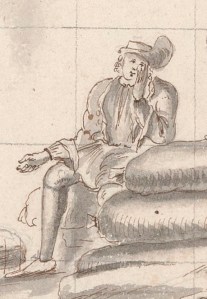
Probable boucanier sitting, an eyewitness illustration from a chart of Île-à-Vache by Paul Cornuau, 1686. (Courtesy of the Bibliothèque Nationale de France.)
So here we have it–several eyewitness illustrations to go with eyewitness written descriptions, correcting past impressions and giving us a brief look into the visual reality of the boucaniers who hunted on Saint-Domingue, provided hides for sale, boucan for buccaneers and local populations, who fought Spaniards sent to stop their interloping, and who often accompanied buccaneers on their roving against the Spanish in the New World.
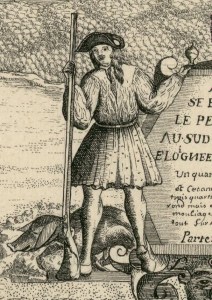
A boucanier, or probably so, given the wild pig at his feet. His fusil boucanier is of classic style. From an eyewitness image of Petit Goave circa 1688 by Partenay. (Courtesy of the Bibliothèque Nationale de France.)
Select Bibliography
Anon. “Proposals for Carrying on an Effectual War in America, Against the French and Spaniards.” 1702. Reprinted in The Harleian Miscellany. London: T. Osborne, 1744.
Avila, Juan de. “Pillage de la ville de Veracruz par les pirates le 18 mai 1683 (Expedition de Lorencillo).” Amoxcalli manuscript no. 266, http://amoxcalli.org.mx/paleografia.php?id=266.
Cornuau, Paul.
——. “Plan des passes et du bourg du levé et dessigné par ordre de Mr. De Cussy, Gouverneur pour le Roy de l’isle de la Tortue et coste St. Domingue.” 1685. Bibliothèque Nationale de France.
——. “Plan du cartier et de la rade de Nipe,” 1685. Bibliothèque Nationale de France.
——. “Plan du Cap et de son entrée,” 1684. Bibliothèque Nationale de France.
——. “Plan du cul de sac de Léogane,” 1685. Bibliothèque Nationale de France.
——. “Plan Ignographique du Fon et de l’Isle à Vache,” 1686. Bibliothèque Nationale de France.
——. “Plan ignographique du Fon et de l’Isle à Vache,” 1686 (second chart bearing this title). Bibliothèque Nationale de France.
Dampier, William. Voyages and Discoveries. 1729. Reprint, London: Argonaut Press, 1931.
Dutertre, Jean Baptiste. Histoire Generale des Ant-Isles Habitées par les François. Paris: Thomas Jolly, 1671.
Exquemelin, A. O. [Alexandre Olivier Exquemelin]. De Americaensche zee-roovers. Amsterdam: Jan ten Hoorn, 1678.
——. Bucaniers of America. London: William Crooke, 1684.
—— [Alexander Olivier O’Exquemelin]. Histoire des avanturiers qui se sont signalez dans les Indes. 2 vols. Paris: Jacques Le Febure,1688.
——. Historie der Boecaniers, of Vrybuyters van America. Amsterdam: Nicolaas ten Hoorn, 1700.
——. The History of the Bucaniers. London: T. Malthus, 1684.
——. Piratas de la America, y luz à la defensa de las costas de Indias Occidentales. Translated from the Dutch by Alonso de Buena-Maison. Cologne: Lorenza Struickman, 1681.
Labat, Jean Baptiste. Nouveau Voyage aux Isles d’Amerique. 6 vols. Paris: Guillaume Cavelier, 1722.
Little, Benerson. The Buccaneer’s Realm: Pirate Life on the Spanish Main, 1674–1688. Washington, DC: Potomac Books, 2007.
——. “Eyewitness Images of Buccaneers and Their Vessels.” The Mariner’s Mirror, vol. 98, no. 3 (2012), 312–326.
——. “Las Tácticas de los Piratas del Caribe.” Desperta Ferro, no. 17 (August 2015), 27-32.
——. “El Mito Pirata.” Desperta Ferro, no. 17 (August 2015), 52-55.
——. The Sea Rover’s Practice: Pirate Tactics and Techniques 1630–1730. Washington, DC: Potomac Books, 2005.
Partenay. “Ainsy se fait voir le Petit Gouave au Sud-est et nord oist éloignée . . . ,” 1688. Bibliothèque Nationale de France.
Copyright Benerson Little, 2015. First posted October 15, 2015, last updated April 30, 2018.
Copyright Benerson Little 2015-2018. First published October 15, 2015, last updated September 10, 2018.
 Swordplay & Swashbucklers