
Home » Posts tagged 'Tobacco'
Tag Archives: Tobacco

Creating that Ship-at-Sea Sensation While Armchair Adventuring: Some Progressively Tongue-in-Cheek Suggestions
A practical, yet certainly tongue-in-cheek, post about creating a buccaneering sensory environment while reading Captain Blood in your armchair, playing Blood & Plunder or Oak & Iron or a buccaneer board game like The Pirate Republic with your friends, watching The Sea Hawk or any other classic sea roving swashbuckler, playing a piratical video game (Sid Meier’s Pirates!, the Monkey Island series, AC Black Flag, Sea of Thieves, and Skull & Bones come to mind), or finally finishing that 1:48 scale model of a 17th century Spanish pirate hunting frigate (perhaps even the Cinco Llagas!) you started a quarter century ago…
Pine Tar & Cordage!

If there’s any single smell that evokes seaman’s “heart thrice walled with oak and brass”* during the golden age of sail, it’s pine tar. It was one of the principal naval stores, critical in the age of wooden ships. Unlike turpentine which was drained from pine tree trunks by notching them serially and collecting the sap, both in liquid form and as hard rosin (pine resin), then boiling it, pine tar was derived by cutting sap-rich heartwood from old growth pine trees (you won’t find this heartwood in most pines these days, they’re cut down too soon), stacking it in great heaps, burning it, and collecting the tar as it drained from the bottom. Pitch is simply pine tar further distilled to make it thicker. (My grandfather used to make his own when my father was a boy.)
Pine tar was thinned with turpentine to preserve running rigging; in thicker consistency for marline; and even thicker for standing rigging. It was also used, often heavily thinned with turpentine and mixed with linseed oil or tallow, or both, for treating the planking on ships’ sides. Pitch was used to seal the seams between planking after caulking them with oakum, &c.
The smell of pine tar and true pitch is, to those like me who love it, entrancing. Nothing evokes the old wooden ships like they do! But to those who hate the smell, those for whom organic smells cause them to recoil in nasal horror, it is akin to the combined smell of rotting road kill and hot roofing tar.
There are several excellent methods for bringing these scents about:
1. The simplest by far is to buy a tin of real pine tar–you can order it online–and open it, or better yet, pour a little bit into a small container and leave it uncovered. It doesn’t take much to fill a room with the smell. Sniff deeply from the container every quarter hour. Or dip your fingers in it and sniff them every so often–then wipe well unless you want your book or miniatures to smell like pine tar too.
2. Learn sail-making by making a ditty bag. You’ll need tarred marline, its smell will linger for months. Keep the bag nearby. When the marline eventually dries out, refresh it with a mixture of pine tar and turpentine.
3. Buy a ball of tarred marline, keep it in a plastic container so it doesn’t dry out over time, open it up as required for the salty tar smell. You’ll need it anyway for suggestion #2 above.
4. Bathe with pine tar soap. There are several on the market, Grandpa’s is highly recommended by many a tall ship sailor. Or just sniff the soap bar occasionally.
5. Treat your shoes with Huberd’s Shoe Grease, it’s made of pine tar and beeswax. Or just open a tin and sniff it periodically. And it really does work well waterproofing shoes, boots, gloves, and also cartouche boxes (for those of you who need to keep your powder dry).
6. Brew and drink Lapsang souchong tea–it smells, and even tastes (pleasantly, actually) of pine tar. Really, it’s much better than you might think, even if it’s anachronistic. It’s easy to find.
7. Hang a coil of marine grade Manila nearby, or better yet, several, or even better, hemp cordage if you can find it. Wet it for best effect. Or, the next time you’re by the seaside, soak it for a couple of days in the ocean, let dry, then hang and sniff as desired.
8. If you want to add more authentic smokiness, light a wood fire to augment the pine tar smell with that of the fire-hearth in the cook-room (NOT galley, that’s a later term). Place a pot of cornmeal (ideally heritage grits which are just cornmeal ground from heritage corn, a much-different and more authentic flavor, but any coarse stone-ground cornmeal will do, and even polenta, yellow grits, &c are close enough) and water on the fire to boil, add bacon fat or, better yet, unrefined manteca (pork lard), to season. Serve with boiled boucan (you’ll have to smoke your own boucan first, you can’t buy it at the market) or true tasajo if you can find it, or any form of smoked or dried pork. Or, boil cornmeal dumplings (recipes on the Internet, they’re still made in some of the former English colonies of the Caribbean), known as doughboys by buccaneers, serve with unrefined manteca. When either or both are ready, dine like a buccaneer.
Be advised that, like most of these scents (or odors, depending on your sense of smell and olfactory triggers in your memory), your spouse or other significant other, unless a sailor or fisherperson, might not like them at all. You may hear about this, in fact. Nod with empathy, promise to keep the door closed.
Rum!
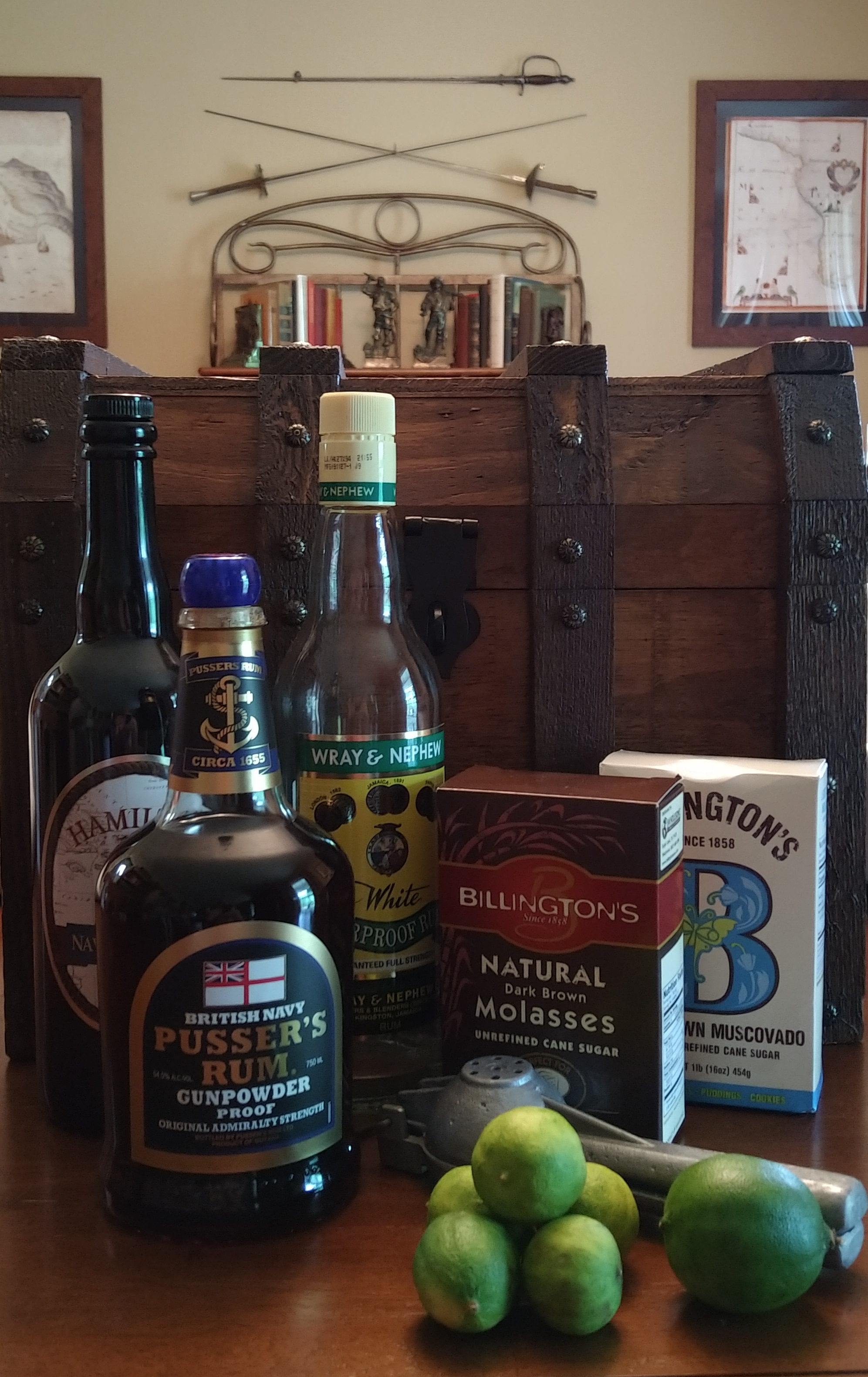
Pour a glass. Sniff. Drink. Repeat carefully. Don’t drive, neither ashore nor at sea, and don’t play with ANY firearms (a potentially fatal combination!) even unloaded, or sharp swords (you’ll stab your eye out for real, especially with a cutlass, or stick your foot to the floor/deck with a smallsword or rapier, the latter incident I’ve some experience with) while imbibing, nor afterward until the effects have passed!
I recommend dark molasses-ey rums: Pusser’s Gunpowder or just plain Pusser’s, Gosling’s, most any Navy rum, &c, or any amber or dark Jamaican or Bajan rum. I’m also partial to the Colombian Ron Viejo de Caldas with a pipe and tobacco (especially in a snow storm with thunder and electric blue lightning, of which there aren’t any in the Caribbean), and Smith & Cross, an authentic 18th to 19th century shipped-from-Jamaica-to-London style is also excellent. If you like a strong molasses taste, try Cruzan Blackstrap.
Lately I’ve become enamored of Privateer Navy Yard, a colonial New England style rum, and, for making punch, Plantation O.F.T.D and Ministry of Rum’s Hamilton 114, but note that this list changes quarterly. Also check out some of the strong pot-stilled, unfiltered, uncolored, “funky” white (often yellow, really) rums. We’re spoiled these days with the number of “funky” aka “hogo” rums these days, including white or yellow rums similar to 17th and 18th century rums, most of which were white or pale yellow and drunk very young. I highly recommend Hampden Estate Rum Fire Overproof. For a darker funky rum, try Doctor Bird Jamaica Rum, a late favorite of mine thanks to my son-in-law. (“Hogo” derives from “Haut goût” or “high taste” and denotes a strong molasses and other raw taste; in meat it indicates gaminess.)
If you’re a modern Cuban-American pirate, it’s going to be the original Cuban Havana Club (not the Puerto Rican stuff although I’ve nothing against it per se) and real Cuban cigars, or so I’ve been told by a modern Cuban-American corsario who introduced me to the combination. That said, it was the wife of a Hungarian who first introduced me to Cuban cigars. She’d smuggled (i.e. forgotten to declare, or so she said, to US Customs) them out of Hungary back in the days of the Iron Curtain. The authorities confiscated some of the cigars, but my friend had hidden others in another bag.

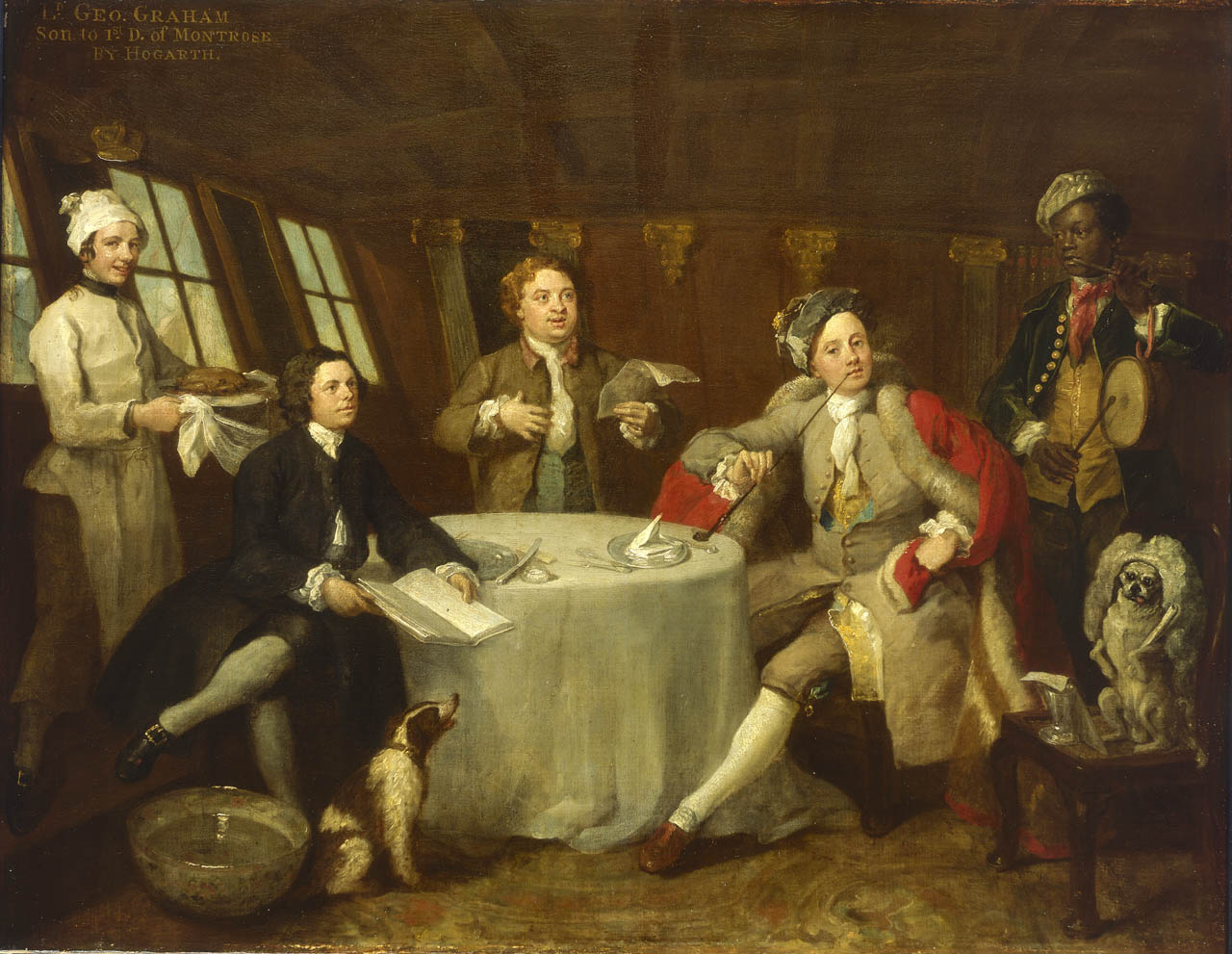

You might also try a 17th-18th century rum punch. The classic modern recipe is one of sour, two of sweet, three of strong, and four of weak, with a bit of grated nutmeg (or even allspice). Translated to the 17th century, this means one part key lime juice (preferred, although you may substitute orange or even pineapple juice), two parts muscovado sugar, three parts rum, and four parts water. Nutmeg was also commonly used in the 17th century. (See the foot of this page for notes on acquiring muscovado and key limes.)
If you plan on serving punch in a bowl, Charles H. Baker Jr. in his a famous drink book The Gentleman’s Companion: Being an Exotic Drinking Book… (1946) suggests chilling all ingredients first, and placing a large block of ice at the center of the bowl. Long gone are the days of ice trucks delivering blocks of ice to be chipped away in the ice box with an ice pick, but instead you can make a large block of ice by using a food storage container as a mold.
Tobacco!

Foremost, don’t smoke. And if you do, let it be only an occasional pipe or tobacco. And smoke outside — if you own your residence it will have better resale value, and your spouse or significant other might not murder you.
If you choose to smoke a pipe, try a high quality clay replica (a churchwarden is an excellent choice for you gentleman and lady buccaneers, but shorter pipes were more common shipboard), fill it with bosun’s rum twist (often called sweet rum twist), Sweet Virginia (Sutliff makes one), or Navy flake, and puff away. That said, I’ve been reliably informed that the early Oronoko (Verina, Sacerdotes, &c) and related Virginia tobaccos of the era were probably more like modern mild burleys.
Add an authentic replica of a seventeenth century pipe tamper if you like — a dolphin (aka dolphin fish, classical dolphin, mahi-mahi) or something bawdy, both of which were common along with other designs. (See Bucklecastings online for some.)
Or, smoke a cigar. Yes, cigars were popular in the 17th century Caribbean. Pretty much everyone smoked them to some degree, although pipes were more popular among the English, French, and Dutch. Cigars far outnumbered pipes among the Spanish, Portuguese, Africans, and, at least in the Caribbean and environs, Native Americans, and were smoked by women as well (as were pipes, by the way, among other nationalities), especially by Spanish women in the Americas. Check this out: Of Buccaneer Christmas, Dog as Dinner, & Cigar Smoking Women.
WARNING! Keep your pipe or cigar away from various flammable mixtures of pine tar, turpentine, beeswax, and linseed oil! Especially if you’ve been drinking rum!
WARNING! Keep your pipe or cigar away from your blackpowder, if any (see below), too! Blackpowder isn’t quite as sensitive to candle or common match flame as Hollywood depicts it, but a tobacco ember might still set it off. Put another way, it might take a dozen common wooden matches to ignite a blackpowder train — or it might take only one! And the flame from even a small amount of blackpowder can burn you to the bone! (Blackpowder, by the way, doesn’t explode, it deflagrates, if you want to get technical. It doesn’t burn as fast as true explosives.)
You can add a pipe bowl cover to your pipe for authenticity and, as was the case even three centuries ago aboard ship, for safety. It’s useful also when stalking wild cattle or feral swine on tinderbox arid coasts and desert islands. I recall my seafaring adventurer father using one when my brother and I would go hunting with him when we were in our early teens.
While smoking your pipe, take a break, tend your geraniums, and randomly shout, ideally from a window at passersby, “Quo, quo, scelesti, ruitis?” If you don’t get the allusion, shame on you! Go back to your armchair and do some more reading. 🙂
Blackpowder!

I’ve had my doubts about including this suggestion, given the large number of fools with firearms in the US these days. However, given that in my experience there are far fewer fools with blackpowder arms, I’ll go ahead.
WARNING! NOT NOT NOT FOR NOVICES OR AMATEURS! THIS IS NO JOKE! UNLESS YOU REALLY KNOW WHAT YOU’RE DOING, DON’T!!!
TRIPLE-CHECK that the barrel of your flintlock musket or pistol is UNLOADED. Prime (but do NOT load), point in a SAFE direction, bring to full cock, and squeeze the trigger — and thereby, assuming your flint is sharp and tight in the cock, fill the room you’re in with just enough smoke to bring your spouse or significant other down upon your ears after any nearby smoke alarms go off. Or maybe do this outside instead and hope your neighbors don’t call the police on you, which they probably will (and probably should, just in case) for discharging a firearm within city limits. Remember what I said about fools and firearms…
Breathe deeply of this broadsides and boarding actions smell. As an archaeologist at the Middelaldercentret in Nykøbing Falster, Denmark put it to me (we were testing firepots and an iron breech-loading swivel gun for a TV show), “There’s no one who doesn’t like the smell of blackpowder!”
If you like, afterward clash a couple of swords together afterward to suggest a boarding action. Prefer fencing swords rather than real cutlasses or functional replicas in order to avoid nicking sharp blades unnecessarily. If you’re going to nick edges, let it be in a real boarding action of which there really aren’t any of the age of sail sort anymore. Cue Jimmy Buffett…
WARNING! Don’t mix with rum drinking! Or any drinking! Or any other substance that impairs your judgment!
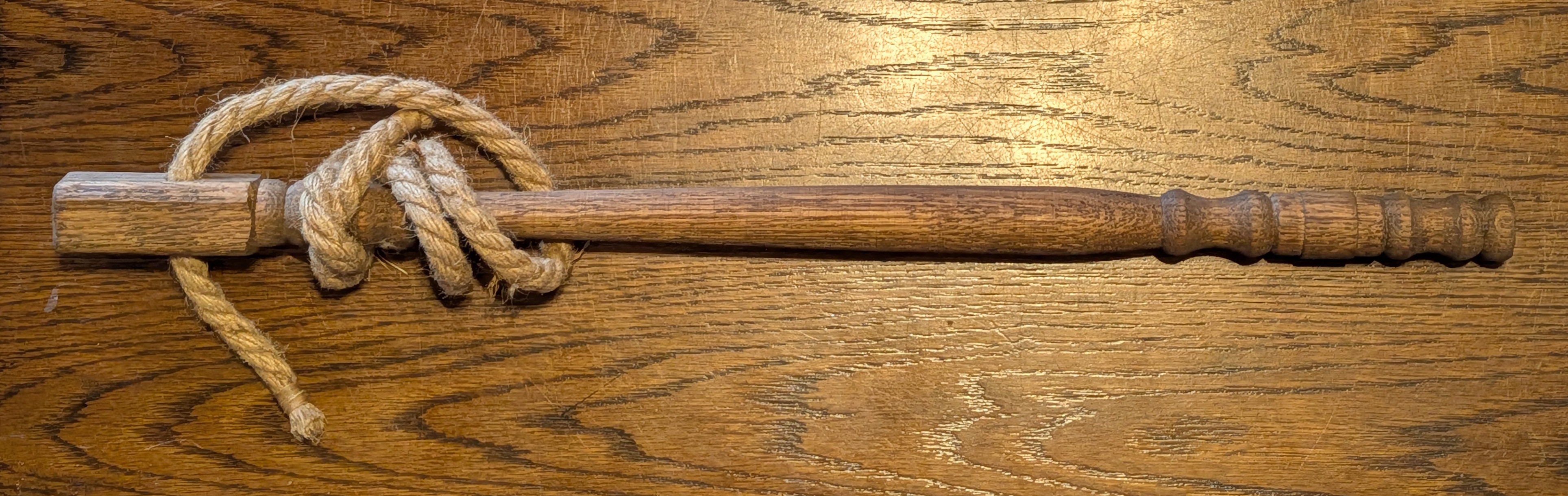
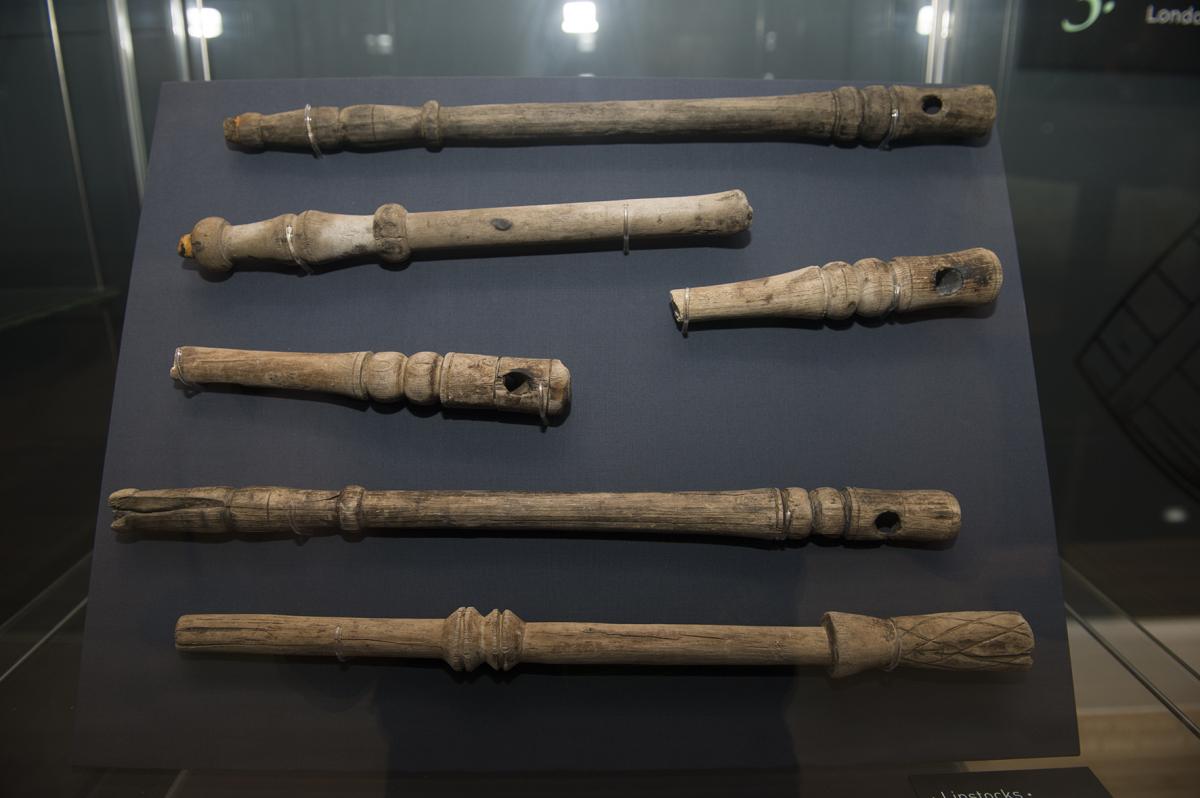
Or, if you prefer a potentially safer means of wafting, light a length of slow match used in the past to fire cannon (or guns, given that we’re emphasizing sea roving) and matchlock mosquetes and arcabuses. Make sure you use half inch (the “size of the little finger”) three strand hemp cordage aka line or rope so that you’re historical — don’t use the small braided slow match available from some reenactment sutlers, it’s historically inaccurate. As for making your slow match, historically-correct recipes are easily found in the Internet. Light your match, let it burn for safety in a metal bowl or preferably in a wooden tub with sand in the bottom as at sea in the 17th century, and sniff and smell away. If you’ve a gun to fire, make a linstock (a turned oak baluster can be easily modified for a very accurate representation, see above), fill the vent with blackpowder, lay a short train of blackpowder to the vent, and crush it with your powder horn — and only then put the match to powder to the train, not the vent. If put to the vent, the ensuing flame from the vent will put out the match and part the strands, forcing it to be cut and re-lighted — thus the historically correct method of putting the match to the train instead of the vent.
Sound Effects!

Put on music or videos of surf, preferably with seagulls in the background.
Or listen to a video (YouTube surely has some) of tall ship sounds–the sea, creaking rigging, seagulls.
Ignore this if you live by the sea or on a boat or ship (lubbers take note: a boat and a ship are not the same thing). If you live near a dump you might hear seagulls. Ignore the smell or pretend it’s the ship’s bilge.
You can always put on a CD of sea shanties, the bawdier the better in most cases, but accept the fact none are 17th or 18th century, but 19th & 20th century and therefore anachronistic. Or, put on a CD of John Playford’s popular 17th century tunes, there are at least two good compilations available. (Or stream them, I know, we’re well into the 21st century…)
If it’s Spanish pirating you want to evoke, try La Bamba: Sones Jarochos from Veracruz sung by José Gutiérrez & Los Hermanos Ochoa (a Smithsonian release). La Bamba was reportedly composed in the aftermath of the sack of Veracruz in 1683, lampooning the bombast of defenders who did nothing to stop the pirates — but claimed they would. Or, if it’s gentlemanly Spanish pirating you want to evoke, try Fantasía para un Gentilhombre by Joaquín Rodrigo, it has elements of Gaspar Sanz’s 17th century guitar compositions; or just sample some of Sanz’s music instead. Navigating Foreign Waters: Spanish Baroque Music & Mexican Folk Music is also an excellent choice.
But if it’s Hollywood pirating you want to evoke, put on Erich Wolfgang Korngold’s score for Captain Blood or The Sea Hawk, Alfred Newman’s for The Black Swan, Franz Waxman’s for Anne of the Indies, Max Steiner’s for The Adventures of Don Juan (I know, Don Juan isn’t a pirate film or even a seafaring one but the score was used in The Goonies aboard the pirate galleon), John Debney’s for Cutthroat Island, or, one of my favorites, the Chieftains’ score for the best version of Treasure Island ever filmed.
Hang a ship’s bell nearby, ring it loudly occasionally, ideally with the correct number on the half hour, remembering to ring in pairs: ding-ding, ding-ding, ding, &c. Unless you’re a complete fool, avoid doing so if your spouse or significant other has a migraine.
Note that sound effects are unnecessary if you’re just watching a movie…
That Salty Sea Smell!

It’s almost impossible to imitate, so go live by the sea if you can. Upside: the smell and sound of the sea. Downside: everything rusts, including your car. Failing this, keep a bottle of seawater handy, open it occasionally, and sniff. If that doesn’t work, attempt to reproduce that special salty sea smell with water, salt, and a few dead guppies.
Pitching, Sending, Rolling, & Yawing…
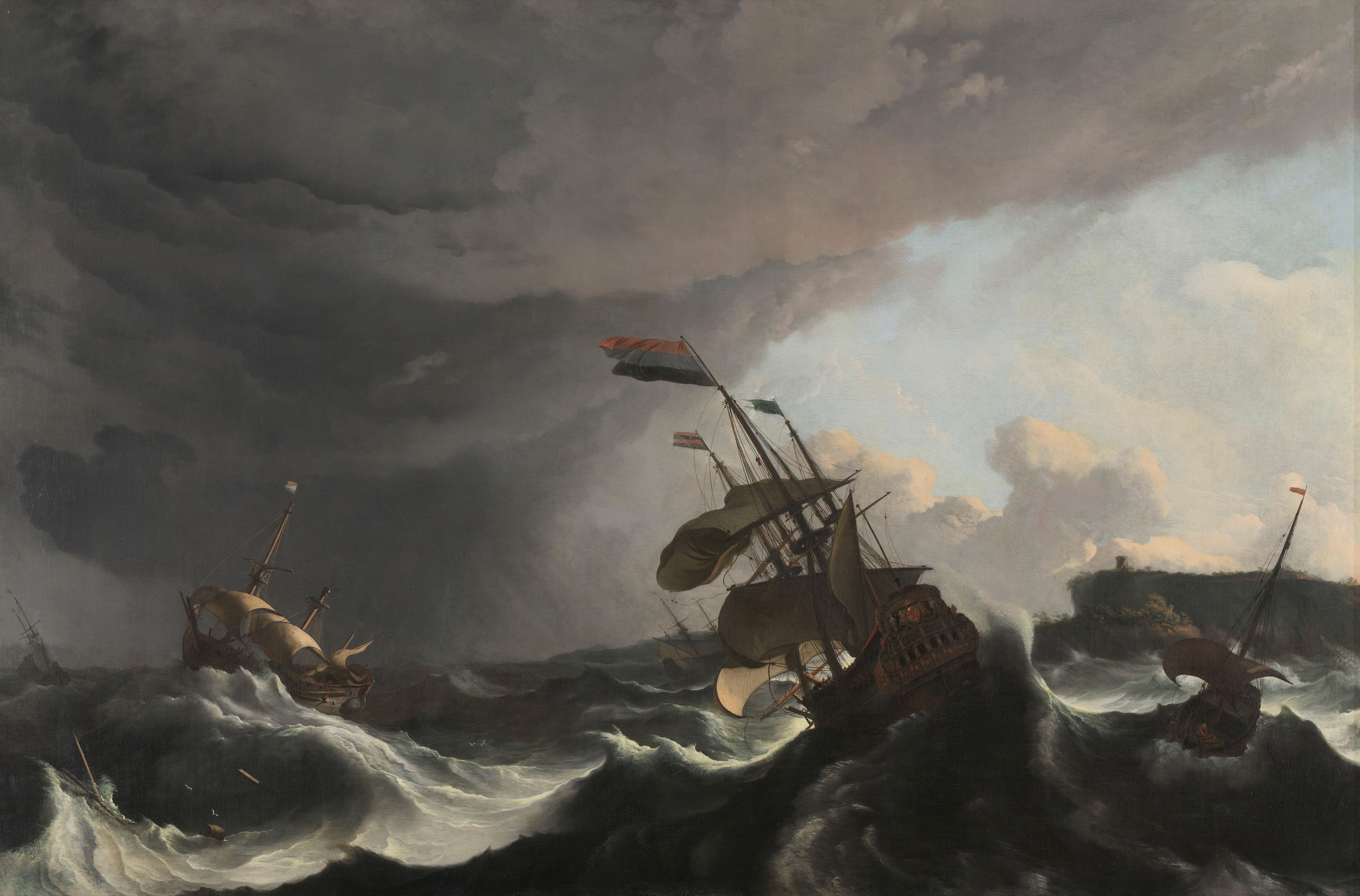
There’s really not much you can do to emulate the feel of a ship underfoot except to go to sea or get drunk or carsick. Best substitute: a hammock. Try not to fall asleep in it after drinking two rum punches. If you plan on inviting your significant other aboard the hammock, whether to recreate life aboard a man-o’-war in harbor or on a desert isle à la Robinson Crusoe, make sure it will hold both of you up! In other words, if you hang your hammock on an isle or cay, make sure your weight won’t pull one or both small trees over onto you. Experientia docet…
The Ship’s Head, Chamber Pots, Pissdales, & the Bilge!

Pretend you’re a buccaneer quartermaster or captain and use a bucket or chamber pot to relieve yourself because you’ve got too much status to use the ship’s head or one of the pissdales (if even there are any along the gun’l), or you’re too lazy to piss in the bilge where you shouldn’t anyway (the ammonia stench from this could actually choke seamen out at times). Pretend your spouse is your personal servant (yes, some buccaneers had indentured servants as their personal servants, and even naval officers often went to sea with servants, mustering many as seamen and taking part of their pay, a common practice of dubious legality) and ask her or him to empty said relief. Stand by for a break-up. Or simply for the contents to be emptied on your head. Personally I recommend passing on this simulation, but to each his, her, or their own…
More Effects of Sight and Sound: Parrots!

Get a parrot, name it Pol (it’s where the name Polly comes from, you can thank Daniel Defoe’s Robinson Crusoe), teach it to shout “Pieces-of-Eight! Pieces-of-Eight!” over and over (but this’s from Stevenson’s Treasure Island). Don’t listen to anyone who tells you parrots are just a fictional pirate trope — some pirate tropes actually have a great deal of legitimacy, particularly this one. Don’t believe me? Check this out: Of Pirates & Parrots (& Monkeys, Too).
However, be prepared for to spend big bucks to acquire and maintain a parrot, and also for guilt trips when the parrot won’t shut the hell up and you stuff it in the closet for a couple hours for some relief. Also, the damn bird will probably outlive you, so make sure to include it in your last will and testament. Leave it to someone who’ll take good care of it. Extra points if giving it to this person will also satisfy your need for petty personal revenge. Warning: acquiring a parrot is a serious undertaking! Best substitute? House-sit for a few days, parrot included.
And Still More: Monkeys!

Get a capuchin (monkey, not monk), put it in a diaper, name it “Captain,” and let it roam free and destroy your home. Or maybe not: primates shouldn’t be kept as pets, although some members of Homo sapiens — a primate species — inexplicably, even unconscionably, thrive on it (both keeping monkeys or other primates, including humans figuratively, as pets, and being kept as pets, that is).
Drawback: monkeys, not to mention many politicians and Internet windbags these days, often fling their turds at humans and can be quite obstreperous when it comes time to correct or prevent their bad behavior. (I’ll forgive monkeys but not politicians, pundits, or “influencers” aka product shills.) For what it’s worth, monkeys are another pirate trope with a great deal of maritime legitimacy. See the link above.
And If You’re Really Bold…
Just stuff the book you’re reading or the game you’re playing into your sea bag or sea chest, find a tall ship in the offing, and join her (its) crew!
Notes on Muscovado and Key Limes
Key limes are available in many groceries these days, including Walmart’s produce sections. Often the limes are listed as Mexican, given their usual origin, and they’re also known as West Indian limes. You’ll know them by their size, a third that of conventional limes.
For muscovado sugar, I recommend buying it in bulk from Amazon, it’s by far the best value, ten one-pound boxes, Billington’s Natural Dark Brown Molasses Sugar, or for a lighter taste, Billington’s Light Muscovado. (Colonial sugar plantations produced both dark muscovado and a lighter “clayed” sugar — in fact, sugar production was responsible for the majority of African slavery in the New World.) Much smaller quantities cost almost as much as do ten pounds in bulk. Billington’s also makes a Dark Muscovado but it’s hard to find in bulk in the US and is quite pricey in smaller quantities and in any case I can’t tell much difference between it and their dark brown molasses sugar — the latter tastes, looks, and cooks like muscovado, except that it has more molasses than the average muscovado, and has less of a floral flavor; most “experts” regard the dark molasses sugar as a form of muscovado. India Tree also makes a muscovado sugar, but prices vary widely; some groceries sell it for around six or seven dollars a pound.
Use dark or light muscovado sugar also for baking cookies, frying plantains with butter, making bananas Foster, making hot buttered rum (use dark rum!), on oatmeal, &c, and for any other brown sugar need. This is the real stuff! You can also use panela, piloncillo, and similar “brick” or “cone” cane sugars to substitute for muscovado, they’re quite similar to 17th century sugars — in fact, they’re produced in much the same way and are generally considered as forms of muscovado. Dark muscovado is marketed in some areas of the world as Barbados sugar, although most today comes from Mauritius and the Philippines.
* Robert Herrick in “A Country-Life: To His Brother Mr. Tho. Herrick” (Hesperides, 1648) quoting Horace, Odes I.3 in translation.
Copyright Benerson Little 2022-2026. First posted July 6, 2022. Last updated February 26, 2026.
Of Buccaneer Christmas, Dog as Dinner, & Cigar Smoking Women
Classic romanticized buccaneers! The pirate captain and his woman ashore on a Caribbean island or an isolated part of the Main, perhaps to share plunder or while careening, or simply to celebrate the holiday. We can always count on Howard Pyle to make the romantic appeal to our imaginations. And indeed, buccaneers did celebrate Christmas (and probably smoked cigars on occasion too), as I discuss below.

“How the Buccaneers Kept Christmas,” Howard Pyle, Harper’s Weekly, December 16, 1899, a special two-page image suitable for framing. In fact, I have it matted and framed.
BUCCANEER CHRISTMAS & DOG FOR DINNER
We do have multiple brief accounts of one buccaneer Christmas. Buccaneers, like other Europeans and European-derived Christian peoples, did observe the holiday, far more often with raucous, inebriated celebration than with religious devotion.
William Dampier noted that the captains of salt ships at Saltudos, or Salt Tortuga–where the very real Dr. Henry Pitman, inspiration for Sabatini’s novel Captain Blood, His Odyssey, was marooned–were always well-supplied with rum, sugar, and lime juice for visiting “privateers,” the euphemism for buccaneers, as opposed to the term “pirates.” Piracy after all was a crime.
“I have seen above 20 Sail at a time in this Road come to lade Salt; and these Ships coming from some of the Caribbe Islands, are always well stored with Rum, Sugar and Lime-juice to make Punch, to hearten their Men when they are at work, getting and bringing aboard the Salt, and they commonly provide the more, in hopes to meet with Privateers, who resort hither in the aforesaid Months, purposely to keep a Christmas, as they call it; being sure to meet with Liquor enough to be merry with, and are very liberal to those that treat them.”
Clearly, a buccaneer Christmas at any time of the year was a drunk-fest.
Our most famous description of an actual buccaneer Christmas dates to 1681, during the final days of the South Sea voyage of Captain Bartholomew Sharp and his companions in arms, in plunder (often as wishful as real), and in debauchery.
Sharp, already having been deposed once as captain once during the voyage during a stay at Juan Fernandez Island, a stay which coincidentally began on Christmas Day. Now, at the end of the voyage and almost home, with numbers depleted by buccaneer desertions, accidents, and deaths in battle, with the remaining crew on short allowance, Sharp remained a divisive leader, not for the least reason that by gambling with his fellow buccaneers he had increased his profit by leaps and bounds, leaving some of his comrades with little profit during the course of a long bloody voyage–not the best way to show leadership by any means.
On December 7th, according to buccaneer surgeon Basil Ringrose (I almost wrote Rathbone!), “This day our worthy Commander, Captain Sharp, had very certain intelligence given him that on Christmas Day, which was now at hand, the company or at least a great part thereof, had a design to shoot him; he having appointed that day some time since to be merry. Hereupon he made us share the wine amongst us, being persuaded they would scarce attempt any such thing in their sobriety. The wine we shared fell out to three jars to each mess.”
Mess size varied, as did Spanish jar size. Five to seven to a mess was common, but could even have been as small as four men. Spanish wine jars often, but not always, held a Spanish arroba, roughly four and a quarter gallons. At 750 milliliters to a modern wine bottle, we do some simple math and find that each mess received the rough equivalent of slightly more than sixty-four modern bottles of wine per mess, to last eighteen days: or, three and a half bottles of wine per day per mess. This wine may have been stronger than what we’re familiar with. It might have been very similar to Peruvian wine fortified with modern Pisco, the latter of which is usually 80 proof when sold in the US, but I’m speculating here based on a description of some of the wine found by buccaneers on the Peruvian coast. (And no, I won’t touch the “Who first came up with Pisco–Peru or Chile?” argument. We’ll leave the swords and poniards sheathed for now.)
Buccaneer surgeon Basil Ringrose provided the details: “This day being Christmas day, for celebration of that great festival we killed yesterday in the evening a sow. This sow we had brought from the Gulf of Nicoya, being then a sucking-pig of three weeks old, more or less, but now weighted about fourscore-and-ten pounds. With this hog’s flesh we made our Christmas dinner, being the only flesh we had eaten ever since we turned away our prizes under the equinoctial and left the island of Plata. We had this day several flaws of wind and some rain…” The holiday was celebrated roughly in the latitude of Rio de Janeiro.

An Ossabaw Island pig long-descended from Spanish and Canary Island stock, perhaps quite similar to the buccaneers’ Christmas pig. (The Livestock Conservancy.)

“Cinghiale. Sanglier. Wildschwein. Keuler. Wild boar. Wildzwein.” A sanglier or wild boar as seen in Europe and the Caribbean from European stock. Sangliers were prized for their taste. 1879. (Rijksmuseum.)
Sharp himself is a bit more direct: “When to Solemnize that Festival as well as we could, we eat the only Hog we had left, drank some Jars of Wine, and made our selves as merry as we were able, which I did the rather that my Men might not Mutiny.”
How they seasoned the pig is not noted. Given that their only way at sea of cooking was in a copper kettle, they would have boiled the flesh rather than roasting it over coals and seasoning it with a pimentade of lime juice, salt, hot peppers (pimento, or chili peppers as we know it), probably allspice, and perhaps a black or similar common pepper, as was common. The seasoning would have been similar in the copper pot, assuming they had the ingredients. The buccaneers would have served it with coarse boiled cornmeal (imagine a coarse polenta or coarse yellow grits, the latter are hard to find anymore) seasoned with salt and manteca (pig lard), which had been their only fare since departing the isle of Plata.
However, diarist John Taylor who visited Jamaica in 1687 wrote that Sharp’s buccaneers also served dog for Christmas dinner:
“Soe that they killed one hog, which was all they had left, and a spanell dog which they bought of one of their quartermaster for 40 dollars, on Christmas Day for their dinner.”
Alas poor beast, alas man’s best friend! But Taylor was no eyewitness, he was just repeating what he had heard from local sources. There was in fact a dog, a little curly shaggy-coated canine, like that of a poodle. And, according to one buccaneer, John Cox, who was there, they did in fact eat him:
“When we took the two Barks at Nicoya, we had a little sucking Pigg in one of them, which we kept on Board ever since for our Christmas days Dinner, which now was grown to be a large Hogg; so we killed it for Dinner, but thinking it not enough for us all, we bought a Spaniel-Dogg of the Quarter-Master for forty pieces of eight, and killed him; so with the Hogg and the Dogg, we made a Feast, and we had some Wine left, which made us merry: This being the only think we had eaten that had blood in it since our departure from the Duke of York‘s Island.”
But no one’s memory is perfect. Did they in fact eat dog for Christmas dinner? Was Cox inspired to exaggerate based solely on the rhyme of Hogg and Dogg? Do we see the interfering hand of an editor trying to “sex up” the manuscript? Again Basil Ringrose comes to the rescue, writing of a day in late January, well after Christmas, just prior to making landfall in the Leeward Islands:
“On that day [January 26, 1682], therefore, a little Spanish shock-dog, which we had found in our last wine-prize taken under the equinoctial and had kept alive till now, was sold at the mast by public cry for 40 pieces-of-eight, his owner saying that all he could get for him should be spent upon the company at a public merriment. Our Commander, Captain Sharp, bought the dog, with intention to eat him, in case we did not see land very soon.”
The money raised was added to one hundred more pieces-of-eight that were left over from a previous sharing of plunder, in which the boatswain, carpenter, and quartermaster had refused to accept shares owing to some disagreement “with the sharers.” The coins were laid up, to be spent ashore in celebration of their return to the Caribbean from the South Sea.
Two days later the buccaneers sighted Barbados, but were scared off by the barge belonging to the English man-of-war Richmond lying at anchor Bridgetown harbor. Two days after that the buccaneers sent a canoe ashore at Antigua, or Antigo as they called it, and from here they went their separate ways.
So it was not a Christmas dog after all! Or was it? We hope it was part of no Christmas dinner except to have gnawed any scraps ravenous buccaneers may have cast his way. “Perros Ingleses!” we have heard Spaniards call the buccaneers, or at least buccaneer surgeon Alexandre Exquemelin said they did on one occasion, and surely in fact on many. But dog don’t eat dog, or so they say, and we hope, more from Ringrose and the buccaneer arrival at Antigua and not necessarily from common proverb, that Cox was wrong and that Sharp may have been mostly joking about eating the dog.
Mostly.
WITH A WILLING WOMAN IN A HAMMOCK
So, would buccaneers have celebrated Christmas as in Pyle’s image above? With a willing woman in a hammock, smoking a cigar? It’s a common image in fiction, that of a romance between a pirate and a lady on the seashore. We almost imagine this as the setting in the aftermath of The Black Swan by Rafael Sabatini, but when we recall the noble manner in which the romance unfolded, his gentlemanly behavior, her lady-like sensibilities, we can’t imagine Priscilla Harradine smoking a cigar. On the other hand, we recall her attraction to men of adventure and her propensity for slipping off to swim nude, and we think perhaps she might after all.

The cover of the 1947 Editorial Molino Argentina edition.
For the sake of romantic notions, combined with the fact of romantic relations between buccaneers and some women, I will forego a discussion of the often profoundly disturbing treatment of women by pirates at times, a fact often ignored or only hinted at it film. You may find these sordid details in The Golden Age of Piracy: The Truth Behind Pirate Myths, and in other works as well.
Some, probably many, buccaneers were married but they did not take their wives, or their women in general for that matter, to sea with them, the one known exception being John Beare who took his woman, the daughter of a rum punch woman in Port Royal, to sea at least once dressed as a man. Accused of piracy by the English–and yes, he was in fact a pirate–he fled to Havana where he married his true love and began serving as a Spanish privateer, or, as the English would have it, a Spanish pirate. Perhaps Beare did celebrate a Christmas ashore while careening, his inamorata waiting languidly in a hammock.
We also have the example of Dutchman Jacobus (James) Marquess, or “Copas” [Cobus] for short, a buccaneer “lingusiter”–also known as a “truchman” or interpreter–in the South Sea with Bartholomew Sharp. Copas fell in love, or perhaps merely deeply in lust, with a “Mustees” Spanish woman at the island of El Cavallo while the buccaneers were ashore taking in water over the course of four days and three nights. Many of his companions worried that he was a turncoat who intended to betray them to the Spanish. A Native American boy also ran away while at the island, perhaps with Copas.
“[T]he woman lieing on borde one or two nights, was very familiar with one Copas a dutch a man, who formerly had saild with the Spaniards…but was mainly Inamoured with thiss women, makeing her severall presents of some Vallew,” wrote a buccaneer who is best identified as Edward Povey.
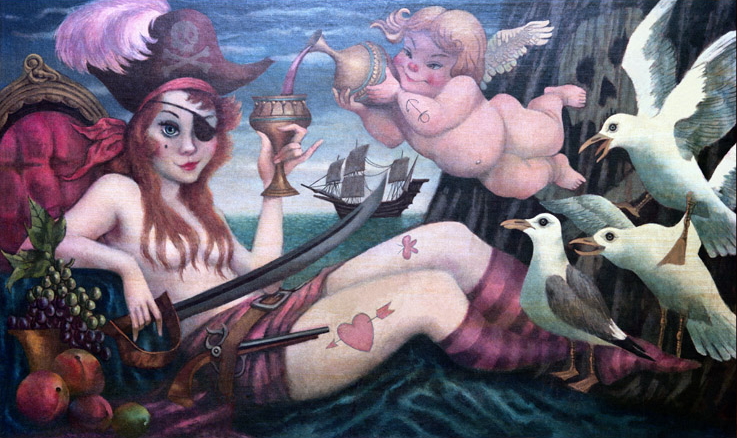
Not in a hammock, yet in a recumbent pose with hints of Venus rising from the waves. Inspired in part perhaps by Howard Pyle’s painting above and perhaps by Spitfire Stevens (Maureen O’Hara) in Against All Flags, and therefore by popular visions of Anne Bonny, the painting is likely ultimately inspired by the redhead that once was part of the Disney Pirates of the Caribbean attraction. The painting, which hangs in the bar in the California version of the ride, is entitled “A Portrait of Things to Come,” suggesting the redhead becomes a pirate after the “bride auction.” Disney Image.
Copas pretended to go hunting but deserted to her instead, leaving all but two hundred pieces-of-eight of his plunder behind–some 2,200 pieces of eight, plus jewels and other goods. He must truly have been in love, indeed! Or perhaps he thought he could sell his knowledge of the buccaneers to their enemies. Alas, this instance of buccaneer love did not occur over Christmas, but late in May, 1681.
Raveneau de Lussan, buccaneer author, wrote that during the occupation of Guayaquil by French flibustiers in 1687, he was almost seduced away by the “widow of the local treasurer,” who suggested they hide in the woods until the pirates were gone, and then they could marry and he would have “her husband’s office in addition to her own extensive holdings.” Quite an offer! But de Lussan turned it down, and again, this flibustier love did not occur over Christmas, but in April. Spring is the time for love, so it is said. Or perhaps just for mating.
If any buccaneers did take their wives or inamoratas with them to sea, I imagine it may have been some of the early flibustiers and boucaniers who did so with their “Amazon wives who could shoot and hunt well,” as one chronicler noted of them, supporting the expeditions and perhaps even participating in the assaults themselves.
CIGAR SMOKING WOMEN
But IF a buccaneer did have his woman with him at Christmas (and here I speak of buccaneers solely as men only because, although there may have been one or more women in disguise among them as actual crew members, to date we know of none–Jacquotte Delahaye is a 20th century fiction, and Anne Dieu-le-Veut was a wealthy shore-based widow, not a flibustière), might she have smoked a cigar?
To find an answer we must first know if people smoked cigars in the 17th century Caribbean or anywhere else for that matter. Many modern pirate researchers and reenactors decry as incorrect the cigar-smoking pirates in Black Sails, for example, and one even called me out–incorrectly–on the subject after he read the prologue to The Golden Age of Piracy.
We turn first to Jean-Baptist Labat, priest and also chronicler of the late 17th and early 18th century Caribbean for the answer:
“We do not use pipes in the Americas; the Spanish, Portuguese, many English and French, nearly all blacks, and all our Caribs smoke bouts [“ends”], or as the Spanish say, cigars… It is rare to find a Spaniard without his provision of cigars.”
(Notably, Labat mis-heard cigaro and wrote it as cigale, or cicada in French. His description of cigars is quite modern: six to seven pouces long, and five to six lignes in diameter, roughly six and a half to seven and a half inches long, and around half an inch in diameter.)

Detail from a Dutch print by Crispijn van de Passe, 1641, showing an imaginary English merchant’s wife with wine and tobacco. (Rijksmuseum.)
We turn next to buccaneer-surgeon and author Alexandre Exquemelin who preceded Labat. He writes in the French edition of his buccaneer book that in “America one uses very little snuff, but smokes much tobacco. From tobacco leaves…they make small rolls which the Spanish call cigarros and which they smoke without a pipe.”
So Spaniards and others smoked cigars. But did buccaneers? Most buccaneers were English, French, and Dutch, although there were many other peoples, nationalities, and ethnicities among them, including Spanish, Portuguese, Italian, and other European origins, plus African, Native American, even Asian via Mexico via the Manila galleon, plus a variety of mixed races. They were, in other words, a variety of white, black, and brown of many origins. And there were Spanish pirates of course!
The English, French, and Dutch chewed tobacco or more commonly smoked it in pipes, small to medium bowl size among the English and French, large among the Dutch. White clay pipes were the most expensive and typically from England and the Netherlands; terracotta pipes were cheaper and often made locally; and wooden pipes were the cheapest (and doubtless the worst to smoke).
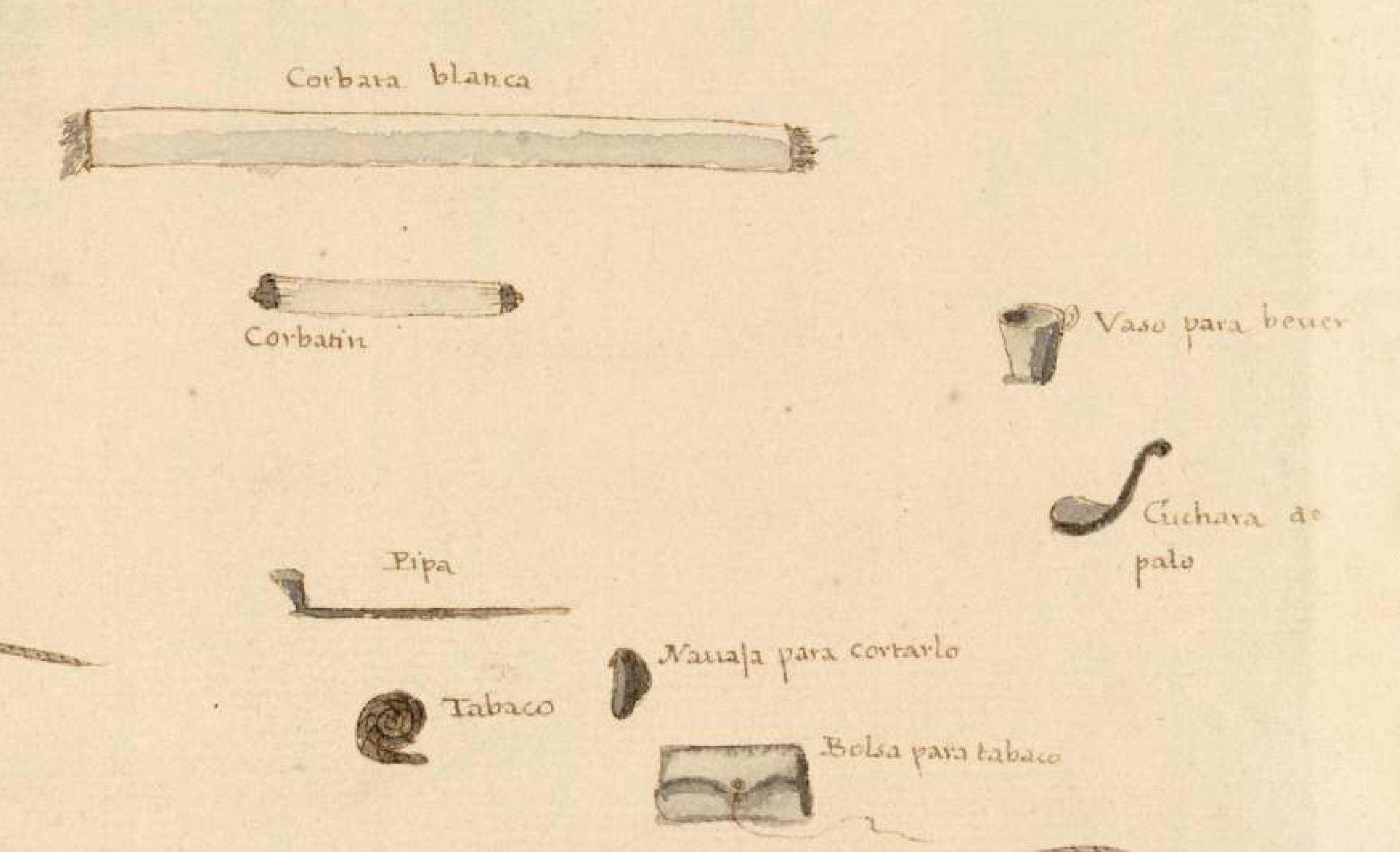
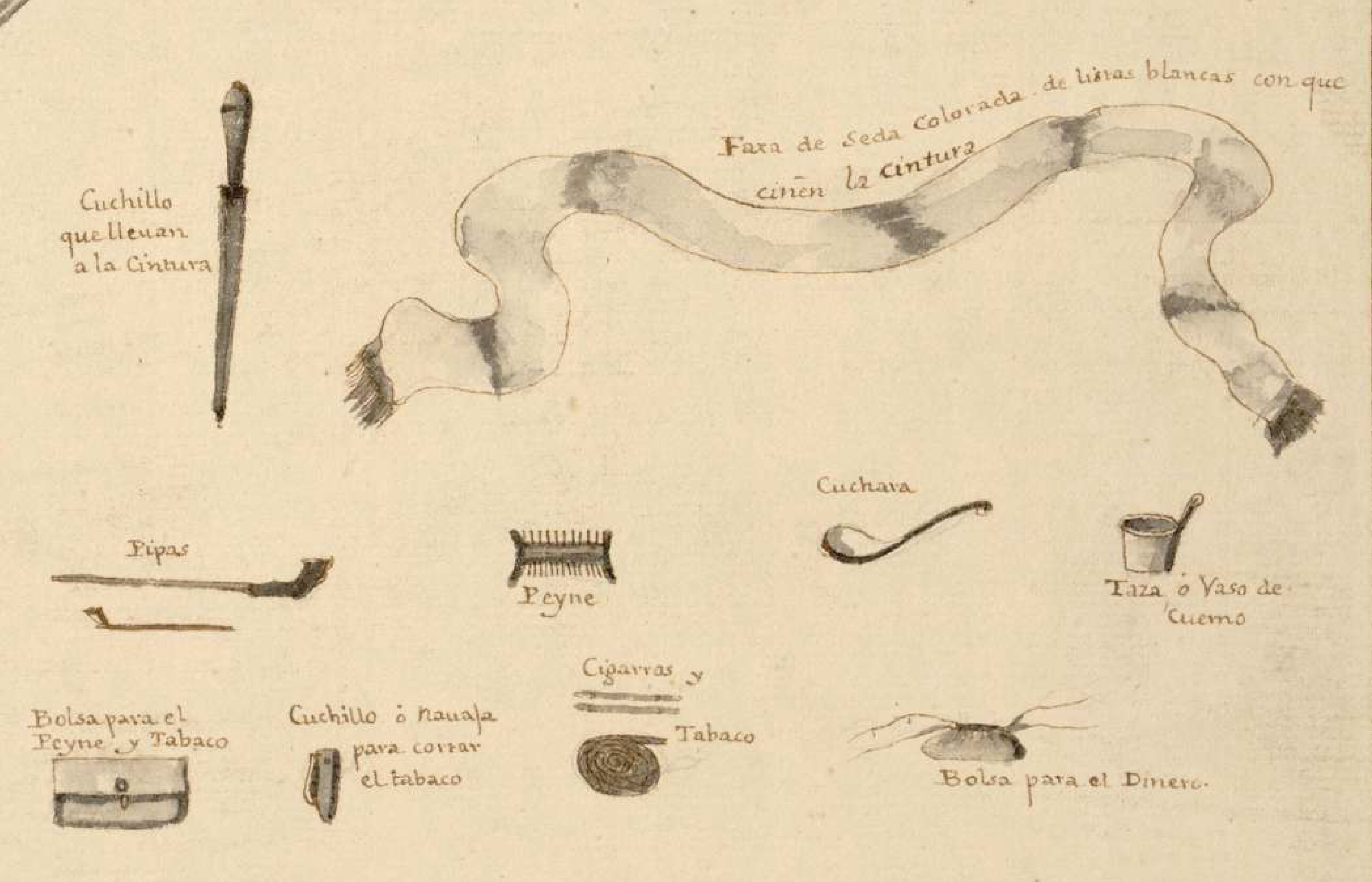
Some of the personal items of a typical Spanish naval officer in the first half of the 18th century, including a pipe, roll tobacco, a folding Navaja for cutting the roll, and a pouch for tobacco. Detail from the Álbum de Construcción Naval by Juan José Navarro de Viana y Búfalo, Marqués de la Victoria, circa 1719 to 1756.

Some of the personal items of a typical Spanish naval seaman in the first half of the 18th century, including pipes, cigars and roll tobacco, a folding pocket knife or Navaja for cutting the roll tobacco, and a pouch for tobacco and comb. Detail from the Álbum de Construcción Naval by Juan José Navarro de Viana y Búfalo, Marqués de la Victoria, circa 1719 to 1756.
However, Spanish buccaneers among them would likely have smoked cigars (or seegars as they became known among the English by the early 18th century), and some English, French, and Dutch may have preferred them at sea as they did ashore. Certainly some African slaves and former slaves among the buccaneers smoked cigars, and it’s probable that some English, French, and Dutch buccaneers smoked captured cigars, if only by cutting them up and smoking the tobacco in their pipes. There is no question that cigars were smoked at sea: the 18th century Spanish Álbum de Construcción Naval of the Marqués de la Victoria shows the cigar along with the pipe among the forms of tobacco used by Spanish seamen. Having smoked both pipe and cigar, I can say that a cigar is no more dangerous aboard a wooden ship than is a pipe: both can be hazardous if appropriate measures are not taken.
Ah, but did women smoke cigars? Well, we know that among the English, French, and Dutch many women smoked pipes, along with many African women in the Caribbean. And there were Native American women who smoked cigars. So why not Spanish women of any ethnicity? And why not cigars, given that they were the predominant means on the Spanish Main of taking tobacco? In fact, we know that in the 18th century there were Spanish creole women who smoked cigars, thus it’s almost certain they did in the 17th century as well.
Alexandre Exquemelin, the buccaneer-surgeon and buccaneer-author who gave us The Bucaniers of America, notes in his French edition that it was as unusual to see a Spanish woman in the Americas who didn’t smoke as it was to see a woman in France who did. (He also did not understand the allure of tobacco, for his medical experience had taught them that smoking was contrary to good health.)
Likewise John Cockburn, writing of the year 1735 in which he was captured by a Spanish guarda costa, or as the English would probably have it, a Spanish pirate, noted the following of three Spanish friars who had just crossed some mountains in Nicaragua:
“The gentlemen gave us some seegars to smoke, which they supposed would be very acceptable. These are leaves of tobacco rolled up in such a manner, that they serve both for a pipe and tobacco itself. These the ladies, as well as gentlemen, are very fond of smoaking; but indeed, they know no other way here, for there is no such thing as a tobacco-pipe throughout New Spain, but poor awkward tools used by the negroes and Indians.”
And who’s to say the woman in Pyle’s painting isn’t Spanish, after all? It is a romantic notion.
Of course, Pyle’s use of a woman smoking a cigar is even more provocative than merely putting her recumbent and languid in a hammock. Since the late seventeenth century, smoking in women has often been seen as a sign of promiscuity rather than as a notion of budding equality. But Pyle’s image is not merely a sexual provocation: it is an image of aggressive independence. This woman is no wallflower, she is no quiet being who fully accepts the purely feminine role imposed upon her. Rather, she is a suitable companion adventurer: a modern progressive woman even by the standards of Pyle’s day. I wouldn’t usually consider Howard Pyle as a feminist per se, but in this case I think he has already proved the argument.
SELECT BIBLIOGRAPHY
Cockburn, John. The Unfortunate Englishmen: or, a Faithful Narrative of the Distresses and Adventures of John Cockburn. “New edition.” London: Hamilton and Co. Shakespeare Library, 1794 (63-64).
[Cox, John]. The Voyages and Adventures of Capt. Barth. Sharp, and Others, in the South Sea. London: P. A. Esq. [Philip Ayers], 1684.
de Lussan, Raveneau. Journal du Voyage Fait a la Mer de Sud, avec les les Flibustiers de l’Amerique en 1684. et Annés Suivantes. Paris: Jean Baptiste Coignard, 1690.
——. Journal of a Voyage into the South Seas in 1684 and the Following Years with the Filibusters. 1689. Reprint, translated and edited by Marguerite Eyer Wilbur. Cleveland: Arthur C. Clark Company, 1930.
——. Journal of a Voyage Made by the Freebooters into the South Sea, 1684, and in the Following Years. 1699. In The History of the Buccaneers of America by Alexandre Exquemelin [Joseph Exquemelin]. Reprint, Boston: Sanborn, Carter and Bazin, 1856.
——. Les Flibustiers de la Mer du Sud. 1695. Reprint, edited by Patrick Villiers. Paris: Éditions France-Empire, 1992.
[Dick, William]. “A Brief Account of Captain Sharp . . .” In The Buccaneers of America by Alexander Exquemelin [John Esquemeling], 257–83. 1684. Reprint, New York: Dorset, 1987.
Exquemelin, Alexandre [Alexander Olivier O’Exquemelin]. Histoire des Avanturiers Flibustiers qui se sont Signalez dans les Indes. 2 vols. Paris: Jacques Le Febvre, 1699. See also his 1686 edition.
Labat, Jean-Baptiste. Nouveau Voyage aux Isles de l’Amerique. The Hague: P. Husson et al, 1724.
Lepers, Jean Baptiste. La Tragique Histoire des Flibustiers: Histoire de Saint-Domingue et de l’Ile de la Tortue, Repaires des Flibustiers, Écrite vers 1715 par le Rév. P. Lepers. Edited by Pierre-Bernard Berthelot. Paris: G. Crés, 1922.
Little, Benerson. The Buccaneer’s Realm: Pirate Life on the Spanish Main, 1674–1688. Washington, DC: Potomac Books, 2007.
——. The Golden Age of Piracy: The Truth About Pirate Myths. New York: Skyhorse Publishing, 2016.
——. The Sea Rover’s Practice: Pirate Tactics and Techniques, 1630–1730. Washington, DC: Potomac Books, 2005.
Navarro de Viana y Búfalo, Juan José. Álbum de Construcción Naval del Marqués de la Victoria. Museo Naval de Madrid.
[Povey, Edward?]. “The Buccaneers on the Isthmus and in the South Sea. 1680–1682.” In Jameson, Privateering and Piracy.
Pyle, Howard. How the Buccaneers Kept Christmas. An illustration in Harper’s Weekly, December 16, 1899.
Ringrose, Basil. “The Buccaneers of America: The Second Volume.” In Exquemelin, Buccaneers of America (Crooke, 1684).
——. Buccaneer Atlas: Basil Ringrose’s South Sea Waggoner. Edited by Derek Howse and Norman J. W. Thrower. Berkeley: University of California Press, 1992.
——. “Captains Sharp, Coxon, Sawkins, and Others . . .” In The History of the Buccaneers of America by Alexander Exquemelin [Joseph Esquemeling], 180–313. 1699. Reprint, Boston: Sanborn, Carter and Bazin, 1856.
Sabatini, Rafael. The Black Swan. Boston: Houghton Mifflin, 1931.
Sharp, Bartholomew. Captain Sharp’s Journal of His Expedition. In A Collection of Original Voyages by William Hacke. 1699. Facsimile reprint, edited by Glyndwr Williams. New York: Scholars’ Facsimiles & Reprints, 1993.
Taylor, John. Jamaica in 1687: The Taylor Manuscript at the National Library of Jamaica. Edited by David Buisseret. Kingston: University of West Indies Press, 2008.
Copyright Benerson Little 2017-2024. Last updated December 3, 2024.
 Swordplay & Swashbucklers