
Home » 2024
Yearly Archives: 2024

The Pirate Captain & His Burning Prey Upon the Background Billows: An Iconic Image

Arguably only a few illustrators have matched, and none have surpassed, Howard Pyle (1853-1911) for his iconic pirate images and their contribution to the modern myth of pirates and piracy. Whether of picturesque and picaresque buccaneers, or of pirate attacks, duels, buried treasure, or extortion of prisoners, his illustrations, with few exceptions, have inspired imitation and homage.
Of all Pyle’s strikingly evocative pirate art, his painting of Captain Keitt for his novella The Ruby of Kishmoor is considered by many to be the pinnacle of his work. We see it above: the pirate captain, clearly inspired by Captain Kidd, braced seaman-fashion on the poop of his pirate ship The Good Fortune in the trough of the sea, his prey, the Rajah of Kishmoor’s great ship The Sun of the East, burning in the background upon the crest of a swell, its mainsail shot to pieces.
The ship’s lantern rises behind the pirate captain, and curiously — and surely for reasons or artistic composition — behind it the ensign staff flying the Jolly Roger. I quibble here: the lantern would historically have been astern of the flagstaff, outboard of the hull, the other inboard. Curiously, the lanterns, and in fact the stern decoration and color, of both ships appear similar if not identical (and somewhat similar ones can also be seen on Disney’s pirate ship the Black Pearl).
Keitt wears an 18th century style cocked hat (aka tricorn) with gold trim, setting off his rather ratty black hair and long mustachios framing a stern face that hints of evil, an expression suggesting he might be posing for a painter, recalling perhaps the pirate portraits in Exquemelin’s The Buccaneers of America. Or perhaps he has been caught off guard, or has been asked a stupid question.
A ratty kerchief is tied around his neck rather than a cravat, and he wears a crimson just-au-corps, waistcoat, and long swashbuckling sash. His wide loose breeches are the seaman’s, and on his feet he wears boots of some sort, perhaps intended as “sea boots” although such were worn largely by fishermen and by seamen of this era only in cold weather. The boots are a deliberate cliché or trope: even more than a century ago the audience expected to see pirates in boots, though most often of those for riding with tops folded over. Pirates wore shoes and stockings or, especially if poor, went barefooted. The idea of “pirate boots” derives via popular illustrators from those of cavaliers and musketeers.
Hanging from a buff baldric is a Spanish “bilbo” style rapier with large curved shells although he would likely have worn a cutlass instead, and from a waist-belt. A short-barreled pistol is stuffed into the sash, and Keitt holds a speaking trumpet in his hand, perhaps with which to verbally abuse those victims doubtless left behind on the burning, sinking ship — he surely no longer has any need of the trumpet for hailing. Perhaps he uses it to bellow at his crew rather than pass orders via his subordinate officers.
There is a somber aspect to the painting: those aboard The Sun of the East who did not perish in the battle and boarding action have surely been left to the severe mercy of the sea.

N. C. Wyeth’s frontispiece and dust jacket art for the US edition of Rafael Sabatini’s Captain Blood: His Odyssey (1922) is almost as famous as Pyle’s painting. Clearly an homage to his teacher’s famous painting, Wyeth’s work embraces the image of Sabatini’s eponymous hero, even if he depicts the famous literary buccaneer in more mid-17th century style rather than of the 1680s. It’s not entirely Wyeth’s fault. Foremost, he intends to evoke the novel and its hero, rather than portray them with complete historical accuracy. Further, Sabatini himself occasionally misuses terms for period dress, for example writing doublet when clearly he intends the just-au-corps, the long coat worn in the 1680s and after.
Still, Wyeth’s painting is true enough to the novel, and clearly he had read it. The illustration was first painted then later used for a novel because it was close enough, as with Wyeth’s dust jacket art and frontispiece for The Black Swan. In the painting above, Peter Blood’s hair and eyes are accurately presented — black and blue — and he has a small mustache as he did in the serialized novel but which he had lost when the novel was published.
He wears a doublet with silver-laced black sleeves, although this ought to be a black and silver just-au-corps. He wears a falling collar of Mechlin lace rather than a cravat of one, and a bullion-encrusted baldric. His hat is rather tall for the period but has the required crimson ostrich plume. The crimson feather is there to add color, but all in all Peter Blood’s dress is close enough to Sabatini’s description: “scrupulously dressed in black with silver lace, a crimson ostrich plume curled about the broad brim of his hat affording the only touch of colour.”
We can easily forgive Wyeth our quibbling criticisms, for, to repeat ourselves, the painting is intended to be figurative and evocative. It is, to quote a past editor of mine in regard to book illustrations, intended to entice potential readers to buy the book.
In the background a Spanish galleon burns, clearly an abandoned prize, although the burning of prizes, but for an English man-of-war (with a Dutch admiral, curiously) burned by the French, is not mentioned in the novel. Perhaps the image is of the Spanish fleet’s flagship Milagrosa which was to be “scuttled” after being defeated by Blood’s buccaneers. More likely, it is a generic image of one of the unnamed Spanish galleons captured by Captain Blood.
In practice burning was often easier than scuttling, particular with larger ships. Buccaneers did occasionally burn prizes, typically keeping some crew and passengers as prisoners while turning the rest loose in a boat, and occasionally sank smaller prizes as well. More often though they were likely to keep the prize or leave it with its crew and passengers, first cutting a mast down or taking some of its sails so that word of the buccaneers might not be swiftly carried to the nearest port.
Of note are the orange-gold clouds with red-black plumes of smoke in front. A sun, perhaps, setting on the galleon and Spanish Empire? Gold for plunder, and red-black for the two colors Sabatini repeatedly uses as themes in the novel?
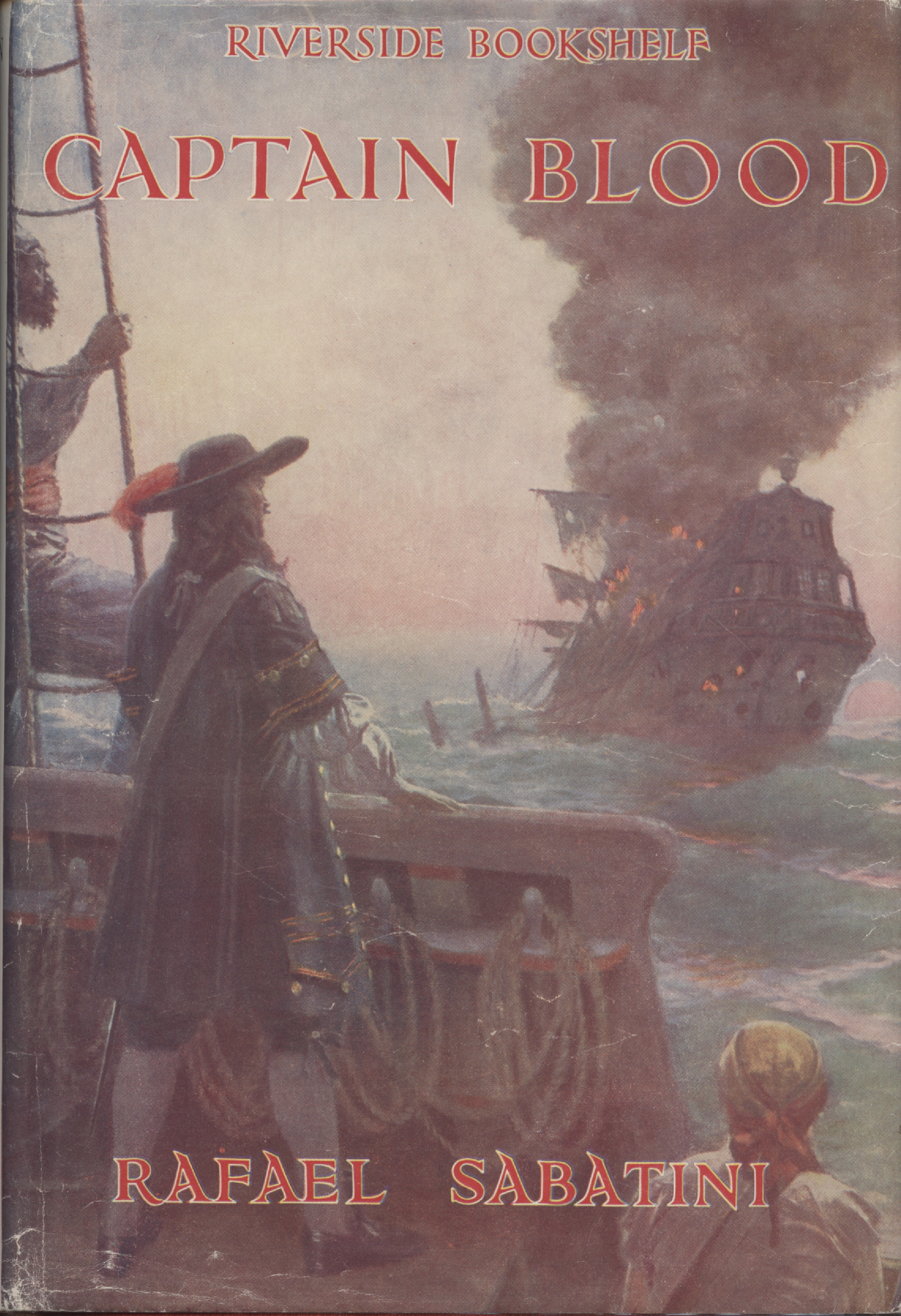
From the 1927 et al Riverside Press Cambridge (a Houghton Mifflin imprint) edition of Captain Blood: His Odyssey, the dust jacket and front cover art by Clyde Osmer Deland (1872-1947). Although the painting is more historically accurate — no boots, correct just-au-corps and hat — it lacks the eye-catching flair of an illustration by Pyle or Wyeth, even if a burning sinking ship draws the eye. And again there’s that damned mustache that’s not in the novel! Here, Deland has no excuse, given that he painted the illustrations several years after the novel’s publication.
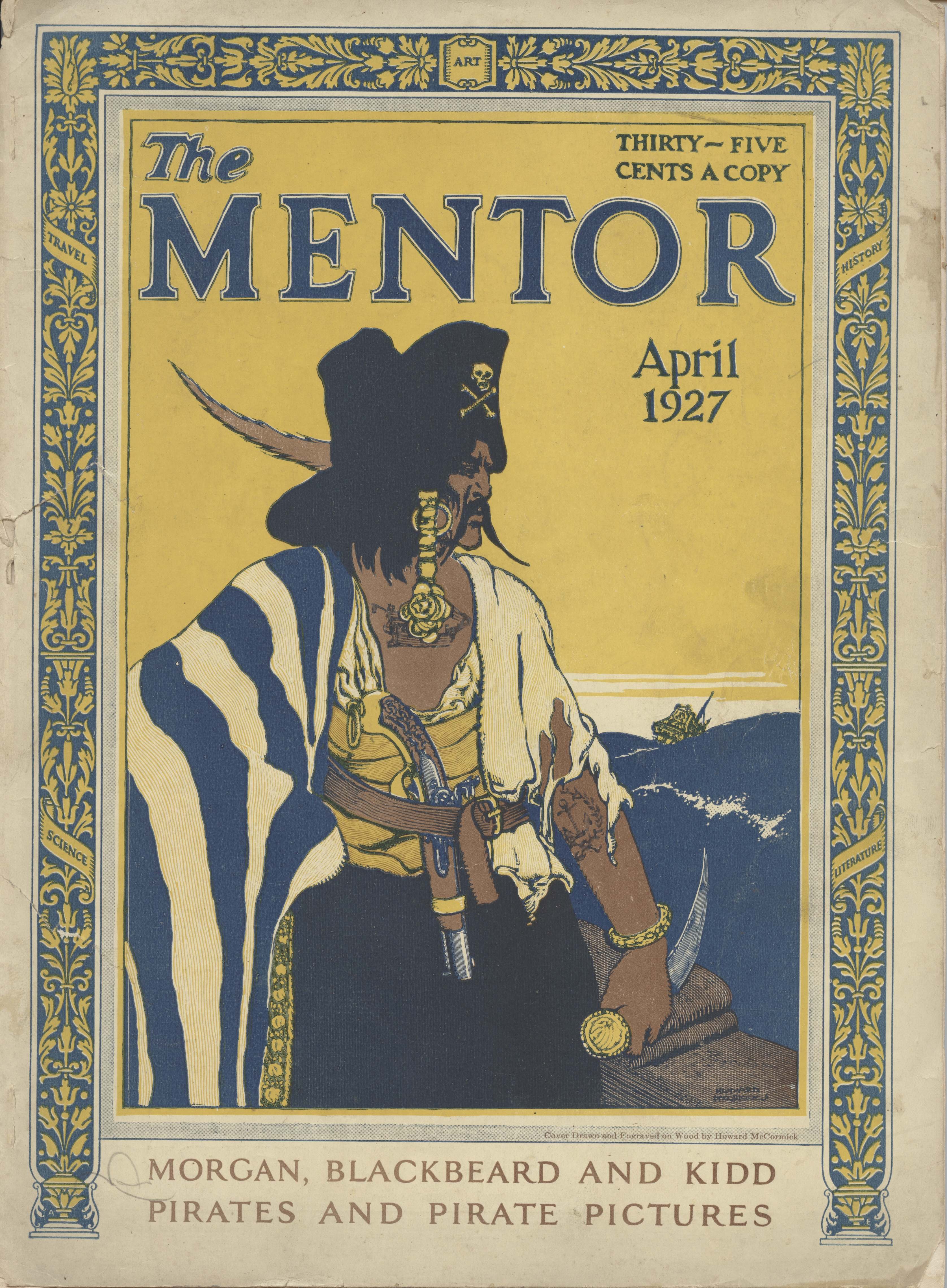
The ship is not burning in the illustration above, but the magazine cover was clearly inspired by Pyle and Wyeth’s paintings. The pirate depiction, in particular its resemblance to the much later Captain Jack Sparrow, is discussed here.

Another Wyeth painting hinting at an homage to his teacher Howard Pyle and which has influenced our idea of the pirate captain and his burning prey on the billows. The blue-green tropical sea is up, giving us the mountain-like billows we like to see — and which also aid in composition. The burning ship is clearly a Spanish galleon, of a style much-used by Wyeth and discussed here. That it has just been plundered is obvious: booty is piled on the poop, including a classic Pyle-style treasure chest with curved top. The buccaneer captain is almost identical to one Wyeth painted for the September 22, 1921 issue of Wall Street Number magazine, a Life magazine publication, discussed here.
The galleon rests on a crest, with the buccaneer ship below in the trough, suggesting the rover is sailing away. Classic Wyeth clouds frame the galleon, and the skull and bones — an anachronism — flies at the stern but we can see only the lower part of the field, as in Pyle’s painting at the top of the page, clearly an homage.

Yet another homage, this time Peter Hurd (1904-1984) to his teacher N. C. Wyeth. Although Hurd was best-known for his paintings and illustrations of life in the Southwest US, he edited and illustrated Marauders of the Sea, a collection of excerpts from pirate stories, 1935, with an introduction by N. C. Wyeth. In the painting, two ships are closely engaged, one of them afire. Here, the pirate captain is not standing the deck of his ship. Rather, the composition is clearly arranged after late 17th century paintings and illustrations of pirate and men-of-war captains and admirals, as will be discussed in more detail shortly.
Hurd’s pirate captain reminds us of the famous depictions of Exquemelin’s buccaneers shown farther below. His eyes are blue and his hair black, like Peter Blood’s, but he also has a Spanish-style mustache and a scar across his cheek. He wields a classic shell-hilt cutlass with large brass rather than iron shells, though all the large shells I’ve seen on cutlasses were iron — only smaller shells might be made of brass. His face is scarred, his jacket is either Spanish or an earlier English doublet, and he wears breast and backplate which Peter Blood did fictitiously and some captains of men-of-war did in reality. Whether any buccaneer captains actually did is entirely speculative, for there is no record of them doing so.
Other Notable Homages
I’ve chosen one authorized imitation of Wyeth’s “Captain Blood,” one authorized inspiration of the Pyle/Wyeth paintings, and also several notable homages, five of them to Howard Pyle’s “famous painting at the top” Captain Keitt,” and rest to Pyle and perhaps to Wyeth and others as well — an homage to homages and to the original.


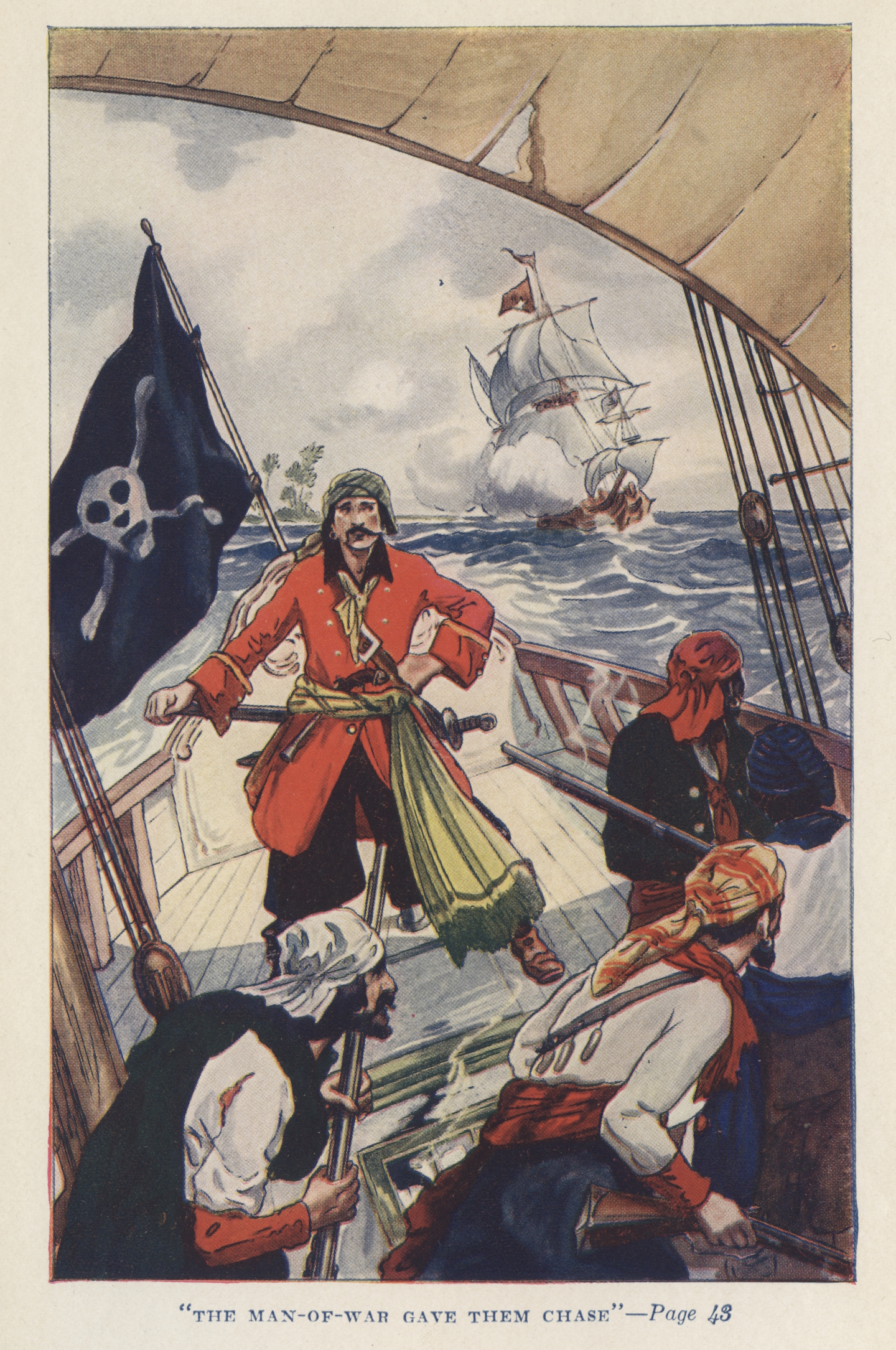
Three illustrations by George Alfred Williams, the first from The Boy’s Book of Pirates and the Sea Rovers by George Alfred Williams (New York: Frederick A. Stokes Company, 1913). It is a likely homage to Pyle’s painting — and only five years afterward. The second and third are from The Pirates of Panama or The Buccaneers of America by John Esquemeling (New York: Frederick A. Stokes, 1914). Both are clearly homages to Pyle’s famous painting. All three doubtless contributed to the image of the iconic image of the pirate captain and his burning ship on the background billows.


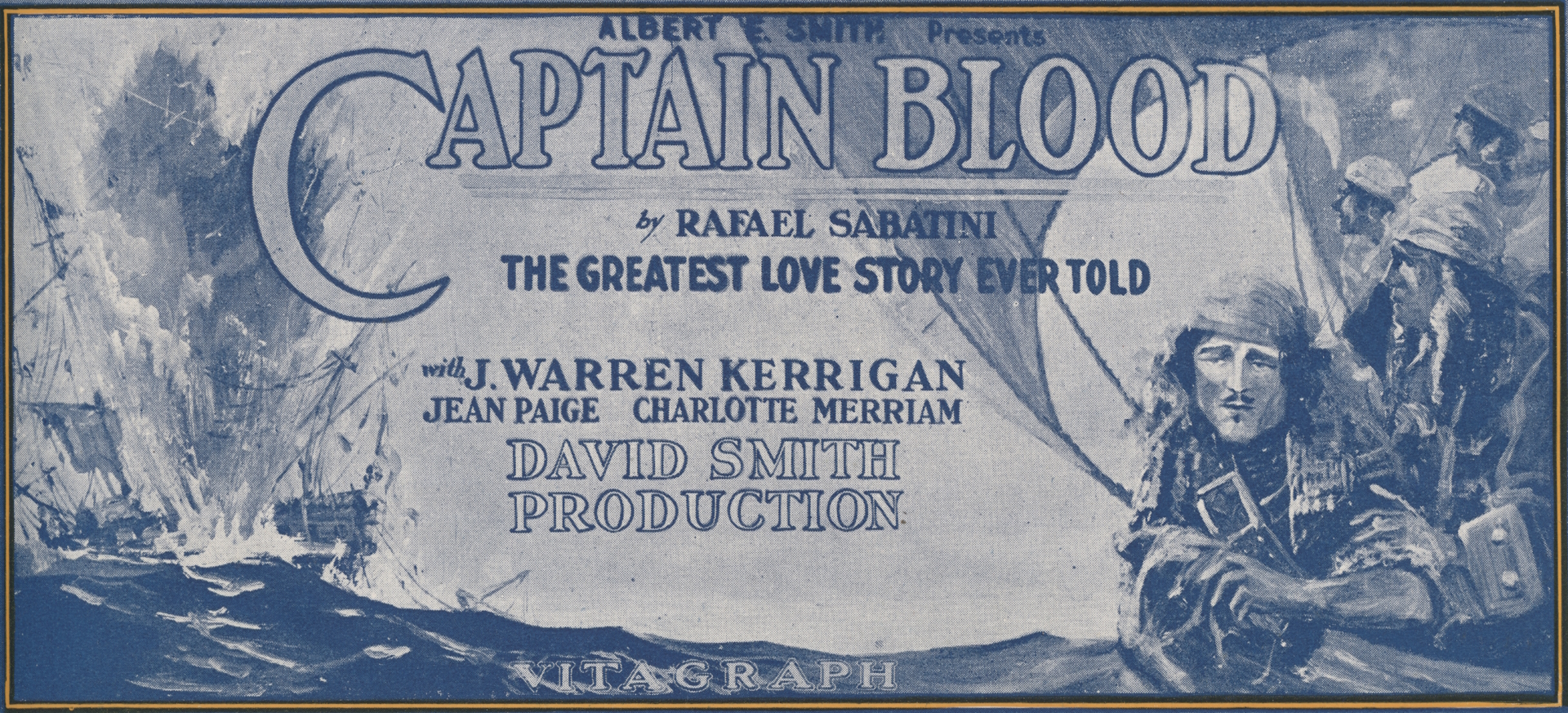
The first image of the four just above is the front cover of the program for the 1924 film version of Captain Blood (Vitagraph) at Astor Theatre, Broadway and 45th, in New York City. The image was also used on a poster for the film. The cover style has been copied from a combination of the dust jacket of the 1922 US release of the novel and of the front board of the book. I’m no fan: here Captain Blood looks more like an unadventurous bourgeois dressed as a pirate for a costume party, rather than the long, lean, hawk-faced adventurer-physician-buccaneer described in the novel.
The likeness is intended to represent J. Warren Kerrigan who played the starring role. Perhaps the unknown illustrator was getting a dig in at Kerrigan and felt the same way I do about him. The actor famously told The Denver Times during the First World War that “I am not going to war. I will go, of course, if my country needs me, but I think that first they should take the great mass of men who aren’t good for anything else, or are only good for the lower grades of work.” Clearly he was no Sabatini-esque hero in real life, nor even an Errol Flynn, at least in regard to courage, panache, dignity, and empathy.
The bottom image is a copy of one of the many posters designed for the 1924 film, clearly inspired by both Pyle and Wyeth. Atypically, the ship is exploding rather than simply burning, although the latter often led to the former.
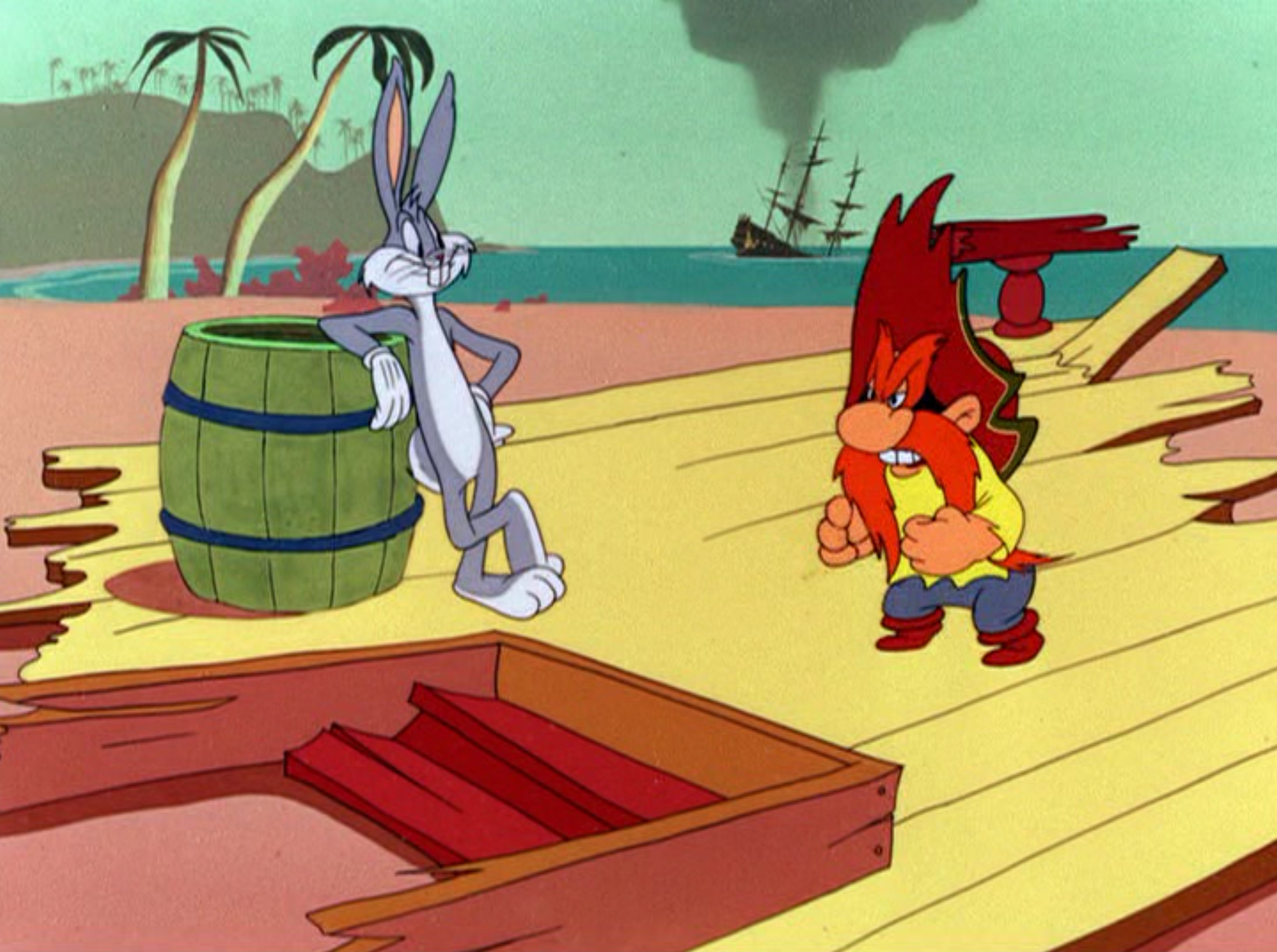
The writers and artists of “Buccaneer Bunny” (Warner Bros. Looney Tunes, 1948) clearly intended an homage to Pyle and Wyeth. It’s basically a reverse or mirror image of the Captain Blood cover art and frontispiece done by N. C. Wyeth. DVD screen capture.

Above is a possible homage to Pyle and Wyeth: Errol Flynn as Brian Hawke just having rescued Alice Kelley as Princess Padma from the burning ship of the Mughal Emperor. Compare with The Goonies screen capture below.

In the painting above there is no burning ship, but one firing a broadside instead. Even so, the image is clearly inspired by the paintings of Pyle and Wyeth, and as much by the illustrations from Alexandre Exquemelin’s The Buccaneers of America discussed below. The painting, artist unknown but suggested by some to be Ed Kohn, has hung for many years in the Pieces of Eight store adjacent to the Pirates of the Caribbean ride at Disneyland. Originally it hung in the Pirates Arcade Museum (mostly an arcade) before the shop replaced it in 1980. It may depict Fortune Red, the animatronic fortune teller in the arcade.

Above, an homage if you like, and clearly a comic riff, on Pyle’s famous painting. A damsel-in-distress has been added — and Chunk’s tongue too… From the attic scene in The Goonies, 1985. Compare with the Against All Flags screen capture above it.
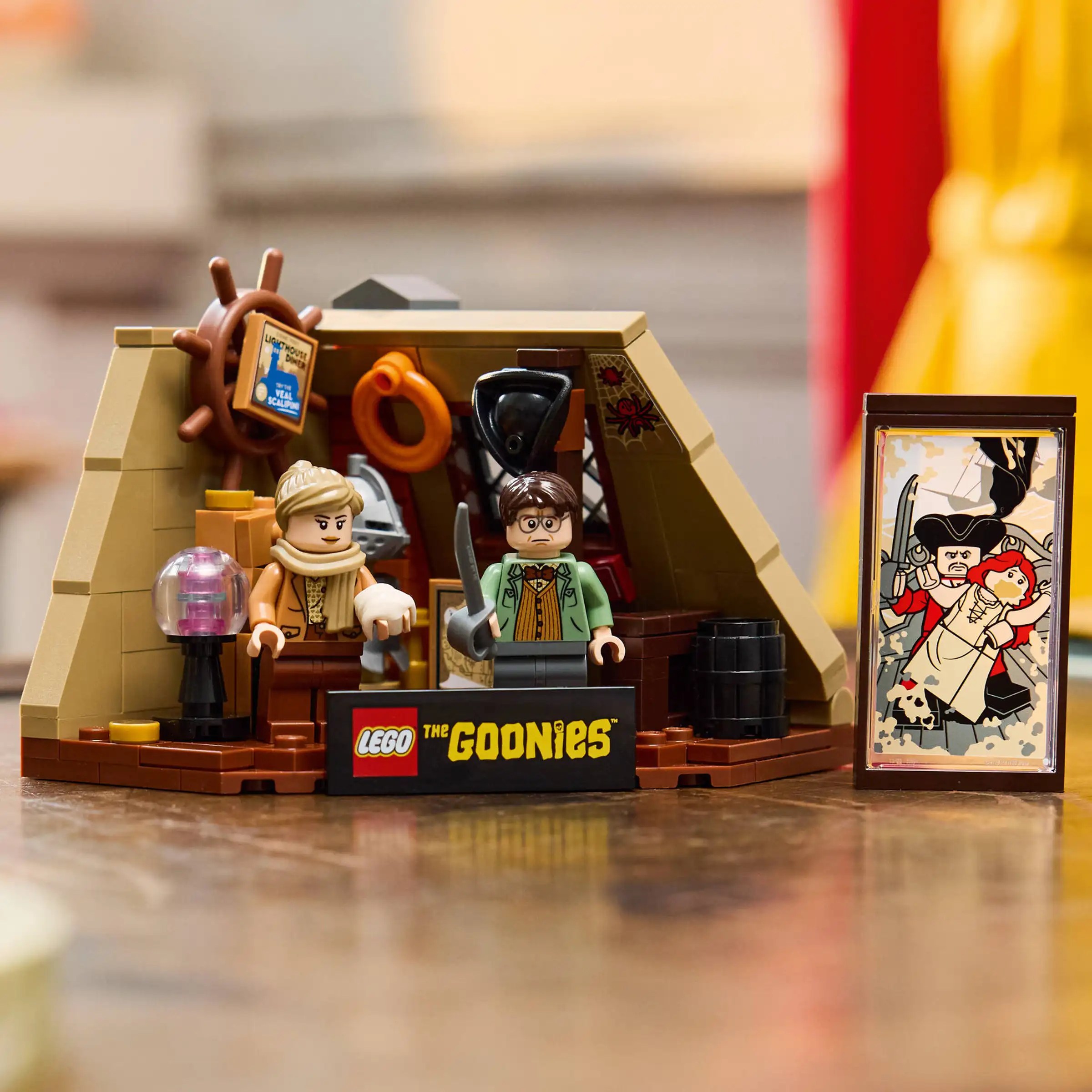
The Goonies painting as imagined by Lego, part of a kit (“The Goonies: The Walshes’ Attic”) to accompany The Goonies ship and the film scenes depicted inside.

I hesitated to post the image above, of Arnold Schwarzenegger as Captain Blood by William Stout. The film was under consideration in 1994, and, although I have great respect for the former Governor of California as an action hero, I am overjoyed that the film never made it into production. The proposed script was of a sort commonly pitched by studio executives, producers, and screenwriters: one intended solely to make money (art, artist, and audience be damned).

Above is an homage by arts and entertainment polymath Jim (James R.) Silke (1931-present) to Howard Pyle’s famous painting (see “After Howard Pyle” below the signature on the painting above) featuring Maureen O’Hara as Spitfire Stevens in Against All Flags (1952), also starring Errol Flynn. The 2005 work was created as a commission for Brian Peck.

My good friend Antón Viejo Alonso brought the image above to my attention. Drawn by noted portrait artist and film costume concept illustrator Darrell Warner for Pirates of the Caribbean: Dead Men Tell No Tales (Disney Studios, 2017), it is clearly an homage to the Howard Pyle painting at the top of the page.
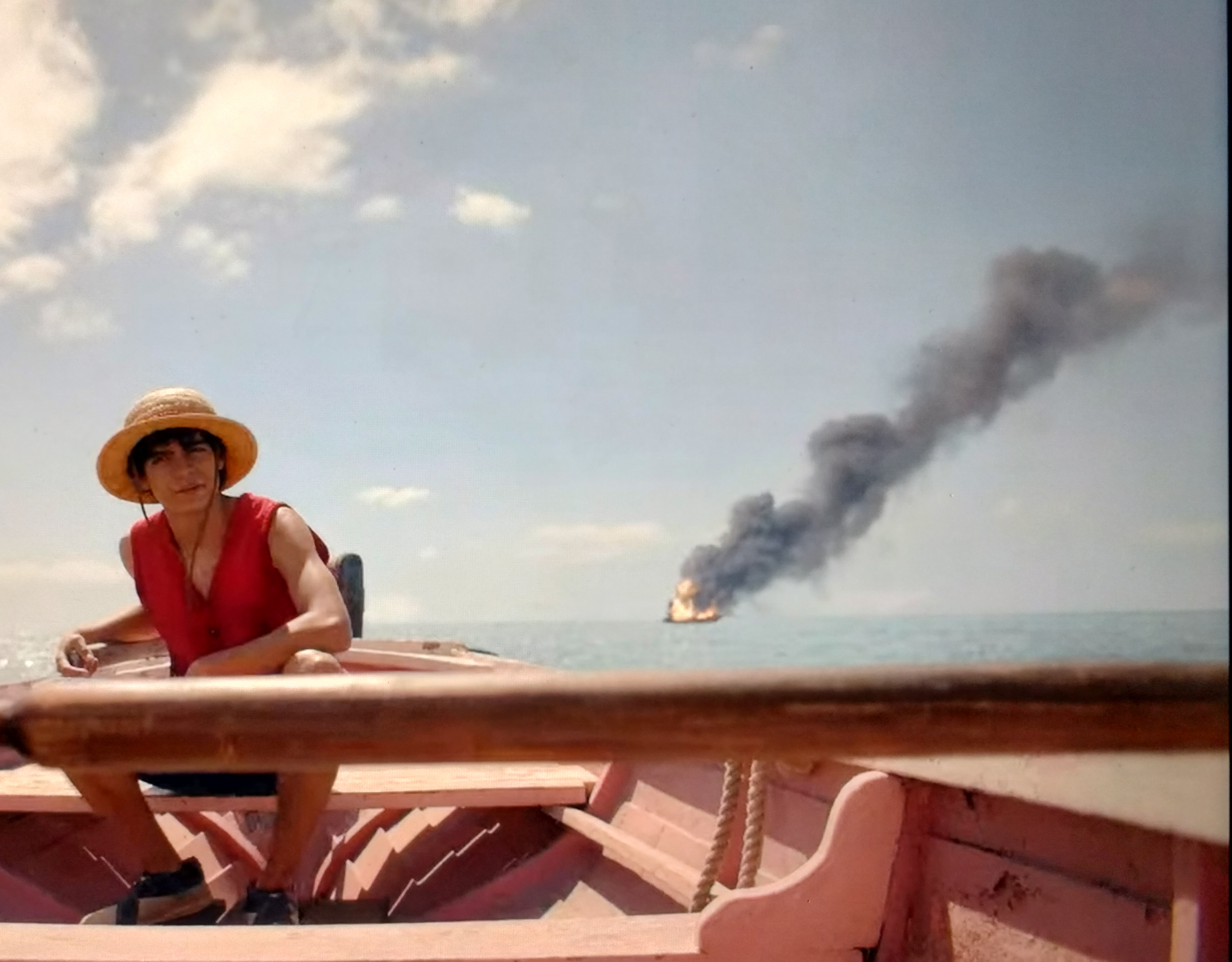
A cropped image from Netflix’s live action 2023 release of One Piece, with pirate-captain-to-be Monkey D. Luffy (played by Iñaki Godoy) in the foreground (foresea? :-)) with a burning ship in the “backsea,” clearly an homage to Pyle, Wyeth, et al. Furthering this argument is the fact that the scene with burning ship is not in the original manga written and illustrated by Eiichiro Oda nor in the anime based on it produced by Toei Animation. (N. B. there is a similar scene when the [Spoiler Alert!] Going Merry burns and sinks much farther along in the voyages of the Straw Hat Pirates, which is perhaps an homage [Spoiler Alert!] to Peter’s Blood’s loss of his beloved Arabella).
Inspirations & Influences
The most likely inspiration — the seed planted in the subconscious — might well be some of the original illustrations in Alexandre Exquemelin’s early Dutch, Spanish, and English editions of The Buccaneers of America. They include several portraits of famous buccaneers, although we have no idea how accurate the depictions are, but this matters little in regard to inspiration.
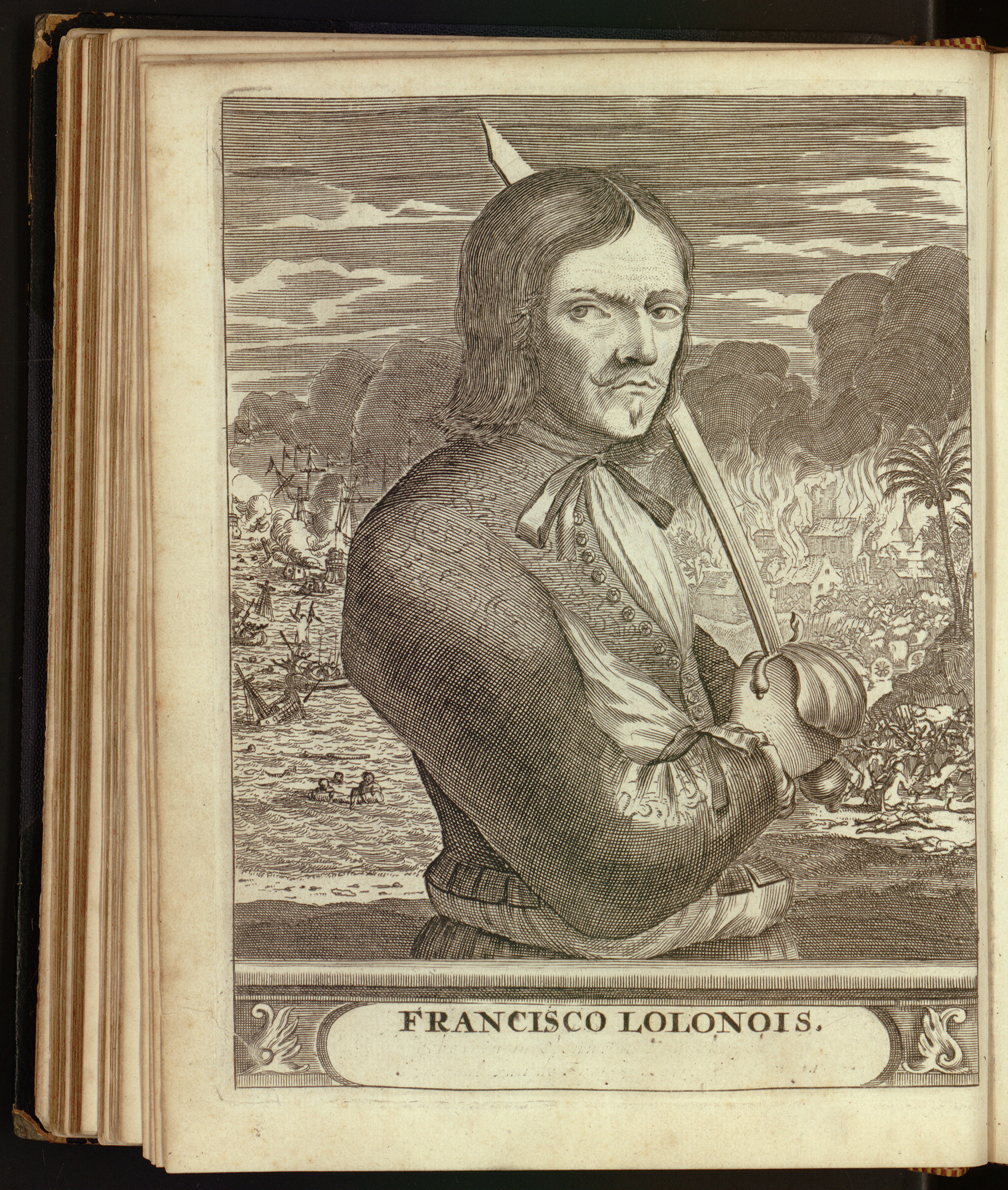
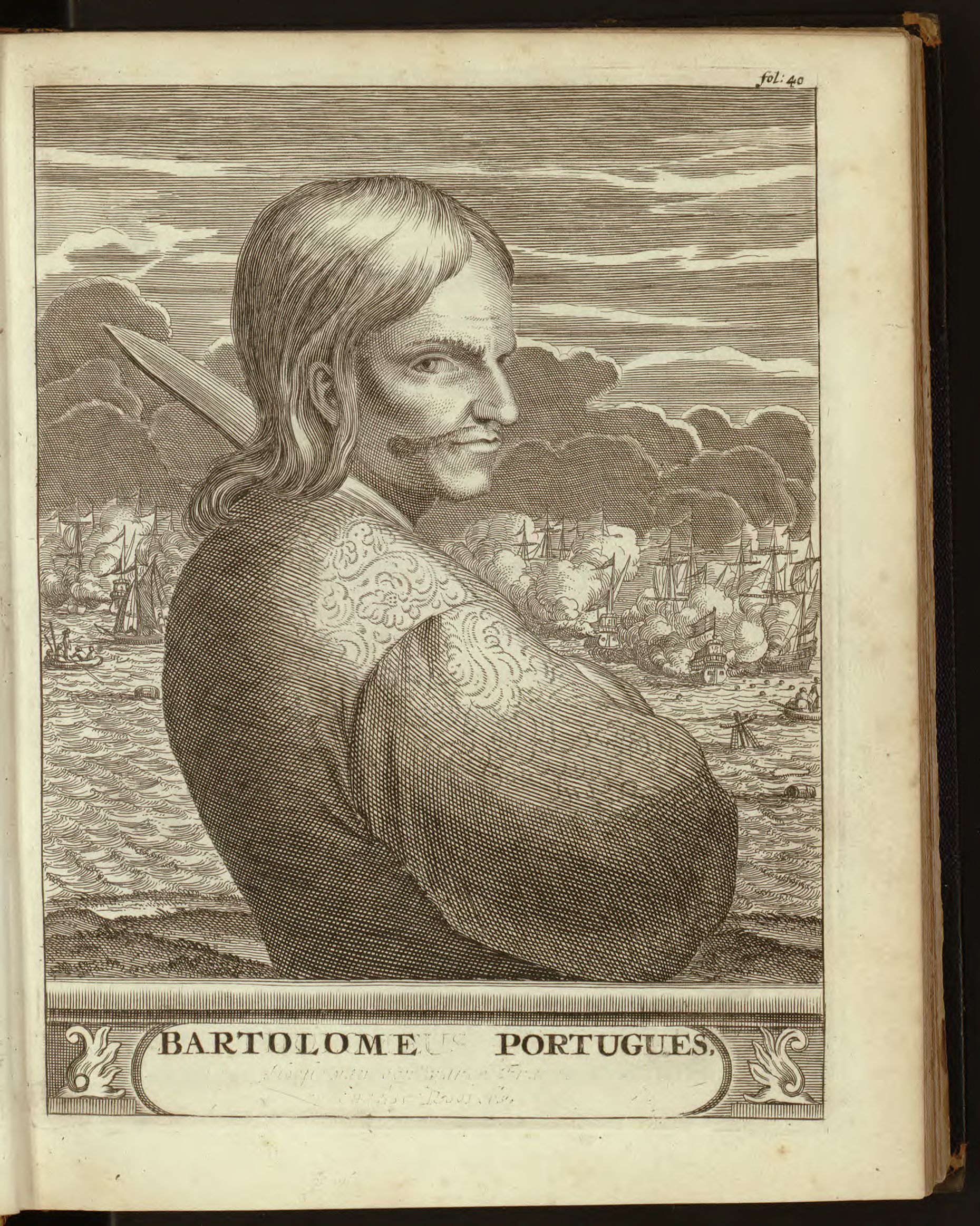

The three illustrations above are Spanish edition copies of the originals in the Dutch 1678 edition: Francois L’Ollonois, Bartholomew Portuguese, and Henry Morgan. All show battles, including sea fights, raging in the background, with billowing smoke suggesting that some ships may be afire. None of these buccaneer captains — as far as we know — are standing on the the decks of the ships. It took Howard Pyle’s genius to compose a portrait evoking the adventure and romance, at least as we believe it to have been, of piracy on the high seas.
The illustrations in Exquemelin’s books were doubtless inspired by a common form of portraiture associated with fighting seamen and soldiers, officers in particular for typically only they could afford portraits or had enough social status that a patron might commission a portrait of them.
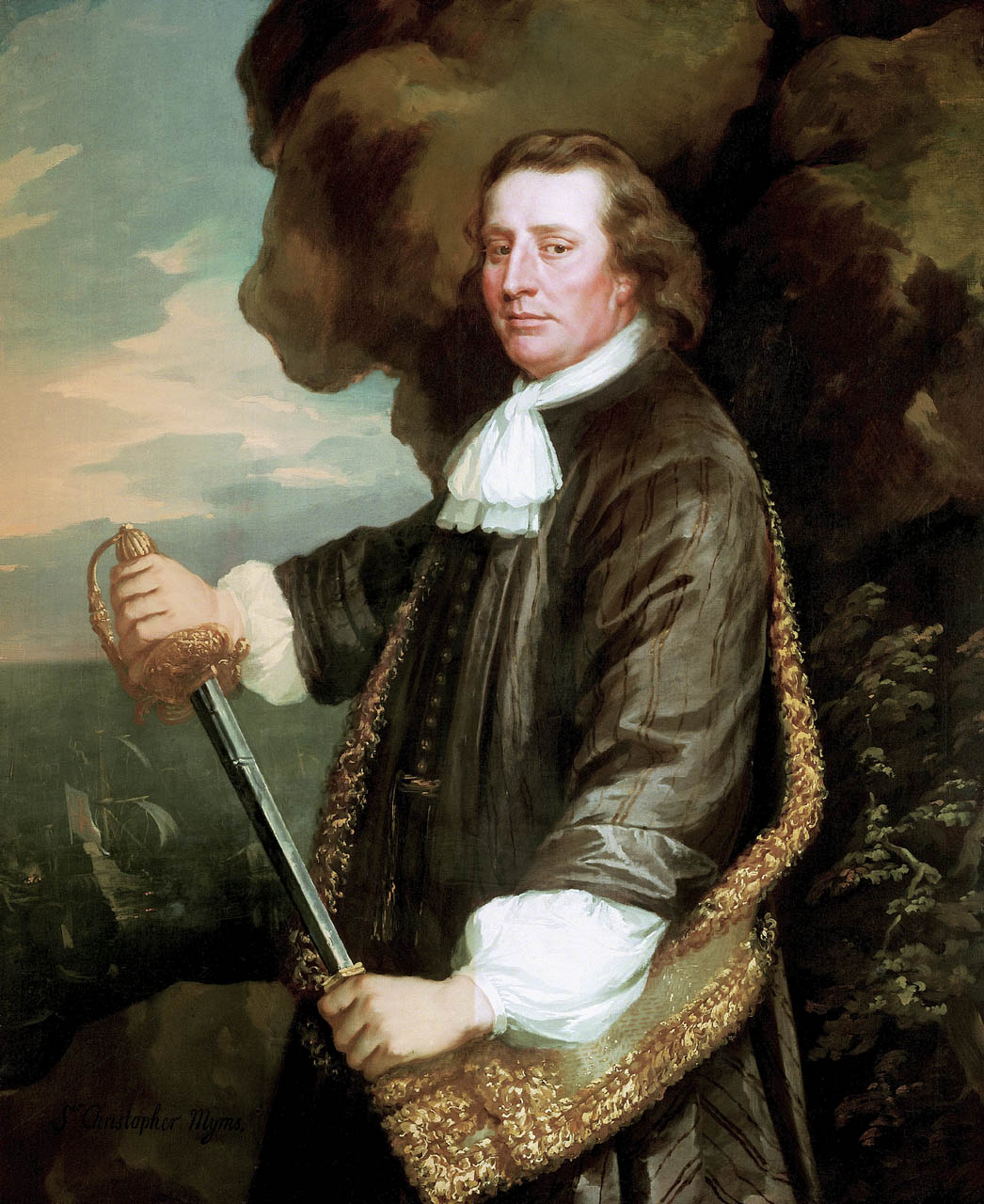
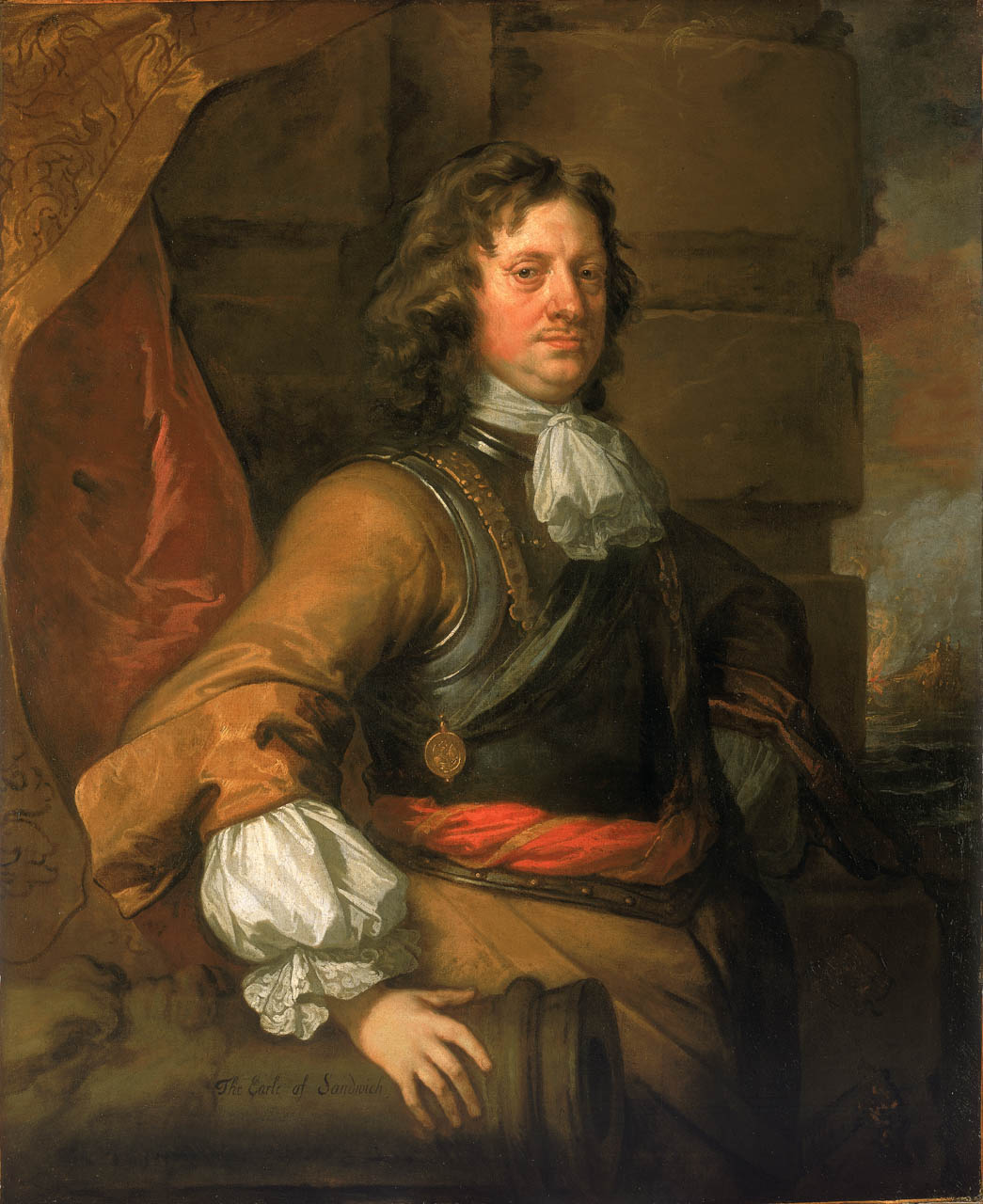
The two portraits above are typical of those of the era: the subject in the foreground, with a depiction of a major associated action in the background. Myngs, prior to becoming an admiral, led a number of raids on the Spanish Main, with buccaneers-as-privateers as his consorts, after the English captured Jamaica from Spain. The portrait of Montague shows us a burning ship, but it may not be that of an enemy. It appears to be of English build, and is therefore more likely the HMS Royal James, Montague’s flagship burned by a Dutch fireship in 1672, resulting in Montague’s death.
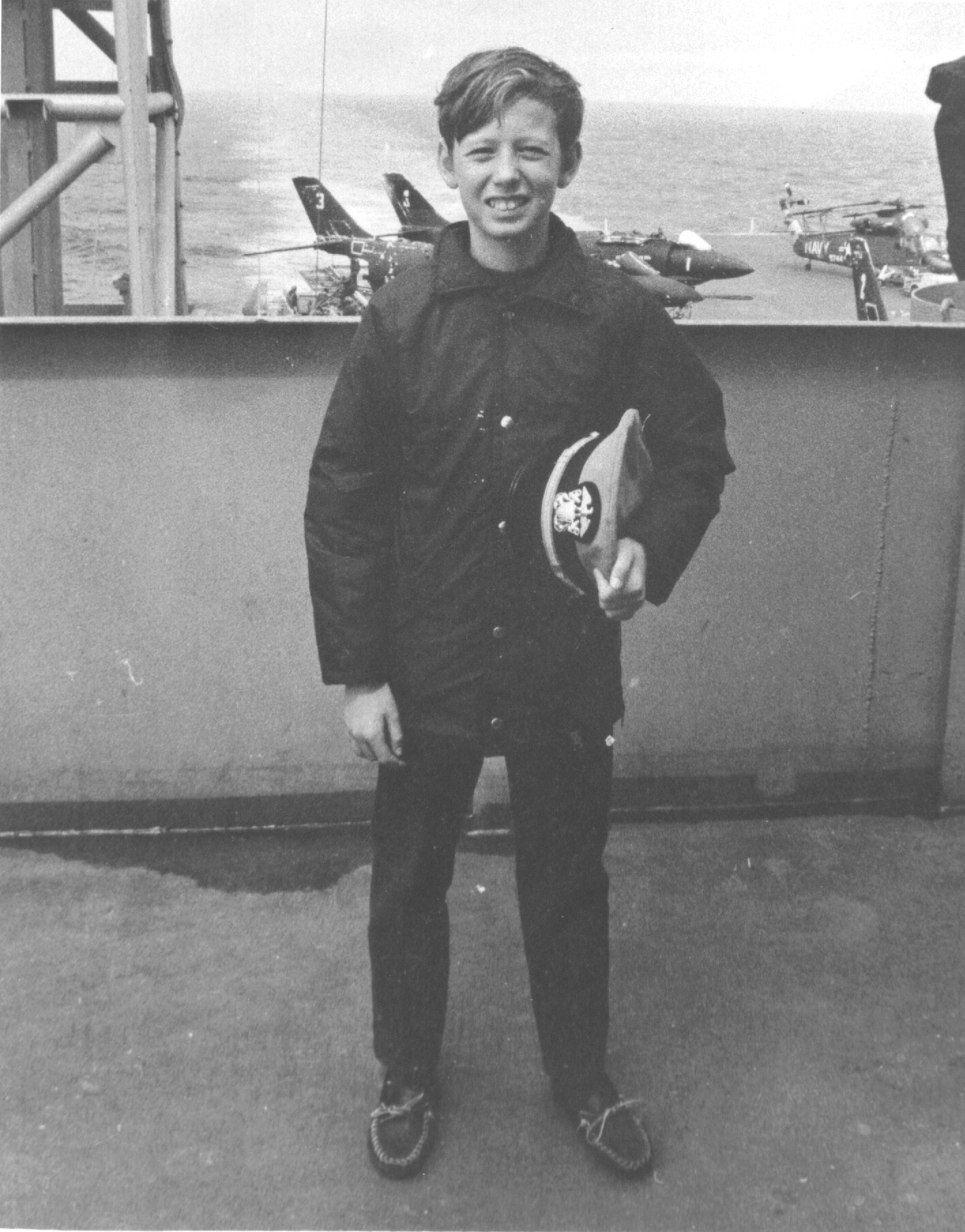
Not quite yet a buccaneer or pirate in the photograph above, nor yet a burning ship on the background billows — but aspirations enough. 🙂
Copyright Benerson Little 2024. First posted 24 September 2024. Last updated November 1, 2025.

The Duel on the Beach, Part V: In Reality

If you’ve read any or all of parts I though IV of this series (In Fiction, In Film, in Rafael Sabatini’s novel The Black Swan, and of the duel between Flynn and Rathbone in Captain Blood, you might be wondering if novelists and Hollywood have depicted buccaneer and pirate duels, a common trope of the genre, accurately. Like much that is popular buccaneer and pirate image, the answer is “yes and no,” or more precisely, “sort of sometimes, but mostly no.” If anything, the duels imagined on page and screen have caught some of the spirit of historical buccaneer and pirate duels, rather than actual practice.
One thing we’re sure of is that the real duels probably did not look like those engaged in by the swordsmen in the plate above!
N. B. Besides the links above, more information about dueling, swordplay, and swords among sea rovers and mariners of the era in general can be found in Buccaneer Cutlasses: What We Know; in chapter 17 of The Buccaneer’s Realm; and in chapter 8 of The Golden Age of Piracy, which has more detail and analysis than is found in this post.
We know that buccaneers and pirates fought duels occasionally, although detailed accounts of individual duels, with an exception or two, do not exist. Further, we know even less about the tactics and techniques of individual duels. In fact, only rarely do we even know what weapons were used in specific duels. Often the description is as spare as, “Here it was that our quartermaster, James Chappel, and myself fought a duel together on shore,” as buccaneer-surgeon Basil Ringrose wrote.
And why were duels fought among buccaneers and pirates? For the same reason they’ve always been fought: usually out of some misguided form of honor, although doubtless there were occasionally good reasons to fight. The gamut of human emotion easily gave rise to duels: jealousy, envy, avarice, lust, deep-seated insecurity, narcissism, pride and its exaggeration hubris, competition, and more. Specifically, pirates might fight over injured pride, insult, gambling, or a woman’s attention. Personal conflict, rum, and the confines of a vessel at sea doubtless fueled many of these deadly challenge fights.
(Numerous books and studies investigate the social origins of the European mania for dueling, and some include analysis of the actual practice of dueling. Among my favorites are V. G. Kiernan, The Duel in European History; François Billacois, The Duel: Its Rise and Fall in Early Modern France; and, probably my most favorite, Pascal Briost et al, Croiser Le Fer: Violence et Culture de l’Epée dans la France Moderne.)

According the Francis Rogers in a journal entry dated 1705 in regard to the Jamaica colonists, “Sword, or sword and pistol, is the common challenge to decide their affronts; except among the ordinary or sea-faring there the fuzee [flintlock musket] or cutlass is the weapon.”
It was not just buccaneers who were inclined to fight duels: the practice was commonplace. Quoting Francis Rogers again on the subject of Jamaican colonists, “They seldom want courage, being too forward in duelling on very slight occasions, standing much on their honour and scorning little base litigious actions.” Likewise the French and French colonists, and the Dutch as well. And Spaniards, including Spanish pirates? Likewise surely, given Iberian honor.
Among the late 17th century buccaneers and boucaniers (cattle and swine hunters who often sailed with buccaneers, some even becoming full-time buccaneers), the fusil boucanier aka “buccaneer gun” — a very long-barrelled, heavy caliber, typically (but not always) club-butted musket used to hunt cattle, swine, and Spaniards — was the primary dueling arm, at least among French buccaneers (the English and Dutch may have used it or another), and not the cutlass or other sword.
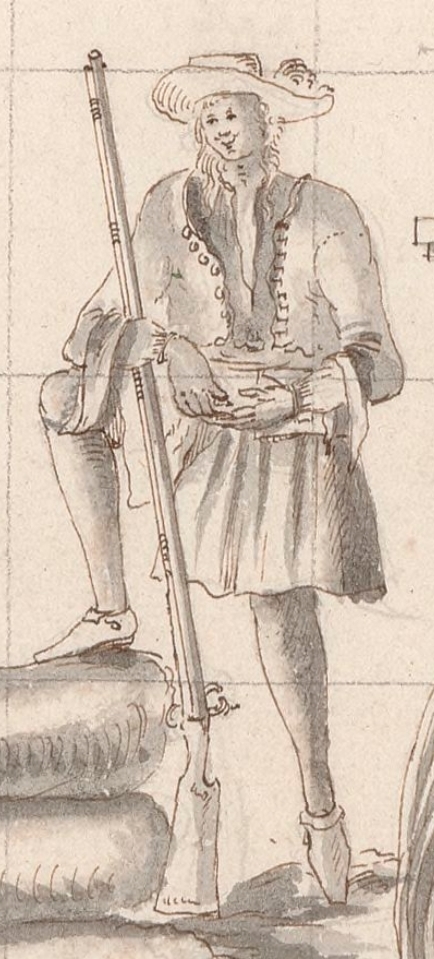
According to buccaneer-surgeon-author Alexandre Exquemelin, these musket duelists drew lots to see who would fire first, then stood at a predetermined distance apart. One hundred yards was a likely distance, in that it required reasonable skill to hit a man-sized target at this range. First the winner of the draw fired, then, if still standing, the loser. A surgeon examined any dead body to make sure there had been no back shooting. Such duels could only be fought ashore.
Cutlass duels were likely as well, but unfortunately we lack the descriptions of many duels, and in the case of affrays, especially when liquor was involved, the pistol or musket might be the weapon grabbed first. At sea, Captain Bartholomew Sharp once took a pistol shot at one of his buccaneer crew, Richard Hendricks, barely missing killing him. All involved were drunk. Ashore, Captain John Coxon took a shot at Captain Peter Harris, possibly with a musket. A duel, perhaps, or an angry affray. In any case, the shot fired in anger was due to personal animosities and competition among leaders. Captain Robert Searles, who sacked St. Augustine in 1668 and, drunk and otherwise engaged, permitted the treasure ship Trinidad to escape with much of the city’s treasure during the sack of Panama in 1670, was killed by another buccaneer while cutting logwood at Laguna de Términos, Mexico, although the circumstances are unclear: a duel, an affray–or murder?
No matter the weapon used, duels were usually fought ashore, for two primary reasons: there was more space in which to fight than in the close confines of a vessel, and the time required for a ship to anchor or even for the adversaries simply to be rowed ashore gave time for hot heads to cool. This is not to suggest that duels might never have been fought aboard ship, but if they were they were rare among buccaneers and the evidence for them is largely non-existent but for one source that states that some duels were fought aboard ship among buccaneers, a Dutch practice perhaps.
The source that suggests this is Zeer Aanmerkelijke Reysen Gedaan door Jan Erasmus Reining by Dr. David van der Sterre. Published in 1691, the book is a biography of Captain Jan Erasmus Reyning, one of many colorful buccaneers of the era. Van der Sterre said he met him at Curaçao and wrote a book based on the tales Reyning told. However, the book is of a common style of the era, that of the heavily-embellished biography and it is difficult to tell what is true and what is imagined.
According to the book, duels were common, including between captains and members of the crew due to the aggressive independent nature of buccaneers and their sense of each being primus inter pares or first among equals. One captain reportedly threw two cutlasses onto the deck of his vessel, challenging an impudent crewman. They then fought “like lions” until the crewman fell overboard, at which point the captain followed, hoping to cut him down in the sea.
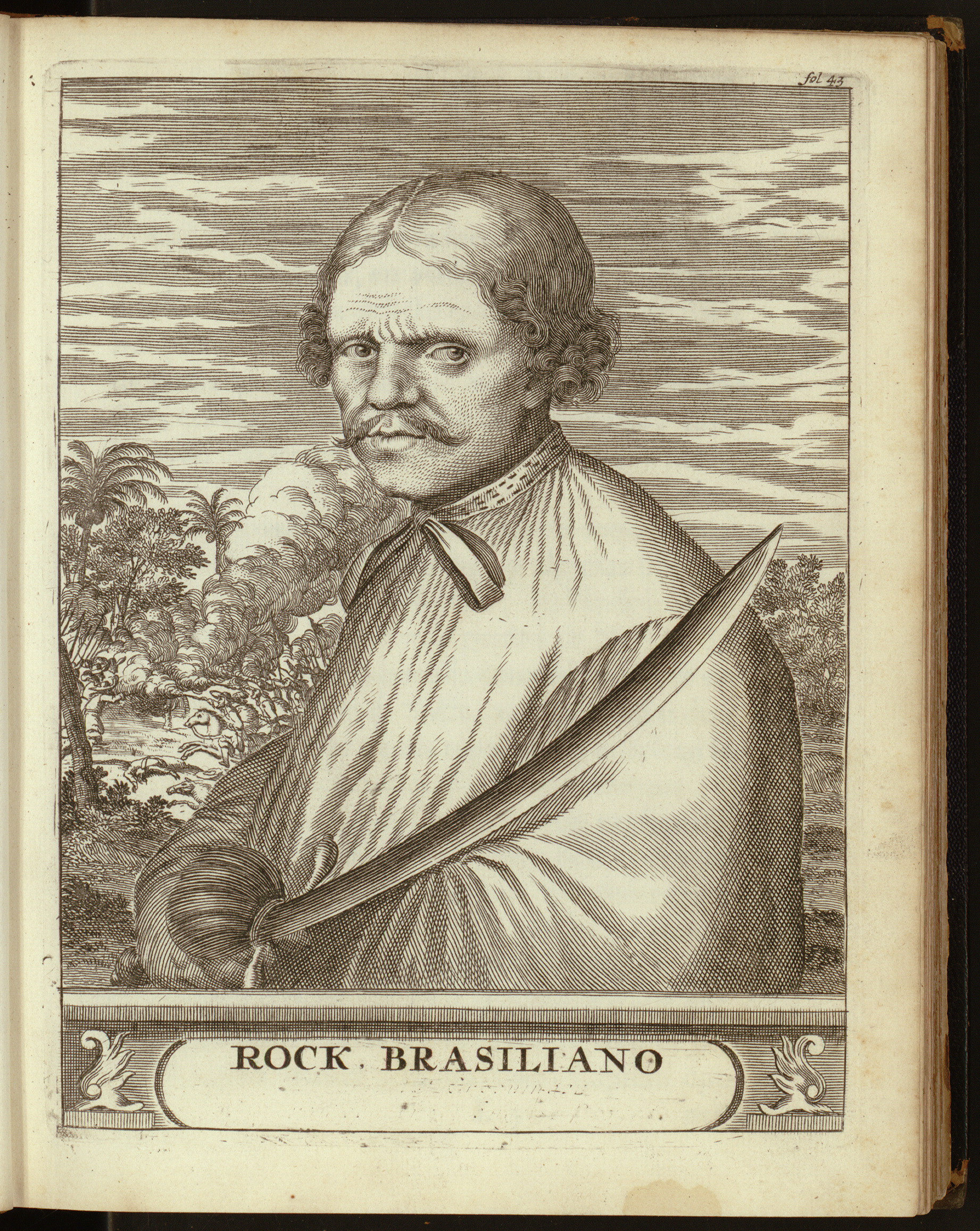
Van der Sterre also describes a duel, again aboard ship, between the infamous, probably borderline psychotic, Captain Roc Brasiliano, aka Captain Rocky aka Gerrit Gerritsen, and Reyning, the latter in command of a buccaneer vessel sailing in consort with Brasiliano in 1668. Reportedly, Captain Rocky struck Reyning’s close friend Jelles de Lecat, later better-known as Captain Yellows and who was serving as Rocky’s quartermaster, for which Reyning challenged him.
The two fought on deck with “houwers” (hewers, hackers — slang for cutlasses; the term sabel or saber, a general term for cutting sword, is also used), with several wounds received each, Reyning having the upper hand in the end. Van der Sterre writes that Rocky ordered his surgeon not to attend to Reyning’s wounds. In response, Reyning threatened to throw the surgeon’s instruments and medicines overboard; Rocky and the surgeon relented. Later, ashore at the Cayman Islands, Captain Rocky acquired a Spanish rapier and challenged Reyning again, who replied that he had a brace of pistols ready. The two vessels soon parted company and the adversaries did not fight again.
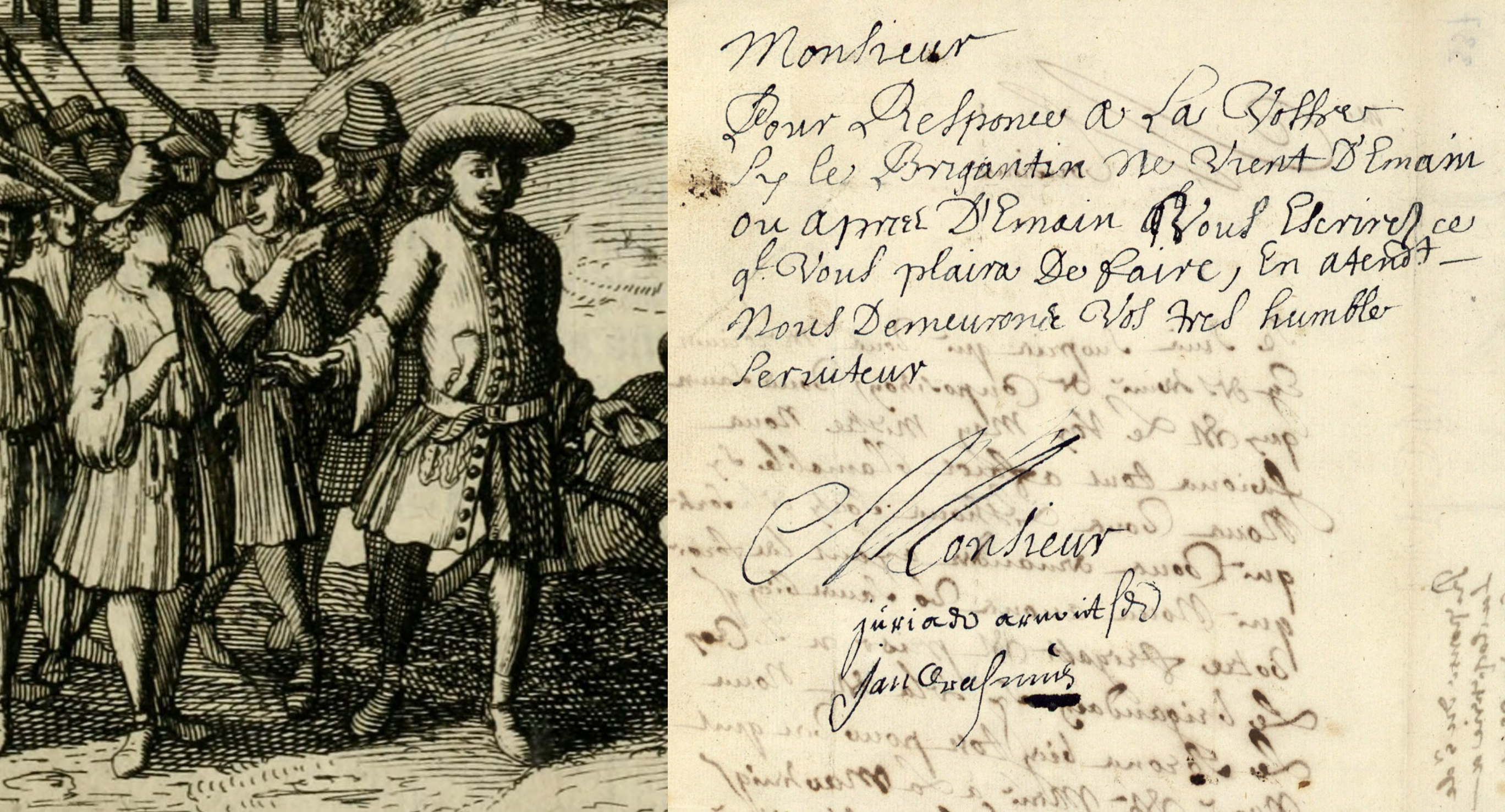
I’ve gone into detailed analysis of this duel in The Golden Age of Piracy. Suffice it here to note that the vessel was small, and that any duel fought in such conditions would force the adversaries to fight close, likely resulting in severe cutting wounds. But the duelists’ wounds, although requiring the ministrations of a surgeon (Rocky had three cuts, Reyning two), were not incapacitating. I suspect the duel, if it occurred, took place ashore or was grossly embellished, or both. Its description is highly detailed, a rarity in accounts of duels of the era. The exceptions are notable: Donald McBane’s personal accounts of his duels for example.
Could the duel have happened as described? Sure. And the fact that each man was wounded multiple times rings true, and one exchange — one man cut in the knee while the other was cut in the head, a classic, if bungled, attack at the knee which the adversary attempts to “slip” and cut at the head — is entirely likely. In fact, the bungling is quite realistic, for sword fights were rarely clean-cut (apologies for the pun!). But light cuts to the head, not to mention all the wounds received here, practically demand longer distance, ashore in other words. In all of my attempts at practical reconstruction of such duels in confined areas, as on a small vessel, both I and my adversary came to close distance, with stout blows (and black bruises) given from our hickory-bladed cutlasses, which, if made with real weapons, would have been severe. Of course, it’s also possible that neither duelist really wanted to seriously hurt the other, much less get hurt, and played it cautiously, hoping simply to draw enough blood to end the fight — which in this case was ended when Rocky took a cut to the forehead and, possibly, could no longer see, a common end to duels with cutting blades.
Further, the duel is corroborated nowhere else, including in Exquemelin’s detailed account of Roc Brasiliano’s life, although Van der Sterre considers this a deliberate slight against his hero. More so, Reyning’s biography is written with a novelist’s eye for detail — with an eye to popular consumption, that is, making it rather suspect. And all other accounts of duels among buccaneers, and even of seafaring men in general of the era, indicate that they were fought ashore. It’s also not unknown for old seafaring adventurers to exaggerate or even invent “sea stories,” taking great pleasure in misleading the gullible.
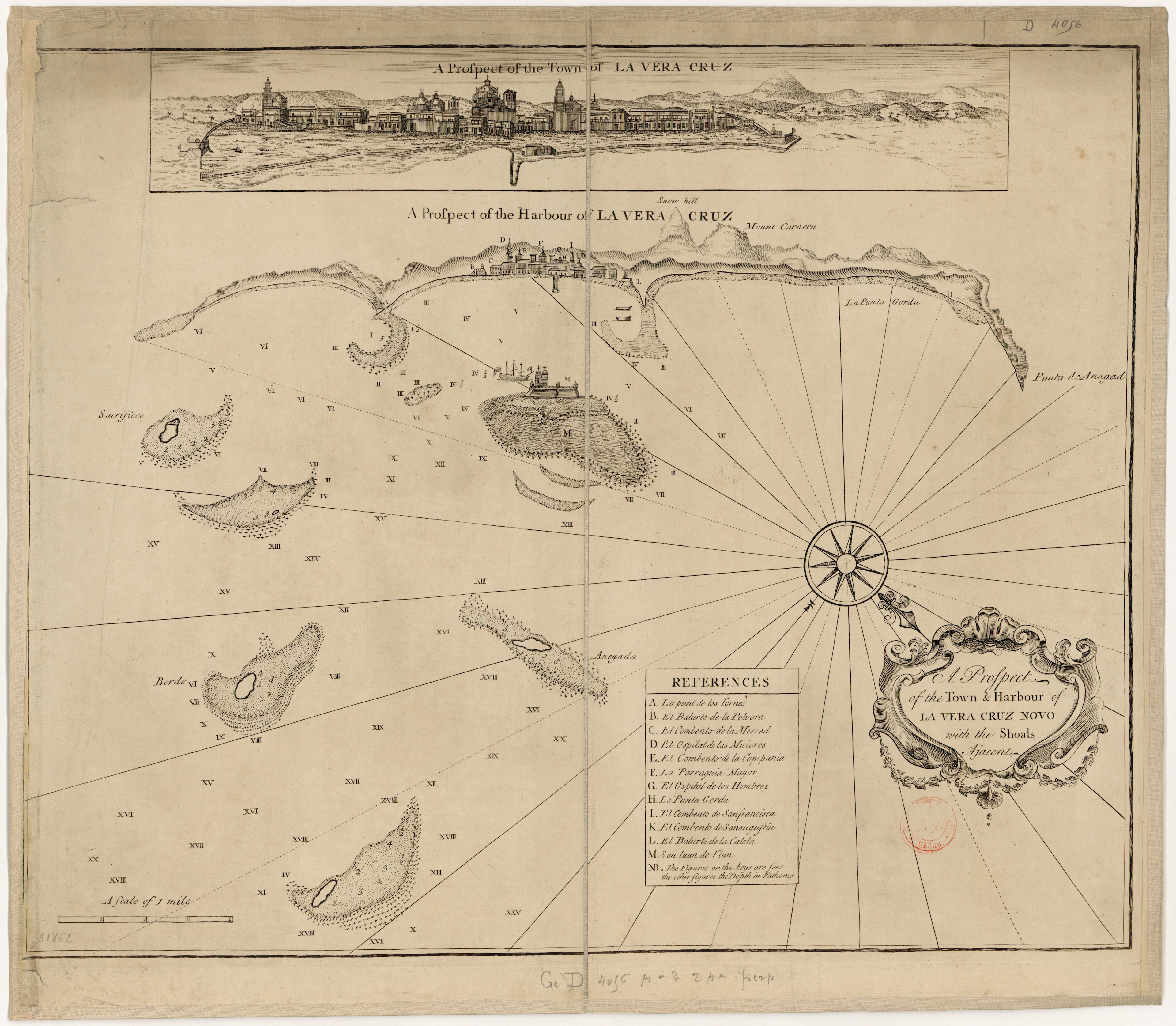
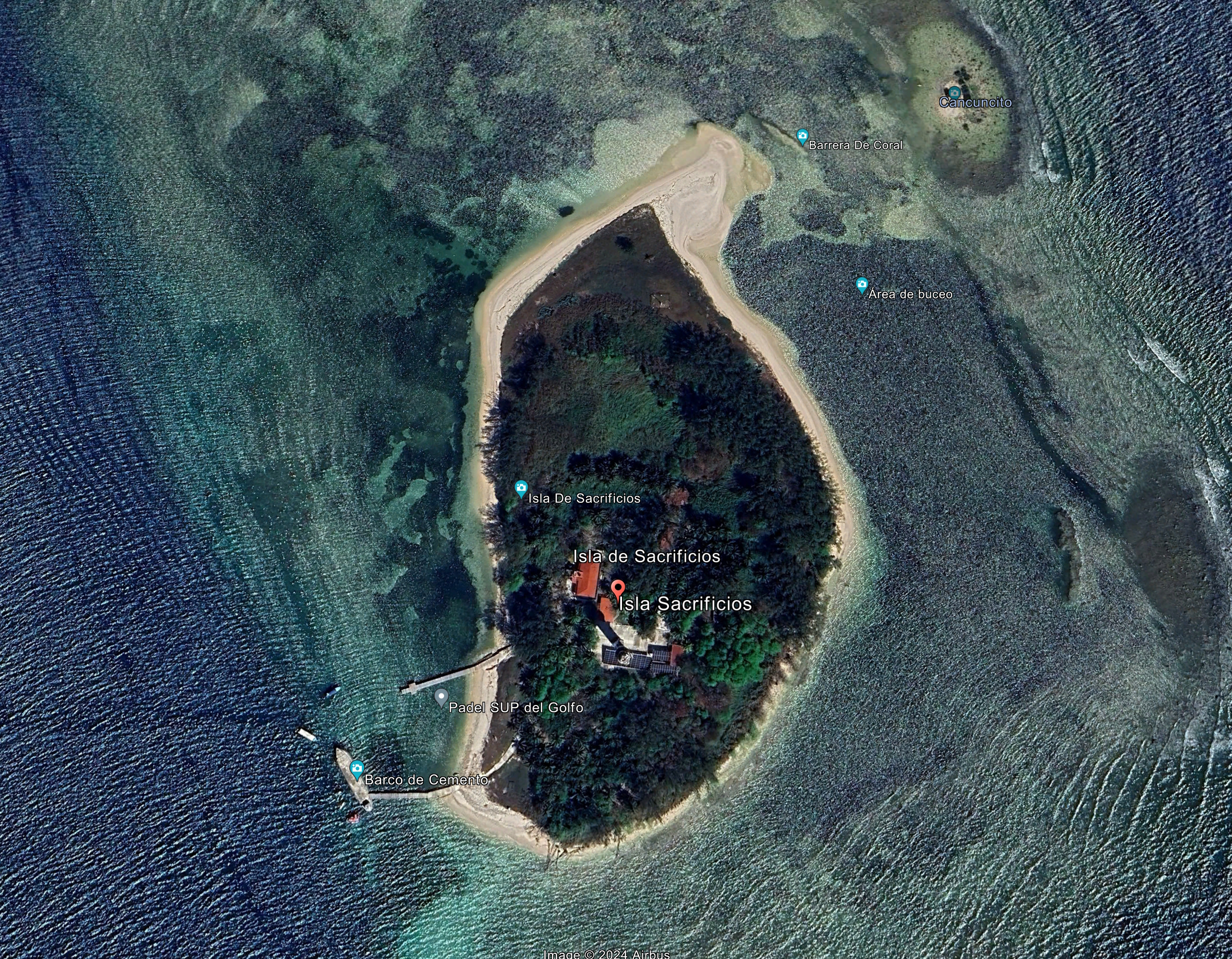
Without doubt the most famous duel among buccaneers, really a quick affray, is that between the famous Dutch buccaneer in French service Laurens de Graff and the dilettante Dutch buccaneer in French service Nicolas Van Horn. The two men despised each other. In particular, de Graff considered Van Horn a pompous fool who had by lack of patience recently lost them the treasure of the Honduras urca. The two captains, along with French gentleman-buccaneer Michel, sieur de Grammont, were co-commanders of the brutal 1683 sack of Veracruz. As the buccaneers loaded their ships with plunder and slaves on Isla Sacrificios, where they had moved from the city for security, de Graff and Van Horn’s contempt for each other came to a head.
Historical sources are uncertain on the real reason or reasons for the duel. There was the urca incident. According to Exquemelin, on the morning of the duel an English buccaneer reported that Van Horn had called de Graff a coward. Van Horn was reportedly angry that de Graff had prevented him from decapitating a dozen prisoners in retaliation for Spanish soldiers firing at French buccaneers who were fetching cornmeal to feed prisoners. Some say there was an argument over what to do next, after the sack of the city: Van Horn wanted to attack the treasure fleet in the offing, but de Graff wanted to depart with what they had, rather than risk losing it. An English governor later wrote that they fought over the division of spoils. And some Spaniards wrote later that the men fought over who could choose how the spoils were divided.
But no matter. Alexandre Exquemelin claims de Graff drew his sword, faced Van Horn, and said, “Voilà! With this I shall avenge the insult you have given me.” If so, Van Horn was damned slow in heeding the warning and drawing his own cutlass and coming on guard.
The fight was a quick one.
According to Fray Avila describing the sack of Veracruz in 1683, “On Thursday afternoon Admiral Lorenzo [Laurens de Graff], seeing how we suffered [from thirst and hunger], told the General [Nicolas Van Horn] that they should cast us ashore as I wanted them to do. The General grew angry and told me he would put us to the sword. At these words the Admiral drew his cutlass with such agility that before the General had put himself on guard Lorenzo had cut him in the arm and ear. They [the pirates] stopped them and I heard the admiral call his soldiers and send him [Van Horn] to his ship which was the almiranta [Van Horn’s St. Nicolas, soon to become de Grammont’s Hardi], and from this day we saw him no more.”
Call de Graff’s cutlass stroke Dutch buccaneer iado if you like. We can speculate on how de Graff made his cut or cuts: a single cut upward from the scabbard striking wrist and forehead; a single blow from high to low after drawing (“lugging out” was the term in English for drawing a sword); or two cuts, perhaps the first from low to high cutting the wrist, and the second from high to low cutting the forehead. Or any of several other possibilities. Van Horn died some days afterward, possibly of gangrene, or possibly of a pestilence that swept through his crew. His death was formally laid at the feet of de Graff, who, when he was considered for a commission as a French officer a few years later, had to petition for and receive a royal pardon for killing Van Horn.

Not quite Flynn versus Rathbone aka Peter Blood versus Levasseur, but nonetheless a duel between pirate captains on a sandy shore in the 1680s — about as close historically as we can get to that most famous of film duels!
Although cutlasses were probably the norm for duels among buccaneers when muskets were not used, and likely enough among buccaneer captains, smallswords may have been used on occasion although we have no record of this. A small but fair number of buccaneers, French in particular, were gentlemen who would have been trained in the use of the smallsword, would have preferred it for formal combat, and may have carried it even in battle.

The sieur de Grammont noted above had fought at least one duel long before becoming a buccaneer: he ran his sister’s suitor thrice through. Also among these French gentlemen-buccaneers were famous buccaneer-author Raveneau de Lussan; the sieur de Chauvelin who served under de Grammont aboard one of his consorts, a half-galley and who was killed in Florida in the aftermath of an aborted attempt on St. Augustine; and the sieur d’Hulot, a veteran of two campaigns against Algiers and the Algerine corsairs, and who would later command the regular French forces on Saint-Domingue. Alas, we have no record of any duels among these smallsword-wielding gentlemen, much less of any smallsword duels on the beach.

An interesting adoption of an army dueling practice was reportedly undertaken by Red Sea pirates circa 1693-94. According the deposition of pirate Samuel Perkins in 1698, fourteen pirates, variously from the crews of captains Thomas Tew, Josiah Raynor, William Mason, and Edward Coats, divided into two factions of seven each on St. Mary’s island some five years prior, “to fight for what they had (thinking they had not made a voyage sufficient for so many) and that one of the said Sevens were all killed, and five of the other, so that the two which survived enjoyed the whole Booty.”
What weapons were used is unknown, but cutlasses are likely. And the amount of booty? If this took place in the year 1693, Tew’s crew shared 1,200 pounds (the equivalent of 6,000 pieces-of-eight) per man, an extraordinary sum, making it unlikely any crew would fight to increase this — unless they had lost their shares gaming. Such losses might make desperate men even more desperate, willing enough to fight in a group duel in which most were likely to be killed. A year prior, the crew of Edward Coats shared 500 pounds per man, still a large booty and three or more times what would be considered a profitable voyage among the Caribbean buccaneers.

It was not uncommon for army regiments, particularly during winter quarters or in garrison, to settle conflicts this way, each choosing their best swordsmen to fight those of the other. Sometimes all fought at the same time, sometimes only one from each side would fight, the victor staying up to fight the next until defeated, then another would take his place.
Famous Scottish soldier, swordsman, duelist, fencing master, and prize fighter Donald McBane describes one such compound duel, its occasion being McBane’s theft of fourteen prostitutes from a Dutch regiment — the Scotsman had a profitable side gig of gambling and prostitution. The “next Day came Twenty-four Swords Men and Demanded the Lasses again, or else give them Satisfaction, we made up Twenty-four Men and Drank together; then we Fought two and two, there was Eleven of the Dutch Killed and Seven of our Men, our Bargain was, that if they beat us, we were to give them the Lasses and Pay them a Tribute, and on the contrary, they were to Pay us Tribute: We fought a Second Time, I being of the Royal it fell to me to Fight first, the first Time I was soon done, but the Second Time before I put I my Sword, I Fought Eight of them so it ended, and they promised to Pay their Tribute, we buried our Dead and parted…” But the Dutch didn’t pay, and shot four of the six men sent for the tribute two or three days afterward.
Early eighteenth-century pirates of the Black Flag reportedly fought duels with pistols ashore, to be followed by cutlasses if necessary, at least according to pirate chronicler and liar-when-convenient Charles Johnson (a pseudonym). The articles of Bartholomew Roberts and his crew reportedly provided that “The Quarter-Master of the Ship, when the Parties will not come to any Reconciliation, accompanies them on Shore with what Assistance he thinks proper, and turns the Disputants Back to Back, at so many Paces Distance: At the Word of Command, they turn and fire immediately, (or else the Piece is knocked out of their Hands:) If both miss they come to their Cutlashes, and then he is declared Victor who draws the first Blood.” Note that this quotation is from a secondary source, albeit a period one, not an primary source; no original examples of pirate articles from the 1714 – 1726 Black Flag era exist.
There were other methods of dueling with pistols during this era, and it is possible that pirates may have used some of them as well. For example, Donald McBane describes a form of pistol duel in which a cloak is held up in each duelist’s left hand so that neither man can see the other, then on cue pistols are fired through the cloak.
One wonders at the description of pistol dueling — generally considered in the popular historical fiction mind to have been a deadly form of honor combat — engaged in first among the Black Sail pirates of Roberts’s crew, to be followed by cutlasses merely to first blood. This is in fact unsurprising: 19th century sources note that pistol duels were far less dangerous than sword duels, and this in an era in which pistols were more accurate than in the late 17th and early 18th centuries. One commentator wrote that only one in six pistol duelists were wounded, and only one in fourteen killed. In sword duels, one or both duelists were nearly always wounded or killed, although another commentator noted that pistol wounds were usually far more dangerous than sword wounds. Pistol dueling grew in popularity as a means of showing one’s “bottom” aka courage, yet it was less dangerous by far than sword duels (unless one got shot), at least until the development of the epee de combat and light Italian dueling sabre in the late 19th century, much of whose swordplay and design were intended to minimize the risk of fatal wounds in an era in which dueling remained popular yet the law had begun to severely punish dueling’s most severe results.
Notably, in spite of their romance and implied associated courage, all forms of dueling were less dangerous than the battlefield of sea or shore.
Charles Johnson describes an early 18th century challenge and its aftermath among pirates. Assuming he is telling the truth, the bosun of Captain Evans, a pirate, challenged his captain to a duel with sword and pistol “on the next shore they came to.” Unsurprisingly — challenges are easy, following up on them much more difficult — the bosun declined to fight, for which Captain Evans caned him. The bosun in turn shot him through the head and leaped overboard to swim ashore but was taken up by the pirates. For this murder the pirate crew resolved to torture the bosun, but the gunner, inflamed with passion, shot him through the body instead. The bosun, not killed, begged a week for repentance. He “should repent and be damned to him,” said another pirate, who then shot the bosun dead.
Thus ends our brief foray into the reality of piratical duels on the beach. As I close this latest blog post, here’s something to note: duels in film and fiction must be exaggerated in order to keep the viewer or reader’s attention. Not so with reality: even a simple, short duel is exciting for the simple reason that real bloodshed is likely.
N. B. The captions at the foot of the first image above read “Outside parry with the forte” & “The thrust made against those who raise their sword when parrying.” The latter thrust would be typically made if the adversary delays the riposte, or as a “high-low” feint attack. Many period masters would disagree with the extension of the un-armed hand, preferring to keep it by the head, ready to parry or oppose.
Copyright Benerson Little 2024. First published August 20, 2024. Last updated September 23, 2025.

Howard Pyle’s Famous “An Attack on a Spanish Galleon” — and Some Real Galleons Too!
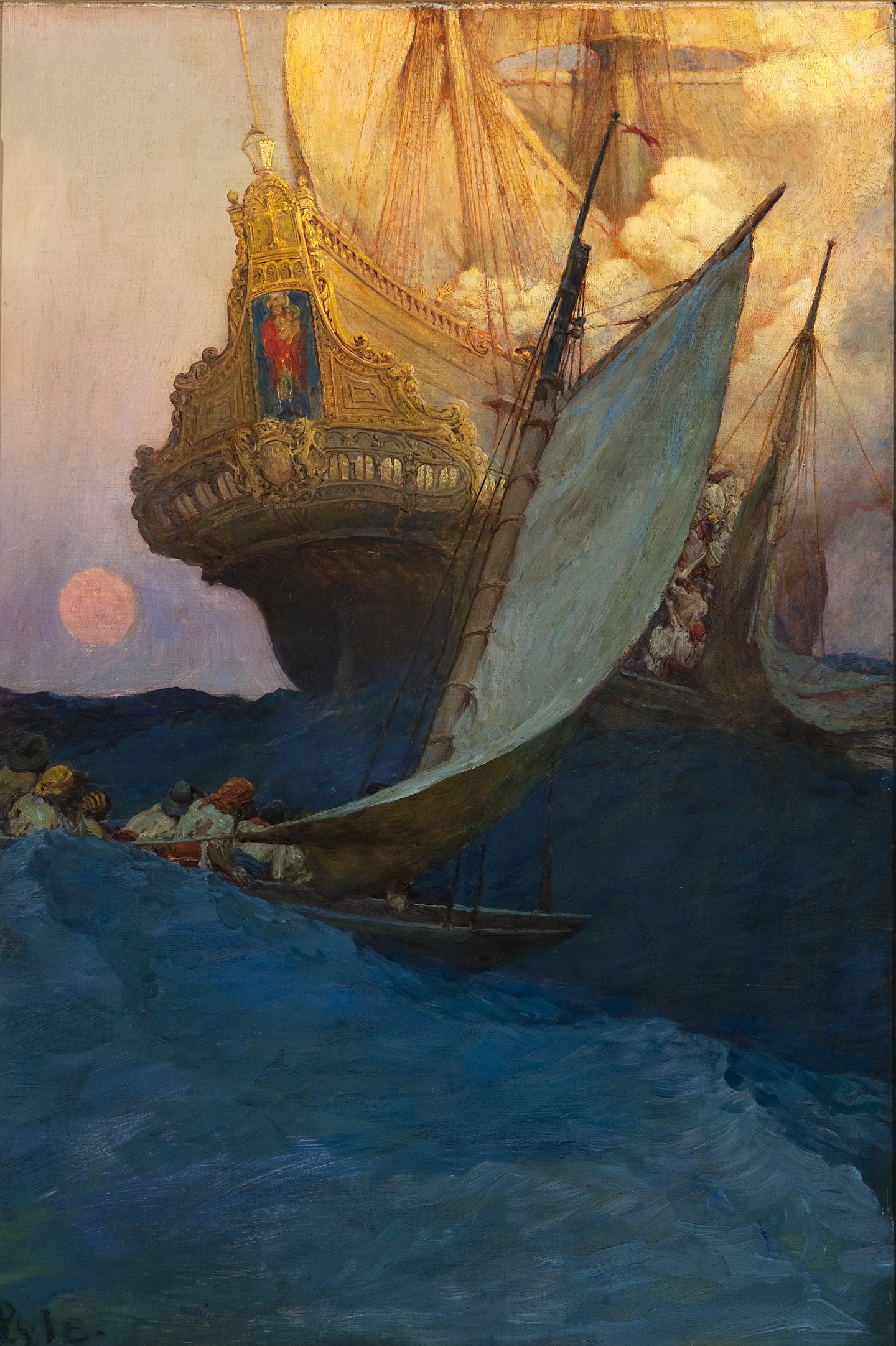
Perhaps the most famous of Howard Pyle’s many piratical paintings and drawings, and certainly the most evocative, “Attack on a Spanish Galleon” has inspired many homages (and plagiarisms) in book illustrations, cinema, and advertising — not mention dreams of Spanish treasure in the minds of both armchair and real sea-going adventurers!
The illustration accompanies several other of Pyle’s most famous buccaneer paintings in “The Fate of a Treasure Town,” an article written by Howard Pyle about the 1697 sack of Cartagena de Indias and published in Harper’s Monthly Magazine, December 1905. The article includes some of Pyle’s most famous buccaneer paintings, including “The Buccaneer was a Picturesque Fellow,” “Extorting Tribute from the Citizens” (used as the cover of The Buccaneer’s Realm, for what it’s worth), and “So the Treasure Was Divided.” Of the most famous paintings of his buccaneer, as opposed to pirate, series, only “Which Shall be Captain?” for “The Buccaneers,” a book of poetry, by Don C. Seitz in Harper’s Monthly Magazine, January 1911, and “How the Buccaneers Kept Christmas,” in Harper’s Weekly, December 16, 1899, are missing.
Charles D. Abbott in Howard Pyle: A Chronicle (Harper & Brothers, 1925) considers these four paintings as the culmination of Pyle’s paintings in “the pirate vein,” although he argues that the painting of “Captain Keitt, standing on the slanting deck of ship with a high sea running behind and a burning galleon in the distance, is perhaps the best of all of Howard Pyle’s pirate pictures.” Even so, he notes that “The one called ‘Attack on a Galleon,’ with its marvelous golds and greens, is a splendid achievement in design.”
Although the attack on a galleon scene in illustration, fiction, and film in general was surely inspired by buccaneer-surgeon-author Alexandre Exquemelin’s The Buccaneers of America (first ed. 1678), Pyle’s was likely factually-inspired by Exquemelin’s possibly apocryphal tale of Pierre Le Grand who captured a Spanish treasure ship by boarding at night. The small buccaneer crew had only one craft and boarded by stealth, catching the Spanish captain and crew off-guard — they had disregarded the distant buccaneer craft as of no threat to a great galleon.
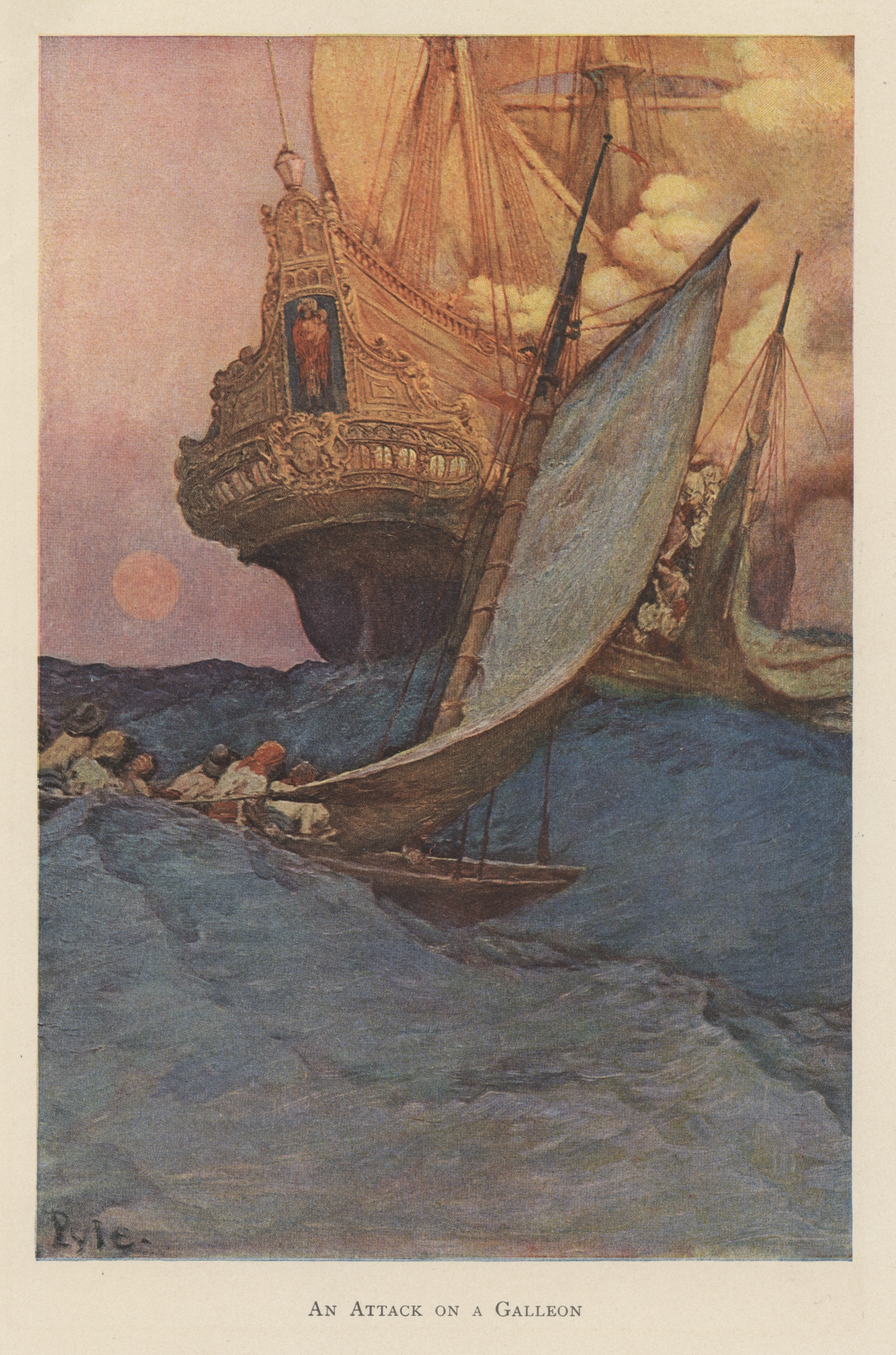
The story may be apocryphal but it has the ring of truth. We know that historically other buccaneers captured Spanish vessels by boarding from small boats, canoes, and periagers (piraguas, pirogues), that sea rovers in general have successfully made similar attacks over the millennia, and that modern naval special operations forces use the tactic as well. (For more information on the tactics of Golden Age buccaneers, pirates, privateers, and naval commerce raiders, see The Sea Rover’s Practice.)
In the painting, one buccaneer boat is already alongside, its boarders streaming up the side and into the waist, and another, gaff-rigged, a dugout canoe perhaps, is captivatingly astern, surely preparing to board as well. The smoke billowing from the deck indicates a fierce fight on deck — muskets and pistols, and probably the upper deck great guns and swivel guns as well, are in action — or possibly even that the ship may be afire, although in the latter circumstance it is unlikely that buccaneers would board, for a fire aboard ship was feared more than any other hazard of the sea.
At the stern, probably on the poop deck, one can sea a Spaniard in a broad Spanish hat, often referred to as a “two-hand hat” (or perhaps it is one of the buccaneers instead?) and aft of him, perhaps on the poop-royal (also known as the topgallant poop, Sp. chopeta/chopa/imperial, Fr. dunette sur dunette/carrosse), a pair of hands in submission and supplication.
A question that continues to perplex me is what time of day does this attack take place? Is that a golden full moon just up over the horizon at sunrise, given its red-orange color? Or is it a sunset, suggesting the setting and settling of a Spanish treasure voyage? Or even of the Spanish Empire in the Americas?

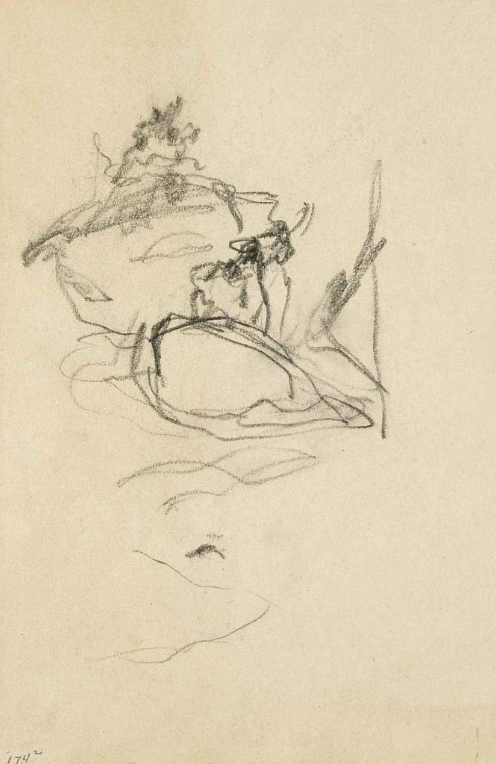
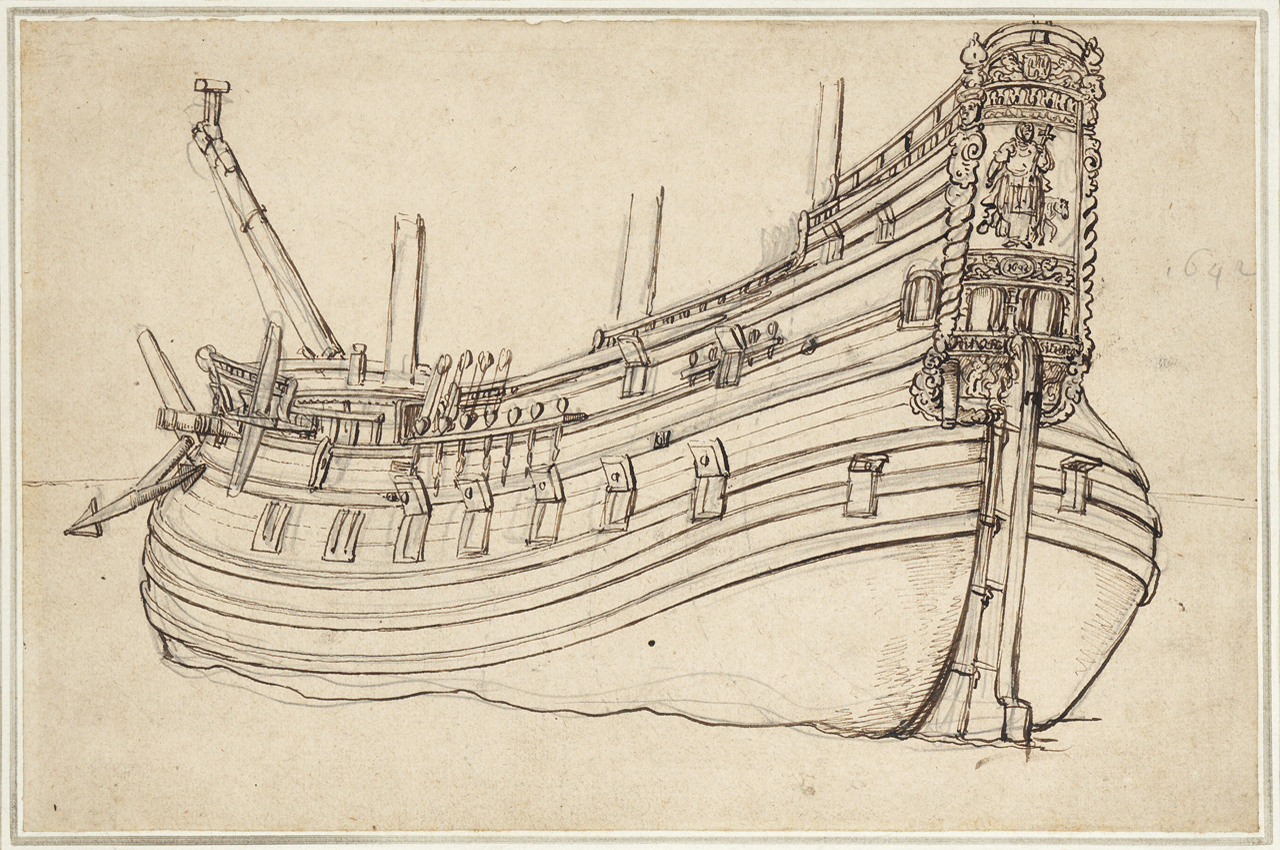
From the left drawing above it’s easy to see that Pyle changed the early conception of the galleon’s stern, eventually elongating it greatly for effect. Even so, the stern is historically-based. Without any doubt, as his inspiration Pyle used the well-known illustration, shown below, by 17th century Dutch artist Wenceslaus Hollar in 1647, and with poetic license narrowed the stern even further. Not only is the Hollar drawing quite similar, but Pyle used it in a later illustration, copying it almost exactly.
The illustrations by Hollar below show a form of mid-17th century Dutch ship used for both East and West India voyages. By the 1660s Dutch sterns, had become a bit lower and less narrow at the upper transom. Even so, some of the East and West India-men shown below, built in the 1640s and 1650s, would have survived in the 1660s and even 1670s or later. Importantly, approximately one third of Spanish ships were Dutch-built, including some treasure ships sent to the Americas, making Pyle’s Dutch-style Spanish galleon historically-correct, or largely so.


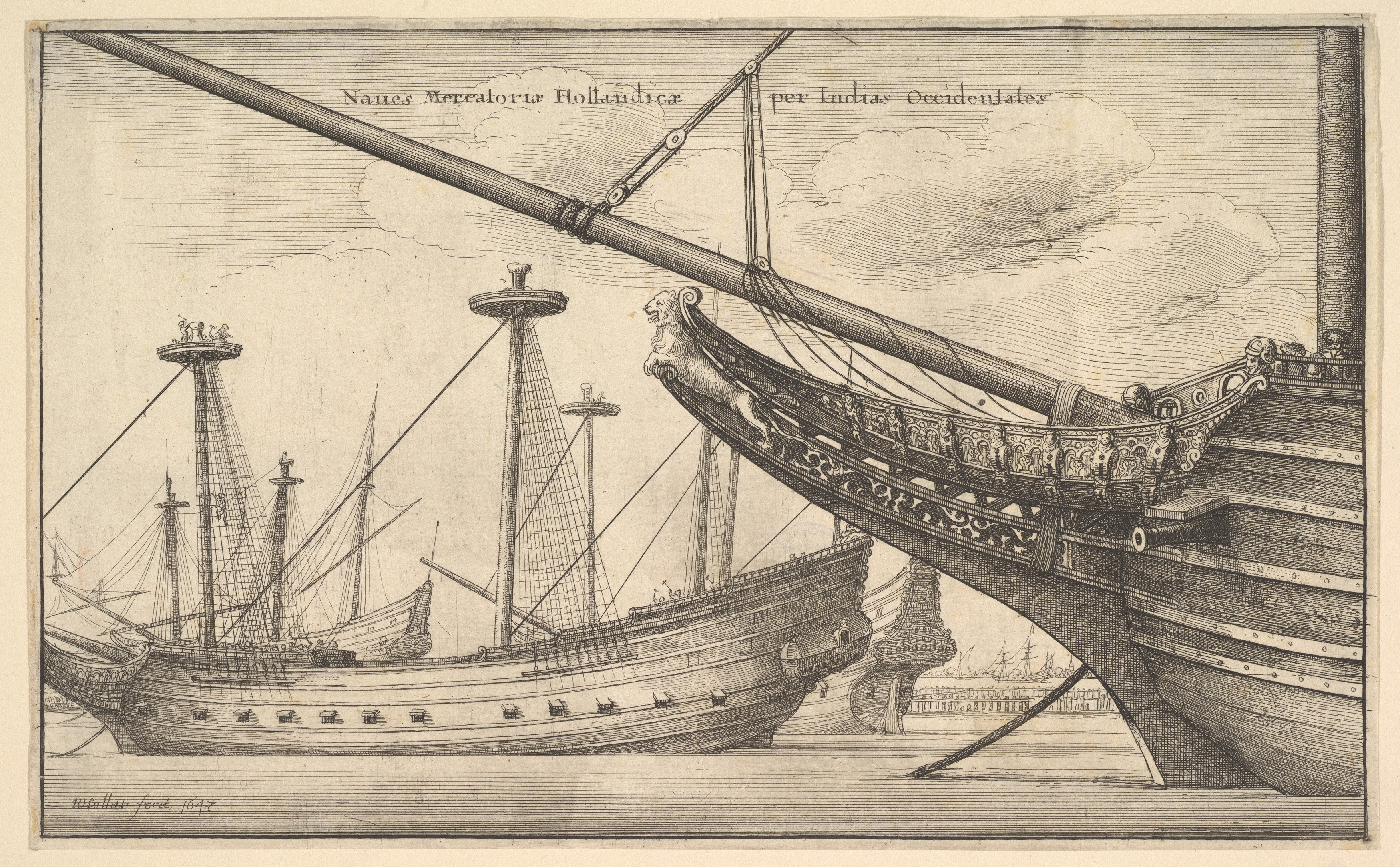

In the comparison above, Pyle has largely kept the structure and decoration with minor modification. Importantly and correctly, he has added a large Catholic religious icon representing the ship’s name at the stern. This was the usual practice aboard Spanish ships of the era, nearly all of which had religious names although some had secular nicknames. So far, the only exception I’ve found to the religious name rule is among some Spanish privateers. Occasionally, a religiously-named Spanish privateer or man-of-war might display the Spanish arms as its main icon at the stern, but it would still display a religious icon representing its name somewhere below or above the arms. Here we can assume that Pyle’s galleon’s name begins with Nuestra Señora given that the icon appears to be of Madonna and Child.
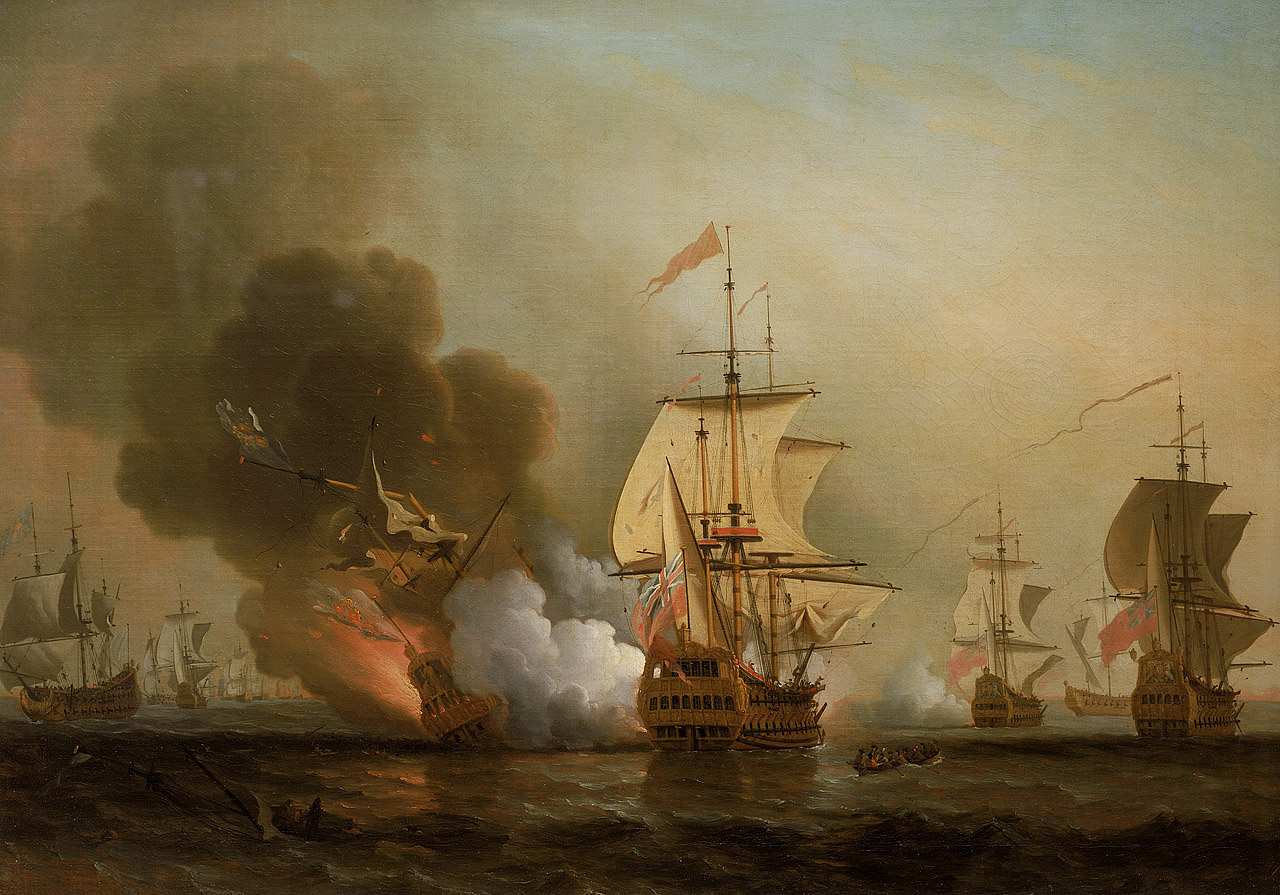
It’s possible that Pyle may have been originally inspired by “Wager’s Action off Cartagena, 28 May 1708” by English painter Samuel Scott. Painted at some point in the 1740s, Scott depicts a classical 17th century Spanish galleon, although in fact the galleon in question, the San Jose, whose remains along with possibly a billion dollars in treasure, are currently undergoing careful salvage off Cartagena de Indias, Colombia, probably looked nothing like this. (Details in the section below on real galleons.) In any case, Pyle may have been familiar with this famous painting, and sought out similar but more detailed images, and found those of Hollar. Notably, Pyle’s billowing smoke and orange colors are similar to Scott’s. (Compare with the image of what is probably the San Jose’s actual stern later in this post.)
A word or two on the term galleon. Originally, in the late 16th and early 17th centuries, it referred to a stout ship with specific characteristics that was built for war and trade. Spanish galleons were noted in particular for their very high sterns. By the late 17th to early 18th centuries the term galleon could refer to (1) in its narrowest definition, a treasure ship of a type built to very specific guidelines for use in the Carrera de Indias (the trade to the Spanish Americas from Spain and from the Spanish Philippines), (2) any Spanish treasure ship of any sort, (3) any Spanish ship with a very high stern and multiple stern galleries, and (4) any ship of war or trade similar to those of Spanish galleons, in particular those of Portugal (occasionally still referred to as carracks as well), Venice, Genoa, and “Turkey” (the Ottoman Empire).
Further, some Spanish officials in the late 17th century incorrectly referred to Spanish men-of-war of the frigate type as galleons, retaining language from earlier in the century. True Spanish galleons, as described in (1) were largely no more by the 1640s except for a small number specifically built for the treasure fleets. Arguably, the last true galleons, and there were but few by this time, were built in the 1690s, yet privateer Woodes Rogers in A Cruising Voyage Round the World (1712) describes one in the first decade of 18th century in the South Sea (the Pacific Spanish Main): “[S]he was call’d the Ascension, built Galeon-fashion, very high with Galleries, Burden between 4 and 500 Tun…” He later refers repeatedly to the ship as a “Galleon” — and oddly, to neither of the Manila galleons as galleons, but only one or the other as the “Manila Ship.”
Although the life of a ship in this era was often less than twenty years, some were in use for thirty to forty years, ensuring that older forms of ships were still well-represented.
Pyle also painted a somewhat similar illustration in 1898, published eventually in Collier’s magazine, December 10, 1904, and it clearly shows that his inspiration was taken from Hollar’s Dutch East Indiaman.


Imitations & Homages
Pyle’s galleon, or its inspiration, has spawned numerous imitations, right down to the present. Many, most perhaps, are homages. Below are a few representative images.
His treasure ship has often been used in advertising, for example in this add from The Saturday Evening Post, October 22, 1927, for 1847 Rogers Bros Silverplate. “Time and Tides are Kindly to Comely Captain Housewife,” reads the caption. Sexist, yet the series of ads does feature a variety of often clearly independent pirate women as opposed to more common images of domesticity. Doubtless the illustrations of sexy pirate women were intended not only to attract the attention of women readers, but also as lure to inspire husbands to buy the cleverly marketed “Pieces of Eight” set of silverware and associated pieces.
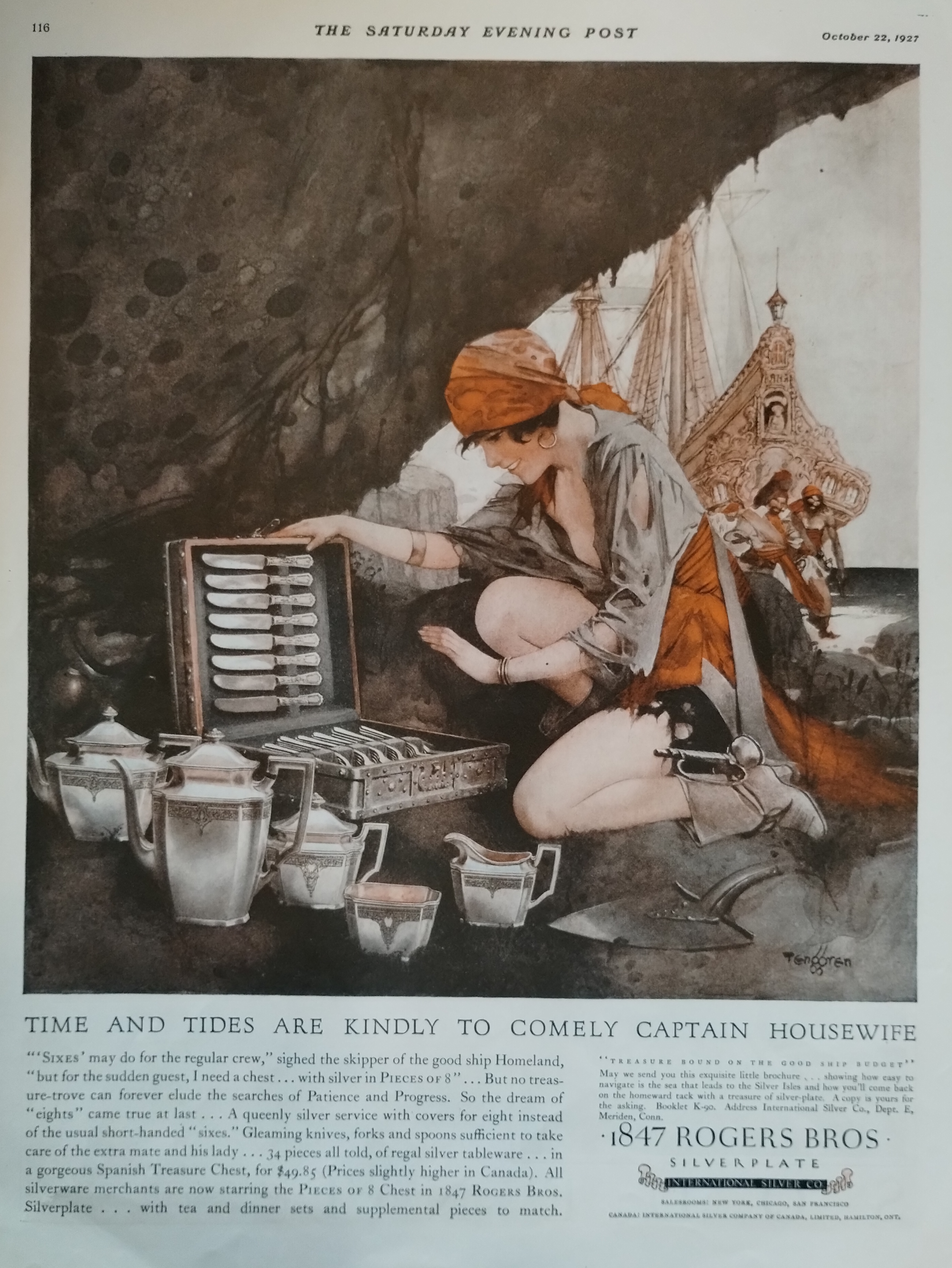
The detail below clearly shows the galleon to be a copy of Pyle’s famous ship. An homage, probably, but also good marketing, immediately evoking the pirates and buccaneers of Howard Pyle and Douglas Fairbanks.

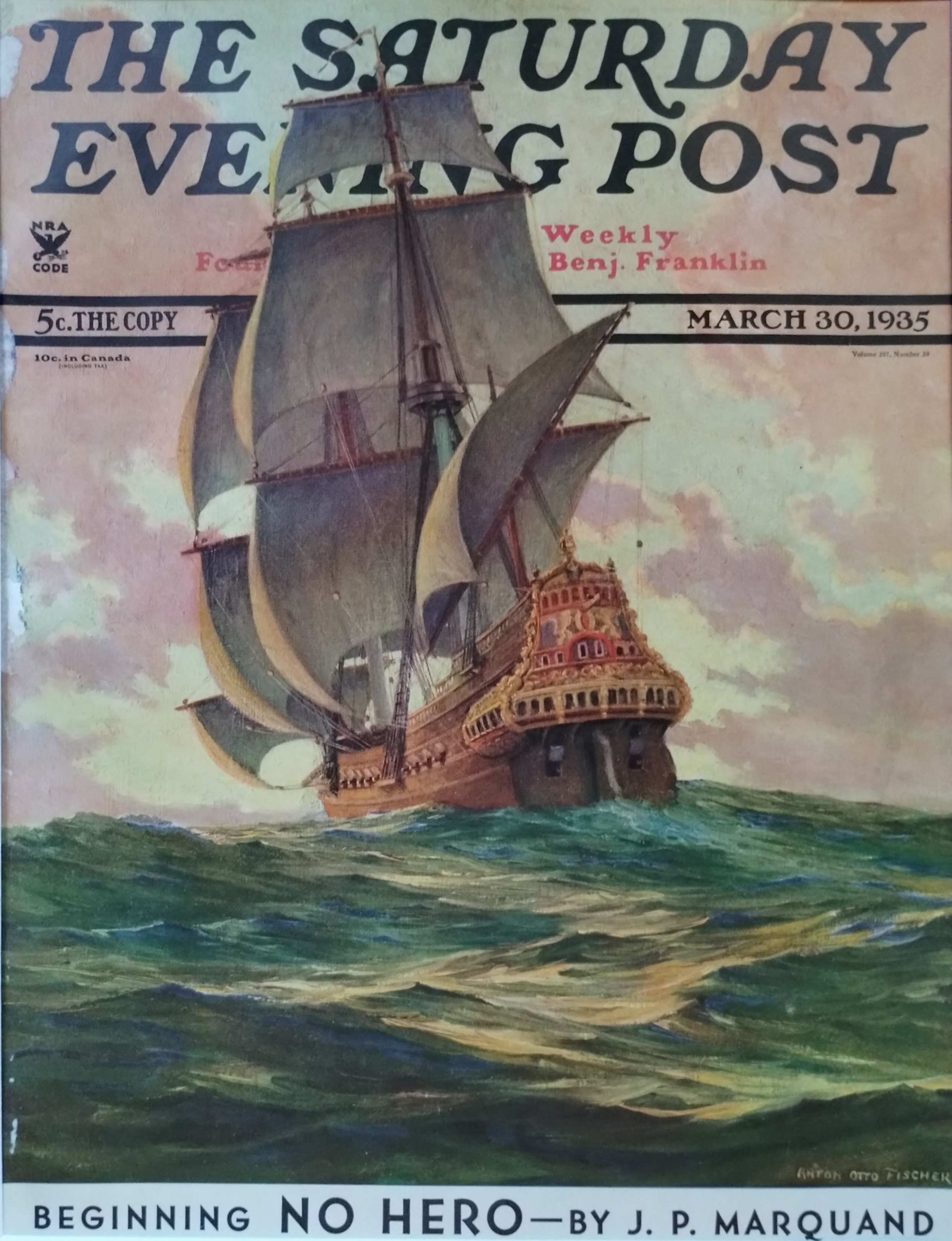
Below is a galleon by well-known Saturday Evening Post artist Anton Otto Fischer, quite clearly in homage to Howard Pyle, based on the galleon in Pyle’s “The Burning Ship” and Hollar’s India-men. The image emphasizes pink-gold hues of ship and cloud and tropical blue sea. Both Fischer and his wife were students of Howard Pyle; Fischer was also an experienced tall ship sailor whose favorite subjects to paint and illustrate were of ships, seamen, and the sea.
A dinner plate dating from 1923 – 1936 — an era of cinematic pirate adventurers Douglas Fairbanks and Errol Flynn, and the buccaneer novels of Rafael Sabatini and Jeffery Farnol — shows likely influence of Howard Pyle’s galleon. That said, as seen above and below, there were real ships with similar sterns.


I almost forgot about several famous galleons, at least one of them an English one, all painted by N. C. Wyeth — perhaps Howard Pyle’s most famous student. All clearly evoke Pyle’s galleon. Homages from student to teacher, without doubt.


I cannot decide if the Cinco Llagas aka Arabella of the 1935 Captain Blood was inspired by Pyle’s painting or not. Without doubt the designers were familiar with Pyle’s galleon, although technically the Arabella is a frigate.

Likewise the Wicked Wench, which was clearly inspired by the Arabella, as I’ve discussed here.

Even so, the galleon — surely the Arabella! — in this 1935-1936 Spanish poster for Captain Blood (Warner Bros., 1935) was copied from or inspired by Pyle’s famous galleon. And appropriately so, given Pyle’s overwhelming influence on pirate films of the era. Note that the forecastle appears to have been appropriated from any of many N. C. Wyeth Elizabethan galleons, or even earlier galleons.

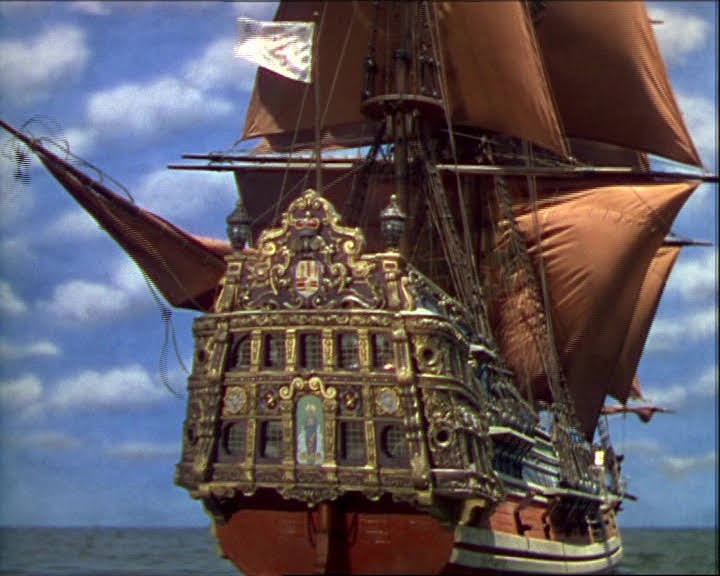
The stern of the Spanish galleon in The Spanish Main (1944) starring Paul Henreid and Maureen O’Hara may well have been influenced by Pyle’s painting, in particular the ascending pointed carved decoration at the top of the stern transom. Compare with that of the Urca de Lima in the television series Black Sails later in the post.
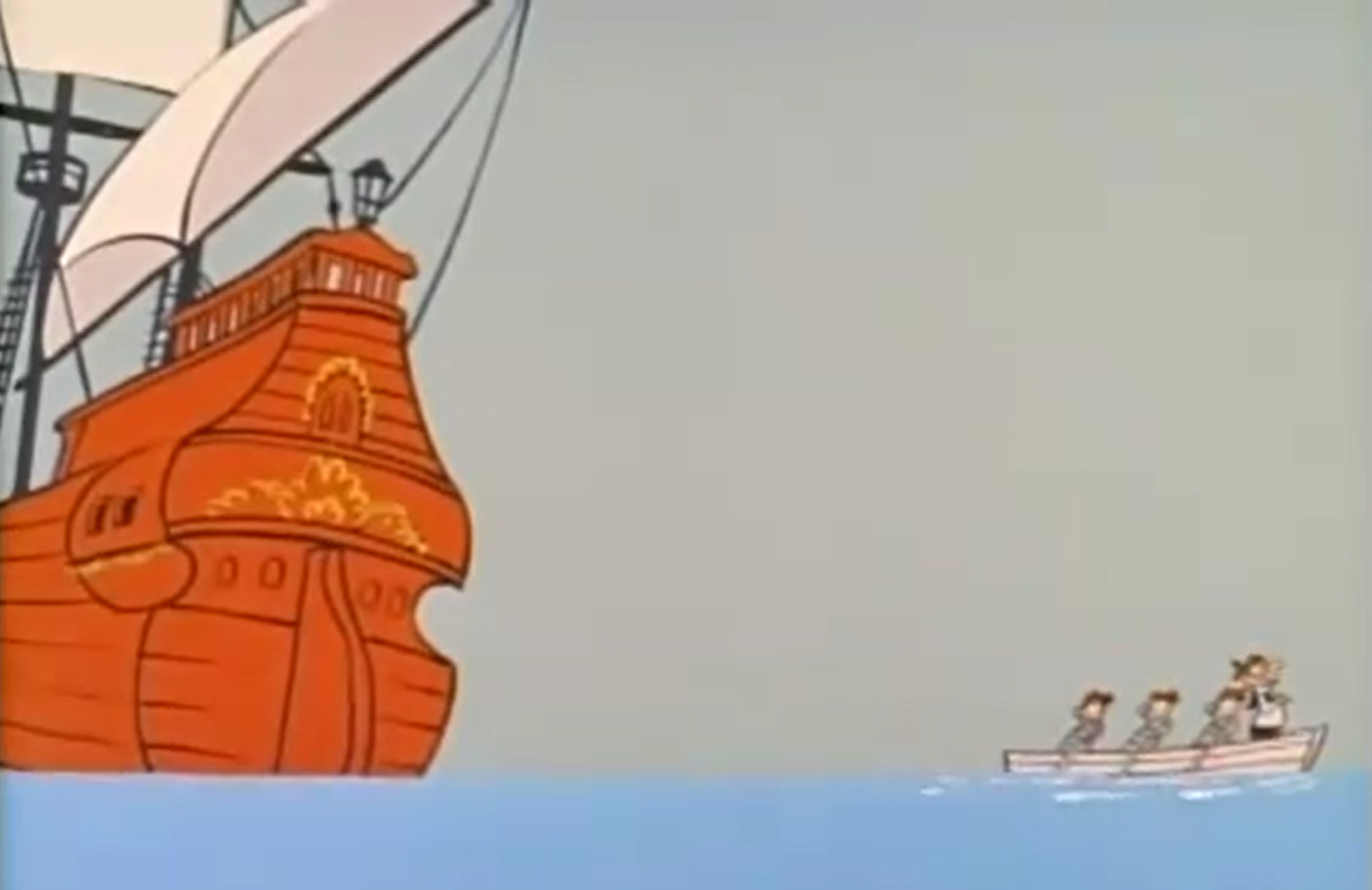
Pyle’s influence is clear in this shot from a Quick Draw McGraw cartoon from 1961:
Famous science fiction and fantasy illustrator Frank Frazetta honored Howard Pyle with an homage to his famous galleon in 1973.

N. C. Wyeth’s grandson, Jamie Wyeth, a famous and outstanding painter in his own right and son of iconic artist Andrew Wyeth, did the artwork for the plate below, a clear homage to both his grandfather and to the man who taught his father, Howard Pyle. In this case it is a “pirate galleon” — clearly a Spanish galleon fallen into the hands of buccaneers per classic trope. (N. B. Buccaneers didn’t fly the black flag with skull and bones, although at least one crew did fly the red banner of no quarter with skull and bones. But it’s the image that counts in storytelling, and we’ve come to expect the black flag on all pirate ships of all eras. See The Golden Age of Piracy for more details.)


Almost certainly the “galleons” (they appear to be manned with English marines) below, especially the one of the left, in this art by cartoonist François Ruyer for a puzzle is an homage to Pyle’s famous painting, with their excessive height and pirates attempting to board one of them via boat. Even the sky color evokes Pyle’s painting.

Likewise an earlier image by Jean-Jacques Loup for Heye, “Captain Flint’s Party,” for a puzzle evokes galleon sterns reaching for the moon, so to speak:

The stern of the Jolly Roger below from Peter Pan (2003) is clearly an homage to Pyle’s galleon.

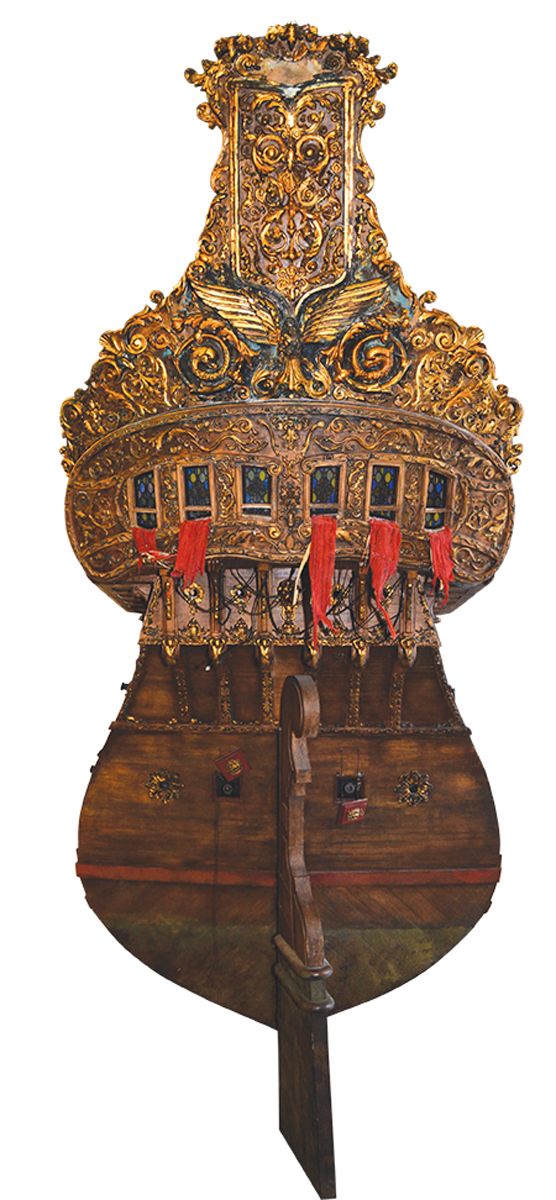
It’s entirely possible that Pyle’s galleon even influenced the design of the Urca de Lima in the Starz dramatic series Black Sails, shown below. (Compare also to the galleon used in The Spanish Main above.) Although I was the historical consultant for all four seasons, I don’t know this for certain as I had no input into sets, including ship design, unfortunately — otherwise the ships might have been more historically accurate. Some of them in reality would not have been seaworthy.
And on a nitpicking the note, urca is the Spanish word for a type of ship originally designed by the Dutch but in use by all Western European seagoing nations. It was known as a fluyt, flute, flutte, or, in English, a pink. It had a rounded stern, not a flat one as the television galleon has, and a very small narrow transom (which might have provided some additional excuse for Pyle’s very narrow upper section of the transom for his Spanish galleon, even though it’s not an urca). In other words, the Black Sails galleon should be an urca instead. It bears noting that an urca is NOT a galleon — yet one might be referred to colloquially as a Spanish galleon if carrying Spanish treasure…


But I digress a bit under the influence of historical accuracy! Even so, this brings us to a good subject: what did Spanish galleons and their sterns actually look like from 1650 to 1700?
Spanish Galleons 1650 to 1700
For the first forty years or so of the 17th century, the large or main transom of Spanish galleons was typically “stepped” (in layman’s language), with the upper part or parts overhanging the lower, rather than flat as soon would be the case. The Spanish galleon Santa Teresa, shown in the three images below, is a good example of this style of very common early 17th century Spanish sterns.

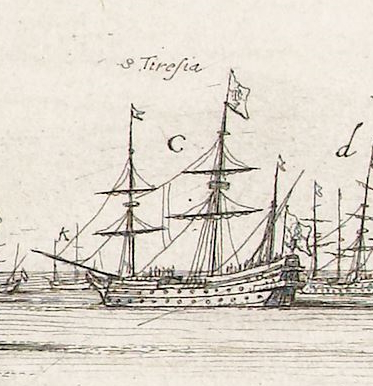

The “Vista de Sevilla” (“View of Seville”), circa 1660, artist unknown, gives us a good view of the sterns of Spanish galleons with enclosed galleries, and the changes that came mid-century. The sterns, although still very high, all now appear “modern” in the sense that the double transom, the upper overhanging the lower, has disappeared.
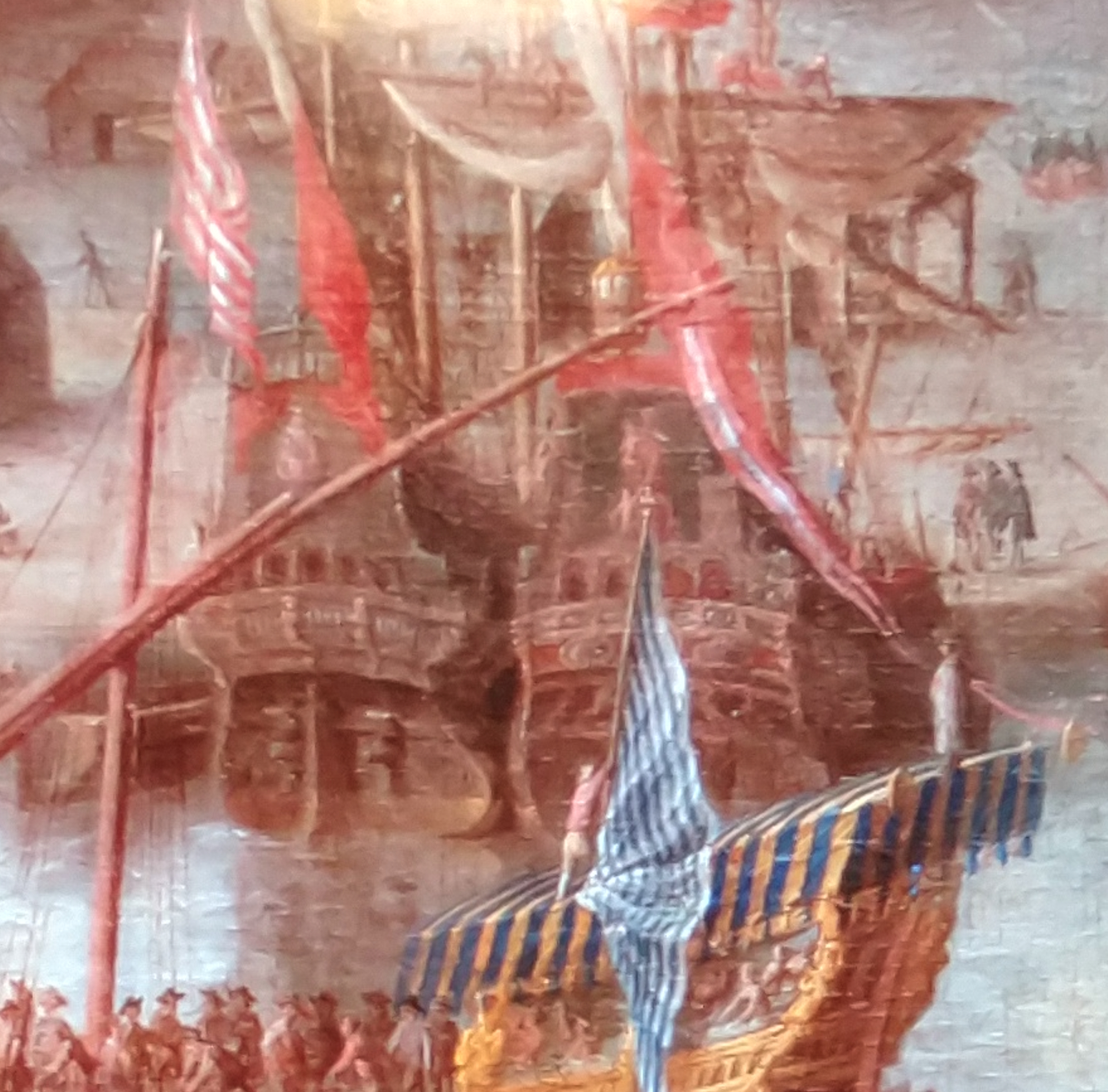


Below is an illustration of “The Spanish fleet sailing from Havana in 1662.” However, neither the Flota de Nueve Espana nor the Flota y Armada de Tierra Firme sailed from Havana in 1662, nor was it likely that either fleet was there at any time that year. More likely, the year was 1661 or 1663. Note the very high sterns of the two larger ships.

Below is a Spanish two-decker man-of-war, the illustration dating probably to the 1660s, almost certainly the Spanish flagship Nuestra Señora del Pilar given the iconography on the stern. Mounting 64 guns (or 70 in one account), of which 20 were 28-pounders and 28 were 18-pounders (some of which would have been placed on the lower gundeck with the 28s), the ship was destroyed when attacked by four fireships in 1676 at the Battle of Palermo. Admirals Don Diego de Ibarra and Don Francisco de la Cerda perished in the flames along with 200 of the ship’s 740 man crew.
Although a frigate rather than a true galleon, the ship shows many of characteristics of Spanish galleons, and men-of-war as shown below often carried Spanish treasure and escorted treasure ships, earning them the appellation of galleon even if incorrect. Note the high stern, the religious iconography, the clinker planking on the upper-works, the channels mounted above the upper gundeck ports, the musketeer loopholes in the waist (identical to Dutch practice), the jeer capstan on the forecastle, and the two open wraparound external galleries, known as corredores, typical of Spanish treasure ships although not always to be found.

Another Spanish man-of-war stern, 1660s, with two open stern galleries that wrap around the hull. The ship may be the Santa Ana of 54 guns, vice-admiral at the Battle of Palermo in 1676, given the stern iconography. If so, she mounted 16 bronze 24-pounders, 26 bronze 18-pounders (some of which would have been mounted on the lower gundeck with the 24s), and 6 iron 16-pounders. She was likely burned but not destroyed at the Battle of Palermo in 1676.

Below are three very similar versions of the galleon Nuestra Señora del Mar, San José y San Francisco, showing details of her shipwreck in the Bermuda Islands in 1691. The ship was launched in Pasajes, Spain in 1681. Of 862.5 Spanish tons (toneladas), she was mounted with only 29 guns, a not uncommon practice for a large Spanish galleon, for much of her space was taken up with cargo. Note the color scheme, the style of painted decoration, the painted scroll-work on the upper-works, and three open external galleries. Each was, per Spanish period references, probably only thirty-three inches deep. The uppermost is at the level of the poop deck or even the poop royal if there is one.


Below, a Spanish galleon with three open stern galleries, flying the royal colors, enters Havana harbor in the second half of the 17th century, probably 1660s to 1680s.

However, in spite of our romance with the open-gallery, high stern Spanish galleon, many did have the open galleries, but had closed galleries, or later, semi-closed, as seen just below in this Spanish galleon at Portobello, 1688.

As noted previously, ships of other nations were sometimes referred to as galleons in the second half of the 17th century, including some of those of Portugal (also occasionally still referred to as carracks as well), Venice, Genoa, and the Ottoman Empire (colloquially referred to as “Turkish” galleons).


The 1680s brought on changes in Spanish shipbuilding, including in its men-of-war and in its remaining true galleons. Although the latter often still had high sterns, they were soon reduced, more in keeping with European construction in general. And although galleons or treasure ships with multiple open, wraparound galleries or corredores were still seen, the enclosed gallery became much more common as did the open gallery, often two or three in number, that did not wrap around to the sides, the latter particularly evident in the 1680s.
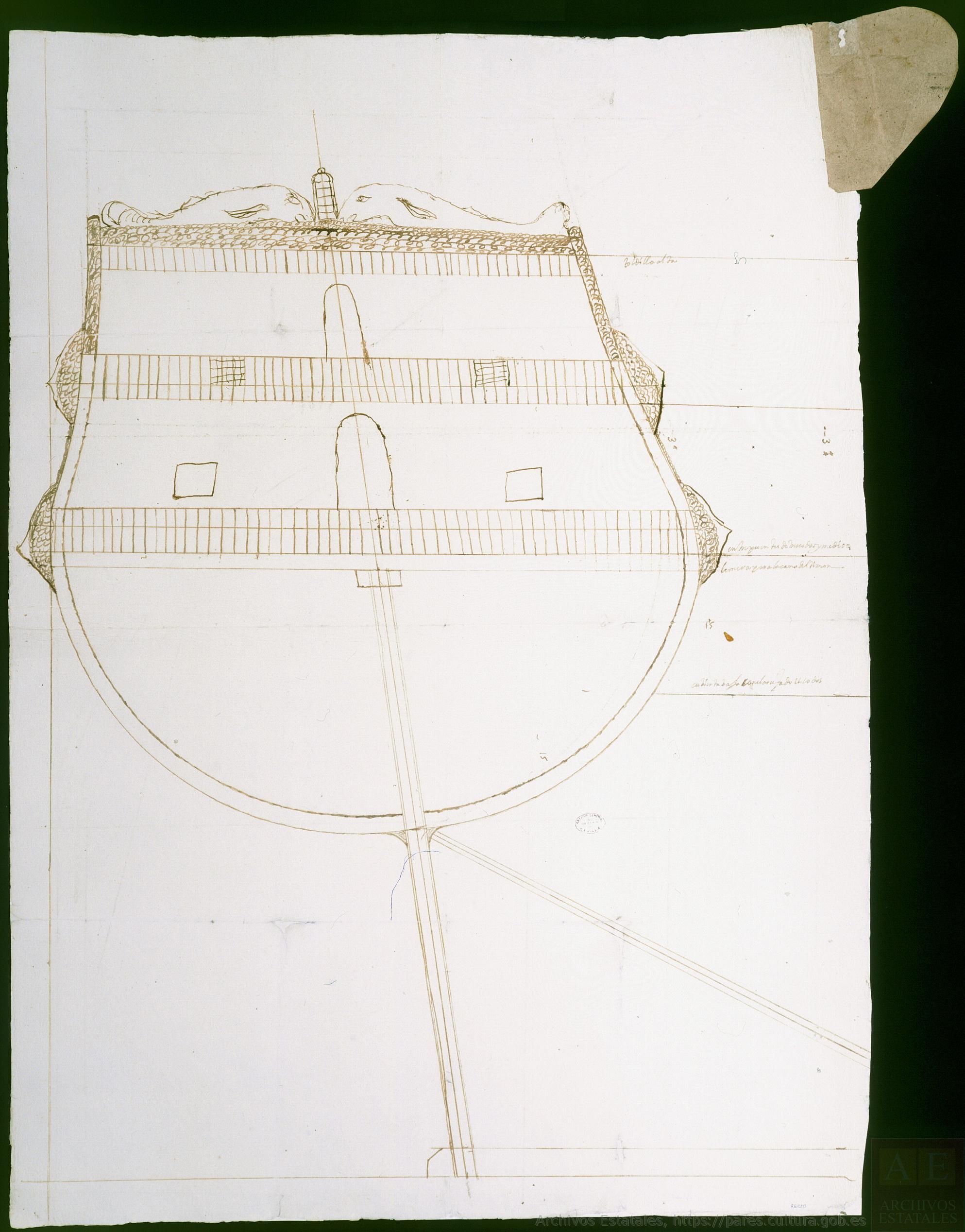
Below are Spanish treasure ships at anchor at Portobello in 1683. The multiple galleries and high sterns are clearly still evident although it appears that not all wrap around the sides but are open only at the stern, as above.

The same treasure ships, or at least ships of the same fleet, at anchor in Portobello in 1682, as drawn by a different artist :

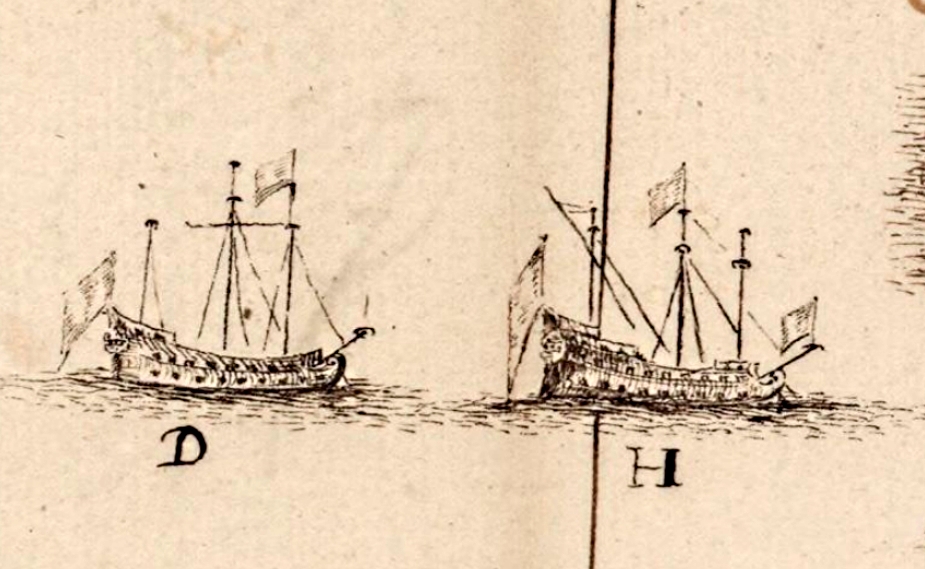
Through the 1680s and 1690s, Spanish men-of-war, which often escorted treasure ships and even carried treasure themselves, were changing, their designs becoming sleeker and more in line with other European navies.
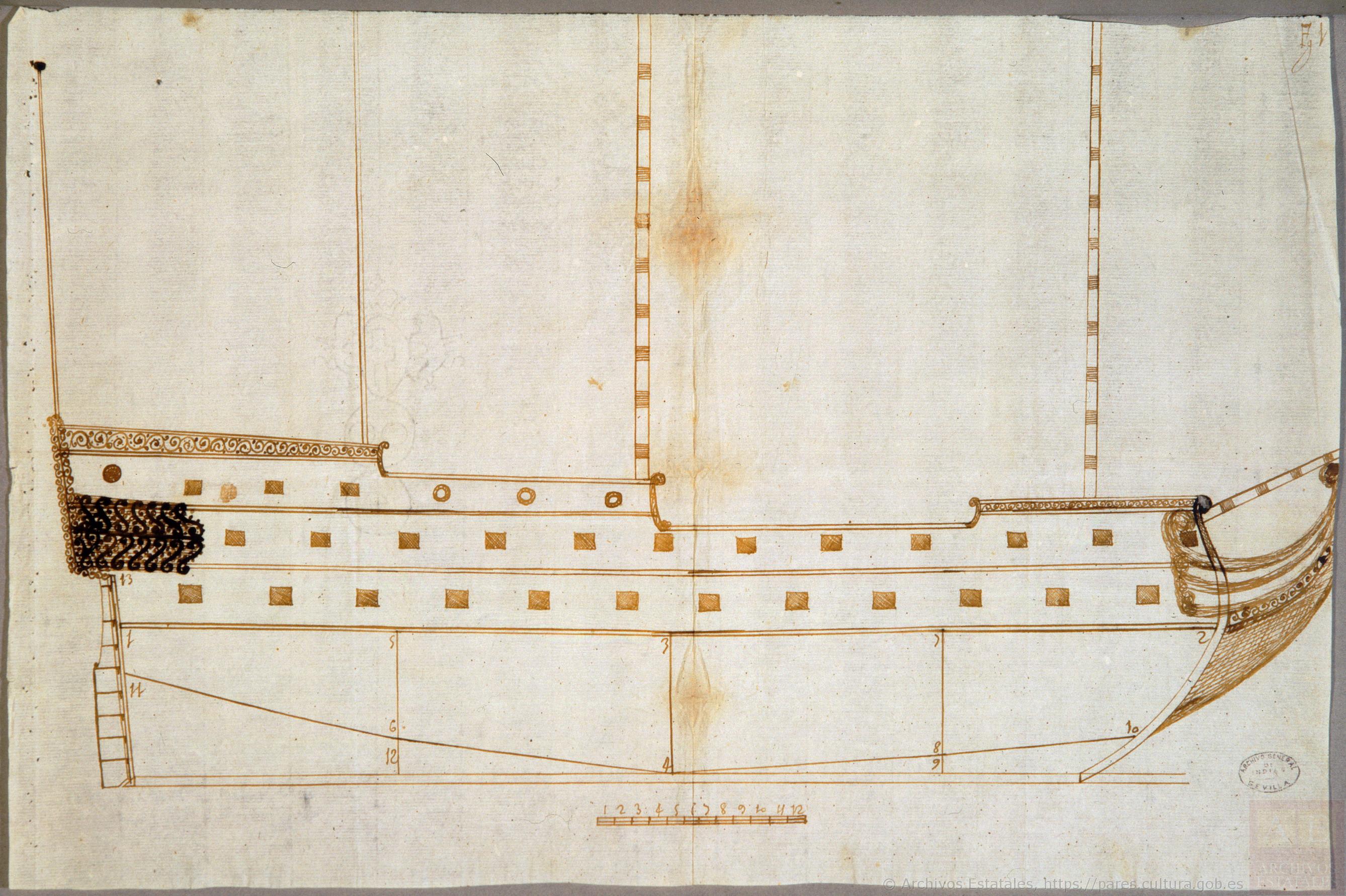

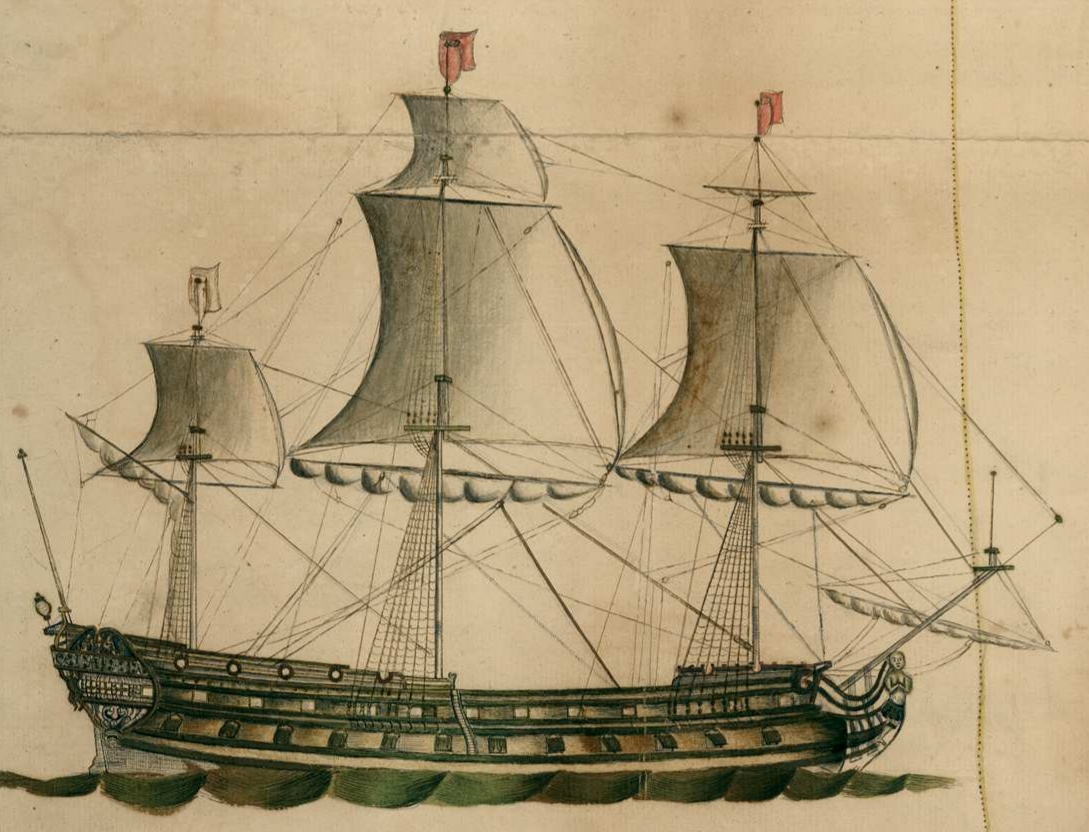
Below is one of a series of proposed Spanish men-of-war, 1691. Although never built, they reflect the new trends in Spanish ship design, including lower sterns and a semi-closed single stern gallery.

Even the last Spanish treasure galleons to be built had similar features. Below is the stern of what scholars generally believe to be the famous San Jose, launched in 1698 and sunk at Cartagena de Indias by Wager’s fleet in 1708, with a treasure aboard estimated by some to be worth as much as 17 billion dollars US today. Compare this drawing with Scott’s painting above of Wager’s action against the San Jose.

With the accession of a Frenchman to the Spanish throne in the early 18th century, over which the War of the Spanish Succession had been fought, Spanish ship design became more contemporary with that of other European sea powers. Gone was the conservatism that too often hindered Spanish shipbuilding. Below is a Spanish treasure ship of the new style. It has a projecting gallery that wraps around the stern (not all Spanish treasure ships and men-of-war had this), with a shade built overhead for the section of the gallery at the transom:
A closer look at these Spanish sterns in the first half of the 18th century. The stern gallery still wraps around the hull.

A simple pen and ink view of a Spanish man-of-war with what appear to be two projecting, probably wraparound, galleries, from a Spanish chart of Isla Vieques off the coast of Puerto Rico, 1721:

Design changes notwithstanding, the high-sterned Spanish treasure ship was in use into the first quarter of the 18th century. I’ve already mentioned Woodes Rogers’s description of one in the South Sea. Below is a depiction of a Spanish treasure ship by Gueroult du Pas in 1710.

And it is these high-sterned Spanish galleons that always have captured our imagination, and continue to do so. Howard Pyle’s famous treasure galleon has helped to keep that imagination not only alive but enhanced. Even the romantically evocative dust jacket below must have been influenced by his famous galleon, with its high stern and colors of sunset or sunrise!

In fact, these iconic images of Spanish galleons from fiction, film, and more aren’t far off from those created by eyewitnesses in the 17th century, including these found on a Spanish 1669 chart of Cartagena de Indias!


Details from “Cartaxena con 46 piésas,” 1669, courtesy of the French National Library.
Copyright Benerson Little 2024-2026. First posted March 27, 2024. Last updated January 25, 2026.
 Swordplay & Swashbucklers