
Home » Fencing (Page 2)
Category Archives: Fencing

Captain Blood: His Odyssey–A Near-Century of Dust Jackets & Trade Covers
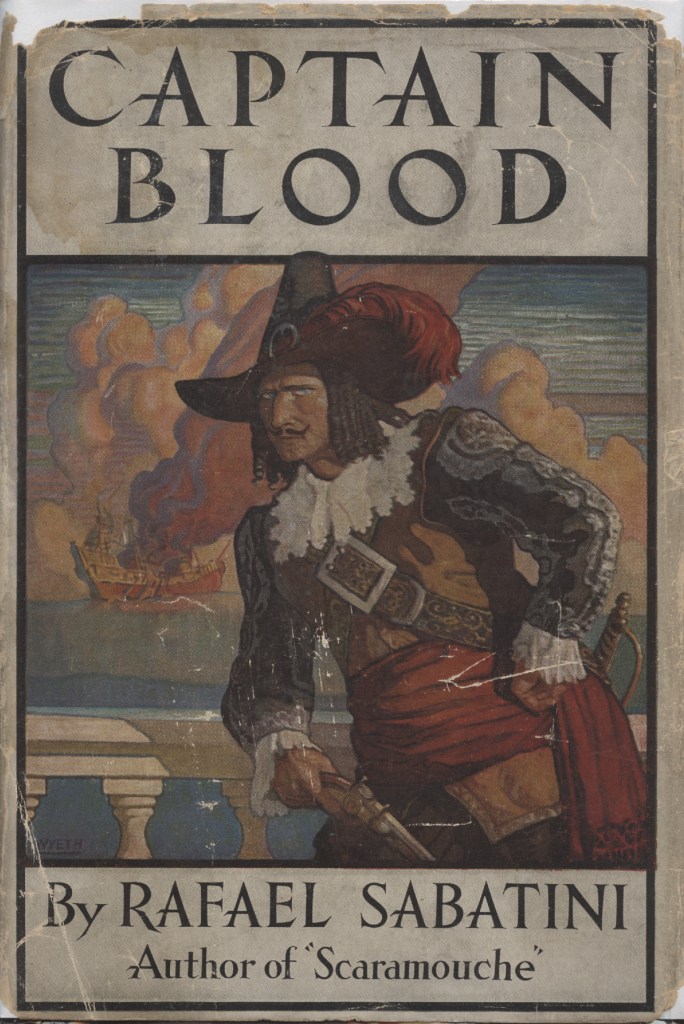
Associated with our announcement of the creation of Treasure Light Press and the forthcoming publication of its first title, Captain Blood: His Odyssey by Rafael Sabatini, The 100th Anniversary Annotated Edition, here’s a look at Captain Blood dust jackets over the years!
In a future post I’ll cover trade and mass market paperback covers.
The dust jacket of the first hardcover edition above is iconic, if not entirely historically accurate, but then, fiction book cover illustrations almost never are. Artist and illustrator N. C. Wyeth–a student of Howard Pyle–does, however, well-conveys the color and swashbuckling adventure of the novel.
Notably, as in many of the dust jackets below, Captain Peter Blood is sporting a mustache. However, only in the magazine serial, “Brethren of the Main,” published prior to the release of the novel, does he wear one. In the novel he does not. The Wyeth illustration has been used in numerous subsequent editions.
Also notably: according to authors Jesse F. Knight and Stephen Darley (see below), Captain Blood did not reach the bestseller list the year it was published. (See the end of the blog for a few notes on identifying true first editions.)

In 1924, Vitagraph motion picture studio released a silent version of Captain Blood, of which only thirty minutes unfortunately still survive. Starring J. Warren Kerrigan–a poor choice if his personal character were to be compared to that of the fictional hero of the book, for he was no Peter Blood nor even an Errol Flynn–the film did much to further promote the novel. In fact, the novel was printed in full or in part in hundreds of newspapers as part of the studio campaign.

The illustration above is not a dust jacket, but the cover of the Astor Theatre program for the 1924 version of Captain Blood, starring J. Warren Kerrigan. The program art is based on the design of the novel’s 1922 US edition.

A UK photoplay edition associated with the 1924 Vitagraph film. Again, Peter Blood sports a mustache he doesn’t have in the book. His costume, however, maintains a fair degree of historical accuracy. The cover illustration is the same one used in the original UK (Hutchinson) first edition. As with the Wyeth illustration, this one has been used in full or in part for numerous subsequent UK editions.

In 1927 a Riverside Press edition (Houghton Mifflin) was published with the dust jacket above, and remained in print for at least twenty-five years. Both the dust jacket and the four illustrations inside are by Clyde O. Deland, the most impressive being that of the cover and perhaps of Col. Bishop being forced to walk the plank, and the least being that of the famous duel on the beach–it looks rather stilted and lacks the dynamism of Howard Pyle and N. C. Wyeth duel impressions. The illustrations are above average for historical detail. I’ve seen a simple drawing in black, based on the illustration, on the front hardcover of some library editions.

In 1929 a German edition was published. Mine has small notes in pencil regarding historical personages and such–Rafael Sabatini’s books have a knack for inspiring the study of history. I’ve often wondered how this reader, assuming he or she read it prior to WWII, regarded the rise of German authoritarianism and dictatorship–and the rise of the Nazi party–in light of the very opposing values of the novel.

A quasi-photoplay edition was published in 1935, timed with the release that December of the famous film that also made Errol Flynn a star. By quasi I mean that its end papers are illustrated with scenes from the film. There are no images placed within the pages, however. The cover is copied from a hard-to-find publicity still from the film, shown below.


An identical dust jacket, lacking only the film information, was also released around 1935 or soon after. I’ve seen this dust jacket on Grosset & Dunlap editions with and without the end papers from the film. Notably, all Grosset & Dunlap editions with this jacket have a statement on the front flap or back cover that it is a reduced price edition, made possible by using the original plates and the author accepting a reduced royalty. I’ve also seen library editions (no dust jackets) with a simple drawing in color, based on the image above, on the hardcover, and I’ve seen the full image itself also used.

Newspaper ad for the 1935 film, showing a US edition dust jacket with Errol Flynn. This jacket was never actually produced.

Dustjacket depicted in the trailer for the 1935 film version. As with the previous jacket, it is an advertising creation and was never printed.

Hutchinson in the UK also published an edition timed with the release of the “new talkie film.” It has no images from the film in the book itself.

Appropriately, given that Peter Blood was half Irish and considered himself an Irishman, an Irish language edition was published in 1937. The text font is beautiful. Sabatini, as did and do many writers, put his pirate hero in boots. In fact, mariners in this era did not wear riding boots–which is what the myth has pirates wearing–aboard ship, or even ashore–unless mounted on a horse.

Below, a heavily-abridged Hachette French edition with a very French cinema-looking Peter Blood on the front.

A rather youngish-looking (definitely not in his thirties) Captain Peter Blood on the dust jacket of the 1973 edition published by Hutchinson Library Services Ltd in the UK. Purists will note the incorrect grip on the smallsword.

Given that both of my fencing masters (Dr. Francis Zold, Dr. Eugene Hamori) were Hungarian, it’s appropriate that I’d have at least one copy in Hungarian to honor these swashbucklers!

There are numerous Russian editions of the novel, many of them well-illustrated. This is not a dust jacket per se, but the printed cover of a hardcover dual edition: Captain Blood: His Odyssey and The Chronicles of Captain Blood (aka Captain Blood Returns in the US).

Above, another softcover I’ve included for interest (and because it doesn’t quite fit with the “Mass Market” editions blog either). From Albania, 1974, a severely abridged version stripped down to eighteen chapters, and all of them cut down to a few pages.

The cover of the Easton Press leather edition. The ship is of a later period and Peter Blood is wearing boots, as in the novel but not as he would have in real life–again, unless he were about to mount a horse or had just dismounted…

Last, my favorite recent hardcover edition. In Spanish, it’s well-illustrated with line drawings, and its design does justice to the story.

Dust jacket illustrations, collectible and evocative as they are, are there for a reason: to induce the potential reader to buy the book. And no matter how appealing they are, they pale when compared to the actual text. A battered old library copy sold for a buck at a yard or library sale is still a great read.
Of course, that hasn’t stopped me from collecting a variety of editions with dustjackets!
Captain Blood First Editions
A quick word of warning to those of you who collect books, especially those looking for first editions. Later editions or printings of Captain Blood are often listed, sometimes mistakenly, sometimes purposefully to deceive, as true first editions. It is easy to mistake later editions for firsts, given that many editions list the original publication year–1922–but not the year of the later edition or impression. For example, both the 1922 first and the 1924 US photoplay state 1922 as the year, but I’ve often seen the 1924 listed as a true first, as I have later editions. I’ve even seen the 1924 photoplay with dustjacket listed as a first for over $1,700–a terrible ripoff, were anyone to pay this much. I acquired both of my similar copies for under $50, and at the time the over $1,700 priced edition was listed (January 2021), so was a $40 edition with dustjacket and in similar condition. Unfortunately, even editions published in the 1930s typically list only 1922 as the year of publication.
Notably, true firsts have the first dust jacket shown above, and list both the year 1922 AND the month and the year of all impressions, except for the first impression, up to the date of the published edition. For example, the eleventh impression of the first edition lists the dates of the second through eleventh impressions, the last given as “ELEVENTH IMPRESSION, OCTOBER 1924.” The dust jacket spine lists the printing, for example, “Twelfth Printing” for the eleventh impression.

For more information on identifying firsts, see The Last of the Great Swashbucklers: A Bio-Bibliography of Rafael Sabatini by Jesse F. Knight and Stephen Darley (New Castle, DE: Oak Knoll Press, 2020), and also “Collecting Rafael Sabatini” by Jesse F. Knight in Firsts: The Book Collector’s Magazine (March 2001, Vol. 11, No. 3).
True firsts in fine or near fine book and dust jacket conditions (very rare!) command large prices, so if you’re looking to buy one, make sure that’s what you’re actually getting. Especially beware of firsts whose dust jacket is actually a modern–and usually so noted–reprint. They’re typically much over-priced. For example, I’ve seen a near-fine original first without dust jacket, which can often be found for $25 or less if you’re patient, combined with a $25 reprint dust jacket–and listed for a few hundred dollars. It’s a ripoff. It’s the original dust jacket, or author signature, or both, that command the great prices.
Copyright Benerson Little 2020-2022. First published February 12, 2020. Last updated November 15, 2022.

Swordplay Aloft: A Fictional But Entirely Enjoyable Pirate Trope

Cutthroat Island finale, Morgan Adams (Geena Davis, right) versus Dawg Brown (Frank Langella). Carolco, 1995.
Originally written in advance of my forthcoming series on “The Duel on the Beach,” here’s a fun look at the Hollywood trope of swordplay in the rigging.
We can probably blame Robert Louis Stevenson’s Treasure Island for the trope’s ultimate inspiration. In the novel [Spoiler Alert!], Jim Hawkins climbs aloft aboard the schooner Hispaniola to escape the murderous pirate Israel Hands, ultimately burning the salty thug’s brains with a brace of pistols. Why the hungover, perhaps even still-besotted, sea-thief didn’t simply use a musket to murder the lad is unknown. Perhaps he was too fogged by rum to think of it, or he didn’t have a musket at hand, or knew he wouldn’t be able to hit the bold lad. More likely, it’s simply a much better scene to have a murderous pirate armed with a knife slowly climb aloft while his victim waits at the extreme point of retreat.

“One Step More, Mr. Hands” by N. C. Wyeth for the 1911 Charles Scribner’s Sons edition of Treasure Island by Robert Louis Stevenson.
Doubtless inspired by Treasure Island, Charles Boardman Hawes includes a scene of fighting aloft in his Newberry award-winnning novel, The Dark Frigate.

But the primary origin of the trope, whether for Mr. Stevenson or Hollywood in general, is almost certainly the simple fact that the masts and rigging are too enticing not be used: a vast network or “jungle gym” overhead with boundless possibilities. It’s simply impossible to ignore the setting towering aloft above a vessel’s decks. It’s a nautical gymnasium begging to be used! And so it often has.
Before going further, we should quickly examine what sailors did, and still do, aloft. They set, take in, and furl sail. They hoist spars and masts aloft, and strike the same as necessary. They stand lookout. They man the tops in battle, enabling armed seamen to fire on the enemy below. They make repairs. They skylark.


Although fighting aloft was routine–men firing from above at men below–there’s no evidence of anything other than with firearms, grenades, and sometimes swivel guns occasionally fired at the enemy also aloft. No swordplay on yards, in other words. Note that in the painting below, no one aloft is wielding a sword, nor are there lines rigged from which to slide down or swing across (another popular but false Hollywood pirate trope). However, note the third image below in which two seamen slide down a forestay.
Actual fighting aloft would look something like this:


The painting just above, although it has many accurate details (including the grappling hook hanging by chain from the yardarm (although it should have two lines attached), appears to be rather romanticized, with seamen sliding down a forestay, another with his cutlass between his teeth, apparently having just slid down the stay, details lacking in the previous two images. Doubtless seamen did slide down stays during routine operations, but during action?
Moving on to film, the earliest scenes of swordplay aloft I’m aware of are those in the 1924 silent version of Peter Pan: a brave Michael — played by Phillipe de Lacy, six or seven years old! — climbs the shrouds after a pirate. The entire melee of lost boys, John, and Michael versus pirates is extraordinarily well-choreographed, far superior to the hack and slash knife sharpening melees of most pirate films, even those with well-choreographed duels between hero and villain. The quality here is no surprise: Henri Uyttenhove was the fencing master and choreographer. The children’s fencing and enthusiasm is a joy to watch.


Even so, when it comes to film, The Black Pirate (Vitagraph, 1926) starring Douglas Fairbanks set the standard for action aloft–but not for swordplay aloft, of which it alas had none. The film included circus-like aerial stunts and a famous scene in which Fairbanks slips a sword or dagger into a sail and slides down its face, cutting the canvas as he does. The stunt was repeated in Against All Flags (Universal-International, 1952), The Goonies (Warner Bros., 1985), Peter Pan (2003 & 2023) and Pirates of the Caribbean: Dead Man’s Chest (Disney, 2006), although in the the last film it appears heavily CGI’d, and may have been in the 2023 Peter Pan as well.


In Captain Blood (Warner Bros., 1935) starring Errol Flynn, the action aloft is more mundane, although it does include some brief swordplay, and includes a lesser trope: pirates sliding down on ropes during boarding actions, swinging from ship to ship, and occasionally from yard to yard, none of which actually occurred to ship to ship combat. Still, it’s fun.


In Double Crossbones, a 1951 Universal International Pictures pirate comedy starring Donald O’Connor (and from which Disney borrowed some scenes and character development for its pirate franchise), O’Connor as pirate Danny Crandall duels aloft with John Emery as Governor Elden of Charleston, South Carolina. At one point, Hope Emerson as Mistress Anne Bonney hoists him aloft a few times, almost Peter Pan-fashion) to avoid the governor’s cuts and thrusts. One wonders if this inspired Disney’s dueling aloft in its 1953 Peter Pan (see below), although the trope is an obvious one. Even so, I’ve yet to find an illustration of Peter Pan and Captain Hook dueling aloft prior to the 1953 film.
In the end, the governor falls off the yard into the sea; good guy Danny Crandall, who spends much time in the film fencing with broomsticks and candlesticks, is allowed to avoid running his enemy through. Several scenes in the film, and Crandall’s character as well, inspired scenes in Disney’s The Pirates of the Caribbean: The Curse of the Black Pearl.
Notably, John Emery starred as one of the villains in The Spanish Main (1945). In the finale he falls to the sword of Paul Henreid as Captain Nicolas Van Horn, even though Emery was the far superior fencer (although when he first picked up a sword in The Corsican Brothers he knew little if anything — clearly Fred Cavens taught him well). Basil Rathbone could commiserate.


In Against All Flags (Universal International, 1952) Errol Flynn as Brian Hawke climbs aloft via the lubber’s hole (for shame!) to cut down the main-yard. He’s lucky the pirates were lazy, otherwise the yard would’ve been slung with chain in time of battle and his rapier of little use in cutting through. When he sees pirates coming at him from aloft and alow, rather than fight them he escapes instead, using Douglas Fairbanks’s famous technique. The film was remade, almost scene for scene, as The King’s Pirate (Universal, 1967), but an acrobatic escape was substituted for the sword-in-sail trick. Against All Flags was one of Flynn’s last films, certainly one of his last good ones (arguably a tie among these last films with Crossed Swords, The Master of Ballantrae, and a more serious film, The Warriors). Against All Flags also starred Maureen O’Hara in her last swashbuckler. She’s as dashing as Flynn in the film, and as good if not better with a sword.


The Crimson Pirate (Warner Bros., 1952) showcased Burt Lancaster’s acrobatic skills aloft, but lacked swordplay. That said, the antics aloft in the finale are real, not CGI’d, and far more spectacular than anything done before or after, arguably superior even to the gymnastics of Douglas Fairbanks in The Black Pirate:

Disney’s Peter Pan (1953) had plenty of action aloft, including an homage to Treasure Island:

But the real action was between Pan and Hook on the main-topsail yard:

And also in Return to Neverland (Disney, 2002):

The action is included on the Disney theme park attraction:

And even in the Disney theme parks Fantasmic! show:

The trope also made it into a series of Dominica Peter Pan postage stamps in 1980, shown below as a Disney pin:

Hallmark has even introduced (July 2023) a 70th anniversary ornament with Pan and Hook swordplay aloft!

Peter Pan (2003) even included a brief homage to the slide down a sail by cutting it. Here, Hook uses his hook to do the deed. Nearly all of the swordplay aloft was literally in the air, given that Hook was permitted to fly in this version, at least in the finale.

Disney added the same classic pirate trope to its 2023 live action, and rather disappointing, at least in script, sets, and settings, version of Peter and Wendy. A cool move, but unnecessary, as above, given that Peter can fly — unless he’s briefly lost his ability to do so.

The Goonies (1995) reprised the sliding down the sail with cutlass or dagger stunt, first on a television in a scene created on set and added ostensibly to Captain Blood watched by Sloth, then near the end of the film when Sloth slides to the deck of the Inferno, Chunk on his back. In the recent Lego build of The Goonies, which includes ship and major scenes, the sliding down the sail scene is recreated.


But it was Cutthroat Island (Carolco, 1995) that did it’s best to include a sword fight in earnest on a yard aloft. The film was a box office bomb. Even so, Geena Davis did a creditable job, the soundtrack is excellent, and it has earned a deserved cult status as a guilty pleasure, so much so that a 4K release is available.


Even Shaggy and Scooby Doo got into the action aloft in Scooby Doo! Pirates Ahoy! in 2006.

Not to be beat by previous adventure aloft, and surely as an homage too, Disney’s Pirates of the Caribbean: At World’s End (2007) included swordplay between Davy Jones and Jack Sparrow on a yard aloft during a storm while dueling ships were whipped around at the edge of a giant maelstrom:

Tales of Monkey Island (2009), a five chapter sequel to the previous Monkey Island games, includes swordplay aloft during the opening puzzle of Chapter 2.

The Adventures of Tintin (Columbia Pictures et al, 2011) featured animated if improbable-but-exciting swordplay aloft:


Swordplay, or at least swords, aloft has continued in recent pirate films. Below is Son Ye-jin as Captain Yeo-wol in The Pirates (Harimao Pictures, 2014), engaging in aerial swashbuckling.

The trope made its way even into the recent Thugs of Hindostan (Latina Pictures, et al, 2018), a pirate-ish, Bollywood, stick-it-to-the-English Indian film:

Action aloft also made its way onto television in the form of the final episode in season four of Black Sails, in a scene in which I, as historical consultant, not to mention as a swordsman of nearly fifty years and a fencing teacher for nearly thirty, had some input.

But the trope has found its way into more than just film. A significant but largely unstudied contribution to pirate culture is that of various collector’s cards: tobacco, bubble gun, and arcade. Typically inspired by popular illustration, film, and general cliché, the cards often include images of swordplay and other fighting aloft, invariably via contrived circumstances often involving pirates or merchant seamen attempting to escape aloft. In the 1930s card just below, failed mutineer-pirates retreat aloft to little avail.


Below, in a 1930s Holloway Pirate Treasure trading card, merchant seamen flee aloft to make their last stand, again to no avail.


Below, a Swedish/French bubble gum card dating to the 1930s. This time it’s not a merchant seaman retreating aloft, but a duel over the plunder on a night “full of stars, the air calm, the sea tranquil.” One of the pirates, Mulrooney, has hidden a brace of pistols in the rigging. He drops his cutlass and climbs aloft, followed by his armed adversary Hawkins. Mulrooney, in most dishonorable fashion–even for a pirate–arms himself with his hidden pistols and shoots Hawkins dead.


Comic books are another significant source of modern pirate culture, and like the cards above they typically reinforce existing tropes. Below, Yellow Beak and Black Pete cross cutlasses (or rather, knife and parrot cutlass) in “Donald Duck Finds Pirate Treasure!” (1942, from an original film concept that was never green-lighted).

Below, the sword fight is on the bowsprit, one man armed with an anachronistic rapier (unless he’s an Iberian or perhaps an Italian under Spanish rule) with quillons in the wrong place, the other armed with an anachronistic “soup ladle” cutlass.

And it’s even made it to a book cover!

And even onto a 1000 piece puzzle!

But just how easy would it be to fence aloft on spars? It wouldn’t be. By way of experiment I’ve attempted footwork on a balance beam, much as in the photograph below but with much less danger. At first it’s not easy to maintain balance and any “fencing” done is best done by way of slow choreographed movements. Put simply, I fell often, more even than the time more than forty years ago a friend and I fenced with sabers at midnight in New Orleans under live oaks on a carpet of acorns (it was a mast year). Still, after a bit of practice one can move conditionally well on a flat beam–but still not sufficiently to prevent a likely fall. A rounded spar would be much more difficult to fence upon.
Aerial fencing, usually on rooftops or on beams or scaffolding attached to them, and usually as stunts or photo opportunities, is not uncommon:


Any real fencing on a beam or spar would obviously quickly result in a fall. Many years ago I saw a fencing high wire act performed at the Ringling Bros & Barnum &Bailey Circus: it was composed of simple, if impressive, choreographed movements, as expected.

In similar fashion, the modern aerial troupe Pirates of the Colombian Caribbean performs a tightrope fencing act on tour, including this past summer at the Miami Seaquarium:


But could swordplay aloft have happened in reality? Even rarely? The answer is akin to that of the myth of buried pirate treasure. Did pirates bury treasure? No, although it’s possible to find a rare instance of a couple of shipwrecked pirates burying their plundered shares to keep other pirates from stealing it. Further, it’s possible to imagine a rare similar but more significant exception, for example the shipwreck of pursued pirates who bury their plunder to prevent a pirate hunting landing party from finding it. But there’s no evidence anything like this ever happened. Similarly, there’s no evidence of swordplay aloft among pirates or anyone else at sea, as thrilling and pregnant with possibility the prospect is. Even so, it’s possible to imagine a rather contrived, but still possible, circumstance. Hollywood does it all the time.


Copyright Benerson Little, 2019-2025. First posted September 18, 2019. Last updated November 27, 2025.
Fencing Quotations

Useful advice and commentary, by category, for swordsmen and swordswomen. I’ve collected these over almost fifty years from a variety of sources, ranging from books published over several centuries to fencing masters and even to my own observations.
Some of these quotations are repeated in my post, Fencing Salles & Fencing Commandments, along with other advice and commentary. Please note that the list below is not complete, and never can be. I will, however, update it as convenient.
Except where noted, the English translations from the original French are mine.
A long detailed list of fencing books can be found here.
On the Virtues of Fencing
“And moreover, the exercifing of weapons putteth away aches, griefes, and difeafes, it increafeth ftrength, and fharpneth the wits, giuith a perfect iudgement, it expelleth melancholy, cholericke and euill conceits, it keepeth a man in breath, perfect health, and long life. It is vnto him that hath the perfection thereof, a moft friendly and comfortable companion when he is alone, hauing but only his weapon about him, it putteth him out of all feare, & in the warres and places of moft danger it maketh him bold, hardie, and valiant.”
—George Silver, Paradoxes of Defence, 1599
“If you master the principles of sword-fencing, when you freely beat one man, you beat any man in the world. The spirit of defeating a man is the same as for ten million men.”
—Musashi Miyamoto, Go Rin No Sho (A Book of Five Rings), 1645. Musashi, Japan’s kensei or “sword saint,” fought and won more than sixty duels before retiring as a hermit to write his famous masterpiece on swordplay and strategy. Of course, what readers often miss is the implication: that you don’t have to have a brilliant understanding of the “Way” in order to fence well—Musashi himself admits that he didn’t understand the true Way until after he had fought all of his duels—but certainly it would help.
And in the West, a similar sentiment:
“J’asseureray que celui qui est instruit dans les armes, ayant du cœur, réussira contre cent mal adroits; j’entends l’un après l’autre, nullus Hercules contra duos.”
“I will assure that he who is instructed in arms, having a stout heart, will succeed against one hundred clumsy swordsmen; [yet] I hear often that there is no Hercules against two [other swordsmen].”
—André Wernesson, sieur de Liancour, Le maistre d’armes: ou, L’exercice de l’epée seule, dans sa perfection, 1686. My translation. The admonition that no one is a Hercules against two adversaries is often written as “No Hercules against the multitude.”
And yet…
“[B]ecause, when a vigorous and brisk Officer, hath perhaps Disabled or run one Enemy thorow, and is actually commanding [grappled with] of another; there steps in a Third, who endeavours to knock him on the head, or Cleave him down; for, Ne Hercules quidem contra multos.”
—Sir William Hope, A New, Short, and Easy Method of Fencing, 1714. Here Hope takes the opposite–and certainly more correct view, swashbuckling films notwithstanding–view that it is difficult, if not impossible or at least highly unlikely, to succeed against multiple adversaries attacking at once. Unlike in Hollywood where enemies are trained to attack one-at-a-time per the script, multiple adversaries tend to attack simultaneously. Hope suggests that the hanging guard might defend against two adversaries while a thick leather gauntlet in the non-dominant hand might defend against a third. But with offense comes at least one opening for the several adversaries…
“When you count all the benefits of swordsmanship, there are so many, encompassing the virtues of heaven and earth.”
—Yagyu Muneyoshi, 17th century, translated by Hiroaki Sato.
“So doeth the Art of Fencing teach us to defend our Bodies, from the Assaults and Attaques of all Adversaries, whether Artists or not, who in respect of the cruel designe they have against our Bodies, may in some sense be accounted Devils, it also teacheth us not to be deceived by the fallacious Quirks and Tricks of Artists when we are engaged with the which do represent the cunning subtile Allurements of the World.”
“[Y]et all Gentlemen should practice it, & have an esteem for it, if it were for no other reason but this, that it is a most pleasant divertissement, and an Innocent, Healthful, and Manly Recreation and Exercise for the Body, and although a Man could reap no Advantage by it for the Defence of his Body; yet that its very keeping a Mans joynts and members nimble and cleaver [clever], and in a ready trime [trim], as it were, for any other Divertisement or Exercise, as Tenice, Dancing, Riding, &e. should make it Esteemed and Practised by all who are above the rank of Clowns.”
—Sir William Hope, The Sword-Man’s Vade-Mecum, 1694
“Nothing can give a greater Lusture and Enoblement to the most Excellent and Bravest Persons, than an absolute and perfect Qualification in the true Knowledge and Skill in Weapons.”
—Zachary Wylde, The English Master of Defence, 1711
“Indeed I am perfectly of opinion, which is corroborated by numberless persons who have experienced the utility of fencing, that for the navy it should be considered as one of the most essential branches of a nautical education, and ought to be encouraged by Captains and Commanders as much as possible. The ship’s company should, every one of them, be compelled to understand the use of the sword familiarly, previously to their going abroad, and should continue practising it at all times on board; for they have, if possible, even more occasion for fencing than the army, because, in general, they are more frequently at close quarters with the enemy than the military are.”
—Joseph Roland, The Amateur of Fencing, 1809
“Glancing fearfully about, I took up the weapon, finding it play very light in my grasp for all its size; and having wielded it, I held it that the moonbeams made a glitter on the long, broad blade. Now as I stood, watching this deadly sparkle, I trembled no longer, my side fears were forgotten, a new strength nerved me and I raised my head, teeth clenched in sudden purpose so desperate bold indeed as filled me with marvelous astonishment at myself; and all this (as I do think) by mere feel of this glittering sword.”
“There remains then always your sword, friend Adam; with this you may win the fame, the fortune—or the grave so honourable. Ha, it is true, when all other fails, there remains always—the sword!”
—Jeffery Farnol, Over the Hills, 1930
“I would consider Laci Nedeczky as a role model, he is the type who has unfortunately already died out in the great scramble, where only business and money are important, and altruism is already on the wane…”
“Nedeczky Lacit példaképnek állítanám, ő az a típus, aki sajnos kipusztult már a nagy tülekedésben, ahol csak az üzlet, a pénz a fontos, és az önzetlenség már szűnőben van…”
—Dr. Francis Zold (Zold Ferenc) commenting on the 90th birthday of László Nedeczky in 2003. Fencing is often believed to instill great virtues, or at least it can. However, many observers have noticed a great diminution in the number of noble, altruistic fencers, alongside a diminution in the number of swashbuckling fencers and masters: often they were one and the same. Quoted in an article by Kö András.

Defining Fencing & Swordplay
“Fencing is neither art nor science. Fencing is fencing!”
—Dr. Francis Zold, personal communication, 1977
“Fencing—is speed!”
Eugenio Pini, quoted in László Szabó, Fencing and the Master, 1977
“The use of arms doth much differ in these times. I hear now the single rapier is altogether in use: when I was young, the rapier and dagger. And I cannot understand, seeing God hath given a man two hands, why he should not use them both for his defence.”
—William Higford, Institutions: Or, Advice to His Grandson, 1658
Mr. Higford makes an excellent point: the reality of real combat with thrusting swords is that the unarmed hand must come into play, if only in opposition in order to prevent angulations (various cavés, “carte over the arm,” &c), the appuntata (a remise made in tempo against a delayed parry), and other continuations and renewals of attacks and ripostes, not to mention to use in extremis as a parry or by grasping the blade or guard to defend oneself. Only in highly regulated formal duels—those of the 19th and early 20th century epee de combat, for example—may this practice be proscribed (and, of course, in sport fencing). See also Sir Wm. Hope immediately below.
“That if a good and dexterous Sword-man have no other design but Defence of his own Person, and not the Destruction of his Adversary’s also, that then his Sword alone, assisted by a judicious Breaking of Measure [retreating], is…sufficient to defend him: But again, if he design to Offend [attack] as well as Defend, then there is an absolute Necessity to make use of his left Hand for his Assistance; otherwise his Adversary, continually redoubling his Thrusts irregularly and with Vigour upon him, he shall never almost have the Opportunity of Thrusting, his Sword being in a manner wholly take up with the Parade, by endeavoring to make good his own Defence…”
“There is a vast difference, betwixt assaulting in a School with Blunts, for a Man’s Diversion, and engaging in the Fields with Sharps, for a Man’s Life; and whatever latitude a Man may take in the one, to show his Address and Dexterity, yet he ought to go a little more warily, and securely to Work, when he is concerned in the other: For in assaulting with Fleurets [foils], a Man may venture upon many difficult and nice Lessons, wherein if he fail, he runs no great Risque, and if they take not at one time, they many succeed at another: But with Sharps, the more plain and simple his Lessons of Pursuit [attack] are, so much the more secure is his Person; whereas, by venturing upon variety of difficult Lessons, he very much exposes himself, even to the hazarding of his Life, by his Adversary’s taking of Time, and endeavouring to Contretemps [an attack into an attack or a simultaneous attack, often resulting in a double touch], which are not so easily effectuat [sic, “effectuated,” i.e., “executed”] against a plain and secure Pursuit [attack].”
“[T]hat it clearly appears, that what goes under the Name of Graceful Fencing, is for no other use, but only for such, as, for Divertisement, counterfit a Fight with Blunts, who only Assault in the Schools with Foils.”
—Sir William Hope, A New, Short, and Easy Method, 1714
“And, though none might suspect it from his clumsy bearing, he is a noted swordsman.”
—John Dickson Carr, Most Secret, 1964. Many excellent fencers appear clumsy or ungraceful, or lack classical form.
“I enjoyed swordsmanship more than anything because is was beautiful. I thought it was a wonderful exercise, a great sport. But I would not put it under the category of sport; I would put it under the category of the arts. I think it’s tremendously skillful and very beautiful.”
—Basil Rathbone, interviewed by Russ Jones for Flashback magazine, June 1972. Modern “Olympic” fencing might be much improved if more fencers and their teachers took this attitude. Rathbone was without doubt the best of the non-competitive Hollywood fencers.
“Briefly, our method could be expressed in this sentence: ‘The best parry is the blow.'”
—Luigi Barbasetti, The Art of the Sabre and the Épée, 1936.
“The most efficacious means of fighting are offensive actions—above all attacks. In all weapons the majority of fencers score the largest amount of hits by attacks…”
—Zbigniew Czajkowski, Understanding Fencing, 2005
However, according to many of the French and derivative schools, old and new, note the following two quotations…
“…but also procures to himself the advantage of playing from the Risposte, which of all Methods of Fencing is the most commendable, and safest, but then, as I have said, it is only to such as are Masters of the Parade; which is a quality rare enough to be found, even amongst the greatest Sword-men.”
—Sir William Hope, A New, Short, and Easy Method of Fencing, 1714. In other words, the method of relying foremost on the riposte is ideal—but only if you have the rare ability of mastering it. My own preference is for a patiently aggressive balance of offense and defense, added to judicious use of second intention and feint-in-time actions which provide the opportunity to both attack and riposte. See especially the quotes on patience below.
“…on doit attendre l’attaque, CAR LA PARADE EST LE PREMIER DEVOIR…“
“…one must wait for the attack, BECAUSE THE PARRY IS THE FIRST DUTY…”
—Augustin Grisier, Les Armes et le Duel, 1847. My translation.
“It is more dangerous to attack than to parry. Instead of waiting you let yourself go. And the great difficulty is to know how to let yourself go far enough without going to far.”
—Baron de Bazancourt, Secrets of the Sword, 1900 (English translation by C. F. Clay of the original 1862 French edition.)
“Dans les salles on discute la valeur des méthodes; qu’il s’agisse de radaellistes (école réformée d’Italie) de méridionaux (obscurantists de l’antique école napolitaine) ou de pinistes, on donne á notre école cet avatage de ne pas exiger une musculature extraordinaire: un tireur italien doit être un hercule, un tireur français peut être…une femme.”
“In the salles the value of the methods is discussed; whether they are Radaellists (the reformed school of Italy [named for the famous Radaelli]), or Southerners (obscurantists of the ancient Neapolitan school), or Pinists [named for the famous Pini], we argue that our school has the advantage of not requiring extraordinary musculature: an Italian fencer must be a Hercules, a French fencer can be…a woman.”
—”Rapière,” “L’Illustration,” 28 May 1892
“La spada è acuta, pungente, affilata, forbita, fatale, formidabile, lucida, nuda, fina, forte, ben temprata, nobile, perfetta.“
“The epee is pointed, biting, sharp, forbidding, fatal, formidable, shiny, naked, fine, strong, well tempered, noble, perfect.”
—Agesilao Greco, La Spada e la sua Disciplina d’Arte, 1912
“Elle [l’épée] voltige, menace, pare, s’élance; elle se fait serpent et spirale, elle est tour à tour flèche ou cercle, couvre son chevalier et envelope l’ennemi.”
“She [the epee] flutters, menaces, parries, launches; she becomes a serpent and a spiral, she is in turn an arrow or a circle, she covers her knight and envelops the enemy.”
—Aurélien Scholl, in the preface to L’Art du Duel by Adolphe Tavernier, new ed., 1885. My translation.
“The genius of the French school is, of course, opportunist. In theory, every move of the adversary is acted on as it is made. The Italian fencer relies more on deductions from what has passed, and on premeditated schemes of attack and defence. Hence the diversity of the spirit in which the systems of opposition are conceived.”
“For the practical realist there is the duelling sword [the epee]; for the stylist there is the foil; for the imaginative and the artistic there is the saber. But some sense of reality, some sense of style, and some sense of artistry is essential to the practice of any one of the three weapons.”
—Percy E. Nobbs, Fencing Tactics, 1936. One might add the Hungarian school to his description of the Italian, given its heavy Italian influence and similar attitude toward tactics.
“La scherma, come l’aritmetica, no sopporta opinioni; essa è un fatto governato da leggi sicure, fisse, esperimentate, le quali se pure tollrano qualche leggera variante all loro forma esteriore, sogliono rimanere integre nella sostanza, perchè conducono sempre allo stesso, allo identico resultato. Insomma: la scherma nostra è come una bella signora la quale muti d’abito: la persona resta sempre la medesima.”
“Fencing, like arithmetic, does not tolerate opinions; it is a fact governed by sure, fixed, tested laws, which, even if they tolerate some slight variation to their external form, usually remain intact in substance, because they always lead to the same, identical result. In short: our fencing is like a beautiful lady who changes her dress: the person always remains the same.”
Eugenio Pini, Tratto Pratico e Teorico Sulla Scherma di Spada, 1904
“L’escrime est une science expérimentale, soumise à des lois immuables comme las physique et la chemie. Chaque movement y a son importance, sa signification, et on peut en verifier les consequences, les avantages et les inconvénients. L’escrime est une art; certaines natures, particulièrement douées, y sont parfois prepares, predestines; mais il faut s’appliquer assidûment pour atteindre à la perfection.”
“Fencing is an experimental science, which operates under immutable laws just as do physics and chemistry. Each movement has its importance, its significance, and one can verify the consequences, advantages, and disadvantages. Fencing is an art; certain natures, particularly gifted, are sometimes prepared, predestined, but it is necessary to apply oneself diligently to achieve perfection.”
—Dr. Achille Edom, L’Escrime, le Duel & l’Épée, 1908. My translation.
“L’art des armes ne consiste pas, contrairement à ce qu’a dit Molière, “à donner et à ne pas recevoir”; mais à ne pas recevoir d’abord et à donner ensuite, si l’on peut.”
“The art of arms consists not, contrary to what Molière said, ‘to give and not to receive,’ but at the outset to not receive and to give subsequently, if one can.”
“Il ne doit y avoir qu’une école d’escrime, celle qui prepare le tireur aussi bien pour l’assaut public que pour le terrain. En un mot, j’estime que l’escrime doit rester un art, mais il ne faut pas qu’elle demeure sans utilité pratique.”
“There must not be but one school of fencing, that which prepares the swordsman as well for the public assault [sport] as for the terrain [duel]. In a word, I deem that fencing must remain as an art, but it must not remain without practical use.”
— Anthime Spinnewyn, L’Escrime à l’épée, 1898. My translation.
“[I]l y a deux escrimes, l’escrime du fleuret et l’escrime de l’épée, l’escrime de la salle et l’escrime du terrain.”
[T]here are two forms of fencing, foil fencing and epee fencing, the swordplay of the club [sport fencing] and the swordplay of the [dueling] ground.
“N’est-ce pas là une indication de plus qu’il y a deux escrimes, l’escrime du fleuret, sport admirable, mais exercice de convention, et l’escrime à l’épée, méthode de combat?”
“Isn’t this more of an indication that there are two forms of fencing [with thrusting weapons], foil fencing, an admirable sport, but an exercise of convention, and epee fencing, a method of combat?”
—Arthur Ranc in the preface to Le Jeu de l’épée by Jules Jacob, 1887. My translation.
“Sur la planche, il suffit d’être plus fort aux armes que son adversaire; l’épée à la main in ne suffit pas d’être le plus habile, il faut aussi être le plus prudent et surtout le plus brave.”
“On the plank [piste, fencing strip], it suffices to have stronger technique than one’s adversary; [but] with a real sword-in-hand it does not suffice to be the most skillful, it is also necessary to be the most prudent and above all the most brave.”
—H. de Villeneuve, in the front matter to L’Art du Duel by Adolphe Tavernier, new ed., 1885. My translation.
“L’épée est une maîtrisse jalouse qui accapare ceux qu’elle a séduits. Elle prend son homme des pieds à lat tête.”
“The epee is a jealous mistress who monopolizes those she has seduced. She takes her man from head to toe.”
—Aurélien Scholl, in the preface to L’Art du Duel by Adolphe Tavernier, new ed., 1885. My translation.
“Jusqu’à ce jour l’Italie a représenté l’école romantique; la France, l’école classique.”
“Up to this day Italy has represented the romantic shool; France, the classical school.”
—Aurélien Scholl, in the preface to Deux Écoles d’armes: L’escrime et le duel en Italie et en France by Daniel Cloutier, 1896. My translation.
“Gallant bearing, disdainful valour, all that is very well in its way, ‘but the thing, Sir, is to hit your man without being hit yourself.’ That is the wisdom of ages.”
—Egerton Castle, “Swordsmanship Considered Historically and as a Sport,” 1903.
“But delightful as good foil-play is, both to performers and lookers-on, it is neither the real sword-fight nor even a reasonably complete preparation for it.”
—Charles Newton-Robinson in “The Revival of the Small-Sword,” 1905, in The Living Age.
“‘Henry Durie,’ said the Master, ‘Two words before I begin. You are a fencer, you can hold a foil; you little know what a change it makes to hold a sword!'”
—Robert Louis Stevenson, The Master of Ballantrae, 1889
De Meuse. — “L’assaut à l’épée de combat doit être l’image la plus complete possible du duel. Or, dans un duel, on ne donne jamais qu’un seul coup d’épée.”
Berger. — “Quelquefois deux et trois. Après une petite blessure on ne s’arrête pas.”
De Meuse. — “The dueling sword bout ought to be the closest image possible of the duel. However, in a duel, there is never only a single epee thrust [wound].”
Berger. — “Sometimes two and three. After a small wound one does not stop.”
—From the Troisième Congrès Internationale d’Escrime, 1908. The Congress was called to determine rules for fencing as sport. Unfortunately, the argument of M. De Meuse failed due to the opposition of foilists who dominated the Congress. They believed epee—the “modern school”—was largely degenerate as a separate weapon and that no special preparation was necessary. These gentlemen had already long since accepted the argument for sport fencing, based on foil fencing as an exercise in technique (much of it useless in actual combat), as something beyond combat and unnecessary to emulate it. In fact, foil had long been proved inadequate for actual combat. See the next quotation.
Renard. — “Nous avons tort de nous mettre dans l’idée que l’assaut est l’image du combat. Je fais de l’escrime comme sport et non pour me batter (marques generals d’approbation) et, autant que possible, pour faire quelque chose de bien. Il ne s’agit pas seulement de toucher.”
Renard. — “We are wrong to put forth the idea that the assault is the image of combat. I fence for sport and not to get battered (general marks of approval [from others]) and, whenever possible, to do something to benefit myself. Fencing is not only about getting the touch.”
—From the Troisième Congrès Internationale d’Escrime, 1908. M. Renard is correct that no bout or assault can be the image of actual combat; no training or practice can. However, from this point forward the idea of all fencing as entirely a sport pastime began to take root and was the death knell of sport fencing as the emulation of actual combat as opposed to sport fencing as pure sport. It’s only grown worse a century later, with foil and saber now entirely artificial. Epee too has it’s artificialities–all forms of swordplay do–but it remains far closer to actual combat than foil or saber, notwithstanding that in many epee exchanges both fencers are hit, even if only one touch is counted. My translation.
“In competition many irregularities occur in connection with the attack. More and more competitors abuse and exploit the incorrect attitude of the judges, who qualify as an attack every advance of the fencer done with invitation or blade lowered, that is, without a threat, although with great speed. Their judgement goes against the fencer who keeps distance to avoid a fleche, although he begins the actual attack with the threat of his weapon. This decision releases a very dangerous, evil “spirit from the bottle”, because–on the basis of the “end justifies the means” principle–more and more competitors depart from the correct, learnt path and abuse the situation. This endangers the entire foundations of fencing, especially of sabre, which rests on realistic conventions.”
“Education, persuasion and the setting of examples and even severe lessons must be used to put an end once and for all to these deviations which threaten the existence of fencing.”
–László Szabó, Fencing and the Master, 1977
The spirit and deviations are unfortunately, and almost unconscionably, long since out of the bottle, and have turned foil and saber into a mere game of tag, and even epee too. The solution is to enforce the convention of legitimate threats with the blade in foil and saber (as opposed to the ludicrous sophistry that substitutes today, permitting attacks in invitation aka “bent arm”), and in epee to lengthen the time within which a double touch may be made, the last of which would force epeeists to focus once again on the ideal of hitting and, importantly, not getting hit.
“The answer is easy. The great art of swordsmanship consists in laying successful snares, such as making your opponent expect the attack exactly where it is not intended. To deceive his expectations, to break up what he combines, to disappoint his plans, and to narrow his action; to dominate his movements, to paralyse his thoughts, represent the art, the science, the skill, and the power of your perfect swordsman…”
—Sir Richard Burton, The Sentiment of the Sword, 1911. Burton was a swordsman, explorer, linguist, scholar, spy, and translator of The Arabian Nights. He was the first non-Muslim to make the Hajj to Mecca, doing so in disguise. As a swordsman he was known as a fierce fighter, with numerous combats in the field.
“C’est une mine si féconde que cette lutte d’adresse, d’habileté, de science, de coup d’œil, d’énergie, de jugement, où toutes les facultés intellectuelles et physiques s’emploient à la fois et se viennent mutuellement en aide.”
“And after all the art of fence does furnish a most interesting fund of conversation—the art of skillful fighting at close quarters, which implies a knowledge of theory combined with a trained power of execution, which taxes eye and hand, vigour and judgment, and brings into play every faculty of mind and body, each doing its part, and each in turn supplementing and reinforcing the other.”
—Baron César de Bazancourt, Les Secrets de l’Épée, 1862. The translation is from the English edition, Secrets of the Sword, 1900, translated by C. F. Clay.
“[Early epeeists] were realists who preferred the romantic to the classic.”
—R. A. Lidstone, Fencing: A Practical Treatise on Foil, Épée, Sabre, 1952. Ever have I been a romantic realist.
“The real fun of fencing is in working out one’s own ruses: sometimes by inspiration on the spur of the moment in a hotly contested bout; and sometimes at leisure, in the watches of the night, for the discomfiture of some difficult opponent who has had the better of it during the day.”
“After a friendly bout is over one carries away the recollection of a few good things well done. It is easy, often too easy, to forget one’s discomfitures. Incidentally, both fencers have revealed their characters to one another, as well as their physical abilities and mental powers. To know is to understand; thus friendships are made.”
“The essence of the game [looseplay, free fencing] is to interest, not to overpower, one’s adversary, and to outwit with a well executed and theoretically fatal cut or thrust. Then, there is a good laugh; whether at one’s own expense or at that of one’s adversary, does not matter. It is by finding out how a hit was made, as much as by trying to make hits, that one learns what fencing means.”
—Percy E. Nobbs, Fencing Tactics, 1936.
“Not so, Anthony, my faith—no! Your murdering tool is cowardly pistol or blundering musketoon whereby Brutish Ignorance may slaughter Learned Valour and from safe distance. But, as Mind is greater than mere Body so is the rapier greater than any other weapon, and its manage an exact science calling not only for the strict accordance of hand, eye and foot, but for an alertness o’ the mind also.”
—Jeffery Farnol, Adam Penfeather, Buccaneer, 1940. Farnol was a fencer and his descriptions of swordplay are accurate.
MAÎTRE D’ARMES: …tous le secret des armes ne consiste qu’en deux choses: à donner et à ne point recevoir; et, comme je vous fis voir l’autre jour par raison demonstrative, il est impossible que vous receviez, si vous savez détourner l’épée de votre ennemi de la ligne de votre corps; ce qui ne dépend seulement que d’un petit mouvement de poignet, ou en dedans or dehors.
JOURDAIN: De cette façon donc, un homme, sans avoir du coeur, est sûr de tuer son homme et de n’être point tué?
MAÎTRE D’ARMES: Sans doute.
MASTER OF ARMS: …the entire secret of arms consists but in two things: to give and not to receive; and, as I demonstrated to you the other day, it is impossible that you will receive, if you have turned your enemy’s sword from the line of your body; and this depends only on a small movement of the wrist, either inside or outside.
JOURDAIN: In this fashion, then, a man, with no courage, is sure to kill his man and not be killed?
MASTER OF ARMS: Without doubt.
—Molière [Jean Baptiste Poquelin], Le Bourgeois Gentilhomme, 1673. One of France’s most famous playwrights, Molière is poking fun at both the bourgeois and at anyone gullible enough to believe that swordplay is a simple matter.
“…because whoever will be but at the Trouble to visit the Fencing-schools, shall scarcely see one Assault of ten, made either be Artists against Artists, or Artists against Ignorants, but what is so Composed and made up of Contre-temps [double touches resulting from an attack into an attack, or from simultaneous attacks], that one would think the greatest Art they learn, and aime at, is to strive who shall Contre-temps oftnest…”
—Sir William Hope, The Sword-Man’s Vade-Mecum, 1694. True then, true later, true today in all forms of swordplay. Notwithstanding modern idealistic classical and historical fencers who believe, via an imagined nostalgia, that the swordplay of past eras was more correct and useful for the encounters with real blades, Hope, not to mention close study, dashes this notion. Double hits are the bane of swordplay, and it is difficult to eradicate them entirely in both play and competition. And, given the large number of accounts of duels in which both antagonists were wounded in contre-temps or “exchanged thrusts,” it was clearly a problem in actual combat as well.
“It is a prejudice to think that swordsmanship is meant solely to slash an opponent. It is meant not to slash an opponent, but to kill evil. It is a way of allowing ten thousand men to live by killing a single evil man.”
—From the Heiho Kaden Sho (Family-Transmitted Book on Swordsmanship), seventeenth century, translated by Hiroaki Sato, 1985.
“The accomplished man does not kill people by using his sword; he lets them live by using his sword.”
—From Taia Ki (On the T’ai-a), seventeenth century, translated by Hiroaki Sato, 1985.
Courtesies
Far more courtesies and expectations of behavior than are given below may be found here: Fencing Salles & Fencing Commandments.
“The salute is an usage established in all the fencing schools, in order to preserve the politeness that we owe to one another.”
—J. Olivier, Fencing Familiarized /L’Art des Armes Simplifié, 1771. Note the phrase in all the fencing schools; the salute was generally not used in a duel or rencontre, at least not among the French and their disciples.
“It is a polite custom to salute your opponent with your blade before the bout, and to offer him your hand at the end.”
“Once the fencer has taken the guard position, he must be considerate of his opponent. Neither fencer must talk during the bout. Fencing requires the greatest possible attention, and this may not be diverted in any way or for any reason except by fencing tactics.”
“In fencing against an opponent who acknowledges your superiority, sportsmanship demands that you do not make the most of your advantages; rather should you assist his swordplay as much as possible, and avoid placing him in a painful or ridiculous position by over-emphasizing your superiority.”
—Luigi Barbasetti, The Art of the Foil, 1932
Note the phrase, “acknowledges your superiority.” You may in all honor and good form make the most of your advantages against a fencer who does not acknowledge your superior skill.
“Don’t show any sign of bad temper if you are the loser.”
“Don’t get conceited, or be haughty, if you are the winner.”
“Don’t forget always to be modest and courteous.”
“If your adversary should prove far superior to you, do not show discontent or bad temper; do not be disheartened, keep up your style and do your best, no matter how badly you may be beaten. Take your defeat in the right spirit, it will help to improve you; take it as a lesson you needed. Remain always the ‘correct gentleman.'”
“Not shaking hands with an adversary after a match or a rencontre is a great lack of courtesy, and should be reprimanded. Saluting an adversary previously to the beginning of a bout should be done before placing the mask on the head.”
—Félix Gravé, Fencing Comprehensive, 1934
“Une simple observation pour terminer: à l’épée comme au fleuret, le silence est de rigueur. La parole est aux armes, dit-on; c’est-à-dire que, seules, la tête el la main doivent agir.”
“A simple observation to end with: at epee as at foil, silence is mandatory. One lets the weapons speak; that is to say, the head and hand must act alone.”
—Claude La Marche [Georges-Marie Félizet], Traité de l’épée, 1884.
“No Scholar nor Spectator without a licence from the Master, should offer to direct or give advice to any of the Scholars, who are either taking a Lesson or Assaulting…First, because without permission they take upon them to play the Master; And secondly, because they reprove oft-times their Commerads for the same very fault they themselves are most guilty of, although perhaps not sensible of, which when By-standers perceive, they smile at them (and with just reason) as being both ignorant and impertinent; therefore it would be a great deal more commendable in them, to be more careful in rectifying their own faults, and less strict in censuring others.”
—Sir William Hope, The Fencing Master’s Advice to His Scholar, 1692
“Upon their first appearance upon the Stage, they march towards one another, with a slow majestick pace, and a bold commanding look, as if they meant both to conquer; and coming near together, they shake hands, and embrace one another, with a chearful look. But their retreat is much quicker than their advance, and, being at first distance, change their countenance, and put themselves into their posture; and so after a pass or two, retire, and then to’t again: And when they have done their play, they embrace, shake hands, and putting on their smoother countenances, give their respects to their Master, and so go off.”
—Richard Ligon, A True and Exact History of the Island of Barbados, 1673. Ligon is describing Portuguese African slaves brought to Barbados, who are fencing expertly with single rapier and rapier and dagger in the manner of Jeronimo Sanchez de Carranza. But for the respects to their “Master”–their owner–the description is a perfect one of how fencers should comport themselves during a bout, from beginning to end.

On Becoming a Fencer
“The way is in training.”
“The essence of this book is that you must train day and night in order to make quick decisions. In strategy it is necessary to treat training as a part of normal life with your spirit unchanging.”
—Musashi Miyamoto, Go Rin No Sho (A Book of Five Rings), 1645.
“For Fencing is an Art which depends mainly upon Practice, and who ever thinks to acquire it any other way, is I assure him mightily mistaken, and the more a man practice and with the more different humors, so much the better for him…”
“[S]o that let the greatest Artist in the World forbear but the Practice of it [fencing] for a twelve month, although I confess he can never loss [lose] the Judgement he hath acquired, yet he will certainly when he cometh to practice again, find his Body and Limbs stiffer, and his Hand and motions both for Defence and Offence, neither so exact, nor by far so swift, as if he had been in a continual Practice, I mean at least once a Week or Fortnight…”
“[T]here is as much difference betwixt taking a Lesson, or playing upon a Masters breast, and Assaulting or performing the same Lessons upon your Commerads, as there is betwixt the repeating of an eloquent Discourse already penned, and the composing of one.”
—Sir William Hope, The Fencing Master’s Advice to His Scholar, 1692
“Finally, Practice is the Marrow and Quintessence of the Art, for without that, a Papist may soon forget his Pater-noster; but by frequent Practice, a Man gains much experience daily, and is continually improving his Skill. This being the last Observation, and one of the chief, no Opportunities of Practising ought to be neglected.”
—Zachary Wylde, The English Master of Defence, 1711
“This being done, place yourself on the position of the guard, with a graceful, but unaffected appearance, animated with a brave boldness; for nothing requires a man to exert himself more than sword-defence, and it is as difficult to attain such an air of intrepidity without much practice, as it is difficult to become perfectly expert in the art.”
—Joseph Roland, The Amateur of Fencing, 1809.
“Si vous voulez devenir un véritable tireur, certainement il vous faudra de longues années de travaux, de méditations sévères, d’exercices incessants.”
“If you would be an accomplished swordsman, you will certainly require years of hard work, close application, and incessant practice.”
—César de Bazancourt, Les Secrets de l’Épée, 1862. The translation is from the English edition, Secrets of the Sword, 1900, translated by C. F. Clay.
And yet, reality too often sets in, past and present:
“Souldiers in a Battel or Attack, do not regularly alwayes observe this [correct] Method [of swordplay]: and most part thrust on any way, without troubling themselves much with the Tierce, Guart, or Feint; but make use of their Swords to attack or defend themselves, according to the small talent that God Almighty has given them.”
—Louis de Gaya, A Treatise of the Arms and Engines of War, 1678
“It was soon over. The brute strength, upon which Levasseur so confidently counted, could avail nothing against the Irishman’s practiced skill.”
—Rafael Sabatini, Captain Blood, 1922
“…and that, too confident of himself, he had neglected to preserve his speed in the only way in which a swordsman may preserve it.”
—Rafael Sabatini, The Black Swan, 1932
“[A] man can never be called a compleat Sword Man, untill he can Defend himself with all kindes of Swords, against all sorts his Adversary can choose against him.”
—Sir William Hope, The Compleat Fencing-Master, 1710.
“L’escrime est une maîtresse capricious et frivole; elle résiste longtemps à ses adorateurs, mais, à ceux qui ont su la posséder, elle reserve des joies incomparables.”
“Fencing is a capricious and frivolous mistress; she long resists her suitors, but, to those are able to possess her, she reserves incomparable joys.”
—Dr. Achille Edom, L’Escrime, le Duel & l’Épée, 1908. My translation.
“For double hits are misfortunes, verging on crimes, and it is not in the lesson, but in friendly looseplay that one must learn to avoid them; or at least not be to blame when they occur.”
“One wastes one’s time and opportunity in going fast with them and piling up a score of hits. If one resolves to give only hit for hit, but to be careful that all the hits one gives have been worked for with due preparation, the bout with the less expert can be very fruitful indeed.”
—Percy E. Nobbs, Fencing Tactics, 1936.
“Another advantage which single-stick possesses is that you may learn to play fairly well even if you take it up as late in life as at five and twenty; whereas I understand that, though many of my fencing friends were introduced to the foil almost as soon as to the corrective birch, and though their heads are now growing grey, they still consider themselves mere tyros in their art.”
—R. G. Allanson-Winn, Broadsword and Singlestick, 1911
“Look at what a lot of things there are to learn—pure science, the only purity there is. You can learn astronomy in a lifetime, natural history in three, literature in six. And then, after you have exhausted a milliard lifetimes in biology and medicine and theocriticism and geography and history and economics—why, you can start to make a cartwheel out of the appropriate wood, or spend fifty years learning to begin to learn to beat your adversary at fencing. After that you can start again on mathematics, until it is time to learn to plough.”
—Merlin speaking to Wart, in T.H. White’s The Once and Future King, 1958
“The more you understand fencing, the more you will enjoy it. This particularly applies to the novice for, like all highly skilled games, it is easy to be put off by the chore of having to begin right at the beginning.”
—Bob Anderson, All About Fencing, 1963. Mr. Anderson was a British Olympic fencer and Olympic coach who became Hollywood’s leading swordplay choreographer, following in the footsteps of Fred Cavens and Ralph Faulkner. The fencing in Star Wars, The Princess Bride, and Alatriste are but three of his many film works. He died in January, 2012, and was inexplicably and inexcusably left out of the In Memoriam tributes at the 2012 and 2013 Oscars.
“The next exercise that a young man shall learn, but not before he is eleven or twelve years age, is fencing…”
—Lord Herbert of Cherbury, 1624, quoted in J. D. Aylward, The English Master of Arms, 1956. The stated age at which to begin fencing is valid today. Although children can be taught earlier, it should be done as fun physical preparation for learning to fence, not instruction in fencing itself with the goal of competition. Unfortunately, youth fencing, often beginning as young as six years (or even younger!), is modern fencing’s cash cow; it pays the bills, and as such children are pushed into competition before they’re physically or psychologically prepared, leading to burn out. Over-pressured by parents living vicariously through their children and coaches looking for “champions,” they lose their love for swordplay or never come to love it at all.
“[G]enerally speaking, few persons, except those of liberal education, ever think of, much less learn, the Art of Fencing, and they, of course, are understood to be familiar with the French language.”
—Joseph Roland, The Amateur of Fencing, 1809
“To be in possession of what you know, you must be in possession of yourself.”
—le sieur Labat, L’art en fait d’armes, 1696, from Mahon’s translation entitled The Art of Fencing, 1734
“For, Anthony, he that would be a true sword-master must first be master of himself, then of his blade, so shall he be master of his adversary. You follow me, I hope?”
—Jeffery Farnol, Adam Penfeather, Buccaneer, 1940
“Well, a man is as he is trained.”
—Sir Arthur Conan Doyle, Micah Clarke, 1894
“Fencing, like other sciences, cannot be degraded to a mechanical art, that may be infallibly practiced by a receipt; nor can it be thoroughly and completely acquired by only reading a book on the subject.”
“At the same time, I earnestly caution the intelligent young amateur, before he adopts any of these new methods of executing the different movements, &c. in Fencing, to submit them to the test of the strictest examination, and to determine, if possible, how far they appear to be consistent with reason and practicability.”
“[T]he pupil, who I wish at all times to make use, but not too hastily, and without partiality, of his own judgement, and not upon every occasion to take for certain evidence any proposition upon the authority alone of a master, merely because he is a master, or that the same may be found in print.”
“They are shown both methods, and after a proper demonstration of their respective merits, I always leave it to their own judgment, to practise that which they find by experience to succeed best. It is on this principle alone I wish all my observations to be weighed. I detest the maxim of acting upon mere authority, without any convincing proof.”
—Joseph Roland, The Amateur of Fencing, 1809
“This is what made him a great coach: he taught strategy and tactics, not just attacks and parries. He taught you how to analyze your opponents, get inside their heads, figure out what they would do, what were their strengths and weaknesses. He taught you to have confidence in yourself, to work hard, to settle for nothing less than the best you could do. He knew how to coax, insult, and inspire his students to achieve ever greater heights of success.”
—Roger Jones, describing Lajos Csiszar in an article, 2000. Csiszar was one of Italo Santelli’s three protégés, and coached Dr. Eugene Hamori after he defected to the US during the 1956 Olympic Games (and after the Hungarian saber team won gold). From an article by Roger Jones, 2000. Jones was one of Csiszar’s US students as well as a member of the 1955 and 1957 US epee teams, an alternate to the 1956 Olympic team, a longtime AFLA/USFA/FIE official, a strong vocal opponent of gamesmanship and cheating, and, of course, like many male students of Santelli, Szabo, Csiszar, Zold, and Hamori, a gentleman and a swordsman. A US Navy Reserve Captain, an author, and an icon of the plastics industry, he passed away in 2014. As with most of my “old school” fencing friends and acquaintances, I had great conversations with him, from which I learned much. My favorite anecdote of his concerned an international fencer who once approached him to throw a bout to him, an unfortunately common practice at the international level, so he could advance. Roger had lost too many bouts to advance. Roger was incensed by the suggestion and defeated his adversary, denying him the ability to advance and putting him in his rightful place. Csiszar was elated: “You fought for your honor!”
“While training, the pupil should naturally practice and experiment ignoring for the time being the question of his powers of hitting, so that he can constantly enrich his knowledge and skills.”
“Fencing lessons built up systematically, practice under bout-like conditions, exercises “au-mur”, conventional exercises, exercises designed to parry attacks, bouts, systematic free fencing, unlimited bouts, bouts fenced until 5 or 10 hits [and today, 15] and competitive fencing constitute the framework within which the fencer can grow to the stature of a competitor.”
—Imre Vass, Párbajtörvívás, 1965, from the first English translation, Epee Fencing, 1976
“American fencers and coaches should understand and build their program on the fact that the coach’s role is only 10 percent of the total effort. Fencers must rely on themselves in training and in competition. Coaches should not try to ‘sell’ themselves to the students. Students must become independent.”
“[Smaller competitions are] ‘practice competitions,’ where the fencer does not necessarily have to win, rather, he should use a wide variety of his moves while checking and following his progress. On major competitions, the fencer should always try to win, and go all out to win, ‘even if he only has one move…'”
—Kaj Czarnecki, American Fencing, Jan/Feb 1980. Maitre Czarnecki, who passed away in 2018, was a Finnish Olympic epee fencer and fifteen time Finnish and Scandinavian champion, winning in all three weapons. He was a leading coach in Sweden, helped train Johan Harmenberg, and eventually became one of the epee coaches at the US Modern Pentathlon Training Center at Fort Sam Houston. I heard him make similar remarks during an epee clinic at the Mardi Gras Fencing Tournament in New Orleans that spring. Too few coaches take these views today, with the result that many fencers are anything but independent on the strip or elsewhere. Many coaches prefer to have their students bound too closely to them–and to take credit for their victories, if not always their losses.
“Always combine footwork with techniques being practiced.”
“Footwork and more footwork. Speed and more speed.”
“Develop these qualities
1. Smoothness 2. Ease 3. Accuracy”
“To find stillness in movement, not stillness in stillness.”
—Bruce Lee, from his notes on “Incorporating fencing principles,” quoted from Jeet Kune Do: Bruce Lee’s Commentaries on the Martial Way, compiled and edited by John Little, 1997. Bruce Lee studied both Western boxing and Western fencing, and incorporated some of their principles in Jeet Kune Do.
“[I]n the beginner’s mind there are many possibilities, but in the expert’s there are few.”
—Shunryu Suzuki. Zen Mind, Beginner’s Mind, 1970. That is, keep your mind open and don’t fall victim to your knowledge or success.
“Bonus homo semper tiro.”
“A good person is always a novice.”
—Derived from Martial XII.li.2. See Suzuki above.

The En Garde: Three Not Incompatible Opinions
“The bravest gentlemen of arms, which I have seen, were Sir Charles Candis, and the now Marquis of Newcastle, his son, Sir Kenelm Digby, and Sir Lewis Dives, whom I have seen compose their whole bodies in such a posture, that they seemed to be a fort impregnable. They were the scholars of John de Nardes of Seville in Spain, who with the dagger alone, would encounter the single rapier and worst him. This exercise is most necessary for you, and also excellent for your health.”
—William Higford, Institutions: Or, Advice to His Grandson, 1658
“This being done, place yourself on the position of the guard, with a graceful, but unaffected appearance, animated with a brave boldness…”
“In whatever attitude you may think it necessary to present yourself facing your adversary, if your mind is prepared to attack and defend, you will be, properly speaking, ‘on guard.'”
—Joseph Roland, The Amateur of Fencing, 1809
“In your en garde you must lean forward slightly and thereby appear to be always in motion, as if you are always attacking. When your opponent looks at you, he or she must believe you are constantly attacking no matter what you are doing.”
— Dr. Eugene Hamori, as best I recall, to me almost fifty years ago, and to my wife within the past ten.

On Patience as a Fencing Virtue: Epeeists, Take Heed!
“’Prevail by patience,’ is the motto of my house, and I have taken it for the guiding maxim of my life.”
—de Bernis, in Rafael Sabatini’s The Black Swan, 1932. The novel builds to a duel at the climax.
Patientia vincit.
(Patience conquers, to conquer or prevail via patience.)
—Old motto and the likely Latin version of the motto of Charles de Bernis, Sabatini’s hero in The Black Swan. Used by the Huntsville Fencing Club until replaced with the motto below.
Patientia ferox vincit.
(To conquer or prevail via a fierce or warlike patience.)
—Modification of patientia vincit based on my experience fencing and teaching fencing, for the Huntsville Fencing Club and Salle de Bernis, 2012
“Patience need not be passive!”
—To my fencing students, circa 2005 to the present.
“L’assaut en un coup demande de la prudence, mais non de l’inactivité.”
“An assault for one touch demands prudence, but not inactivity.”
—J. Joseph Renaud in L’Escrime: fleuret, par Kirchoffer; épée, par J. Joseph Renaud; sabre, par Léon Lécuyer, 1913. Compare with Patientia Ferox Vincit and “Patience need not be passive!” above. I discovered this quote in April 2013, proving, yet again, that there is little original in fencing, and none of us are as original as we think we might be.
“Errors of distance, overeagerness, foolhardiness and impatience, are faults for which every épéeist of experience is on the look-out in his opponent’s game. More, they are faults which the épéeist will try to bring about in the unwary swordsman.”
—Roger Crosnier, Fencing with the Epee, 1958. As or more important, in my opinion, than watching for or inducing these errors in the opponent, is preventing them in oneself.
“Patience is the first virtue of an épée fencer.”
—Luigi Barbasetti, The Art of the Sabre and the Épée, 1936
Notwithstanding the necessity of aggressive patience in epee, or in any dueling sword, with the introduction of a severe modern “non-combativity” rule that forces epeeists to fence aggressively–put simply, there must be a touch scored within a minute or there is a penalty–, the often foolish and feckless fencing powers-that-be are undermining the very essence of swordplay itself. Action in fencing is not composed of touches but of physical and intellectual maneuvering. Some of the most exciting bouts I’ve ever fenced or watched have had few touches scored. My wife and I often go eight or more minutes without a touch (eleven minutes once), and an old friend of mine, a truly classical epeeist, and I often go several minutes without a touch–and in both of these examples other fencers typically stop to watch. A lack of prodigious scoring doesn’t equate with spectator boredom. If it did, no one would watch baseball or soccer, or for that matter, golf. Why the rule change? It’s pressure from the IOC: if sports don’t draw enough spectators (i.e. advertising dollars), they’re out. Fencing officials, elite coaches, and elite fencers are abandoning fencing’s core values for the sake of the cachet of the Olympic Games, which in fact field only a small number of fencers as compared to the World Championships.
“A l’épée, il faut savoir attendre.”
“In epee, one must know how to wait.”
—Claude La Marche [Georges-Marie Félizet], Traité de l’épée, 1884. The translation is by Brian House from his excellent English version, The Dueling Sword, 2009
And yet…
“Never hesitate!”
—Dr. Francis Zold, personal communication during a lesson, 1978

Fencing Qualities, Techniques, & Tactics
“La fortune aidait souvent la valeur un peu téméraire.”
“Fortune often aids valor that is a bit reckless.”
—Capt. René Duguay-Trouin, Mémoires, 1741. Duguay-Trouin was a famous late 17th and early 18th century French privateer and naval officer who once captured a ship by boarding it, then engaging the enemy captain single-handedly, sword-in-hand, forcing him to surrender in the style of the great Hollywood swashbucklers. He was a duelist (bretteur) when young, and later brought at least one fencing teacher (a master’s assistant) aboard his ship in order to improve his crews’ fighting ability. He later had a rencontre in the street with the fencing teacher, a fight that was anything but academic. The quotation may derive from audentis fortuna iuvat, later written by Virgil as audaces Fortuna iuvat (Fortune aids the bold). Similar is the SAS motto, ‘Who Dares Wins.'” My translation.
“Dans le noble exercice des armes, ce n’est pas aux audacieux que sourit la fortune, mais aux persévérants.”
“In the noble exercise of arms, it is not the audacious that Fortune smiles upon, but on those who persevere.”
—Anthime Spinnewyn, L’Escrime à l’épée, 1898. My translation. Compare with Duguay-Trouin above, and with the admonitions of Francis Zold and Nobuo Hayashi below.
“Joignez dans le combat, la valeur à la prudence, la peau du Lion à celle du Renard.”
“In battle let valour and prudence go together, the lyon’s courage with the fox’s craft.”
—le sieur Labat, L’art des armes, 1696. The English is from Andrew Mahon’s translation, The Art of Fencing, 1734.
“The man in the periwig, whose every movement was as swift and light-footed as a cat’s, lowered the sword point.”
—John Dickson Carr, The Devil in Velvet, 1951
“Fencing without Judgement, is just like a Watch without a Spring, a Neat piece of Work with a great many fine Wheels, but without any Motion, the want of which maketh her useless.”
—Sir William Hope, The Sword-Man’s Vade-Mecum, 1694
“[T]he true Art of Sword-defence depends, in great measure, on judgement in deceiving the adversary’s motions, and in not being deceived by his.”
—Joseph Roland, The Amateur of Fencing, 1809
“For what are all strategems, ambuscades, and outfalls but lying upon a large scale?”
—Sir Arthur Conan Doyle, Micah Clarke, 1894
“Perhaps it would not be an exaggeration to say that the fencer’s skill in tactics is displayed to a large degree by the ability to mislead an opponent, to recognise the opponent’s intentions and to discern any attempts to be mislead.”
—Zbigniew Czajkowski, “Fencing Actions—Terminology, Their Classification and Application in Competition,” n.d.
“Double-dealing is the basis of swordsmanship. By double-dealing, I mean the stratagem of obtaining truth through deception.”
—From The Death-Dealing Blade, Yagyu Munenori, 17th century, translated by Hiroaki Sato.
“A duel, whether regarded as a ceremony in the cult of honor, or even when reduced in its moral essence to a form of manly sport, demands a perfect singleness of intention, a homicidal austerity of mood.”
—Joseph Conrad, The Duel, 1908. Conrad’s story was based on the actual tale of a long-running series of duels between two Napoleonic officers. It was later made into an excellent film, The Duellists, 1977.
“Be simple, be smart. Don’t move your weapon until you are ready to use it… then SHOOT! Let the younger fencers become eager and make mistakes. Against the older ones, use your speed and strength. Remember, mano de ferro, braccio di gomma—have a hand of iron and an arm of rubber.”
—Italo Santelli, quoted by Lajos Csiszar quoted by Roger Jones, [1950s] 2000.
“Always keep a Spring in our Arm and Wrist, to make your Thrust go the quicker, and your Parie the more sure, and as soon as you have done either, Recover them again.”
—Donald McBane, Expert Sword-man’s Companion, 1728.
Ratón que se sábe mas de un horádo, présto le cagé el gáto.
The cat soon catches the rat that knows but one hole. [More literally: the mouse who knows more than one hole soon escapes the cat.]
—proverb quoted in John Stevens, A New Spanish Grammar, 1725
“Rouse me not.”
—The Conisby family motto, from Jeffery Farnol’s swashbuckler Martin Conisby’s Vengeance, 1921. Some fencers, myself included, fence well when “roused” or angered, at least for a while, although historical the usual advice has been to keep one’s anger and temper reined in. If one is to fence angry or in fury, let it be cold-blooded rather than hot-blooded. See also Dr. Eugene Hamori’s advice to me below.
“One last bit of advice for the strip: Get MAD at your opponents, at the director, at the world, etc., when you fence and quit apologizing for yourself.”
“But if it works for you, then do it.”
—Dr. Eugene Hamori, personal correspondence, 1995
Anger is not recommended for hot-tempered fencers, but for cold-blooded ones who can focus their anger–and it won’t last forever, this focused anger. You’ll still have to rely on cool-headed technique most of the time.
“Your opponent, when struck, is bound to transform himself. When struck, he thinks, ‘What’s this! I’ve been struck!’ and may get angry. If he gets angry, he becomes resolute. If you relax at that moment, your opponent will strike you down. Regard the opponent you’ve struck as a furious boar.'”
—From The Life-Giving Sword, Yagyu Munenori, 17th century, translated by Hiroaki Sato. I’ve warned cocky fencing students not to anger they’re opponents unless they know beforehand that the opponents will lose control. Many, as noted above, will not. It’s a fine lesson for a cocky student to be soundly beaten by an adversary he or she has angered.
“And, remember, there is nothing bad in fencing, provided that it succeeds.”
—Sir Richard Burton, The Sentiment of the Sword, 1911. See also Eugene Hamori above. It should be noted that Burton is, in the case of salle fencing and dueling, speaking only of honorable fencing, certainly not the gamesmanship and “cheating within the rules” far too many fencers, albeit a minority thankfully, consider fair play.
“[The epee or duelling sword] is a democratic weapon in that the less skillful fencer always has a chance to win; but it is an exacting task for a fencer consistently to achieve distinction in duelling sword unless he combines a fundamentally sound technique with the instinct of strategy.”
—Julio Martinez Castello, The Theory and Practice of Fencing, 1933. The same may be said of the smallsword or any dueling sword.
“Épée fencing requires a special technique, courage, opportunism and concentration of effort in the highest degree. It is the highest expression of the art of fencing, because it alone is based on the conception of hitting the opponent without oneself being hit… Litheness, agility and speed, which are the essentials for the successful épéeist, are largely based on his footwork… Épée fencing is par excellence a game of timing, tactics and bluff… Subtlety, bluff and courage are salient features of this game… While caution is essential with the duelling weapon, the best devised moves will come to naught unless the épéeist possesses courage to risk everything when the right opportunity presents itself.”
—C-L de Beaumont, OBE, in Fencing: Ancient Art and Modern Sport, 1960
“There is in steel a subtle magnetism which is the index of one’s antagonist.”
—Rafael Sabatini, The Suitors of Yvonne, 1902
“Here was a man whom much and constant practice had given extraordinary speed and a technique that was almost perfect. In addition, he enjoyed over André-Louis physical advantages of strength and length of reach, which rendered him altogether formidable. And he was cool, too; cool and self-contained; fearless and purposeful. Would anything shake that calm, wondered André-Louis.”
—Rafael Sabatini, Scaramouche, 1921
“NOVEL: Pshaw! Talking is like Fencing, the quicker the better; run ‘em down, run ‘em down; no matter for parrying; push on still, sa, sa, sa: no matter whether you argue in form, push in guard, or no.
MANLY: Or hit, or no; I think thou alwayes talk’st without thinking, Novel.”
—William Wycherley, The Plain-Dealer, 1674. The lines are satire. Captain Manly is an honest plain-speaking fighting seaman who serves “out of Honour, not Interest,” while Novel is “a pert railing Coxcomb,” or in other words, an ass, and clearly no swordsman either.
“Be not over elated at the thrusts you hit with, nor despise those by which you are hit.”
“Never set any value upon any thrust you give, before you examine whether it was well given, without any danger attending it.”
“Study the danger and advantage of every thrust you make.”
—Andrew Lonnergan, The Fencer’s Guide, 1771.
“We consider being in tune bad, being out of tune good. When you and your opponent are in tune with each other, he can use his sword better; when you are not, he can’t. You must strike in such a way as to make it hard for your opponent to use his sword well… The point is to stay out of tune with your opponent. Out of tune, you can step in.”
—From The Death-Dealing Blade, Yagyu Munenori, 17th century, translated by Hiroaki Sato. In other words, don’t match your opponent’s rhythm. And if you do, you must be prepared to strike just before your opponent intends to strike, breaking tempo in this manner. This principle–“Fence out of tune!”, or in terms of Western swordplay, “Fence in broken time!”, is one I constantly instill in students’ practice.
“C’est une chose si difficile à prendre que lest temps, l’épée à la main, que je ne conseille a personne de s’y trop hasarder.”
“Taking tempo is such a difficult thing to do, sword-in-hand [i.e. with a real sword], that I do not recommend anyone risk it too much.”
—André Wernesson, sieur de Liancour, Le maistre d’armes: ou, L’exercice de l’epée seule, dans sa perfection, 1686. My translation.
Such tempo actions, seldom recommended by duelists, make up much of modern epee. My first fencing master, who had fought at least one duel, once pointed out to me the dangers of tempo actions with real swords, particularly in counter-attacks: they will not stop fully developed attacks. Even a time thrust to body might stop the forward motion of an attack only if it strikes the breastbone, base of the ulna, or possibly forehead, targets to small to risk. The danger is even greater with counter-attacks to the arm when the adversary has launched a strong attack. Nonetheless, even in the 17th and 18th centuries, many swordsmen used time hits in combat with sharps. See immediately below, and also all quotes by Sir Wm. Hope and Donald McBane.
“I bound his Sword and made a half Thrust at his Breast, he Timed me and wounded me in the Mouth; we took another turn, I took a little better care, and gave him a Thrust in the Body…”
Donald McBane, Expert Sword-man’s Companion, 1728. Time thrusts, in this case a disengage from a bind, when used wisely in this era were made in opposition and typically with the unarmed hand closing the line as well, in order to ensure maximum safety. Mouth wound notwithstanding, McBane killed his adversary, a boastful Gascon. As noted elsewhere, time hits were common in duels and affrays in spite of cautions regarding their use in combat.
“This last fault of drawing back the hand on the attack, or in plain terms, stabbing, deserves a word by itself. It is perfectly fatal to good fencing…Before delivering his point, the stabber checks the onward movement of the blade by drawing back the hand, and therefore loses all the space and time wasted in first withdrawing the hand from the starting-point and then returning to it. While this process is going on, all the opponent has to do is to straighten, which is clearly quicker, as it is all on the way. No sane man would dream of laying himself open in such a way if he were engaged in fighting for his life…”
—Henry Arthur Colmore Dunn, Fencing, 1899. Unfortunately, this technique of “stabbing” (i.e. “bent arm attacks” or “attacks in invitation”) and the dangers it holds to the user were swords real, is now considered an acceptable form of attack—in fact, it is the most common—in modern foil and saber fencing, to the point [pun half-intended] that neither weapon much resembles actual combat anymore, but are more akin to a game of tag with steel rods, all governed by a set of esoteric rules pandering to an imaginary audience.
“The flexibility of the foil will enable an expert fencer to produce effects that may dazzle the uninitiated, while they are well understood, and known to be mere sleight-of-hand tricks by those familiar with the exercise… If an expert fencer makes a rapid pass over his opponent’s guard, striking his foil near its centre, with force, against that of his opponent, he can spring the point of his foil from ten to eighteen inches, according to the flexibility of his blade; whereas if he makes a cut with a sword, using equal force and striking with the edge of his blade, he can not spring the point of his weapon the hundredth part of an inch.”
—Matthew J. O’Rourke, A New System of Sword Exercise, 1872
In other words—take note, those of you who belong to the significant sub-set of classical fencers whose understanding of fencing history is often of the cherry-picked and ideologically fanciful variety—the flick has been around a long time. For good reason did foilists in the 19th century, and even into the early 20th, wear fat fencing gloves thickly padded with horsehair. In fact, it’s impossible to entirely get rid of the flick, given the need for practice weapons to have flexible blades. Many of the 19th century foil blades I’ve examined, including some in my collection, have ridiculously flexible blades.
I’m no fan of the flick, for it’s a purely sport technique that has no place in real combat or in swordplay intended to emulate it as much as possible. I’ve included the quote above primarily to note the failure in common knowledge of fencing history: the use of the flick in modern fencing (a bit less so in foil now but still common in epee) is often cited by “classical fencers” as a reason modern fencing is “impure.” Well, so then was 19th century French foil…
“Never give up!”
—Dr. Francis Zold, personal communication, 1977-1978. This was one of his admonitions to all of his students.
“A man never gives up! A man dies first!”
—Nobuo Hayashi, my judo and jiujutsu teacher, 1979 or 1980. Sensei Hayashi was brought up before and during WWII in the old jiujutsu, had trained to become a Kamikaze pilot, and won the Japanese university judo championship in the late 1950s. His anecdotes, like those of my fencing masters, were delightful. He shouted this comment after a student, attempting to escape him on the mat, simply gave up. As I recall, Sensei Hayashi also ordered the student to leave the dojo/gym. It was in fact largely impossible for his students to escape him on the mat, although he would permit it on occasion if a technique were impeccably executed, at least by some of his more advanced students. By accident and his inattention I once slipped loose and almost escaped: he laughed, hauled me back, and twisted me into a pretzel. He had great regard for fencers and swordplay, both Japanese and European, and, seeing me under the tutelage of my fencing master one afternoon, I think he was thereby inclined afterward to indulge my learning in perhaps a paternal fashion.
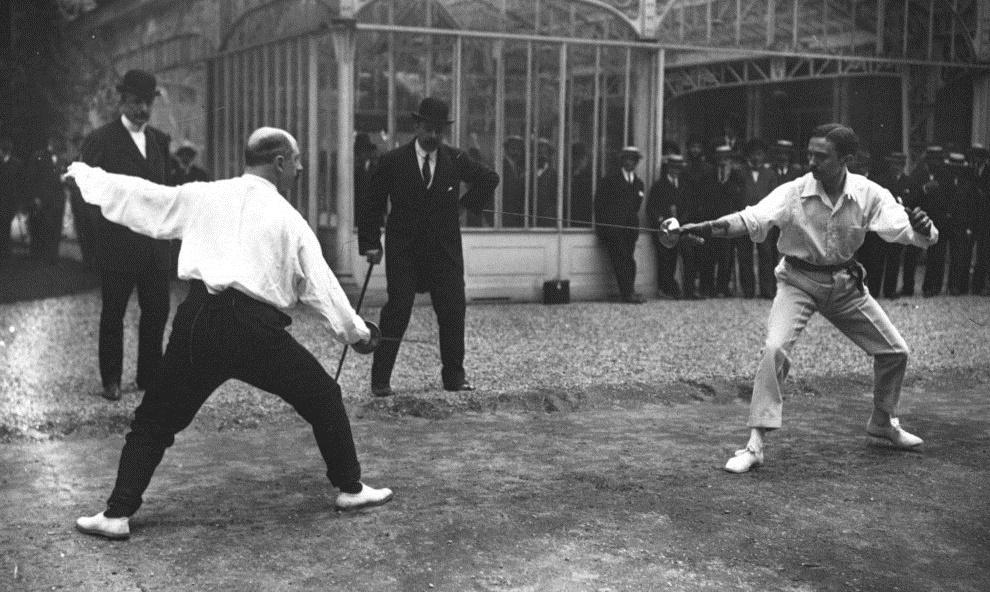
Of Honor
“Ne tirez l’épée que pour servir le Prince , conserver vôtre honneur ou défendre vôtre vie.”
“Draw not your sword, but to serve your king, preserve your honor, or defend your life.”
—le sieur Labat, L’art des armes, 1696, from Andrew Mahon’s translation, The Art of Fencing, 1734
“Never lose on purpose, you must always fence to win for your honor!”
—Lajos Csiszar, quoted by student Roger Jones, 2000. The quote dates to the 1950s, and probably earlier.
“To paraphrase Theodore Roosevelt, ‘the things that will destroy American fencing are victories at any price, prestige at any price, expenses first instead of honor first, and love of subsidies and the state-supported athlete theory of ‘amateur sports.'”
—Roger Jones, “Poor Technique?” in American Fencing, March 1966
Given the current state of USA Fencing, it’s quite clear that the future Roger Jones feared has come to pass. Roger was on the US Epee Team in 1955 and was an alternate in 1956, and was also a member of the US and FIE Rules Committees. He believed foremost in honor in fencing. Full disclosure: Roger was a friend of mine, whom I first met when he contacted me while writing a review of one of my books for Naval History Magazine as I recall (Roger was also a retired reservist US Navy Captain). It became quickly apparent when the subject passed to fencing — he’d read my letters to American Fencing magazine in which I deplored the recommendation of gamesmanship, or “cheating within the rules” as he termed it — that our views were similar, and for a reason: Italo Santelli was one of our fencing grandfathers and we’d both been trained by masters descended from Santelli. In fact, Roger had trained under Lajos Csiszar at the same time as my second master, Dr. Eugene Hamori. See also the Roger Jones quotes above.
“It is happily true that in England we no longer curb the indiscreet utterance of undisciplined lips with cold steel, nor adopt the crude method of letting in light upon the mind through a hole in the body.”
—Henry Arthur Colmore Dunn, Fencing, 1899
“So in their own sense Duelling cannot properly vindicat[e] any opprobrious epithet, but that of a Coward.”
—Wm. Anstruther, Essays, Moral and Divine, 1701
“I mention these to caution you on all occasions to be on your Guard, and not to trust any man whatever who is your adversary. For many have been deceived by not taking care of themselves in these cases, tho’ their adversaries have been men of strict honour, as they thought, and that they would not be so base and villainous as to be guilty of any thing below the character of Brave Men and Gentlemen. Experientiæ Docet.”
—Donald McBane, Expert Sword-man’s Companion, 1728. McBane, a Scot, was a veteran soldier wounded several times in action, as well as a swordsman, duelist, fencing master, occasional pimp, and prize fighter. He is also the man for whom “Soldier’s Leap” is named in Scotland. Good advice not only for a duel, but for life in general. Experientiæ Docet is an abbreviated form of Experientiæ Docet Stultos: Experience Teaches Fools. McBane appears to be making a subtle joke at his own expense.
“The honor of some adversaries can never be relied on safely. In a selfish or revengeful spirit, many persons might be disposed to commit assassination, for which reason, friends and time are always indispensable.”
“No boast, threat, trick, or stratagem, which may wound the feelings, or lessen the equality of the combatants, should ever enter into the contemplation of a gentleman.”
—Joseph Hamilton, The Approved Guide Through All the Stages of a Quarrel, 1829. The first quotation is in the vein of McBane, above. Many have honor in the mundane, when there is little risk to life, limb, property, money, or reputation; far fewer have honor where there is much risk or peril.
“Eh bien! les duellistes poitevins qui ont laissé à bon titre le renom d’adversaires dangereux, Bourbeau (un cousin de l’ancien ministre), Lemaire, le fameux de Pindray — jen passe — n’étaient pas classés parmi les forts tireurs. Je le tiens de mon vieux professeur, le père Nerrière, un maître de l’école de Lafaugère que M. Legouvé a peut-être connu et qui m’a répété plus d’une fois que de Pindray, redoutable, terrible sur le terrain, n’avait travaillé sérieusèment à la salle qu’après ses duels les plus retentissants.”
“Well! The duelists of Poitou who have left good title to being renowned as dangerous adversaries, Bourbeau (a cousin of the former minister), Lemaire, the famous de Pindray—I pass over others—were not classified among the strongest fencers. I learned from my old professor, Nerrière the father, a master of the school of Lafaugère that Mr. Legouvé has perhaps known and who told me more than once that de Pindray, deadly, terrible on the field of honor, trained seriously in the salle only after he had fought his most sensational duels.”
—Arthur Ranc, in the preface to Jules Jacob’s Le jeu de l’épée, revised by Émile André, 1887.
In other words, the best sport fencers did not usually make the best duelists. See also the quote below.
“I mention this affair to show that something more than skill is necessary when using a naked weapon or shotted pistol; and the most able fencer and the first-rate shot are not always the best men in the field.”
—Andrew Steinmetz, The Romance of Duelling, 1868.
“To avoid those Desperate Combats, my Advice is for all Gentlemen, to take a hearty Cup, and to Drink Friends to avoid Trouble.”
—Donald McBane, The Expert Sword-Man’s Companion, 1728. Again, good advice in general.

More From the Latin
Praemonitus praemunitus.
Forwarned is forearmed.
—quoted in Captain Blood: His Odyssey by Rafael Sabatini
Occasionem cognosce.
Recognize an opportunity.
Quaere verum.
Seek the truth.
Festina lente.
Make haste slowly.
Aut inveniam viam aut faciam.
Either I shall find a way or I shall make one.

Pen & Sword
“Pour un oui, pour un non, se battre, —ou faire un vers!”
“For a yes, for a no, to fight, —or write a verse!”
—Edmund Rostand, Cyrano de Bergerac, 1897.
“La plume s’associe fréquemment á l’épée…C’est que la littérature est une escrime intellectuelle et la polémique, á plus forte raison: arguments et objections y cliquettent autant que lames d’acier.“
“The pen is frequently associated with the sword…This is because literature is an intellectual fencing and controversy, even more so: arguments and objections click and clatter as much as steel blades.”
—Emma Lambotte, L’Escrimeuse, 1937. Mme. Lambotte was a noted Belgian poet and the muse and patron of painter James Ensor—and a fencer as well.
“Le fleuret, c’est la grammaire; l’épée c’est l’éloquence. Racine et Boileau écrivaient au fleuret; Shakespeare et Victor Hugo — à l’épée.”
“The foil is grammar; the epee is eloquence. Racine and Boileau wrote with the foil; Shakespeare and Victor Hugo — with the epee.”
—Aurélien Scholl, in the preface to Deux Écoles d’armes: L’escrime et le duel en Italie et en France by Daniel Cloutier, 1896. My translation. Today we might amend this to say “classical foil is grammar,” modern foil having departed, several decades ago, far from the rigor and conventions of classical foil.
The classical Italo-Hungarian foil I was taught almost fifty years was an excellent foundation even for modern epee, and held its own at all levels of domestic and international foil competition. But today’s “modern foil” is now the antithesis of the classical, of the epee, and of combat with sharps, in particular in having abandoned the requirement of the threat made by an extending or extended point directed at the target. A sophistry has taken its place: an invalid attack (aka a “bent arm” attack, an “attack in invitation,” what amounts to a suicidal attack with sharps) is today a valid attack solely because it is now defined as one, via the perverse mental gymnastics that argue that “it doesn’t matter if the point is not initially directed at the target during an attack because it will eventually arrive there.” But it likely won’t if the attacker first runs onto the adversary’s point, contrary to the likelihood of a point already directed at the target. The modern answer to this reality? To simply disallow it in the rules.
“Tomando ora la espada, ora la pluma.”
“Now taking up the sword, now the pen.”
—Garcilaso de la Vega, Égloga III (v.40), early 16th century. Garcilaso was a 16th century Spanish soldier-poet and true Renaissance man. He died in 1536 of wounds suffered in battle at Le Muy, France. Armas y lettras—arms and letters—is a common theme in 16th and 17th century Spanish literature.
“Nunca la lanza embotó la pluma ni la pluma la lanza.”
“The lance never blunted the pen nor the pen the lance.”
—Sancho Panza in Don Quixote by Miguel de Cervantes
“I’ll make thee glorious by my pen,
and famous by my sword;”
—James Graham, Marquis of Montrose, “I’ll never love Thee more,” 1642 or 1643. Sir Walter Scott reversed glorious and famous, apparently not appreciating the attachment of glory to the pen. Montrose, a Scottish hero, led a guerrilla campaign through the Highlands against Cromwell’s forces. In the end he was hanged, instead of being beheaded as was due given his rank. His body was decapitated after his death, and his head was piked at the Tollbooth in Edinburgh.
To the Reader.
Harke, Reader, would’st be learn’d ith’ Warres,
A Captaine in a gowne?
Strike a league with Bookes and Starres,
And weave of both the Crowne?
Would’st be a Wonder? Such a one
As would winne with a Looke?
A Schollar in a Garrison?
And conquer by the Booke?
Take then this Mathematick Shield,
And henceforth by its Rules,
Be able to dispute ith Field,
And combate in the Schooles.
Whil’st peacefull Learning once agen
And th’ Souldier do concorde,
As that he fights now with her Penne,
And shes writes with his Sword.
RICH LOVELACE
A. Glouces. Oxon.
—Richard Lovelace, the famous cavalier poet, in the preface to Pallas Armata: The Gentlemen’s Armorie by G. A. (probably Gideon Ashwell according to sword scholar J. D. Aylward), 1639
“…the penny siller [silver] slew mair souls than the naked sword slew bodies.”
—Sir Walter Scott, Rob Roy, 1818. Not the pen, but something like it in that it can be used for both good and evil.
“[H]ow much more cruel the pen may be than the sword.”
—Robert Burton, The Anatomy of Melancholy, 1621
“Benbu itchi.”
“Pen and sword in accord.”
—Japanese, 17th century or earlier.
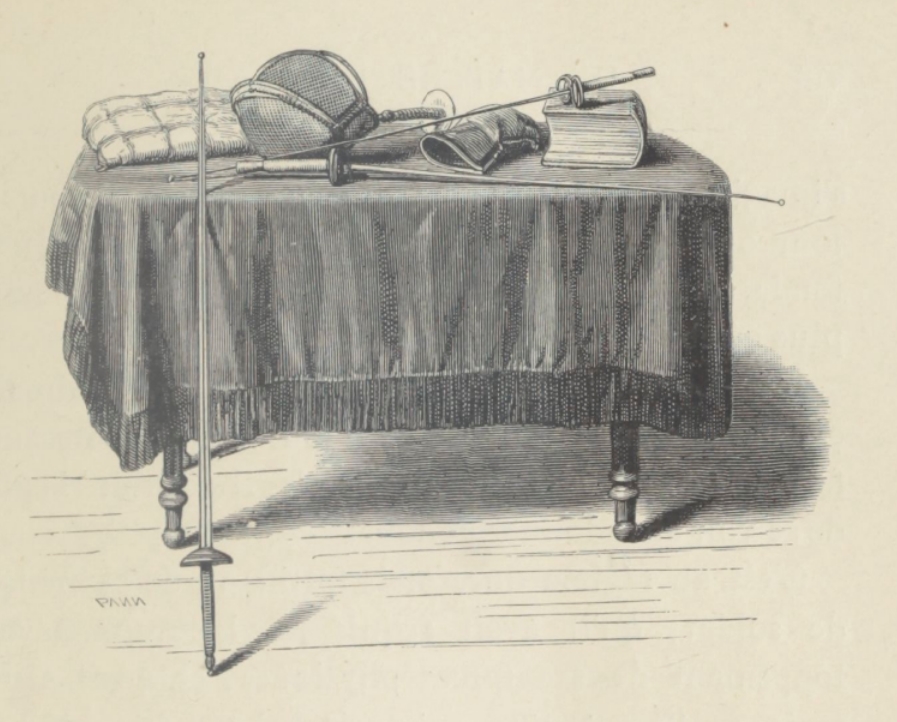
Fencing Language
“Hé là!”
—Literally, “Hey there!” Often shouted during a vigorous exchange ending in a successful touch, or at least it once was until recently. More embarrassingly, it is sometimes shouted in expectation of a touch that ultimately fails. In Cyrano de Bergerac is the shout “Hé! Là donc!”—that is, “Hey! There thus!” Many old French masters and fencers believed in absolute silence during swordplay, while many Italians permitted some expressions. An occasional Hé là! or similar ejaculation is acceptable in my opinion; anything else is boorish.
“Hé là, Pamela!”
—Dr. Francis Zold, in lessons he gave throughout his life. I once asked Chaba Pallaghy, an elite Hungarian and US fencer and international official who knew Dr. Zold well, what it meant, he said it was simply something that the gentleman, scholar, and swordsman said. So many times I heard him say this in my lessons when I did something well. It is as imprinted upon my fencing soul in the same manner as, “One more, one more, yes, very nice,” as spoken by Dr. Eugene Hamori in his lessons to me.
“When a young Country Gentleman comes to Town, and Steps in to a Fencing-School, and hears a Master desire his Scholar to Play Feint a La Teste, Botte Coupe, Flancanade, Under Counter; or to Dequarte and Volt; he is amazed at these Terms, and is perswaded, that there is a kind of Conjuring Magick in the Art…”
—Sir William Hope, A New, Short, and Easy Method of Fencing, 1714
“Mardieu, depuis le temps je me serois mis en garde, j’aurois gagné la mesure, je l’aurois rompue, j’aurois surpris le fort, j’aurois pris le temps, j’aurois coupé sous le bras, j’aurois marqué tous les batemens, j’aurois tiré la flanconade, j’aurois porté le coup de dessous, je me serois allongé de tierce sur les armes, j’aurois quarté du pied gauche, j’aurois marqué feinte à la pointe et dedans et dehors, j’aurois estramaçoné, ébranlé, empiété, engagé, volté, porté, paré, riposté, carté, passé, désarmé et tué vingt hommes.”
“God’s Death, in the time it would take to put myself on guard, I would gain the measure, retreat a step, surprise the forte, take the tempo, make a coupé beneath the arm, make all the beats, make a flanconnade, make a thrust below, lunge in tierce in opposition, make an inquartata, feint with the point inside and outside, make a cut, concuss my enemy, invade, engage, volt, thrust, parry, riposte, chase, pass, disarm, and kill twenty men.”
—Chasteauforte, in Cyrano de Bergerac’s Le Pedant Joué, 1654, written in 1645. Chasteauforte takes a beating while he talks about his prowess as a swordsman. The character probably derives from Plautus’ Miles Gloriosus, the boastful cowardly soldier, and from experience as well. As the Spanish might put it, He who boasts of it did not do it. If you want to be taken seriously, prove yourself with deeds, not words.
Mardieu is an exclamation deriving from mordieu or mort de Dieu = God’s death. Surpris le fort is to be found nowhere else in the literature of sword; it may be intended to indicate grasping the adversary’s blade at the forte with one’s hand, a common technique when grappling. It may also indicate a prise de fer or even simply a proper thrust, fort against foible. Or, it may be satire, suggesting that Chasteauforte is so foolish a fencer as to attempt with his own blade to seize the fort of his adversary’s, rather than the foible. The phrase “j’aurois quarté du pied gauche” (I would have quartered with the left foot) refers to what today is known as the inquartata, typically a counter-attack made while pivoting on the left foot in order to remove the body from the line of the adversary’s thrust.
The real Cyrano de Bergerac was a redoubtable swordsman who fought literally dozens of duels and affrays, and reportedly once singlehandedly routed a mob of a hundred or more, although it was likely far fewer. He also had a large nose, and was a famous French writer whose work includes the stories of trips to the moon and sun, a pair of the first science fiction and fantasy novels. Rostand’s Cyrano is a Gascon, based on his name, de Bergerac. However, the real Cyrano was a Parisian. My translation.
“Enter Petro drest like a French Fencing Master.
Pet. Signior Barberacho has sent me to teach you de Art of Fencing.
Sir Signall Buffoon. Illustrissimo Signior Monsieur, I am the person who am to learn.
Tickletext. Stay Sir stay,—let me ask him some few questions first, for Sir I have play’d at Back-Sword and cou’d have handled ye a weapon as well as any man of my time in the University.
Sir Sig. Say you so Mr. Tickletext, and I‘faith you shall have about with him
[Tick. Gravely goes to Petro.
Tick. Hum—hum—Mr. Monsieur—pray what are the Guards that you like best?
Pet. Monsieur, eder de Quart or de Terse, dey be both French and Itallian; den for your Parades, degaements, your advancements, your Eloynements, and Retierments: dey be de same;
Tick. Cart and Horse, what new found inventions and words have we here,—Sir I wou’d know, whether you like St. Georges Guard or not.
Pet. Alon—Monsieur, Mette vous en Guard! take de Flurette.
Sir Sig. nay faith and troth Governor thou that have a Rubbers with him.
[Tick. Smiling refuses.
Tick. Nay certo Sir Signal,—and yet you shall prevail;—well Sir, come your ways?
[Takes the Fluret.
Pet. Set your right foot forward, turn up your hand so—dat be de Quart—now turn it dus—and that be de Terse.
Tick. Hocus Pocus, Hicksius Doxius—here be de Cart, and here be de Horse—why, what’s all this for, hah, Sir—and where’s your Guard all this while?
Sir Sig. Ay, Sir, where’s your Guard, Sir, as my Governour says, Sir, hah?
Tick. Come, come, Sir, I must instruct you, I see; Come your ways, Sir.—
Pet. Attende, attende une peu—trust de right hand and de right leg forward together.—
Tick. I marry Sir, that’s a good one indeed: What shall become of my Head then, Sir? what Guard have I left for that, good Mr. Monsieur, hah?
Pet. Ah, Morbleu, is not dis for everyting?
Tick. No, marry is not it, Sir; St. George’s Guard is best for the Head whilst you live—as thus, Sir.
Pet. Dat, Sir, ha, ha—dat be de Guard for de Back-Sword.
Tick. Back-sword, Sir, yes, Back-sword, what shou’d it be else?
Pet. And dis be de Single Rapier.
Tick. Single-Rapier with a Vengeance, there’s a weapon for a Gentleman indeed; is all this stir about Single-Rapier?
Pet. Single-Rapier! What wou’d you have for de Gentleman, de Cudgel for de Gentleman?
Tick. No, Sir, but I wou’d have it for de Rascally Frenchman, who comes to abuse Persons of Quality with paltry single Rapier.—Single Rapier! Come, Sir, come—put your self in your Cart and your Horse as you call it, and I’ll shew you the difference.”
—Aphra Behn, The Feign’d Curtizans; or, a Night’s Intrigue, 1679. Satire on a fencing lesson and fencing language, in other words, with sallies against French masters and backsword versus smallsword or, as it is called here, single rapier. Aphra Behn was the first professional woman writer in the UK. She was also briefly a spy.
“For at Broad-Sword, all the Blows, Chops, Strokes, Pitches, Thro’s, Flirts and Slips, are perform’d over the Point of the Sword, unless you fall to the Leg: But at Small-Sword, all Thrusts, Passes, Pushes, Assaults, Essays and Passages, are commonly made under the Shell, (unless it be Cart or Ters over Arm,) close to the Fort of your Opponents Weapon, with a Longe, or you cannot reach to do Execution.”
“The next thing I shall proceed to, is to the Terms of Art and Variety of Assaults, Pushes, Thrusts, Essays, Passes and Passages, all which are lodged under the Notion of True and False Play. True Play is a clean made Pass, Push, Assault or Thrust, directly perform’d, without change or alteration of the Point of your Weapon at any part or place of your Opponent you discover lies most open, or in answering your Opponent from his Assault. False Play or Falsifying, I call Quibles, Dazzels, Feints, Fallacies, Shams, Decoi’s and Enganuo’s, all which I shall explain in their Order.”
—Zachary Wylde, The English Master of Defence, 1711. Much of Mr. Wylde’s charming fencing vocabulary is his, and his alone.
“From a room beyond, the door of which was closed, came the stamping of feet, the click and slither of steel upon steel, and dominating these sounds a vibrant, sonorous voice speaking a language that was certainly French; but such French as is never heard outside a fencing-school. “Coulez! Mais, coulez donc!…So! Now the flanconnade—en carte…And here is the riposte…Let us begin again. Come! The ward of tierce…Make the coupé, and then the quinte par dessus les armes…O, mais allongez! Allongez! Allez au fond!” the voice cried in expostulation. “Come, that was better.” The blades ceased.”
—Rafael Sabatini, Scaramouche, 1921

Revenge with a Sword
“Honor and revenge have no alliance; therefore, reparation for offence or injury, is all that can be fairly sought for, or conceded.”
—Joseph Hamilton, The Approved Guide Through All the Stages of a Quarrel, 1829. In other words, a duel must be fought for the sake of honor alone. A combat for the sake of revenge is a mere single combat, yet should, paradoxically, still be fought with honor, at least until the villain, Hollywood style, betrays his honor, which is probably why the rencontre is being fought in the first place.
“Oui, s’écria-t-il, voici la fille de Nevers!….Viens donc la chercher derrière mon épée, assassin! toi qui as commandé le meurtre, toi qui l’as achevé lâchement par derrière!… Qui que tu sois, ta main gardera ma marque. Je te reconnaîtrai. Et, quand il sera temps, si tu ne viens pas à Lagardère, Lagardère ira à toi!”
“Yes, cried he, here is the daughter of Nevers!….Come therefore and search for her behind my sword, assassin! You who have commanded murder, you who have achieved it by backstabbing cowardice! Whoever you are, your hand has my mark. I will recognize you. And when the time comes, if you will not come to Lagardère, Lagardère will come to you!”
—Lagardère, in Paul Feval’s Le Bossu, 1857. Feval, along with Dumas (who probably inspired him) et al, helped establish the swashbuckling genre in literature. He also wrote a series each of vampire and crime detection novels. The phrase, “Si tu ne viens pas à Lagardère, Lagardère ira à toi!” became proverbial in France. My translation.
“In both men the same grim determination prevailed. The opponent must be killed; there could be no half-measures here.”
—Rafael Sabatini, Scaramouche, 1921
“The next morning, Inigo began the track-down. He had it all carefully planned in his mind. He would find the six-fingered man. He would go up to him. He would say simply, “Hello, my name is Inigo Montoya, you killed my father, prepare to die,” and then, oh then, the duel.”
—William Goldman, The Princess Bride, 1973
“I shall write villain upon him with my rapier’s point.”
—Sir Arthur Conan Doyle, Micah Clarke, 1894
“Then I’ll take her when you’re dead.”
—Peter Blood, in Captain Blood by Rafael Sabatini, 1922. Captain Blood engages Captain Levasseur in a rencontre on the beach of Virgin Magra, Sabatini’s joke on the name of Virgin Gorda. In the novel the duel is but briefly described, but is one of the highlights of the 1935 film version with Errol Flynn. The film duel appropriates for its finale the trick of fence described in Sabatini’s The Black Swan. The duel was filmed at Three Arch Bay, just south of Laguna Beach. Naturally, the duel, only briefly described, is over a woman’s honor on the one hand, and over her possession on the other.
“‘Proud and insolent youth,’ said Hook, ‘prepare to meet thy doom.’
‘Dark and sinister man,’ Peter answered, ‘have at thee.'”
—J. M. Barrie, Peter and Wendy (also Peter Pan, Peter Pan and Wendy), 1911.
Too often the phrase “Have at thee”—which means “I shall attack you” or ‘I’m going to attack you”—is altered ludicrously in film and stage to “Have at me!” or even more ludicrously is changed to something on the order of “Let’s do this” on the assumption that the audience is filled with idiots.

Some Shakespeare
“He jests at scars that never felt a wound.”
—Wm. Shakespeare, Romeo and Juliet, Act 2, Scene 2.
“MERCUTIO O calm, dishonourable, vile submission!
Alla stoccata carries it away.
[Draws]
Tybalt, you rat-catcher, will you walk?
TYBALT What wouldst thou have with me?
MERCUTIO Good king of cats, nothing but one of your nine
lives; that I mean to make bold withal, and as you
shall use me hereafter, drybeat the rest of the
eight. Will you pluck your sword out of his pitcher
by the ears? make haste, lest mine be about your
ears ere it be out.
TYBALT I am for you.
[Drawing]
ROMEO Gentle Mercutio, put thy rapier up.
MERCUTIO Come, sir, your passado.
[They fight]”
***
“MERCUTIO Zounds, a dog, a rat, a mouse, a
cat, to scratch a man to death! a braggart, a
rogue, a villain, that fights by the book of
arithmetic!”
—Wm. Shakespeare, Romeo and Juliet, Act 3, Scene 1. The “book of arithmetic” reference is to forms of rapier play emphasizing geometry, the extreme form of which was the Spanish verdadera destreza mocked by poet and playwright Francisco de Quevedo.
“HAMLET This likes me well. These foils have all a length?
***
OSRIC A hit, a very palpable hit.
***
LAERTES A touch, a touch, I do confess ‘t.
***
HAMLET Come, for the third, Laertes: you but dally;
I pray you, pass with your best violence;
I am afeard you make a wanton of me.”
—William Shakespeare, Hamlet
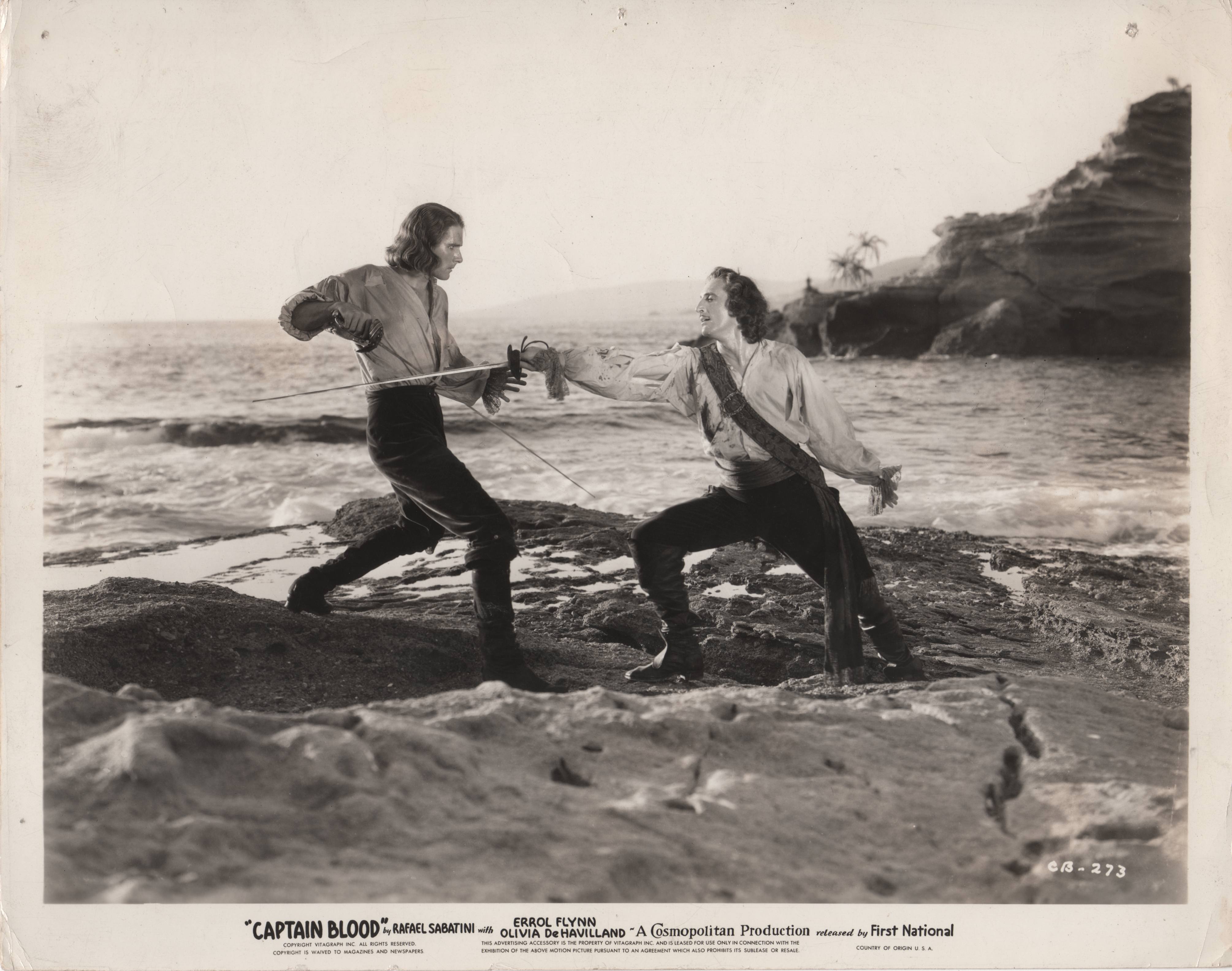
More from Swashbuckling Literature & Film
“Villain, unhand the Lady, and defend thy self. [Draws
***
Have at thee—St. George for England.”
—Lovewell in Love and a Bottle by George Farquhar, 1698
“Un pour tous! Tous pour un!”
“One for all! All for one!”
—Alexandre Dumas, Les Trois Mousquetaires, 1844. The lines are often misquoted or poorly translated as “All for one and one for all!”
“Les coquilles tintent, ding-don.
* * *
Prince, demande á Dieu pardon!
Je quarte du pied, j’escarmouche,
Je coupe, je feinte…
(Se fendant.)
Hé! Là donc!
(Le vicomte chancelle; Cyrano salue.)
A la fin de l’envoi, je touche.”
“The shells ring, ding dong.
* * *
Prince, ask God for pardon!
I thrust in fourth, I skirmish,
I cutover, I feint…
(Lunging.)
Hey! There thus!
The viscount staggers; Cyrano salutes.
At the end of the refrain, I touch.”
—Edmund Rostand, Cyrano de Bergerac, 1897. My translation. The phrase “Je quarte du pied” is almost certainly shorthand for a phrase Cyrano himself used in his 1654 play, Le Pedant Joué: “j’aurois quarté du pied gauche.” The term refers to the inquartata, generally defined as a counter-attack made while pivoting a quarter turn on the right (leading, left for a left-hander) foot toward the outside in order to remove the body from the line of the adversary’s attack. Escarmouche means to skirmish–to aggressively reconnoiter, in other words. The word may also hint at the character Scaramouche–a “little skirmisher” who is often beaten–in the Italian commedia dell’arte. Rafael Sabatini’s famous novel Scaramouche is a classic of the character and of expert swordplay.
“Without more words they fell to and for a space there was no advantage to either blade. Peter was a superb swordsman, and parried with dazzling rapidity; ever and anon he followed up a feint with a short lunge that got past his foe’s defence, but his shorter reach stood him in ill stead, and he could not drive the steel home. Hook, scarcely his inferior in brilliancy, but not quite so nimble in wrist play, forced him back by the weight of his onset, hoping suddenly to end all with a favourite thrust, taught him long ago by Barbecue [Long John Silver] at Rio; but to his astonishment he found this thrust turned aside again and again. The he sought to close and give the quietus with his iron hook, which all this time had been pawing the air; but Peter doubled under it and, lunging fiercely, pierced him in the ribs.”
J. M. Barrie, Peter and Wendy, 1911
“Your swordsmanship? Where did you learn the blade?”
“In Spain, señorita, where there are no eyes like yours.”
—The Mark of Zorro starring Douglas Fairbanks, 1920
“He heard them, wheeled about, flung off his coat, and disengaged his sword, all with the speed of lightning and the address of the man who for ten years had walked amid perils, and learned to depend on his blade.”
“‘You fence skillfully,’ said he, sneering, ‘too skillfully for an honest man. Will you now tell me without any more of this, precisely what the Princess Sophia was doing here with you?'”
—Rafael Sabatini, “The Tragedy of Herrenhausen” in The Historical Nights Entertainment, 1917. The story concerns the Swedish Count of Konigsmark and his affair, physical or otherwise, with the Princess Sophia Dorothea, wife of the unfaithful and crude yet intellectually enlightened Georg Ludwig, ruler of Hanover in Germany and the future George I of Great Britain. Most historians believe the Count was murdered on the order of Georg Ludwig. His brother is credited with inventing the colichemarde blade although the form was around before him. If the brother had any part in its more modern invention and use, the inspiration may have come from some of the by light, well-balanced Spanish rapier blades thick at the forte, or even from some of the rapier-style colichemarde blades found in some Dutch or German transitional swords. More likely, Konigsmark might be credited with naming the blade perhaps because he wore one, thereby popularizing an already exiting form.
“He was born with a gift of laughter and a sense that the world was mad.”
“Oh, you are surely mad! M. de La Tour d’Azyr is reputed the most dangerous sword in France.”
“Have you never noticed that most reputations are undeserved?”
“The slender, wickedly delicate blades clashed together, and after a momentary glizade were whirling, swift and bright as lightnings, and almost as impossible to follow with the eye.”
—Rafael Sabatini, Scaramouche, 1921. The gift of laughter quote was added to a Yale dormitory during construction in the 1930s, then ordered covered over with ivy when it was discovered by Yale dons that the quote was from a “mere” popular novelist. It has since been restored.
“The light of guttering candles fell upon the two small-swords where they lay, the one glittering brightly, the other its murderous steel horribly bent and dimmed…”
—Jeffery Farnol, Sir John Dering, 1923
“Clash and ring of vicious steel that flickered in close and deadly action; stamp of feet and hiss of quick-drawn breath; skill and scorn of death against murderous craft and imperious will. To and fro, up and down, back and forth, they fought with no stay or respite now, changing their ground with nimble volts and dexterous passes, while slowly yet surely, Adam compelled his enemy in the one direction.”
“Sir,” he sighed, “as one swordsman and maître d’armes academique to another, I do here acknowledge a palpable hit and cry: ‘Touché!’ Indeed, you have tongue nimble and unexpected as your sword. Sir, I can appreciate wit, I can admire swordcraft, but though you possess both, I regret to say you prove yourself so extreme detestable that I propose to rid myself of you once and for all.”
—Jeffery Farnol, Adam Penfeather, Buccaneer, 1940
“Rash, you think? Precipitate on both sides? Absolutely, the pair of them going off at half-cock like that, in a place where both were imposters and liable to have to do some awkward explaining–aye, but when two such as Black Bilbo and Long Ben Avery cross swords, d’ye see, then sense and reason take wing, wi’ a wannion, and naught’s to matter save the bright eyes and whirling point o’ th’adversary. There isn’t an instant to draw a breath, or spit a curse (like “Ha, villain!” or “Government ponce!”), or mess about with the furniture, for this is world title stuff, from prime to octave, high lines and low, wi’ imbroccata, stoccata, alongez, and all that jazz, the two lithe figures shuffling, gliding and lunging with what looks like a bright buzz-saw flickering and clashing between them, too fast for the eye to follow.”
—George MacDonald Fraser, The Pyrates, 1984
“Kiss my steel!” cried the gallant gaily, and the little Milburn, seeing the chance to deliver the best riposte in the whole encounter, cried: “Kiss my arse!” and died happy.
—George MacDonald Fraser, The Reivers, 2007
“Inigo Montoya: You are using Bonetti’s Defense against me, ah?
Man in Black: I thought it fitting considering the rocky terrain.
Inigo Montoya: Naturally, you must expect me to attack with Capo Ferro?
Man in Black: Naturally, but I find that Thibault cancels out Capo Ferro. Don’t you?
Inigo Montoya: Unless the enemy has studied his Agrippa… which I have!
* * *
Inigo Montoya: You are wonderful.
Man in Black: Thank you; I’ve worked hard to become so.
Inigo Montoya: I admit it, you are better than I am.
Man in Black: Then why are you smiling?
Inigo Montoya: Because I know something you don’t know.
Man in Black: And what is that?
Inigo Montoya: I… am not left-handed.
Man in Black: You are amazing.
Inigo Montoya: I ought to be, after 20 years.
Man in Black: Oh, there’s something I ought to tell you.
Inigo Montoya: Tell me.
Man in Black: I’m not left-handed either.”
—Dialogue from the film The Princess Bride, 1987. The fencing masters named are real, but the associated tactics are mere Hollywood, likely intended as homage or just mere color. The duel was choreographed by Bob Anderson. In the novel, this dialogue does not exist. Instead, the masters and tactics are part of the narrative description. Author and screenwriter William Goldman also mentions “McBone,” a likely deliberate alteration of, or error for, Scottish swordsman and fencing master Donald McBane.
Truly ambidextrous fencers are rare. In almost fifty years I’ve met only one, Professor Ted Cotton, although my wife Mary Crouch could likely become one if she so chose, one of the founders of fencing in Huntsville, John Jordan, could also fence well enough left-handed, two of our current members routinely switch hands, and I myself can fence tolerably well with my offhand and have begun to use it regularly. Professor Cotton would wear a back-zip jacket and had a body cord down each arm, and would fence his opponents left or right as he thought best. Italian epee great Edoardo Mangiarotti, a right-hander, was taught to fence left-handed by his father in order to give him a competitive advantage, but it is said that he could fence just as well right-handed.
Copyright Benerson Little, 1977-2025. First posted December 19, 2018. Last updated January 15, 2025.

Fencing Salles & Fencing Commandments

German fencing school mid-eighteenth century. Not only is the smallsword being practiced (or competed in, given that there are a few marshals or directeurs de combat) with foils, but also sword and dagger, two-handed sword, dusack (a short cutting sword similar to a cutlass or falchion), halberd, and quarterstaff. The galleries and stands are full of spectators, fencers and fighters are taking refreshment, and women are (probably) feigning interest in the martial spectacle. The Rijksmuseum, the source of this image, has three high resolution versions, each with slightly different coloration.
The fencing salle, or school or club, if you will, is a hall of mirrors to the soul, and if not to the soul, then at least to fundamental character. It is a magical place whose special sights and insights are enriched by a special language accented with the unmistakable sounds of blade on blade.
Perhaps Rafael Sabatini put it best in Scaramouche (1921):
“From a room beyond, the door of which was closed, came the stamping of feet, the click and slither of steel upon steel, and dominating these sounds a vibrant, sonorous voice speaking a language that was certainly French; but such French as is never heard outside a fencing-school. ‘Coulez! Mais, coulez donc!…So! Now the flanconnade—en carte…And here is the riposte…Let us begin again. Come! The ward of tierce…Make the coupé, and then the quinte par dessus les armes…O, mais allongez! Allongez! Allez au fond!’ the voice cried in expostulation. ‘Come, that was better.” The blades ceased.”
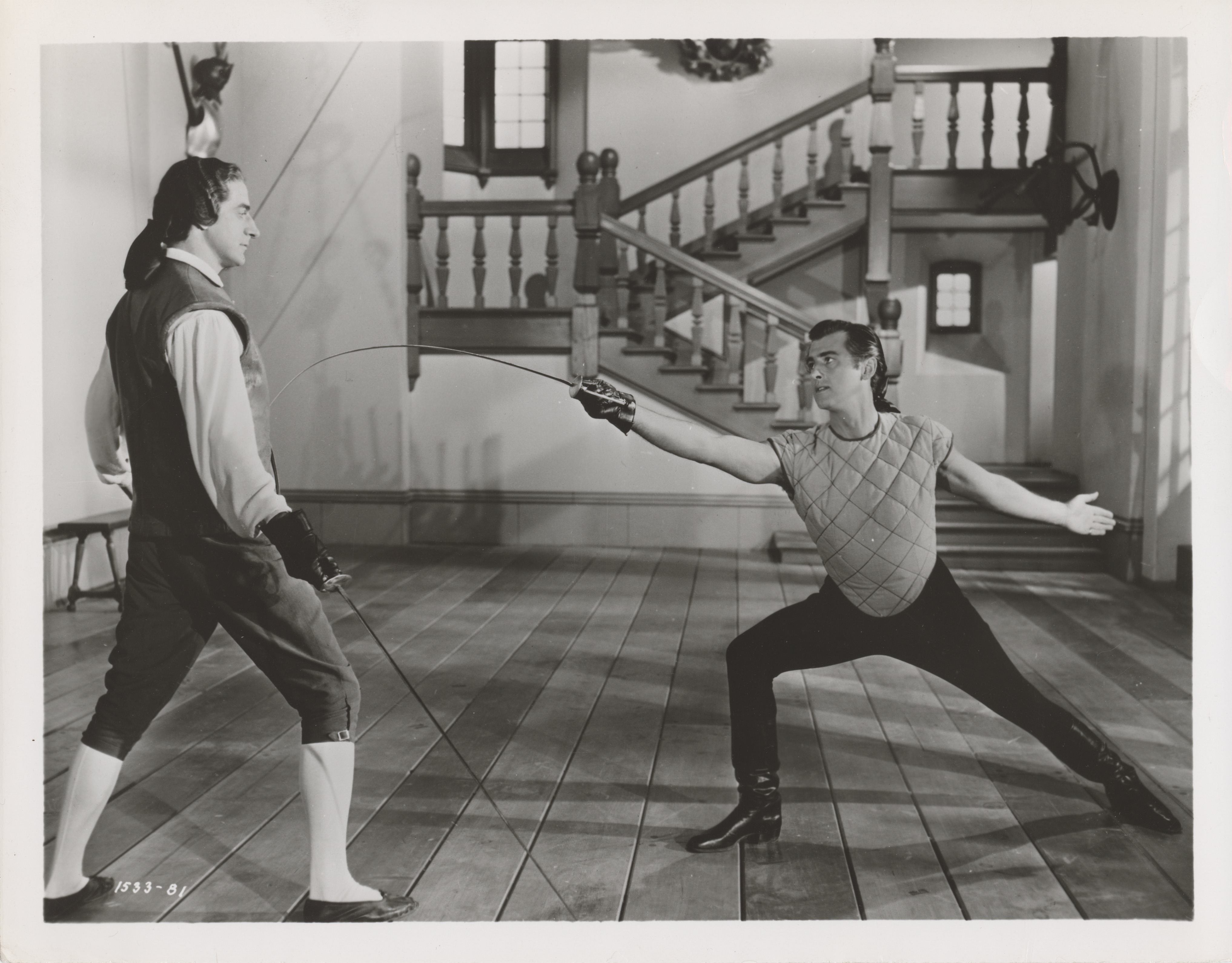
Stewart Granger (right) as Andre Moreau in Scaramouche (MGM 1952), a film about the French Revolution that avoids depicting its mass brutality. Still, it’s an enjoyable diversion. Fencing master Doutreval of Dijon (a character made up for the film–in the book it is Bertrand des Amis), played here by John Dehner, gives a much too wide invitation upon which Granger attacks in tempo. Appropriately, or mostly so, neither master nor student is wearing a mask. Although masks would soon become fairly common, many early masters eschewed them, believing they would lead to sloppy fencing. They are used in the book, however. Inappropriately, neither man wears the fencing shoes common to the era. Happily, though, Doutreval quotes a now-famous description of how to hold a foil: like a little bird, not so loose that it might escape, and not so tightly that you choke it. (The original, as opposed to film, quotation: “Tenez votre épée comme si vous aviez dans la main un petit oiseau: assez ferme pour ne pas le laisser échapper, mais pas assez fort pour l’étoufler.“) The quote is not used in Sabatini’s book. Although I once heard it attributed to Louis Justin Lafaugére, I’ve only found it in Essais sur l’Escrime by Richard de la Pervanchère (1867). Given that Jean Heremans choreographed the swordplay, we might perhaps give him credit for resurrecting it. Of course, this grip is not quite appropriate today, although I do teach it for use with the aid fingers (middle, ring, and little): the modern vice grip between manipulators (thumb and forefinger) would not be good for the bird in the hand… Shifting now to the other subject of this post, that of behavior on strip, co-star Eleanor Parker said she and everyone on set found Stewart Granger insufferable.
And with the fencing salle come a few rules for honorable deportment, as suitable today as they were in the past. And, as the lessons of fencing are apt for the world beyond, so too are the core of its courtesies and other appropriate behaviors.
Many have been recently eroded, at least to a greater degree than in the past, among modern or “Olympic” fencers, largely due to the Federation Internationale d’Escrime’s rather abject submission to the International Olympic Committee’s desire to have Olympic sports present [melo]dramatic “spectacles” designed solely to increase viewership and therefore income from advertising. National fencing bodies typically willing to go along with almost anything as long as it means that fencing will remain an Olympic sport, no matter in what form, play a significant role as well.
Even so, all styles of swordplay are seeing rules of fencing etiquette debased by the competing egos of many fencing masters, teachers, coaches, and fencers themselves, in addition to the general degeneration of civility, including the practices of honor and humility, these days.
N.B. I am by definition a “modern” fencer, although I also practice classical and historical fencing. Any criticisms therefore are not those of an outsider attempting to disparage modern fencing or other forms of swordplay.

“Der Fechtende Student” by “Dendrono” aka Johann Georg Puschner (Nuremberg, 1725). Note how the foils are hung, the fencing shoes under the bench, the fencing master with his plastron, the list of rules posted on the wall, the large windows for light, and the vaulting horse, common in fencing salles at the time. The foils are very typical of the German style.
Here therefore are a few rules and guidelines of recommended behavior in the salle, from recent years to past centuries, with some of my own thrown in near the end of the post. I am intentionally avoiding excessively in-depth commentary on the behavior of many fencers today, for it would probably quickly turn into a near-rant. Thankfully, the majority of fencers today, in all forms of legitimate swordplay, still behave with excellent deportment on the strip–but it doesn’t take too many bad apples to spoil the reputation of a sport or other organized skill.
I’ll make two important points up front. First, the best way to teach good behavior in the fencing salle, and everywhere, is by example. Younger fencers are far more likely to behave with courtesy and dignity if they have the good examples and associated expectations of their fencing teachers, veteran fencers, and experienced peers. It starts at the top. Unfortunately, some of the most egregious violations are often found here.
Second, I don’t want this to turn into an “Olympic” or sport fencers versus classical and historical fencers. I’m ecumenical when it comes to fencing. I’ve practiced many forms of swordplay over the past forty or so years, and I’ve seen plenty of poor behavior in the form of various violations of the following rules and guidelines among members of all three groups, and among others as well. But to repeat, most fencers, no matter their preferred form of swordplay, still manage to behave well on the strip.

“Le Maistre d’Armes” by Nicolas Bonnart, from his Recueil des Modes de la Cour de France, 1678-1693. (LACMA)
Muriel Witte in American Fencing magazine, 1966

Muriel Witte, American Fencing magazine, March 1966.
Regarding number 6, some fencers past fencers would ask for or accept odds, and some today do so as well, either by having the weaker fencer’s touches count for more, or by setting a goal the weaker fencer much reach in a five, ten, or fifteen touch bout. For example, the weaker fencer wins if he gets to five touches before the stronger gets to ten. This was never a practice in the salles where I learned to fence, and I have never engaged in it. The odds are rarely well-balanced, usually favoring one or the other of the fencers.
A better practice is to avoid setting odds or a handicap, and instead set a goal of touches against your opponent, averaging them over time and working to score above this level if you’re the weaker fencer, or to improve the distance if you’re the stronger (and if you’re significantly stronger, just fence and don’t worry about the distance between scores). Too often the more experienced fencer suggests odds that will push him or her, but such odds often don’t push the weaker fencer enough. For example, a balance of 15 to 5 strong to weak may be good for the stronger fencer, but a better balance might be 15 to 8 in order to push the weaker fencer more. Further, the setting of odds by the stronger fencer can often come across as patronizing, even arrogant, at times.
Number 7 dates to the days of gyms which made much use of natural light through high windows, and which some poor sports among fencers would take the side of the strip with better light (although in bouts for touches with dry weapons, fencers swapped sides after one fencer scored three touches or half the time expired). In fact, an old dueling tactic was to place your adversary on disadvantageous ground, for example with the sun or wind in his (or at times her) face. Dueling practice in the late 19th and 20th centuries tried to minimize any advantage one adversary might have over the other by way of terrain or weather.
Outdoor fencing is not done often enough these days, although some of us still enjoy it. Unfortunately, it’s no longer permitted as a format for earning ratings in epee by the USFA. (Or as it’s now called, USA Fencing, and prior to that US Fencing. It’s hard to keep up with the name changes. In fact, it was the AFLA–the Amateur Fencers League of America when I started fencing more than forty years ago.) And with the addition of relatively new ratings (D’s and E’s) plus a direct elimination format that vastly increases the likelihood of earning a rating as compared to the old pool system (which unfortunately produced a large percentage of under-rated fencers), we find a flood of rated fencers these days. As such, modern fencing has unfortunately become for many fencers “all about the rating,” with the result that there are far fewer “fun” tournaments than in the past. Nonetheless, there’s no reason not to hold outdoor epee tournaments on occasion, ideally set in picturesque or historic venues. I have fond memories of an outdoor epee event held on the grounds of a Florida beach hotel, for example.

From The Art of Fencing by Reginald and Louis Senac, “Professional Champions of America,” 1915.
“Decalogo Dello Schermidore” by Aldo Cerchiari and Edoardo Mangiarotti
From their book La Vera Scherma (Milan: Longanesi & Co, 1966). The commandments are also posted on the website of the famous Milanese Mangiarotti Fencing School. Edoardo Mangiarotti was easily one of the few truly great epeeists of the past century. All fencers should strictly abide by these precepts of fencing honor and fair play:

In translation…
1. Remember that you are the representative of the noblest of all sports. It unites fencers from around the world in the same ideal.
2. Practice your sport unselfishly and with absolute loyalty.
3. Be a gentleman or lady on the strip and off, from sport to social events.
4. Do not discuss fencing if you have not learned fencing and its rules.
5. Learn how to lose with dignity and win with honor.
6. Respect your opponent at all times, whoever he or she is, but try to overcome him or her in combat with all of your energy.
7. Remember that until the last thrust your opponent has not yet won.
8. Serenely accept a defeat rather than take advantage of a victory obtained by deception.
9. Do not step onto the fencing strip with defective weapons or with the white uniform in disarray.
10. Honor, respect and defend your name, the prestige of your master, the colors of your club, the flag of your country.
![[Rencontre_d'escrime_féminine_entre_Mme_[...]Agence_Rol_btv1b6910360f](https://benersonlittle.com/wp-content/uploads/2018/07/rencontre_descrime_fc3a9minine_entre_mme_-agence_rol_btv1b6910360f.jpeg)
“Rencontre d’escrime féminine entre Mme Rouvière et Alice [Aline] Guillemot, le 27 mai 1908, au Cercle Hoche.” Note the weapon racks on the wall, the formal attire, and the piste raised for the occasion. (Press photograph, Agence Rol, in the Bibliothèque Nationale de France.)
A Variety
“No boast, threat, trick, or stratagem, which may wound the feelings, or lessen the equality of the combatants, should ever enter into the contemplation of a gentleman.”
—Joseph Hamilton, The Approved Guide Through All the Stages of a Quarrel, 1829
“Never lose on purpose, you must always fence to win for your honor!”
—Lajos Csiszar, quoted by student Roger Jones, former member of the US 1955 and 1957 epee teams, alternate to the 1956 US Olympic epee team, member of both the AFLA (i.e. USA Fencing) and FIE rules committees, in an article dating to 2000, and in later conversation with me. The quote itself dates to the 1950s, and probably earlier. Csiszar was one of Italo Santelli’s three protégés (assistant fencing masters).
Roger himself best describes how Csiszar came to tell him this:
“The first time I fenced in Europe, I learned that cheating was part of the sport, unlike in the U.S. It was common for countrymen to throw bouts to the favorite during the early rounds, in order to improve his seeding for subsequent rounds. Csiszar hated this, as did I. He told me, “Never lose on purpose, you must always fence to win for your honor!” In the 1957 World Championships, an Austrian approached me just before our bout, which was the last one in the round. He pointed out that I would be eliminated even if I won, but that if he won, he would go on into the next round. He asked me to lose, saying “You speak German, therefore, we must stick together.” I refused, and then defeated him 5-2. Afterwards, I told Maestro about the incident, and he hugged me, saying “I knew you would always fight for your honor.” He made me feel so proud.”
—Roger Jones, “Fencing Generations,” manuscript, November 2000. Roger was an outstanding swordsman, business executive, writer, former naval officer, and gentleman who deplored the notion of gamesmanship and cheating in fencing. He passed away a few years ago.
“Your complete swordsman must be one who can place his hits with a gallant good grace, but one also who will not allow a clumsy opponent to prevail himself on any hap-hazard thrust.”
—Egerton Castle, “Swordsmanship Considered Historically and as a Sport,” 1903
“Gallant good grace” is too often forgotten today.
“Don’t flatter yourself in your Lessons, and still less in Assaults.”
“Be not angry at receiving a Thrust, but take care to avoid it.”
“Be not vain at the Thrusts you give, nor shew Contempt when you receive them.”
—Jean de Labat, L’Art en Fait d’Armes, 1692, as translate by Andrew Mahon, 1730
Labat has lots of good advice still relevant today.
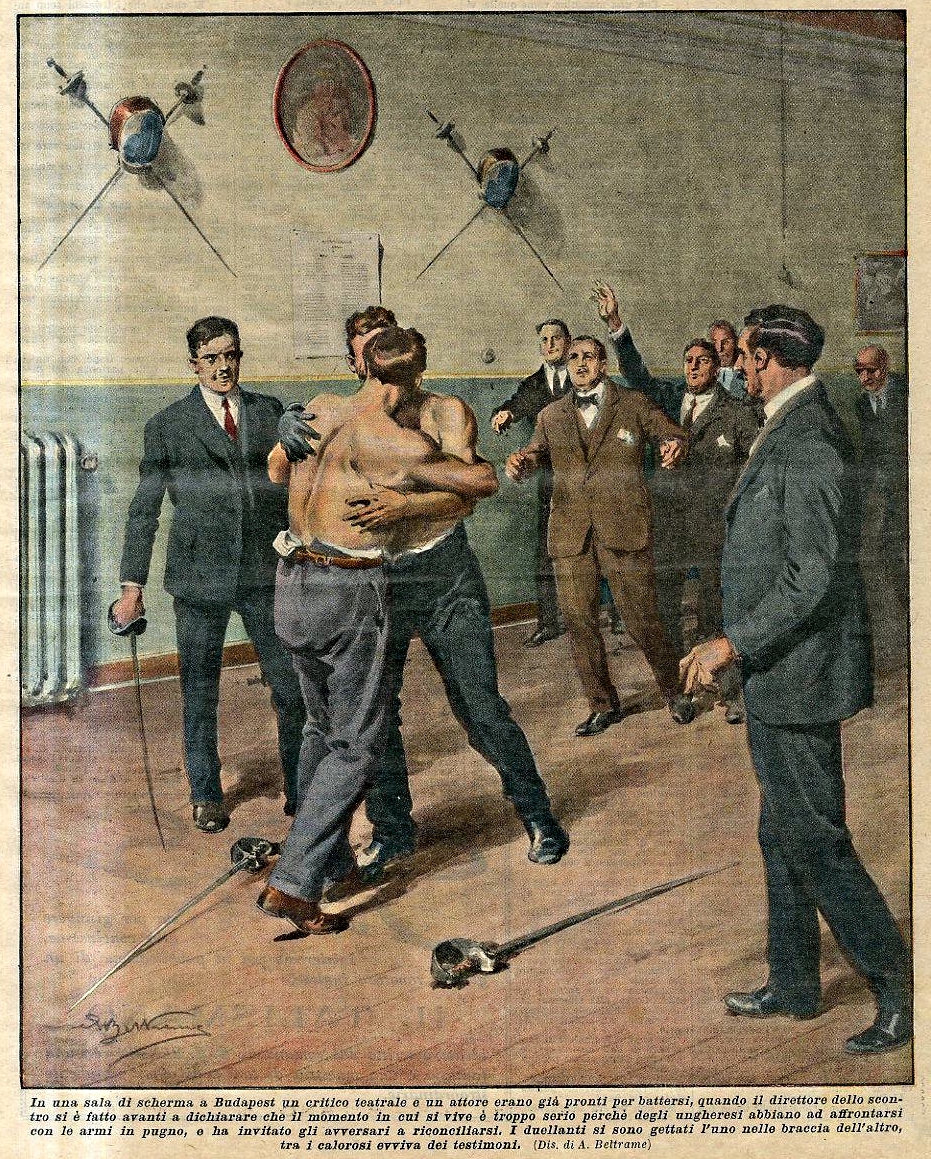
Immediate aftermath of a 1931 duel in a Budapest fencing salle–Salle Santelli, perhaps? The old master was known to regularly host duels. Hungarians were rabid duelists at the time; one newspaper article estimates six hundred annually. (A. Beltrame, for the cover of La Domenica del Corriere, 20 December 1931.)
“‘I have never,’ says M. [Ernest] Legouvé, ‘met a single fencer who would not–say once a year–deny that he had been touched when the hit was palpable. It is so easy to say ‘I did not feel it,’ and a hit not recognised does not count.'”
—H. Sutherland Edwards, “Fencing Schools,” Old & New Paris, vol. 2, 1894.
To summarize the quote above: You should always declare all touches against you when are fencing ‘dry’ in the salle!
That said, some masters will suggest that in the case of a competitive bout you leave it to the director and jury. I in turn leave this to your discretion and sense of honor. Personally, I would declare an obviously good touch unremarked by the judges.
Of course, not all touches are always obvious to giver or receiver, and allowance must be made for the possibility that the adversary did not feel a particular touch. In epee it is common for many of us to let our practice partner know that he or she hit, but that the touch was either late or flat.
There remains a vestige of the practice of declaring touches, or not declaring them, today in modern electrical epee fencing. In competitions on non-electric strips, I believe a fencer should declare a solid obvious touch on his foot in the case where the referee or floor judges have no opinion or state that no such touch was made. If, however, the fencer is unsure whether the touch was valid—when it might be just a scrape along the floor, a light touch, and so on—he or she should not declare it and leave the determination to the referee (who may overrule the floor judges). Even so, many coaches direct their fencers to never admit to a foot touch, or to any possible error that may favor the adversary, often justifying this on the premise that “It all evens out in the end.” I will always inform my adversary if, for example, I think his or her weapon is not working, and so forth. No victory in art or sport is worth anything if it is obtained through active or passive chicanery.
It is also a too-common practice, this not declaring of touches on occasion, among some classical and historical fencers today, and would be among modern fencers as well were it not for the electrical scoring apparatus. Certainly it was in the past when both saber practice and competitions were dry, and foil practice was typically conducted dry in order to suppress the “pig sticking” tendency induced by the electrical scoring apparatus. Over the past forty-two years I’ve met a number of fencers who were notorious for not declaring valid hits, over and above the possibility that they simply didn’t feel them. Of course, in saber there was a remedy: slowly escalate your hits, making them harder and harder until your adversary has choice but to declare them, if only by rubbing his arm… This was, and is, also the solution to saber fencers who consistently hit too hard.

Schermschool by Caspar Luyken, 1711. Note the unarmed hand position with the cutting swords as opposed to thrusting swords. Note also the danger to the unprotected face, the eyes in particular. (Rijksmuseum.)
And More Variety
“It is a polite custom to salute your opponent with your blade before the bout, and to offer him your hand at the end.”
“Once the fencer has taken the guard position, he must be considerate of his opponent. Neither fencer must talk during the bout. Fencing requires the greatest possible attention, and this may not be diverted in any way or for any reason except by fencing tactics.”
“In fencing against an opponent who acknowledges your superiority, sportsmanship demands that you do not make the most of your advantages; rather should you assist his swordplay as much as possible, and avoid placing him in a painful or ridiculous position by over-emphasizing your superiority.”
—Luigi Barbasetti, The Art of the Foil, 1932
Regarding Barbasetti’s third statement, it’s unfortunately far less common today to see fencers practicing this: many are unwilling, often solely for the sake of ego, to forgo even a few touches in the name of good sportsmanship. Another practice less often seen today is that of subtly “throwing” your opponent a touch to make up for a touch awarded against him or her due to a bad call by the director (known today as the “referee” in a bid to make fencing more “audience friendly”—I kid you not). Technically an illegal practice, its honorable intentions more than compensate for the breaking of the rule that the fencer must always fence to win.
Barbasetti’s first statement is now written into the rules due to the unsportsmanlike behavior in the past of a few fencers. See also Félix Gravé below.
“No Scholar nor Spectator without a licence from the Master, should offer to direct or give advice to any of the Scholars, who are either taking a Lesson or Assaulting… First, because without permission they take upon them to play the Master; And secondly, because they reprove oft-times their Commerads for the same very fault they themselves are most guilty of, although perhaps not sensible of, which when By-standers perceive, they smile at them (and with just reason) as being both ignorant and impertinent; therefore it would be a great deal more commendable in them, to be more careful in rectifying their own faults, and less strict in censuring others.”
—Sir William Hope, The Fencing Master’s Advice to His Scholar, 1692
More proof that not much has changed over the centuries.
“If you aren’t modest but show off your swordsmanship, you’ll be hated by people and be embarrassed.”
—Yagyu Muneyoshi, 17th century, translated by Hiroaki Sato.
“Though there are People of bad Taste in every Art or Science, there are more in that of Fencing than in others…”
—Jean de Labat, L’Art en Fait d’Armes, 1692, as translated by Andrew Mahon, 1730.
This is a sentiment I’ve heard more than once from much-experienced fencers over the last four or so decades, often expressed more narrowly: “There are more charlatans among fencing teachers than among any other sort of teachers.” Again, it’s more proof that not much has changed. The answer is simple: be of good taste, of good behavior, and of good knowledge, and let your behavior in the salle demonstrate this, whether you’re teaching or fencing. Or whatever, whenever.

“Schermschool van de Universiteit van Leiden” (Fencing School at the University of Leiden) by Willem Isaacsz van Swanenburg, after Jan Cornelisz van ‘t Woudt, 1614. On the walls are pole arms, matchlock muskets, dusacks, longswords, and foils (rapier). On the floor is the popular geometric outline associated with some forms of rapier footwork, along with a vaulting horse. Students are fencing with the rapier and the longsword, and one is practicing the various movements associated with loading, aiming, and firing a musket. (Rijksmuseum.)
“Don’t show any sign of bad temper if you are the loser.”
“Don’t get conceited, or be haughty, if you are the winner.”
“Don’t forget always to be modest and courteous.”
“If your adversary should prove far superior to you, do not show discontent or bad temper; do not be disheartened, keep up your style and do your best, no matter how badly you may be beaten. Take your defeat in the right spirit, it will help to improve you; take it as a lesson you needed. Remain always the “correct gentleman.”
“The use of the unarmed hand to parry an attack would be an incorrect movement; the use of the unarmed hand to make signs or attract the adversary’s attention would also be incorrect, whilst talking or conversing during the fight would be unruly.”
“[R]efuting a decision or arguing about the verdict of the judges would be considered bad form and ill-mannered.”
“Not shaking hands with an adversary after a match or a rencontre is a great lack of courtesy, and should be reprimanded. Saluting an adversary previously to the beginning of a bout should be done before placing the mask on the head.”
—Félix Gravé, Fencing Comprehensive, 1934
You may, of course, politely challenge the referee on the misapplication of a rule or the failure to apply a rule. Both occur far more often than they should, by the way, perhaps due in part to the modern “guild of referees” that values simple examination (and testing fees!) over experience in the practice and spirit of swordplay (and hasn’t improved refereeing at all). So know the rules, follow them, and be prepared to see them properly applied.
Even so, the best solution to bad refereeing/directing/judging is often the classic one: become good enough that the referee’s incompetence, bias, or, rarely, cheating, is irrelevant. In foil the old electrical scoring solution, and still a valid one today in foil and now saber too, was to make single-light touches, stripping the referee of the act of determining right-of-way.
As for shaking hands and saluting, the requirement has been written into the FIE and USFA rules due to repeated violations by a small number of fencers.

Second session of a recent beginning fencing class at the Huntsville Fencing Club. Photo by Amy Hitchcock.
A Few of My Own
These aren’t quite as eloquent or pithy as those above, but to quote Horace from his Ars Poetica in my defense, when I’m brief I’m often misunderstood.
1. My more modern take on Sir William Hope above: Do not give unsolicited fencing advice unless you’re an instructor giving it to one of your students, in which case it is by definition solicited. The principal exception is that of an experienced fencer politely suggesting a correction to an egregious error committed by a beginner. The fact that fencers often appear to accept such advice can be deceiving: it may simply be politeness or mere uncertainly as to whether the novice should tell the advanced fencer to please just be quiet and fence.
2. Given that many beginners are avidly seeking fencing knowledge, and can thus be easily misled, it is incumbent upon fencers giving advice to ensure that such advice is not only solicited and correct, but useful and appropriate to the recipient. Provide only what you know for certain from experience, never what you think you know. Importantly, make sure your advice is suitable the fencer you’re giving it to. Too often, fencers assume that what is good for them is good everyone. Further, many fencers have not yet reached the level at which all good advice may be of use. In other words, don’t provide advice that’s over the fencer’s head or inaccessible due to the level of technique required. And if you’re giving advice to show off: Don’t! In sum, don’t be a know-it-all. (See also Cerchiari & Mangiarotti #4 above).
3. For a stronger fencer to constantly shout “I missed!” when fencing a weaker fencer, or any fencer for that matter, is not only rude and patronizing, but ignores the fact that his or her adversary is probably missing often too.
At the very least it can be an annoying distraction.
“I missed!” is often shouted by some advanced fencers when hit by weaker fencers, as if to excuse the touch as an accident. In fact, advanced fencers often rely on the fact that weaker fencers often do miss–thus making an advanced fencer who shouts “I missed!” a double hypocrite.
Is it OK to occasionally shout “I missed!” when in spite of setting almost everything up perfectly you miss, perhaps because your point control was sloppy? Sure, but don’t overdo it. Is it OK do do so when fencing a friend who understands your frustration? Of course. But it’s never OK to do so in order to [arrogantly] dismiss a weaker’s fencer’s touch.
The fact is, if you get hit, you did something wrong and the other fencer something right.
More simply and more broadly: keep quiet when fencing so your adversary can concentrate.

A “traditional” modern fencing salle at Semmelweis University High School, Budapest, June 2014. My wife Mary and I visited it, escorted by our friend and fencing master Dr. Eugene Hamori, and especially by HEMA longsword and modern saber fencer Kristina Nagy who assists at the salle. (Authors photo.)
4. Related to number 3: Don’t be the fencer who is insufferable both in victory and defeat. Or in either. Or ever.
5. Avoid “showboating” and “grandstanding.” A particularly egregious example is that of a more experienced fencer moving close and opening the line widely, as if to say, “I’m wide open and even then you probably can’t hit me!” It’s an insulting practice, one that indicates insecurity on the part of the fencer doing it, and one the experienced fencer would never attempt with another fencer of the same or greater ability. It’s OK to move closer to a weaker fencer and open the line a bit more in order to work on developing one’s speed while simultaneously giving the weaker fencer the opportunity to score more in practice. It’s not acceptable to do so in a grandstanding or patronizing manner.
6. If you’re waiting alone on the only empty strip for someone to fence and a pair of fencers comes up to use the strip, you must turn it over to them. Most fencers waiting alone on a strip for someone to fence understand this and will automatically yield the strip to a pair of fencers who need it. Occasionally though, there are strip hogs. Fencers new to the sport are often uncomfortable asking a solitary fencer, waiting for no one in particular, to yield the strip. If you notice this, invite them both onto the strip immediately. And don’t be afraid to ask, even politely demand, a strip hog to yield the strip!

18/11/25, “Escrime féminine à la maison des étudiants.” Unidentified French fencing salle showcasing female students. (Press photograph, Agence Rol, 18 November 1925, Bibliothèque nationale de France.)
7. For coaches and parents, and especially, fencers: No cheating!
In particular, neither give nor, for fencers on strip, accept advice during a competition bout except during the one minute breaks in direct elimination. Strictly speaking, these breaks are the only time coaching or other tactical assistance is permitted during a bout. All other tactical aid during a bout is in fact cheating, including hand signs, “secret language,” and so on, not mention overt coaching. Don’t tolerate it! If you do, you have a personality flaw, plain and simple.
N. B. Before I continue, I must note that the USFA, or as it now terms itself, “USA Fencing” (marketing, marketing), permits coaching from the side of the strip by coaches or spectators as long as it doesn’t interfere with the bout. This is a US rule: try it in many places internationally and you’ll still get in trouble, as you should. Of course, the USFA now complains that such coaching is getting out of hand (surprise, surprise) and is now at work on a coaches code of conduct. In other words, the USFA is complaining about a problem it created, but won’t take up the appropriate solution, that of eliminating strip-coaching (and won’t admit it caused the problem, either).
So, to continue, and operating under the assumption that strip-coaching is and should be illegal…
Over the past two decades I’ve seen a new practice by a certain type of fencer in competition: the “whiplash,” that is, the head snapping around to look at the coach whenever the fencer is unsure about a touch or the progress of the bout, even in epee. Some fencers do this after each touch awarded to their adversaries. Should I challenge the call? Should I change my tactics? Should I do this again?
Sorry, but your coach is not permitted to respond in any way, notwithstanding that some coaches have trained their fencers to seek such advice during a bout. The sad fact is that many competitive fencers today are uncomfortable, some even to the point of near panic, if their coaches are not at the piste during their bouts.
A fair number of fencing coaches will “test the waters” during a competition by coaching during an early bout to see if the referee or bout committee will put a stop to it. If not, they’ll continue. Others will only try this during a challenging bout (that is, one in which one of their students is losing) during the direct elimination.
One of the most egregious violators I’ve seen was a coach who constantly decried the “cheating” by other coaches and clubs, including the giving of advice from the side of the strip during a bout, yet he was one of the most active practitioners I’ve ever seen, both as a coach on the sidelines and as a referee, although he “wisely”—if a cheater can be said to be acting wisely—limited it to critical bouts if experienced fencers and referees were present. However, he engaged in it nearly always if only inexperienced or easily intimidated fencers and referees were present—at least until someone showed up who would call him out on it.
And, on a related issue: No, the modern era of gamesmanship and cheating in fencing was not started by the Soviet Union’s entry into competitive fencing, some commentators notwithstanding, nor did this begin the general debasement in deportment on the strip. I’ll save this conversation for another day, but will note two things now: (1) there are plenty of early examples of these bad behaviors long prior to the Soviet Union entering sport fencing, and (2) it was notable how quickly nations other than France and Italy began regularly winning medals in epee and foil after the introduction of the electrical scoring apparatus–French and Italian judges could no longer pretend not to see touches.
In sum, if your child’s coach or teacher engages in any of these behaviors, tell him or her it’s unacceptable and that you’ll remove your child from the club if it continues. Many, perhaps most fencing coaches these days unfortunately follow a business model, which inevitably requires an emphasis on youth fencing: they’ll change their attitudes if a significant number of parents quit writing checks.
I’m a bit cynical about progress in this area, though, having watched for decades how often many parents, living vicarious second lives via their children, will accept or turn a blind eye to all sorts of egregious, even outrageous, behavior from coaches and teachers in sports and performing arts on the remote chance that their child will win nothing more than a local title or become a briefly notable local performer. And when greater rewards are at stake, far too many parents will turn a blind eye to almost anything.
Put plainly, a fencing bout should be a contest between two fencers and no one else.
Fencing’s best lesson is independent decision-making under stress.
A recent beginning class at the Huntsville Fencing Club. More than anything, a fencing salle is its fencers.
Fencing & Wine
Or, how fencing shows character and why this matters. Again I quote from H. Sutherland Edwards (1894) who is quoting dramatic author, not mention fencer and promoter of women’s rights and child education (and whose name was given to a perhaps phantasmagoric reef in the South Sea), Ernest Legouvé:
“Fencing has, moreover, its utilitarian value. It teaches you to judge men. With the foil in hand no dissimulation is possible. After five minutes of foil-play the false varnish of mundane hypocrisy falls and trickles away with the perspiration: instead of the polished man of the world, with yellow gloves and conventional phrases, you have before you the actual man, a calculator or a blunderer, weak or firm, wily or ingenious, sincere or treacherous… One day I derived a great advantage. I was crossing foils with a large broker in brandies, rums, and champagnes. Before the passage of arms he had offered me his services in regard to a supply of liquors, and I had almost accepted… The fencing at an end, I went to the proprietor [of the fencing salle] and said: ‘I shall buy no champagne of that man.’ ‘Why not?’ ‘His wine must be adulterated–he denies every hit.'”
Yes, character matters, then and now. And fencing reveals it better than anything other than the dire life-threatening circumstances of man and nature. A person who cannot be trusted on the strip should not be trusted off the strip.
Copyright Benerson Little 2018-2020. First posted July 20, 2018, last updated March 28, 2020.

In Honor of My Fencing Masters: Hussar Swordplay on Horseback!

A brief post on Hungarian Hussar swordplay on horseback, in honor of my Hungarian fencing masters: Dr. Francis Zold (1904 – 2004) and Dr. Eugene Hamori, both part of the extraordinary tradition and fame of the Hungarian fencing epoch of the past century and longer. Theirs was an era in which perhaps no more than three dozen fencers ruled saber fencing for half a century. It was a world in which swordplay and its associated honor were still entwined with world events. It was a time in which dueling was still practiced or had only recently seen its end. Many of these men were familiar with swordplay in both the duel and in sport. To learn fencing from my two masters and to hear the stories they told was like stepping into a novel by Rafael Sabatini or Alexandre Dumas.
Before I begin the discussion of hussar swordplay, here are two abridged biographies, given that this post is in honor of my fencing masters. One day I’ll post full biographies of these two fascinating men.

Dr. Zold, long a minor Hungarian celebrity and well-known fixture in Hungarian fencing, was easily recognized by the green glasses he always wore (Zold means green in Hungarian), as well as by the shout of “Hé, là! Pamela!” when a student did something well during a lesson. He was the 1948 Hungarian Olympic team captain, reportedly fought a duel (I have this from a very knowledgeable source), and was a student of the famous Italo Santelli. By the great master’s own admission, Dr. Zold was one of his four greatest students: “[Jeno] Fuchs the tactician, [Endres] Kabos the attacker, [Attila] Petschauer the jumper, and [Ferenc] Zold the fighter.” (From “Francis Zold’s Death” by Ko Andras, February 24, 2005.)
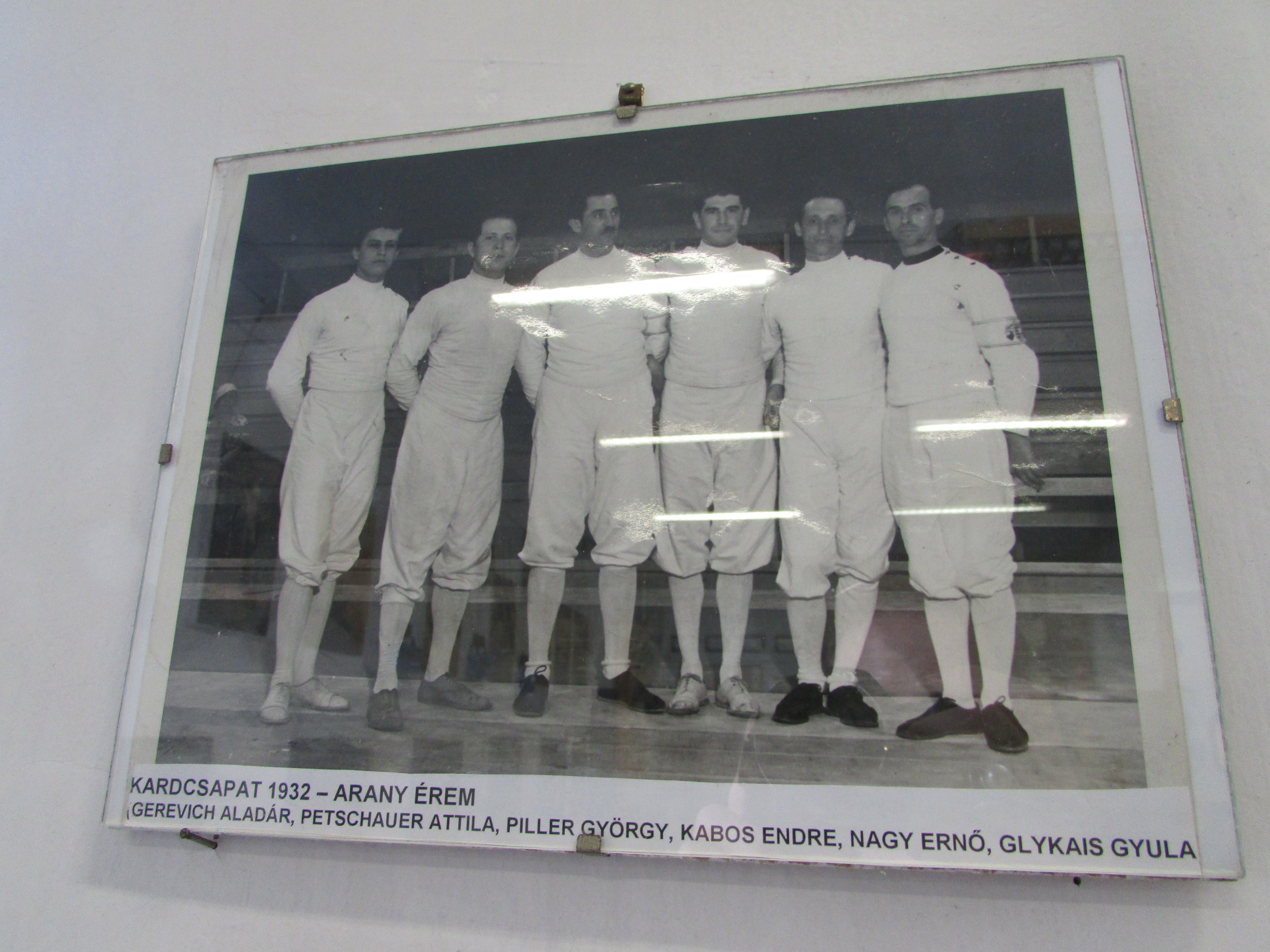
Regarding two of the Santelli’s fencers mentioned with Dr. Zold, Petschauer was an Olympian with two gold saber medals and also a high school classmate of Dr. Zold. He was murdered in a Nazi concentration camp at the instigation of a Hungarian officer who was also a former equestrian Olympian. Kabos was an Olympian with four gold saber medals, and was serving as forced labor in Budapest at the time of his death, when Margit (Margaret) Bridge (to Margit-sziget, or Margaret Island) blew up accidentally as the Nazis were rigging it with explosives to destroy in advance of the Soviet army. Dr. Zold had spoken with Kabos just moments before.
Dr. Zold opposed the Nazi regime, which resulting in his being stripped of his fencing posts in the 1930s. During WWII he was at first conscripted as an artillery captain. After the crushing defeat of the Hungarian Second Army at Don River in 1943, Dr. Zold ran the Red Cross in Budapest, and also assisted Raoul Wallenberg in helping Jews escape from Hungary after Nazi Germany annexed the country and began shipping Jews to concentration camps. He was one of the last to see Wallenberg alive outside of Soviet custody, even warning him twenty-four hours before he was taken that word was that the Soviets were after him. (Wallenberg appears to have been murdered by the Soviet secret police after being held for two years.)
Dr. Zold defected from Hungary after the Soviet Union ruthlessly crushed the brief democratic Hungarian rebellion, murdering protestors in the streets. His doctoral degrees in Hungarian law and literature were useless in the US, so he turned to teaching fencing, primarily at the Claremont colleges although he also taught for some years at the University of Southern California where I learned from him. He wrote thousands of articles, many of them on fencing, and wrote and edited books as well. He also served as coach to many US fencing teams, including youth and women’s teams.
I attended the party in honor of Dr. Zold’s 95th birthday (I was one of three there who did not speak Hungarian), and corresponded with him until his death, long after I had my last lesson from him in 1978. I always enjoyed his stories, as I did Dr. Hamori’s. From Dr. Zold, for example, I learned how the Hungarian fencers were invited by swashbuckling actor Douglas Fairbanks to his famous home, Pickfair, during the 1932 Olympic Games. This was probably on August 9 at the party thrown for two hundred officials, celebrities (including Charlie Chaplin, Clark Gable, and Constance Bennett), and some of the participants. Fairbanks, an active supporter of the Los Angeles Games, and his entourage came to watch the saber finals on August 13, where Gyorgi Piller of Hungary won the gold. The Hungarian saber fencers were easily the best in the world, and saber in those days the flashiest, most swashbuckling of the three weapons. (Thanks to changes in saber, and to a lesser degree in epee, the latter weapon has replaced the former as the most “fencing- and swashbuckling-like” of the three.)

I studied fencing afterward under Dr. Eugene Hamori in New Orleans. He was a member of the gold medal world championship team in 1955 and the Olympic saber team in 1956, defecting to the US soon after; the Soviet military had ruthlessly crushed the brief Hungarian uprising that occurred that summer. He first studied fencing under Alfred Tusnady-Tschurl, graduate of the famous Austrio-Hungarian fencing academy at Wiener-Neustadt, under the direction of Luigi Barbasetti; László Szabó, one of Santelli’s three proteges, author of Fencing and the Master, and a very close friend of Francis Zold; Gyorgi Piller, student of Laszlo Borsodi (one of the creators of modern Hungarian saber technique), 1932 Olympic saber gold medalist, later the Hungarian head coach; Lajos Csiszar, also one of Santelli’s three proteges; and not too long ago he even had some lessons from László Szepesi, famous as the Hungarian master who led France to international saber golds. No matter how good you are at fencing or at teaching fencing, you’re never too old or too experienced to profit from fencing lessons.
An accredited fencing master among his many accomplishments, Dr. Hamori remained a close friend and was my mentor in all issues regarding the teaching of swordplay. Dr. Zold gave me my classical foundation, but it was Dr. Hamori who really put everything together for me, even though he always gave Dr. Zold the credit. We corresponded for more than forty years and visited whenever we can. My wife Mary and I even attended a Royal Shakespeare Company performance of Hamlet, suitably sub-titled (or super-titled, in that the sub-titles were above rather than below?) in Hungarian on electronic boards, on Margit Island with him a few years ago, and afterward discussed both the difficulty for even a native English speaker to grasp Shakespearean dialogue, and, as expected, the swordplay as well. (We thought the final phrase d’armes was a bit too quick and lacked enough dramatic emphasis, for what it’s worth.)
Both of my fencing masters helped encourage my sense of literacy and broad learning (whose foundations were first encouraged by my parents and, perhaps not surprisingly to those who’ve read them, later by the novels of Rafael Sabatini). Fencing is simply one part of a broad education, not to mention a means of safely engaging in the martial competition natural to humans.
At Hamlet we also ran into outstanding HEMA longsword and modern saber fencer Krisztina Nagy. Not long before, she had escorted us around the famous Semmelweis University high school fencing salle, whose current fencing master is László Szepesi. The salle’s master from 1948 TO 1955 was Dr. László Emlékére Duronelli, the third of Italo Santelli’s proteges.
Dr. Hamori passed away on November 23, 2026, in his beloved Budapest.
Perhaps the most important lesson I learned from both fencing masters is that mistakes are OK, that you learn from them, and that, as a fencing teacher, or any teacher, you don’t have to know everything, and more importantly, you must never pretend to. Neither of my fencing masters ever pretended to me that he knew everything about fencing. Dr. Zold often referred to sources, both books and people, who knew more about a given subject in swordplay than he did, in spite of his vast experience. Dr. Hamori, in one of many examples, often demurred on giving me his answer to an epee question. A few years back he would instead consult his close friend, famous fencer and fencing master József Sákovics. After Sákovics’s passing, he gave me the recommendations of Hungarian head coach Gábor Udvarhelyi.
Too many “experts” today, or so it appears to me, would almost rather die than be seen as not having all the answers, even though it is impossible to have them all in any subject. A fulsome minority of fencing teachers (and similarly of certain personalities with PhDs, I must add) include some of the worst offenders in my experience, at times inventing empty answers and even pretending to experience they don’t have. Often this is the result of the cult of personality–excessive or insecure ego, or both, seeking adulation–far too many “experts” engage in. My own fencing masters entirely avoided this. Frankly, the honest, humble practice of the pointing out the truth wherever it may lie, with the obvious benefits of doing so, is too little seen today–all the more reason I have to thank my own fencing masters, my parents, and others like them for the lessons they’ve imparted to me.
Dr. Zold and Dr. Hamori were each the epitome of the classic refined gentleman scholar and swordsman.
And Now, Hussar Swordplay on Horseback!

Please note that this is just a brief introduction to Hussars and their swordplay as described in a small number of English sources, Andrew Lonergan for the most part (citation below), with a few minor observations of my own. There are some historical fencing organizations, Hungarian in particular, who are working admirably to restore Hussar saber technique both mounted and afoot in detail.
When it comes to recreating historical fencing technique, success, particularly as defined by historical accuracy, varies. In the case of the smallsword, for example, it’s relatively easy to obtain a likely high degree of historical accuracy, given the large number of available texts and its fundamental similarity to “modern classical” foil and epee, both of which are ultimately descended from it. On the other hand, some historical technique is poorly documented, Highland broadsword for example, and requires greater sifting through clues and the use of intelligent practical speculation. (There’s quite a bit of unintelligent practical speculation going on, unfortunately, in historical discussions, including those on the subject of the use of arms.)
So, who were the Hungarian Hussars? They were some of the best irregular light cavalry in the world, known for their flamboyant courage in battle and their use of the saber, a curved sword descended ultimately from the cutting swords of the Mongol invaders. The hussars were extreme swashbucklers, in other words. (My own Little ancestors were Border reivers from the Scottish West March, another famous group of light cavalry, not to mention cattle thieves.)
To give you a better idea of who the hussars were, I’ll quote from The Sea Rover’s Practice, itself quoting from the journal of naval officer Pattee Byng: “Sicilian partisans in 1719 sniped at German and Hungarian soldiers, and Hungarian Hussars ‘with their usual custom and dexterity, struck off their heads with their sabers.'” (Pattee Byng’s Journal, edited by J. L. Cranmer-Byng. Greenwich: Navy Records Society, 1950. Italics mine.)
The illustration above is sufficient corroboration.
In 1693 a regiment of Hungarian hussars was incorporated into the French army, although Hungarian cavalry had served Louis XIV prior to this. In the eighteenth century there were French-manned units modeled on them in place, and also other natively-manned units in other European armies as well. Hungarian hussars were in service past World War One.

According to a seventeenth century English dictionary, the word hussar was said to derive from the Hungarian light horsemen’s battle cry of “Husa!” However, both Dr. Hamori and a now former honorary Hungarian consul in New Orleans told me that this is not what they were taught in school in Hungary. Further, some modern etymologies, Merriam-Webster for example, suggest the word has its origins in the Serbian and Croatian word for pirate. The Hungarian word is huszár. (For a period definition and etymology, see New World of English Words, 2nd ed., edited by E. Phillips [London: E. Tyler for Nath. Brooke, 1662], s.v. “Husares.”)

Andrew Lonnergan’s practical book on swordplay, short-titled The Fencer’s Guide (London: for the Author, 1771) is one of those rare fencing texts discussion practical swordplay beyond the salle and the duel: for the battlefield, in other words.
Section VIII of his book, “Is a Lesson for and against a Party of Hussars, or Light Horse.”
He refers to Hussars as “scampering troops, who like not to attack in a body, nor to attack a body [a troop, company, or other ‘body’ of horse].”
Importantly regarding technique, he notes that they “may annoy you, in wheeling together, either by fire or sword, though even if ou were a grand division, wheeling upon its center; for they endeavour to attack all other troops behind, or sideways, as they run by them, with a Sawing-cut, and then turn to the rest of them again, that they may repeat this cut with their swords so arched, that when but an inch of the edge, near the point, catches a man’s neck, the middle, or belly of the blade, will sever a joint, and often leave the head hanging by a sinew, or a piece of skin.”

The ‘sawing-cut’ is a cut pushed or carried forward, as opposed to the more common ‘drawing-cut’ pulled or drawn backwards toward the swordsman’s body. The strong curve of the Hussar saber makes thrusting with the point difficult (it must be hooked). But as described by Lonnergan, the thrust is effective because it is made with the first inch or so with the edge which cuts through soft tissue. This is probably best effected on horseback at speed. I have tested this cut afoot via simple extension as well as via a powerful lunge, and found that it does not appear to be as effective as Lonnergan describes. (I used a Cold Steel scimitar on a variety of test subject materials, ranging from a large beef brisket to bound straw to large banana trees being cut back for the winter.) However, the kinetic energy of a rider attacking at the hand-gallop would almost certainly make the sawing cut as effective as Lonnergan describes, cutting through clothing and flesh.
This is different from what Hollywood and swashbuckling novels have accustomed us to see: that is, large sweeping head- and limb-lopping cuts. A sawing cut, if less flashy, was probably more effective and, importantly, more difficult to recognize and defeat.

Regarding defense in Hussar swordplay, Lonnergan writes that, “If you strike at them as you meet them, they will avoid your blow, by stooping forward, leaning backward, or even by throwing themselves to the opposite sides of their horses, and will recover their saddles again.” Mounted esquive!
Lonnergan recommends cutting at Hussar sword arms because “it is naturally in a St. George [modern saber quinte, more or less]to save their heads.
To thrust at a Hussar, he recommends “a Segonde [seconde] darted forwarsds, for so the height of your horses, superior to theirs, will have it, and afford you greater power over them in a close attack, which they must avoid as much as possible.”
When fencing on horseback Hussar-to-Hussar, Lonnergan notes that “their best method is to parry any cut made at them with a Quarte, Tierce, or Prime, and repost with a Sawing-Cut, and thrust, and recover with a Drawing-cut.”
Most notably, he writes that the “bent [curve] of their swords will afford them an unavoidable Quarte-over-the-arm, or a Cavè [sic: the accent grave is used incorrectly on cavé in the original text].”
In other words, the Hussar saber with its curved blade has a natural cavé or angulation against quart, tierce, or prime parries (or any other parries, in fact). I’ve heard some historical fencers note that this is an advantage the curved saber has, but I must note here that Lonnergan is referring to actions on horseback with horses moving at speed! The rider, executing the natural angulation with the saber, can escape the riposte as he rides by, while simultaneously cutting or thrusting with cavé (the thrust described is actually a cut). This is not the case afoot: fencer A attacks with an inside cut, fencer B parries quarte and ripostes covered, fencer A makes a cavé around the quarte riposte–and receives his adversary’s riposte cut, having failed to protect himself against it. In other words, use this cavé afoot at your own peril. Fencing, after all, is supposed to be about hitting and not getting hit.

A cut not mentioned by Lonergan, and in fact one in which I’ve only ever seen in Hollywood films, is the low sweeping cut forward on horseback. Often in movies you see knights and so forth lopping off heads this way. However, we probably don’t see it in fencing texts or descriptions of mounted combat for a reason: it would be easily parried by an enemy on foot if were armed with sword, pike, halberd, or musket, and the parry might even dismount the attacking rider.
It would be similarly dangerous against a mounted adversary, leaving the attacker exposed in the high lines unless protected by head and body armor of some sort. Further, the cut might easily be stopped by the enemy’s mount, again with the possibility of disarmament. Hollywood typically does things for show, for drama, not necessarily for historical authenticity.
The closest I’ve seen in reality to this Hollywood low cut is a low thrust made with a straight sword (broad or back) against a mounted adversary, the hand held at the level of the rider’s hip and the point aimed at the enemy’s lower abdomen. The mounted attacker typically has breast and back, and probably a skull cap under his hat, and the thrust is intended for the lower abdomen just under the enemy’s armor.

Lonnergan’s advice for light horsemen being pursued by larger numbers of horsemen is swashbuckling at its best: “Otherwise you may, like the Prussian or Hungarian Hussars, fire under your arm backward, or over our shoulder, and kill at random when flying and closely pursued.”
Firing pistols over one’s shoulder or under one’s arm while fleeing at the gallop? Swashbucking indeed! And it’s clearly a technique clearly used long before the Hollywood cowboys I grew up watching did so on television and in film, inspired perhaps by a famous Frederic Remington painting.

Although this has been an incomplete description of Hussar swordplay, hopefully it has dashed a few Hollywood myths, and also demonstrated that the study of swordplay–inevitably lifelong if you really intend to grasp it–is as fascinating as any other subject, if not more so.

Copyright Benerson Little 2018 – 2026. First published April 13, 2018. Last updated February 22, 2026.

Women Epeeists

A quick post on women and epee fencing, inspired by the photograph of Frances Drake above. She was a Hollywood actress (or actor, if you prefer more modern usage) from the 1930s. The photograph dates to 1934, although I’ve been unable so far to identify the film for which this and similar publicity stills were made. I’d like to, for the the photograph is unusual in that it shows her with epees, not foils.
Until the 1980s, women were not permitted to fence epee in competition due to a patronizing chauvinism (I suppose all chauvinism is patronizing, though) that decreed that women were (1) too weak to fence epee, or saber for that matter, and (2) shouldn’t be fencing epee or saber which were originally dueling arms, therefore “man’s weapons.”
The attitude persisted well into the 1980s and even beyond with some male fencers and fencing masters. Around 1980 I had some lessons from a famous epee master, and as I walked on the strip epee-in-hand for his first epee lesson of the day, and my first with him ever, he smiled and said, “Ah, finally a man’s weapon!” In part he meant it as a compliment in that I was fencing epee, not foil, and therefore as a bit of a dig at foil as well. Still, the comment is instructive and indicative of the attitude at the time. In his defense, most fencing masters would not teach epee or saber to women at the time, even if they believed them suitable to the weapons, for there were no competitions in them available to women, certainly not at the national level.

A Castello practice epee in my collection, complete with point d’arrêt and a guard quite torn up by the points d’arrêt of numerous adversaries. The wide bell guard originally supported a short-lived French-Italian combination grip, one with an Italian crossbar connected to a French grip. It was listed in the Castello catalog as a “French-Italian Duelling Sword.” An epee with a screw-on pommel was up to this era known as an épée démontable or “interchangeable epee,” as Félix Gravé describes it. Not only was it easier to replace broken blades, but the practice blade could be exchanged with a real blade in case of a duel, making the transition from practice weapon to real one less likely to affect grip, balance, &c.
Of course, more than three decades of women fencing epee and saber have disproved any such absurd notions that women can’t manage these weapons. Just fence my wife sometime if you don’t believe me.
Recently, I obtained a copy of Fencing Comprehensive by Félix Gravé, published in 1934. In it he makes reference to women epee fencers, in particular to how they should dress when fencing epee, clearly indicating that some women did indeed fence epee in the 1930s, and not just Ms. Drake in a Hollywood photo shoot. The fact that there were women epeeists in the 1930s pleases me inordinately.

From Fencing Comprehensive by Félix Gravé, 1934.
As for the epees Ms. Drake is holding, they’re probably Castello epees. The guards appear to be aluminum with steel reinforcements. In the 1930s, epee guards were usually made either of rolled steel or of aluminum, with either flat steel reinforcements, as with hers, or angled washers made of either steel or aluminum, as in the image above. The pommels are two-piece, of aluminum and brass, again as in the same image.
Drake’s fencing jacket is quilted, a type difficult to find anymore although once common. The last I saw for sale from major vendors was in the early 1990s. The glove is decorated and might not actually be a fencing glove–epee gloves at this time had leather palms and fingers with “sailcloth” backs and cuffs.

Woman epeeist on the cover of the French magazine, La Revue, September 1941.
As for women epeeists today, of the five epeeists I consider to have been the greatest in the past century, two of them are women: Timea Nagy of Hungary and Laura Flessel-Colovic of France. Frankly, I prefer women’s epee, for it balances technique with tactics, with speed and strength in support. Too many male epeeists try to reverse this, putting technique and tactics as subordinate to speed and strength. Usually they would fence better if they’d follow the practice of most women epeeists.
In sum: long live women epeeists!

My wife, on the left, competing in Colombia a few years ago.
Copyright Benerson Little, 2018. First published February 16, 2018. Last updated May 25, 2021.

Jack Sparrow, Perhaps? The Origin of an Early “Hollywood” Pirate, Plus the Authentic Image of a Real Buccaneer

The small caption reads “Cover Drawn and Engraved on Wood by Howard McCormick.” Author’s collection.
The illustration above was created in late 1926 or early 1927, and published in April of the latter year. Among its several pirate clichés (skull and bones on the hat, tattoos, curved dagger, long threatening mustache) is one I had thought was entirely modern: a pirate hair braid with coins attached.
Quite possibly, this coin braid is the artist’s idea of a pirate “love lock.” The love lock was popular among some young English and French gentlemen in the first half of the seventeenth century. Usually worn on the left side, it was typically tied with a ribbon, a “silken twist” as one author called it. Occasionally two were worn, one on each side as in the image below.

Henri de Lorraine, Count of Harcourt (1601-1666), known as “le Cadet la Perle” due to his bravery in battle. He is also sporting a pair of love locks. Print by Nicolas de Larmessin, 1663. British Museum.
This “pirate love lock” is a noteworthy characteristic of the very Hollywood, very fantasy pirate Captain Jack Sparrow, and I wonder if this image did not inspire much of his look. Historically-speaking, though, there is no historical basis for it among pirates of the “Golden Age” (circa 1655 to 1725), although it’s possible there may have been a gentleman rover or two who wore one during the first half of the seventeenth century–but not a braid or lock with coins.
Of course, much of The Mentor pirate image above was clearly inspired by famous illustrator and author Howard Pyle, as shown below.

Romantic, largely imagined painting of a buccaneer. From “The Fate of a Treasure-Town” in Harper’s Monthly Magazine, December 1905. The image is reprinted in Howard Pyle’s Book of Pirates.

“How the Buccaneers Kept Christmas,” Howard Pyle, Harper’s Weekly, December 16, 1899, a special two-page image. I’ve discussed this image in Of Buccaneer Christmas, Dog as Dinner, & Cigar Smoking Women.

A classic Howard Pyle line drawing, from Howard Pyle’s Book of Pirates.
There’s a hint of N. C. Wyeth too, not surprising given that he was a student of Howard Pyle. However, Captain Peter Blood was a gentleman pirate, and the pirate on The Mentor cover is clearly not.

Battered dust jacket from the photoplay edition of Captain Blood: His Odyssey by Rafael Sabatini, 1922. The cover art and identical frontispiece artwork by N. C. Wyeth.
And Wyeth’s Captain Blood cover is clearly influenced by this 1921 cover he painted for Life magazine. In fact, less the goatee, the two buccaneers might be one and the same:

Details about the painting can be found at the Brandywine River Museum of Art. Oddly, the Life magazine issue has no story or article about buccaneers or pirates.

“The Pirate” by N. C. Wyeth. Pretty much the same pirate as immediately above, less the fictional “pirate boots,” this time painted for Hal Haskell Sr., a Dupont executive who commissioned it in 1929. For years the painting hung in Haskel’s yacht, and afterward to the present in the family home. The print is available from The Busacca Gallery, Art-Cade Gallery, and other vendors.
The Pyle influence continued through the twentieth century in film, illustration, and mass market paperbacks about pirates…

“Pirate Dreaming of Home” by Norman Rockwell, 1924. The painting is also clearly based on Howard Pyle’s famous painting, “The Buccaneer Was a Picturesque Fellow,” and may be intended to represent the same buccaneer later in life, or perhaps is simply an homage to Pyle. (Norman Rockwell Museum.)
The Mentor illustration is also clearly influenced by Douglas Fairbanks’s 1926 film The Black Pirate, which was, according to Fairbanks himself, heavily influenced by Howard Pyle’s Book of Pirates and to a fair degree by Peter Pan.
Seriously, check out Fairbanks’s costume in the film, it’s obviously that of Peter Pan grown up. I have a soft spot for Douglas Fairbanks: my first fencing master, Dr. Francis Zold, described him as a gentleman and a swordsman, and described how Fairbanks invited the Hungarian fencers to his mansion Picfair (named after Fairbanks and his wife, Mary Pickford) after György Jekelfalussy-Piller won the gold saber medal at the 1932 Los Angeles Olympic Games. (N.B. I think Dr. Zold was referring to Fairbanks Sr. as a gentleman and a swordsman, but a nagging itch in my mind suggests that it was Fairbanks Jr. instead.)
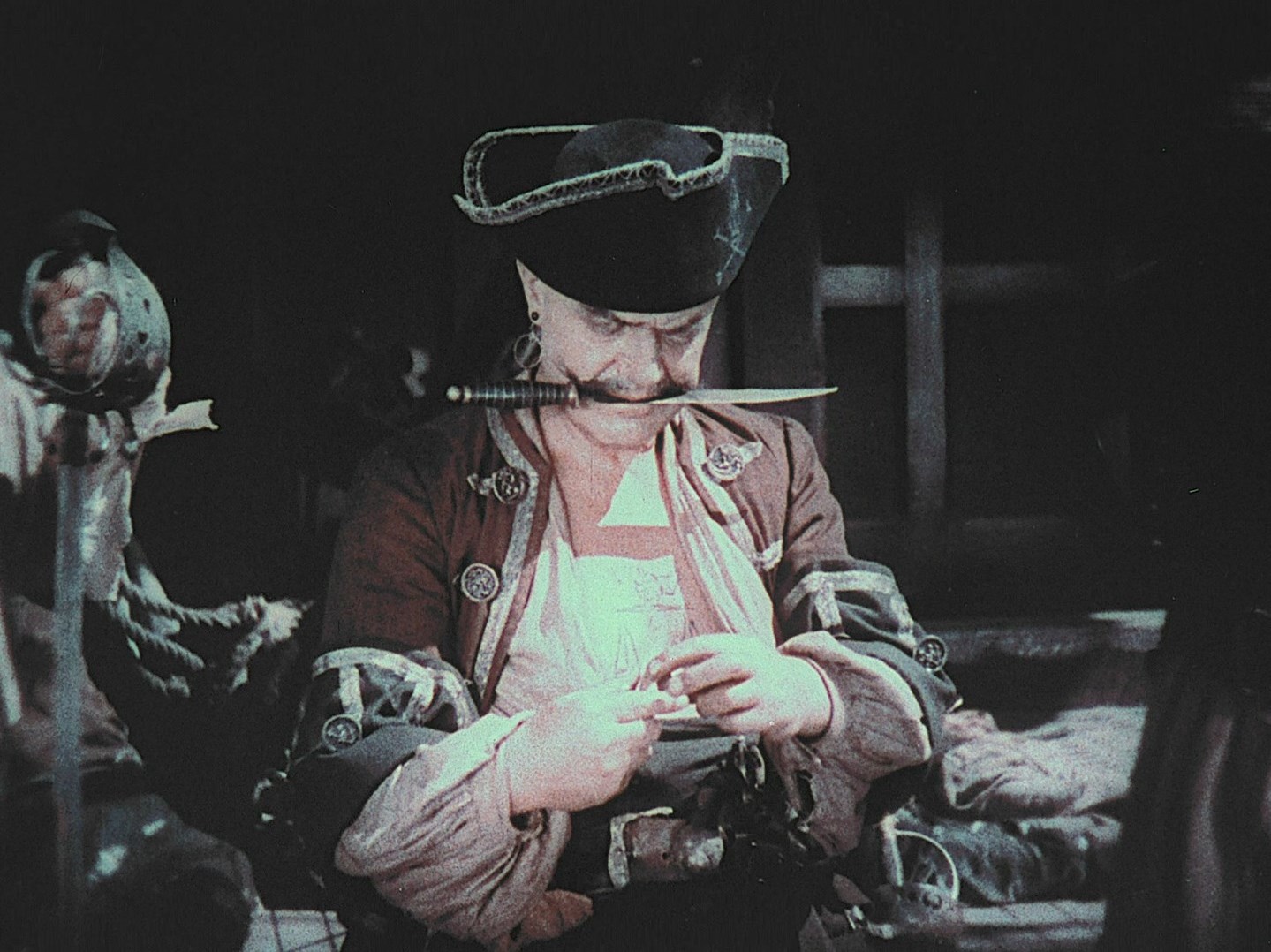
Anders Randolf as the pirate captain in The Black Pirate. Note the skull and bones on the hat, the dagger in the mouth, the hoop earring, and, just visible, the tattoo on the chest. Screen capture from the Kino Blu-ray. A useful review of the film is available here.

Publicity still, possibly a frame enlargement from B&W footage given the grain, of the admirable duel on the beach between Randalf and Fairbanks, choreographed by Fred Cavens. More on this in a later blog post. Author’s collection.
And here, finally, we have Johnny Depp as Jack Sparrow in the flesh, braids and such dangling from his hair, again for which there is no historical precedent among Golden Age pirates that we know of. It’s hard to see how Depp’s costume, in particular his hair, might not have been influenced by the illustration at the top of the page. If it weren’t, it’s quite a coincidence.

“Captain Jack Sparrow makes port” from the Jack Sparrow Gallery on the Disney Pirates of the Caribbean website.

Jack Sparrow again, with a closer look at his braids &c. from the Jack Sparrow Gallery on the Disney Pirates of the Caribbean website.
As noted, it’s entirely possible that the Pirates of the Caribbean: The Curse of the Black Pearl costume designers never saw the image at the top of the page. They may have imagined it themselves, or been influenced by something else. A very likely possibility is Donald O’Connor in the 1951 film Double Crossbones, a campy pirate comedy that makes fun of nearly all pirate clichés.
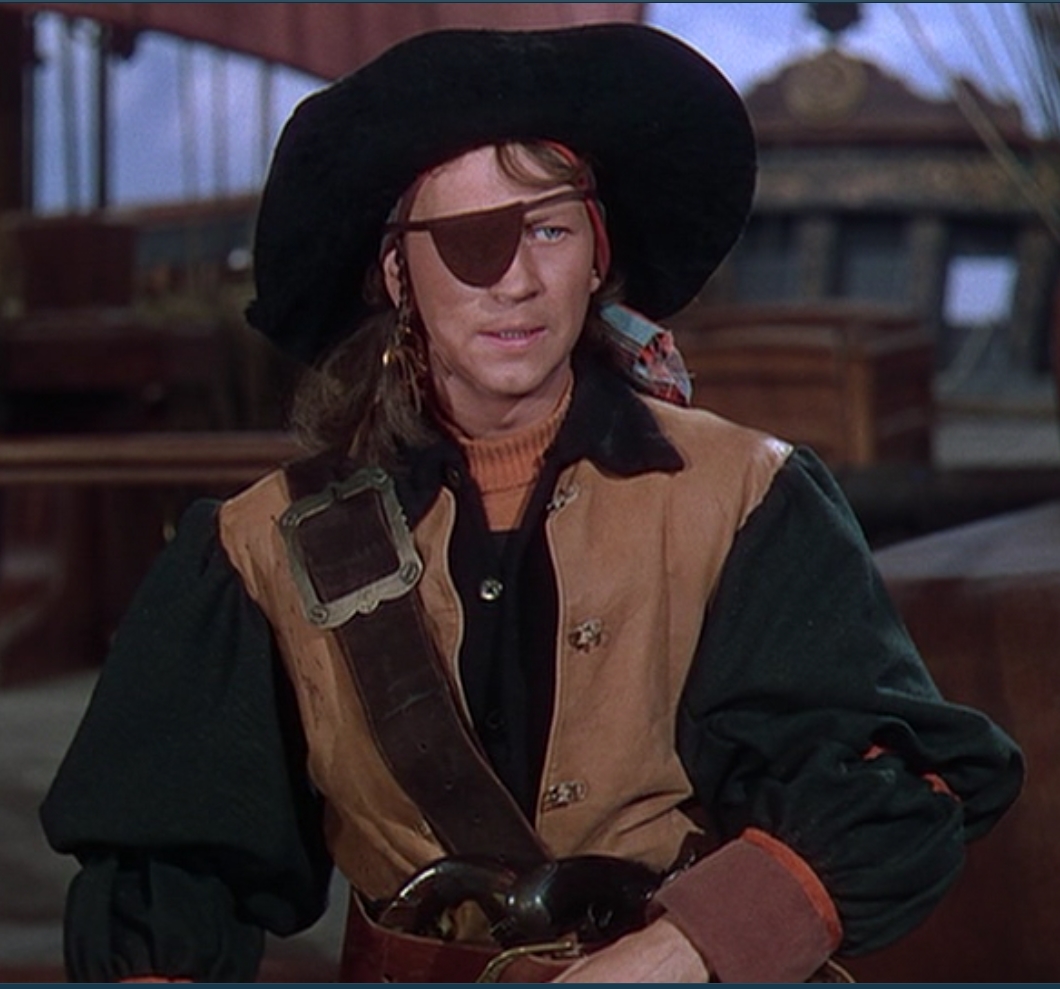
Donald O’Connor in Double Crossbones. Note the braid over his right ear. (Screen capture.)
Although this may seem to be little more than coincidence, there are other similarities between the two films, strongly suggesting the writers and costume designers were familiar with it. In particular, O’Connor plays a shy, somewhat bumbling shopkeeper’s apprentice in love with the governor’s beautiful ward, and she with him. Due to difference in social class he’s unwilling to express his love openly until by accident he becomes a pirate. Sound familiar? Even the costumes of the governor’s ward (Lady Sylvia Copeland, played by Helena Carter) are similar (homage-fashion?) to those of Elizabeth Swann, played by Keira Knightley. If not the Pirates of the Caribbean costume designer, then perhaps the Double Crossbones costume designer was familiar with the image at the top of the page.
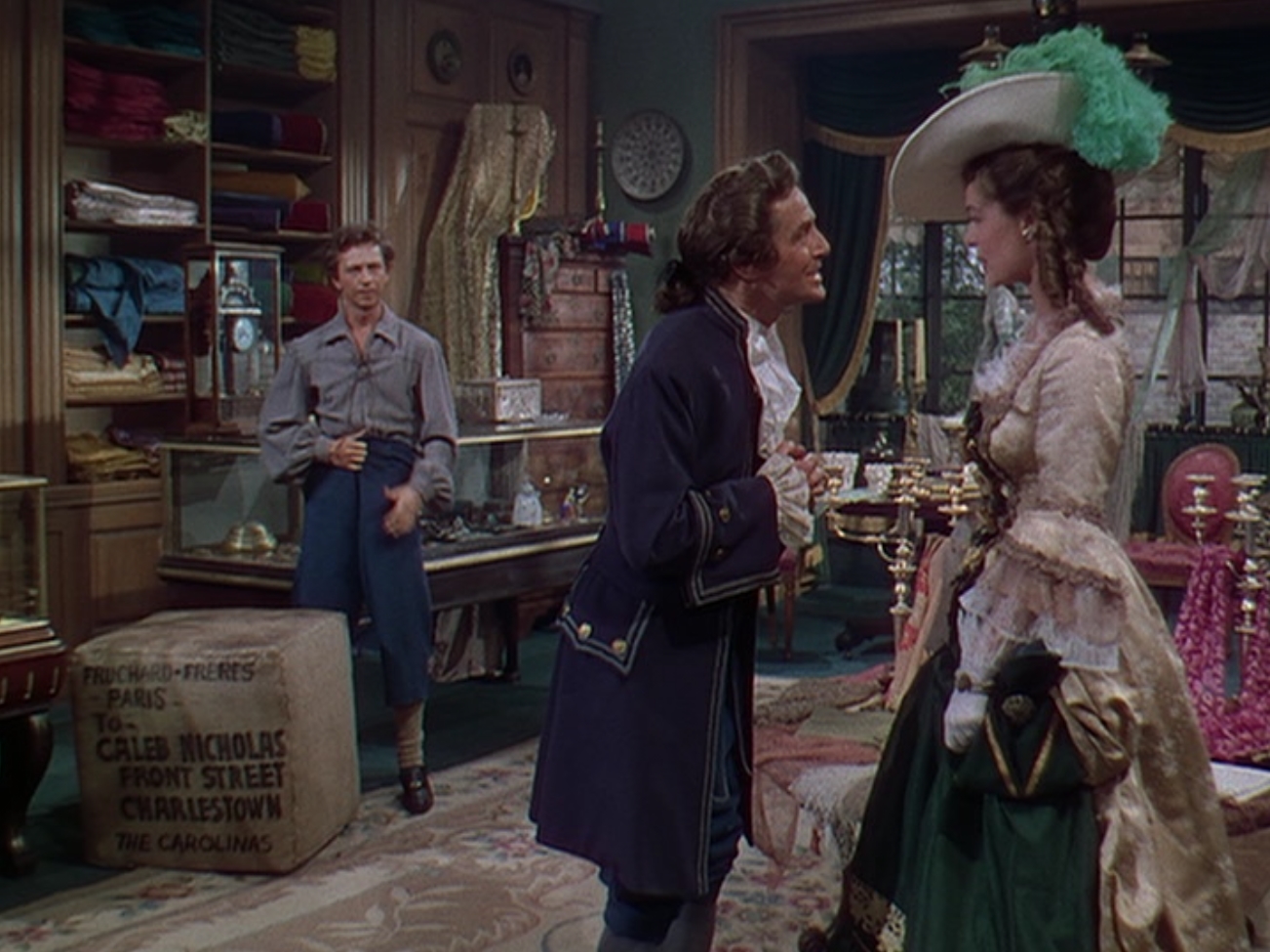


Screen captures from Double Crossbones, 1951. Plenty of candlesticks, not to mention a painted miniature around the neck instead of a magical Aztec coin.
And there’s another film possibility: Torin Thatcher (a pirate’s name if ever there were!) as Humble Bellows in The Crimson Pirate (1952). Bellows wears a love knot, perhaps to compensate for his balding pate. It’s surely better than a comb-over! Disney may have been inspired by Bellows’s coiffure, for, like Double Crossbones above, there are numerous homages, shall we say, to the film in the Disney franchise, ranging from the way soldiers march to the “walking boat underwater” scene. It’s also possible that Donald O’Connor’s ‘do inspired Bellows’s.

Torin Thatcher as Humble Bellows in The Crimson Pirate (1952). Blu-ray screen capture.
Of course, all this so far is “Hollywood,” for lack of a better term. There are a number of serious groups of reenactors, scholars, and others trying to correct the false historical image, all with varying degrees of accuracy, agreement and disagreement, and success.
Hollywood has yet to get aboard, no matter whether in pirate films and television series, or often any film or television set prior to the nineteenth century for that matter, probably because it’s easier to play to audience expectations (and, unfortunately, much of the audience doesn’t really care), not to mention that there’s a tendency or even a fad among costume designers to do something that “evokes” the image or era rather than depict it accurately, not to mention the time and other expense of researching, designing, and creating costumes from scratch when there are costumes “close enough,” so to speak, already in film wardrobes.
Here’s a hint, Hollywood: you can start by getting rid of the “pirate boots.” They didn’t exist. They’re actually based on riding boots, and a pirate would only be in riding boots if he were on a horse–and horses aren’t often ridden aboard ship. Further, you can get rid of the baldrics in most cases, exceptions being primarily for gentlemen pirates wearing smallswords into the 1680s, no later. (You can have some Spanish pirates with rapiers wear baldrics after this, though.) And for that matter, you can get rid of wide belts and large belt buckles too. But if nothing else, please, please get rid of the boots, which, if I recall correctly, a UK journalist once correctly described as nothing more than fetish-wear.
Full disclosure: I was the historical consultant to Black Sails, a great show with a great cast and crew, but I had nothing to do with the costuming, much of which is considered as near-blasphemy by advocates of historical accuracy in material culture in television and film. That said, the show is a fictional prequel to a work of fiction that variously created or expanded some of our biggest myths about pirates–buried treasure, the black spot, and so on. Looked at this way, if you can accept the story you can probably tolerate the costuming.
I’ve discussed what real pirates and buccaneers looked like several times, not without some occasional minor quibbling by other authorities. The Golden Age of Piracy has some details, as do two or three of my other books, but several of my blog posts also discuss some of the more egregious clichés, with more posts on the subject to come.
At any rate, here’s an image of a real buccaneer, a French flibustier in fact, from the 1680s. It’s an eyewitness image, one of only a handful of authentic eyewitness images of “Golden Age” sea rovers. It and the others prove that an image may evoke swashbuckling pirates while still being entirely accurate.

One of several eyewitness images of French flibustiers (buccaneers) in the 1680s. These are the only known eyewitness images of Golden Age sea rovers. They went largely unnoticed and without commentary until I ran across them by accident while researching late 17th century charts of French Caribbean ports. I’ve discussed them in an article for the Mariner’s Mirror, and also in these two posts: The Authentic Image of the Real Buccaneers of Captain Blood: His Odyssey by Rafael Sabatini and The Authentic Image of the Boucanier. The posts include citations to the original images.
Copyright Benerson Little 2018. First published January 23, 2018. Last updated April 4, 2018.
For Fun: Underwater Samurai!

Detail from the full image below.
Just for fun: Samurai underwater combat! Imagined underwater fighting, both via surface supplied air (“deep sea diving”) and free swimming descents, during the very real Battle of Yalu River in 1894. Japanese forces defeated a Chinese fleet in a very close battle during the First Sino-Japanese War. The underwater imagery is, of course, quite imaginary but also quite cool.

Underwater battle during the Battle of Yalu River by Kobayashi Toshimitsu, 1894. Rijksmuseum.
Holiday Wishes! (And Some Hollywood Swashbuckler Biographies)

Wishing everyone Happy Holidays, however you celebrate them! Merry Christmas, Happy Hanukah, Happy Kwanzaa, Happy Solstice, Happy New Year (Western and Chinese)–all and more as you wish and please. It’s a secular Christmas here: Santa Claus, reindeer and sleigh, Douglas fir tree (except this year due to the nation-wide shortage, we cut a Virginia pine locally instead), stockings hung by the chimney with care, homemade cookies, fire in the fireplace, books read to children (and to nearby listening adults), much gift giving, plus Basil Rathbone, Albert Finney, Michael Caine, George C. Scott, Mister Magoo (aka Jim Backus of Gilligan’s Island fame), Reginald Owen, and Seymour Hicks as Scrooge, plus occasional swords and sword adventure with musketeers and pirates (and dark rum left for Santa as he makes his rounds), along with the usual excellent food, drink, family, and good cheer.
That said, this is a blog and therefore a suitable place to give praise to the four swashbucklers in the image above, from the 1952 RKO film, At Sword’s Point, also released as The Sons of the Musketeers. The movie is not considered to be the best of its genre, yet is still better than most and worth watching just to see Maureen O’Hara wield a sword–and there’s more to see than just O’Hara’s swordplay and independence, although as noted she alone makes the film worthwhile.
So, from left to right…
Alan Hale Jr. as Porthos Jr.
Alan Hale Jr., a solid more-than-character actor appeared in many films but is by far best known for his role as Jonas Grumby aka “the Skipper” in Gilligan’s Island.
Publicity still of Alan Hale Jr. as Jonas Grumby aka “The Skipper” in Gilligan’s Island.
Hale Jr. also starred as Porthos Sr. in a 1970s version of The Man in the Iron Mask entitled The Fifth Musketeer, a film that rounded up a variety of aging actors who had starred in swashbuckling and adventure stage, film, or television, and tossed them in with luminaries such as Rex Harrison and Olivia de Havilland, with up and comers such as Beau Bridges and Ian McShane, and with the addition of Ursula Andress and Sylvia Kristel, the latter best-known for the erotic Emmanuelle films. But not even this sterling cast could hold the film together, even coming as it did on the heels of the recent Three Musketeers and Four Musketeers films.
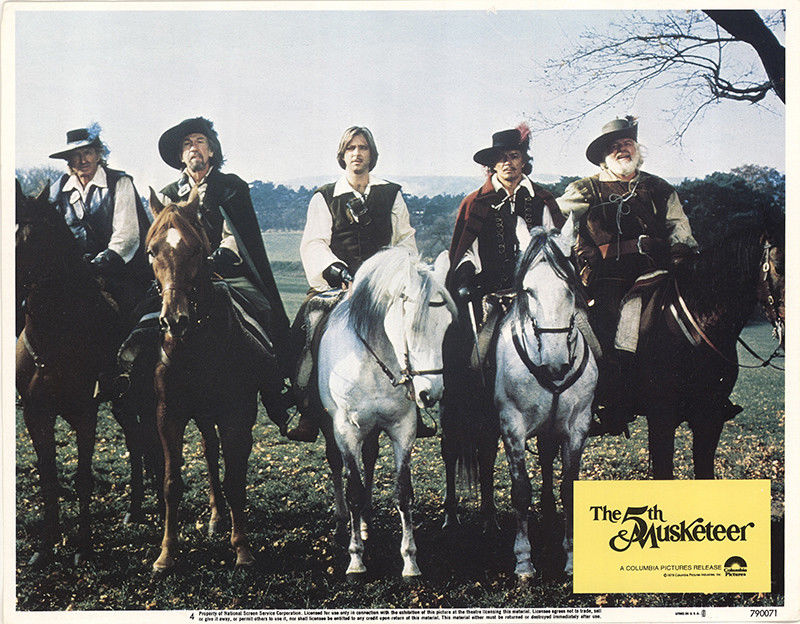
Alan Hale Jr. (far right) as Porthos in The Fifth Musketeer (1979). From left: Lloyd Bridges (whom I once “saw” as an early toddler in a film theater in Key West while he was there filming Sea Hunt), Jose Ferrer, Beau Bridges (son of Lloyd), Cornel Wilde, and Alan Hale Jr. (Columbia Pictures lobby card, 1979.)
If Alan Hale Jr. looks familiar to fans of older films, he should, for as Porthos Jr. and Porthos Sr., Hale makes an homage to his father, Alan Hale Sr., who appeared in a fair number of swashbucklers, most famously The Sea Hawk, Robin Hood, and The Adventures of Don Juan, all starring his close friend Errol Flynn. In Robin Hood he reprised his role as Little John, having first played the character in the extravagant silent version by swashbuckling film star, producer, and director Douglas Fairbanks. He took up the role again in 1950 in Rogues of Sherwood Forest. Hale, born Rufus Edward MacKahan, co-starred in several other Flynn films as well: Dodge City, Virginia City, The Private Lives of Elizabeth and Essex, and several others for a total of thirteen films.

Alan Hale Sr. as Little John in The Adventures of Robin Hood (Warner Bros., 1938), starring Errol Flynn, Olivia de Havilland, Basil Rathbone, and Claude Raines.

Screen capture from the Gilligan’s Island Christmas episode (“Birds Gotta Fly, Fish Gotta Talk”), 1964. Alan Hale Jr. plays Santa, whom the castaways believe is the Skipper. But is Santa actually the Skipper?
Maureen O’Hara as Claire, Daughter of Athos
I’ll doubtless devote an entire post one day to Maureen O’Hara and her swordplay in swashbucklers. Alas, as often as she wielded a sword in a swashbuckler, she did not in another. In The Spanish Main and The Black Swan, the most successful of her swashbucklers, she had no sword-in-hand (although Binnie Barnes took up the blade admirably in the former). So, until I post a full article on O’Hara, here are a few images of the strong-willed, independent, red-headed, Dublin-born and raised actress (or actor, if you prefer):

Maureen O’Hara engaging multiple adversaries in At Sword’s Point.

Not dressed for swordplay. O’Hara in At Sword’s Point.
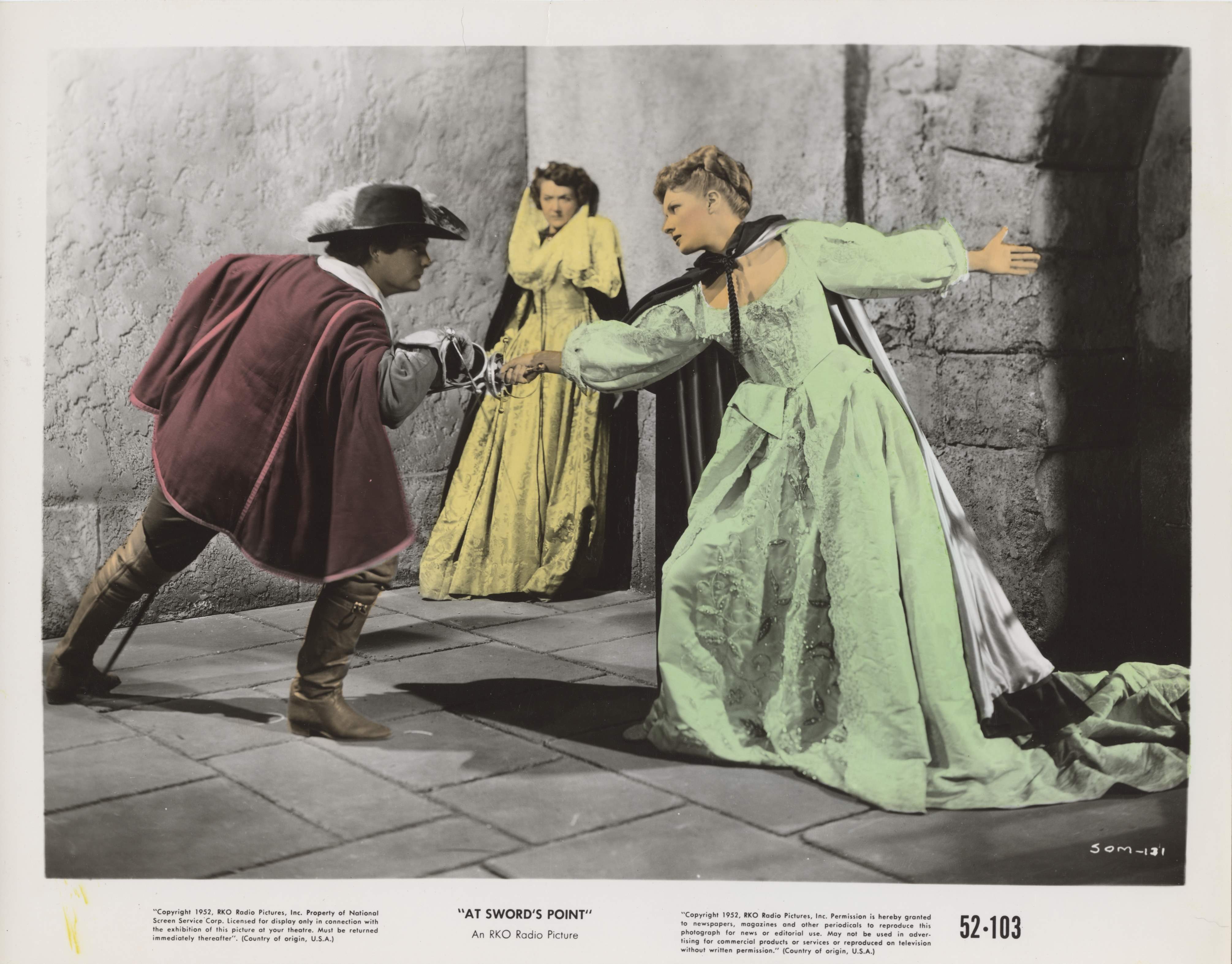
Fencing a Cardinal’s guard in At Sword’s Point, O’Hara still not dressed for swordplay.
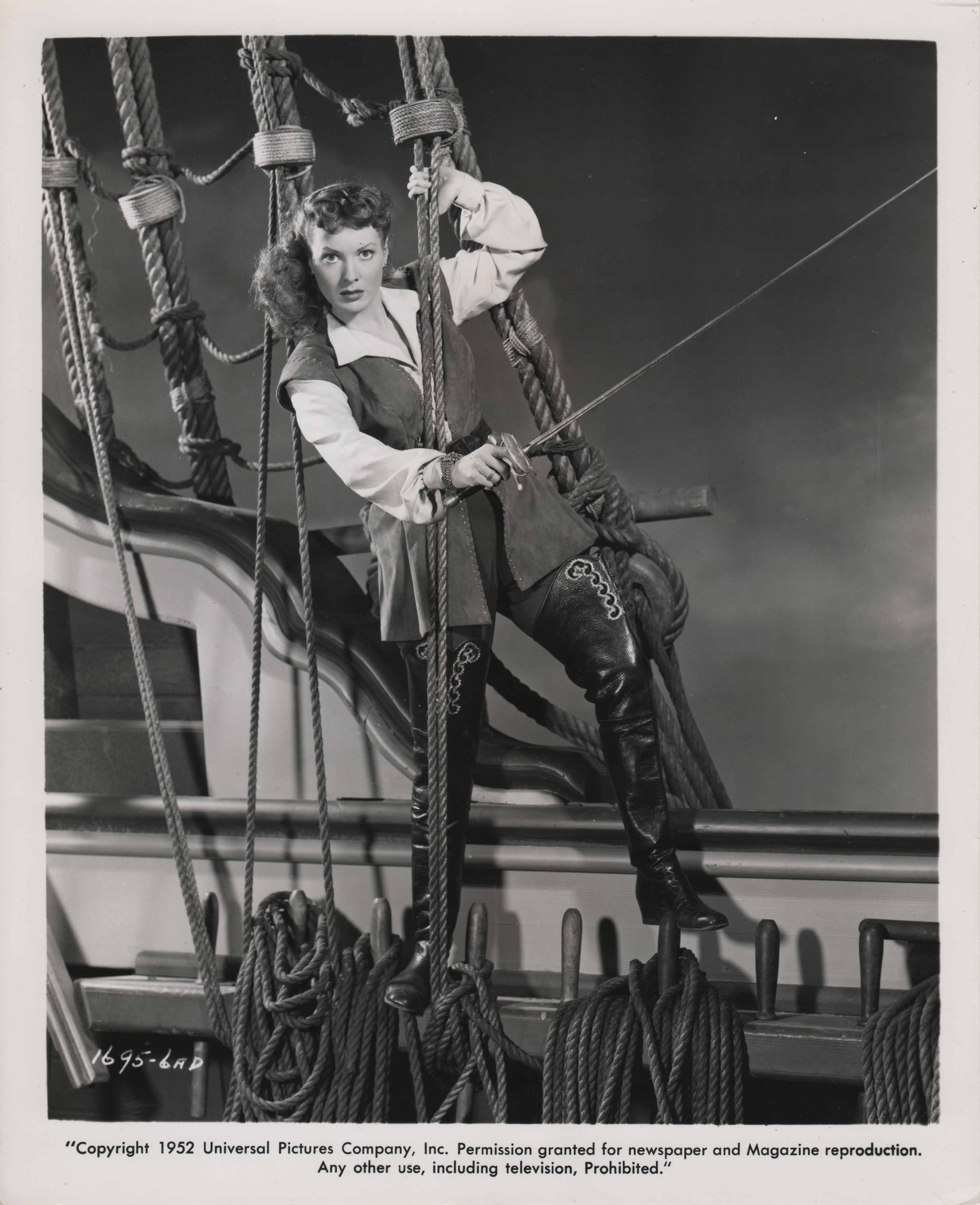
As Spitfire in At Sword’s Point, co-starring Errol Flynn in his last swashbuckler. O’Hara carries the film and in the climax gets to engage in swordplay once more on film.

O’Hara engaging blades in Against All Flags.
Maureen O’Hara in one of her most famous roles, in the holiday classic Miracle on 34th Street. With her are Edmund Gwenn and a very young Natalie Wood.
Cornel Wilde as d’Artagnan Jr.
Born to Czech-Hungarian parents in Manhattan, Cornel Wilde often traveled with his father to Europe where he picked up several languages and, reportedly, skill at fencing. An avid and outstanding fencer, Wilde turned down membership on the US saber team for the 1936 Olympic Games in order to accept a theatrical position–a decision few fencers would ever consider making. It’s one thing to give up a potential or possible eventual position on an Olympic fencing team, quite another to give up an offered one. That said, the several actors I know with fencing experience might very choose an opportunity in the form of a middling role in film or theater over fencing in the Olympic Games, although I’m sure the decision wouldn’t be an easy one.

Wilde fencing-brawling in At Sword’s Point.
An accomplished actor, Wilde’s looks, swordplay, and athleticism led him to starring roles in numerous swashbucklers.
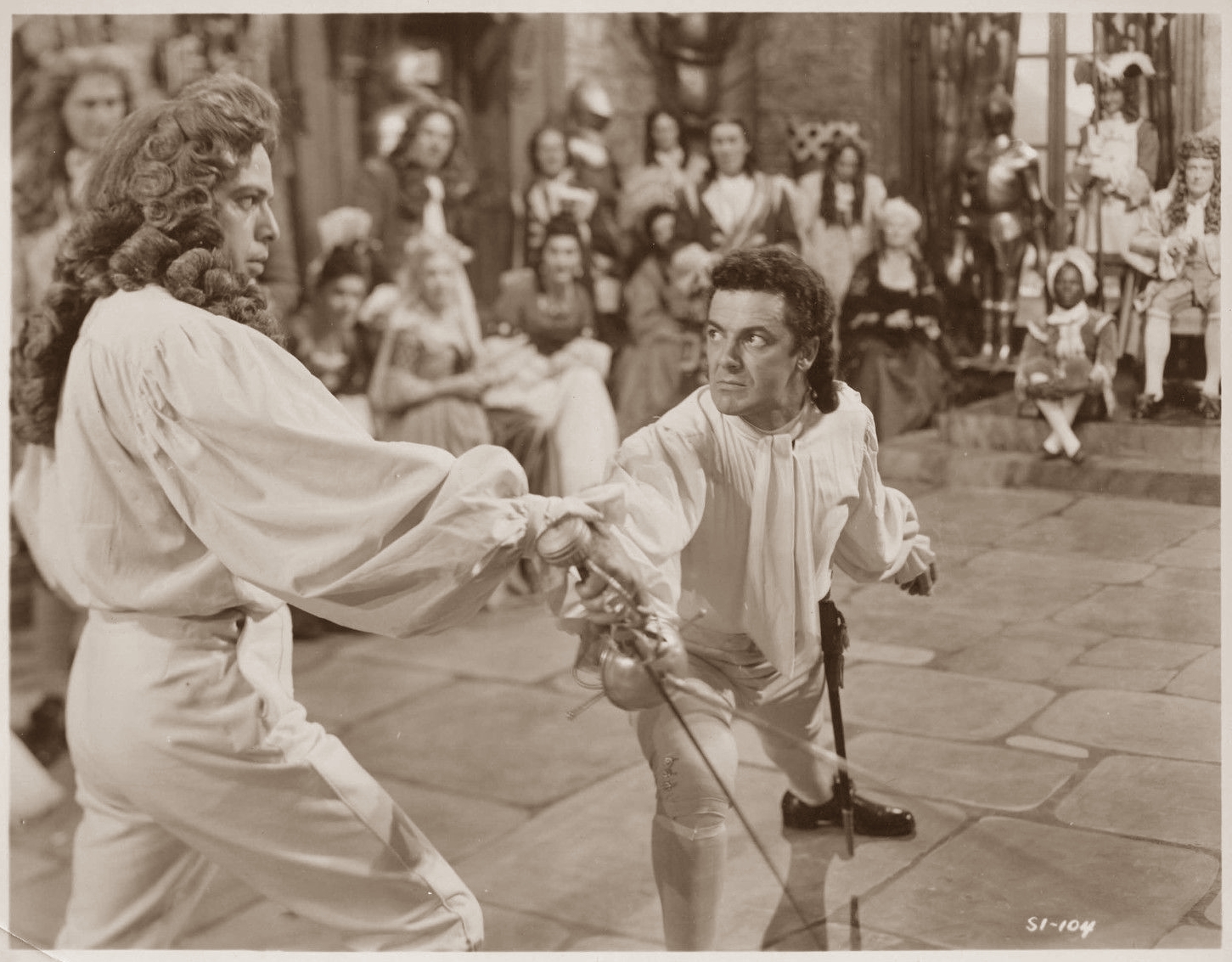
Wilde fencing Herbert Lom (of the Pink Panther films fame) in The Star of India.
Wilde furthered his fencing study in the US under famous Hungarian-born fencing master Joseph Vince who had a studio and fencing supplier company first in New York City, later in Beverly Hills. Wilde even illustrated Vince’s book on fencing.

Illustration by Cornel Wilde for Fencing by Joseph Vince.

When fencing jackets were indeed dashing. My first jacket, purchased in 1977.
If I have a favorite of Wilde’s films, it is almost certainly The Naked Prey. Relegated to cult film status by many today, it is best considered as an action art film, if such a category exist. In any case, it is a minor classic (Criterion has released it), notwithstanding mixed reviews. Wilde was fifty-two when he produced, directed, and starred in the film, a physically demanding starring role for anyone, not to mention that he was ill most of the time–demands that most men even half his age probably could not have handled.

Lobby card from The Naked Prey (1965).
Dan O’Herlihy as Aramis Jr.
An accomplished actor who should be better known today, O’Herlihy played a variety or roles during his long career, ranging from several swashbucklers to serious contemporary roles to character pieces such as “The Old Man” in the RoboCop films.
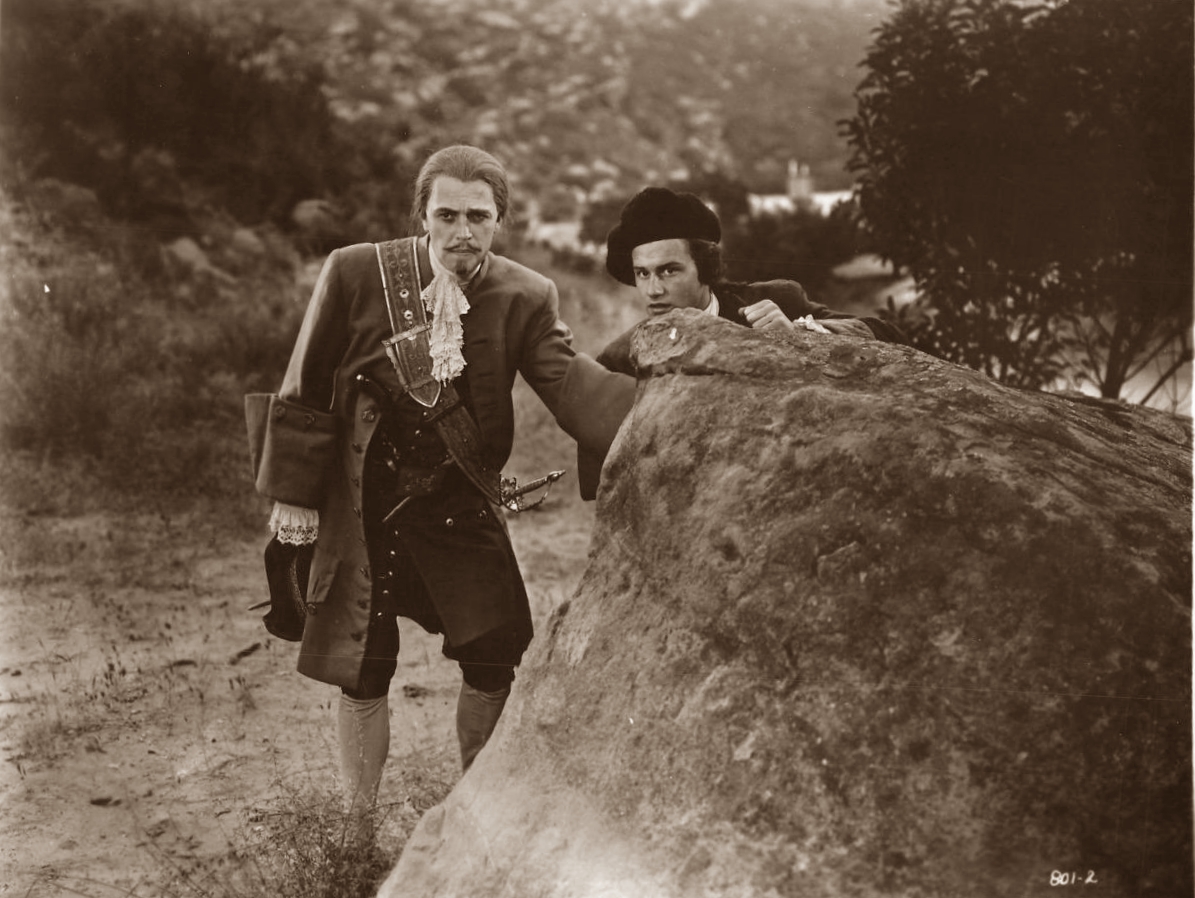
As Alan Breck [Stewart] in Kidnapped, also starring Roddy McDowell. (1948.)
O’Herlihy was nominated for an Oscar for his starring role in Robinson Crusoe, directed by famous-auteur-to-be Luis Buñuel.

Robinson Crusoe poster, 1954. The film was produced and made in Mexico for the English-speaking market. A Spanish language version was also produced.
Ever the distinguished-voiced actor’s friend: audio books.

Audio book on vinyl: Dan O’Herlihy reading A Christmas Carol. Four records at 16 RPM, I can’t even recall that speed on a turntable… (The Billboard, October 26, 1959.)
HAPPY HOLIDAYS!
Copyright Benerson Little 2017-2018. First posted December 20, 2017, last updated January 7, 2018.
Novels with Swordplay: Some Suggestions

Illustration by N. C. Wyeth from “The Duel on the Beach” by Rafael Sabatini, a short story soon published as the novel The Black Swan. The illustration was also used on the dust jacket of the first US edition of the novel. (Ladies Home Journal, September 1931.)
For your perusal, a list of a handful of swashbuckling historical novels–pirates, musketeers, various spadassins and bretteurs–with engaging swordplay, even if not always entirely accurate in its depiction. If you’re reading any of my blog posts, chances are you have friends who might enjoy reading some of these books, thus my suggestion as Christmas, Hanukkah, or other gifts this holiday season.
Three caveats are in order: all of the following are favorites of mine, all are set in the seventeenth and eighteenth centuries, and all are not “all” in the sense that the list, even narrowed strictly to my favorites, is quite incomplete. Without doubt I’ll add to it every holiday season. And maybe one day a list of swashbuckling films, another of table and board games, maybe even of video games too…
Upon reflection, perhaps a fourth caveat is in order as well: simply enjoy the stories and their swordplay for what they are. Don’t be too critical, especially of the latter. Except for the case of the reader who is an experienced fencer with a strong understanding of period fencing terms and technique (far more rare than you might think), complex historical fencing scenes cannot be written simply and just as simply understood. Nor can technique and actions in general be explained sufficiently for the neophyte to understand, at least not if the writer wishes to keep the action flowing. The writer must strike a middle ground, one that won’t lose the tempo and thus the reader. This is not so easily done.

Victor Hugo–Hugo to most of us, an adopted Norwegian forest stray–with a pair of late nineteenth century French foils with Solingen blades, and a Hungarian mask made in Budapest, dating to the 1930s. Because cats and swords. Or cats and swords and books.
It’s possible the Moby Dick technique would work–explain and teach prior to the event–but it’s just as likely that many readers would shun this, unfortunately. For what it’s worth, Moby Dick is by far my favorite novel and I consider it the greatest ever written. It is not, however, a book for readers who cannot step momentarily away from the narrative. As I’ve discovered after the publication of two of my books in which narrative history is interspersed with analysis and explanation, there are quite a few such readers, some of whom become plaintively irate and simultaneously–and often amusingly–confessional of more than a degree of ignorance when the narrative is interrupted for any reason. To sample this sort of reader’s mindset, just read a few of the negative reviews of Moby Dick on Amazon–not those by obvious trolls but those by apparently sincere reviewers. Put plainly, using Moby Dick as a template for swordplay scenes would probably be distracting in most swashbuckling novels.

Cover and frontispiece illustration by N. C. Wyeth for the first and early US editions of Rafael Sabatini’s Captain Blood: His Odyssey.
In regard to acquiring any of these enjoyable titles, note that some are out of print except perhaps as overly-priced modern print-on-demand editions. Even for those still in print, I highly recommend purchasing earlier copies from used or antiquarian dealers–there are plenty of highly affordable copies, just look around for them. Abebooks is a great place to start, but only if you have no local independent used or antiquarian bookstores available to try first. And these days, alas, there might not be any…
Why an older edition? Because the scent of an old book helps set the period atmosphere. Add a comfortable chair, a sword or two on the wall, a fireplace in a reading room or a fire pit on the beach nearby, and, if you’re of age to drink, perhaps some rum, Madeira, or sherry-sack on a side table, and you’re ready to go. Or Scotch, especially a peaty single malt distilled near the seaside, it will evoke the atmosphere of Sir Walter Scot’s The Pirate. Scotch always works.
So just sit back and let the writer carry you along. Don’t forget to imagine the ring of steel on steel and the sharp smell of ozone after an exceptionally sharp beat or parry. And if you really enjoy scenes with swordplay, there’s no reason you can’t further your education by taking up fencing, whatever your age or physical ability. If you’d rather begin first by reading about swordplay, you can start here with Fencing Books For Swordsmen & Swordswomen. And if you’re interested in how swashbuckling novels come to be–romance, swordplay, and all–read Ruth Heredia’s outstanding two volume Romantic Prince, details below.
Captain Blood: His Odyssey by Rafael Sabatini
Better known by its short title, Captain Blood, I list this first even though there’s really no significant description of swordplay, not even during the duel that is one of the best parts, of many, in the 1935 film version starring Errol Flynn. You must imagine the sword combat, yet in no way does it detract from this great swashbuckling romance that has inspired readers and writers worldwide, not to mention two major film versions (1924 and 1935). It is truly a modern classic. If you really want to judge the quality of the prose, read a few passages out loud: they’re wonderfully lyrical and evocative.
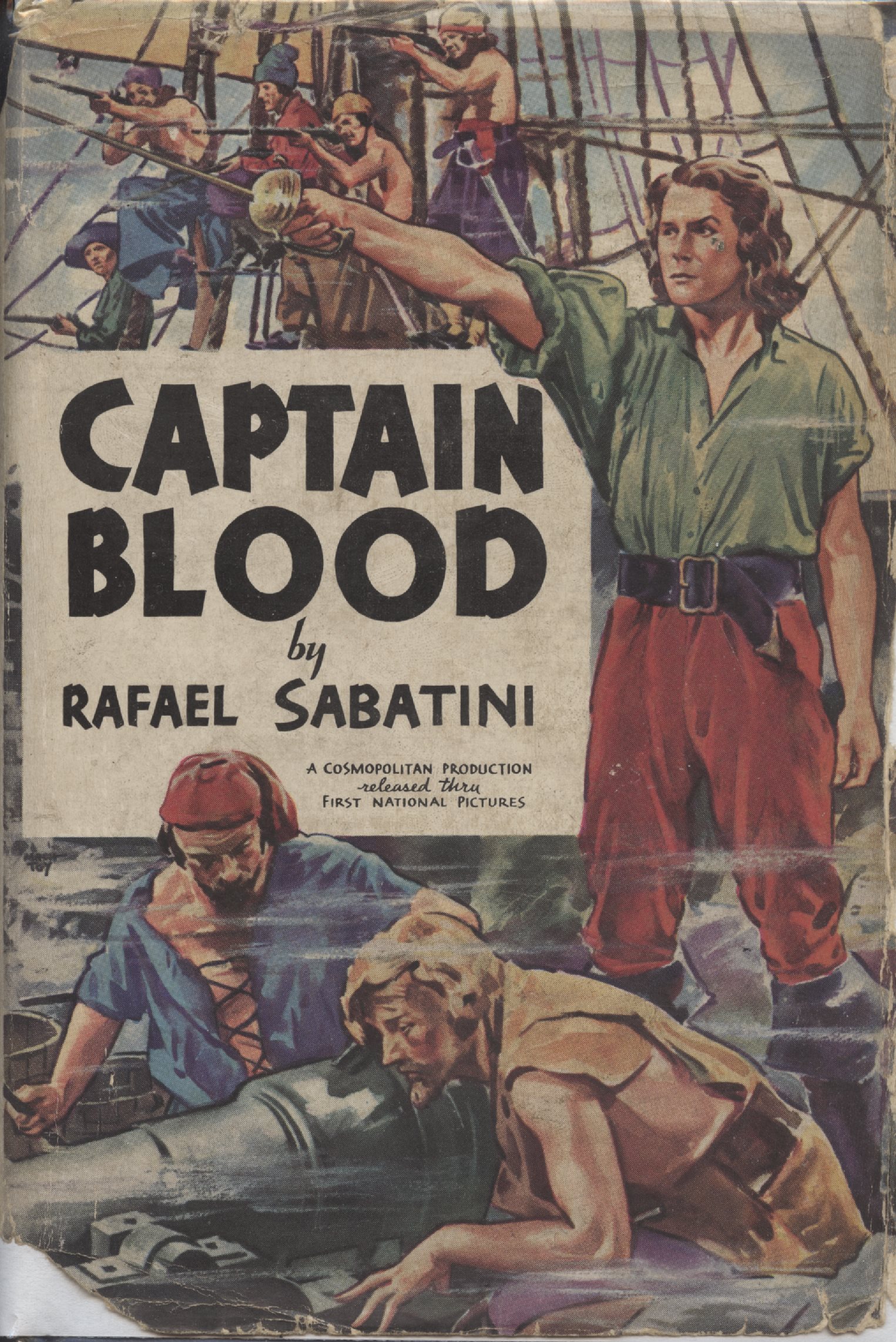
Photoplay edition from 1935, with Errol Flynn as Captain Blood on the cover. Although technically a photoplay edition, the only film images are to be found on the end papers. A nearly identical dust jacket was included with a non-photoplay edition at roughly the same time, the only difference being that the three small lines of film production text are missing.
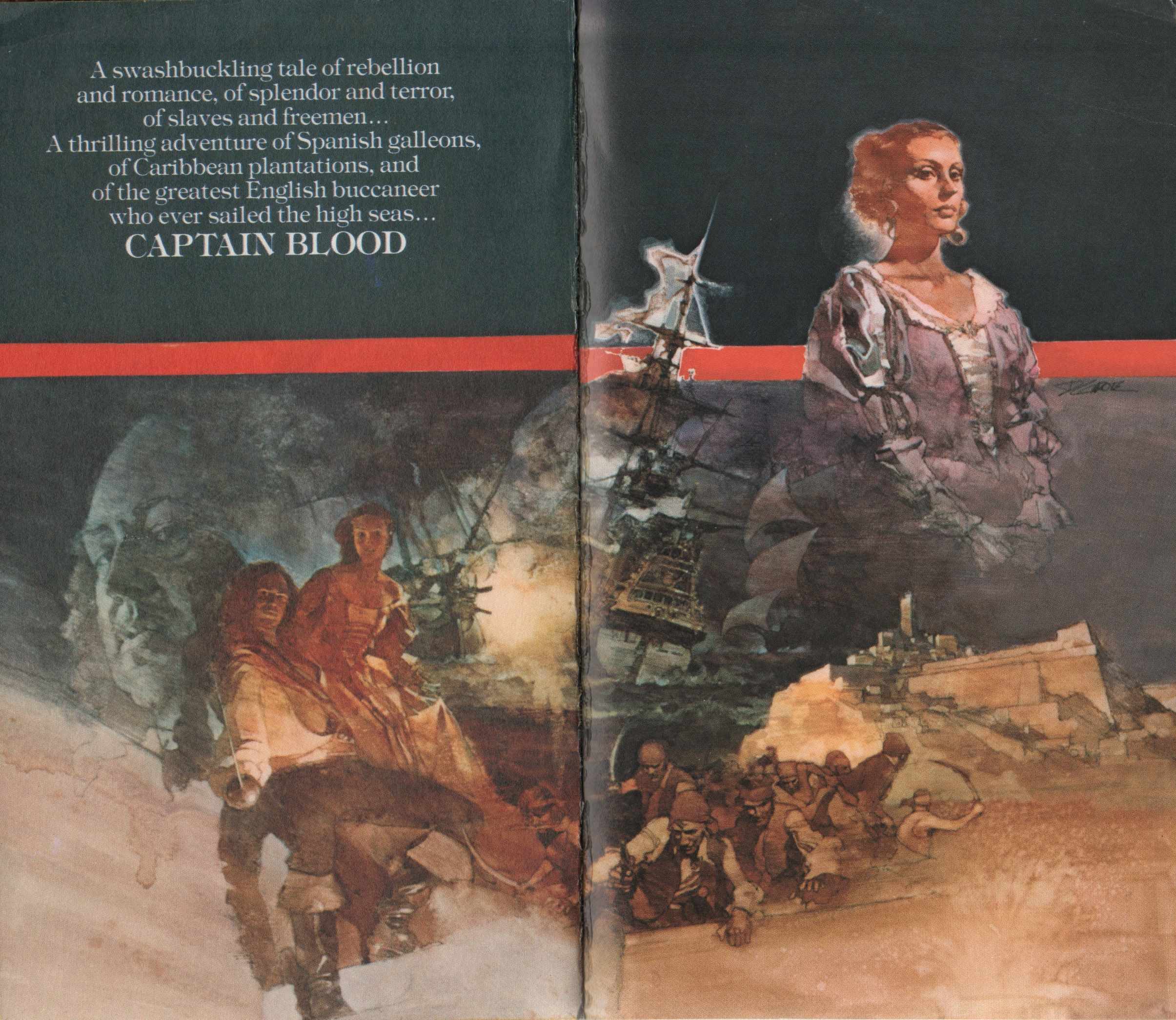
Wonderful artwork from a 1976 US paperback edition of Captain Blood.
Captain Blood Returns by Rafael Sabatini
If it’s a description of swordplay in a tale of Captain Blood, you’ll have to settle for the “Love Story of Jeremy Pitt” in Captain Blood Returns, also known in UK editions as the Chronicles of Captain Blood. Great Captain Blood fare, follow up it with The Fortunes of Captain Blood.

Dust jacket for the first US edition. Artwork by Dean Cornwell.

Endpapers in the first US edition of Captain Blood Returns, artwork by Dean Cornwell.
The Black Swan by Rafael Sabatini
One of the greatest of swashbucklers whose plot leads, line after line, to a dueling climax. The 1942 film of the same name, starring Tyrone Power and Maureen O’Hara, doesn’t do the book justice, not to mention takes great liberties with both plot and character.

Dust jacket, first and early US editions. Art by N. C. Wyeth.

Front cover of dust jacket of first UK edition (Hutchinson).
Fortune’s Fool by Rafael Sabatini
An embittered former Cromwellian officer reassessing his life during the early days of the Restoration–and proper use of the unarmed hand in a sword fight too!

Frontispiece by Aiden L. Ripley to early US editions of Fortune’s Fool.
Venetian Masque by Rafael Sabatini
A novel evoking many of the elements of my Hungarian fencing masters’ own history: spies, duels, intrigue, war, revolution, narrow escapes, and above all, courage. Plus Venice!
“With delicate precision he calculated the moment at which to turn and face them. He chose to do it standing on the lowest step of the bridge, a position which would give him a slight command of them when they charged. As he spun round, he drew his sword with one hand whilst with the other he swept the cloak from his shoulders. He knew exactly what he was going to do. They should find that a gentleman who had been through all the hazards that had lain for him between Quiberon and Savenay did not fall an easy prey to a couple of bully swordsmen…”

Illustration from “Hearts and Swords” in Liberty Magazine, 1934. The story would become the novel Venetian Masque. The illustration has been copied from the John Falter collection at the official State of Nebraska history website. Rather sloppily, in both instances in which Rafael Sabatini is referenced, his name is spelled Sabitini. Even the State of Nebraska must surely have fact checkers and copy editors.
Scaramouche by Rafael Sabatini
“He was born with the gift of laughter and a sense that the world was mad.” Add a sword and you have Scaramouche.
To my mind, a tie with The Black Swan in regard to a novel built around swordplay, and far superior in its scope. Easily has the best–most evocative, that is–description of a fencing salle, hands down.

To Have and To Hold by Mary Johnston
Listed here primarily as representative of the genre at the time (the late nineteenth century) and because it influenced Rafael Sabatini, the novel has most of the classic clichés of the genre, including the duel for command of a pirate ship, something that never actually happened. A gentleman swordsman, pirates, Native Americans, a damsel incognita in distress… The duel takes place, as best as I can tell, on Fisherman’s Island off Cape Charles, Virginia.

Frontispiece by Howard Pyle.

Dust jacket from the 1931 US edition. Illustration by Frank Schoonover, a student of Howard Pyle. The painting is an obvious homage to Pyle’s painting for the original edition.
Adam Penfeather, Buccaneer by Jeffery Farnol
The prequel to the following two novels, you may either love or hate the style in which it’s and the rest are written, the dialogue in particular. Even if you don’t much care for the style–I don’t much–the series are worth reading anyway for the adventure and swordplay, often including sword-armed women in disguise. Farnol will never come close to replacing Sabatini to me, but this doesn’t stop me from enjoying Farnol’s swashbucklers. And at least Farnol’s dialogue doesn’t sound like, to paraphrase a friend of mine, suburbanites chatting inanely at a PTA meeting–a problem with much dialogue in modern historical fiction and television drama.
As for swordplay, Farnol often takes the evocative approach, providing broad strokes to give a sense of the action without providing detail which might confuse non-fencers:
“Once more the swords rang together and, joined thus, whirled in flashing arcs, parted to clash in slithering flurry, their flickering points darting, now in the high line, now in the low, until Adam’s blade seemed to waver from this line, flashing wide, but in that same instant he stepped nimbly aside, and as Sir Benjamin passed in the expected lunge Adam smote him lightly across broad back with the flat of his blade.”
Non-fencing authors take note of the critical vocabulary for swordplay scenes: rang, flashing, slithering, flickering, darting, flashing…

Dust jacket for the first US edition. The first UK edition has a boat instead…
Black Bartlemy’s Treasure by Jeffery Farnol
Great swashbuckling fare, the first part of a two novel series.

Easily one of the most evocative dustjackets on any pirate or swashbuckling novel.
Martin Conisby’s Vengeance by Jeffery Farnol
This quote alone sells this sequel to Black Bartlemy’s Treasure: “So-ho, fool!” cried she, brandishing her weapon. “You have a sword, I mind—go fetch it and I will teach ye punto riverso, the stoccato, the imbrocato, and let you some o’ your sluggish, English blood. Go fetch the sword, I bid ye.”

The Pyrates by George MacDonald Fraser
Enjoyable parody of swashbuckling pirate novels and films, much influenced by the works of Rafael Sabatini and Jeffery Farnol. Fraser, an author himself of wonderful swashbuckling adventure, was a great fan of Sabatini.

The Princess Bride by William Goldman
Requires no description. The swordplay, like that in The Pirates above, is affectionate parody, and much more detailed than in the film.

25th edition, with map endpapers of course!

Nicely illustrated recent edition.
Rob Roy by Sir Walter Scott
Excellent if mostly, if not entirely, historically inaccurate tale of Rob Roy MacGregor told through the eyes of a visiting Englishman. It has a couple of excellent descriptions of swordplay, ranging from a duel with smallswords to action with Highland broadswords.

Le Petit Parisien ou Le Bossu by Paul Féval père
I’m going to pass on Alexandre Dumas for a variety of reasons, not the least of which is that I’ll eventually devote an entire blog to him. If, however, you feel he should be represented here, The Three Musketeers series is where to begin, but you must read the entire series of novels. Be aware that many such series are actually abridged. For a slightly different Dumas take on the swashbuckler, try Georges (an exception to the seventeenth and eighteenth century rule, an almost autobiographical novel in its focus on race and prejudice) or The Women’s War (or The War of Women, in French La Guerre des Femmes). Both are favorites of mine.
Instead, I’ll suggest a great swashbuckler by one of Dumas’ contemporaries. Le Petit Parisien ou Le Bossu is a true roman de cape et d’épée (swashbuckling novel) of revenge from the which the line, “Si tu ne viens pas à Lagardère, Lagardère ira à toi!” (“If you will not come to Lagardère, Lagardère will come to you!”), has passed into French proverb. The novel has been made into film at least nine times, plus into a couple of television versions as well as several stage versions. Unfortunately, I’m aware of only one English translation, and it is excessively–an understatement–abridged. Alexandre Dumas, Paul Féval, Rafael Sabatini are the trinity who truly established the swashbuckler as a significant literary genre.

Bill advertising Le Petit Parisien ou Le Bossu by Paul Féval, 1865. ( Bibliothèque Nationale de France.)
Cyrano de Bergerac by Edmond Rostand
Not a novel, but mandatory reading nonetheless, with one of the two greatest stage duels ever written, the other being that in Hamlet. Wonderful drama, philosophy in action, and sword adventure, including a duel fought to impromptu verse. Like Captain Blood, it is one of the truly inspirational swashbucklers. To be read at least every few years, and seen on stage whenever available. There are several excellent film versions as well.
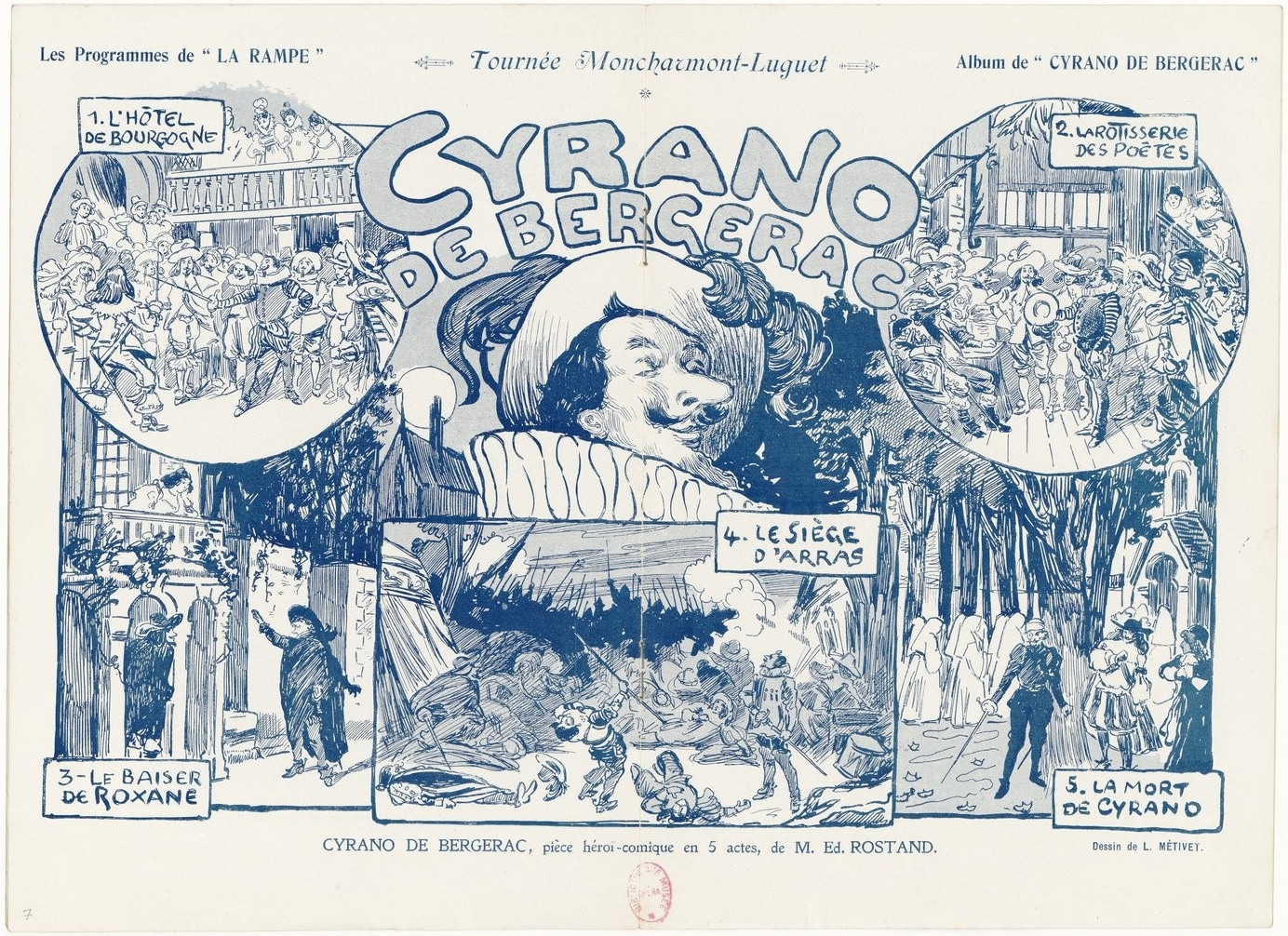
Theater program, 1898. (Bibliothèque Nationale de France.)
The Years Between &c by Paul Féval fils & “M. Lassez”
Two series of novels of the imagined adventures of the d’Artagnan of Alexandre Dumas and the Cyrano of Edmond Rostand, filling the twenty years between The Three Musketeers and Twenty Years After in the first, and immediately following Twenty Years After in the second. The books are filled with the expected enjoyable affrays and other adventures of the genre, including the usual improbable circumstances and coincidences. The first series consists of The Mysterious Cavalier, Martyr to the Queen, The Secret of the Bastille, and The Heir of Buckingham, published in English in four volumes. The second includes State Secret, The Escape of the Man in the Iron Mask, and The Wedding of Cyrano, published in English in two volumes as Comrades at Arms and Salute to Cyrano.

Comrades at Arms dust jacket of the US and Canada edition (New York and Toronto: Longmans Green and Co, 1930).
The Devil in Velvet by John Dickson Carr
Fully enjoyable read about a modern history professor who travels to the seventeenth century via a bargain with the devil. The professor discovers that his modern swordplay is superior to that of the seventeenth century–a wonderful idea for a novel but otherwise flawed in reality. At best, if the professor were a “modern” epee fencer, there might be parity. But who cares? After all, who can travel back in time anyway except in the imagination? If you’re a fencer well-versed in historical fencing versus modern (again, not as many as you might think, including some who believe they are), suspend your disbelief. And if you’re not, just enjoy the novel for what it is.


Wonderful endpapers!
Most Secret by John Dickson Carr
Pure genre by the famous mystery writer, this time entirely set in the seventeenth century. Cavaliers, spies, and a damsel in distress!

Dust jacket, Most Secret (London: Hamish Hamilton, 1964).
The Alatriste Novels by Arturo Pérez-Reverte
Leaping forward almost two hundred years, the Alatriste novels are a highly recommended recent series by one of Spain’s great novelists, although some critics note that the books are a bit dark. I’d call them realistic. Unfortunately, the latest of the series, El Puente de los Asesinos (The Bridge of the Assassins or The Assassin’s Bridge) has not been translated into English and doesn’t appear likely to be anytime soon, if at all, an apparent casualty of insufficient sales of the previous volumes and a reflection upon the state of the genre at the moment. That the genre should not have a larger readership given the times we live in is curious, but perhaps the audience awaits a few real-life swashbuckling heroes to reappear first. I have read The Assassin’s Bridge, but in French, and enjoyed it. My Spanish is simply not up to the task. The first six volumes are available in English translation. I also suggest The Fencing Master (El Maestro de Escrima) by the same author.

Romantic Prince by Ruth Heredia
For readers seeking to understand how written romances come to be, you can do no better than to read Ruth Heredia’s two Romantic Prince volumes: Seeking Sabatini and Reading Sabatini. The first is a biography of Rafael Sabatini, the second a guide to reading his many works, including some discussion of swordplay. Ruth Heredia is the preeminent expert on all things Rafael Sabatini. Long an officer and significant contributor to the Rafael Sabatini Society, she is a gifted writer in her right, and, in my own experience, an eloquent voice for sanity, empathy, and justice in a mad world. Originally published in now hard-to-find soft cover, her two volumes are now available in revised editions for free for personal use by requesting them from the author. You can find details at attica-ruth.


Fortune’s Whelp by Benerson Little
Last, a blatant effort at self-promotion, although I honestly did enjoy writing the swordplay scenes (not to mention working them out sword-in-hand), and I do enjoy re-reading the associated passages, or at least as much as I’m able to enjoy my own writing (the urge to revise and improve, even after publication, is quite distracting). A sequel, Fortune’s Favorite, is forthcoming, and at least another after it. Then, if all goes well, a series of prequels.

Fortune’s Whelp (Penmore Press, 2015).
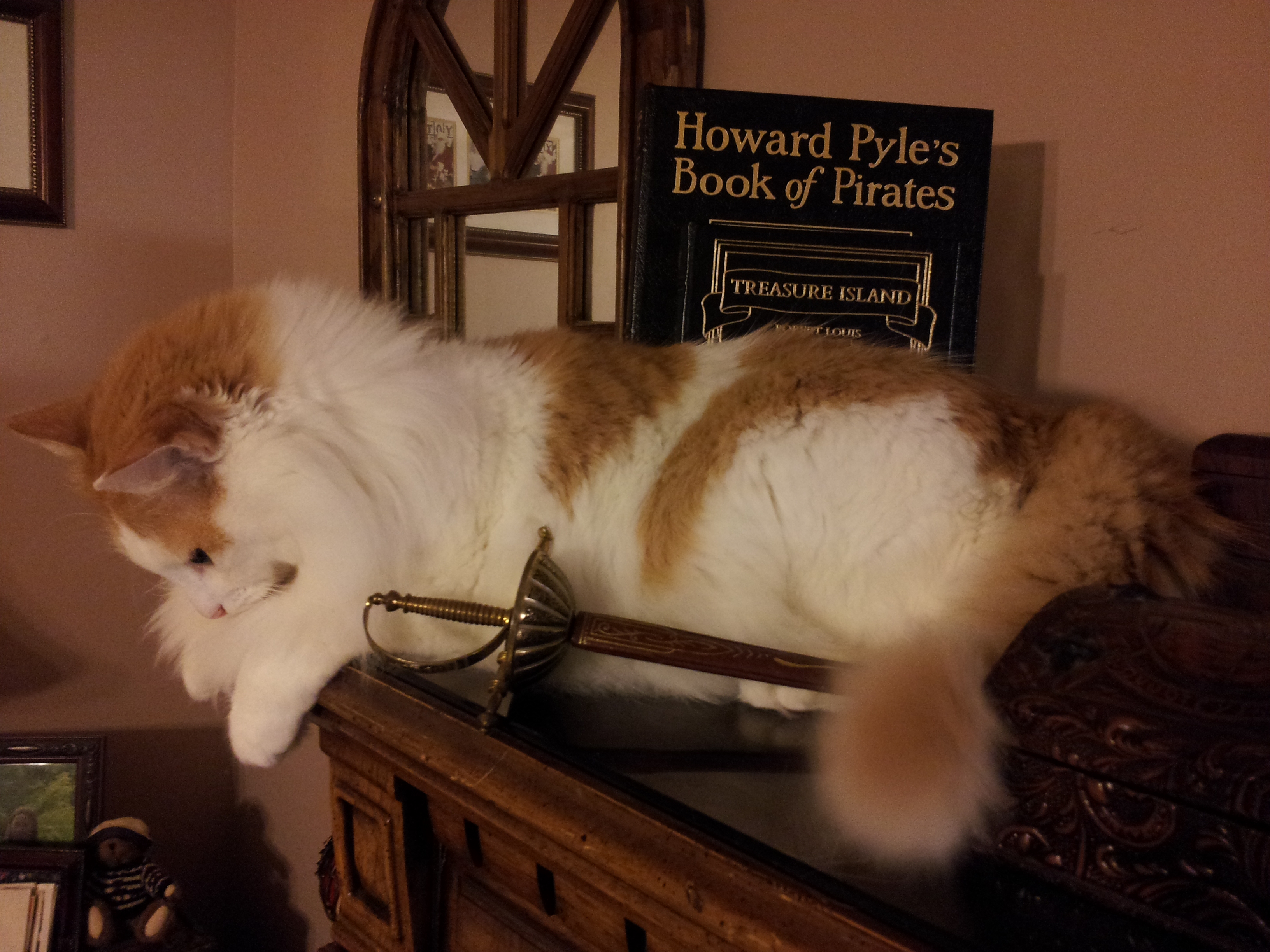
A swashbuckling descendant of sea roving Norse felines. Because cats and swords. If it’s one thing a swordsman or swordswoman can always use, it’s feline grace, tempo, and speed, not to mention sardonic cold-blooded cool.
Copyright Benerson Little 2017. First published December 14, 2017. Last updated April 14, 2020.
The Night Thrust; or, More Politely, the Passata Soto
“This subterfuge is termed a Night-Thrust; being a short method of deciding a skirmish in the dark.”
–Andrew Lonergan, The Fencer’s Guide, 1777.
But Edward was no longer there, or at least not where Lynch expected. Completely covered by the inky darkness, Edward had lunged backward, his left hand dropping to the ground, his body bending inward, his blade shooting forward at Lynch’s belly: the Italians called this passata soto, but some of Edward’s English contemporaries called it the “night thrust” for its utility in the darkness.
Benerson Little, Fortune’s Whelp, 2015
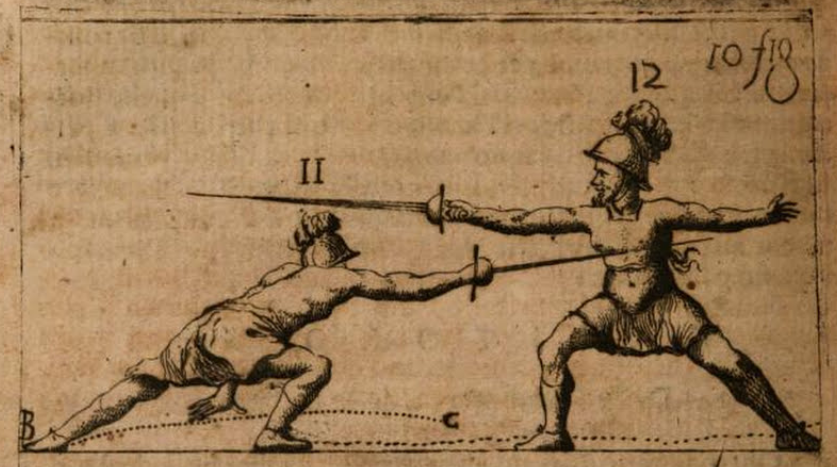
The Classic Passata Soto or “Night Thrust”
A staple of many Western fencing texts since the Renaissance, the passata soto, or passata sotto, also known variously as the sbasso, sottobotta, and cartoccio on occasion, the various dessous of the French masters of the smallsword and the passata di sotto of the modern, is usually defined as a counter-attack made by lowering the body while simultaneously thrusting, extending the rear foot in a reverse lunge, and placing the unarmed hand on the ground for support. Occasionally the technique is recommended as an attack with a true lunge, rather than a reverse. Andrew Lonergan provides an eighteenth century definition and exercise of the passata soto under the name of night thrust:
“On Guard in Quarte; and disengage a Quarte-over-the-arm [modern sixte]. I now batter [beat] with a Tierce; and begin to advance my left foot to form my Pass upon you in Tierce. Now when you see my left foot move, slip your left foot back, so as to pitch yourself on that knee; stoop your head so that your arm now turned into a Segonde may cover it, hold your left hand extended toward the ground, that it may sustain you, in case you should totter; thus my point will pass over your head, and I shall fall upon yours.”
And his reasoning why such “athletic” techniques should not be abandoned:
“Though these methods of Disarming, and Passing, Volting, and that of the Night Thrust, seem to be almost abolished by the refiners of these arts; I cannot conceive why a man, who is naturally strong and active, should not avail himself of such advantages, especially when improved by our athletic exercises, so engaging to an English subject, and forbidding to all others.”
In the old Italian schools, the body was usually bent at the waist. In some of the old French, the body was lowered by a very low reverse lunge. The adversary may be hit either with the extending arm or by impaling upon it, or both.

In terms of the modern French school, the “passata di sotto” is classified as an esquive, specifically une passe dessous with the back leg extended or both legs deeply bent.
With real weapons, the adversary is ideally impaled, usually in the belly which is, were the swords real, a good place to hit because there are no ribs and cartilage to potentially prevent the point from entering or otherwise diminish its penetration. There is also some anecdotal evidence to suggest that in some cases belly wounds may be more quickly incapacitating.

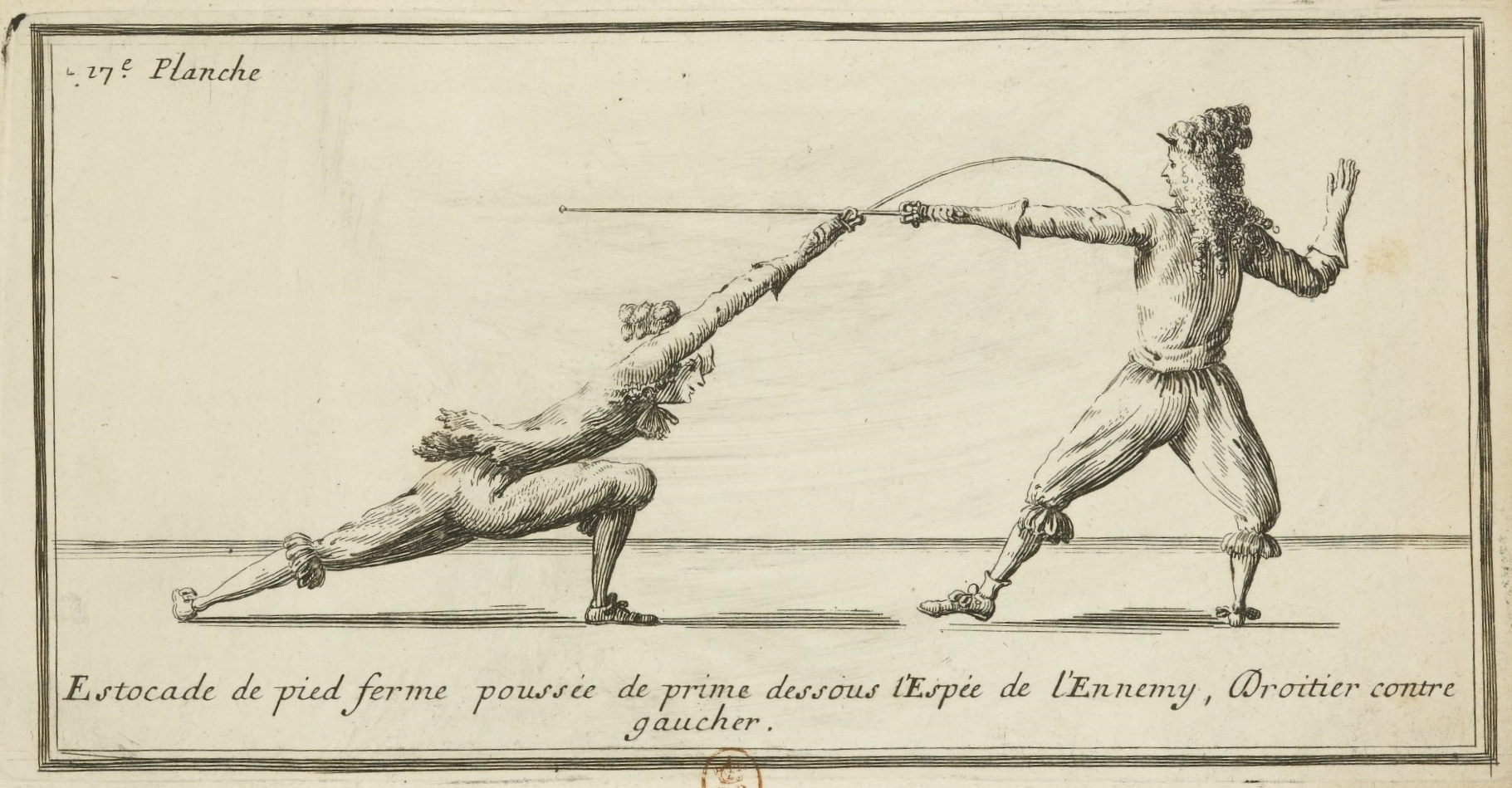
A very long low lunge which made going forward might slip under the adversary’s guard, as in Rafael Sabatini’s novel The Black Swan (1932), and which made in reverse might serve aid a counter-attack by lowering of the body. (An analysis of the duel in the novel may be found here: The Duel on the Beach, Part II: The Black Swan.)
Long low lunges like this are often identified with, or confused with, the passata soto. Note, however, that fencing language is highly malleable and definitions vary: one master’s passata soto might include only the classic reverse lunge with a bend at the waist, while another’s may include any lowering of the body in attack or counter-attack. Most masters, however, consider it to be a counter-attack with esquive, the body lowering in place or with a reverse lunge, and not a long low lunge forward.

The passata soto is not without significant drawbacks, which is probably why Lonergan recommended its use at night and nowhere else. Foremost, it must be well-timed. Too late, and the fencer attempting it may get hit in the face, neck, or upper torso. Too soon, and the fencer attempting it throws away the advantage of the surprise mandatory to its success. Used too often, and the adversary may learn how to trigger it with a feint, and then take advantage of the poor position the classical passata soto leaves the fencer in.
And it is this poor position that is the major drawback of the passata soto, in particular with real weapons. With the unarmed hand on the ground, the torso bent sideways, and the rear leg extended well behind, the fencer is in a bad position for defense after a failed attack or, even if the swords were real, after impaling the adversary. Few wounds are immediately incapacitating, including ultimately fatal wounds: many duelists and battlefield swordsmen were wounded or killed after giving an adversary a fatal wound. Even with a mortal wound to the heart, an adversary may live as long as ten seconds. Even assuming an average of four, that’s plenty of time to even things up.
In the case of dry (non-electric) weapons, the judges and director (referee) will determine whether a hit was made, whether it was in time, and whether a hit on the fencer who ducked is valid via rules regarding replacing of target. In the case of electrical weapons, the machine will make the determination in epee, and the machine and director in foil and saber.
For the fencer armed with a rapier on poniard, placing the poniard-armed hand on the ground is giving up half of one’s offense and defense, to be replaced by almost blind trust.
From the position of the passata soto, a prime or lifted sixte/septime beat or bind, or a St. George parry or opposition (modern saber quinte) accompanied by the use of the unarmed hand to help ward off the adversary’s blade, plus an urgent recovery forward or backward, all performed near-simultaneously, is the only viable option if the passata soto has failed to hit or otherwise halt the adversary.
Such recovery, however, is invariably slow, and a loss of balance may ensue if the unarmed hand is removed from the ground too soon to assist in parrying or opposing, for example. Further, the long low position leaves the fencer vulnerable if the arrest fails, whether by missing the adversary or failing to immediately incapacitate him. In particular, the head, neck, and subclavian area are exposed. Fatal thrusting wounds can be given in any of the three areas. It’s likely that execution at night might alleviate some of these weaknesses in the technique, but it would need to be a dark night with little ambient light.
Historical Techniques Similar to Passata Soto
There are better methods, past and present. In particular, these methods, while not reducing the target quite as much, leave the fencer in a much better position should the counter-attack fail, or, with real weapons, should the adversary be hit but not be immediately incapacitated. Some masters, Sir William Hope for example, believed also that a lowered position better-protected the torso.
In general they consist of a lowering of the body to a lesser degree, often with a parry or beat first, or with a thrust in opposition. Below are a series of images depicting this in various forms over time.
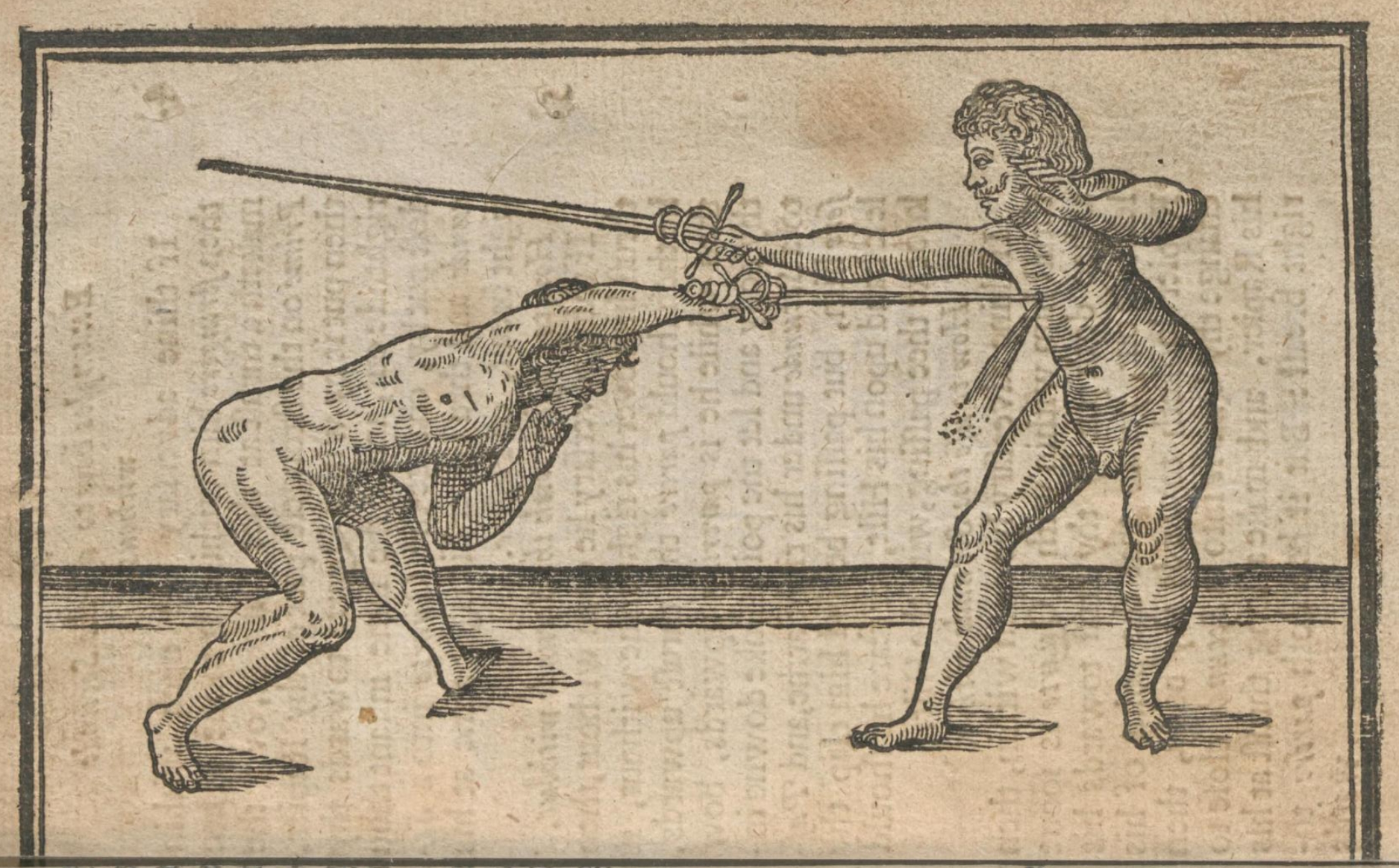
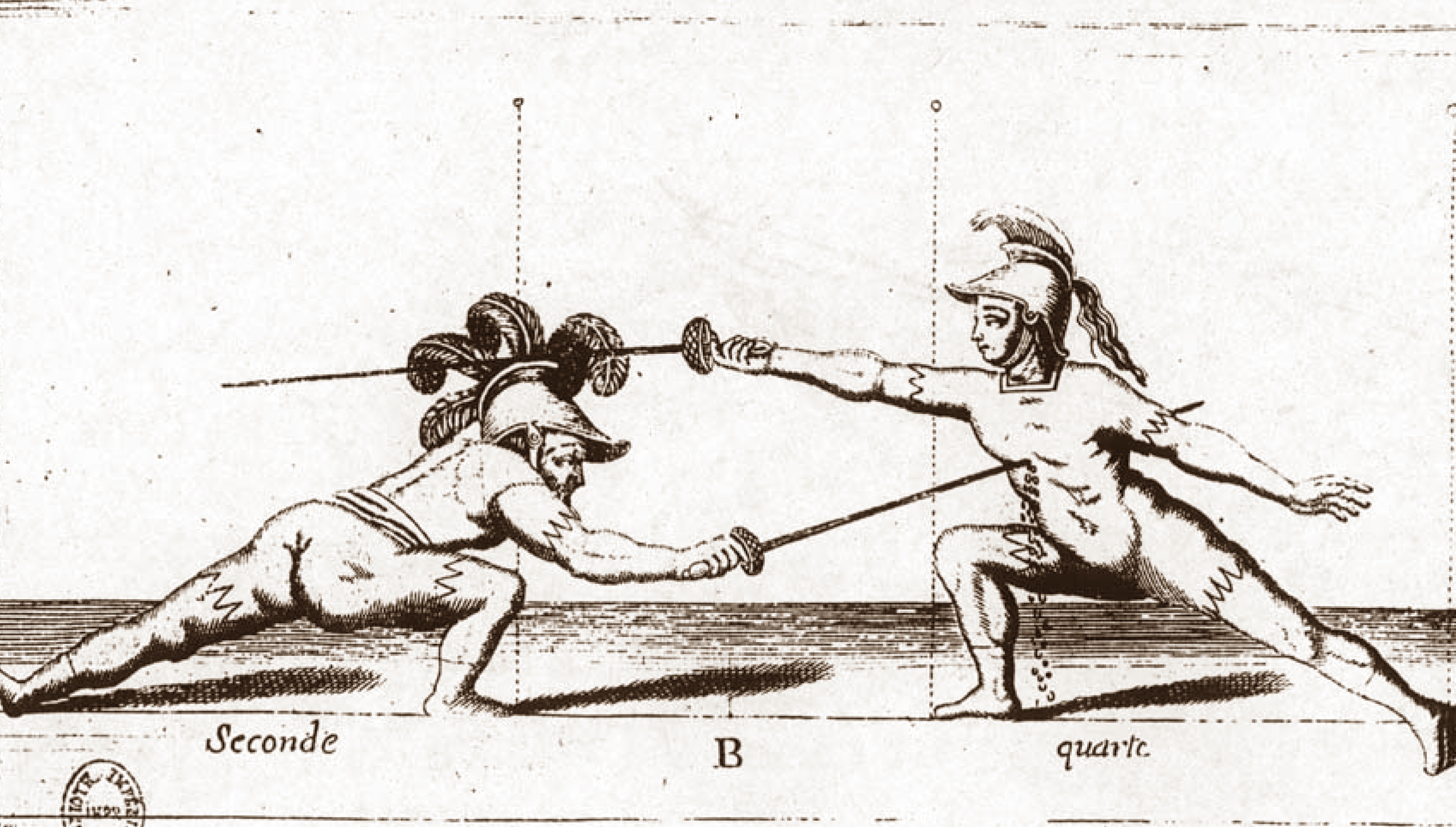

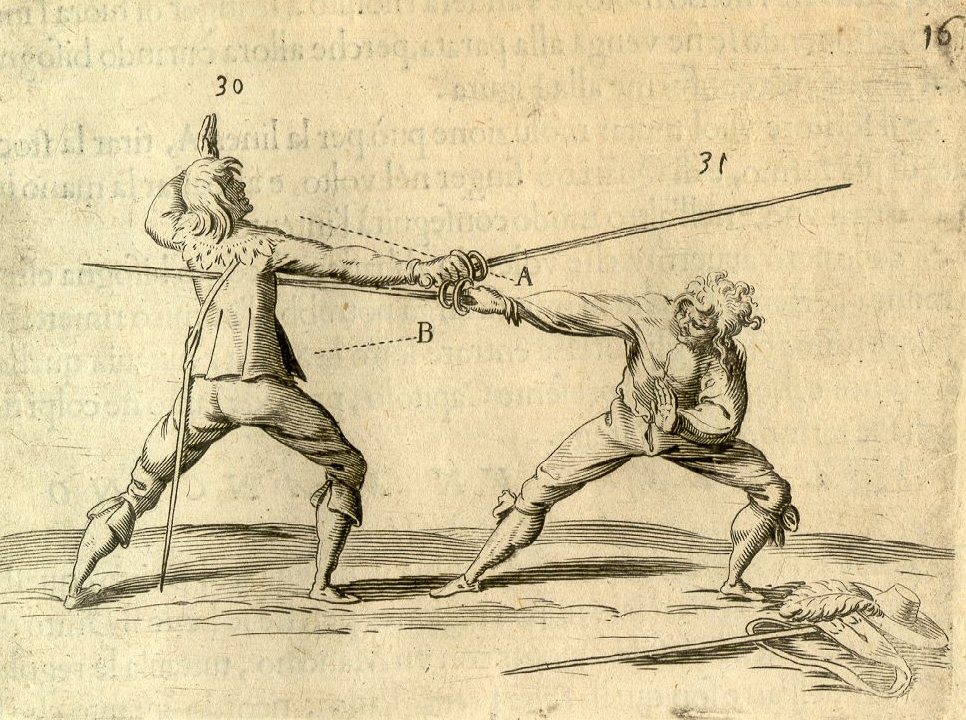


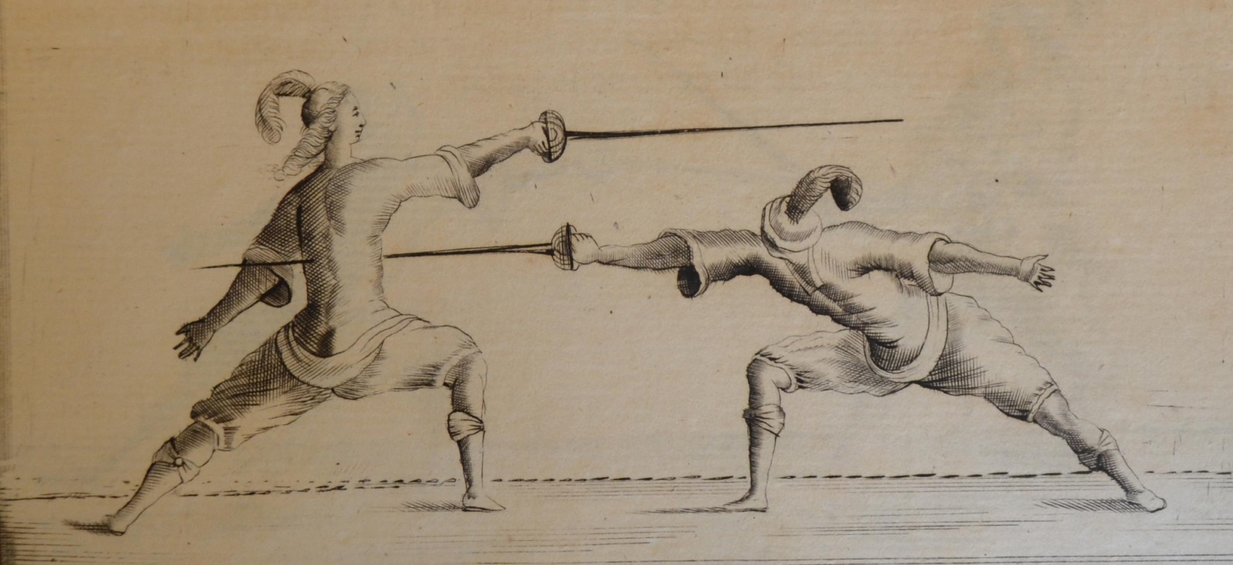

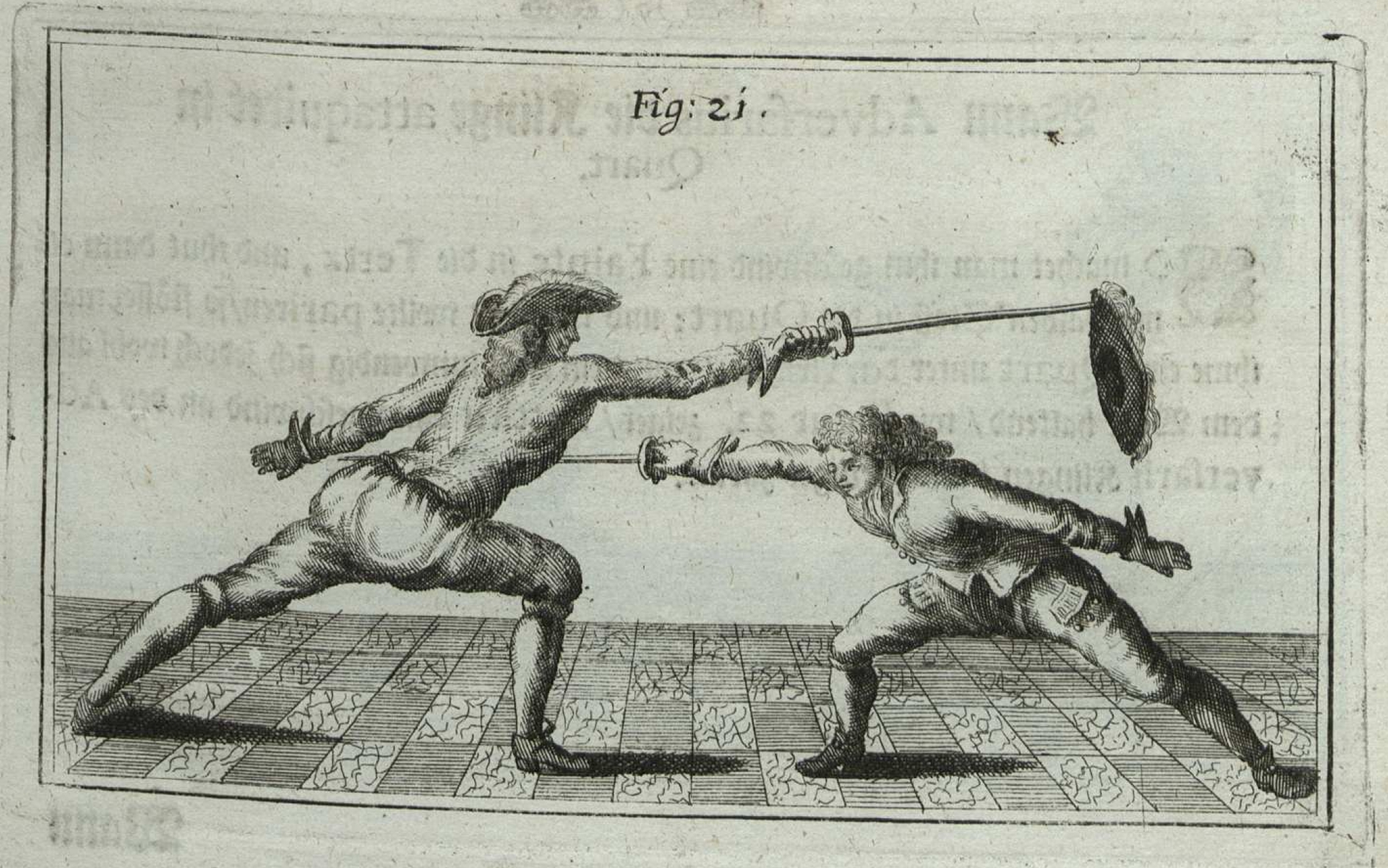


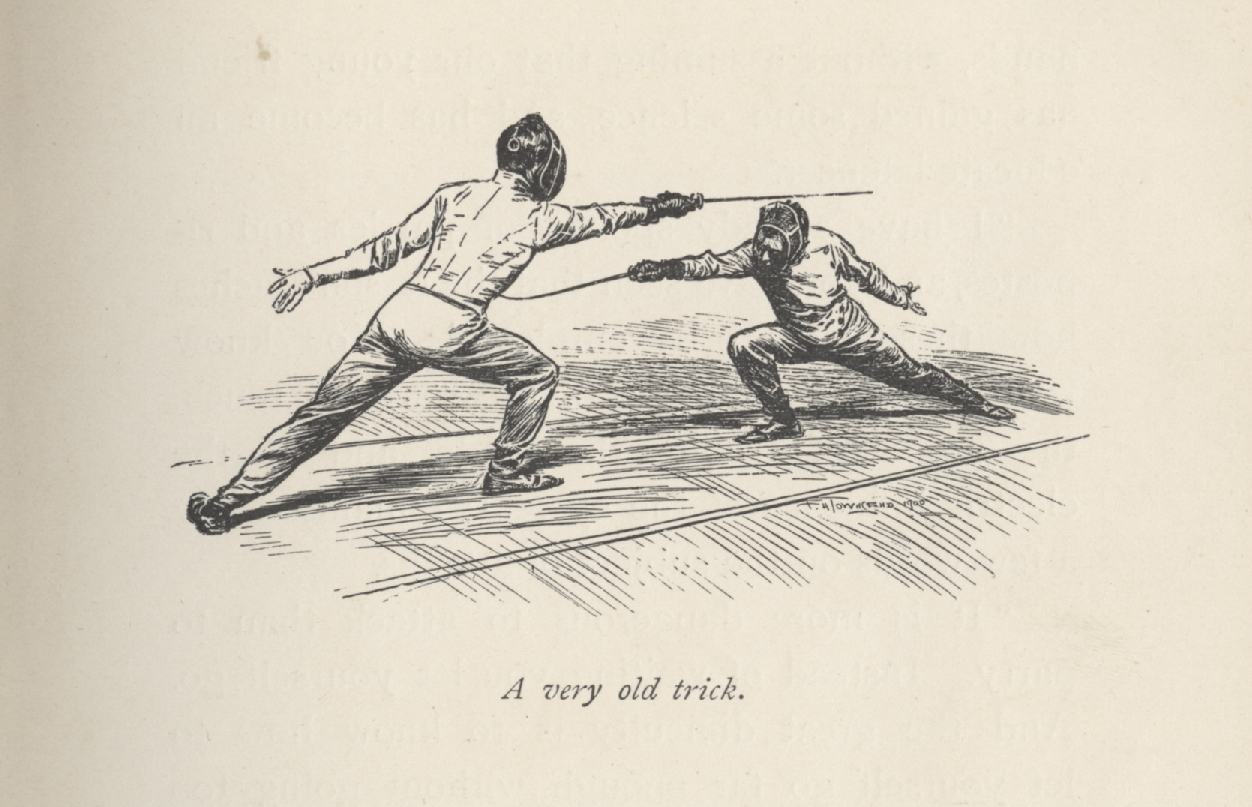
The Passata Soto in Film
The passata soto is seldom shown in film, unfortunately, but here are four associated examples:


The Passato Soto in Modern Fencing
In modern competitive fencing, the technique is still occasionally seen in its classical form, in particular against a flèche, but more often is seen in the modified form of “squatting.” This is not a new technique! It was noted by Jean Joseph-Renaud more than a century ago. He correctly–as expected–notes that the latter form is easier.
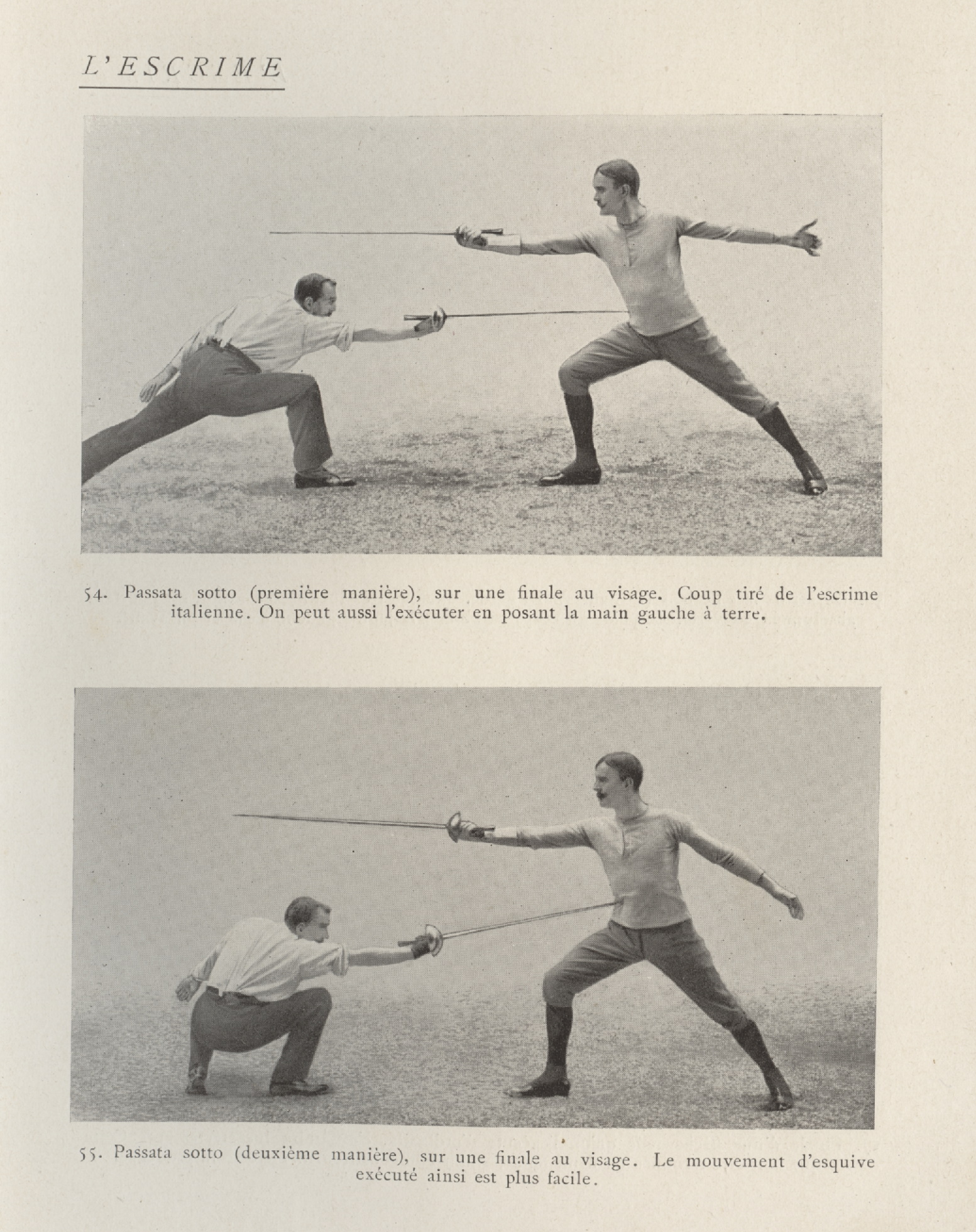

In the spring of 1978 I saw it well-used by a University of Southern California epeeist–I made up the weakest third of the USC epee team, having fenced for less than a year–at a large collegiate meet at the University of California San Diego. The score was la belle (4-4), with no time limit for the final touch as I recall. (It was a nice rule that, of no time limit for the last touch! It’s long since been sadly abolished in the name of expediency…)
Suddenly both fencers stopped and pulled off their masks, but for no reason other than that they had heard the bell on the adjacent strip and, their adrenalin up for the la belle touch, mistook it for theirs. The young director… Hold on for a moment. Today the director, from directeur de combat, the person who “directs” a duel, is called a “referee,” solely because the foolish powers that be thought it would make fencing more spectator friendly… Seriously.
But back to our anecdote. The young college-age director, rather than enforcing the halt and putting the fencers back on guard, said “I didn’t call halt!”
You know what surely happened next. Without putting masks back on, immediately the opposing team’s fencer flèched while ours dropped into a beautiful passata soto. We got the touch and the bout. Neither fencer, thankfully, was hit in the unprotected face. Or at least that’s how I recall it happened.


In modern usage, although infrequently seen, is a form known as the “turning” passata soto. The description is best left to R. A. Lidstone:
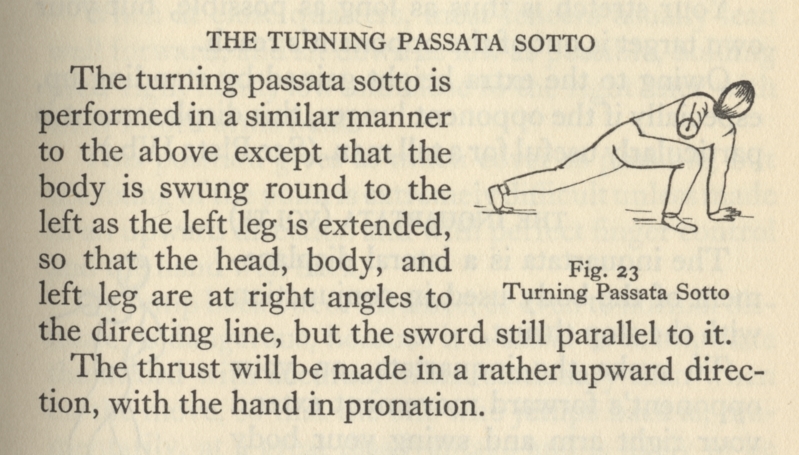
In competitive use, the modern form most often takes the form of ducking or squatting, shown below. Ducking has been used for at least seventy-five years in modern fencing.

Copyright Benerson Little 2017-2023. Last updated October 24, 2023.

Fencing Books For Swordsmen & Swordswomen
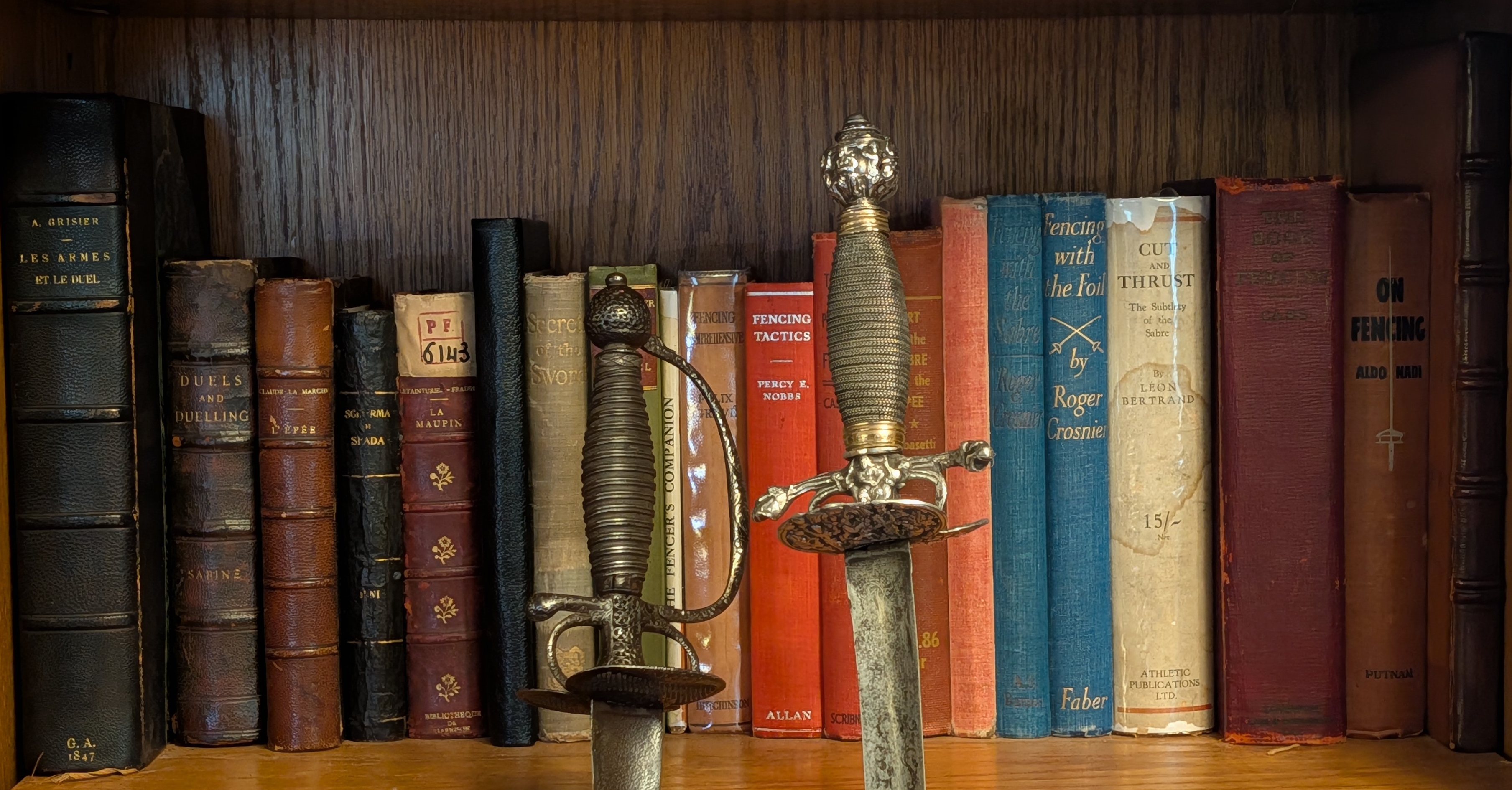
The content in this post is more background on than digression from the general subjects of this blog–swordplay and swashbucklers–, for what is either without fencing technique? The following fencing books are my recommendations for fencers across the spectrum, from early modern historical to “classical” to modern “Olympic” competitive. It includes sections on the modern Olympic weapons, classical fencing, rapier, smallsword, various cut & thrust, theory, Japanese texts, and more.
The list below, although quite long, is not exhaustive—there are many good fencing books not listed (and some more bad than good as well). Some are not listed simply because I have not yet read them. The history list in particular is abridged due to sheer volume, but less so than in past years, and I have not yet begun to include much in the way of mid-19th century works or of books on swords as opposed to swordplay. Fencing books can be very useful, but are no substitute for proper instruction and diligent practice, as I learned from my fencing masters, Dr. Francis Zold and Dr. Eugene Hamori. See the end of the list for suggestions on acquiring the books listed here, or for that matter, many books in general.
The first fencing book I ever read, in 1975 or 1976, was Bob Anderson’s All About Fencing, along with a beginning text by Nancy Curry or Muriel Bower, I can’t recall which, probably the former. These were followed by, once I started fencing in 1977 under Dr. Zold at USC, either Curry or Bower’s book (the latter I think, given Bower’s association with USC), then Charles Selberg’s Foil (and when it was published, his Revised Foil), Michel Alaux’s Modern Fencing, Marvin Nelson’s Winning Fencing, and, in 1980, Imre Vass’s Epee Fencing, soon followed by Laszlo Szabo’s Fencing and the Master. From that point my interest in fencing texts exploded.
My earliest years of fencing education, however, were dominated by fencing lessons, verbal instruction, and oral histories, not fencing books. Notably, my epee instruction was derived in large part from Vass via Dr. Hamori’s own knowledge of the weapon and in consultation with his close friend József Sakovits (trained by Imre Vass) who was one of the world’s greatest epeeists and later Hungarian national coach. The general method of instruction used by my masters was derived directly from Szabo, his master Italo Santelli, and other notable Hungarian masters such as Gyorgi Piller–yet never for four years were the works of Vass or Szabo recommended to me. They were, in essence, above my ability at the time.
As Italo Santelli put it, fencing is something you do, not something you write (and therefore read) about! Thus were my early years filled with learning to fence not by reading but by fencing and fencing lessons. That said, the study of fencing texts does have an important place in learning to fence: it broadens one’s knowledge of the subject. Fencing books provide a map to the world of swordplay. They can also point out errors in technique, training, and tactics (although a fencing master is always better for this), and can reorient one’s perspective in certain cases.
Associated fencing quotations can be found here.
N. B. If you take the broad study of swordplay seriously, you will find yourself compelled to consider the following questions major and minor, for example: Does offense or defence put the fencer in the strongest position, or does a balance between the two? Should the fencer extend fully before lunging or simply begin with the point, extending and lunging near simultaneously? Where should the fencer primarily look when fencing — at the hilt and blade, at the eyes (if they could be seen), or broadly at the whole, or in combination, shifting from one to another? Should the fencer emphasize power (strength and speed) or finesse, or both? Tactically, is the strategic fencer or the opportunistic fencer generally superior?
Essays on Fencing & Life
So rare are these essays that I’ve found only two to list so far, although occasionally the subject is touched upon in prefaces to fencing books. I’ve listed Lambotte’s first, as her entire short work is on the subject. The first third of Bertrand’s book qualify as an essay on fencing & life, thus the book is the only one to get a double entry.
Arguably, Bazancourt’s Secrets of the Sword and Burton’s The Sentiment of the Sword occasionally connect fencing to life in general, and Gravé’s Fencing Comprehensive has a sense of this as well. All three are noted below.
L’Escrimeuse by Emma Lambotte, 1937. A delightful essay on fencing, on being a woman fencer, on fencing’s connection to and reflection of life, and on the characters of various fencing nationalities, among many other brief subjects. Mme. Lambotte was a noted Belgian poet and the muse and patron of painter James Ensor.
Cut and Thrust: The Subtlety of the Sabre by Leon Bertrand, 1927. The first five chapters of Bertrand’s book qualify as essays on fencing and life, ranging from a defense of fencing as sport to a defense of dueling to physical and mental exercise. See the full entry below.
Modern Epee
Why have I placed Modern Epee—that is, epee as fenced from the 1930s to the present in its various forms—first among books on technique? Because it’s the best starting point for most budding fencers today, even if their ultimate goal is classical or historical fencing. It is by far the most popular modern competitive weapon (it looks like swordplay, its judging is simple, it much more resembles sword-fighting with sharps than either modern foil or saber, it is very “democratic” in that the weaker fencer always stands a chance, as some have put it), and—if taught appropriately via a classical foundation as it should be—is also an excellent foundation for historical and classical fencing. Modern competitive foil and saber have become largely useless for this, both as fenced and as taught, for they’ve given up the classical notion derived from combat that attacks in invitation–with the point non-threatening and/or the arm not extended or extending–would be suicidal with real weapons.
It should be noted that some modern epeeists consider not only classical epee technique (point d’arrêt technique, especially non-electrical, and true dueling technique), but also “modern classical” (electrical pre-Harmenberg, so to speak) technique to be obsolete. This narrow view has no basis in fact except to some degree in the case of some elite (world class, that is) epeeists. Purely classical and modern classical epeeists can, and often do, fence as far as a solid A, or national, level, and classical technique is the foundation of elite epee technique. In fact, elite women’s epee retains a significant amount of so-called classical technique, and the compiler of this list is well-acquainted with a Greek-American epeeist some 80-plus years old whose classical, very old school straight arm dueling technique can still give even young elite epeeists fits.
Note, however, that the definition of classical fencing has changed over time and continues to change today. More than a century ago foil was considered the classical school and epee the modern, and French duellists of a century ago were classified according to three schools: foil, foil-epee, and epee! In fact, one need only read Achille Edom’s 1910 book on epee fencing (see below) to realize that much of what is considered new in epee is in fact more than a century old. In other words, epeeists should not consider older epee texts, nor any epee style of the past century or more, as unworthy of practical study, modern fads, to which epee is highly susceptible, notwithstanding.
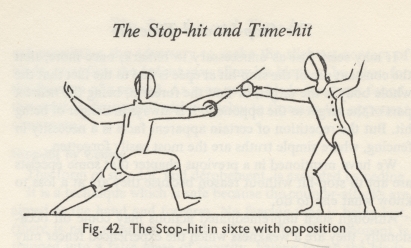
Fencing with the Epee by Roger Crosnier, 1958. A thorough description of modern classical epee technique, still very useful today. Prof. Crosnier’s book on foil fencing (see the Foil section) should be read hand-in-hand with his epee text.
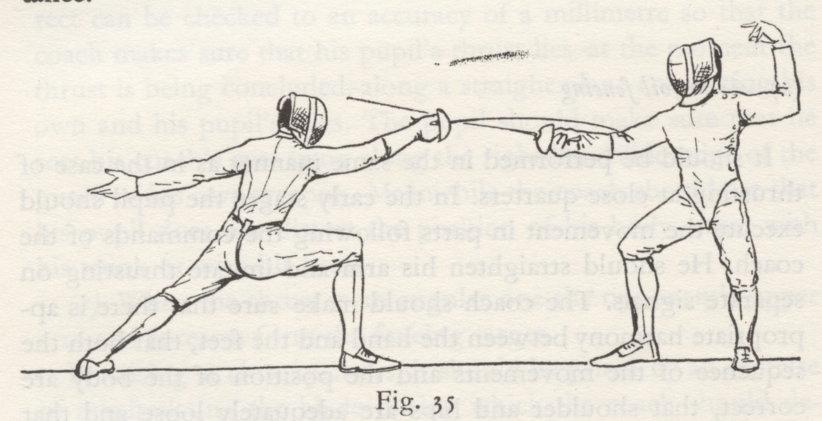
Epee Fencing: A Complete System by Imre Vass, 1965 in Hungarian, 1976 1st English edition, revised English editions 1998, 2011. The most thorough epee text ever written. That said, highly recommended for epee coaches at all levels, recommended only with caution for intermediate to advanced fencers (at least three to five years or more significant experience)—but not for beginners. There is much useful, often profound, material, but some sections can be skipped entirely by some fencers, and others require sufficient epee fencing experience in order to profit from them. The revised editions were edited by fencer and publisher Stephan Khinoy, and amplify and supplement the original text in places.
The latest edition suggests the need for such classical training today, in spite of the so-called “new paradigm” (see Harmenberg below, his book was also originally published by Khinoy). I agree. Even for those relatively few fencers (as compared to the entire body of epeeists) who wish to and are able to emulate Harmenberg’s sport methods, a solid base of “modern classical” epee training is still necessary. For most epeeists, even superior amateurs, modern classical technique is all they’ll ever need.
Again, caution is advised when studying the book; it’s best to have a solid understanding of fundamental epee technique and theory before reading it. In fact, it helps to understand the Italian school in order to understand Vass’s theoretical framework: Luigi Barbasetti’s book on foil (see below) is a good start. Vass trained international medalists József Sákovics and Béla Rerrich, both of whom went on to become leading epee masters and national coaches, the former in Hungary, the latter in Sweden, with numerous international champions to their credit. He also trained four-time Olympic gold medalist in epee Győző Kulcsár, who later as a fencing master trained two-time Olympic gold medalist in epee Timea Nagy. József Sákovics, considered by many to be the first “modern” epee fencer, died in 2009, Béla Rerrich in 2005, and Győző Kulcsár in 2018.
La Spada: Metodo del Maestro Caposcuola Giuseppe Mangiarotti by Edoardo Mangiarotti, the Comitato Olimpico Nazionale Italiano, Scuola Centrale Dello Sport, and Federazione Italiana Scherma, 1971. Epee as taught by the famous Guiseppe Mangiarotti: a thorough exposition of his method. Beginner-friendly, too, at least if you read Italian or have a working knowledge of fencing technique and language along with a background in Romance languages other than Italian. Includes excellent illustrations of blade positions, better perhaps than in any other epee text. (Side note: the book even includes illustrations from the works of Vass and Szabo. Kingston and Cheris in this section also have excellent illustrations of blade positions.)
Prof. Mangiarotti, who studied under Italo Santelli as well as under other masters Italian and French, was an Olympic fencer, seventeen-time Italian national epee champion, father of famous champion Edoardo Mangiarotti as well as of noted fencers Dario and Mario Mangiarotti, and founder of a famous epee school in Milan, still in existence, that blended the French and Italian schools and produced champions for decades. Edoardo won 13 Olympic medals and 26 World Championship medals, and was known for his fluid, very Italian footwork as well as for his strategy of attacking hard and fast early on to get touches, then playing a defensive game. Highly recommended: it is my second-favorite “modern” epee fencing book. See also Mangiarotti and Cerchiari in the “Combined Modern Epee, Foil, and Saber Texts” below. For the French school, see Alaux and Cléry in the same section.
Epee Combat Manual by Terence Kingston, 2001, 2004. Highly recommended beginning to intermediate text. Should be required reading for new epeeists. Pair with How to Fence Epee by Schrepfer (below). Unfortunately, Kingston’s book is unavailable in the US anymore, and his web store ships only to the UK and EU (or I suppose he still ships to the EU after Brexit–a lot of small businesses are having issues doing so).
Fencing: Steps to Success by Elaine Cheris, 2002. Actually an epee and foil text, but the epee stands out more to me, and is very useful to both recreational and competitive fencers. Includes training drills as well as excellent illustrations of technique, including from the fencer’s point of view. The book is a good companion to Kingston’s book above. Cheris is one of the great US fencers in both epee and foil.
Epee 2.0: The Birth of the New Paradigm by Johan Harmenberg, 2007. For advanced epeeists and coaches only. There is a second edition–Epee 2.5 I think–that I have not yet read, therefore some or all of the criticisms below might be valid for the new edition. Importantly, the book is suited, in Harmenberg’s own words, only to truly advanced fencers, although this has not stopped many insufficiently experienced epeeists, and even their coaches, from foolishly assuming they can emulate its technique and tactics—and in doing so, impale themselves by repeatedly running onto their adversary’s point from distance much too close. This is often quite funny to watch, especially in the case of exceptionally tall epeeists, with their naturally slower tempo, who throw away their height advantage.
Although there is very useful material in the book, some of Harmenberg’s recommendations are controversial and not all masters agree with the described training regimen, except, again, perhaps in the case of elite epeeists. Further, Harmenberg at times appears to take more credit than he deserves, albeit innocently, given that other epeeists were also knocking at the door of his new style, and had been for some time. Harmenberg, however, was arguably the first elite epeeist to succeed with it at the Olympic and World Championship levels. That is, the first to use “outstripping” attacks—beating the double touch timing by a hair—to the body as a primary technique and tactic, although others, the Soviets notably, had already been using the fleche in renewed attacks to great effect in an outstripping rather than conventional tempo. (Vass calls these sorts of touches “combat” techniques; a better term might be “sport” techniques.) It was also common to see some epeeists below the international level in the 60s and early 70s use technique similar to Harmenberg’s, but they were unable to succeed with it against elite modern classical, aka conventional, epeeists at the international level.
Additionally, some of his criticisms, even though thoroughly honest, of the modern classical technique are not entirely valid. For example, his objection to epeeists who use, and their masters who teach, attacks with a fully extended arm prior to the lunge is somewhat misplaced: although many French fencers and masters did adhere to the technique during the heyday of dueling with the epee, this was done primarily to prevent serious injury and death by emphasizing long distance and straight-arm attacks on the arm. There has long been a debate on whether the attack with extension first or with point only first is faster in practice, and the issue is confounded by en gardes with a near-fully extended arm, and with renewed attacks made with extended arm, for example immediately after a counter-attack that falls short.
Even so, the lunge with near-simultaneous extension (likewise, the “progressive attack”) has been commonplace three or more centuries prior up to today, was used even by some French epee dueling masters, and some lineages of masters had never taught otherwise. (“Historical” fencers, please don’t bother to argue with me on this smallsword history, simply open up and read the first two dozen period smallsword manuals you lay your hands on.)
Still, many early epee masters (and some saber masters too) did teach that the simple attack via lunge, almost always to the arm, must be made with the arm fully extended first, although others argued correctly that simultaneous or near-simultaneous extension and lunge was faster, as Harmenberg likewise deduced (as did masters in past centuries). Indeed, if you intend to hit the body with an attack, you’d better not extend first then lunge! If you do, you’ll lose a tempo, warn your adversary, and probably get successfully parried or counter-attacked. Early epee masters generally avoided recommending attacks to the body due to the increased risk of double touches—and the increased risk of jail time for murder or manslaughter. (Roughly seventy percent of modern epee touches are made to the body thanks to the flat tip of the epee which is less effective to the arm when compared to the old jacket-tearing points d’arret which were highly analogous to the sharp point of a dueling epee.)
The argument remains as to whether Harmenberg’s described techniques and tactics are truly revolutionary, or merely one of the final steps in the evolution of sport epee, in that the “paradigm” takes complete advantage of the 20th to 25th of a second tempo provided by the electrical apparatus, and entirely disregards any consideration of classical tempo so necessary were swords real — sharp, that is, and intended to put holes in an adversary.
The book is based on the Swedish epeeist’s experiences leading up to his 1977 world championship and 1980 Olympic gold. In other words, however profound the book may be to sport fencing, its author’s ideas were not new in 2007—only their publication was.
Epee Fencing by Steve Paul et al, published by Leon Paul, 2011. A very useful text for the modern competitor. Positive criticisms: thorough and well-illustrated. Negative criticisms: 100% emphasis on epee as pure sport (as opposed to epee as dueling swordplay or martial art modified for sport) and a magazine-style layout (or in imitation of a badly-designed webpage?), including a thin magazine-like cover that will not hold up to much wear.
How to Fence Epee: The Fantastic 4 Method by Clément Schrepfer, 2015. Translated from the original French edition, Faire de l’épée: La méthode des 4 fantastiques, by Brendan Robertson. Not a manual of technique per se, but suggestions on how to use it. A very useful book, with only little to find disagreement with, and mostly in terms of style or tradition and not practicality. Highly recommended, especially for beginning to intermediate epeeists. An excellent companion volume to the Epee Combat Manual by Kingston (above) or Learn Fencing — Épée below.
Learn Fencing — Épée by Peter Russel, 2015. A generally good introduction to modern epee for beginners. Quibbles: the black background and resolution of some of the photos makes for difficult viewing and therefore comprehension at times, and the description of beats is inadequate, essentially relegating the beat to a reconnaissance action with the foible. This may be an artifact of the ignorance of the beat many modern fencers have (I blame their coaches for following the fad of not teaching a complete technique). Numerous times over the past fifteen years I’ve been told by visiting fencers that they’ve never encountered a beat as strong as mine and suggest I must have extraordinary forearm strength. Nonsense! It’s all technique! My wife, smaller and less strong than I am, has a beat as powerful. As Vass (noted above) put it, the beat (use the middle of the blade, not the foible except for reconnaissance) can be used to open the target, delay the adversary’s response, provoke a reaction, and loosen the adversary’s grip, thus further delaying the response. Enough ranting. 🙂 (Last quibble: poor copyediting on the cover, in which Épée is spelled Épeé, but books shouldn’t be judged by their covers.)
Put plainly, the book is Harmenberg’s exposition of how HE fences. Tellingly, whenever I ask elite European fencers and masters about the book, they shrug their shoulders. If they do happen to know who Harmenberg is, their answer is something on the order of, “Well, if it worked for him, good, but there are many other ways to fence epee…” That said, far too many epee teachers in the US have adopted his theory, all too often too early for their students and quite imperfectly, although lately I see this fad–and there are many fads in fencing–fading.
See also the “Combined Modern Epee, Foil, and Saber Texts” section, especially Alaux, Barth/Beck, Cléry, de Beaumont, Deladrier, Lidstone, Lukovich, Mangiarotti/Cerchiari, and Vince, as well as the “Epee de Combat” section in general, and Castello and Gravé in the “Classical Fencing” section.
The Epee de Combat or Dueling Sword:
Epee for Actual Combat, In Other Words (and Almost Immediately for Sport as Well)
All of these works are of use to the modern epeeist, and all demonstrate that there is, overall, little new in modern epee fencing. Even the pistol grip was growing in popularity in France by 1908, although its use in dueling was prohibited and it would be the Italians who found in it the perfect replacement for the romantic rapier grip used on their fiorettas and spadas. Only the tactics and techniques of “out-stripping” (of trying to hit a 25th to a 20th of a second before one gets hit), and of the unrealistic abomination of flicking (and arguably, of foot touches), are new. In fact, by 1900, if not earlier, epee was often judged not according to the realities of sharp swords, but according to a perceptible difference in timing when both fencers hit–in other words, who hit first, much akin to the modern electrical apparatus (unfortunately).
Double touches, including “outstripping” touches of which modern epeeists are so fond (hitting just enough prior to the adversary’s hit that it will be considered a single touch, when with real swords both fencers would be hit) have long been the bane of the salle or sport fencer, even long before the advent of electrical scoring and its too short timing–there have always been fencers trying only to get the first hit, however they may, as if playing tag. There is an unfortunate natural tendency to turn fencing into a game of mere “who hits first” tag. As for the flick, it is new only to epee: it was used by a fair number of foilists in the 19th century and almost certainly in the two immediately prior centuries as well, and there are references as late as the 1930s noting what can be done with a very flexible blade rather than a stiff one. Flicks and foot touches are too dangerous to attempt with an epee de combat: they would cause little damage while leaving the user vulnerable to more damaging, even fatal, thrusts, not to mention that the blade of a real dueling epee is too stiff to permit the flick. Some old dueling epee masters even proscribed the “thrown thrust” common in epee, because, like the flick would if it could be used with a dueling sword (it can’t because the dueling blade is too stiff), it wounded only the skin, not the muscle beneath; the latter wound was more likely to end the contest.
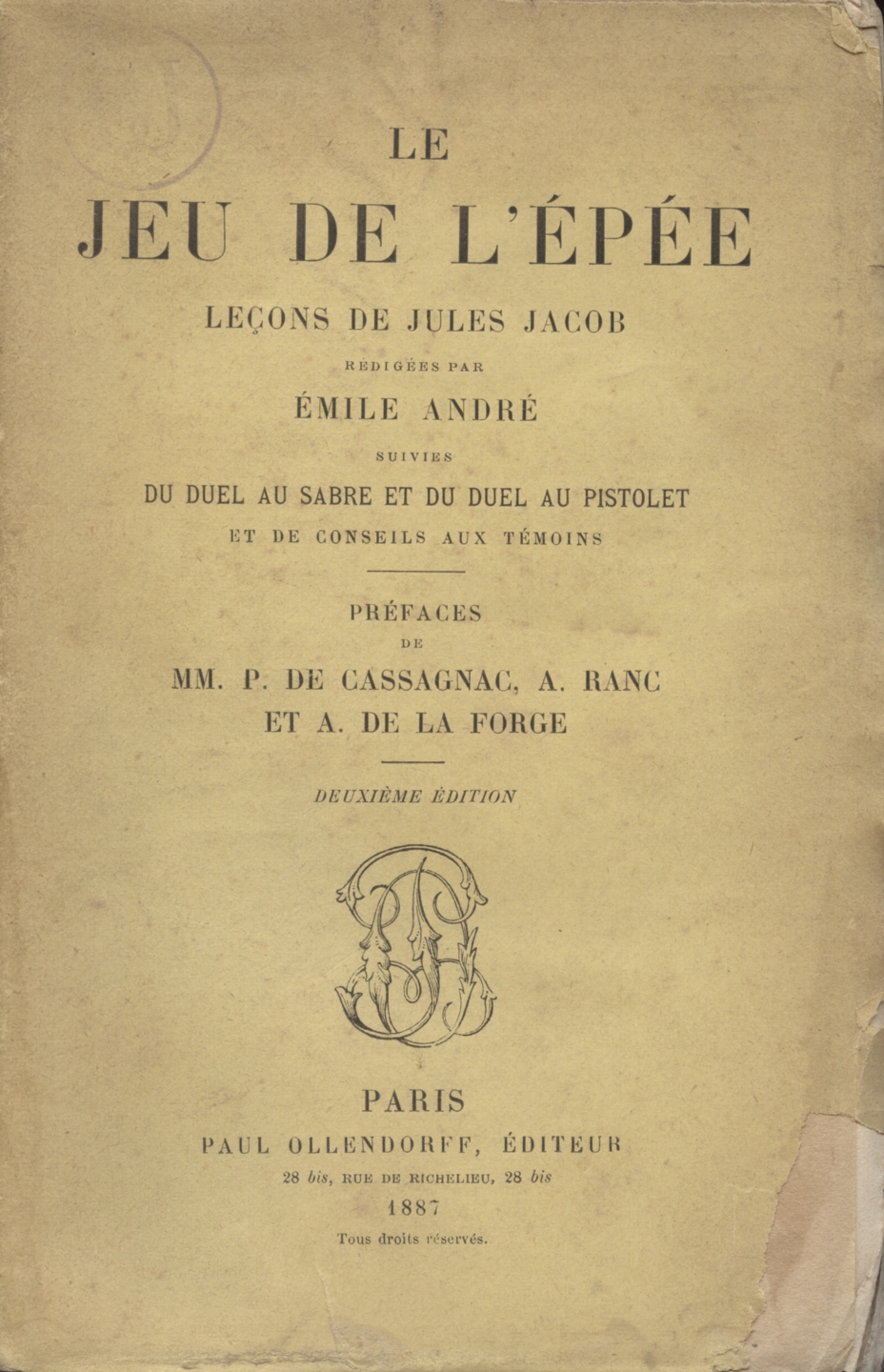
Le jeu de l’épée by Jules Jacob, as reported by Émile André, 1887. Lessons of the fencing master who essentially created modern epee in the 1870s. By the third quarter of the19th century the foil had become a “weapon” of pure sport, although it had been heading in this direction since the late 17th century. M. Jacob adapted smallsword technique to create a form of swordplay suitable to surviving a duel with the 19th century épée de combat, or mere epee, as its modern descendant is called. The technique emphasized longer distance and hits to the arm—and thereby also reduced convictions for manslaughter and murder. It some came to be known as the “modern school,” as opposed to the “traditional school”–foil fencing, that is.
The book outraged many foil purists, who subsequently went into sophistic denial when his epee technique proved far superior to foil technique in a duel: Jacob’s less technically proficient epeeists were deadly against even highly skilled foilists, who maintained that the only difference between the technique of the salle and of the duel was the accompanying mental attitude. (If true, attitude was clearly deficient among the fleurettistes who fought duels with Jacob’s épéistes.) The book plainly points out the difference between the jeu de salle (sport fencing) and the jeu de terrain (swordplay of the duel), and reminds us that many of the best duelists were usually not “forts tireurs”—good sport fencers, that is. The same would doubtless be true today. Highly recommended. There is, I believe, an English translation now available.
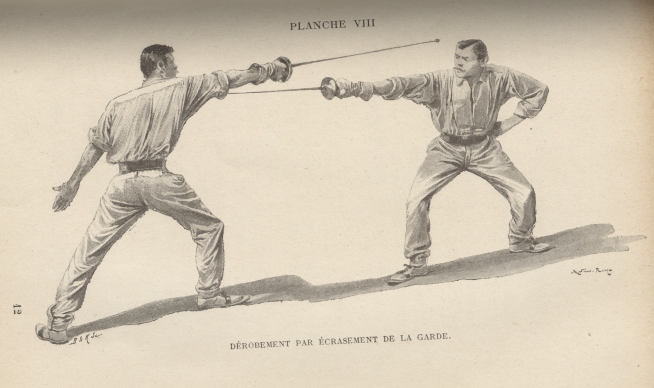
L’Épée by Claude La Marche [Georges-Marie Felizet], illustrated by Marius Roy, 1884, reprinted 1898 or 1899; also The Dueling Sword, an English translation edited and translated by Brian House, 2010. Very thorough, and in its translation was for a long time the only early French epee and epee dueling manual available in English. Real swordplay, in other words, and useful even to epeeists today. To a degree the book is a somewhat foil-based response to the purely epee-based technique of M. Jacob (see above). M. La Marche differs from M. Jacob on some points, particularly on the value of attacks to the body, of which M. La Marche is in favor, as were smallswords-men (and smallswords-women).
The modern trend in epee, at least at the elite levels, and among instructors who train less skilled fencers as if they were elite fencers, emphasizes attacks to the body. Where to emphasize attacks—arm or body—has been an ongoing re-argument ever since the flat electric tip was introduced to replace the much superior “pineapple” tip in the early 1960s, rendering arm shots more difficult. The epee fencing argument over arm versus body derives from late nineteenth century dueling practice—arms hits could easily settle honor in the modern age in which killing a man in a duel would surely send the perpetrator to prison, and the longer distance that facilitated them was simply safer. For reasons that would take up too much space here in discussion, the body was also the primary target in the smallsword era—but the dangers of this distance were mitigated by the use of the unarmed hand to parry and oppose as necessary, and by the extensive use of opposition and prises de fer. Similar varying perspectives are seen in sport epee today. Notably, and often forgotten by some fencing teachers, roughly thirty percent of epee touches today are to the arm, not the body, even with the emphasis on the body as the better target for the flat modern epee point. A highly recommended book, and useful even to modern competitive epee fencers.
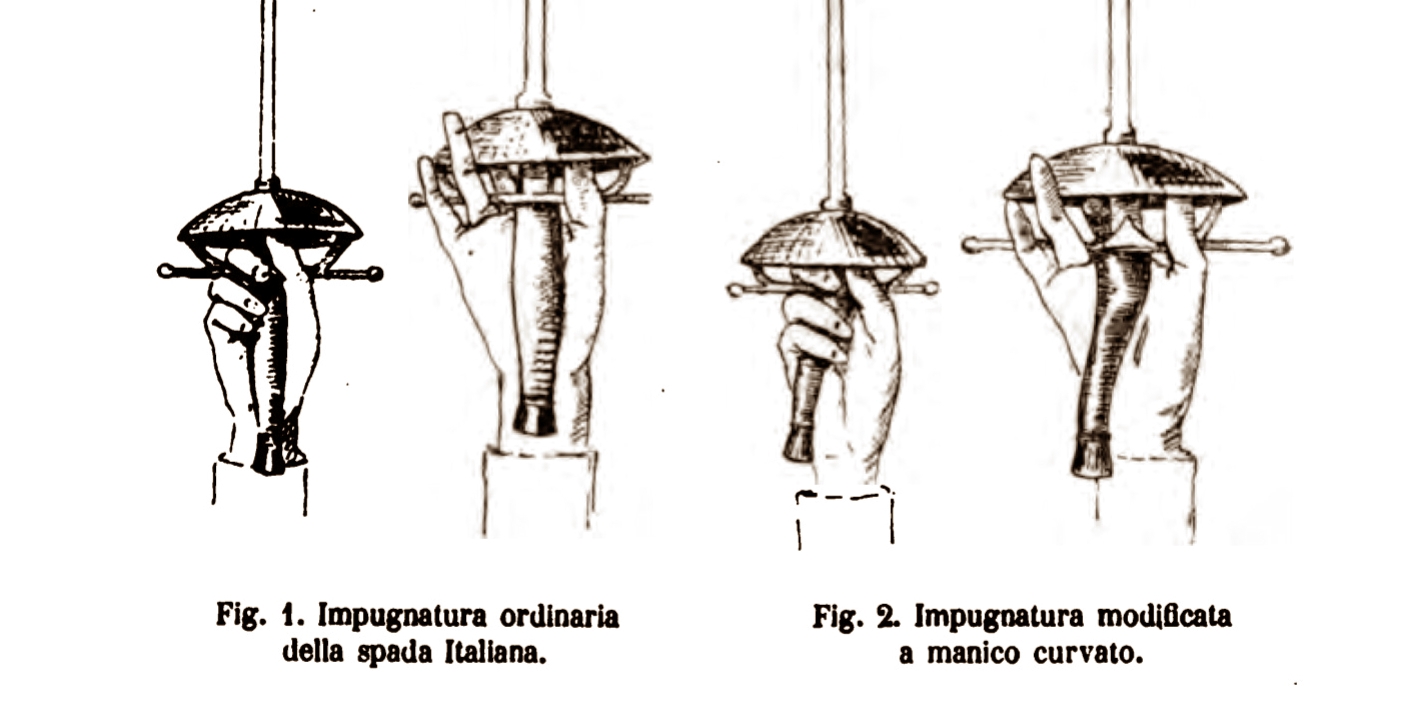
Manuale Teorico-Pratico per la Scherma di Spada e Sciabola by Giordano Rossi, 1885. A manual of the Italian dueling sword and dueling saber, very practical, very classically Italian although it does include some “modern” usages, including his preferred Italian spada with a curved grip, akin to a later French grip, with a significant set to the blade, although it doesn’t seem that this style of Italian grip won many fencers over — but did it perhaps influence the French to increase the curve of their grip? I haven’t seen any French foils or epees circa the 1880s with such a severe curve, and haven’t run across any Italian foils or epees with it either, for that matter. Rossi invented the grip in response to the Italian use of the, as he terms it, l’impugnatura del fioretto misto (mixed foil grip — the use of a wrist strap, perhaps?). He claims his design strengthens the grip of the little and ring fingers, negating the need for the ugly and uncomfortable wrist strap. Italian foils and epees rarely have a set to the blade, for it must be made beyond the thick ricasso. In the old Italian system of lines (quarte, mezzo-cierco, tierce, seconde) was entirely functional without a set to the blade. That said, I’m still uncomfortable with sixte in an Italian foil or epee without a set to the blade — I tend to hit farther inside than I prefer.
In any case, the book demonstrates a technique quite useful to epee, and in fact the influence of the Italian school would become a significant part of modern epee.
L’Art du Duel by Adolphe Eugene Tavernier, 1885. Advice on dueling. Suggests tactics and techniques for the epee duel, including how to deal with the inexperienced adversary, the average one and, of course, the expert swordsman. Of interest to the student of fencing history and the duelist, and one of the few books to deal with the subject of tactics against fencers of various levels of competence.
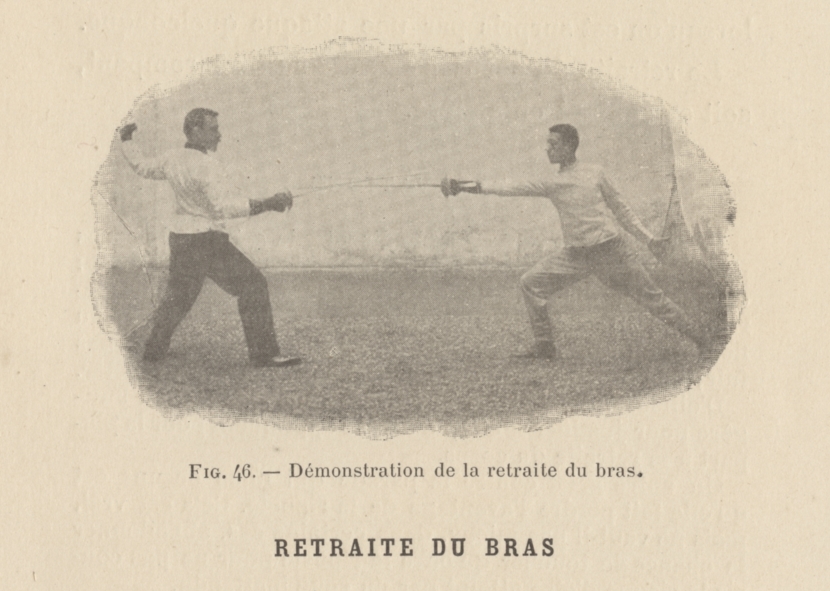
L’Escrime a l’épée by Anthime Spinnewyn and Paul Manoury, 1898. Excellent work on the epee de combat, with much practical advice on epee fencing, training, and teaching applicable even today. Among the many worthwhile admonitions is that the recovery from the lunge is just as important as the lunge itself–both must be as fast as possible, especially if the epees are pointed.

Les Armes et le Duel by Augustin Grisier, 1847. A magnificent treatise on mid-19th century fencing and dueling by a swashbuckling master, with a fascinating (and, as expected, long) preface — or more correctly, a “Préface en forme de causerie ou causerie en forme de préface” — by Alexandre Dumas. The book discusses dueling, technique, the two contemporary schools (one traditional, one modern, of course!), briefly the bayonet, fencing masters, and more. It might be included in any of several categories on this page.
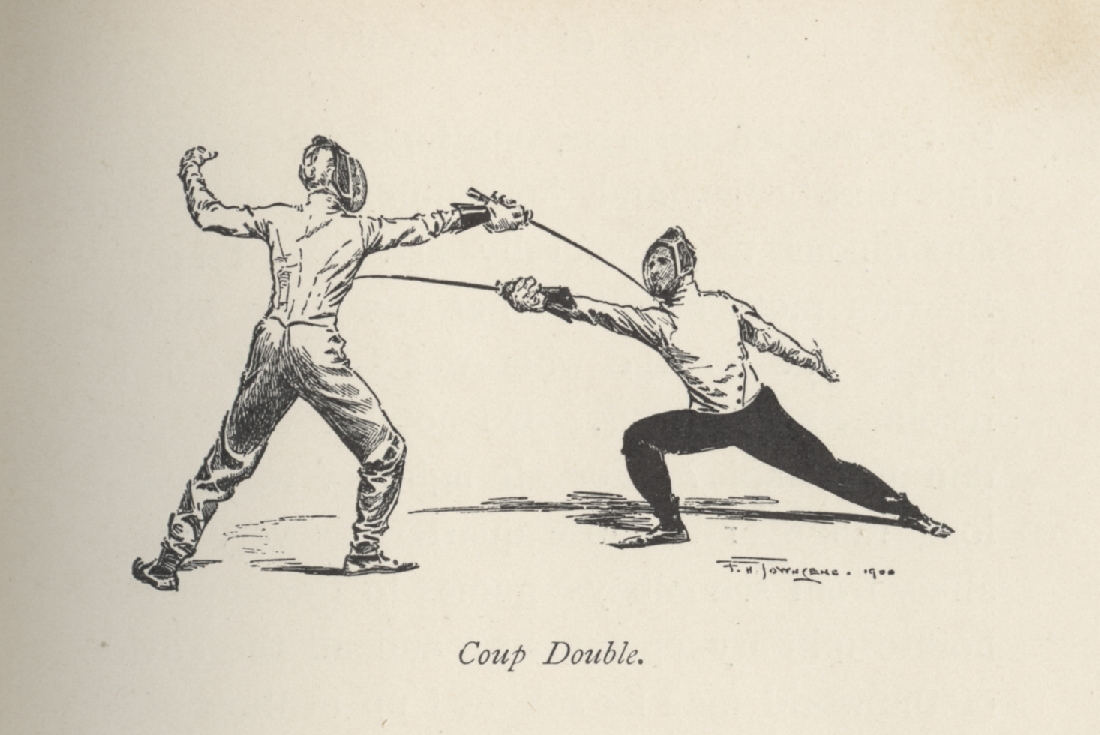
Les secrets de l’épée by Baron César de Bazancourt, 1862, published in English as Secrets of the Sword in 1900, reprint 1998. Practical advice on hitting and not getting hit from the mid-19th century. Much of the advice sounds quite modern. Likewise highly recommended.
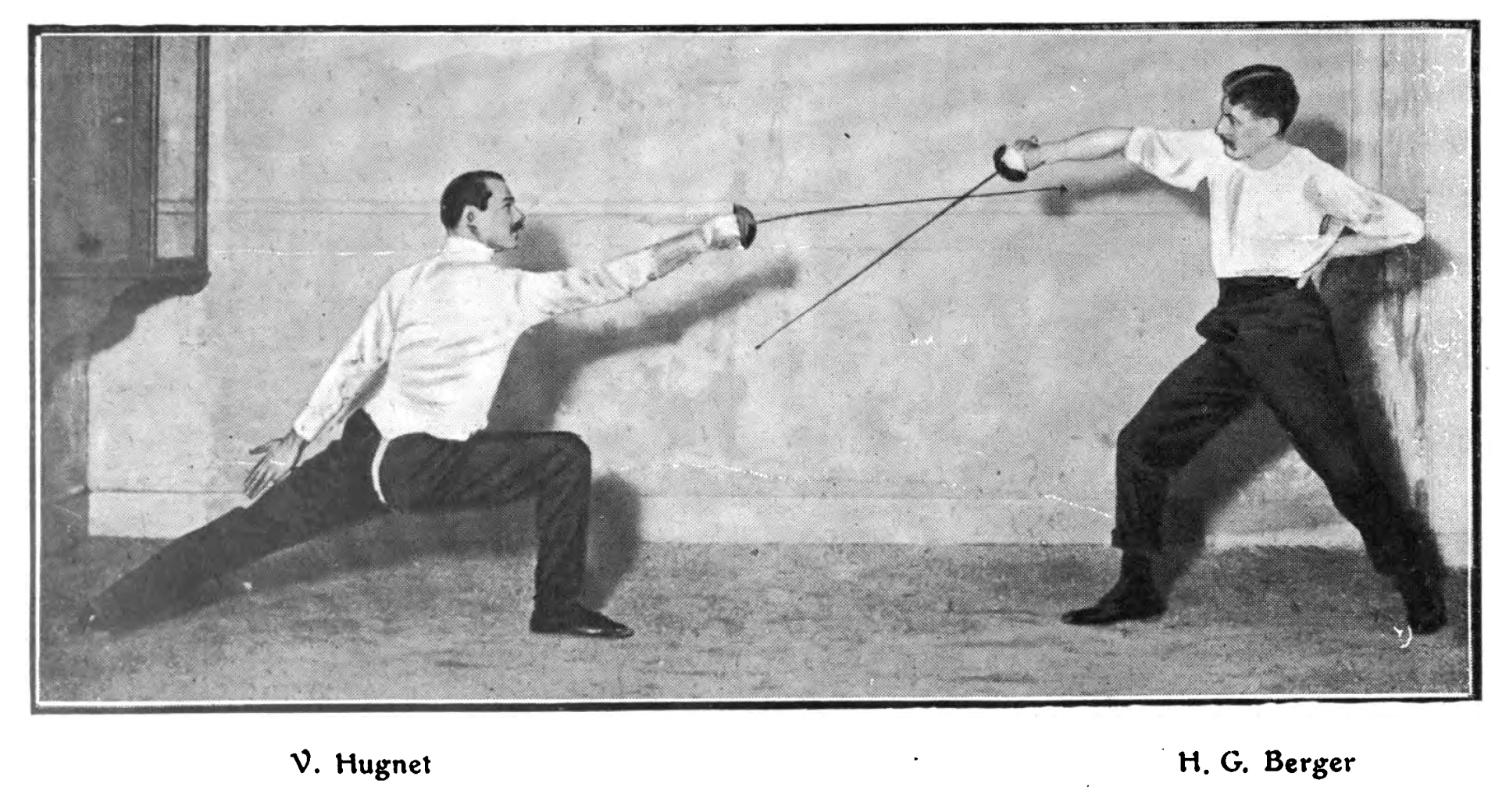
L’escrime, le duel & l’épée by Achille Edom, 1908. A remarkably prescient and practical work, one of my favorites, and one that demonstrates plainly that there is little new in epee fencing today. In particular, M. Edom, a Frenchman, recommends the more physical Italian style over the French, prefers the Greco offset guard and the pistol grip, and bemoans the rise of sport technique such as wide angulations to the wrist—thrusts that with dueling epees (with sharp points, that is) would not stop a fully developed attack to the body, leaving the attacker with a wound to the wrist, and the attacked with a possibly fatal wound to the chest, neck, or head.
The origin of these angulations was due much in part to the single point type of point d’arrét used by many at the time: a small ring was soldered to a real pointed blade a centimeter or so from the tip, then wrapped with heavy thread to act as a barrier to full penetration. Unfortunately, this heavy wrapping prevented hits at the shallow angles a real point was capable of, thus a new emphasis on unrealistic wide angulations. The three point “dry” and four point electrical, and later “pineapple” electrical points d’arrét greatly corrected this, but the subsequent modern flat point (brought into use in the early 1960s in order to quit tearing up the new nylon jackets perhaps?) inspired the popularity of severe angulations once more. In fact, almost any stop thrust to the arm would not arrest a fully developed attack, although you might have the satisfaction, as your adversary’s attacking blade penetrates your chest, of pinning his (or her) arm to his (or her) chest as he (or she) runs up your blade. Highly recommended.
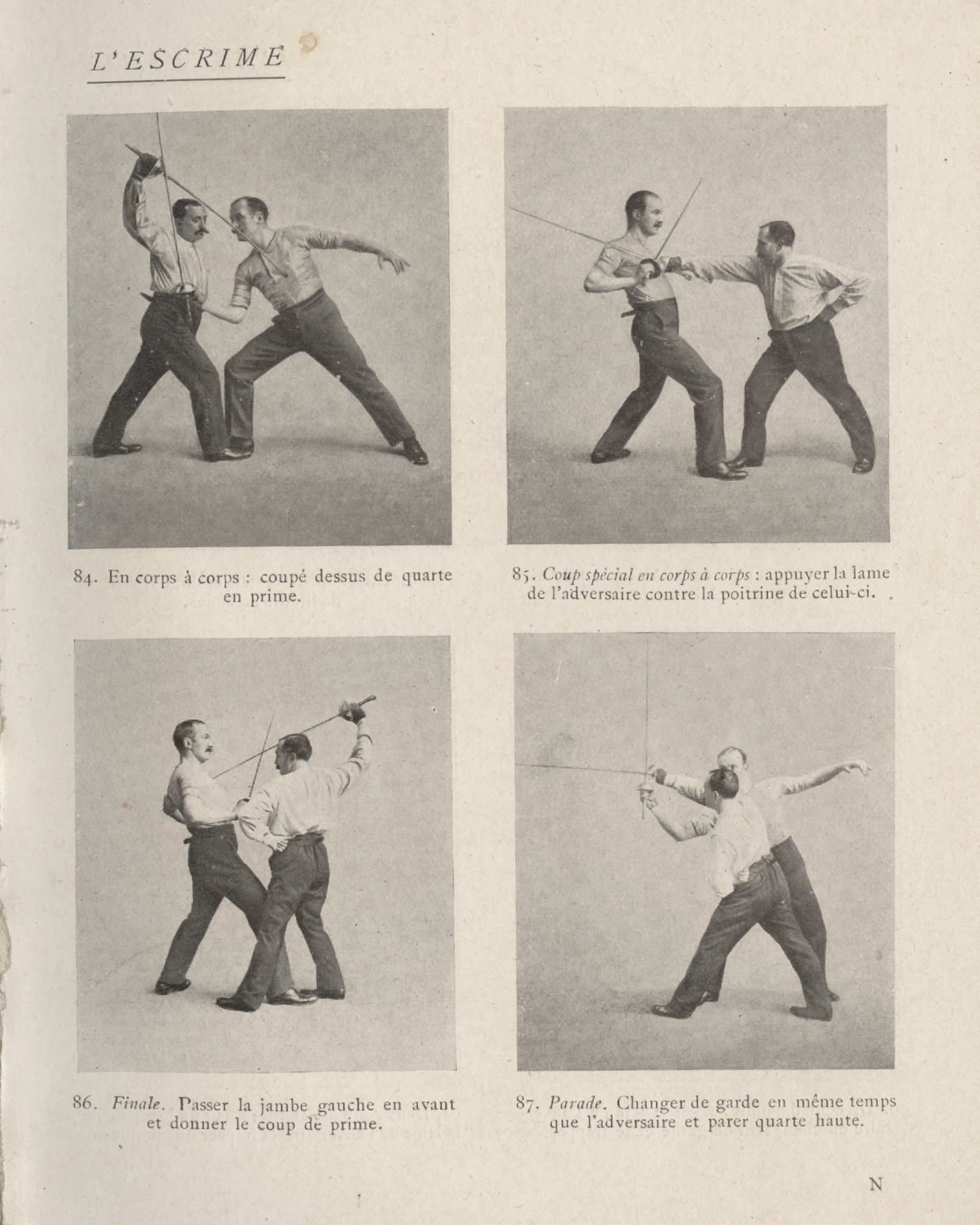
L’Escrime by J. Joseph-Renaud, 1911. One of the best of a number of outstanding epee books published during the Golden Age of epee and of books on the subject, by far. The author does by far a superior job explaining the faults in French foil for dueling, comparing French foil to Italian (thus explaining why Italians successfully trained with their foil for the duel with the spada or epee de combat but the same could not be said of the French), and explaining a wide variety of epee technique, both that which is correct and that which is faulty but commonly seen. Thoroughly illustrated with photographs, the volume is of great use to the modern epeeist, historical or classical epeeist, and fencing historian and theorist. Joseph-Renaud is a member of the community of epee masters for whom the lunge must always be preceded by a fully extended arm, and he does not recommend attacks to the body. Much of the reasoning for this is to protect the duelist from a potentially mortal wound in himself or in his adversary, the latter of which would result in criminal prosecution and the former of which, well… In fact, as smallswords-men of past centuries, and even the author himself, knew, the lunge with the arm extending near simultaneously (just a hair ahead, that is) is the fastest attack by lunge, and mandatory if one is attacking the body, not the arm. (And, to play devil’s advocate here, most of us would admit if we were honest that our point control during an attack with lunge is superior if we fully extend first…)
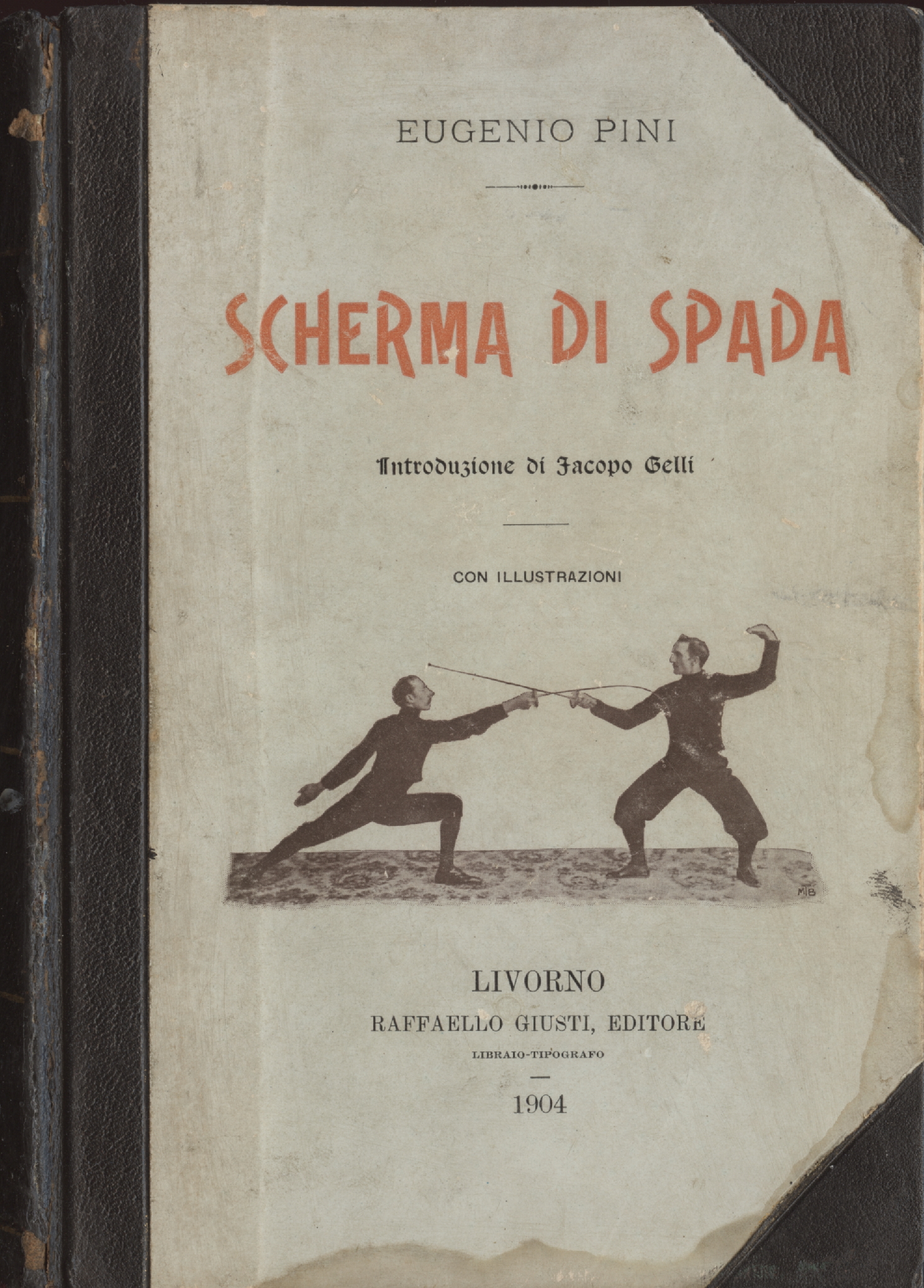
Tratto Pratico e Teorico Sulla Scherma di Spada, by Eugenio Pini, 1904. Excellent and thorough practical treatise on swordplay with the Italian spada or dueling sword by the Italian master who epitomized a form of swordplay that melded the Italian and French schools (more former than latter, though) and emphasized physical strength and speed–so no, this emphasis on power and speed isn’t new to fencing, nothing really is, in fact. At the time the book was written, the school of the Italian dueling sword was based on the fioretta or foil, which was used for training instead of the spada itself. Pini points out correctly that at the time the French schools had separated foil from epee, and epeeists were now taught with the epee rather than the foil, although this would soon change as French foilists, unhappy at being usurped by the “modern school” of epee and its epeeists, would attempt to reassert their dominance via a foil-based school of epee. For a long time the Hungarian school, via the Italian, kept up this tradition of training epeeists first as good foilists. In fact, it’s how I was trained almost fifty years ago. However, the modern divergence between foil and epee has made this almost impossible. Pini was a redoubtable swordsman whom some described as a panther when fencing. Like many masters of the era, he was a redoubtable duelist also.
The Sentiment of the Sword: A Country-house Dialogue by explorer, adventurer, linguist, scholar, writer, and swordsman Sir Richard Burton, 1911. As with Bazancourt’s book which inspired this Anglo version, not strictly an epee manual, but still useful for understanding swordplay in the sense of the need to hit and not get hit, as opposed to hitting according to conventions which deny touches not made in accordance with said conventions, but which in a duel would be quite real, and in many cases fatal. (Thus the practical and, if in a duel, fatal flaw in foil fencing.) Burton’s book also has some quite modern advice on learning to fence. Burton had used a real sword many times in bloody combat, and was known as an extraordinarily fierce warrior. Highly recommended.
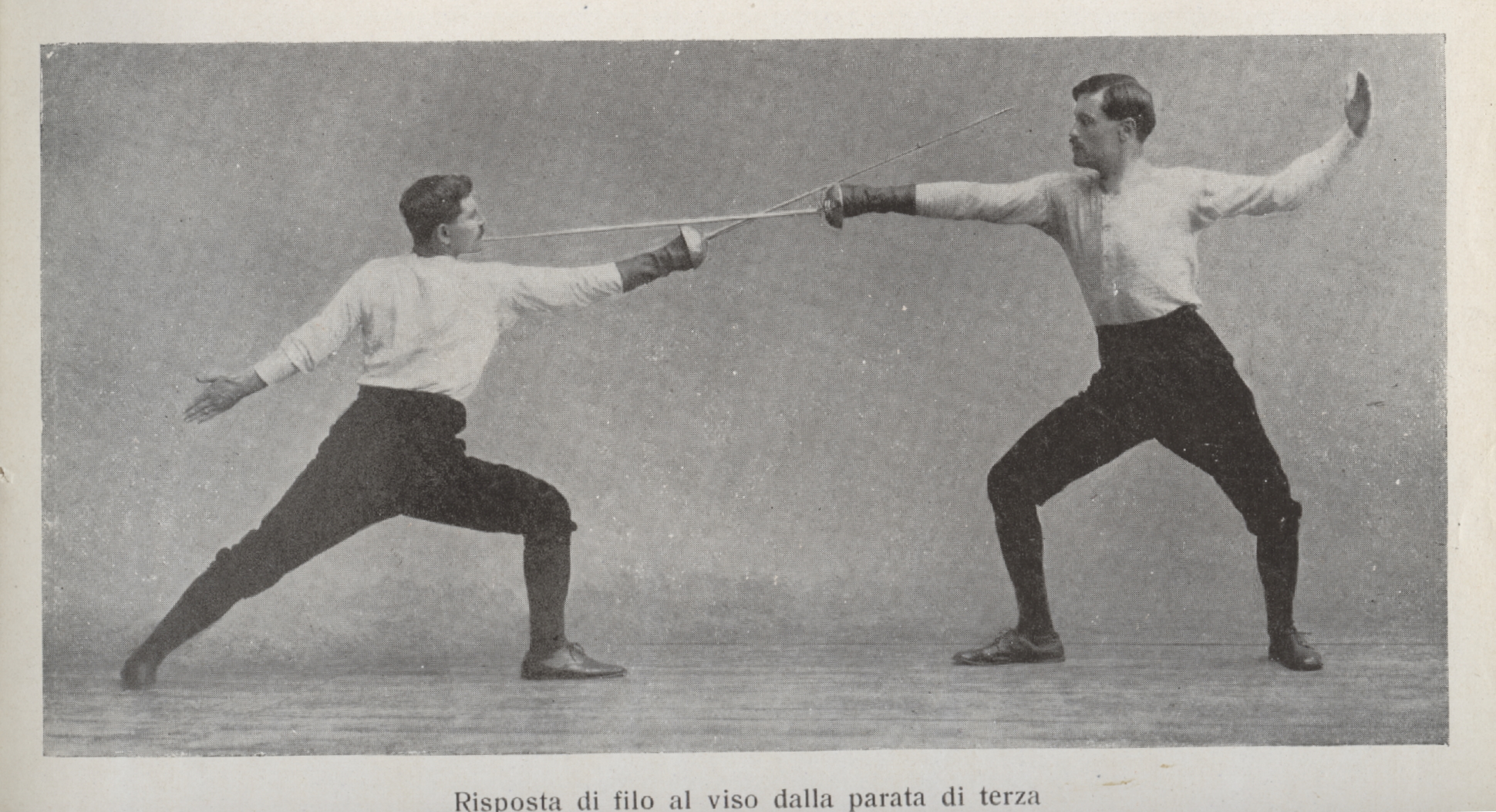
La Spada e la Sua Disciplina d’Arte by Agesilao Greco, 1912. Another of my favorites: a practical, very Italian text on the dueling sword, with, among other things, demonstrations of the Italian grip versus the French (e.g. showing that opposition with the Italian grip can overcome the extra length afforded by holding the French grip toward the pommel) and, a rarity in epee books, French especially, numerous bind thrusts to the head (filo al viso; in fairness to the French, Joseph Renaud describes and illustrates a stop thrust au visage with esquive).
The text also includes many examples of filo thrusts (bind thrusts, strong opposition thrusts) to the torso, which are often downplayed in French texts of the era, given the possibility of killing one’s adversary with them (better to hit the arm a few times and go home than worry through an investigation and possible conviction for manslaughter or murder; some period French texts do discuss these thrusts, particularly those of the “foil-epee” and “foil” French dueling schools). The book also includes descriptions of the Italian spada (noting that at the time they were of equal length, i.e. the Italian had a slightly longer blade), clothing and equipment, &c. The photographs are clear and well-posed. Unbelievably, my copy, signed, was never read: most of the pages are still uncut. Highly recommended.
Agesilao Greco was, along with his brother Aurelio, the greatest of a great family of fencers dating to the mid-19th century. The brothers highly influenced the Italian form of epee fencing for both dueling and sport. The Greco Academy of Arms in Rome still exists and still trains world class fencers. It also has a nationally-recognized fencing museum, the Casa Museo Accademia d’Armi Musumeci Greco that I’ve been told is well worth visiting. Greco’s description of the dueling spada is as elegant as the sword is; I’ve included it here and here. Agesilao was also known as an inveterate duelist with a fiery temper, and as a master and competitor he, according to William Gaugler, fenced every, or nearly so, famous fencer during his lifetime. His book on the spada was the most popular book on the subject in Italian in his era.
Épée, par J.-Joseph Renaud, 1913, in L’Escrime: fleuret, par Kirchoffer; épée, par J. Joseph Renaud; sabre, par Léon Lécuyer. Excellent advice on training, competition, and dueling, including a technical argument and diagram describing when to use sixte and its counter, and when to use quarte. This latter matter is more important than it seems, for most fencing instructors teach the usual parries and imply that any of the two classical French parries can be used in their appropriate quadrants in any circumstances (true in theory but not in practice) and should be varied in order to keep the adversary guessing (true in both theory and practice, but often difficult given that most fencers under stress have a preferred parry).
There are instances in which only a single parry—even in epee and smallsword, in which low line parries may be used in the high line as well, often providing several possibilities in each quadrant—is viable. For example, quinte (low quarte) against a powerful wide-angled attack, especially if directed toward the abdomen. Any other parry will often be forced or will fail to defeat the angulation. In fact, this is why the quinte parry was introduced. Or, against a wide, high, powerful, angulated thrust to the body in the high outside line (same handed epeeists), in particular when delivered via flèche by a tall strong fencer with his hand in tierce, a circle-sixte or even a circle-tierce will likely be forced even if timed well. A true prime will not defeat the angulation, and a common septime (Italian prime, mezocierco) must be taken too far out of line, exposing the arm to a simple disengage over the top. Octave and seconde cannot be taken effectively, for they too are likely to be forced. Only quarte or quinte (really just a low quarte) taken with the point out of line, with a riposte to the head or possibly the neck or shoulder, is viable in most cases. A modified prime (high sixte/septime) can work but can be difficult to execute if the attacker is tall and strong. Best to stop such attacks on their preparation.
The book includes a discussion of the Italian school. Although M. Renaud grudgingly admits that Italian foilists are equal to their French counterparts, he disparages Italian epee and by implication its rapier origins, stating categorically that the French invented epee fencing and the Italians were no match for French epeeists. In fact, the Italian epee school would soon rise to equal prominence with the French, with Edoardo Mangiarotti becoming one of the great epeeists of the 20th century. (These include Frenchman Lucien Gaudin of the early 20th century, Hungarians József Sákovics and Győző Kulcsár of the mid- and late century. Johan Harmenberg (1976 – 1980) should probably make the list as well. Were I to include possible twenty-first century epee greats as well, I’d suggest Timea Nagy and Géza Imre of Hungary, and Laura Flessel-Colovic of France. Doubtless other epeeists could join this list.)
Naturally, M. Renaud avoids any discussion of what might happen were French epeeists to trade their epees for Italian dueling spadas. Compare his comments on the Italian school to those of Achille Edom above. Side bar: he notes that most French epee schools of the era had outside gardens for practice, in addition to the indoor salle. Pity we don’t have these today…
“Technique du Duel en Une Leçon Suivi des Règles usuelles du Combat à l’épée” by Georges Dubois, published in La Culture Physique, 1908. Excellent work based on the author’s experience preparing would-be duelists for the duel, including those who have never held a weapon before (whom he advises to constantly counter-attack with a retreat). Disposes with many myths regarding dueling: he points out that most duelists weren’t fencers, and suggests that the epee was designed to help keep both combatants alive and thereby avoid the charge of manslaughter or murder. Never was a weapon so well designed to keep adversaries from killing each other, the author notes.
L’Escrime de Duel by Georges Dubois, 1913. A more conventional epee text intended for dueling than his Technique du Duel above. He does not dismiss foil, as many epee masters did. He discusses the Italian school, provides realistic technique for dueling, discusses preparation for a duel including how to prepare a novice duelist with no fencing experience for a duel twenty-four hours later, and breaks down several demonstration bouts and actual duels for the purposes of educating the reader. He recommends that both attacks and counter-attacks be directed toward what some masters in English have called the “shoulder hole” (the area between the deltoid and the pectoral) because one is more likely to hit even the advanced target when the point is aimed here, given that the target arm was near-certain to be extended on both attack and counter-attack (a fact often forgotten by many epee fencers today who constantly target the bent arm in the adversary’s en garde, and miss as the target arm is extended). Many masters today emphasize thrusting to the shoulder hole — but if over-emphasized the student may forget that it’s also useful to target the lower extending arm in tempo.
See also the “Classical Fencing” section below.
Combined Modern Epee, Foil, and Saber Texts
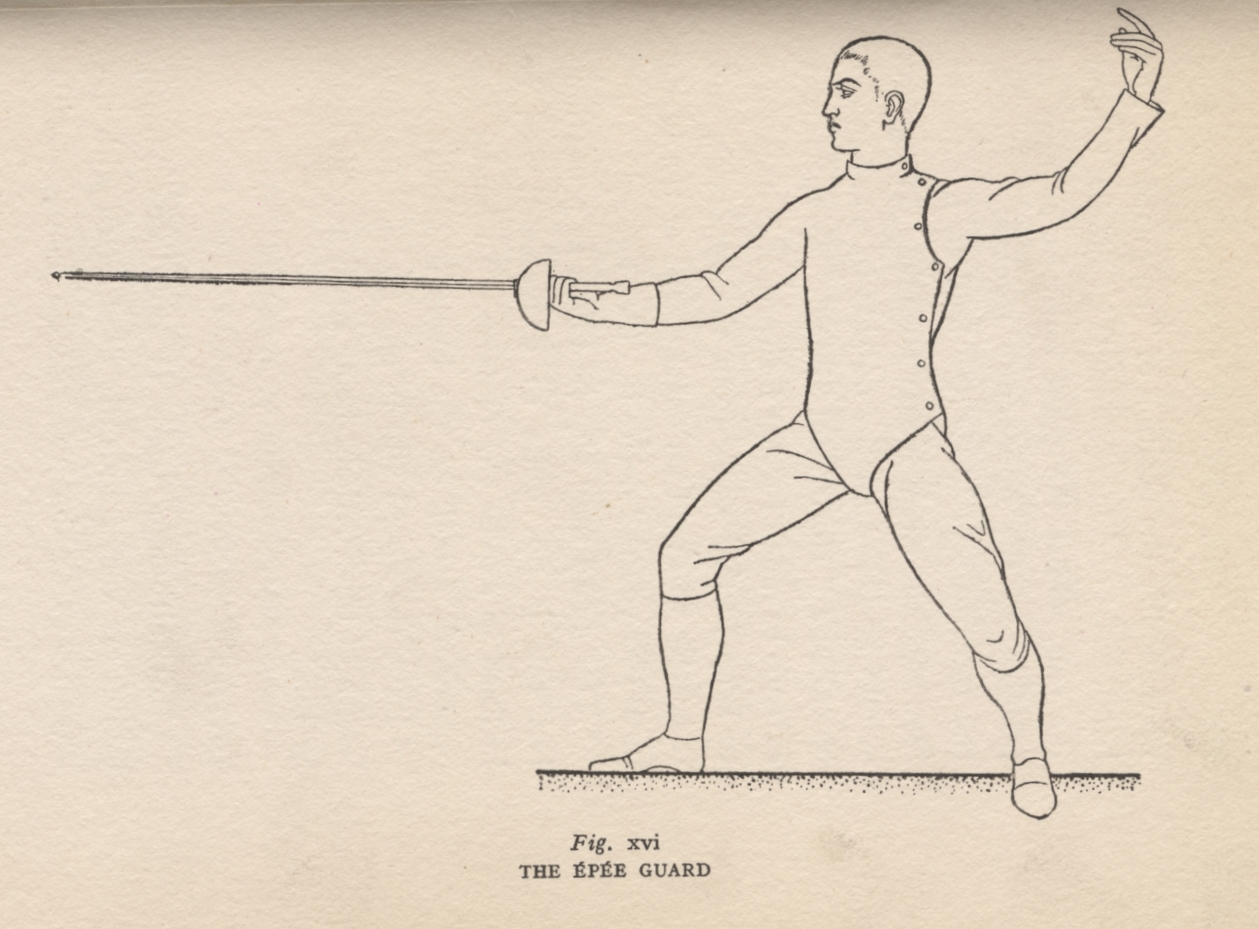
The Art of Fencing by R. A. Lidstone, 1930 and Fencing: A Practical Treatise on Foil, Épée, Sabre by R. A. Lidstone, 1952. The second significantly revised book is more thorough, with a very useful, clearly written epee section with plenty of exercises for master and pupil. Discusses tactics, unusual epee en gardes, and, in the foil section, unusual displacements, most of them Italian. It even describes Professor Guissepe Mangiarotti’s “jump back”—an epee counter-attack made while leaping back and landing on the front foot. The second edition is an excellent practical work drawing from both the French and Italian, highly recommended. In fact, along with Szabo’s work, the second edition is one of the most useful books on fencing on this entire page. For fencing historians, a comparison of the first edition to the second edition shows how much, and how quickly, modern fencing changed during the first half of the twentieth century.
Fencing by Joseph Vince, 1937, 1940, revised edition 1962. Illustrated by US saber champion, designated Olympic team member (until he suddenly abandoned competitive fencing for the stage), and swashbuckling actor Cornel Wilde. Vince was a US national coach and national saber champion who kept a salle in Beverly Hills for decades, and, until 1968 when he sold it to Torao Mori, owned Joseph Vince Company, a fencing equipment supplier that provided, among its complete line, classically dashing fencing jackets of a fit and style unfortunately no longer seen. In fact, my first fencing jacket was a “Joseph Vince, Beverly Hills” made of a heavy, high thread count cotton with silver-colored buttons. The left, that is, unarmed, sleeve was lighter and cuffed. An elegant style truly to be found no more.
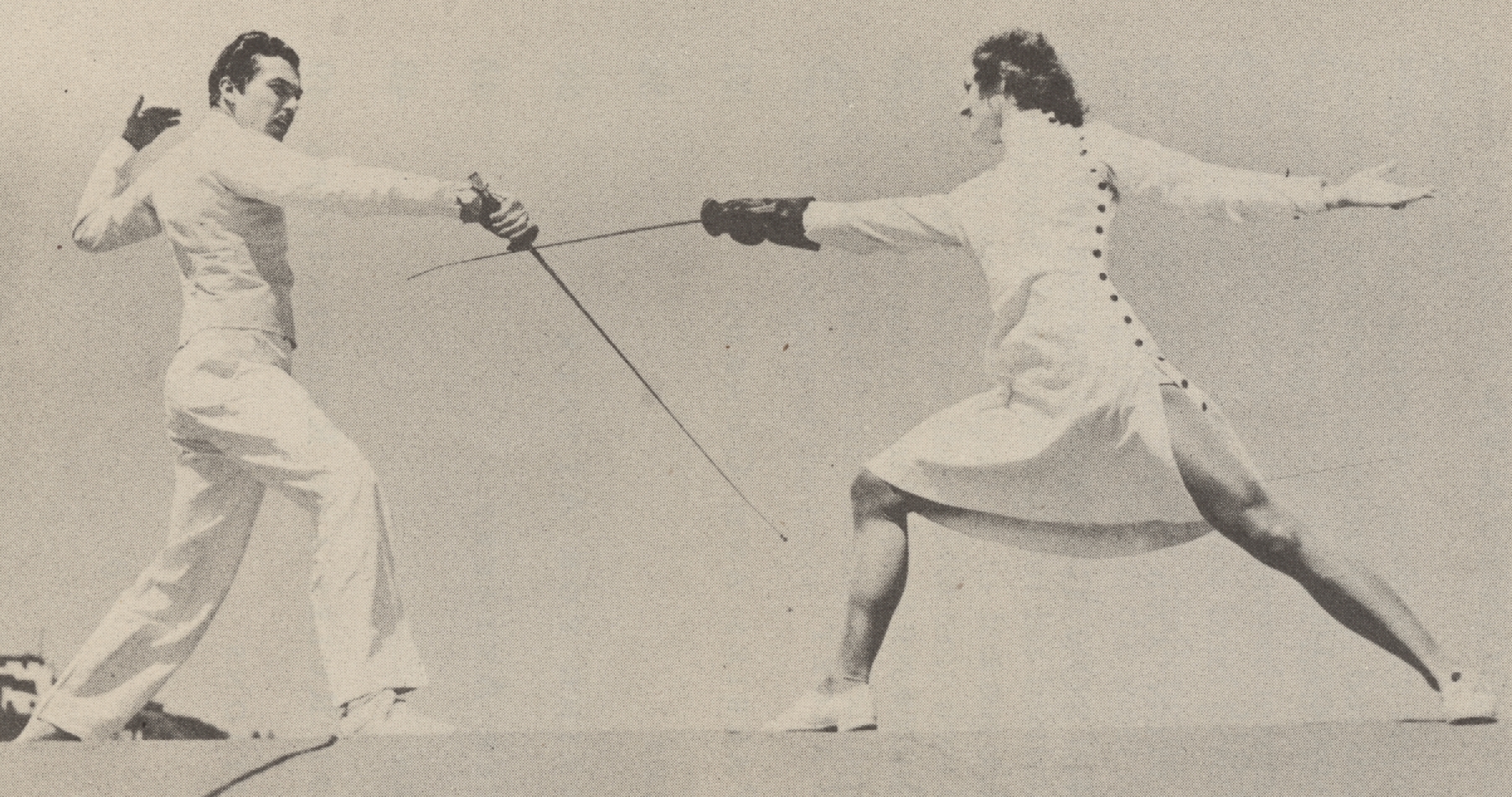
Fencing for All by Victor E. Lawson, 1946. The front cover gives the title as How to Fence. A very short basic text, only slightly more than a pamphlet, notable only to the fencing historian, particularly him or her interested in the history of women’s fencing. Lawson’s book actively promotes women fencers, although most appear to be aspiring actresses and models, and the caption of one photograph strongly suggests that Lawson’s goal is to promote his fencing salle in NYC as a means of attaining poise &c for actresses (I use the now generally discarded feminine of “actor” here because “female actor” sounds a bit stilted, and in Lawson’s day he appears to have been recruiting women primarily, not men). Notwithstanding his purpose, Lawson’s little book does actively promote women fencers, and has several useful photographs of women in fencing attire of the 1940s, quite different from today. It also has a good summary of fencing rules at the time. Other titles in the series include Police Jiu Jutsu, Scientific Boxing, and How to Be a Detective–everything to to prepare the reader to be the dark sword of a film noir.
Modern Fencing: A Comprehensive Manual for The Foil—The Epee—The Sabre by Clovis Deladrier, 1948, reprint 2005. Strong epee section. Includes exercises, lesson plans, and excellent practical advice. Readers should not be put off by some terms and practices that seem dated, for example Deladrier’s use of the classic older terms low quarte for septime and low sixte for octave, and his preference for the center-mount epee guard. The epee section is worth serious study. The teaching advice and lesson plans for advanced epeeists called upon to teach at times is also a useful review for experienced epee coaches. Deladrier was the fencing master at the US Naval Academy.
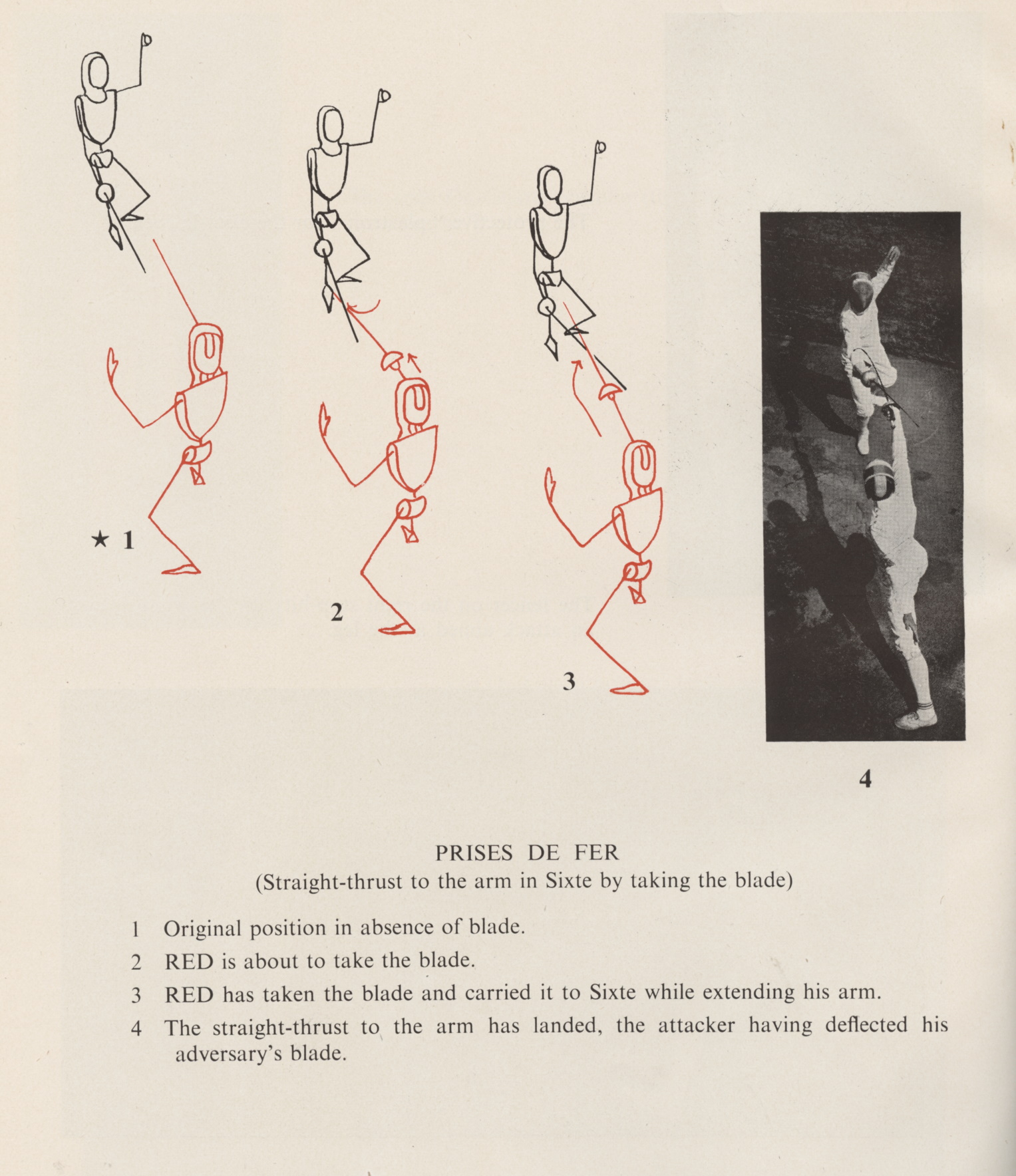
Fencing Technique in Pictures, 1955, edited by C-L. de Beaumont, assisted by Roger Crosnier, with contributors Léon Bertrand, Bela Balogh, and Raymond Paul. Basic foil, epee, and saber instruction by a who’s who of UK fencing masters of the past century, in line drawings and photographs, the former of which look a bit like the robots in the old comic book, Magnus, Robot Killer. Useful information, still applicable today. The book is one of three on this page attempting to show action in sequence in more than two or three steps using photographs or illustrations, the other two being Bertrand and Anderson. I suspect the format of the images and size and color of the book may have influenced Bac Tau’s excellent edition (see below) which in some ways might be an homage. “Dedicated by permission to The Rt. Hon. Sir WINSTON CHURCHILL K. G., O. M., C. H., M. P. First Honorary President of The Amateur Fencing Association.”
Fencing: Ancient Art and Modern Sport by C-L de Beaumont, 1960, 1970, revised edition 1978. Solid “classical” text on electric foil and epee, and dry saber by a noted British master and Olympic fencer. Excellent, perhaps best anywhere, description of the character and characteristics of epee fencing (de Beaumont was an epeeist). Good chapters on tactics and training.
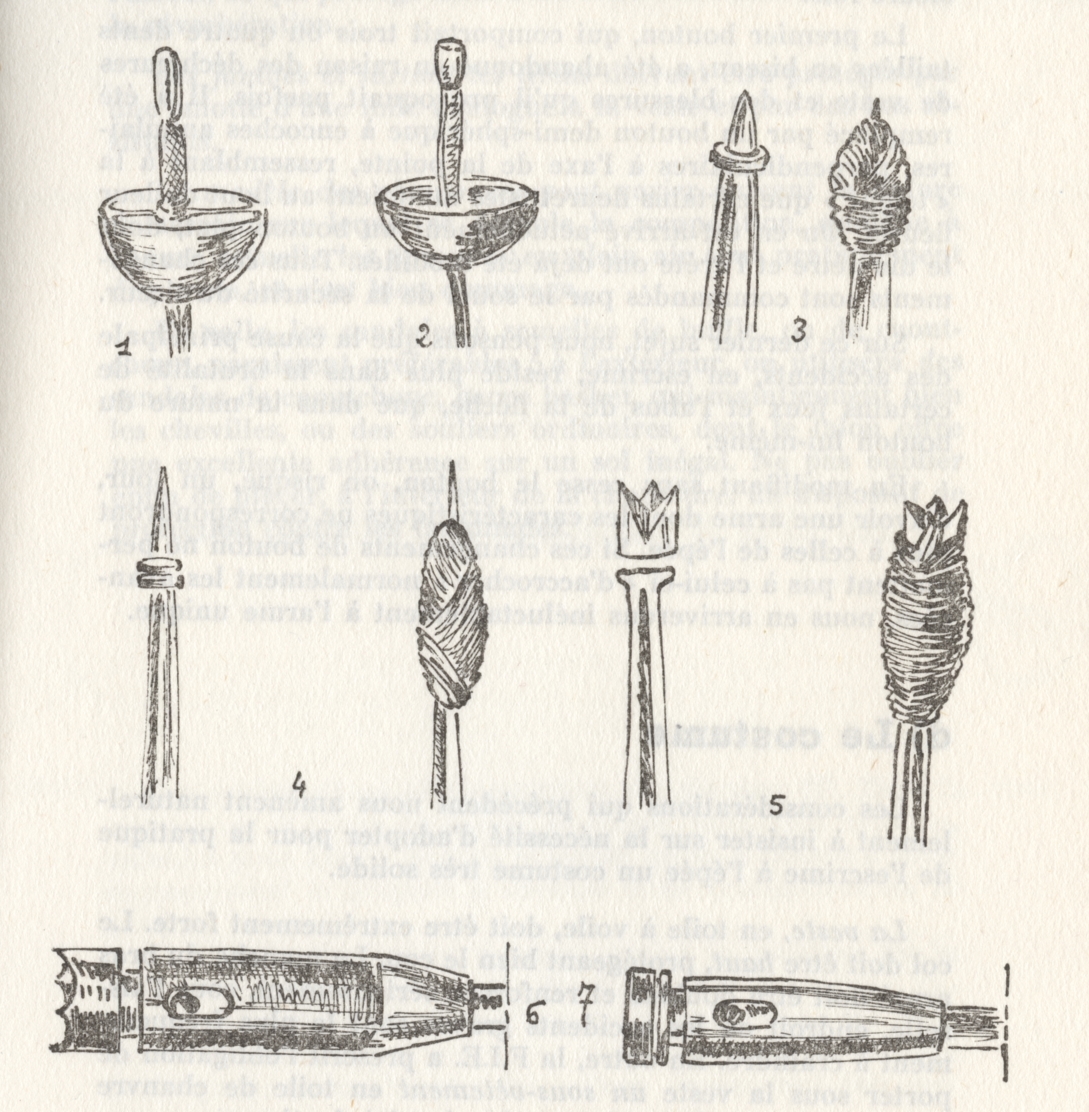
Escrime by Raoul Cléry, 1965. A thorough, practical text, absolutely one of the best, by one of the great French masters. Highly recommended. The epitome of the French school in foil and epee, but the saber is Hungarian and is so noted. While serving as Commandant of the Fencing Division at the military school at Antibes, Lt. Cléry wrote his Traité d’Escrime de Pointe: Le Fleuret et L’Epée (Société Française de Presse, 1948) upon which his later work is heavily based. The five books in the latter work’s bibliography (Edom, André, Renaud, Prévost & Jollivet, and the 1908 rules) are also all outstanding, practical works.
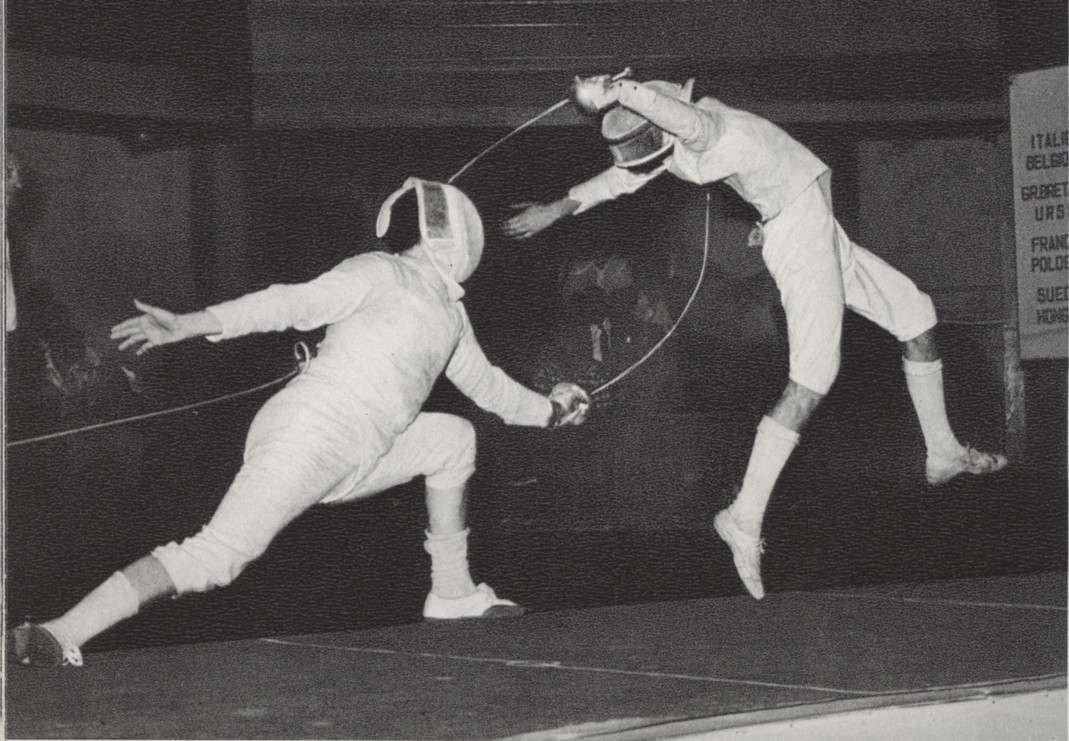
La Vera Scherma by Edoardo Mangiarotti and Aldo Cerchiari, 1966. A very useful book for all three weapons, although I’m naturally more disposed to its epee section, particularly given Mangiarotti’s fame in the spada. Exceptionally well-illustrated. In Italian, and the modern classical Italian school, of course. An excellent beginning to intermediate text on all three weapons. One of the virtues of this book is the use of photographs of technique in action, showing what fencing actions actually look like as performed by elite fencers. Most fencing books use posed photographs or otherwise idealistic illustrations, providing elevated expectations of the often unattainable except at slow speed with a conforming partner. There is nothing wrong with illustrating the ideal, providing it is pointed out that it is exactly that, an ideal, seldom to be seen in practice even by elite fencers. The book also includes line drawings of ideal technique.
Modern Fencing: Foil, Epee, and Saber by Michel Alaux, 1975. A thorough introduction to all three weapons by one of the great French masters who taught in the US. Short but good sections on bouting tactics, lessons, and conditioning. Excellent text for the novice fencer through intermediate fencer. The French school, of course.
Fencing: The Modern International Style by Istvan Lukovich, 1975, 1986. By the author of the noted Electric Foil Fencing. Excellent if brief epee section, very useful to both epeeists and their teachers in that it covers and explains most of what most epeeists will ever need to know. The Hungarian school. Highly recommended for all three weapons.
L’Escrime by Jacques Donnadieu, Christian Noël, and Jean-Marie Safra, 1978. Solid introductory to intermediate text, quite well-illustrated with many photographs of fencing technique, including of technique in competitive action. I’m also somewhat partial to the book given that its images, taken as they were at the time I began fencing, are nostalgic.
Fencing: Techniques of Foil, Epee and Sabre by Brian Pitman, 1988. Solid beginning to intermediate text.
Fencing by Bac H. Tau, 1994[?]. A tome that includes thorough sections on training, tactics, and weapon repair. Excellent section on physical training for fencing, along with other highly useful appendices. Deserves far more attention than it has received. Highly recommended: a delightful book to read. The book size, cover color, design, and illustrations may have been influenced by–in homage to?–Fencing Technique in Pictures, edited by C – L. de Beaumont, 1955.
Foil, Saber, and Épée Fencing by Maxwell R. Garret, Emmanuil G. Kaidanov, and Gil A. Pezza, 1994. A very useful beginning to intermediate text.
Fencing: What a Sportsman Should Know About Technique and Tactics by David A. Tyshler and Gennady D. Tyshler, 1995. Excellent information but an at times poor translation from Russian. Supplement with the Tyshler DVDs (available from many fencing equipment suppliers), or better yet, simply refer to the DVDs. David Tyshler was a Russian master and Olympic and world championship medalist; Gennady Tyshler is a leading Russian master. Quite a few excellent fencing and teaching materials produced by the Tyshler’s are now available online.
The Complete Guide to Fencing, edited by Berndt Barth and Emil Beck, 2007. The German school. A thorough, up-to-date text. Good sections on theory, performance, and athletic training (with a useful emphasis on high rep exercises). Good epee section, much derived from the highly successful Tauberbischofsheim school of epee founded by the largely self-taught Emil Beck.
Modern Foil
The technique described in many of the books in this section is based on the 20th century rule that a foil attack consists either of a fully extended arm with point threatening—aimed at, that is—the valid target, or the later rule which permitted an extending arm with point threatening relaxed, and correctly so, in order to accommodate the highly useful and historically proven progressive attack. These rules were rooted in dueling practice and therefore make more sense if we want fencing technique to reflect its dueling origins.
However, the modern interpretation of an attack is a sophistry that permits the point to be aimed away from the target during the extension: if it will end up at the target in the end, it is therefore a valid attack, or so the sophists argue and thereby permit. The old duelists knew better. To make counter-attack against a valid attack with extended or extending arm aimed at the target would likely result in a double hit. However, a counter-attack against a “bent-arm” attack, in particular one with the point not directed at the target, might well result in a single hit, thus the validity of the counter-attack over the attack in this instance. In the former instance, the attacker’s point would continue forward and hit in spite of the counter-attack; in the latter it probably would not.
In other words, a valid attack should not consist of a bent, non-extending arm at any point, especially one with the point aimed at something other than the valid target. Attacks in invitation or otherwise with a bent non-extending arm are quite simply not in the spirit of staying alive. In other words, were the swords pointed, the modern attack would be simply suicidal. Unfortunately, right-of-way in foil and saber have abandoned this principal, permitting attacks with a bent-arm and the point well out-of-line. Put more simply, fence epee until foil and saber are fixed—if ever they are.
Fencing with the Foil by Roger Crosnier, 1955. One of the best expositions of modern classical foil of the French school ever written in English. Excellent explanations of practical theory, including on tempo and the progressive attack. Frankly, excellent throughout. Epeeists should read it together with Crosnier’s epee text, foilists together with Lukovich’s foil text.
Foil Fencing by Muriel Bower [Muriel Taitt], 1966 et al. Numerous editions, prefer the latest (1996, Muriel Taitt). Solid beginning foil text, used over the four decades by thousands of beginning fencers, including in 1977 by the compiler of this list of books in a beginning class taught by Dr. Francis Zold. Or at least I think it was this text. Perhaps it was Curry’s instead? The second editon of Bower’s version includes as co-author Torao Mori–a noted competitive fencer and fencing master–who took over the Joseph Vince Co. fencing supplier on Crenshaw Blvd (and where I purchased my first fencing mask, jacket, and glove in 1977).
Fencing by Nancy L. Curry, 1969. Solid beginning foil text although dated in terms of “modern” foil technique and rules. Even so, a good text on core technique. The book is clearly intended to accompany a college-level beginning fencing class and here it succeeds, describing in basic terms the fundamentals that can be covered in a single semester. As with a few other texts, it has useful images of fencing technique taken from above in order to show correct relationships. Nit-picking here: in the acknowledgements, a reference to the famous Castello fencing supplier is written as Costello, a typo and surely not a hat tip to Abbott and Lou…
All About Fencing: An Introduction to the Foil by Bob Anderson, 1970, 2nd printing 1973. The book is unique in that the reader can, by flipping pages, see properly executed technique, and in a manner superior even to much of the modern fencing video available. There is a hint of two of sexism common to the era—Anderson states that only men can cope with the epee and sabre, for example, which is nonsense—, but few fencing books of the first seven or eight decades of the 20th century do not take such a view. Some might disagree with some of his brief fencing history as well, but the history in many fencing books is open for debate, based as it often is on common understanding as opposed to rigorous analysis.
Anderson was a British Olympic fencer and Olympic coach who became Hollywood’s leading swordplay choreographer, following in the footsteps of Fred Cavens, Ralph Faulkner, and Jean Herrimans. The fencing in Star Wars, The Princess Bride, and Alatriste are but three of his many film works. (His book is also one of the first two books on fencing the compiler of this list ever read. In fact, the book was in the Mount Miguel HS library—seldom anymore will you find fencing books in high school libraries.) Mr. Anderson died on January 1, 2012, and was inexplicably and inexcusably snubbed by both the 2012 and 2013 Oscars during the In Memoriam segment.
Electric Foil Fencing by Istvan Lukovich, 1971, 1998. Perhaps the most thorough electrical foil text, with excellent sections on fencing theory and requirements. Valuable even today, in spite of being written and published prior to the modern debasement of right-of-way conventions (i.e. attacks in invitation or “bent arm” attacks legitimized), although foil and saber were already inclining in this direction when Lukovich wrote his book. I strongly recommend studying this text hand-in-hand with Barbasetti’s book on foil; this will provide the student with a thorough understanding of the classical and modern foil games, and how one developed into the other — not to mention provide a thorough understanding of foil theory.
Foil and The Revised Foil by Charles Selberg, 1975 and 1993 respectively. Thorough and very useful, with a good section on tactics. In general, the Hungarian (or Italo-Hungarian) school. Highly recommended, but prefer the 1993 Revised Foil. Selberg also produced an extensive selection of instructional videos. Now on DVD, they are available from Selberg Fencing at http://www.selbergfencing.com/.
Basic Foil Fencing by Charles Simonian, 2005. A solid introductory text.
Foil Lessons With Victor by David A. Littell, 1994. A twenty-three page foil monograph far more useful than its brevity might suggest. It’s based on the author’s lessons from fencing master Victor Bukov. Useful in all three weapons, it presents a variety of tactical methods of attack, heavily distance-based. Readers familiar with Hungarian theory and practice (and thereby Russian and general East European) will recognize the descriptions.
“Modern” Saber
By “modern” I intend the saber techinique introduced or even created by Italo Santelli et al in the very early 20th century in Hungary. I understand fully that this weapon — Hungarian saber, in essence — no longer exists except in the hands of some aging fencers. It is otherwise vestigial, even if some vestiges remain strong. The school and weapon were deliberately destroyed by the flawed electrification of the saber and the degrading of right-of-way conventions, solely for the purpose of opening saber medals to more than the very few nations who dominated the weapon for almost a century. I have included the Borysiuk text because it follows in the tradition of detailed, scholarly even, fencing texts and is the only thorough modern electrical saber text in English.
Cut and Thrust: The Subtlety of the Sabre by Leon Bertrand, 1927. The author was the fourth generation of famous English masters of French descent, the family having taught not only many great English fencers, but some English royalty plus Napoleons I and III. Leon Bertrand studied widely, including saber under Italo Santelli and then in Italy, receiving both a fencing master’s certificate and a knighthood as part of his latter experience. The first third of his book is a delightful foray into fencing as sport, dueling, exercise (and why fencing is the premier means thereof, or should be), with numerous anecdotes along the way. The saber text itself is solid, presenting the Italian school that developed into the Hungarian; one might argue that his technique is Italo-Hungarian. The author, by the way, is a proponent of the full extension prior to lunging, and of focusing on the entire fencer and blade, and not on the hilt/blade or other area along. The book’s tone and technique are quite familiar to me: in fact, my first fencing master, Dr. Francis Zold, would have known Bertrand from his time with Santelli. Bertrand was also one of the two London masters who trained actor Basil Rathbone, one of the best Hollywood actor-fencers. (More detail on Rathbone and Hollywood fencing can be found here.) Bertrand’s saber book is one of my favorite fencing texts, possibly in my top three. Highly recommended!
Modern Sabre Methodology by Zoltán Beke and József Polgár, 1963. Translated from the Hungarian. Not “modern” in the sense of the most recent form of saber fencing, but “modern” in the sense of twentieth century Hungarian saber before saber’s debasement via the electrical scoring system and the degeneration of the interpretation of right-of-way. Worth acquiring if you can find an affordable copy, but if you do it will likely be by accident, unfortunately. Mine was. A very thorough exposition of every technique in the Hungarian saber repertoire. Not for beginners! One of my favorite passages is its excellent, simple definition of tempo, along with the very useful discussion following, all suitable to all three weapons—or to all swords in all places in all eras, in fact. It is also, from a historical perspective, easy to see how Hungarian saber influenced Hungarian epee, and therefore modern epee. I highly recommend studying this text hand-in-hand with Bertrand’s Cut and Thrust: The Subtlety of the Sabre and Barbasetti’s work on saber: collectively these will provide the student with a thorough understanding of the classical (i.e. Italian) and modern (i.e. classical modern Hungarian) saber schools, and how one developed into the other — not to mention provide a thorough understanding of saber theory.
Fencing With the Saber by Roger Crosnier, 1965. Excellent, thorough work on “Hungarian” saber, second only to that of Beke and Polgár above. A suitable companion to Prof. Crosnier’s works on foil and epee. Note, however, that the terminology and categorization of technique is of the classical French school, not the Hungarian. The fundamentals are still useful today. Naturally, Prof. Crosnier does not permit the attack with the arm in invitation or otherwise bent…
Modern Saber Fencing by Zbigniew Borysiuk, 2009. Only if the modern “weapon” known as electric saber appeals to you. Still, a very good book, and the only thorough one on the subject in print in English. Unintelligible conventions plus attacks with the un-extending arm held low in invitation while leaving the body nakedly exposed plus awkwardly cramped footwork plus hitting with the flat of the blade do not saber fencing make. The flat merely chastises: it’s the edge that cuts. The rest is simply too tiresome to debate.
The Cléry and Lukovich titles in the “Epee, Foil, and Saber” section have excellent instruction on Hungarian saber. Cléry also includes some detailed history of the origin of the Hungarian school. The Beck/Barth text includes excellent information on modern post-Hungarian saber. As noted above, the famous Hungarian saber technique was destroyed principally by the electrification of saber, said by knowledgeable world class fencers and FIE sources to have been a compound decision based on the likelihood that the obvious flaws in electric saber would permit a less strict technique, particularly when aided by a debasement of right-of-way, and would thereby open international saber medals to more than the handful countries with the critical mass of elite saber coaches and sabreurs able to master in-depth the clear, clean technical repertoire of the Hungarian weapon; such technique was mandatory for correct judging.
For half a century Hungary reigned over twentieth century saber, and maintained a strong grip on it even after a number of sabreurs defected during the Melbourne Olympic Games in response to the 1956 Hungarian uprising against the Soviet Union. Recent US gains in modern electrical saber were based in part on the early willingness of US coaches to embrace the new “weapon,” while some of their European counterparts, who had previously excelled in saber, attempted to continue the use of traditional Hungarian technique.
Theory, Teaching, and Training
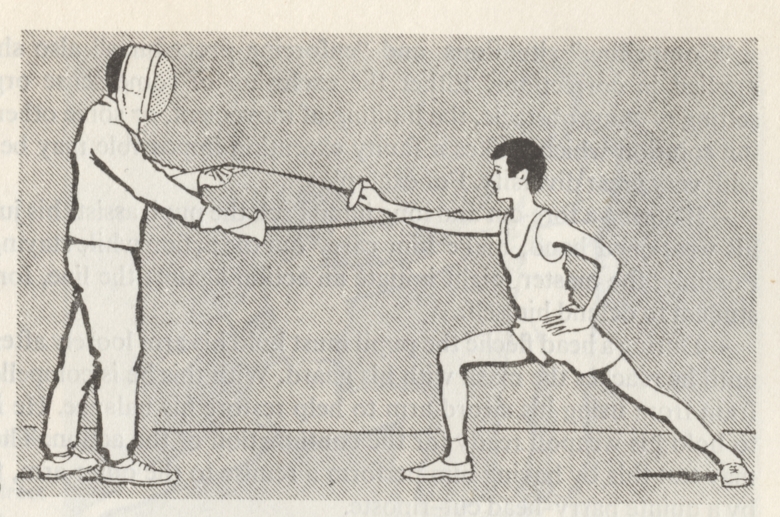
Fencing and the Master by László Szabó, 1977, 1997. Forward by Dr. Eugene Hamori, a student of Szabó’s (and my second fencing master and close friend), in the 1997 edition. The best book ever written on the subject of teaching fencing: the fencing coach’s vade-mecum. Highly recommended. Excellent material on theory and other aspects of fencing, besides the practical. Intermediate to advanced fencers will also find it useful, in particular for its sections on tactics, preparation, drilling, and stealing distance. Szabó, who trained a number of Hungarian champions, was one of Italo Santelli’s three protégés and a close friend of Dr. Francis Zold, my first fencing master.
László Duronelli and Lajos Csiszar were the other two Santelli protégés. Csiszar was master for many years at the University of Pennsylvania after emigrating to the US. Among his students were Dr. Eugene Hamori and Roger Jones, the latter of whom one day contacted me about writing a review of one of my books; during our conversation we realized we had the same ultimate fencing roots and identical views, therefore quite understandably, on honor in fencing. (Roger was a US team epeeist in ’55, an Olympic alternate in ’56, member of the FIE rules committee, and a strong proponent of honor in fencing as opposed to cheating and gamesmanship aka “cheating within the rules.”) Duronelli was master for many years at the fencing salle at Semmelweis High School, run by Semmelweis University, in Budapest. This delightfully old school salle, which has produced many champions, is still in existence, with László Szepesi, who helped bring saber gold to France, as its current master (or at least he was when my wife and I visited some years ago). Eugene Hamori along with Krisztina Nagy (a very talented fencer and master in both HEMA longsword and modern Olympic saber) escorted us on the visit to the salle. Dr. Hamori passed away in 2025.
A Dictionary of Universally Used Fencing Terminology by William M. Gaugler, 1997. A well-researched fencing dictionary although it could have been even longer — but then, only fencing aficionados like myself might read it. “Universally Used (But Not Always Agreed Upon) Fencing Terminology would be a more accurate title.
Escrime: Enseignement et entraînement by Daniel Popelin, 2002. In French. The theory and practice of teaching fencing and training fencers. Rather than use the typical pyramidal view of fencing from its base to its competitive elite at the point, M. Popelin suggests a truncated pyramid, whose range is from beginner to national level, to indicate the majority of fencers, and a cylinder on top of this to indicate international and aspiring-to-international fencers. He astutely notes that the majority of fencers do not seriously train to become elite fencers, for many reasons, and thus fencers should be trained differently according to their needs. In other words, the training of the “club” fencer, no matter how talented, should be different from that of the elite competitor. Or put another way, simply because a technique, classical or otherwise, is not used at the elite level is no reason for non-elite competitors to abandon it or, worse, never learn it.
Understanding Fencing by Zbigniew Czajkowski, 2005. Highly recommended for fencers and coaches interested in practical theory. Czajkowski is a leading Polish master whose students in all three weapons have earned gold at the Olympics and world championships.
One Touch at a Time by Aladar Kogler, 2005. The psychology and tactics of competitive fencing, by an Olympic fencing coach and noted sports psychologist. Recommended.
Theory, Methods and Exercises in Fencing by Ziemowit Wojciechowski, circa 1986. By a world-class fencer and master. Foil-based, but still an excellent book for fencers and coaches of all three weapons. Good information on evaluating and dealing with an opponent’s tactical style, especially in foil, although, again, still useful in epee and saber.
See also Joseph Roland, The Amateur of Fencing, in the “Historical Fencing” section below.
“Classical Fencing”
(Modern Non- Electrical Technique)
Some of the books below (Barbasetti, Gaugler) use one of the several classical Italian parrying systems and numberings, as opposed to the French or modified French systems and numbering preferred by most teachers today. (There are also several French-based numbering systems, each differing slightly in the naming of a parry or two, or in the use of a parry, for what it’s worth.) All of the books below are useful to the modern electrical game, epee particularly, and to foil and saber at their fundamental level. At some point foil and saber may return to a more classical standing, rather than their present sport-dominated extreme artificiality, notwithstanding that foil has always been highly artificial, or at least the French school was and now all schools are, for the past 150 to 200 years, and moderately artificial prior to that. Even in the heyday of dueling there was a distinction between “school play” and “fencing with sharps.” See also the texts listed in the “Epee de Combat” section.
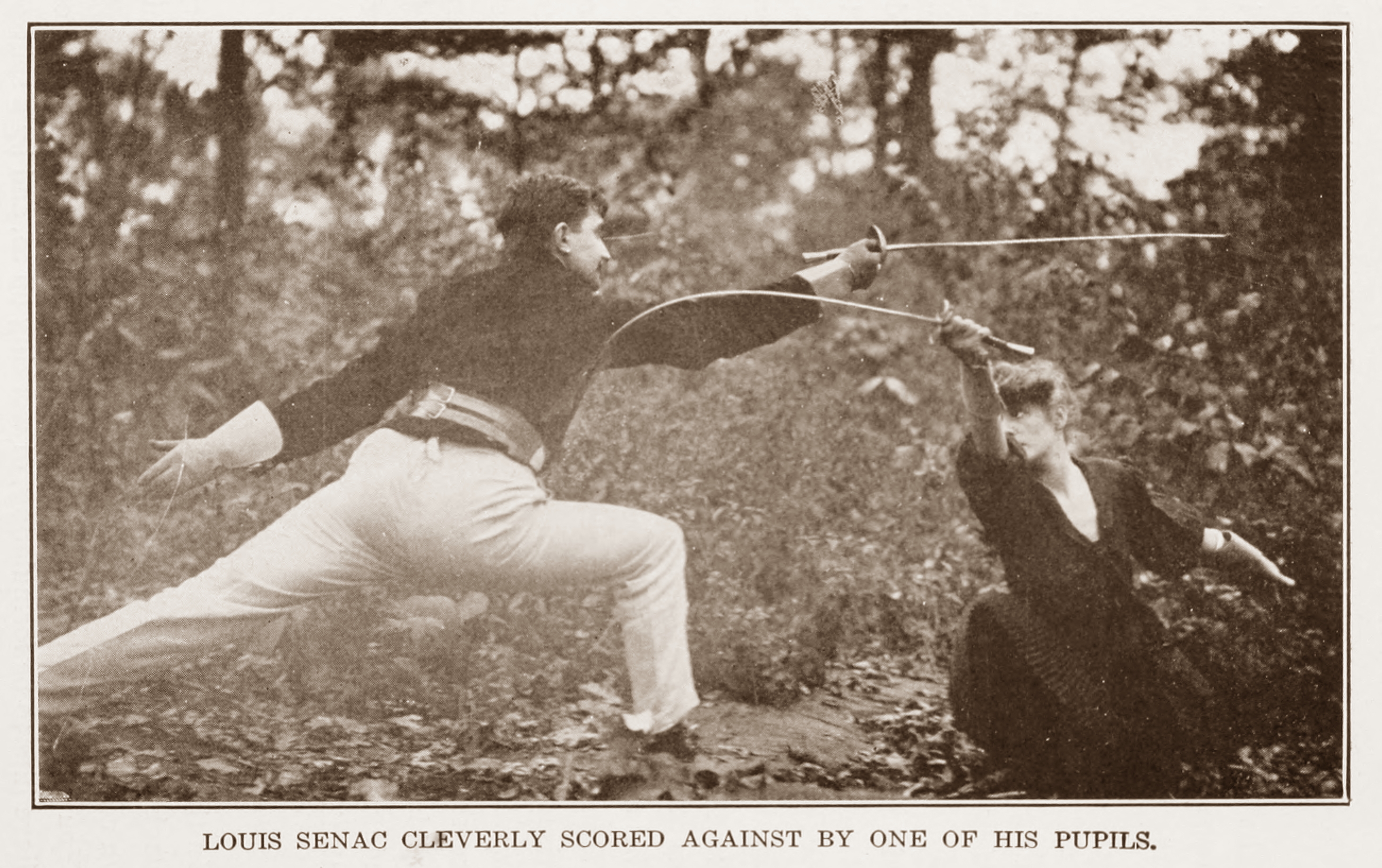
The Art of Fencing by Louis and Regis Senac, with a section on saber by Edward Breck, 1904 (hardcover), also 1915 & 1936 (softcovers, with foil and saber by Breck). Part of the Spalding Athletic Library, the book is particularly useful to fencing historians as it covers a transition period in modern fencing, has illustrations of clearly expert women fencers (unfortunately unidentified), has lengthy fencing equipment adds (1905), shorter equipment ads (1915), and the 1905 Amateur Fencing League of America fencing competition rules (1915, 1936). The book’s downside–but only occasional–is its excessively evangelical attitude in promoting the French school, an attitude associated with patronizing and common-at-the-time claims that one must be an overly-muscular athlete to fence well in the “inferior” Italian school. Blame the psychological reaction of inferiority by spindly and otherwise un-athletic French fencers to the hyper-muscular Italian swordsman Eugenio Pini for this. One can also be lean and still very strong, as with the whipcord muscles of some of Rafael Sabatini’s heroes, a physical type well-suited to fencing and found in reality as often as in fiction. To my mind, there is no excuse, other than long-term injury or disease, not to be fit: with strong muscles, good flexibility, and excellent aerobic and anaerobic endurance. Although the book nobly promotes women’s fencing and notes that at least one woman fencer was more than a match for any man, it does recommend fencing to women in part because it “reduces surplus adipose tissue, making their figures trim and comely, rounds their muscles, develops their busts,” &c. Perhaps this was mere marketing and not sincerely-held chauvinism.
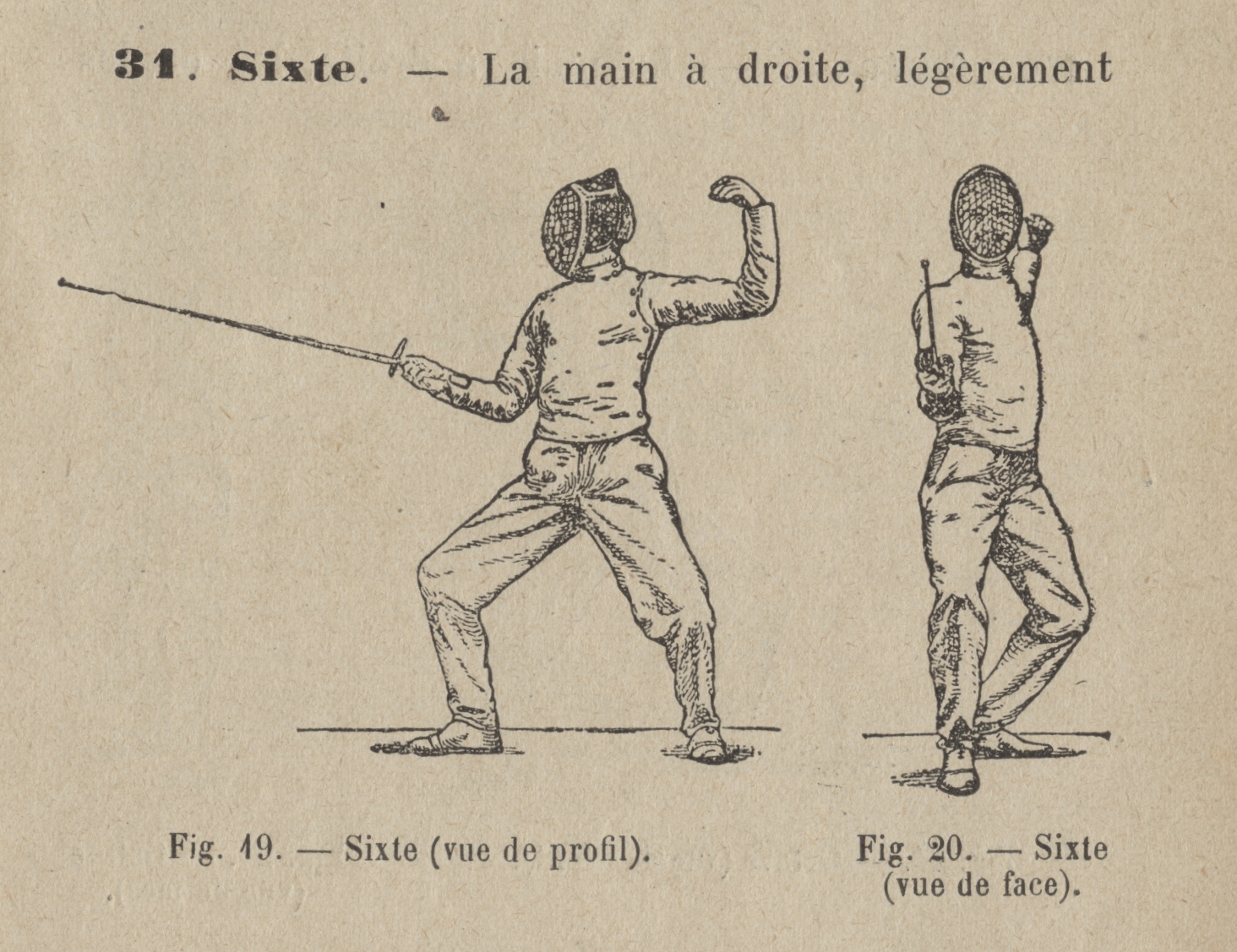
Réglement d’Escrime by the Ministère de la Guerre, France, 1909 and other editions. A short treatise on foil fencing for the French military that provides a detailed look at the classical French school. Useful for classical fencers and historians, and, frankly, any fencers interested in French technique given that it remains sound today, at least as a foundation. Oddly, one would have expected the French military to have adopted the new epee technique rather than foil at this time, and even more so, would have emphasised the saber instead of either, given that it was still in use as a practical military arm at the time.
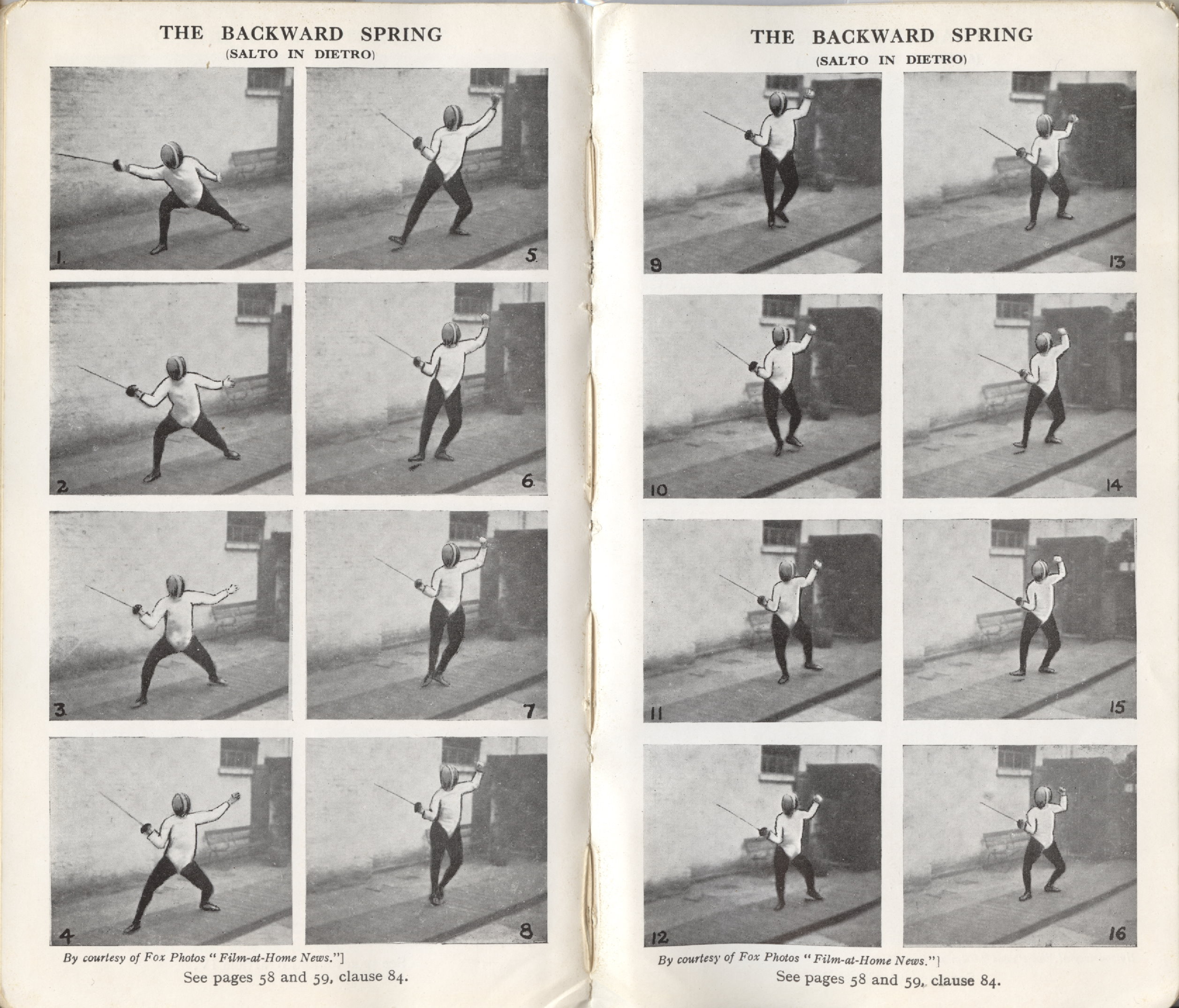
The Fencer’s Companion by Léon Bertrand, 1934 to 1958 and possibly later. A delightful little book, hardcover but pocket-sized, with enough information on all three weapons to substantially educate fencers from novice to intermediate-advanced, with fundamental lessons required at all levels of fencing. The book also includes useful advice on teaching fencing. Prof. Bertrand — son, grandson, and great grandson of famous British fencing masters of French descent, was one of the most influential masters in the history of modern fencing in the UK. Among his many students was famous actor (and decent fencer, and by decent I intend the classical definition, that is, very good) Basil Rathbone. Bertrand’s book on saber (see above) is one of my top five favorite fencing books.
Among Prof. Bertrand’s useful advice is to learn to fence from the beginning with both hands, starting with the weak hand first for balance. It’s advice unlikely to be followed often but it has excellent virtues, and will likely be the subject of a blog post one of these days. More than a quarter century ago I began learning to fence left-handed in order to give left-handed lessons as well as right. During COVID I seriously incorporated left-handed footwork, drills, and fencing into my regimen, equal those of my right-handed, with quite useful results. Prof. Bertrand also has advice for fencing against classical Italian fencers, in which the counter-quarte and Italian prime (a high septime) dominate. (Note for readers of Imre Vass: his “destructing parries” in quarte and septime correspond to–are equivalent to–these two classical Italian parries that in combination “cut the line” or “destroy” feint attacks in the high line and will parry high-low and low-high feint attacks in the inside line.)
I’d not be surprised to find that The Fencer’s Companion influenced All About Fencing: An Introduction to the Foil by Bob Anderson, in particular the images of technique in action. Whereas Prof. Bertrand includes a series of photos depicting various actions as shown above, Anderson took this a step further so that by flipping pages the reader can see the technique in action, similar to a primitive film. See also Bob Anderson’s book on this page.
The Book of Fencing by Eleanor Baldwin Cass, 1930. The book is particularly noteworthy as it was, and remains, one of only a handful of fencing texts written by a woman, even including modern texts. Ms. Cass was an American, and the book was, not surprisingly, published in Boston, birthplace both of conservative American Puritanism (which later traveled largely to the US South, go figure), as well as liberal progressive thought. The epee section is sparse, as is often the case with many three-weapon texts, but the foil section is classically thorough. The book is also a great source on much of the fencing history of the day, and thus quite useful to the fencing historian.
The Art of the Foil by Luigi Barbasetti, 1932. The Italian foil. An outstanding book that should be studied hand-in-hand with Imre Vass’s book on electrical foil. Barbasetti’s book includes a succinct but thorough history of fencing, a good section on tactics, and a glossary of fencing terms in English, French, Italian, and German. A useful book for epeeists as well. Barbasetti was one of several Italian fencing masters who carried Italian technique to Hungary and Austria, including to the Austro-Hungarian Normal Military Fencing School of Wiener-Neustadt in 1895 where he re-organized it. (Alfred Tusnady-Tschurl, one of my “fencing grandfathers”—the fencing masters of my own fencing masters—was a graduate and had studied under Barbasetti.) Italo Santelli was the most notable of these Italian immigrant masters. Santelli famously said that fencing is something you do, not something you write about—thus there is no book by Santelli in this list.
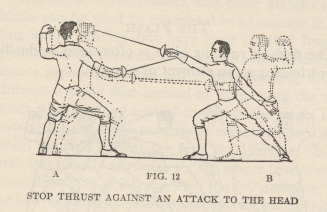
The Theory and Practice of Fencing by Julio Martinez Castelló, 1933, & Theory of Fencing, 1931. One of my favorite dozen or so fencing books. The author was trained in the early 20th century Spanish school, which was based on the best of the French and Italian, including a modified modified French grip that gave it the (theoretical) point control of the French grip with the strength of the Italian grip. (This grip is illegal in modern competition, although a pistol grip variation without an external weighted pommel exists that is legal, if you can find it.) The Neapolitan Italians were the first to formally attempt to combine the French and Italian schools on any scale, followed by the Spanish and, via the Italians, the Hungarians, although fencing “schools” have always adopted technique from each other and adapted it to their own methods. However, in both editions the author notes that the book, which he wrote to help “young men and women in the many schools and colleges” in the US, including those without a teacher, is not based entirely on any particular system, although he says the foil is mostly French, the saber Italian, and the duelling sword (epee) from his own experience.
The author notes that at the time he wrote his book the French school predominated in the US, and this remained largely true at least until the 1970s, in foil and epee especially, in spite of an influx of elite Hungarians in the 50s and 60s. (I was often told in the late 70s and early 80s that I fenced epee like a pentathlete, rather than conventionally, French, that is: in fact, I fenced like a Hungarian, although notably my lessons from two Hungarian masters and one French master–the famous Michel Sebastiani, French-Corsican, and a former pentathlete–were seamless and very similar.) Saber in the US was by the 70s largely Hungarian, at least among the best sabreurs. Castelló also writes that the predominant saber school circa 1930 was Italian, but in fact by then the Hungarian school, based on the Italian but modified to suit Hungarian attributes, was dominant. But this is a quibble, yet I’ll add one more: Castelló repeats the canard about the saber target being limited from the waist up because it was a cavalry weapon, i.e. one didn’t hit the horse. This is arrant nonsense, still repeated today. The target in saber is based on an old Italian rule that limited the target to the area above the waist in order to protect a duelist’s manhood. This is noted in numerous late 19th century Italian texts.
Castelló had also self-published a smaller volume, Theory of Fencing, in 1931. Copies could be ordered from the author himself for $2. The more detailed 1933 version was released by noted publishing house Charles Scribner’s & Sons. Both books–the later book is simply an expansion of the first in both text and illustration–are excellent sources of fundamental fencing theory and technique, knowledge often far too lacking in many fencers today. Castelló included an excellent description of the two most classical epee styles–“straight arm” and “bent arm”–and associated technique and tactics. (See Lidstone’s later edition above for others.)
Among Castelló’s students was Joseph Velarde, the West Point Military Academy fencing master whose stand against racial discrimination opened US collegiate fencing competition to Black fencers. By coincidence I once worked alongside Velarde’s son, a former US Marine Corps officer, many years ago. A decade before that I had first fenced with and competed against the founders of the old M.A.R.S. Fencing Club at the Marshall Space Flight Center in Huntsville, Alabama, most of whom were among the Apollo engineers who put humankind on the Moon. (The fourth was and is a brilliant Byzantine iconographer and the finest fencer I’ve ever seen in the old school straight arm epee technique.) One of these veritable musketeers, Joe Dabbs, who has since passed away, had trained for years under Velarde. I have remained friends with all of these old M.A.R.S. fencers for almost half a century, and most were active fencers until recently as age and old injuries restrained them, although I still fence with one of them regularly (Elias Katsaros, with French grips and true “hit and not get hit” dueling practice only!). John Jordan and Donny Philips—the other two members of the Four Musketeers—are also still with us. (And John, in his nineties, although he does not fence anymore, still has a fencer’s mind as sharp as a rapier and does forty pushups and situps, plus some dumbbell curls, daily.)
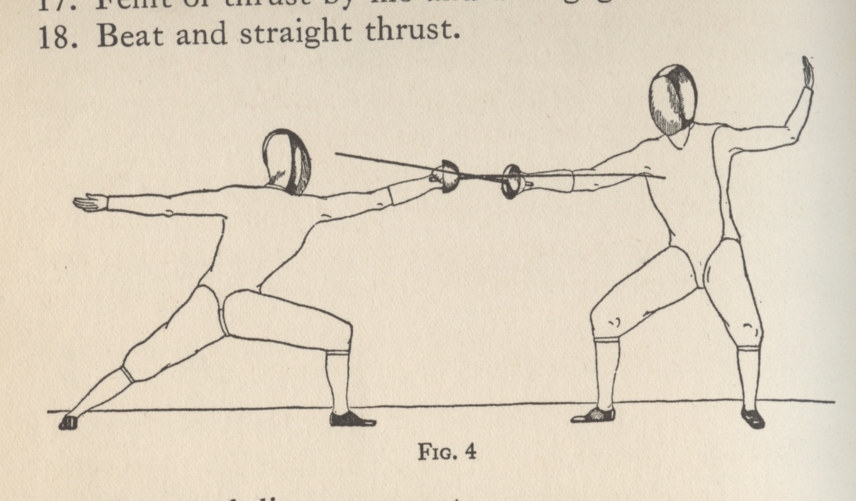
The Art of the Sabre and the Epee by Luigi Barbasetti, 1936. By one of the great early twentieth century masters. The epee section is quite sparse, and refers the student to the foil for much technique, a quite common practice in many of the Italian schools, given the similarity in technique and practice between the two weapons. Castello’s book (see above) has a far more thorough epee section. Barbasetti’s saber section should be studied hand-in-hand with Bertrand’s book on saber, and with Beke and Polgár’s book on saberas well. See above.
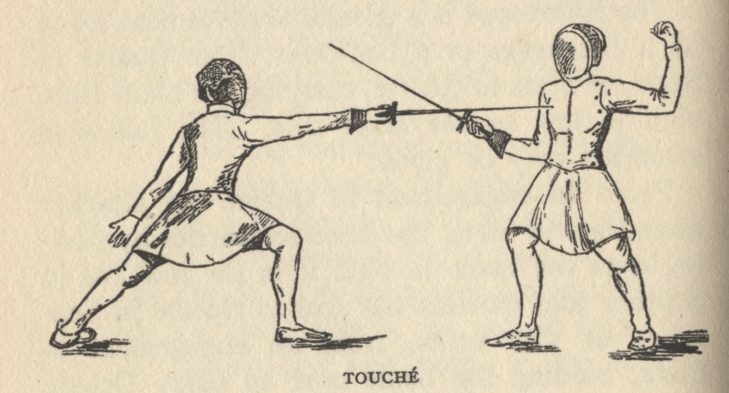
Fencing Comprehensive by Félix Gravé, 1934. A delightful and, too my mind, too short fencing treatise covering foil and epee, filled with pithy fencing wisdom that has never been out-of-date. The author’s general observations are also noteworthy. For example, the truly classical fencer in form and technique is born, not made. (Not to worry, those of you in the majority who weren’t born to fit into the classical mold–even in the days of “classical fencing” such fencers were rare, and one need not fit this mold in order to be a great fencer. Anyone who tells you otherwise is ignorant and probably, to quote The Princess Bride, selling something.) Gravé has good advice for teaching, on dealing with some of the more common types of fencer, on tactics in general, and for conducting a duel. For the fencing historian, he has several drawings of period fencing grips, the French interchangeable epee system (l’épée démontable), various guards (coquilles), pommels, points d’arrêts, the development of the fencing mask, &c. Interestingly and happily, he mentions women epeeists, and has an illustration of the clothing they should wear (“men’s,” basically) long before epee was permitted to women in competition, a fact that pleases me immensely. Like Bertrand above, Gravé taught famous actor (and decent fencer, see above for the definition of decent) Basil Rathbone.
On Fencing by Aldo Nadi, 1943, reprint 1994. A famous Italian fencer’s thoughts, pompous, patronizing, and otherwise, on technique and competition. For Nadi, there was only one correct way to fence: his. Held up as a god by many modern “classical fencers,” Nadi despised the French grip as much as many of the same “classical fencers” today despise the pistol grip and advocate the Italian and [Nadi-despised] French grips. Let no one claim that blind self-irony and hypocrisy, often humorous, even hilarious, never reigns among pseudo-experts, or for that matter, among quite a few true experts. Even so, the book has some quite useful advice on fencing.
Nadi also wrote an autobiography so pompous and self-indulgent that he could find no publisher during his lifetime. It was finally published in the 90s perhaps, I’ll have to check the date: I have so far been unable to get past the first few pages. Nadi also wanted to be an actor, but never managed more than a bit part in Key Largo. Reportedly, fencing audiences around the world cheered when Humphrey Bogard shot Nadi’s character.
The Science of Fencing by William M. Gaugler, 1997. A thorough modern description of purely classical Italian foil, epee, and saber technique. Pedagogical, as one would expect, and almost old school military in its technical presentation. Professor Gaugler, a student of Aldo Nadi and other great classical Italian masters, passed away in 2011.
Fencing Tactics
Many books touch on fencing tactics, but to date I’ve found one devoted exclusively to the subject — and it’s one of the best books on the subject of fencing in general I’ve ever read.
Fencing Tactics by Percy E. Nobbs, 1936. By the 1908 Canadian Olympic Foil Medalist, the book is a delight to read and study, easily one of a handful of the most practical fencing books ever written, certainly one of my handful of favorites even if I don’t agree with everything–and is a book generally unknown to nearly all fencers these days. It is also one of only two books by Canadians on this list (see also Bac H. Tau), and both are outstanding. However, take heed: the book is based on classical notions of tempo and right-of-way, and in some ways is an exposition largely of how the author fenced (similar to the books of Nadi and Harmenberg, for example).
Mr. Nobbs covers tactics in depth, better explains the difference between the classical Italian (and by implication, Italo-Hungarian) school versus the French, discusses opposition thoroughly, points out how important footwork is to tactics, and captures well the spirit and practice of each of the three modern weapons. He also describes the difference between free fencing (loose play), competition fencing, and exhibition fencing–and particularly how one should fence and behave in each form. For example, the superior fencer should trade touches with the weaker in free fencing, rather than simply trying to hit as many times as possible.
Mr. Nobb’s discussion of opposition is quite useful, with educational observations on the role played by the bend in the blade as it hits, something that would not occur with real swords and their very stiff blades. This blade bending is less relevant today with electrical scoring in epee, but is still pertinent in the conventional weapons: for example, a counter-attack without priority but whose blade bends as it hits can help exclude the arriving valid attack. In other words, the valid attack might have arrived were the blade to remain straight. The book also describes useful footwork beyond the conventional advance, retreat, lunge, and recovery, most of which is seen today, but not all. We rarely see, for example, the stolen march (forward crossover, lunge) today, although I was in fact taught it decades ago. Still, some epeeists today occasionally use a crossover followed by a fleche, often as a suprise attack after the command “Fence!” is given. Nor do we see the reverse rassemblement (standing as in a rassemblement but by bringing the rear foot forward) to make a counter-attack, a practice once used in foil.
Amusingly, Nobbs includes an epee counter-attack that concludes with a reverse-crossover-spin-jump-retreat! I’m no fan of turning the back in any martial practice, and the described technique would not only run afoul of the modern rule against doing so, and is clearly also pre-electrical, for the fencer executing the technique would be wound up in the reel cord. Still, it would be a swashbuckling delight if executed without error although to what real purpose I cannot fathom: a half-retreat crossover accelerating into a long jump backward would work as well or better and is far more stable–and you can keep your eyes on your adversary the entire time. It’s a conundrum that such a dubious technique–unless I’m missing something–would be included in an otherwise practical work. An inside joke? Probably. In fact, I don’t even care for exposing my back in the fleche when running past an adversary, and prefer instead to fleche straight at my opponent, a technique centuries old and well-described by Sir Wm. Hope. A quick trivium: until the 1940s, in “dry” (non-electric) epee if one fencer passed another, he or she could turn around and continue fencing facing the other way, provided a halt had not been called. Nobbs also provides the third different definition of copertino I’ve run across: fencing language is both used and abused by fencing masters.
Recalling my first fencing master, Dr. Francis Zold, who told me much the same thing, Nobbs points out that the premise of competitive epee at the time, that a hit arriving at the arm of the attacker first would count while that of the attacker would not because the attacker’s body hit would be stopped or delayed by the defender’s arm hit, is flawed. In fact, the majority of counter-attacks to the arm or the body would not halt a fully developed attack. It’s a purely sport technique when done deliberately. The book is one of those I delight in discovering. And it’s printed on high quality laid paper too! Highly recommended–but have a thorough working knowledge of at least intermediate fencing technique first.
Historical Fencing
That Is, To Hit and Not Get Hit–At Least in Theory
Rapier & “Transitional” Rapier
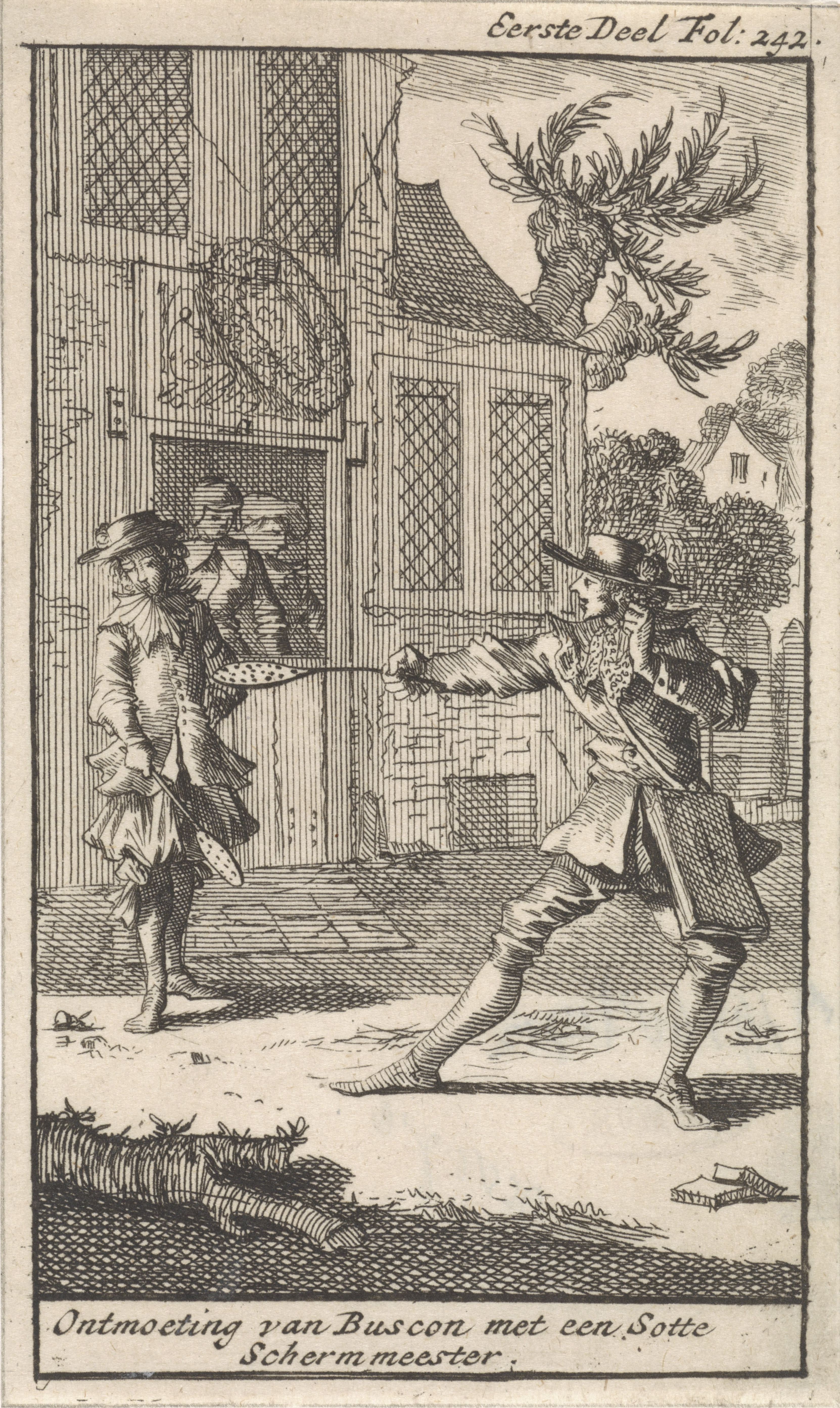
Libro de Jeronimo de Carranza, que trata de la filosfia de las armas y de su destreza, y de la aggression y defension Christiana by Jeronimo de Carranza, 1582. Add to this the works of his student, don Luis Pacheco y Narvaez. The book is the exposition of la verdadera destreza, or true art, and as such is necessary for understanding one of the major schools of Spanish rapier. The style is based much on complex geometric forms derived from the simple theory that discovering the shortest safest path in attack or defense is the basis of speed (in fact, it is but one component). From this proposition the school became wrapped in unnecessary esoterica including elements of mathematics and philosophy that have little if any practical bearing on practical swordplay. Yet it was this esoterica that made it surely lucrative for fencing masters whose students were, as many are today, eager for “secret knowledge.” The system was scathingly and brilliantly lampooned by famous poet, swordsman, and Spanish national treasure Francisco de Quevedo in El Buscón. Quevedo reportedly (some argue that this story is a myth) once humiliated Narvaez in a duel: with his rapier he removed Narvaez’s hat. In fairness, it can be argued that the verdadera destreza was an early effort at scientific or rational fencing theory that, albeit with different emphasis, would come to dominate the smallsword in the late 18th and early 19th centuries.
Part of my bias against attaching philosophy, metaphysics, “secret knowledge,” and other such “floral appendages” to fencing is that the allure is primarily to make fencing lucrative to some fencing teachers’ bank accounts and all too often to enrich the teachers’ egos as well as their wallets. I’ve seen a number of modern teachers practice this in Olympic, classical, and historical fencing. It is a pompous, pretentious, and, often to many students, ultimately disappointing practice. Fencing has more than enough fascinating allure, and its lessons are easily applied to life: it need not be wrapped up mysteriously and excessively in mathematics, philosophy, and, to be plain, alchemy. Or, more generally, in esoteric bullsh*t.
That said, one of the best ways to look at the destreza verdadera form may be to consider it as the truly Spanish Baroque style of swordplay, caught up in all that was good and bad in the excesses of the Spanish Baroque period. And if nothing else, at least it suggests you consider that all the arts and sciences are connected.
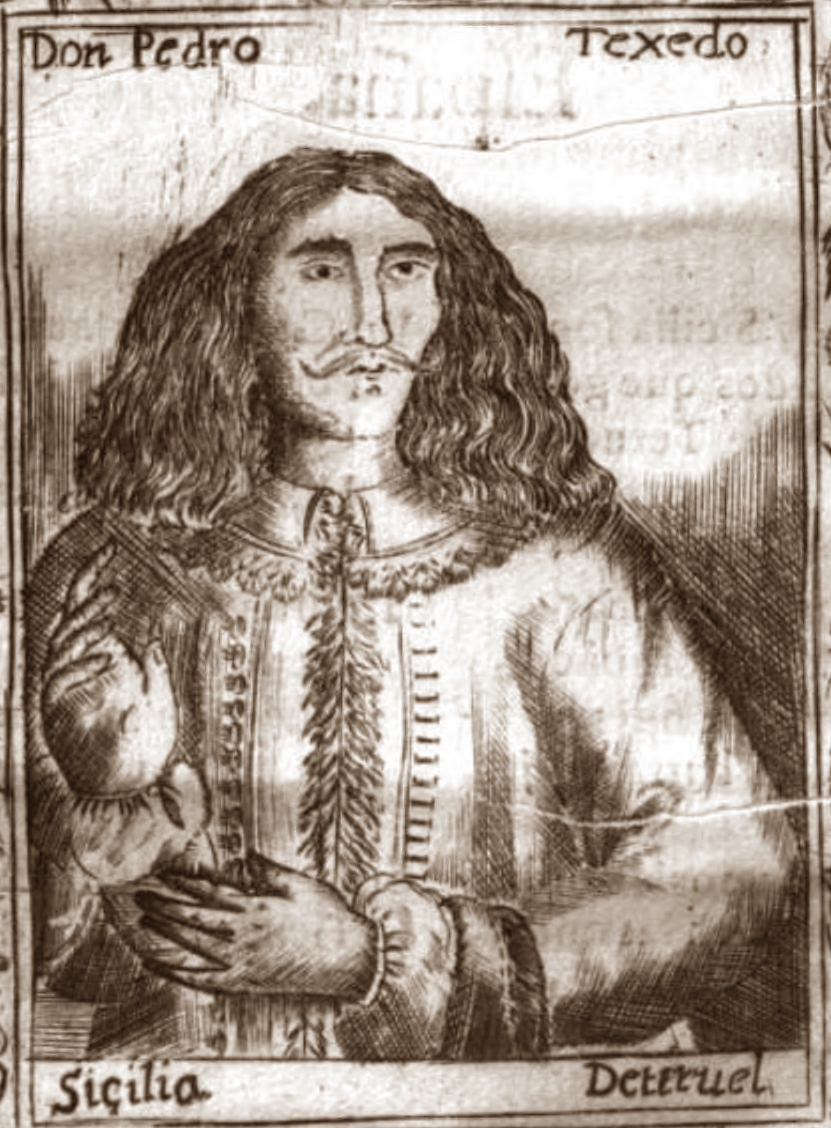
Escuela de Principiantes y Promptuario de Questiones en la Philosophia de la Berdadera Destreça de las Armas by Don Pedro Texedo Sicilia de Tervel, 1678. As with the Destreza Indiana below, the author’s name alone is quite evocative. Add to this the author’s image in the front papers, evoking the aloof, Roman-nosed Spanish don (not quite a myth by any means), and we have a book right out of a Hollywood swashbuckler. It has everything for the fencer enraptured by the destreza verdadera, including excellent illustrations of swashbuckling swordsmen—Spaniards, we assume, although their Spanish dress includes baldrics rather than the narrow sword-belts worn by Spaniards at the time except when in military dress, which was basically French—holding classic cup-hilt rapiers and standing on “magic” geometric circles. Discusses rapier and dagger, single rapier, and rapier and target.
The author’s image page includes references to theologia, obtica, practica, astrologia, speculativa, arismetica, matematica, musica, and philosophia, which is quite an education: only by reading the book is the question answered as to whether some or all apply to the destreza verdadera. “All,” I imagine Texedo would say. Further, I am unsure who the audience was: the book was published in Naples, under Spanish rule at the time; the clothing and baldric are a bit curious (perhaps of Spaniards in Naples? Or in Sicily? Or of Italians in Spanish dress?); and the dedication is to His Majesty the King of Spain, of course.
The book’s purpose is clear, though, according to Texedo’s motto: Omnia Contra Tela is shorthand for “unum omnia contra tela Latinorum” from Virgil’s Aeneid, book VIII. The complete phrase translates as “alone sufficient against all the weapons of the Latins” (Benjamin Apthorp Gould, 1826; Latin translation should always be left to serious scholars). Given that destreza is written beneath the motto, it’s pretty certain that Texedo held his practice of philosophical swordplay in high regard.
I imagine Don Pedro Texedo, whom I rank among my favorite Spanish swordsmen, as equal to “John de Nardes of Seville in Spain, who with the dagger alone, would encounter the single rapier and worst him.” (William Higford, 1658. “Juan de Nardes” of Seville is probably Juan Domínguez of Sevilla, with documents dated 1639 identifying him according to a detailed list in “Esgrimidores Sevillanos” in Revista de archivos, bibliotecas y museos, vol. 24 (1911). He is not listed among the Seville masters named in the Bibliografía é historia de la esgrima española by Enrique de Leguina y Vidal (1904), although notably Florentino de Pancorvo of Seville is described as being particularly able in single dagger versus single rapier.)
Las Tretas de la Vulgar y Comun Esgrima, de Espadas Sola, y Con Armas Dobles by Manuel Cruzado y Peralta, 1702. My many thanks to Pradana who corrected my description of this book. When I reviewed it ten to fifteen years ago, I simply read the title and scanned the text for examples of “common” Spanish rapier, and so I assumed it was a book overall on the comun technique. Pradana pointed out that the text is in fact a criticism of the common method. Mea culpa! He later emailed me to point out that I was partly correct: the text does include descriptions of the common method, as I was certain I had read (in spite of my mediocre Spanish). Thankfully I now do a more detailed review and re-review of sources prior to formal publication. In regard to “comun” texts, Pradana recommends Domingo Luis Godinho. Although I’m aware of this author I haven’t yet reviewed the book, but will post a summary when I do.
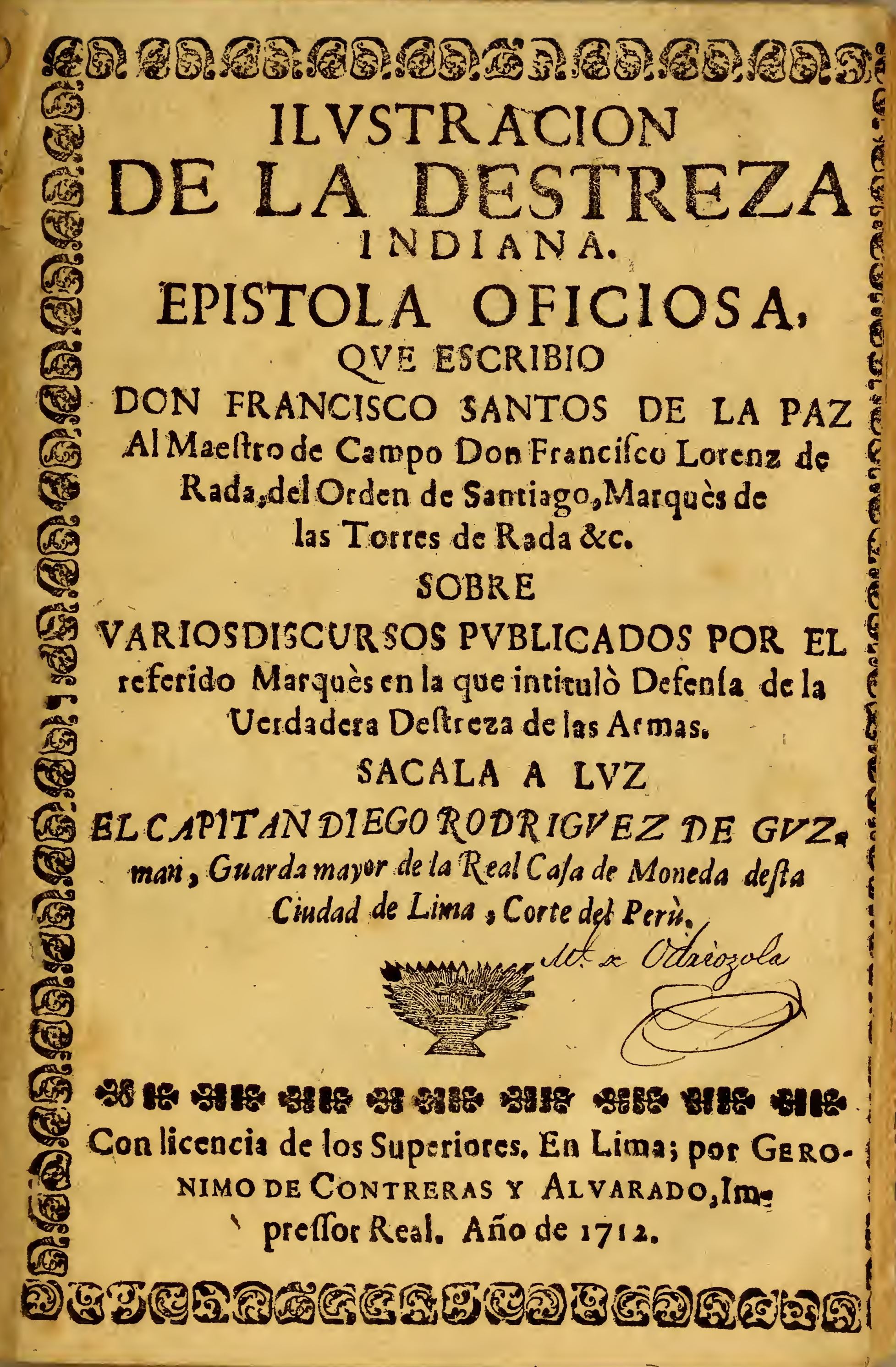
Illustracion de la Destreza Indiana by Don Francisco Santos de la Paz and Capitan Deigo Rodriguez de Guzman: Lima, 1712. Noteworthy primarily because it was the first fencing book, to my knowledge, published in the Americas. The authors’ names alone conjure assignations and affrays fought with rapier and poniard, or capa y espada, at night, not to mention the myth of duels on deck between noble pirate captains and treacherous Spaniards, although to be accurate we should drop the “noble” from pirate captains all of the time unless fictional (for example, Captains Peter Blood and Charles de Bernis), and “treacherous” from Spaniards most of the time. Trust me on this, I write books on the subject. See also Edward Blackwell in the “Smallsword” section below.
Gran Simulacro by Ridolfo Capo Ferro, 1610, 1629. A beautiful 2004 hardcover edition, Italian Rapier Combat: Capo Ferro’s ‘Gran Simulacro,’ edited by Jared Kirby, is available, as is a 2012 softcover reprint.
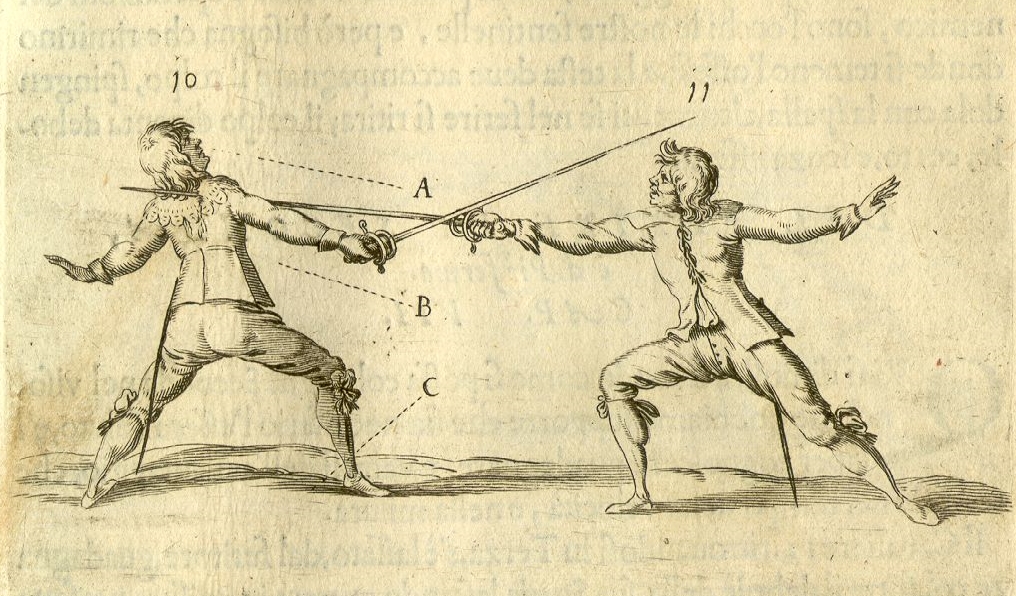
L’Arte di Ben Maneggiare la Spada by Francesco Ferdinando Alfieri, 1653. Beautifully and graphically illustrated treatise of the Italian spada, both of single sword and sword and dagger. Highly recommended.
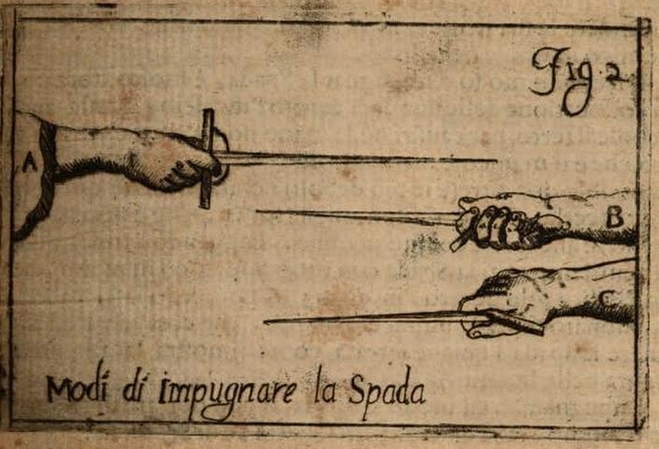
Regole Della Scherma by Francesco Antonio Marcelli, 1686. Detailed, practical study of the Italian spada, including single sword, sword and dagger, and sword versus other arms and vice versa, for example the saber or scimitar versus rapier. A very practical book with sound, practical advice useful in rapier, smallsword, and epee. Dedicated to Queen Christina of Sweden, who had abdicated her throne and now resided in Rome. Greta Garbo starred as Queen Christina in an excellent film of the same name.
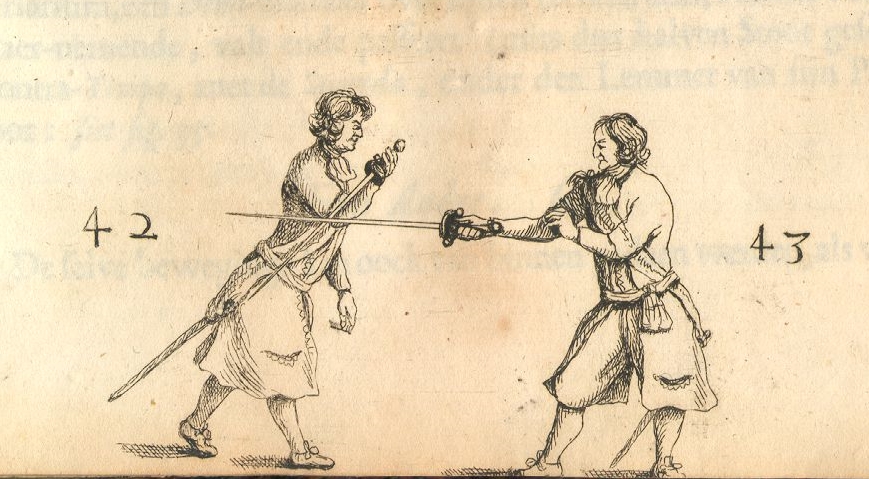
Grondige Beschryvinge Van de Edele ende Ridderlijcke Scherm-ofte Wapen-konste by Joannes Georgius Bruchius, 1671. A Dutch text presaging the persistent influence of the rapier into the age of the smallsword in Northern European schools—the Dutch, the various German, and others. Notably, in spite of the date and obvious transitioning to a lighter weapon, the book still uses much Italian rapier terminology. Solid technique for the duelist, soldier, and brawler, much of it looking remarkably similar to modern epee. The author references various illustrations throughout the book, in order that the reader may put them together in different described sequences. Clever, but unfortunately cumbersome too, as one might expect.
The book illustrates one of the most practical uses of what Alfred Hutton, in saber, refers to as “high octave”—used, that is, here as a yielding parry from quarte to exclude the adversary’s blade after running him through. Immediately closing the distance and commanding the adversary’s blade was vital. An adversary is seldom dead or disabled immediately, after all, and this technique would prevent him (or, rarely, her) from making a killing thrust in revenge, assuming a perfect world of course. Not everything goes according to plan, or so Fortune is said to say and without doubt often proves. Some nineteenth century saber masters recommended its use to counter-parry a quarte riposte made in opposition, suggesting that it was the only parry that could be made quick enough, which at the distance of direct riposte may be true. Hollywood is occasionally enamored of the technique, but it’s usually cringeworthy to watch the lovefest, so stilted, weak, and inappropriate in execution—unbelievable, in other words—it usually is.
See George Silver in the “Broadswords…” section below for a passionate argument against the rapier.
Smallsword (Epee de Rencontre, Epee de Cour, Espadin)
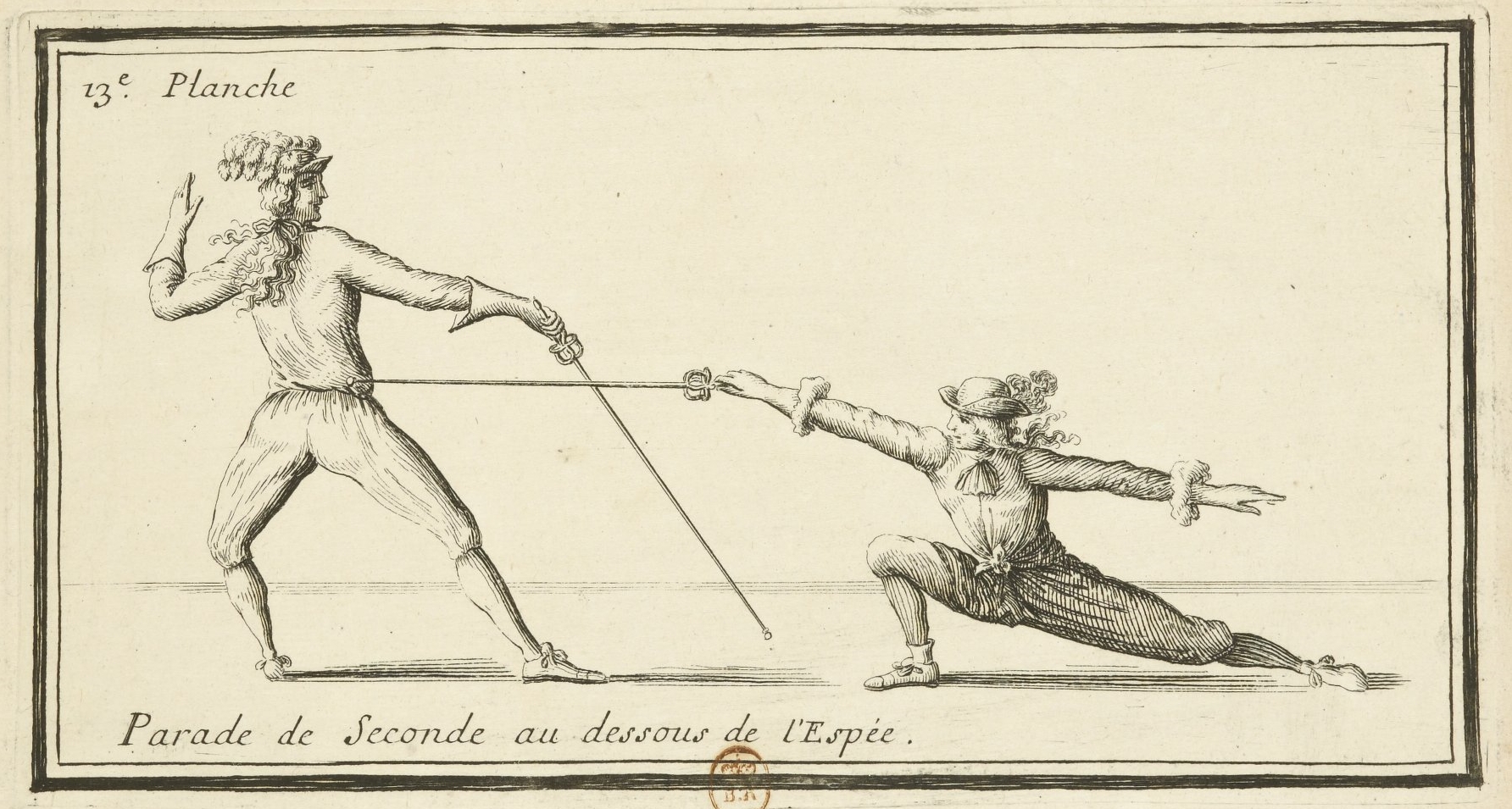
Les Vrays Principes de l’Espée Seule by the sieur de la Touche, 1670. The establishment of the modern French school of the smallsword, whose principals went largely unchanged for more than three centuries, and remain much in place today. Fencing for the French court. Although the technique is practical as described, or at least what would soon be considered conventional, and later classical, the illustrations show a lunge absurdly long, one that could hardly be recovered from in good time or in good defense. Perhaps it was to please Louis XIV and his tastes in elegance and dance.
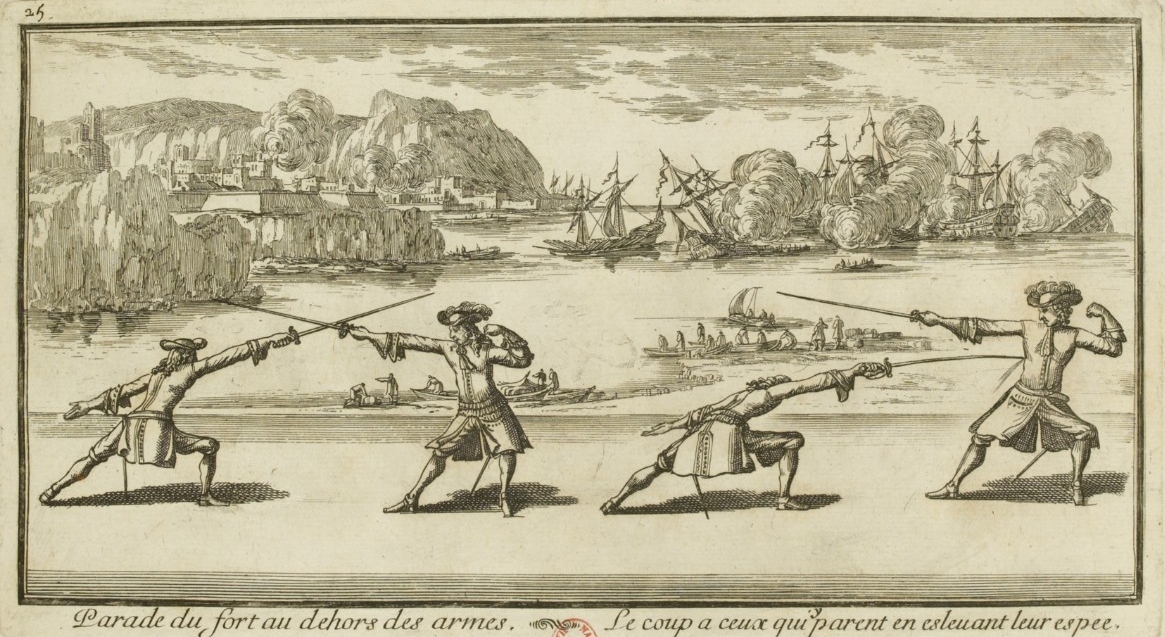
Le Maître d’Armes ou L’Exercice de l’Epée Seule dans sa Perfection by Andre Wernesson, Sieur de Liancour, 1692. An excellent study of the smallsword, albeit in some ways more suited to gentilshommes of the French court than to adventurers in the field, although the author does cover commanding and other disarms. Julie d’Aubigny, aka Mademoiselle la Maupin, the opera singer and duelist, among other occupations and pastimes, may well have studied under Wernesson, maître en fait d’armes to the Petit Ecurie, given her swashbuckling father’s position at court as the secretary to the comte d’Armagnac. (She might also have studied under Jean or François Rousseau, maîtres en fait d’armes to the Grande Ecurie.)
La Maupin, among her many adventures, was convicted and subsequently sentenced in absentia to be burned to death by the Parlement d’Aix for seducing a novice and burning a corpse in the associated convent. The verdict, however, was delivered against the sieur d’Aubigny; La Maupin’s masculine disguise apparently fooling, or perhaps pretending to fool, the right people. The criminal seductress’s former protector, the comte d’Armagnac, petitioned Louis XIV to overturn the decision, which he did, doubtless given his strong inclination toward attractive talented women. Clearly, independent women were hard to come by—and apparently hard to spot when dressed as a man fleeing a convent and prosecution.
L’art des armes by le sieur Labat, 1696. English translation, The Art of Fencing by Andrew Mahon, 1734. Another excellent study of the smallsword, although Labat, like de Liancour, was not quite as practical-minded regarding the smallsword in sudden rencontres, street fights, and the battlefield as some authors, McBane for example, were. From his work, as well as Hope’s below, it is easy to see the origins of sport fencing, aka foil fencing. In fact, I suspect that most fencers of this era far preferred “school play” to the possibility of injury or death in a real rencontre.
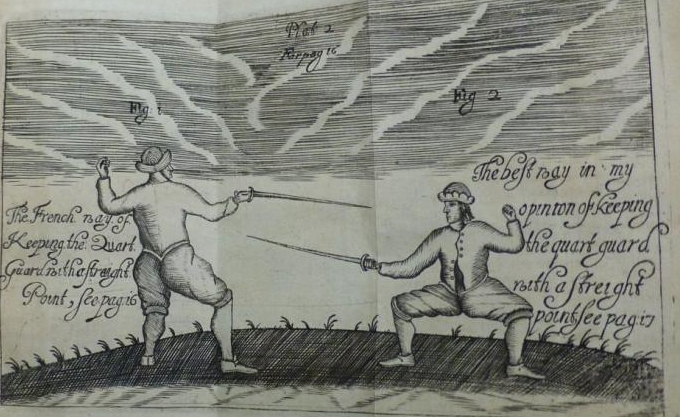
The Compleat Fencing-Master by Sir William Hope, 1692, 1710. Largely a reprint of Hope’s earlier work, the Scots Fencing Master, or Compleat Small-Swordman, 1687. An excellent work, highly recommended. Hope was an astute amateur, and his observations on fencing concepts are valuable to both the historical and modern fencer. Additionally, he has much practical advice for fighting with “sharps.” A favorite.
The Sword-Man’s Vade-Mecum by Sir William Hope, 1691, 1694, 1705. Excellent advice for surviving a fight with “sharps.” That is, practical considerations for dueling and “rancounters” (rencontres) or street fights. Likewise a favorite.
The Fencing-Master’s Advice to His Scholar by Sir William Hope, 1692. Rules and advice, including technique, for “school play”—that is, for sport fencing. Ever wonder where foil conventions and rules come from? In spite of most historical texts noting that conventions originally derived for reasons of safety, it is clear that sport, convenience, and appearance also played a major role, perhaps even the greater one, starting in the late 17th century, if not much earlier. And double likewise, a favorite.
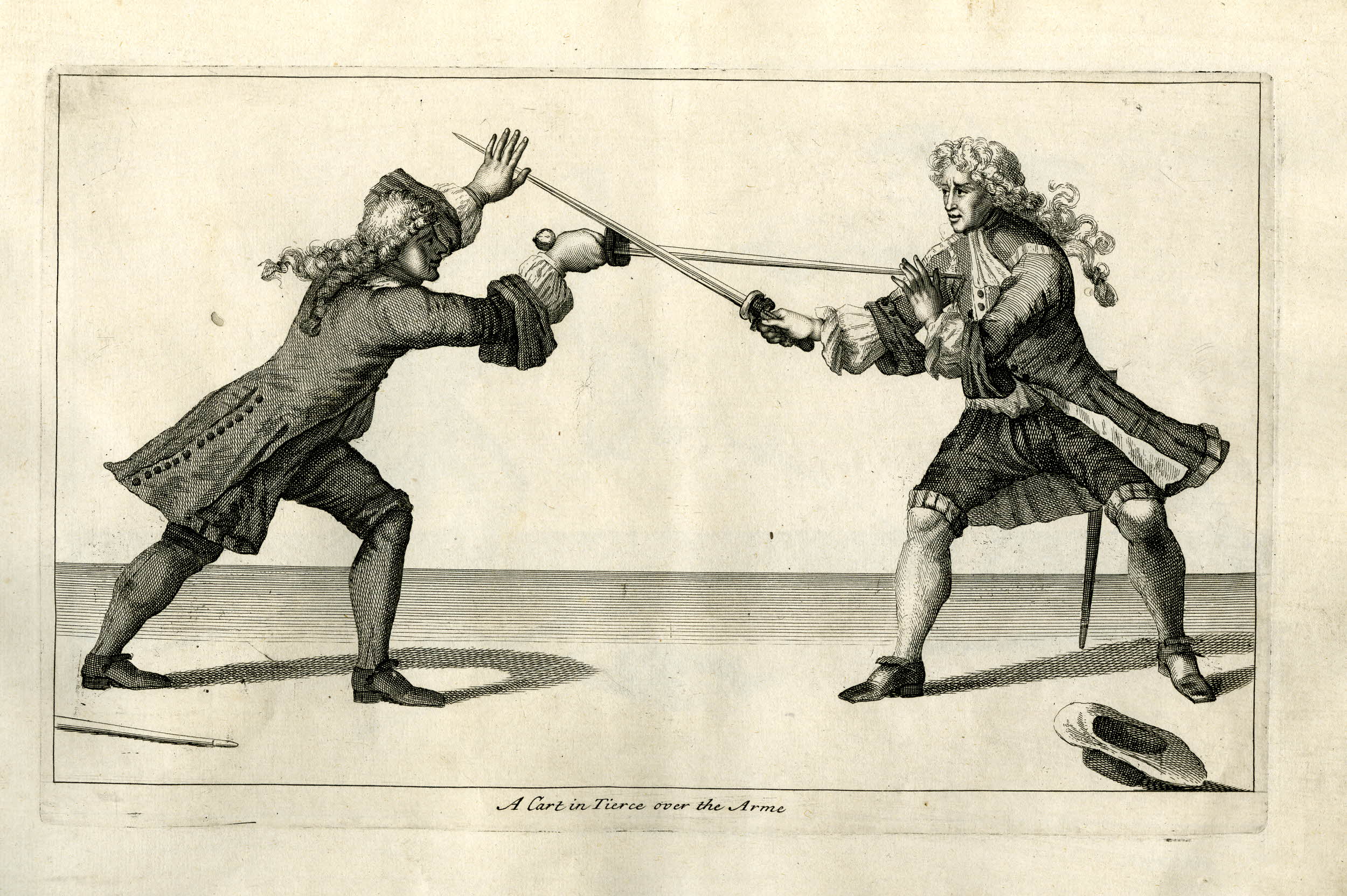
The Art of Fencing Represented in Proper Figures Exhibiting the Several Passes, Encloses, Disarms, &c. by Marcellus Laroon, various editions suggested to date from the 1680s to circa 1700 but almost certainly correctly close to the latter year. Illustrations and single line descriptions only, very useful to the historian not only of fencing but of period dress. (I’ve relied heavily on these images for Fortune’s Whelp, for example.) Figures are in a variety of fencing positions, most with smallswords, some with buttoned foils. Worthy of much study. A number of images are suggestive of, or even imitated from, 17th century rapier and “transitional rapier” illustrations, making it at quite possible, or even probable, that the French school was not yet entirely in full force even in the English smallsword, or that the Dutch immigrant illustrator Laroon, who bore a facial scar from an affray with swords, was showing his Dutch influence. (See Bruchius in the “Rapier & Transitional” Rapier section, for example.) Very much a favorite.
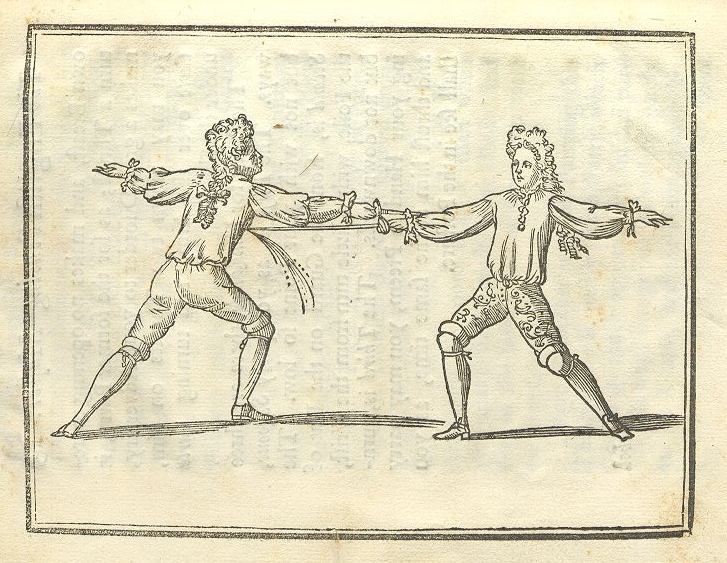
The English Fencing-Master: or, the Compleat Tuterour of the Small Sword by Henry Blackwell, 1702. A short text thereby suggesting that “Compleat Tuterour” is hyperbole, with decent illustrations showing wounds with spurting blood for emphasis. Includes more proof that the modern sixte thrust aka “carte over the arm” was well in use much earlier than some fencing historians suggest. Charming spelling of seconde: “Sagoone.” But the spelling of carte, tierce, and prime are conventional. Blackwell includes a good but brief discussion of flanconnade, one of my favorite thrusts in its several varieties: it secures the adversary’s blade, is perfectly placed for additional opposition with the unarmed hand (were this still legal), and, thrust low, avoids the ribs and their cartilage which might impede the thrust (assuming the adversaries are fencing with “sharps” of course). Blackwell’s recommended en garde is with the arm mostly extended, as is the case with many smallsword texts—it’s simply a safer guard with a real thrusting sword than the common foil guard of the past two centuries. See also Edward Blackwell below!
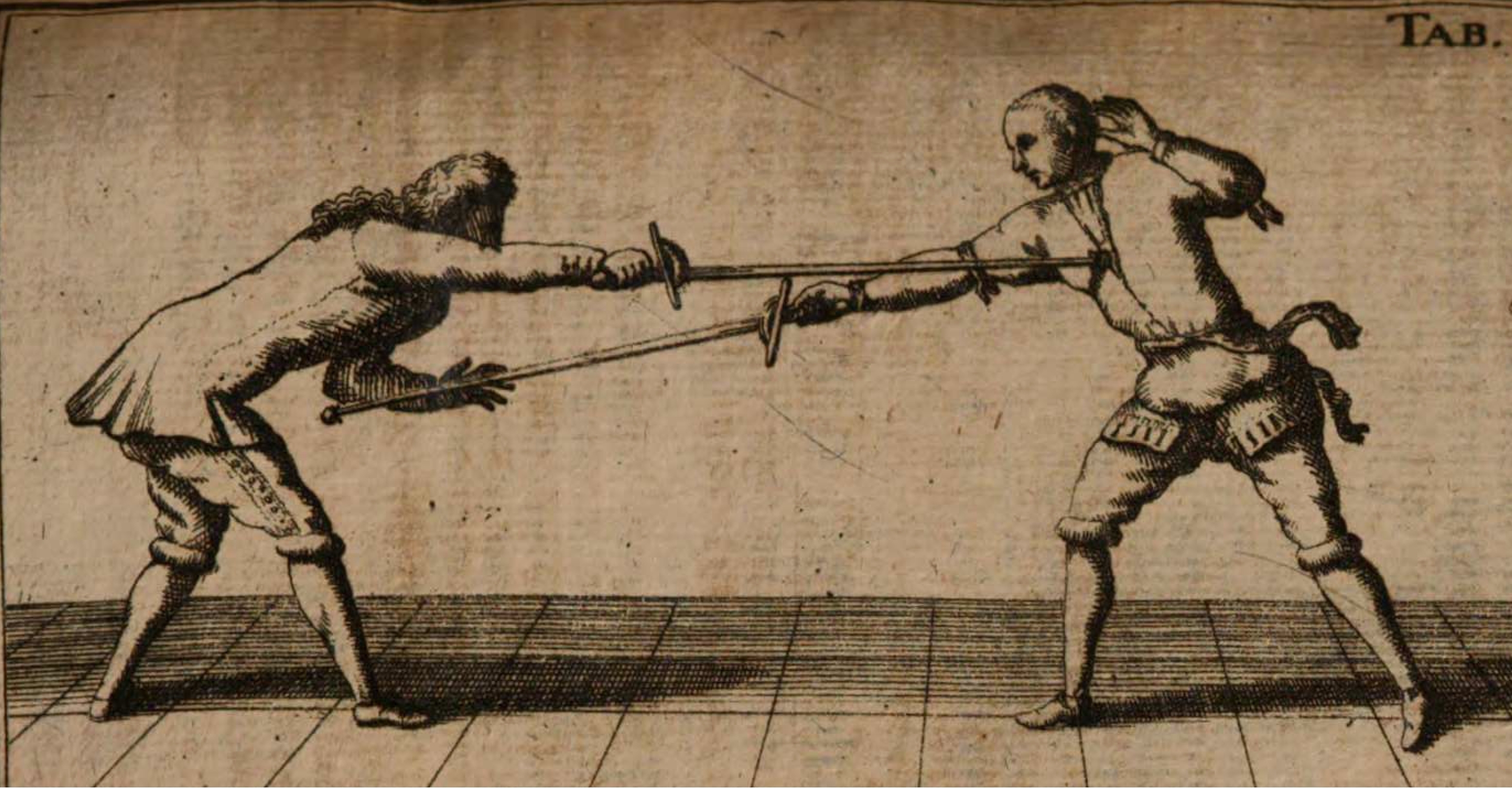
Der Geöffnete Fecht-Boden by B. Schillern, 1706. German text showing the influence of the rapier even with the smallsword into the 18th century. Compare with Doyle’s French-influenced German text below and with Bruchius’s Dutch text in the “Rapier” section above.
Advertisement, Especially to Fencing Masters by Sir William Hope, probably 1707. An advertisement with argument for Hope’s new book detailing his new method of fencing using the hanging guard. Excellent, if brief and not entirely complete, discussion as to why swordplay on the battlefield is different from that of the duel. (He doesn’t provide reasons why cutting weapons, or cut and thrust, are preferred: cuts may not kill but often disable more quickly that thrusts, it is easier to change direction and defend while doing so with a cutting weapon, thrusts may stick in the adversary and thereby be problematic for mounted troops–many have been dismounted by a thrust stuck in an enemy.) Hope is less convincing when it comes to his argument that his method is new, and not merely a restatement of one of the Walloon or German styles.
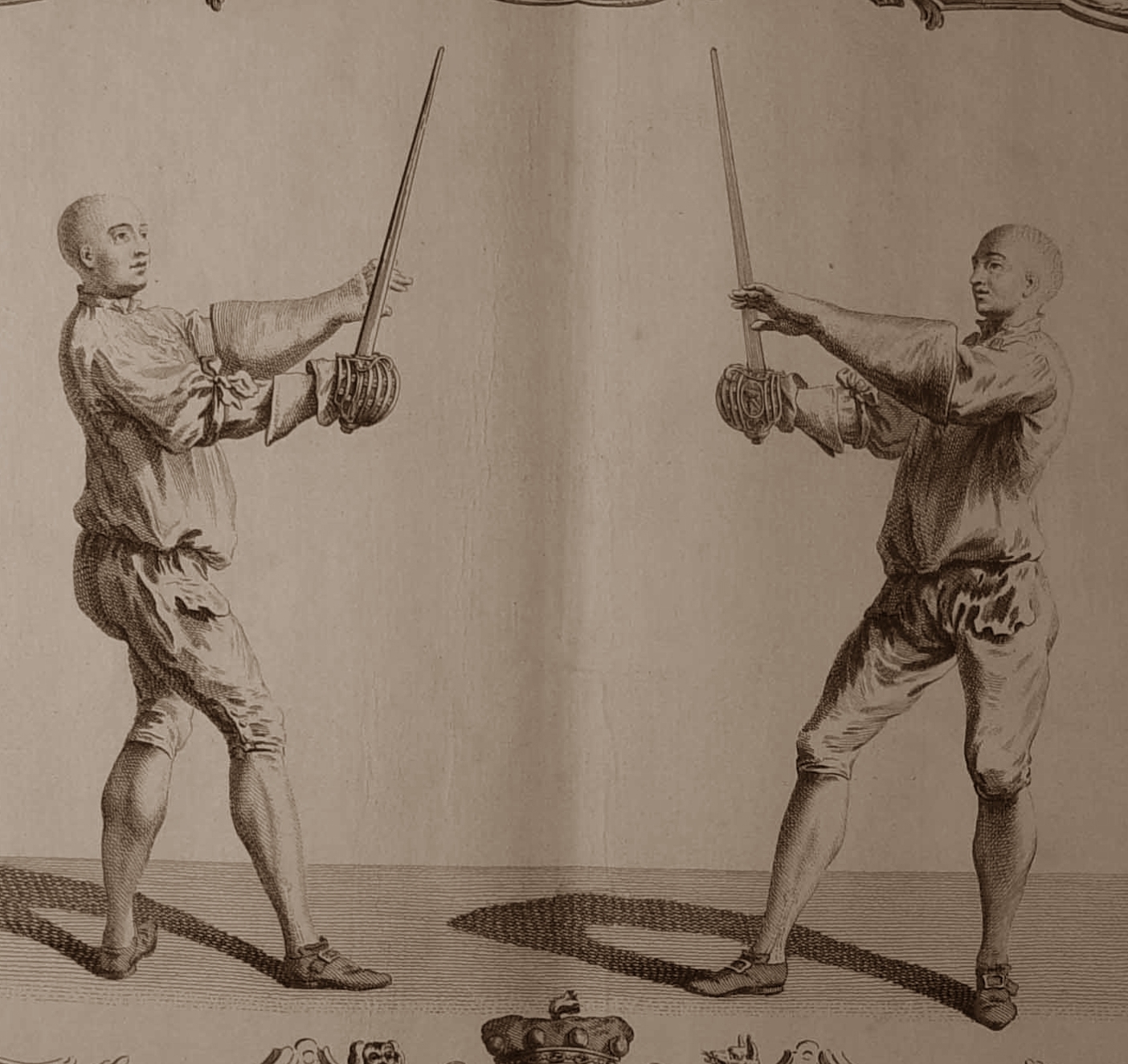
New Method of Fencing by Sir William Hope, 1707, 1714, et al. Hope’s exposition of his conversion to the hanging guard, known by many as the “falloon” (from Walloon) guard, as opposed to the more common guards in quarte and tierce, for the smallsword, sheering sword, and backsword. The book has been reprinted in Highland Swordsmanship, edited by Mark Rector, 2001. Among his excellent advice for swordplay on the battlefield, Hope recommends a stout gauntlet on the unarmed hand for parrying.
The English Master of Defence: or, the Gentleman’s Al-a-Mode Accomplishment by Zackary Wylde, 1711. A difficult read at times, especially for those without a strong base in classical fencing, smallsword, and backsword/broadsword technique, not to mention in English syntax and phrases circa 1700, but the language is colorful, the writer charmingly self-confident, and his descriptions—once deciphered—proof that there is little new in “modern” fencing. Covers smallsword, broadsword, quarterstaff, and wrestling.
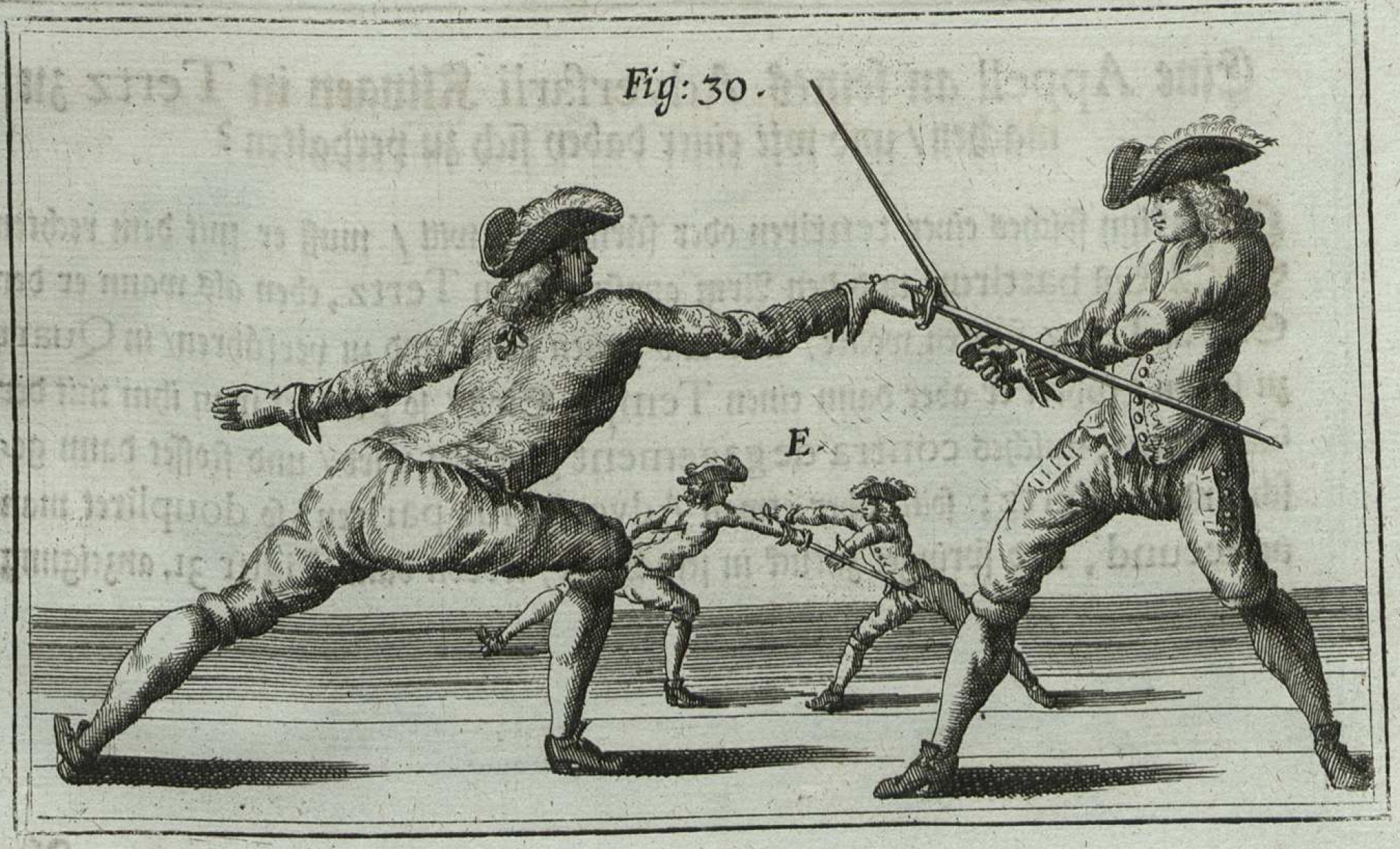
Neu Alamodische Ritterliche Fecht- und Schirm-Kunst by Alexander Doyle, 1715. An Irishman introduces Germans to the French school, with plenty of parries and oppositions with the unarmed hand, plus disarmings, grapplings, and trips/throws to satisfy advocates of the native German schools. Almost as well-illustrated as Girard below, and in some ways I almost prefer Doyle’s illustrations. An excellent reference for the practical-minded swordsman.

Expert Sword-Man’s Companion by Donald McBane, 1728. McBane was a Scottish soldier, swordsman, fencing master, duelist, prize fighter, and collateral pimp whose deeds and escapades began in the late 17th century and continued into the 18th. Highly recommended, almost certainly the best text on practical swordplay for the duel, affray, rencontre, street fight, &c, based as it is on his own extensive experience wetting his blade with the blood of adversaries, and occasionally wetting theirs with his own. Literary connection: in The Princess Bride the author refers to McBane as “McBone.” The book has been reprinted at least three times in recent years: a 2015 edition edited by Keith Farrell in Scotland, a 2017 edition edited by Jared Kirby, and a 2001 edition edited by Mark Rector in Highland Swordsmanship (readers of this last edition may choose to disregard the photographs of McBane’s technique and refer instead to McBane’s descriptions and original illustrations which are unfortunately not reproduced in this edition). Very much my favorite historical fencing text.
A Compleat System of Fencing: or, the Art of Defence, In the Use of the Small-Sword by Edward Blackwell, 1734, in Williamsburg, Virginia. The first fencing text published in North America and the first in English in the Americas as well, sub-titled Wherein The most necessary Parts thereof are plainly laid down; chiefly for Gentlemen, Promoters and Lovers of that SCIENCE in North America. Given the last names plus the similarity of titles and technique, Edward Blackwell is surely related to Henry Blackwell, most likely as father and son. The book includes a good introduction as to why one should fence—Americans, take note! It’s apparently long been a problem promoting swordplay in British-derived North America!—as well as solid descriptions of swordplay, including how to deal with a low guard, in “Master and Scholar” format (Sir Wm. Hope has used this format too).
As with Henry, the book has a good description of the flanconnade, and the likely son has corrected the likely father’s spelling of “Seconde.” Good discussion of time and counter-time, along with a reminder that foilists have long been inclined to impale themselves by attacking into an attack (so have many epeeists, too, but foilists tend to regard double hits as imaginary). Like his likely father, the son prefers a more extended guard, and not the scandalously “crooked Arm” so popular with foilists since the 19th century—but at least most of them extended from beginning to end during their attacks until recently—and also with aggressive “ignorants” of the smallsword era who did not extend during their attacks. Yes, attacks with a bent arm are those of the fencing illiterate, thus one might argue that both modern foil and saber fencers are quite unlettered (and some epeeists are too). See also Henry Blackwell above.
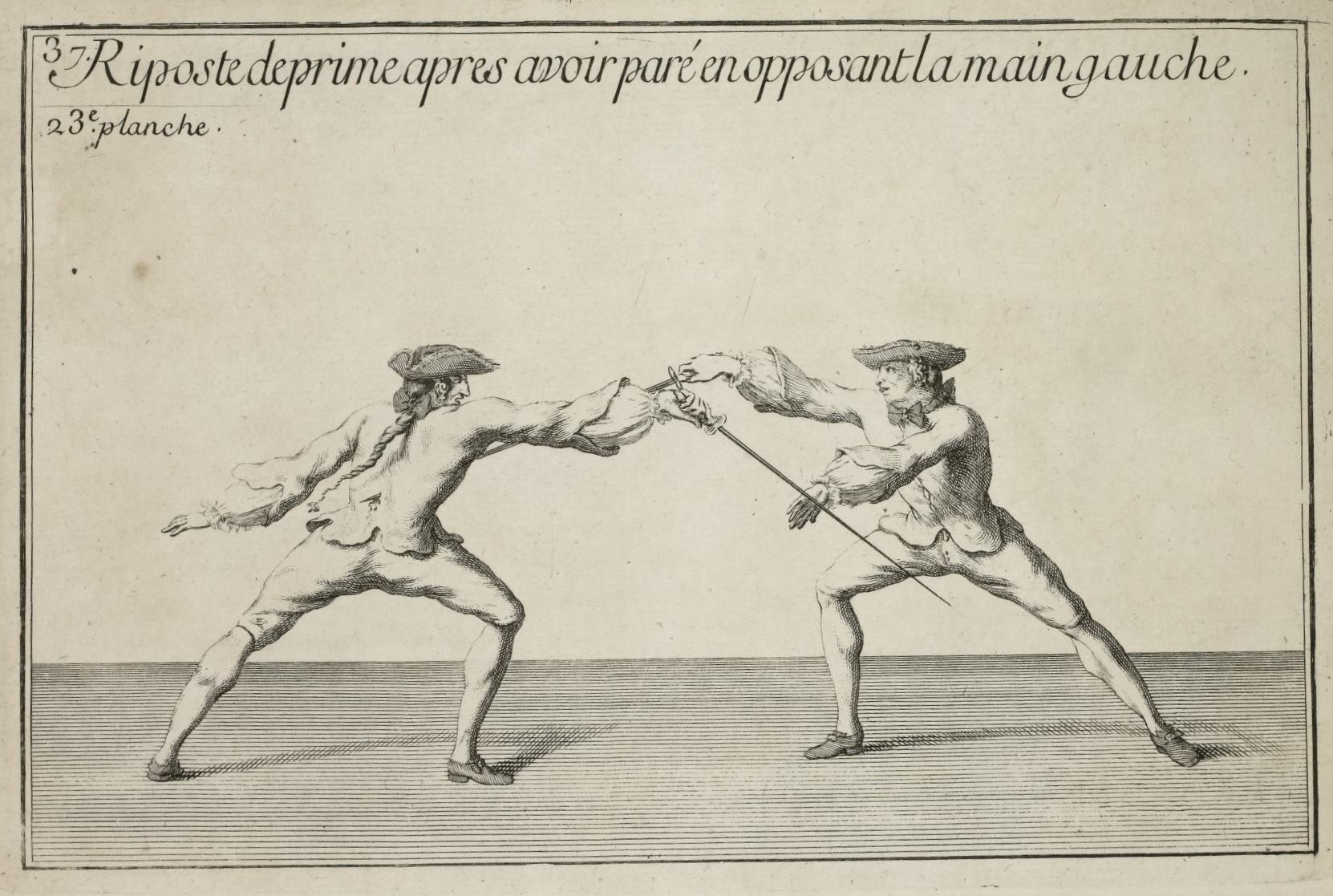
Traité des Armes by P. J. F. Girard, 1737, 1740, et al. Possibly the best book on the smallsword ever written. Not only beautifully illustrated, the book describes smallsword technique in detail, including its use on the battlefield against other weapons. It emphasizes practical swordplay for the duel as well as for the affray or rencontre, even against foreign fencing styles, and for battle. Girard was a naval officer. Highly recommended.
A Treatise Upon the Useful Science of Defence, Connecting the Small and Back-Sword, and Shewing the Affinity Between Them by Capt. John Godfrey, 1747. Practical book on smallsword and backsword, including a very useful analysis of backsword prizefighters, and some notes on boxing as well.
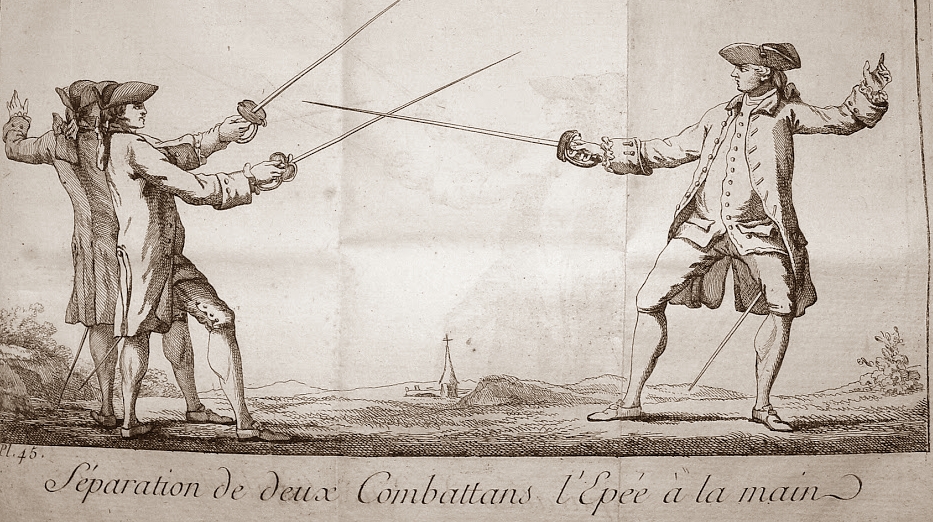
L’Art des Armes by Guillaume Danet, 1766. Excellent work on the smallsword, with practical exposition of the theory and practice, along with useful associated exotica, including how to break up a duel (grasp the shell of one adversary’s sword and direct your point at the other). However, the Internet being what it is—as useful to the lazy in their laziness, fools in their folly, and idiots in their idiocy, as it is to those largely unafflicted with these defects of behavior and intellect—the illustration is unfortunately reproduced on occasion to demonstrate, quite incorrectly, how to fight two adversaries simultaneously.
Among much useful commentary, Danet demonstrates his functional knowledge of fencing history and texts; decries commanding the blade (seizing the adversary’s sword) and disarmaments, but discusses them anyway because the fencer should know how to defend against them; discusses and decries volts and the passata soto (under another name); and wishes that parries with the unarmed hand had never been invented, although he distinguishes between parries with the hand and opposition of the hand, the latter of which he approves.
Danet provides the modern definition of fencing time: the time it takes to perform any single action of hand or foot. On the other hand, his renaming of parries is confusing to modern fencers, and was to his contemporaries as well. La Boëssière père, via his son (see below) was highly critical of Danet in general (not unusual in itself for fencing masters to criticize each other, often pompously), although it is easy to see from both that the “practical” swordplay of the smallsword was in danger of descending into near-complete artificiality, which in the next century it did.
In spite of its many virtues, my fondness for the book is actually based much on Rafael Sabatini’s affection for it, on which he founded much of his description of French swordplay, particularly in Scaramouche. Danet’s style of fencing is very much in keeping with the style of Sabatini’s logical intellect, and therefore of Sabatini’s swashbuckling heroes, although Sabatini, being half Italian, did not shrink from occasional cunning, nor did he object to his swordsmen partaking occasionally from the Italian school. From Danet is the inspiration for Andre-Louis Moreau’s new theory of swordplay, although in reality it would be nullified by an arrest, not to mention difficult to execute even with a cooperative adversary. But don’t let this spoil the excellent novel, which among its many virtues great and small is an evocative description of a fencing lesson that stirs me to this day. And in many ways Sabatini’s theory was correct at its core: the fencer should force his or her adversary into a pre-selected avenue of no escape.
Sabatini also used the historical person of Danet in the short story, “The Open Door” in Turbulent Tales (1946). For more details on Sabatini and Danet, not to mention, and far more importantly, on Sabatini’s works in general, I highly recommend Romantic Prince: Reading Rafael by Ruth Heredia, 2015. I am honored to have assisted Ruth on the subject of swordplay in Sabatini’s works.
The Fencer’s Guide by Andrew Lonnergan, 1771. Practical smallsword-play described with some occasionally uncommon fencing language: the practices of whirling, wrenching, and lurching, for example, which are synonyms for three conventional techniques. A more scholarly and readable update on Wylde is one way of looking at the book. Lonnergan also includes a very useful discussion of the backsword and spadroon, as well as some very practical advice for and against the cavalry, dragoons, and Hussars or light horse—whether the adversary wears breastplate and helmet determines to a great degree the swordplay used. He has brief useful advice for the fencer armed with a walking stick (it must be wielded a bit differently, having no edge or point), and sees no reason that an athletic fencer cannot use the various volts, night thrust (passata soto), grapplings, &c, which by now many masters had lost favor with. However, see Danet above.
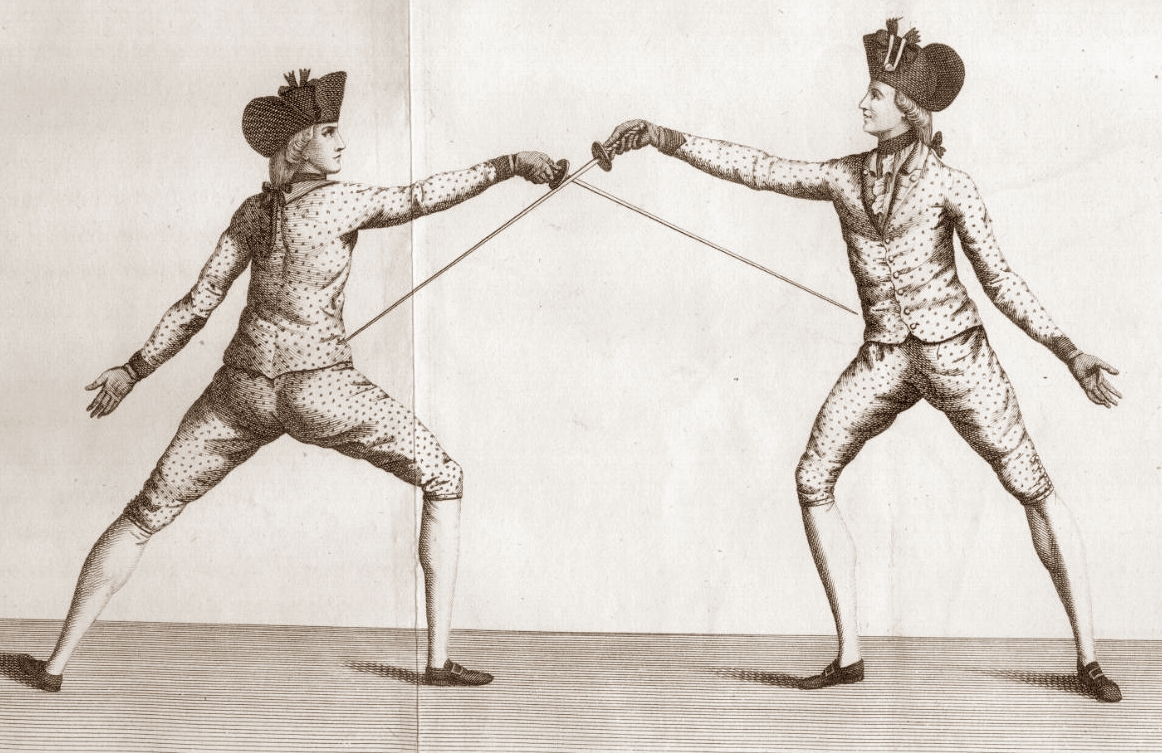
The Army and Navy Gentleman’s Companion; or a New and Complete Treatise on the Theory and Practice of Fencing by John McArthur, 1784. Solid exposition of the smallsword, with conventional language—McArthur doesn’t use Lonnergan’s romantically descriptive flourishes when naming some techniques. Again, here is yet another book proving that there is really nothing new in modern fencing. As with many fencing books, it includes some useful and some not so useful tidbits, for example, the deflecting of a pistol with a smallsword, something I suggest should not have been tried except in extremis and was probably most successful when used with a strong cutting sword—a broadsword, backsword, saber, or cutlass—that, rather than deflect the pistol, severed some of the fingers or the hand holding it instead. Very much worth reading, as for that matter are all the smallsword texts listed here, in order to expand one’s perspective on the theory and practice of Western thrusting swords.
The School of Fencing by Domenico Angelo, 1787. Several modern reprints available. The height of the 18th century French school, though by now the smallsword was mostly an accoutrement of dress, occasional dueling arm, and for some military officers, a badge of office. Fencing for the gentleman. The book is not my favorite, even though it was also published under “Escrime” in Diderot’s famous encyclopedia. Perhaps it’s the illustrations: I cannot image any serious swordsman or swordswoman posing so delicately. For the latter part of the 18th century I much prefer Danet, Lonnergan especially, and even McArthur (whose illustrations are likewise a bit too delicate to represent the soldier and fighting seaman in my opinion).
The Amateur of Fencing by Joseph Roland, 1809. Highly recommended for all fencers. Although the technical material is quite useful to the smallsword fencer and worth reading by the modern fencer. In particular, Roland, first quoting McArthur above, recommended the study of fencing to navy men, for “they are more frequently at close quarters with the enemy than the military are.” But the book’s real value lies in his philosophy of teaching fencing and learning to fence. Specifically, he attempts to go beyond the mere mechanical practices of teaching fencing and of fencing itself, practices still far too common even today. In fact, such mechanical description is the entire content, or nearly so, of most books on fencing, then and now. Roland wished to go beyond this and develop a sense of tempo, tactics, awareness, and independence in the student.
Most valuable are several of his admonitions, for example, “[T]he pupil, who I wish at all times to make use, but not too hastily, and without partiality, of his own judgement, and not upon every occasion to take for certain evidence any proposition upon the authority alone of a master, merely because he is a master, or that the same may be found in print.” Although there are masters who have embraced this philosophy today (including mine), the majority do not appear to have done so and remain instead “mechanical.” Of these, too many reign at the center of a cult of personality, with the result that their students are anything but independent on the piste or, unfortunately, in life.
Traité de l’Art des Armes by La Boëssière fils, 1818. An explication by the son of the school of the father (a contemporary of Angelo and Danet, among others). Highly recommended, especially for the student of the smallsword or of fencing history and theory in general. A superb text, with useful observations (practiced too little today, both in the making and the study of) for teaching students, including the young, the old, and women too, along with practical tidbits, for example an early discussion of the use of the fencing mask (masque de fil-fer, that is, iron wire), instructions on how to mount and button a fleuret d’assaut, and a criticism of the quality of the “new” foil blades, something common throughout the history of fencing it seems: I’m old enough, for example, to have used the superbly-balanced, light, long-lasting non-maraging Prieur foil and epee blades forged in the 1970s (there were no maraging blades back then).
Traité de l’ Art de faire des Armes by Louis-Justin Lafaugère, 1820. Perhaps, along with the only secondarily-described method of Jean-Louis (see below), the last of the great treatises of the smallsword. After this date, and until the development of the épée de combat, we find with few exceptions mostly foil fencing in the form of what was once known as “school play”—sport fencing, or worse, le jeu de salon, in a form unsuitable for combat with sharps. Lafaugère, a redoubtable fencer and swordsman (there is a difference), wrote in detail of the many variations of feints and their many combinations, making the book, to some, overly complex. The only modern text comparable in similar complexity is Imre Vass’s grand epee book (see the “Modern Epee” section above) in which he details feint attacks in similar fashion.
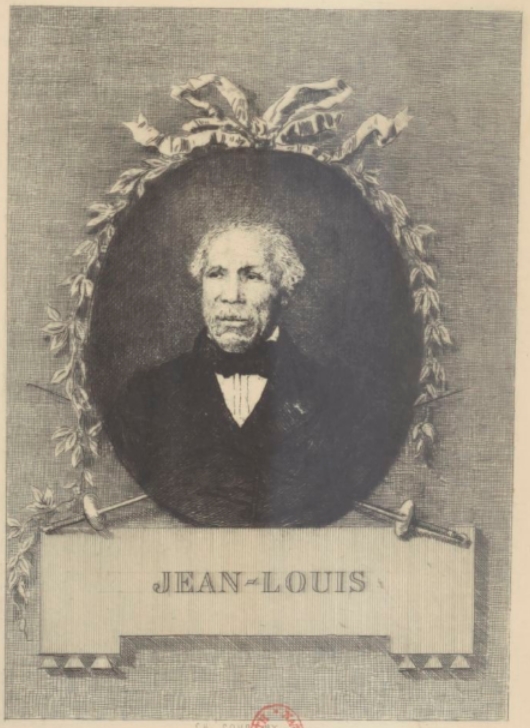
Un Maître d’armes Sous la Restauration : Petit Essai Historique by Arsène Vigeant, 1883. Strictly speaking, a biography of one history’s most swashbuckling and talented swordsmen and fencing masters, Jean-Louis. Like Alexandre Dumas who gave us some of the greatest swashbuckling and historical novels ever written, Jean-Louis was of mixed black and white French Caribbean descent. The book is listed here because Vigeant includes a detailed description of Jean-Louis’s teaching method, along with many of his drills, quite modern and still useful today. In any case, Jean-Louis’s story alone is a magnificent read. His daughter, if I recall correctly, was a quite talented fencer, too. For those of you who don’t read French, Michel Alaux includes a detailed biography of Jean-Louis (see the “Combined Modern” section above). Jean-Louis’s salle survived into the 20th century, and Alaux was its master for some years.
Backsword, Broadsword, Saber, &c.
Paradoxes of Defence by George Silver, 1599, reprint 1968 et al. A vigorous defense of English cut-and-thrust swordplay for dueling or battle, and excoriation of the rapier and rapier play. Contains perhaps the best description ever put to paper of the virtues of fencing, as well as the best examination for qualification as a fencing master or expert. Yes, if you want to be an expert swordsman or swordswoman, you must be able to routinely defeat unskilled fencers and not be thrown by their irregular technique and tactics! If you can’t, you’re merely a common fencer best suited to engaging others of your ilk. The fencing may not be pretty when you engage the unskilled, the hack, the ferrailleur, or the extremely unconventional, but you must be able to defeat any inferior fencer, not just those with conventional technique and tactics. Further, you must be able to hold your own against your equals, no matter their style, and force superior fencers to work hard for their victories—and occasionally, defeat them by doing so.
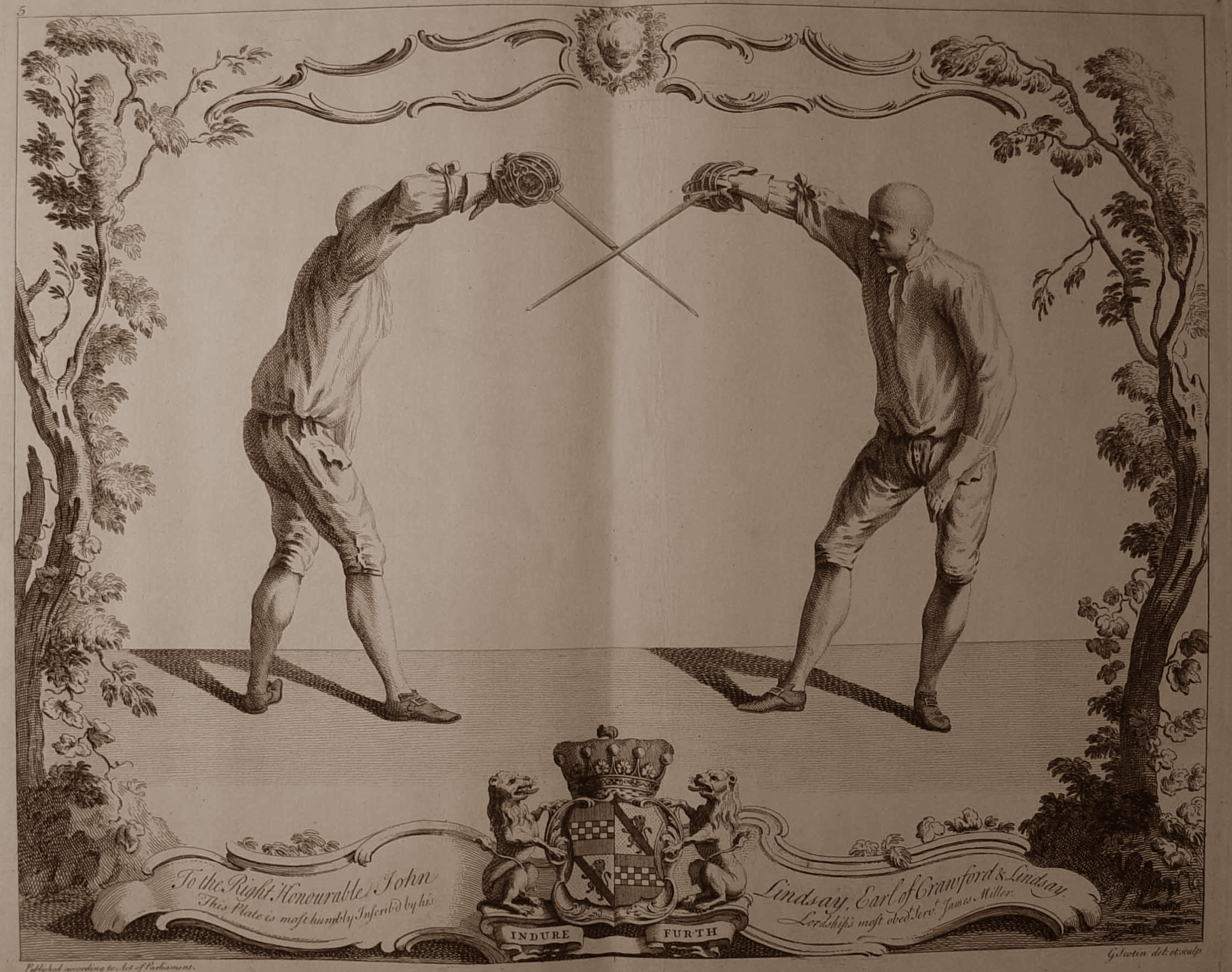
A Treatise on Backsword, Sword, Buckler, Sword and Dagger, Sword and Great Gauntlet, Falchon, [&] Quarterstaff by Capt. James Miller, 1738. Plates with a column of descriptive notes on the front page. Half a dozen or more of the fifteen plates apply to the basket-hilt backsword, and two to the falchion, and therefore to the cutlass. Excellent illustrations of positions poorly illustrated or described in other cutting sword texts of the period. Sir Wm. Hope was a fan of the “great gauntlet,” particularly on the battlefield. Miller was a soldier, later a stage gladiator.
The Use of the Broad Sword by Thomas Page. Norwich, England: M. Chase, 1746. 18th century broadsword technique, including that of the Scottish Highlanders, applicable also to the backsword and cutlass.
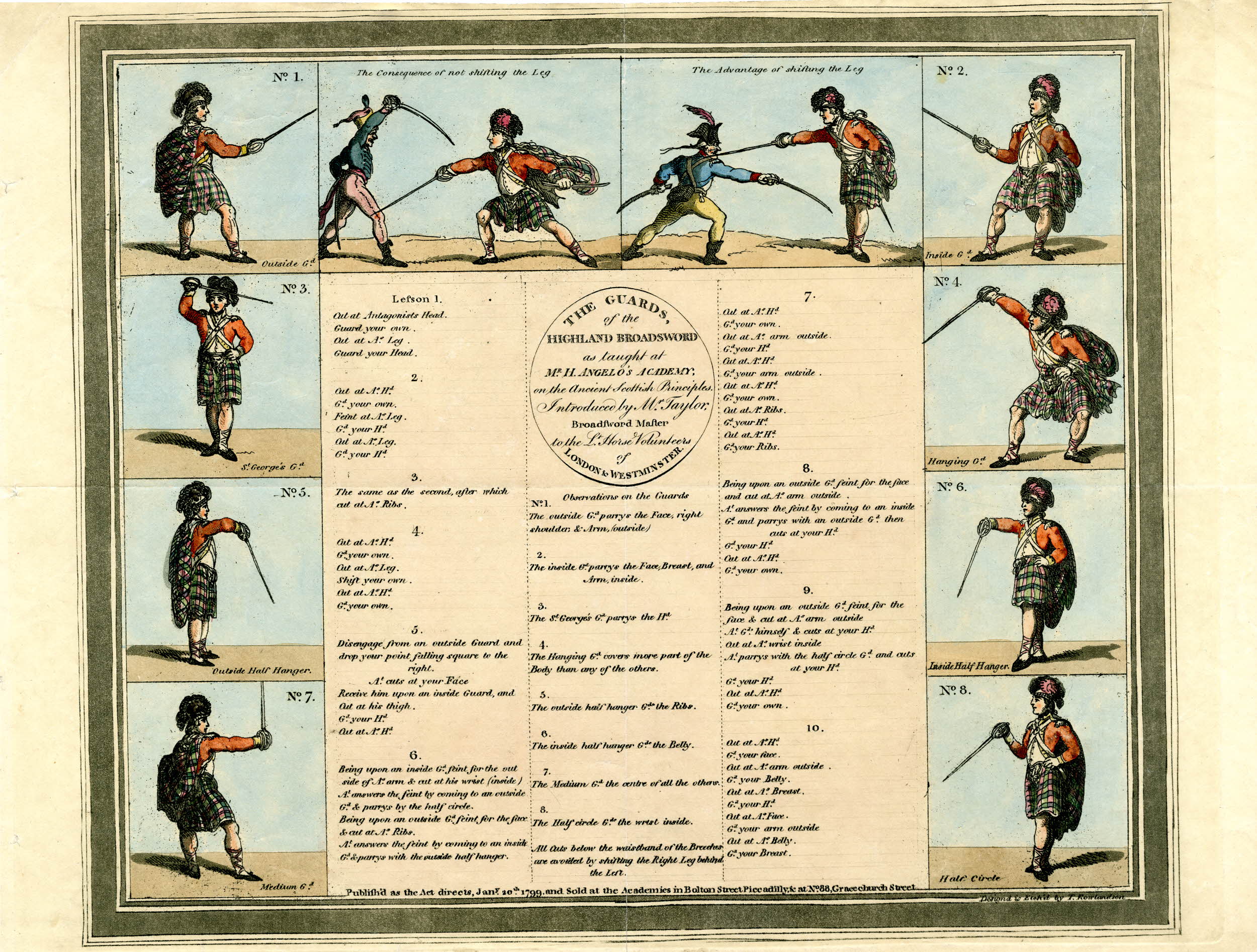
Highland Broadsword, edited by Paul Wagner and Mark Rector, 2004 (1790 – 1805). Five late 18th and early 19th century broadsword manuals (Anti-Pugilism by “a Highland Officer,” 1790; MacGregor’s Lecture on the Art of Defence, 1791; On the Use of the Broadsword by Henry Angelo, 1817; The Art of Defence on Foot with the Broad Sword and Saber, by R. K. Porter, 1804; and Fencing Familiarized, by Thomas Mathewson, 1805). Practical cut-and-thrust swordplay.
The Broad Swordsman’s Pocket Companion, “Designed by Capt. Wroughton,” ca. 1830. One of the last real English broadsword manuals of the era of Empire—actually, a book of plates only—before cut and thrust began to be absorbed by the rise in popularity of saber, not that there was actually much difference. Short, well-illustrated with colored prints of military fencers wearing fencing masks and armed with singlesticks. The book is exactly what it says.
The Art of the Dueling Sabre by Settimo del Frate explaining Guiseppe Radaelli’s saber method, translated and explained by Christopher Holzman, 2011. Del Frate’s original works were published in 1868 and 1872. Indispensable, along with the Wright/Masiello/Ciullini work below, for understanding Radaelli’s method of saber. It changed Italian saber fencing forever, and is the root of the Hungarian school.
Lessons in Sabre, Singlestick, Sabre & Bayonet, and Sword Feats; or, How to Use a Cut-And-Thrust Sword by J. M. Waite, 1880. Superb text on practical swordplay, highly recommended.
The Broadsword: as Taught by the Celebrated Italian Masters, Signors Masiello and Ciullini, of Florence, by Francis Vere Wright, Ferdinando Masiello, and [first name unknown] Ciullini, 1889. An English text on the Italian school of the light or dueling saber established by Guiseppe Radaelli in the 1870s. Maestro Masiello was a student of Radaelli; Ciullini probably was as well. Soon this Radaellian school would be transformed by Italo Santelli (a student of Carlo Pessina, who was a student of both Radaelli and Masaniello Parise) and László Borsody into the Hungarian saber school that would lead to Hungary’s half century reign in international sport saber competition. For those interested in the debunking of fencing myths, the book clearly states why the modern saber target is restricted to the area above the waist (and no, it has nothing to do with sabers once having been used on horseback): it was considered “unchivalrous” to hit below the belt. That is, the Italians wanted to keep their manhood undivided.
Cold Steel by Alfred Hutton, 1889, modern reprints available. Practical swordplay for the light saber (sorry, Star Wars fans, it’s not what you think) or even backsword, and also the “great sword” and stick. Highly recommended.
Broadsword and Singlestick by R. C. Allanson-Winn, 1890, reprints 2006, 2009. Excellent work on practical cut-and-thrust swordplay, most highly recommended. Quite English in its pragmatism.
See also Wylde, McBane, Godfrey, and Lonnergan in the Smallsword section above.
Cutlass
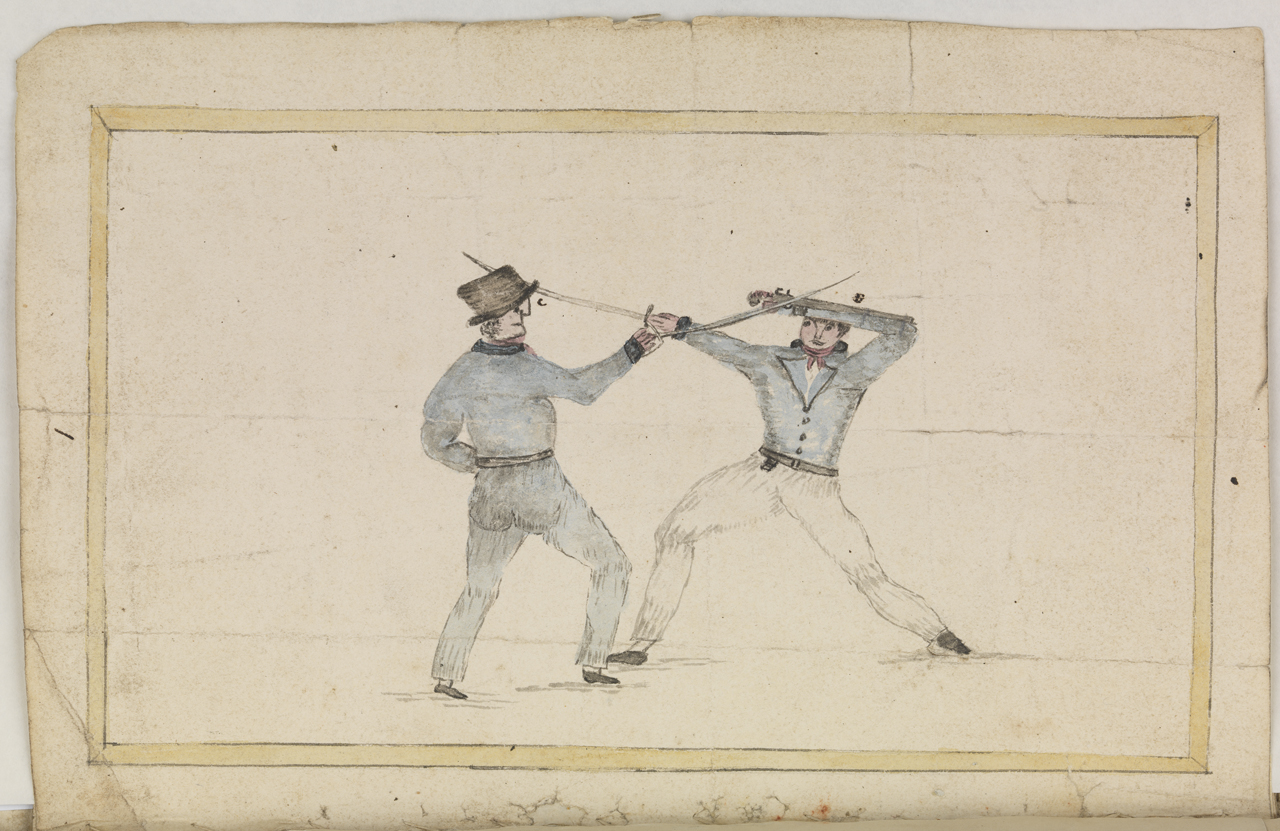
In spite of the popular—and correct—association of the cutlass with piracy, privateering, and naval boarding actions of the 17th through early 19th centuries, there are for all practical purposes no cutlass texts prior to the late 18th. Even Roland (see the Smallsword section above), who recommended fencing in particular for naval officers and crews because they had the most need of it given the prevalence of boarding actions, and Girard and McArthur who were naval officers, do not really describe it—Girard not at all, McArthur only briefly by identifying its guards and cuts as those of broadsword, and Roland largely by quoting McArthur.
Cutlass play, at least as described in cutlass manuals, of the later era was based almost entirely on the broadsword and saber technique of the time. However, given the cutlass’s useful abilities at close distances (those of riposte and of grappling), there were doubtless techniques used in earlier periods but not noted later, for example grazing parry-ripostes made in a near-single tempo, short powerful cleaving cuts, plus a variety of techniques suitable when grappling, not the least of which would have been pummeling. F. C. Grove in the introduction to Fencing (London: Longmans, Green, and Co., 1893) wrote: “One of us once saw a sailor of extraordinary strength seize a cutlass close to the hilt, where the edge is blunt, and break it short off.” Quite unconventional even by 17th century standards, yet for the seaman armed with a cutlass in action, not at all surprising. Marcelli (see the “Rapier” section above) notes something I’ve not seen elsewhere but becomes quite obvious when practicing cuts with a cutlass: the weapon is capable of fatal strokes at grappling distance.
Besides the study of backsword, broadsword, and saber texts, I recommend those of the dusack as well. Practice with a knowledgeable partner is also required, as is cutting practice in order to get a good feel for the weapon. The very few texts below are merely representative of saber technique of the later period: it is by no means a complete list. I have described late 17th century cutlass technique, or at least what we know of it, in The Sea Rover’s Practice, The Buccaneer’s Realm, and The Golden Age of Piracy, especially in the last book. Additionally, those interested may want to review my blog post, Buccaneer Cutlasses: What We Know, as it includes some information on technique. Marcelli and Girard have some discussion of opposing a saber against a rapier or smallsword, and Marcelli also vice versa, much of which is applicable to the cutlass. Likewise Captain Miller in the “Backsword” section has two plates showing falchion or hanger guards (inside and outside) applicable to the cutlass.
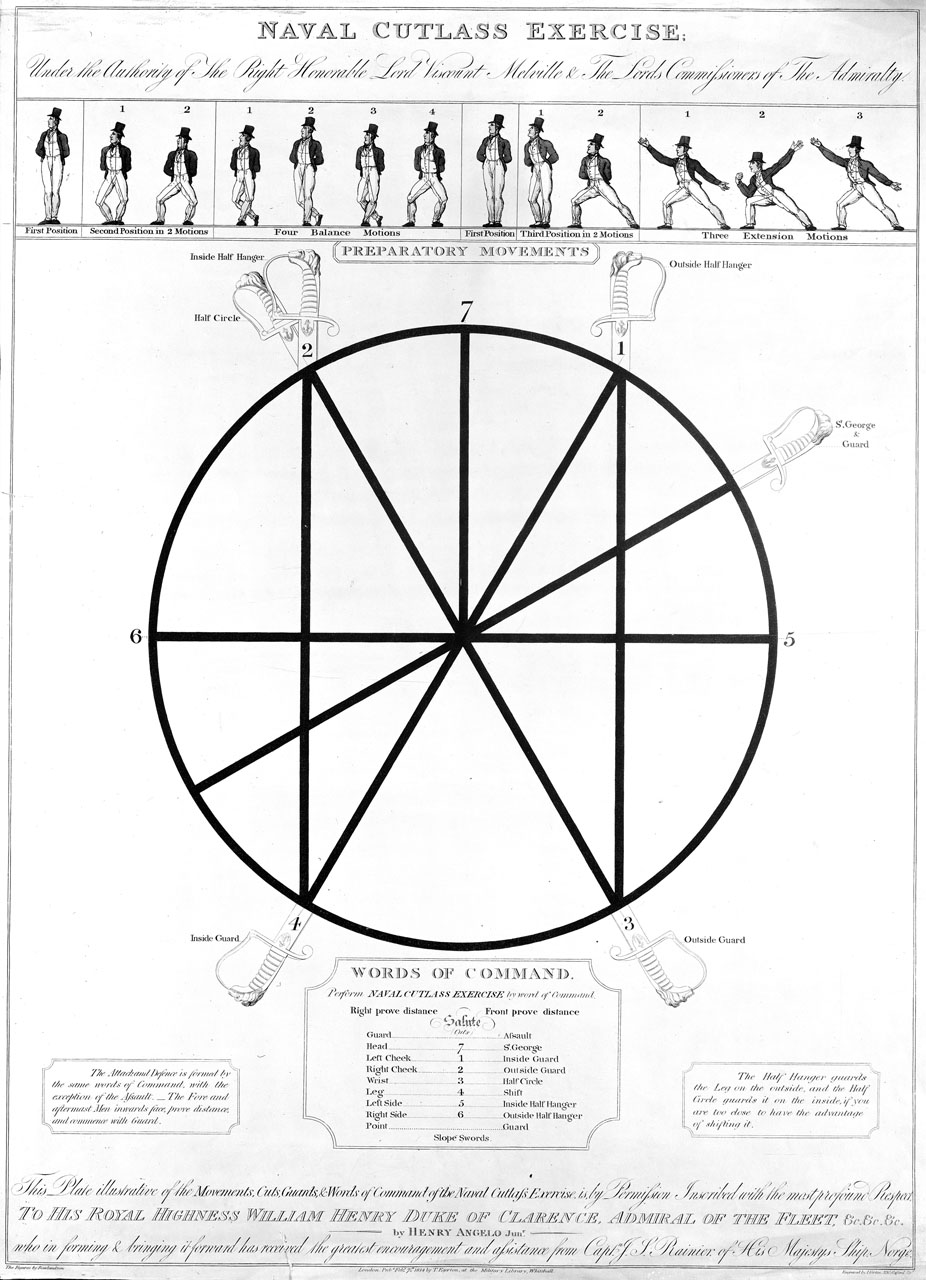
Naval Cutlass Exercise by Henry Angelo, 1813. A detailed illustration of footwork, cuts, and “words of command.” Based entirely on the broadsword, it might as well be broadsword, so why bother—except that Angelo was paid for it by the Royal Navy. In his defense, McArthur (see the “Smallsword” section above) agrees that cutlass and hanger guards and cuts are the same as those of the broadsword. Nonetheless, there are techniques one can use with a cutlass at the distance of “handy-grips” that cannot be used with a broadsword or other longer cutting sword.
Naval Cutlass Exercise “For the Use of Her Majesty’s Ships,” 1859. Includes a good general illustration of cuts and guards, as well as well-regulated military-style (naturally) drills for cuts, guards (equivalent to parries), and points (thrusts, that is). The brief “Concluding Observations” include a vital one for combat: “…but he must ever be “on guard” to meet the impromtu [sic] hit of such as cannot help returning [riposting], whether hit or not.”
The Ship and Gun Drills of the U. S. Navy, by the Naval Department, Division of Militia Affairs, 1914. Seaman’s manual with brief instruction on the USN “Sword Exercise.” The attacks and parries are simple and functional, and the illustrations useful.
British Naval Swords and Swordsmanship by John McGrath & Mark Burton, 2013. Includes a couple of good chapters on British naval swordsmanship, but as can be expected given the source material, the discussion is by and large of the late 18th century and afterward. Includes a description of British naval fencers as well. Required background reading for the student of cutlass swordplay and required technical reading for the collector of British naval swords.
Stage Swordplay / Theatrical Fencing / Stage Combat & Choreography
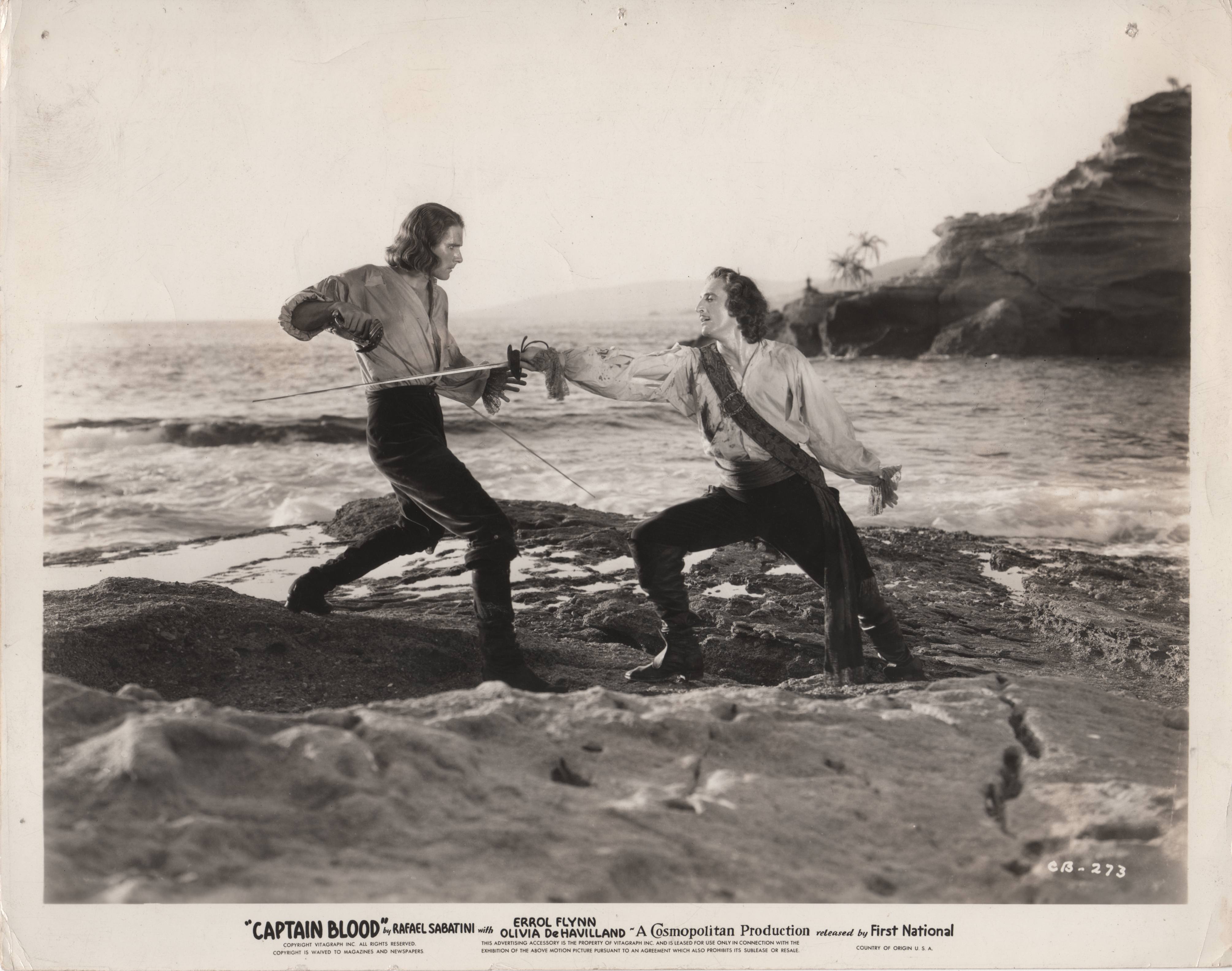
At some point many fencing teachers will be approached to choreograph swordplay, most often for a local production. The task must no be approached lightly. The choreographer’s job is prepare a swordplay script to be executed: the choreographer’s duty is to prepare actors to safely execute the script. In general, actors should be used for staged swordplay, not fencers unless they are both skilled and have classical training. Stage swordplay is intended to convey the illustion of combat; fencers are trained to hit and may forget this even when choreographed. Further, the tempo is much different between stage swordplay and fencing for sport or actual combat: a predictable tempo is required for safety in the former, but broken tempo for the latter. Broken tempo in a choreographed swordfight can lead to injury. In particular, the eyes are at great risk. Again, fencing teachers should not undertake stage fencing choreography lightly.
Sword and Masque by Julius Palffy-Alpar, 1967. By a Hungarian fencing master, the book is largely a beginning fencing book with a smaller section devoted to stage fighting. Although it does briefly cover period swords and provides samples of choreography for famous stage fight scenes, it offers little to the fencing teacher regarding training and safe techniques. Far more useful is the book by William Hobbs.
Stage Combat: “the action to the word” by William Hobbs, 1980. By a stage and film swordfight choreographer who ranks with Henri Uyttenhove, Fred Cavens, Ralph Faulkner, Jean Heremans, and Bob Anderson and whose credits include the 1973/74 The Three Musketeers and The Four Musketeers (the best musketeer films by far, in my opinion), The Duellists (the most historically accurate swordplay, ever), and numerous stage fights produced among others by Laurence Olivier and played among others by Peter O’Toole, Albert Finney, and many others. Hobbs covers the history of stage fighting, orchestration, the use of dramatic surprise, safety and rehearsals, safe sword technique, historical accuracy, fight notation, and more. Hobbs is adamant about using actors — modern fencers and fencing does not look historical. (Here I understand but disagree in part — if skilled and classically trained in their first lessons, rare today but fairly common when I first learned to fence almost fifty years ago, modern fencers can portray historically accurate stage swordplay, with one caveat: most cannot act. Better, though is the use of fencing masters and experienced fencing teachers, for they have the necessary control, thus the routine long shot doubling by Fred Cavens et al in the films of the 20s, 30s, and 40s.) Laurence Olivier’s foreward is worth the read as well. Highly recommended. Note that Hobbs’s numbering of parries is his own, designed for actors to learn: it will be confusing to anyone who learned to fence in the past four hundred years.
Additional information on stage swordplay, particularly on the subjects of tempo and of choreography associated with Fred Cavens, can be found here and here.
Bibliography
La Bibliographie de l’Escrime Ancienne et Moderne by Arsène Vigeant, 1882. Not as complete as the bibliography below, but highly useful nonetheless. M. Vigeant had a thorough understanding of both swordplay itself and its history.
A Complete Bibliography of Fencing & Duelling by Carl A. Thimm, 1896. A very useful, largely complete bibliography through the late 19th century. Reprints from 1968 and 1999 are available, though often pricey. Look instead for the free pdf on Google books unless you find that fortune generally favors you or you have plenty of money to spend, the latter, of course, being one way or another proof that fortune has favored you at least once.
The History of Fencing & Swordplay
Schools and Masters of Fence by Egerton Castle, 1885, reprints 1968, 2003. European fencing to the late 19th century. Highly recommended.
Old Sword Play by Alfred Hutton, 1892, reprint 2001. A brief description of European fencing technique over the ages by a noted English fencing master.
The Sword and the Centuries by Alfred Hutton, 1901, reprint 1995. A history of European fencing and swords. A classic.
IIIe Congrès International d’Escrime, Brussels, 1905. For those interested in the arguments and squabbles that created modern sport fencing rules—and how sport interests came to dominate in epee competition, rather than having epee competition emulate dueling or the jeu de terrain as closely as possible.
The English Master of Arms: From the Twelfth to the Twentieth Century by J. D. Aylward, 1956. Excellent work covering not only English fencing masters, but necessarily the development of fencing in the British Isles as well. One of my favorites. Aylward’s book on the smallsword in England is also highly recommended for anyone with an interest in smallswords or late seventeenth and eighteenth century fencing or dueling.
Swordsmen of the Screen: From Douglas Fairbanks to Michael York by Jeffrey Richards, 1977. The history of swordsmen and swordswomen in film to 1977. Swashbuckling actors and the fencing masters who doubled for them. Worth the read if you’re into film swashbucklers.
Martini A-Z of Fencing by E.D. Morton, 1988. Not a book on fencing history per se, but a compendium that includes much fencing history, as well as fencing terms, concepts, and trivia. One of Mr. Morton’s entries is Rafael Sabatini. I disagree with most of Mr. Morton’s criticisms of Sabatini, including his claim that much of what he wrote about ships &c is in error. Sabatini did make errors, but they’re not nearly so egregious as Mr. Morton claims, with the exception of presenting a ship’s stern to cannon-fire in order to minimize damage (in fact, this would, as Mr. Morton notes, be more dangerous). Vanity aside, I hesitate to note that I am in fact an expert in this area, and can easily point out where Mr. Morton is incorrect. Notwithstanding that the majority of Mr. Morton’s entries are valid, readers must take the Sabatini entry with a grain of salt.
En garde: Du duel à l’escrime by Pierre Lacaze, 1991. Well-illustrated popular history of mostly French fencing and swordplay.
The History of Fencing by William M. Gaugler, 1998. A detailed history and analysis of the Italian schools into the first half of the 20th century, with a fair, if quite limited, discussion of French schools. The modern schools, including the revolutionary Hungarian (or Hungarian-Italian) saber school, are unfortunately and inexplicably not described. Gaugler’s book has detailed description of the technique presented in a number of books listed in this post, along with fencing-related biographical details of many of the authors.
Escrime by Gerard Six, photography by Vincent Lyky, 1998. “Coffee table” fencing book covering everything from history to technique, albeit briefly, and mostly French. Well-photographed.
The Secret History of the Sword by Christoph Amberger, 1999. By a veteran of the Mensur, also known as fighting for scars—which is by most definitions the purpose of macho male one-ups-man-ship. Most of us, just like Tom Sawyer, are proud of our scars. Highly recommended—the book that is, but we can include scars as well, as proof of a life well-lived and of a fortunate one also, in that we’re still alive to show off our scars.
Croiser le Fer: Violence et Culture de L’épée dans la France Modern (XVIe-XVIIIe Siècle) by Pascal Brioist, Hervé Drévillon, and Pierre Serna, 2002. Excellent scholarly study of swordplay and dueling in France from the 16th to 18th centuries. Highly recommended.
By the Sword by Richard Cohen, 2002. A history of fencing, including the modern schools, by a British Olympic fencer. Arguably the only thorough modern history of fencing. Highly recommended; my favorite book by far on the history of fencing.
Reclaiming the Blade by Galatia Films, DVD, 2009. A mostly well-intentioned attempt to “reclaim” authentic Western swordplay and historical fencing, but unfortunately marred by the heavy-handed, ideological manner in which it attacks sport fencing and some other forms of swordplay, not to mention by its egregious overuse of Hollywood references and interviews—Hollywood depictions of swordplay are usually divorced entirely from reality, thereby undercutting the argument. At its best, the documentary extols Western swordplay. At its worst, it further divides rather than unites the several major fencing communities.
To pick a bone with—or perhaps cross swords with?—the film’s makers, although many modern competitive fencers often do not practice the ideal of “hitting and not getting hit,” there are plenty, epeeists especially, or at least veteran epeeists, who do understand the concept well, can execute it exceptionally well when necessary, and are happy to argue the point, weapon in hand, with any fencer of any sort. In fact, some of us trained entirely under masters who fenced when dueling was still practiced and the saber was still a military arm—and who understood that it was entirely acceptable to practice both forms of swordplay, that is, sport or recreational, and practical training for combat with real weapons. To promote the so-called reality of historical and classical fencing is double-edged and often cuts hypocritically: excessive “contre-temps” or double-touches have been the bane of fencing for centuries, and modern “historical” and “classical” fencers are no more immune to them than were the fencers of the past whom they seek to emulate.
As for those who would compare “classical fencing” poses with photographs of modern fencers in action in order to prove the “sloppiness” of modern fencing: I can show them the same awkward action shots in their “classical fencing.” All it takes is a camera and an unposed subject.
Japanese Texts
Tengu Geijutsuron (The Demon’s Sermon on the Martial Arts) by Issai Chozanshi [Niwa Jurozaemon Tadaaki], translated by William Scott Wilson, 2006. Includes the famous story illustrating the psychology of swordplay, Neko no Myojutsu (The Mysterious Technique of the Cat). Originally written in the early 18th century.
Heihō Kaden Sho (The Sword and the Mind) by Kamiizumi Hidetsuna, Yagyū Muneyoshi, and Yagyū Munenori, translated by Hiroaki Sato, 1985. Originally compiled in the 17th century.
Go Rin No Sho (A Book of Five Rings) by Miyamoto Musashi, translated by Victor Harris, 1974. Completed in 1645, shortly before the author’s death. Numerous editions available, including an excellent translation by William Scott Wilson. A classic on swordplay, strategy, and tactics. Every fencer — and everyone in general — should read it.
The Unfettered Mind by Takuan Sōhō, translated by William Scott Wilson, 1986. Three essays on swordsmanship (Fudōchishinmyōroku, Reirōshū, and Taiaki) by a Zen master and contemporary of Musashi. Written in the early 17th century. Highly recommended.
Suggestions on Acquiring the Books Above
Several of the listed titles (Borysiuk, Czajkowski, Harmenberg, Holzman, Kogler, Lukovich, Szabo, and Vass) were available directly from the publisher, Swordplay Books Online (http://www.swordplaybooks.com/), but with the passing of its owner/editor the titles are largely available now only from fencing suppliers while their stock lasts, and from other common sources. Many fencing books in print may be ordered from various online retailers, and occasionally may be found in bookstores. However, most of the titles listed above are out of print. Some of the older titles are in the public domain and are available as .pdf files on Google Books, archive.org (an excellent site but for its terrible practice of making some books still under copyright available, thus cheating their authors and publishers), and other electronic book sites. College students and faculty may be able to access some titles digitally or in traditional print via their university libraries.
Some of the seventeenth and eighteenth century titles in English are published as fairly inexpensive reprints by Gale ECCO and EEBO (Early English Books Online), along with similar cheap—in the sense of cheaply reproduced from mediocre quality digital scans or old microfiches—facsimile reprint publishers, and are available via Amazon and other online bookstores. However, please note that most of these versions DO NOT INCLUDE FOLDOUT PLATES, so if you’re looking for the illustrations you may have to look elsewhere. Some of these and other old fencing texts may be found in various national digital libraries, often of much better quality, and with complete foldout plates.
A reader of this post, Pradana (see Cruzado y Peralta in the rapier section above), recommends Freelance Academy Press https://www.freelanceacademypress.com/, Fallen Rook Publishing http://www.fallenrookpublishing.co.uk/publications/, and AGEA Editora http://ageaeditora.com/en/ as sources for modern reprints.
Bookfinder.com compares prices of books in and out of print among online retailers, including independent booksellers. Fetchbook.info compares prices among online retailers and some of the major independent bookstores, but my browser warns that the site is a security risk. Abebooks.com and Alibris.com permit title searches through the stock of thousands of independent booksellers; I personally recommend Abebooks although some “drop shipment” booksellers — at times unreliable in their descriptions — now are among the sellers since Amazon (unfortunately) purchased the site. Search all of these sites to get an idea of price range before searching on eBay: although some books on eBay are good, even great, deals, some are grossly overpriced or over-bid.
Overall, I recommend Abebooks.com if you don’t have a local independent brick-and-mortar store carrying fencing books (unlikely) or willing to order for you. Those of you who never had to rely pre-Internet on book vendors for online searches won’t quite appreciate how useful and cost-effective Abebooks &c are: “back in the day,” booksellers doing searches for customers would typically mark up the price of a book found at another vendor by one hundred percent—plus shipping. Naturally, they didn’t inform you of this practice.
Some fencing books can be found on Amazon.com, but ALWAYS price compare first, especially with used or antiquarian editions. Many Amazon book vendors have a bad — frankly, unethical — practice of listing out of print volumes at ridiculously high prices. About nine out of ten I’d say. I’ve seen a used copy of one of my books listed for about $300 by an Amazon vendor, when it could be found on other sites for as little as $25 in the same condition. Similarly with fencing books. Two more reasons to avoid Amazon: the company often packs books, softcovers especially, with other items, leading to damaged books. A call to Amazon customer service about this resulted only in hilarious escalation from representative to supervisor to “specialist” with no solution other than a promise to “forward your [my] concerns to the appropriate team.” Their scripts don’t cover the issue other than to offer a refund after the book is returned. I didn’t want a replacement: I wanted Amazon to stop damaging books. This request perplexed them immensely, for their was no answer to it in their scripts. Last, Amazon’s cutthroat pricing on books, in which the company apparently loses money, is designed to corner your book sales market at the expense of local bookshops and major chains. I’d rather support bookstores than a rapacious enterprise.
Many fencing suppliers carry fencing books in stock, although the number of titles is often limited. Some libraries carry fencing books, but the selection these days is usually slim. Compare to my high school library which had three or four books on fencing, and we didn’t have, and never had, a fencing club or team.
Most of the sport fencing books listed above are dated in regard to modern competitive rules, practices, and uniform and equipment requirements. Always refer to the current USA Fencing rule book and USA Fencing operations manual, or other appropriate national fencing regulations for HEMA, historical, classical, and other organizations, for competition rules and regulations. USA Fencing rules, such as they now are, are available for download at USA Fencing’s website.
Copyright 2008-2026 Benerson Little. Last updated February 10, 2026.
 Swordplay & Swashbucklers