
Home » Posts tagged 'Rafael Sabatini'
Tag Archives: Rafael Sabatini

The Pirate Captain & His Burning Prey Upon the Background Billows: An Iconic Image

Arguably only a few illustrators have matched, and none have surpassed, Howard Pyle (1853-1911) for his iconic pirate images and their contribution to the modern myth of pirates and piracy. Whether of picturesque and picaresque buccaneers, or of pirate attacks, duels, buried treasure, or extortion of prisoners, his illustrations, with few exceptions, have inspired imitation and homage.
Of all Pyle’s strikingly evocative pirate art, his painting of Captain Keitt for his novella The Ruby of Kishmoor is considered by many to be the pinnacle of his work. We see it above: the pirate captain, clearly inspired by Captain Kidd, braced seaman-fashion on the poop of his pirate ship The Good Fortune in the trough of the sea, his prey, the Rajah of Kishmoor’s great ship The Sun of the East, burning in the background upon the crest of a swell, its mainsail shot to pieces.
The ship’s lantern rises behind the pirate captain, and curiously — and surely for reasons or artistic composition — behind it the ensign staff flying the Jolly Roger. I quibble here: the lantern would historically have been astern of the flagstaff, outboard of the hull, the other inboard. Curiously, the lanterns, and in fact the stern decoration and color, of both ships appear similar if not identical (and somewhat similar ones can also be seen on Disney’s pirate ship the Black Pearl).
Keitt wears an 18th century style cocked hat (aka tricorn) with gold trim, setting off his rather ratty black hair and long mustachios framing a stern face that hints of evil, an expression suggesting he might be posing for a painter, recalling perhaps the pirate portraits in Exquemelin’s The Buccaneers of America. Or perhaps he has been caught off guard, or has been asked a stupid question.
A ratty kerchief is tied around his neck rather than a cravat, and he wears a crimson just-au-corps, waistcoat, and long swashbuckling sash. His wide loose breeches are the seaman’s, and on his feet he wears boots of some sort, perhaps intended as “sea boots” although such were worn largely by fishermen and by seamen of this era only in cold weather. The boots are a deliberate cliché or trope: even more than a century ago the audience expected to see pirates in boots, though most often of those for riding with tops folded over. Pirates wore shoes and stockings or, especially if poor, went barefooted. The idea of “pirate boots” derives via popular illustrators from those of cavaliers and musketeers.
Hanging from a buff baldric is a Spanish “bilbo” style rapier with large curved shells although he would likely have worn a cutlass instead, and from a waist-belt. A short-barreled pistol is stuffed into the sash, and Keitt holds a speaking trumpet in his hand, perhaps with which to verbally abuse those victims doubtless left behind on the burning, sinking ship — he surely no longer has any need of the trumpet for hailing. Perhaps he uses it to bellow at his crew rather than pass orders via his subordinate officers.
There is a somber aspect to the painting: those aboard The Sun of the East who did not perish in the battle and boarding action have surely been left to the severe mercy of the sea.

N. C. Wyeth’s frontispiece and dust jacket art for the US edition of Rafael Sabatini’s Captain Blood: His Odyssey (1922) is almost as famous as Pyle’s painting. Clearly an homage to his teacher’s famous painting, Wyeth’s work embraces the image of Sabatini’s eponymous hero, even if he depicts the famous literary buccaneer in more mid-17th century style rather than of the 1680s. It’s not entirely Wyeth’s fault. Foremost, he intends to evoke the novel and its hero, rather than portray them with complete historical accuracy. Further, Sabatini himself occasionally misuses terms for period dress, for example writing doublet when clearly he intends the just-au-corps, the long coat worn in the 1680s and after.
Still, Wyeth’s painting is true enough to the novel, and clearly he had read it. The illustration was first painted then later used for a novel because it was close enough, as with Wyeth’s dust jacket art and frontispiece for The Black Swan. In the painting above, Peter Blood’s hair and eyes are accurately presented — black and blue — and he has a small mustache as he did in the serialized novel but which he had lost when the novel was published.
He wears a doublet with silver-laced black sleeves, although this ought to be a black and silver just-au-corps. He wears a falling collar of Mechlin lace rather than a cravat of one, and a bullion-encrusted baldric. His hat is rather tall for the period but has the required crimson ostrich plume. The crimson feather is there to add color, but all in all Peter Blood’s dress is close enough to Sabatini’s description: “scrupulously dressed in black with silver lace, a crimson ostrich plume curled about the broad brim of his hat affording the only touch of colour.”
We can easily forgive Wyeth our quibbling criticisms, for, to repeat ourselves, the painting is intended to be figurative and evocative. It is, to quote a past editor of mine in regard to book illustrations, intended to entice potential readers to buy the book.
In the background a Spanish galleon burns, clearly an abandoned prize, although the burning of prizes, but for an English man-of-war (with a Dutch admiral, curiously) burned by the French, is not mentioned in the novel. Perhaps the image is of the Spanish fleet’s flagship Milagrosa which was to be “scuttled” after being defeated by Blood’s buccaneers. More likely, it is a generic image of one of the unnamed Spanish galleons captured by Captain Blood.
In practice burning was often easier than scuttling, particular with larger ships. Buccaneers did occasionally burn prizes, typically keeping some crew and passengers as prisoners while turning the rest loose in a boat, and occasionally sank smaller prizes as well. More often though they were likely to keep the prize or leave it with its crew and passengers, first cutting a mast down or taking some of its sails so that word of the buccaneers might not be swiftly carried to the nearest port.
Of note are the orange-gold clouds with red-black plumes of smoke in front. A sun, perhaps, setting on the galleon and Spanish Empire? Gold for plunder, and red-black for the two colors Sabatini repeatedly uses as themes in the novel?
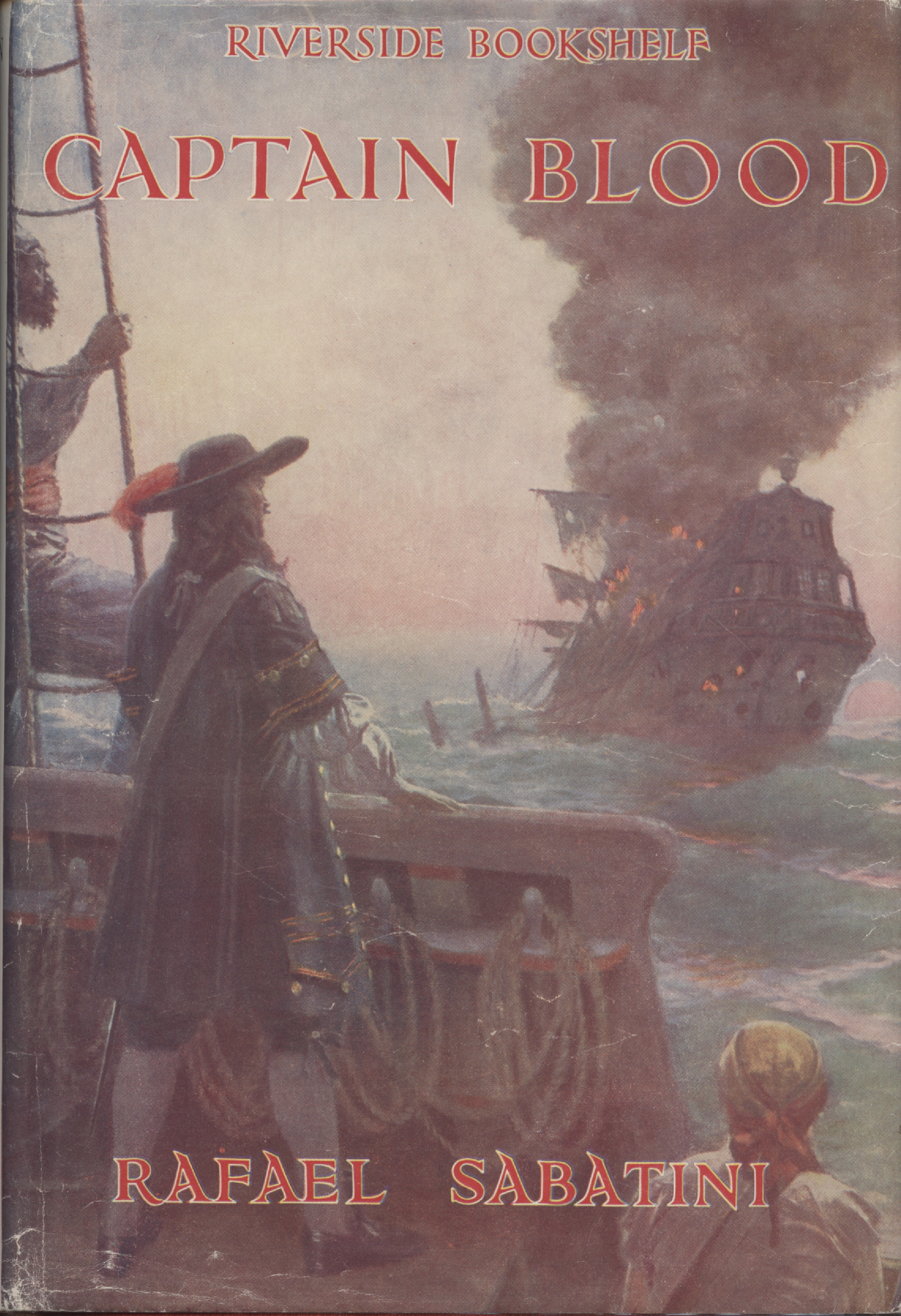
From the 1927 et al Riverside Press Cambridge (a Houghton Mifflin imprint) edition of Captain Blood: His Odyssey, the dust jacket and front cover art by Clyde Osmer Deland (1872-1947). Although the painting is more historically accurate — no boots, correct just-au-corps and hat — it lacks the eye-catching flair of an illustration by Pyle or Wyeth, even if a burning sinking ship draws the eye. And again there’s that damned mustache that’s not in the novel! Here, Deland has no excuse, given that he painted the illustrations several years after the novel’s publication.
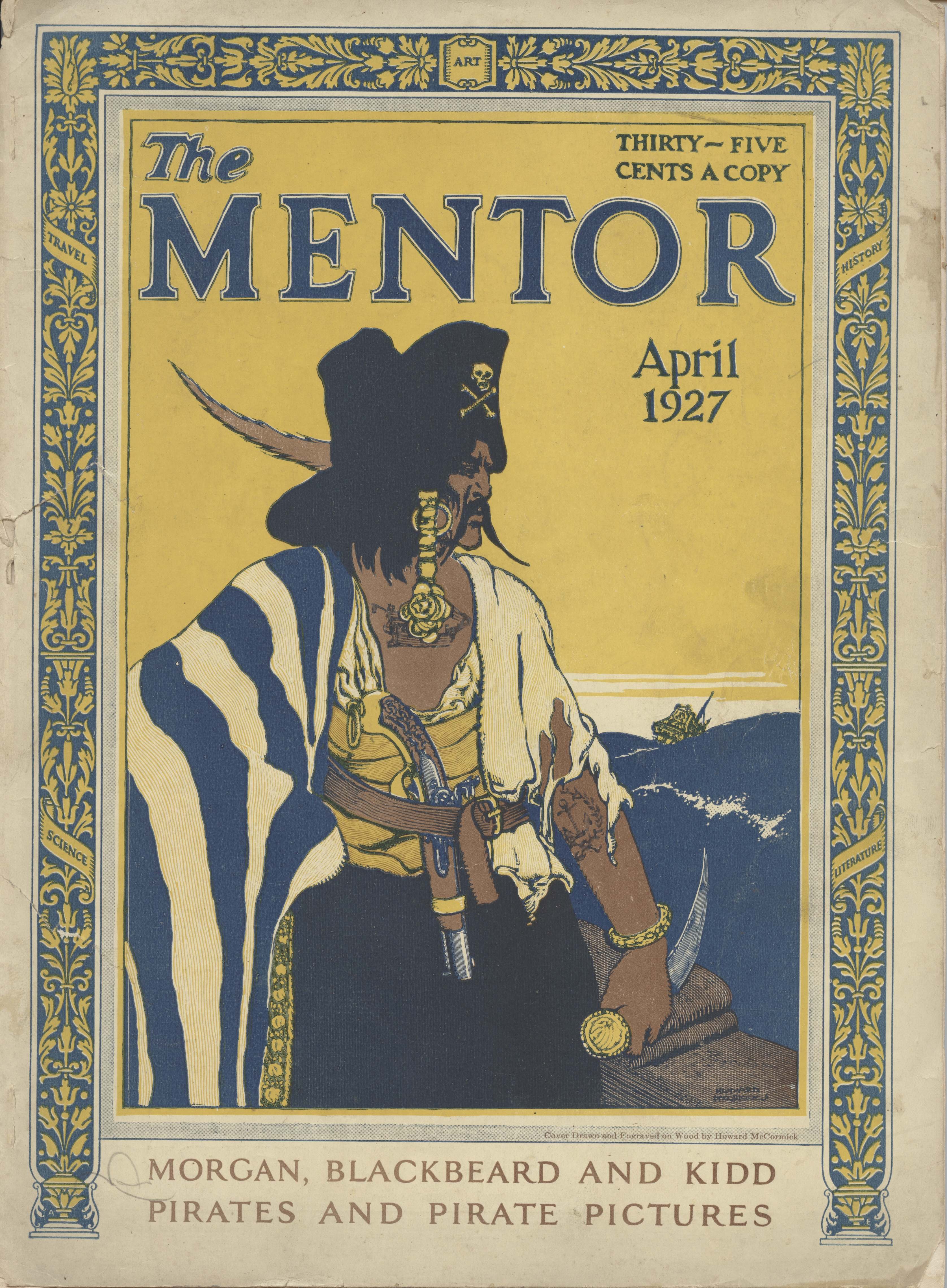
The ship is not burning in the illustration above, but the magazine cover was clearly inspired by Pyle and Wyeth’s paintings. The pirate depiction, in particular its resemblance to the much later Captain Jack Sparrow, is discussed here.

Another Wyeth painting hinting at an homage to his teacher Howard Pyle and which has influenced our idea of the pirate captain and his burning prey on the billows. The blue-green tropical sea is up, giving us the mountain-like billows we like to see — and which also aid in composition. The burning ship is clearly a Spanish galleon, of a style much-used by Wyeth and discussed here. That it has just been plundered is obvious: booty is piled on the poop, including a classic Pyle-style treasure chest with curved top. The buccaneer captain is almost identical to one Wyeth painted for the September 22, 1921 issue of Wall Street Number magazine, a Life magazine publication, discussed here.
The galleon rests on a crest, with the buccaneer ship below in the trough, suggesting the rover is sailing away. Classic Wyeth clouds frame the galleon, and the skull and bones — an anachronism — flies at the stern but we can see only the lower part of the field, as in Pyle’s painting at the top of the page, clearly an homage.

Yet another homage, this time Peter Hurd (1904-1984) to his teacher N. C. Wyeth. Although Hurd was best-known for his paintings and illustrations of life in the Southwest US, he edited and illustrated Marauders of the Sea, a collection of excerpts from pirate stories, 1935, with an introduction by N. C. Wyeth. In the painting, two ships are closely engaged, one of them afire. Here, the pirate captain is not standing the deck of his ship. Rather, the composition is clearly arranged after late 17th century paintings and illustrations of pirate and men-of-war captains and admirals, as will be discussed in more detail shortly.
Hurd’s pirate captain reminds us of the famous depictions of Exquemelin’s buccaneers shown farther below. His eyes are blue and his hair black, like Peter Blood’s, but he also has a Spanish-style mustache and a scar across his cheek. He wields a classic shell-hilt cutlass with large brass rather than iron shells, though all the large shells I’ve seen on cutlasses were iron — only smaller shells might be made of brass. His face is scarred, his jacket is either Spanish or an earlier English doublet, and he wears breast and backplate which Peter Blood did fictitiously and some captains of men-of-war did in reality. Whether any buccaneer captains actually did is entirely speculative, for there is no record of them doing so.
Other Notable Homages
I’ve chosen one authorized imitation of Wyeth’s “Captain Blood,” one authorized inspiration of the Pyle/Wyeth paintings, and also several notable homages, five of them to Howard Pyle’s “famous painting at the top” Captain Keitt,” and rest to Pyle and perhaps to Wyeth and others as well — an homage to homages and to the original.


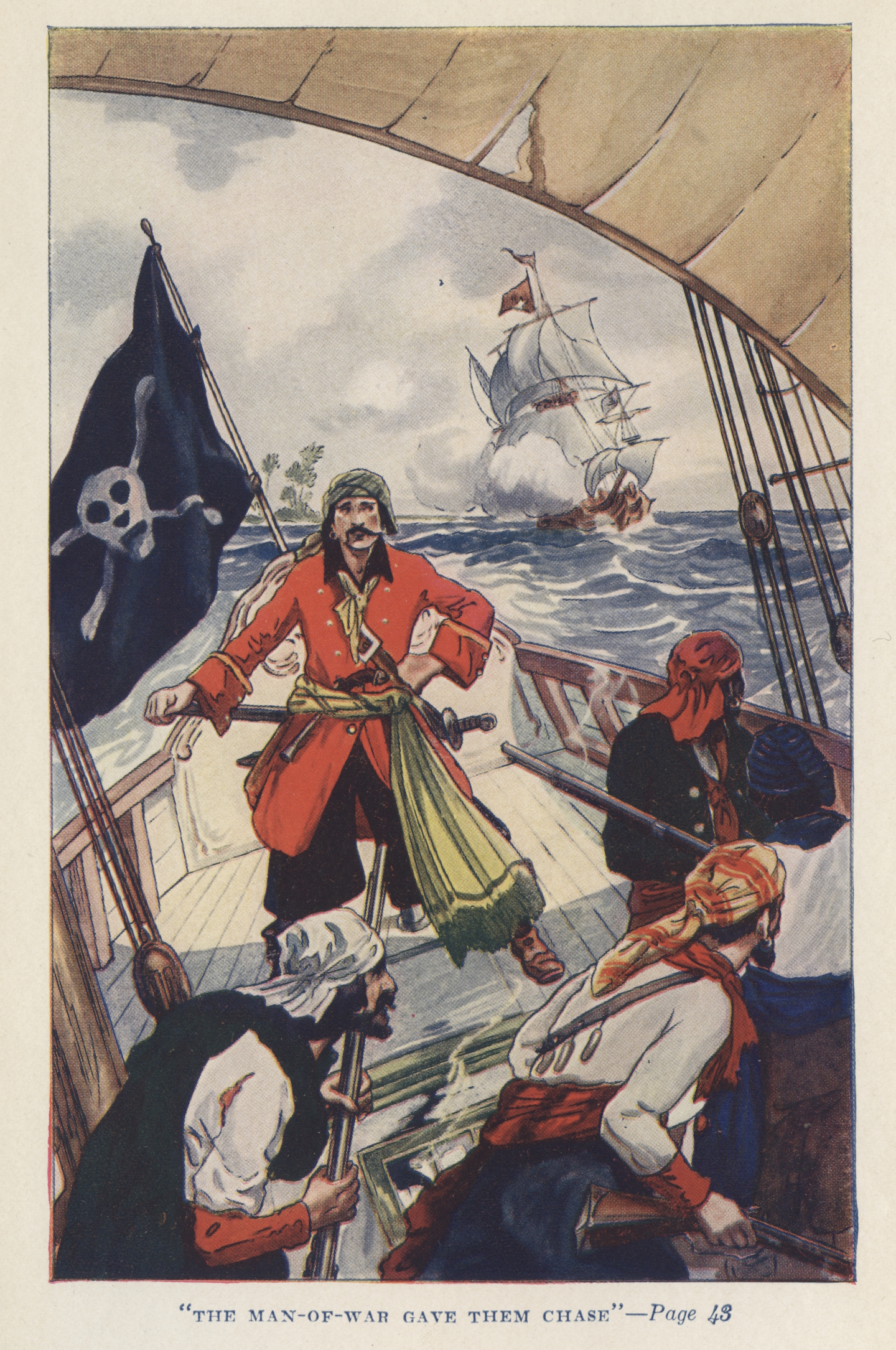
Three illustrations by George Alfred Williams, the first from The Boy’s Book of Pirates and the Sea Rovers by George Alfred Williams (New York: Frederick A. Stokes Company, 1913). It is a likely homage to Pyle’s painting — and only five years afterward. The second and third are from The Pirates of Panama or The Buccaneers of America by John Esquemeling (New York: Frederick A. Stokes, 1914). Both are clearly homages to Pyle’s famous painting. All three doubtless contributed to the image of the iconic image of the pirate captain and his burning ship on the background billows.


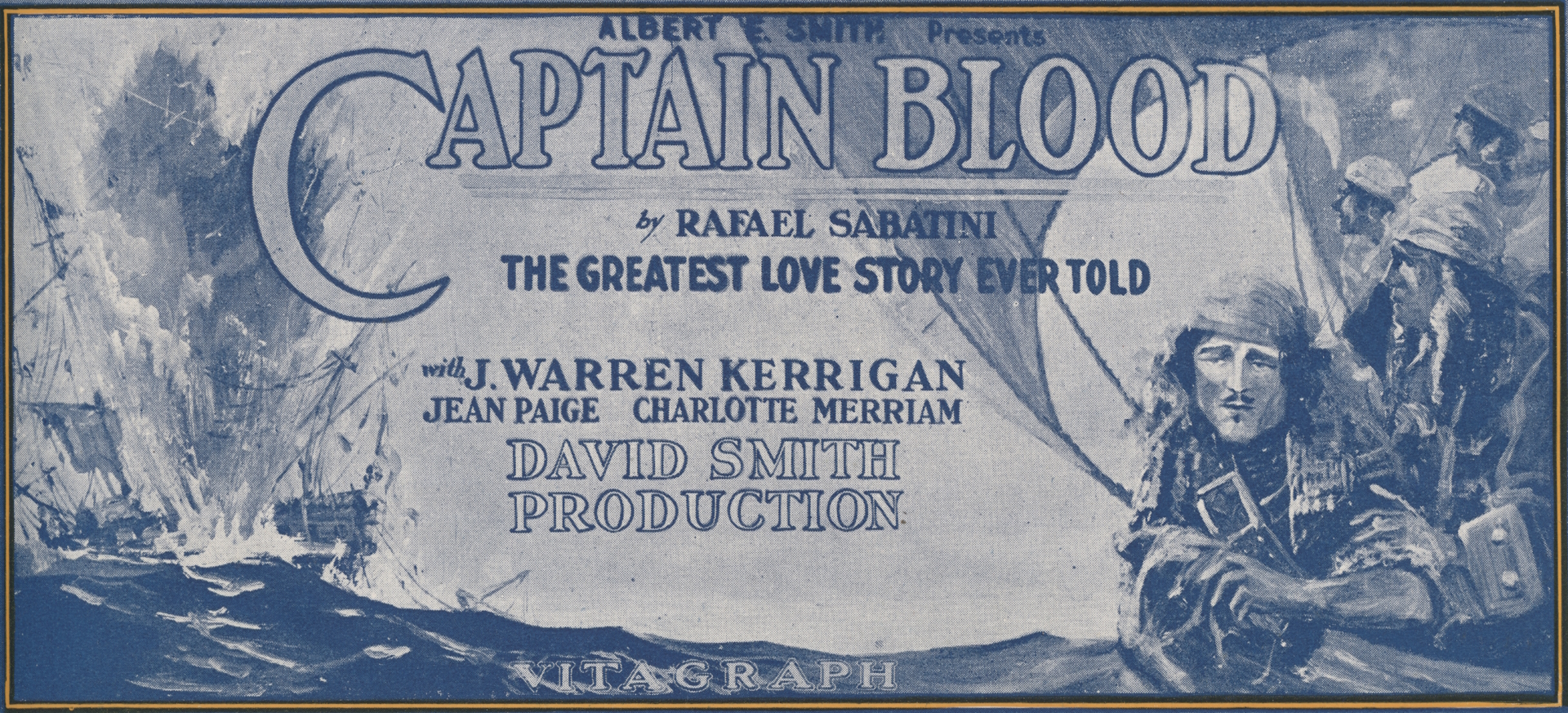
The first image of the four just above is the front cover of the program for the 1924 film version of Captain Blood (Vitagraph) at Astor Theatre, Broadway and 45th, in New York City. The image was also used on a poster for the film. The cover style has been copied from a combination of the dust jacket of the 1922 US release of the novel and of the front board of the book. I’m no fan: here Captain Blood looks more like an unadventurous bourgeois dressed as a pirate for a costume party, rather than the long, lean, hawk-faced adventurer-physician-buccaneer described in the novel.
The likeness is intended to represent J. Warren Kerrigan who played the starring role. Perhaps the unknown illustrator was getting a dig in at Kerrigan and felt the same way I do about him. The actor famously told The Denver Times during the First World War that “I am not going to war. I will go, of course, if my country needs me, but I think that first they should take the great mass of men who aren’t good for anything else, or are only good for the lower grades of work.” Clearly he was no Sabatini-esque hero in real life, nor even an Errol Flynn, at least in regard to courage, panache, dignity, and empathy.
The bottom image is a copy of one of the many posters designed for the 1924 film, clearly inspired by both Pyle and Wyeth. Atypically, the ship is exploding rather than simply burning, although the latter often led to the former.
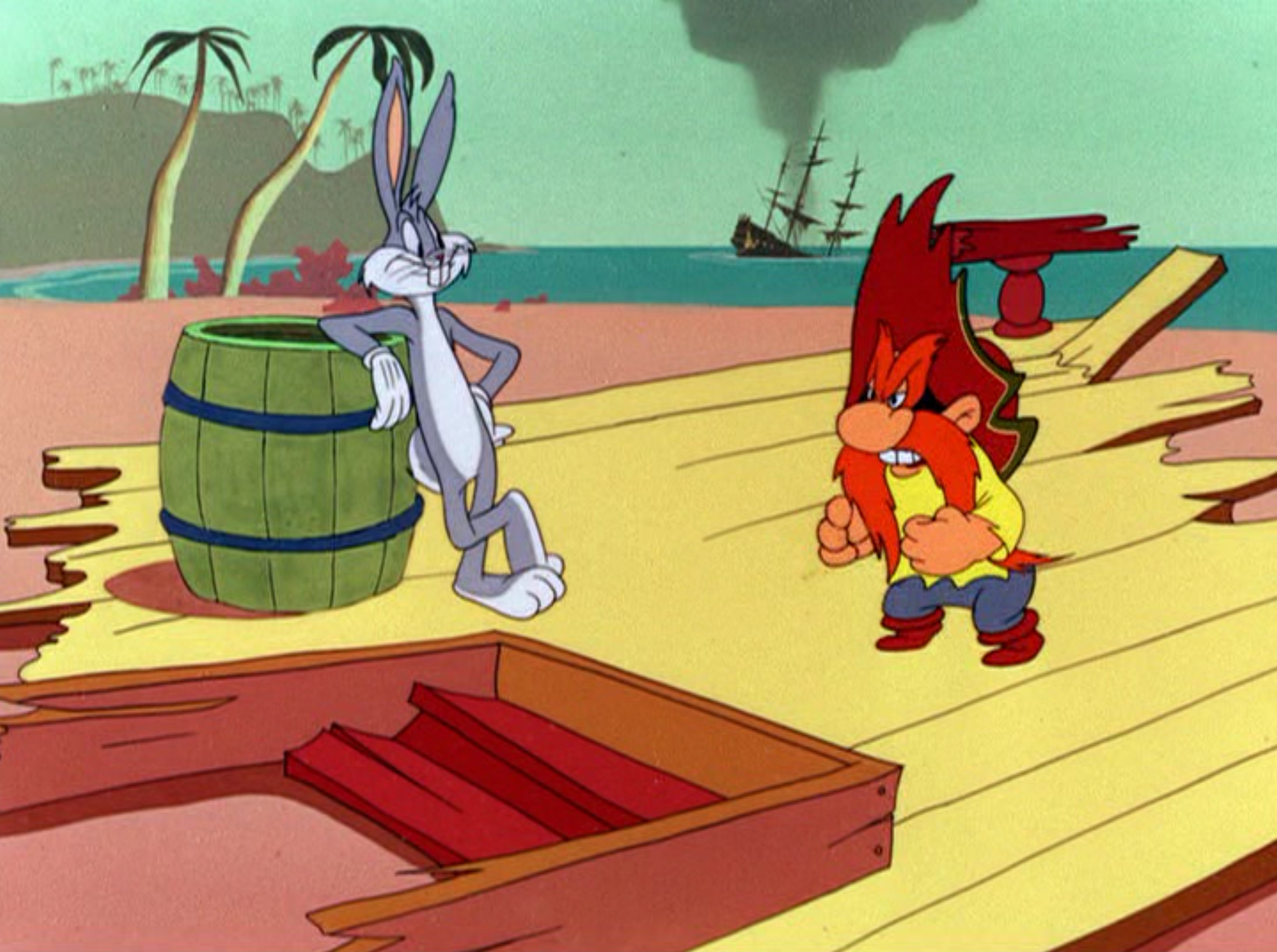
The writers and artists of “Buccaneer Bunny” (Warner Bros. Looney Tunes, 1948) clearly intended an homage to Pyle and Wyeth. It’s basically a reverse or mirror image of the Captain Blood cover art and frontispiece done by N. C. Wyeth. DVD screen capture.

Above is a possible homage to Pyle and Wyeth: Errol Flynn as Brian Hawke just having rescued Alice Kelley as Princess Padma from the burning ship of the Mughal Emperor. Compare with The Goonies screen capture below.

In the painting above there is no burning ship, but one firing a broadside instead. Even so, the image is clearly inspired by the paintings of Pyle and Wyeth, and as much by the illustrations from Alexandre Exquemelin’s The Buccaneers of America discussed below. The painting, artist unknown but suggested by some to be Ed Kohn, has hung for many years in the Pieces of Eight store adjacent to the Pirates of the Caribbean ride at Disneyland. Originally it hung in the Pirates Arcade Museum (mostly an arcade) before the shop replaced it in 1980. It may depict Fortune Red, the animatronic fortune teller in the arcade.

Above, an homage if you like, and clearly a comic riff, on Pyle’s famous painting. A damsel-in-distress has been added — and Chunk’s tongue too… From the attic scene in The Goonies, 1985. Compare with the Against All Flags screen capture above it.

The Goonies painting as imagined by Lego, part of a kit (“The Goonies: The Walshes’ Attic”) to accompany The Goonies ship and the film scenes depicted inside.

I hesitated to post the image above, of Arnold Schwarzenegger as Captain Blood by William Stout. The film was under consideration in 1994, and, although I have great respect for the former Governor of California as an action hero, I am overjoyed that the film never made it into production. The proposed script was of a sort commonly pitched by studio executives, producers, and screenwriters: one intended solely to make money (art, artist, and audience be damned).

Above is an homage by arts and entertainment polymath Jim (James R.) Silke (1931-present) to Howard Pyle’s famous painting (see “After Howard Pyle” below the signature on the painting above) featuring Maureen O’Hara as Spitfire Stevens in Against All Flags (1952), also starring Errol Flynn. The 2005 work was created as a commission for Brian Peck.

My good friend Antón Viejo Alonso brought the image above to my attention. Drawn by noted portrait artist and film costume concept illustrator Darrell Warner for Pirates of the Caribbean: Dead Men Tell No Tales (Disney Studios, 2017), it is clearly an homage to the Howard Pyle painting at the top of the page.
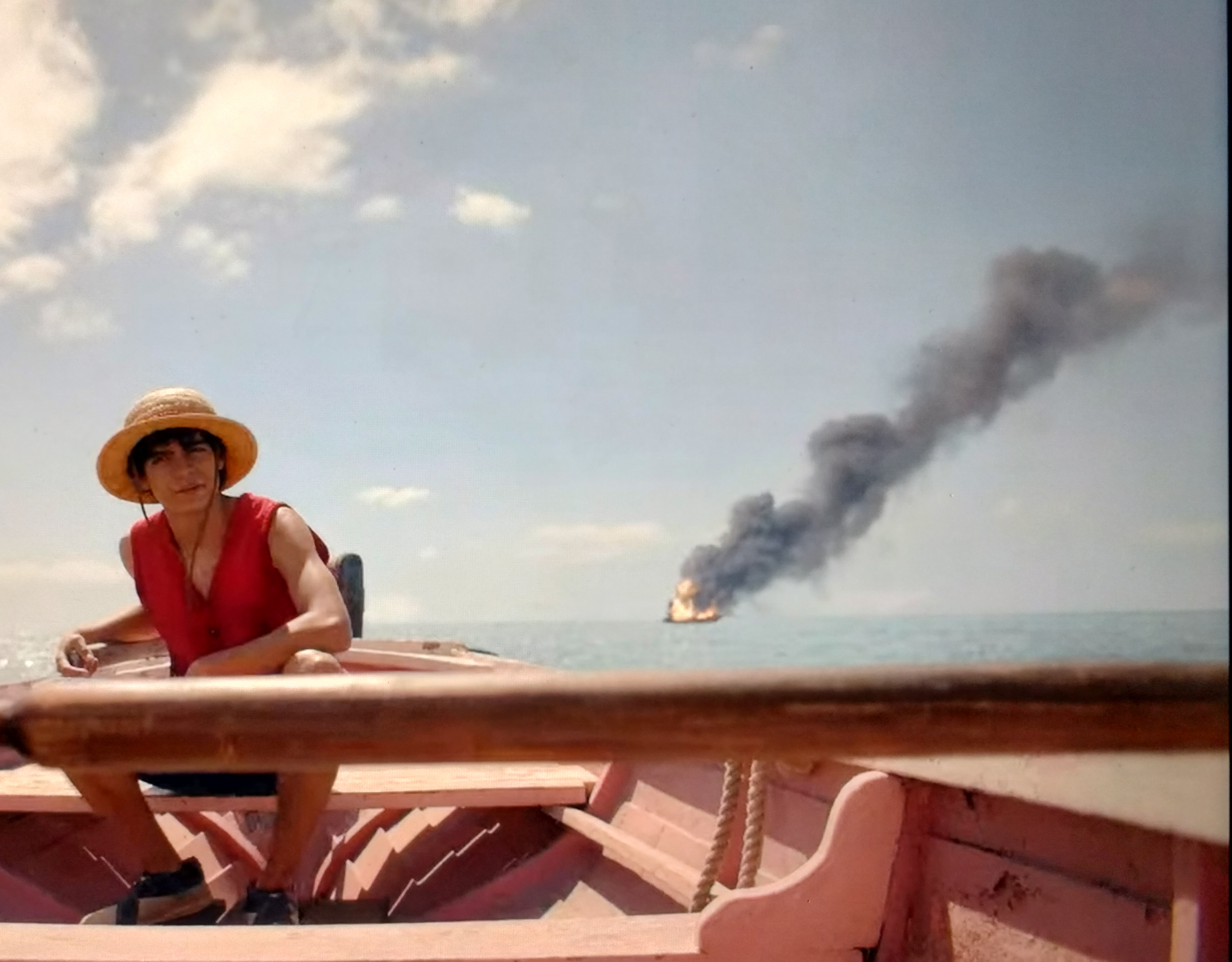
A cropped image from Netflix’s live action 2023 release of One Piece, with pirate-captain-to-be Monkey D. Luffy (played by Iñaki Godoy) in the foreground (foresea? :-)) with a burning ship in the “backsea,” clearly an homage to Pyle, Wyeth, et al. Furthering this argument is the fact that the scene with burning ship is not in the original manga written and illustrated by Eiichiro Oda nor in the anime based on it produced by Toei Animation. (N. B. there is a similar scene when the [Spoiler Alert!] Going Merry burns and sinks much farther along in the voyages of the Straw Hat Pirates, which is perhaps an homage [Spoiler Alert!] to Peter’s Blood’s loss of his beloved Arabella).
Inspirations & Influences
The most likely inspiration — the seed planted in the subconscious — might well be some of the original illustrations in Alexandre Exquemelin’s early Dutch, Spanish, and English editions of The Buccaneers of America. They include several portraits of famous buccaneers, although we have no idea how accurate the depictions are, but this matters little in regard to inspiration.
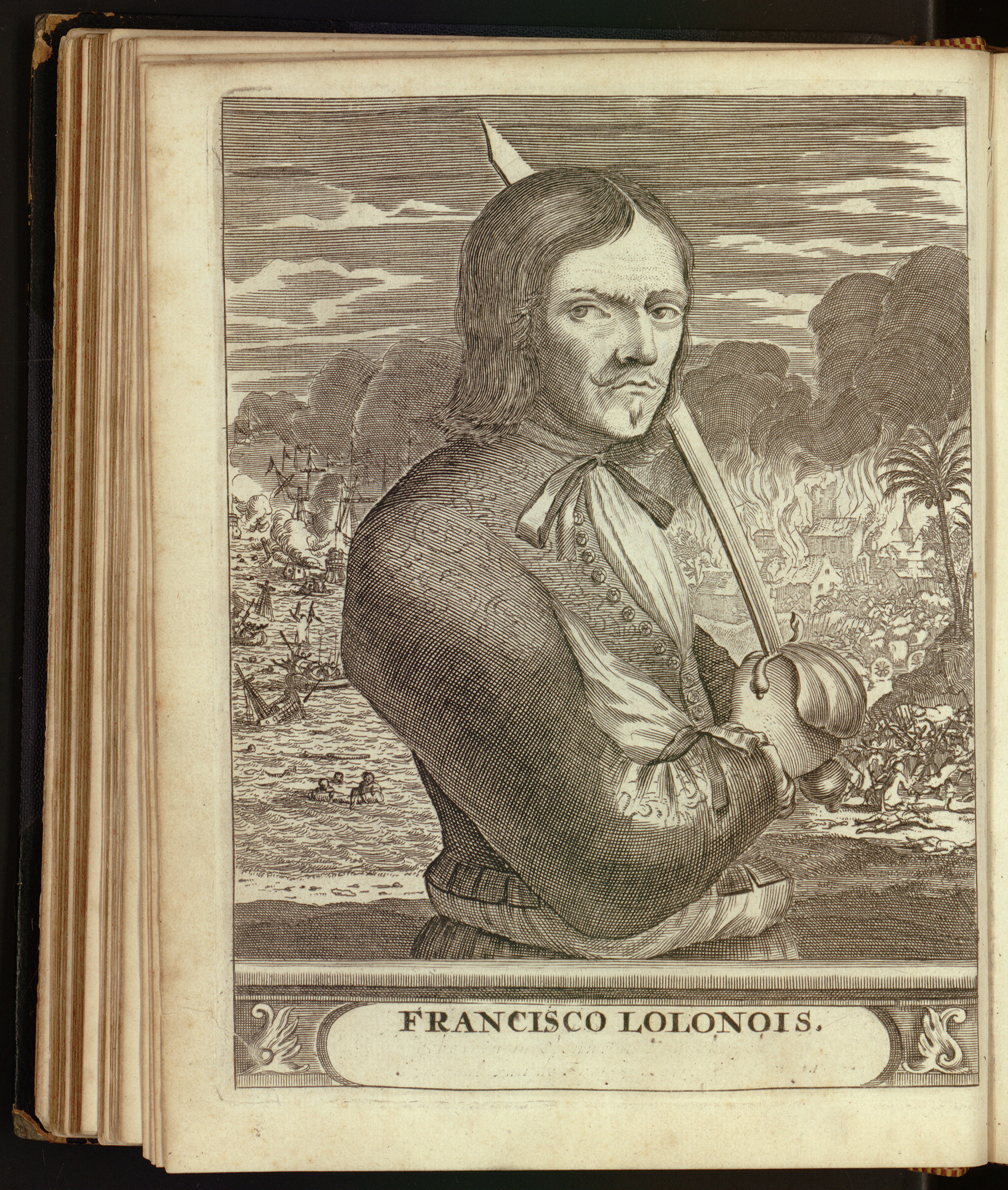
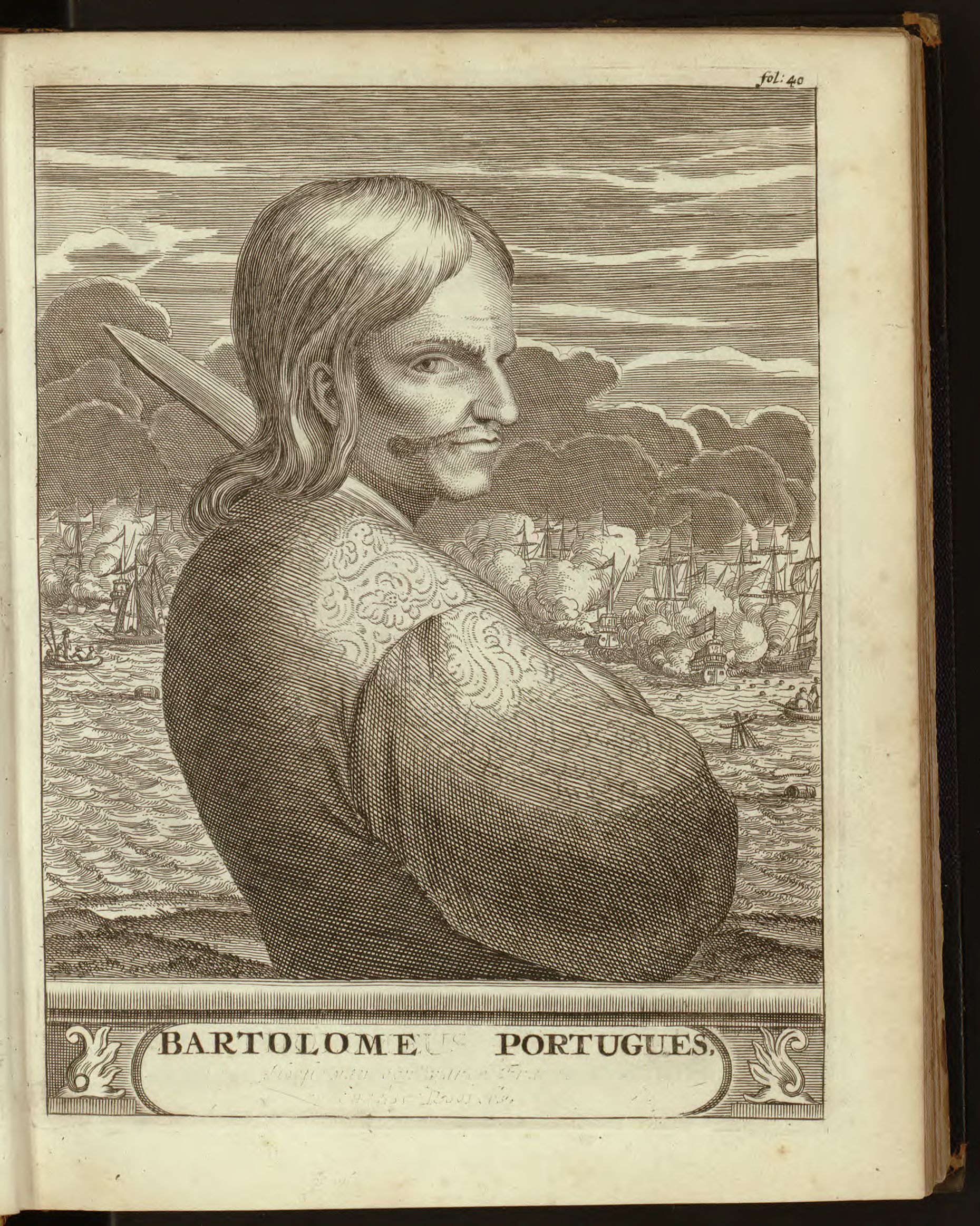

The three illustrations above are Spanish edition copies of the originals in the Dutch 1678 edition: Francois L’Ollonois, Bartholomew Portuguese, and Henry Morgan. All show battles, including sea fights, raging in the background, with billowing smoke suggesting that some ships may be afire. None of these buccaneer captains — as far as we know — are standing on the the decks of the ships. It took Howard Pyle’s genius to compose a portrait evoking the adventure and romance, at least as we believe it to have been, of piracy on the high seas.
The illustrations in Exquemelin’s books were doubtless inspired by a common form of portraiture associated with fighting seamen and soldiers, officers in particular for typically only they could afford portraits or had enough social status that a patron might commission a portrait of them.
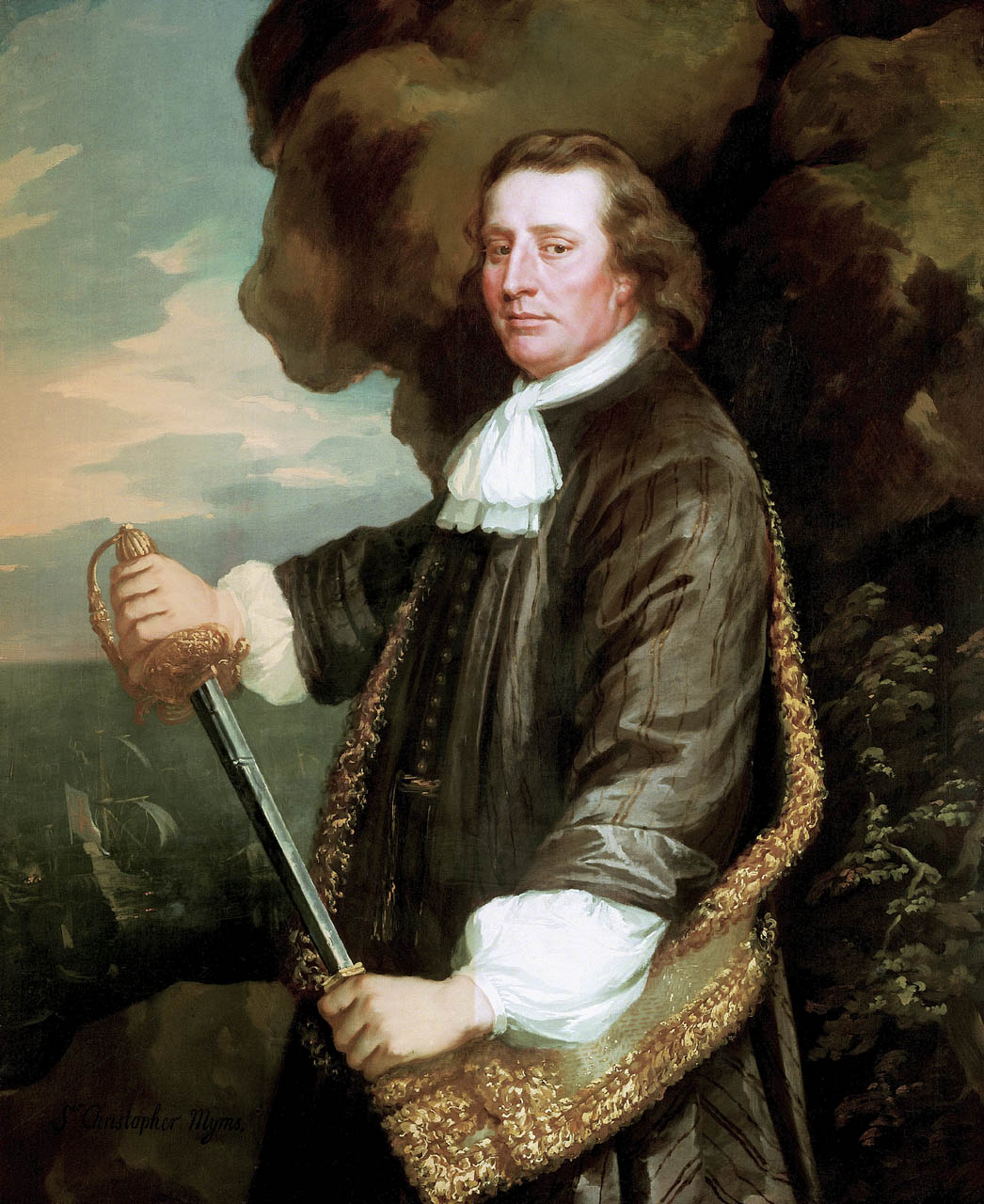
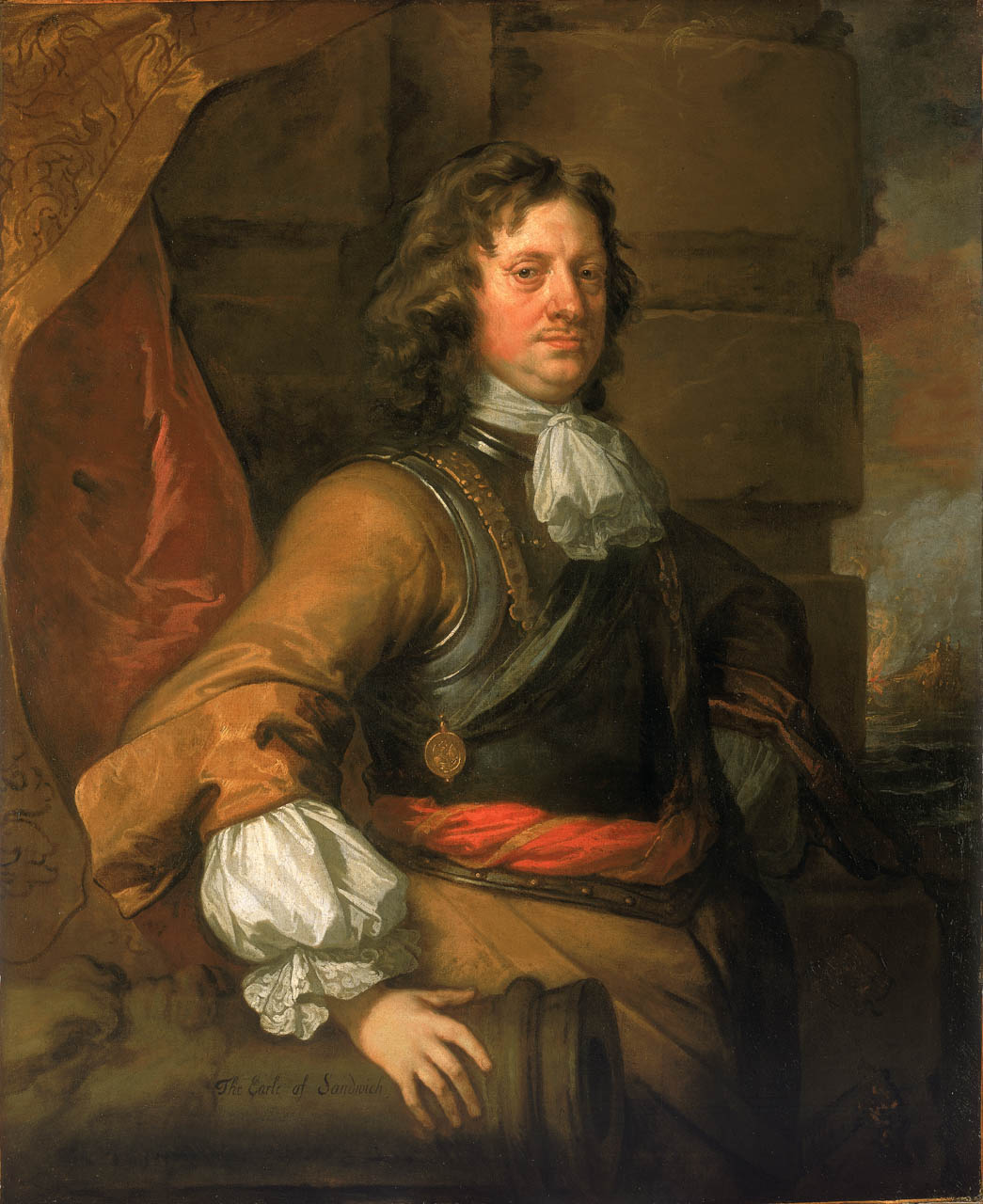
The two portraits above are typical of those of the era: the subject in the foreground, with a depiction of a major associated action in the background. Myngs, prior to becoming an admiral, led a number of raids on the Spanish Main, with buccaneers-as-privateers as his consorts, after the English captured Jamaica from Spain. The portrait of Montague shows us a burning ship, but it may not be that of an enemy. It appears to be of English build, and is therefore more likely the HMS Royal James, Montague’s flagship burned by a Dutch fireship in 1672, resulting in Montague’s death.
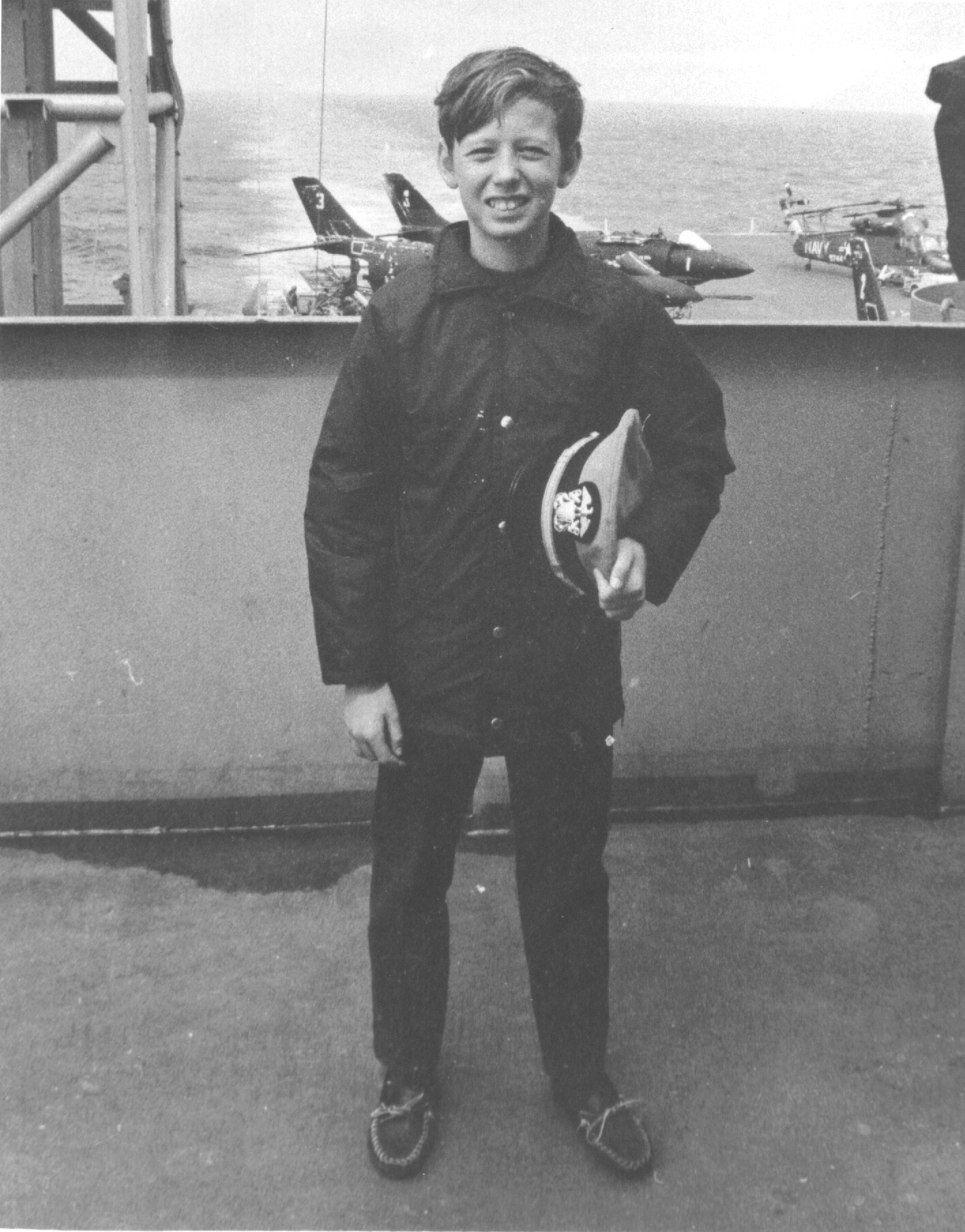
Not quite yet a buccaneer or pirate in the photograph above, nor yet a burning ship on the background billows — but aspirations enough. 🙂
Copyright Benerson Little 2024. First posted 24 September 2024. Last updated November 1, 2025.

Pirate Ships, Pirate Prey, & Pirate Hunters: Eyewitness Illustrations & Accompanying Stories

Modern histories of so-called Golden Age pirates — those circa 1655 to 1730 — are often filled with images of pirate ships, many of which are implied to be accurate representations. In fact, there are few eyewitness images of actual buccaneer and pirate ships of this era — perhaps no more than five!
Most period images of buccaneer and pirate ships, not mention of pirate prey and pirate hunters, were drawn not by eyewitnesses in the Caribbean or in other places pirates roved but in England and Europe by the professional illustrators of various editions of books on buccaneers and pirates. These artists never saw the vessels they drew, probably had little if any input from eyewitnesses who had seen them, and were often clearly inept when it came to accurate representation (Hollywood also has always often had this problem and still does).
Even when the illustrator had a good description, the result often hit far from the mark, as we’ll see below. There were no professional artists such as the Willem van de Velde father and son, or Pierre Puget, or any of a number of maritime painters of the era to paint the Caribbean and its people, landscapes, and vessels. This is history’s loss.
Modern scholarly reconstructions in the form of illustration or model — Whydah, Queen Anne’s Revenge, &c — are based on limited eyewitness accounts and scarce records of the actual ships, with reference to hopefully similar ships found in period maritime paintings, drawings, and construction records. At best they are intelligently conjectural. But conjectural they are, even if they are the best we might ever do.
Nonetheless, there exist eyewitness illustrations of at least five Golden Age sea roving vessels we can for the most part put names, captains, and adventures to. In other words, they are illustrations of real buccaneer or pirate vessels made by illustrators and painters who actually saw them or were provided a high degree of detail by eyewitnesses. Additionally, there is an illustration of two others that is almost certainly based on eyewitness descriptions taken firsthand by the illustrator.
The first two are Spanish-built pirate/privateer half-galleys, one for certain, the other almost certain. The third and fourth are of a captured Spanish merchantman soon to be converted by flibustiers to piracy, and its captor. The fifth is a pirate which had recently plundered on the Guinea coast. The sixth and seventh are pirates, one English, one French, one of whom was destroyed by a pair of English men-of-war.
Further, we have illustrations of the two most famous Spanish pirate hunting ships — even if unsuccessful more often than successful — along with an excellent, highly detailed, quite accurate drawing of the HMS Drake, a sixth rate used for pirate hunting in the 1680s Caribbean, and the HMS Bonetta, which was dispatched against a pirate but did not engage it — plus a reasonable image each of the pirate hunters HMS Drake and HMS Falcon. At another time we’ll look at a painting of what may be the most famous of all pirate prey of the era; I’ve more research to do before I commit my argument to print.
We’ll take a look at all nine, with accompanying swashbuckling history in depth. As with the eyewitness images of buccaneers and boucaniers I found in the French National Library, I found several, but not all, of these eyewitness images of vessels likewise largely unnoted and unnoticed.
A Spanish Half-Galley (Galeota) Commanded by Cuban-Italian Corsario Mateo Guarín, 1685

Commissioned by the governor of Cuba, Fernández de Córdoba, in 1683 to make reprisals against English and French pirates and smugglers. In January 1684, Guarín led a raid on Siguatey (Cigateo, aka Eleuthera) and New Providence in the Bahamas.
Mateo Guarín (sometimes Marín) was an Italian privateer — a corsario — from Venetia (the surrounding region of Venice, Italy) in Spanish service. In Italian his name was Matteo Guarino. It was not unusual to find Italian adventurers in Spanish service in the Caribbean; another will be discussed in another post soon.
An English account of the raid: “At the beginning of January about two hundred of their choicest men were fitted out from Havana, well armed, in two barco-luengos, the one of forty, the other of thirty oars. They went to a-small uninhabited island called St. Andrews, where they took an English sloop which was there for cutting timber. They made the three men in her their pilots, and came to the back of Providence on 18th January and waited through the night. At daybreak they landed 120 of their men at the town, while fifty assailed the shipping—six vessels—in the harbour. The people in the town being surprised fled from it to the woods, those in the ships also deserted them and fled on board a New England vessel of ten guns. This and one more ship stood out to sea; the rest were all pillaged and three men murdered.
“The Spaniards killed no one in the town, but kept it till four o’clock in the afternoon, in which time they took away all the wrought and unwrought plate that they could find, a quantity of English dry-goods, and such provisions as they wanted, and loaded their booty, valued by the English at 14.000l., in a pink that they took in the harbour. While the Spaniards were in possession of the town, fourteen Englishmen got together and drove all the Spaniards before them. They would have driven them from the town and retaken the plunder if they had had powder and ball enough, and if the inhabitants had known of a rallying point, and had found but fifty firearms they might have saved all. All might also have been saved by the ship of ten guns if she had but stayed. But three men were killed, but many were carried off prisoners by the Spaniards, as suspected of being pirates.” There was a much more brutal raid against New Providence later in 1684; it is unknown if Guarín participated.
In 1684 Guarín was surprised by that famous Dutch flibustier-in-French-service, Laurens de Graff, at the large Isle of Pines (Isla de Pinos, today Isla de Juventud) off the southern coast of Cuba, but escaped the more heavily-armed and -manned buccaneer.
De Graff was the greatest of buccaneers in the 1680s. In fact, certain aspects of Rafael Sabatini’s famous character Captain Blood are based on him. Caribbean Spaniards had great enmity toward the Dutch buccaneer not only because he was so successful, but because he had deserted Spanish service as a gunner of the Armada de Barlovento and later co-led the brutal sacks of Veracruz and Campeche. De Graff had long ranged and raided along the Cuban coast, and gathered intelligence there as well, in particular from a source named [Juan?] Montiel who provided detailed information on ship movements from Havana, doubtless in return for trade goods or money.
This desperate desire for vengeance against buccaneers and against de Graff in particular ranged across the Spanish Main, but would usually turn out poorly for all the Spanish pirate hunters sent against de Graff, including Capitán Guarín who made the bold personal decision to become de Graff’s principal nemesis.
In October 1684 Guarín attacked the HMS Bonneta (Bonito in colonial records; see the section on Bannister below for an image and more information) of no more than four guns along the south coast of Cuba as it was sailing to Santiago de Trinidad, Cuba to demand the return of captured English seamen from a sloop belonging to Derick Cornelison. The small English man-of-war (see also Bannister below) had sent a boat ashore for water, per treaty. Guarín captured the boat and its eight-man crew, stole the English jack it had flown for protection, and hoisted it aboard a pirate-hunting piragua.
In Captain Stanley’s words: “I at once got up sail, but had no sooner done so than I saw the galley and a periago coming under sail and oars, the galley flying the Spanish flag with a red ensign and the periago the King’s jack, which he had taken in my boat. I fired at the galley when she came within range, and she at me, and we were engaged from nine to eleven, when they got into the creek where there was not water for me to follow them.” The English captain slipped away before more galleys and piraguas might arrive: there were two of the former and seven of the latter in Santiago de Trinidad. Afterward he provided protection to nearby English turtling sloops nearby, and soon afterward rescued four English turtling sloops from the French flibustier Captain Bréha who was robbing them of provisions.
In early 1685, commanding a half-galley, known in Spanish as a galeota, Guarín raided Nipe on the island of Hispaniola, not far from the flibustier haven of Petit Goave. The corsario and his crew flew the white flag of France for deception, but also apparently fought under it — a violation of the laws of war, in addition to any charges of piracy. Guarín and his crew carried away forty slaves, soon declared in Baracoa and Puerto Principe, Cuba, as good plunder worth approximately 8,800 pesos de ocho reals (pieces-of-eight). The corsarios probably carried away little other plunder, given the small agricultural nature of the settlement.
An official French account notes that two demi-galères (half-galleys, galeotas) attacked Nipe for a second time later that year, but that their original intended target was the plantation belonging to Governor de Pouançay via an extortion attempt at ransom. The attackers changed their minds when their threat was rebuffed. The second attack on Nipe failed due to the town becoming alarmed before the raid began. It is unknown whether this second attack was led by Guarín.
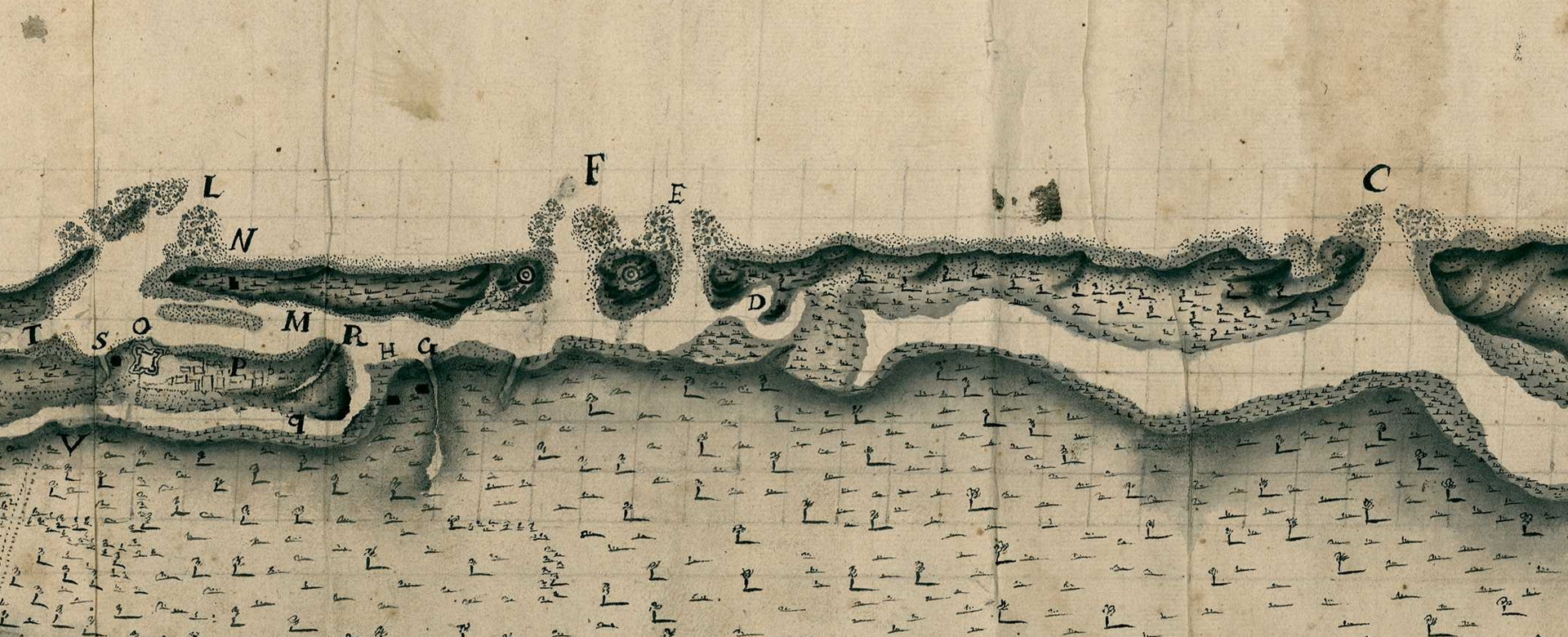
By good fortune, French engineer Pierre de Cornuau had been sent to French Hispaniola to survey and draw charts of French ports. His chart of Nipe, drawn the same year as Guarín’s raid, shows the Spanish half-galley (see the image above). It is quite typical of the form (more on this below), and Cornuau, who probably did not see the half-galley himself, certainly had it described to him by eyewitnesses.

As will be seen in the next section, Cornuau’s simple drawing is a very accurate rendering of these vessels as used by the Spanish in the Caribbean. It has a single carriage gun (cannon) mounted at the bow, a pair of gallows for sweeps (oars) amidships, two masts and two furled lateen sails, and a flagstaff at the stern for the ensign. Missing in the drawing, but probably mounted on the actual vessel, are a handful of swivel guns (small cannon mounted on yokes), probably of the chamber-loaded sort known as patereroes in English. “The galleys are what are called half-galleys in the straits, and carry eighty to a hundred and twenty men; the periagos carry from fifty to seventy,” wrote Lieutenant-Governor Hender Molesworth. One account of Guarín’s half-galley arms it with “sixty-five men, one “Cushee-piece” and six patararoes,” another with eight patararoes (breech-loading swivel cannon mounted on the rails).
Soon afterward, in company with corsario Alexandro Thomás de Léon, Guarín captured the small flibustier frigate Coronet, commanded by Jean Baptiste. Interrogated at Trinidad, Cuba, the French captain gave up exceptional detail regarding the plantation of Laurens de Graff on Saint-Domingue, and also on that of Michel, sieur de Grammont, another of the greatest buccaneers of the 1680s. He also learned that at his plantation de Graff had a mulatta wife or mistress he had “seized” from Veracruz, named Olaya de Escurre, with whom he had a son. (De Graff had only two lawfully married wives as far as we know: he divorced Petronilla de Guzman of the Canary Islands to marry the wealthy widow Anne Dieu-le-Veut on Saint-Domingue after he became a French officer.) It is possible that de Escurre was his mistress from his years when he lived in Veracruz in the service of the Armada de Barlovento as a gunner, or that he in fact enslaved her, or otherwise carried her away as human plunder, during the sack of Veracruz.
Guarín, commanding two piraguas, or quite probably galeotas (piragua and pirogue are often used mistakenly for half-galley/galeota), built for the purpose in Havana, possibly including the one shown above, captured the guardhouse then sacked the plantation, taking numerous slaves as plunder and liberating a number of formerly free mulatta women who had been carried away as slaves from Veracruz. Among the prisoners was the young son of de Graff and de Escurre, whose capture the governor of Cuba hoped might force de Graff into negotiations and thereby reduce raids on Spanish ships and towns. De Graff was not present when his plantation was raided.
In February 1686, commanding two piraguas (according to Spanish records) or two “galleys” (according to English records, thus we will assume one was the half-galley shown above), Guarín attacked two English smugglers: the Swallow pink (a flute) of 22 guns commanded by Edward Goffe, and the Ann sloop of 6 guns commanded by [William?] Peartree, off the Tayabacoa River, Cuba, near Trinidad. (Spanish records Hispanicize the names as “Gafi y Peltre.”) The English captains claimed to be seeking to wood and water, as was permitted by treaty, a common, usually false, claim made by smugglers. Rebuffed at Trinidad, they sailed SE ten leagues to the small cays off the Tayabacoa.
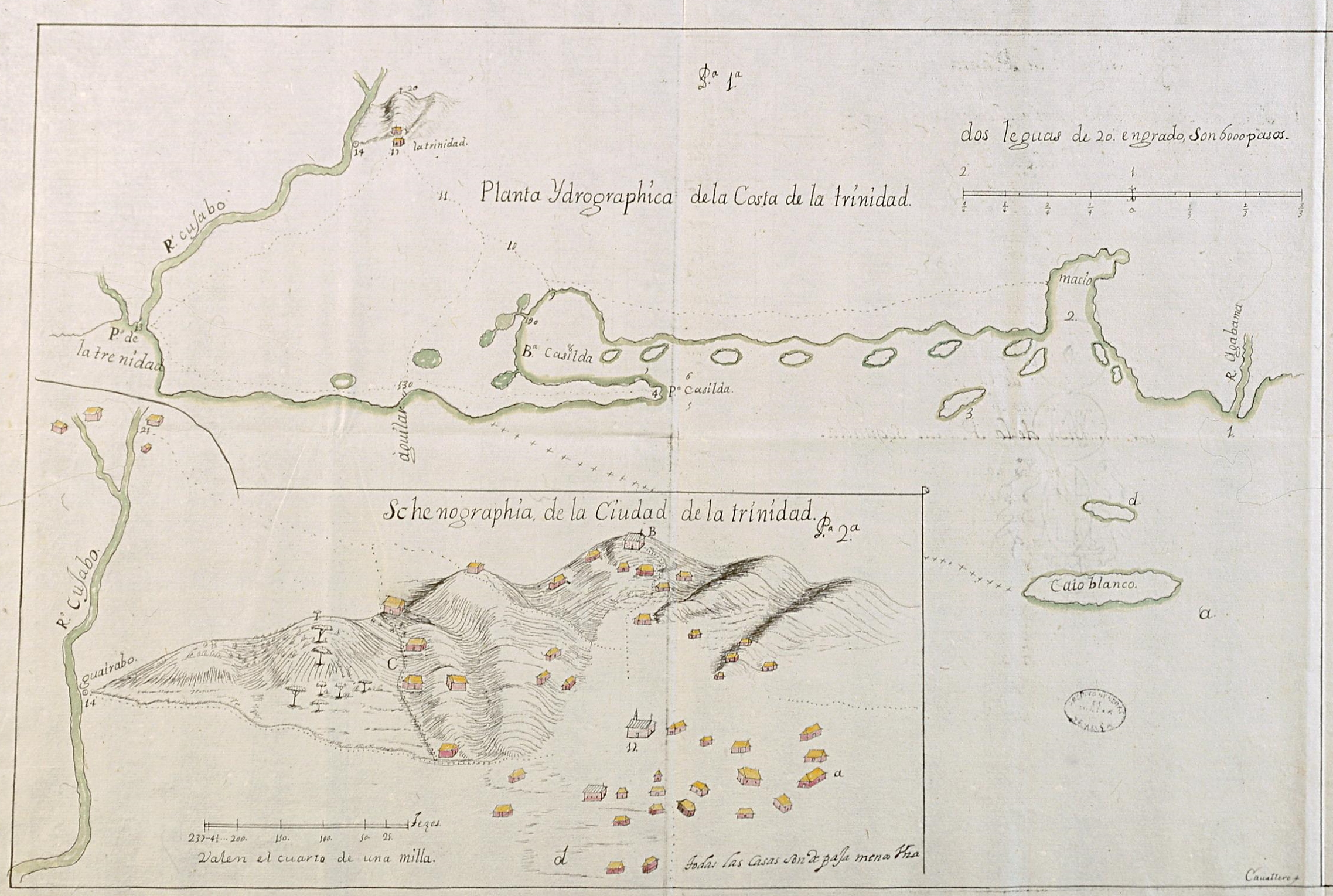
The Spaniards soon arrived and attacked; the battle was brutal and bloody. According to Goffe, “the Governor of Trinidad sent two galleys out, one of forty and one of eighty-five men, the latter of which, as the master confesses, was present at the sack of New Providence. Both galleys came up to my ship’s side, and without hailing poured in a volley, which killed two men and wounded five or six, and then making fast to my ship’s side tried to board her. Having the sloop’s crew on board we defended ourselves, and after about half an hour’s engagement, there were about sixty Spanish pirates killed and thirty-eight wounded. The smaller galley managed to clear herself, but the larger we captured and brought into Jamaica.”
Guarín’s account is similar, but with ugly accusations of murder. He states that he lost 24 men killed in the battle, with 50 more abused and murdered after the battle, including his lieutenant hanged by the English victors, and 30 more of his men put ashore. He himself was severely wounded, and, along with his surgeon, carpenter (a Maltese), and a mulatto from Havana named Juan Cristián, was carried into Jamaica.
Guarín and his comrades were tried for piracy; he and Juan Cristián were sentenced to hang. Although Guarín’s commission was sufficient to protect him from prosecution for piracy for his attack on the Swallow and the Ann, it could not protect him from prosecution for his attack on New Providence and for seizing the boat and eight crewmen of the HMS Bonetta. Even so, by good fortune both men were reprieved when the Spanish Assiento (slave trade) representative in Jamaica, Don Santiago del Castillo, contacted the Spanish ambassador in London, Don Pedro de Ronquillo, who petitioned King James II to release the convicted pirates.
In fact, Lieutenant-Governor Molesworth had already reprieved him pending the recommendation of King James II: “The Spanish captain referred to in my last has been found guilty of piracy, for robbing a sloop from Nevis and stealing Capt. Stanley’s boat. For reasons relating to our Spanish trade, and understanding that he had treated those under his power well and had apologised to Captain Stanley, soon after committing the fact, for not knowing his to be a King’s ship, I have granted his reprieve. I am since glad that I did so, for I find that the Spanish Governors will be very much concerned for him, and particularly those who have obliged me most by granting restitution of prisoners. Lately I have received a letter from the Governor of Santiago, in Cuba, demanding him in the same manner as I have demanded prisoners, and making such excuses for him that I conceive, if he had been executed, it would have passed current among Spanish Governors that he had suffered only for carrying out the Spanish King’s Commission. This would have raised a great clamour against us and would have endangered all our traders who are or may in future fall into their power. I have therefore reprieved him till the King’s pleasure be known.”
By October, 1686, Guarín and his comrades were free men again but his adventures afterward were tame by comparison. With a new vessel provided by investors, possibly another half-galley, he transported the governor of Florida to St. Augustine, patrolled the Cuban coast, and, on July 4, 1688 was dispatched unsuccessfully aboard his piragua or half-galley along with an urca (a Spanish fluyt) to seek a pirate frigate, brigantine, and canoe at Santa Lucía, Cuba, believed at the time to have been commanded by the notorious Dutch flibustier-in-French-service Jan Willems aka Captain Yanky (also Yankey).
Guarín soon found himself imprisoned again, but this time not by his English or French enemies, but by his compatriot cubanos in Havana. His vessel was seized after he was accused by some local hidalgos of having sold slaves captured at the Bahamas and Saint-Domingue that actually had belonged to them before being plundered by English and French buccaneers. One scholar suggests this was a false accusation to protect the governor against accusations of engaging in contraband.
According to Spanish law, as a Capitán de Mar y de Guerra, a title accorded him by his privateering commission (patente de corso), he should have been immune to such accusations. Even so, Guarín spent a year and a half in jail, and the last we hear of him is that his case was pending at the Council of the Indies. There is no record of this bold corsario taking to sea again.
For more information on this and other Cuban corsarios, see El Corso en Cuba Siglo XVII by César García del Pino (Havana: Editorial de Ciencias Sociales, 2001), and La Defensa de la Isla de Cuba en la Segunda Mitad del Siglo XVII by Francisco Castillo Meléndez (Seville: Diputación Provincial, Sevilla, 1986). The English eyewitness account and associated correspondence can be found in the Calendar of State Papers Colonial, America and West Indies, 1685-1688.
A Captured Spanish Half-Galley Commanded by Nicolás Brigaut in 1686

By the mid-1680s most major Spanish ports had at least one galeota used for intercepting smugglers, pirate hunting, and raids of reprisal, and also as an advice (dispatch) vessel. Of shallow draft, with the ability to maneuver under both sail and oar, the vessels were ideal for their purpose. They could attack from and escape over shallow waters, attack in calms at the bow or stern of smugglers and pirates and thereby avoid their broadsides, and could travel close inshore and up-river for raids on French and English settlements.
Most had two masts with a single lateen sail on each, approximately thirty oars or sweeps, a long thrusting prow or beakhead, one or two carriage guns in the bow, and often four or more patereroes (swivel cannon) on the rails at the bow and stern. Sweeps were stowed on gallows amidships when not in use. Recognizing their utility, both the French and English began using them, either constructing them themselves or using captured Spanish ones. In English the vessel was typically referred to as a half-galley, in French as a demi-galère or sometimes, confusingly, a pirogue, and in Spanish as a galeota or occasionally, again confusingly, a piragua.

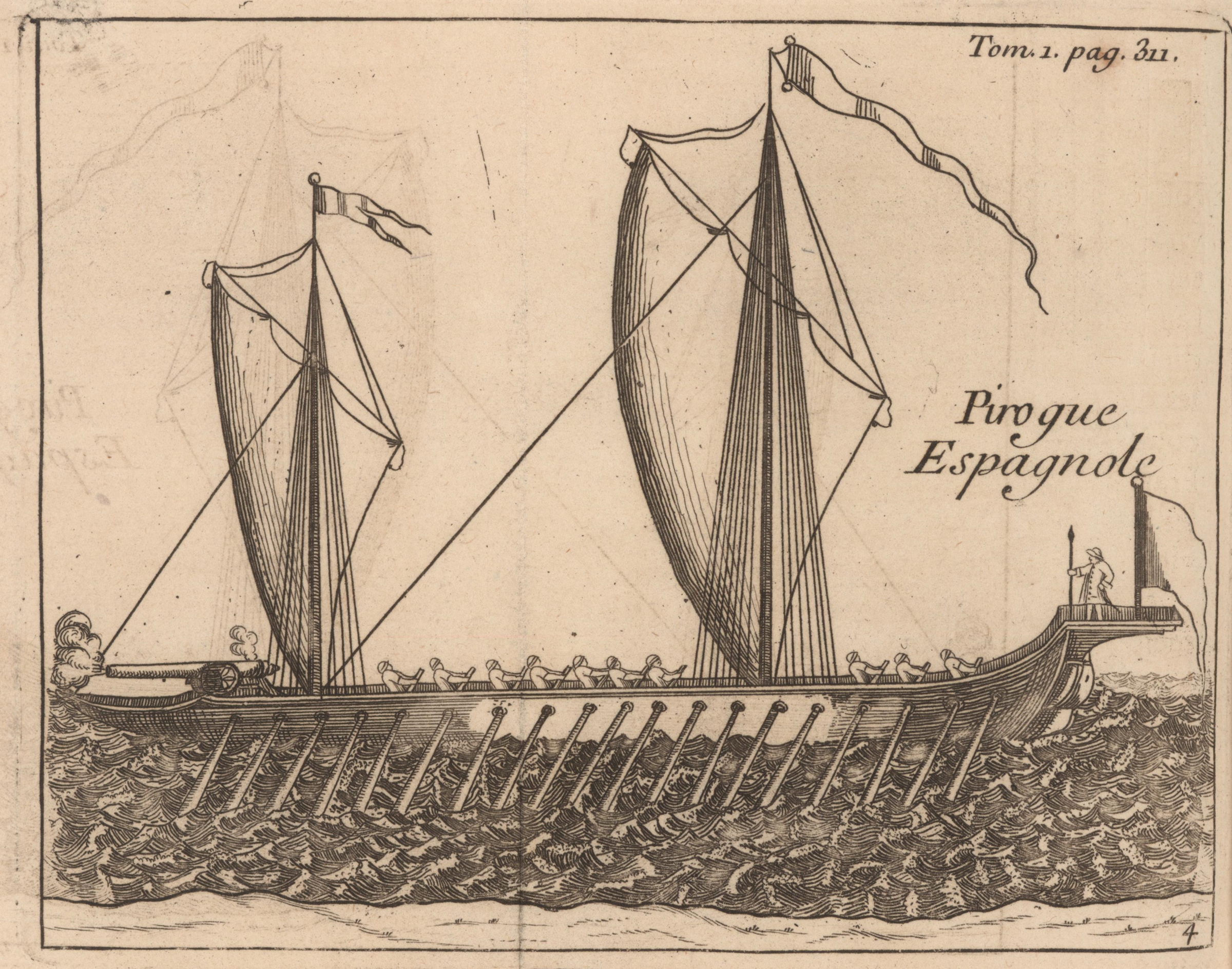


Michel, sieur de Grammont, the “general” of the buccaneers at the sack of Campeche (Laurens de Graff was the buccaneer “admiral”), brought away a half-galley with him after the town and surrounding region were attacked at length and then abandoned in 1685. In April of the following year Grammont’ set about to attack St. Augustine, Florida via the southern passage at Matanzas.
With Grammont’s flotilla was the half-galley captured at Campeche, armed with two carriage guns (remember, at sea a cannon is called a gun, back then and even today) at the bow and now commanded by Capitaine Nicolás Brigaut. His job was to collect intelligence, secure provisions, capture Native American interpreters, and prevent a warning from getting to St. Augustine while doing so. He easily captured a few soldiers from the watchtower—they rowed out to find out who he was and thereby discovered to their dismay who he was. The buccaneers tortured at least two of them for information regarding the defenses of St. Augustine.

It wasn’t long before word got to St. Augustine in spite of Brigaut’s precautions, and a small force commanded by José Begambre was sent against Brigaut and his marooned flibustiers. According to one account, the pirate captain sent two boatloads of men ashore, and according to another they fought from the half-galley. In any case, after a four hour battle the small Spanish force withdrew with casualties.
First point to Brigaut and his men! But plans seldom work as well in reality as in theory. Fortune turned against the pirates in the form of accident or ignorance of the local waters, and the half-galley wrecked on Matanzas Bar.
Worse, two more forces under the commands of Capitán Antonio de Argüelles, who had successfully ambushed attacking pirates in 1683, and Sargento Mayor (in other words, “Major”) Pedro de Aranda y Avellaneda, the former with nine soldiers and the latter with forty, arrived the following morning. The pirates had come ashore and, according to one account, made simple trenches from which to defend against a counterattack. After a second firefight, the Spanish again withdrew with casualties. The pirates had lost the element of surprise and feared more reinforcements. Brigaut sent several men in a ship’s boat to warn Grammont with instructions to pick the stranded pirates up at Mosquito Bar, the location today of New Smyrna Beach. The pirates headed south during the night.
Five leagues shy of their destination the gallant Brigaut and his gallant crew — or so we suppose they were gallant, at least in battle — were set upon by fifty or sixty Native Americans intent upon freeing the pirates’ prisoners. Again Brigaut’s flibusters put their attackers to flight. Unfortunately, one of Brigaut’s prisoners, Juan López, escaped and brought word to St. Augustine. Almost immediately gallant Capitán Francisco de Fuentes and fifty gallant men — again, we suppose they were gallant — headed south in two pirogues to attack Brigaut and his men at Mosquito Bar. Meanwhile, news spread fast in St. Augustine that as many as seven pirate ships had been seen, and that Grammont and his sloop were preparing to make a landing to the north now that the southern approach had been thwarted. Clearly the attack was not yet defeated.
And at Mosquito Bar the substance was of life and death, of raw survival, and, unfortunately for the buccaneers, luck was on the side of the Spanish by means of the timely accident that Brigaut’s men were separated into two parties. Luck, or Fortune if you will, often has poor timing, almost as if on purpose. The Spaniards slaughtered the nineteen pirates in the smaller group, then attacked the larger and massacred all but three, their desperate courage notwithstanding. Those they spared were not, by the way, any of the four remaining Spanish prisoners held by the pirates, which strongly suggests either that nearly everyone was slaughtered in an orgy of violent fear and rage that refused to distinguish between friend and foe, or that the Spanish believed the prisoners had deserted to the pirates, which Spaniards sometimes did, and so they put them to the sword as well.
Only here, in this description of slaughter, does our Hollywood image of Hollywood actors acting in Hollywood style — our cultural interpretation, in other words — begin to fail us as we — rather, if we — imagine soldiers and pirates sweating profusely in the combination of heat, humidity, rage, and fear, their hands and faces blackened with spent gunpowder, their burning eyes squinting from salt and the sea glare; as we imagine the sand sticking to the blood of those killing and of those dying or dead, most of whom probably called upon God both to kill and to save; as we imagine the flies swarming over and upon the dark purple that now stained, however briefly, the windswept battlefield dotted with the living and the dead among the coastal scrub.
We don’t know for sure if the Spaniards simply refused to grant quarter and slaughtered the pirates and prisoners in battle, or massacred them immediately after they surrendered, and it’s even possible that the pirates killed their prisoners themselves. Pirates liked to hold hostages, and French pirates sometimes decapitated their terror-stricken hostages — well, most were probably terror-stricken, but there may have been a few stubbornly courageous hold-outs who were merely afraid but not terror-stricken — when their demands weren’t met. Of course, hostage- and head-taking is something we find deplorable today, at least in “the real world,” but we generally condone in film and on television, at least if the hostage takers are the good guys and they don’t decapitate except in a fair fight. Terrorists and drug cartels behead the innocent — but surely our beloved swashbucklers don’t.

Even so, the pirates probably shouted something on the order of “Matamos los rehenes!” in Spanish at their attackers, which means “We are going to kill the hostages!” although the Spanish is actually in the present indicative tense, not the future simple, which is a more common usage in Spanish than in English when threatening future action. Just so you know.
A fair number of pirates could speak Spanish as a second language because it was useful for interrogating and torturing and tactical pretending and such. And some pirates were Spanish, siding with the English buccaneers and French flibustiers and against their own for profit, and probably a few for revenge — conversos and “crypto-Jews,” for example, although the Spanish interrogations of Spanish-born pirates I’ve seen are silent on the issue. Still, it’s likely some were.
At any rate, “Matadlos, no nos importa!” the Spaniards probably shouted back at the pirates, which means, more or less, “Go ahead and kill them, we don’t care!” although the phrase was more likely something on the order of “Go ahead and kill them you murdering French dogs, you pirates, thieves, and cutthroats, you sons of whores and cuckolds, you mostly Lutheran [which is what Spaniards called all Protestants] therefore un-Christian except in name French cowards who torture the innocent and rape virgins and bugger each other, and bugger your ugly French-pox’d mothers too!” Or likely something along these lines. Such language is common among soldiers and sailors of all eras.
As for the battle itself, likely the truth lies betwixt, as often it does: most of the pirates probably died in battle, and the rest, given that there was some quarter given, were summarily put to the sword in a violent assault right after they surrendered, which seems a reasonable if uncivilized thing to do to the pirates who had sacked Veracruz and Campeche, raping and murdering and torturing as they did. There is speculation that the Spaniards may have given no quarter due to the mistaken belief, carried by escaped prisoner Juan López to St. Augustine, that the Spanish renegade Alonso de Avesilla, who had guided the pirates during the 1683 attack on the city, was in command of the half-galley.
However, Avesilla (possibly the same Spanish corsario known as Augustino Alvares who commanded a barco luengo in 1683) reportedly had died at the flibustier home port Petit Goave two years before; his name may have been given out by the pirates as a joke. The three spared pirates were the white French captain Brigaut and a black pirate named Diego, a “native” of St. Christopher’s (therefore his real name might have been James or Jacques), until they could be interrogated, and a boy on account of his age. Diego, by the way, given that he was spared with Brigaut, may even have been Brigaut’s quartermaster, that is, his second-in-command, making him the highest ranking black — of full African origin, in other words — pirate officer of the so-called “golden age” discovered to date.

Brigaut confessed and was put to death — “Confess and be hanged!” has a long history in literature as well as in murderous hypocrisy of both the religious and political sort — at St. Augustine alongside Diego the Black Pirate who probably thought that piracy was a far better way of life than slavery (assuming he had been a slave), or at least until it came time to be hanged or garroted. Long before this Grammont had abandoned his attack on St. Augustine.
The official French account of the incident at Matanzas, sent from Governor de Cussy of Tortuga and Saint-Domingue to his superior in France, the Marquis de Seigneley, only barely resembled reality. Brigaut wasn’t a pirate, he was merely seeking provisions. The law permitted this seeking of provisions, water, and shelter in extremis. In fact, Brigaut wasn’t even mentioned by name, although his commander, the sieur de Grammont, briefly was.
Most of the few lines describing the incident were devoted to the sad story of a young Parisian of good family, the sieur de Chauvelin, who was reportedly given quarter, taken before the governor of St. Augustine, then put to death in spite of his quality as a gentleman. Further, during the battle itself it was twenty, or maybe seventy, pirates — or rather, twenty or seventy innocent French privateers attacked while innocently seeking provisions per international agreement — standing valiantly against three hundred Spaniards, who prevailed only after reinforcements arrived.
Governor de Cussy heard this story from a flibustier captain named du Marc, who had recently escaped from Spanish imprisonment and who probably had the story second hand, or even third or fourth hand. In any event, according to the French version, the beastly Spaniards weren’t hanging pirates who had come to sack St. Augustine, to plunder, murder, and rape. Rather, they were murdering young Parisian gentlemen who were only seeking provisions. Or murdering at least one young Parisian gentleman, and if one, then probably others, naturally. All we really know from du Marc’s version of this story is that a young man named Chauvelin, of adventurous spirit, joined a band of flibustiers and probably died on or near a pretty Florida beach.

So, was the half-galley depicted above the one commanded by Brigaut? Probably, or more than probably, for my research strongly suggests that there were only two half-galleys at French Hispaniola in the late 1680s: Nicolás Brigaut’s, captured at Campeche in 1685 by the sieur de Grammont, then home-ported at Petit Goave, and lost in 1686 at Matanzas, Florida; and one built by the French and apparently home-ported at Cap François, the French capital of Saint-Domingue. The latter was sent in 1686 to look for remnants the pirate Banister’s crew at Samana after a pair of English men-of-war destroyed his ship, the Golden Fleece. A third, Spanish, which I originally believed to have been captured in 1687 at Petit Goave, in fact escaped to Cuba.
Brigaut’s half-galley would have been home-ported at Petit Goave, and the illustration is part of a 1688 chart of Petit Goave. Paul Cornuau, who drew the chart, had been at Hispaniola since at least 1684 and would have been familiar with the vessel. In fact, it is entirely possible that the two flibustiers standing in the foreground might be members of its crew, perhaps even Brigaut and Diego, but unfortunately we’ll never know.
I’ve used numerous sources for this account, more than I’m inclined to list here. However, interested readers can start with “Grammont’s Landing at Little Matanza’s Inlet, 1686,” by Luis R. Arana and Eugenia B. Arana in El Escribano: The St. Augustine Journal of History, 9, no. 3 (1972); “The Testimony of Thomás de la Torre, a Spanish Slave” by Alejandra Dubcovsky in The William and Mary Quarterly, Vol. 70, No. 3 (July 2013); and The Struggle for the Georgia Coast by John E. Worth (Tuscaloosa: University of Alabama Press, 2007).
The 14-gun Saint-Roze & a 6-gun Bark Commanded by Laurens de Graff & Jean Charpin

It is no accident that Laurens de Graff looms large in these histories of eyewitness images of piratical vessels: he was the greatest of buccaneers in the 1680s, a period also in which French engineers were drafting charts of French Caribbean ports and illustrating them with local ships and buccaneers.
In the year 1687 de Graff was still cruising as a buccaneer in French service, but had been offered and accepted a commission as a regular military officer in the service of the French king. However, before he could take up said commission, he must first receive his pardon for the death of Captain Nicolas Van Horn in a duel at Campeche in 1685, his letters of naturalization as a French citizen, and his commission as an officer.
So while he waiting he did what he knew best: he cruised for Spanish plunder. Late in the previous year he lost his famous Neptune, with which he had fought the two greatest ships of the Armada de Barlovento, forcing them to withdraw. While chasing a Spanish bark near Cartagena de Indias, he ran aground on an unknown rock or reef. The crew of the Spanish bark ran their vessel aground and set it afire, but Laurens quickly set out in a canoe, boarded it, put the fire out, and put his crew aboard
This small six-gun bark, which may be seen on the right side of the image above, replaced his grounded and foundered Neptune. In March 1687 Laurens and his one hundred fifty men — imagine them all crammed into the small bark! — raided the coast of Costa Rica and ascended the Matina Valley. In August thirty of his crew abandoned the cruise and returned to Petit Goave, and in October Laurens and the rest of his crew returned, having first captured the Santa Rosa of seventy-six tons (probably toneladas de mercante, roughly equal to ninety de guerra, close to English tonnage) and fourteen guns near Cartagena. The small Assiento ship was en route to Curacao to buy slaves, and therefore had approximately 75,000 pieces-of-eight aboard — and each man’s share would come to roughly 500 pieces-of-eight, quite a profitable cruise in the end!
The Santiago, a frigate of the private pirate-hunting Armada de Vizcaínos (the Armada of Biscay, or informally, Basque Armada, referred to as La Armada de Nuestra Señora del Rosario by its former admiral), commanded by Fermín de Salabarría who had once served as general of the galleons of the Philippines, set out in pursuit but ran aground; the ship was lost on June 26, 1688. The armada had some minor successes, but largely failed at its purpose, apparently preferring trade and smuggling to less profitable pirate hunting.
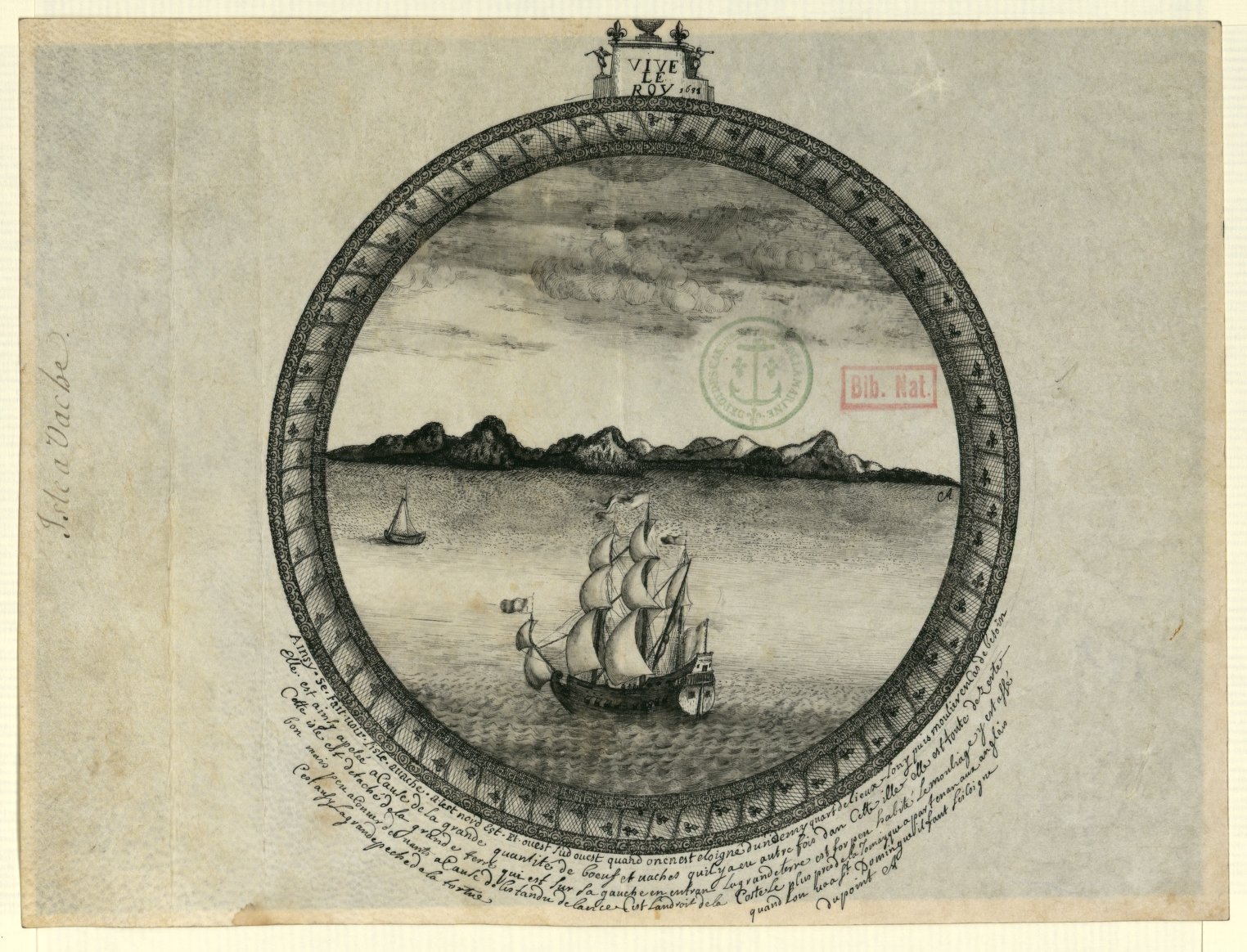
At Petit Goave Laurens received his pardon, naturalization, and commission as an officer, and also orders from Governor de Cussy to occupy Île-à-Vache. Everyone knew war was coming, and preparations had begun in earnest. Unfortunately, in spite of his now official status as a French major responsible for helping defend Saint-Domingue, de Graff had almost immediately set sail again as a buccaneer, with the Saint-Roze as his flagship and the small Spanish bark, the latter almost certainly commanded by his lieutenant Jean Charpin.
Receiving word of this, Governor de Cussy set sail in the French man-of-war Le Marin and intercepted de Graff and Charpin and ordered them to abandon their plans to cruise against the Spanish, and return to Petit Goave. The incident, illustrated by Parthenay, is shown below.

To pacify the restive buccaneers, de Cussy granted land at Cul de Sac to one hundred fifty of them. The remainder sailed with de Graff and Charpin sailed to Île-à-Vache to follow de Cussy’s orders and occupy the often disputed island.
Well, sort of.
Whether instigated by de Graff who would profit from the voyage, or by French buccaneers who had no intention of sitting on their butts occupying an island when they could be cruising against the Spanish, seventy or eighty of them signed articles, with Jean Charpin as their captain and Mathurin Desmarestz as their quartermaster, and set sail aboard the Saint-Roze with de Graff’s blessing — after all, as owner of the ship, he would profit handsomely from a successful cruise.
The articles are notable because they are one of the few original sets that exist; most sets of known articles are described accurately in other sources, for example, in Alexandre Exquemelin’s works. However, although their articles are described in such sources, they are not recorded as written in individual sets of articles. For this reason I’ve included those of the Saint-Roze here, in their original French and in translation. The translation is mine, and any errors in it are therefore mine. I’ve annotated the English translation. (Additional extensive details on buccaneer articles can be found in The Buccaneer’s Realm.)

Copie de la charte-partie faite entre
M. Charpin, commandant la Sainte-Rose, et son équipage qui sont convenus entre eux de lui donner dix lots pour lui, que pour son commandement et pour son navire.
Tous les bâtiments pris en mer ou à l’ancre portant huniers qui ne se donneront point voyage; les bâtiments seront brûlés et les agrès seront pour le bâtiment de guerre.
Item. Tous les bâtiments pris, le capitaine aura le choix; et le non-choix demeurera à l’équipage sans que le capitaine y puisse rien prétendre.
Item. Le capitaine se réserve ses chaudières et son canot de guerre; et les chaudières qui seront prises seront pour l’équipage.
Item. Tous bâtiments pris hors de la portée du canon avec les canots de guerre seront pillage. Tous ballots entamés entre deux ponts ou au fond de cale, pillage.
Item. Or, argent, perle, diamant, musc, ambre, civette et toutes sortes de pierreries, pillage.
Item. Celui qui aura la vue des bâtiments aura 100 pièces de 8 si la prise est de valeur ou double pillage.
Item. Tout homme estropié au service du bâtiment aura 600 pièces de 8 ou 6 nègres a choix s’il s’en prend.
Item. Tout homme convaincu de lâcheté perdra son voyage.
Item. Tout homme faisant faux serment et convaincu de vol perdra son voyage et sera dégradé sur la première caye.
Item. Tout canot de guerre qui sortira en course qui prendra au-dessus de 500 pièces sera pour l’équipage dudit canot.
Item. Tous nègres et autres esclaves qui seront pris par le canot reviendront au pied du mât.
Item. Pour les Espagnols qui ne seront point guéris, étant arrivé en lieu, l’équipage s’oblige de donner une pièce de 8 pour lesdits malades pour le chirurgien par jour l’espace de 3 mois étant arrivé à terre.
Item. M. de La Borderie et M. Jocom se sont obligés de servir l’équipage de tout ce qui leur sera nécessaire pendant le voyage; et l’équipage s’oblige de leur donner 180 pièces de 8 pour leur coffre; et ceux des chirurgiens qui seront pris avec les instruments qui ne seront point garnis d’argent seront pour le chirurgien.
Ladite charte ne pourra se casser ni annuler que nous n’ayons fait voyage tous ensemble.
Fait à l’île à Vache, ancré et affourché le 18 de février 1688.
Ainsi signé : Jean Charpin et Mathurin Desmarestz, quartier-maître de l’équipage.
Copy of the charter-party made between
Mr. Charpin, commander of the Sainte-Rose, and his crew who agreed among themselves to give him ten shares for himself, for his command and for his ship. [Captains were typically given extra shares as “owners” of their vessels; this is how they could get rich. Charpin’s ten shares would include two for his service as captain, as compared to the common buccaneer’s single share. This leaves eight shares for the vessel; such determination was based on the size and state of the vessel, and its armament, as judged by the crew. Such determination often worked out to roughly one share per ten tons or per gun (a general rule of thumb is one gun per ten tons for determining a vessels’s armament), although it was just as often less than this, as it is here.]
All vessels taken at sea or at anchor carrying topsails which will not give themselves a voyage [i.e. be kept as prizes]; the vessels will be burned and the rigging will be [used] for the man-of-war [the Saint-Roze].
Item. All vessels taken, the captain will have a choice; and those he does not choose will remain with the crew without the captain being able to claim anything from it. [Typically this means that the captain could swap his ship for another, if better.]
Item. The captain reserves his cauldrons and his war canoe [canoes and pirogues were often used in the Caribbean instead of common ship’s boats]; and the cauldrons that will be taken will be for the crew. [Cauldrons, whether for cooking or for boiling cane juice were valuable and were common plunder. Here, the captain is probably claiming ownership over the ship’s cookroom cauldrons and the ship’s main boat or canoe.]
Item. Any vessels taken out of cannon range with war canoes [armed canoes or boats] will be plundered. All bales [already] started [opened] between two decks or in the hold, pillage. [There was a distinction between plunder and pillage; the former was shared among the entire crew, owners, and government, the latter was usually shared only among the crew. The article indicates that bales found already open ‘tween decks or in the hold are pillage, not plunder. Of course, it would be hard to prove how many were already “started”…]
Item. Gold, silver, pearl, diamond, musk, amber, civet and all kinds of precious stones, pillage. [This is a significant article, indicating that much valuable plunder will remain in the crew’s hands, not the owner’s or government’s. However, coin/specie is almost certainly excluded by custom from the definitions of gold and silver.]
Item. Whoever has the [first] sighting of the [captured] vessels will have 100 pieces-of-8 if the catch is valuable or double plunder [double share, if it is not valuable].
Item. Any man crippled [maimed] in the service of the vessel [cruise] will have 600 pieces-of-8 or 6 blacks [slaves] according to his choice. [See also the article on surgeon payment below.]
Item. Any man convicted of cowardice will lose his voyage [his shares and other profit will be confiscated and divided among the rest of the crew].
Item. Any man falsely sworn and convicted of theft will lose his voyage [see article above] and be degraded [stripped of the name and quality of a flibustier and marooned without food or clothes, according to a 1697 source] on the first key [the first island encountered].
Item. Any war canoe that goes out cruising that takes [captures] over 500 pieces [-of-eight] [it] will be for [divided among] the crew of said boat.
Item. All blacks and other slaves [Native Americans, mulattos, and mestizos were often taken as slaves] who will be taken by the canoe will return to the foot of the mast [i.e. will be considered as pillage; pillage was typically divided at the foot of the mainmast, as were other division of spoils].
Item. For the Spaniards [wounded Spanish prisoners] who will not [cannot] be cured, having arrived in place [to put them ashore?], the crew undertakes to give a piece of 8 for the said patients for the surgeon per day for the space of 3 months having arrived on land. [This appears to be payment to the ship’s surgeon for having treated wounded Spaniards. It probably also applies to any wounded, as an eyewitness description suggests: a piece-of-eight a day per patient to the surgeon for up to forty days, and the same to each wounded flibuster.]
Item. M. de La Borderie and M. Jocom are obliged to supply the crew with everything they will need during the voyage; and the crew undertakes to give them 180 pieces of 8 for their chest; and those of the [Spanish] surgeons who will be captured with the instruments which will not be lined with silver will be for the [ship’s] surgeon. [This article applies to the two surgeons: they must supply all instruments and medicines for the voyage, for which they are to be paid 180 pieces-of-eight for their surgeon’s chests. Any captured surgeon’s chests belong to the ship’s surgeons unless the instruments &c are of silver, in which case they are pillage.]
Said charter cannot be broken or canceled until we have cruised together.
Done at Ile à Vache, at anchor and in harbor, 18 February 1688.
Thus signed: Jean Charpin and Mathurin Desmarestz, quartermaster of the crew.
Captain Jean Charpin, known among Caribbean Spaniards as Juanillo, was of mixed race, probably white and Native American. A native of Sanlúcar de Barrameda in Spain, his father French, his mother Spanish, he was, like his former captain Laurens de Graff, a renegade who had deserted Spanish service. He had served at de Graff’s side since at least 1683. As a side note, Spanish records indicate that one of the crew of the Saint-Roze was a Genoese married to a Cuban woman at Guanauacoa.
The Saint-Roze set a course for the isle of Roatan in the Gulf of Honduras and careened there. The island was a well-known rendezvous of buccaneers, and soon the crew of the Saint-Roze was increased by the addition of a group of buccaneers — or more correctly, pirates — who according to French and Spanish records had returned overland from the South Sea (here, the Pacific coast of the Spanish Main) via the Coco River on the borders of Nicaragua and Honduras. Without doubt they were part of Pierre Picard’s expedition (as was buccaneer-author Raveneau de Lussan). Some scholars suggest instead that they many have recently left service under Jan Willems aka Yankey after he attacked the bodegas on the Rio Dulce and the Honduras urca at Puerto Caballos.

In any case, the new arrivals were commanded by a Huguenot named Jean Fantin who had previously served under the mutineer captain Pierre Pain aboard the French man-of-war La Trompeuse as quartermaster, and then under the Dutch flibustier-in-French-service (there were a lot of them) Captain Yankey aboard the Hardy. Having careened, the buccaneers set sail and plundered Trujillo and Olancho in Honduras, gaining only small plunder, six thousand pieces-of-eight of which were acquired via the ransom of local officials. From Honduras the buccaneers sailed to Cuba, cruised off Havana to no profit, went ashore to shoot pigs and cattle for provisions, and slipped away from an armadilla sent after them.
From Cuba the buccaneers sailed to New Castle in Pennsylvania (modern Delaware), capturing en route a Dutch merchantman of 120 tons and fourteen guns. They also captured an English sloop trading from Barbados to the Bermudas. After plundering the sloop and taking it as a prize the buccaneers gave the merchant crew the Saint-Roze which was becoming unseaworthy, and was certainly unfit for a voyage to the far side of the world. The merchant seamen sailed the Saint-Roze to Barbados where it was eventually sold for scrap, having been determined to be unfit for sea anymore and unrepairable — buccaneers had a deserved reputation as lazy seamen, often failing to do necessary maintenance and repairs. Charpin’s rovers soon released the merchant captain too, and returned his sloop to him as well.
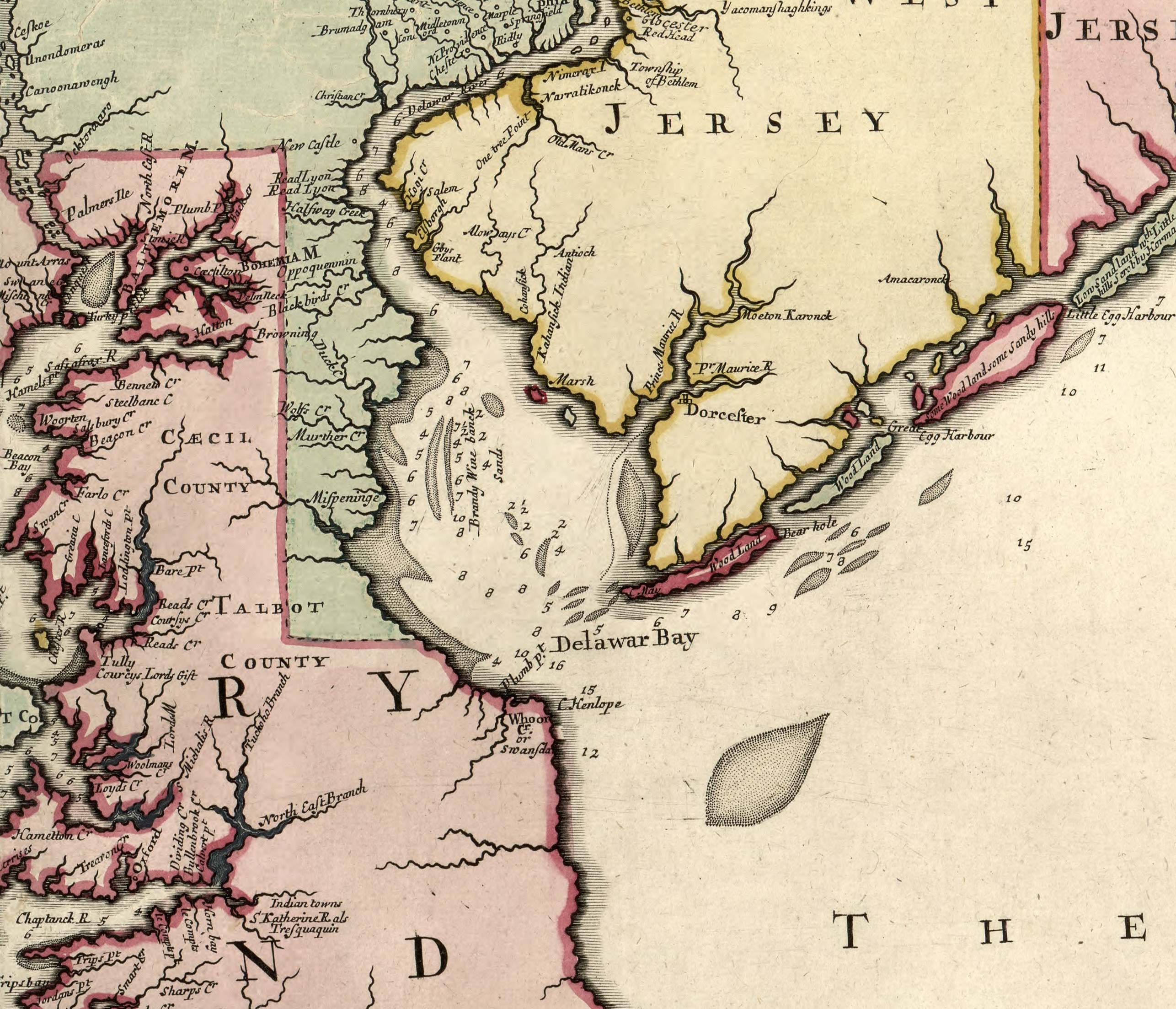
The buccaneers sold the cargo of the Dutch prize, now named the Dauphin, in New Castle, “Pennsylvania” (the region, including New England, was always a haven for pirates) for provisions. The buccaneers sailed to Boa Vista in the Cape Verdes, originally intending to plunder the Guinea Coast. Here they debated their next course: Guinea, the Red Sea, or the South Sea. Conflict set in: Jean Fantin was elected captain and claimed the Dutch prize as his own, contrary to the articles of the Saint-Roze. While there, a flotilla under the command of Jean du Casse arrived, en route to raid Surinam. Charpin appealed to du Casse regarding the Dutch prize, but was rebuffed. Du Casse also turned a blind eye to the buccaneers’ capture of a richly-laden sixteen-gun Spanish merchantman, commanded by Francisco Dias de Padilla, from Havana, other than to attach it as a fireship to his squadron, and persuade, by threat of force, the buccaneers to join his expedition.

After du Casse’s desultory and generally unprofitable raid on Surinam, Charpin returned to Petit Goave in command of the Dauphin and, at least until 1695 and probably until King William’s War ended in 1697, served as a French flibustier corsaire (a buccaneer-privateer), operating largely in the Caribbean although at one point, in concert with Captain Picard and other flibustiers, he cruised far north to raid Rhode Island.
His quartermaster Mathurin Desmarestz (a nomme de guerre, his real name was Isaac Veyret) upon his return took a commission as captain of a French privateer flute, the Machine, of three hundred tons and eight guns out of Martinique. In 1690, in consort with a barque commanded by the sieur de Montauban, he captured a rich Spanish galleon, the Jesús Nazarena y Nuestra Señora del Carmen, nicknamed the Ballestera and commanded by Pedro Fernandez de Valenzuela. Desmarestz and the Ballestera cruised the Caribbean for another year, then, having armed the ship with thirty-two guns and manned it with three hundred men, set sail for the Red Sea, to include encounters with Henry Every… But that’s another story!
But as or more interesting perhaps is the tale of the Spanish prize captured at the Cape Verdes, now commanded by Jean Fantin. The Huguenot captain and his crew returned to Martinique where they were commissioned as corsaires. Joining du Casse’s flotilla again, they sailed to St. Christopher where approximately one hundred ten of the crew assisted du Casse in mounting a six-gun battery ashore to dislodge the English defenders. As they did so, the remaining eight English aboard mutinied, “overcame” the dozen remaining French buccaneers, and set sail for Antigua where they were commissioned as an English privateer and recruited another seventy to eighty buccaneers for their crew.
Why does this matter? Because among these eight mutineer Englishmen were William Kidd and Robert Culliford (also Colliver), both of whom would meet again on the far side of the world, one as a failed pirate hunter, the other as a Red Sea pirate. In fact, both may have been with Fantin in the South Sea under Picard or with Yankey when he raided Honduras, or even were with Charpin aboard the Saint-Roze at Île-à-Vache. Kidd was made captain of the former French privateer, now named the Blessed William — and his crew would soon run away with the ship while Kidd was ashore, and turn pirate. The rest is history.
And to add a curious footnote: the Santa Rosa is almost certainly the same Spanish Assiento slave ship owned by the company of Don Juan Coymans that in January 1686 was intended to carry 600 slaves to Portobello from Jamaica. In December 1684 it had sailed from Jamaica to Portobello with 304 slaves aboard. In March 1686 Lieutenant-Governor Hender Molesworth of Jamaica, having lost the service of the HMS Ruby, ordered the ship impressed and fitted out to hunt the pirate Bannister (see below), in company with the HMS Bonneta. However, the expedition does not appear to have actually sailed; the arrival of the HMS Falcon and HMS Drake precluded any need to impress the Spanish ship.
For more details on Charpin, Fantin, and Veyret, see the Dictionnaire des Flibustiers des Caraïbes by Jacques Gasser (Les Sables d’Olonne, France: Editions Beaupre, 2017). Details on the Coymans Assiento can be found in numerous scholarly studies.
A Pirate Ship Captured at Baradaires, Saint-Domingue in 1687 by Flibustier Jean de Bernanos

In October 1687, upon hearing word that a pirate — described in French as a forbin, that is, a true pirate, not a flibustier — was on the coast, after having plundered the Guinea Coast of Africa and probably attempting to sell a cargo of slaves illicitly — Governor de Cussy dispatched the sieur de Franquesney aboard the man-of-war Le Marin to seize the pirate. No fool when it came to dealing with pirates, Franquesney recruited veteran buccaneer Jean de Bernanos, who recruited fifteen flibustiers to augment the naval seamen in case push came to shove.
At Baradieres the French man-of-war trapped the pirate who, hoping to ingratiate its crew with the warship’s captain and crew, fired a twelve-gun salute, but to no avail. Bernanos and his men boarded and seized the small frigate and its cargo. For his service, Bernanos was awarded the ship, although almost certainly not its cargo which would have been seized by the local government as piratical goods. To date, I have found no records indicating who the captain and crew of the pirate ship were, nor even their nationality.

Little is known of Jean de Bernanos, aka Captain La Sound or Lessone, prior to his becoming a flibustier except that he had formerly been a captain of cavalry, in France as far as we know. One author reports his birth place and year as Metz, France, 1645, while others suggest his birth date and place are unknown. He is found first in written records as having crossed the Isthmus of Panama in 1679 with eighty-five buccaneers under his command and two hundred Native American allies. Forewarned of his coming by the leader of rival tribe, Spanish forces from Panama intercepted Bernanos at Cheapo and forced the buccaneers to retreat.
In 1680 Bernanos and his flibustiers aboard their ninety-ton, six-gun frigate joined John Coxon and company in the sack of Portobello, but declined to join the English buccaneers on their journey across the Isthmus of Darien and into the South Sea, a voyage made famous by the adventures of escapades primarily under the command of the famous rogue Bartholomew Sharp. Bernanos and his buccaneers turned back after the attack on the Spanish gold mines.
Bernanos next appears in command of a five-vessel flotilla: his Schitié of eight guns and eighty men; Grogniet’s Saint-Joseph of six guns and seventy men; Blot’s Guagone (or Quagone) of eight guns and ninety men; Vigneron’s barque Louise of four guns and thirty men; and Petit’s “bateau” Rusé of four guns and forty men. In May 1684 Bernanos’s buccaneers and their Native American allies ascended the Orinoco River and attacked Santo Tome de Guyana, capturing the local fort after a six-hour battle. Little plunder was found. Bernanos and his buccaneers burned the small town and carried away several important prisoners whom they ransomed at Port of Spain, Trinidad, for ten thousand pieces-of-eight and various goods and supplies. One scholar suggests the expedition up the Orinoco was in search of fabled treasure that did not exist.
Bernanos appears to have afterward retired to his plantation on Tortuga until brought back into service against the pirate at Baradieres. King William’s War broke out effectively in 1688, and in 1689 we find Bernanos in command of a twenty-gun, one-hundred fifty-man privateer, quite possibly the captured pirate vessel in the image above.
In May 1690 he attacked a flotilla of English turtle fishing vessels, but all escaped except for one bark, the Calapatch (a calapatch is the top shell of a turtle), who valiantly attacked the privateer, permitting the escape of its companions.
Soon afterward Bernanos captured a considerable Spanish prize but the prize crew mutinied, sold the cargo at the pirate haven of St. Thomas — a Danish colony — where they recruited more men and turned pirate “against all flags” but reportedly perished in the end.
In 1692 Bernanos was commissioned as a major in the French army and was given command of the fortification at Port-de-Paix, Saint-Domingue. Described as a “brave man…, captain of cavalry, who had been a privateer…,” he died defending Port-de-Paix against a combined English and Spanish attack in 1695.
For more information on Bernanos, see the Dictionnaire des Flibustiers des Caraïbes by Jacques Gasser (Les Sables d’Olonne, France: Editions Beaupre, 2017).
The Golden Fleece of Joseph Banister and the Saint-Nicolas aka Le Favori aka La Chavale of Michel Andresson and soon François Rolle, 1686
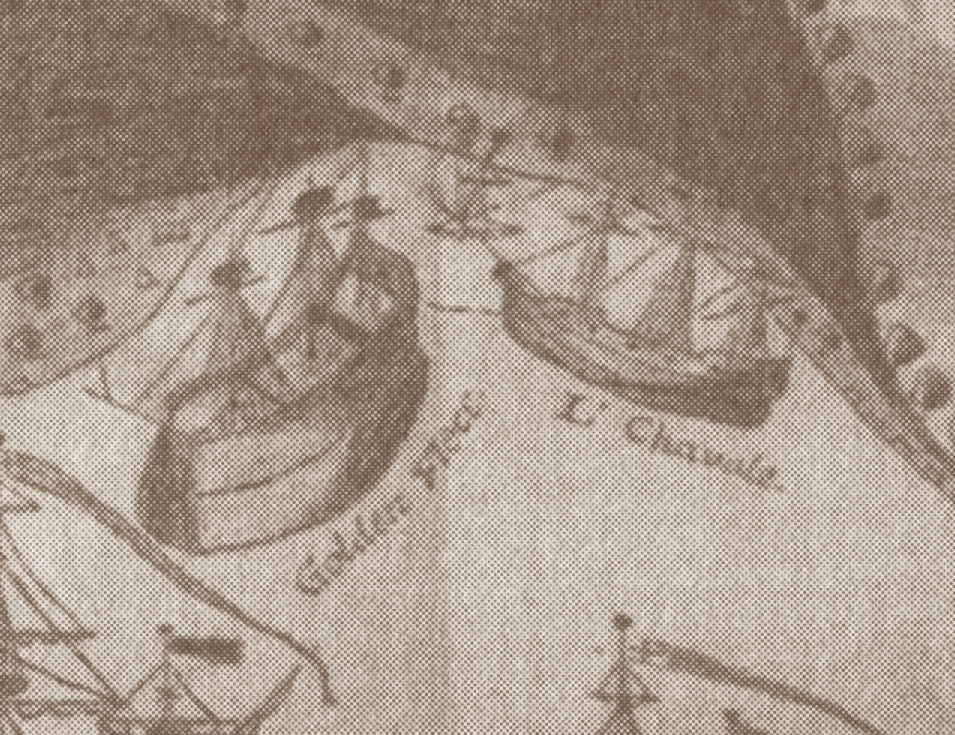
The image above shows two ships, the Golden Fleece, a pirate, commanded by Joseph Bannister, and La Chavale, a flibustier but soon to be pirate, commanded by Michel Andresson. Drawn by ship’s clerk John Taylor, it was one of many that illustrated his manuscript of his life at Port Royal, Jamaica in 1687. However, although Taylor did sail aboard the HMS Falcon for a few months, he was not present during the attack on Bannister’s ship, described below, in 1686, although he pretends he was; the details were described to him by officers and crew of the HMS Falcon.
If you’ve read Captain Blood: His Odyssey by Rafael Sabatini, you’re familiar with the escape of Peter Blood and the Arabella from Port Royal, Jamaica, a scene Sabatini may have been influenced to write by the escape from Port Royal in early 1685 under the guns of Charles Fort by Captain Joseph Bannister (or Banister), commanding the 30-, 36-, or 40-gun, 400 ton merchantman Golden Fleece. The ship had been trading from London to Port Royal under his command at least as early as 1680, when she sank in nine fathoms while at anchor in the harbor. The Golden Fleece discharged her entire lading but, due to a lack of local goods, had loaded little in its place. The ship was top-heavy and when her crew went to one side to scrape the hull, the Golden Fleece overset, drowning several of her crew. With the help of several divers the ship was refloated and refitted, but at a loss of £1,000 to her owners, one of whom was surely Bannister.

In early May 1684, Bannister, heavily in debt probably due to losses from the 1680 accident, put to sea from Port Royal, claiming to be bound to New England for trade but intending piracy instead. He recruited one hundred men from local sloops and probably the French buccaneer haven at Petit Goave, and petitioned the French for a privateering commission, which was denied, although he apparently received some backing from the famous buccaneer Michel, sieur de Grammont. In July Bannister, his ship, and crew were captured by the English pirate hunting guardships HMS Ruby, HMS Bonetta, and a half-galley while he was catching and salting turtle for provisions in the Cayman Islands. Wisely, the pirates did not put up a fight. Bannister had “115 men on board, most the veriest rogues in these Indies,” according to Sir Thomas Lynch.
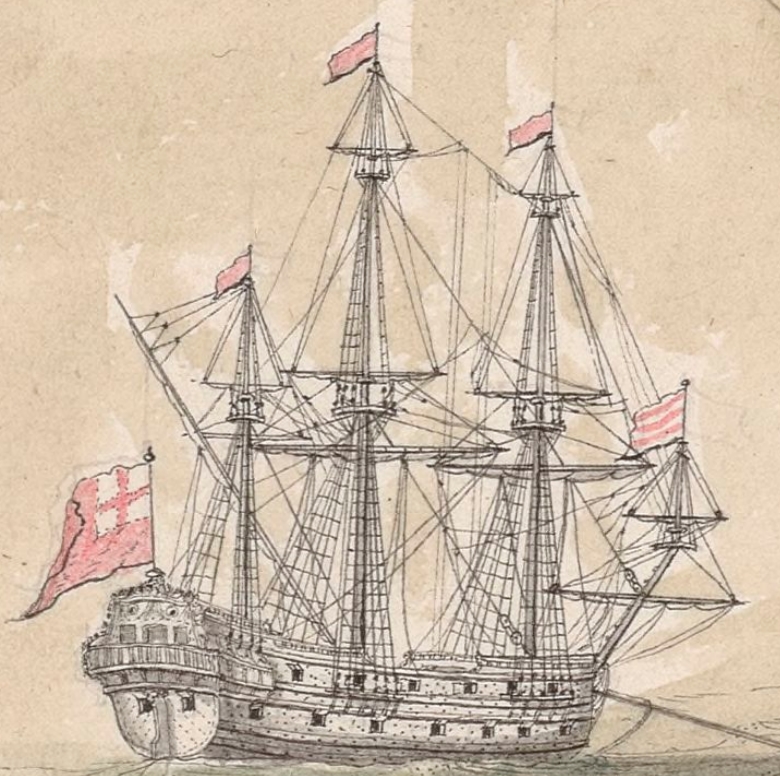
Bannister and his crew were held for piracy, having captured a Spanish canoe with two men aboard and kept the men as prisoners. But Bannister was able to communicate with allies in Jamaica, who provided him with money to pay the Spaniards for their canoe and cargo, and even to pay them wages while they had been in his custody. The Spaniards would not testify against Bannister, and so the grand jury, with a vote of nine opposed and four in favor, refused to find a true bill. Bannister, not believed likely to run due to security (a bond) provided by friends, was ordered held for a second attempt at trial for piracy. Meanwhile, he dispatched the Golden Fleece to London and back under another captain, but the voyage failed to bring him any profit. He therefore made his plans and preparations to once more attempt piracy.
As Lieutenant-Governor Hender Molesworth (1638 – 1689) of Jamaica described it, “About ten days since Captain Bannister one dark night sailed in a desperate manner passed the fort. He had, it is said, fifty men ready in the hold with plugs to stop shot-holes. But the sentries being careless, the night dark, and the wind fresh, he was abreast of the fort before Major Beckford, the commander, was warned, and had passed fourteen of the guns. Beckford did all that he could, but could only place three shot in him. He at once sent me word of the occurrence, which was a great surprise to me, for I thought that Bannister’s want of credit would prevent him from ever getting the ship to sea again.” Bannister had slipped his cables; John Taylor claimed he had 160 men aboard.
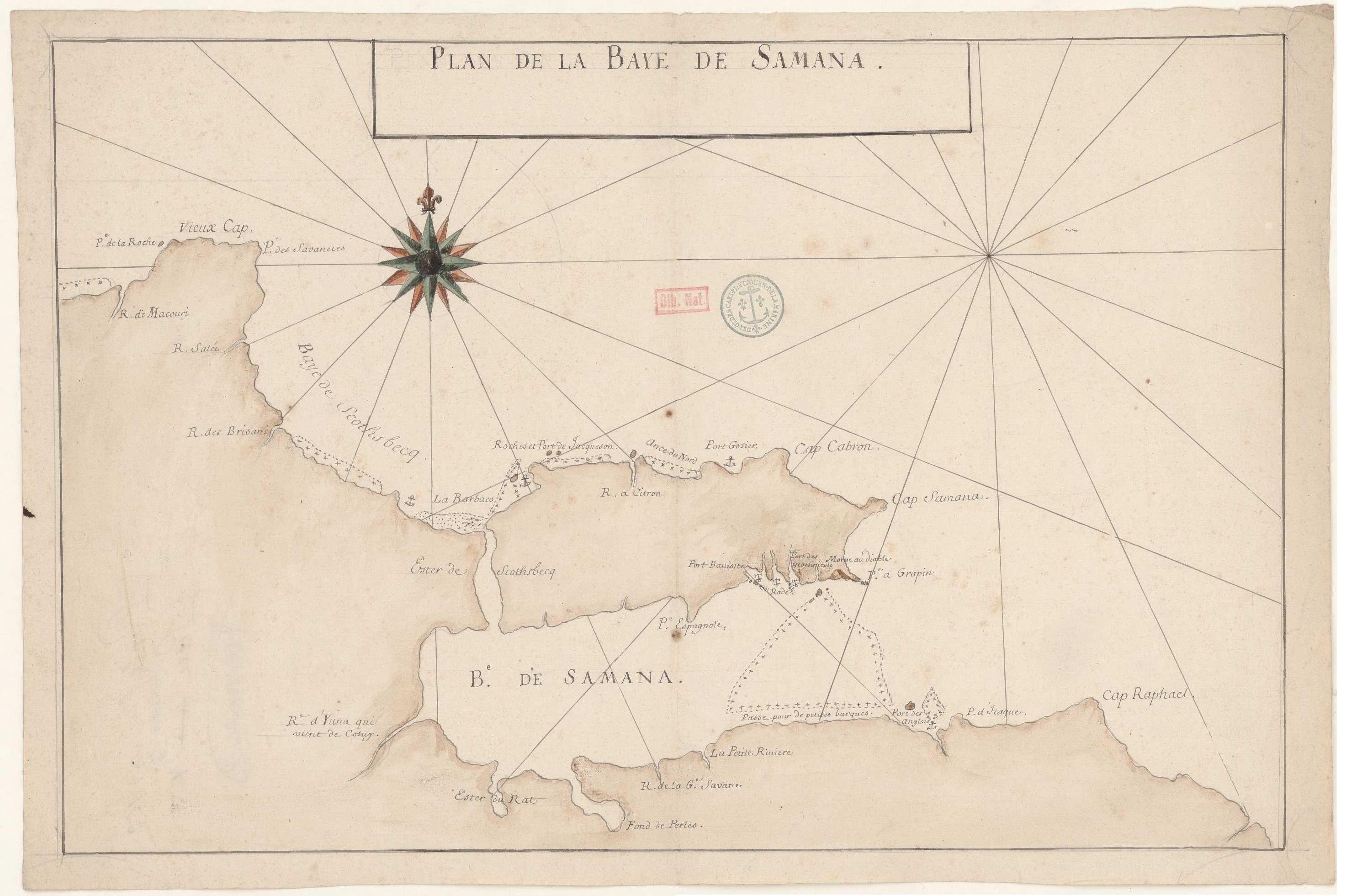

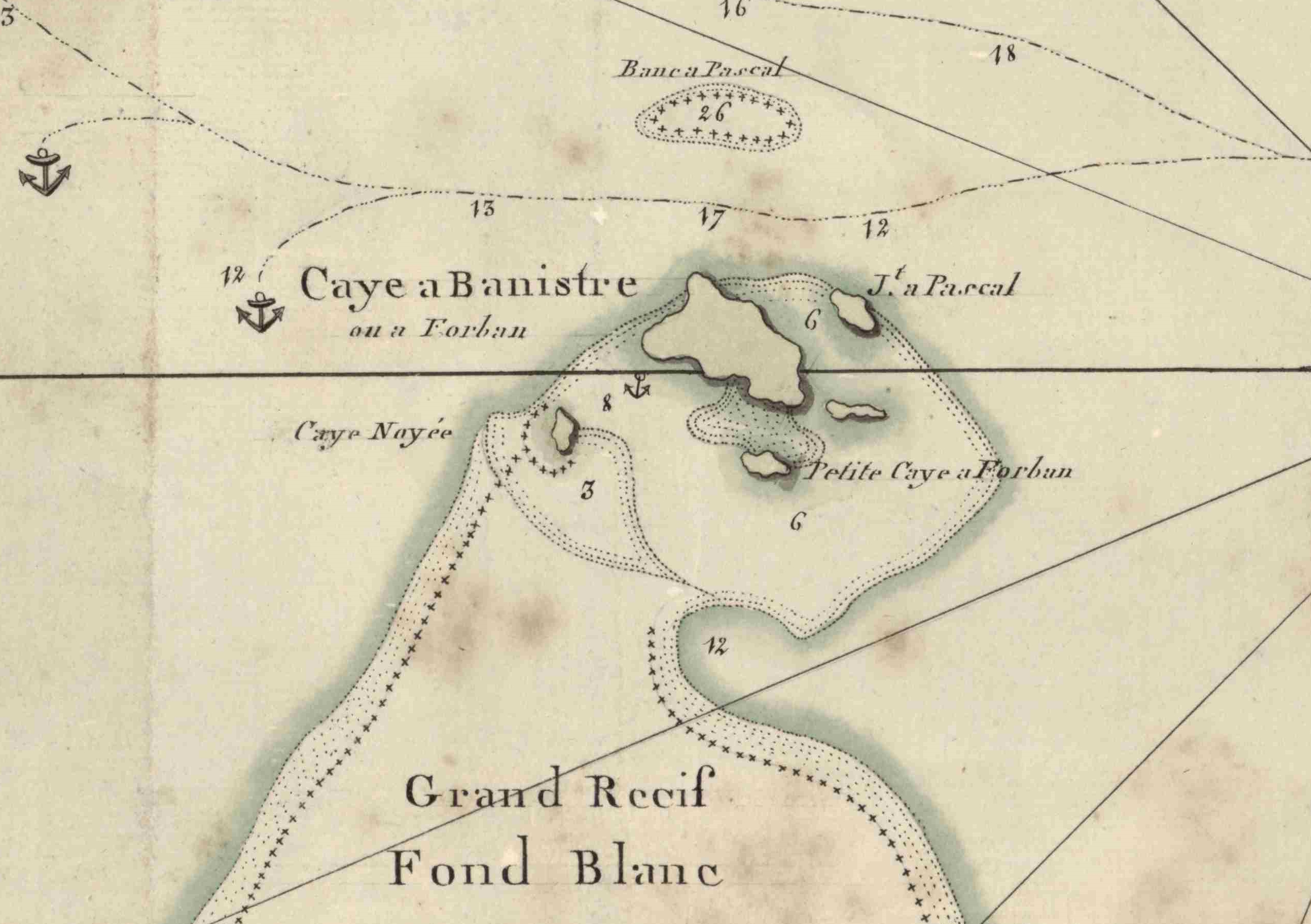
The sloop HMS Bonetta (or Boneta, 4 guns, 57 tons; Bonito in colonial records), commanded by Edward Stanley, sailed after Bannister and ordered him to return but the renegade declined, giving assurances he had no intention of turning pirate, which he soon did. For the next year Bannister mixed first with French buccaneers then set out on his own, capturing Spanish vessels. A demand by the HMS Ruby that de Grammont, in whose flotilla he consorted for a while, turn him over for sailing under a foreign commission was rebuffed, ostensibly because the French claimed Bannister had no commission from them. The English captain did not insist, given the size and number of the French ships, which included those of de Grammont, Laurens de Graff, and Jan Willems aka Yankey — the three most powerful and famous of the 1680s. Bannister is believed to have remained with the French buccaneers, and was probably with them at the sack of Campeche soon afterward. But if so, it was to little profit.
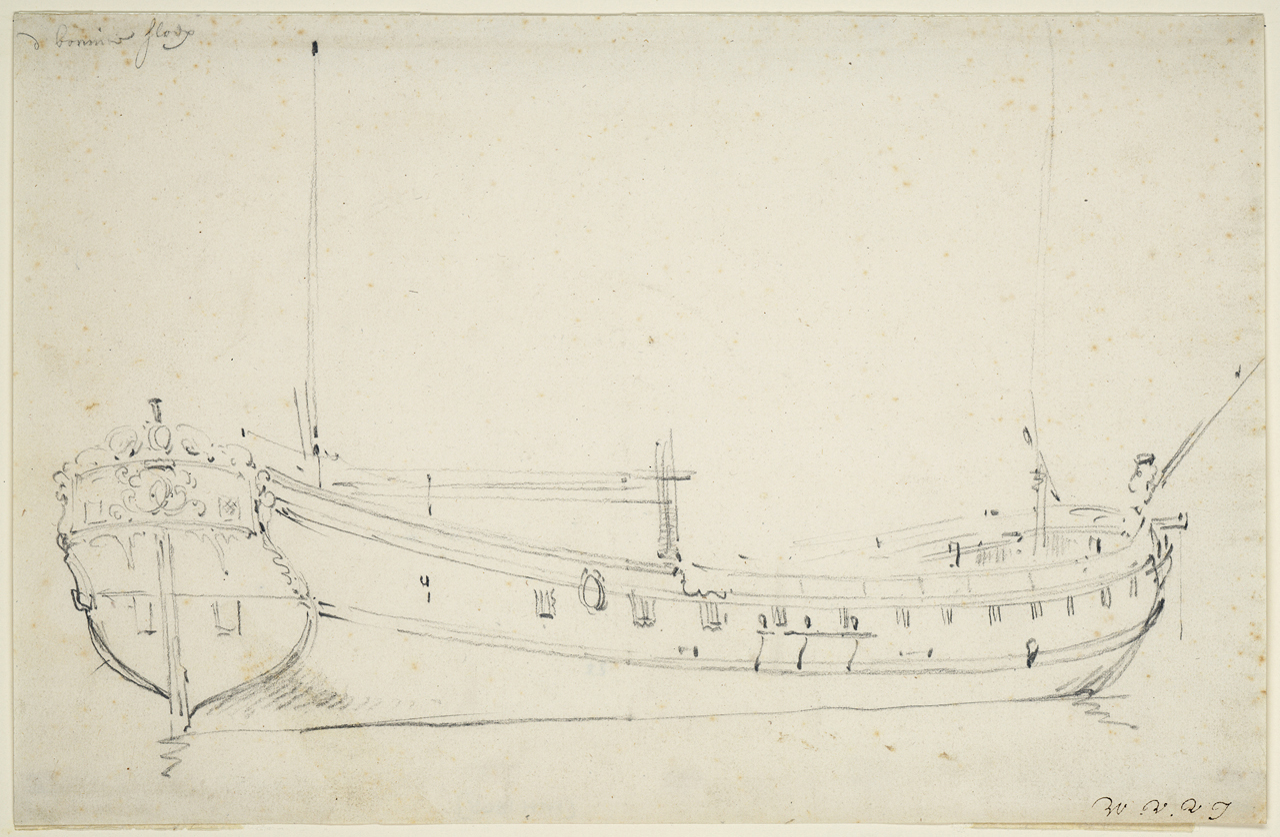
Meanwhile, in late 1685 two hired sloops manned with English naval seamen searched for two months but failed to find him. In January he was reported at the French buccaneer haven at Petit Goave, and in March Lieutenant-Governor Hender Molesworth ordered the impressment of the Spanish Assiento slave ship Sancta Rosa (see above!) to be used in the search for Bannister, given that the HMS Ruby was undergoing repairs. However, the arrival of two new men-of-war precluded this. In May 1686 Bannister was reported careening at Samana Bay on Hispaniola. Immediately the newly arrived HMS Falcon and HMS Drake were dispatched. The two men-of-war spent nearly all their powder pummeling the Golden Fleece as it lay on its side careened. Bannister’s men had built gun emplacements and returned fire (a detail that would inspire part of the plot of The Black Swan by Sabatini), killing and wounding some of the English naval seamen. The Golden Fleece was damaged so badly that the pirates burned it in the end. Taylor’s drawing, a rather crude one, shows a large ship with raised forecastle and quarterdeck, but no poop deck (or a very short one).

Occasionally a rabid pirate fan (typically on Wikipedia, often the encyclopedia of misinformation) will argue that this cannonading of a careened pirate ship was a pirate victory against the English navy, but it’s hard to claim victory when you lost your forty-gun pirate man-of-war while your enemies are still afloat and need only re-arm, and now you must cruise in a small sloop, and will end up as shortly to be described. For the English men-of-war, the fight was half-victory, half failure but — not defeat. The pirate ship was destroyed but the pirates remained at large.
Nearby, but not attacked, was a small captured urqueta (a flibot or small fluyt) manned by French buccaneers who took the marooned pirates aboard. The English buccaneers soon departed in a small Spanish bark or sloop captured by the French. Bannister, now sailing under a false name, and his men cruised the Mosquito Coast until captured by the HMS Drake after gaining intelligence of him from some of his former crewmen, all of whom had abandoned Bannister and six others, and ran away with the bark, abandoning him among the Mosquito Indians.

Bannister was captured “in disguise a-roasting a plantain, in a pore Indian wigwam.” One of his men fired a musket at the English seamen, for which he was killed in return. The other three of Bannister’s crew were captured as well. The pirate captain and the three of his crew were hanged in January 1687 aboard the pirate hunter as it sailed within view of Port Royal. It was “a spectacle of great satisfaction to all good people and of terror to the favourers of pirates, the manner of his punishment being that which will most discourage others,” according to the Governor of Jamaica. After the Drake anchored with the hanged pirates as an example, the bodies were cut down and tossed into the sea near Gun Key. Two boys who had sailed with him were pardoned and turned loose in Port Royal, but both were hoisted aloft by “their armholes, at the mizonpeek” while the four pirates were hanged. One of the boys, according to Charles Johnson, grew up to be the possibly fictional pirate captain William Lewis.
The French flibustiers at anchor near Bannister careening at Samana Bay were commanded at the time by Michel Andresson, often known as Captain Michel. Another of the famous French buccaneers of the 1680s, he succeeded to command of Laurens de Graff’s Le Tigre in 1682, and in 1683 commanded the company of buccaneers that stormed the southern bastion at Vera Cruz. In 1684 he was with de Graff and others off Cartagena when they were attacked by three Spanish slave ships converted to men-of-war; the buccaneers captured or destroyed the ships sent after them. De Graff took command of the thirty-four gun San Francisco Javier y San Lucas Evangelista and renamed it Le Neptune, and Andresson took command of La Paz (probably a nickname for the San Joseph) and renamed it La Mutine.
In company with Captain Brouage, Andresson captured two Dutch ships trading at Cuba, and carried the plunder to Boston for sale — New England Puritans were well-known for their hypocritical avarice (see link noted above). After some minor unprofitable adventures, most of Andresson’s crew deserted him in 1685 to cross the Isthmus of Darien into the South Sea (see buccaneer-author Raveneau de Lussan for details!). He soon joined an old comrade-in-arms, François LeSage and was given command of his Dutch prize, the Saint-Nicolas, renamed Le Favori, a 100-ton, fourteen-gun flute originally intended to trade illicitly along the Spanish Main. Its crew of flibustiers were described as some of the most seditious and mutinous in the Caribbean.
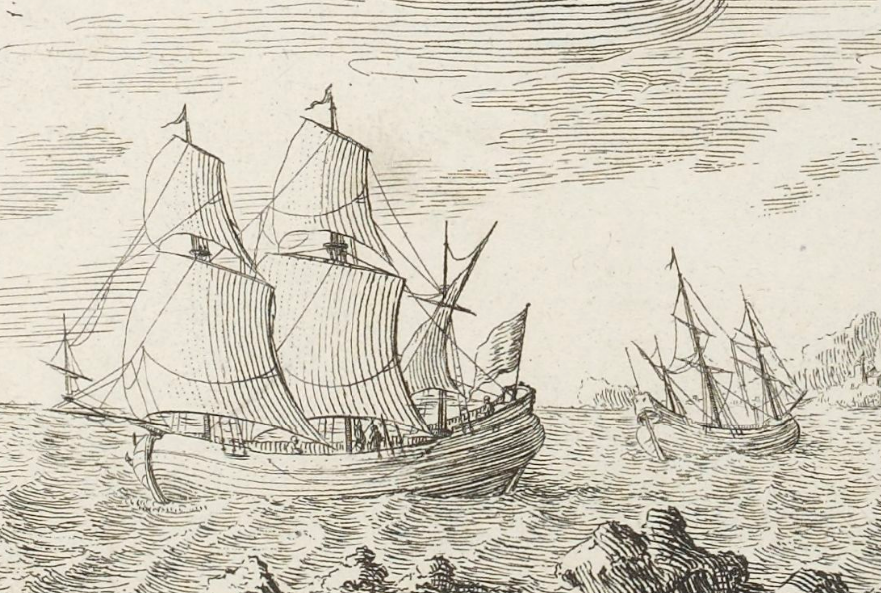
The small ship, called La Chavale by John Taylor, who would have had it described to him by English naval officers and crew who had destroyed Bannister’s ship, is clearly a small flute, known as an urqueta by the Spanish, a pink by the English, and a flibot by the French, as is described in other sources. If Taylor is correct about the name, it reflects a name-change under Andresson’s command.
After a failed attempt to sail into the South Sea via the Strait of Magellan, Andresson, now separated from Le Sage, headed to the Caribbean to repair, careen, and provision for a second attempt into the South Sea. At Samana he met Joseph Bannister; the English attack had been focused only the English pirate, and the French escaped harm. After the departure of the English pirates whom they rescued, the French sailed to the Guinea Coast, first being nearly destroyed by an English merchantman, the Baudan, where they deposed Andresson and elected their quartermaster, François Rolle, a Dutchman (real name Frantz Rools) as captain. The buccaneers sailed into the South Sea, where they remained until 1693.
The voyage is noteworthy because a complete manuscript written by one of the crew exists, and also because during their attack on Acaponeta, Mexico in 1688, the buccaneers carried a red flag of no quarter — the pavillon sans quartier — with a skull and crossed bones beneath. It is the only known instance of buccaneers flying the skull and bones, although likely it was flown at other times. As for Captain Rolle, he went ashore at Cayenne at the end of his voyage in 1693. He married a Dutchwoman there, purchased a large plantation, and remained there until his death in 1722 at the approximate age of eighty.

The Bannister text above was taken largely from a draft appendix for the forthcoming Annotated Edition of Captain Blood: His Odyssey, ed. Benerson Little. Details on both Bannister and the Andresson/Rolle voyage can be found in the author’s book, The Golden Age of Piracy. The Calendar of State Papers, America and West Indies, 1685 – 1688 has numerous details regarding Bannister (search both Banister and Bannister). For more information on the French buccaneers described above, see the Dictionnaire des Flibustiers des Caraïbes by Jacques Gasser (Les Sables d’Olonne, France: Editions Beaupre, 2017). The original journal of the French voyage can be found digitized in the French National Library, and also in the Bulletin of the Société des Sciences et Arts de Bayonne (Bayonne: Lamaignère, 1894), edited by Edward Ducéré, and in The Last Buccaneers in the South Sea 1686 – 1695, edited by Peter T. Bradley (both with one problematic transcription error — Panama for Samana — although the original manuscript clearly shows the latter).
The Capitana and Almirante of the Armada de Barlovento, 1685: The Santo Cristo de Burgos and the Nuestra Señora de la Concepción

In 1685 Laurens de Graff commanded Le Neptune, as noted previously, now mounted with forty-eight or fifty guns (many were probably swivels) and carrying a crew of three hundred, at the equally brutal sack of Campeche, Mexico. He was one of the few buccaneers, flibustiers, or outright pirates of the age of sail ever to command a great, heavily-armed ship.
After the sack—rape is surely a better word—of Campeche, the raiders scattered at the sight of the Armada de Barlovento, although the pirate hunting armada picked off a few of them. Three days later, off the north Yucatán coast of Mexico, near Alacrán (Scorpion) reef, de Graff’s lookout sighted two ships. The larger was the Nuestra Señora de Jonjón, an urca or frigate of roughly 335 tons and twenty to thirty guns.
The smaller vessel was the eight-gun Jesús, María y José, a patache or small escort ship of unknown rig, formerly known as the Sevillana. Both were part of the pirate hunting Armada de Barlovento. The Jesús, María y José immediately set all sail and a course away from the pirates, desperate to inform the famous, now elderly Admiral Andrés de Ochoa y Zárate that the greatest of pirates was nearby. The Jonhón wisely kept her distance. Soon enough, the captain of the patache informed the admiral of the opportunity to destroy the man who so successfully scourged the Spanish Main.
Within a day the main force of the Armada de Barlovento came in sight of de Graff, and a powerful squadron it was. The Spanish Capitana or flagship was the Dutch-built Santo Cristo de Burgos, of 650 tons and fifty-six guns, her stern with an image of Christ crucified, wearing a skirt that fell to beneath the knees. Aboard her was the Armada’s commander-in-chief, Andrés de Ochoa, ill to the point of physical incapacitation but who would refuse to leave his quarterdeck. The Almirante or vice-admiral was the Dutch-built Nuestra Señora de la Concepción, of fifty-two guns, probably 550 tons, and commanded by Antonio de Astina.

The two great ships were typically Dutch, although both appear, unusually, to have the semi-open stern gallery seen on some Spanish ships at this time. Both of the large pirate hunters were more lightly armed than we might expect—in fact, over-gunning is an historical error often made in novels and films, especially those depicting ships of the seventeenth and early eighteenth centuries. Based on the armament of similar ships of the Armada de Barlovento circa 1700, the Burgos was probably armed with twelve pounders on the gundeck, perhaps a few sixteen or eighteen pounders (culverins) as well, with demi-culverins shooting eight pound shot on the deck above, and four pounders on the “castillos,” that is, on the forecastle and quarterdeck, and possibly the poop.
The Concepción was likely armed with twelve pounders, or even ten pounders if twelves were unavailable, on the gundeck, sakers of five or six pound shot on the upper, with smaller guns on the quarterdeck and, possibly, the poop. Accompanying these two great ships was the recently captured pirate ship Reglita, itself originally a Spanish prize, of twenty-two guns, probably of six or four pound shot, commanded by présador or prize-master Pedro de Iriarte.
And it was by these three ships that De Graff found himself trapped to leeward in his Neptune of as many as fifty guns, though we must doubt that these were all great guns, given the tonnage of his ship. His ship probably had ports for no more than thirty-five to forty great guns of probably no more than eight and four pound shot; the rest were almost certainly various swivel cannon. Put plainly, he was heavily out-gunned.
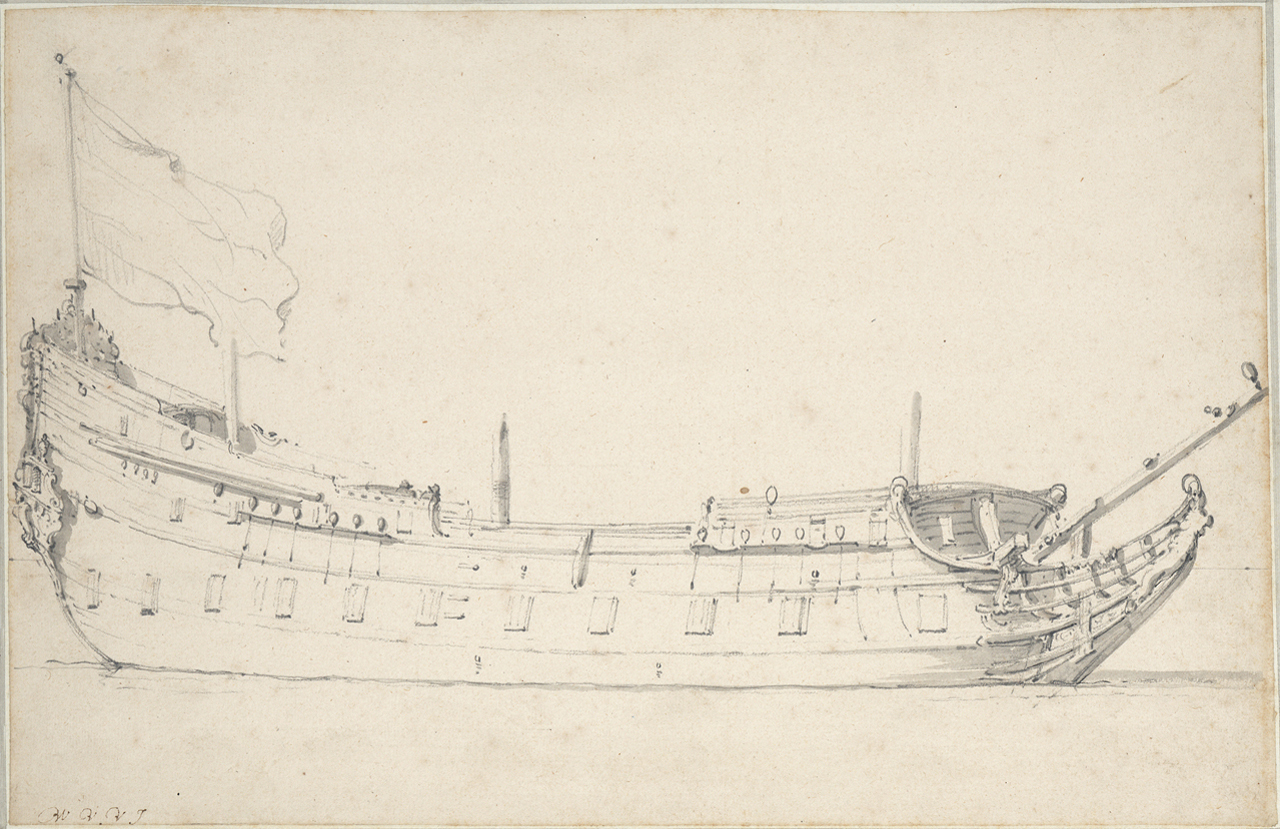
Unable to gain the weather gage so necessary to give him a fighting chance against two large men-of-war—or to escape them—de Graff ordered the Neptune to lie by and prepare for battle. In the language of the day, he had “catch’d a Tartar.” The Armada was not idle either. During the night, the two powerful Spanish men-of-war brought flibustier prisoners aboard to help man the guns against their flibustier brethren—or die.
The battle began early the next morning. De Graff could surely have fought off, perhaps even captured, one of these great men-of-war, but two at once? Still, de Graff knew his business and just how serious the situation was. Before battle began he spoke boldly to his crew, as recounted by buccaneer-surgeon Alexandre Exquemelin:
“You are too experienced to not understand the peril we are running, and too brave to fear it,” he said. “It is necessary here to be cautious of all yet to risk all, to defend and attack at the same time. Valor, deception, fear, and even despair must all be put to use on this occasion; where, if we fall into the hands of our enemies, nothing awaits us but all sorts of infamies, from the most cruel of torments to, finally, the end of life. We must therefore escape their barbarity; and to escape, we must fight.”
The great ships of the Armada sailed bravely down upon the waiting Neptune and her cornered pirate crew. Coming into range, the Burgos fired a warning shot from a bow chaser. The Neptune made no response. Onward sailed the Burgos, the Concepción not far behind. And here the Armada made its first tactical mistake, sailing on each side of the Neptune. In this position, the Spaniards could not fire on the enemy without also firing into each other. Only in Hollywood can two ships sail closely one on each side of another ship and destroy it, as in Pirates of the Caribbean: At World’s End. In reality, it could be suicide or nearly so. Of course, Rafael Sabatini, doubtless inspired by Exquemelin’s description of the battle, got the tactic right in Captain Blood, with his hero emulating de Graff by sailing between the Spanish men-of-war Milagrosa and Hidalga.

De Graff shouted orders to fire starboard and larboard. First one side, then the other of the Neptune blazed iron into the pair of pirate hunters. Immediately de Graff topped the broadsides off with an enormous discharge of musketry. Buccaneer surgeon Alexandre Exquemelin claimed that the musketry alone killed or wounded fifty Spaniards, and this might be true: filibusters and buccaneers were known for their ability with their long-barreled muskets. The Burgos, ready to fight, let loose its own powerful broadside in return.
Spanish records, however, give a slightly different account of this first phrase d’armes, perhaps truthfully, perhaps to cover up a grave error. Admiral Andrés de Ochoa y Zárate, the records suggest, believed de Graff would speak to him, surely to discuss terms, and so approached the pirate. After all, de Graff was out-numbered, out-gunned, and out-manned. But when the admiral’s ship came into close range, de Graff let his great guns do the talking.
For the next twelve hours de Graff maneuvered his ship defensively such that his enemy could seldom or never bring two broadsides to bear on him at once. Never did de Graff gain the weather gage, yet in spite of this the Armada ships never boarded him. In fact, they feared to do so. De Graff had a large crew that was clearly proving its prowess in open sea battle. If the Spaniards were to board, they first had to outmaneuver him, and both ships must board him, one first, then the other alongside the first. Once one had boarded, the other must cease firing, but the pirate had no such restriction. Perhaps most threatening, they knew too well de Graff’s prowess as a gunner. He might slaughter far too many of their men as they came near to board, for boarders, if there are many of them, must be massed on deck just before they board, and thus are vulnerable.
And de Graff made sure the Armada captains and crews understood how dangerous it would be to try to board. At one point, De Graff ordered his helmsmen to close with the Burgos and his gun crews to aim a broadside at close range at the mainmast. In this age broadsides were not fired as in Hollywood films, all guns firing at once or almost so, with each gun captain simultaneously touching his match to his gun. Rather, these great guns were often fired by a few gunners, gunner’s mates, or officers who went from one gun to the next and then the next, or they were aimed and fired by individually by each gun’s captain, all in order to ensure good aim.

In either case, a real broadside in this era was a ragged slow-motion series of ear-cracking explosions of fire and smoke that ripped from iron into wood and flesh. Buccaneer-surgeon Alexandre Exquemelin claims that de Graff himself aimed the gun that dismasted the Burgos. And it’s likely de Graff did aim several or more of his guns in this broadside, but the mainmast of the Burgos, although damaged, did not fall. Even so, the broadside was so effective that the Spaniards abandoned any thought of boarding the Neptune.
Surely emulating the famous previous fight of de Graff’s Le Tigre against the situado (payroll) ship La Francesa, the larger, less maneuverable Neptune twisted and turned as the fight continued, engaging first one ship, then the other, but taking no unnecessary risks. De Graff wanted to batter his enemies down, one then the other, however long it took. The Concepción, valiantly bearing the brunt of the fight, fired at least sixty full broadsides at the Neptune, and Burgos at least fourteen. The Spanish officers would later claim their powder was bad, and maybe it was. Yet it was powerful enough to kill five Spanish gunners when their great gun exploded.
But de Graff’s powder was not bad, and moreover, his crew knew how to load, aim, and fire accurately. Smoke covered the water between the ships as they blazed away. Men bled and died on each side, including de Graff himself, wounded in the leg. He was carried below and his crew lost heart. But as soon as de Graff heard his guns slacking, he rose, climbed back to his quarterdeck, and, sword in one hand, pistol in the other, and rallied his filibuster crew.
The battle continued until nightfall, when all three ships stood off from each other to tend to their wounded, knot their shattered rigging, repair the leaks in their hulls, and pump the water from their holds. The Neptune was in terrible condition. Although only nine of her crew had been killed and but ten or twelve wounded, the Neptune herself had taken a beating, for the Spanish broadsides had not been ineffective. Her foretopmast was shattered. Far worse, she had been hulled at the waterline by so many round shot that she was listing severely due to the water that continued to flood her hold in spite of the plugs pounded into the hull by his carpenter and mates. Through the night de Graff’s crew worked to lighten Neptune, to right her and prepare her for battle on the morn.
At dawn the next morning the Neptune had finally gained the weather gage—and the Burgos and Concepción were in no mood to engage her again. Their crews were battered and almost beaten, with dozens killed and wounded. They had expended most of their powder and shot, and the upper works of the Burgos were shattered. During the night the elderly admiral had been given his last rites in expectation of his death: he would live but two more days. With a single exception, the Armada officers believed that calling off the fight was the best course. Only Pedro de Iriarte wanted to chase the pirate and renew the fight, more for the sense of honor and reputation than for tactical wisdom. Surely every one of them felt shamed by their failure to capture, at odds of two to one of ships and guns in favor, this notorious pirate who had once been one of them.
This account is an edited, abbreviated version that appears in The Golden Age of Piracy: The Truth Behind Pirate Myths. Citations can be found in the endnotes of the book (I’m frankly too lazy to add them here. 🙂 ).
Copyright Benerson Little 2023. First posted 26 January 2023. Last updated 23 February 2023.

Captain Blood, Not Jack Sparrow: The Real Origin of Disney’s Wicked Wench Pirate Ship

It’s an epic image, one that anyone who’s ever cruised through the Pirates of the Caribbean attraction at one of the Disney theme parks is familiar with: a pirate ship cannonading — “firing its guns at” or “engaging” in sea parlance — a Spanish fort.
But the image-in-motion long predates the Disney attraction. In fact, as I’ll demonstrate shortly, the entire scene was lifted directly from Rafael Sabatini’s famous novel, Captain Blood: His Odyssey and especially from the 1935 film version starring Errol Flynn, Olivia de Havilland, and Basil Rathbone. And the Wicked Wench pirate ship of the attraction was more than simply inspired by the Cinco Llagas / Arabella, as the ship in the novel and film was named: it was copied from it!
Originally the attraction depicted buccaneers in the second half of the 17th century attacking and sacking a Spanish town on the Main. “IN THE CROSS FIRE of cannonades between pirate ship and Caribbean port,” begins the caption of the 1968 Disney publicity still of the Wicked Wench shown above. It continues with “this crew of Disneyland adventurers sail through Pirates of the Caribbean as grape shot and cannonballs land around them. The pirate captain on his bridge gives the signal for an eight gun salute. The scene of one of ten action-packed segments in the thoroughly realistic re-creation of buccaneer days.” For now I’ll pass on correcting Disney’s descriptive language, as some readers might misconstrue such revisions as nautical pedantry.

However, in spite of the obvious historical basis for the ride’s inspiration, according to Disney’s modern Pirates of the Caribbean film franchise “canon” the Wicked Wench was instead the ship that would become the Black Pearl commanded by Jack Sparrow et al, more or less, post-buccaneer era. Not a buccaneer ship, in other words, but a later ship turned to pirate ship as would fly the Jolly Roger. This, of course, is nothing more than mere revisionism for the sake of marketing the ride on the coattails of the film series, and any “canon” (as in nearly all franchises) is nothing more than the result of a series of screenwriters trying to write popular scripts, and fans subsequently trying to make rabid sense of their details and many loose ends.
Myself, I much prefer the original orientation of the attraction, liberties taken with real buccaneer history notwithstanding. That said, comic ride though it may be (and one that I thoroughly enjoy), it does get some things right, including torture, pillage, and burning, not to mention the original implication of some scenes now altered from their original. We have, in fact, two versions of piracy in our culture: factual history and popular myth, the latter often overwhelming the former.
And now for the evidence that the Wicked Wench is really the Cinco Llagas / Arabella!
The Scene of Ship Attacking Fort Was Inspired by & Lifted Largely From the 1935 Film
One need only to watch the 1935 Captain Blood to confirm this. The only difference between the two is that the roles are reversed: rather than a Spanish pirate attacking the principal town of an English colony in the late 17th century as in the Rafael Sabatini novel and the film based on it, buccaneers in the attraction attack a Spanish town, as they often successfully did — and far, far more often than Spanish pirates did against English, French, and Dutch colonies.
In fact, in Pirates of the Caribbean: The Black Pearl there is an homage to the pirate attack in the 1935 film version of Captain Blood: some of the shots of locals running for cover are quite similar to those in Captain Blood.
For more details on the ship-versus-Spanish fort trope, see “The Iconic “Spanish” Fort: Only a Spanish Galleon Says “Pirates” Better!“


The battle depicted in the Disney ride, and by derivation the one in Captain Blood, was given an homage in The Curse of Monkey Island (LucasArts, 1997).

The Wicked Wench is Red Like the Cinco Llagas / Arabella of the Novel
According to Rafael Sabatini, who clearly emphasized the sanguinary nature of buccaneering via the hero’s name and other thematic elements, the color of Peter Blood’s pirate ship was red. However, red was not an exceptionally common color of ships at the time. Red paint was typically used for the bulwarks (the inner “walls”), gun carriages, and often some fittings of men-of-war, and some other ships as well, at the time, and the upper works (the upper outside of the hull) and sterns of some ships were occasionally painted red — but never the entire hull. However, the application of pine tar, tallow, and linseed oil could lend a reddish hue to hull planking (particularly to those ships built of various “mahoganies” in the Americas), but this would not cause a ship to be referred to as red. (Far more details on the possible appearance of the Cinco Llagas / Arabella are forthcoming in Treasure Light Press’s annotated Captain Blood.)
And the Wicked Wench? A red ship, of course!

The Profiles of the Wicked Wench and the Cinco Llagas / Arabella are Too Similar to be Coincidental
Indeed! The similarity is obvious when comparing the images below. Even the scrollwork on the stern upper works is almost identical (see the image above and also at the end of this section). Disney did make some alterations to suit the attraction, including reducing the ship from two decks to one, and, of course, making it small enough to fit in the attraction.



And Then There’s the Names of the Ships…
After its capture by a handful of renegade rebels-convict led by Dr. Peter Blood, the Cinco Llagas was renamed the Arabella after the woman Blood loved but thought he could never have. Arabella Bishop, although independent, strong-willed, and anything but swooning (or languishingly voluptuous!), was still a lady in manners and mores, unlikely to (sadly!) run away to sea in men’s clothes with Peter Blood. One can easily see a tongue-in-cheek homage to Arabella and the Arabella in the renaming of the Spanish frigate as the Wicked Wench, and even in the “Woman in Red” in the old Bride Auction scene on the attraction. This would be in keeping with the piratical sense of humor of the attraction’s designers: gentleman buccaneer Peter Blood and his Arabella versus the ruffian buccaneer captain and his Wicked Wench.
Likewise the captain of the Wicked Wench as an inverted homage: no clean-shaven gentleman buccaneer he, unlike Captain Peter Blood, but bearded and beribboned like Blackbeard the Pirate and bellowing in G-rated curses like Robert Newton or Peter Ustinov in their piratical film roles. That is, before Hector Barbossa took his place to align with the film franchise. (N.B. Blackbeard was not a buccaneer but a later black flag pirate, and although most buccaneers appeared to have been clean-shaven, some French boucaniers, and therefore buccaneers, did wear beards.)
For more details on “The Woman in Red,” now “Redd the Pirate,” (and in any case, an anthropomorphism of the ship by both), see “The Women in Red: The Evolution of a Pirate Trope.” For more details on the black flag — the so-called Rackham flag with skull and crossed cutlasses — flown by the Wicked Wench, see “The Fanciful, Mythical “Calico Jack Rackham” Pirate Flag.” Note that on the Disney LP featuring a narrated soundtrack of the ride, the Wicked Wench is referred to as the Black Mariah, the name of the ship in “Donald Finds Pirate Gold!” Perhaps Wicked Wench was suitable on the stern but not in narration at the time on an LP likely to be listened to mostly by children?

The Lanterns
An oddity I’ve for long assumed was simply a designer’s idea to help add more light to the ship is the placement of port and starboard lanterns on the gunwales at the quarterdeck near the break of the poop deck. However, I wonder if the placement — which surely still serves the purpose of lighting — was not inspired by the poster below, in which a fanciful Arabella has two prominent lanterns low on the stern:


So, Was the Wicked Wench Really the Arabella?
Only Disney knows — and only Disney can answer how the Arabella, sunk among the cays just off Port Royal, Jamaica in 1689 while defending the town from French attack, came to be raised, refitted, and ended up again in buccaneer, then pirate, hands… 🙂
That said, it is a sweet homage, even if unintended, that the Arabella as the Black Pearl, formerly the Wicked Wench, attacks Port Royal, as the Arabella did as the Cinco Llagas flying Spanish colors in the 1935 film starring Errol Flynn and Olivia de Havilland. 🙂
And the Black Pearl?
If you’re looking for the real original inspiration for the Black Pearl, discard any notion of it having been the Wicked Wench — this is probably just “canon after the fact.” Convenient revisionism for the sake of marketing, in other words. Sparrow’s famous ship is more likely inspired ultimately by Tom Leach’s 40-gun Black Swan, from Sabatini’s novel of the same title. Or at the very least it corresponds closely to Sabatini’s description of the ship, including its black hull. Even the un-authorized plastic model of Sparrow’s Black Pearl is sold under the name of the Black Swan. Are there similarities between the Wicked Wench and the Black Pearl? Of course there are. Clearly the set designers took a look at the Wicked Wench, but it is much closer to the Arabella. (By the way, the duel in The Black Swan is described here.) It’s also possible that the Black Pearl was inspired by the black pearl Rathbone- and Hook-inspired Bilbo wore in his rapier in The Pyrates by George MacDonald Fraser, for there are quite a few details in the Disney franchise clearly inspired by the comic novel.
And for you budding “nautical pedants” out there, here’s the correction to the Disney text quoted above: “this crew of Disneyland adventurers [an acceptable term: French buccaneers aka flibustiers were often referred to as adventurers] sail through Pirates of the Caribbean as grape shot [this form of small shot was in its early development and generally not known by this name at this time] and cannonballs [more correctly, round shot] land [splash] around them. The pirate captain on his bridge [quarterdeck, not bridge] gives the signal for an eight gun salute [a correct humorous euphemism for a broadside]. The scene of one of ten action-packed segments in the thoroughly [and humorous] realistic re-creation of buccaneer days [a statement more correct than it might appear at first]…”
Post Script: The Wicked Wench is Not the Only Disney Pirate Ship Inspired By an Errol Flynn Film…

Disney’s Jolly Roger, from the animated version of Peter Pan (1953), bears a striking resemblance to the Albatross from The Sea Hawk (1940, directed by Michael Curtiz and starring Errol Flynn). 🙂
Copyright Benerson Little 2022-2025. First posted June 22, 2022. Last updated October 21, 2025.

The Duel on the Beach, Part IV: Flynn versus Rathbone in Captain Blood!

Classic film buffs, fencers, armchair adventurers, real swashbucklers, and romantics of many other stripes may debate over which film duel is the “best.” But no matter the standard, the duel between Errol Flynn as the hero Peter Blood and Basil Rathbone as the villain Levasseur in Captain Blood (1935) as choreographed by Fred Cavens always makes the top few, often at number one. For me, there is no contest. There are a few far more historically accurate film duels (in fact, there are only a few historically accurate film duels at all), and there are a few film duels more technically proficient (for example, The Mark of Zorro), but none in my opinion exceed this one in sheer excitement, drama, swashbuckling swordplay, and watching pleasure.*
Of the duel, George MacDonald Fraser (author of The Pyrates, the Flashman series, and more, plus screenwriter of The Three and Four Musketeers, historian, swordsman, journalist, and soldier) in The Hollywood History of the World regards it as “the most famous of screen duels…” and “Flynn v. Rathbone (Captain Blood) belongs in some swordsmen’s Valhalla of its own…” I cannot agree more.
The duel certainly had something to do with the resurgence of fencing’s popularity in the US in the mid- to late 30s as well: “No doubt, it was ‘Captain Blood’ that brought about the renaissance of the duel [in film].” (Risher, 1936. See also Grant, 1937).
The 1935 release, a remake of the silent 1924 film, was hotly anticipated although the potential cost of filming ships at sea had put its production at risk for several years. Sea stories were expensive to film with real ships, and “three completed shooting scripts” had attempted to solve the problem, in part by reducing the number of ships. The solution was finally found in “process-shots” — miniature ships, fort, and town filmed for the sea battles and cannonadings. In fact, few scenes were filmed on location; the duel was arguably the most vital one. (Jackman, 1936.)
Newspapers and film magazines ate up rumors, often created by Warner Bros. studio as part of its publicity campaign, regarding who would star in the film. At one point Robert Donat and Jean Muir were rumored to star, and later Bette Davis in Muir’s place. Many others were considered as well. But it was Irish-Australian newcomer Errol Flynn who landed the lead and after some re-shoots fell naturally into the role.
Costing a reported $1,000,000, the film was directed by Hungarian-born Michael Curtiz, and also starred nineteen-year-old Olivia de Havilland fresh from stage and film performances in A Midsummer Night’s Dream. Basil Rathbone and an array of established character actors filled out the cast, supplemented by a number of real life adventurers among the ship crews and extras. Erich Wolfgang Korngold, whose film music would change Hollywood forever, wrote the score, most of it original, some adapted from Liszt. Anton Grot designed the sets and Dwight Franklin provided the historical consulting. Casey Robinson adapted the novel to the screenplay, simplifying it greatly but keeping the essentials. Released at Christmas, the swashbuckling romance was an immediate blockbuster and launched Flynn and de Havilland to stardom.
Historical note: the film premiered on December 19, 1935, was released in New York City on December 26, and had its national release on December 28. Movie theater tickets cost about a quarter, the equivalent of not quite six dollars today. Movies were one of the principal forms of entertainment of all classes at the time, but especially of the working and middle classes, and were clearly quite affordable — at least for those who had work. The world was still in the grip of the Great Depression and unemployment in the US was twenty percent. Franklin Delano Roosevelt was President of the United States, and the combination of Nazism in Germany, Fascism in Italy, and authoritarian military rule in Japan would soon plunge the world into war.
This post is a bit long and detailed, and occasionally technical when it comes to buccaneer history, fencing, and swords. Feel free therefore to jump around if you prefer, or just scroll through and check out the images. The major sections are marked. Reading the other “Duel on the Beach” posts is recommended but not required: In Fiction, in The Black Swan, In Film, and In Reality. Some of the in-depth historical details below have been drawn from the annotations Treasure Light Press is writing for its forthcoming edition of Captain Blood.
The Duel: The Novel Versus the Film
The 1935 duel was composed entirely from scratch: the novel by Rafael Sabatini provides no significant detail. The author does include plenty of dramatic tension leading up to the swordfight in the novel, but for the assault itself we have only dialogue and minor notes.
[Spoiler Alert! Skip to the next header if you haven’t read the novel — or if you have and don’t need the refresher!].
In the novel, Peter Blood and the crew of his ship the Arabella, believed by their consort Captain Levasseur and his crew of La Foudre to be well on their way back to Tortuga after the capture of a Spanish ship, have in fact been driven to the island of “Virgin Magra” (see below) where they discover Levasseur about to torture the son of the Governor d’Ogeron of Tortuga.
Levasseur has kidnapped the young man and his sister, murdering a Dutch captain and seizing his brig in the process. The cruel pirate, modeled on the infamous l’Ollonois and described as having served under him, is in lust with Madeleine d’Ogeron, and she believes she is in love with him until his murderous brutality is revealed. Now Levasseur intends to hold both for ransom, with the threat of “not marrying” Madeleine first if his demands are not met. It’s a classic set up of romantic adventure, with nuance as only Sabatini can add.


But just in time, Peter Blood and a handful of his officers and crew arrive as the marplot. After distracting Levasseur’s crew with an offer to pay the anticipated ransom for the woman and her brother up front, and casting their portion of the ransom in the form of pearls before swine, Peter Blood intends to remove Madeleine and her brother to his forty-gun Arabella, but Levasseur will have none of it.

From the novel:
“Levasseur, his hand on his sword, his face a white mask of rage, was confronting Captain Blood to hinder his departure.
“You do not take her while I live!” he cried.
“Then I’ll take her when you’re dead,” said Captain Blood, and his own blade flashed in the sunlight. “The articles provide that any man of whatever rank concealing any part of a prize, be it of the value of no more than a peso, shall be hanged at the yardarm. It’s what I intended for you in the end. But since ye prefer it this way, ye muckrake, faith, I’ll be humouring you.”
He waved away the men who would have interfered, and the blades rang together.”
There is really no more description of the duel except the following lines:
“It was soon over. The brute strength, upon which Levasseur so confidently counted, could avail nothing against the Irishman’s practised skill. When, with both lungs transfixed, he lay prone on the white sand, coughing out his rascally life, Captain Blood looked calmly at Cahusac across the body.”
A decade later Sabatini made up for the lack of detail by writing “The Duel on the Beach” (1931) and the novel based on it, The Black Swan (1932), in which a Peter Blood-like hero, Charles de Bernis, fights a duel with a Levasseur-like villain, Tom Leach. I’ve discussed the duel in detail here. In fact, this fictional duel probably inspired elements of the Captain Blood film duel.
However, in the film two of the principal characters have been changed due to the streamlining of the novel for the script: Madeleine d’Ogeron has been replaced by Arabella Bishop (Olivia de Havilland) and her brother by diplomat Lord Willoughby (Henry Stephenson).
The Dueling Terrain in the Novel: The Dunes and Beach of Virgin Magra

In the novel, the duel takes place on Virgin Magra (the Meager — Skinny, that is — Virgin), which is nothing more than Sabatini’s joke on Virgin Gorda (the Fat Virgin) in the British Virgin Islands. Virgin Gorda is arguably, depending on one’s eye, rather skinny than fat, and meager as compared to other islands in produce.
Even so, it is one of the most beautiful islands in the Caribbean. Mangrove, cactus including prickly pear, various scrub, and short deciduous trees (20 to 40 feet high) including allspice and quite a few others, made up most of the flora in the 17th century.
Coconut trees grow in small numbers on the island today but were probably not present in the 17th century. In fact, in the 17th century most Caribbean coconut palms, an introduced species, were on the Main, not the islands. Some small shrub palms up to fifteen feet tall probably did grow on the island, however. Species of Royal Palms grow on the island today but have been cultivated, and probably did not exist on there in the 17th century.
Sabatini is correct when he describes salt ponds on the island: in past centuries there were several bordered by mangrove swamps. Among the animals the visiting buccaneers might have encountered are sea turtles, iguanas, and large flocks of flamingos and ducks.


The Spanish and Dutch attempted small settlements in the mid-17th century on Virgin Gorda without success. In the second half of the 17th century Virgin Gorda was visited by loggers for boat- and shipbuilding timber, but these visitors established no permanent settlements. The island was probably also visited occasionally by salt-rakers.
In 1680 the English established small settlements on Virgin Gorda and nearby Tortola, the latter predominant, but the islands were soon raided by Spanish privateers or pirates, depending on one’s point of view. In the summer of 1687 the island was still apparently largely depopulated thanks to the Spanish raids.
A few families had probably been reinstalled at a small settlement at St. Thomas Bay, which would one day become known as Spanish Fort. Some authorities, based on period records, note fourteen free white males, a few free white females, and three slaves on the island at roughly this time. Very likely they hid from the buccaneer visitors, or at least from Levasseur and his French, were we to combine fact with fiction.

Given that Levasseur anchored his small eighteen-gun frigate La Foudre in the north lagoon, known as Gorda Sound and North Sound today, for repairs, the duel would have to be fought on one of the lagoon’s beaches. Although today there is only a significant dune presence at Savanna Bay, or as it was known in the 17th century, West Bay, there were other dune systems in the past, almost certainly some of them at the lagoon.
Hills — and a lazy lookout — would have screened the Arabella anchored to the southwest from view. Of course, Levasseur would have been advised to keep a good lookout (we know Peter Blood would have). Even so, Spanish pirates would surely have thought twice about attacking one or two stout buccaneer frigates.
Virgin Gorda in the 17th century has everything we imagine necessary for a duel on the beach between pirate captains — except coconut palms.
The Terrain in the Film: Three Arch Bay at Laguna Beach

The duel in the film was shot not on Catalina Island, as many fans often assume, but at Three Arch Bay at Laguna Beach. It is a classic Southern California vista: a sunny sandy shore amidst grand, craggy, evocative rocks. We will assume that the palm trees in the background were put there by the set designers and their crews, notwithstanding that Southern California (I lived in San Diego for twenty years and in LA for five) is known for its various palm trees, although the coconut is not one of them. The romantic vista adds to the scene, almost as a third character. The shot below is but one of many the beach was perfectly suited for, even demanded.
In fact, the location was chosen specifically to make the duel more exciting. From the original script by Casey Robinson: “The nature of our location will help a good deal here, for the fight not to be on the flat, but will range over the rocks and cliff edges of the rough country.”


Coincidentally, there is one location on Virgin Gorda that does look similar: “The Baths,” where sandy shore meets rock formations. It’s too far south, though, to answer the novel’s description of action and location, but following a novel closely has never stood in the way of Hollywood.

The Hero: Peter Blood

If you’ve read the novel or seen the 1935 film, you already know Peter Blood’s history: a physician (with surgical skill) accused of treason for treating a wounded rebel during the 1685 Monmouth Rebellion, he was convicted and sentenced to ten years transportation as an indentured servant at Barbados. During a Spanish raid of reprisal he and a number of his fellow rebels-convict board the Spanish frigate at anchor while the crew is indulging in pillage and rapine ashore, capture it, and destroy the Spaniards in their boats the following morning. The rebels-convict escape to Tortuga, an island just off the north coast of Saint-Domingue (modern Haiti), and become buccaneers.
Given Peter Blood’s martial experience and Spanish imprisonment previous to setting down as a physician and eventually turning buccaneer, he would certainly be quite familiar with the French, Dutch, and Spanish schools of fence with thrusting weapons — the smallsword and the Spanish rapier — and also the cutlass given his Dutch naval experience, and would surely be able to handle a sword well-enough to defend himself in a variety of circumstances.
Importantly, the novel is a swashbuckling romance, with associated noble notions of duty, honor, and “right as might” rather than the opposite. These virtues set the stage for the duel in which Peter Blood rescues a swooning heroine in danger of sexual assault, a theme Sabatini often returns to in his novels and which often defines his heroes. Although swooning damsels are thankfully less popular today, the virtue of standing up for and defending the oppressed, whatever their sex and circumstances, will hopefully never go out of fashion — and likewise that Levasseurs everywhere will sooner or later get their just desserts via sword or otherwise.
A much more detailed history &c will be provided in Captain Blood: His Odyssey, the Annotated Edition when finally published by Treasure Light Press.
The part is played by Errol Flynn in the 1935 film. Although a bit young for the role at twenty-six — Sabatini’s hero was in his early thirties — Flynn didn’t depart too far from the character as described by the author. His dress is not quite as sartorial as Sabatini described, and Hal Wallis of Warner Bros. Studio was often incensed that Flynn even wore a lace cravat, much less anything that might be regarded as “feminine.” Wallis was reportedly furious with historical consultant Dwight Franklin, and with director Curtiz for taking his advice, something I can relate to from personal experience: inevitably there’s someone in the mix, even if not the director or one or more of the writers, who doesn’t like the historical consultant’s advice — an art director, for example. But Franklin was right, even though he had never seen eyewitness images of buccaneers drawn in the 1680s: some of them are wearing lace cravats!
The Fictional & Historical Villain: Captain Levasseur

The character of Levasseur, played with panache and an exaggerated French accent by Basil Rathbone, is based on two historical characters. Sabatini appropriated the name and some of the character from the real Captain François Levasseur, a Huguenot soldier of fortune, military engineer, and de facto governor of Tortuga from roughly 1640 to 1652. During his tenure he heroically repelled a major Spanish attack and despicably persecuted local Catholics in the name of Calvinism, among other crimes.
Neither the character of Levasseur nor the name was based, as a page or two on Wikipedia (far more often than not a terribly inaccurate resource on pirates and piracy, not to mention many other subjects) have stated, on the early 18th century French pirate, Olivier Levasseur aka La Buse (a nickname which might mean the “Buzzard” — the swift but proverbial stupid European bird of prey, not the American carrion eater — or “Mouth” or “Cow Dung” depending on spelling).
By his own admission, not to mention obviously, one of Sabatini’s his principal sources was Alexandre Exquemelin’s The Buccaneers of America, whose English and French editions were first published in the 1680s. The polylingual Sabatini read both. Each covers material the other doesn’t, and he found plenty of detail on Levasseur in the French. The real Levasseur (or Le Vasseur) was murdered by two of his closest associates — captains and companions in fortune hunting, practically family to him, according to Exquemelin — reportedly because he had raped the beautiful mistress, possibly also a slave, possibly a prostitute according to 17th century Caribbean historian Jean-Baptiste du Tertre, of one of them named Tibaut (or Thibaut). They intended to put an end to his tyranny.
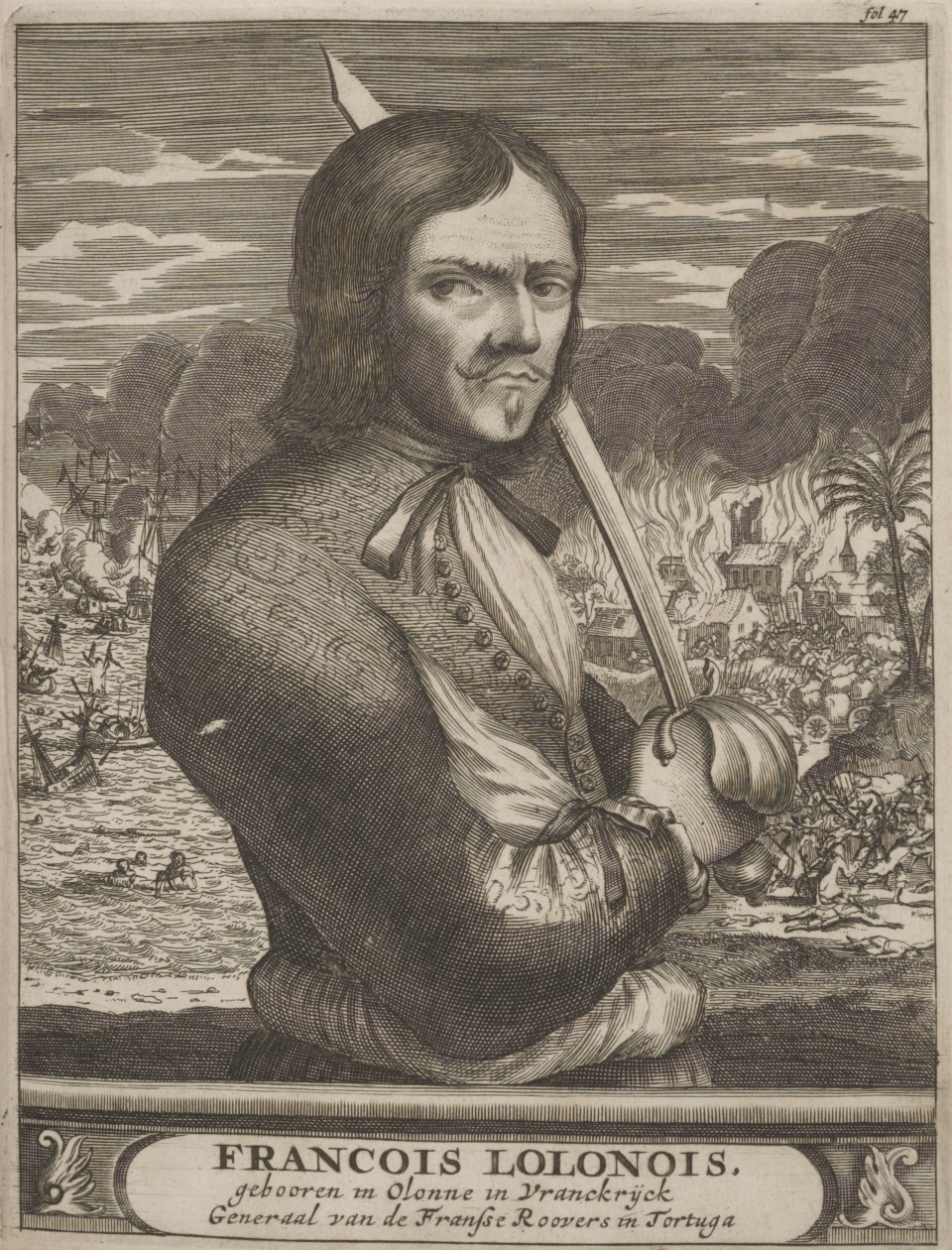
Appropriate to his namesake fictional character, Levasseur was killed on the shore of Basse Terre, Tortuga at one of his warehouses by his two confreres and several of their associates: the eventual coup de grace was one or more thrusts with daggers. Perhaps his compadres killed him in part to protect Tibaut’s mistress — or perhaps just so Tibaut could keep her for himself. Reportedly just before he died Levasseur begged for a priest because he wanted to die a Catholic. Or at least du Tertre says he so pleaded.
More likely, du Tertre, a priest in anti-Reformation mode as all were, invented this to curry favor with his largely Catholic audience, not to mention keep his priestly credentials in good standing. Sabatini carried Levasseur’s unconscionable behavior over to his fictional French buccaneer who kidnaps the besotted daughter of the governor of Tortuga — his inamorata — and clearly intends to rape her if she resists his advances.
Sabatini also based the character on François l’Ollonois (or L’Ollonais as Sabatini spells it according the edition he studied), aka Jean-David Nau, &c — a vicious French buccaneer noted not only for his successes against the Spanish, but for his murder and torture of Spanish prisoners beyond that of most of his brutal brethren, few of whom would have cut the heart from a living prisoner and taken a bite from it, for example. That said, he was not the only French buccaneer to decapitate prisoners on occasion, and the torture of prisoners by buccaneers was common, horrid, and often at its worst in the search for plunder. Sabatini notes that the fictional Levasseur had learned his trade as the lieutenant of l’Ollonois.
A former indentured servant to a boucanier, l’Ollonois became a buccaneer circa 1660, rose quickly to command, and so served until his brutal and well-deserved torture and death at the hands of Native Americans on the Isthmus of Darien in 1669. His executioners burned and scattered his remains. Sabatini has clearly based the character of his Levasseur on both the original Levasseur and l’Ollonois.
The l’Ollonois lieutenant who would have been the fictional Levasseur’s historical counterpart was one of the following, or even all of them: Michel le Basque (Michel de Maristegui according to some scholars, the sieur d’Artigny according to du Tertre), a retired buccaneer and French officer who had captured a considerable Spanish prize not long before he commanded the ground force at Maracaibo in 1666, and commanded le Dauphin, l’Ollonois’s former ship, in 1668 (by now l’Ollonois commanded the Saint-Jean of 26 guns); the literate Moise Vauclin who commanded the buccaneer vice-admiral at Maracaibo, of 10 guns and 90 men; or Pierre le Picard who commanded a brigantin of 40 men at Maracaibo in 1666, separated from L’Ollonois in 1668, and guided Henry Morgan to Maracaibo in 1669. The fictional Levasseur’s previous experience at Maracaibo as L’Ollonois’ quartermaster or lieutenant would, of course, well-serve the plot of Captain Blood: His Odyssey.
One or more of these men probably also have served as the inspiration for Cahusec, the fictional Levasseur’s quartermaster (second-in-command, or lieutenant as Sabatini his it), whose name Sabatini almost certainly took from François de Rotondy, sieur de Cahuzac, who attacked the English under Edward Warner at St. Kitts (Saint-Christophe) Island in 1629 at the Battle of l’Anse-aux-Papillons.
Now that our brief exposition of history is complete, on to the actors, choreographers, and the film duel itself!
Actors as Adversaries: Errol Flynn as a Swordsman

It is common for Hollywood publicity machines to endow their stars with qualities and skills they don’t actually have, or to grossly exaggerate them, and the fencing skill of swashbuckling stars, with some notable exceptions, was treated no differently.
Errol Flynn has long had a reputation as a swordsman — Olivia de Havilland (Benham, 1937) said that he could fence, among his many other athletic accomplishments — but according to the film’s choreographer and fencing master Fred Cavens, not to mention Flynn himself, the swashbuckling actor was not much of a fencer, Hollywood promotional media notwithstanding. Cavens stated in 1941 that Flynn “fences execrably.” (Brady, 1941.) In fact, Cavens doubled for Flynn more than studios were willing to admit publicly. It is doubtful that Flynn knew anything about fencing prior to meeting Cavens on the set of Captain Blood.
Film historian Rudy Behlmer was more nuanced: “Flynn, on the other hand, did not have the discipline for constant practice. Fortunately, he was a quick study and a natural athlete, and this, together with his form and flair, made his duelling look good on the screen.” (Behlmer, 1965.) An accurate assessment, in my opinion.

Basil Rathbone, who played Levasseur and was in fact a skilled fencer, said that “Mr. Flynn and Mr. [Tyrone] Power were fine actors, we all know that, but they did not know swords… The only actor I actually fought with on screen was Flynn, and that’s the only time I was really scared. I wasn’t scared because he was careless, but because he didn’t know how to protect himself. I knew how to protect myself, but it’s like a professional fighter in boxing — fighting someone who doesn’t know how to fight. But sometimes the fellow doesn’t know how to fight will do something outrageous and you’ll find yourself injured. I stayed away from Flynn as much as I could, and, as he was eventually going to ‘kill’ me, it didn’t look bad on the screen.” (Jones, 1972.)
Maureen O’Hara in her autobiography ‘Tis Her wrote of her work with Flynn on Against All Flags (1952), “As you might expect, Flynn was an excellent fencer.” Even so, she also wrote, “I was flattered when critics said that I had outfenced Errol Flynn!” And so she had, being far more diligent at learning to fence from Cavens, and, as a woman actor in Hollywood, having far to prove to sexist producers and directors.

Douglas Fairbanks Jr., a swashbuckler in both film and life, also commented on Flynn’s swordplay: “‘Errol Flynn was good at staging a scene, especially in close ups, but I think he was better at other kinds of fencing,’ he added, pleased with his joke.” (Page, 1968.)
Flynn had little to say in his autobiography My Wicked Wicked Ways about his swordsmanship, perhaps because he was trying to avoid the stereotype that dogged him for so long. Even so, he admitted his lack of fencing skill:
“I don’t know much about fencing, but I know how to make it look good. You only have to stand still and look forward, your head proud, and let the sword point straight out, you and the sword both unmoving, and it is dramatic. Let the sword point dip two inches, and the gesture can look very clever and dangerous.” In fact, this is an excellent en garde with the epee de combat, or late 19th and early 20th century dueling sword, and for that matter, with rapier and smallsword as well.

In fairness to Flynn, Hollywood fencing master Ralph Faulkner (more on him below) stated that Flynn “could memorize every movement in a sword script and remember them six weeks later.” (Folkart, 1987.)
None of this lack of fencing ability stopped the Warner Bros. or other studio publicity machines from claiming otherwise. In fact, Warner Bros. in its press package claimed that Flynn was trained for Captain Blood by “Professor Guiseppe Valcori, Italian fencing expert,” whose existence no amount of research can confirm — because he’s an invention of Warner Bros. In fact, Flynn was trained for the film by Fred Cavens.
Actors as Adversaries: Basil Rathbone as a Swordsman

Basil Rathbone, on the other hand, was a skilled, albeit non-competitive fencer — a “good club fencer” in the parlance of the day, and there is no shame in this by any standard. In his autobiography In and Out of Character he notes that he studied in London under famous masters Léon Bertrand and Félix Gravé.
Bertrand, in addition to his family’s 19th century French fencing heritage, was a graduate of the Italian National Fencing Academy in Naples (he was made a knight of the Order of the Crown of Italy in 1927) and succeeded Professor Magrini as the leading teacher of Italian saber in the UK. He was the fourth generation heir of the Betrands who had instructed Napoleon I and III, along with some British royalty, were the successors of the great Henry Angelo, and in Rathbone’s time taught in Hanover Square. Gravé founded his London salle in 1900, established the British Academy of Fencing Masters in 1931, taught not only competitive fencing but stage fencing, and had many women students (and modern fencing would be the better for it if fencers adhered to his principals on sportsmanship and deportment).
Reading the books and articles of these two famous masters, it is easy to see how Rathbone came by his noble, elegant form. Later he studied, for five years according to Rudy Behlmer, under Fred Cavens, in Rathbone’s words “the greatest swordsman of them all,” with additional preparation by Cavens for various films.
Occasionally one runs across a Hollywood history describing the Captain Blood duel as between two actors ignorant of fencing, but this is arrant ignorant nonsense compounded by a lack of research: by all accounts, including eyewitness and other firsthand, Rathbone was a competent fencer, if not a competitor. There is no shame in being a club fencer; many of us who were once serious competitors tire of competition or find other pressing interests and so become club fencers for reasons of recreation and study — for sheer pleasure, in other words. (Plus it’s always fun to watch or even be the “dark horse” club fencer who knocks a nationally-ranked competitive fencer, or even just a commonly arrogant one, out in the direct elimination rounds.)

According to his autobiography, Rathbone took up fencing “because in the early days, when I was training for to be an actor, you went for a job on the understanding that the producer knew you could fence, that you could sing and that you could dance.” He further noted, “I enjoyed swordsmanship more than anything because is was beautiful. I thought it was a wonderful exercise, a great sport. But I would not put it under the category of sport; I would put it under the category of the arts. I think it’s tremendously skillful and very beautiful.” (Jones, 1972.) “It’s the finest exercise I’ve discovered yet, requiring speed, timing, endurance.” (Whitaker, 1936.)
Rathbone had a deserved reputation as a good fencer among the Hollywood crowd. Cavens noted that in swashbuckling films the “villains, especially Basil Rathbone, are splendid fencers, but the heroes…are ineffectual.” He further said that Rathbone was able to handle himself throughout with ease [i.e. not doubled in The Mark of Zorro].” (Cavens quoted by Brady, 1941.) Even so, he also noted that, “He has excellent form and is the most colorful of all the people I have taught. I doubt that he would do well in competition, but for picture purposes he is better than the best fencer in the world.” (Cavens quoted by Behlmer, 1965.)
Cavens ranked Rathbone a close second to Cornel Wilde as the best of all the actors he had trained. Wilde, in addition to being a movie star, had been a top-ranked US national saber fencer, originally trained in Hungary. (Gunson, 1947.) Fencing master Ralph Faulkner described Rathbone as an accomplished swordsman (Folkart, 1987), and Douglas Fairbanks Jr. stated that “Basil Rathbone was very good” (Page, 1968).

Long, Lean, and Lithe
One visual aspect of the duel that immediately stands out is that of two long, lean, lithe swordsmen — literally almost living swords themselves — engaged in mortal combat. Fred Cavens noted that “the ideal duelist is tall, lithe, quick on his feet, and with a nice swift coordination of of eye and muscle.” (Whitaker, 1936.) Both Flynn and Rathbone easily met this ideal.
Agesilao Greco, in his great book La Spada e la sua Disciplina d’Arte (1912), described the dueling sword — the spada or épée de combat — in terms that could apply not only to long sharp thrusting swords themselves, but to those who, with similar physical characteristics, wielded them, perfectly imagining the idealized adversaries in Captain Blood as played by Flynn and Rathbone:
“La spada è acuta, pungente, affilata, forbita, fatale, formidabile, lucida, nuda, fina, forte, ben temprata, nobile, perfetta.“
“The epee is pointed, biting, sharp, forbidding, fatal, formidable, shiny, naked, fine, strong, well-tempered, noble, perfect.” (Author’s translation.)
That said, there are outstanding fencers who are not only not long, lean, and lithe, but are short, stocky, and appear awkward, lacking any sense of classical form but who should never be underestimated. But it’s those built like Flynn and Rathbone who arguably look best in screen duels.
Fred Cavens put it best: “Film fencers should have perfect grace and form, qualities which are not necessary in competition… I have seen Olympic champions who had such atrocious form they couldn’t appear in pictures because audiences would laugh at them. But they would be extremely dangerous in a real duel.” (Behlmer, 1965.)

Flynn, and probably Rathbone as well to some degree, are also responsible for popularizing “6′ 2″ and 180 pounds” as the masculine ideal in height and weight. Fan pages and unauthorized biographies often list the height of both men as 6′ 2″ inches, although in fact both men appear to have been around 6′ 1″ tall. Flynn, according to accounds, weighed 180 to 185 pounds. Rathbone in his autobiography gives his own weight as consistently 172 pounds (and it’s not improbable that he claimed a couple of pounds he didn’t have, as slender men often do).
But it was Flynn who really set the ideal, thanks to a 1936 article in the Los Angeles Times: “but he [Flynn] also started a vogue for handsome young six-foot-and-over-super-huskies as leading men which hasn’t been equaled before in screen history…it began to be realized how six feet two inches and 180 pounds of 26-year-old virility could knock ’em over at the box office.” (Wolfenden, 1936.)
And so it went from there. I still recall in the 70s and 80s men trying to impress women, and even other men in locker rooms, by their purported “6′ 2″ and 180 pounds.” The fact that many of them stood an inch or two shorter than me, who’s a hair over 6′ 1″, seemed to matter not at all to them.
So engrained was this ideal that George MacDonald Fraser in his comic, occasionally satirical, novel The Pyrates (1984) made his Boy Scout-ish naval hero, Capt. Benjamin Avery, “everything that a hero of historical romance should be; he was all of Mr Sabatini’s supermen rolled into one, and he knew it… For the record, this wonder boy was six feet two, with shoulders like a navvy and the waist of a ballerina…”
Fraser didn’t forget Rathbone: “gentlemen-adventurers proud and lithe and austere and indistinguishable from Basil Rathbone…” Further, the character of “Bilbo is Basil Rathbone playing a raffish Captain Hook.” The novel is an homage to the Golden Age of piratical swashbuckling books and films of the 20s, 30s, and 40s.
The Swords


Historically, if thrusting swords were used in a late 17th century duel among the English and Europeans other than the Spanish, Portuguese, and some Italians, they would usually have been smallswords with double-edged flat or hexagonal (or similar) rapier-like blades in form but shorter, or three-cornered blades, including Colichemarde blades quite broad at the forte. We can’t rule out an occasional “transitional rapier” (a modern term) with perhaps longer blades and possibly larger hilts. At least one was recovered from the Sedgemoor battlefield in 1685 (which battle plays a great role in the novel and film), probably dating 1640 to 1660.
Sabatini describes long rapiers as being used, and probably intended Spanish cup-hilts or transitional rapiers. However, the term was also used as slang for smallsword in the late 17th century, given that both swords were used for thrusting, so it could still be correct to say that “rapiers” were used. Historically, however, cutlasses would have most often been used (more on this in part five).
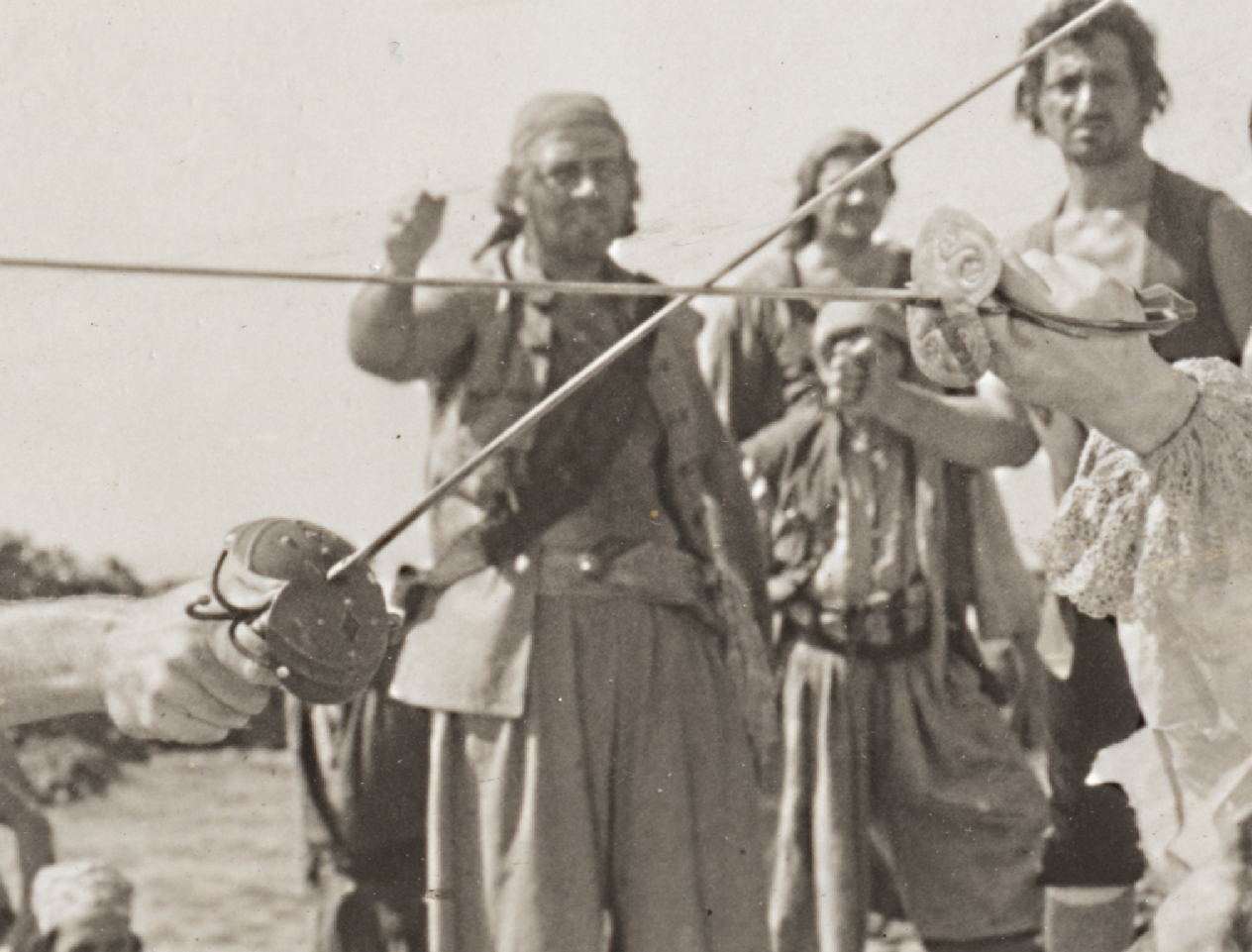

In the film, both swords are theatrical “rapiers” mounted with sport epee blades, known in the past as “hollow,” three-cornered, or triangular blades. They are stiffer by comparison to foil and saber blades, and show up well on screen. Since the 19th century it was recognized how difficult it is to see foils onstage, given their small hilts and narrow blades. In the latter part of the 19th century, as actors began to be trained in legitimate swordplay and stage duels came to reflect reality more, foils were often replaced by swords with larger hilts, typically rapier hilts or fanciful rapier hilts, and thicker blades — thus the anachronistic rapiers with sport epee blades used in Captain Blood.
The hilts of both swords used in the film duel are a bit fanciful, neither corresponding exactly to historical swords. Flynn’s appears to something of a reduced Pappenheimer hilt (for example, a Norman type 67 but with no side rings), with two solid shells, a pair of curved quillons, and a knuckle guard, perhaps also resembling a shallow Spanish bilbo-hilt (Norman type 82) with smaller shells.
Rathbone’s rapier hilt appears to be nothing more than a common smallsword hilt (Norman type 112) but with enlarged shells, rings, and quillons. One might argue it is instead a small-hilted Spanish “dueling rapier” or “Spanish smallsword” (as some call it) — an espadín — of a sort that was introduced 1680 to 1700 and became even more common after a Bourbon began sitting on the Spanish throne. Most of these have very large (as compared to French smallswords) rounded shells, or smaller, shallower cup-hilts, or smaller “bilbo” hilts, but occasionally one with large mostly flat shells, as with Rathbone’s, is seen. Perhaps a bretteur or spadassin (a thug with a sword), as Levasseur clearly was, preferred the longer blade of the transitional rapier or espadín to that of French smallsword in order to gain an advantage. That said, the heavier transitional rapier and Spanish smallswords would be at a disadvantage in speed as compared to the true smallsword.

The sword designer — Fred Cavens, perhaps, or more likely pirate historian and costume designer Dwight Franklin — was probably thinking of swords that would evoke “Cavalier” or “Musketeer” rapiers of some sort. As noted in a caption above, Flynn’s may have been inspired by that of Captain Keitt in Howard Pyle’s famous painting.
The enlarged hilts of the theatrical rapiers used provided a better film image, or so the thinking probably went, than the smaller, but more legitimate, authentic smallsword hilts. Plus, viewers have been conditioned by fiction and film to expect rapiers no matter the era, no matter how anachronistic. For filming, the larger rubber buttons or points d’arrêt were removed — more on this below!
Choreographer & Choreography
The duel was choreographed by famous swordfight director Fred Cavens. He began fencing at twelve years old circa 1894, was teaching other boys how to fence at fourteen, and graduated at eighteen from the famous L’École Normale de Gymnastique et d’Escrime Militaires de Belgique in Brussels, a school modeled on the famous French military school at Joinville-le-Pont near Paris. At twenty-one he was a full-fledged fencing master in the Belgian army.
After his service in the Belgian Army, Cavens emigrated to the US in 1919, soon after both his marriage to a Belgian dancer in an opera company and the end of World War One. He was invited by some American sportsmen, fencers we assume, to open a salle in Santa Barbara, California, leading to an introduction to various film studios, whose swordplay on camera to date, other than that choreographed by fellow Belgian master Henry J. Uyttenhove, was often little more than knife-sharpening actions, often in long shots, or was entirely doubled (which generally demanded long shots in order to carry out the deception). (Anon., 1936.) Leon Bertrand, the famous fencing master (and who helped train Rathbone in London) noted that the old “Glasgow tens” and other clunky hack and slash patterns of the 19th century popular theater were still seen in some silent pictures in the 1920s. Cavens et al would finally end their reign — mostly. Bad swordplay in film is still too common today.
Cavens by his own account came to Hollywood in 1921, although he is often incorrectly credited with film choreography as early as 1920. His first major role in fencing choreography in film as far as we know was the swordplay for the 1922 short film The Three Must-Get-Theres, a parody of Douglas Fairbanks’s 1921 The Three Musketeers. The comic film is quite funny, even brilliant at times, and is possibly the best send-up of swordplay and musketeers I’ve seen. Although there are moments of common “blade sharpening” fake swordplay, most of the fencing is of outstanding caliber. In fact, director and star Max Linder was an accomplished fencer who had competed in epee, if not also in foil and saber. The film, by the way, is available on YouTube in a couple of versions, and also on a Grapevine DVD. The latter is by far the better version.

Fairbanks loved the swordplay in the comic film and first met Cavens on the set of Dorothy Vernon of Haddon Hall, a production starring Fairbanks’s wife Mary Pickford. Fairbanks quickly hired him for Don Q, Son of Zorro (1925) and then for his genre-establishing 1926 swashbuckler The Black Pirate the following year, in which during a rehearsal he hit Fairbanks in the face, causing a wound in front of visitors. Cavens also choreographed the swordplay in Fairbanks’s The Man in the Iron Mask (1929), among his many, many credits from the 1920s to 1950s. By 1934 his major film choreography also included Ashes of Vengeance, The Dangerous Maid, The Three Musketeers, The Sea Hawk, The Road to Yesterday, and The Count of Monte Cristo. (Anon. 1934, Behlmer, 1965.)
Cavens had a theory of romantic realism — a bit more romance, a bit less realism, with authentic if at times theatrical fencing — for filming swordplay on the screen, a theory that worked quite well in practice from the audience’s perspective.
“For the screen, in order to be well photographed and also grasped by the audience, all swordplay should be so telegraphed with emphases that the audience will see what’s coming.” (Cavens quoted in Behlmer, 1965.) This, of course, is a form of false tempo, discussed here, that would likely get a fencer killed in a duel. But it works well for the audience — and that’s the goal.
It is in fact an improvement upon a method already known in the late 19th century English theater. As described by William Herries Pollock in 1896: “To make it [stage swordplay] effective both to an expert and a lay audience a man must be, like Henry Irving, a good swordsman; but it is, after all, in its component phrases, as simple as it can be made showy.”
Behlmer further quoted Cavens: “All movements — instead of being as small as possible, as in competitive fencing — must be large, but nevertheless correct. Magnified, is the word. The routine — there must be a routine, and so well learned the actor executes it subconsciously — should contain the most spectacular attacks and parries it is possible to execute while remaining logical to the situation. In other words, the duel should be a fight and not a fencing exhibition, and should disregard at times classically correct guards and lunges. The attitudes arising naturally out of fighting instinct should predominate. When this occurs the whole performance will leave an impression of strength, skill and manly grace.”

Cavens prepared actors, ranging from Flynn and Rathbone to Maureen O’Hara, Binnie Barnes, Jean Peters, and many others, thoroughly, teaching them not only the scripted swordplay itself, but also fencing in general. Maureen O’Hara in her autobiography described her preparation for At Sword’s Point (1952): “I trained rigorously for six weeks with Fred Cavens and his son to perfect my stunts for the picture. Fred Cavens was an outstanding Belgian military fencing master and had trained all the great swashbucklers in Hollywood. He taught me intricate attacks and parries, envelopments, disengagements, and coupes. Physically, I’ve never worked harder for a role.” For The Corsican Brothers (1941), Cavens coached Douglas Fairbanks Jr. for a month prior to filming. (Brady, 1941.)
His process was described by Thomas Brady: “Cavens’s greatest value to a producer is his ability to prepare a fight with the precision of a choreographer. No impromptu bout, he says, looks truly exciting to the camera. His technique with a picture follows a regular pattern. First, with the director and the camera man, he examines the sets to be used for fights and learns in general what the action must be and how much time it shall take. Then, in the esoteric language of the swordsman he writes down every move the attacking fencer will make. For a three-minute fight in Fox’s “The Mark of Zorro,” Cavens’s “score” ran to 750 words. Tyrone Power and Basil Rathbone had to memorize it… Even when Cavens and his own son fight a duel on the screen, as in “The Corsican Brothers,” they memorize a “ballet” routine beforehand.” (Brady, 1941.)
Cavens preferred actors to fencing for film choreography. “If skilled fencers fight for the camera, they have certain reflexes, result of long training, that must be overcome. Their work is too fast, also, to register. Actors are not burdened by these reflexes, and they remember to act, which is important.” (Cavens quoted by Coons, 1936.)
“A movie duel, under Cavens’ direction, is ‘broader’ than a real encounter, but technically correct as to all the fine points. The ‘broadness’ permits the opponents to register dramatic reactions. (Coons, 1936.)
The Duel Master Scene in the shooting script by Casey Robinson includes the following notes, which depart from Sabatini for whom Levasseur was a mere thug and bully in both his life and his swordsmanship:
“The details of this duel must naturally, be worked out by an expert in this line. We wish to emphasize here the general nature that this fight must have. Usually duels in pictures are contests between some agile, brilliant, hero and a slow and dull witted, even though powerful villain. Such is not the case here. Here we must have a great fight between two truly great swordsmen, equally matched in quickness, brilliance, and skill. It is not a fight to the first advantage or the first spilling of blood, but a fight to the death. It is a vicious, terrific battle in which both men take a great deal of punishment before the final conclusion. In other words, the fight would be routined not after the order of duels that have been shown in pictures, but rather after the order of some of the great rough and tumble encounters that have made their pictures famous notably, the fight in ‘The Spoilers’. Thus, before the battle is finished, part of Blood’s clothes have been cut away and he is very much marked up by Levasseur’s sword.”
Note that dueling was still in vogue in France, Italy, and Hungary at the time of filming (although WWI had diminished the practice significantly, only WWII would almost entirely put a stop to it), thus the comments on first advantage and first blood have more than purely Hollywood relevance. In fact, my first fencing master, an active swordsman during the 1930s and trained by the famous Italo Santelli, had fought at least one duel in Budapest in the 1930s. Fred Cavens had acted as directeur de combat for several duels and had fought as many more. (Anon., 1934.)
[Quick aside: until a couple or so decades ago, referees in modern fencing in the US were referred to as directors, from directeur de combat, the person who supervised a formal duel. If the competition were non-electric, the director might be referred to as the President of the Jury, for the president presided over four judges. Today, the term “referee” is used, the powers-that-be rather incredulously arguing that the name change would make fencing more accessible to the still largely imaginary audience. “One fool makes many,” according to the proverb.]
According to the LA Times, Cavens also trained “one hundred fifty men…in the art of being pirates at the Warner Studio” for Captain Blood. “They go to school every day for eight hours to fence under the tutelage of Fred Cavens… He is also teaching them how to climb riggings and other tricks of the trade.” (Kendall, 1935.) Certainly Cavens would have trained the pirates in cutlass-play, but as for teaching “pirates” to climb aloft, although Cavens would certainly know how this was done given his experience on Douglas Fairbanks’s The Black Pirate (1926), we imagine Sailor Vincent (see below) or some other salty seafarer was actually responsible for this aspect of training.
Filming the Duel
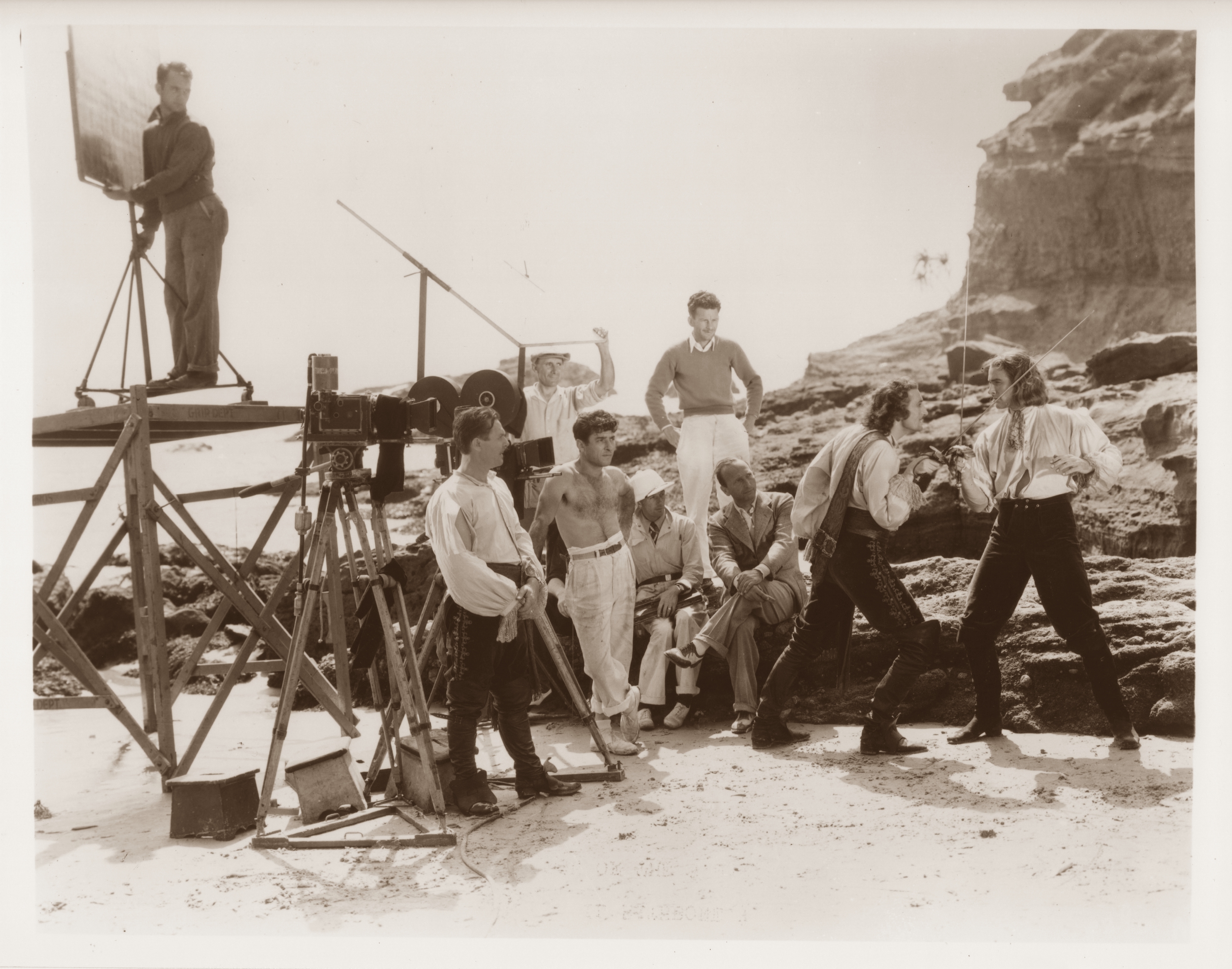
Shooting a duel could take days, and one author (Matzen, 2010) notes that shooting this one was hindered by “bad weather, milky gray skies, [and] audio challenges brought on by the pounding surf,” and two actors who could not fence — in fact, it was only Flynn who could not fence. The Virgin Magra scenes, including the “pearls before swine” build up to the duel, were shot September 16 through 18 and 24 through 26, with delays caused by cloud cover, aircraft, and high fog. Some takes were shot with artificial light (Florczak, 2022).
“These scenes take, Lord knows, how many set-ups. For instance, they will not take a long shot alone; they’ll take a master shot, then a medium shot and then take some close-ups. Any fight that lasts five minutes on the screen could easily take two days to shoot,” said Basil Rathbone (Jones, 1972).
According to Rudy Behlmer (1965), “When the duel is shown to the director, he, and perhaps the cinematographer, may alter the set, props and lighting. After which, the duel routine is broken up into master shots, close-ups, special angles, etc., and photographed with either principals or doubles, depending upon the actors’ capabilities and the specific shot.
There is a myth that director Michael Curtiz engaged in swordplay himself during the filming: “Curtiz, who is quite the swordsman himself, having been a member of the Hungarian Olympic team in 1912, would fight with each of them first, to show how he wanted it done.” (Whitaker, 1936.)
This of course, is nonsense, at least regarding the Olympic Games, and probably in its entirety as well. Curtiz, although apparently fond of claiming he was on the 1912 Hungarian team, does not appear to been an Olympian. I have not found his Hungarian names (Manó Kertész Kaminer and Kertész Mihály) or anything similar among the fully detailed records of the foil, epee, and saber events from first pools to final of the 1912 Games. Even so, numerous biographies repeat the myth as fact, although occasionally the word “allegedly” is used. For good reason did Cavens, not Curtiz, choreograph the duel.
Doubling of the sword-fighting actors was common at the time, including in Captain Blood. “The villains, especially Basil Rathbone, are splendid fencers, but the heroes, according to Mr. Cavens, are ineffectual fellows when it comes to cold steel… And when the script demands that he [Errol Flynn] resort to the sword to defend his honor, Warner Brothers resorts to Mr. Cavens.” (Brady, 1941.)
However, Fred Cavens, as proved by the photo below, as well as others farther down, doubled Rathbone, not Flynn, when necessary during the duel. In fact, Hal Wallis complained of the dailies of the duel, noting that the wigs and costumes of the doubles were terrible as compared to those of the actors. The photos below show he had good reason. Thankfully, the doubles were used only in the long shots, as far as I can tell, in the final cut.


Flynn was doubled as necessary by Caven’s assistant, Ralph Faulkner, soon to become one of Cavens’s principal Hollywood heirs. Faulkner was 1928 Pacific Coast foil and epee champion, and a member of the US Olympic saber team at the 1928 and 1932 Games. Regarding the 1932 games, “One of the mysteries in the competition between Poland and the United States was the removal of Ralph Faulkner, the only Southern Californian on the team, from the American line-up. Faulkner had been entered in the contest with Hungary and had succeeded in taking two of the three bouts for America in her score against that country.” (Durbin, 1932.)
A mystery indeed! [And a brief digression!] The Hungarians ruled saber for fifty years; their national saber championship was tougher than the Games themselves, so deep were the Hungarians in elite sabreurs. That Faulkner could win two of three bouts against the Hungarian team that would win gold is amazing — no other fencer at the 1932 Games won more than one bout against them (in fact, for fifty years a total of slightly more than 30 Hungarian sabreurs won nearly every elite competition in the world) — and should have guaranteed his inclusion in the bronze medal bout against Poland. However, the elitist East Coast prejudice against his Southern California roots is not out of the question, and this probably cost the US a medal: the US lost to Poland by a single touch.

One of the methods of excluding “outsiders” was via cheating by side judges and bout directors during qualifying championships: the director had one and a half votes, and each of the two side judges watching a single fencer had one vote each and could therefore overrule even an honest director. The other method, common in the first half of the 20th century, was exclusion by the committee “choosing the best fencers” or even by a team captain during events. I’m speculating, of course, but these latter two means were probably the way Faulkner, an outsider, was excluded from the bronze medal team match — and entirely from the individual events in the 1928 and 1932 Games.
[Warning: further fascinating digression ahead!] In fact, until the 1950s team selection in US saber fencing was reportedly largely ruled by the “New York saber Mafia,” as many non-New York fencers called the narrow-minded, cliquish US saber fencing establishment, and a number of deserving fencers failed to make the US team due to prejudice against them, including at times of race and religion. The brilliant Herb Spector, described by one of my masters, Dr. Eugene Hamori, as the best saber fencer in the world in a two-touch bout, springs immediately to mind, among others. I have both met Herb on numerous occasions and fenced him once in competition: he was the personification of the highest praise of Dr. Francis Zold, my first fencing master, that of being both a gentleman and swordsman.
This unsportsmanlike, even dishonorable, practice arguably had its roots in the at-the-time elitist Fencers Club of New York. (The Fencers Club of NY still exists, although some suggest that its past arrogant elitism may have passed into the hands of the New York Athletic Club. Please note that no suggestion of dishonorable or unsportsmanlike conduct is herein made toward either club today, in part because I don’t like wasting my time with NY lawyers, or any lawyers, although the sense of crass elitism remains according to some observers.)
Faulkner himself confirmed bias as the reason he was only permitted to compete as part of the US Olympic saber team in both 1928 and 1932, and not in the individual saber events: the controlling Eastern Establishment “didn’t feel a savage from out West could be superior.” (Folkart, 1987.)
The “Mafia’s” spine, at least in regard to the Olympic Games, was broken when Hungarian gold medalist saber fencers, including one of my own masters, Dr. Eugene Hamori, defected to the US after the Soviet Union brutally crushed the democratic Hungarian uprising in 1956 during the Olympic Games. The Hungarians’ technique was so superior and clean that any cheating against them would have been far too obvious.
And if this clear superiority didn’t stop the mischief, I’ve seen how some of these Hungarians dealt with cheating directors and side judges clearly in cahoots with the opposing fencer: they would drop the opponent to the strip with a welting chest cut, making the hit overtly clear even to the most willfully blind. (I’ve also seen the technique used once by a Hungarian Olympic medalist in New Orleans frustrated with the director, a friend of his and also an Olympic medalist — and the fencer he dropped to the ground was also a friend. Temper, temper… Or tempo, tempo?)
However, even as late as the 1970s the “Mafia’s” influence was still apparent to some degree, at least in the Junior Olympics, according to several fencers I knew. As a good friend of mine noted at the time, he could beat any of the elite junior New York competitors anywhere in the US and world — except in New York City. A bout director there even shrugged in apology to him once, after the two side judges were repeatedly, and clearly deliberately, blind to his clean on-target touches made with undisputed priority.
Faulkner was still teaching fencing at his salle, Falcon Studios, aka the Faulkner School of Fencing, in Hollywood, when I first started learning in 1977. By then he gave lessons seated and was nearly blind, or so I was told, but his lessons were still extraordinarily instructive in blade-work. I was advised to take a lesson just to say I had, if nothing more, but never managed to do so in part because I was well-satisfied with my own swashbuckling master, Dr. Francis Zold. (I was also an impecunious college student in LA without a car.) Many Hollywood and stage fencing choreographers — Anthony De Longis comes quickly to mind — studied under Faulkner and by their own admissions owe much to him. Maestro Faulkner died in 1985 at the age of ninety-five.

But back to the filming of the duel! Flynn was noted in the production of later films as having a drinking problem on set, which in the case of swordplay would be quite dangerous.
Whether Flynn drank during the filming of the duel in Captain Blood is not noted anywhere I can find. According to Maureen O’Hara in her autobiography, “I enjoyed working with Errol because he was a pro. He always came to work prepared. He rehearsed hard and practiced his fencing sequences very meticulously with Fred Cavens… He also knew his lines, something I greatly respect in an actor. Of course, there was one glaring inconsistency with his professionalism. Errol also drank on the set, something I greatly disliked. You couldn’t stop him; Errol did whatever he liked. If the director prohibited alcohol on the set, then Errol would inject oranges with booze and eat them during breaks. We worked around his drinking. Everything good that we got on film was shot early in the day. He started gulping his “water” early in the morning and by four P.M. was in no shape to continue filming.”
Flynn himself describes in his autobiography how when filming a boarding scene during the production of Captain Blood he fell to the ground with an attack of malaria or blackwater fever. He cured the shaking, shivering weakness of the attack with a bottle of Cognac suggested, he says, by the crew. He was called on the carpet by Jack Warner the following day as the result of this drinking: “The script girl tipped me off. They had rushes of the scene I finished after the bottle of cognac. In the film I was waving the sword about like a Cossack, shouting lines that weren’t in the script, and had almost fallen off the boat. A bit of real drunken acting.”
The filming of the duel was publicized in small ways in advance of the movie’s release. The press package claimed, for example, that “Actor Breaks Three Rapiers in Duel,” which is probably true in reference to blades. Hilts might break, but are generally much sturdier. It would be surprising if spare rapiers and blades were not on set during filming. Even so, according to a press clipping, a “rush order for additional rapiers was sent out when Errol Flynn…broke three of them during the filming of scenes in which he has a duel with a rival pirate…”
Also according to the Warner Bros. publicity package for the film and often repeated as fact, Flynn “received two small wounds during his battle with Basil Rathbone.” A separate publicity clip for newspaper release noted four: the “most serious wound was on the actor’s head, slightly above the left temple. He also was cut by his opponent, Basil Rathbone, near the right eye, on the neck and on the right forearm.”
And according to one reporter, “they really drew blood too, so that Flynn had some actual wounds to be doctored after that exciting buccaneering day.” (Whitaker, 1936.)
Although injuries do occur on occasion in well-prepared, well-choreographed swordfights, those listed here are probably pure invention for the sake of publicity: Rathbone in his autobiography states that he never hurt anyone when filming any fencing scene, nor was hurt by anyone. The photograph of Flynn below shows the “wounds” — and they appear to be nothing more than those created by a make-up artist for the scene. If Flynn were wounded during the filming of the duel, it would have therefore been by Fred Cavens, and surely due to Flynn’s own error. I think it also possible but highly unlikely that Cavens would have deliberately hit Flynn as a reminder to be careful — or not to do anything too stupid or too dangerous that might hurt his film adversary. (This can, however, be an effective teaching method with a blunt tip used during an egregious error made by a student without a jacket, although not all students these days are suitable to this practice.)

At one point, again according to the press package, Flynn fell off a cliff at Three Arch Bay during filming:
“Flynn was doing a scene depicting a duel with rapiers between himself as Pirate Blood and Basil Rathbone, who portrays the role of Levasseur, French buccaneer and Blood’s rival. In order to give the scene added drama, Director Michael Curtiz had Flynn drive Rathbone at swordspoint onto a small ledge on the side of a cliff overlooking the bay. The cliff was not quite perpendicular, however, sloping off gently so that the ledge was about ten or twelve feet shoreward and forty feet above the water line.
“With the cameras grinding, Flynn backed Rathbone onto the ledge according to instructions. For several minutes the rapiers of the duelists flashed. Then, suddenly, a shout of dismay rose.
“Flynn had tripped on a small rock and toppled outward from the ledge. Slowly at first, he strove to regain his footing, but in vain. When he finally realized there was no chance of saving himself, he put all his power into an outward leap. He soared out from the ledge, cut cleanly into the water, missing the base of the cliff a mere matter of inches. He swam to the beach unaided.
“A less powerful man than Flynn could not possibly have put the force behind his leap to clear the base of the cliff… [He] suffered nothing worse than a slightly lacerated knee which scraped a submerged rock.” Although it’s entirely possible that the incident did take place, Hollywood clearly does love hyperbole, not only for the sake of publicity, but for its own sake. Flynn even reportedly “rescued” Olivia de Havilland after a wave swept her into the ocean (Amburn, 2018). Separating fact from fiction in Hollywood is difficult, and fans often prefer the fantasy.

The shooting of the duel wrapped up near dusk on the final day (probably September 26). Rathbone tells an anecdote (Jones, 1972) about how “Sailor Vincent,” the nominal head of the pirate extras and, according to the press package, an “all-Navy welterweight boxing champion,” asked Flynn and Rathbone near the end of a day’s shooting if they were going to wrap it up that day or give the extras another day to get paid. “Our reputations as swordsmen were at stake,” Rathbone said, and so they decided to finish the shooting that day. They were probably quite ready to get past the exhausting shooting of the duel.
“Now what we had to do was this:” Rathbone said, “a man stood with a stopwatch, and he timed the waves coming in. There was a short routine in which Flynn had to get me, kill me, and I had to fall exactly as a wave was coming in. If I fell exactly as a wave was coming it, it would cover me with water and as it went back out again, there I would be lying on the ground with my eyes wide open. You try lying with your eyes wide open, and sea water in them without blinking. Well, we did it! Exactly to the second, we timed the swordplay which took fifteen seconds. At the end of fifteen seconds I had to fall and the wave had to come in and I had to fall into the wave. This happened exactly to the second.
“The thing that Flynn and I expected was that Sailor Vincent would come across and say, “Well, thanks for nothing!” Instead of that, all the extras applauded loudly. They were so thrilled at the sheer skill of it because this required beautiful timing and Flynn and I worked very hard on the sequence.”
After a few more shots, and with the sun soon too low at 4:30 to shoot, filming of the duel finished and everyone went home. Rathbone noted that had they failed to get the final scene correct, they would have had to shoot again the next day because he would have had to wait for a new, dry costume.

The Myth of “Sharp Tips” Used in the Film Duel
There has long been a myth that director Michael Curtiz demanded that the tips be removed from the rapiers so they wouldn’t show up on film, and therefore the actors fought their duel with sharp points. This myth, among other issues, demonstrates a lack of understanding of how practice fencing swords are constructed and used.
The rapiers used in the duel were mounted with “dry” (i.e. non-electrical — electrical scoring was introduced the following year at the Olympic Games) epee blades, which might be considered a reasonable facsimile of the “three cornered” blades of many smallswords of the 1680s. Unlike modern epee blades, which are wider at the forte (the third nearest the hilt) and thicker at the foible (the third nearest the point), epee blades for most of the 20th century tended be narrower at both forte and foible than modern blades.
Practice dry epee blades were not, and are not, sharp, but instead are forged with a flat tack-like tip, often only slightly larger in diameter than the distal end of the blade. For “dry” practice in the 1930s (which was nearly all practice back then) either a hard rubber “button” was placed over the flat tip, or a point d’arrêt with three small sharp points was lashed to it with linen thread, dental floss, or very narrow (1/16″) cloth tape. There was no sharp point beneath. See the image below.
For shooting a duel scene in any film of the era, the rubber buttons or other points d’arrêt were typically removed, leaving the flat tips which made for better visuals. The flat tips are not as obvious on film but still could be dangerous, to eyes in particular, and required well-rehearsed actors for safety. The flat tips could also scratch or even make shallow cuts in the worst cases, but were not a significant threat to life or limb except, as just noted, to eyes. Typically only a wound from a broken blade might be life threatening.

However, according to some sources citing cameraman Hal Mohr (Davis, 1971, for example), the tips of the blades were broken off at Curtiz’s demand, leaving sharp points. This not only strains belief but is easily disproved. Breaking a fencing blade is relatively easy but breaking it immediately behind the flat tip is not. It would usually require a strong cutting tool or a hacksaw blade to cut the blade just behind the tip, and would indeed leave a much more dangerous point, something no fencing master would permit in the hands of even a talented amateur such as Rathbone, much less an unskilled fencer like Flynn.
I once choreographed and engaged in some fencing with sharp, pointed scimitars for a documentary. For safety it was necessary that both of us were highly skilled with pointed and edged weapons, we rehearsed and memorized the routine thoroughly beforehand, and during actual filming we worked at about half the speed we were capable of. Anything else with sharp or pointed swords could easily have led to serious injury or fatality. Fencing on stage with “sharps” was occasionally done in the 19th century, according to Pollock — with expected occasionally bloody consequences.
Notably, of the many original still photographs of the Flynn-Rathbone duel in my collection, at least of those in which the points are in focus, none show sharp or broken points, but instead, as expected, the typical flat points of practice epee blades. See below, for example. The photographs of the duel were taken at various stages of the its filming. The flat tips can even be seen in some of the scenes on film when watched frame-by-frame. Further, it is hard to believe that if Rathbone and Flynn had fenced with sharp points, Rathbone would not have mentioned such a dangerous undertaking in interviews or his autobiography. Again, we have a myth promoted by the Warner Bros. publicity machine and accepted at face value by much of the public.
Its ultimate origin is probably in a dueling trope common to 19th century swashbuckling romantic adventure novels: two erstwhile duelists, or their seconds, hastily break off the tips of their foils so they can fight for real. Walter Herries Pollock shreds this nonsense in his 1896 article on stage fencing: the tips would need to be filed, a noisy and lengthy process, or they would need to be snapped, an impossibility to do so such that each would be the same length. A trope, in other words, made into a myth. (Pollock.)


The Musical Accompaniment

The film score was composed by Erich Wolfgang Korngold, who largely created the modern practice of classical composition for film music. Korngold had not quite four weeks to compose it (November 10 to December 8, 1935; he was paid for a total of only five and a half weeks work), and was assisted by his long-term orchestrator and collaborator Hugo Friedhofer. Nearly all of the film’s music is original, with one major exception and a few minor associated additions. In addition, two minor pieces — songs sung by Spanish soldiers and seamen — were composed by Milan Roder, another long-term collaborator of Korngold’s. Throughout the process, Korngold was, unusually, monitored closely by Hal Wallis (who closely monitored everything, not always successfully, on the picture).
The major exceptions to original music, of course, were the scores for the duel on the beach and the climactic battle scene at the finale. Reportedly, the film’s preview had been moved up in order to meet a Christmas release date, and the score had to be completed within twenty-four hours. Out of time, Korngold adapted Frans Liszt’s symphonic poem Prometheus to the duel, a circumstance that apparently offended his sense of artistry and professionalism. He also adapted Liszt’s Mazeppa and used it for the climactic battle scene as well as for parts of the Spanish attack on Port Royal. These adaptations led him to refuse to have the credits list him as composer, and instead as musical arranger, in spite of his having composed the majority of the film score. For this reason the score was not nominated for an Academy Award, sadly. Korngold’s original film compositions — “opera without words” and “symphonic poems” — and method of scoring changed Hollywood film music forever. (See Carroll, Kalinak, and Winters for much more detail, in particular Carroll for an outstanding biography and Kalinak for a detailed study of the music in the film.)

According to Brendan G. Carroll, Korngold gave Friedhofer the Liszt score along with a new introduction and coda at 8:30 PM the day before it was required. Friedhofer spent the night arranging the adaptation. At 7:00 AM a messenger picked up the orchestration for copying. It was recorded that afternoon. That said, elements of the Liszt’s Prometheus also appear, as least as far as my untrained ear can tell, in the tracks “Peter is Bound — Pirates!” and “A Timely Interruption,” the latter of which is really a continuation of the former.
The 2001 Tsunami Captain Blood soundtrack (TSU 0141) above is the only one I’m aware of with the entire film score, including the duel. The thirty-one tracks provide an hour’s worth of neo-romantic swashbuckling listening pleasure. Out-of-print and now often listed at high prices by vendors hoping to make a quick extra buck, if you’re patient you can usually find a reasonably-priced copy. It’s my favorite of all the vinyl and CD Captain Blood soundtracks, and probably my favorite of all the full swashbuckler scores available on CD (or whatever else soundtracks are published via these days — I’ve never stopped listening to and collecting vinyl and CDs even as I’ve added other media to our collection, although I did long ago abandon cassette tapes).
Liszt’s Prometheus is also excellent listening. It’s often included on collections with Liszt’s Preludes, in which case you can also enjoy the overture to the old Flash Gordon film serial, a “space opera” — which was by definition a Western set in outer space. Our most popular modern version, arguably of both space operas and Westerns, is Star Wars and its many serializations. Star Wars has also taken over most of the old classic swashbuckling genres, to my dismay.
The Duel!

And now the duel itself. The best way to enjoy it — in fact, the only way — is to watch it. For those with an interest in the actual fencing details of the choreography, I’ve included a few annotations below. Fencing enthusiasts, feel free to disagree with my observations and assessments!
The fight really was between two true adventurers. Flynn was an Irish-Australian born and raised in Tasmania. In his autobiography describes himself in his youth as a “devil in boy’s clothing,” and after numerous misadventures leading to his eighteenth year he entered several years of seafaring adventure and fortune hunting — tobacco planting, gold mining, and various sea trades — associated with Papua New Guinea. An athlete but never a fencer, he does fondly describe playing with a sword an ancestor had taken from Captain William Bligh during the infamous mutiny, and he denounces his father for giving it away to the Naval and Military Club at Hobart.
Rathbone was the Patrols Officer of the Second Battalion of the Liverpool Scottish during WWI, and was awarded the Military Cross for heroism for his intelligence collection patrols, in particular one in which he led a small party across “No Man’s Land” into the German trenches for intelligence during daylight. At one point Baron von Richtofen, better known as the Red Baron, and his Flying Circus, which included future Nazi leader and convicted war criminal Hermann Goerring, flew a mere one hundred feet overhead, strafing the British line. In the enemy trenches, Rathbone, using his service revolver, shot and killed a German soldier. Documents taken from the soldier’s pockets indicated that a retreat was imminent. Rathbone led his men out safely under heavy machinegun fire. (Rathbone, 1962.)

The duel could not have been easy to film and fight in the sand, a surface which presents its own special difficulties. The rear foot tends to slip on the lunge. Turning the foot onto its inner edge is helpful (as some 17th and 18th century masters note), as is pushing more outward than directly behind on the lunge with the rear foot, as is maneuvering the fight onto the area of wet compacted beach between the soft dry sand above and the wet saturated sand below, or onto an area of vegetation. But at least the implausible “pirate boots” — buccaneers and pirates didn’t wear them unless on horseback, and it was rare to take a canter or gallop around the quarterdeck of a ship — would keep sand out!
The duel begins with Flynn wearing what at first appears to be a sleeveless waistcoat but is in fact a coat with different-colored sleeves or a long-sleeved waistcoat, with a baldric worn over a sash, apparently sewn or otherwise un-historically attached to the sash to keep the former from bouncing around. Rathbone is in his shirtsleeves, but likewise with a baldric worn over a sash. Eyewitness images of buccaneers in the 1680s — the only eyewitness images of any European-derived sea rovers during the Golden Age of Piracy — do show sashes on French buccaneers, but not baldrics. Sword-belts were worn instead, given their convenience, and they’re also not as hot. If a baldric were worn, it would typically have been worn beneath a sash to prevent it from bouncing around. (Why baldrics over sashes rather than under them as more practical? So the baldrics could be removed while leaving the romantic sashes in place.) I’ll discuss this further in part five of this series.
And now, for fun, a brief look at some of the swordplay itself. One of these days I may annotate the entire duel, but I’ve lost my old notes and haven’t the time at the moment to review it in its entirely again. A few instances will suffice for now.
The duel begins as several of Peter Blood’s officers begin escorting Arabella Bishop to a small bluff en route to their ship. Cahusec tries to restrain Levasseur but he’ll have none of it. “You do not take her while I live!” he shouts and draws his sword. “Then I’ll take her when you’re dead!” Blood replies, drawing his own sword, tossing his hat, and beginning to remove his baldric and waistcoat. Cahusec tries one more time to dissuade his captain, but fails.
Levasseur runs at Blood and thrusts in tierce. Blood parries tierce and shifts aside for additional protection against the the attack. The men move to open ground where Levasseur makes a half lunge, thrusting in quarte. Returning to his guard, Levasseur makes several change beats from quarte to tierce and back, followed by a few disengages in the same line against Blood’s en garde in quarte.
Levasseur feints outside (tierce), then inside (quarte), and finishes with a thrust without lunging in the low line, which is parried quinte (low quarte) by Blood, who ripostes with a quick extension but no lunge. Both men are clearly engaging in reconnaissance.
Now, in a wide shot, Blood traverses to his left. Levasseur attempts a wide, too obvious head feint, saber-like (this is theatrical swordplay, after all), to the inside, then cuts to the outside. Flynn makes a half-quarte parry, followed by a tierce which parries the attack, and ripostes low in seconde. Flynn parries another attack in tierce, again ripostes seconde, then attempts a head cut which is parried by Levasseur who ripostes inside, which is parried by Flynn in prime. Flynn makes a quick attack in seconde which is parried, and — very nicely and correctly — recovers quickly with a circular parry in the high line to protect himself just in case.
Flynn traverses to the left again, then attempts a flashy, and very “telegraphed,” head attack that would evolve in later films to a “triple moulinet,” which would become his signature move in his film swordplay. And every time I see it, I shout “Time him! Time him! Time him!” in my head to his adversary. Flashy, yes. And just asking to receive a time thrust to the throat! (Of course, moments before Rathbone had done much the same, if less flambouyantly…)
And so it goes, all very swashbuckling and theatrical.
For the sake of time, for now at least, I’m skipping over most of the following swordplay. As the duel progresses toward the rocks upon which Levasseur will meet his end, there are a couple of long shots which clearly show Rathbone and Flynn doubled by Cavens and Faulkner. Certainly, the publicity still below proves that Cavens doubled Rathbone in one of these shots, and in the same shot on film it is easy to recognize Cavens briefly. Faulkner is almost certainly doubling Flynn in the same shot. The studio was concerned about these obvious doubles — yet in fairness, the film used a great deal of old sea battle shots in the finale, and this is quite obvious.

I do want to mention my three favorite phrases (a phrase is a complete exchange, from start to finish, in fencing, for example: attack, parry, riposte, counter-riposte, counter-attack, &c, until there is a hit or the fencers break distance). All three take place in the final moments of the duel.
First is a croisé in sixte by Levasseur, which is beautifully parried by Blood with a prime, followed immediately by the classic, and very flashy, bind-thrust riposte in tierce (or sixte) to the head, the blade arcing from low to high, almost as a moulinet, although the hit doesn’t quite land. In the right circumstances the technique can disarm the adversary. But nicely done, still!
This is soon followed by Levasseur binding Blood’s blade from sixte to septime, with Blood countering with a yielding parry in tierce as he falls. Again, nicely done!
(We might call this techique “The Levasseur” and it can be a highly effective indeed unless the adversary knows his yielding parries or is exceptional at avoiding the blade, to paraphrase Inigo Montoya: a feint-bind in seconde followed immediately by a feint-bind in counter-seconde, then quickly change direction and bind sixte to septime with a flanconnade thrust…)
A quick side note: previous to this Levasseur falls, and Blood gallantly permits him to get up. But when Blood falls, Levasseur does his best to take advantage of the situation, showing the difference in their characters.
And now the two men are face-to-face at “handy grips!” Here we have the obligatory close-up, hilt-to-hilt, deadly fury in each man’s eyes!
The adversaries quickly get to their feet, surprisingly without punching or pommeling each other, for the final engagement in which, moments after a quick, beautiful bind with transfer in sixte which is parried in prime, Blood kills Levasseur by lunging off the line — an esquive or, arguably in the language of the day, a volt — and “pinking” him, to use a 17th century term, from side to side. I strongly suspect the finish was inspired by the one in the duel in Rafael Sabatini’s The Black Swan, published three years before.
The film duel from start to finish is just under three minutes, yet time stands still for that short time, so exciting is the swordplay and acting. A timeless scene of piratical yet noble swashbuckling indeed!

And, in the latest news (and it’s about time!), Captain Blood has recently been re-released (January 2026) on 4K, Blu-ray, and DVD by Criterion! (But what’s up with that Frank Frazetta / John Carter of Mars sword?) 🙂
Next in the series: The Duel on the Beach in Reality!
Select Bibliography
Ellis Amburn. Olivia de Havilland and the Golden Age of Hollywood. Lanham, MD: Rowman & Littlefield, 2018.
Anon. “Frederic Cavens, 79, Taught Stars Fencing.” New York Times, May 2, 1962.
Anon. “Sealing Wax, Cabbages and Kings.” New York Times, September 30, 1934.
Rudy Behlmer. “Swordplay on the Screen: The Best of it Has Been Due to Belgian Fencing Masters.” Films in Review, June-July 1965.
Laura Benham, “Nothing Short of a Miracle.” Picture Play Magazine, March, 1937.
Leon Bertrand, Cut and Thrust: The Subtlety of the Sabre. London: Athletic Publications Ltd., 1927.
Thomas Brady. “Meet Hollywood’s Fencing Master.” New York Times, October 5, 1941.
Brendan G. Carroll. The Last Prodigy: a Biography of Erich Wolfgang Korngold. Hong Kong: Amadeus Press, 1997.
Richard Cohen. By the Sword. New York: Random House, 2002.
Robbin Coons. “Villains Die by the Sword as Movies Turn to Dueling.” Santa Ana Journal. March 8, 1936.
John Davis. “Captain Blood.” The Velvet Light Trap, No. 1, June 1971.
Edith Durbin. “Rolph and Doug Watch Hungary Win at Sabers.” Los Angeles Times, August 12, 1932.
Jean-Baptiste Dutertre. Histoire generale des Antilles habitées par les François. Paris: Thomas Jolly, 1667.
Alexandre Exquemelin. [John Esquemeling]. The Buccaneers of America. London: Crooke, 1684.
——. [Alexander Olivier Exquemelin]. Histoire des Avanturiers Flibustiers qui se sont Signalez dans les Indes. 2 vols. Paris: Jacques Le Febvre, 1699.
Robert Florczak. Errol Flynn: the Illustrated Life Chronology. Guilford, CT: The Lyons Press, 2022.
Errol Flynn. My Wicked, Wicked Ways. New York: G. P. Putnam’s Sons, 1959.
Burt A. Folkart. “Ralph B. Faulkner, 95, Film Swordsman, Dies.” Los Angeles Times, January 31, 1987.
George MacDonald Fraser. The Hollywood History of the World. New York: Random House, 1989.
Maxwell Reid Grant. “D’Artagnan Comes Back.” Modern Mechanix, March, 1937.
Victor Gunson. “Those Who Take the Sword (In Movies) Must First Learn How From Fred Cavens.” Daily Herald, Circleville, Ohio. August 13, 1947.
Fred W. Jackman. “The ‘Process-Shot’: Economies Made ‘Captain Blood’ Possible.” American Cinematographer, February 1936.
Russ Jones. “Rathbone.” Flashback magazine, June 1972.
Kathryn Kalinak. Settling the Score: Music and the Classical Hollywood Film. Madison, WI: University of Wisconson Press, 1992.
Read Kendall. “Out and About in Hollywood.” Los Angeles Times, September 13, 1935.
Benerson Little. The Buccaneer’s Realm: Pirate Life on the Spanish Main, 1674 – 1688. Washington DC: Potomac Books, 2007.
——. The Golden Age of Piracy: The Truth Behind Pirate Myths. New York: Skyhorse, 2016.
Robert Matzen: Errol & Olivia: Ego & Obsession in Golden Era Hollywood. Pittsburg: Golden Knight Books, 2010.
Maureen O’Hara. ‘Tis Her. New York: Simon & Schuster, 2004.
Don Page. “Another Fairbanks Roams Sherwood Forest.” Los Angeles Times, January 19, 1968.
Walter Herries Pollock. “Stage Swordsmanship.” The Theatre, June 1, 1896.
Basil Rathbone. In and Out of Character. New York: Doubleday, 1962.
Donna Risher. “Clang of Rapiers Resounds In Filmdom As Movies Hark Back to Days of Duels.” Albany Democrat-Herald, April 18, 1936.
Casey Robinson. Captain Blood Shooting Script. Warner Bros., 1935.
Rafael Sabatini. Captain Blood: His Odyssey. New York: Houghton Mifflin, 1922.
——. The Black Swan. New York: Houghton Mifflin, 1932.
Warner Bros. Captain Blood Press and Publicity Package, 1935.
Alma Whitaker. “Stars Who’ve Learned Fencing for Films Make It Latest Indoor Sport.” Los Angeles Times, February 2, 1936.
Ben Winters. Korngold in America: Music, Myth, and Hollywood. Oxford: Oxford University Press, 2025.
John R. Woolfenden. “Flock of Handsome Brutes Spring Up as Leading Men.” Los Angeles Times, May 17, 1936.
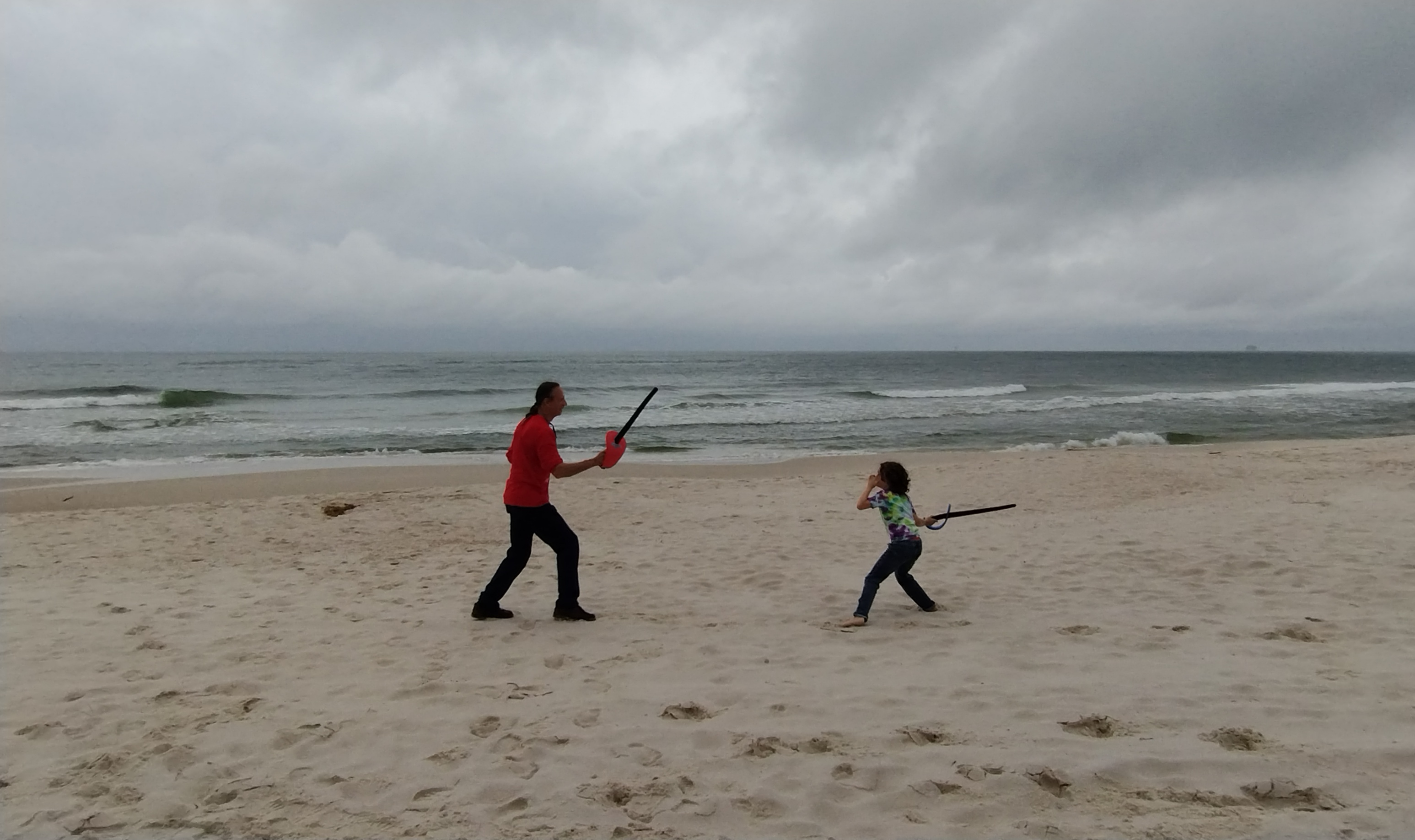
*My personal top three duels: Captain Blood, The Mark of Zorro, and The Princess Bride.
Copyright Benerson Little 2022-2026. First posted 29 March 2022. Last updated January 2, 2026.

How a Mystery Pirate Captain Gave Us Rafael Sabatini’s Captain Blood & the Films of Errol Flynn

With the advent of the 100th anniversary of the publication of Captain Blood: His Odyssey by Rafael Sabatini, not to mention our forthcoming thoroughly annotated anniversary edition, a look into the largely unknown, and until now unpublished, history behind the novel is timely: of real buccaneers and mystery pirates, of an incognito pirate captain whose identity we hope to reveal for the first time, and how without them there would be no famous novel Captain Blood nor any films of Errol Flynn, at least as we know them!
One of Sabatini’s major influences was the published journal of Monmouth rebel-convict Henry Pitman who, sentenced to indentured servitude on Barbados, escaped by sea, found himself marooned on Saltudos Island, and was eventually rescued by a crew of unnamed buccaneers. His story alone is worth the telling, and frankly no one does it better than he does. But before we get to Pitman’s odyssey and how it ultimately gave birth to the novel and the film version starring Errol Flynn, and thereby made him a star, we must first slip back to 1683, to Veracruz, Mexico as most of its inhabitants slept, in spite of obvious warning signs, as buccaneers set foot ashore not far away…
English Pirates Incognito & the Sack of La Vera Cruz
In the bodegas and aduana of the city lay not only two years’ worth of the plundered wealth of New Spain, but also valuable goods from the Far East, the latter having arrived after a long voyage across the Pacific to Acapulco aboard the Manila galleons, and from there across the arid Mexican countryside via mule trains known as recuas.
Pieces-of-eight and silver bars! Jewels and gold doblóns! Gold and silver church icons! Cochineal, indigo, logwood, and cacao! Rich silks and glazed china!
It was a lure the eight hundred buccaneers could not resist—and the city was wide open. Sand dunes piled high against the cheaply-built city walls, the pirate hunting Armada de Barlovento was not in port, the governor refused to believe the two ships seen earlier were pirates, and even the three-man mounted guard who spotted the buccaneers ashore were too frightened to ride ahead and give warning.
So here we have it, fact proving that fiction and film are not too far separated from it: historical buccaneers preparing to sack a sleepy Spanish town just as depicted in The Black Swan (1940) starring Tyrone Power and Maureen O’Hara, or in the Disney theme park attraction, at least before it became tied to the fantasy Pirates of the Caribbean films. Surely a lovesick suitor, guitar-in-hand, is serenading his inamorata on the balcony above as buccaneers slink to the city walls and prepare to unleash a violent but, in terms of entertainment, socially acceptable assault.
But not really: Disneyland and Hollywood are fun but they’re not reality. The assault on the city was quick and brutal—and successful. The buccaneers packed the residents into the great Iglesia de San Lorenzo del Convento de la Merced, searched and found plunder everywhere, tortured residents to reveal hidden treasure, and in buccaneer fashion raped and pillaged.

First they ransacked the casas reales, or government buildings, including the governor’s palace, the customs house, and various storehouses and magazines; then the richest private homes and the city’s six churches and convents—Jesuit, Augustinian, Franciscan, and Inquisitional Dominican among them—and surely also the two church-hospitals, and likewise the two chapels outside the walls; and last, the homes and businesses likely to be of less value.
Most of the attackers were French, with a smaller number of Dutch and English buccaneers in their company. And it is with the two English captains we are concerned, even if the two most notable Dutch commanders—Laurens de Graff and Nicolas Van Horn—will be remembered in part for their brief duel on Sacrificios Island.
English buccaneer captain George Spurre discovered the Spanish governor hiding in a stable and protected him from French buccaneers who had formerly been imprisoned in the city and now sought revenge. Eventually the buccaneers set sail while the Spanish defenders and the newly-arrived treasure fleet debated, boasted of revenge, and waited on reinforcements. This bombastic do-nothingness inspired a song composed soon afterward, “La Bamba,” made famous almost three centuries later as a Top 40 Hit by 1950s pop star Ritchie Valens.
The plunderers of Veracruz sailed away with riches in their holds, divided buccaneer-fashion: two to six shares to the captain, one and a half to the quartermaster, one to most everyone else, with one vital additional spoil: a captain would typically receive anywhere from a few shares to thirty or more for the maintenance of the vessel he commanded. Any shares unused for this went into the captain’s pocket—most of them, that is. This is a fact often overlooked or even unknown to scholars and enthusiasts who over-hype the egalitarian nature of buccaneers: Successful buccaneer captains could get very rich.
George Spurre, a well-known buccaneer who commanded a sloop and sixty men, returned to Jamaica where he lived and where his plunder of broken gold, silver coin and plate, jewels, cacao, two hundredweight of cochineal dye, African or other slaves of color, and more was variously seized and embezzled by the governor of Jamaica, Sir Thomas Lynch, using the excuse of illegal pirate goods. Soon enough, Spurre died, leaving his wife to sue Lynch for the return of his new estate.
But it is Spurre’s compatriot, Jacob Hall, a far more fortunate pirate, who is most important to our story. He had put it about that he was from Bermuda, without doubt to cover his true origin, for he was a Carolinian from Charlestown, a place known facetiously by some as Puerto Franco thanks to the large number of French buccaneers who routinely sold their plunder and refitted there. Trading with pirates was an easy way to get cash, after all. No questions would be asked in Charlestown because everyone already knew the answers. They also knew to deny everything piratical to outsiders.

Hall was rich now, the likely five to ten extra shares awarded him from the ownership of his small vessel—a small frigate, brigantine, or barque-longue—making him so. With them he bought a house in the city and a plantation in the country, and was well on his way to becoming the notable Carolinian gentleman he would one day be. Paraphrasing Mel Brooks in The History of the World: Part I, it was good to be the captain of a profitable buccaneer voyage!
The Lure & Allure of St. Augustine
As with many who took up sea roving, Jacob Hall would not or could not put the trade aside. Just as hope inevitably sprang eternal among buccaneers after any cruise—the next one must be more profitable!—so did success breed new attempts. James Fennimore Cooper aptly put it in The Sea Lions, a novel in part of pirates and buried treasure: “Men become adventurous by oft-repeated success…” They take greater and greater risks, in other words. And this addiction to sea thieving would one day become so incurable that it would lead to a generation of outright pirates who sailed “against all flags” under their own black ones.
St. Augustine, an outpost town established to protect the Florida Strait through which the Spanish treasure fleets passed, had long been an inviting target. The most famous of seventeenth century attacks was its sack by buccaneers under Robert Searle in 1668. Today, buccaneer re-enactors and pirate pretenders flock annually to the city to reenact the piratical slaughter of 1668 via choreographed mayhem of musket and sword, albeit in a much more civilized manner, which includes neither spillage of blood nor theft, or at least none significant, nor vandalism, burning, torture, or pillage. I did once see Tea Partiers amusingly mistaken for pirates in St. Augustine by tourists, then quickly dismissed once it became clear they were common zealots rather than trope-ish buccaneers.

At least three attacks on the city had been seriously considered or attempted in the early 1680s. The first was abandoned even before a planned rendezvous took place on Anclote in the Florida Keys in 1681. The second, from late 1681 into 1682, devolved into little more than the sacking the poor-in-everything presidio of San Marcos de Apalache and the rich-in-cattle Hacienda de la Chua in Florida, plus the capture of several vessels ranging from tiny sloops to a pair of small frigates, plus the murder by the famous buccaneer John Coxon of ten Native Americans at Matanzas—doubtless his excuse for murdering them was that they resisted—and the enslavement of fifteen more. St. Augustine was left untouched.
The third, in 1683, actually landed a force composed of buccaneers, several of whose captains hailed from English colonies in North America. Disappointed at “fishing for silver” on the wreck of the Spanish galleon Nuestra Señora de las Maravillas, they turned their attention to what they hoped was easier plunder. Within a mile and a half of St. Augustine they marched, only to be driven off by valiant Capitán Antonio de Argüelles and his troops.
Although it is common to reflect from present to past and imagine pirates then as they have been portrayed in modern films, rarely is Spanish courage and martial skill on display in them, although The Black Pirate starring Douglas Fairbanks is an exception.
Digression aside, in 1684 Jacob Hall—whom we imagine Hollywood might have cast Errol Flynn to play—set sail in command of a small frigate, brigantine, or barque-longue, perhaps the same he had commanded at Veracruz, part of an English buccaneer flotilla soon joined to a French one to sack St. Augustine, Florida. The French contingent was commanded by the sieur de Grammont, the third major commander of Veracruz fame—whom we imagine Hollywood might have cast Oliver Reed to play—and the English by Thomas Jingle. Alas for the raiders, a storm dispersed the eleven vessels. Some of the plunder-seekers went on to other adventures, while a few plundered poor Spanish missions along the Georgia coast.
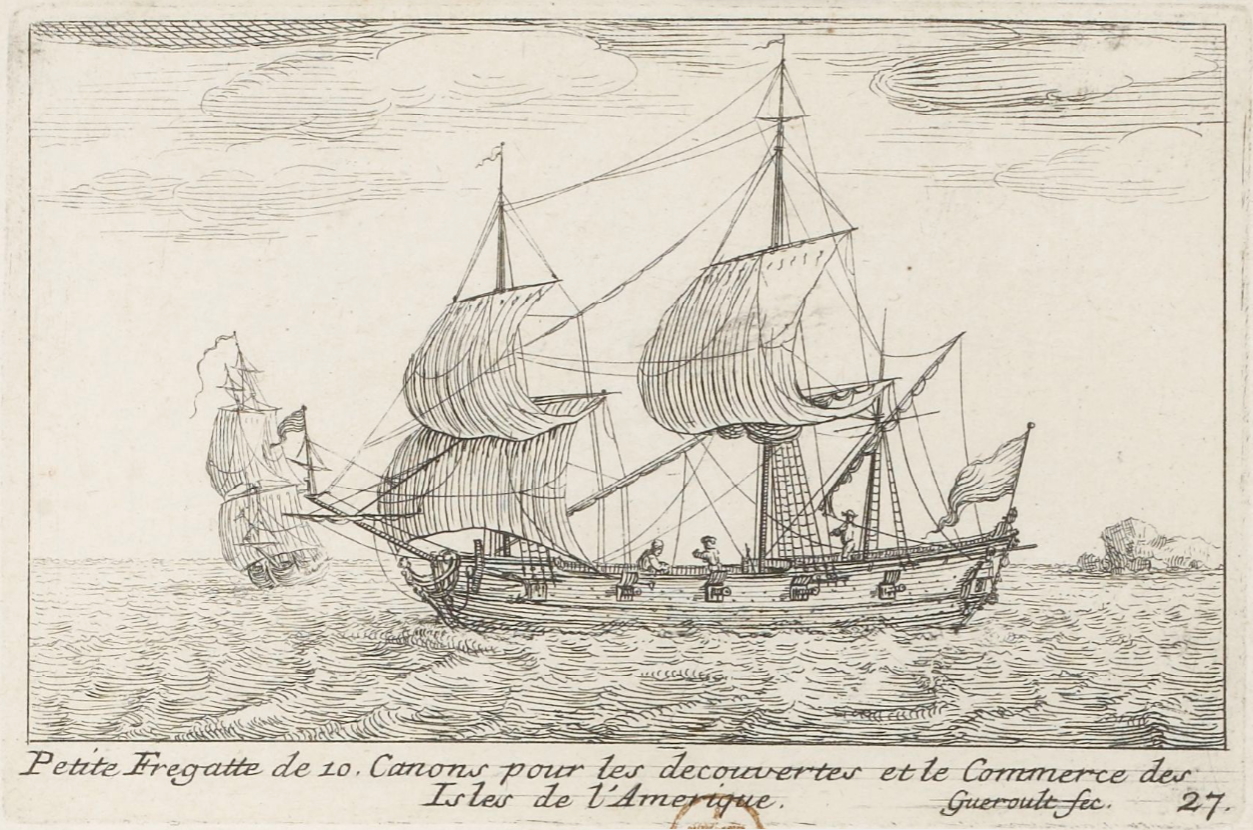

After the planned attack on St. Augustine was thwarted, de Grammont sailed north and plundered an English merchant ketch of provisions, forcing its crew to seek food at the San Buenaventura de Guadalquini mission on what is today St. Simon’s Island, Georgia, where the local military officer seized the ketch for any or all of several reasons, ranging from it being a dastardly pirate to a mere interloper on Spanish territory. One of the ketch’s crew was a Flemish seaman whose name, Jan Klare perhaps, was Hispanicized as Juan Clar. To the Fleming’s rescue came an English captain who followed in Grammont’s wake and recaptured the ketch.
Clar, who had the good or bad fortune to later fall into Spanish hands again, testified in St. Augustine that the pirate captain who rescued him was named “Chacopal,” which has misled some historians into thinking he was the pirate Jacob Evertson because it sounds like Jacob, which in fact it does (but wait a moment). The Spanish mangled a lot of English, French, and Dutch names, and vice versa: Bartholomew Sharp became Batharpe and Batcharpe, [Richard] Sawkins became Hawkins, [John] Watling became Bothing, and Jan Willems aka Yankey became Jan Zanques, for example. Occasionally, historians mangle the mangling in their attempts to reverse engineer the Hispanicization, hoping thereby to prove what they want to see.
In fact, Chacopal is merely the Spanish phonetic equivalent of Jacob Hall. Sound it out, if you like. From Clar that we learn that Hall owned a house and “hacienda” purchased with plunder from Veracruz. Yet there are no records of any Jacob Hall owning property in Charlestown or in the countryside. Further, Clar noted that Thomas Jingle also had a house there but there are no records of his property either. Notably, town records from the era are very complete, making an omission for one or both of these two captains highly unlikely.
At least one scholar has suggested that Jingle’s name was the Spanish pronunciation of a famous buccaneer captain nicknamed Yankey, noted above, probably an affectionate diminutive of Jan. The same diminutive is probably the origin of Yankee as in “Yankee Doodle” and “damn Yankees.” Jingle—“Hin-glay”—does sound a little bit like it, in fact.
But, alas, no cigar, although as I’ve noted elsewhere (“Of Buccaneer Christmas, Dog as Dinner, & Cigar Smoking Women”) the Spanish did smoke them at the time: six to seven inches long, about a half inch in diameter, even Spanish women smoked them, as did Native Americans, many African slaves, and quite a few Englishmen, Frenchmen, and Dutchmen as well, therefore some buccaneers and pirates too, experts residing on social media and claiming otherwise notwithstanding.
Why no cigar? Because Yankey was nowhere near St. Augustine at the time.

Thomas Jingle, “privateer,” reportedly had a privateering commission from Robert Clarke, “Governor and Captain-General of the Bahamas of New Providence,” which may have been true for the governor of the tiny pirate-and-beachcomber’s-island had a habit of issuing them without any real authority to do so other than his quite correct perception that the commissions would help line his pockets. The practice also earned him a warrant for his arrest and by 1683 the loss of his post. Jingle was from New England, some said, but his name is noted in the annals of piracy only in regard to this aborted attack on St. Augustine, and for good reason: it was not his real name.
In fact, Jingle is phonetic Spanish for Hinkley.
And Thomas Hinkley was the governor of New England.
And our pirate captain Jacob Hall? The real Jacob Hall was a famous rope dancer — tightrope walker — in London. So famous was he that Nell Gynn, mistress of King Charles II, had a silver bed made that included the figure of Hall dancing on a wire. Reportedly, Barbara Villiers (Countess of Castlemain, Duchess of Cleveland), one of Charles’s former mistresses, had an affair with Hall in revenge.
In other words, “Jacob Hall” and “Thomas Jingle” were jokes at the expense of Spaniards, not to mention potential English pirate hunters, akin to signing your name as Mickey Mouse, Donald Duck, or Ronald Reagan. Or, if you want to balance the scales of insignificant political satire, Bill Clinton.
How to reconcile this?
Easy.
Jacob Hall and Thomas Jingle were mystery pirate gentlemen sailing under false names, although doubtless everyone in Charlestown knew exactly who they were and supported them in their piratical escapades.
One of them, as we shall soon see, may have set Errol Flynn’s career in motion.
Of Pirates, Rebels, Odd Connections, & the Want of a Nail
If there is a single decade or two that may lay legitimate claim as the ultimate origin of the greatest of pirate fiction and film, it would surely be the 1680s. Counterintuitively, it is not the previous two decades, in which Henry Morgan, François l’Ollonois, and their bloody ilk reigned and whose escapades made sea roving popular in the public mind thanks to popular written accounts, nor the second and third of the next century when the pirates who sailed under the black flag reigned and centuries later became proud symbols, with little basis in fact, of social rebellion and freedom.
The 1680s gave us three series of events critical to all things piratical today, the first two of which are vital here: the Duke of Monmouth, whose brief rebellion in England and Scotland ended at the Battle of Sedgemoor on July 6, 1685; the suppression of Caribbean buccaneering which forced the rovers into the South Sea and beyond, and which would thirty years later help lead to the rise of pirates who sailed under the black flag; and the publication of popular editions in English and French of buccaneer-surgeon Alexandre Exquemelin’s The Buccaneers of America.
The Monmouth rebels are necessary to understanding one of the most common piracy tropes in fiction and film, one actually quite rare, if not entirely non-existent, in reality: that of the falsely accused who is thereby compelled by circumstance to turn pirate, excluding, of course, a few buccaneers who had become sea rovers due to Spanish confiscation of their lawful cargos. Or perhaps we should just say cargos, lawful often being in the mind of the beholder in the Caribbean at the time. And in any case these men were likely to have become buccaneers no matter their circumstances.
One of these rebels was sea surgeon Mr.—not Dr., for only physicians used the latter title—Henry Pitman. Although never in arms against his king, as he says, he was nonetheless committing treason and he knew it when he joined Monmouth’s rebel army as a surgeon after dropping by with his brother to view the Duke and his rebel army. In his defense he notes that he treated wounded rebels and Royalists alike, and claimed that he was caught up in the rebellion by misadventure when a troop of Royalist horse blocked his way home. Soon afterward he lost his mount, and, prevailed upon to assist the surgeons who had their hands full with the battle-wounded, he joined the rebels, bidden by his conscience to do his sacred medical duty.
The rebellion was crushed at the Battle of Sedgemoor, and hundreds of prisoners were hastily tried and convicted en masse in a series of trials that soon came to be known as the Bloody Assizes. Sentenced to ten years of indentured servitude in Barbados—still a far better punishment than to be hanged, disemboweled, quartered and dismembered (all members!) and hung in parts from gibbets, as happened to many rebels, and still better than to be an African slave on a New World plantation, the counter-argument of some modern racists notwithstanding—Pitman soon tired of his treatment at the hands of the owner of his indenture, Colonel Robert Bishop. The details need not concern us at the moment. In fact, you should read them for yourself later. I’ll say it over and over: the original accounts are often far better reading than any modern secondary accounts.
Suffice it that Pitman led several of his companion rebels-convict and two debtors in an escape in a ship’s boat by night. Almost immediately the rebels-convict discovered that their boat was extremely leaky and, fearing they might be overheard by an English frigate or one of the forts in Carlisle Bay, they let seawater fill the boat almost to the gunwales before they started bailing. Afterward they were forced to bail constantly, made more difficult when one of the rebels-convict accidentally threw the bailing bowl overboard.
Almost as bad, their candles had melted into a single lump, making them useless, and their tinder and matches were now wet due to the leaking boat, thus they could not steer in the darkness by their compass, having no light. And soon everyone but Pitman, the only seafarer among them, was terribly seasick.
Here we’ll take a page from fiction and film—leaving the reader or viewer in suspense, that is—and depart from Pitman and his rebels-convict confederates as they make their way toward the Dutch islands by sea, while we look at two curiously associated piratical voyages.
The South Sea and, Once Again, St. Augustine
First we return to Puerto Franco, or Charlestown if you like, where local investors and adventurers had outfitted three armed sloops crewed with roughly equal numbers of local Englishmen and visiting French buccaneers. Their plan: sail to the Caribbean, seize a Spanish ship—or Dutch, if trading with the Spanish, for a Dutch merchantman with Spanish goods was practically Spanish anyway—and sail through the Strait of Magellan into the South Sea to plunder the Pacific Spanish Main, as many English and French buccaneers were doing at the moment. The date they set sail is uncertain: it may have been late 1686 to early 1687, or even early 1686.
The Franco-Carolinian buccaneers were successful at the beginning of their voyage, capturing a “Dutch ship of force,” but were turned back at the Strait of Magellan, unable to pass through due to severe weather. They sailed back north, to the remarkably beautiful Ilha de Fernando de Noronha more than three hundred miles off the coast of Brazil. Like Juan Fernandez Island in the South Sea, it was isolated enough that a sea roving ship could water and refit after a passage around Cape Horn or through the Strait of Magellan. Here they held council and by a vote of the crew decided to turn pirate. By this they meant they would capture ships other than Spanish, or Dutch trading with the Spanish, in this case a Portuguese merchantman if they espyed one.
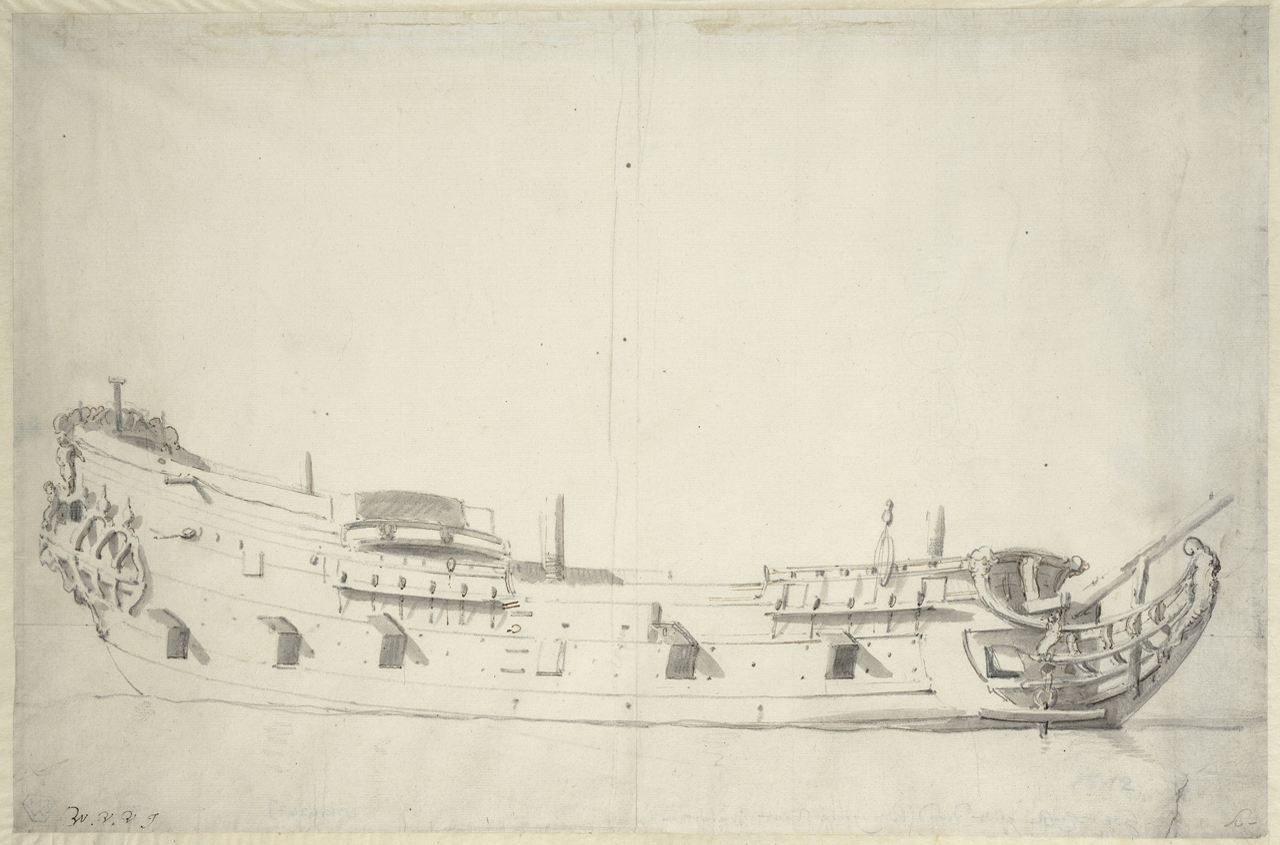
However, eight of the crew, all English, abandoned the enterprise, preferring not to engage in outright piracy: buccaneering against the Spanish held no qualms for them, for only occasionally were its practitioners actually hanged. But their brethren had no boat to spare, so, taking their sea chests and plunder ashore, and with the donation of some stores, tools, rigging, and a cask of dry peas, they fashioned a four-ton boat out of mangrove—a good wood for boatbuilding, actually—in six weeks. The peas they kept for sea provision, and while on the island they ate wild figs, Brown Boobies (Sula leucogaster), and Booby eggs.
Their buccaneer brethren, meanwhile, had set sail, and soon descried a large Portuguese merchantman laden with wine, linen, at least a few slaves, and other goods along the coast of Brazil. In tonnage, crew, and probably guns it was a greater ship of force than that of the pirates, yet they captured it with little resistance. The pirates told Pitman the ship was named the Grand Gustaphus, or more correctly, the Grande Gustav if this is actually the ship’s name and not one given it by the buccaneers. I found no such named ship in Portuguese or Brazilian records, but this is no surprise: records of merchant ships at the time are notoriously incomplete.
The buccaneers returned to Fernando de Noronha, put their prisoners ashore (causing the eight former crew to keep well on their guard after the buccaneers departed again), and shared the plunder. The crew divided in two, of French and English respectively, the former keeping one ship by agreement and heading home to Petit Goâve on Hispaniola, the latter keeping the other and sailing north, anchoring at “Blanco”—probably Punta de los Blanquizales, Trinidad—most likely for repairs to their now leaky ship before returning home. But first the pirates needed to know how matters stood between the English governments and pirates. Was there, for example, an amnesty available?
Now—suspensefully again—we leave these pirates for the moment as they prepare to sail into the Caribbean, and turn to another pirate voyage. Once more we head to St. Augustine, the outpost so coveted by pirates in the 1680s. In late April, 1686, the grand old buccaneer Michel, sieur de Grammont set his eye again on the Florida outpost. Once more, it was his intention to attack via the southern passage at Matanzas. Yes, this is a pattern: pirates were not going to commit suicide by sailing into the mouths of the guns of the Castillo de San Marcos. Everyone intended to attack from Matanzas instead.

Here, Capitaine Nicolás Brigaut, commanding a half-galley armed with two guns (at sea a cannon is called a gun, back then and even today) at the bow, probably a few swivels on the gunwales, and captured the year before during the sack of Campeche, Mexico (again by de Graff and de Grammont), was tasked with securing Native Americans to serve as “intelligencers” and guides, and to prevent the sentinels at the Matanzas watchtower from warning St. Augustine. He and his buccaneers easily captured the soldiers on watch: some of them rowed out to discoverer what the vessel was. The buccaneers tortured at least two for information regarding the defenses of St. Augustine.
And then everything went to hell. A Spanish force from St. Augustine counter-attacked but was beaten back. Even so, all good so far, in spite of the loss of surprise. Then the half-galley wrecked on Matanzas Bar, changing the situation entirely. Brigaut—whom we imagine might have been played by Basil Rathbone, pity about the French accent though—sent several men in a ship’s boat to warn de Grammont and tell him they would retreat to Mosquito Bar, the location today of New Smyrna Beach, where it would be easier to rescue them. The buccaneers set out on the five league march and twice more fought off attackers, including forty or fifty Native Americans. Finally, they faced Capitán Francisco de Fuentes—who might have been played by Pedro de Cordoba or perhaps by Ricardo Montalbán channeling Khan Noonien Singe—and fifty Spanish soldiers.
The buccaneers faced a naked truth: they were trapped on the beach. We imagine soldiers and pirates sweating profusely in the combination of heat, humidity, rage, and fear, their hands and faces blackened with spent gunpowder, their burning eyes squinting from salt and the sea glare. We imagine the sand sticking to the blood of those killing and of those dying or dead, most of whom probably called upon God both to kill and to save. We imagine the flies swarming over and upon the dark purple that now stained, however briefly, the windswept battlefield dotted with the living and the dead among the coastal scrub.
Here was life and death laid plain in the form of raw survival. Unfortunately for the buccaneers, luck was on the side of the Spanish by means of the timely accident that Brigaut’s men were separated into two parties. Luck, or Fortune if you will, often has poor timing, almost as if on purpose. The Spaniards slaughtered the nineteen pirates in the smaller group, then attacked the larger and massacred all but three, their desperate courage notwithstanding.
The official French account of the incident at Matanzas, sent from Governor de Cussy of Tortuga and Saint-Domingue to his superior in France, the Marquis de Seigneley, only barely resembled reality. Brigaut wasn’t a pirate, he was merely seeking provisions. The law permitted this seeking of provisions, water, and shelter in extremis. In fact, Brigaut wasn’t even mentioned, although his commander, the sieur de Grammont, briefly was.
Most of the few lines describing the incident were devoted to the sad story of a young Parisian of good family, the sieur de Chauvelin, who was reportedly given quarter, taken before the governor of St. Augustine, then put to death in spite of his quality as a gentleman. Further, during the battle itself it was twenty, or maybe seventy, pirates—or rather, twenty or seventy innocent French privateers attacked while innocently seeking provisions per international agreement—standing valiantly against three hundred Spaniards, who prevailed only after reinforcements arrived. All we really know—maybe—from this version of the story is that a young man named Chauvelin, of adventurous spirit, joined a band of flibustiers and probably died on or near a pretty Florida beach.
The most notable takeaway from the failed attack is that one of the survivors, quartermaster Diego the Black Pirate (a quartermaster was second-in-command among buccaneers and pirates), is the highest ranking Black man of full African blood noted among the predominantly white buccaneer or pirate crews. He, along with Captain Brigaut, were soon hanged or garroted at St. Augustine.
Grammont blockaded St. Augustine for two weeks, doubtless hoping for the arrival of the situado or payroll ship from Veracruz, and perhaps hoping to starve the city into negotiations. St. Augustine was not self-sufficient, so a ship had been sent to Havana for corn, or maize as it was better known then—corn was wheat, after all. Afterward de Grammont set sail to Charlestown, South Carolina where he almost certainly refreshed, refitted, and recruited as he had done before. Edward Randolph, the king’s special representative to New England, claimed that the Carolina governor had turned the pirate away. He was surely mistaken.

But 1686 was not yet finished with pirates lusting after the Florida outpost. Near the year’s end, and inspired by de Grammont’s unfortunate recent failure, Dutch pirates Jan Willems, aka Captain Yankey, and Jacob Everson—it really is them this time—along with their largely English crews from Jamaica, with some French and Dutch as well, along with a pack of Carolinians who determined that piracy might be a better way of life than farming or trading for deer skins and Native American slaves, were recruited by the governor of Carolina to attack St. Augustine in reprisal for recent Spanish reprisals on the Carolina coast.
One recent attack had just destroyed the Scottish colony at Stuarts Town in Carolina, plundered English plantations, and even threatened Charlestown itself, at least until a hurricane ended the retaliatory effort. Ironically, Brigaut’s half-galley had been refitted for Spanish use and sent on the raid. The Spanish attacks were reprisals for Carolinian-instigated reprisals by Native Americans (not that they did not have good reason without English instigation) on Spanish properties and subjects, and doubtless as general reprisals for Carolinian support for pirates. Alas, or happily perhaps, delays left many of the pirates dispirited, and added to this a new governor arrived and ordered a stop to the attack.
But thankfully for our tale, a few of the pirates Yankey had sent to steal canoes from Native Americans in the Gulf of Florida (known today as the Strait of Florida) to use in the attack via the Matanzas River were attacked by Native Americans when they went ashore to “turn turtle” for provisions. Two pirates died in the attack, and two more afterward, including the quartermaster, from cyanide poisoning caused by eating improperly-prepared cassava root.
These incidents caused these buccaneers to miss their rendezvous with Captain Yankey and their shipmates, leaving them to sail back to the Caribbean where they imagined the pickings were better. A few months later, by dint of unknown circumstances, they ended up on tiny Isla Tortuga—Saltatudos or “Salt Tortuga” as the English called it, not the Tortuga of buccaneering fame on the Hispaniola coast—near Isla Margarita along the Venezuelan coast, the latter island once a center of Spanish pearl diving until its beds were destroyed by rapacious overharvesting. Saltudos was a desert isle most of the year, except for a few months when ships, often English, dropped by to “rake salt,” and Spanish guardas-costas dropped by looking for them.
Apparently abandoned by their comrades again, or lost, a handful of Yankey’s turtle-turning buccaneers found themselves marooned, their canoe unfit for anything but shoreline voyages or a quick attack on a small Spanish merchantman that might anchor at the island.
But a new arrival would soon change this!
Marooned!
On May 16, after several days of trials and mistrials at sea, the rebels-convict, whose destination was Curacao, sighted Saltatudos Island. As they approached they saw a canoe paddling toward them. Quickly they loaded their muskets and blunderbuss with broken glass—in their haste they had left their bag of musket balls behind on the wharf—and prepared for a fight, fearing the two men in the canoe were Native Americans, given that they paddled rather than rowed as most Europeans did, even in canoes.

In fact, the men were not merely “Englishmen in distress, &c.,” as they claimed at first, but some of Yankey’s long lost buccaneers. The rebels-convicts and buccaneers went ashore together and brought each other up-to-date on world and local affairs, such as they had heard. The buccaneers, nodding with approval at learning that the new arrivals were Monmouth’s men, said, “That if the Duke of Monmouth had had One Thousand of them [buccaneers], they would soon have to put to flight the King’s Army.” Quite a boast, but then buccaneers were prone to such fanfaronades.
Almost immediately the marooned buccaneers were interested in Pitman’s boat. Leaky as it was, it was no use for sea roving, at least not as a water craft. The buccaneers’ canoe had low sides, but the lowly dugout canoe was otherwise a great craft for small piracies. It was swift, could be hidden easily among mangrove while buccaneers lay in wait for passing Spanish vessels, and required little maintenance. However, to be truly seaworthy for open water voyages, rather than coastal cruising (clearly the buccaneers had become separated from a larger vessel), it required raised sides to keep out the sea. This required boards, which they had, and nails, which they did not.
Pitman’s boat had a purpose after all: the buccaneers wanted to burn it for the ironwork, which was the easiest way to get at its nails and spikes, but Pitman and his companions refused. The buccaneers, being buccaneers, burned it anyway. As soon as they had raised the sides of the canoe they put out to sea, on May 25 in fact, leaving Pitman and his companions to live a marooner’s life for three months, the sort that would soon inspire Daniel Defoe’s Robinson Crusoe.
Pitman and his companions built rude huts of scrap wood and sea grass, gathered sea turtle eggs, “turned turtle” and cooked “calipash and calipee” in the sand or dried the flesh in the sun, and for a change gathered and ate “whelks,” probably conchs. A Native American, purchased by Pitman from the buccaneers for thirty pieces-of-eight, fished for his owner with bow and arrow. The rebels-convict roasted the catch on the beach. Their clothes soon wore out, and their shoes too, but by walking so much on rocks, the “Bottoms of our Feet was hardened into such a callous substance, that there was scarce any Rocks so hard but we could boldly trample them under our feet.”
Pitman, trying to be prepared for any and every eventually, even concocted a plan of escape should they be captured by an enemy: he dissolved “a sufficient quantity of Opium in a Bottle of rich Cordial Water” and planned to give it to “those Persons that should take us,” and put them to sleep.
In the meantime, the now once more sea roving buccaneers sailed across the course of the English buccaneers who had captured the Portuguese ship and informed its captain and crew of Pitman and his companions. The buccaneer ship sailed to the island, brought Pitman aboard, and at the captain’s suggestion but via vote of the crew—buccaneers were democratic, remember—graciously took him aboard, probably because he was a surgeon, but left his companions behind. The captain sadly pointed out that he had only two votes and two shares, and could not overrule his crew. Even so, they gave the remaining marooners some provisions and promised to send a ship after them when they could.
Importantly, Pitman was extremely circumspect when it came to this pirate captain, for he never identifies him by name although he surely knew it. Without doubt, the captain did not want it put about, much less published. The names of most buccaneer captains are well-recorded, but some had good reason for remaining incognito, as we have already seen.

Learning from the Saltatudos buccaneers that New Providence Island was again inhabited, the buccaneers laid a course to the island haven of outcasts and all sorts piratical. There they unladed their ship, including its guns, and burned it. All went their separate ways, some to remain on the island, others to return to Carolina.
A few built a fort on nearby Eleuthera Island and armed it with eight of the ship’s guns, only to lose it later in the year when privately commissioned pirate hunter George Lenham in the sloop Ruby raided it, arrested the pirates, confiscated their “spoil…of little value,” and got testimony from the five Portuguese Black slaves—four men and a boy—in their possession. The pirates claimed they were preparing to sail to New England to accept a pirate amnesty. Lenham and his superior consort Captain Thomas Spragge of the HMS Drake were also accused by the residents of nearby New Providence of plundering their homes. The pirate hunters admitted to this, noting that their accusers were in fact pirates.

Pitman took passage from New Providence aboard an English ketch. He might have gone ashore at Charlestown, but for the ketch captain’s fear of arrest for having been dealing at New Providence with “privateers”—with pirates, that is. He probably had nothing to fear. Pitman remained aboard and went ashore at New York instead, yet another colony known for looking the other way when the subject was piracy. Not long after, Pitman returned to England in disguise.
In 1689 he published his short memoir, A Relation of the Great Sufferings and Strange Adventures of Henry Pitman. The Glorious Revolution of 1688 ultimately gave freedom back to the rebels-convict two to three years later, although those in Barbados were required to remain on the island due to a shortage of white men for the militia and trades due to disease. In 1691 Pitman voluntarily returned to Barbados, where he died two years later.
Behold Captain Blood: His Odyssey and Errol Flynn! And Just Who Was that Unknown Pirate Captain?
So why is all of this important?
Because this is why we have Captain Blood: His Odyssey, and therefore the 1935 film which made Errol Flynn a star, and more.
Because “for want of a nail,” or of a few, there would be no canoe full of pirates to sail across the path of an incognito pirate captain who would, via their timely information, rescue a marooned rebel-convict surgeon.
Because without this captain and his crew Pitman might very likely have died on a mostly desert isle, in which case he would never have written the story of his adventures, most importantly of those with pirates. At the very least he would probably not have been rescued by pirates. And if Pitman’s odyssey were never published, Rafael Sabatini would never have read it and there would be no inspiration for Captain Blood as we know it.

And if there were no Captain Blood then there might be no films with Errol Flynn, therefore no famous Disney pirates ride as we know it—the ship versus fort scene is straight out of the novel—and therefore perhaps no famous Disney pirate films, and therefore we might have a very different modern pirate culture for everyone from scholars to writers of bodice-ripping romances to misapprehend.
Still, three questions remain unanswered: who were Jacob Hall and Thomas Jingle, the mystery pirate captains of Charlestown, South Carolina? Likewise the mystery pirate captain who rescued Henry Pitman, without whom we might have no great pirate film to make Errol Flynn a star? And might Hall or Jingle have been Pitman’s mystery captain?
To find the answer we turn first to the South Carolinian raid on St. Augustine in 1702. Led by Governor James Moore, the attacking forces moved by land and sea, sacking missions and outposts on route, and besieged the Spanish outpost but failed to capture the Castillo de San Marcos—a grand Spanish Main fortress and icon of American history, still standing and straight out of both Hollywood and reality, well worth a visit, as is the much smaller mid-18th century Fuerte Matanzas not far away—and the fifteen hundred souls packed inside.

The land forces were commanded by Colonel Robert Daniell (or Daniel), a noted Carolinian gentleman who had emigrated from Barbados. He had first purchased land in Carolina in 1677, owned a house in the city, a plantation in the countryside, and had long served in various military and naval capacities, including briefly assisting the soon-to-be famous Commodore Charles Wager during King William’s War. Daniell would one day become Lieutenant-Governor of North Carolina.
He was also, according to Don Josef de Zúñiga y Zerda, Gobernador de Florida, “one of the Jamaica pirates” (he actually he calls them as corsarios, which may refer to pirates or privateers), and “a renowned and experienced pirate, one of those who sacked Vera Cruz.”
Put plainly, Jacob Hall could be none other than Robert Daniell, who deserves not only the appellation of noteworthy early Carolina citizen and politician, but also of its most famous pirate. His list of piratical depredations includes the sack of Veracruz in 1683 and the attempted sack of St. Augustine in 1684. His is the classic exception that proves the rule, in this case of the gentleman pirate in disguise, another classic Hollywood trope that was quite rare in reality.
And Thomas Jingle? He may well have been Daniell’s occasional comrade-in-arms, James Risby, a buccaneering, pirateering, quasi-gentleman with a list of borderline skullduggeries as long as his arm. He had begun his career cutting logwood—a highly desirable dyewood—in Spanish territory circa 1669, a practice the Spanish considered highly illegal but the English government and merchant traders encouraged. In 1677 he was captured by a Spanish guardacosta and later released, but the Spaniards confiscated his vessel and cargo, perhaps provoking a career as a buccaneer in retaliation as was the case with a number of merchant captains who would turn to sea roving.
In 1683 he was sent on a mission by the governor of Jamaica to Petit Goâve, the French buccaneer haven on Hispaniola (Tortuga was largely abandoned by now, novelists and Hollywood notwithstanding), to demand the return of plunder taken by buccaneer George Spurre at Veracruz and by the notorious pirate Jean Hamlin at sea, and to forbid French buccaneers from English ports—which also means he had not accompanied Hall-Daniell at the sack of Veracruz.
Assuming his nom de guerre was Thomas Jingle, or rather, Hinkley, he commanded a vessel at the attempted sack of St. Augustine in 1684 under the sieur de Grammont. In 1696, under his real name and during a long association with the quasi-piratical sorts at New Providence Island, he ferried twenty-six fugitive crewmen of the notorious Red Sea pirate Henry Every, who had captured the Great Mughal’s treasure ship, not to mention whose crew had raped the many women aboard, from New Providence to Carolina and then across to Galloway, Ireland, where they landed discreetly and dispersed, for which he would have been paid handsomely.
In 1698 he was dubiously commissioned by the governor of New Providence as a pirate hunter along with three others including Colonel Read Elding, a mulatto sea captain of the same island and who would two years later become the de facto, if unlawfully commissioned, wife-swapping adventurer-governor of the piratical island. The pirate hunters failed to capture a real pirate, but did plunder an innocent merchant sloop for which they were accused of piracy. In 1702 Risby commanded the small naval force in the attack on St. Augustine.
In 1706, now Colonel Risby, he played an active role defending Charlestown against a Franco-Spanish attack. So famous and respected was he that “several gentlemen and others who were willing to share in the danger and honour” were adamant about serving at his side aboard a separate Dutch privateer sloop during the attack French fleet, rather than aboard the Seaflower commanded by famous slave trader, merchant trader, pirate hunter, and private naval seaman Colonel William Rhett who would later gain fame as the captor of gentleman pirate and general fool Stede Bonnet.
Which brings us to the question of the identity of the captain incognito who rescued Henry Pitman.
We assume he was almost certainly a Carolinian, given the voyage’s origin, although it’s entirely possible he might not have been. If he were, Daniell and Risby are therefore by far the two most likely candidates, being the two predominant buccaneer captains operating out of South Carolina at the time—in fact, they are the only known such English sea roving captains ported there, although others clearly touched there. My romantic inclination, never a good path on a factual quest except for inspiration, is on Daniell.

He fits the character of Pitman’s captain exactly as Governor William Markham of Pennsylvania described Daniell in 1697: “an easy good-natured man.” Likewise his vital need to remain incognito. Certainly his buccaneer experience and contacts lend him to the position, and nearly every buccaneer in the mid-1680s had his eye set on the South Sea. The Caribbean was becoming too dangerous, especially for English sea rovers.
Unfortunately, if Pitman’s statement is correct, that the pirates had been at sea roughly eighteen months, Daniell could not have been the captain because his signature is on a South Carolina document dated October 15, 1686. Of course, eighteen months, although a short cruise for buccaneers sailing into the South Sea, might be a bit long for those who failed to round Cape Horn. Eight months is more reasonable, and perhaps the longer period is a transcription or hearsay error, leaving open the window in which Daniell could very well have commanded the expedition.
Is this even partial proof? Of course not. It’s merely strong conjecture, with questions that must first be answered—and we may never have answers to some. Even so, this will not prevent the hypothesis from being posted to Wikipedia or other online pages as “fact.” There might even be other known candidates, including not only Risby, whom my objective analysis points to as the most likely, assuming the captain was a Carolinian.
There is, for example, “marriner of Charles Towne” John Williamson who when he died in 1688 had £192 in silver and gold in coin and plate (the equivalent of roughly 855 pieces-of-eight), an enormous cash sum to have on hand for any seaman, even a merchant captain! That is, unless the seaman were a successful buccaneer, or at least a frugal successful one, unlike the majority who typically spent their booty in debauchery. In fact, we have already seen that eight hundred pieces-of-eight was each common buccaneer’s share of plunder at Veracruz, suggesting Williamson may have at least been one of the crewmen of Jacob Hall aka Robert Daniell.
Another possibility for the captain of the English buccaneers is John Headley, as argued for by scholar Raynald Laprise, and I think he’s probably correct. You can read about it in the pdf paper located here: Henry Pitman, ou les rendez-vous de Salt Tortuga. (I’ll also note that M. Laprise argues Thomas Handley aka Henley was Thomas Jingle, a suspect I placed on the back burner given that I could find no record of a Handley owning property in Carolina. The rest of M. Laprise’s excellent, extensive research is also well worth reading.)
Still, in my heart I stand, at least until I’m overwhelmed with evidence otherwise (Laprise has done so, I think) with Colonel Daniell as Pitman’s captain and therefore the secret progenitor of Rafael Sabatini’s famous Captain Peter Blood. For better and, too often, for worse, this is how the process works: heart over head. In other words, my desire-based reasoning, even if ultimately incorrect (the ghost of Headley or Risby, or of whichever captain rescued Pitman, surely furious and may haunt me for this), helps satisfy my need to reconcile fact with fiction, if only temporarily: in this case the romance versus reality of a gentleman pirate from Barbados one day becoming governor of Jamaica, a fiction we now know might very well have had its origin in a mystery gentleman pirate of South Carolina who one day became Lieutenant Governor of North Carolina.
Or, how the combination of mystery pirates, an obscure account of a marooned rebels and pirates, and the want of a few nails can inspire famous popular fiction and strongly influence culture three centuries later.
This tenuous adventure-romance of connections little-known and well-known, of tales rightly- and wrongly-known, this odyssey of seeking fact, creating fiction, and balancing both, is much of what the manuscript this has been excerpted and edited from is about: how fact becomes fiction, fiction fact, and how we do—and, more importantly, how we should—regard both.
Copyright Benerson Little 2021. First posted November 23, 2021. Last revised May 16, 2024.
The Duel on the Beach, Part II: The Black Swan (Updated!)

Perhaps the only swashbuckling novel whose narrative arc rests entirely upon the near-certainty of a duel at the climax, Rafael Sabatini’s The Black Swan epitomizes the duel on the beach: a desert isle and a ship careened; a pair of expert swordsmen who hate each other; a damsel’s safety, even her life, depending upon the outcome; an audience of pirates as Howard Pyle or N. C. Wyeth painted at their finest; and, above all, at atmosphere of tropical romance amidst danger.
Famed novelist George MacDonald Fraser, in his introduction to Captain Blood: His Odyssey (Akadine, 1998), referred to The Black Swan as “an almost domestic story of the buccaneers.” The only other novel to come close to such “domesticity” is Frenchman’s Creek by Daphne Du Maurier–but it has no climactic duel. (Fraser also described The Black Swan as “almost claustrophobic,” not as in insult but to point out that it takes place largely within the confines of a tiny desert isle.)
Even The Leatherneck magazine, a publication for United States Marines, noted in October 1932 that “the thrilling duel between Tom [Leach] and Charles [de Bernis] is one of the best pieces of description we have read in many moons.” Of all the pirate duels in literature it easily ranks as the finest. (Contrast this magazine with the Ladies’ Home Journal below: Sabatini had broad appeal.)
Let me note right now that (1) this blog post is not a review–I thoroughly enjoy the novel, it’s one of my favorite “summer” reads, especially at the beach–but more of an abridged annotation. Further (2), this post is divided in two sections: background and annotations, so to speak, regarding the novel itself, followed by a detailed dissection of a singular technique employed in the duel.
This post follows part one (the duel on the beach in fiction) and precedes part three (in film), part four (Flynn versus Rathbone in Captain Blood), and part five (in reality).

The first section has some spoilers, but not so many as might ruin the first-time reading of the novel. Even so, if you haven’t read the book, you might still to choose to read it now and then return here. And then re-read the novel, it’s certainly enjoyable enough to deserve a second time around.
However, if you haven’t yet read the novel, PLEASE DON’T READ THE SECOND PART ON THE DUEL ITSELF! Read the novel, then return. I’ll place a second warning just prior, just in case. Reading Part One of this Duel on the Beach series is also helpful but not required.
Background & Annotations
The Black Swan was based on a short story, likely written simultaneously with the novel itself, by Rafael Sabatini, called “The Duel on the Beach,” published in the Ladies’ Home Journal, September 1931. Sabatini’s short stories, excerpts, and “pre-novels” were published widely in both “men’s” and “women’s” magazines. “The Brethren of the Main,” upon which Captain Blood: His Odyssey was based, was serialized in Adventure magazine, for example, for a largely male audience.


The Famous Wyeth Painting
The novel is often closely associated with N. C. Wyeth’s famous painting, shown above and below, used on its US dust jacket. Secondarily, and unfortunately, it is often also associated with the 1942 film of the same name, which takes such extraordinary liberties with the novel as to be the same story almost in name only. The film deserves little if any further discussion here.
Wyeth’s painting evokes the action of the climactic duel, if not entirely accurately. The close parrying of hero Charles de Bernis and the animal-like aggressiveness of villain Tom Leach are graphically represented, but the actual technique of both depicted fencers leaves something to be desired for expert swordsmen. It’s more representative or symbolic than accurate, although–as I will be the first to point out–one could argue that the swordsman on the left may have just made a close, shortened parry as he stepped forward into an attack. But no matter, at least not for now.
More importantly, a couple of principal characters, whom we would expect to be in the painting, Major Sands in particular, are missing. Further, it is difficult to tell the color of the clothing of de Bernis on the left–is it the “violet taffetas with its deep cuffs reversed in black and the buttonholes richly laced with silver” (and apparently with claret breeches) which Sabatini early on confuses with a suit of pale blue taffetas worn by this “tall, slim, vigorous figure of a man”? De Bernis, for what it’s worth, wore the violet at the duel.

Still, the woman in the painting might be Priscilla Harradine, the love interest, wearing “lettuce” green as she does at all times, duel included, in The Black Swan other than in the opening scene, although the bright orange doesn’t fit. Further, the woman in the painting has the correct “golden” hair, and pirate Tom Leach, on the right, wears the scarlet breeches of his faded scarlet suit, as in the novel, including at the time of the duel.
Still, it’s not as accurate a representation of the novel’s duel as we would expect from a commissioned painting, even though most dust jacket and frontispiece art is often inaccurate.
And there’s a reason for this: the painting was commissioned neither for the 1931 story nor the 1932 novel. Rather, it was commissioned in the mid-1920s by Carl Fisher, a wealthy American entrepreneur. N. C. Wyeth completed the painting in 1926. Two of Fisher’s friends are depicted as pirates watching the duel, one of whom is John Oliver La Gorce of The National Geographic Society (more details here) and into whose hands the painting passed, and from his eventually to the Society.
Some suggestions have been made that Sabatini may have written the duel scene to somewhat correspond to the painting. This is entirely possible, but I don’t think it is necessarily so except in broad strokes, as we’ll see momentarily, and also later in the discussion of the duel itself. The trope of pirate duels on the beach leads all of them to look much alike, in other words, thanks in large part to Howard Pyle. (See Part One for other examples.)

The positions of the swordsmen in the “Duel on the Beach” painting are almost identical to those in an earlier N. C. Wyeth work shown immediately above, also named, or at least captioned, “The Duel on the Beach.” Wyeth painted it for Westward Ho! by Charles Kingsley (New York: Charles Scribner’s Sons, 1924), a swashbuckling romance of Elizabethan privateering.

The parrying fencer in the 1924 Captain Blood poster above, artist unknown, is strikingly similar to that painted by N. C. Wyeth the same year for Westward Ho! and was probably influenced by Wyeth’s painting. Note the similarities to Wyeth’s 1931 painting used for the dust jacket and frontispiece of The Black Swan.
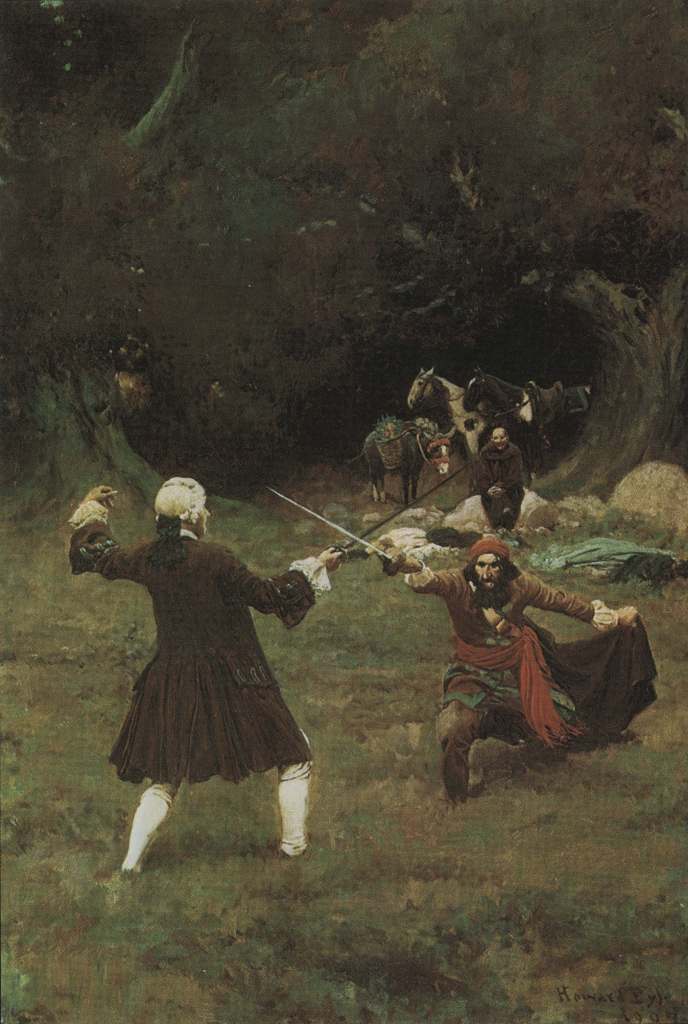
I strongly suspect Wyeth’s later “generic pirate sword-fight on the beach” painting that become the cover of The Black Swan was originally intended, at least in part, to suggest the duel in Captain Blood: His Odyssey. The clothing of the figure on the left might even be the “black with silver lace” of Captain Peter Blood.
Wyeth’s dust jacket and frontispiece for Captain Blood: His Odyssey, shown below, bolster my argument, as do the two single lines describing the duel in it [SPOILER ALERT]:
“It was soon over. The brute strength, upon which Levasseur so confidently counted, could avail nothing against the Irishman’s practised skill.”

Even so, again there are details lacking that we would expect: the buccaneers are not divided into two groups representing the two crews (Blood’s and Levasseur’s); Cahusac and the pearls-before-swine do not figure prominently among the spectators; Governor d’Ogeron’s son is missing; two ships rather than one show up in the background (the Arabella was anchored out of sight); and most importantly, Mademoiselle d’Ogeron and her lustrous black hair is missing–as already noted, the woman in the painting has blond hair.
Even more to the point (pun half-intended), perhaps Sabatini re-clothed his hero from sky blue to violet to match the painting–and then he and his editor forgot to correct all instances. It wouldn’t be the first time harried writers and editors have let errors go uncorrected.
Thus, at best, in spite of my best hopes and desires, the painting may have merely been inspired to suggest the duel in Captain Blood. The original “Duel on the Beach” painting, by the way, an oil on canvas 48 by 60 inches, was sold at auction by Christie’s in 2012 for $1,082,500.
The Duelists: Charles de Bernis & Tom Leach

The novel’s hero is Charles de Bernis, former buccaneer and close companion of Henry Morgan. Sabatini biographer Ruth Heredia, author of Romantic Prince: Seeking Sabatini and Romantic Prince: Reading Sabatini, considers the character to be ultimately an iteration of Captain Peter Blood, probably Sabatini’s favorite of all those he created.
De Bernis is more or less a French gentleman, if a bit of a fortune hunter or adventurer originally, which all flibustiers by definition were. And indeed a fair number of flibustier leaders were gentlemen, most notably Michel, sieur de Grammont, who played so commanding a role in many of the great French buccaneering actions of the 1680s. Others included Raveneau de Lussan who wrote a journal documenting one of the great South Seas buccaneering expeditions; the sieur d’Hulot, veteran of two campaigns against Algiers and the Algerine corsairs, who would later command the regular French forces on Saint-Domingue; the sieur de Chauvelin who died in battle during a failed reconnaissance of Matanzas prior to an ultimately aborted attempt on St. Augustine; and many more.
Barring the boots Sabatini and so many authors of his era dress buccaneers in–a trope or myth, there were no horses to ride aboard ship, thus no need for boots of “fine black Cordovan leather,” nor any evidence that seamen, including buccaneers, wore them–Charles de Bernis in real life would have otherwise dressed much as the author described him.

The image above is a near-perfect fit for Charles de Bernis. Please note that the cavalier is wearing “stirrup hose,” not boots. Stirrup hose was variously popular from the 1650s in the Netherlands to as late as the 1680s in parts of Spanish America. In France, it seemed largely, if not entirely, out-of-style circa 1680, and de Bernis likely no longer wore it.
Sword-belts were also common by this time, although many gentlemen did still wear baldrics as Sabatini’s hero does, of purple leather stiff with silver bullion. That said, eyewitness images of 1680s buccaneers (they do exist, I discuss them here) shows sword-belts, not baldrics. But this is a mere quibble.
So perfect is this illustration that I suggested it to Firelock Games (likely with the fictional Charles de Bernis in the back of my mind), and Miami artist Peter Diesen Hosfeld then used it as the basis for the French flibustier commander for its tabletop war game Blood & Plunder.

Popular illustrations and covers for the novel are rarely accurate, although this one for the 1976 Ballantine Books mass market paperback (the first I read, in fact), comes closer than most, and could have taken its inspiration from the author’s description along with images such as the one above:
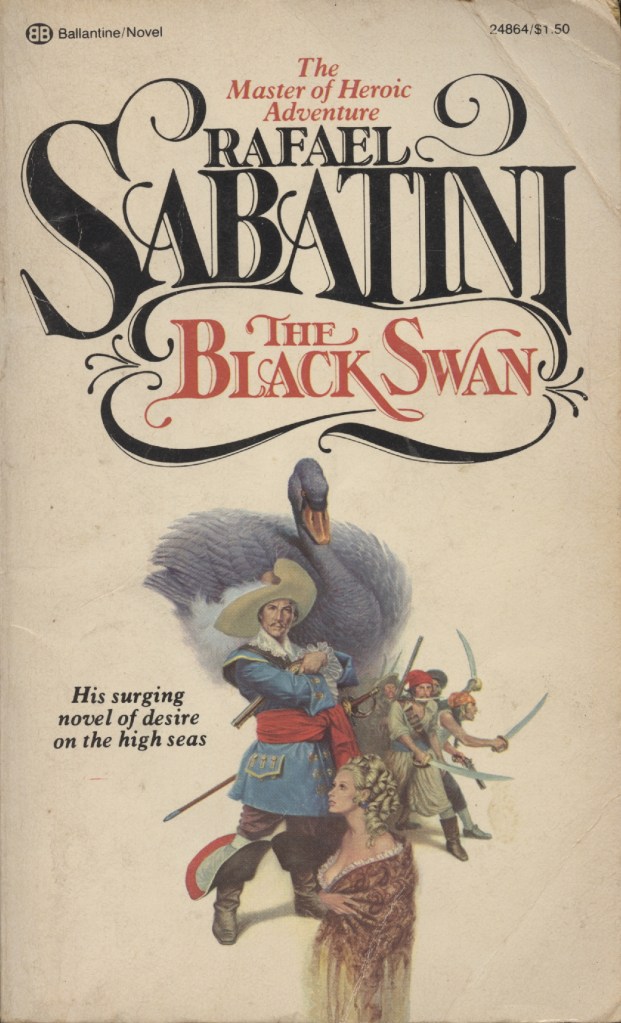
As for red-suited Tom Leach, the villain, his name and something of his character may have been inspired by the fictional Captain Edward Leach of the East India Company, who out of greed betrayed his fellow passengers to pirates, and was, in poetic justice, murdered by the same pirates. Captain Leach, a fictional character, was invented by artist and author Howard Pyle in The Rose of Paradise (1887/1888), his first pirate novel.
However, there are two likely authentic 1680s candidates for his inspiration, both of whom Sabatini, an avid researcher, was probably aware of, given that their exploits are well-documented in the Calendar of State Papers Colonial, America and West Indies.
The first is Joseph Banister, an indebted English sea captain turned pirate who slipped away at night with his 36-gun Golden Fleece, a former merchantman, under the cannon of the forts at Port Royal, Jamaica, escaping with little damage due to his surprise flight. But his piratical adventure would be relatively short-lived.
In June 1686 while careening his ship at Samana Bay, Hispaniola he was discovered by the pirate hunters HMS Falcon and HMS Drake. The men-of-war expended nearly all of their powder pounding the pirate ship to pieces. Banister’s temporary shore batteries (which [SPOILER ALERT] Tom Leach should have erected at the Albuquerque Keys) returned fire but failed to stop the men-of-war.

His ship lost, Banister and a few of his crew set sail with the French flibustier crew of a nearby flibot (the French term for a small flute) of one hundred tons and six guns. Parting soon afterward aboard a captured sloop, Banister was soon run to ground by the Royal Navy and hanged from the yardarm of the HMS Drake in sight of Port Royal, Jamaica in 1687.
As a noteworthy aside, the flibustiers Banister briefly consorted with soon set sail for the South Sea (the Pacific coast of South America), plundering until 1693 and leaving behind a journal of their escapades. In 1688, while attacking Acaponeta, Mexico, these French pirates unfurled a red flag of no quarter–the pavillon rouge, the pavillon sans quartier–of special interest: the red flag bore a white skill with crossbones beneath, the only instance of the skull and bones being flown by late seventeenth century buccaneers or flibustiers. It is possible, even likely, though, that it was flown at other times as well.
However, no matter his piracies, Banister was nowhere near the villain that Tom Leach is. Leach murdered captured crews, but not so Banister. But there was a 1680s pirate villain who was a closer match to Leach in villainy: Jean Hamlin, or more correctly Jean Amelin whose real name was Pierre Egron.
In desperate need of extra time for numerous projects, I’ll cheat and quote, with some paraphrase and revision, from the original draft of The Buccaneer’s Realm (Potomac Books, 2009), along with some added details from the Dictionnaire de Flibustiers Caraïbes by Jacques Gasser:
In 1683 Hamlin, a Frenchman commanding two sloops, captured the merchantman La Trompeuse (The Deceiver) from a French Huguenot, conman, and thief named Paine, and embarked on a piratical rampage. Or so goes the version of the story in English records. In French records, Hamlin inherited the ship from French buccaneer Nicolas Amon, known as Grénéze, when he gave up command in order to command another vessel on a voyage to the South Sea.
Amon had captured La Trompeuse, 200 tons and 16 guns, at the Isle of Roatan. Originally a French merchantman contracted to ferry soldiers, poor young women destined to become wives, and sundry goods and supplies to Cayenne, it was commanded by a Pierre Pan, a French Huguenot (Protestant). Learning of the first dragonnades in France — Louis XIV ordered dragoons quartered on French Huguenots in order to harass them into turning Catholic — Pain took the ship from Cayenne to Barbados, then to Jamaica where he contracted it to English merchant traders.
Hamlin set sail on a brutal voyage or outright piracy. He soon captured an English ship, informed the crew he was a pirate–not, mind you, a buccaneer or flibustier–, tortured some of the crew, impressed some, plundered the ship, and let her go. He soon captured several other English vessels, then sailed to the Guinea Coast and captured eleven slavers and three boats, plundering them all.
At Cape St. John the pirates divided the spoil, and, quarreling, separated into two companies, part remaining with Hamlin, part choosing to serve under an Englishman named Thomas Morgan (no relation to Sir Henry and probably a false name). Hamlin’s usual tactic was to fly an English Jack and commission pendant as if he were an English man-of-war, come alongside as if seeking a salute, and fire a broadside. Indeed, Hamlin’s strategy and tactics were identical to those of the early eighteenth century Anglo-American pirates who flew the black flag: attack weaker merchantmen, preferably by ruse. Most significantly, Hamlin and his crew referred to themselves openly as pirates, not buccaneers, filibusters, or “privateers.”

Hamlin was noted for torturing prisoners and otherwise brutalizing them, and for cutting men down “left and right” when he boarded ships. The violence often seemed in retaliation for any resistance.
Throughout his piracies he was protected by the corrupt Danish governor of St. Thomas, although after one return to St. Thomas, the HMS Francis entered the harbor and burned his ship in spite of being fired upon by the Danish fort. Some of Hamlin’s ship-less crew volunteered to serve Captain Le Sage, others Captain Yanky (Jan Willems). Soon enough, the governor of St. Thomas sold Hamlin a sloop with which he reportedly captured a Dutch frigate of thirty-six guns, renamed her La Nouvelle Trompeuse (the New Deceiver), manned it with sixty of his old crew and sixty new men, and continued his depredations. Some claimed that the ship was outfitted in New England, a colony well-noted for its Protestant piety and hypocritical support of piracy.
Other sources indicate that the ship was instead Hamlin’s consort, the Resolution commanded by Thomas Morgan. The ship had been chased aground at St. Thomas by the HMS Francis, whose crew cut its masts down and abandoned it. Hamlin soon refitted the frigate and sailed south, plundering mostly small prizes along the coast of Brazil. At one point, in a fit of rage and revenge, he cut the nose and ears from a captured priest, forced him to eat them, then murdered him. Or more likely, a sadistic crewman who acted as chief torturer — René Marcart, known as Vaujour, along with his assistants “La Fontaine” and Guillaume Belhumeur — did the deed while Hamlin supervised.
Some of his crew were so appalled at this abuse of a priest that they quit the ship in Cayenne. One of them, Jean le Mont, slipped away from Cayenne to Dutch Suriname — and was hanged for piracy. Four others who made it back to St. Thomas, including forced surgeon Samuel Beloth, made a similar mistake of sailing to Dutch Suriname where they thought they might lead a better life than at St. Thomas, and escape charges of piracy as well. The three pirate seamen were hanged for piracy and Beloth was forced to serve as a surgeon without pay indefinitely.
In his final act of piracy Hamlin had captured a small Portuguese ship and carried her into St. Thomas where he forced some of her Dutch crew to serve with him, even as the governor of St. Thomas forced some of the captured crew to draw lots and hanged the losers. Hamlin, who can rightly be called the first of the true pirates of the Golden Age — only the black flag was missing — was never captured.
In fact, he settled at St. Thomas, that Danish slave colony (they were all slave colonies, but St. Thomas was settled by Denmark specifically to profit from the slave trade) and occasional pirate haven, under his real name, and until his death owned a cacao (chocolate) plantation and raised a family with his wife, Barbara Rambert, who bore him three children.
Make Hamlin an Englishman, and not quite as lucky, and we almost have Tom Leach.
The Swords: The “Rapier” aka The Smallsword

In the novel, the duel is fought with rapiers. This is mildly problematic, as by this time the true rapier was still carried only Iberians–Spaniards and Portuguese–and by some Italians in areas under Spanish rule. The smallsword, with its shorter, lighter blade and smaller hilt, was the common dueling sword among gentlemen and those so pretending.


However, word usage comes to our rescue: Sabatini’s “rapier” remained in use in the British Isles as a word for smallsword. In fact, the English tended to refer to the Spanish rapier as a “spado,” from espada.
Although the cutlass was the common sword of late 17th century mariners, there are a few accounts of those who carried smallswords. Given that Charles de Bernis is something of a gentleman, and Tom Leach prides himself on his swordplay, we can imagine the duel, historically and realistically, as Sabatini described it.

[BRIEF SPOILER ALERT!] Charles de Bernis prepares for the duel by secretly practicing with the pompous Major Sands. In the book, the men use their real swords for practice, each with a pear-shaped wooden tip added to blunt the weapons. This is historically inaccurate, and almost certainly Sabatini, with his experience of fencing, knew this, but went with a simple plot device instead to keep the narrative clean and simple.


Read sword blades were never intended for practice with blade or target contact. They are tempered differently than practice blades, the latter of which are designed to flex many times before breaking, as well as to flex in order to take up some of the energy when hitting.
Real blades were and are usually much stiffer in order to maximize penetration–a too flexible blade might not penetrate thick clothing, cartilage, or otherwise deeply enough to cause a serious wound. Further, the use of real sword blades for practice will severely nick the sharp edges (if sharpened–not all smallsword blades were, but the nicks will still eventually damage the integrity of the blade) and significantly increase the risk of breaking a blade. In other words, such practice will ruin a fighting sword blade.

Practice swords called foils were used instead of real thrusting swords, and there were several styles in use at the time. The French “crowned” style was prominent in many schools. Pierre, the servant of Charles de Bernis, could easily have hidden the foils beforehand, making the scene more historically accurate. Hopefully the island was large enough, or the pirates busy enough, not to hear the clash of steel on steel–it travels far and there is no other sound quite like it.

The Dueling Ground: Maldita Key
The duel and much of the rising conflict leading to it takes place on the northernmost of the two Cayos de Albuquerque while Tom Leach’s pirate ship the Black Swan* is being careened there. The islands do exist, although their geography doesn’t entirely match that described in the novel, which for reasons of plot must take certain liberties. It might also have been quite difficult for the author to get accurate details of these small out-of-the-way keys.
There is, however, plenty of beach for dueling on the real island.
Located off the Mosquito Coast of Nicaragua and Belize south of Santa Catalina (Providencia, Old Providence) and San Andres Islands (roughly twenty-five miles SSW of the latter), the two small principal Albuquerque keys are actually part of Colombia (with a small military presence on the north key). The keys are ringed with reefs: technically, the islands are part of an atoll with a large lagoon at its center. Some old English charts list them as the S.S.W. Keys. The keys are roughly 250 to 300 yards apart, and Cayo de Norte is perhaps 200 yards across. Passage to its anchorages is difficult. Both keys are covered in coconut palms.


Cayo del Norte, where the action takes place, is named Maldita Key in the novel, meaning cursed or damned, probably a name of Sabatini’s creation given that I’ve not found the name referenced anywhere else. This isn’t the only time he invents or changes a place name. Similarly, Sabatini has imagined the island as larger, with higher elevations in places than the roughly 7 feet maximum elevation of the real island, and with a hidden pool of fresh water large enough to swim in.
Having once lived on Old Providence Island until the Spanish sacked it and forced the interloping settlers from it, buccaneer Charles de Bernis would have been familiar with the keys to the south.

The Duel Itself
LAST WARNING! SPOILER ALERTS! If you haven’t yet read the novel, you should stop, read The Black Swan, and then return.
The duel as described by Sabatini is about as well-written as a sword duel can be: exciting, well-paced, and largely rooted in reality. As such, I’m not going to comment further except to discuss and dissect the singular unconventional technique used by Charles de Bernis to kill his adversary.
Several years ago in a long-running conversation with Sabatini biographer Ruth Heredia as she prepared her second volume, Romantic Prince: Reading Sabatini, we had numerous discussions about swordplay in his novels. One point of discussion was what the de Bernis technique might actually have been.

I was never satisfied with the answer, discussed below, I gave her. Then one recent evening, while rereading the duel as part of some research into my annotations for Captain Blood, the answer struck me. I realized I had been mistaken in every analysis I’ve done on the duel, and knew immediately what de Bernis had done—and where Sabatini almost certainly found his inspiration. It was right under my nose all along, a purloined technique lying literally in plain sight for two decades or more, but my mind had categorized it such that I had not yet made the connection. Please excuse my excitement and fencing vanity as I make my argument.
For what it’s worth, this separate blog on The Black Swan was inspired by a recent long e-letter to Ruth Heredia on the subject.

The pertinent details: at the end of the duel, Leach makes a sudden and sneaky (sudden and sneaky are expected in swordplay) long low lunge in the “Italian” style, snake-like, with one hand supporting him, to slip under the guard of de Bernis. This was in fact both a French and Italian technique in the late 17th century, although by Rafael Sabatini’s era it was largely confined to the Italian and was generally considered as such. Sabatini notes in the novel that no “direct” parry could deflect this attack once fully launched. (Strictly speaking, a direct or simple parry is one made by moving the point and hand more or less in a direct line horizontally, as opposed to a diagonal, half circle, or circle.) While this may not be entirely true (see below and also the note at the end of this blog), a very low attack like this is quite difficult to parry, making an esquive (see also the discussion below) of some sort highly useful in defending against it.
Further, an attack made with the body and hand so low can only have as its torso target the lower abdomen or the groin, making it a ruthless, dishonorable attack when this is the intended, as opposed to accidental target — an attack suitable to Tom Leach’s venomous character.
As Leach lunges, de Bernis disappears from the line of attack. “Pivoting slightly to the left, he averted his body by making in his turn a lunging movement outward upon the left knee.” It was a “queer, unacademic movement” that “had placed him low upon his opponent’s flank.” De Bernis then passed his sword through Leach.
We require six conditions for the answer:
- A pivoting movement that averts the body.
- It must outward upon the LEFT knee (we assume almost assuredly that de Bernis is a right-hander).
- It must be a “queer, unacademic movment.”
- It must place him low upon his opponent’s flank.
- It must put de Bernis in position to pass his blade “side to side” through Leach.
- It must require TWO tempos, one for the pivoting movement, and one for the thrust into Leach’s flank.
As already noted, I was never satisfied with any conclusion I’ve come to. Of course, it could be that Sabatini left his description somewhat vague on purpose, and I’ve considered this as a possibility. However, my best guess was some form of intagliata, a term used by some nineteenth century Italian masters for an “inside” lunge off the line. In other words, if you’re a right-hander, you lunge toward the left, or inside, removing your body from the direct line of attack or riposte and placing yourself upon your adversary’s flank.

by Cesare Enrichetti, 1871. the fencer on the right has lunged off the line to the left in order to avoid his adversary’s blade.

The intagliata is a member of a group of techniques known in French as esquives, or in English, dodgings or body displacements for lack of more elegant expressions. The two principal esquives are the inquartata and the passata soto, both of which are primarily used as counter-attacks in a single tempo, designed to avoid the adversary’s attack while simultaneously thrusting, preferably in opposition (closing the line to prevent the adversary from hitting) or with bind (pressure on the adversary’s blade to prevent it from hitting) and removing the body from the line of attack.
They may also be used in two tempos, parrying and displacing in the first tempo, and riposting in the second. Single tempo counter-attacks without esquive often result in double hits, even when opposition is attempted, for the fencer often fails to predict the correct line or uses inadequate opposition. Body displacement increases the protection. It’s a backup, in other words.
Other esquives include the cartoccio or forward lunge while lowering the upper body; the rassemblement or very old school “slipping” as it was called; the “pass” or crossover forward bringing the rear foot forward in front of the lead foot; the simple backward lean; a lunge forward to the inside with rear foot (arguably a form of the pass); the various leaps or voltes to the side noted by some late 17th and early 18th century masters (seldom used now due to the narrowness of the fencing strip); and the lunge to the outside (to the right for a right-hander) off the line. My personal preference for dealing with Leach’s style attack is to retreat with a crossover (lead leg passing behind read leg) — if possible — while counter-attacking to the head (and, in historical weapons, using the offhand to attempt a parry), or making a hard low-line parry (see the technical note at the end). Note that if attacked in tempo as one advances, this is a difficult attack to counter without also getting hit.

I considered and even tested all of these. None entirely met the conditions. In particular, none were considered then as un-academic, although it could be argued that the leaps to the side are considered so today and likewise in Sabatini’s era. But the leaps met few of the other conditions. Compounding the problem was Sabatini’s use of the word “outward” which I, with 46 years fencing and studying swordplay of the past and present, and 26 teaching both, took at first to mean “outside,” which in fencing terms means, for a right-hander, to the right. In fact, Sabatini appears to have meant the word conventionally–outward rather than inward. One problem solved!
Yet the major problem still remained. In the 1935 film version of Captain Blood there is one option depicted, probably drawn by famous fencing choreographer Ralph Cavens (take note!) from an interpretation of The Black Swan is my guess — a volt to the left with the leading right foot, followed by the rear — but this too is actually an academic movement, a form of intagliata, again really nothing more than “lunging off the line.”
I remained distracted by the question: what other possible, conceivable two tempo movement — a pivot and lunging movement outward upon the left knee, followed by a thrust, probably via a lunge — would fit? What esquive could it be if not an intagliata? What might work yet be unorthodox? Importantly, what might be documented — not imaginary — in this category? In other words, how did Sabatini develop this scene, what was his inspiration?
I think almost certainly right here:

On the right a swordsman has made a very long low lunge. His hand is not on the ground as it commonly was, but this is immaterial. On the left is a swordsman slightly off the line, bending inward slightly, WITH HIS LEFT (REAR) LEG BENT IN A SOMEWHAT LUNGING MANNER.
This left fencer’s position appears bothersome to fencers not well-versed in fencing history (most aren’t, in fact). What does it depict? It might well be just a lean backward onto the rear leg to avoid a sudden low attack, or a failed retreat — the 17th century French school advocated keeping most weight on the rear foot, forcing most retreats to be made by crossing over, front foot moving first to the rear, passing the rear foot en route. (In fact, a parry combined with a crossover retreat is perhaps the safest counter to a long low lunge.) Or, it might be something more conventional, which we’ll discuss in a moment.
What’s important is what Rafael Sabatini might have thought it was!
Let’s assume, for the sake of argument, that it depicts a fencer who has just pivoted off the line slightly in a lunging fashion in order to avoid a long low attack, as described by Sabatini. If so, to execute this, de Bernis need, as described, only pivot slightly to the left on the right or lead foot as he simultaneously leans back into a lunge on the left leg. This places him out of the direct line of attack and also out of range — and he has a tempo to do this as the low attack is made.

In fact, the parry shown in the detail above is a natural one against a long low attack, and would help protect de Bernis as he made his next movement, by providing some opposition — but it would almost certainly not have stopped the attack, or at least such conclusion might be drawn from the image. The exceptionally low attack might easily “force” most parries, as it has here.
In other words, parrying with the hand held at the usual height of the en garde position makes it difficult to apply forte (the strong third of the blade nearest the hilt) against the middle or, preferably, foible (weak third of the blade at the tip end), so necessary for an effective parry. In the detail above, the foible or middle of the parrying blade has been applied against the forte of the attacking blade, rendering the parry largely useless. It is likely that Sabatini’s statement to the effect that there is no direct parry that can stop such an attack once fully launched was inspired in part by this image. (See the technical note at the end of this blog for more detail, including on at least one unconventional parry that can deflect such an attack.)
But let us return to the unusual esquive. Because Leach is now subsequently off-balance — for a full second, fortunately — de Bernis has a second tempo in which to run him through, almost certainly with a conventional lunge. In fact, such long low lunges have a distinct disadvantage: they’re slow to recover from conventionally, that is, to the rear, leaving the fencer in danger. Likewise, if the fencer recovers forward, he (or she) may be at dangerously close distance. As well, poor balance is typical of this long lunge although there are some rare fencers who can manage it well, at least on hard floors.

Importantly, does the technique of Charles de Bernis work?
I’ve tested it — and it does! It is also historical, it is also unorthodox — and its imagination by Sabatini from the drawing, brilliant. It would only require that the fencer using be familiar with lunging with his left leg — having experience fencing left-handed, in other words, would help. And a fair number of fencers, although probably not a majority, did practice at times with the off-hand.
In fact, if the technique were deliberate, it would fall into the category of “secret thrusts,” which were nothing more than legitimate, if unorthodox, technique that was known to a minority of fencers and masters and was useful only in rare circumstances. And once it’s found useful, the unorthodox becomes the orthodox, in everything, not only in fencing.
The inspiring drawing is by Louis François du Bouchet, marquis de Sourches (1645 – 1716), circa 1670. The small collection of his drawings is well-known to historians of seventeenth century France. More importantly, there are some thirteen volumes of his memoirs, dating from 1681 to 1712, first published in the late 19th century: Mémoires du marquis de Sourches sur le règne de Louis XIV, publiés par le comte de Cosnac et Arthur Bertrand (Paris: Hachette, 1882-1893). Sabatini would doubtless have run across these volumes of memoirs of the French court in his researches, and from them his drawings, if not otherwise. I’ve found copies of the swordplay image in both the British Museum and Rijksmusem.
So, there we have it! Or do we? I think almost certainly this is Sabatini’s inspiration. But does the drawing actually represent what the author described?

Almost certainly not.
The two images below are from Les Vrays Principes de l’Espée Seule by the sieur de la Touche, 1670. The first shows the long lunge in use, or at least promoted (it requires great flexibility), at the time, although not as long as the extreme lunges above, along with the en garde. The second also shows the common French en garde of the 1660s and 1670s, with most of the weight on the rear leg and the lead leg almost straight.
Vestiges of this en garde remain in some of the French schools today. A few years ago, although Olympic gold medalist Dr. Eugene Hamori had been mentoring me as a fencing teacher for two decades, he had not given me a fencing lesson since 1981. As I came en garde very upright, almost leaning back, a position I’d picked up from years of giving fencing lessons, he immediately said, “That’s a beautiful French guard, Ben. Now lean forward a little bit, like a Hungarian.”
We find this unbalanced French en garde not only in de la Touche’s work, but in other images as well, as shown below. The guard does have the advantage of keeping the body well back and even permitting one to lean back even farther — the first commandment of swordplay is (or should be) to hit and, especially, to not get hit. But the guard has the disadvantage of limiting mobility, including a slower attack (but then, that’s not what the French school was most noted for anyway at the time).
Most French schools would soon place less extreme emphasis on this heavy rear foot position, although it would remain in use to a lesser degree for another century.

So there’s an end on it, yes? Sabatini’s inspiration and its reality?
Or is there more?
In my experience there always is. Below, from Alfieri, here’s a swordsman leaning backward, weight on his rear leg, to avoid a thrust while thrusting in turn. It doesn’t take much to imagine the addition of a small lunging movement off the line with the rear leg. In this case, though, the fencer on the right has made a single tempo movement, thrusting as he simultaneously evades an adversary who has rashly ventured too close, or has been tricked into doing so. Tom Leach provides no such opportunity. 🙂
Still, I think we have Sabatini’s original source above in the du Bouchet drawing, and therefore the “queer, un-academic” technique of Charles de Bernis as well.
However, the most useful lesson, at least fencing-wise, from the novel may be the admonition derived from the following lines:
“…and that, too confident of himself, he had neglected to preserve his speed in the only way in which a swordsman may preserve it.”
In this time of pandemic, fencers may improve their footwork, increase their flexibility and strength, study strategy and tactics, and so forth. But it takes free fencing — practice with an adversary — to maintain the most important components of fencing speed: the sense of tempo and the ability to react without hesitation. Without these, raw speed is worth next to nothing sword-in-hand.
Next up in the series: the duel on the beach in film!
Update!
I have often thought that the final technique in the duel choreographed by Fred Cavens for the Flynn-Rathbone duel in Captain Blood (1935) was his take on Sabatini’s technique as described in The Black Swan. It is mindful to remind ourselves that almost none of our ideas and inspirations, particularly in swordplay, are original, and so it is here. The 1952 photograph below, which I ran across quite by accident recently (September 2023), shows Fred Cavens lunging at actor-swordsman Cornel Wilde — who is making a lunge with the left foot exactly as described by Sabatini in The Black Swan! I would not be surprised if Cavens, as I was, was unsatisfied with his first answer. Clearly he found it — at least seven years before I was born — and as noted above, the technique does work! Below is a beautiful representation.

Technical End Note on Parrying Leach’s Low Attack: Arguably there are five parries that might possibly deflect Leach’s blade: septime, octave, seconde, quinte (low quarte), all by different names in the 1680s and some not really even in much use at all; and a largely unfamiliar vertical parry made straight down, noted by Augustin Grisier in 1847 (he names it cinquième or quarte-croisée), described in some of the old Italian schools, and also described by Alfred Hutton in his famous fencing text, Cold Steel. He describes the parry as being effective against an upward vertical cut toward the “fork” aka the groin.
Such vertical and other below the waist cuts are the reason, by the way, that the modern saber target is limited to the body from the waist up. This is due to the Italians who made the rules more than a century ago, intending by them to protect their manhood. Yet the myth of the saber target “being limited to above the waist due to the saber being a cavalry weapon, and you wouldn’t want to hurt the horse,” persists in spite of being arrant nonsense. In fact, the modern “Olympic” saber derives from the light dueling saber of the nineteenth century, and it was used in duels afoot. As for not hitting the horse or below the waist? Such blows were commonly permitted in duels among many various schools and peoples, and always in warfare.
Below the waist attacks, especially to the knee, have long been common with cutting weapons, but somewhat less so with thrusting weapons, at least when the legs are target (the area below the ribs is in fact an excellent target with real thrusting weapons), due to the fact that a thrust to the legs is rarely incapacitating, unlike a cut, and leaves the attacker’s head and torso wide open for a possibly fatal counter thrust. Thrusts to the groin, besides generally being considered dishonorable when intentional, may easily miss and slip between the legs, leaving the attacker open as just noted. In my experience, fencers hit in the groin by thrusting weapons are usually themselves at fault, having parried late or insufficiently, or used a filo/grazing or yielding parry incorrectly and thereby carrying the attacking blade to the groin.
The vertical downward hard parry of Grisier et al is used unknowingly by some epee fencers today, and if asked would probably define it as an incomplete seconde. I use it and find it highly effective against hard-driven low attacks, particularly when made Hungarian style with beat as the opposition parry is made (Sir Wm. Hope also recommended that parries be made in this manner). Grisier recommends riposting in opposition. The parry is made by lowering the hand while simultaneously bringing the point perpendicular to the fencing line — pointing inside, that is, 90 degrees away from the fencing line and definitely not in line with the adversary, contrary to most advice of keeping the point in line with the target. It is in spite of this a highly effective parry and riposte. One imagines de Bernis using it successfully and riposting with an opposition thrust to the eye, given that much of the target would be protected by Leach’s long lunge and extended arm.

In order for any of the first four of these parries to be effective against a low thrust, the parrying hand must be lowered significantly in order to bring forte to foible, making for a slow parry. If the parry is begun after the attack has developed, instead of at its initiation, often by anticipating it, it will likely prove ineffective.
Note again that Sabatini writes that no direct parry — one made in a more or less straight horizonal line — can stop the attack. Sabatini probably intends to mean that no simple parry (direct, diagonal, half-circle), rather than a circular parry would stop the attack, for a circular parry would likely be too slow and would be forced by the attack. A true direct parry against the attack would have to be made from an en garde held in a very low line, McBane’s “Portuguese guard” for example. But if de Bernis had been in this guard, Leach would not have made his low attack.
However the direct vertical parry just described, if correctly timed and made with a powerful beat with the middle of the blade on the attacker’s foible or middle, can be highly effective against such attacks, capable of being forced only with great difficulty. Even so, Sabatini is largely correct when he writes that such a low powerful attack is not easily parried, at least not conventionally.
Hutton notes that septime is also effective against low vertical upward cuts. In my experience it has some utility against low thrusts, particularly if the parry is made with a combined beat/opposition and the hand is dropped to bring forte against foible. However, it is often easily forced.
* The pirate ship Black Swan may be the ultimate inspiration for the concept of Disney’s Black Pearl (rather than the Wicked Wench). Details here…
Copyright Benerson Little, 2020 – 2026. First published 10 September 2020. Last updated 10 February 2026.

The Duel on the Beach, Part I: In Fiction & Illustration
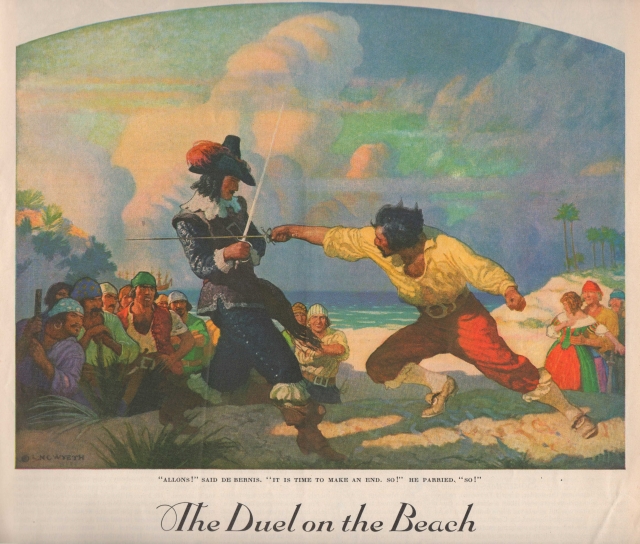
It’s all too easy to imagine a duel on the beach between pirates or, as fiction and film often have it, between pirate captains. A sandy beach, palm trees, spectators often including both pirates and a woman in distress, a tropical sea and sky–a duel is mandatory in the genre if only because the setting demands one.
This blog post is part one of a likely five part series on the classical piratical duel on the beach, a pirate trope too evocative to pass up and one based to some degree in reality too. Only the trope of the tavern sword brawl is as prevalent, but not as romantic.
Up first is a look at the sandy duel in fiction. Part two examines the duel described by Rafael Sabatini in The Black Swan, in particular the origin of the hero’s singular technique. Part three reviews the duel on the beach in film, part four takes a close look at the most famous fictional duel on the beach, that depicted in Captain Blood (1935) starring Errol Flynn and Basil Rathbone, and part five discusses the historical reality of the duel on the beach.
In particular, we’ll look not just at some classic swashbuckling episodes, but also consider how genres and tropes are created, and how misinterpretation often not only leads us astray, but also, at times, to authentic historical discoveries.

It’s entirely likely that I’ll also throw in a blog post each on the inquartata, the flanconnade, and also the intagliata and similar techniques of “lunging off the line,” given their prevalence in swashbuckling fiction and film (not to mention their utility in historical and modern fencing). I’ve already written one for the same reason on The Night Thrust; or, More Politely, the Passata Soto, and I’ve discussed Sabatini’s hero’s off the line technique in The Black Swan, linked above. I’ll likely also write a brief post on Dutch knife fighting for reasons noted just below.
The series is also part of an effort to encourage outdoor fencing, especially at the beach or seaside. (Don’t worry, any light rust is easily removed from blades! In fact, two or three hours in a sea breeze will start to rust carbon steel.) Not too long ago the FIE (the international fencing body) in its infinite [lack of] wisdom did away with outdoor tournaments in epee, at least as sanctioned events, and national bodies followed suit. Not even the Covid-19 pandemic inspired the dour, sports-rabid international and national bodies to reconsider outdoor fencing. Tournaments held outdoors — at the beach, at historical sites, in parks — are a lot of fun for their own sake, although arguably fencing these days seems more focused on its falsely purported utility as an add-on to college applications than on fun. Some of my fondest fencing memories are of outdoor swordplay, both competitive and recreational, and their associated celebrations.

So where to begin? It seems almost too easy. At least half the blame lays with the highly enjoyable illustrator and writer of out-sized piratical myth, misconception, and trope (and even some fact!), Howard Pyle, several of whose students–N. C. Wyeth and Frank E. Schoonover in particular–followed closely in his swashbuckling-illustrator footsteps.
However, before we get to Pyle in detail, we need to note the existence of an old ballad called “Dixey Bull” or “The Slaying of Dixey Bull” which describes a duel on tiny Beaver Island (near modern Pemaquid Beach, Maine) between a pirate captain and a local fisherman. The ballad was first published in 1907 from oral tradition dating possibly as early as circa 1725 based on its mention of the “skull and cross bones,” language used, and its description of swordplay consistent with early to mid-18th century prizefighting and broadsword technique. The song was sung in Maine and environs, was apparently well-known by seamen and fishermen, and their wives and daughters, and it’s entirely possible that Howard Pyle was aware of its existence.

Dixie Bull was the first-noted pirate of New England and the northeast coast of North America. In 1632 some Frenchmen in a pinnace robbed him of his trading stock of blankets, “ruggs,” coats, &c, for which he sought reprisal at sea in his own small craft. Failing to make good against the French he plundered some local Englishmen, thereby turning pirate. In 1633 three deserters from his crew said he’d gone over to the French, although he is believed to have eventually returned to England.
In the ballad, which has no known basis in reality, as is the case with many ballads of the era, Dixey Bull is challenged by local fisherman Daniel Curtis to a duel with broadswords. If Bull wins, he and his crew keep their stolen treasure. If he loses, the pirate crew returns the plunder and sails away. Wounded, but with a trick worthy of one of Rafael Sabatini’s heroes or the best of those of swashbuckling Hollywood, Curtis kills Bull. Of course, no such duel ever took place: pirates would never offer up their plunder on a point of honor. Whether or not the ballad influenced Howard Pyle is unknown but certainly possible.


Although Howard Pyle painted several sword duels, two of them by the seaside, it’s his “Which Shall Be Captain?” (shown above the Dixie Bull images) that may be the significant culprit, and it shows no obvious connection to the duel between Bull and Curtis. In the painting, two pirate captains struggle against each other with daggers to determine who will command. The notion of dueling for command is false, however, to be discussed in more detail in part five (or if you can’t wait, you can read about it in The Golden Age of Piracy: The Truth Behind Pirate Myths). Put simply, captains and quartermasters were democratically elected. Even lesser officers required the approval of the crew. Dueling was never considered or acted upon as a means to gain command.

Likewise false, or at least uncommon as far as we know, is the use of daggers in duels on the beach. In fact, among buccaneers the musket was usual dueling weapon although some fought with cutlasses. However, there may be a possible exception among Dutch and Flemish seamen, who like many of their adventurous compatriots ashore had a habit of knife fighting, often using their hats in the unarmed hand for parrying. The style of fighting appears to have been more cut than thrust, notwithstanding the Dutch term “snickersnee,” which means to stick or stab and thrust, which Lewis Carroll turned into the snicker-snak of the vorpal sword. (See Buccaneer Cutlasses: What We Know for more information on cutlasses, including a bit on dueling.)
Even so, the only authenticated duel between buccaneer captains was between two Dutchmen–and they used cutlasses. Again, more on this in part five.
A duel on the beach between Dutch pirate captains is likely not what Pyle intended though, unless they were Dutch buccaneer captains of which there were in fact a fair number, more of them in service among French flibustiers than among English buccaneers. Their names are legend: Laurens de Graff, Nicolas Van Horn, Michiel Andrieszoon aka Michel Andresson, Jan Willems aka Yanky, Jacob Evertson, and Jan Erasmus Reyning among many others.
No matter his original intention, Pyle’s scene-setting has been imitated as homage, sometimes even copied, in numerous films as well as in illustrations for swashbuckling tales.

However, Pyle’s painting can only ultimately be said to have inspired the trope to far greater prominence, for a decade earlier, in 1899, Mary Johnston’s To Have and to Hold was published, a romantic novel of ladies, gentlemen, settlers (or invaders), Native Americans, and pirates. Notably, Howard Pyle painted the frontispiece, and, more on this later, Johnston’s works were a significant influence on Rafael Sabatini, author of Captain Blood and many other great romantic, often swashbuckling, novels.

Pyle’s painting of the duel for command, between gentleman hero and the last of three pirate villains he fights one after the other, takes place on what is known today as Fisherman’s Island off Cape Charles, Virginia. All three duels are described not in terms of fencing technique but via the hero’s thoughts and emotions as he fights–and easy way to avoid describing actual swordplay. Side note: the hero’s second adversary is a Spaniard (the best blade in Lima) and the third is the “man in black and silver”–almost as if the duel takes place in The Princess Bride. I won’t add the duel in The Princess Bride to this post, although I’m sorely tempted, as it takes place not on the shore but on the cliffs high above.
The entire composition of Pyle’s painting has been copied by many illustrators and filmmakers, including Douglas Fairbanks in The Black Pirate (1926) and Michael Curtiz in Captain Blood (1935).
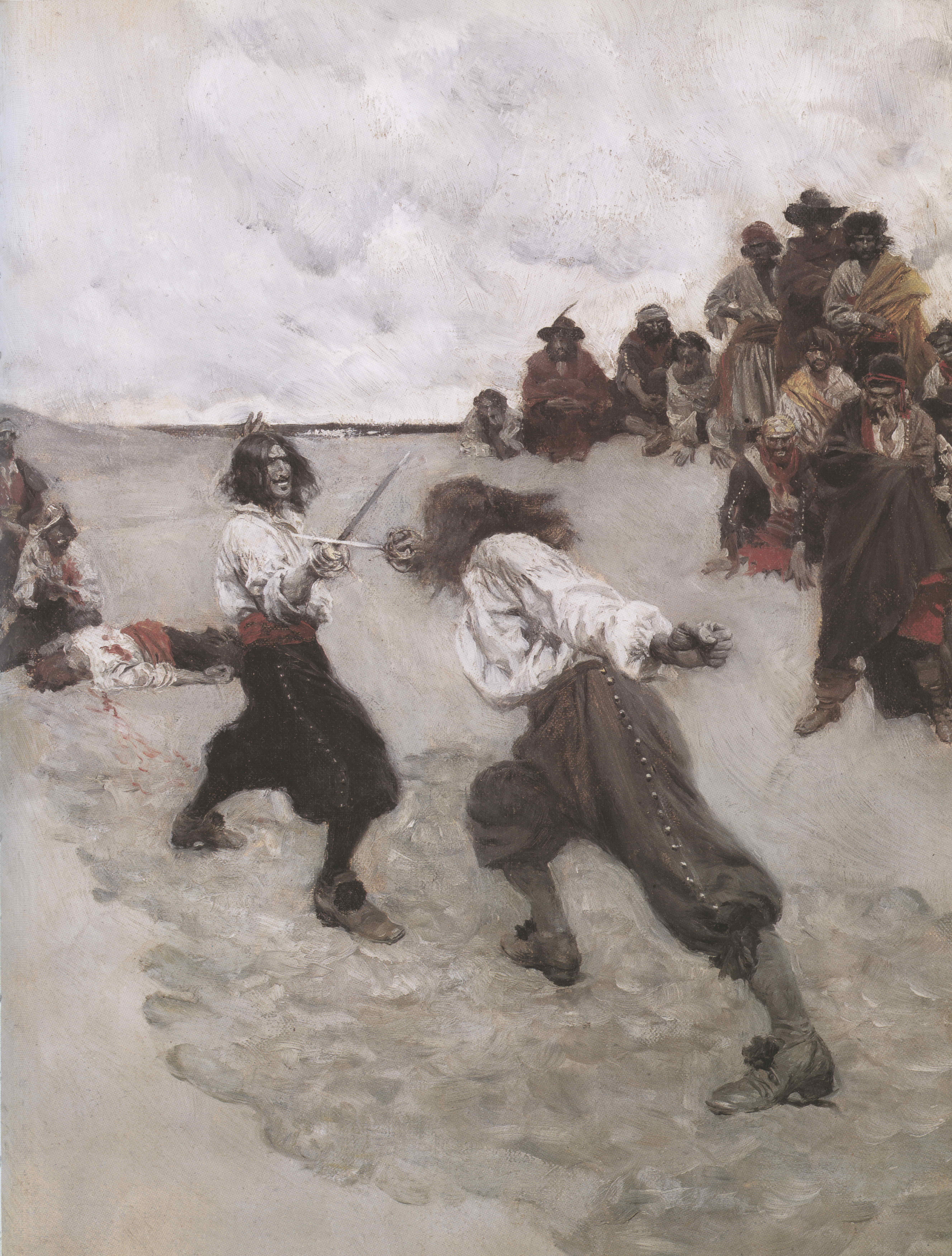

As for the action itself, duels in fiction and film require high drama. It helps if the hero and his adversary are equally matched, although often the hero ends up hard-pressed but prevails in the end, often by stratagem. Occasionally we see the hero who is always in control, whose swordplay is so exceptional that the villain comes soon to realize he (villainous duelists are almost always a he, thus the pronoun) is entirely outmatched. Here the drama derives from the villain realizing he’s going to lose and be rewarded as he so richly deserves.
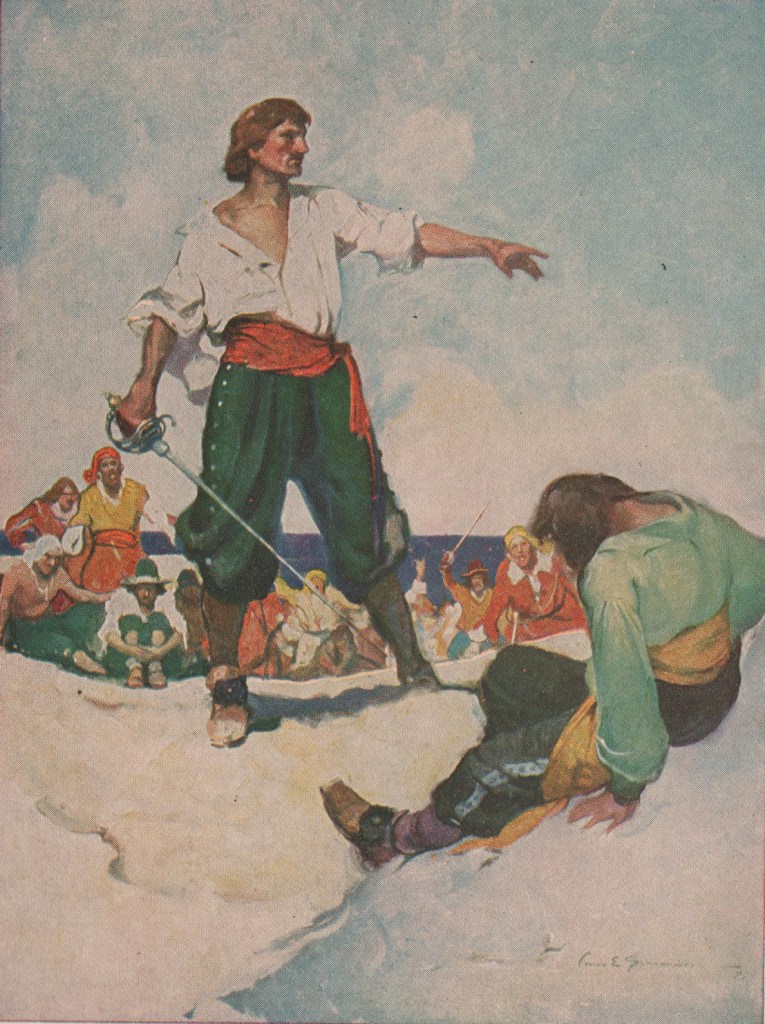
Depicting swordplay in fiction can be difficult, or rather, is actually quite difficult. Explain too much and you lose drama and tempo. Explain too little, and the duel is reduced to vague nonsense, even if dramatic. Using a few modern fencing terms has been the refuge of many novelists–but modern terms lack the flavor, and often the correct historical technique, to adequately depict a historical duel. And even in this case only fencers will actually understand what’s going on. In other words, to understand fencing you must be a fencer (and this is part of the reason, in spite of the FIE’s attempts at dumbing down fencing, why it will never be, and frankly should not be, a great spectator sport). But writers often cheat and describe swordfights only in vague terms or through the protagonist’s mental state.
In related fashion, writers often forget, or far more likely haven’t learned, that fencing on a shoreline causes changes in footwork and agility. Fencing in sand tends to slow the action down a bit, footwork in particular. Lunges are slower because the foot slips even in the best-compacted damp sand. Of course, if the beach is rocky, as in Captain Blood (1935), or covered in various beach and dune plants, this may help prevent the foot from slipping although it may also increase the risk of tripping and falling. Fencing in shallow water can diminish the lunge or even negate it.
Further, sand gets in the shoe, which can affect footwork. Sand is also readily available for villainously throwing in the adversary’s eyes. And, as in the case of all outdoor fencing on uneven ground, there’s always the chance at taking a special form of tempo, that of the brief surprise when the adversary accidentally steps in a hole or runs into a bush or trips over driftwood, or is maneuvered into doing this. Distraction, however brief, can be fatal.

There are partial remedy for these hazards, which I’ll discuss in part five, and, like running in the sand, you’ll at least in part naturally adapt to the best technique over time. (Thanks Bear Mac Mahon for your brief comments and reminders on fencing in the sand. 🙂 )
Sadly, seldom does any of this make it into fictional accounts of duels on the beach. But no matter! It’s the ring and spark of steel on steel while the sun glints off sand and sea we’re after. Which, by the way, is another issue with fencing on the beach: glare, which can easily be used to advantage by maneuvering the adversary into position with his face facing sun and sea, or even a sandy sea breeze…
On occasion there artwork of a duel on the beach unassociated with a published story, and even when discovered there is often something of a written description associated with it, as with Frank Dadd’s “The End of the Game” published in The Illustrated London News:

The duel on the beach also makes its way into pirate pulp fiction, as in these novels by Donald Barr Chidsey (the rhythm of whose name makes me think of Simon Bar Sinister):


The duel on the beach has had a fair amount of depiction in other print media as well, including comic books and trading cards:
The front cover of Buccaneers (January 1950, #19) showing a duel on the beach, with costumes and en gardes inspired by a combination of several films. Notably, the duelist on the left has an en garde typical of many beginning fencers.
A trading card duel, with buccaneers watching as in Howard Pyle’s paintings and in the films The Black Pirate and Captain Blood.

A duel over buried treasure below, with daggers, clearly inspired by the famous Howard Pyle painting.

Below, a duel for command–a myth, as is the duel or affray over buried treasure.
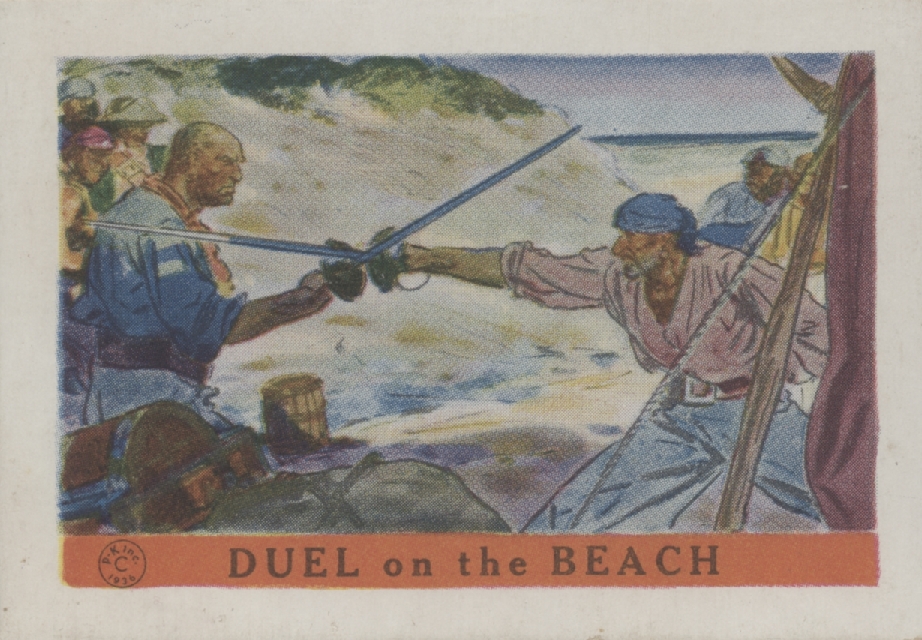

The trading card above probably owes as much to Douglas Fairbanks’s The Black Pirate (1926) as it does to Howard Pyle and various fiction, as shown below–but then, The Black Pirate owes much to Howard Pyle, purposely so according to the film program. We’ll discuss the duel in this film in more detail in part three.

There is a duel on the beach–well, not the beach but on higher ground on tiny Beaver Island, for the “ledges” (rocks) ran down to the water–in Clothes Make the Pirate by Holman Day (1925), a comic pirate novel. The duel is based on the fictional encounter between Dixie Bull and Daniel Curtis but is fought here between two tailors, Tidd and Sneck, both of them impersonating pirates (the former pretends to be Dixie Bull), and the two tailors merely pretend to fight, working out the details while briefly hidden behind some spruce trees during the engagement.

Of course, one of the great duels on the beach is depicted in Captain Blood: His Odyssey (1922) by Rafael Sabatini, in particular the dramatic build-up and famous dialogue. But alas, the duel itself is described in only two lines:
“It was soon over. The brute strength, upon which Levasseur so confidently counted, could avail nothing against the Irishman’s practised skill.”
In part four we’ll look further into this most famous of duels as it was depicted in the 1935 film starring Errol Flynn, Olivia de Havilland, and Basil Rathbone.
Numerous illustrators have tried their hand at the duel, some more successfully than others, historical accuracy (and even fictional accuracy) often to be desired.


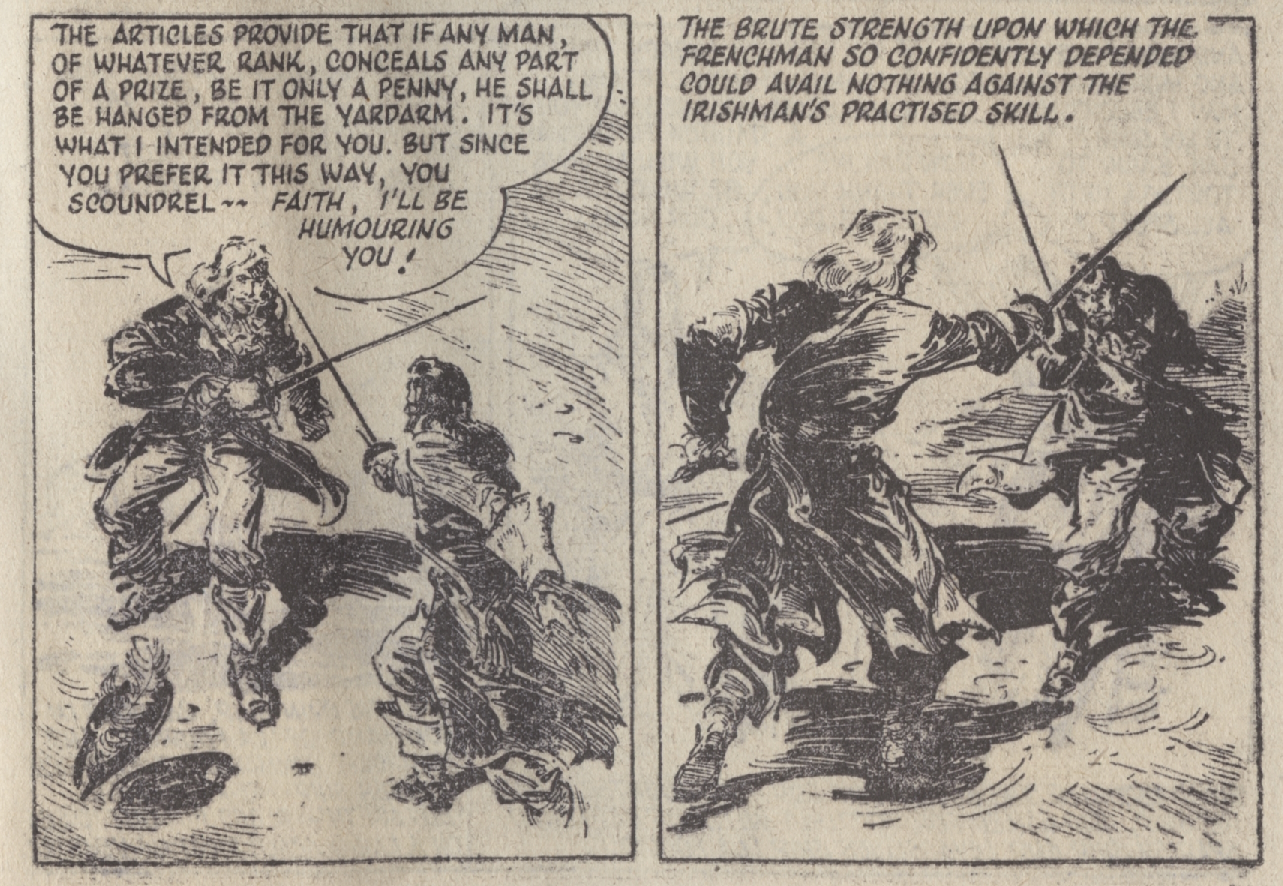


This is a good opportunity to segue to several tobacco card illustrations of duels on the beach. Up first is Captain Blood, although based entirely on the duel in the 1935 film.

Although I can’t discover any connection to specific works of fiction per se, four of Don Maitz’s paintings of swordplay on the beach evoke classic swashbucklers and the paintings of Howard Pyle and N. C. Wyeth. Mr. Maitz is a famous illustrator, perhaps most noted for his depictions of Captain Morgan for the rum of the same name. Copies of his works can be purchased here.
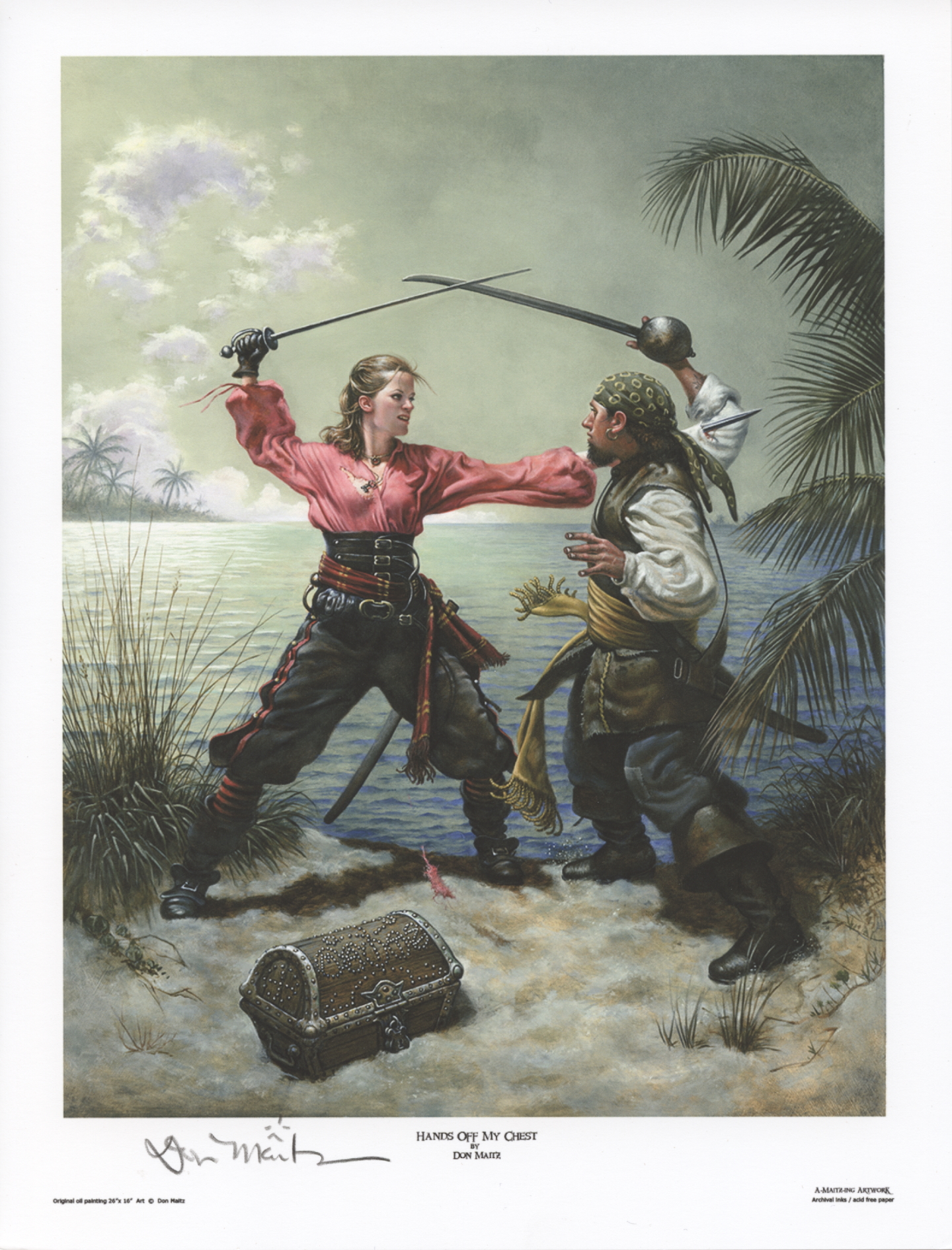
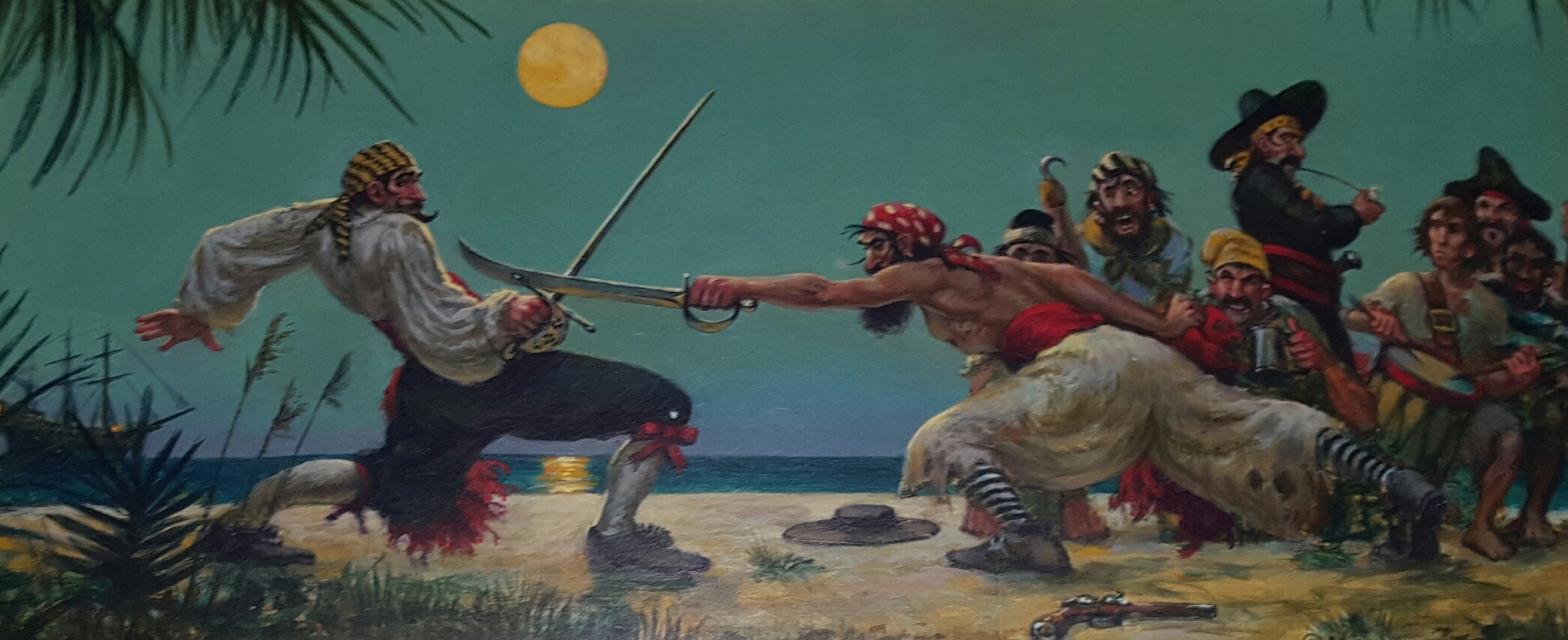
The purportedly authentic duel between Mary Read and a fellow pirate who was threatening her lover (or at least Charles Johnson so claimed, but he lied often in his 1724-1726 chronicle of pirates) shows up in an Allen & Ginter Cigarettes trading card, circa 1888. I’ve included it here as the account may well be fictional.

Norman Price illustrated this duel in The Rogue’s Moon by Robert W. Chambers (New York: D. Appleton and Company, 1929), yet another prolific (roughly one hundred novels, short story collections, and children’s books) popular genre writer already forgotten less than a century later. The story is enjoyable enough even given its light genre and Chambers’s style. It is action-filled and interspersed with scenes of mild titillation, and includes several major characters of the era (Blackbeard among them) in prime appearances, with pirates as the story’s villains. The protagonist is a cross-dressing, seeking-revenge-against-pirates, older teenager named Nancy Topsfield. The novel pretends to a background of historical accuracy, which is in fact, as with most of the genre, only superficial at best.

The duel is brief but exciting, and follows the manner described by Charles Johnson as in use by the early eighteenth century pirates of the black flag: pistols followed by cutlasses. Read’s sword is a “Barbary” or “Arab” blade, which might be a nimcha (of which were some naval captains who owned these swords, usually as trophies) but which the illustrations suggest is more likely a scimitar (or shamshir if you want to be pedantic–but scimitar was the common word in use by Europeans at the time). In either case her blade looks curved enough that she needs to hook her thrust. The duel ends with a near-decapitation.
Although Price’s drawings and paintings of men in the story are reasonably historically accurate by the low standard of popular illustration, he takes pop culture liberties with the leading female characters. He and Chambers dress Mary Read as a typical 1920s/1930s Hollywood starlet-type of pirate, sometimes termed “pirate flapper” and derived most likely from Douglas Fairbanks’s style of dress in his 1926 The Black Pirate. Female pirates were commonly depicted in this fashion during this era, ranging from magazine ads for sterling flatware to Hollywood studio portraits.

Given the rarity of known pirate duels, it’s not surprising that so few are depicted in various literature. However, at least one is. The famous duel, familiar if you’ve read the French edition of Alexandre Exquemelin’s The Buccaneers of America, or other related French texts (or even some of my books), between Laurens de Graff and Nicolas Van Horn at Isla Sacrificios near Veracruz in 1683 is also depicted on a cigarette card. However, given that this duel actually occurred and we have period accounts of it, we’ll save further description for part five. Whoever illustrated the duel below had not read the rare eyewitness account (unsurprising at it is neither easily found nor easily deciphered) although he or she may have read a secondary account, possibly Exquemelin’s.

All of this rather meandering exposition of the duel on the beach in fiction is leading us to a single novel that epitomizes it above all others: The Black Swan by Rafael Sabatini. And, given its role and singular technique, I’ll devote part two of this series to it entirely.

An honorable mention of sorts must go to George MacDonald Fraser’s comic novel The Pyrates (Collins 1983 & Knopf 1984). It’s one of my favorite pirate novels. It’s a campy, loving, satirical send up of pirate fiction and film, including Captain Blood: Fraser was a fan of Sabatini as I was and remain (and as well of Fraser). My attachment is also due in part due to the fact that when I first read it I was a somewhat cocky young naval officer, Navy SEAL, and swordsman recovering on a San Diego beach from an injury received on a Hawaiian beach during deployment.
Fraser’s duel on the beach scene is not traditional. Instead, it is a blindfolded duel between the super Sabatini-esque hero, Benjamin Avery, and the anti-hero Colonel Thomas Blood, a character based on the real quasi-gentleman who stole the English Crown jewels and whose name Sabatini appropriated for his honorable hero. Soon abandoned by the pirates who set them en garde on Dead Man’s Chest (an islet or cay in the Virgin Islands and the inspiration via author Charles Kingsley for said lyric in Treasure Island), the two adversaries fence comically in hoods, with swords tied to their hands and a small bell as well to cue them.
A line or two captures the spirit: “Even Black Sheba, concerned as she was for Avery, could not repress a smile as he came academically on guard, extended himself in a perfect lunge, and fell slap into the surf.”

I’d have to do a more detailed survey of recent fiction to adequately note any other significant renderings in fiction of duels on the beach. At the moment, only one comes to mind, that depicted by famous Spanish novelist Arturo Pérez-Reverte in El Puente de Los Asesinos (2011), part of his excellent Capitán Alatriste series. Alas, there is no English translation. The first six were translated, but not the seventh due to low sales, an indication of where the genre–especially “upmarket” swashbucklers–is today, replaced largely, and sadly, by fantasy.
Much if not most of the swashbuckling fiction that does make it print today tends to fall into the “writing by trope” category with inaccurate historical detail (a problem with much historical fiction in general today, to the point that many authors have accepted fictional tropes as historical fact and will vigorously, even hilariously, defend them) and “dialogue as might be spoken by modern suburbanites at a cocktail party” (likewise a common problem as a journalist friend pointed out), or is sadly relegated to small ebook and print-on-demand presses with little if any access to brick-and-mortar chains and independents. I remain hopeful that this will change. And if I bother to dust off Fortune’s Favorite, the sequel to Fortune’s Whelp, I’ll let you know–it has a duel on the beach in it. In the Caribbean. Naturally. 🙂
On a more positive note, I’ll close with two watercolors of pirate dueling on the beach, by one of the most famous American painters of all: Andrew Wyeth, son of illustrator N. C. Wyeth, around the age of twenty.


And last, well, just because it’s a beautiful beach painting in the pirate genre by Andrew Wyeth…

NOTES
A couple of notes on the duel at Teviot beach by Howard Pyle: Aficionados of fencing history will note that Pyle clearly took his inspiration from late 19th and early 20th century epee duels, many of which were photographed, and some even filmed. In the late 17th century it would be unusual for there to be a directeur de combat (someone who monitors the fight, in other words, and ensures that no villainy is perpetrated). Further, seconds often fought too, and spectators were absent more often than not.
Even more critically, both swordsmen are in sixte rather than tierce (although one might argue that the fencer on the left is actually correctly in carte, perhaps having just been parried to the outside line by a circular parry). Sixte, not yet called by this name, was not unknown but was disregarded by most masters and fencers in spite of its utility in closing the “light” (hole, open target) revealed in tierce. Sixte is a weaker position and requires more blade set and wrist angulation (some of the latter was later relieved by modifying the way the grip was held) than tierce, which is a stronger position physically and whose point falls naturally toward the adversary’s shoulder. The guards shown in the painting are more typical of fencers in Pyle’s day (and in ours as well).
POSTSCRIPT for members of the Huntsville Fencing Club: post-pandemic we’ll [finally] host a rum tournament on the beach. 🙂
Copyright Benerson Little 2020. First published September 1, 2020. Last updated October 8, 2024.

Fortune’s Fool: Swordplay in the Time of Pestilence

Set amidst the 1665 London plague, Fortune’s Fool by Rafael Sabatini spins the tale of an English officer, Colonel Randal Holles, too often abandoned by the goddess Fortune.
It’s not Sabatini’s best work, but it’s an enjoyable read and, in particular, it clearly show’s his worldview: one romantically cynical, in that he understood well the foolishness and fecklessness, even the depravity and cowardice, of much of humankind, while simultaneously asserting that good can, and often does, triumph in the end.
Sabatini understood that to succeed honorably, even nobly in such a world, one needed not only courage, but wit as well. And it never hurt to have a sharp sword too.

In particular, the novel, whose details are almost certainly drawn from Daniel Defoe’s A Journal of the Plague Year (1722) and the Diary of Samuel Pepys, shows numerous parallels with today’s Covid-19 pestilence. After all, people don’t change. They lie, they deny, they seek supernatural counsel, they indulge in quackery, they hoard, they exploit, they scapegoat, they profit from the death of the members of some groups over others.
And yet, many rise above the baser nature of humanity, and behave nobly, with great courage and sacrifice.

And, romance though it is, Fortune’s Favorite shows this hopeful, uplifting side of humanity amidst death and the panicked fear of it. Even so, and sadly, our modern experience with the Covid-19 pandemic has proved Sabatini, not to mention historical chroniclers, too accurate in their descriptions of humanity in time of a deadly pandemic.

The protagonist is based on Gervase Holles (1605 – 1675) and his family. Plot details concerning widows and profane exchanges appear to be based on those of his father, Frescheville Holles (1575- 1630), but Randal himself is likely based on Gervase’s son, Sir Frescheville Holles (1642 – 1672). Sir Frescheville, originally an officer of militia and afterward a privateer captain, was, similarly to the narrative in the book, appointed to the navy thanks to the patronage of George Monck, Duke of Albemarle. Sir Frescheville, commanding the HMS Antelope, lost an arm at the Four Days Battle, was knighted afterward, became Member of Parliament for Grimsby, later mayor of Grimsby, and was made a Fellow of the Royal Society. He was killed in action in 1672 while commanding the HMS Cambridge at the Battle of Solebay. There was no real Randal Holles by name. Futher, no Holles appears on the death warrant of King Charles I, unlike in the book, given that the real Holles family were supporters of the royal prerogative, not Parliamentary rebels against the king.
Finally, and notably, the novel has an excellent description of swordplay in action too!

Copyright Benerson Little 2020. First published March 30, 2020. Last updated February 18, 2021.

Captain Blood: His Odyssey–A Near-Century of Dust Jackets & Trade Covers
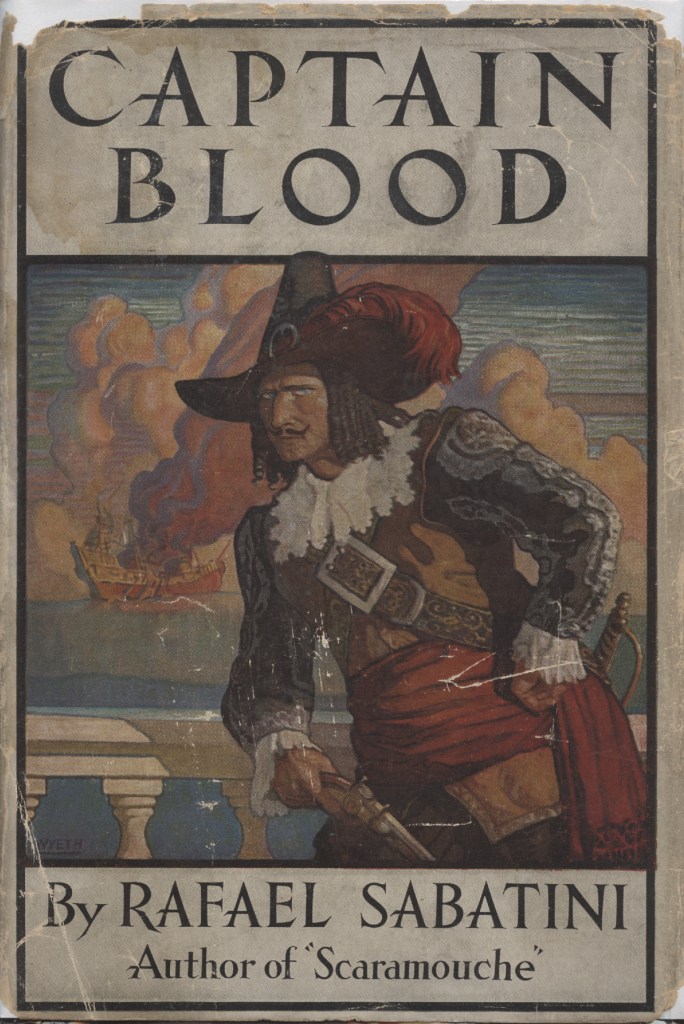
Associated with our announcement of the creation of Treasure Light Press and the forthcoming publication of its first title, Captain Blood: His Odyssey by Rafael Sabatini, The 100th Anniversary Annotated Edition, here’s a look at Captain Blood dust jackets over the years!
In a future post I’ll cover trade and mass market paperback covers.
The dust jacket of the first hardcover edition above is iconic, if not entirely historically accurate, but then, fiction book cover illustrations almost never are. Artist and illustrator N. C. Wyeth–a student of Howard Pyle–does, however, well-conveys the color and swashbuckling adventure of the novel.
Notably, as in many of the dust jackets below, Captain Peter Blood is sporting a mustache. However, only in the magazine serial, “Brethren of the Main,” published prior to the release of the novel, does he wear one. In the novel he does not. The Wyeth illustration has been used in numerous subsequent editions.
Also notably: according to authors Jesse F. Knight and Stephen Darley (see below), Captain Blood did not reach the bestseller list the year it was published. (See the end of the blog for a few notes on identifying true first editions.)

In 1924, Vitagraph motion picture studio released a silent version of Captain Blood, of which only thirty minutes unfortunately still survive. Starring J. Warren Kerrigan–a poor choice if his personal character were to be compared to that of the fictional hero of the book, for he was no Peter Blood nor even an Errol Flynn–the film did much to further promote the novel. In fact, the novel was printed in full or in part in hundreds of newspapers as part of the studio campaign.

The illustration above is not a dust jacket, but the cover of the Astor Theatre program for the 1924 version of Captain Blood, starring J. Warren Kerrigan. The program art is based on the design of the novel’s 1922 US edition.

A UK photoplay edition associated with the 1924 Vitagraph film. Again, Peter Blood sports a mustache he doesn’t have in the book. His costume, however, maintains a fair degree of historical accuracy. The cover illustration is the same one used in the original UK (Hutchinson) first edition. As with the Wyeth illustration, this one has been used in full or in part for numerous subsequent UK editions.

In 1927 a Riverside Press edition (Houghton Mifflin) was published with the dust jacket above, and remained in print for at least twenty-five years. Both the dust jacket and the four illustrations inside are by Clyde O. Deland, the most impressive being that of the cover and perhaps of Col. Bishop being forced to walk the plank, and the least being that of the famous duel on the beach–it looks rather stilted and lacks the dynamism of Howard Pyle and N. C. Wyeth duel impressions. The illustrations are above average for historical detail. I’ve seen a simple drawing in black, based on the illustration, on the front hardcover of some library editions.

In 1929 a German edition was published. Mine has small notes in pencil regarding historical personages and such–Rafael Sabatini’s books have a knack for inspiring the study of history. I’ve often wondered how this reader, assuming he or she read it prior to WWII, regarded the rise of German authoritarianism and dictatorship–and the rise of the Nazi party–in light of the very opposing values of the novel.

A quasi-photoplay edition was published in 1935, timed with the release that December of the famous film that also made Errol Flynn a star. By quasi I mean that its end papers are illustrated with scenes from the film. There are no images placed within the pages, however. The cover is copied from a hard-to-find publicity still from the film, shown below.


An identical dust jacket, lacking only the film information, was also released around 1935 or soon after. I’ve seen this dust jacket on Grosset & Dunlap editions with and without the end papers from the film. Notably, all Grosset & Dunlap editions with this jacket have a statement on the front flap or back cover that it is a reduced price edition, made possible by using the original plates and the author accepting a reduced royalty. I’ve also seen library editions (no dust jackets) with a simple drawing in color, based on the image above, on the hardcover, and I’ve seen the full image itself also used.

Newspaper ad for the 1935 film, showing a US edition dust jacket with Errol Flynn. This jacket was never actually produced.

Dustjacket depicted in the trailer for the 1935 film version. As with the previous jacket, it is an advertising creation and was never printed.

Hutchinson in the UK also published an edition timed with the release of the “new talkie film.” It has no images from the film in the book itself.

Appropriately, given that Peter Blood was half Irish and considered himself an Irishman, an Irish language edition was published in 1937. The text font is beautiful. Sabatini, as did and do many writers, put his pirate hero in boots. In fact, mariners in this era did not wear riding boots–which is what the myth has pirates wearing–aboard ship, or even ashore–unless mounted on a horse.

Below, a heavily-abridged Hachette French edition with a very French cinema-looking Peter Blood on the front.

A rather youngish-looking (definitely not in his thirties) Captain Peter Blood on the dust jacket of the 1973 edition published by Hutchinson Library Services Ltd in the UK. Purists will note the incorrect grip on the smallsword.

Given that both of my fencing masters (Dr. Francis Zold, Dr. Eugene Hamori) were Hungarian, it’s appropriate that I’d have at least one copy in Hungarian to honor these swashbucklers!

There are numerous Russian editions of the novel, many of them well-illustrated. This is not a dust jacket per se, but the printed cover of a hardcover dual edition: Captain Blood: His Odyssey and The Chronicles of Captain Blood (aka Captain Blood Returns in the US).

Above, another softcover I’ve included for interest (and because it doesn’t quite fit with the “Mass Market” editions blog either). From Albania, 1974, a severely abridged version stripped down to eighteen chapters, and all of them cut down to a few pages.

The cover of the Easton Press leather edition. The ship is of a later period and Peter Blood is wearing boots, as in the novel but not as he would have in real life–again, unless he were about to mount a horse or had just dismounted…

Last, my favorite recent hardcover edition. In Spanish, it’s well-illustrated with line drawings, and its design does justice to the story.

Dust jacket illustrations, collectible and evocative as they are, are there for a reason: to induce the potential reader to buy the book. And no matter how appealing they are, they pale when compared to the actual text. A battered old library copy sold for a buck at a yard or library sale is still a great read.
Of course, that hasn’t stopped me from collecting a variety of editions with dustjackets!
Captain Blood First Editions
A quick word of warning to those of you who collect books, especially those looking for first editions. Later editions or printings of Captain Blood are often listed, sometimes mistakenly, sometimes purposefully to deceive, as true first editions. It is easy to mistake later editions for firsts, given that many editions list the original publication year–1922–but not the year of the later edition or impression. For example, both the 1922 first and the 1924 US photoplay state 1922 as the year, but I’ve often seen the 1924 listed as a true first, as I have later editions. I’ve even seen the 1924 photoplay with dustjacket listed as a first for over $1,700–a terrible ripoff, were anyone to pay this much. I acquired both of my similar copies for under $50, and at the time the over $1,700 priced edition was listed (January 2021), so was a $40 edition with dustjacket and in similar condition. Unfortunately, even editions published in the 1930s typically list only 1922 as the year of publication.
Notably, true firsts have the first dust jacket shown above, and list both the year 1922 AND the month and the year of all impressions, except for the first impression, up to the date of the published edition. For example, the eleventh impression of the first edition lists the dates of the second through eleventh impressions, the last given as “ELEVENTH IMPRESSION, OCTOBER 1924.” The dust jacket spine lists the printing, for example, “Twelfth Printing” for the eleventh impression.

For more information on identifying firsts, see The Last of the Great Swashbucklers: A Bio-Bibliography of Rafael Sabatini by Jesse F. Knight and Stephen Darley (New Castle, DE: Oak Knoll Press, 2020), and also “Collecting Rafael Sabatini” by Jesse F. Knight in Firsts: The Book Collector’s Magazine (March 2001, Vol. 11, No. 3).
True firsts in fine or near fine book and dust jacket conditions (very rare!) command large prices, so if you’re looking to buy one, make sure that’s what you’re actually getting. Especially beware of firsts whose dust jacket is actually a modern–and usually so noted–reprint. They’re typically much over-priced. For example, I’ve seen a near-fine original first without dust jacket, which can often be found for $25 or less if you’re patient, combined with a $25 reprint dust jacket–and listed for a few hundred dollars. It’s a ripoff. It’s the original dust jacket, or author signature, or both, that command the great prices.
Copyright Benerson Little 2020-2022. First published February 12, 2020. Last updated November 15, 2022.
Novels with Swordplay: Some Suggestions

Illustration by N. C. Wyeth from “The Duel on the Beach” by Rafael Sabatini, a short story soon published as the novel The Black Swan. The illustration was also used on the dust jacket of the first US edition of the novel. (Ladies Home Journal, September 1931.)
For your perusal, a list of a handful of swashbuckling historical novels–pirates, musketeers, various spadassins and bretteurs–with engaging swordplay, even if not always entirely accurate in its depiction. If you’re reading any of my blog posts, chances are you have friends who might enjoy reading some of these books, thus my suggestion as Christmas, Hanukkah, or other gifts this holiday season.
Three caveats are in order: all of the following are favorites of mine, all are set in the seventeenth and eighteenth centuries, and all are not “all” in the sense that the list, even narrowed strictly to my favorites, is quite incomplete. Without doubt I’ll add to it every holiday season. And maybe one day a list of swashbuckling films, another of table and board games, maybe even of video games too…
Upon reflection, perhaps a fourth caveat is in order as well: simply enjoy the stories and their swordplay for what they are. Don’t be too critical, especially of the latter. Except for the case of the reader who is an experienced fencer with a strong understanding of period fencing terms and technique (far more rare than you might think), complex historical fencing scenes cannot be written simply and just as simply understood. Nor can technique and actions in general be explained sufficiently for the neophyte to understand, at least not if the writer wishes to keep the action flowing. The writer must strike a middle ground, one that won’t lose the tempo and thus the reader. This is not so easily done.

Victor Hugo–Hugo to most of us, an adopted Norwegian forest stray–with a pair of late nineteenth century French foils with Solingen blades, and a Hungarian mask made in Budapest, dating to the 1930s. Because cats and swords. Or cats and swords and books.
It’s possible the Moby Dick technique would work–explain and teach prior to the event–but it’s just as likely that many readers would shun this, unfortunately. For what it’s worth, Moby Dick is by far my favorite novel and I consider it the greatest ever written. It is not, however, a book for readers who cannot step momentarily away from the narrative. As I’ve discovered after the publication of two of my books in which narrative history is interspersed with analysis and explanation, there are quite a few such readers, some of whom become plaintively irate and simultaneously–and often amusingly–confessional of more than a degree of ignorance when the narrative is interrupted for any reason. To sample this sort of reader’s mindset, just read a few of the negative reviews of Moby Dick on Amazon–not those by obvious trolls but those by apparently sincere reviewers. Put plainly, using Moby Dick as a template for swordplay scenes would probably be distracting in most swashbuckling novels.

Cover and frontispiece illustration by N. C. Wyeth for the first and early US editions of Rafael Sabatini’s Captain Blood: His Odyssey.
In regard to acquiring any of these enjoyable titles, note that some are out of print except perhaps as overly-priced modern print-on-demand editions. Even for those still in print, I highly recommend purchasing earlier copies from used or antiquarian dealers–there are plenty of highly affordable copies, just look around for them. Abebooks is a great place to start, but only if you have no local independent used or antiquarian bookstores available to try first. And these days, alas, there might not be any…
Why an older edition? Because the scent of an old book helps set the period atmosphere. Add a comfortable chair, a sword or two on the wall, a fireplace in a reading room or a fire pit on the beach nearby, and, if you’re of age to drink, perhaps some rum, Madeira, or sherry-sack on a side table, and you’re ready to go. Or Scotch, especially a peaty single malt distilled near the seaside, it will evoke the atmosphere of Sir Walter Scot’s The Pirate. Scotch always works.
So just sit back and let the writer carry you along. Don’t forget to imagine the ring of steel on steel and the sharp smell of ozone after an exceptionally sharp beat or parry. And if you really enjoy scenes with swordplay, there’s no reason you can’t further your education by taking up fencing, whatever your age or physical ability. If you’d rather begin first by reading about swordplay, you can start here with Fencing Books For Swordsmen & Swordswomen. And if you’re interested in how swashbuckling novels come to be–romance, swordplay, and all–read Ruth Heredia’s outstanding two volume Romantic Prince, details below.
Captain Blood: His Odyssey by Rafael Sabatini
Better known by its short title, Captain Blood, I list this first even though there’s really no significant description of swordplay, not even during the duel that is one of the best parts, of many, in the 1935 film version starring Errol Flynn. You must imagine the sword combat, yet in no way does it detract from this great swashbuckling romance that has inspired readers and writers worldwide, not to mention two major film versions (1924 and 1935). It is truly a modern classic. If you really want to judge the quality of the prose, read a few passages out loud: they’re wonderfully lyrical and evocative.
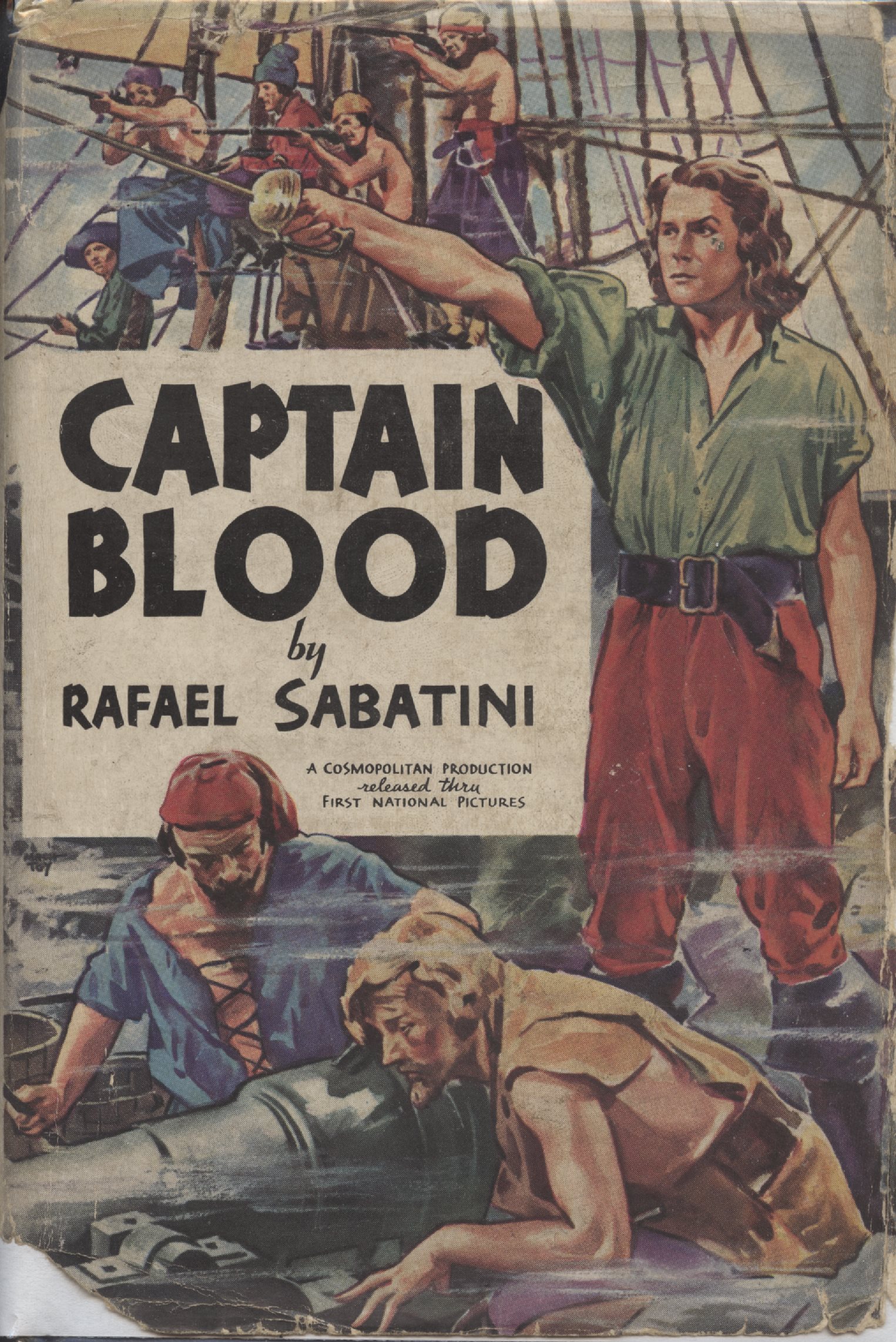
Photoplay edition from 1935, with Errol Flynn as Captain Blood on the cover. Although technically a photoplay edition, the only film images are to be found on the end papers. A nearly identical dust jacket was included with a non-photoplay edition at roughly the same time, the only difference being that the three small lines of film production text are missing.
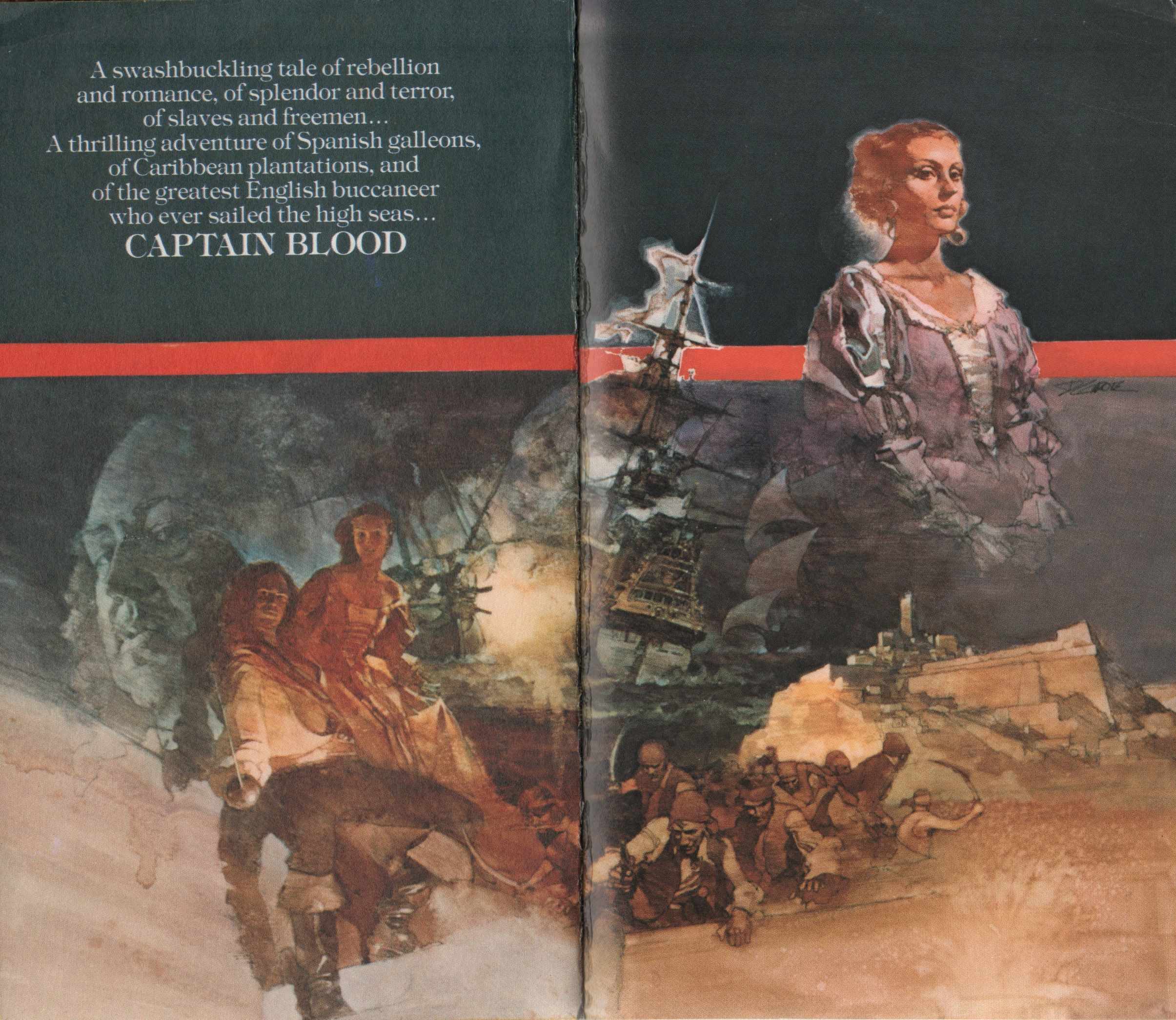
Wonderful artwork from a 1976 US paperback edition of Captain Blood.
Captain Blood Returns by Rafael Sabatini
If it’s a description of swordplay in a tale of Captain Blood, you’ll have to settle for the “Love Story of Jeremy Pitt” in Captain Blood Returns, also known in UK editions as the Chronicles of Captain Blood. Great Captain Blood fare, follow up it with The Fortunes of Captain Blood.

Dust jacket for the first US edition. Artwork by Dean Cornwell.

Endpapers in the first US edition of Captain Blood Returns, artwork by Dean Cornwell.
The Black Swan by Rafael Sabatini
One of the greatest of swashbucklers whose plot leads, line after line, to a dueling climax. The 1942 film of the same name, starring Tyrone Power and Maureen O’Hara, doesn’t do the book justice, not to mention takes great liberties with both plot and character.

Dust jacket, first and early US editions. Art by N. C. Wyeth.

Front cover of dust jacket of first UK edition (Hutchinson).
Fortune’s Fool by Rafael Sabatini
An embittered former Cromwellian officer reassessing his life during the early days of the Restoration–and proper use of the unarmed hand in a sword fight too!

Frontispiece by Aiden L. Ripley to early US editions of Fortune’s Fool.
Venetian Masque by Rafael Sabatini
A novel evoking many of the elements of my Hungarian fencing masters’ own history: spies, duels, intrigue, war, revolution, narrow escapes, and above all, courage. Plus Venice!
“With delicate precision he calculated the moment at which to turn and face them. He chose to do it standing on the lowest step of the bridge, a position which would give him a slight command of them when they charged. As he spun round, he drew his sword with one hand whilst with the other he swept the cloak from his shoulders. He knew exactly what he was going to do. They should find that a gentleman who had been through all the hazards that had lain for him between Quiberon and Savenay did not fall an easy prey to a couple of bully swordsmen…”

Illustration from “Hearts and Swords” in Liberty Magazine, 1934. The story would become the novel Venetian Masque. The illustration has been copied from the John Falter collection at the official State of Nebraska history website. Rather sloppily, in both instances in which Rafael Sabatini is referenced, his name is spelled Sabitini. Even the State of Nebraska must surely have fact checkers and copy editors.
Scaramouche by Rafael Sabatini
“He was born with the gift of laughter and a sense that the world was mad.” Add a sword and you have Scaramouche.
To my mind, a tie with The Black Swan in regard to a novel built around swordplay, and far superior in its scope. Easily has the best–most evocative, that is–description of a fencing salle, hands down.

To Have and To Hold by Mary Johnston
Listed here primarily as representative of the genre at the time (the late nineteenth century) and because it influenced Rafael Sabatini, the novel has most of the classic clichés of the genre, including the duel for command of a pirate ship, something that never actually happened. A gentleman swordsman, pirates, Native Americans, a damsel incognita in distress… The duel takes place, as best as I can tell, on Fisherman’s Island off Cape Charles, Virginia.

Frontispiece by Howard Pyle.

Dust jacket from the 1931 US edition. Illustration by Frank Schoonover, a student of Howard Pyle. The painting is an obvious homage to Pyle’s painting for the original edition.
Adam Penfeather, Buccaneer by Jeffery Farnol
The prequel to the following two novels, you may either love or hate the style in which it’s and the rest are written, the dialogue in particular. Even if you don’t much care for the style–I don’t much–the series are worth reading anyway for the adventure and swordplay, often including sword-armed women in disguise. Farnol will never come close to replacing Sabatini to me, but this doesn’t stop me from enjoying Farnol’s swashbucklers. And at least Farnol’s dialogue doesn’t sound like, to paraphrase a friend of mine, suburbanites chatting inanely at a PTA meeting–a problem with much dialogue in modern historical fiction and television drama.
As for swordplay, Farnol often takes the evocative approach, providing broad strokes to give a sense of the action without providing detail which might confuse non-fencers:
“Once more the swords rang together and, joined thus, whirled in flashing arcs, parted to clash in slithering flurry, their flickering points darting, now in the high line, now in the low, until Adam’s blade seemed to waver from this line, flashing wide, but in that same instant he stepped nimbly aside, and as Sir Benjamin passed in the expected lunge Adam smote him lightly across broad back with the flat of his blade.”
Non-fencing authors take note of the critical vocabulary for swordplay scenes: rang, flashing, slithering, flickering, darting, flashing…

Dust jacket for the first US edition. The first UK edition has a boat instead…
Black Bartlemy’s Treasure by Jeffery Farnol
Great swashbuckling fare, the first part of a two novel series.

Easily one of the most evocative dustjackets on any pirate or swashbuckling novel.
Martin Conisby’s Vengeance by Jeffery Farnol
This quote alone sells this sequel to Black Bartlemy’s Treasure: “So-ho, fool!” cried she, brandishing her weapon. “You have a sword, I mind—go fetch it and I will teach ye punto riverso, the stoccato, the imbrocato, and let you some o’ your sluggish, English blood. Go fetch the sword, I bid ye.”

The Pyrates by George MacDonald Fraser
Enjoyable parody of swashbuckling pirate novels and films, much influenced by the works of Rafael Sabatini and Jeffery Farnol. Fraser, an author himself of wonderful swashbuckling adventure, was a great fan of Sabatini.

The Princess Bride by William Goldman
Requires no description. The swordplay, like that in The Pirates above, is affectionate parody, and much more detailed than in the film.

25th edition, with map endpapers of course!

Nicely illustrated recent edition.
Rob Roy by Sir Walter Scott
Excellent if mostly, if not entirely, historically inaccurate tale of Rob Roy MacGregor told through the eyes of a visiting Englishman. It has a couple of excellent descriptions of swordplay, ranging from a duel with smallswords to action with Highland broadswords.

Le Petit Parisien ou Le Bossu by Paul Féval père
I’m going to pass on Alexandre Dumas for a variety of reasons, not the least of which is that I’ll eventually devote an entire blog to him. If, however, you feel he should be represented here, The Three Musketeers series is where to begin, but you must read the entire series of novels. Be aware that many such series are actually abridged. For a slightly different Dumas take on the swashbuckler, try Georges (an exception to the seventeenth and eighteenth century rule, an almost autobiographical novel in its focus on race and prejudice) or The Women’s War (or The War of Women, in French La Guerre des Femmes). Both are favorites of mine.
Instead, I’ll suggest a great swashbuckler by one of Dumas’ contemporaries. Le Petit Parisien ou Le Bossu is a true roman de cape et d’épée (swashbuckling novel) of revenge from the which the line, “Si tu ne viens pas à Lagardère, Lagardère ira à toi!” (“If you will not come to Lagardère, Lagardère will come to you!”), has passed into French proverb. The novel has been made into film at least nine times, plus into a couple of television versions as well as several stage versions. Unfortunately, I’m aware of only one English translation, and it is excessively–an understatement–abridged. Alexandre Dumas, Paul Féval, Rafael Sabatini are the trinity who truly established the swashbuckler as a significant literary genre.

Bill advertising Le Petit Parisien ou Le Bossu by Paul Féval, 1865. ( Bibliothèque Nationale de France.)
Cyrano de Bergerac by Edmond Rostand
Not a novel, but mandatory reading nonetheless, with one of the two greatest stage duels ever written, the other being that in Hamlet. Wonderful drama, philosophy in action, and sword adventure, including a duel fought to impromptu verse. Like Captain Blood, it is one of the truly inspirational swashbucklers. To be read at least every few years, and seen on stage whenever available. There are several excellent film versions as well.
Theater program, 1898. (Bibliothèque Nationale de France.)
The Years Between &c by Paul Féval fils & “M. Lassez”
Two series of novels of the imagined adventures of the d’Artagnan of Alexandre Dumas and the Cyrano of Edmond Rostand, filling the twenty years between The Three Musketeers and Twenty Years After in the first, and immediately following Twenty Years After in the second. The books are filled with the expected enjoyable affrays and other adventures of the genre, including the usual improbable circumstances and coincidences. The first series consists of The Mysterious Cavalier, Martyr to the Queen, The Secret of the Bastille, and The Heir of Buckingham, published in English in four volumes. The second includes State Secret, The Escape of the Man in the Iron Mask, and The Wedding of Cyrano, published in English in two volumes as Comrades at Arms and Salute to Cyrano.

Comrades at Arms dust jacket of the US and Canada edition (New York and Toronto: Longmans Green and Co, 1930).
The Devil in Velvet by John Dickson Carr
Fully enjoyable read about a modern history professor who travels to the seventeenth century via a bargain with the devil. The professor discovers that his modern swordplay is superior to that of the seventeenth century–a wonderful idea for a novel but otherwise flawed in reality. At best, if the professor were a “modern” epee fencer, there might be parity. But who cares? After all, who can travel back in time anyway except in the imagination? If you’re a fencer well-versed in historical fencing versus modern (again, not as many as you might think, including some who believe they are), suspend your disbelief. And if you’re not, just enjoy the novel for what it is.


Wonderful endpapers!
Most Secret by John Dickson Carr
Pure genre by the famous mystery writer, this time entirely set in the seventeenth century. Cavaliers, spies, and a damsel in distress!

Dust jacket, Most Secret (London: Hamish Hamilton, 1964).
The Alatriste Novels by Arturo Pérez-Reverte
Leaping forward almost two hundred years, the Alatriste novels are a highly recommended recent series by one of Spain’s great novelists, although some critics note that the books are a bit dark. I’d call them realistic. Unfortunately, the latest of the series, El Puente de los Asesinos (The Bridge of the Assassins or The Assassin’s Bridge) has not been translated into English and doesn’t appear likely to be anytime soon, if at all, an apparent casualty of insufficient sales of the previous volumes and a reflection upon the state of the genre at the moment. That the genre should not have a larger readership given the times we live in is curious, but perhaps the audience awaits a few real-life swashbuckling heroes to reappear first. I have read The Assassin’s Bridge, but in French, and enjoyed it. My Spanish is simply not up to the task. The first six volumes are available in English translation. I also suggest The Fencing Master (El Maestro de Escrima) by the same author.

Romantic Prince by Ruth Heredia
For readers seeking to understand how written romances come to be, you can do no better than to read Ruth Heredia’s two Romantic Prince volumes: Seeking Sabatini and Reading Sabatini. The first is a biography of Rafael Sabatini, the second a guide to reading his many works, including some discussion of swordplay. Ruth Heredia is the preeminent expert on all things Rafael Sabatini. Long an officer and significant contributor to the Rafael Sabatini Society, she is a gifted writer in her right, and, in my own experience, an eloquent voice for sanity, empathy, and justice in a mad world. Originally published in now hard-to-find soft cover, her two volumes are now available in revised editions for free for personal use by requesting them from the author. You can find details at attica-ruth.


Fortune’s Whelp by Benerson Little
Last, a blatant effort at self-promotion, although I honestly did enjoy writing the swordplay scenes (not to mention working them out sword-in-hand), and I do enjoy re-reading the associated passages, or at least as much as I’m able to enjoy my own writing (the urge to revise and improve, even after publication, is quite distracting). A sequel, Fortune’s Favorite, is forthcoming, and at least another after it. Then, if all goes well, a series of prequels.

Fortune’s Whelp (Penmore Press, 2015).
A swashbuckling descendant of sea roving Norse felines. Because cats and swords. If it’s one thing a swordsman or swordswoman can always use, it’s feline grace, tempo, and speed, not to mention sardonic cold-blooded cool.
Copyright Benerson Little 2017. First published December 14, 2017. Last updated April 14, 2020.

Fencing Books For Swordsmen & Swordswomen
The content in this post is more background on than digression from the general subjects of this blog–swordplay and swashbucklers–, for what is either without fencing technique? The following fencing books are my recommendations for fencers across the spectrum, from early modern historical to “classical” to modern “Olympic” competitive. It includes sections on the modern Olympic weapons, classical fencing, rapier, smallsword, various cut & thrust, theory, Japanese texts, and more.
The list below, although quite long, is not exhaustive—there are many good fencing books not listed (and some more bad than good as well). Some are not listed simply because I have not yet read them. The history list in particular is abridged due to sheer volume, but less so than in past years, and I have not yet begun to include much in the way of mid-19th century works or of books on swords as opposed to swordplay. Fencing books can be very useful, but are no substitute for proper instruction and diligent practice, as I learned from my fencing masters, Dr. Francis Zold and Dr. Eugene Hamori. See the end of the list for suggestions on acquiring the books listed here, or for that matter, many books in general.
The first fencing book I ever read, in 1975 or 1976, was Bob Anderson’s All About Fencing, along with a beginning text by Nancy Curry or Muriel Bower, I can’t recall which, probably the former. These were followed by, once I started fencing in 1977 under Dr. Zold at USC, either Curry or Bower’s book (the latter I think, given Bower’s association with USC), then Charles Selberg’s Foil (and when it was published, his Revised Foil), Michel Alaux’s Modern Fencing, Marvin Nelson’s Winning Fencing, and, in 1980, Imre Vass’s Epee Fencing, soon followed by Laszlo Szabo’s Fencing and the Master. From that point my interest in fencing texts exploded.
My earliest years of fencing education, however, were dominated by fencing lessons, verbal instruction, and oral histories, not fencing books. Notably, my epee instruction was derived in large part from Vass via Dr. Hamori’s own knowledge of the weapon and in consultation with his close friend József Sakovits (trained by Imre Vass) who was one of the world’s greatest epeeists and later Hungarian national coach. The general method of instruction used by my masters was derived directly from Szabo, his master Italo Santelli, and other notable Hungarian masters such as Gyorgi Piller–yet never for four years were the works of Vass or Szabo recommended to me. They were, in essence, above my ability at the time.
As Italo Santelli put it, fencing is something you do, not something you write (and therefore read) about! Thus were my early years filled with learning to fence not by reading but by fencing and fencing lessons. That said, the study of fencing texts does have an important place in learning to fence: it broadens one’s knowledge of the subject. Fencing books provide a map to the world of swordplay. They can also point out errors in technique, training, and tactics (although a fencing master is always better for this), and can reorient one’s perspective in certain cases.
Associated fencing quotations can be found here.
N. B. If you take the broad study of swordplay seriously, you will find yourself compelled to consider the following questions major and minor, for example: Does offense or defence put the fencer in the strongest position, or does a balance between the two? Should the fencer extend fully before lunging or simply begin with the point, extending and lunging near simultaneously? Where should the fencer primarily look when fencing — at the hilt and blade, at the eyes (if they could be seen), or broadly at the whole, or in combination, shifting from one to another? Should the fencer emphasize power (strength and speed) or finesse, or both? Tactically, is the strategic fencer or the opportunistic fencer generally superior?
Essays on Fencing & Life
So rare are these essays that I’ve found only two to list so far, although occasionally the subject is touched upon in prefaces to fencing books. I’ve listed Lambotte’s first, as her entire short work is on the subject. The first third of Bertrand’s book qualify as an essay on fencing & life, thus the book is the only one to get a double entry.
Arguably, Bazancourt’s Secrets of the Sword and Burton’s The Sentiment of the Sword occasionally connect fencing to life in general, and Gravé’s Fencing Comprehensive has a sense of this as well. All three are noted below.
L’Escrimeuse by Emma Lambotte, 1937. A delightful essay on fencing, on being a woman fencer, on fencing’s connection to and reflection of life, and on the characters of various fencing nationalities, among many other brief subjects. Mme. Lambotte was a noted Belgian poet and the muse and patron of painter James Ensor.
Cut and Thrust: The Subtlety of the Sabre by Leon Bertrand, 1927. The first five chapters of Bertrand’s book qualify as essays on fencing and life, ranging from a defense of fencing as sport to a defense of dueling to physical and mental exercise. See the full entry below.
Modern Epee
Why have I placed Modern Epee—that is, epee as fenced from the 1930s to the present in its various forms—first among books on technique? Because it’s the best starting point for most budding fencers today, even if their ultimate goal is classical or historical fencing. It is by far the most popular modern competitive weapon (it looks like swordplay, its judging is simple, it much more resembles sword-fighting with sharps than either modern foil or saber, it is very “democratic” in that the weaker fencer always stands a chance, as some have put it), and—if taught appropriately via a classical foundation as it should be—is also an excellent foundation for historical and classical fencing. Modern competitive foil and saber have become largely useless for this, both as fenced and as taught, for they’ve given up the classical notion derived from combat that attacks in invitation–with the point non-threatening and/or the arm not extended or extending–would be suicidal with real weapons.
It should be noted that some modern epeeists consider not only classical epee technique (point d’arrêt technique, especially non-electrical, and true dueling technique), but also “modern classical” (electrical pre-Harmenberg, so to speak) technique to be obsolete. This narrow view has no basis in fact except to some degree in the case of some elite (world class, that is) epeeists. Purely classical and modern classical epeeists can, and often do, fence as far as a solid A, or national, level, and classical technique is the foundation of elite epee technique. In fact, elite women’s epee retains a significant amount of so-called classical technique, and the compiler of this list is well-acquainted with a Greek-American epeeist some 80-plus years old whose classical, very old school straight arm dueling technique can still give even young elite epeeists fits.
Note, however, that the definition of classical fencing has changed over time and continues to change today. More than a century ago foil was considered the classical school and epee the modern, and French duellists of a century ago were classified according to three schools: foil, foil-epee, and epee! In fact, one need only read Achille Edom’s 1910 book on epee fencing (see below) to realize that much of what is considered new in epee is in fact more than a century old. In other words, epeeists should not consider older epee texts, nor any epee style of the past century or more, as unworthy of practical study, modern fads, to which epee is highly susceptible, notwithstanding.
Fencing with the Epee by Roger Crosnier, 1958. A thorough description of modern classical epee technique, still very useful today. Prof. Crosnier’s book on foil fencing (see the Foil section) should be read hand-in-hand with his epee text.
Epee Fencing: A Complete System by Imre Vass, 1965 in Hungarian, 1976 1st English edition, revised English editions 1998, 2011. The most thorough epee text ever written. That said, highly recommended for epee coaches at all levels, recommended only with caution for intermediate to advanced fencers (at least three to five years or more significant experience)—but not for beginners. There is much useful, often profound, material, but some sections can be skipped entirely by some fencers, and others require sufficient epee fencing experience in order to profit from them. The revised editions were edited by fencer and publisher Stephan Khinoy, and amplify and supplement the original text in places.
The latest edition suggests the need for such classical training today, in spite of the so-called “new paradigm” (see Harmenberg below, his book was also originally published by Khinoy). I agree. Even for those relatively few fencers (as compared to the entire body of epeeists) who wish to and are able to emulate Harmenberg’s sport methods, a solid base of “modern classical” epee training is still necessary. For most epeeists, even superior amateurs, modern classical technique is all they’ll ever need.
Again, caution is advised when studying the book; it’s best to have a solid understanding of fundamental epee technique and theory before reading it. In fact, it helps to understand the Italian school in order to understand Vass’s theoretical framework: Luigi Barbasetti’s book on foil (see below) is a good start. Vass trained international medalists József Sákovics and Béla Rerrich, both of whom went on to become leading epee masters and national coaches, the former in Hungary, the latter in Sweden, with numerous international champions to their credit. He also trained four-time Olympic gold medalist in epee Győző Kulcsár, who later as a fencing master trained two-time Olympic gold medalist in epee Timea Nagy. József Sákovics, considered by many to be the first “modern” epee fencer, died in 2009, Béla Rerrich in 2005, and Győző Kulcsár in 2018.
La Spada: Metodo del Maestro Caposcuola Giuseppe Mangiarotti by Edoardo Mangiarotti, the Comitato Olimpico Nazionale Italiano, Scuola Centrale Dello Sport, and Federazione Italiana Scherma, 1971. Epee as taught by the famous Guiseppe Mangiarotti: a thorough exposition of his method. Beginner-friendly, too, at least if you read Italian or have a working knowledge of fencing technique and language along with a background in Romance languages other than Italian. Includes excellent illustrations of blade positions, better perhaps than in any other epee text. (Side note: the book even includes illustrations from the works of Vass and Szabo. Kingston and Cheris in this section also have excellent illustrations of blade positions.)
Prof. Mangiarotti, who studied under Italo Santelli as well as under other masters Italian and French, was an Olympic fencer, seventeen-time Italian national epee champion, father of famous champion Edoardo Mangiarotti as well as of noted fencers Dario and Mario Mangiarotti, and founder of a famous epee school in Milan, still in existence, that blended the French and Italian schools and produced champions for decades. Edoardo won 13 Olympic medals and 26 World Championship medals, and was known for his fluid, very Italian footwork as well as for his strategy of attacking hard and fast early on to get touches, then playing a defensive game. Highly recommended: it is my second-favorite “modern” epee fencing book. See also Mangiarotti and Cerchiari in the “Combined Modern Epee, Foil, and Saber Texts” below. For the French school, see Alaux and Cléry in the same section.
Epee Combat Manual by Terence Kingston, 2001, 2004. Highly recommended beginning to intermediate text. Should be required reading for new epeeists. Pair with How to Fence Epee by Schrepfer (below). Unfortunately, Kingston’s book is unavailable in the US anymore, and his web store ships only to the UK and EU (or I suppose he still ships to the EU after Brexit–a lot of small businesses are having issues doing so).
Fencing: Steps to Success by Elaine Cheris, 2002. Actually an epee and foil text, but the epee stands out more to me, and is very useful to both recreational and competitive fencers. Includes training drills as well as excellent illustrations of technique, including from the fencer’s point of view. The book is a good companion to Kingston’s book above. Cheris is one of the great US fencers in both epee and foil.
Epee 2.0: The Birth of the New Paradigm by Johan Harmenberg, 2007. For advanced epeeists and coaches only. There is a second edition–Epee 2.5 I think–that I have not yet read, therefore some or all of the criticisms below might be valid for the new edition. Importantly, the book is suited, in Harmenberg’s own words, only to truly advanced fencers, although this has not stopped many insufficiently experienced epeeists, and even their coaches, from foolishly assuming they can emulate its technique and tactics—and in doing so, impale themselves by repeatedly running onto their adversary’s point from distance much too close. This is often quite funny to watch, especially in the case of exceptionally tall epeeists, with their naturally slower tempo, who throw away their height advantage.
Although there is very useful material in the book, some of Harmenberg’s recommendations are controversial and not all masters agree with the described training regimen, except, again, perhaps in the case of elite epeeists. Further, Harmenberg at times appears to take more credit than he deserves, albeit innocently, given that other epeeists were also knocking at the door of his new style, and had been for some time. Harmenberg, however, was arguably the first elite epeeist to succeed with it at the Olympic and World Championship levels. That is, the first to use “outstripping” attacks—beating the double touch timing by a hair—to the body as a primary technique and tactic, although others, the Soviets notably, had already been using the fleche in renewed attacks to great effect in an outstripping rather than conventional tempo. (Vass calls these sorts of touches “combat” techniques; a better term might be “sport” techniques.) It was also common to see some epeeists below the international level in the 60s and early 70s use technique similar to Harmenberg’s, but they were unable to succeed with it against elite modern classical, aka conventional, epeeists at the international level.
Additionally, some of his criticisms, even though thoroughly honest, of the modern classical technique are not entirely valid. For example, his objection to epeeists who use, and their masters who teach, attacks with a fully extended arm prior to the lunge is somewhat misplaced: although many French fencers and masters did adhere to the technique during the heyday of dueling with the epee, this was done primarily to prevent serious injury and death by emphasizing long distance and straight-arm attacks on the arm. There has long been a debate on whether the attack with extension first or with point only first is faster in practice, and the issue is confounded by en gardes with a near-fully extended arm, and with renewed attacks made with extended arm, for example immediately after a counter-attack that falls short.
Even so, the lunge with near-simultaneous extension (likewise, the “progressive attack”) has been commonplace three or more centuries prior up to today, was used even by some French epee dueling masters, and some lineages of masters had never taught otherwise. (“Historical” fencers, please don’t bother to argue with me on this smallsword history, simply open up and read the first two dozen period smallsword manuals you lay your hands on.)
Still, many early epee masters (and some saber masters too) did teach that the simple attack via lunge, almost always to the arm, must be made with the arm fully extended first, although others argued correctly that simultaneous or near-simultaneous extension and lunge was faster, as Harmenberg likewise deduced (as did masters in past centuries). Indeed, if you intend to hit the body with an attack, you’d better not extend first then lunge! If you do, you’ll lose a tempo, warn your adversary, and probably get successfully parried or counter-attacked. Early epee masters generally avoided recommending attacks to the body due to the increased risk of double touches—and the increased risk of jail time for murder or manslaughter. (Roughly seventy percent of modern epee touches are made to the body thanks to the flat tip of the epee which is less effective to the arm when compared to the old jacket-tearing points d’arret which were highly analogous to the sharp point of a dueling epee.)
The argument remains as to whether Harmenberg’s described techniques and tactics are truly revolutionary, or merely one of the final steps in the evolution of sport epee, in that the “paradigm” takes complete advantage of the 20th to 25th of a second tempo provided by the electrical apparatus, and entirely disregards any consideration of classical tempo so necessary were swords real — sharp, that is, and intended to put holes in an adversary.
The book is based on the Swedish epeeist’s experiences leading up to his 1977 world championship and 1980 Olympic gold. In other words, however profound the book may be to sport fencing, its author’s ideas were not new in 2007—only their publication was.
Epee Fencing by Steve Paul et al, published by Leon Paul, 2011. A very useful text for the modern competitor. Positive criticisms: thorough and well-illustrated. Negative criticisms: 100% emphasis on epee as pure sport (as opposed to epee as dueling swordplay or martial art modified for sport) and a magazine-style layout (or in imitation of a badly-designed webpage?), including a thin magazine-like cover that will not hold up to much wear.
How to Fence Epee: The Fantastic 4 Method by Clément Schrepfer, 2015. Translated from the original French edition, Faire de l’épée: La méthode des 4 fantastiques, by Brendan Robertson. Not a manual of technique per se, but suggestions on how to use it. A very useful book, with only little to find disagreement with, and mostly in terms of style or tradition and not practicality. Highly recommended, especially for beginning to intermediate epeeists. An excellent companion volume to the Epee Combat Manual by Kingston (above) or Learn Fencing — Épée below.
Learn Fencing — Épée by Peter Russel, 2015. A generally good introduction to modern epee for beginners. Quibbles: the black background and resolution of some of the photos makes for difficult viewing and therefore comprehension at times, and the description of beats is inadequate, essentially relegating the beat to a reconnaissance action with the foible. This may be an artifact of the ignorance of the beat many modern fencers have (I blame their coaches for following the fad of not teaching a complete technique). Numerous times over the past fifteen years I’ve been told by visiting fencers that they’ve never encountered a beat as strong as mine and suggest I must have extraordinary forearm strength. Nonsense! It’s all technique! My wife, smaller and less strong than I am, has a beat as powerful. As Vass (noted above) put it, the beat (use the middle of the blade, not the foible except for reconnaissance) can be used to open the target, delay the adversary’s response, provoke a reaction, and loosen the adversary’s grip, thus further delaying the response. Enough ranting. 🙂 (Last quibble: poor copyediting on the cover, in which Épée is spelled Épeé, but books shouldn’t be judged by their covers.)
Put plainly, the book is Harmenberg’s exposition of how HE fences. Tellingly, whenever I ask elite European fencers and masters about the book, they shrug their shoulders. If they do happen to know who Harmenberg is, their answer is something on the order of, “Well, if it worked for him, good, but there are many other ways to fence epee…” That said, far too many epee teachers in the US have adopted his theory, all too often too early for their students and quite imperfectly, although lately I see this fad–and there are many fads in fencing–fading.
See also the “Combined Modern Epee, Foil, and Saber Texts” section, especially Alaux, Barth/Beck, Cléry, de Beaumont, Deladrier, Lidstone, Lukovich, Mangiarotti/Cerchiari, and Vince, as well as the “Epee de Combat” section in general, and Castello and Gravé in the “Classical Fencing” section.
The Epee de Combat or Dueling Sword:
Epee for Actual Combat, In Other Words (and Almost Immediately for Sport as Well)
All of these works are of use to the modern epeeist, and all demonstrate that there is, overall, little new in modern epee fencing. Even the pistol grip was growing in popularity in France by 1908, although its use in dueling was prohibited and it would be the Italians who found in it the perfect replacement for the romantic rapier grip used on their fiorettas and spadas. Only the tactics and techniques of “out-stripping” (of trying to hit a 25th to a 20th of a second before one gets hit), and of the unrealistic abomination of flicking (and arguably, of foot touches), are new. In fact, by 1900, if not earlier, epee was often judged not according to the realities of sharp swords, but according to a perceptible difference in timing when both fencers hit–in other words, who hit first, much akin to the modern electrical apparatus (unfortunately).
Double touches, including “outstripping” touches of which modern epeeists are so fond (hitting just enough prior to the adversary’s hit that it will be considered a single touch, when with real swords both fencers would be hit) have long been the bane of the salle or sport fencer, even long before the advent of electrical scoring and its too short timing–there have always been fencers trying only to get the first hit, however they may, as if playing tag. There is an unfortunate natural tendency to turn fencing into a game of mere “who hits first” tag. As for the flick, it is new only to epee: it was used by a fair number of foilists in the 19th century and almost certainly in the two immediately prior centuries as well, and there are references as late as the 1930s noting what can be done with a very flexible blade rather than a stiff one. Flicks and foot touches are too dangerous to attempt with an epee de combat: they would cause little damage while leaving the user vulnerable to more damaging, even fatal, thrusts, not to mention that the blade of a real dueling epee is too stiff to permit the flick. Some old dueling epee masters even proscribed the “thrown thrust” common in epee, because, like the flick would if it could be used with a dueling sword (it can’t because the dueling blade is too stiff), it wounded only the skin, not the muscle beneath; the latter wound was more likely to end the contest.
Le jeu de l’épée by Jules Jacob, as reported by Émile André, 1887. Lessons of the fencing master who essentially created modern epee in the 1870s. By the third quarter of the19th century the foil had become a “weapon” of pure sport, although it had been heading in this direction since the late 17th century. M. Jacob adapted smallsword technique to create a form of swordplay suitable to surviving a duel with the 19th century épée de combat, or mere epee, as its modern descendant is called. The technique emphasized longer distance and hits to the arm—and thereby also reduced convictions for manslaughter and murder. It some came to be known as the “modern school,” as opposed to the “traditional school”–foil fencing, that is.
The book outraged many foil purists, who subsequently went into sophistic denial when his epee technique proved far superior to foil technique in a duel: Jacob’s less technically proficient epeeists were deadly against even highly skilled foilists, who maintained that the only difference between the technique of the salle and of the duel was the accompanying mental attitude. (If true, attitude was clearly deficient among the fleurettistes who fought duels with Jacob’s épéistes.) The book plainly points out the difference between the jeu de salle (sport fencing) and the jeu de terrain (swordplay of the duel), and reminds us that many of the best duelists were usually not “forts tireurs”—good sport fencers, that is. The same would doubtless be true today. Highly recommended. There is, I believe, an English translation now available.
L’Épée by Claude La Marche [Georges-Marie Felizet], illustrated by Marius Roy, 1884, reprinted 1898 or 1899; also The Dueling Sword, an English translation edited and translated by Brian House, 2010. Very thorough, and in its translation was for a long time the only early French epee and epee dueling manual available in English. Real swordplay, in other words, and useful even to epeeists today. To a degree the book is a somewhat foil-based response to the purely epee-based technique of M. Jacob (see above). M. La Marche differs from M. Jacob on some points, particularly on the value of attacks to the body, of which M. La Marche is in favor, as were smallswords-men (and smallswords-women).
The modern trend in epee, at least at the elite levels, and among instructors who train less skilled fencers as if they were elite fencers, emphasizes attacks to the body. Where to emphasize attacks—arm or body—has been an ongoing re-argument ever since the flat electric tip was introduced to replace the much superior “pineapple” tip in the early 1960s, rendering arm shots more difficult. The epee fencing argument over arm versus body derives from late nineteenth century dueling practice—arms hits could easily settle honor in the modern age in which killing a man in a duel would surely send the perpetrator to prison, and the longer distance that facilitated them was simply safer. For reasons that would take up too much space here in discussion, the body was also the primary target in the smallsword era—but the dangers of this distance were mitigated by the use of the unarmed hand to parry and oppose as necessary, and by the extensive use of opposition and prises de fer. Similar varying perspectives are seen in sport epee today. Notably, and often forgotten by some fencing teachers, roughly thirty percent of epee touches today are to the arm, not the body, even with the emphasis on the body as the better target for the flat modern epee point. A highly recommended book, and useful even to modern competitive epee fencers.
Manuale Teorico-Pratico per la Scherma di Spada e Sciabola by Giordano Rossi, 1885. A manual of the Italian dueling sword and dueling saber, very practical, very classically Italian although it does include some “modern” usages, including his preferred Italian spada with a curved grip, akin to a later French grip, with a significant set to the blade, although it doesn’t seem that this style of Italian grip won many fencers over — but did it perhaps influence the French to increase the curve of their grip? I haven’t seen any French foils or epees circa the 1880s with such a severe curve, and haven’t run across any Italian foils or epees with it either, for that matter. Rossi invented the grip in response to the Italian use of the, as he terms it, l’impugnatura del fioretto misto (mixed foil grip — the use of a wrist strap, perhaps?). He claims his design strengthens the grip of the little and ring fingers, negating the need for the ugly and uncomfortable wrist strap. Italian foils and epees rarely have a set to the blade, for it must be made beyond the thick ricasso. In the old Italian system of lines (quarte, mezzo-cierco, tierce, seconde) was entirely functional without a set to the blade. That said, I’m still uncomfortable with sixte in an Italian foil or epee without a set to the blade — I tend to hit farther inside than I prefer.
In any case, the book demonstrates a technique quite useful to epee, and in fact the influence of the Italian school would become a significant part of modern epee.
L’Art du Duel by Adolphe Eugene Tavernier, 1885. Advice on dueling. Suggests tactics and techniques for the epee duel, including how to deal with the inexperienced adversary, the average one and, of course, the expert swordsman. Of interest to the student of fencing history and the duelist, and one of the few books to deal with the subject of tactics against fencers of various levels of competence.
L’Escrime a l’épée by Anthime Spinnewyn and Paul Manoury, 1898. Excellent work on the epee de combat, with much practical advice on epee fencing, training, and teaching applicable even today. Among the many worthwhile admonitions is that the recovery from the lunge is just as important as the lunge itself–both must be as fast as possible, especially if the epees are pointed.

Les Armes et le Duel by Augustin Grisier, 1847. A magnificent treatise on mid-19th century fencing and dueling by a swashbuckling master, with a fascinating (and, as expected, long) preface — or more correctly, a “Préface en forme de causerie ou causerie en forme de préface” — by Alexandre Dumas. The book discusses dueling, technique, the two contemporary schools (one traditional, one modern, of course!), briefly the bayonet, fencing masters, and more. It might be included in any of several categories on this page.
Les secrets de l’épée by Baron César de Bazancourt, 1862, published in English as Secrets of the Sword in 1900, reprint 1998. Practical advice on hitting and not getting hit from the mid-19th century. Much of the advice sounds quite modern. Likewise highly recommended.
L’escrime, le duel & l’épée by Achille Edom, 1908. A remarkably prescient and practical work, one of my favorites, and one that demonstrates plainly that there is little new in epee fencing today. In particular, M. Edom, a Frenchman, recommends the more physical Italian style over the French, prefers the Greco offset guard and the pistol grip, and bemoans the rise of sport technique such as wide angulations to the wrist—thrusts that with dueling epees (with sharp points, that is) would not stop a fully developed attack to the body, leaving the attacker with a wound to the wrist, and the attacked with a possibly fatal wound to the chest, neck, or head.
The origin of these angulations was due much in part to the single point type of point d’arrét used by many at the time: a small ring was soldered to a real pointed blade a centimeter or so from the tip, then wrapped with heavy thread to act as a barrier to full penetration. Unfortunately, this heavy wrapping prevented hits at the shallow angles a real point was capable of, thus a new emphasis on unrealistic wide angulations. The three point “dry” and four point electrical, and later “pineapple” electrical points d’arrét greatly corrected this, but the subsequent modern flat point (brought into use in the early 1960s in order to quit tearing up the new nylon jackets perhaps?) inspired the popularity of severe angulations once more. In fact, almost any stop thrust to the arm would not arrest a fully developed attack, although you might have the satisfaction, as your adversary’s attacking blade penetrates your chest, of pinning his (or her) arm to his (or her) chest as he (or she) runs up your blade. Highly recommended.
L’Escrime by J. Joseph-Renaud, 1911. One of the best of a number of outstanding epee books published during the Golden Age of epee and of books on the subject, by far. The author does by far a superior job explaining the faults in French foil for dueling, comparing French foil to Italian (thus explaining why Italians successfully trained with their foil for the duel with the spada or epee de combat but the same could not be said of the French), and explaining a wide variety of epee technique, both that which is correct and that which is faulty but commonly seen. Thoroughly illustrated with photographs, the volume is of great use to the modern epeeist, historical or classical epeeist, and fencing historian and theorist. Joseph-Renaud is a member of the community of epee masters for whom the lunge must always be preceded by a fully extended arm, and he does not recommend attacks to the body. Much of the reasoning for this is to protect the duelist from a potentially mortal wound in himself or in his adversary, the latter of which would result in criminal prosecution and the former of which, well… In fact, as smallswords-men of past centuries, and even the author himself, knew, the lunge with the arm extending near simultaneously (just a hair ahead, that is) is the fastest attack by lunge, and mandatory if one is attacking the body, not the arm. (And, to play devil’s advocate here, most of us would admit if we were honest that our point control during an attack with lunge is superior if we fully extend first…)
Tratto Pratico e Teorico Sulla Scherma di Spada, by Eugenio Pini, 1904. Excellent and thorough practical treatise on swordplay with the Italian spada or dueling sword by the Italian master who epitomized a form of swordplay that melded the Italian and French schools (more former than latter, though) and emphasized physical strength and speed–so no, this emphasis on power and speed isn’t new to fencing, nothing really is, in fact. At the time the book was written, the school of the Italian dueling sword was based on the fioretta or foil, which was used for training instead of the spada itself. Pini points out correctly that at the time the French schools had separated foil from epee, and epeeists were now taught with the epee rather than the foil, although this would soon change as French foilists, unhappy at being usurped by the “modern school” of epee and its epeeists, would attempt to reassert their dominance via a foil-based school of epee. For a long time the Hungarian school, via the Italian, kept up this tradition of training epeeists first as good foilists. In fact, it’s how I was trained almost fifty years ago. However, the modern divergence between foil and epee has made this almost impossible. Pini was a redoubtable swordsman whom some described as a panther when fencing. Like many masters of the era, he was a redoubtable duelist also.
The Sentiment of the Sword: A Country-house Dialogue by explorer, adventurer, linguist, scholar, writer, and swordsman Sir Richard Burton, 1911. As with Bazancourt’s book which inspired this Anglo version, not strictly an epee manual, but still useful for understanding swordplay in the sense of the need to hit and not get hit, as opposed to hitting according to conventions which deny touches not made in accordance with said conventions, but which in a duel would be quite real, and in many cases fatal. (Thus the practical and, if in a duel, fatal flaw in foil fencing.) Burton’s book also has some quite modern advice on learning to fence. Burton had used a real sword many times in bloody combat, and was known as an extraordinarily fierce warrior. Highly recommended.
La Spada e la Sua Disciplina d’Arte by Agesilao Greco, 1912. Another of my favorites: a practical, very Italian text on the dueling sword, with, among other things, demonstrations of the Italian grip versus the French (e.g. showing that opposition with the Italian grip can overcome the extra length afforded by holding the French grip toward the pommel) and, a rarity in epee books, French especially, numerous bind thrusts to the head (filo al viso; in fairness to the French, Joseph Renaud describes and illustrates a stop thrust au visage with esquive).
The text also includes many examples of filo thrusts (bind thrusts, strong opposition thrusts) to the torso, which are often downplayed in French texts of the era, given the possibility of killing one’s adversary with them (better to hit the arm a few times and go home than worry through an investigation and possible conviction for manslaughter or murder; some period French texts do discuss these thrusts, particularly those of the “foil-epee” and “foil” French dueling schools). The book also includes descriptions of the Italian spada (noting that at the time they were of equal length, i.e. the Italian had a slightly longer blade), clothing and equipment, &c. The photographs are clear and well-posed. Unbelievably, my copy, signed, was never read: most of the pages are still uncut. Highly recommended.
Agesilao Greco was, along with his brother Aurelio, the greatest of a great family of fencers dating to the mid-19th century. The brothers highly influenced the Italian form of epee fencing for both dueling and sport. The Greco Academy of Arms in Rome still exists and still trains world class fencers. It also has a nationally-recognized fencing museum, the Casa Museo Accademia d’Armi Musumeci Greco that I’ve been told is well worth visiting. Greco’s description of the dueling spada is as elegant as the sword is; I’ve included it here and here. Agesilao was also known as an inveterate duelist with a fiery temper, and as a master and competitor he, according to William Gaugler, fenced every, or nearly so, famous fencer during his lifetime. His book on the spada was the most popular book on the subject in Italian in his era.
Épée, par J.-Joseph Renaud, 1913, in L’Escrime: fleuret, par Kirchoffer; épée, par J. Joseph Renaud; sabre, par Léon Lécuyer. Excellent advice on training, competition, and dueling, including a technical argument and diagram describing when to use sixte and its counter, and when to use quarte. This latter matter is more important than it seems, for most fencing instructors teach the usual parries and imply that any of the two classical French parries can be used in their appropriate quadrants in any circumstances (true in theory but not in practice) and should be varied in order to keep the adversary guessing (true in both theory and practice, but often difficult given that most fencers under stress have a preferred parry).
There are instances in which only a single parry—even in epee and smallsword, in which low line parries may be used in the high line as well, often providing several possibilities in each quadrant—is viable. For example, quinte (low quarte) against a powerful wide-angled attack, especially if directed toward the abdomen. Any other parry will often be forced or will fail to defeat the angulation. In fact, this is why the quinte parry was introduced. Or, against a wide, high, powerful, angulated thrust to the body in the high outside line (same handed epeeists), in particular when delivered via flèche by a tall strong fencer with his hand in tierce, a circle-sixte or even a circle-tierce will likely be forced even if timed well. A true prime will not defeat the angulation, and a common septime (Italian prime, mezocierco) must be taken too far out of line, exposing the arm to a simple disengage over the top. Octave and seconde cannot be taken effectively, for they too are likely to be forced. Only quarte or quinte (really just a low quarte) taken with the point out of line, with a riposte to the head or possibly the neck or shoulder, is viable in most cases. A modified prime (high sixte/septime) can work but can be difficult to execute if the attacker is tall and strong. Best to stop such attacks on their preparation.
The book includes a discussion of the Italian school. Although M. Renaud grudgingly admits that Italian foilists are equal to their French counterparts, he disparages Italian epee and by implication its rapier origins, stating categorically that the French invented epee fencing and the Italians were no match for French epeeists. In fact, the Italian epee school would soon rise to equal prominence with the French, with Edoardo Mangiarotti becoming one of the great epeeists of the 20th century. (These include Frenchman Lucien Gaudin of the early 20th century, Hungarians József Sákovics and Győző Kulcsár of the mid- and late century. Johan Harmenberg (1976 – 1980) should probably make the list as well. Were I to include possible twenty-first century epee greats as well, I’d suggest Timea Nagy and Géza Imre of Hungary, and Laura Flessel-Colovic of France. Doubtless other epeeists could join this list.)
Naturally, M. Renaud avoids any discussion of what might happen were French epeeists to trade their epees for Italian dueling spadas. Compare his comments on the Italian school to those of Achille Edom above. Side bar: he notes that most French epee schools of the era had outside gardens for practice, in addition to the indoor salle. Pity we don’t have these today…
“Technique du Duel en Une Leçon Suivi des Règles usuelles du Combat à l’épée” by Georges Dubois, published in La Culture Physique, 1908. Excellent work based on the author’s experience preparing would-be duelists for the duel, including those who have never held a weapon before (whom he advises to constantly counter-attack with a retreat). Disposes with many myths regarding dueling: he points out that most duelists weren’t fencers, and suggests that the epee was designed to help keep both combatants alive and thereby avoid the charge of manslaughter or murder. Never was a weapon so well designed to keep adversaries from killing each other, the author notes.
L’Escrime de Duel by Georges Dubois, 1913. A more conventional epee text intended for dueling than his Technique du Duel above. He does not dismiss foil, as many epee masters did. He discusses the Italian school, provides realistic technique for dueling, discusses preparation for a duel including how to prepare a novice duelist with no fencing experience for a duel twenty-four hours later, and breaks down several demonstration bouts and actual duels for the purposes of educating the reader. He recommends that both attacks and counter-attacks be directed toward what some masters in English have called the “shoulder hole” (the area between the deltoid and the pectoral) because one is more likely to hit even the advanced target when the point is aimed here, given that the target arm was near-certain to be extended on both attack and counter-attack (a fact often forgotten by many epee fencers today who constantly target the bent arm in the adversary’s en garde, and miss as the target arm is extended). Many masters today emphasize thrusting to the shoulder hole — but if over-emphasized the student may forget that it’s also useful to target the lower extending arm in tempo.
See also the “Classical Fencing” section below.
Combined Modern Epee, Foil, and Saber Texts
The Art of Fencing by R. A. Lidstone, 1930 and Fencing: A Practical Treatise on Foil, Épée, Sabre by R. A. Lidstone, 1952. The second significantly revised book is more thorough, with a very useful, clearly written epee section with plenty of exercises for master and pupil. Discusses tactics, unusual epee en gardes, and, in the foil section, unusual displacements, most of them Italian. It even describes Professor Guissepe Mangiarotti’s “jump back”—an epee counter-attack made while leaping back and landing on the front foot. The second edition is an excellent practical work drawing from both the French and Italian, highly recommended. In fact, along with Szabo’s work, the second edition is one of the most useful books on fencing on this entire page. For fencing historians, a comparison of the first edition to the second edition shows how much, and how quickly, modern fencing changed during the first half of the twentieth century.
Fencing by Joseph Vince, 1937, 1940, revised edition 1962. Illustrated by US saber champion, designated Olympic team member (until he suddenly abandoned competitive fencing for the stage), and swashbuckling actor Cornel Wilde. Vince was a US national coach and national saber champion who kept a salle in Beverly Hills for decades, and, until 1968 when he sold it to Torao Mori, owned Joseph Vince Company, a fencing equipment supplier that provided, among its complete line, classically dashing fencing jackets of a fit and style unfortunately no longer seen. In fact, my first fencing jacket was a “Joseph Vince, Beverly Hills” made of a heavy, high thread count cotton with silver-colored buttons. The left, that is, unarmed, sleeve was lighter and cuffed. An elegant style truly to be found no more.
Fencing for All by Victor E. Lawson, 1946. The front cover gives the title as How to Fence. A very short basic text, only slightly more than a pamphlet, notable only to the fencing historian, particularly him or her interested in the history of women’s fencing. Lawson’s book actively promotes women fencers, although most appear to be aspiring actresses and models, and the caption of one photograph strongly suggests that Lawson’s goal is to promote his fencing salle in NYC as a means of attaining poise &c for actresses (I use the now generally discarded feminine of “actor” here because “female actor” sounds a bit stilted, and in Lawson’s day he appears to have been recruiting women primarily, not men). Notwithstanding his purpose, Lawson’s little book does actively promote women fencers, and has several useful photographs of women in fencing attire of the 1940s, quite different from today. It also has a good summary of fencing rules at the time. Other titles in the series include Police Jiu Jutsu, Scientific Boxing, and How to Be a Detective–everything to to prepare the reader to be the dark sword of a film noir.
Modern Fencing: A Comprehensive Manual for The Foil—The Epee—The Sabre by Clovis Deladrier, 1948, reprint 2005. Strong epee section. Includes exercises, lesson plans, and excellent practical advice. Readers should not be put off by some terms and practices that seem dated, for example Deladrier’s use of the classic older terms low quarte for septime and low sixte for octave, and his preference for the center-mount epee guard. The epee section is worth serious study. The teaching advice and lesson plans for advanced epeeists called upon to teach at times is also a useful review for experienced epee coaches. Deladrier was the fencing master at the US Naval Academy.
Fencing Technique in Pictures, 1955, edited by C-L. de Beaumont, assisted by Roger Crosnier, with contributors Léon Bertrand, Bela Balogh, and Raymond Paul. Basic foil, epee, and saber instruction by a who’s who of UK fencing masters of the past century, in line drawings and photographs, the former of which look a bit like the robots in the old comic book, Magnus, Robot Killer. Useful information, still applicable today. The book is one of three on this page attempting to show action in sequence in more than two or three steps using photographs or illustrations, the other two being Bertrand and Anderson. I suspect the format of the images and size and color of the book may have influenced Bac Tau’s excellent edition (see below) which in some ways might be an homage. “Dedicated by permission to The Rt. Hon. Sir WINSTON CHURCHILL K. G., O. M., C. H., M. P. First Honorary President of The Amateur Fencing Association.”
Fencing: Ancient Art and Modern Sport by C-L de Beaumont, 1960, 1970, revised edition 1978. Solid “classical” text on electric foil and epee, and dry saber by a noted British master and Olympic fencer. Excellent, perhaps best anywhere, description of the character and characteristics of epee fencing (de Beaumont was an epeeist). Good chapters on tactics and training.
Escrime by Raoul Cléry, 1965. A thorough, practical text, absolutely one of the best, by one of the great French masters. Highly recommended. The epitome of the French school in foil and epee, but the saber is Hungarian and is so noted. While serving as Commandant of the Fencing Division at the military school at Antibes, Lt. Cléry wrote his Traité d’Escrime de Pointe: Le Fleuret et L’Epée (Société Française de Presse, 1948) upon which his later work is heavily based. The five books in the latter work’s bibliography (Edom, André, Renaud, Prévost & Jollivet, and the 1908 rules) are also all outstanding, practical works.
La Vera Scherma by Edoardo Mangiarotti and Aldo Cerchiari, 1966. A very useful book for all three weapons, although I’m naturally more disposed to its epee section, particularly given Mangiarotti’s fame in the spada. Exceptionally well-illustrated. In Italian, and the modern classical Italian school, of course. An excellent beginning to intermediate text on all three weapons. One of the virtues of this book is the use of photographs of technique in action, showing what fencing actions actually look like as performed by elite fencers. Most fencing books use posed photographs or otherwise idealistic illustrations, providing elevated expectations of the often unattainable except at slow speed with a conforming partner. There is nothing wrong with illustrating the ideal, providing it is pointed out that it is exactly that, an ideal, seldom to be seen in practice even by elite fencers. The book also includes line drawings of ideal technique.
Modern Fencing: Foil, Epee, and Saber by Michel Alaux, 1975. A thorough introduction to all three weapons by one of the great French masters who taught in the US. Short but good sections on bouting tactics, lessons, and conditioning. Excellent text for the novice fencer through intermediate fencer. The French school, of course.
Fencing: The Modern International Style by Istvan Lukovich, 1975, 1986. By the author of the noted Electric Foil Fencing. Excellent if brief epee section, very useful to both epeeists and their teachers in that it covers and explains most of what most epeeists will ever need to know. The Hungarian school. Highly recommended for all three weapons.
L’Escrime by Jacques Donnadieu, Christian Noël, and Jean-Marie Safra, 1978. Solid introductory to intermediate text, quite well-illustrated with many photographs of fencing technique, including of technique in competitive action. I’m also somewhat partial to the book given that its images, taken as they were at the time I began fencing, are nostalgic.
Fencing: Techniques of Foil, Epee and Sabre by Brian Pitman, 1988. Solid beginning to intermediate text.
Fencing by Bac H. Tau, 1994[?]. A tome that includes thorough sections on training, tactics, and weapon repair. Excellent section on physical training for fencing, along with other highly useful appendices. Deserves far more attention than it has received. Highly recommended: a delightful book to read. The book size, cover color, design, and illustrations may have been influenced by–in homage to?–Fencing Technique in Pictures, edited by C – L. de Beaumont, 1955.
Foil, Saber, and Épée Fencing by Maxwell R. Garret, Emmanuil G. Kaidanov, and Gil A. Pezza, 1994. A very useful beginning to intermediate text.
Fencing: What a Sportsman Should Know About Technique and Tactics by David A. Tyshler and Gennady D. Tyshler, 1995. Excellent information but an at times poor translation from Russian. Supplement with the Tyshler DVDs (available from many fencing equipment suppliers), or better yet, simply refer to the DVDs. David Tyshler was a Russian master and Olympic and world championship medalist; Gennady Tyshler is a leading Russian master. Quite a few excellent fencing and teaching materials produced by the Tyshler’s are now available online.
The Complete Guide to Fencing, edited by Berndt Barth and Emil Beck, 2007. The German school. A thorough, up-to-date text. Good sections on theory, performance, and athletic training (with a useful emphasis on high rep exercises). Good epee section, much derived from the highly successful Tauberbischofsheim school of epee founded by the largely self-taught Emil Beck.
Modern Foil
The technique described in many of the books in this section is based on the 20th century rule that a foil attack consists either of a fully extended arm with point threatening—aimed at, that is—the valid target, or the later rule which permitted an extending arm with point threatening relaxed, and correctly so, in order to accommodate the highly useful and historically proven progressive attack. These rules were rooted in dueling practice and therefore make more sense if we want fencing technique to reflect its dueling origins.
However, the modern interpretation of an attack is a sophistry that permits the point to be aimed away from the target during the extension: if it will end up at the target in the end, it is therefore a valid attack, or so the sophists argue and thereby permit. The old duelists knew better. To make counter-attack against a valid attack with extended or extending arm aimed at the target would likely result in a double hit. However, a counter-attack against a “bent-arm” attack, in particular one with the point not directed at the target, might well result in a single hit, thus the validity of the counter-attack over the attack in this instance. In the former instance, the attacker’s point would continue forward and hit in spite of the counter-attack; in the latter it probably would not.
In other words, a valid attack should not consist of a bent, non-extending arm at any point, especially one with the point aimed at something other than the valid target. Attacks in invitation or otherwise with a bent non-extending arm are quite simply not in the spirit of staying alive. In other words, were the swords pointed, the modern attack would be simply suicidal. Unfortunately, right-of-way in foil and saber have abandoned this principal, permitting attacks with a bent-arm and the point well out-of-line. Put more simply, fence epee until foil and saber are fixed—if ever they are.
Fencing with the Foil by Roger Crosnier, 1955. One of the best expositions of modern classical foil of the French school ever written in English. Excellent explanations of practical theory, including on tempo and the progressive attack. Frankly, excellent throughout. Epeeists should read it together with Crosnier’s epee text, foilists together with Lukovich’s foil text.
Foil Fencing by Muriel Bower [Muriel Taitt], 1966 et al. Numerous editions, prefer the latest (1996, Muriel Taitt). Solid beginning foil text, used over the four decades by thousands of beginning fencers, including in 1977 by the compiler of this list of books in a beginning class taught by Dr. Francis Zold. Or at least I think it was this text. Perhaps it was Curry’s instead? The second editon of Bower’s version includes as co-author Torao Mori–a noted competitive fencer and fencing master–who took over the Joseph Vince Co. fencing supplier on Crenshaw Blvd (and where I purchased my first fencing mask, jacket, and glove in 1977).
Fencing by Nancy L. Curry, 1969. Solid beginning foil text although dated in terms of “modern” foil technique and rules. Even so, a good text on core technique. The book is clearly intended to accompany a college-level beginning fencing class and here it succeeds, describing in basic terms the fundamentals that can be covered in a single semester. As with a few other texts, it has useful images of fencing technique taken from above in order to show correct relationships. Nit-picking here: in the acknowledgements, a reference to the famous Castello fencing supplier is written as Costello, a typo and surely not a hat tip to Abbott and Lou…
All About Fencing: An Introduction to the Foil by Bob Anderson, 1970, 2nd printing 1973. The book is unique in that the reader can, by flipping pages, see properly executed technique, and in a manner superior even to much of the modern fencing video available. There is a hint of two of sexism common to the era—Anderson states that only men can cope with the epee and sabre, for example, which is nonsense—, but few fencing books of the first seven or eight decades of the 20th century do not take such a view. Some might disagree with some of his brief fencing history as well, but the history in many fencing books is open for debate, based as it often is on common understanding as opposed to rigorous analysis.
Anderson was a British Olympic fencer and Olympic coach who became Hollywood’s leading swordplay choreographer, following in the footsteps of Fred Cavens, Ralph Faulkner, and Jean Herrimans. The fencing in Star Wars, The Princess Bride, and Alatriste are but three of his many film works. (His book is also one of the first two books on fencing the compiler of this list ever read. In fact, the book was in the Mount Miguel HS library—seldom anymore will you find fencing books in high school libraries.) Mr. Anderson died on January 1, 2012, and was inexplicably and inexcusably snubbed by both the 2012 and 2013 Oscars during the In Memoriam segment.
Electric Foil Fencing by Istvan Lukovich, 1971, 1998. Perhaps the most thorough electrical foil text, with excellent sections on fencing theory and requirements. Valuable even today, in spite of being written and published prior to the modern debasement of right-of-way conventions (i.e. attacks in invitation or “bent arm” attacks legitimized), although foil and saber were already inclining in this direction when Lukovich wrote his book. I strongly recommend studying this text hand-in-hand with Barbasetti’s book on foil; this will provide the student with a thorough understanding of the classical and modern foil games, and how one developed into the other — not to mention provide a thorough understanding of foil theory.
Foil and The Revised Foil by Charles Selberg, 1975 and 1993 respectively. Thorough and very useful, with a good section on tactics. In general, the Hungarian (or Italo-Hungarian) school. Highly recommended, but prefer the 1993 Revised Foil. Selberg also produced an extensive selection of instructional videos. Now on DVD, they are available from Selberg Fencing at http://www.selbergfencing.com/.
Basic Foil Fencing by Charles Simonian, 2005. A solid introductory text.
Foil Lessons With Victor by David A. Littell, 1994. A twenty-three page foil monograph far more useful than its brevity might suggest. It’s based on the author’s lessons from fencing master Victor Bukov. Useful in all three weapons, it presents a variety of tactical methods of attack, heavily distance-based. Readers familiar with Hungarian theory and practice (and thereby Russian and general East European) will recognize the descriptions.
“Modern” Saber
By “modern” I intend the saber techinique introduced or even created by Italo Santelli et al in the very early 20th century in Hungary. I understand fully that this weapon — Hungarian saber, in essence — no longer exists except in the hands of some aging fencers. It is otherwise vestigial, even if some vestiges remain strong. The school and weapon were deliberately destroyed by the flawed electrification of the saber and the degrading of right-of-way conventions, solely for the purpose of opening saber medals to more than the very few nations who dominated the weapon for almost a century. I have included the Borysiuk text because it follows in the tradition of detailed, scholarly even, fencing texts and is the only thorough modern electrical saber text in English.
Cut and Thrust: The Subtlety of the Sabre by Leon Bertrand, 1927. The author was the fourth generation of famous English masters of French descent, the family having taught not only many great English fencers, but some English royalty plus Napoleons I and III. Leon Bertrand studied widely, including saber under Italo Santelli and then in Italy, receiving both a fencing master’s certificate and a knighthood as part of his latter experience. The first third of his book is a delightful foray into fencing as sport, dueling, exercise (and why fencing is the premier means thereof, or should be), with numerous anecdotes along the way. The saber text itself is solid, presenting the Italian school that developed into the Hungarian; one might argue that his technique is Italo-Hungarian. The author, by the way, is a proponent of the full extension prior to lunging, and of focusing on the entire fencer and blade, and not on the hilt/blade or other area along. The book’s tone and technique are quite familiar to me: in fact, my first fencing master, Dr. Francis Zold, would have known Bertrand from his time with Santelli. Bertrand was also one of the two London masters who trained actor Basil Rathbone, one of the best Hollywood actor-fencers. (More detail on Rathbone and Hollywood fencing can be found here.) Bertrand’s saber book is one of my favorite fencing texts, possibly in my top three. Highly recommended!
Modern Sabre Methodology by Zoltán Beke and József Polgár, 1963. Translated from the Hungarian. Not “modern” in the sense of the most recent form of saber fencing, but “modern” in the sense of twentieth century Hungarian saber before saber’s debasement via the electrical scoring system and the degeneration of the interpretation of right-of-way. Worth acquiring if you can find an affordable copy, but if you do it will likely be by accident, unfortunately. Mine was. A very thorough exposition of every technique in the Hungarian saber repertoire. Not for beginners! One of my favorite passages is its excellent, simple definition of tempo, along with the very useful discussion following, all suitable to all three weapons—or to all swords in all places in all eras, in fact. It is also, from a historical perspective, easy to see how Hungarian saber influenced Hungarian epee, and therefore modern epee. I highly recommend studying this text hand-in-hand with Bertrand’s Cut and Thrust: The Subtlety of the Sabre and Barbasetti’s work on saber: collectively these will provide the student with a thorough understanding of the classical (i.e. Italian) and modern (i.e. classical modern Hungarian) saber schools, and how one developed into the other — not to mention provide a thorough understanding of saber theory.
Fencing With the Saber by Roger Crosnier, 1965. Excellent, thorough work on “Hungarian” saber, second only to that of Beke and Polgár above. A suitable companion to Prof. Crosnier’s works on foil and epee. Note, however, that the terminology and categorization of technique is of the classical French school, not the Hungarian. The fundamentals are still useful today. Naturally, Prof. Crosnier does not permit the attack with the arm in invitation or otherwise bent…
Modern Saber Fencing by Zbigniew Borysiuk, 2009. Only if the modern “weapon” known as electric saber appeals to you. Still, a very good book, and the only thorough one on the subject in print in English. Unintelligible conventions plus attacks with the un-extending arm held low in invitation while leaving the body nakedly exposed plus awkwardly cramped footwork plus hitting with the flat of the blade do not saber fencing make. The flat merely chastises: it’s the edge that cuts. The rest is simply too tiresome to debate.
The Cléry and Lukovich titles in the “Epee, Foil, and Saber” section have excellent instruction on Hungarian saber. Cléry also includes some detailed history of the origin of the Hungarian school. The Beck/Barth text includes excellent information on modern post-Hungarian saber. As noted above, the famous Hungarian saber technique was destroyed principally by the electrification of saber, said by knowledgeable world class fencers and FIE sources to have been a compound decision based on the likelihood that the obvious flaws in electric saber would permit a less strict technique, particularly when aided by a debasement of right-of-way, and would thereby open international saber medals to more than the handful countries with the critical mass of elite saber coaches and sabreurs able to master in-depth the clear, clean technical repertoire of the Hungarian weapon; such technique was mandatory for correct judging.
For half a century Hungary reigned over twentieth century saber, and maintained a strong grip on it even after a number of sabreurs defected during the Melbourne Olympic Games in response to the 1956 Hungarian uprising against the Soviet Union. Recent US gains in modern electrical saber were based in part on the early willingness of US coaches to embrace the new “weapon,” while some of their European counterparts, who had previously excelled in saber, attempted to continue the use of traditional Hungarian technique.
Theory, Teaching, and Training
Fencing and the Master by László Szabó, 1977, 1997. Forward by Dr. Eugene Hamori, a student of Szabó’s (and my second fencing master and close friend), in the 1997 edition. The best book ever written on the subject of teaching fencing: the fencing coach’s vade-mecum. Highly recommended. Excellent material on theory and other aspects of fencing, besides the practical. Intermediate to advanced fencers will also find it useful, in particular for its sections on tactics, preparation, drilling, and stealing distance. Szabó, who trained a number of Hungarian champions, was one of Italo Santelli’s three protégés and a close friend of Dr. Francis Zold, my first fencing master.
László Duronelli and Lajos Csiszar were the other two Santelli protégés. Csiszar was master for many years at the University of Pennsylvania after emigrating to the US. Among his students were Dr. Eugene Hamori and Roger Jones, the latter of whom one day contacted me about writing a review of one of my books; during our conversation we realized we had the same ultimate fencing roots and identical views, therefore quite understandably, on honor in fencing. (Roger was a US team epeeist in ’55, an Olympic alternate in ’56, member of the FIE rules committee, and a strong proponent of honor in fencing as opposed to cheating and gamesmanship aka “cheating within the rules.”) Duronelli was master for many years at the fencing salle at Semmelweis High School, run by Semmelweis University, in Budapest. This delightfully old school salle, which has produced many champions, is still in existence, with László Szepesi, who helped bring saber gold to France, as its current master (or at least he was when my wife and I visited some years ago). Eugene Hamori along with Krisztina Nagy (a very talented fencer and master in both HEMA longsword and modern Olympic saber) escorted us on the visit to the salle. Dr. Hamori passed away in 2025.
A Dictionary of Universally Used Fencing Terminology by William M. Gaugler, 1997. A well-researched fencing dictionary although it could have been even longer — but then, only fencing aficionados like myself might read it. “Universally Used (But Not Always Agreed Upon) Fencing Terminology would be a more accurate title.
Escrime: Enseignement et entraînement by Daniel Popelin, 2002. In French. The theory and practice of teaching fencing and training fencers. Rather than use the typical pyramidal view of fencing from its base to its competitive elite at the point, M. Popelin suggests a truncated pyramid, whose range is from beginner to national level, to indicate the majority of fencers, and a cylinder on top of this to indicate international and aspiring-to-international fencers. He astutely notes that the majority of fencers do not seriously train to become elite fencers, for many reasons, and thus fencers should be trained differently according to their needs. In other words, the training of the “club” fencer, no matter how talented, should be different from that of the elite competitor. Or put another way, simply because a technique, classical or otherwise, is not used at the elite level is no reason for non-elite competitors to abandon it or, worse, never learn it.
Understanding Fencing by Zbigniew Czajkowski, 2005. Highly recommended for fencers and coaches interested in practical theory. Czajkowski is a leading Polish master whose students in all three weapons have earned gold at the Olympics and world championships.
One Touch at a Time by Aladar Kogler, 2005. The psychology and tactics of competitive fencing, by an Olympic fencing coach and noted sports psychologist. Recommended.
Theory, Methods and Exercises in Fencing by Ziemowit Wojciechowski, circa 1986. By a world-class fencer and master. Foil-based, but still an excellent book for fencers and coaches of all three weapons. Good information on evaluating and dealing with an opponent’s tactical style, especially in foil, although, again, still useful in epee and saber.
See also Joseph Roland, The Amateur of Fencing, in the “Historical Fencing” section below.
“Classical Fencing”
(Modern Non- Electrical Technique)
Some of the books below (Barbasetti, Gaugler) use one of the several classical Italian parrying systems and numberings, as opposed to the French or modified French systems and numbering preferred by most teachers today. (There are also several French-based numbering systems, each differing slightly in the naming of a parry or two, or in the use of a parry, for what it’s worth.) All of the books below are useful to the modern electrical game, epee particularly, and to foil and saber at their fundamental level. At some point foil and saber may return to a more classical standing, rather than their present sport-dominated extreme artificiality, notwithstanding that foil has always been highly artificial, or at least the French school was and now all schools are, for the past 150 to 200 years, and moderately artificial prior to that. Even in the heyday of dueling there was a distinction between “school play” and “fencing with sharps.” See also the texts listed in the “Epee de Combat” section.
The Art of Fencing by Louis and Regis Senac, with a section on saber by Edward Breck, 1904 (hardcover), also 1915 & 1936 (softcovers, with foil and saber by Breck). Part of the Spalding Athletic Library, the book is particularly useful to fencing historians as it covers a transition period in modern fencing, has illustrations of clearly expert women fencers (unfortunately unidentified), has lengthy fencing equipment adds (1905), shorter equipment ads (1915), and the 1905 Amateur Fencing League of America fencing competition rules (1915, 1936). The book’s downside–but only occasional–is its excessively evangelical attitude in promoting the French school, an attitude associated with patronizing and common-at-the-time claims that one must be an overly-muscular athlete to fence well in the “inferior” Italian school. Blame the psychological reaction of inferiority by spindly and otherwise un-athletic French fencers to the hyper-muscular Italian swordsman Eugenio Pini for this. One can also be lean and still very strong, as with the whipcord muscles of some of Rafael Sabatini’s heroes, a physical type well-suited to fencing and found in reality as often as in fiction. To my mind, there is no excuse, other than long-term injury or disease, not to be fit: with strong muscles, good flexibility, and excellent aerobic and anaerobic endurance. Although the book nobly promotes women’s fencing and notes that at least one woman fencer was more than a match for any man, it does recommend fencing to women in part because it “reduces surplus adipose tissue, making their figures trim and comely, rounds their muscles, develops their busts,” &c. Perhaps this was mere marketing and not sincerely-held chauvinism.
Réglement d’Escrime by the Ministère de la Guerre, France, 1909 and other editions. A short treatise on foil fencing for the French military that provides a detailed look at the classical French school. Useful for classical fencers and historians, and, frankly, any fencers interested in French technique given that it remains sound today, at least as a foundation. Oddly, one would have expected the French military to have adopted the new epee technique rather than foil at this time, and even more so, would have emphasised the saber instead of either, given that it was still in use as a practical military arm at the time.
The Fencer’s Companion by Léon Bertrand, 1934 to 1958 and possibly later. A delightful little book, hardcover but pocket-sized, with enough information on all three weapons to substantially educate fencers from novice to intermediate-advanced, with fundamental lessons required at all levels of fencing. The book also includes useful advice on teaching fencing. Prof. Bertrand — son, grandson, and great grandson of famous British fencing masters of French descent, was one of the most influential masters in the history of modern fencing in the UK. Among his many students was famous actor (and decent fencer, and by decent I intend the classical definition, that is, very good) Basil Rathbone. Bertrand’s book on saber (see above) is one of my top five favorite fencing books.
Among Prof. Bertrand’s useful advice is to learn to fence from the beginning with both hands, starting with the weak hand first for balance. It’s advice unlikely to be followed often but it has excellent virtues, and will likely be the subject of a blog post one of these days. More than a quarter century ago I began learning to fence left-handed in order to give left-handed lessons as well as right. During COVID I seriously incorporated left-handed footwork, drills, and fencing into my regimen, equal those of my right-handed, with quite useful results. Prof. Bertrand also has advice for fencing against classical Italian fencers, in which the counter-quarte and Italian prime (a high septime) dominate. (Note for readers of Imre Vass: his “destructing parries” in quarte and septime correspond to–are equivalent to–these two classical Italian parries that in combination “cut the line” or “destroy” feint attacks in the high line and will parry high-low and low-high feint attacks in the inside line.)
I’d not be surprised to find that The Fencer’s Companion influenced All About Fencing: An Introduction to the Foil by Bob Anderson, in particular the images of technique in action. Whereas Prof. Bertrand includes a series of photos depicting various actions as shown above, Anderson took this a step further so that by flipping pages the reader can see the technique in action, similar to a primitive film. See also Bob Anderson’s book on this page.
The Book of Fencing by Eleanor Baldwin Cass, 1930. The book is particularly noteworthy as it was, and remains, one of only a handful of fencing texts written by a woman, even including modern texts. Ms. Cass was an American, and the book was, not surprisingly, published in Boston, birthplace both of conservative American Puritanism (which later traveled largely to the US South, go figure), as well as liberal progressive thought. The epee section is sparse, as is often the case with many three-weapon texts, but the foil section is classically thorough. The book is also a great source on much of the fencing history of the day, and thus quite useful to the fencing historian.
The Art of the Foil by Luigi Barbasetti, 1932. The Italian foil. An outstanding book that should be studied hand-in-hand with Imre Vass’s book on electrical foil. Barbasetti’s book includes a succinct but thorough history of fencing, a good section on tactics, and a glossary of fencing terms in English, French, Italian, and German. A useful book for epeeists as well. Barbasetti was one of several Italian fencing masters who carried Italian technique to Hungary and Austria, including to the Austro-Hungarian Normal Military Fencing School of Wiener-Neustadt in 1895 where he re-organized it. (Alfred Tusnady-Tschurl, one of my “fencing grandfathers”—the fencing masters of my own fencing masters—was a graduate and had studied under Barbasetti.) Italo Santelli was the most notable of these Italian immigrant masters. Santelli famously said that fencing is something you do, not something you write about—thus there is no book by Santelli in this list.
The Theory and Practice of Fencing by Julio Martinez Castelló, 1933, & Theory of Fencing, 1931. One of my favorite dozen or so fencing books. The author was trained in the early 20th century Spanish school, which was based on the best of the French and Italian, including a modified modified French grip that gave it the (theoretical) point control of the French grip with the strength of the Italian grip. (This grip is illegal in modern competition, although a pistol grip variation without an external weighted pommel exists that is legal, if you can find it.) The Neapolitan Italians were the first to formally attempt to combine the French and Italian schools on any scale, followed by the Spanish and, via the Italians, the Hungarians, although fencing “schools” have always adopted technique from each other and adapted it to their own methods. However, in both editions the author notes that the book, which he wrote to help “young men and women in the many schools and colleges” in the US, including those without a teacher, is not based entirely on any particular system, although he says the foil is mostly French, the saber Italian, and the duelling sword (epee) from his own experience.
The author notes that at the time he wrote his book the French school predominated in the US, and this remained largely true at least until the 1970s, in foil and epee especially, in spite of an influx of elite Hungarians in the 50s and 60s. (I was often told in the late 70s and early 80s that I fenced epee like a pentathlete, rather than conventionally, French, that is: in fact, I fenced like a Hungarian, although notably my lessons from two Hungarian masters and one French master–the famous Michel Sebastiani, French-Corsican, and a former pentathlete–were seamless and very similar.) Saber in the US was by the 70s largely Hungarian, at least among the best sabreurs. Castelló also writes that the predominant saber school circa 1930 was Italian, but in fact by then the Hungarian school, based on the Italian but modified to suit Hungarian attributes, was dominant. But this is a quibble, yet I’ll add one more: Castelló repeats the canard about the saber target being limited from the waist up because it was a cavalry weapon, i.e. one didn’t hit the horse. This is arrant nonsense, still repeated today. The target in saber is based on an old Italian rule that limited the target to the area above the waist in order to protect a duelist’s manhood. This is noted in numerous late 19th century Italian texts.
Castelló had also self-published a smaller volume, Theory of Fencing, in 1931. Copies could be ordered from the author himself for $2. The more detailed 1933 version was released by noted publishing house Charles Scribner’s & Sons. Both books–the later book is simply an expansion of the first in both text and illustration–are excellent sources of fundamental fencing theory and technique, knowledge often far too lacking in many fencers today. Castelló included an excellent description of the two most classical epee styles–“straight arm” and “bent arm”–and associated technique and tactics. (See Lidstone’s later edition above for others.)
Among Castelló’s students was Joseph Velarde, the West Point Military Academy fencing master whose stand against racial discrimination opened US collegiate fencing competition to Black fencers. By coincidence I once worked alongside Velarde’s son, a former US Marine Corps officer, many years ago. A decade before that I had first fenced with and competed against the founders of the old M.A.R.S. Fencing Club at the Marshall Space Flight Center in Huntsville, Alabama, most of whom were among the Apollo engineers who put humankind on the Moon. (The fourth was and is a brilliant Byzantine iconographer and the finest fencer I’ve ever seen in the old school straight arm epee technique.) One of these veritable musketeers, Joe Dabbs, who has since passed away, had trained for years under Velarde. I have remained friends with all of these old M.A.R.S. fencers for almost half a century, and most were active fencers until recently as age and old injuries restrained them, although I still fence with one of them regularly (Elias Katsaros, with French grips and true “hit and not get hit” dueling practice only!). John Jordan and Donny Philips—the other two members of the Four Musketeers—are also still with us. (And John, in his nineties, although he does not fence anymore, still has a fencer’s mind as sharp as a rapier and does forty pushups and situps, plus some dumbbell curls, daily.)
The Art of the Sabre and the Epee by Luigi Barbasetti, 1936. By one of the great early twentieth century masters. The epee section is quite sparse, and refers the student to the foil for much technique, a quite common practice in many of the Italian schools, given the similarity in technique and practice between the two weapons. Castello’s book (see above) has a far more thorough epee section. Barbasetti’s saber section should be studied hand-in-hand with Bertrand’s book on saber, and with Beke and Polgár’s book on saberas well. See above.
Fencing Comprehensive by Félix Gravé, 1934. A delightful and, too my mind, too short fencing treatise covering foil and epee, filled with pithy fencing wisdom that has never been out-of-date. The author’s general observations are also noteworthy. For example, the truly classical fencer in form and technique is born, not made. (Not to worry, those of you in the majority who weren’t born to fit into the classical mold–even in the days of “classical fencing” such fencers were rare, and one need not fit this mold in order to be a great fencer. Anyone who tells you otherwise is ignorant and probably, to quote The Princess Bride, selling something.) Gravé has good advice for teaching, on dealing with some of the more common types of fencer, on tactics in general, and for conducting a duel. For the fencing historian, he has several drawings of period fencing grips, the French interchangeable epee system (l’épée démontable), various guards (coquilles), pommels, points d’arrêts, the development of the fencing mask, &c. Interestingly and happily, he mentions women epeeists, and has an illustration of the clothing they should wear (“men’s,” basically) long before epee was permitted to women in competition, a fact that pleases me immensely. Like Bertrand above, Gravé taught famous actor (and decent fencer, see above for the definition of decent) Basil Rathbone.
On Fencing by Aldo Nadi, 1943, reprint 1994. A famous Italian fencer’s thoughts, pompous, patronizing, and otherwise, on technique and competition. For Nadi, there was only one correct way to fence: his. Held up as a god by many modern “classical fencers,” Nadi despised the French grip as much as many of the same “classical fencers” today despise the pistol grip and advocate the Italian and [Nadi-despised] French grips. Let no one claim that blind self-irony and hypocrisy, often humorous, even hilarious, never reigns among pseudo-experts, or for that matter, among quite a few true experts. Even so, the book has some quite useful advice on fencing.
Nadi also wrote an autobiography so pompous and self-indulgent that he could find no publisher during his lifetime. It was finally published in the 90s perhaps, I’ll have to check the date: I have so far been unable to get past the first few pages. Nadi also wanted to be an actor, but never managed more than a bit part in Key Largo. Reportedly, fencing audiences around the world cheered when Humphrey Bogard shot Nadi’s character.
The Science of Fencing by William M. Gaugler, 1997. A thorough modern description of purely classical Italian foil, epee, and saber technique. Pedagogical, as one would expect, and almost old school military in its technical presentation. Professor Gaugler, a student of Aldo Nadi and other great classical Italian masters, passed away in 2011.
Fencing Tactics
Many books touch on fencing tactics, but to date I’ve found one devoted exclusively to the subject — and it’s one of the best books on the subject of fencing in general I’ve ever read.
Fencing Tactics by Percy E. Nobbs, 1936. By the 1908 Canadian Olympic Foil Medalist, the book is a delight to read and study, easily one of a handful of the most practical fencing books ever written, certainly one of my handful of favorites even if I don’t agree with everything–and is a book generally unknown to nearly all fencers these days. It is also one of only two books by Canadians on this list (see also Bac H. Tau), and both are outstanding. However, take heed: the book is based on classical notions of tempo and right-of-way, and in some ways is an exposition largely of how the author fenced (similar to the books of Nadi and Harmenberg, for example).
Mr. Nobbs covers tactics in depth, better explains the difference between the classical Italian (and by implication, Italo-Hungarian) school versus the French, discusses opposition thoroughly, points out how important footwork is to tactics, and captures well the spirit and practice of each of the three modern weapons. He also describes the difference between free fencing (loose play), competition fencing, and exhibition fencing–and particularly how one should fence and behave in each form. For example, the superior fencer should trade touches with the weaker in free fencing, rather than simply trying to hit as many times as possible.
Mr. Nobb’s discussion of opposition is quite useful, with educational observations on the role played by the bend in the blade as it hits, something that would not occur with real swords and their very stiff blades. This blade bending is less relevant today with electrical scoring in epee, but is still pertinent in the conventional weapons: for example, a counter-attack without priority but whose blade bends as it hits can help exclude the arriving valid attack. In other words, the valid attack might have arrived were the blade to remain straight. The book also describes useful footwork beyond the conventional advance, retreat, lunge, and recovery, most of which is seen today, but not all. We rarely see, for example, the stolen march (forward crossover, lunge) today, although I was in fact taught it decades ago. Still, some epeeists today occasionally use a crossover followed by a fleche, often as a suprise attack after the command “Fence!” is given. Nor do we see the reverse rassemblement (standing as in a rassemblement but by bringing the rear foot forward) to make a counter-attack, a practice once used in foil.
Amusingly, Nobbs includes an epee counter-attack that concludes with a reverse-crossover-spin-jump-retreat! I’m no fan of turning the back in any martial practice, and the described technique would not only run afoul of the modern rule against doing so, and is clearly also pre-electrical, for the fencer executing the technique would be wound up in the reel cord. Still, it would be a swashbuckling delight if executed without error although to what real purpose I cannot fathom: a half-retreat crossover accelerating into a long jump backward would work as well or better and is far more stable–and you can keep your eyes on your adversary the entire time. It’s a conundrum that such a dubious technique–unless I’m missing something–would be included in an otherwise practical work. An inside joke? Probably. In fact, I don’t even care for exposing my back in the fleche when running past an adversary, and prefer instead to fleche straight at my opponent, a technique centuries old and well-described by Sir Wm. Hope. A quick trivium: until the 1940s, in “dry” (non-electric) epee if one fencer passed another, he or she could turn around and continue fencing facing the other way, provided a halt had not been called. Nobbs also provides the third different definition of copertino I’ve run across: fencing language is both used and abused by fencing masters.
Recalling my first fencing master, Dr. Francis Zold, who told me much the same thing, Nobbs points out that the premise of competitive epee at the time, that a hit arriving at the arm of the attacker first would count while that of the attacker would not because the attacker’s body hit would be stopped or delayed by the defender’s arm hit, is flawed. In fact, the majority of counter-attacks to the arm or the body would not halt a fully developed attack. It’s a purely sport technique when done deliberately. The book is one of those I delight in discovering. And it’s printed on high quality laid paper too! Highly recommended–but have a thorough working knowledge of at least intermediate fencing technique first.
Historical Fencing
That Is, To Hit and Not Get Hit–At Least in Theory
Rapier & “Transitional” Rapier
Libro de Jeronimo de Carranza, que trata de la filosfia de las armas y de su destreza, y de la aggression y defension Christiana by Jeronimo de Carranza, 1582. Add to this the works of his student, don Luis Pacheco y Narvaez. The book is the exposition of la verdadera destreza, or true art, and as such is necessary for understanding one of the major schools of Spanish rapier. The style is based much on complex geometric forms derived from the simple theory that discovering the shortest safest path in attack or defense is the basis of speed (in fact, it is but one component). From this proposition the school became wrapped in unnecessary esoterica including elements of mathematics and philosophy that have little if any practical bearing on practical swordplay. Yet it was this esoterica that made it surely lucrative for fencing masters whose students were, as many are today, eager for “secret knowledge.” The system was scathingly and brilliantly lampooned by famous poet, swordsman, and Spanish national treasure Francisco de Quevedo in El Buscón. Quevedo reportedly (some argue that this story is a myth) once humiliated Narvaez in a duel: with his rapier he removed Narvaez’s hat. In fairness, it can be argued that the verdadera destreza was an early effort at scientific or rational fencing theory that, albeit with different emphasis, would come to dominate the smallsword in the late 18th and early 19th centuries.
Part of my bias against attaching philosophy, metaphysics, “secret knowledge,” and other such “floral appendages” to fencing is that the allure is primarily to make fencing lucrative to some fencing teachers’ bank accounts and all too often to enrich the teachers’ egos as well as their wallets. I’ve seen a number of modern teachers practice this in Olympic, classical, and historical fencing. It is a pompous, pretentious, and, often to many students, ultimately disappointing practice. Fencing has more than enough fascinating allure, and its lessons are easily applied to life: it need not be wrapped up mysteriously and excessively in mathematics, philosophy, and, to be plain, alchemy. Or, more generally, in esoteric bullsh*t.
That said, one of the best ways to look at the destreza verdadera form may be to consider it as the truly Spanish Baroque style of swordplay, caught up in all that was good and bad in the excesses of the Spanish Baroque period. And if nothing else, at least it suggests you consider that all the arts and sciences are connected.
Escuela de Principiantes y Promptuario de Questiones en la Philosophia de la Berdadera Destreça de las Armas by Don Pedro Texedo Sicilia de Tervel, 1678. As with the Destreza Indiana below, the author’s name alone is quite evocative. Add to this the author’s image in the front papers, evoking the aloof, Roman-nosed Spanish don (not quite a myth by any means), and we have a book right out of a Hollywood swashbuckler. It has everything for the fencer enraptured by the destreza verdadera, including excellent illustrations of swashbuckling swordsmen—Spaniards, we assume, although their Spanish dress includes baldrics rather than the narrow sword-belts worn by Spaniards at the time except when in military dress, which was basically French—holding classic cup-hilt rapiers and standing on “magic” geometric circles. Discusses rapier and dagger, single rapier, and rapier and target.
The author’s image page includes references to theologia, obtica, practica, astrologia, speculativa, arismetica, matematica, musica, and philosophia, which is quite an education: only by reading the book is the question answered as to whether some or all apply to the destreza verdadera. “All,” I imagine Texedo would say. Further, I am unsure who the audience was: the book was published in Naples, under Spanish rule at the time; the clothing and baldric are a bit curious (perhaps of Spaniards in Naples? Or in Sicily? Or of Italians in Spanish dress?); and the dedication is to His Majesty the King of Spain, of course.
The book’s purpose is clear, though, according to Texedo’s motto: Omnia Contra Tela is shorthand for “unum omnia contra tela Latinorum” from Virgil’s Aeneid, book VIII. The complete phrase translates as “alone sufficient against all the weapons of the Latins” (Benjamin Apthorp Gould, 1826; Latin translation should always be left to serious scholars). Given that destreza is written beneath the motto, it’s pretty certain that Texedo held his practice of philosophical swordplay in high regard.
I imagine Don Pedro Texedo, whom I rank among my favorite Spanish swordsmen, as equal to “John de Nardes of Seville in Spain, who with the dagger alone, would encounter the single rapier and worst him.” (William Higford, 1658. “Juan de Nardes” of Seville is probably Juan Domínguez of Sevilla, with documents dated 1639 identifying him according to a detailed list in “Esgrimidores Sevillanos” in Revista de archivos, bibliotecas y museos, vol. 24 (1911). He is not listed among the Seville masters named in the Bibliografía é historia de la esgrima española by Enrique de Leguina y Vidal (1904), although notably Florentino de Pancorvo of Seville is described as being particularly able in single dagger versus single rapier.)
Las Tretas de la Vulgar y Comun Esgrima, de Espadas Sola, y Con Armas Dobles by Manuel Cruzado y Peralta, 1702. My many thanks to Pradana who corrected my description of this book. When I reviewed it ten to fifteen years ago, I simply read the title and scanned the text for examples of “common” Spanish rapier, and so I assumed it was a book overall on the comun technique. Pradana pointed out that the text is in fact a criticism of the common method. Mea culpa! He later emailed me to point out that I was partly correct: the text does include descriptions of the common method, as I was certain I had read (in spite of my mediocre Spanish). Thankfully I now do a more detailed review and re-review of sources prior to formal publication. In regard to “comun” texts, Pradana recommends Domingo Luis Godinho. Although I’m aware of this author I haven’t yet reviewed the book, but will post a summary when I do.
Illustracion de la Destreza Indiana by Don Francisco Santos de la Paz and Capitan Deigo Rodriguez de Guzman: Lima, 1712. Noteworthy primarily because it was the first fencing book, to my knowledge, published in the Americas. The authors’ names alone conjure assignations and affrays fought with rapier and poniard, or capa y espada, at night, not to mention the myth of duels on deck between noble pirate captains and treacherous Spaniards, although to be accurate we should drop the “noble” from pirate captains all of the time unless fictional (for example, Captains Peter Blood and Charles de Bernis), and “treacherous” from Spaniards most of the time. Trust me on this, I write books on the subject. See also Edward Blackwell in the “Smallsword” section below.
Gran Simulacro by Ridolfo Capo Ferro, 1610, 1629. A beautiful 2004 hardcover edition, Italian Rapier Combat: Capo Ferro’s ‘Gran Simulacro,’ edited by Jared Kirby, is available, as is a 2012 softcover reprint.
L’Arte di Ben Maneggiare la Spada by Francesco Ferdinando Alfieri, 1653. Beautifully and graphically illustrated treatise of the Italian spada, both of single sword and sword and dagger. Highly recommended.
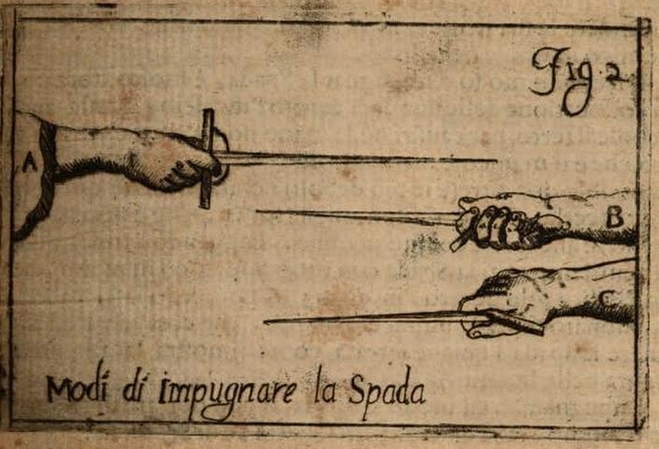
Regole Della Scherma by Francesco Antonio Marcelli, 1686. Detailed, practical study of the Italian spada, including single sword, sword and dagger, and sword versus other arms and vice versa, for example the saber or scimitar versus rapier. A very practical book with sound, practical advice useful in rapier, smallsword, and epee. Dedicated to Queen Christina of Sweden, who had abdicated her throne and now resided in Rome. Greta Garbo starred as Queen Christina in an excellent film of the same name.
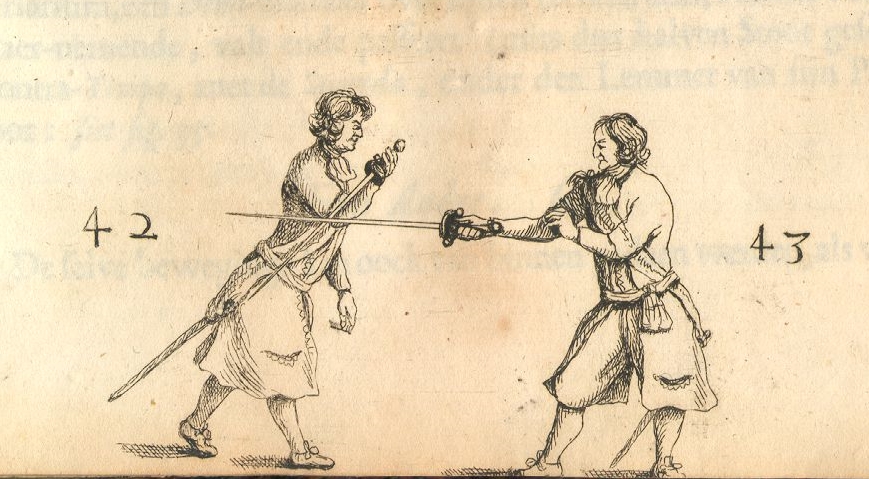
Grondige Beschryvinge Van de Edele ende Ridderlijcke Scherm-ofte Wapen-konste by Joannes Georgius Bruchius, 1671. A Dutch text presaging the persistent influence of the rapier into the age of the smallsword in Northern European schools—the Dutch, the various German, and others. Notably, in spite of the date and obvious transitioning to a lighter weapon, the book still uses much Italian rapier terminology. Solid technique for the duelist, soldier, and brawler, much of it looking remarkably similar to modern epee. The author references various illustrations throughout the book, in order that the reader may put them together in different described sequences. Clever, but unfortunately cumbersome too, as one might expect.
The book illustrates one of the most practical uses of what Alfred Hutton, in saber, refers to as “high octave”—used, that is, here as a yielding parry from quarte to exclude the adversary’s blade after running him through. Immediately closing the distance and commanding the adversary’s blade was vital. An adversary is seldom dead or disabled immediately, after all, and this technique would prevent him (or, rarely, her) from making a killing thrust in revenge, assuming a perfect world of course. Not everything goes according to plan, or so Fortune is said to say and without doubt often proves. Some nineteenth century saber masters recommended its use to counter-parry a quarte riposte made in opposition, suggesting that it was the only parry that could be made quick enough, which at the distance of direct riposte may be true. Hollywood is occasionally enamored of the technique, but it’s usually cringeworthy to watch the lovefest, so stilted, weak, and inappropriate in execution—unbelievable, in other words—it usually is.
See George Silver in the “Broadswords…” section below for a passionate argument against the rapier.
Smallsword (Epee de Rencontre, Epee de Cour, Espadin)
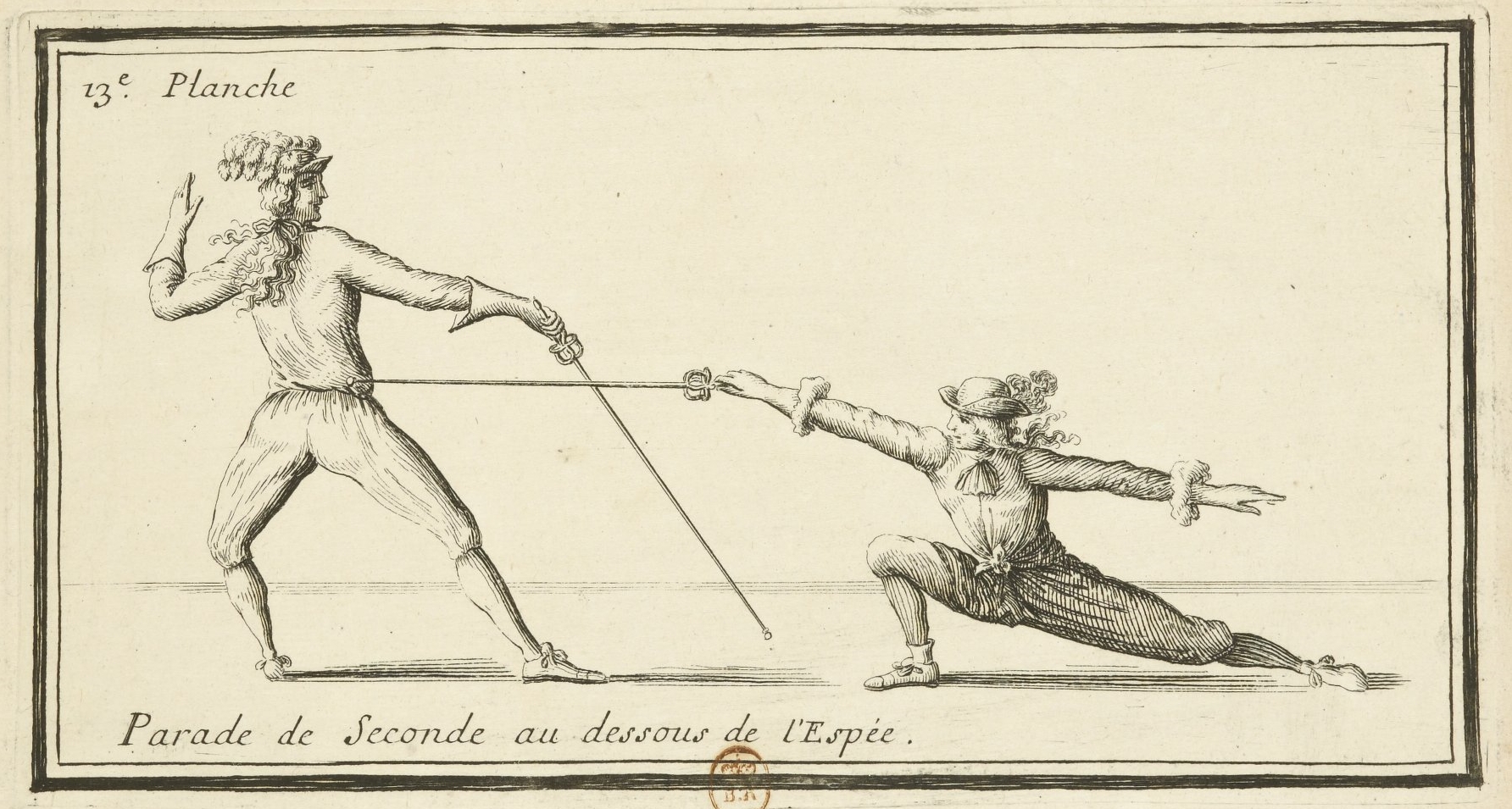
Les Vrays Principes de l’Espée Seule by the sieur de la Touche, 1670. The establishment of the modern French school of the smallsword, whose principals went largely unchanged for more than three centuries, and remain much in place today. Fencing for the French court. Although the technique is practical as described, or at least what would soon be considered conventional, and later classical, the illustrations show a lunge absurdly long, one that could hardly be recovered from in good time or in good defense. Perhaps it was to please Louis XIV and his tastes in elegance and dance.
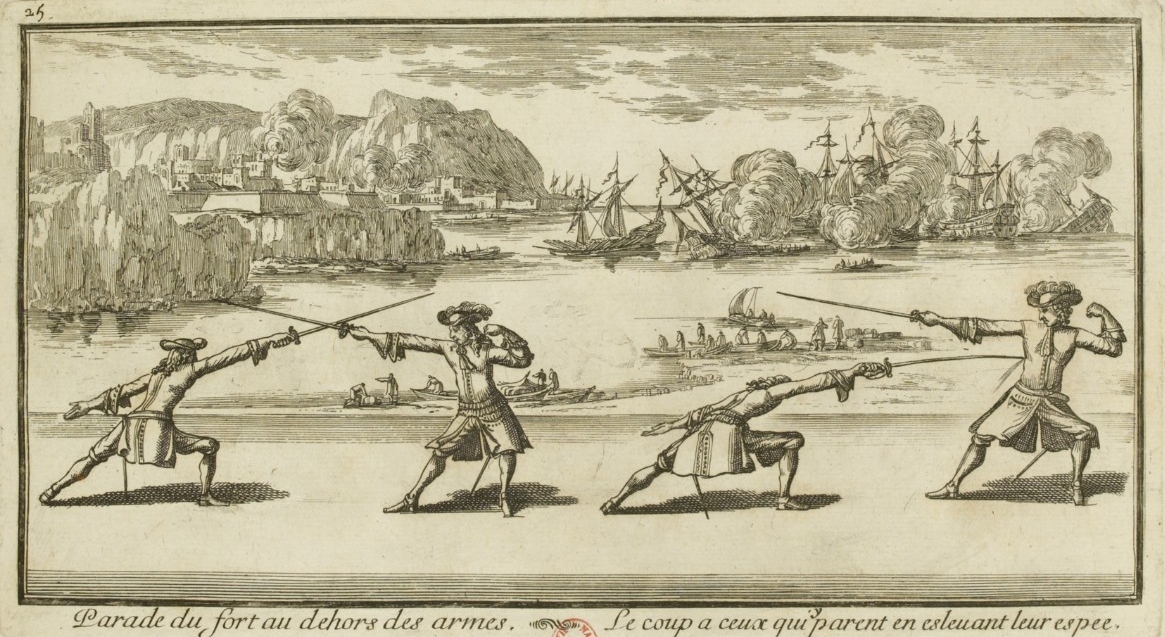
Le Maître d’Armes ou L’Exercice de l’Epée Seule dans sa Perfection by Andre Wernesson, Sieur de Liancour, 1692. An excellent study of the smallsword, albeit in some ways more suited to gentilshommes of the French court than to adventurers in the field, although the author does cover commanding and other disarms. Julie d’Aubigny, aka Mademoiselle la Maupin, the opera singer and duelist, among other occupations and pastimes, may well have studied under Wernesson, maître en fait d’armes to the Petit Ecurie, given her swashbuckling father’s position at court as the secretary to the comte d’Armagnac. (She might also have studied under Jean or François Rousseau, maîtres en fait d’armes to the Grande Ecurie.)
La Maupin, among her many adventures, was convicted and subsequently sentenced in absentia to be burned to death by the Parlement d’Aix for seducing a novice and burning a corpse in the associated convent. The verdict, however, was delivered against the sieur d’Aubigny; La Maupin’s masculine disguise apparently fooling, or perhaps pretending to fool, the right people. The criminal seductress’s former protector, the comte d’Armagnac, petitioned Louis XIV to overturn the decision, which he did, doubtless given his strong inclination toward attractive talented women. Clearly, independent women were hard to come by—and apparently hard to spot when dressed as a man fleeing a convent and prosecution.
L’art des armes by le sieur Labat, 1696. English translation, The Art of Fencing by Andrew Mahon, 1734. Another excellent study of the smallsword, although Labat, like de Liancour, was not quite as practical-minded regarding the smallsword in sudden rencontres, street fights, and the battlefield as some authors, McBane for example, were. From his work, as well as Hope’s below, it is easy to see the origins of sport fencing, aka foil fencing. In fact, I suspect that most fencers of this era far preferred “school play” to the possibility of injury or death in a real rencontre.
The Compleat Fencing-Master by Sir William Hope, 1692, 1710. Largely a reprint of Hope’s earlier work, the Scots Fencing Master, or Compleat Small-Swordman, 1687. An excellent work, highly recommended. Hope was an astute amateur, and his observations on fencing concepts are valuable to both the historical and modern fencer. Additionally, he has much practical advice for fighting with “sharps.” A favorite.
The Sword-Man’s Vade-Mecum by Sir William Hope, 1691, 1694, 1705. Excellent advice for surviving a fight with “sharps.” That is, practical considerations for dueling and “rancounters” (rencontres) or street fights. Likewise a favorite.
The Fencing-Master’s Advice to His Scholar by Sir William Hope, 1692. Rules and advice, including technique, for “school play”—that is, for sport fencing. Ever wonder where foil conventions and rules come from? In spite of most historical texts noting that conventions originally derived for reasons of safety, it is clear that sport, convenience, and appearance also played a major role, perhaps even the greater one, starting in the late 17th century, if not much earlier. And double likewise, a favorite.
The Art of Fencing Represented in Proper Figures Exhibiting the Several Passes, Encloses, Disarms, &c. by Marcellus Laroon, various editions suggested to date from the 1680s to circa 1700 but almost certainly correctly close to the latter year. Illustrations and single line descriptions only, very useful to the historian not only of fencing but of period dress. (I’ve relied heavily on these images for Fortune’s Whelp, for example.) Figures are in a variety of fencing positions, most with smallswords, some with buttoned foils. Worthy of much study. A number of images are suggestive of, or even imitated from, 17th century rapier and “transitional rapier” illustrations, making it at quite possible, or even probable, that the French school was not yet entirely in full force even in the English smallsword, or that the Dutch immigrant illustrator Laroon, who bore a facial scar from an affray with swords, was showing his Dutch influence. (See Bruchius in the “Rapier & Transitional” Rapier section, for example.) Very much a favorite.
The English Fencing-Master: or, the Compleat Tuterour of the Small Sword by Henry Blackwell, 1702. A short text thereby suggesting that “Compleat Tuterour” is hyperbole, with decent illustrations showing wounds with spurting blood for emphasis. Includes more proof that the modern sixte thrust aka “carte over the arm” was well in use much earlier than some fencing historians suggest. Charming spelling of seconde: “Sagoone.” But the spelling of carte, tierce, and prime are conventional. Blackwell includes a good but brief discussion of flanconnade, one of my favorite thrusts in its several varieties: it secures the adversary’s blade, is perfectly placed for additional opposition with the unarmed hand (were this still legal), and, thrust low, avoids the ribs and their cartilage which might impede the thrust (assuming the adversaries are fencing with “sharps” of course). Blackwell’s recommended en garde is with the arm mostly extended, as is the case with many smallsword texts—it’s simply a safer guard with a real thrusting sword than the common foil guard of the past two centuries. See also Edward Blackwell below!
Der Geöffnete Fecht-Boden by B. Schillern, 1706. German text showing the influence of the rapier even with the smallsword into the 18th century. Compare with Doyle’s French-influenced German text below and with Bruchius’s Dutch text in the “Rapier” section above.
Advertisement, Especially to Fencing Masters by Sir William Hope, probably 1707. An advertisement with argument for Hope’s new book detailing his new method of fencing using the hanging guard. Excellent, if brief and not entirely complete, discussion as to why swordplay on the battlefield is different from that of the duel. (He doesn’t provide reasons why cutting weapons, or cut and thrust, are preferred: cuts may not kill but often disable more quickly that thrusts, it is easier to change direction and defend while doing so with a cutting weapon, thrusts may stick in the adversary and thereby be problematic for mounted troops–many have been dismounted by a thrust stuck in an enemy.) Hope is less convincing when it comes to his argument that his method is new, and not merely a restatement of one of the Walloon or German styles.
New Method of Fencing by Sir William Hope, 1707, 1714, et al. Hope’s exposition of his conversion to the hanging guard, known by many as the “falloon” (from Walloon) guard, as opposed to the more common guards in quarte and tierce, for the smallsword, sheering sword, and backsword. The book has been reprinted in Highland Swordsmanship, edited by Mark Rector, 2001. Among his excellent advice for swordplay on the battlefield, Hope recommends a stout gauntlet on the unarmed hand for parrying.
The English Master of Defence: or, the Gentleman’s Al-a-Mode Accomplishment by Zackary Wylde, 1711. A difficult read at times, especially for those without a strong base in classical fencing, smallsword, and backsword/broadsword technique, not to mention in English syntax and phrases circa 1700, but the language is colorful, the writer charmingly self-confident, and his descriptions—once deciphered—proof that there is little new in “modern” fencing. Covers smallsword, broadsword, quarterstaff, and wrestling.
Neu Alamodische Ritterliche Fecht- und Schirm-Kunst by Alexander Doyle, 1715. An Irishman introduces Germans to the French school, with plenty of parries and oppositions with the unarmed hand, plus disarmings, grapplings, and trips/throws to satisfy advocates of the native German schools. Almost as well-illustrated as Girard below, and in some ways I almost prefer Doyle’s illustrations. An excellent reference for the practical-minded swordsman.

Expert Sword-Man’s Companion by Donald McBane, 1728. McBane was a Scottish soldier, swordsman, fencing master, duelist, prize fighter, and collateral pimp whose deeds and escapades began in the late 17th century and continued into the 18th. Highly recommended, almost certainly the best text on practical swordplay for the duel, affray, rencontre, street fight, &c, based as it is on his own extensive experience wetting his blade with the blood of adversaries, and occasionally wetting theirs with his own. Literary connection: in The Princess Bride the author refers to McBane as “McBone.” The book has been reprinted at least three times in recent years: a 2015 edition edited by Keith Farrell in Scotland, a 2017 edition edited by Jared Kirby, and a 2001 edition edited by Mark Rector in Highland Swordsmanship (readers of this last edition may choose to disregard the photographs of McBane’s technique and refer instead to McBane’s descriptions and original illustrations which are unfortunately not reproduced in this edition). Very much my favorite historical fencing text.
A Compleat System of Fencing: or, the Art of Defence, In the Use of the Small-Sword by Edward Blackwell, 1734, in Williamsburg, Virginia. The first fencing text published in North America and the first in English in the Americas as well, sub-titled Wherein The most necessary Parts thereof are plainly laid down; chiefly for Gentlemen, Promoters and Lovers of that SCIENCE in North America. Given the last names plus the similarity of titles and technique, Edward Blackwell is surely related to Henry Blackwell, most likely as father and son. The book includes a good introduction as to why one should fence—Americans, take note! It’s apparently long been a problem promoting swordplay in British-derived North America!—as well as solid descriptions of swordplay, including how to deal with a low guard, in “Master and Scholar” format (Sir Wm. Hope has used this format too).
As with Henry, the book has a good description of the flanconnade, and the likely son has corrected the likely father’s spelling of “Seconde.” Good discussion of time and counter-time, along with a reminder that foilists have long been inclined to impale themselves by attacking into an attack (so have many epeeists, too, but foilists tend to regard double hits as imaginary). Like his likely father, the son prefers a more extended guard, and not the scandalously “crooked Arm” so popular with foilists since the 19th century—but at least most of them extended from beginning to end during their attacks until recently—and also with aggressive “ignorants” of the smallsword era who did not extend during their attacks. Yes, attacks with a bent arm are those of the fencing illiterate, thus one might argue that both modern foil and saber fencers are quite unlettered (and some epeeists are too). See also Henry Blackwell above.
Traité des Armes by P. J. F. Girard, 1737, 1740, et al. Possibly the best book on the smallsword ever written. Not only beautifully illustrated, the book describes smallsword technique in detail, including its use on the battlefield against other weapons. It emphasizes practical swordplay for the duel as well as for the affray or rencontre, even against foreign fencing styles, and for battle. Girard was a naval officer. Highly recommended.
A Treatise Upon the Useful Science of Defence, Connecting the Small and Back-Sword, and Shewing the Affinity Between Them by Capt. John Godfrey, 1747. Practical book on smallsword and backsword, including a very useful analysis of backsword prizefighters, and some notes on boxing as well.
L’Art des Armes by Guillaume Danet, 1766. Excellent work on the smallsword, with practical exposition of the theory and practice, along with useful associated exotica, including how to break up a duel (grasp the shell of one adversary’s sword and direct your point at the other). However, the Internet being what it is—as useful to the lazy in their laziness, fools in their folly, and idiots in their idiocy, as it is to those largely unafflicted with these defects of behavior and intellect—the illustration is unfortunately reproduced on occasion to demonstrate, quite incorrectly, how to fight two adversaries simultaneously.
Among much useful commentary, Danet demonstrates his functional knowledge of fencing history and texts; decries commanding the blade (seizing the adversary’s sword) and disarmaments, but discusses them anyway because the fencer should know how to defend against them; discusses and decries volts and the passata soto (under another name); and wishes that parries with the unarmed hand had never been invented, although he distinguishes between parries with the hand and opposition of the hand, the latter of which he approves.
Danet provides the modern definition of fencing time: the time it takes to perform any single action of hand or foot. On the other hand, his renaming of parries is confusing to modern fencers, and was to his contemporaries as well. La Boëssière père, via his son (see below) was highly critical of Danet in general (not unusual in itself for fencing masters to criticize each other, often pompously), although it is easy to see from both that the “practical” swordplay of the smallsword was in danger of descending into near-complete artificiality, which in the next century it did.
In spite of its many virtues, my fondness for the book is actually based much on Rafael Sabatini’s affection for it, on which he founded much of his description of French swordplay, particularly in Scaramouche. Danet’s style of fencing is very much in keeping with the style of Sabatini’s logical intellect, and therefore of Sabatini’s swashbuckling heroes, although Sabatini, being half Italian, did not shrink from occasional cunning, nor did he object to his swordsmen partaking occasionally from the Italian school. From Danet is the inspiration for Andre-Louis Moreau’s new theory of swordplay, although in reality it would be nullified by an arrest, not to mention difficult to execute even with a cooperative adversary. But don’t let this spoil the excellent novel, which among its many virtues great and small is an evocative description of a fencing lesson that stirs me to this day. And in many ways Sabatini’s theory was correct at its core: the fencer should force his or her adversary into a pre-selected avenue of no escape.
Sabatini also used the historical person of Danet in the short story, “The Open Door” in Turbulent Tales (1946). For more details on Sabatini and Danet, not to mention, and far more importantly, on Sabatini’s works in general, I highly recommend Romantic Prince: Reading Rafael by Ruth Heredia, 2015. I am honored to have assisted Ruth on the subject of swordplay in Sabatini’s works.
The Fencer’s Guide by Andrew Lonnergan, 1771. Practical smallsword-play described with some occasionally uncommon fencing language: the practices of whirling, wrenching, and lurching, for example, which are synonyms for three conventional techniques. A more scholarly and readable update on Wylde is one way of looking at the book. Lonnergan also includes a very useful discussion of the backsword and spadroon, as well as some very practical advice for and against the cavalry, dragoons, and Hussars or light horse—whether the adversary wears breastplate and helmet determines to a great degree the swordplay used. He has brief useful advice for the fencer armed with a walking stick (it must be wielded a bit differently, having no edge or point), and sees no reason that an athletic fencer cannot use the various volts, night thrust (passata soto), grapplings, &c, which by now many masters had lost favor with. However, see Danet above.
The Army and Navy Gentleman’s Companion; or a New and Complete Treatise on the Theory and Practice of Fencing by John McArthur, 1784. Solid exposition of the smallsword, with conventional language—McArthur doesn’t use Lonnergan’s romantically descriptive flourishes when naming some techniques. Again, here is yet another book proving that there is really nothing new in modern fencing. As with many fencing books, it includes some useful and some not so useful tidbits, for example, the deflecting of a pistol with a smallsword, something I suggest should not have been tried except in extremis and was probably most successful when used with a strong cutting sword—a broadsword, backsword, saber, or cutlass—that, rather than deflect the pistol, severed some of the fingers or the hand holding it instead. Very much worth reading, as for that matter are all the smallsword texts listed here, in order to expand one’s perspective on the theory and practice of Western thrusting swords.
The School of Fencing by Domenico Angelo, 1787. Several modern reprints available. The height of the 18th century French school, though by now the smallsword was mostly an accoutrement of dress, occasional dueling arm, and for some military officers, a badge of office. Fencing for the gentleman. The book is not my favorite, even though it was also published under “Escrime” in Diderot’s famous encyclopedia. Perhaps it’s the illustrations: I cannot image any serious swordsman or swordswoman posing so delicately. For the latter part of the 18th century I much prefer Danet, Lonnergan especially, and even McArthur (whose illustrations are likewise a bit too delicate to represent the soldier and fighting seaman in my opinion).
The Amateur of Fencing by Joseph Roland, 1809. Highly recommended for all fencers. Although the technical material is quite useful to the smallsword fencer and worth reading by the modern fencer. In particular, Roland, first quoting McArthur above, recommended the study of fencing to navy men, for “they are more frequently at close quarters with the enemy than the military are.” But the book’s real value lies in his philosophy of teaching fencing and learning to fence. Specifically, he attempts to go beyond the mere mechanical practices of teaching fencing and of fencing itself, practices still far too common even today. In fact, such mechanical description is the entire content, or nearly so, of most books on fencing, then and now. Roland wished to go beyond this and develop a sense of tempo, tactics, awareness, and independence in the student.
Most valuable are several of his admonitions, for example, “[T]he pupil, who I wish at all times to make use, but not too hastily, and without partiality, of his own judgement, and not upon every occasion to take for certain evidence any proposition upon the authority alone of a master, merely because he is a master, or that the same may be found in print.” Although there are masters who have embraced this philosophy today (including mine), the majority do not appear to have done so and remain instead “mechanical.” Of these, too many reign at the center of a cult of personality, with the result that their students are anything but independent on the piste or, unfortunately, in life.
Traité de l’Art des Armes by La Boëssière fils, 1818. An explication by the son of the school of the father (a contemporary of Angelo and Danet, among others). Highly recommended, especially for the student of the smallsword or of fencing history and theory in general. A superb text, with useful observations (practiced too little today, both in the making and the study of) for teaching students, including the young, the old, and women too, along with practical tidbits, for example an early discussion of the use of the fencing mask (masque de fil-fer, that is, iron wire), instructions on how to mount and button a fleuret d’assaut, and a criticism of the quality of the “new” foil blades, something common throughout the history of fencing it seems: I’m old enough, for example, to have used the superbly-balanced, light, long-lasting non-maraging Prieur foil and epee blades forged in the 1970s (there were no maraging blades back then).
Traité de l’ Art de faire des Armes by Louis-Justin Lafaugère, 1820. Perhaps, along with the only secondarily-described method of Jean-Louis (see below), the last of the great treatises of the smallsword. After this date, and until the development of the épée de combat, we find with few exceptions mostly foil fencing in the form of what was once known as “school play”—sport fencing, or worse, le jeu de salon, in a form unsuitable for combat with sharps. Lafaugère, a redoubtable fencer and swordsman (there is a difference), wrote in detail of the many variations of feints and their many combinations, making the book, to some, overly complex. The only modern text comparable in similar complexity is Imre Vass’s grand epee book (see the “Modern Epee” section above) in which he details feint attacks in similar fashion.
Un Maître d’armes Sous la Restauration : Petit Essai Historique by Arsène Vigeant, 1883. Strictly speaking, a biography of one history’s most swashbuckling and talented swordsmen and fencing masters, Jean-Louis. Like Alexandre Dumas who gave us some of the greatest swashbuckling and historical novels ever written, Jean-Louis was of mixed black and white French Caribbean descent. The book is listed here because Vigeant includes a detailed description of Jean-Louis’s teaching method, along with many of his drills, quite modern and still useful today. In any case, Jean-Louis’s story alone is a magnificent read. His daughter, if I recall correctly, was a quite talented fencer, too. For those of you who don’t read French, Michel Alaux includes a detailed biography of Jean-Louis (see the “Combined Modern” section above). Jean-Louis’s salle survived into the 20th century, and Alaux was its master for some years.
Backsword, Broadsword, Saber, &c.
Paradoxes of Defence by George Silver, 1599, reprint 1968 et al. A vigorous defense of English cut-and-thrust swordplay for dueling or battle, and excoriation of the rapier and rapier play. Contains perhaps the best description ever put to paper of the virtues of fencing, as well as the best examination for qualification as a fencing master or expert. Yes, if you want to be an expert swordsman or swordswoman, you must be able to routinely defeat unskilled fencers and not be thrown by their irregular technique and tactics! If you can’t, you’re merely a common fencer best suited to engaging others of your ilk. The fencing may not be pretty when you engage the unskilled, the hack, the ferrailleur, or the extremely unconventional, but you must be able to defeat any inferior fencer, not just those with conventional technique and tactics. Further, you must be able to hold your own against your equals, no matter their style, and force superior fencers to work hard for their victories—and occasionally, defeat them by doing so.
A Treatise on Backsword, Sword, Buckler, Sword and Dagger, Sword and Great Gauntlet, Falchon, [&] Quarterstaff by Capt. James Miller, 1738. Plates with a column of descriptive notes on the front page. Half a dozen or more of the fifteen plates apply to the basket-hilt backsword, and two to the falchion, and therefore to the cutlass. Excellent illustrations of positions poorly illustrated or described in other cutting sword texts of the period. Sir Wm. Hope was a fan of the “great gauntlet,” particularly on the battlefield. Miller was a soldier, later a stage gladiator.
The Use of the Broad Sword by Thomas Page. Norwich, England: M. Chase, 1746. 18th century broadsword technique, including that of the Scottish Highlanders, applicable also to the backsword and cutlass.
Highland Broadsword, edited by Paul Wagner and Mark Rector, 2004 (1790 – 1805). Five late 18th and early 19th century broadsword manuals (Anti-Pugilism by “a Highland Officer,” 1790; MacGregor’s Lecture on the Art of Defence, 1791; On the Use of the Broadsword by Henry Angelo, 1817; The Art of Defence on Foot with the Broad Sword and Saber, by R. K. Porter, 1804; and Fencing Familiarized, by Thomas Mathewson, 1805). Practical cut-and-thrust swordplay.
The Broad Swordsman’s Pocket Companion, “Designed by Capt. Wroughton,” ca. 1830. One of the last real English broadsword manuals of the era of Empire—actually, a book of plates only—before cut and thrust began to be absorbed by the rise in popularity of saber, not that there was actually much difference. Short, well-illustrated with colored prints of military fencers wearing fencing masks and armed with singlesticks. The book is exactly what it says.
The Art of the Dueling Sabre by Settimo del Frate explaining Guiseppe Radaelli’s saber method, translated and explained by Christopher Holzman, 2011. Del Frate’s original works were published in 1868 and 1872. Indispensable, along with the Wright/Masiello/Ciullini work below, for understanding Radaelli’s method of saber. It changed Italian saber fencing forever, and is the root of the Hungarian school.
Lessons in Sabre, Singlestick, Sabre & Bayonet, and Sword Feats; or, How to Use a Cut-And-Thrust Sword by J. M. Waite, 1880. Superb text on practical swordplay, highly recommended.
The Broadsword: as Taught by the Celebrated Italian Masters, Signors Masiello and Ciullini, of Florence, by Francis Vere Wright, Ferdinando Masiello, and [first name unknown] Ciullini, 1889. An English text on the Italian school of the light or dueling saber established by Guiseppe Radaelli in the 1870s. Maestro Masiello was a student of Radaelli; Ciullini probably was as well. Soon this Radaellian school would be transformed by Italo Santelli (a student of Carlo Pessina, who was a student of both Radaelli and Masaniello Parise) and László Borsody into the Hungarian saber school that would lead to Hungary’s half century reign in international sport saber competition. For those interested in the debunking of fencing myths, the book clearly states why the modern saber target is restricted to the area above the waist (and no, it has nothing to do with sabers once having been used on horseback): it was considered “unchivalrous” to hit below the belt. That is, the Italians wanted to keep their manhood undivided.
Cold Steel by Alfred Hutton, 1889, modern reprints available. Practical swordplay for the light saber (sorry, Star Wars fans, it’s not what you think) or even backsword, and also the “great sword” and stick. Highly recommended.
Broadsword and Singlestick by R. C. Allanson-Winn, 1890, reprints 2006, 2009. Excellent work on practical cut-and-thrust swordplay, most highly recommended. Quite English in its pragmatism.
See also Wylde, McBane, Godfrey, and Lonnergan in the Smallsword section above.
Cutlass
In spite of the popular—and correct—association of the cutlass with piracy, privateering, and naval boarding actions of the 17th through early 19th centuries, there are for all practical purposes no cutlass texts prior to the late 18th. Even Roland (see the Smallsword section above), who recommended fencing in particular for naval officers and crews because they had the most need of it given the prevalence of boarding actions, and Girard and McArthur who were naval officers, do not really describe it—Girard not at all, McArthur only briefly by identifying its guards and cuts as those of broadsword, and Roland largely by quoting McArthur.
Cutlass play, at least as described in cutlass manuals, of the later era was based almost entirely on the broadsword and saber technique of the time. However, given the cutlass’s useful abilities at close distances (those of riposte and of grappling), there were doubtless techniques used in earlier periods but not noted later, for example grazing parry-ripostes made in a near-single tempo, short powerful cleaving cuts, plus a variety of techniques suitable when grappling, not the least of which would have been pummeling. F. C. Grove in the introduction to Fencing (London: Longmans, Green, and Co., 1893) wrote: “One of us once saw a sailor of extraordinary strength seize a cutlass close to the hilt, where the edge is blunt, and break it short off.” Quite unconventional even by 17th century standards, yet for the seaman armed with a cutlass in action, not at all surprising. Marcelli (see the “Rapier” section above) notes something I’ve not seen elsewhere but becomes quite obvious when practicing cuts with a cutlass: the weapon is capable of fatal strokes at grappling distance.
Besides the study of backsword, broadsword, and saber texts, I recommend those of the dusack as well. Practice with a knowledgeable partner is also required, as is cutting practice in order to get a good feel for the weapon. The very few texts below are merely representative of saber technique of the later period: it is by no means a complete list. I have described late 17th century cutlass technique, or at least what we know of it, in The Sea Rover’s Practice, The Buccaneer’s Realm, and The Golden Age of Piracy, especially in the last book. Additionally, those interested may want to review my blog post, Buccaneer Cutlasses: What We Know, as it includes some information on technique. Marcelli and Girard have some discussion of opposing a saber against a rapier or smallsword, and Marcelli also vice versa, much of which is applicable to the cutlass. Likewise Captain Miller in the “Backsword” section has two plates showing falchion or hanger guards (inside and outside) applicable to the cutlass.
Naval Cutlass Exercise by Henry Angelo, 1813. A detailed illustration of footwork, cuts, and “words of command.” Based entirely on the broadsword, it might as well be broadsword, so why bother—except that Angelo was paid for it by the Royal Navy. In his defense, McArthur (see the “Smallsword” section above) agrees that cutlass and hanger guards and cuts are the same as those of the broadsword. Nonetheless, there are techniques one can use with a cutlass at the distance of “handy-grips” that cannot be used with a broadsword or other longer cutting sword.
Naval Cutlass Exercise “For the Use of Her Majesty’s Ships,” 1859. Includes a good general illustration of cuts and guards, as well as well-regulated military-style (naturally) drills for cuts, guards (equivalent to parries), and points (thrusts, that is). The brief “Concluding Observations” include a vital one for combat: “…but he must ever be “on guard” to meet the impromtu [sic] hit of such as cannot help returning [riposting], whether hit or not.”
The Ship and Gun Drills of the U. S. Navy, by the Naval Department, Division of Militia Affairs, 1914. Seaman’s manual with brief instruction on the USN “Sword Exercise.” The attacks and parries are simple and functional, and the illustrations useful.
British Naval Swords and Swordsmanship by John McGrath & Mark Burton, 2013. Includes a couple of good chapters on British naval swordsmanship, but as can be expected given the source material, the discussion is by and large of the late 18th century and afterward. Includes a description of British naval fencers as well. Required background reading for the student of cutlass swordplay and required technical reading for the collector of British naval swords.
Stage Swordplay / Theatrical Fencing / Stage Combat & Choreography
At some point many fencing teachers will be approached to choreograph swordplay, most often for a local production. The task must no be approached lightly. The choreographer’s job is prepare a swordplay script to be executed: the choreographer’s duty is to prepare actors to safely execute the script. In general, actors should be used for staged swordplay, not fencers unless they are both skilled and have classical training. Stage swordplay is intended to convey the illustion of combat; fencers are trained to hit and may forget this even when choreographed. Further, the tempo is much different between stage swordplay and fencing for sport or actual combat: a predictable tempo is required for safety in the former, but broken tempo for the latter. Broken tempo in a choreographed swordfight can lead to injury. In particular, the eyes are at great risk. Again, fencing teachers should not undertake stage fencing choreography lightly.
Sword and Masque by Julius Palffy-Alpar, 1967. By a Hungarian fencing master, the book is largely a beginning fencing book with a smaller section devoted to stage fighting. Although it does briefly cover period swords and provides samples of choreography for famous stage fight scenes, it offers little to the fencing teacher regarding training and safe techniques. Far more useful is the book by William Hobbs.
Stage Combat: “the action to the word” by William Hobbs, 1980. By a stage and film swordfight choreographer who ranks with Henri Uyttenhove, Fred Cavens, Ralph Faulkner, Jean Heremans, and Bob Anderson and whose credits include the 1973/74 The Three Musketeers and The Four Musketeers (the best musketeer films by far, in my opinion), The Duellists (the most historically accurate swordplay, ever), and numerous stage fights produced among others by Laurence Olivier and played among others by Peter O’Toole, Albert Finney, and many others. Hobbs covers the history of stage fighting, orchestration, the use of dramatic surprise, safety and rehearsals, safe sword technique, historical accuracy, fight notation, and more. Hobbs is adamant about using actors — modern fencers and fencing does not look historical. (Here I understand but disagree in part — if skilled and classically trained in their first lessons, rare today but fairly common when I first learned to fence almost fifty years ago, modern fencers can portray historically accurate stage swordplay, with one caveat: most cannot act. Better, though is the use of fencing masters and experienced fencing teachers, for they have the necessary control, thus the routine long shot doubling by Fred Cavens et al in the films of the 20s, 30s, and 40s.) Laurence Olivier’s foreward is worth the read as well. Highly recommended. Note that Hobbs’s numbering of parries is his own, designed for actors to learn: it will be confusing to anyone who learned to fence in the past four hundred years.
Additional information on stage swordplay, particularly on the subjects of tempo and of choreography associated with Fred Cavens, can be found here and here.
Bibliography
La Bibliographie de l’Escrime Ancienne et Moderne by Arsène Vigeant, 1882. Not as complete as the bibliography below, but highly useful nonetheless. M. Vigeant had a thorough understanding of both swordplay itself and its history.
A Complete Bibliography of Fencing & Duelling by Carl A. Thimm, 1896. A very useful, largely complete bibliography through the late 19th century. Reprints from 1968 and 1999 are available, though often pricey. Look instead for the free pdf on Google books unless you find that fortune generally favors you or you have plenty of money to spend, the latter, of course, being one way or another proof that fortune has favored you at least once.
The History of Fencing & Swordplay
Schools and Masters of Fence by Egerton Castle, 1885, reprints 1968, 2003. European fencing to the late 19th century. Highly recommended.
Old Sword Play by Alfred Hutton, 1892, reprint 2001. A brief description of European fencing technique over the ages by a noted English fencing master.
The Sword and the Centuries by Alfred Hutton, 1901, reprint 1995. A history of European fencing and swords. A classic.
IIIe Congrès International d’Escrime, Brussels, 1905. For those interested in the arguments and squabbles that created modern sport fencing rules—and how sport interests came to dominate in epee competition, rather than having epee competition emulate dueling or the jeu de terrain as closely as possible.
The English Master of Arms: From the Twelfth to the Twentieth Century by J. D. Aylward, 1956. Excellent work covering not only English fencing masters, but necessarily the development of fencing in the British Isles as well. One of my favorites. Aylward’s book on the smallsword in England is also highly recommended for anyone with an interest in smallswords or late seventeenth and eighteenth century fencing or dueling.
Swordsmen of the Screen: From Douglas Fairbanks to Michael York by Jeffrey Richards, 1977. The history of swordsmen and swordswomen in film to 1977. Swashbuckling actors and the fencing masters who doubled for them. Worth the read if you’re into film swashbucklers.
Martini A-Z of Fencing by E.D. Morton, 1988. Not a book on fencing history per se, but a compendium that includes much fencing history, as well as fencing terms, concepts, and trivia. One of Mr. Morton’s entries is Rafael Sabatini. I disagree with most of Mr. Morton’s criticisms of Sabatini, including his claim that much of what he wrote about ships &c is in error. Sabatini did make errors, but they’re not nearly so egregious as Mr. Morton claims, with the exception of presenting a ship’s stern to cannon-fire in order to minimize damage (in fact, this would, as Mr. Morton notes, be more dangerous). Vanity aside, I hesitate to note that I am in fact an expert in this area, and can easily point out where Mr. Morton is incorrect. Notwithstanding that the majority of Mr. Morton’s entries are valid, readers must take the Sabatini entry with a grain of salt.
En garde: Du duel à l’escrime by Pierre Lacaze, 1991. Well-illustrated popular history of mostly French fencing and swordplay.
The History of Fencing by William M. Gaugler, 1998. A detailed history and analysis of the Italian schools into the first half of the 20th century, with a fair, if quite limited, discussion of French schools. The modern schools, including the revolutionary Hungarian (or Hungarian-Italian) saber school, are unfortunately and inexplicably not described. Gaugler’s book has detailed description of the technique presented in a number of books listed in this post, along with fencing-related biographical details of many of the authors.
Escrime by Gerard Six, photography by Vincent Lyky, 1998. “Coffee table” fencing book covering everything from history to technique, albeit briefly, and mostly French. Well-photographed.
The Secret History of the Sword by Christoph Amberger, 1999. By a veteran of the Mensur, also known as fighting for scars—which is by most definitions the purpose of macho male one-ups-man-ship. Most of us, just like Tom Sawyer, are proud of our scars. Highly recommended—the book that is, but we can include scars as well, as proof of a life well-lived and of a fortunate one also, in that we’re still alive to show off our scars.
Croiser le Fer: Violence et Culture de L’épée dans la France Modern (XVIe-XVIIIe Siècle) by Pascal Brioist, Hervé Drévillon, and Pierre Serna, 2002. Excellent scholarly study of swordplay and dueling in France from the 16th to 18th centuries. Highly recommended.
By the Sword by Richard Cohen, 2002. A history of fencing, including the modern schools, by a British Olympic fencer. Arguably the only thorough modern history of fencing. Highly recommended; my favorite book by far on the history of fencing.
Reclaiming the Blade by Galatia Films, DVD, 2009. A mostly well-intentioned attempt to “reclaim” authentic Western swordplay and historical fencing, but unfortunately marred by the heavy-handed, ideological manner in which it attacks sport fencing and some other forms of swordplay, not to mention by its egregious overuse of Hollywood references and interviews—Hollywood depictions of swordplay are usually divorced entirely from reality, thereby undercutting the argument. At its best, the documentary extols Western swordplay. At its worst, it further divides rather than unites the several major fencing communities.
To pick a bone with—or perhaps cross swords with?—the film’s makers, although many modern competitive fencers often do not practice the ideal of “hitting and not getting hit,” there are plenty, epeeists especially, or at least veteran epeeists, who do understand the concept well, can execute it exceptionally well when necessary, and are happy to argue the point, weapon in hand, with any fencer of any sort. In fact, some of us trained entirely under masters who fenced when dueling was still practiced and the saber was still a military arm—and who understood that it was entirely acceptable to practice both forms of swordplay, that is, sport or recreational, and practical training for combat with real weapons. To promote the so-called reality of historical and classical fencing is double-edged and often cuts hypocritically: excessive “contre-temps” or double-touches have been the bane of fencing for centuries, and modern “historical” and “classical” fencers are no more immune to them than were the fencers of the past whom they seek to emulate.
As for those who would compare “classical fencing” poses with photographs of modern fencers in action in order to prove the “sloppiness” of modern fencing: I can show them the same awkward action shots in their “classical fencing.” All it takes is a camera and an unposed subject.
Japanese Texts
Tengu Geijutsuron (The Demon’s Sermon on the Martial Arts) by Issai Chozanshi [Niwa Jurozaemon Tadaaki], translated by William Scott Wilson, 2006. Includes the famous story illustrating the psychology of swordplay, Neko no Myojutsu (The Mysterious Technique of the Cat). Originally written in the early 18th century.
Heihō Kaden Sho (The Sword and the Mind) by Kamiizumi Hidetsuna, Yagyū Muneyoshi, and Yagyū Munenori, translated by Hiroaki Sato, 1985. Originally compiled in the 17th century.
Go Rin No Sho (A Book of Five Rings) by Miyamoto Musashi, translated by Victor Harris, 1974. Completed in 1645, shortly before the author’s death. Numerous editions available, including an excellent translation by William Scott Wilson. A classic on swordplay, strategy, and tactics. Every fencer — and everyone in general — should read it.
The Unfettered Mind by Takuan Sōhō, translated by William Scott Wilson, 1986. Three essays on swordsmanship (Fudōchishinmyōroku, Reirōshū, and Taiaki) by a Zen master and contemporary of Musashi. Written in the early 17th century. Highly recommended.
Suggestions on Acquiring the Books Above
Several of the listed titles (Borysiuk, Czajkowski, Harmenberg, Holzman, Kogler, Lukovich, Szabo, and Vass) were available directly from the publisher, Swordplay Books Online (http://www.swordplaybooks.com/), but with the passing of its owner/editor the titles are largely available now only from fencing suppliers while their stock lasts, and from other common sources. Many fencing books in print may be ordered from various online retailers, and occasionally may be found in bookstores. However, most of the titles listed above are out of print. Some of the older titles are in the public domain and are available as .pdf files on Google Books, archive.org (an excellent site but for its terrible practice of making some books still under copyright available, thus cheating their authors and publishers), and other electronic book sites. College students and faculty may be able to access some titles digitally or in traditional print via their university libraries.
Some of the seventeenth and eighteenth century titles in English are published as fairly inexpensive reprints by Gale ECCO and EEBO (Early English Books Online), along with similar cheap—in the sense of cheaply reproduced from mediocre quality digital scans or old microfiches—facsimile reprint publishers, and are available via Amazon and other online bookstores. However, please note that most of these versions DO NOT INCLUDE FOLDOUT PLATES, so if you’re looking for the illustrations you may have to look elsewhere. Some of these and other old fencing texts may be found in various national digital libraries, often of much better quality, and with complete foldout plates.
A reader of this post, Pradana (see Cruzado y Peralta in the rapier section above), recommends Freelance Academy Press https://www.freelanceacademypress.com/, Fallen Rook Publishing http://www.fallenrookpublishing.co.uk/publications/, and AGEA Editora http://ageaeditora.com/en/ as sources for modern reprints.
Bookfinder.com compares prices of books in and out of print among online retailers, including independent booksellers. Fetchbook.info compares prices among online retailers and some of the major independent bookstores, but my browser warns that the site is a security risk. Abebooks.com and Alibris.com permit title searches through the stock of thousands of independent booksellers; I personally recommend Abebooks although some “drop shipment” booksellers — at times unreliable in their descriptions — now are among the sellers since Amazon (unfortunately) purchased the site. Search all of these sites to get an idea of price range before searching on eBay: although some books on eBay are good, even great, deals, some are grossly overpriced or over-bid.
Overall, I recommend Abebooks.com if you don’t have a local independent brick-and-mortar store carrying fencing books (unlikely) or willing to order for you. Those of you who never had to rely pre-Internet on book vendors for online searches won’t quite appreciate how useful and cost-effective Abebooks &c are: “back in the day,” booksellers doing searches for customers would typically mark up the price of a book found at another vendor by one hundred percent—plus shipping. Naturally, they didn’t inform you of this practice.
Some fencing books can be found on Amazon.com, but ALWAYS price compare first, especially with used or antiquarian editions. Many Amazon book vendors have a bad — frankly, unethical — practice of listing out of print volumes at ridiculously high prices. About nine out of ten I’d say. I’ve seen a used copy of one of my books listed for about $300 by an Amazon vendor, when it could be found on other sites for as little as $25 in the same condition. Similarly with fencing books. Two more reasons to avoid Amazon: the company often packs books, softcovers especially, with other items, leading to damaged books. A call to Amazon customer service about this resulted only in hilarious escalation from representative to supervisor to “specialist” with no solution other than a promise to “forward your [my] concerns to the appropriate team.” Their scripts don’t cover the issue other than to offer a refund after the book is returned. I didn’t want a replacement: I wanted Amazon to stop damaging books. This request perplexed them immensely, for their was no answer to it in their scripts. Last, Amazon’s cutthroat pricing on books, in which the company apparently loses money, is designed to corner your book sales market at the expense of local bookshops and major chains. I’d rather support bookstores than a rapacious enterprise.
Many fencing suppliers carry fencing books in stock, although the number of titles is often limited. Some libraries carry fencing books, but the selection these days is usually slim. Compare to my high school library which had three or four books on fencing, and we didn’t have, and never had, a fencing club or team.
Most of the sport fencing books listed above are dated in regard to modern competitive rules, practices, and uniform and equipment requirements. Always refer to the current USA Fencing rule book and USA Fencing operations manual, or other appropriate national fencing regulations for HEMA, historical, classical, and other organizations, for competition rules and regulations. USA Fencing rules, such as they now are, are available for download at USA Fencing’s website.
Copyright 2008-2026 Benerson Little. Last updated February 10, 2026.
Of Buccaneer Christmas, Dog as Dinner, & Cigar Smoking Women
Classic romanticized buccaneers! The pirate captain and his woman ashore on a Caribbean island or an isolated part of the Main, perhaps to share plunder or while careening, or simply to celebrate the holiday. We can always count on Howard Pyle to make the romantic appeal to our imaginations. And indeed, buccaneers did celebrate Christmas (and probably smoked cigars on occasion too), as I discuss below.

“How the Buccaneers Kept Christmas,” Howard Pyle, Harper’s Weekly, December 16, 1899, a special two-page image suitable for framing. In fact, I have it matted and framed.
BUCCANEER CHRISTMAS & DOG FOR DINNER
We do have multiple brief accounts of one buccaneer Christmas. Buccaneers, like other Europeans and European-derived Christian peoples, did observe the holiday, far more often with raucous, inebriated celebration than with religious devotion.
William Dampier noted that the captains of salt ships at Saltudos, or Salt Tortuga–where the very real Dr. Henry Pitman, inspiration for Sabatini’s novel Captain Blood, His Odyssey, was marooned–were always well-supplied with rum, sugar, and lime juice for visiting “privateers,” the euphemism for buccaneers, as opposed to the term “pirates.” Piracy after all was a crime.
“I have seen above 20 Sail at a time in this Road come to lade Salt; and these Ships coming from some of the Caribbe Islands, are always well stored with Rum, Sugar and Lime-juice to make Punch, to hearten their Men when they are at work, getting and bringing aboard the Salt, and they commonly provide the more, in hopes to meet with Privateers, who resort hither in the aforesaid Months, purposely to keep a Christmas, as they call it; being sure to meet with Liquor enough to be merry with, and are very liberal to those that treat them.”
Clearly, a buccaneer Christmas at any time of the year was a drunk-fest.
Our most famous description of an actual buccaneer Christmas dates to 1681, during the final days of the South Sea voyage of Captain Bartholomew Sharp and his companions in arms, in plunder (often as wishful as real), and in debauchery.
Sharp, already having been deposed once as captain once during the voyage during a stay at Juan Fernandez Island, a stay which coincidentally began on Christmas Day. Now, at the end of the voyage and almost home, with numbers depleted by buccaneer desertions, accidents, and deaths in battle, with the remaining crew on short allowance, Sharp remained a divisive leader, not for the least reason that by gambling with his fellow buccaneers he had increased his profit by leaps and bounds, leaving some of his comrades with little profit during the course of a long bloody voyage–not the best way to show leadership by any means.
On December 7th, according to buccaneer surgeon Basil Ringrose (I almost wrote Rathbone!), “This day our worthy Commander, Captain Sharp, had very certain intelligence given him that on Christmas Day, which was now at hand, the company or at least a great part thereof, had a design to shoot him; he having appointed that day some time since to be merry. Hereupon he made us share the wine amongst us, being persuaded they would scarce attempt any such thing in their sobriety. The wine we shared fell out to three jars to each mess.”
Mess size varied, as did Spanish jar size. Five to seven to a mess was common, but could even have been as small as four men. Spanish wine jars often, but not always, held a Spanish arroba, roughly four and a quarter gallons. At 750 milliliters to a modern wine bottle, we do some simple math and find that each mess received the rough equivalent of slightly more than sixty-four modern bottles of wine per mess, to last eighteen days: or, three and a half bottles of wine per day per mess. This wine may have been stronger than what we’re familiar with. It might have been very similar to Peruvian wine fortified with modern Pisco, the latter of which is usually 80 proof when sold in the US, but I’m speculating here based on a description of some of the wine found by buccaneers on the Peruvian coast. (And no, I won’t touch the “Who first came up with Pisco–Peru or Chile?” argument. We’ll leave the swords and poniards sheathed for now.)
Buccaneer surgeon Basil Ringrose provided the details: “This day being Christmas day, for celebration of that great festival we killed yesterday in the evening a sow. This sow we had brought from the Gulf of Nicoya, being then a sucking-pig of three weeks old, more or less, but now weighted about fourscore-and-ten pounds. With this hog’s flesh we made our Christmas dinner, being the only flesh we had eaten ever since we turned away our prizes under the equinoctial and left the island of Plata. We had this day several flaws of wind and some rain…” The holiday was celebrated roughly in the latitude of Rio de Janeiro.

An Ossabaw Island pig long-descended from Spanish and Canary Island stock, perhaps quite similar to the buccaneers’ Christmas pig. (The Livestock Conservancy.)

“Cinghiale. Sanglier. Wildschwein. Keuler. Wild boar. Wildzwein.” A sanglier or wild boar as seen in Europe and the Caribbean from European stock. Sangliers were prized for their taste. 1879. (Rijksmuseum.)
Sharp himself is a bit more direct: “When to Solemnize that Festival as well as we could, we eat the only Hog we had left, drank some Jars of Wine, and made our selves as merry as we were able, which I did the rather that my Men might not Mutiny.”
How they seasoned the pig is not noted. Given that their only way at sea of cooking was in a copper kettle, they would have boiled the flesh rather than roasting it over coals and seasoning it with a pimentade of lime juice, salt, hot peppers (pimento, or chili peppers as we know it), probably allspice, and perhaps a black or similar common pepper, as was common. The seasoning would have been similar in the copper pot, assuming they had the ingredients. The buccaneers would have served it with coarse boiled cornmeal (imagine a coarse polenta or coarse yellow grits, the latter are hard to find anymore) seasoned with salt and manteca (pig lard), which had been their only fare since departing the isle of Plata.
However, diarist John Taylor who visited Jamaica in 1687 wrote that Sharp’s buccaneers also served dog for Christmas dinner:
“Soe that they killed one hog, which was all they had left, and a spanell dog which they bought of one of their quartermaster for 40 dollars, on Christmas Day for their dinner.”
Alas poor beast, alas man’s best friend! But Taylor was no eyewitness, he was just repeating what he had heard from local sources. There was in fact a dog, a little curly shaggy-coated canine, like that of a poodle. And, according to one buccaneer, John Cox, who was there, they did in fact eat him:
“When we took the two Barks at Nicoya, we had a little sucking Pigg in one of them, which we kept on Board ever since for our Christmas days Dinner, which now was grown to be a large Hogg; so we killed it for Dinner, but thinking it not enough for us all, we bought a Spaniel-Dogg of the Quarter-Master for forty pieces of eight, and killed him; so with the Hogg and the Dogg, we made a Feast, and we had some Wine left, which made us merry: This being the only think we had eaten that had blood in it since our departure from the Duke of York‘s Island.”
But no one’s memory is perfect. Did they in fact eat dog for Christmas dinner? Was Cox inspired to exaggerate based solely on the rhyme of Hogg and Dogg? Do we see the interfering hand of an editor trying to “sex up” the manuscript? Again Basil Ringrose comes to the rescue, writing of a day in late January, well after Christmas, just prior to making landfall in the Leeward Islands:
“On that day [January 26, 1682], therefore, a little Spanish shock-dog, which we had found in our last wine-prize taken under the equinoctial and had kept alive till now, was sold at the mast by public cry for 40 pieces-of-eight, his owner saying that all he could get for him should be spent upon the company at a public merriment. Our Commander, Captain Sharp, bought the dog, with intention to eat him, in case we did not see land very soon.”
The money raised was added to one hundred more pieces-of-eight that were left over from a previous sharing of plunder, in which the boatswain, carpenter, and quartermaster had refused to accept shares owing to some disagreement “with the sharers.” The coins were laid up, to be spent ashore in celebration of their return to the Caribbean from the South Sea.
Two days later the buccaneers sighted Barbados, but were scared off by the barge belonging to the English man-of-war Richmond lying at anchor Bridgetown harbor. Two days after that the buccaneers sent a canoe ashore at Antigua, or Antigo as they called it, and from here they went their separate ways.
So it was not a Christmas dog after all! Or was it? We hope it was part of no Christmas dinner except to have gnawed any scraps ravenous buccaneers may have cast his way. “Perros Ingleses!” we have heard Spaniards call the buccaneers, or at least buccaneer surgeon Alexandre Exquemelin said they did on one occasion, and surely in fact on many. But dog don’t eat dog, or so they say, and we hope, more from Ringrose and the buccaneer arrival at Antigua and not necessarily from common proverb, that Cox was wrong and that Sharp may have been mostly joking about eating the dog.
Mostly.
WITH A WILLING WOMAN IN A HAMMOCK
So, would buccaneers have celebrated Christmas as in Pyle’s image above? With a willing woman in a hammock, smoking a cigar? It’s a common image in fiction, that of a romance between a pirate and a lady on the seashore. We almost imagine this as the setting in the aftermath of The Black Swan by Rafael Sabatini, but when we recall the noble manner in which the romance unfolded, his gentlemanly behavior, her lady-like sensibilities, we can’t imagine Priscilla Harradine smoking a cigar. On the other hand, we recall her attraction to men of adventure and her propensity for slipping off to swim nude, and we think perhaps she might after all.

The cover of the 1947 Editorial Molino Argentina edition.
For the sake of romantic notions, combined with the fact of romantic relations between buccaneers and some women, I will forego a discussion of the often profoundly disturbing treatment of women by pirates at times, a fact often ignored or only hinted at it film. You may find these sordid details in The Golden Age of Piracy: The Truth Behind Pirate Myths, and in other works as well.
Some, probably many, buccaneers were married but they did not take their wives, or their women in general for that matter, to sea with them, the one known exception being John Beare who took his woman, the daughter of a rum punch woman in Port Royal, to sea at least once dressed as a man. Accused of piracy by the English–and yes, he was in fact a pirate–he fled to Havana where he married his true love and began serving as a Spanish privateer, or, as the English would have it, a Spanish pirate. Perhaps Beare did celebrate a Christmas ashore while careening, his inamorata waiting languidly in a hammock.
We also have the example of Dutchman Jacobus (James) Marquess, or “Copas” [Cobus] for short, a buccaneer “lingusiter”–also known as a “truchman” or interpreter–in the South Sea with Bartholomew Sharp. Copas fell in love, or perhaps merely deeply in lust, with a “Mustees” Spanish woman at the island of El Cavallo while the buccaneers were ashore taking in water over the course of four days and three nights. Many of his companions worried that he was a turncoat who intended to betray them to the Spanish. A Native American boy also ran away while at the island, perhaps with Copas.
“[T]he woman lieing on borde one or two nights, was very familiar with one Copas a dutch a man, who formerly had saild with the Spaniards…but was mainly Inamoured with thiss women, makeing her severall presents of some Vallew,” wrote a buccaneer who is best identified as Edward Povey.
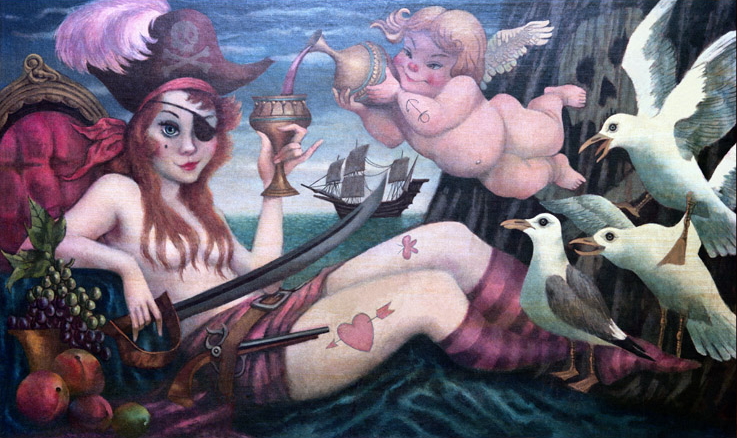
Not in a hammock, yet in a recumbent pose with hints of Venus rising from the waves. Inspired in part perhaps by Howard Pyle’s painting above and perhaps by Spitfire Stevens (Maureen O’Hara) in Against All Flags, and therefore by popular visions of Anne Bonny, the painting is likely ultimately inspired by the redhead that once was part of the Disney Pirates of the Caribbean attraction. The painting, which hangs in the bar in the California version of the ride, is entitled “A Portrait of Things to Come,” suggesting the redhead becomes a pirate after the “bride auction.” Disney Image.
Copas pretended to go hunting but deserted to her instead, leaving all but two hundred pieces-of-eight of his plunder behind–some 2,200 pieces of eight, plus jewels and other goods. He must truly have been in love, indeed! Or perhaps he thought he could sell his knowledge of the buccaneers to their enemies. Alas, this instance of buccaneer love did not occur over Christmas, but late in May, 1681.
Raveneau de Lussan, buccaneer author, wrote that during the occupation of Guayaquil by French flibustiers in 1687, he was almost seduced away by the “widow of the local treasurer,” who suggested they hide in the woods until the pirates were gone, and then they could marry and he would have “her husband’s office in addition to her own extensive holdings.” Quite an offer! But de Lussan turned it down, and again, this flibustier love did not occur over Christmas, but in April. Spring is the time for love, so it is said. Or perhaps just for mating.
If any buccaneers did take their wives or inamoratas with them to sea, I imagine it may have been some of the early flibustiers and boucaniers who did so with their “Amazon wives who could shoot and hunt well,” as one chronicler noted of them, supporting the expeditions and perhaps even participating in the assaults themselves.
CIGAR SMOKING WOMEN
But IF a buccaneer did have his woman with him at Christmas (and here I speak of buccaneers solely as men only because, although there may have been one or more women in disguise among them as actual crew members, to date we know of none–Jacquotte Delahaye is a 20th century fiction, and Anne Dieu-le-Veut was a wealthy shore-based widow, not a flibustière), might she have smoked a cigar?
To find an answer we must first know if people smoked cigars in the 17th century Caribbean or anywhere else for that matter. Many modern pirate researchers and reenactors decry as incorrect the cigar-smoking pirates in Black Sails, for example, and one even called me out–incorrectly–on the subject after he read the prologue to The Golden Age of Piracy.
We turn first to Jean-Baptist Labat, priest and also chronicler of the late 17th and early 18th century Caribbean for the answer:
“We do not use pipes in the Americas; the Spanish, Portuguese, many English and French, nearly all blacks, and all our Caribs smoke bouts [“ends”], or as the Spanish say, cigars… It is rare to find a Spaniard without his provision of cigars.”
(Notably, Labat mis-heard cigaro and wrote it as cigale, or cicada in French. His description of cigars is quite modern: six to seven pouces long, and five to six lignes in diameter, roughly six and a half to seven and a half inches long, and around half an inch in diameter.)

Detail from a Dutch print by Crispijn van de Passe, 1641, showing an imaginary English merchant’s wife with wine and tobacco. (Rijksmuseum.)
We turn next to buccaneer-surgeon and author Alexandre Exquemelin who preceded Labat. He writes in the French edition of his buccaneer book that in “America one uses very little snuff, but smokes much tobacco. From tobacco leaves…they make small rolls which the Spanish call cigarros and which they smoke without a pipe.”
So Spaniards and others smoked cigars. But did buccaneers? Most buccaneers were English, French, and Dutch, although there were many other peoples, nationalities, and ethnicities among them, including Spanish, Portuguese, Italian, and other European origins, plus African, Native American, even Asian via Mexico via the Manila galleon, plus a variety of mixed races. They were, in other words, a variety of white, black, and brown of many origins. And there were Spanish pirates of course!
The English, French, and Dutch chewed tobacco or more commonly smoked it in pipes, small to medium bowl size among the English and French, large among the Dutch. White clay pipes were the most expensive and typically from England and the Netherlands; terracotta pipes were cheaper and often made locally; and wooden pipes were the cheapest (and doubtless the worst to smoke).
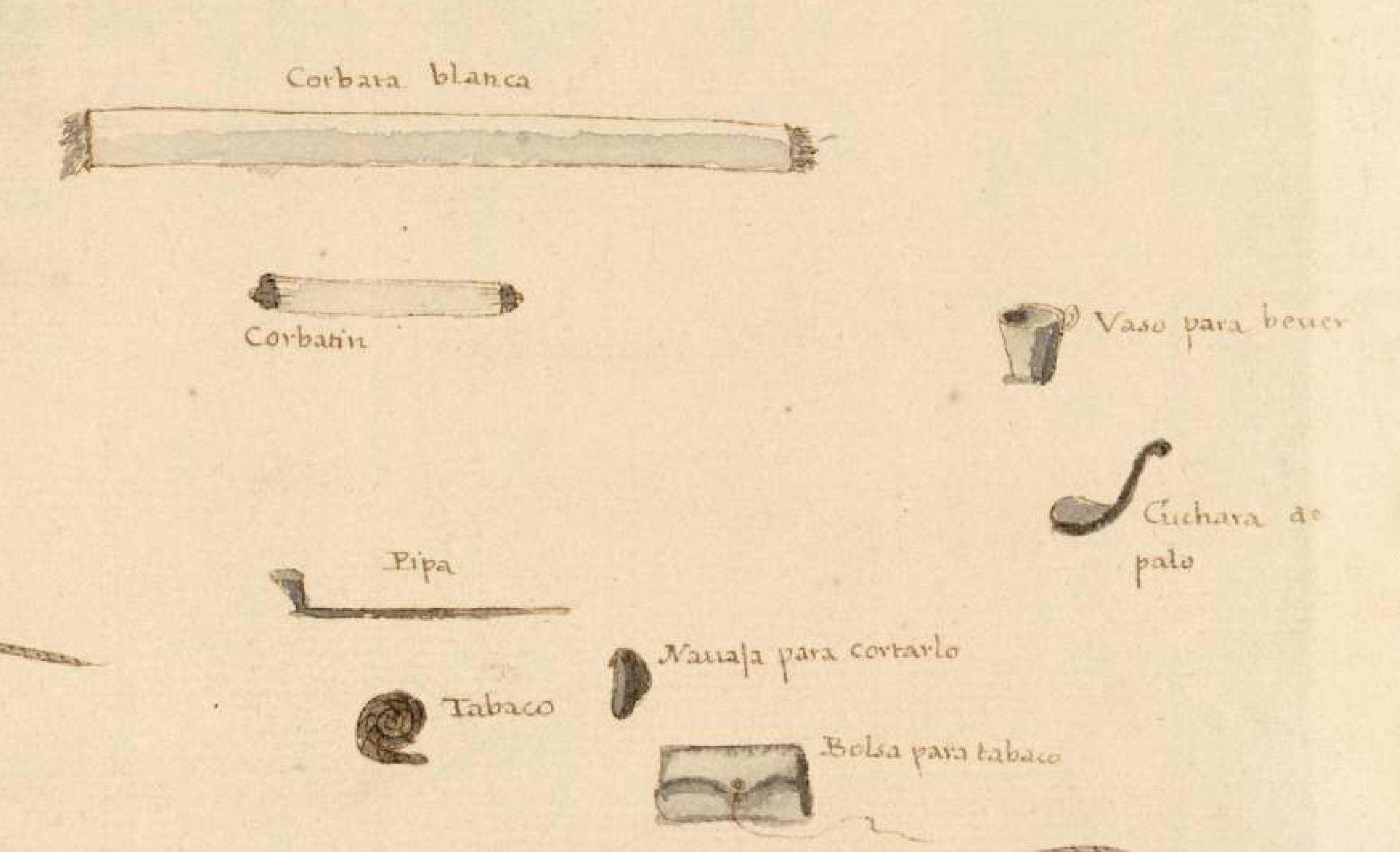
Some of the personal items of a typical Spanish naval officer in the first half of the 18th century, including a pipe, roll tobacco, a folding Navaja for cutting the roll, and a pouch for tobacco. Detail from the Álbum de Construcción Naval by Juan José Navarro de Viana y Búfalo, Marqués de la Victoria, circa 1719 to 1756.

Some of the personal items of a typical Spanish naval seaman in the first half of the 18th century, including pipes, cigars and roll tobacco, a folding pocket knife or Navaja for cutting the roll tobacco, and a pouch for tobacco and comb. Detail from the Álbum de Construcción Naval by Juan José Navarro de Viana y Búfalo, Marqués de la Victoria, circa 1719 to 1756.
However, Spanish buccaneers among them would likely have smoked cigars (or seegars as they became known among the English by the early 18th century), and some English, French, and Dutch may have preferred them at sea as they did ashore. Certainly some African slaves and former slaves among the buccaneers smoked cigars, and it’s probable that some English, French, and Dutch buccaneers smoked captured cigars, if only by cutting them up and smoking the tobacco in their pipes. There is no question that cigars were smoked at sea: the 18th century Spanish Álbum de Construcción Naval of the Marqués de la Victoria shows the cigar along with the pipe among the forms of tobacco used by Spanish seamen. Having smoked both pipe and cigar, I can say that a cigar is no more dangerous aboard a wooden ship than is a pipe: both can be hazardous if appropriate measures are not taken.
Ah, but did women smoke cigars? Well, we know that among the English, French, and Dutch many women smoked pipes, along with many African women in the Caribbean. And there were Native American women who smoked cigars. So why not Spanish women of any ethnicity? And why not cigars, given that they were the predominant means on the Spanish Main of taking tobacco? In fact, we know that in the 18th century there were Spanish creole women who smoked cigars, thus it’s almost certain they did in the 17th century as well.
Alexandre Exquemelin, the buccaneer-surgeon and buccaneer-author who gave us The Bucaniers of America, notes in his French edition that it was as unusual to see a Spanish woman in the Americas who didn’t smoke as it was to see a woman in France who did. (He also did not understand the allure of tobacco, for his medical experience had taught them that smoking was contrary to good health.)
Likewise John Cockburn, writing of the year 1735 in which he was captured by a Spanish guarda costa, or as the English would probably have it, a Spanish pirate, noted the following of three Spanish friars who had just crossed some mountains in Nicaragua:
“The gentlemen gave us some seegars to smoke, which they supposed would be very acceptable. These are leaves of tobacco rolled up in such a manner, that they serve both for a pipe and tobacco itself. These the ladies, as well as gentlemen, are very fond of smoaking; but indeed, they know no other way here, for there is no such thing as a tobacco-pipe throughout New Spain, but poor awkward tools used by the negroes and Indians.”
And who’s to say the woman in Pyle’s painting isn’t Spanish, after all? It is a romantic notion.
Of course, Pyle’s use of a woman smoking a cigar is even more provocative than merely putting her recumbent and languid in a hammock. Since the late seventeenth century, smoking in women has often been seen as a sign of promiscuity rather than as a notion of budding equality. But Pyle’s image is not merely a sexual provocation: it is an image of aggressive independence. This woman is no wallflower, she is no quiet being who fully accepts the purely feminine role imposed upon her. Rather, she is a suitable companion adventurer: a modern progressive woman even by the standards of Pyle’s day. I wouldn’t usually consider Howard Pyle as a feminist per se, but in this case I think he has already proved the argument.
SELECT BIBLIOGRAPHY
Cockburn, John. The Unfortunate Englishmen: or, a Faithful Narrative of the Distresses and Adventures of John Cockburn. “New edition.” London: Hamilton and Co. Shakespeare Library, 1794 (63-64).
[Cox, John]. The Voyages and Adventures of Capt. Barth. Sharp, and Others, in the South Sea. London: P. A. Esq. [Philip Ayers], 1684.
de Lussan, Raveneau. Journal du Voyage Fait a la Mer de Sud, avec les les Flibustiers de l’Amerique en 1684. et Annés Suivantes. Paris: Jean Baptiste Coignard, 1690.
——. Journal of a Voyage into the South Seas in 1684 and the Following Years with the Filibusters. 1689. Reprint, translated and edited by Marguerite Eyer Wilbur. Cleveland: Arthur C. Clark Company, 1930.
——. Journal of a Voyage Made by the Freebooters into the South Sea, 1684, and in the Following Years. 1699. In The History of the Buccaneers of America by Alexandre Exquemelin [Joseph Exquemelin]. Reprint, Boston: Sanborn, Carter and Bazin, 1856.
——. Les Flibustiers de la Mer du Sud. 1695. Reprint, edited by Patrick Villiers. Paris: Éditions France-Empire, 1992.
[Dick, William]. “A Brief Account of Captain Sharp . . .” In The Buccaneers of America by Alexander Exquemelin [John Esquemeling], 257–83. 1684. Reprint, New York: Dorset, 1987.
Exquemelin, Alexandre [Alexander Olivier O’Exquemelin]. Histoire des Avanturiers Flibustiers qui se sont Signalez dans les Indes. 2 vols. Paris: Jacques Le Febvre, 1699. See also his 1686 edition.
Labat, Jean-Baptiste. Nouveau Voyage aux Isles de l’Amerique. The Hague: P. Husson et al, 1724.
Lepers, Jean Baptiste. La Tragique Histoire des Flibustiers: Histoire de Saint-Domingue et de l’Ile de la Tortue, Repaires des Flibustiers, Écrite vers 1715 par le Rév. P. Lepers. Edited by Pierre-Bernard Berthelot. Paris: G. Crés, 1922.
Little, Benerson. The Buccaneer’s Realm: Pirate Life on the Spanish Main, 1674–1688. Washington, DC: Potomac Books, 2007.
——. The Golden Age of Piracy: The Truth About Pirate Myths. New York: Skyhorse Publishing, 2016.
——. The Sea Rover’s Practice: Pirate Tactics and Techniques, 1630–1730. Washington, DC: Potomac Books, 2005.
Navarro de Viana y Búfalo, Juan José. Álbum de Construcción Naval del Marqués de la Victoria. Museo Naval de Madrid.
[Povey, Edward?]. “The Buccaneers on the Isthmus and in the South Sea. 1680–1682.” In Jameson, Privateering and Piracy.
Pyle, Howard. How the Buccaneers Kept Christmas. An illustration in Harper’s Weekly, December 16, 1899.
Ringrose, Basil. “The Buccaneers of America: The Second Volume.” In Exquemelin, Buccaneers of America (Crooke, 1684).
——. Buccaneer Atlas: Basil Ringrose’s South Sea Waggoner. Edited by Derek Howse and Norman J. W. Thrower. Berkeley: University of California Press, 1992.
——. “Captains Sharp, Coxon, Sawkins, and Others . . .” In The History of the Buccaneers of America by Alexander Exquemelin [Joseph Esquemeling], 180–313. 1699. Reprint, Boston: Sanborn, Carter and Bazin, 1856.
Sabatini, Rafael. The Black Swan. Boston: Houghton Mifflin, 1931.
Sharp, Bartholomew. Captain Sharp’s Journal of His Expedition. In A Collection of Original Voyages by William Hacke. 1699. Facsimile reprint, edited by Glyndwr Williams. New York: Scholars’ Facsimiles & Reprints, 1993.
Taylor, John. Jamaica in 1687: The Taylor Manuscript at the National Library of Jamaica. Edited by David Buisseret. Kingston: University of West Indies Press, 2008.
Copyright Benerson Little 2017-2024. Last updated December 3, 2024.
 Swordplay & Swashbucklers