

It’s an epic image, one that anyone who’s ever cruised through the Pirates of the Caribbean attraction at one of the Disney theme parks is familiar with: a pirate ship cannonading — “firing its guns at” or “engaging” in sea parlance — a Spanish fort.
But the image-in-motion long predates the Disney attraction. In fact, as I’ll demonstrate shortly, the entire scene was lifted directly from Rafael Sabatini’s famous novel, Captain Blood: His Odyssey and especially from the 1935 film version starring Errol Flynn, Olivia de Havilland, and Basil Rathbone. And the Wicked Wench pirate ship of the attraction was more than simply inspired by the Cinco Llagas / Arabella, as the ship in the novel and film was named: it was copied from it!
Originally the attraction depicted buccaneers in the second half of the 17th century attacking and sacking a Spanish town on the Main. “IN THE CROSS FIRE of cannonades between pirate ship and Caribbean port,” begins the caption of the 1968 Disney publicity still of the Wicked Wench shown above. It continues with “this crew of Disneyland adventurers sail through Pirates of the Caribbean as grape shot and cannonballs land around them. The pirate captain on his bridge gives the signal for an eight gun salute. The scene of one of ten action-packed segments in the thoroughly realistic re-creation of buccaneer days.” For now I’ll pass on correcting Disney’s descriptive language, as some readers might misconstrue such revisions as nautical pedantry.

However, in spite of the obvious historical basis for the ride’s inspiration, according to Disney’s modern Pirates of the Caribbean film franchise “canon” the Wicked Wench was instead the ship that would become the Black Pearl commanded by Jack Sparrow et al, more or less, post-buccaneer era. Not a buccaneer ship, in other words, but a later ship turned to pirate ship as would fly the Jolly Roger. This, of course, is nothing more than mere revisionism for the sake of marketing the ride on the coattails of the film series, and any “canon” (as in nearly all franchises) is nothing more than the result of a series of screenwriters trying to write popular scripts, and fans subsequently trying to make rabid sense of their details and many loose ends.
Myself, I much prefer the original orientation of the attraction, liberties taken with real buccaneer history notwithstanding. That said, comic ride though it may be (and one that I thoroughly enjoy), it does get some things right, including torture, pillage, and burning, not to mention the original implication of some scenes now altered from their original. We have, in fact, two versions of piracy in our culture: factual history and popular myth, the latter often overwhelming the former.
And now for the evidence that the Wicked Wench is really the Cinco Llagas / Arabella!
The Scene of Ship Attacking Fort Was Inspired by & Lifted Largely From the 1935 Film
One need only to watch the 1935 Captain Blood to confirm this. The only difference between the two is that the roles are reversed: rather than a Spanish pirate attacking the principal town of an English colony in the late 17th century as in the Rafael Sabatini novel and the film based on it, buccaneers in the attraction attack a Spanish town, as they often successfully did — and far, far more often than Spanish pirates did against English, French, and Dutch colonies.
In fact, in Pirates of the Caribbean: The Black Pearl there is an homage to the pirate attack in the 1935 film version of Captain Blood: some of the shots of locals running for cover are quite similar to those in Captain Blood.
For more details on the ship-versus-Spanish fort trope, see “The Iconic “Spanish” Fort: Only a Spanish Galleon Says “Pirates” Better!“


The battle depicted in the Disney ride, and by derivation the one in Captain Blood, was given an homage in The Curse of Monkey Island (LucasArts, 1997).

The Wicked Wench is Red Like the Cinco Llagas / Arabella of the Novel
According to Rafael Sabatini, who clearly emphasized the sanguinary nature of buccaneering via the hero’s name and other thematic elements, the color of Peter Blood’s pirate ship was red. However, red was not an exceptionally common color of ships at the time. Red paint was typically used for the bulwarks (the inner “walls”), gun carriages, and often some fittings of men-of-war, and some other ships as well, at the time, and the upper works (the upper outside of the hull) and sterns of some ships were occasionally painted red — but never the entire hull. However, the application of pine tar, tallow, and linseed oil could lend a reddish hue to hull planking (particularly to those ships built of various “mahoganies” in the Americas), but this would not cause a ship to be referred to as red. (Far more details on the possible appearance of the Cinco Llagas / Arabella are forthcoming in Treasure Light Press’s annotated Captain Blood.)
And the Wicked Wench? A red ship, of course!

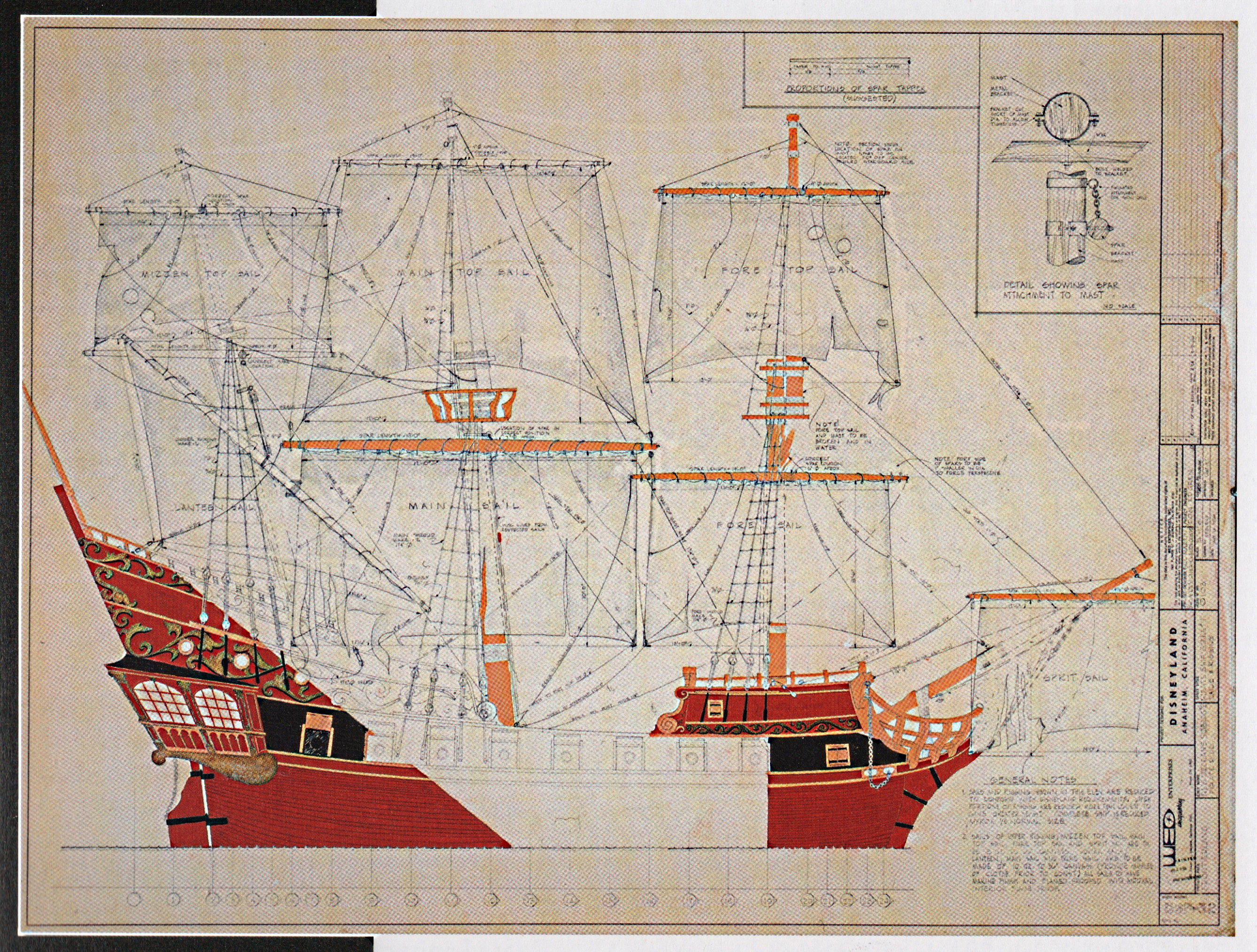
The Profiles of the Wicked Wench and the Cinco Llagas / Arabella are Too Similar to be Coincidental
Indeed! The similarity is obvious when comparing the images below. Even the scrollwork on the stern upper works is almost identical (see the image above and also at the end of this section). Disney did make some alterations to suit the attraction, including reducing the ship from two decks to one, and, of course, making it small enough to fit in the attraction.



And Then There’s the Names of the Ships…
After its capture by a handful of renegade rebels-convict led by Dr. Peter Blood, the Cinco Llagas was renamed the Arabella after the woman Blood loved but thought he could never have. Arabella Bishop, although independent, strong-willed, and anything but swooning (or languishingly voluptuous!), was still a lady in manners and mores, unlikely to (sadly!) run away to sea in men’s clothes with Peter Blood. One can easily see a tongue-in-cheek homage to Arabella and the Arabella in the renaming of the Spanish frigate as the Wicked Wench, and even in the “Woman in Red” in the old Bride Auction scene on the attraction. This would be in keeping with the piratical sense of humor of the attraction’s designers: gentleman buccaneer Peter Blood and his Arabella versus the ruffian buccaneer captain and his Wicked Wench.
Likewise the captain of the Wicked Wench as an inverted homage: no clean-shaven gentleman buccaneer he, unlike Captain Peter Blood, but bearded and beribboned like Blackbeard the Pirate and bellowing in G-rated curses like Robert Newton or Peter Ustinov in their piratical film roles. That is, before Hector Barbossa took his place to align with the film franchise. (N.B. Blackbeard was not a buccaneer but a later black flag pirate, and although most buccaneers appeared to have been clean-shaven, some French boucaniers, and therefore buccaneers, did wear beards.)
For more details on “The Woman in Red,” now “Redd the Pirate,” (and in any case, an anthropomorphism of the ship by both), see “The Women in Red: The Evolution of a Pirate Trope.” For more details on the black flag — the so-called Rackham flag with skull and crossed cutlasses — flown by the Wicked Wench, see “The Fanciful, Mythical “Calico Jack Rackham” Pirate Flag.” Note that on the Disney LP featuring a narrated soundtrack of the ride, the Wicked Wench is referred to as the Black Mariah, the name of the ship in “Donald Finds Pirate Gold!” Perhaps Wicked Wench was suitable on the stern but not in narration at the time on an LP likely to be listened to mostly by children?

The Lanterns
An oddity I’ve for long assumed was simply a designer’s idea to help add more light to the ship is the placement of port and starboard lanterns on the gunwales at the quarterdeck near the break of the poop deck. However, I wonder if the placement — which surely still serves the purpose of lighting — was not inspired by the poster below, in which a fanciful Arabella has two prominent lanterns low on the stern:


So, Was the Wicked Wench Really the Arabella?
Only Disney knows — and only Disney can answer how the Arabella, sunk among the cays just off Port Royal, Jamaica in 1689 while defending the town from French attack, came to be raised, refitted, and ended up again in buccaneer, then pirate, hands… 🙂
That said, it is a sweet homage, even if unintended, that the Arabella as the Black Pearl, formerly the Wicked Wench, attacks Port Royal, as the Arabella did as the Cinco Llagas flying Spanish colors in the 1935 film starring Errol Flynn and Olivia de Havilland. 🙂
And the Black Pearl?
If you’re looking for the real original inspiration for the Black Pearl, discard any notion of it having been the Wicked Wench — this is probably just “canon after the fact.” Convenient revisionism for the sake of marketing, in other words. Sparrow’s famous ship is more likely inspired ultimately by Tom Leach’s 40-gun Black Swan, from Sabatini’s novel of the same title. Or at the very least it corresponds closely to Sabatini’s description of the ship, including its black hull. Even the un-authorized plastic model of Sparrow’s Black Pearl is sold under the name of the Black Swan. Are there similarities between the Wicked Wench and the Black Pearl? Of course there are. Clearly the set designers took a look at the Wicked Wench, but it is much closer to the Arabella. (By the way, the duel in The Black Swan is described here.) It’s also possible that the Black Pearl was inspired by the black pearl Rathbone- and Hook-inspired Bilbo wore in his rapier in The Pyrates by George MacDonald Fraser, for there are quite a few details in the Disney franchise clearly inspired by the comic novel.
And for you budding “nautical pedants” out there, here’s the correction to the Disney text quoted above: “this crew of Disneyland adventurers [an acceptable term: French buccaneers aka flibustiers were often referred to as adventurers] sail through Pirates of the Caribbean as grape shot [this form of small shot was in its early development and generally not known by this name at this time] and cannonballs [more correctly, round shot] land [splash] around them. The pirate captain on his bridge [quarterdeck, not bridge] gives the signal for an eight gun salute [a correct humorous euphemism for a broadside]. The scene of one of ten action-packed segments in the thoroughly [and humorous] realistic re-creation of buccaneer days [a statement more correct than it might appear at first]…”
Post Script: The Wicked Wench is Not the Only Disney Pirate Ship Inspired By an Errol Flynn Film…

Disney’s Jolly Roger, from the animated version of Peter Pan (1953), bears a striking resemblance to the Albatross from The Sea Hawk (1940, directed by Michael Curtiz and starring Errol Flynn). 🙂
Copyright Benerson Little 2022-2025. First posted June 22, 2022. Last updated October 21, 2025.


 Swordplay & Swashbucklers
Reblogged this on Treasure Light Press.
LikeLike
[…] * The pirate ship Black Swan may be the ultimate inspiration for Disney’s Black Pearl (rather than the Wicked Wench). Details here… […]
LikeLike
[…] homage to the inspiration for Captain Hook (with a touch of the real inspiration for the Wicked Wench pirate ship too!). Author’s […]
LikeLike
[…] as she holds up a cursed Aztec coin, probably because this was the flag originally flown aboard the Wicked Wench, which was via a rather extreme revisionism converted from a buccaneer ship raiding the Spanish […]
LikeLike
TCM is running their usual pre-Oscars tribute to Oscar nominated and winning movies. Watching while working out this morning, it is very obvious that the Disney team took a lot from the Captain Blood movie. One only need watch the section where the Spanish pirates attack to see exactly how Disney copied the look of the town, the fighting and the destruction in developing the Pirates of the Caribbean ride. Pretty cool to see.
LikeLiked by 1 person
Those are exactly my thoughts the first time I saw Curse of the Black Pearl. 🙂
LikeLike
[…] Likewise the Wicked Wench, which was clearly inspired by the Arabella, as I’ve discussed here. […]
LikeLike
Hi Benerson,
Great website.
Crazy question: Are you aware of anyone or any company that ever produced a physical model of the Cinco Llagos/Arabella?
I know you can find all sorts of models on amazon of the Black Pearl/Queen Annes Revenge and the Flying Dutchman etc. or knockoffs of said vessels.
I was just wondering if you ever came across anything?
LikeLike
There was only one model kit of the Arabella / Cinco Llagas I’m aware of. It started off as plans (posted in this blog post) in the 1930s, then there was a simple kit in the 30s-40s, and later the kit was improved a bit by Constructo, I’m guessing in the 60s. That said, these kits are very simple ones and you’d probably not recognize the finished product as the Arabella per se.
Within the week I’ll add images of the kits to this post for you, I own both. You can often find the Constructo kit on ebay for around $100 including shipping, but it might not be what you’re looking for. Also, there are no kits of Spanish 40-or-so-gun frigates circa 1670s to 1680s, nor of similar galleons of this era. There is a Spanish galleon wood model kit dated 1688, but it’s actually of a late 16th or early 17th century galleon, and a bit too small in tonnage in any case.
The so-called Lindberg “Captain Kidd” ship plastic model, which is actually the Wappen von Hamburg done in plastic but renamed for sales, could, with a reduction in quarter, poop, and forecastle guns and a couple minor modifications, pass for a Spanish man-of-war frigate of the 1670s to 1680s. It’s been around since the 60s I think, with only changes in box art (the early art was quite evocative).
Corel has an expensive wooden model version of the Wappen von Hamburg, identical to the plastic kit but three times the size at roughly 1:48, and I’m slowly converting it to the Cinco Llagas as it might have looked in reality. (The model wasn’t nearly so expensive when I bought it on sale twenty-five years ago!) You’re looking to find a ship of 400 to 550 tons if you want to convert one of the few possible kits on the market.
If you haven’t seen this more recent blog post, it’ll help if you want to recreate the Cinco Llagas as it might’ve looked: https://benersonlittle.com/2024/03/27/howard-pyles-famous-an-attack-on-a-spanish-galleon-and-some-real-galleons-too/ You’re welcome to email me as well.
As for the film version Arabellas (1924, 1935), we’d need better plans than the one’s I’ve posted if you want to accurately recreate it. They’re close but not exact to the film — and the set version of the ship has minor differences from the model used in the tank. It would actually be a bit easier to replicate if you can find a kit of a 1670s to 1680s English 40 gun frigate such as the (expensive) HMS Mordaunt. The 1935 film ship appears to have taken its design largely from English frigates of the era (drawings were readily available, not so with Spanish ships of the era) while raising the height of the stern.
I hope this helps! 🙂
LikeLike